
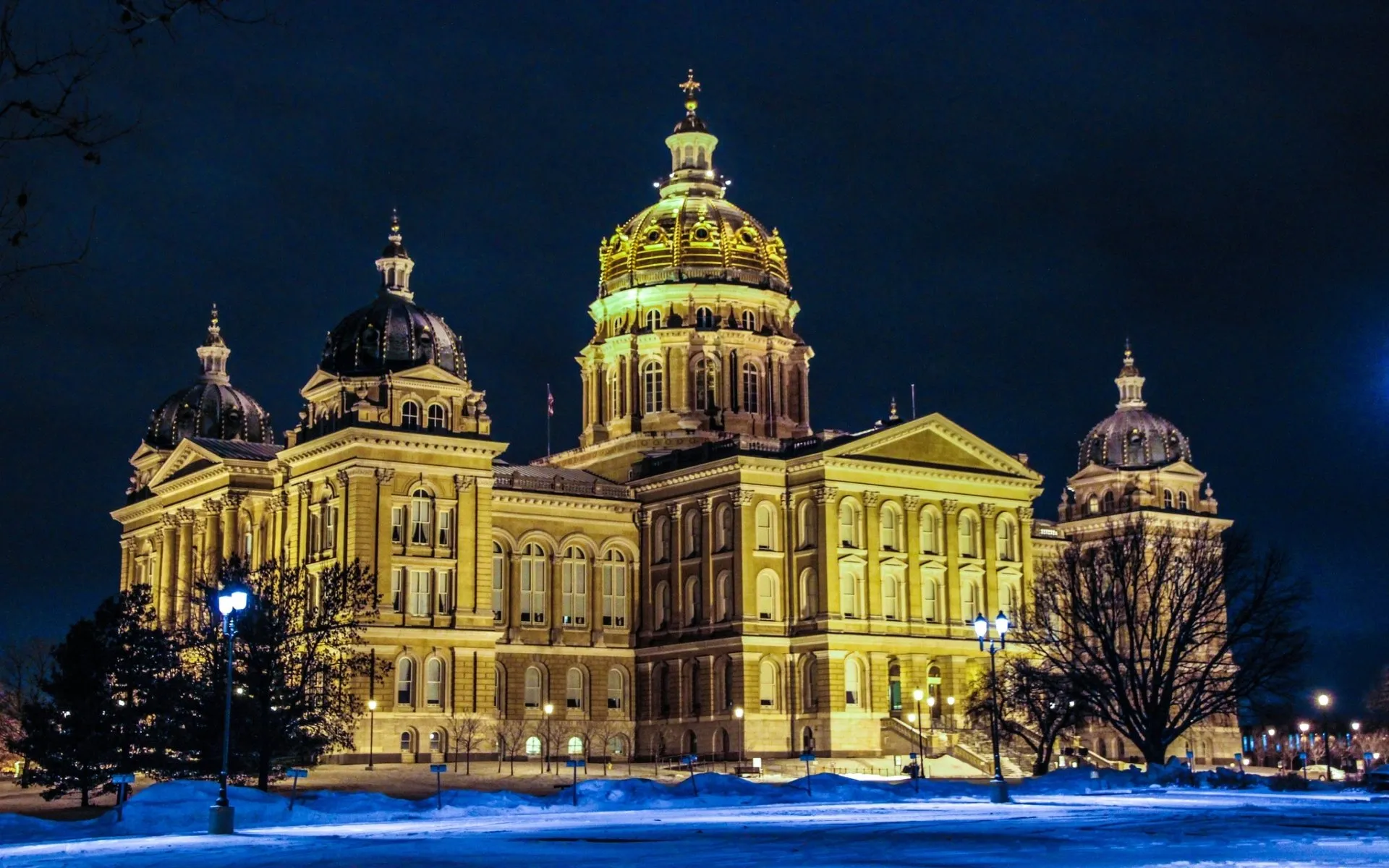

The Iowa Constitution
The Iowa Constitution is the state's highest law. It sets up the General Assembly, the governor, and the courts, lists the rights every Iowan holds against the state, and lays down rules for elections, state debt, schools, and local government. Article XII declares it "the supreme law of the state" and says any law inconsistent with it is void, and the constitution itself must fit inside the U.S. Constitution.
Iowa has held three constitutional conventions, all in Iowa City. Voters rejected the first draft, written in 1844, by 7,019 votes to 6,023. They approved the second on August 3, 1846, by 9,492 to 9,036, and Iowa entered the Union under it as the 29th state on December 28, 1846. The third convention adopted today's constitution on March 5, 1857; voters approved it on August 3, 1857, by 40,311 votes to 38,681, and Governor James W. Grimes proclaimed it the supreme law of the state on September 3, 1857.
The sections in force today run about 11,000 words, roughly one and a half times the length of the U.S. Constitution with all of its amendments. The Iowa Legislature lists 51 amendments ratified by voters from 1868 through 2024. Every one of them began in the General Assembly, because Iowa's constitution gives citizens no way to propose amendments by petition.
The full text below is the codified version published by the Iowa Legislative Services Agency, an official legal publication under Iowa Code chapter 2B, which works every amendment into the original text. It includes the amendments through Amendment 51 (2024). On November 3, 2026, voters approved Amendment 1, which requires a two-thirds vote of each chamber to raise income tax rates, according to unofficial returns; it adds a new Article XIII that is not yet in the official text below. See the Iowa voter guide for the 2026 election for the ballot.
Convention dates and vote counts from the Iowa Legislature's page on Iowa's constitutional conventions; amendment count from the Legislature's list of amendment citations; word count from the official text below; the 2026 result from unofficial returns reported by Newsweek.
What Sets Iowa's Constitution Apart
Iowa's constitution is short and has kept most of its 1857 wording, but voters have changed it in ways that set it apart from the U.S. Constitution and from many other states. These are the features readers most often ask about.
Iowa's Bill of Rights (Article I) opens with a statement the federal Bill of Rights does not make: "All men and women are, by nature, free and equal, and have certain inalienable rights," among them "enjoying and defending life and liberty, acquiring, possessing and protecting property, and pursuing and obtaining safety and happiness." The 1857 text said only "All men"; voters added "and women" with Amendment 45 in 1998.
In 2022 voters added section 1A (Amendment 49). It says the right of the people to keep and bear arms "shall not be infringed," calls it "a fundamental individual right," and directs that "any and all restrictions of this right shall be subject to strict scrutiny," the most demanding test a court can apply to a law. The federal Second Amendment contains no such instruction about how courts are to review gun laws.
Other sections reach further than their federal counterparts. Section 7 lets a person accused of libel prove the statement was true, and requires acquittal if it was true and "published with good motives and for justifiable ends." Read more about freedom of the press. Section 22 gives residents who are not citizens the same rights as native-born citizens to own and inherit property, and section 24 voids any lease of farmland that runs longer than twenty years.
Some sections reflect Iowa's farm economy. Section 18 requires "just compensation" before private property is taken for public use, set by a jury that may not count any benefit the owner gains from the project. A 1908 addition (Amendment 13) lets the General Assembly allow drains, ditches, and levees across other people's land and create drainage districts paid for by the owners who benefit. Learn more about eminent domain.
As written in 1857, Article II limited the vote to "white" male citizens, and the census, legislative apportionment, and militia sections also counted only white residents. Article XII, section 14 put a separate question on the same 1857 ballot: "Shall the word 'White' be stricken out of the Article on the Right of Suffrage?" The official text notes that the proposition failed to be adopted.
Eleven years later, in 1868, voters approved five amendments that struck the word "white" from the voting, census, apportionment, and militia sections, so Black men in Iowa could vote. Learn more about the long fight for voting rights.
Barriers to holding office came down more slowly. The 1857 text required members of the Iowa House of Representatives to be "free white" male citizens; voters struck "free white" in 1880 (Amendment 6) and the word "male" in 1926 (Amendment 15), according to the notes in the official original text.
The voting article was rewritten again in 2024. Amendment 50 says that "only a citizen of the United States" who is 18 may vote, and it also lets a citizen who will be 18 by the next general election vote in the primary election before it. The militia article, by contrast, still reads "able-bodied male citizens, between the ages of eighteen and forty-five years."
Iowa's judges are not chosen in contested elections. Since Amendment 21 in 1962, the governor fills each vacancy on the Iowa Supreme Court from three nominees chosen by a state judicial nominating commission, and each district court vacancy from two nominees chosen by a district commission. If the governor does not act within thirty days, the chief justice makes the appointment from the same list (Article V, section 15).
The constitution sets the commissions' makeup unless a law provides otherwise: members appointed by the governor, an equal number elected by the lawyers of the state or district, and the most senior judge as chair. Members serve six-year terms, cannot serve a second term on the same commission, and are to be chosen "without reference to political affiliation" (section 16).
Voters still decide whether judges stay. After at least a year on the bench, a judge stands in a retention election on a separate ballot that asks only whether the judge should be kept for another term, which must be at least eight years for the state supreme court and six years for district judges (section 17). There is no opponent on the ballot.
Those elections drew national attention in 2010. A year after the Iowa Supreme Court's unanimous ruling in Varnum v. Brien (2009), which struck down the state's ban on same-sex marriage on equal protection grounds under the Iowa Constitution, voters removed Chief Justice Marsha Ternus and Justices Michael Streit and David Baker, who had joined it. The court's readings of the constitution can also change: in 2018 it found a fundamental right to abortion in the Iowa Constitution, and in 2022 it overruled that decision.
The 1857 constitution keeps a tight limit on state borrowing. Article VII, section 2 caps the state's debts for deficits and unplanned expenses at $250,000, a figure unchanged since 1857. Any larger debt, other than debt to repel invasion, suppress insurrection, or defend the state in war, must be for a single named project, must come with a tax to repay it within twenty years, and must be approved by voters at a general election (section 5).
Local governments face a limit too. Article XI, section 3 bars any county, city, or other political subdivision from borrowing more than five percent of the value of the taxable property within it.
Voters have locked some money to specific purposes. Since 1942 (Amendment 18), motor vehicle registration fees and fuel taxes may be spent only on public highways. Since 1996 (Amendment 44), hunting, fishing, and trapping license fees may be spent only on fish and wildlife programs. In 2010 about 63 percent of voters approved Amendment 48, which created a Natural Resources and Outdoor Recreation Trust Fund, but the fund receives money only once lawmakers raise the state sales tax.
The newest money rule came in 2026. Amendment 1, passed by two consecutive General Assemblies (the 90th and 91st) and approved by voters on November 3, 2026, requires two-thirds of the members of each chamber to pass a bill that raises an income tax rate or creates a new state tax on income, and gives anyone challenging such a law one year to sue. See how income taxes developed in the United States.
Amendment 25 (1968) changed how much power Iowa cities have. Article III, section 38A grants cities "home rule power and authority" over their local affairs, as long as they do not conflict with state law, and declares that the old rule limiting a city to powers "granted in express words is not a part of the law of this state." Cities still may not levy a tax unless the General Assembly allows it.
Counties received the same home rule power in 1978 (Amendment 37, section 39A), and the constitution says that when a county's power conflicts with a city's, the city's prevails within its own limits. Both grants are limited to powers "not inconsistent with the laws of the general assembly," so state law still controls.
The General Assembly also keeps a check on state agencies. Since 1984 (Amendment 38), it may cancel any administrative rule an agency adopts by passing a resolution with a majority of all members of each chamber (section 40).
Since Amendment 27 in 1968, the governor may approve an appropriation bill "in whole or in part" and strike individual spending items, and the General Assembly can restore a struck item only the way it overrides any veto, by a two-thirds vote of each chamber. Compare the federal veto power.
A state constitution keeps wording that later laws have made obsolete until voters remove it, and Iowa's codified text marks many such passages with a footnote. The largest example is the first part of Article IX: fifteen sections setting up a state board of education with power to make laws for the schools. The official notes say the General Assembly abolished that board in 1864, using the power section 15 gave it.
Article XI, section 1 still sets the civil jurisdiction of justices of the peace at $100, or $300 with the consent of the parties. The official notes say the office of justice of the peace was abolished in 1972. Article V, section 2 still says the supreme court "shall consist of three judges"; the notes point to section 10, which lets the General Assembly increase the number of supreme court judges.
Article VIII, sections 6 through 11, written in 1857 for state-chartered banks that printed their own paper money, remain in the text. The official notes say Iowa courts have held that they apply only to "banks of issue." Article II, section 7 still schedules the general election of 1916.
Some 1857 wording no longer appears in the codified text at all. The editors left out the transitional sections of Article XII, which set the first elections and carried territorial officers over to the new state, and show them as "[* * *]" with a note pointing to the original constitution, where they are preserved word for word.
How the Constitution Gets Changed
Every change to Iowa's constitution has to be approved by voters. There are two ways to put one on the ballot, and citizens cannot start either one by petition.
Under Article X, section 1, an amendment can start in either chamber. It must pass by a majority of all members elected to each chamber, be entered in the journals with a recorded vote, and be published for three months before the next general election. Then the newly elected General Assembly must pass the same amendment again by the same majority. Only then does it go to voters, and if a majority of those voting on it approve, it becomes part of the constitution. Article X gives the governor no part in the process.
The two-session rule means every amendment takes at least two years and an election to reach the ballot. The two 2024 amendments, on voter citizenship and on succession to the governor's office, were first passed in 2022 and passed again in 2023. The 2026 income tax amendment was passed by the 90th General Assembly and again by the 91st. Follow what the Iowa Legislature is working on now.
When two or more amendments are on the same ballot, section 2 requires that voters be able to vote for or against each one separately. Article X contains no process for citizens to propose amendments or laws by petition, so every one of Iowa's 51 ratified amendments was proposed by the General Assembly.
Article X, section 3, rewritten by Amendment 22 in 1964, requires that the question "Shall there be a convention to revise the Constitution, and propose amendment or amendments to same?" appear on the general election ballot in 1970 and every tenth year after, and whenever the General Assembly provides by law. If a majority votes yes, the next General Assembly must arrange the election of delegates, and anything the convention proposes goes back to voters, with each amendment voted on separately.
Voters have said no every time. All six of the automatic questions from 1970 through 2020 were rejected, according to Ballotpedia, and in 2020 the question failed by 70.4 percent to 29.6 percent in the Secretary of State's canvass. The next automatic vote is due in 2030. Iowa has not held a convention since the one that wrote the 1857 constitution.
Read the Full Text
The complete constitution in force today, article by article, as the state publishes it. Open an article for a short summary and then its full text. Each section's history note shows when voters adopted or changed it.
Official codified text as published by the Iowa Legislative Services Agency, including amendments through Amendment 51 (2024). Amendment 1, approved by voters on November 3, 2026, is not yet included. The section headings (catchwords) and footnotes are the editors'; cross-references to Iowa Code statutes are left out. Articles III and IX are each divided into two parts with their own section numbers, so each part is shown separately. Official text ↗
Preamble
WE THE PEOPLE OF THE STATE OF IOWA, grateful to the Supreme Being for the blessings hitherto enjoyed, and feeling our dependence on Him for a continuation of those blessings, do ordain and establish a free and independent government, by the name of the State of Iowa, the boundaries whereof shall be as follows:
Beginning in the middle of the main channel of the Mississippi River, at a point due east of the middle of the mouth of the main channel of the Des Moines River, thence up the middle of the main channel of the said Des Moines River, to a point on said river where the northern boundary line of the state of Missouri, as established by the Constitution of that state, adopted June 12th, 1820, crosses the said middle of the main channel of the said Des Moines River; thence westwardly along the said northern boundary line of the state of Missouri, as established at the time aforesaid, until an extension of said line intersects the middle of the main channel of the Missouri River; thence up the middle of the main channel of the said Missouri River to a point opposite the middle of the main channel of the Big Sioux River, according to Nicollett’s Map; thence up the main channel of the said Big Sioux River, according to the said map, until it is intersected by the parallel of forty three degrees and thirty minutes north latitude; thence east along said parallel of forty three degrees and thirty minutes until said parallel intersects the middle of the main channel of the Mississippi River; thence down the middle of the main channel of said Mississippi River to the place of beginning.
In short: Iowa's Bill of Rights. It declares all men and women free and equal, protects religion, speech, the press, and assembly, guards against unreasonable searches, and guarantees jury trials, due process, and the rights of people accused of crimes. Since 2022 it also declares the right to keep and bear arms a fundamental individual right whose limits courts must review under strict scrutiny.
Section 1. Rights of persons
All men and women are, by nature, free and equal, and have certain inalienable rights, among which are those of enjoying and defending life and liberty, acquiring, possessing and protecting property, and pursuing and obtaining safety and happiness.
History: Amended by Amendment 45 (1998)
Section 1A. Right to keep and bear arms
The right of the people to keep and bear arms shall not be infringed. The sovereign state of Iowa affirms and recognizes this right to be a fundamental individual right. Any and all restrictions of this right shall be subject to strict scrutiny.
History: Added by Amendment 49 (2022)
Section 2. Political power
All political power is inherent in the people. Government is instituted for the protection, security, and benefit of the people, and they have the right, at all times, to alter or reform the same, whenever the public good may require it.
Section 3. Religion
The general assembly shall make no law respecting an establishment of religion, or prohibiting the free exercise thereof; nor shall any person be compelled to attend any place of worship, pay tithes, taxes, or other rates for building or repairing places of worship, or the maintenance of any minister, or ministry.
Section 4. Religious test, witnesses
No religious test shall be required as a qualification for any office, or public trust, and no person shall be deprived of any of his rights, privileges, or capacities, or disqualified from the performance of any of his public or private duties, or rendered incompetent to give evidence in any court of law or equity, in consequence of his opinions on the subject of religion; and any party to any judicial proceeding shall have the right to use as a witness, or take the testimony of, any other person not disqualified on account of interest, who may be cognizant of any fact material to the case; and parties to suits may be witnesses, as provided by law.
Section 6. Laws uniform
All laws of a general nature shall have a uniform operation; the general assembly shall not grant to any citizen, or class of citizens, privileges or immunities, which, upon the same terms shall not equally belong to all citizens.
Section 7. Liberty of speech and press
Every person may speak, write, and publish his sentiments on all subjects, being responsible for the abuse of that right. No law shall be passed to restrain or abridge the liberty of speech, or of the press. In all prosecutions or indictments for libel, the truth may be given in evidence to the jury, and if it appears* to the jury that the matter charged as libellous was true, and was published with good motives and for justifiable ends, the party shall be acquitted.
Note from the official text:
*In the original text, the word is “appear”, see original Constitution, Art. I, §7
Section 8. Personal security, searches and seizures
The right of the people to be secure in their persons, houses, papers and effects, against unreasonable seizures and searches shall not be violated; and no warrant shall issue but on probable cause, supported by oath or affirmation, particularly describing the place to be searched, and the persons and things to be seized.
Section 9. Right of trial by jury, due process of law
The right of trial by jury shall remain inviolate; but the general assembly may authorize trial by a jury of a less number than twelve men in inferior courts; but no person shall be deprived of life, liberty, or property, without due process of law.
Section 10. Rights of persons accused
In all criminal prosecutions, and in cases involving the life, or liberty of an individual the accused shall have a right to a speedy and public trial by an impartial jury; to be informed of the accusation against him, to have a copy of the same when demanded; to be confronted with the witnesses against him; to have compulsory process for his witnesses; and, to have the assistance of counsel.
Section 11. When indictment necessary, grand jury
All offenses less than felony and in which the maximum permissible imprisonment does not exceed thirty days shall be tried summarily before an officer authorized by law, on information under oath, without indictment, or the intervention of a grand jury, saving to the defendant the right of appeal; and no person shall be held to answer for any higher criminal offense, unless on presentment or indictment by a grand jury, except in cases arising in the army, or navy, or in the militia, when in actual service, in time of war or public danger.
The grand jury may consist of any number of members not less than five, nor more than fifteen, as the general assembly may by law provide, or the general assembly may provide for holding persons to answer for any criminal offense without the intervention of a grand jury.
History: Paragraph 1 amended by Amendment 46 (1998); Paragraph 2 added by Amendment 9 (1884)
Section 12. Twice tried, bail
No person shall after acquittal, be tried for the same offence. All persons shall, before conviction, be bailable, by sufficient sureties, except for capital offences where the proof is evident, or the presumption great.
Section 13. Habeas corpus
The writ of habeas corpus shall not be suspended, or refused when application is made as required by law, unless in case of rebellion, or invasion the public safety may require it.
Section 14. Military
The military shall be subordinate to the civil power. No standing army shall be kept up by the state in time of peace; and in time of war, no appropriation for a standing army shall be for a longer time than two years.
Section 15. Quartering soldiers
No soldier shall, in time of peace, be quartered in any house without the consent of the owner, nor in time of war except in the manner prescribed by law.
Section 16. Treason
Treason against the state shall consist only in levying war against it, adhering to its enemies, or giving them aid and comfort. No person shall be convicted of treason, unless on the evidence of two witnesses to the same overt act, or confession in open court.
Section 17. Bail, punishments
Excessive bail shall not be required; excessive fines shall not be imposed, and cruel and unusual punishment shall not be inflicted.
Section 18. Eminent domain, drainage ditches and levees
Private property shall not be taken for public use without just compensation first being made, or secured to be made to the owner thereof, as soon as the damages shall be assessed by a jury, who shall not take into consideration any advantages that may result to said owner on account of the improvement for which it is taken.
The general assembly, however, may pass laws permitting the owners of lands to construct drains, ditches, and levees for agricultural, sanitary or mining purposes across the lands of others, and provide for the organization of drainage districts, vest the proper authorities with power to construct and maintain levees, drains and ditches and to keep in repair all drains, ditches, and levees heretofore constructed under the laws of the state, by special assessments upon the property benefited thereby. The general assembly may provide by law for the condemnation of such real estate as shall be necessary for the construction and maintenance of such drains, ditches and levees, and prescribe the method of making such condemnation.
History: Paragraph 2 added by Amendment 13 (1908)
Section 19. Imprisonment for debt
No person shall be imprisoned for debt in any civil action, on mesne or final process, unless in case of fraud; and no person shall be imprisoned for a militia fine in time of peace.
Section 20. Right of assemblage, petition
The people have the right freely to assemble together to counsel for the common good; to make known their opinions to their representatives and to petition for a redress of grievances.
Section 21. Attainder, ex post facto law, obligation of contract
No bill of attainder, ex post facto law, or law impairing the obligation of contracts, shall ever be passed.
Section 22. Resident aliens
Foreigners who are, or may hereafter become residents of this state, shall enjoy the same rights in respect to the possession, enjoyment and descent of property, as native born citizens.
Section 23. Slavery, penal servitude
There shall be no slavery in this state; nor shall there be involuntary servitude, unless for the punishment of crime.
Section 24. Agricultural leases
No lease or grant of agricultural lands, reserving any rent, or service of any kind, shall be valid for a longer period than twenty years.
Section 25. Rights reserved
This enumeration of rights shall not be construed to impair or deny others, retained by the people.
1 repealed section is not shown.
In short: Who can vote: citizens of the United States who are 18 and meet the residency rules set by law, with 17-year-olds who will be 18 by the general election allowed to vote in the primary. It bars people adjudged mentally incompetent to vote and people convicted of an infamous crime, and requires that all elections be by ballot.
Section 1. Electors
Only a citizen of the United States of the age of eighteen years, who shall have been a resident of this state for such period of time as shall be provided by law and of the county in which the citizen claims the citizen’s vote for such period of time as shall be provided by law, shall be entitled to vote at all elections which are authorized by law. However, for purposes of a primary election, a United States citizen must be at least eighteen years of age as of the next general election following the primary election. The required periods of residence shall not exceed six months in this state and sixty days in the county.
History: Repealed and rewritten by Amendment 50 (2024)
Note from the official text:
See United States Constitution, Amendments 19 and 26
Section 2. Privileged from arrest
Electors shall, in all cases except treason, felony, or breach of the peace, be privileged from arrest on the days of election, during their attendance at such election, going to and returning therefrom.
Section 3. From military duty
No elector shall be obliged to perform military duty on the day of election, except in time of war, or public danger.
Section 4. Persons in military service
No person in the military, naval, or marine service of the United States shall be considered a resident of this state by being stationed in any garrison, barrack, or military or naval place, or station within this state.
Section 5. Disqualified persons
A person adjudged mentally incompetent to vote or a person convicted of any infamous crime shall not be entitled to the privilege of an elector.
History: Repealed and rewritten by Amendment 47 (2008)
Section 6. Ballot
All elections by the people shall be by ballot.
Section 7. General election
The general election for state, district, county and township officers in the year 1916 shall be held in the same month and on the same day as that fixed by the laws of the United States for the election of presidential electors, or of president and vice-president of the United States; and thereafter such election shall be held at such time as the general assembly may by law provide.
History: Repealed and rewritten by Amendment 14 (1916)
In short: Divides state power among the legislative, executive, and judicial departments and bars anyone serving in one from exercising the powers of another, except where the constitution allows it.
Section 1. Departments of government
The powers of the government of Iowa shall be divided into three separate departments, the legislative, the executive, and the judicial: and no person charged with the exercise of powers properly belonging to one of these departments shall exercise any function appertaining to either of the others, except in cases hereinafter expressly directed or permitted.
In short: Creates the General Assembly, a Senate of no more than 50 members and a House of Representatives of no more than 100, meeting every year in January. It sets how bills pass, the governor's veto and item veto, impeachment, and how legislative districts are redrawn after each census, and it grants home rule to cities and counties and lets the General Assembly cancel agency rules.
Section 1. General assembly
The legislative authority of this state shall be vested in a general assembly, which shall consist of a senate and house of representatives; and the style of every law shall be, “Be it enacted by the General Assembly of the State of Iowa.”
Section 2. Annual sessions of general assembly, special sessions
The general assembly shall meet in session on the second Monday of January of each year. Upon written request to the presiding officer of each house of the general assembly by two-thirds of the members of each house, the general assembly shall convene in special session. The governor of the state may convene the general assembly by proclamation in the interim.
History: Repealed and rewritten by Amendment 36 (1974)
Note from the official text:
Special sessions, see also this codified Iowa Constitution, Art. IV, §11
Section 3. Representatives
The members of the house of representatives shall be chosen every second year, by the qualified electors of their respective districts, [* * *]* and their term of office shall commence on the first day of January next after their election, and continue two years, and until their successors are elected and qualified.
Note from the official text:
*Language, relating to the time of holding the general elections, appears to have been superseded or made obsolete as a result of changes made to Art. II, §7, and has been omitted from this codified Iowa Constitution, see original Constitution, Art. III, §3, for omitted language
Section 4. Qualifications
No person shall be a member of the house of representatives who shall not have attained the age of twenty-one years, be a citizen of the United States, and shall have been an inhabitant of this state one year next preceding his election, and at the time of his election shall have had an actual residence of sixty days in the county, or district he may have been chosen to represent.
History: Amended by Amendment 6 (1880) and Amendment 15 (1926)
Section 5. Senators, qualifications
Senators shall be chosen for the term of four years, at the same time and place as representatives; they shall be twenty-five years of age, and possess the qualifications of representatives as to residence and citizenship.
Section 6. Senators, number and classification
The number of senators shall total not more than one-half the membership of the house of representatives. Senators shall be classified so that as nearly as possible one-half of the members of the senate shall be elected every two years.
History: Repealed and rewritten by Amendment 26 (1968)
Note from the official text:
See also this codified Iowa Constitution, Art. III, §34
Section 7. Officers, elections determined
Each house shall choose its own officers, and judge of the qualification, election, and return of its own members. A contested election shall be determined in such manner as shall be directed by law.
Section 8. Quorum
A majority of each house shall constitute a quorum to transact business; but a smaller number may adjourn from day to day, and may compel the attendance of absent members in such manner and under such penalties as each house may provide.
Section 9. Authority of the houses
Each house shall sit upon its own adjournments, keep a journal of its proceedings, and publish the same; determine its rules of proceedings, punish members for disorderly behavior, and, with the consent of two thirds, expel a member, but not a second time for the same offense; and shall have all other powers necessary for a branch of the general assembly of a free and independent state.
Section 10. Protest, record of vote
Every member of the general assembly shall have the liberty to dissent from, or protest against any Act or resolution which he may think injurious to the public, or an individual, and have the reasons for his dissent entered on the journals; and the yeas and nays of the members of either house, on any question, shall, at the desire of any two members present, be entered on the journals.
Section 11. Privileged from arrest
Senators and representatives, in all cases, except treason, felony, or breach of the peace, shall be privileged from arrest during the session of the general assembly, and in going to and returning from the same.
Section 12. Vacancies
When vacancies occur in either house, the governor or the person exercising the functions of governor, shall issue writs of election to fill such vacancies.
Section 13. Doors open
The doors of each house shall be open, except on such occasions, as, in the opinion of the house, may require secrecy.
Section 14. Adjournments
Neither house shall, without the consent of the other, adjourn for more than three days, nor to any other place than that in which they may be sitting.
Section 15. Bills
Bills may originate in either house, and may be amended, altered, or rejected by the other; and every bill having passed both houses, shall be signed by the speaker and president of their respective houses.
Section 16. Executive approval, veto, item veto by governor
Every bill which shall have passed the general assembly, shall, before it becomes a law, be presented to the governor. If he approve, he shall sign it; but if not, he shall return it with his objections, to the house in which it originated, which shall enter the same upon their journal, and proceed to reconsider it; if, after such reconsideration, it again pass both houses, by yeas and nays, by a majority of two thirds of the members of each house, it shall become a law, notwithstanding the governor’s* objections. If any bill shall not be returned within three days after it shall have been presented to him, Sunday excepted, the same shall be a law in like manner as if he had signed it, unless the general assembly, by adjournment, prevent such return. Any bill submitted to the governor for his approval during the last three days of a session of the general assembly, shall be deposited by him in the office of the secretary of state, within thirty days after the adjournment, with his approval, if approved by him, and with his objections, if he disapproves thereof.
The governor may approve appropriation bills in whole or in part, and may disapprove any item of an appropriation bill; and the part approved shall become a law. Any item of an appropriation bill disapproved by the governor shall be returned, with his objections, to the house in which it originated, or shall be deposited by him in the office of the secretary of state in the case of an appropriation bill submitted to the governor for his approval during the last three days of a session of the general assembly, and the procedure in each case shall be the same as provided for other bills. Any such item of an appropriation bill may be enacted into law notwithstanding the governor’s objections, in the same manner as provided for other bills.
History: Paragraph 2 added by Amendment 27 (1968)
Note from the official text:
*In the original text, the word was “Governors”, see original Constitution, Art. III, §16
Section 17. Passage of bills
No bill shall be passed unless by the assent of a majority of all the members elected to each branch of the general assembly, and the question upon the final passage shall be taken immediately upon its last reading, and the yeas and nays entered on the journal.
Section 18. Receipts and expenditures
An accurate statement of the receipts and expenditures of the public money shall be attached to and published with the laws, at every regular session of the general assembly.
Section 19. Impeachment
The house of representatives shall have the sole power of impeachment, and all impeachments shall be tried by the senate. When sitting for that purpose, the senators shall be upon oath or affirmation; and no person shall be convicted without the concurrence of two thirds of the members present.
Note from the official text:
Referred to in this codified Iowa Constitution, Art. V, §19
Section 20. Officers subject to impeachment, judgment
The governor, judges of the supreme and district courts, and other state officers, shall be liable to impeachment for any misdemeanor or malfeasance in office;* but judgment in such cases shall extend only to removal from office, and disqualification to hold any office of honor, trust, or profit, under this state; but the party convicted or acquitted shall nevertheless be liable to indictment, trial, and punishment, according to law. All other civil officers shall be tried for misdemeanors and malfeasance in office, in such manner as the general assembly may provide.
Note from the official text:
*In the original text, a colon was used, see original Constitution, Art. III, §20
Referred to in this codified Iowa Constitution, Art. V, §19
Section 21. Members not appointed to office
No senator or representative shall, during the time for which he shall have been elected, be appointed to any civil office of profit under this state, which shall have been created, or the emoluments of which shall have been increased during such term, except such offices as may be filled by elections by the people.
Section 22. Disqualification
No person holding any lucrative office under the United States, or this state, or any other power, shall be eligible to hold a seat in the general assembly;* but offices in the militia, to which there is attached no annual salary, or the office of justice of the peace,** or postmaster whose compensation does not exceed one hundred dollars per annum, or notary public, shall not be deemed lucrative.
Note from the official text:
*In the original text, a colon was used, see original Constitution, Art. III, §22
**The office of justice of peace was abolished by 1972 Acts, ch 1124
Section 23. Failure to account
No person who may hereafter be a collector or holder of public monies, shall have a seat in either house of the general assembly, or be eligible to hold any office of trust or profit in this state, until he shall have accounted for and paid into the treasury all sums for which he may be liable.
Section 24. Appropriations
No money shall be drawn from the treasury but in consequence of appropriations made by law.
Section 25. Compensation and expenses of general assembly
Each member of the general assembly shall receive such compensation and allowances for expenses as shall be fixed by law but no general assembly shall have the power to increase compensation and allowances effective prior to the convening of the next general assembly following the session in which any increase is adopted.
History: Repealed and rewritten by Amendment 28 (1968)
Section 26. Time laws to take effect
An Act of the general assembly passed at a regular session of a general assembly shall take effect on July 1 following its passage unless a different effective date is stated in an Act of the general assembly. An Act passed at a special session of a general assembly shall take effect ninety days after adjournment of the special session unless a different effective date is stated in an Act of the general assembly. The general assembly may establish by law a procedure for giving notice of the contents of Acts of immediate importance which become law.
History: Repealed and rewritten by Amendment 40 (1986)
Section 27. Divorce
No divorce shall be granted by the general assembly.
Section 29. Acts, one subject, expressed in title
Every Act shall embrace but one subject, and matters properly connected therewith; which subject shall be expressed in the title. But if any subject shall be embraced in an Act which shall not be expressed in the title, such Act shall be void only as to so much thereof as shall not be expressed in the title.
Section 30. Local or special laws, general and uniform, boundaries of counties
The general assembly shall not pass local or special laws in the following cases:
For the assessment and collection of taxes for state, county, or road purposes;
For laying out, opening, and working roads or highways;
For changing the names of persons;
For the incorporation of cities and towns;
For vacating roads, town plats, streets, alleys, or public squares;
For locating or changing county seats.
In all the cases above enumerated, and in all other cases where a general law can be made applicable, all laws shall be general, and of uniform operation throughout the state; and no law changing the boundary lines of any county shall have effect until upon being submitted to the people of the counties affected by the change, at a general election, it shall be approved by a majority of the votes in each county, cast for and against it.
Note from the official text:
Laws uniform, see this codified Iowa Constitution, Art. I, §6
Section 31. Extra compensation, payment of claims, appropriations for local or private purposes
No extra compensation shall be made to any officer, public agent, or contractor, after the service shall have been rendered, or the contract entered into; nor, shall any money be paid on any claim, the subject matter of which shall not have been provided for by preexisting laws, and no public money or property shall be appropriated for local, or private purposes, unless such appropriation, compensation, or claim, be allowed by two thirds of the members elected to each branch of the general assembly.
Section 32. Oath of members
Members of the general assembly shall, before they enter upon the duties of their respective offices, take and subscribe the following oath or affirmation: “I do solemnly swear, or affirm, (as the case may be,) that I will support the Constitution of the United States, and the Constitution of the State of Iowa, and that I will faithfully discharge the duties of senator, (or representative, as the case may be,) according to the best of my ability”. And members of the general assembly are hereby empowered to administer to each other the said oath or affirmation.
Section 34. Senate and house of representatives, limitation
The senate shall be composed of not more than fifty and the house of representatives of not more than one hundred members. Senators and representatives shall be elected from districts established by law. Each district so established shall be of compact and contiguous territory. The state shall be apportioned into senatorial and representative districts on the basis of population. The general assembly may provide by law for factors in addition to population, not in conflict with the Constitution of the United States, which may be considered in the apportioning of senatorial districts. No law so adopted shall permit the establishment of senatorial districts whereby a majority of the members of the senate shall represent less than forty percent of the population of the state as shown by the most recent United States decennial census.
History: Repealed and rewritten by Amendment 26 (1968)
Note from the official text:
See also this codified Iowa Constitution, Art. III, §6, 39
Section 35. Senators and representatives, number and districts
The general assembly shall in 1971 and in each year immediately following the United States decennial census determine the number of senators and representatives to be elected to the general assembly and establish senatorial and representative districts. The general assembly shall complete the apportionment prior to September 1 of the year so required. If the apportionment fails to become law prior to September 15 of such year, the supreme court shall cause the state to be apportioned into senatorial and representative districts to comply with the requirements of the Constitution prior to December 31 of such year. The reapportioning authority shall, where necessary in establishing senatorial districts, shorten the term of any senator prior to completion of the term. Any senator whose term is so terminated shall not be compensated for the uncompleted part of the term.
History: Repealed and rewritten by Amendment 26 (1968)
Section 36. Review by supreme court
Upon verified application by any qualified elector, the supreme court shall review an apportionment plan adopted by the general assembly which has been enacted into law. Should the supreme court determine such plan does not comply with the requirements of the Constitution, the court shall within ninety days adopt or cause to be adopted an apportionment plan which shall so comply. The supreme court shall have original jurisdiction of all litigation questioning the apportionment of the general assembly or any apportionment plan adopted by the general assembly.
History: Repealed and rewritten by Amendment 26 (1968)
Section 37. Congressional districts
When a congressional district is composed of two or more counties it shall not be entirely separated by a county belonging to another district and no county shall be divided in forming a congressional district.
History: Repealed and rewritten by Amendment 26 (1968)
Section 38. Elections by general assembly
In all elections by the general assembly, the members thereof shall vote viva voce and the votes shall be entered on the journal.
Section 38A. Municipal home rule
Municipal corporations are granted home rule power and authority, not inconsistent with the laws of the general assembly, to determine their local affairs and government, except that they shall not have power to levy any tax unless expressly authorized by the general assembly.
The rule or proposition of law that a municipal corporation possesses and can exercise only those powers granted in express words is not a part of the law of this state.
History: Added by Amendment 25 (1968)
Section 39. Legislative districts
In establishing senatorial and representative districts, the state shall be divided into as many senatorial districts as there are members of the senate and into as many representative districts as there are members of the house of representatives. One senator shall be elected from each senatorial district and one representative shall be elected from each representative district.
History: Added by Amendment 29 (1970)
Note from the official text:
See also this codified Iowa Constitution, Art. III, §34
Section 39A. Counties home rule
Counties or joint county-municipal corporation governments are granted home rule power and authority, not inconsistent with the laws of the general assembly, to determine their local affairs and government, except that they shall not have power to levy any tax unless expressly authorized by the general assembly. The general assembly may provide for the creation and dissolution of joint county-municipal corporation governments. The general assembly may provide for the establishment of charters in county or joint county-municipal corporation governments.
If the power or authority of a county conflicts with the power and authority of a municipal corporation, the power and authority exercised by a municipal corporation shall prevail within its jurisdiction.
The proposition or rule of law that a county or joint county-municipal corporation government possesses and can exercise only those powers granted in express words is not a part of the law of this state.
History: Added by Amendment 37 (1978)
Section 40. Nullification of administrative rules
The general assembly may nullify an adopted administrative rule of a state agency by the passage of a resolution by a majority of all of the members of each house of the general assembly.
History: Added by Amendment 38 (1984)
2 repealed sections are not shown.
In short: Creates the offices of governor and lieutenant governor, elected together as a team for four-year terms. It covers the governor's duties as commander in chief, the power to pardon and to call special sessions, the line of succession, and the election of the secretary of state, auditor, and treasurer.
Section 1. Governor
The supreme executive power of this state shall be vested in a chief magistrate, who shall be styled the governor of the state of Iowa.
Section 2. Election and term
The governor and the lieutenant governor shall be elected by the qualified electors at the time and place of voting for members of the general assembly. Each of them shall hold office for four years from the time of installation in office and until a successor is elected and qualifies.
History: Repealed and rewritten by Amendment 41 (1988); 1988 repeal and rewrite was effective beginning with the 1990 general election
Section 3. Governor and lieutenant governor elected jointly, returns of elections
The electors shall designate their selections for governor and lieutenant governor as if these two offices were one and the same. The names of nominees for the governor and the lieutenant governor shall be grouped together in a set on the ballot according to which nominee for governor is seeking office with which nominee for lieutenant governor, as prescribed by law. An elector shall cast only one vote for both a nominee for governor and a nominee for lieutenant governor. The returns of every election for governor and lieutenant governor shall be sealed and transmitted to the seat of government of the state, and directed to the speaker of the house of representatives who shall open and publish them in the presence of both houses of the general assembly.
History: Repealed and rewritten by Amendment 41 (1988); 1988 repeal and rewrite was effective beginning with the 1990 general election
Section 4. Election by general assembly in case of tie, succession by lieutenant governor
The nominees for governor and lieutenant governor jointly having the highest number of votes cast for them shall be declared duly elected. If two or more sets of nominees for governor and lieutenant governor have an equal and the highest number of votes for the offices jointly, the general assembly shall by joint vote proceed, as soon as is possible, to elect one set of nominees for governor and lieutenant governor. If, upon the completion by the general assembly of the canvass of votes for governor and lieutenant governor, it appears that the nominee for governor in the set of nominees for governor and lieutenant governor receiving the highest number of votes has since died or resigned, is unable to qualify, fails to qualify, or is for any other reason unable to assume the duties of the office of governor for the ensuing term, the powers and duties shall devolve to the nominee for lieutenant governor of the same set of nominees for governor and lieutenant governor, who shall assume the powers and duties of governor upon inauguration and until the disability is removed. If both nominees for governor and lieutenant governor are unable to assume the duties of the office of governor, the person next in succession shall act as governor.
History: Repealed and rewritten by Amendment 41 (1988); 1988 repeal and rewrite was effective beginning with the 1990 general election
Section 5. Contested elections
Contested elections for the offices of governor and lieutenant governor shall be determined by the general assembly as prescribed by law.
History: Repealed and rewritten by Amendment 41 (1988); 1988 repeal and rewrite was effective beginning with the 1990 general election
Section 6. Eligibility
No person shall be eligible to the office of governor, or lieutenant governor, who shall not have been a citizen of the United States, and a resident of the state, two years next preceding the election, and attained the age of thirty years at the time of said election.
Section 7. Commander in chief
The governor shall be commander in chief of the militia, the army, and navy of this state.
Section 8. Duties of governor
He shall transact all executive business with the officers of government, civil and military, and may require information in writing from the officers of the executive department upon any subject relating to the duties of their respective offices.
Section 9. Execution of laws
He shall take care that the laws are faithfully executed.
Section 10. Vacancies
When any office shall, from any cause, become vacant, and no mode is provided by the Constitution and laws for filling such vacancy, the governor shall have power to fill such vacancy, by granting a commission, which shall expire at the end of the next session of the general assembly, or at the next election by the people.
Section 11. Convening general assembly
He may, on extraordinary occasions, convene the general assembly by proclamation, and shall state to both houses, when assembled, the purpose for which they shall have been convened.
Note from the official text:
See also this codified Iowa Constitution, Art. III, §2
Section 12. Message
He shall communicate, by message, to the general assembly, at every regular session, the condition of the state, and recommend such matters as he shall deem expedient.
Section 13. Adjournment
In case of disagreement between the two houses with respect to the time of adjournment, the governor shall have power to adjourn the general assembly to such time as he may think proper; but no such adjournment shall be beyond the time fixed for the regular meeting of the next general assembly.
Section 14. Disqualification
No persons shall, while holding any office under the authority of the United States, or this state, execute the office of governor, or lieutenant governor, except as hereinafter expressly provided.
Section 15. Terms, compensation
The official terms of the governor and lieutenant governor shall commence on the Tuesday after the second Monday of January next after their election and shall continue until their successors are elected and qualify. The governor and lieutenant governor shall be paid compensation and expenses as provided by law. The lieutenant governor, while acting as governor, shall be paid the compensation and expenses prescribed for the governor.
History: Repealed and rewritten by Amendment 42 (1988); 1988 repeal and rewrite was effective beginning with the second Monday in January 1991
Section 16. Pardons, reprieves, commutations
The governor shall have power to grant reprieves, commutations and pardons, after conviction, for all offences except treason and cases of impeachment, subject to such regulations as may be provided by law. Upon conviction for treason, he shall have power to suspend the execution of the sentence until the case shall be reported to the general assembly at its next meeting, when the general assembly shall either grant a pardon, commute the sentence, direct the execution of the sentence, or grant a further reprieve. He shall have power to remit fines and forfeitures, under such regulations as may be prescribed by law; and shall report to the general assembly, at its next meeting, each case of reprieve, commutation, or pardon granted, and the reasons therefor; and also all persons in whose favor remission of fines and forfeitures shall have been made, and the several amounts remitted.
Section 17. Lieutenant governor or lieutenant governor-elect to become or act as governor or governor-elect
If there is a temporary disability of the governor, the lieutenant governor shall act as governor until the disability is removed, or the governor dies, resigns, or is removed from office. In case of the death, resignation, or removal from office of the governor, the lieutenant governor shall become governor for the remainder of the term, which shall create a vacancy in the office of lieutenant governor. This section shall also apply, as appropriate, to the governor-elect and the lieutenant governor-elect.
History: Repealed and rewritten by Amendment 51 (2024)
Section 18. Duties of lieutenant governor
The lieutenant governor shall have the duties provided by law and those duties of the governor assigned to the lieutenant governor by the governor.
History: Repealed and rewritten by Amendment 42 (1988); 1988 repeal and rewrite was effective beginning with the second Monday in January 1991
Section 19. Succession to office of governor and lieutenant governor
If there be a vacancy in the office of the governor and the lieutenant governor shall by reason of death, impeachment, resignation, removal from office, or other disability become incapable of performing the duties pertaining to the office of governor, the president of the senate shall act as governor until the vacancy is filled or the disability removed; and if the president of the senate, for any of the above causes, shall be incapable of performing the duties pertaining to the office of governor the same shall devolve upon the speaker of the house of representatives; and if the speaker of the house of representatives, for any of the above causes, shall be incapable of performing the duties of the office of governor, the justices of the supreme court shall convene the general assembly by proclamation and the general assembly shall organize by the election of a president by the senate and a speaker by the house of representatives. The general assembly shall thereupon immediately proceed to the election of a governor and lieutenant governor in joint convention.
History: Repealed and rewritten by Amendment 42 (1988); 1988 repeal and rewrite was effective beginning with the second Monday in January 1991
Section 20. Seal of state
There shall be a seal of this state, which shall be kept by the governor, and used by him officially, and shall be called the great seal of the state of Iowa.
Section 21. Grants and commissions
All grants and commissions shall be in the name and by the authority of the people of the state of Iowa, sealed with the great seal of the state, signed by the governor, and countersigned by the secretary of state.
Section 22. Secretary, auditor, treasurer
A secretary of state, an auditor of state and a treasurer of state shall be elected by the qualified electors at the same time that the governor is elected and for a four-year term commencing on the first day of January next after their election, and they shall perform such duties as may be provided by law.
History: Repealed and rewritten by Amendment 32 (1972)
In short: The courts: a supreme court, district courts, and other courts the General Assembly creates. Judges are appointed by the governor from nominating commission lists and then face retention elections, and the supreme court may retire judges for disability and discipline them for misconduct. It also provides for an elected attorney general.
Section 1. Courts
The judicial power shall be vested in a supreme court, district courts, and such other courts, inferior to the supreme court, as the general assembly may, from time to time, establish.
Section 2. Supreme court
The supreme court shall consist of three judges, two of whom shall constitute a quorum to hold court.*
Note from the official text:
*See this codified Iowa Constitution, Art. V, §10; see also Iowa Code §602.4101
Section 4. Jurisdiction of supreme court
The supreme court shall have appellate jurisdiction only in cases in chancery, and shall constitute a court for the correction of errors at law, under such restrictions as the general assembly may, by law, prescribe; and shall have power to issue all writs and process necessary to secure justice to parties, and shall exercise a supervisory and administrative control over all inferior judicial tribunals throughout the state.
History: Amended by Amendment 21 (1962)
Section 6. Jurisdiction of district court
The district court shall be a court of law and equity, which shall be distinct and separate jurisdictions, and have jurisdiction in civil and criminal matters arising in their respective districts, in such manner as shall be prescribed by law.
Section 7. Conservators of the peace
The judges of the supreme and district courts shall be conservators of the peace throughout the state.
Section 8. Style of process
The style of all process shall be, “The State of Iowa”, and all prosecutions shall be conducted in the name and by the authority of the same.
Section 10. Judicial districts
The state shall be divided into eleven judicial districts; and after the year eighteen hundred and sixty, the general assembly may reorganize the judicial districts and increase or diminish the number of districts, or the number of judges of the said court, and may increase the number of judges of the supreme court; but such increase or diminution shall not be more than one district, or one judge of either court, at any one session; and no reorganization of the districts, or diminution of the number of judges, shall have the effect of removing a judge from office. Such reorganization of the districts, or any change in the boundaries thereof, or increase or diminution of the number of judges, shall take place every four years thereafter, if necessary, and at no other time.
At any regular session of the general assembly the state may be divided into the necessary judicial districts for district court purposes, or the said districts may be reorganized and the number of the districts and the judges of said courts increased or diminished; but no reorganization of the districts or diminution of the judges shall have the effect of removing a judge from office.
History: Paragraph 2 added by Amendment 8 (1884); much of paragraph 1 appears to be superseded by paragraph 2
Section 12. Attorney general
The general assembly shall provide, by law, for the election of an attorney general by the people, whose term of office shall be four years, and until his successor is elected and qualifies.
History: Repealed and rewritten by Amendment 32 (1972)
Section 14. System of court practice
It shall be the duty of the general assembly to provide for the carrying into effect of this article, and to provide for a general system of practice in all the courts of this state.
Note from the official text:
For provisions relative to the grand jury, see this codified Iowa Constitution, Art. I, §11
Section 15. Vacancies in courts
Vacancies in the supreme court and district court shall be filled by appointment by the governor from lists of nominees submitted by the appropriate judicial nominating commission. Three nominees shall be submitted for each supreme court vacancy, and two nominees shall be submitted for each district court vacancy. If the governor fails for thirty days to make the appointment, it shall be made from such nominees by the chief justice of the supreme court.
History: Added by Amendment 21 (1962)
Section 16. State and district nominating commissions
There shall be a state judicial nominating commission. Such commission shall make nominations to fill vacancies in the supreme court. Until July 4, 1973, and thereafter unless otherwise provided by law, the state judicial nominating commission shall be composed and selected as follows: There shall be not less than three nor more than eight appointive members, as provided by law, and an equal number of elective members on such commission, all of whom shall be electors of the state. The appointive members shall be appointed by the governor subject to confirmation by the senate. The elective members shall be elected by the resident members of the bar of the state. The judge of the supreme court who is senior in length of service on said court, other than the chief justice, shall also be a member of such commission and shall be its chairman.
There shall be a district judicial nominating commission in each judicial district of the state. Such commissions shall make nominations to fill vacancies in the district court within their respective districts. Until July 4, 1973, and thereafter unless otherwise provided by law, district judicial nominating commissions shall be composed and selected as follows: There shall be not less than three nor more than six appointive members, as provided by law, and an equal number of elective members on each such commission, all of whom shall be electors of the district. The appointive members shall be appointed by the governor. The elective members shall be elected by the resident members of the bar of the district. The district judge of such district who is senior in length of service shall also be a member of such commission and shall be its chairman.
Due consideration shall be given to area representation in the appointment and election of judicial nominating commission members. Appointive and elective members of judicial nominating commissions shall serve for six-year terms, shall be ineligible for a second six-year term on the same commission, shall hold no office of profit of the United States or of the state during their terms, shall be chosen without reference to political affiliation, and shall have such other qualifications as may be prescribed by law. As near as may be, the terms of one-third of such members shall expire every two years.
History: Added by Amendment 21 (1962)
Section 17. Terms, judicial elections
Members of all courts shall have such tenure in office as may be fixed by law, but terms of supreme court judges shall be not less than eight years and terms of district court judges shall be not less than six years. Judges shall serve for one year after appointment and until the first day of January following the next judicial election after the expiration of such year. They shall at such judicial election stand for retention in office on a separate ballot which shall submit the question of whether such judge shall be retained in office for the tenure prescribed for such office and when such tenure is a term of years, on their request, they shall, at the judicial election next before the end of each term, stand again for retention on such ballot. Present supreme court and district court judges, at the expiration of their respective terms, may be retained in office in like manner for the tenure prescribed for such office. The general assembly shall prescribe the time for holding judicial elections.
History: Added by Amendment 21 (1962)
Section 18. Salaries, qualifications, retirement
Judges of the supreme court and district court shall receive salaries from the state, shall be members of the bar of the state and shall have such other qualifications as may be prescribed by law. Judges of the supreme court and district court shall be ineligible to any other office of the state while serving on said court and for two years thereafter, except that district judges shall be eligible to the office of supreme court judge. Other judicial officers shall be selected in such manner and shall have such tenure, compensation and other qualification as may be fixed by law. The general assembly shall prescribe mandatory retirement for judges of the supreme court and district court at a specified age and shall provide for adequate retirement compensation. Retired judges may be subject to special assignment to temporary judicial duties by the supreme court, as provided by law.
History: Added by Amendment 21 (1962)
Section 19. Retirement and discipline of judges
In addition to the legislative power of impeachment of judges as set forth in article three (III), sections nineteen (19) and twenty (20) of the Constitution, the supreme court shall have power to retire judges for disability and to discipline or remove them for good cause, upon application by a commission on judicial qualifications. The general assembly shall provide by law for the implementation of this section.
History: Added by Amendment 33 (1972)
5 repealed sections are not shown.
In short: Sets out who makes up the state militia, excuses people with religious objections to bearing arms from service in peacetime if they pay an equivalent, and provides for the election of militia officers.
Section 1. Composition, training
The militia of this state shall be composed of all able-bodied male citizens, between the ages of eighteen and forty-five years, except such as are or may hereafter be exempt by the laws of the United States, or of this state, and shall be armed, equipped, and trained, as the general assembly may provide by law.
History: Amended by Amendment 5 (1868)
Section 2. Exemption
No person or persons conscientiously scrupulous of bearing arms shall be compelled to do military duty in time of peace: Provided, that such person or persons shall pay an equivalent for such exemption in the same manner as other citizens.
Section 3. Officers
All commissioned officers of the militia, (staff officers excepted,) shall be elected by the persons liable to perform military duty, and shall be commissioned by the governor.
In short: Limits state debt to $250,000 except in war or by a vote of the people for a single project, and bars the state from lending its credit to private parties. It also requires road-use taxes to go to highways, hunting and fishing fees to wildlife programs, and creates a natural resources trust fund.
Section 1. Credit not to be loaned
The credit of the state shall not, in any manner, be given or loaned to, or in aid of, any individual, association, or corporation; and the state shall never assume, or become responsible for, the debts or liabilities of any individual, association, or corporation, unless incurred in time of war for the benefit of the state.
Section 2. Limitation
The state may contract debts to supply casual deficits or failures in revenues, or to meet expenses not otherwise provided for; but the aggregate amount of such debts, direct and contingent, whether contracted by virtue of one or more Acts of the general assembly, or at different periods of time, shall never exceed the sum of two hundred and fifty thousand dollars; and the money arising from the creation of such debts, shall be applied to the purpose for which it was obtained, or to repay the debts so contracted, and to no other purpose whatever.
Section 3. Losses to school funds
All losses to the permanent, school, or university fund of this state, which shall have been occasioned by the defalcation, mismanagement or fraud of the agents or officers controlling and managing the same, shall be audited by the proper authorities of the state. The amount so audited shall be a permanent funded debt against the state, in favor of the respective fund, sustaining the loss, upon which not less than six per cent. annual interest shall be paid. The amount of liability so created shall not be counted as a part of the indebtedness authorized by the second section of this article.
Section 4. War debts
In addition to the above limited power to contract debts, the state may contract debts to repel invasion, suppress insurrection, or defend the state in war; but the money arising from the debts so contracted shall be applied to the purpose for which it was raised, or to repay such debts, and to no other purpose whatever.
Section 5. Contracting debt, submission to the people
Except the debts herein before specified in this article, no debt shall be hereafter contracted by, or on behalf of this state, unless such debt shall be authorized by some law for some single work or object, to be distinctly specified therein; and such law shall impose and provide for the collection of a direct annual tax, sufficient to pay the interest on such debt, as it falls due, and also to pay and discharge the principal of such debt, within twenty years from the time of the contracting thereof; but no such law shall take effect until at a general election it shall have been submitted to the people, and have received a majority of all the votes cast for and against it at such election; and all money raised by authority of such law, shall be applied only to the specific object therein stated, or to the payment of the debt created thereby; and such law shall be published in at least one newspaper in each county, if one is published therein, throughout the state, for three months preceding the election at which it is submitted to the people.
Section 6. Legislature may repeal
The legislature may, at any time, after the approval of such law by the people, if no debt shall have been contracted in pursuance thereof, repeal the same; and may, at any time, forbid the contracting of any further debt, or liability, under such law; but the tax imposed by such law, in proportion to the debt or liability, which may have been contracted in pursuance thereof, shall remain in force and be irrepealable, and be annually collected, until the principal and interest are fully paid.
Section 7. Tax imposed distinctly stated
Every law which imposes, continues, or revives a tax, shall distinctly state the tax, and the object to which it is to be applied; and it shall not be sufficient to refer to any other law to fix such tax or object.
Section 8. Motor vehicle fees and fuel taxes
All motor vehicle registration fees and all licenses and excise taxes on motor vehicle fuel, except cost of administration, shall be used exclusively for the construction, maintenance and supervision of the public highways exclusively within the state or for the payment of bonds issued or to be issued for the construction of such public highways and the payment of interest on such bonds.
History: Added by Amendment 18 (1942)
Section 9. Fish and wildlife protection funds
All revenue derived from state license fees for hunting, fishing, and trapping, and all state funds appropriated for, and federal or private funds received by the state for, the regulation or advancement of hunting, fishing, or trapping, or the protection, propagation, restoration, management, or harvest of fish or wildlife, shall be used exclusively for the performance and administration of activities related to those purposes.
History: Added by Amendment 44 (1996)
Section 10. Natural resources
A natural resources and outdoor recreation trust fund is created within the treasury for the purposes of protecting and enhancing water quality and natural areas in this state including parks, trails, and fish and wildlife habitat, and conserving agricultural soils in this state. Moneys in the fund shall be exclusively appropriated by law for these purposes.
The general assembly shall provide by law for the implementation of this section, including by providing for the administration of the fund and at least annual audits of the fund.
Except as otherwise provided in this section, the fund shall be annually credited with an amount equal to the amount generated by a sales tax rate of three-eighths of one percent as may be imposed upon the retail sales price of tangible personal property and the furnishing of enumerated services sold in this state.
No revenue shall be credited to the fund until the tax rate for the sales tax imposed upon the retail sales price of tangible personal property and the furnishing of enumerated services sold in this state in effect on the effective date of this section is increased. After such an increased tax rate becomes effective, an amount equal to the amount generated by the increase in the tax rate shall be annually credited to the fund, not to exceed an amount equal to the amount generated by a tax rate of three-eighths of one percent imposed upon the retail sales price of tangible personal property and the furnishing of enumerated services sold in this state.
History: Added by Amendment 48 (2010)
In short: Requires corporations to be created under general laws rather than special acts and to be taxed like individuals, and bars the state from owning stock in a corporation. Its banking sections, written for banks that issued paper money, require voter approval of banking laws and make stockholders liable to creditors.
Section 1. How created
No corporation shall be created by special laws; but the general assembly shall provide, by general laws, for the organization of all corporations hereafter to be created, except as hereinafter provided.
Section 2. Taxation of corporations
The property of all corporations for pecuniary profit, shall be subject to taxation, the same as that of individuals.
Section 3. State not to be a stockholder
The state shall not become a stockholder in any corporation, nor shall it assume or pay the debt or liability of any corporation, unless incurred in time of war for the benefit of the state.
Section 4. Municipal corporations
No political or municipal corporation shall become a stockholder in any banking corporation, directly or indirectly.
Section 5. Banking associations
No Act of the general assembly, authorizing or creating corporations or associations with banking powers, nor amendments thereto shall take effect, or in any manner be in force, until the same shall have been submitted, separately, to the people, at a general or special election, as provided by law, to be held not less than three months after the passage of the Act, and shall have been approved by a majority of all the electors voting for and against it at such election.
Section 6. State bank
Subject to the provisions of the foregoing section, the general assembly may also provide for the establishment of a state bank with branches.*
Note from the official text:
*Codified Iowa Constitution, Art. VIII, §6-11 apply to banks of issue only, see 63 Iowa 11, 220 Iowa 794, and 221 Iowa 102
Section 7. Specie basis
If a state bank be established, it shall be founded on an actual specie basis, and the branches shall be mutually responsible for each other’s liabilities upon all notes, bills, and other issues intended for circulation as money.*
Note from the official text:
*Codified Iowa Constitution, Art. VIII, §6-11 apply to banks of issue only, see 63 Iowa 11, 220 Iowa 794, and 221 Iowa 102
Section 8. General banking law
If a general banking law shall be enacted, it shall provide for the registry and countersigning, by an officer of state, of all bills, or paper credit designed to circulate as money, and require security to the full amount thereof, to be deposited with the state treasurer, in United States stocks, or in interest paying stocks of states in good credit and standing, to be rated at ten per cent. below their average value in the city of New York, for the thirty days next preceding their deposit; and in case of a depreciation of any portion of said stocks, to the amount of ten per cent. on the dollar, the bank or banks owning such stock shall be required to make up said deficiency by depositing additional stocks: and said law shall also provide for the recording of the names of all stockholders in such corporations, the amount of stock held by each, the time of any transfer, and to whom.*
Note from the official text:
*Codified Iowa Constitution, Art. VIII, §6-11 apply to banks of issue only, see 63 Iowa 11, 220 Iowa 794, and 221 Iowa 102
Section 9. Stockholders’ responsibility
Every stockholder in a banking corporation or institution shall be individually responsible and liable to its creditors, over and above the amount of stock by him or her held, to an amount equal to his or her respective shares so held for all of its liabilities, accruing while he or she remains such stockholder.*
Note from the official text:
*Codified Iowa Constitution, Art. VIII, §6-11 apply to banks of issue only, see 63 Iowa 11, 220 Iowa 794, and 221 Iowa 102
Section 10. Billholders preferred
In case of the insolvency of any banking institution, the billholders shall have a preference over its other creditors.*
Note from the official text:
*Codified Iowa Constitution, Art. VIII, §6-11 apply to banks of issue only, see 63 Iowa 11, 220 Iowa 794, and 221 Iowa 102
Section 11. Specie payments, suspension
The suspension of specie payments by banking institutions shall never be permitted or sanctioned.*
Note from the official text:
*Codified Iowa Constitution, Art. VIII, §6-11 apply to banks of issue only, see 63 Iowa 11, 220 Iowa 794, and 221 Iowa 102
Section 12. Amendment or repeal of laws, exclusive privileges
Subject to the provisions of this article, the general assembly shall have power to amend or repeal all laws for the organization or creation of corporations, or granting of special or exclusive privileges or immunities, by a vote of two thirds of each branch of the general assembly; and no exclusive privileges, except as in this article provided, shall ever be granted.
In short: The 1857 plan for a state board of education with power to make rules for the schools, together with the rule that the state university be established at one place. The board was abolished in 1864 under section 15, so most of this part no longer operates.
Note from the official text:
**See this codified Iowa Constitution, Art. IX, 1st Education, §15; the board of education was abolished in 1864 by 1864 Acts, ch 52, §1
Section 1. Board of education
The educational interest of the state, including common schools and other educational institutions, shall be under the management of a board of education, which shall consist of the lieutenant governor, who shall be the presiding officer of the board, and have the casting vote in case of a tie, and one member to be elected from each judicial district in the state.*
Note from the official text:
*This provision appears to have been superseded or may be obsolete, see this codified Iowa Constitution, Art. IX, 1st Education, §15; the board of education was abolished in 1864 by 1864 Acts, ch 52, §1
Section 2. Eligibility
No person shall be eligible as a member of said board who shall not have attained the age of twenty five years, and shall have been one year a citizen of the state.*
Note from the official text:
*This provision appears to have been superseded or may be obsolete, see this codified Iowa Constitution, Art. IX, 1st Education, §15; the board of education was abolished in 1864 by 1864 Acts, ch 52, §1
Section 3. Election of members
One member of said board shall be chosen by the qualified electors of each district, and shall hold the office for the term of four years, and until his successor is elected and qualified. After the first election under this Constitution, the board shall be divided, as nearly as practicable, into two equal classes, and the seats of the first class shall be vacated after the expiration of two years; and one half of the board shall be chosen every two years thereafter.*
Note from the official text:
*This provision appears to have been superseded or may be obsolete, see this codified Iowa Constitution, Art. IX, 1st Education, §15; the board of education was abolished in 1864 by 1864 Acts, ch 52, §1
Section 4. First session
The first session of the board of education shall be held at the seat of government, on the first Monday of December, after their election; after which the general assembly may fix the time and place of meeting.*
Note from the official text:
*This provision appears to have been superseded or may be obsolete, see this codified Iowa Constitution, Art. IX, 1st Education, §15; the board of education was abolished in 1864 by 1864 Acts, ch 52, §1
Section 5. Limitation of sessions
The session of the board shall be limited to twenty days, and but one session shall be held in any one year, except upon extraordinary occasions, when, upon the recommendation of two thirds of the board, the governor may order a special session.*
Note from the official text:
*This provision appears to have been superseded or may be obsolete, see this codified Iowa Constitution, Art. IX, 1st Education, §15; the board of education was abolished in 1864 by 1864 Acts, ch 52, §1
Section 6. Secretary
The board of education shall appoint a secretary, who shall be the executive officer of the board, and perform such duties as may be imposed upon him by the board, and the laws of the state. They shall keep a journal of their proceedings, which shall be published and distributed in the same manner as the journals of the general assembly.*
Note from the official text:
*This provision appears to have been superseded or may be obsolete, see this codified Iowa Constitution, Art. IX, 1st Education, §15; the board of education was abolished in 1864 by 1864 Acts, ch 52, §1
Section 7. Rules and regulations
All rules and regulations made by the board shall be published and distributed to the several counties, townships, and school districts, as may be provided for by the board, and when so made, published and distributed, they shall have the force and effect of law.*
Note from the official text:
*This provision appears to have been superseded or may be obsolete, see this codified Iowa Constitution, Art. IX, 1st Education, §15; the board of education was abolished in 1864 by 1864 Acts, ch 52, §1
Section 8. Power to legislate
The board of education shall have full power and authority to legislate and make all needful rules and regulations in relation to common schools, and other educational institutions, that are instituted, to receive aid from the school or university fund of this state;* but all acts, rules, and regulations of said board may be altered, amended or repealed by the general assembly; and when so altered, amended, or repealed they shall not be re-enacted by the board of education.**
Note from the official text:
*In the original text, a colon was used, see original Constitution, Art. IX, 1st Education and School boards, §8
**This provision appears to have been superseded or may be obsolete, see this codified Iowa Constitution, Art. IX, 1st Education, §15; the board of education was abolished in 1864 by 1864 Acts, ch 52, §1
Section 9. Governor ex officio a member
The governor of the state shall be, ex officio, a member of said board.*
Note from the official text:
*This provision appears to have been superseded or may be obsolete, see this codified Iowa Constitution, Art. IX, 1st Education, §15; the board of education was abolished in 1864 by 1864 Acts, ch 52, §1
Section 10. Expenses
The board shall have no power to levy taxes, or make appropriations of money. Their contingent expenses shall be provided for by the general assembly.*
Note from the official text:
*This provision appears to have been superseded or may be obsolete, see this codified Iowa Constitution, Art. IX, 1st Education, §15; the board of education was abolished in 1864 by 1864 Acts, ch 52, §1
Section 11. State university
The state university shall be established at one place without branches at any other place, and the university fund shall be applied to that institution and no other.*
Note from the official text:
*This provision may have been superseded or may be obsolete, see this codified Iowa Constitution, Art. IX, 1st Education, §15. See also this codified Iowa Constitution, Art. IX, 2nd School Fund and School Lands, §2 and 5, and Art. XI, §8
Section 12. Common schools
The board of education shall provide for the education of all the youths of the state, through a system of common schools and such school shall be organized and kept in each school district at least three months in each year. Any district failing, for two consecutive years, to organize and keep up a school as aforesaid may be deprived of their portion of the school fund.*
Note from the official text:
*This provision appears to have been superseded or may be obsolete, see this codified Iowa Constitution, Art. IX, 1st Education, §15; the board of education was abolished in 1864 by 1864 Acts, ch 52, §1
Section 13. Compensation
The members of the board of education shall each receive the same per diem during the time of their session, and mileage going to and returning therefrom, as members of the general assembly.*
Note from the official text:
*This provision appears to have been superseded or may be obsolete, see this codified Iowa Constitution, Art. IX, 1st Education, §15; the board of education was abolished in 1864 by 1864 Acts, ch 52, §1
Section 14. Quorum, style of acts
A majority of the board shall constitute a quorum for the transaction of business; but no rule, regulation, or law, for the government of common schools or other educational institutions, shall pass without the concurrence of a majority of all the members of the board, which shall be expressed by the yeas and nays on the final passage. The style of all acts of the board shall be, “Be it enacted by the board of education of the state of Iowa”.*
Note from the official text:
*This provision appears to have been superseded or may be obsolete, see this codified Iowa Constitution, Art. IX, 1st Education, §15; the board of education was abolished in 1864 by 1864 Acts, ch 52, §1
Section 15. Board may be abolished
The general assembly shall have power to abolish or reorganize said board of education, and provide for the educational interest of the state in any other manner that to them shall seem best and proper.*
Note from the official text:
*The board of education was abolished in 1864 by 1864 Acts, ch 52, §1
In short: Puts school funds and school lands under the General Assembly. It creates permanent funds for the state university and the public schools from federal land grants and from the estates of people who die without a will or heir, and requires that the interest go to the university and to the common schools.
Section 1. Control, management
The educational and school funds and lands shall be under the control and management of the general assembly of this state.
Section 2. Permanent fund
The university lands, and the proceeds thereof, and all monies belonging to said fund shall be a permanent fund for the sole use of the state university. The interest arising from the same shall be annually appropriated for the support and benefit of said university.
Section 3. Perpetual support fund
The general assembly shall encourage, by all suitable means, the promotion of intellectual, scientific, moral, and agricultural improvement. The proceeds of all lands that have been, or hereafter may be, granted by the United States to this state, for the support of schools, which may have been, or shall hereafter be sold, or disposed of, and the five hundred thousand acres of land granted to the new states, under an Act of Congress, distributing the proceeds of the public lands among the several states of the union, approved in the year of our Lord one thousand eight hundred and forty-one,* and all estates of deceased persons who may have died without leaving a will or heir, and also such per cent. as has been or may hereafter be granted by Congress, on the sale of lands in this state, shall be, and remain a perpetual fund, the interest of which, together with all rents of the unsold lands, and such other means as the general assembly may provide, shall be inviolably appropriated to the support of common schools throughout the state.
Note from the official text:
*In the original text, “forty-one” did not contain a hyphen
Section 5. Proceeds of lands
The general assembly shall take measures for the protection, improvement, or other disposition of such lands as have been, or may hereafter be reserved, or granted by the United States, or any person or persons, to this state, for the use of the university, and the funds accruing from the rents or sale of such lands, or from any other source for the purpose aforesaid, shall be, and remain, a permanent fund, the interest of which shall be applied to the support of said university, for the promotion of literature, the arts and sciences, as may be authorized by the terms of such grant. And it shall be the duty of the general assembly as soon as may be, to provide effectual means for the improvement and permanent security of the funds of said university.
Section 6. Agents of school funds
The financial agents of the school funds shall be the same, that by law, receive and control the state and county revenue for other civil purposes, under such regulations as may be provided by law.
2 repealed sections are not shown.
In short: How the constitution is changed: amendments passed by two consecutive General Assemblies and approved by voters, with each amendment voted on separately, and a question on calling a constitutional convention on the ballot every ten years.
Section 1. How proposed, submission
Any amendment or amendments to this Constitution may be proposed in either house of the general assembly; and if the same shall be agreed to by a majority of the members elected to each of the two houses, such proposed amendment shall be entered on their journals, with the yeas and nays taken thereon, and referred to the legislature to be chosen at the next general election, and shall be published, as provided by law, for three months previous to the time of making such choice; and if, in the general assembly so next chosen as aforesaid, such proposed amendment or amendments shall be agreed to, by a majority of all the members elected to each house, then it shall be the duty of the general assembly to submit such proposed amendment or amendments to the people, in such manner, and at such time as the general assembly shall provide; and if the people shall approve and ratify such amendment or amendments, by a majority of the electors qualified to vote for members of the general assembly, voting thereon, such amendment or amendments shall become a part of the Constitution of this state.
Section 2. More than one amendment
If two or more amendments shall be submitted at the same time, they shall be submitted in such manner that the electors shall vote for or against each of such amendments separately.
Section 3. Constitutional convention
At the general election to be held in the year one thousand nine hundred and seventy, and in each tenth year thereafter, and also at such times as the general assembly may, by law, provide, the question, “Shall there be a convention to revise the Constitution, and propose amendment or amendments to same?” shall be decided by the electors qualified to vote for members of the general assembly; and in case a majority of the electors so qualified, voting at such election, for and against such proposition, shall decide in favor of a convention for such purpose, the general assembly, at its next session, shall provide by law for the election of delegates to such convention, and for submitting the results of said convention to the people, in such manner and at such time as the general assembly shall provide; and if the people shall approve and ratify such amendment or amendments, by a majority of the electors qualified to vote for members of the general assembly, voting thereon, such amendment or amendments shall become a part of the Constitution of this state. If two or more amendments shall be submitted at the same time, they shall be submitted in such a manner that electors may vote for or against each such amendment separately.
History: Repealed and rewritten by Amendment 22 (1964)
In short: Rules that fit nowhere else: minimum county size, a debt limit of five percent of taxable property for counties and cities, the oath of office, how vacancies are filled, and Des Moines as the permanent seat of government and Iowa City as home of the state university.
Section 1. Justice of peace, jurisdiction
The jurisdiction of justices of the peace shall extend to all civil cases, (except cases in chancery, and cases where the question of title to real estate may arise,) where the amount in controversy does not exceed one hundred dollars, and by the consent of parties may be extended to any amount not exceeding three hundred dollars.*
Note from the official text:
Nonindictable misdemeanors, jurisdiction, see codified Iowa Constitution, Art. I, §11
*This provision appears to have been superseded or may be obsolete, see this codified Iowa Constitution, Art. V, §1; the office of justice of peace was abolished by 1972 Acts, ch 1124
Section 2. Counties
No new county shall be hereafter created containing less than four hundred and thirty two square miles; nor shall the territory of any organized county be reduced below that area; except the county of Worth, and the counties west of it, along the northern boundary of this state, may be organized without additional territory.
Section 3. Indebtedness of political or municipal corporations
No county, or other political or municipal corporation shall be allowed to become indebted in any manner, or for any purpose, to an amount, in the aggregate, exceeding five per centum on the value of the taxable property within such county or corporation, to be ascertained by the last state and county tax lists, previous to the incurring of such indebtedness.
Section 4. Boundaries of state
The boundaries of the state may be enlarged, with the consent of Congress and the general assembly.
Section 5. Oath of office
Every person elected or appointed to any office, shall, before entering upon the duties thereof, take an oath or affirmation to support the Constitution of the United States, and of this state, and also an oath of office.
Section 6. How vacancies filled
In all cases of elections to fill vacancies in office occurring before the expiration of a full term, the person so elected shall hold for the residue of the unexpired term; and all persons appointed to fill vacancies in office, shall hold until the next general election, and until their successors are elected and qualified.
Section 7. Land grants located
The general assembly shall not locate any of the public lands, which have been, or may be granted by Congress to this state, and the location of which may be given to the general assembly, upon lands actually settled, without the consent of the occupant. The extent of the claim of such occupant, so exempted, shall not exceed three hundred and twenty acres.
Section 8. Seat of government established, state university
The seat of government is hereby permanently established, as now fixed by law, at the city of Des Moines, in the county of Polk; and the state university, at Iowa City, in the county of Johnson.
Note from the official text:
In January of 1855, the fifth general assembly established a commission to relocate the seat of government to within two miles of the junction of the Des Moines and Raccoon rivers in Polk county, see 1855 Acts, ch 72
In short: Declares the constitution the supreme law of the state and keeps earlier laws in force unless they conflict with it. Its remaining 1857 sections, which managed the move to the new constitution, are left out of the codified text.
Section 1. Supreme law, constitutionality of acts
This Constitution shall be the supreme law of the state, and any law inconsistent therewith, shall be void. The general assembly shall pass all laws necessary to carry this Constitution into effect.
Section 2. Laws in force
All laws now in force and not inconsistent with this Constitution, shall remain in force until they shall expire or be repealed.
Section 3. Proceedings not affected
[* * *]*
Note from the official text:
*This transitional provision has been omitted from this codified Iowa Constitution, see original Constitution, Art. XII, §3, for omitted language
Section 5. Bonds in force
[* * *]*
Note from the official text:
*This transitional provision has been omitted from this codified Iowa Constitution, see original Constitution, Art. XII, §5, for omitted language
Section 6. First election for governor and lieutenant governor
[* * *]*
Note from the official text:
*This transitional provision has been omitted from this codified Iowa Constitution, see original Constitution, Art. XII, §6, for omitted language
Section 7. First election of officers
[* * *]*
Note from the official text:
*This transitional provision has been omitted from this codified Iowa Constitution, see original Constitution, Art. XII, §7, for omitted language
Section 8. For judges of supreme court
[* * *]*
Note from the official text:
*This transitional provision has been omitted from this codified Iowa Constitution, see original Constitution, Art. XII, §8, for omitted language
Section 9. General assembly, first session
[* * *]*
Note from the official text:
*This transitional provision has been omitted from this codified Iowa Constitution, see original Constitution, Art. XII, §9, for omitted language
Section 10. Senators
[* * *]*
Note from the official text:
*This transitional provision has been omitted from this codified Iowa Constitution, see original Constitution, Art. XII, §10, for omitted language
Section 11. Offices not vacated
[* * *]*
Note from the official text:
*This transitional provision has been omitted from this codified Iowa Constitution, see original Constitution, Art. XII, §11, for omitted language
Section 12. Judicial districts
[* * *]*
Note from the official text:
*This transitional provision has been omitted from this codified Iowa Constitution, see original Constitution, Art. XII, §12, for omitted language
Section 13. Submission of Constitution
[* * *]*
Note from the official text:
*This transitional provision has been omitted from this codified Iowa Constitution, see original Constitution, Art. XII, §13, for omitted language
Section 14. Proposition to strike out the word “white”
[* * *]*
Note from the official text:
*This provision requiring the separate submission of the proposition at the same election as the original Constitution has been omitted from this codified Iowa Constitution, see original Constitution, Art. XII, §14, for omitted language
This proposition was submitted to the electorate, but failed to be adopted; see, however, Amendment 1 (1868)
Section 15. Mills county
[* * *]*
Note from the official text:
*This transitional provision has been omitted from this codified Iowa Constitution, see original Constitution, Art. XII, §15, for omitted language
Section 16. General election
[* * *]*
History: Added by Amendment 11 (1904); apparently superseded by codified Iowa Constitution, Art. II, §7, which was added by Amendment 14 (1916)
Note from the official text:
*This transitional provision has been omitted from this codified Iowa Constitution, see original Constitution, Art. XII, §16, for omitted language
1 repealed section is not shown.
Sources & Further Reading
- Iowa Constitution, Codified (Iowa Legislative Services Agency)
- Iowa Constitution, Original, with Amendments (Iowa Legislative Services Agency)
- Iowa Constitution (Iowa Legislature)
- Iowa Constitution: Conventions (Iowa Legislature)
- Iowa Constitution: Amendment Citations (Iowa Legislature)
- Senate Joint Resolution 11, 91st General Assembly (Iowa Legislature)
- 5 States Vote for Major Changes to Income Tax (Newsweek, 2026)
- Iowa Supreme Court Strikes Down Same-Sex Marriage Ban (FindLaw Writ, 2009)
- State Supreme Court Justices in Retention Elections (Ballotpedia News, 2020)
- Justices Spar Over Judicial and Legislative Power in Iowa Abortion Ruling (Brennan Center, 2023)
- Iowa Constitutional Convention Question (2020) (Ballotpedia)
- ELECTION RESULTS: Voters approve Amendment 1 (KCRG)
The full text is reproduced from the Iowa Legislative Services Agency's official codified publication. Laws and constitutions are not subject to copyright. Summaries on this page are our own and are not legal advice; the official text controls. Checked against official sources on November 16, 2026.