About Iowa
Iowa takes its name from the Ioway people, a Siouan-speaking nation who lived in the region when French explorers arrived. The word "Ioway" is believed to derive from a Dakota Sioux word meaning "the sleepy ones" or possibly from an Algonquian word meaning "beautiful land." French traders recorded the name of the people and the river associated with them, and the name passed into English as "Iowa." When the Iowa Territory was organized in 1838, the name was applied to the new territory, and Iowa became a state in 1846. The state's name is one of a large group derived from the indigenous peoples who inhabited the Great Plains and Midwest before European settlement.
Iowa sits in the middle of America, geographically, agriculturally, and politically. Bounded by two of the country's great rivers, the Mississippi to the east and the Missouri to the west, the state is a nearly perfectly flat prairie of extraordinary fertility. Iowa has some of the richest topsoil on Earth, a legacy of glaciation that left behind deposits of loam and silt up to 200 feet deep in some places.
That soil has made Iowa a food production machine unlike any other state its size. Iowa produces more hogs, more eggs, more corn, and more soybeans than almost anywhere else in the country. Its agricultural output feeds hundreds of millions of people, directly through food products and indirectly through animal feed, and fuels the nation through its ethanol plants.
Iowa is also reshaping itself for the 21st century. Its wind energy transition has been among the fastest and most dramatic of any state. Des Moines has emerged as a genuinely livable, growing city. And the University of Iowa Writers' Workshop in Iowa City has produced more Pulitzer Prize winners than almost any institution in the country. Iowa quietly exceeds expectations.
Geography, Four Regions
Iowa is flat in all directions, but the rivers, lakes, and subtle geological variations create four distinct regional characters.
Des Moines sits at the confluence of the Des Moines and Raccoon rivers near the geographic center of the state. It is Iowa's capital, its largest city, and its financial hub, home to a remarkable concentration of insurance and financial services companies that have earned it the nickname 'Hartford of the Midwest.' The city has reinvented itself over recent decades into a livable, growing metro with a thriving food scene, strong arts culture, and consistent rankings among the best places to live in America.
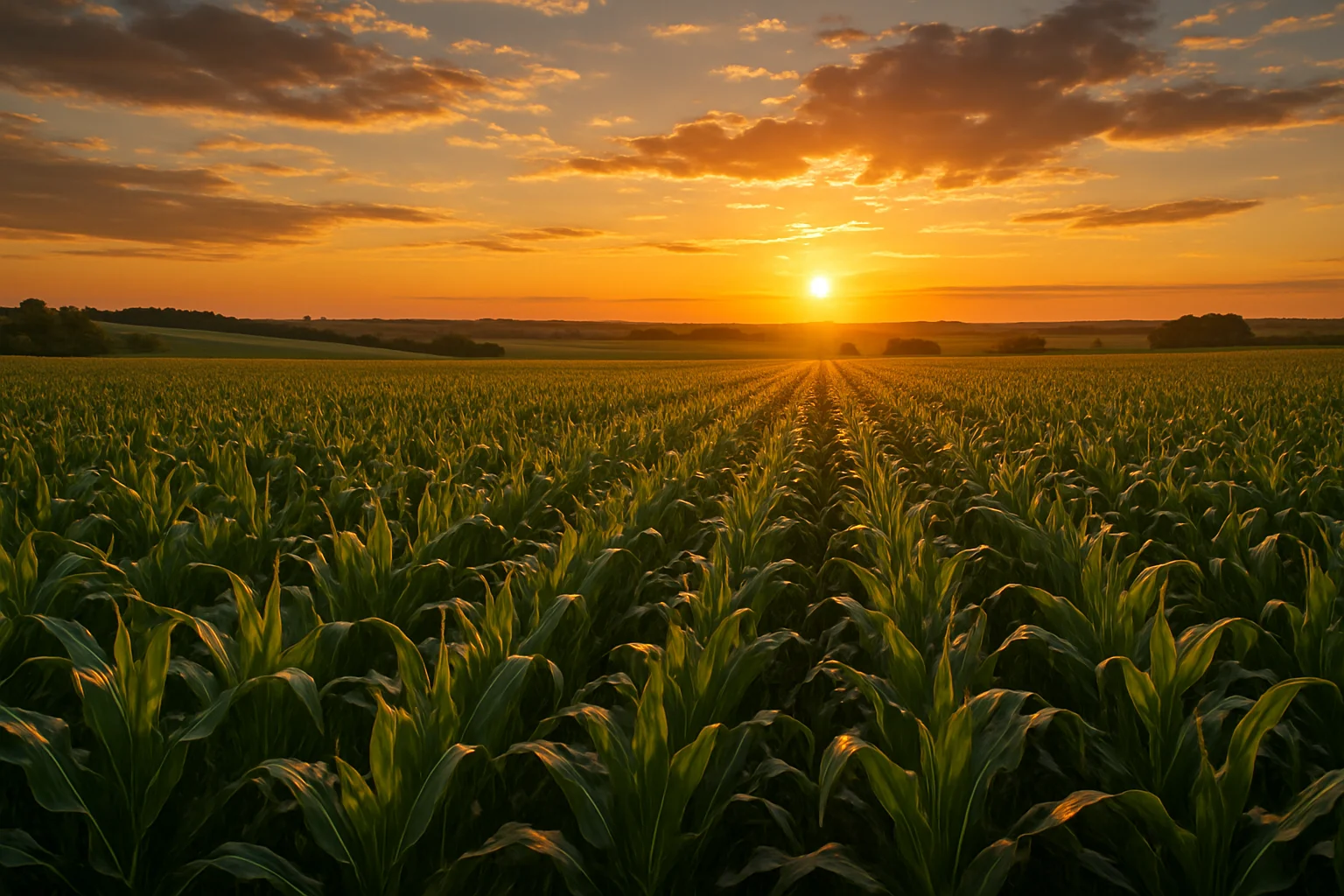
The flat, impossibly fertile prairie surrounding it grows some of the most productive corn and soybean fields on Earth.
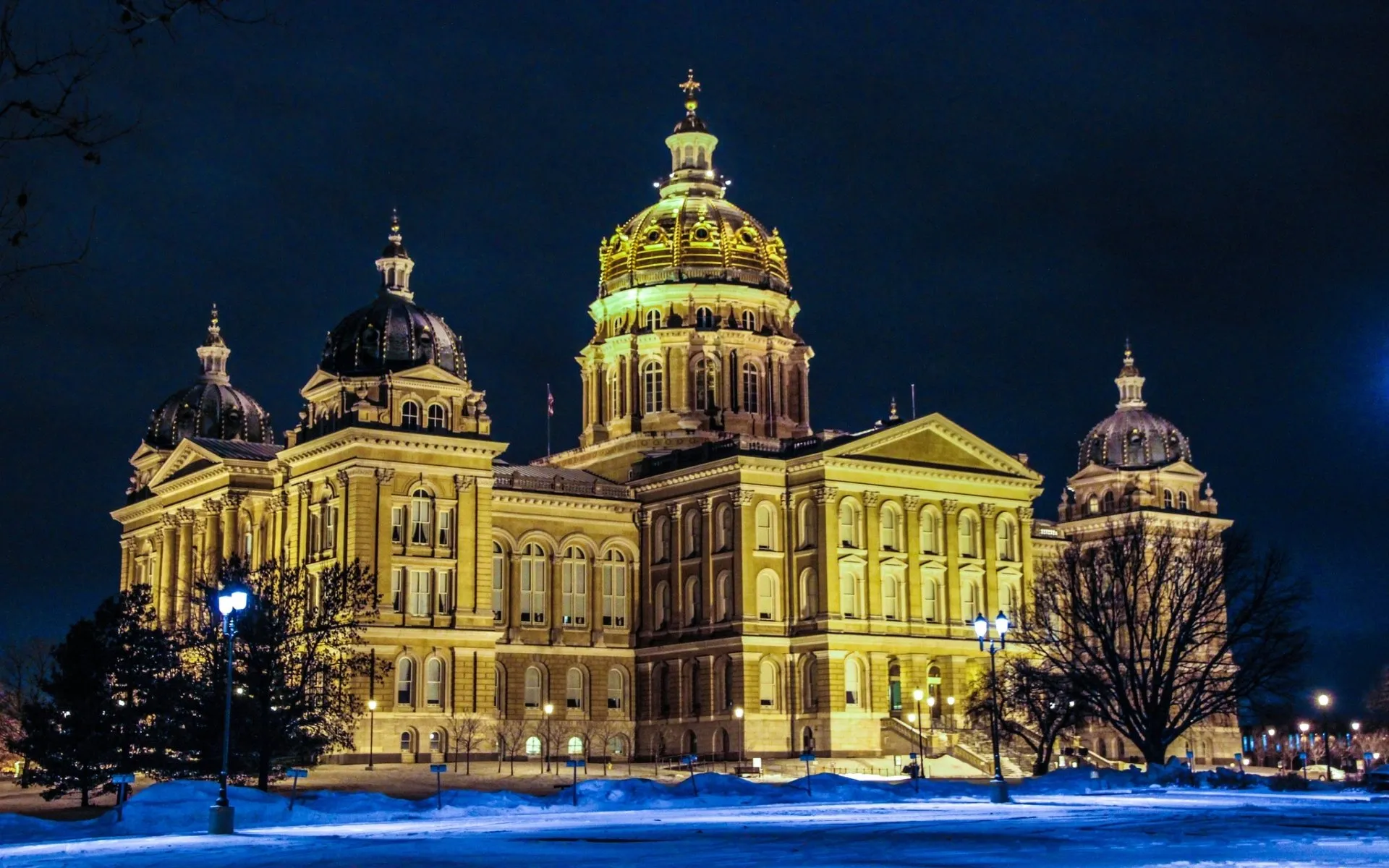
Des Moines was laid out in 1843 around a military post, Fort Des Moines, and became the permanent state capital in 1857, taking the seat of government from Iowa City. The gold-domed Iowa State Capitol, completed in 1886, is the only five-domed capitol in the country. Polk County holds roughly 500,000 people, about a sixth of the state, and the metro has grown past 700,000, one of the faster-growing in the Midwest.
Principal Financial Group, founded in Des Moines in 1879, anchors an insurance cluster that also includes Nationwide, Wellmark Blue Cross Blue Shield, and EMC, together employing tens of thousands downtown. The city rebuilt its riverfront after the catastrophic 1993 flood, when the Des Moines Water Works treatment plant was submerged and about 250,000 people went without running tap water for 12 days. Every four years, the caucuses turn the city into a temporary national media capital.
Iowa's eastern border is defined by the Mississippi River, one of America's most consequential waterways. The Quad Cities, Davenport and Bettendorf on the Iowa side, Rock Island and Moline in Illinois, form a bi-state metro of 450,000 that has historically been a manufacturing and river trade center.
Iowa City, home to the University of Iowa and the first of only two UNESCO Cities of Literature in the United States (with Seattle), anchors the intellectual and creative life of the region. Dubuque, the oldest city in Iowa, sits on limestone bluffs overlooking the Mississippi and has transformed from an industrial river town into a tech and insurance hub.
The Mississippi here is a working river run by a chain of locks and dams the Army Corps of Engineers built in the 1930s, keeping a nine-foot channel so barges can move Iowa grain south toward the Gulf. Near Marquette, Effigy Mounds National Monument protects more than 200 prehistoric earthworks, some shaped like bears and birds, built by Native peoples between roughly 500 BC and 1300 AD.
Cedar Rapids, the second-largest city, is a corn-milling center where Quaker Oats, Cargill, and ADM operate some of the world's largest cereal and wet-milling plants, earning it the local nickname 'City of Five Smells.' A 2008 flood on the Cedar River put much of downtown under water and caused billions in damage, and a 2020 derecho packing 140-mph winds destroyed an estimated ten million trees across the corridor in a matter of hours.
Iowa's western edge follows the Missouri River along the Nebraska and South Dakota borders. Council Bluffs, across the river from Omaha, is the largest city in western Iowa and an important freight and logistics hub.
The Loess Hills, a rare geological formation of wind-deposited soil rising 200 feet above the Missouri River floodplain, stretch along the western edge and represent one of the largest loess deposits in the world outside China. Sioux City anchors the northwest corner, a meat processing and agricultural services center serving a tri-state area.
Abraham Lincoln designated Council Bluffs the eastern terminus of the first transcontinental railroad in 1863, and the Union Pacific still routes heavy freight through the area; the cheap grid power drew large Google and Microsoft data centers to the city. The Lewis and Clark expedition held its first formal council with Native leaders, members of the Oto and Missouria, near the site in August 1804, which is how Council Bluffs got its name.
The Loess Hills run about 200 miles from Sioux City to the Missouri state line and occur in comparable depth only along the Yellow River in China. Sioux City's stockyards were once among the busiest in the nation; today Tyson, Seaboard Triumph Foods, and other packers make the metro a major pork and beef processing center whose workforce depends heavily on immigrant and refugee labor.
Northern Iowa is classic glaciated prairie, pancake-flat terrain left by retreating glaciers, dotted with small lakes, wetlands, and some of the most productive farmland in the world. The Iowa Great Lakes region near Spirit Lake is the state's primary recreational lake district.
The region is also Iowa's wind energy frontier: thousands of wind turbines dot the horizon, generating electricity that has made Iowa the national leader in wind energy as a share of total power generation. Mason City and Fort Dodge anchor the regional economy.
The Iowa Great Lakes, West Okoboji, East Okoboji, and Spirit Lake, were carved by the Des Moines Lobe, the last glacier to reach the state, which retreated only about 12,000 years ago and left the surrounding flat, poorly drained 'prairie pothole' country. West Okoboji is one of only a few true blue-water spring-fed lakes in the world.
The Spirit Lake Massacre of March 1857, in which a band led by the Dakota leader Inkpaduta killed roughly 35 settlers, was the last major violent clash between settlers and Native people in Iowa. The steady winds off the open prairie now turn thousands of turbines; MidAmerican Energy, owned by Berkshire Hathaway, has poured well over 10 billion dollars into Iowa wind and says it generates the equivalent of 100% of its Iowa customers' annual electricity use from renewables.

Economy
Iowa's economy is built on an agricultural foundation but diversified by financial services, manufacturing, energy, and biofuels into one of the most resilient state economies in the Midwest.
Iowa is the undisputed center of American food production. The state leads the nation in hog production, with roughly 23 million hogs, there are more pigs than people.
Iowa is consistently #1 or #2 nationally in corn production, #1 or #2 in soybeans, and the top egg-producing state in America. The agricultural output flows through a massive processing infrastructure: Iowa is home to major meatpacking operations (Tyson, Iowa Premium), grain elevators, ethanol plants, and feed manufacturers that together make the state one of the most economically productive per capita in the Midwest.
Iowa has roughly 30 million acres of farmland, about 85% of the state's land area, spread across some 85,000 farms averaging around 350 acres. Cropland values have climbed to records, averaging above 11,000 dollars an acre statewide in 2023 in the annual Iowa State University land-value survey, which has tracked prices since 1941.
The scale of livestock production is also Iowa's biggest water-quality problem. The Des Moines Water Works sued three upstream drainage districts in 2015 over nitrate runoff from farm fields, a case a federal judge dismissed in 2017, and the state's voluntary Nutrient Reduction Strategy has been criticized for slow progress. Farm income is heavily exposed to trade policy: the 2018-2019 tariff fight with China sharply cut Iowa soybean exports before federal payments partly filled the gap.
Iowa has become a national model for wind energy transition. More than 60% of the electricity generated in Iowa comes from wind turbines, the highest percentage of any state in the country. The state hosts over 5,000 wind turbines and has attracted billions in investment from energy companies.
Iowa's flat terrain, consistent winds, and available land make it ideal for large-scale wind development. The wind industry employs thousands of Iowans in manufacturing, installation, and maintenance, including at a major MHI Vestas turbine blade factory in Newton.
Iowa passed the nation's first renewable portfolio standard in 1983, requiring utilities to buy a set amount of renewable power, and its first utility-scale turbines went up near Storm Lake in 1999. By 2022 wind supplied about 62% of the state's electricity generation, ahead of Kansas and Oklahoma and the highest share of any state.
MidAmerican Energy and Alliant Energy together have invested more than 15 billion dollars in Iowa wind, and the state now has over 6,000 turbines. Manufacturing followed the turbines: blade and component plants opened in Newton, Fort Madison, and West Branch, though the Newton blade plant has since changed owners and cut jobs as on-again, off-again federal tax credits whipsawed national demand.
Des Moines hosts the headquarters of Principal Financial Group, EMC Insurance, Wellmark Blue Cross Blue Shield, FBL Financial, and dozens of other major insurance and financial companies. The concentration of insurance companies in Iowa dates to the late 19th century and has made the state's capital city a financial center disproportionate to its population.
Principal Financial alone manages over $500 billion in assets. The financial services sector is the single largest non-farm employer in the state.
The cluster traces to 1867, when the Equitable Life Insurance Company of Iowa was chartered in Des Moines; by the 1910s the city was promoting itself as an insurance capital to rival Hartford. Insurance-friendly state regulation and a central-time-zone location convenient for national call centers helped the sector expand through the 20th century.
Principal Financial Group, a Fortune 500 company, now manages more than 650 billion dollars in assets. Other large local employers include Nationwide, which absorbed Des Moines-based Allied Insurance, Voya, and Wells Fargo, which runs one of its largest operations campuses anywhere in West Des Moines with well over 10,000 employees. Financial activities make up a larger share of Iowa's economy than they do nationally.
John Deere, though headquartered across the Mississippi in Moline, Illinois, has its largest manufacturing operations in Iowa, with major plants in Waterloo, Dubuque, and Ottumwa that employ thousands. Pella Corporation, headquartered in Pella, Iowa, is one of America's premier window and door manufacturers.
Quaker Oats has a major oatmeal processing facility in Cedar Rapids. The food processing industry, turning Iowa's agricultural output into consumer products, is one of the state's largest manufacturing sectors.
John Deere's Waterloo operations, tractor assembly, an engine works, and a foundry, employ well over 5,000 people and are the company's largest manufacturing footprint anywhere. Deere workers in Iowa were at the center of a five-week United Auto Workers strike in the fall of 2021 that ended with a contract raising pay about 20% over its term and drawing national attention during a wave of labor actions.
Winnebago Industries built the American motorhome business from Forest City, Iowa, starting in 1958, and it remains a major employer there. Vermeer, a family-owned maker of hay balers and trenching equipment in Pella, had a large plant destroyed by an EF3 tornado in July 2018; none of the roughly 1,000 people sheltering inside were killed, and the company rebuilt on the same site.
Iowa is the nation's top ethanol-producing state, home to dozens of ethanol plants that convert corn into fuel blended with gasoline across the country. Iowa produces roughly 4 billion gallons of ethanol annually, about 30% of all U.S. ethanol production.
The industry has been a major economic driver in rural Iowa, providing a market for corn surplus and jobs in processing towns. Iowa also produces significant quantities of biodiesel from soybean oil.
Iowa has more than 40 ethanol plants and about a dozen biodiesel plants, most built during a boom that followed the federal Renewable Fuel Standard mandates of 2005 and 2007. Roughly half of Iowa's corn crop now goes to ethanol, and the distillers grains left over from the process are sold back to farmers as high-protein livestock feed.
The industry's next fight is over carbon pipelines. Summit Carbon Solutions has proposed a multi-state pipeline to carry captured carbon dioxide from Iowa ethanol plants to underground storage in North Dakota, which would let the fuel qualify for federal low-carbon credits, but the project has met fierce opposition from landowners over the threatened use of eminent domain, and its Iowa permit remained contested in the courts as of 2024.
How Iowa's State Government Works
Iowa operates a three-branch state government. The Iowa General Assembly consists of a 50-member Senate (four-year staggered terms) and a 100-member House of Representatives (two-year terms). Iowa's governor serves four-year terms with no term limits.
Iowa has been a reliably Republican state since the early 2010s, though it was genuinely competitive throughout much of the late 20th century. The state voted for Barack Obama in 2008 and 2012 before shifting sharply toward Donald Trump in 2016 and 2020, in one of the most dramatic partisan realignments of any state in the country. Republicans now hold the governorship, both Senate seats, and large legislative majorities.
Iowa's caucus system, which gives the state first-in-the-nation status in presidential primaries, has given it disproportionate political influence for over fifty years. Presidential hopefuls must spend months in Iowa, meeting voters in diners and community halls, courting the state's agricultural and evangelical constituencies.
Governor of Iowa
Current Governor
Kim Reynolds

- Party
- Republican
- In Office Since
- May 24, 2017
- Elected
- 2018, re-elected 2022 (+19 pts)
- Term Ends
- January 2027
- Born
- August 4, 1969, St. Charles, Iowa
- Background
- Small business owner, county treasurer
- Prior Role
- Iowa Lieutenant Governor (2011–2017)
Kim Reynolds is the 43rd Governor of Iowa and the first woman ever elected governor in Iowa's history. She assumed office in 2017 when Governor Terry Branstad was appointed U.S. Ambassador to China, then won election in her own right. She has focused on tax cuts, school choice legislation, and positioning Iowa as a model for conservative governance.
Other Current State Officials
Lieutenant Governor
Chris Cournoyer
Appointed by Governor Reynolds in December 2024 after Adam Gregg (lieutenant governor 2017 to 2024) resigned. A former state senator from the Quad Cities area, she previously served on a local school board.
Attorney General
Brenna Bird
In office since January 2023. Former prosecutor and county attorney from Story County. Focus on farm protection, human trafficking, and challenging federal overreach.
State Auditor
Rob Sand
In office since January 2019, re-elected 2022. The lone Democrat elected statewide in Iowa. Former federal prosecutor. Focus on government accountability and fraud prevention.
The Iowa General Assembly
Iowa State Senate
- Seats: 50 members
- Terms: 4-year terms
The upper chamber. Iowa senators serve staggered 4-year terms, with half the chamber on the ballot every two years.
Iowa House of Representatives
- Seats: 100 members
- Terms: 2-year terms
The lower chamber. All 100 Iowa House seats are on the ballot every two years. The Iowa House has been one of the more competitive chambers in recent cycles, though Republicans have held the majority in recent years.
Iowa's U.S. Senators
U.S. Senator
Chuck Grassley
One of the longest-serving senators in American history, Grassley was first elected in 1980 and was re-elected in 2022 at age 89, among the oldest people ever elected to a full Senate term (Strom Thurmond was 93 when re-elected in 1996). A farmer from New Hartford, Iowa, he has served on the Senate Judiciary and Finance committees for decades and has been a leading voice on oversight, whistleblower protections, and government transparency. His streak of 8,927 consecutive roll-call votes, broken in 2020, is the second-longest in Senate history after William Proxmire's 10,252. In 2025 he became President pro tempore of the Senate and chairman of the Judiciary Committee.
U.S. Senator
Joni Ernst
A retired Army National Guard lieutenant colonel who served in Kuwait and Iraq. Won her 2014 Senate race with the memorable campaign ad: 'I grew up castrating hogs on an Iowa farm, so when I get to Washington, I'll know how to cut pork.' Re-elected in 2020. Serves on the Armed Services and Agriculture committees. Focuses on military readiness, farm policy, and government waste reduction.
Iowa Through the Years
From early settlement to the present day. Tap any era to read more.
Iowa's rich prairies and river valleys were home to several Indigenous nations before European contact. The Meskwaki (Fox) and Sauk people inhabited the eastern and central regions, living in permanent villages along the major rivers and farming alongside hunting and fishing.
The Dakota Sioux dominated the northwestern prairies. The 1832 Black Hawk War, fought partially in Iowa, ended with the forced cession of Sauk and Meskwaki lands east of the Mississippi, opening the territory to rapid American settlement.
After the 1832 cession the Sauk and Meskwaki were removed to Kansas, but a group of Meskwaki quietly came back, and in 1857 they used their own funds to buy 80 acres of land along the Iowa River in Tama County. That land, held in federal trust and steadily expanded to roughly 8,000 acres with about 1,400 residents, is the Meskwaki Settlement, the only tribal land in Iowa.
The state's name comes from the Ioway (Baxoje) people, who by the 1830s had largely been pushed onto reservations in Nebraska, Kansas, and Oklahoma. Black Hawk, the Sauk leader whose 1832 resistance gave the war its name, dictated an autobiography in 1833 that became one of the first Native American autobiographies published in the United States and a widely read account of dispossession.
Iowa was admitted to the Union on December 28, 1846 as the 29th state, a free state admitted in tandem with Florida (a slave state) to maintain the sectional balance. Iowa had been organized as a territory in 1838 and grew rapidly as settlers from the East pushed westward along the National Road and river systems.
The state's rich prairie soil attracted German, Scandinavian, and Bohemian immigrants who became the backbone of its agricultural economy.
Voters rejected Iowa's first proposed constitution in 1844, in part because Congress had drawn the new state's boundaries too small; a second constitution with the borders Iowa still has was approved in 1846. The capital was moved from Iowa City to the more central Des Moines in 1857, and the University of Iowa took over the vacated Old Capitol building.
Iowa's 1857 constitution, still in effect, was strikingly progressive for its era. The Iowa Supreme Court struck down school segregation in Clark v. Board of Directors (1868), 86 years before Brown v. Board of Education, and barred racial discrimination on steamboats in Coger v. North Western Union Packet Co. (1873). In 1869 Iowa admitted Arabella Mansfield to the bar, making her the first woman licensed to practice law in the United States.
Iowa's record in the Civil War was remarkable even by the standards of the era. The state sent approximately 76,000 men to fight for the Union, roughly 60% of all men of military age. Iowa suffered more casualties as a share of its population than almost any other Northern state.
Not a single Iowa regiment refused to re-enlist when their initial terms expired. Iowa's fierce commitment to the Union cause shaped its political identity as reliably Republican for generations afterward.
Iowa raised 48 infantry regiments, nine cavalry regiments, and four artillery batteries. About 13,000 Iowa soldiers died, the large majority from disease rather than battle, and Iowa units fought at Shiloh, in the Vicksburg campaign, and alongside Sherman on the march through Georgia.
Governor Samuel Kirkwood, a close Lincoln ally, became known as Iowa's 'war governor' and later served as a U.S. senator and Secretary of the Interior. The war fixed Iowa's politics for decades: the state voted Republican in every presidential election from 1856 through 1928 except for 1912, one of the most consistent partisan records of any state.
The arrival of railroads transformed Iowa from a frontier territory into the agricultural powerhouse it remains today. Rail lines criss-crossed the state in the 1860s and 1870s, opening markets for Iowa's corn and hogs to eastern cities and export ports.
Iowa quickly became the most productive agricultural state per capita in the nation. The railroad also brought the first wave of large-scale immigration, particularly from Germany and Scandinavia, and established the small-town infrastructure of grain elevators, banks, and merchants that still defines rural Iowa.
By 1870 five land-grant railroads had crossed Iowa west to the Missouri River. Farmer anger over freight rates led the legislature to pass the 'Granger Laws' in 1874, capping what railroads and grain elevators could charge; the U.S. Supreme Court upheld that kind of state regulation in the 1877 Granger Cases, a foundational precedent for government oversight of private business.
The rail grid set Iowa's settlement pattern in place: county-seat towns spaced about a day's wagon haul apart, each with a courthouse, grain elevators, and a main street. Immigrant groups clustered by origin, Germans around Dubuque and the Amana Colonies, Dutch at Pella and Orange City, Czechs in Cedar Rapids, Norwegians in Winneshiek County, and those communities' churches and festivals still mark the map today.
The 1980s Farm Crisis devastated rural Iowa more than almost any other state. Rising interest rates, falling land prices, and collapsing commodity markets triggered a wave of farm foreclosures that drove tens of thousands of farm families off land their families had worked for generations. Iowa lost 20% of its farm operators in just five years.
Small towns across the state collapsed as their economic base disappeared. The crisis reshaped Iowa's politics, accelerated rural depopulation, and left psychological scars that still inform the state's political identity, particularly its wariness of Wall Street and trade policy.
Farmland that sold for around 2,000 dollars an acre in 1979 fell to roughly 800 by 1986, erasing the equity farmers had borrowed against when interest rates on operating loans reached 18 to 21%. 'Sheriff's sales' of foreclosed farms became common scenes, hundreds of rural banks failed, and the pressure helped shape the disaster provisions of the 1985 Farm Bill.
The crisis gave rise to Farm Aid, the annual benefit concert Willie Nelson, Neil Young, and John Mellencamp first staged in 1985, and to activist groups such as PrairieFire and the Iowa Farm Unity Coalition. In one case near Lone Tree in December 1985 that came to symbolize the era's despair, a farmer facing foreclosure killed his banker and a neighbor before killing his wife and himself.
Since 1972, Iowa has held the first presidential nominating contest in the country, the Iowa caucuses. The unusual format, in which voters gather in schools and community centers to physically stand in groups supporting their candidate, has made Iowa a must-win state for presidential hopefuls and a media circus every four years.
Iowa's caucuses have launched careers (Barack Obama in 2008, Jimmy Carter in 1976) and ended them. The state's outsized political influence, driven by its first-in-the-nation status rather than its population, has been both celebrated and criticized for giving disproportionate power to a predominantly white, rural state.
Iowa landed at the front of the calendar almost by accident. After the turbulent 1968 Democratic convention, the party's reworked 1972 rules required more time between each stage of delegate selection, and Iowa's multi-step caucus-to-convention process forced it to schedule its precinct caucuses in January. Jimmy Carter's 1976 campaign spotted the opening and turned Iowa into the model for months of face-to-face retail campaigning.
The 2020 Democratic caucuses collapsed when a new results-reporting app failed and the count was delayed for days, undercutting Iowa's argument for going first. In 2022 the Democratic National Committee removed Iowa from the lead-off slot for 2024 in favor of South Carolina; Iowa Republicans kept their caucuses first, holding them on January 15, 2024, where Donald Trump won by about 30 points.
Iowa's Defining Moments in American History
These are the events that didn't just shape Iowa, they changed the nation.
Since 1972, the Iowa caucuses have been the first contest of every presidential primary season, giving this state of 3.2 million people extraordinary influence over who becomes president. Jimmy Carter's surprise 1976 Iowa showing launched his candidacy.
Barack Obama's 2008 Iowa caucus win, in a predominantly white state, proved his national viability and effectively made him the Democratic frontrunner. The caucuses have been controversial: critics argue Iowa is too white, too rural, and too unrepresentative to hold such an early and influential role in picking the nation's leader.
The caucuses are run by the political parties, not the state, and historically required voters to show up in person for as long as two hours on a January weeknight, which held turnout far below a normal primary and tilted it toward the most committed activists. Candidates spent a year or more building precinct-level organizations, and a strong Iowa finish could unlock national donors and momentum out of proportion to the roughly 40 delegates each party awarded.
After the 2020 reporting meltdown, national Democrats ended Iowa's first-in-the-nation status, and Iowa Democrats switched to a mail-in preference vote for 2024. Iowa Republicans held their caucuses first on January 15, 2024, where Donald Trump won by about 30 points, the widest margin in a contested Iowa Republican caucus, before the party's nominating calendar moved on to New Hampshire.
Iowa has emerged as the unexpected national leader in wind energy. More than 60% of Iowa's electricity now comes from wind turbines, the highest percentage of any state. Iowa's early investment in wind infrastructure, driven by state renewable energy mandates and federal tax credits, has created thousands of jobs and billions in rural economic activity.
The state's experience has become a model studied by other states and nations seeking to rapidly decarbonize their electricity grids. Iowa proves that a landlocked, agricultural state can lead the clean energy transition.
Iowa's 1983 Alternative Energy Production law was the first state renewable-electricity requirement in the country, and governors of both parties kept the policy steady for four decades. The federal wind production tax credit, first passed in 1992, did much of the rest, and Iowa's flat land and farm-lease culture, where turbines pay landowners several thousand dollars a year each, made siting relatively easy.
Wind now supports an estimated 5,000 to 6,000 Iowa jobs and pays tens of millions of dollars a year in property taxes to rural counties and school districts. The cheap power has become an economic-development tool in its own right: Facebook, Google, Microsoft, and Apple have all built large Iowa data centers, each citing access to renewable electricity as a reason for choosing the state.
The 1989 film Field of Dreams, based on W.P. Kinsella's novel Shoeless Joe, was filmed on an actual farm near Dyersville, Iowa and became one of the most beloved sports films in American history. The farm still operates and draws hundreds of thousands of visitors annually.
In 2021, Major League Baseball hosted its first Field of Dreams Game in Dyersville, with the Chicago White Sox and New York Yankees playing on a temporary diamond carved from the surrounding cornfield. The game drew the highest television ratings for a regular-season MLB game in 16 years.
The movie was shot over the summer of 1988 on the Lansing family farm, with the ballfield built across two adjoining properties. For years afterward the two owners ran competing halves of the attraction before the site was consolidated and sold in 2011 to investors who added a larger complex; the original field remains free to visit and draws roughly 100,000 people a year.
The 2021 MLB game drew about 8 million viewers on Fox, the largest audience for a regular-season game since 2005, and the White Sox won on a walk-off home run by Tim Anderson. A second game followed in 2022 between the Cubs and Reds, and the league then paused the series while a permanent stadium and youth-baseball complex were built on the site.
Notable Iowans
Herbert Hoover
31st President of the United States, born in West Branch
John Wayne
Hollywood icon and Academy Award winner, born in Winterset
Grant Wood
Painter of American Gothic, one of the most recognized American artworks, born in Anamosa
Shawn Johnson
Olympic gymnastics gold medalist at the 2008 Beijing Games, born in Des Moines
Bob Feller
Baseball Hall of Famer known as Rapid Robert, born in Van Meter
Ashton Kutcher
Actor and technology investor, born in Cedar Rapids
State Symbols & Quick Facts
| Nickname | "The Hawkeye State" |
| Capital | Des Moines |
| Largest City | Des Moines |
| Statehood | December 28, 1846 (29th state) |
| Population | ~3.2 million (2025 est.) |
| Area | 56,273 sq mi, 26th largest state |
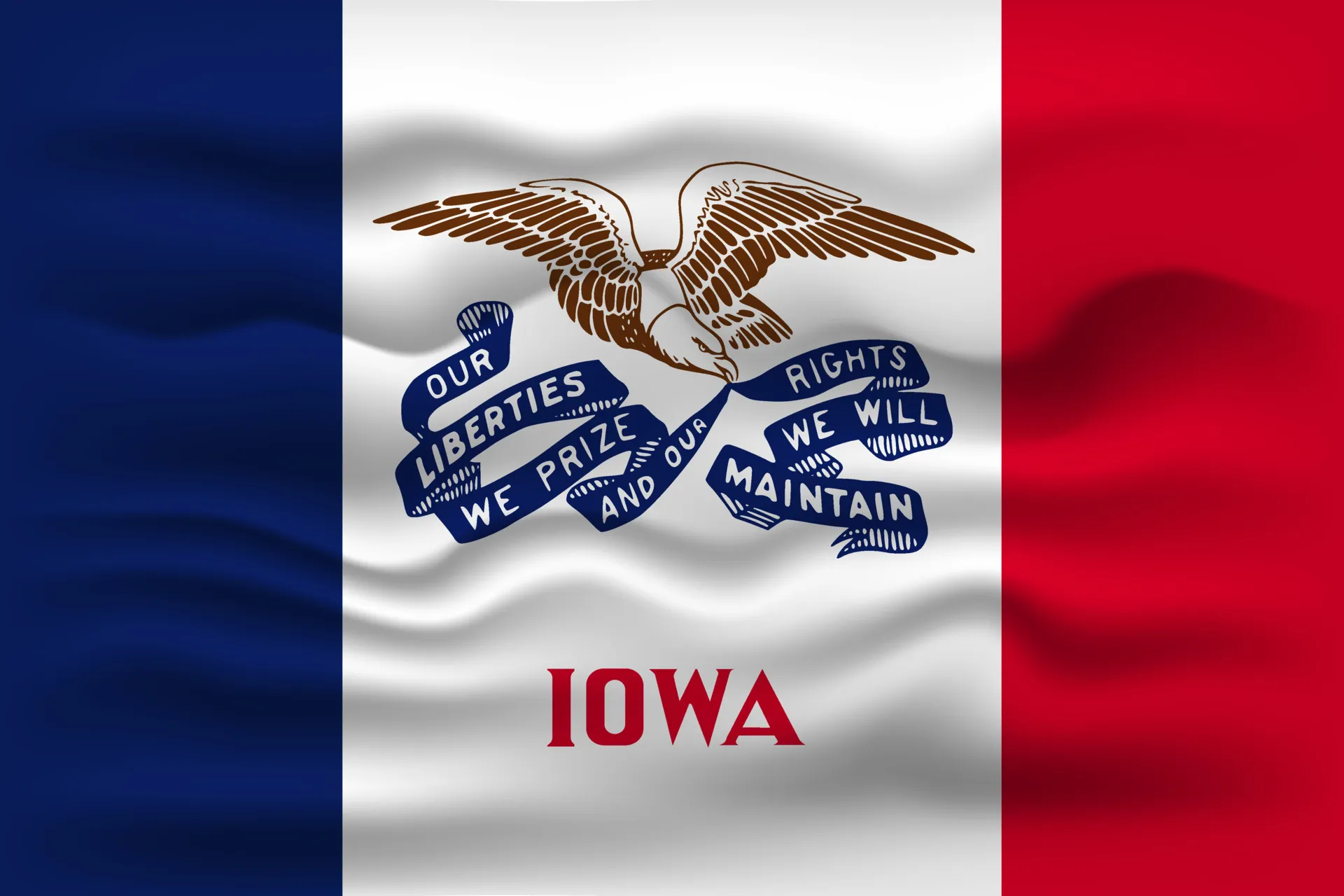
| Motto | Our Liberties We Prize and Our Rights We Will Maintain |
| State Bird | Eastern Goldfinch (American Goldfinch) |
| State Flower | Wild Prairie Rose |
| State Tree | Oak |
| State Rock | Geode |
| State Song | "The Song of Iowa" |
| Time Zone | Central Time (UTC−6 / UTC−5) |
| Borders | Minnesota (N), Wisconsin & Illinois (E across Mississippi), Missouri (S), Nebraska & South Dakota (W across Missouri River) |
Did You Know?
Iowa has more hogs than people, roughly 23 million pigs versus 3.2 million human residents. The state produces about 30% of all pork consumed in the United States, and its hog confinement operations are among the largest in the world.
Senator Chuck Grassley of Iowa cast 8,927 consecutive roll-call votes from 1993 to 2020, the second-longest streak in Senate history after William Proxmire's 10,252. Re-elected in 2022 at age 89, he is among the oldest people ever elected to a full Senate term.
Iowa City became the first UNESCO City of Literature in the United States in 2008, and only Seattle (2017) has joined it since. The designation recognizes the city's concentration of literary culture, driven by the University of Iowa Writers' Workshop, founded in 1936 and one of the most renowned creative writing programs in America.
Iowa produces about 30% of all ethanol made in the United States, more than any other state. Dozens of plants across Iowa convert corn into fuel that is blended into gasoline sold at filling stations across the country.
The Iowa State Fair in Des Moines is one of the largest state fairs in America, drawing over a million visitors annually. It is famous for its butter cow, a life-sized sculpture of a cow carved from 600 pounds of butter, displayed in a refrigerated case. The butter cow has been a fair tradition since 1911.
Quick Facts and Common Questions
Short answers to the questions people most often ask about Iowa: its abbreviation, how it became a state, its capital, and its role in presidential elections.
Iowa's two-letter postal abbreviation is IA. The U.S. Census Bureau places it in the Midwest region, in the West North Central division, and about 3.19 million people lived there in the 2020 census.
Iowa became the 29th state on December 28, 1846. Its land was part of the Louisiana Purchase of 1803, and Congress created the Iowa Territory in 1838.
Iowa is named for the Iowa River, which took its name from the Ioway people, who call themselves Báxoje. The name was used by French and English writers in many spellings before settling on "Iowa."
Des Moines has been the capital since 1857. Burlington served as the territorial capital from 1838 to 1841, and Iowa City was the capital from 1841 to 1857, when the government moved to the more central Des Moines. Iowa City's Old Capitol is now part of the University of Iowa, and the current State Capitol in Des Moines was completed in 1886.
Iowa borders Minnesota to the north, Wisconsin and Illinois to the east, Missouri to the south, and Nebraska and South Dakota to the west. Rivers form almost all of its eastern and western borders: the Mississippi on the east, and the Missouri and Big Sioux on the west.
Iowa is known as "The Hawkeye State." Its motto is "Our liberties we prize and our rights we will maintain." Its state bird is the eastern goldfinch, its flower is the wild prairie rose, and its tree is the oak.
Based on the 2020 census, Iowa has 4 seats in the U.S. House of Representatives, the same as before, which gives it 6 votes in the Electoral College.
Beginning in the 1970s, the Iowa caucuses were for decades the first major contest in the race for each party's presidential nomination, giving the state outsized attention from candidates. The national parties set the calendar, and the Democratic Party changed its early-state order for 2024. Learn more about how elections work.
Effigy Mounds National Monument
Sacred Earthworks Built by Indigenous People Over 2,500 Years Along the Mississippi River
About Effigy Mounds National Monument
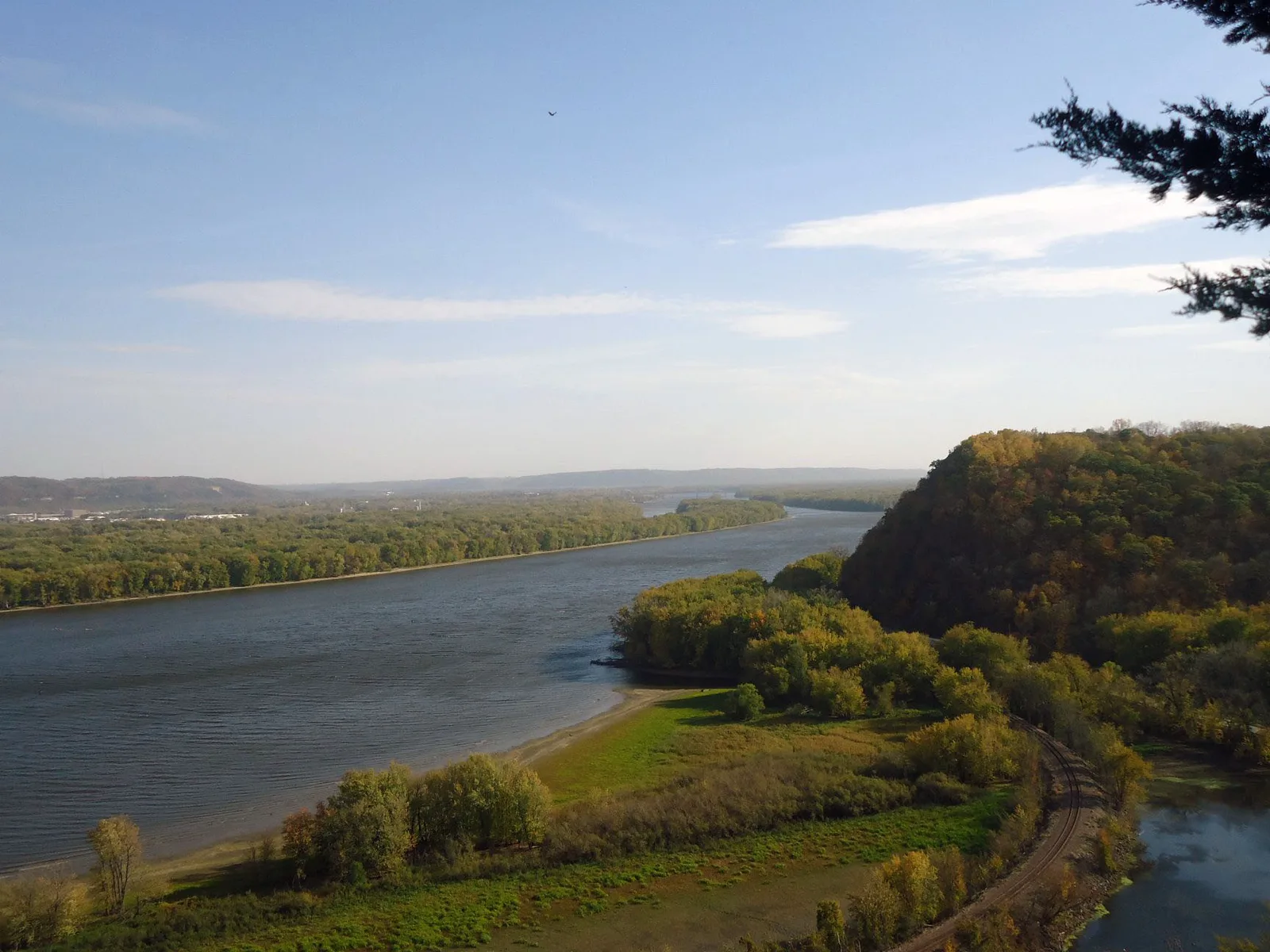
Effigy Mounds National Monument protects about 2,500 acres of forested Mississippi River bluff in far northeastern Iowa, containing roughly 206 recorded Native American mounds, 31 of them shaped as bears and birds.
The conical burial mounds here were built as early as 500 BCE, but the effigies, low earthen figures a few feet high, date mostly to between about 700 and 1100 CE, the work of Late Woodland people archaeologists call the Effigy Moundbuilders.
Effigy mounds of this kind are found almost nowhere outside a small region of the Upper Midwest, and this monument holds one of its densest and best-preserved concentrations, including the Marching Bears, a line of ten bear figures and three birds strung along a clifftop.
President Truman proclaimed the monument on October 25, 1949, after decades of survey work by the Iowa archaeologists Charles Keyes and Ellison Orr; today it consults with roughly 20 affiliated tribal nations whose members regard the mounds as the graves and sacred works of their ancestors.
- Designation
- National Monument
- Location
- Harpers Ferry, Allamakee County, Iowa
- Established
- October 25, 1949
- Annual Visitors
- ~150,000
The Mound Builders' World
The oldest mounds on the bluffs are simple domes and long low ridges, most of them built between about 500 BCE and 700 CE as burial and ceremonial sites.
Many hold one or a few burials placed on the old ground surface or in a shallow pit and then covered with basket-loads of earth; others appear to hold no burials at all.
The earliest, from the Middle Woodland period, reflect contact with the Hopewell exchange network, which moved copper from Lake Superior, obsidian from the Yellowstone country, and marine shell from the Gulf across the eastern half of the continent.
Linear mounds, some more than 100 feet long, often connect or align with other mounds and may mark boundaries or paths rather than graves.
The bird effigies, built with outstretched wings that can span more than 100 feet, are among the largest figures at the monument; the Great Hawk in the North Unit is a well-known example.
They are generally read as thunderbirds or other sky beings, part of a widespread Upper Midwestern belief in an 'upper world' of birds set against a 'lower world' of water spirits.
Effigy groups often pair sky and earth figures, birds alongside bears or long-tailed 'water panthers,' which some archaeologists interpret as a balancing of those worlds in a single ceremonial ground.
Because the shapes read clearly only from above, aerial photography beginning in the 1930s and, more recently, airborne lidar have been essential to mapping and studying them.
The Marching Bears group in the South Unit, ten bear figures walking in the same direction along the bluff with three birds among them, is the monument's signature feature and a formation with no known parallel.
The Great Bear Mound in the North Unit is about 137 feet long and 3 to 4 feet high, one of the largest bear effigies anywhere.
Bears may stand for clans, for the earth or 'lower world,' or for spirit helpers; Ho-Chunk and other descendant nations connect the figures to clan identity and to the dead.
The effigies were shaped by hand, one basket of soil at a time, with no evidence of draft animals or specialized tools, a communal effort spread over generations.
The monument sits in the Driftless Area, a corner of the Upper Midwest the last glaciers missed, so its rivers have cut deep, steep-walled valleys instead of the flat till plains around it.
The bluffs rise as much as 300 to 450 feet above the river, with long views into Wisconsin and Minnesota from Fire Point and Hanging Rock.
The Mississippi corridor was a major travel and trade route for thousands of years and a rich source of fish, mussels, waterfowl, and bottomland plant foods.
The mound builders placed most of their effigies right at the bluff edge, overlooking the river, a siting that descendant nations and archaeologists both read as deliberate and significant.
Indigenous Connections
Ho-Chunk Nation
The Ho-Chunk, or Hoocak (Winnebago), regard northeastern Iowa and southwestern Wisconsin as part of their homeland and the effigy mounds as the burial places and sacred works of their ancestors.
The United States forced the Ho-Chunk out of the region in a series of removals between the 1830s and 1870s, to Iowa, Minnesota, South Dakota, and Nebraska; many walked back repeatedly.
Those who returned to Wisconsin without a reservation became today's Wisconsin Ho-Chunk Nation, while those held in Nebraska became the federally separate Winnebago Tribe of Nebraska.
The Ho-Chunk Nation maintains a formal consulting relationship with the National Park Service. Tribal representatives participate in monument management decisions, particularly regarding repatriation of ancestral remains and objects.
Meskwaki Nation (Sac and Fox)
The Meskwaki (Fox) and their Sauk allies lived across the Upper Mississippi valley in the 1700s and 1800s and count the effigy mounds among sites tied to their ceremonial life and origin stories.
After the 1832 Black Hawk War the United States pushed the Sauk and Meskwaki out of Iowa; in the 1850s a group of Meskwaki pooled money and bought back land along the Iowa River near Tama.
That purchase became the Meskwaki Settlement, land the tribe owns outright rather than holding in federal trust as a reservation, and the only tribally owned land in Iowa.
The Meskwaki Settlement near Tama, Iowa, is the only tribally-owned land in Iowa not on a federal reservation. The nation participates in NPS consultation and advocates for the protection of mound sites throughout the region.
Exploring Effigy Mounds
Great Bear Mound Trail
From the visitor center the trail climbs the bluff by switchbacks, gaining about 350 feet through oak and maple forest to the clifftop.
It passes conical mounds and the Little Bear and Great Bear effigies; the Great Bear, roughly 137 feet long, is easiest to make out in low morning or evening light when the shadows pick up its outline.
Longer routes continue south along the ridge toward Hanging Rock and, in the separate South Unit, the Marching Bears.
Rangers ask hikers to stay on the tread and never walk on a mound; the effigies are unmarked graves, and foot traffic compacts and erodes them.
Fire Point Trail
Fire Point is a bluff-edge overlook in the North Unit with a wide view up and down the Mississippi into Wisconsin and Minnesota.
The trail passes tallgrass prairie that the Park Service has replanted and burns periodically, recreating the open bluff top the mound builders would have known.
Several conical mounds and a compact effigy group lie right along the path near the point.
The name comes from evidence of long use of the spot for fires; it is one of the monument's most visited features and the turnaround for many day hikers.
Visitor Center and Mound View
The visitor center, rebuilt and reopened in 2016, has exhibits on Woodland life, mound building, and the descendant nations, developed with tribal input.
A short, level, accessible trail from the building reaches ground-level views of several conical mounds for visitors who cannot manage the bluff climb.
Rangers lead guided hikes in summer and run programs on effigy mapping, prairie restoration, and repatriation under the Native American Graves Protection and Repatriation Act.
The center also tells the monument's own difficult recent history, including the removal of ancestral remains by a former superintendent and unauthorized construction on mounds in the 2000s.
Conservation Challenges
Erosion and Freeze-Thaw Cycles
The mounds are unlined heaps of soil, and every hard rain and every winter freeze-and-thaw moves a little of that soil downhill.
On the steep bluff edges where many effigies sit, undercutting and slumping are constant threats, and a few mounds have partly slid over the cliff.
Park crews regrade drainage, fill gullies, and reseed bare spots with deep-rooted native grasses whose roots hold the surface together.
Wetter, more intense storms and a longer freeze-thaw shoulder season are expected to speed this loss, making monitoring and small repairs a permanent job.
Invasive Species
Garlic mustard, bush honeysuckle, and multiflora rose have spread into the monument's forests and prairies, shading out the native grasses and sedges that armor the mound surfaces.
Where invasive shrubs take over, the ground beneath goes bare and erodes faster, and roots and animal burrows in the loosened soil can distort a mound's shape.
Restoration crews pull, cut, and spot-treat invasives every year and use prescribed fire on the prairie units to favor native plants.
The goal is a stable cover of native vegetation, the same kind of plant community that protected these earthworks for the better part of a thousand years.
Construction Damage and Management Failures
Between about 1999 and 2010 the monument built roughly half a mile of boardwalks, plus sheds and other structures, on and around mounds without the required archaeological review or tribal consultation.
A National Park Service investigation completed in the mid-2010s found that at least 78 mounds had been damaged, and the responsible superintendent left the agency.
Separately, a former superintendent was found in 2016 to have removed human remains from the monument around 1990 and kept them for roughly two decades before they were returned; he pleaded guilty to a federal charge.
The Park Service removed the unauthorized structures, rebuilt its consultation process with the affiliated tribes, and now treats the episode as a case study in what the law requires.
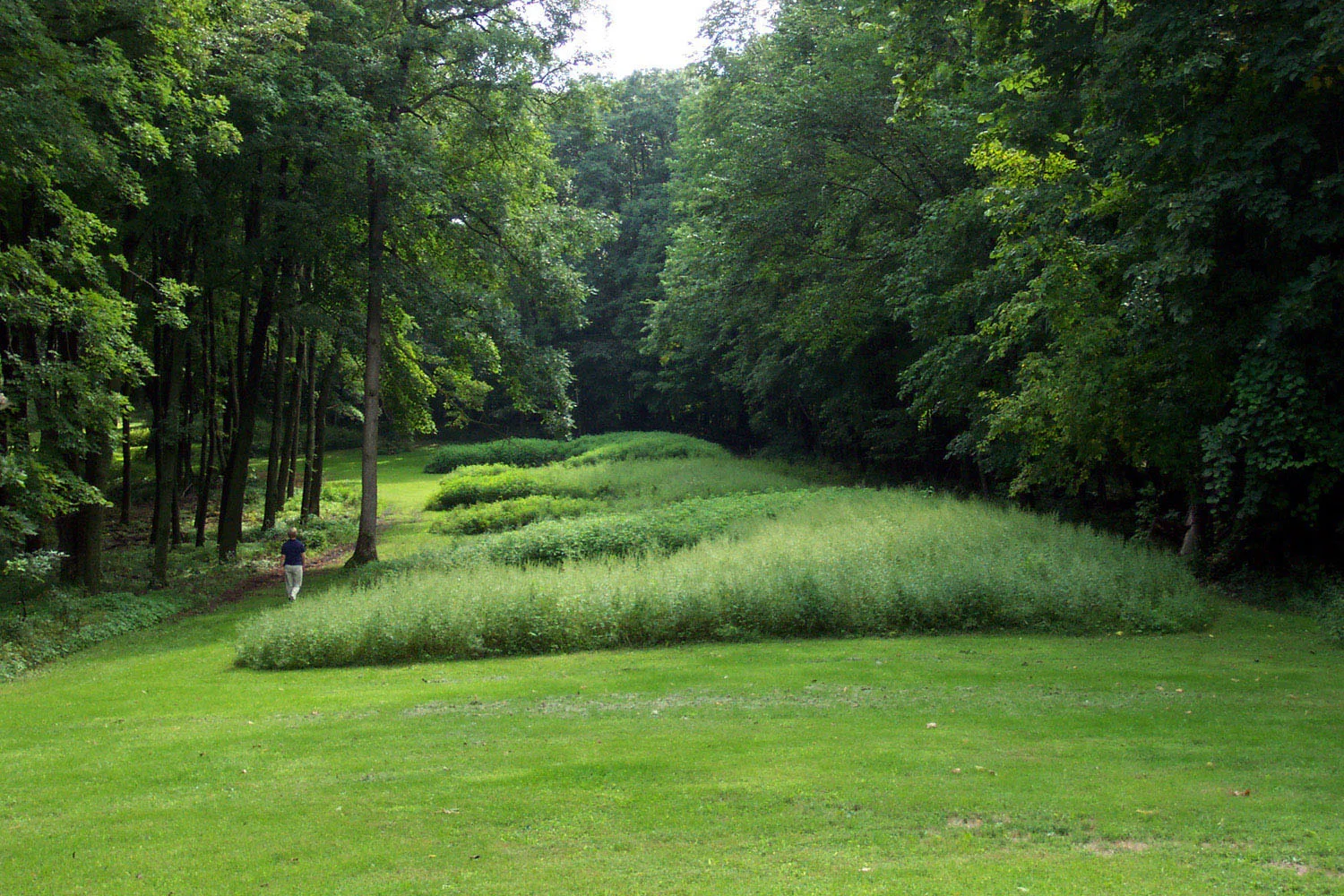
The Marching Bears, 10 bear effigy mounds in procession along the bluff top
At a Glance
Did You Know?
The Marching Bears mound group contains 10 bear effigies walking in the same direction, a formation unique in North American mound building.
Hopewell people transported copper from Michigan's Upper Peninsula and obsidian from Yellowstone to Iowa, evidence of vast trade networks spanning thousands of miles.
Some researchers believe effigy mound alignments correspond to celestial events, including solstice sunrises and moonrise positions, suggesting sophisticated astronomical knowledge.
Plan Your Visit
Location
Harpers Ferry, Allamakee County, Iowa
Designation
National Monument
Best Time to Visit
May through October; fall foliage frames the blufftop mound views
Admission
Free; visitor center has exhibits and ranger programs