About Pennsylvania
Pennsylvania was named by King Charles II of England in 1681 in honor of Admiral Sir William Penn, the father of the colony's founder, William Penn. The king owed a debt of 16,000 pounds to Admiral Penn, and he repaid it with a grant of land in North America. The name combines "Penn" with "sylvania," from the Latin word for woodland or forest, creating "Penn's Woodland." William Penn himself was uncomfortable with the name, worrying it appeared self-aggrandizing and would make him look as though he had named the colony after himself. He requested that the king call it "New Wales" or simply "Sylvania," but Charles II insisted on Pennsylvania. Penn went on to found Philadelphia and design one of the most tolerant and democratic colonies in British North America.
Pennsylvania is the state where America was invented. The Declaration of Independence was signed here. The Constitution was written here. The Continental Army was forged at Valley Forge. The bloodiest battle of the Civil War, the battle whose outcome determined that the Union would survive, was fought at Gettysburg, and it was over the Pennsylvania fields near Shanksville that the passengers of Flight 93 made the decision that kept the U.S. Capitol standing on September 11, 2001. No other state has been so repeatedly present at the moments that defined the country.
Pennsylvania is also a state of remarkable contrasts. Philadelphia and Pittsburgh, its two great cities, are culturally as different from each other as Boston is from Chicago, separated by 300 miles and by distinct histories, accents, and identities. Between them lies a landscape that moves from the Amish farms of Lancaster County, the most productive non-irrigated farmland in the United States, through the coal towns of the Alleghenies to the robotic research laboratories of Carnegie Mellon University, where the future of artificial intelligence is being shaped in the same city that built the industrial 20th century.
Pennsylvania has been a crucial battleground state in every presidential election in living memory, and its political geography, Democratic cities, Republican rural counties, and competitive suburbs in the middle, mirrors the national divide so precisely that Pennsylvania has become the state that political scientists use as a baseline for understanding American electoral geography. Its destiny and the nation's have been intertwined since 1681 and show no sign of separating.
Pennsylvania's Five Regions
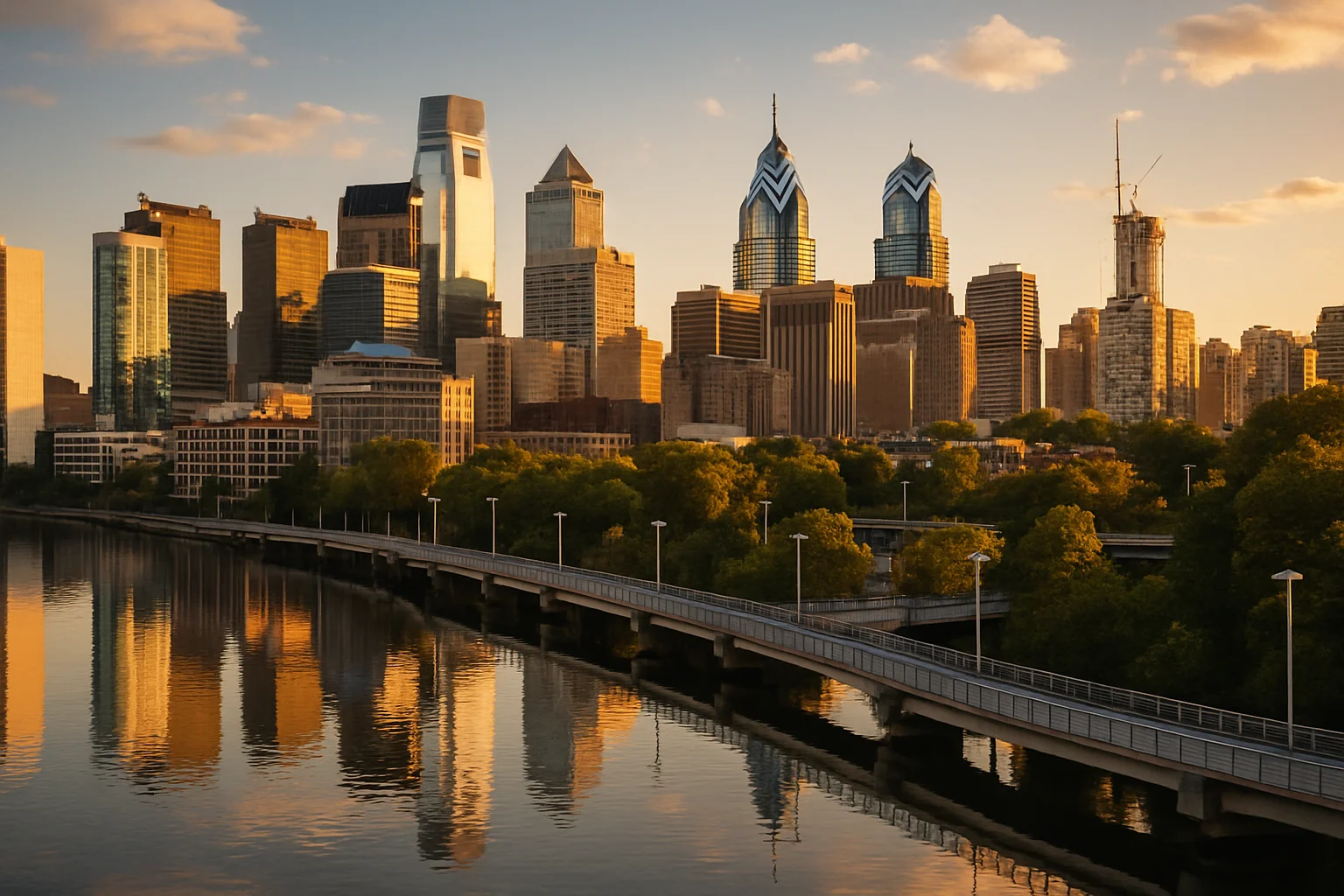
Philadelphia, the City of Brotherly Love, was the most important city in North America for much of the 18th century and remains one of the great American cities, defined by its revolutionary history, its distinguished cultural institutions, its working-class neighborhoods, and a civic pride that finds particular expression in its sports culture, arguably the most passionate and demanding fan base in American professional sports. The city of 1.6 million (metropolitan area 6.2 million) was the largest city in colonial America and served as the nation's capital from 1790 to 1800 while Washington DC was constructed.
The historic district centered on Independence Hall, where both the Declaration of Independence and the Constitution were signed, where the Liberty Bell hung for a century, and where George Washington presided over the Constitutional Convention, is the most historically significant urban block in the United States and one of the most visited in the world. The Philadelphia Museum of Art (whose grand steps were immortalized by Rocky in a scene that has since generated more tourism than any artwork inside the building), the Barnes Foundation (arguably the finest collection of Impressionist and Post-Impressionist paintings in the world), the Philadelphia Orchestra (one of the great orchestras in American history), and the University of Pennsylvania (one of the original Ivy League institutions, founded 1740 by Benjamin Franklin) anchor a cultural infrastructure of extraordinary depth.
The Amtrak Northeast Corridor, which carries more passengers than any other rail line in the United States, has Philadelphia's 30th Street Station as its largest station.
The southeastern Pennsylvania suburbs, Main Line communities, Chester County, Montgomery County, form one of the wealthiest suburban landscapes in the country, driven by the pharmaceutical, finance, and healthcare industries clustered along the I-76 and Route 30 corridors.
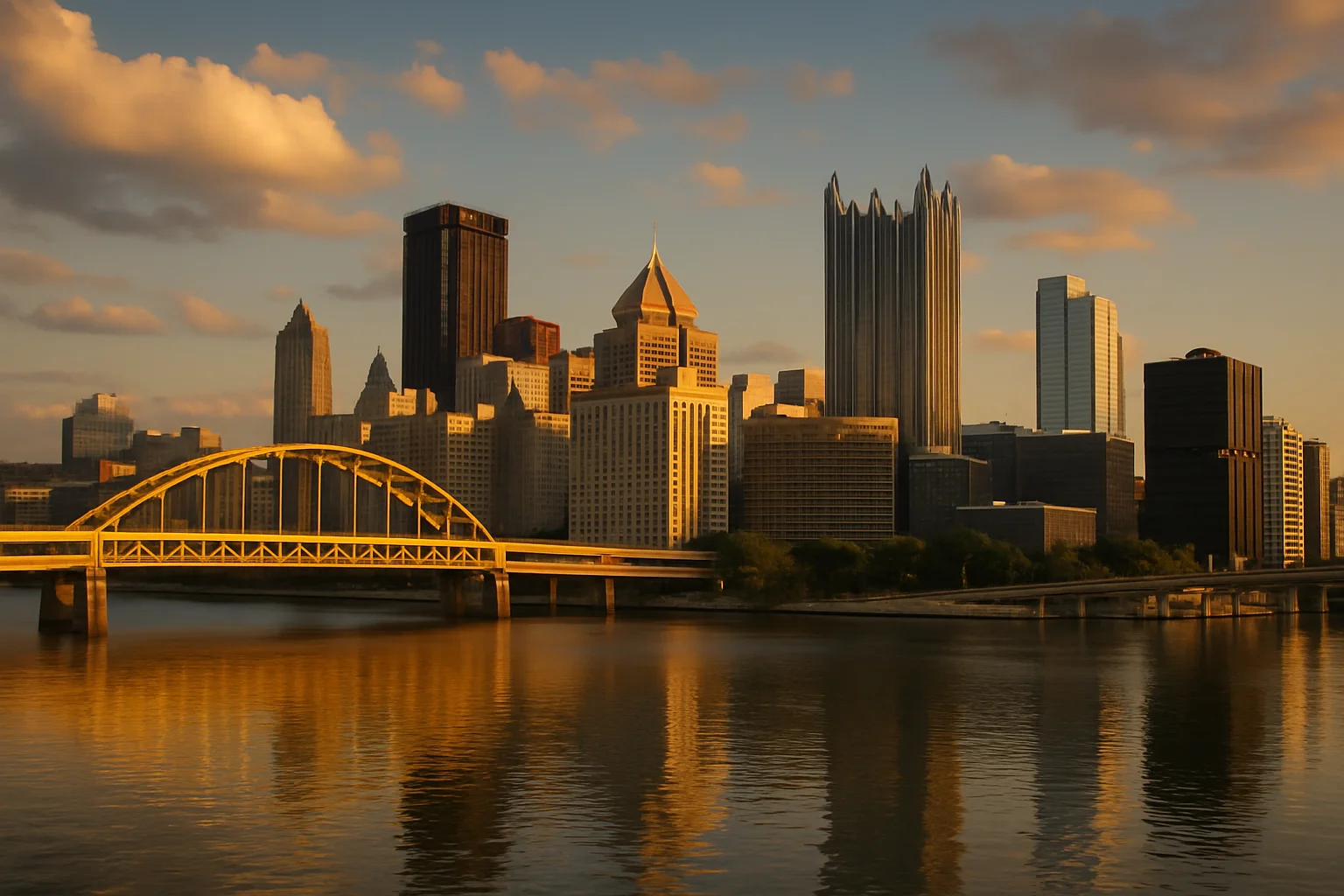
Pittsburgh, at the confluence of the Allegheny and Monongahela rivers, which join to form the Ohio River at the city's iconic Point State Park 'Golden Triangle', is one of the great American urban comeback stories, a city that went from producing half the world's steel to being cited as a model of post-industrial reinvention. The physical landscape of Pittsburgh is extraordinary: built on steep hillsides and river valleys that required the construction of inclined planes (the Duquesne and Monongahela Inclines still operate as tourist attractions and commuter routes), crossed by 446 bridges, more than any city in the world, including Venice, and divided into 90 distinct neighborhoods of remarkable ethnic and cultural variety, Pittsburgh offers a density of built environment and human character that surprises visitors expecting a deindustrialized wasteland.
The Cathedral of Learning at the University of Pittsburgh, a 42-story Gothic tower containing 30 classrooms designed in the architectural styles of different nations, is the second-tallest academic building in the world and one of the most unusual university structures in America. Carnegie Mellon University, a few blocks away, has transformed the Pittsburgh economy from a steel-dependent monoculture to a global technology hub.
The North Shore, redeveloped around PNC Park (consistently ranked among the most beautiful baseball stadiums in the country) and Acrisure Stadium, has drawn visitors and residents back to the city's waterfront. The Strip District, once a wholesale produce market, has become one of the most vibrant food and nightlife neighborhoods in the Midwest.
Pittsburgh's population has declined from its 1950 peak of 676,000 to approximately 300,000, but the broader metropolitan area of 2.4 million remains the state's second economic center.
Lancaster County and its surrounding Pennsylvania Dutch (Deutsch, German-origin) communities represent one of the most distinctive and thoroughly studied agricultural and cultural landscapes in the United States. The term 'Pennsylvania Dutch' refers not to the Netherlands but to the German-speaking (Deutsch) immigrants, Reformed, Lutheran, Mennonite, and Amish, who flooded into William Penn's tolerant colony from the Palatinate and other German states in the 18th century, attracted by Penn's promise of religious freedom and cheap land.
The Amish and Old Order Mennonite communities that survive in Lancaster County and adjacent counties (particularly in the 'Big Valley' of Mifflin County and the Holmes County-adjacent communities) are the most visible expression of this culture, but Pennsylvania Dutch heritage permeates the entire region's food (shoofly pie, Lebanon bologna, scrapple, funnel cake), architecture (hex signs on barns, distinctive farmhouse styles), and religious landscape. Lancaster City, the county seat, is a small city of 60,000 that punches far above its weight culturally: its downtown has been revitalized by a restaurant scene, arts community, and immigrant population that has made it one of the more cited examples of mid-sized city renewal in the Northeast.
The Pennsylvania Dutch country draws over 10 million tourists annually to its farm markets, quilt shops, buggy rides, and Amish farm tours, an agritourism economy that generates over $2 billion annually and is the primary economic driver for rural communities that have maintained their farming character through active preservation and zoning. Gettysburg, in Adams County at the western edge of the Pennsylvania Dutch region, is the most visited Civil War site in the country.
Lancaster County has become an unlikely center of refugee resettlement, taking in more refugees per capita than almost any U.S. county, so that the city of Lancaster now has significant Bhutanese, Congolese, Iraqi, and Vietnamese communities alongside a long-established Puerto Rican population; that diversity, plus the tourism economy, has turned Lancaster city Democratic in a heavily Republican county.
The Amish here are not a museum exhibit but a growing society under strain: land at 15,000 to 25,000 dollars an acre has pushed many families into carpentry, furniture-making, and small manufacturing shops, and a chronic conflict runs between plain-community practices and modern regulation, over milk pasteurization, building codes, septic rules, and, in a long-running case, a 2019 to 2021 fight over whether a Lancaster County dairy could sell raw milk and herd shares.
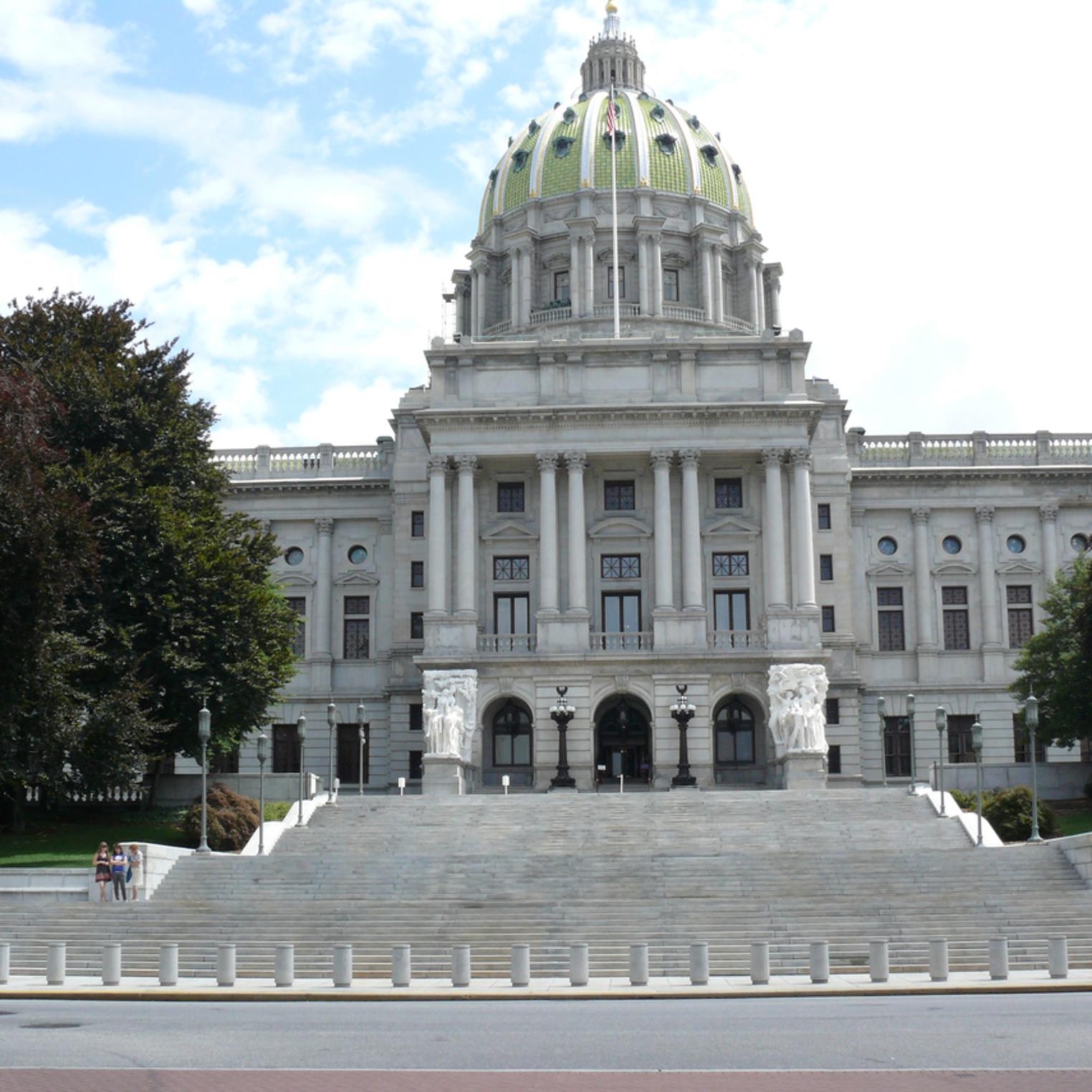
Beyond Lancaster, south-central Pennsylvania holds Hershey, the chocolate company town with its own amusement park and medical center; York, once 'the first capital of the United States' when the Continental Congress met there in 1777 to 1778; and Harrisburg, the state capital, whose 1906 Beaux-Arts capitol Theodore Roosevelt called 'the handsomest building I ever saw' and which was also the center of a 2010s municipal debt crisis over a failed incinerator.
The central spine of Pennsylvania, dominated by the parallel ridges and valleys of the Ridge and Valley physiographic province and the broad Allegheny Plateau to the west, is the part of the state most shaped by the coal economy that defined Pennsylvania's industrial character for a century and then collapsed, leaving behind communities whose recovery has been slow, incomplete, and economically challenged. The anthracite coal fields of Schuylkill, Carbon, Luzerne, and Lackawanna counties in the northeastern part of this region were the dominant source of America's home heating fuel from the Civil War through World War II; the collapse of anthracite demand as oil and natural gas replaced coal for heating sent these communities into an economic tailspin from which many have not recovered.
Scranton and Wilkes-Barre, the twin cities of the Wyoming Valley, have worked for decades to rebuild post-coal economies around healthcare, education (University of Scranton, Wilkes University, Misericordia), and logistics (their location at the intersection of I-81 and I-80 has attracted distribution warehouses). The north-central Pennsylvania counties of Lycoming, Clinton, Potter, Tioga, and their neighbors constitute one of the most sparsely populated and scenically beautiful regions in the eastern United States: the Pine Creek Gorge in Tioga County, often called the 'Pennsylvania Grand Canyon,' is a 1,450-foot-deep gorge carved by a glacial lake outlet that offers hiking, kayaking, and wilderness scenery comparable to the Appalachian West.
Penn State University's main campus at State College (University Park) sits in Centre County, the geographic center of Pennsylvania, and constitutes with its 46,000 students an economic and cultural island of considerable size in an otherwise rural landscape.
The anthracite towns were built and broken by one industry. Coal drew Irish, Welsh, Polish, Italian, Lithuanian, and Slovak immigrants who filled the parishes and social clubs still visible in Scranton and Hazleton, and it produced some of the deadliest disasters and hardest strikes in American history, the 1902 anthracite strike that Theodore Roosevelt personally settled, and the 1959 Knox Mine disaster near Pittston, when the Susquehanna River broke into the workings and killed 12 men and effectively ended deep anthracite mining. A mine fire that started in 1962 under the town of Centralia still burns and has reduced the borough to a handful of residents.
Johnstown, in the Alleghenies proper, is remembered for the 1889 flood, when a poorly maintained private dam above a millionaires' fishing club failed and a wall of water killed more than 2,200 people in minutes, one of the deadliest disasters in U.S. history and a landmark in the law of corporate liability; the town flooded catastrophically again in 1936 and 1977.
Today the region's economy leans on prisons, hospitals, warehouses at the I-80/I-81 crossroads, Penn State and the smaller state universities, gas drilling in the northern tier, and outdoor tourism on the Pine Creek rail-trail and the state's large public forests and game lands; population in most of the coal and central counties has been flat or falling for decades.
Northeastern Pennsylvania encompasses two quite different landscapes and economic realities: the Pocono Mountains resort region, which has been drawing vacationers from New York City and Philadelphia since the railroad era, and the Lehigh Valley industrial corridor, one of the most economically significant small metropolitan areas in the Northeast. The Pocono Mountains, a plateau rising to approximately 2,000 feet in the counties of Monroe, Pike, and Wayne immediately west and north of the Delaware Water Gap, have been a resort destination since the 1880s, when railroad connections made the cool mountain lakes accessible to New York City's middle and working classes.
The region developed a distinctive honeymoon resort economy, heart-shaped bathtubs and champagne glass hot tubs became emblematic of Pocono resort culture in the 1960s and 1970s, and has since evolved into a broader outdoor recreation destination with skiing at Camelback and Jack Frost/Big Boulder, boating on Lake Wallenpaupack, hiking in Delaware Water Gap National Recreation Area, and outdoor sports tourism that draws millions of New Yorkers and Philadelphians annually. The Lehigh Valley, centered on Allentown, Bethlehem, and Easton, is one of the most economically complex small metropolitan areas in America.
Bethlehem Steel, once the second-largest steel company in the United States, dominated the Lehigh Valley economy for most of the 20th century; its Bethlehem works, which at peak employed 31,000 workers on a 1,800-acre site along the Lehigh River, has been converted into the SteelStacks arts and entertainment campus, one of the most acclaimed adaptive reuse projects in the country.
The Lehigh Valley has attracted distribution centers, healthcare facilities, and light manufacturing that have made it one of the more economically resilient mid-sized metros in the Northeast.

Economy
Pennsylvania's $960 billion economy is the sixth largest in the nation, a diverse, resilient machine built on world-class healthcare, transformative technology research, energy extraction, sophisticated manufacturing, and the agricultural heritage of the most productive farmland in the eastern United States.
The University of Pennsylvania Health System (Penn Medicine), encompassing the Hospital of the University of Pennsylvania, Pennsylvania Hospital (the oldest hospital in the United States, founded by Benjamin Franklin in 1751), and multiple specialty hospitals across the Philadelphia region, consistently ranks among the top medical systems in the country and conducts research that has produced fundamental advances in gene therapy, immunotherapy, and organ transplantation. The mRNA vaccine technology that underlies the Moderna and Pfizer-BioNTech COVID-19 vaccines was developed in significant part by Katalin Kariko and Drew Weissman at the University of Pennsylvania, work that won the 2023 Nobel Prize in Physiology or Medicine and represents one of the most consequential biomedical breakthroughs of the century.
Children's Hospital of Philadelphia (CHOP), founded in 1855 as the first children's hospital in America, is consistently ranked the top children's hospital in the United States and has pioneered fetal surgery, pediatric oncology, and treatments for rare genetic diseases. UPMC (University of Pittsburgh Medical Center), headquartered in Pittsburgh, has grown from a regional academic medical center into a global health enterprise with 40 hospitals, 800 doctors' offices, and operations on four continents; it is the largest employer in Pennsylvania and one of the largest nonprofit health systems in the world.
The Philadelphia-area life sciences corridor, centered on the University City district adjacent to Penn and Drexel, has become one of the most important biotech and pharmaceutical research hubs in the world, with companies developing cell and gene therapies, oncology drugs, and medical devices that represent the frontier of 21st-century medicine.
Philadelphia has a specific claim in the newest branch of medicine: the first two FDA-approved gene therapies came from work there, Spark Therapeutics' Luxturna for inherited blindness (2017), spun out of CHOP, and Kymriah, the first CAR-T cancer immunotherapy (2017), based on Carl June's lab at Penn. Roche bought Spark for about 4.8 billion dollars in 2019, and the region markets itself as 'Cellicon Valley.'
The two big systems are also political and fiscal giants. UPMC, a tax-exempt nonprofit, is Pennsylvania's largest private employer with roughly 90,000 workers, and its long feud with the insurer Highmark over which patients could use which hospitals prompted state intervention and a court-brokered access agreement. Pennsylvania's aging population and its large Medicaid and Medicare rolls make health care one of the biggest lines in the state budget.
Rural hospitals tell the other side of the story: more than a dozen Pennsylvania hospitals have closed or merged since 2010, and the state runs a first-in-the-nation 'global budget' program that pays participating rural hospitals a fixed annual sum regardless of patient volume, an experiment other states are watching.
Carnegie Mellon University, founded in 1900 by Andrew Carnegie and now consistently ranked among the top computer science and engineering institutions in the world, has been the engine of this transformation. CMU's School of Computer Science, its Robotics Institute (the largest university robotics research center in the world), and its Machine Learning Department have produced a disproportionate share of the foundational research in artificial intelligence, autonomous vehicles, natural language processing, and computer vision that underpins the global technology economy. Carnegie Mellon alumni have founded or led companies including Google, Apple, Intel, and dozens of AI startups.
Uber's Advanced Technologies Group chose Pittsburgh as its autonomous vehicle research headquarters in 2015, triggering an influx of technology investment that made Pittsburgh one of the most watched mid-sized tech cities in America. Aurora Innovation, developing self-driving truck technology, is headquartered in Pittsburgh. Duolingo, the language learning application with 500 million users, was founded at CMU and remains headquartered in Pittsburgh.
The University of Pittsburgh's own technology and research programs, combined with CMU's ecosystem, have made the Oakland neighborhood of Pittsburgh, where the two universities are adjacent, one of the densest concentrations of research talent in the world. Philadelphia's technology sector, centered on University City and the Navy Yard redevelopment, is a second significant tech hub, with strengths in health informatics, financial technology, and the defense and intelligence community.
CMU's computing pedigree is deep and specific: the first American computer science department was founded there in 1965, Herbert Simon and Allen Newell did the founding work of artificial intelligence in its offices, and a CMU vending machine wired to the ARPANET in 1982 is remembered as the first internet-connected appliance. The university also builds robots that go places people cannot, into the Chernobyl and Fukushima reactor buildings and, through a CMU-led team, to a near-win in NASA's lunar rover competitions.
The autonomous-vehicle boom that Uber's 2015 arrival set off has since cooled: Uber sold its self-driving unit to Aurora in 2020 after a fatal 2018 test crash in Arizona, and several Pittsburgh AV startups have downsized, but Aurora, Argo alumni, and Motional keep the cluster among the largest in the country, and Google, Meta, and Apple all run Pittsburgh engineering offices near CMU.
Pennsylvania as a whole has struggled to keep the talent it trains: Penn State, Pitt, CMU, Drexel, and Temple graduate tens of thousands of engineers and scientists a year, but the state has long had net out-migration of young college graduates to New York, Boston, and Washington, a 'brain drain' that economic-development officials treat as the central challenge.
Pennsylvania's natural gas production grew from negligible levels before 2008 to make the state consistently the first or second largest natural gas producer in the nation, with production exceeding six trillion cubic feet annually, a transformation of the state's energy sector as dramatic, in its own way, as the oil boom transformed Oklahoma. The Marcellus boom has brought economic activity to rural communities in the northern tier and western Pennsylvania, but it has also brought persistent environmental concerns: methane leakage, water contamination from improper well casings, the disposal of brine and fracking fluid, and the seismic activity associated with wastewater injection.
Pennsylvania's nuclear power sector is also significant: the state operates more nuclear reactors than any other, with plants including Three Mile Island Unit 1 (which operated for decades after its twin Unit 2's 1979 partial meltdown), Beaver Valley, Limerick, Peach Bottom, and Susquehanna providing a substantial portion of the state's electricity from zero-carbon generation.
The electricity transmission infrastructure of the PJM Interconnection, the largest electricity market in the world serving 13 states and DC, is operated from Norristown, Pennsylvania, and Pennsylvania sits at the physical and operational center of the Eastern Interconnection that powers the eastern United States.
Pennsylvania is the birthplace of the American oil industry: Edwin Drake drilled the first commercial oil well near Titusville in 1859, touching off a boom that made towns like Oil City and Pithole and gave rise to Standard Oil, and the state's Bradford field was for a time the source of most of the world's crude. Pennsylvania is also a major coal state still, the largest producer of anthracite (nearly all U.S. supply) and a significant bituminous producer, though mining employment is a fraction of its 1920s peak of over 350,000.
The fracking boom is contested politically as well as environmentally. Pennsylvania is the only major gas state with no severance tax on production, instead levying a per-well 'impact fee' that sends money to drilling-region counties, and repeated proposals for a severance tax have died in the legislature; a 2020 grand jury led by then-Attorney General Josh Shapiro found state regulators had failed for years to protect residents from fracking's health and water effects.
Pennsylvania joined the multistate Regional Greenhouse Gas Initiative carbon-cap program by executive action under Governor Tom Wolf in 2022, but the move was blocked by state courts and Republican lawmakers and remains unresolved, leaving the state, one of the largest carbon emitters in the country, without a settled climate-and-energy policy.
The Pittsburgh region's steel industry, which at its mid-20th century peak produced more steel than any geographic area outside the Ruhr Valley in Germany, built the modern United States: the bridges, skyscrapers, railroads, ships, tanks, and appliances of American industrial civilization were made from Pittsburgh steel. Andrew Carnegie's Carnegie Steel Company, which became U.S. Steel in 1901 in the largest corporate merger in American history at the time (capitalized at $1.4 billion, 7 percent of US GDP), dominated world steel production for decades.
The collapse of integrated steelmaking in the Monongahela Valley between 1977 and 1987, driven by foreign competition, aging plants, and the structural decline of the industries that consumed steel, was one of the most severe industrial contractions in American history, eliminating over 150,000 steelworking jobs in western Pennsylvania alone and devastating communities along the Mon Valley that have not fully recovered four decades later. The state's manufacturing base has been rebuilt around advanced sectors: specialty steel and metals (Allegheny Technologies in Pittsburgh, one of the world's leading specialty metals producers), defense manufacturing (BAE Systems, Lockheed Martin, and dozens of defense contractors), pharmaceutical manufacturing (GSK, Merck, and others with major Pennsylvania operations), food processing (Hershey, Campbell Soup, Heinz, all Pennsylvania companies), and a cluster of smaller precision manufacturers in the Lehigh Valley and south-central regions.
The manufacturing sector today employs far fewer people than in its steel-age peak but produces more economic value per worker, a transformation that has benefited those who remained employed but provided little comfort to the communities and workers displaced by the transition.
Pennsylvania industry ran on immigrant labor and made the state a cradle of American unionism: the Molly Maguires in the 1870s anthracite fields, the 1877 railroad strike that burned much of Pittsburgh, the 1892 Homestead battle, and the 1919 nationwide steel strike, largely broken in Pennsylvania, all shaped national labor law, and the United Steelworkers and the United Mine Workers are still headquartered or historically rooted in the state.
The food-and-consumer-goods sector is a distinct strength that survived deindustrialization better than heavy metal: Hershey (a company town built by chocolate magnate Milton Hershey, who also endowed a school for orphans that owns a controlling stake to this day), the Utz and Snyder's snack-food cluster around Hanover, Yuengling of Pottsville (America's oldest operating brewery, founded 1829), and Crayola in the Lehigh Valley are all Pennsylvania institutions.
The state has landed some large 21st-century plants, a Shell ethane 'cracker' near Monaca that opened in 2022 to turn Marcellus gas into plastic pellets, and Nestle, Amazon, and auto-parts investments, but manufacturing employment as a share of Pennsylvania jobs has kept sliding, and the political grievance over lost factory work is central to the state's status as a presidential swing state.
Lancaster County's Amish and Mennonite communities, descendants of Swiss-German Anabaptist immigrants who arrived in Pennsylvania in the early 18th century drawn by William Penn's promise of religious tolerance, farm approximately 400,000 acres of Lancaster County using methods that range from fully traditional horse-drawn cultivation to selective adoption of modern technology, producing some of the highest crop yields per acre of any farming system in America on intensively managed, multigenerational family farms. Pennsylvania is the nation's leading mushroom-producing state, with Kennett Square in Chester County growing approximately 65 percent of all commercially produced mushrooms in the United States, a concentration of mushroom cultivation that developed from the late 19th century in the area's abandoned mushroom beds and now constitutes a $600 million industry.
The state is also a major dairy producer, with Pennsylvania Dutch country's dairy farms contributing to a milk and cheese economy significant enough to support the state's status as one of the top dairy states.
Pennsylvania's wine industry, centered in the southeastern counties and in the Lake Erie shore region of Erie County, has grown to more than 300 wineries, and the state produces the majority of the nation's supply of several specialty crops including horseradish.
Lancaster County's productivity has a demographic driver: the Old Order Amish population of the U.S. has roughly doubled since 2000 to about 380,000, growing at nearly 3 percent a year because families average six or seven children and few young people leave, and the Lancaster settlement, the oldest and one of the largest, has spread its farms into surrounding counties and to new colonies as far as New York and Kentucky as local land prices climbed past 20,000 dollars an acre.
That growth has produced real friction. Amish and Mennonite farms are among the largest sources of the manure runoff that pollutes the Susquehanna and, through it, the Chesapeake Bay, and Pennsylvania has repeatedly fallen behind its federal Bay-cleanup targets, with agriculture the hardest sector to bring into compliance. Conservation districts now pay farmers to fence livestock out of streams and plant buffer strips.
Pennsylvania is also a leading producer of apples, Christmas trees, and eggs, and the Kennett Square mushroom industry, worth well over half a billion dollars, relies heavily on immigrant labor from Mexico and Central America, which has made the town a focus of federal immigration-enforcement fights.
Philadelphia was the financial capital of the United States from the founding era until New York surpassed it in the early 19th century: the First and Second Banks of the United States were both located in Philadelphia, and the Philadelphia Stock Exchange, founded in 1790, was the first stock exchange in the United States. The financial legacy persists: Vanguard Group, the world's second-largest investment management company with over $8 trillion in assets under management, is headquartered in Malvern, Pennsylvania (Chester County), and its founder John Bogle's invention of the index fund at Vanguard in 1976 is widely regarded as the most important innovation in retail investing history.
Lincoln Financial Group and Cigna, two major insurance companies, are headquartered in the Philadelphia suburbs. Comcast Corporation, the largest cable and media company in the United States and the parent company of NBCUniversal, is headquartered in Philadelphia and is the city's most prominent corporate citizen.
Pittsburgh's financial services sector, while smaller than Philadelphia's, includes PNC Financial Services (one of the ten largest US banks by assets, headquartered in Pittsburgh and deeply identified with the city), and the corporate successors to the industrial giants, Alcoa, U.S. Steel (still headquartered in Pittsburgh), PPG Industries, that once made Pittsburgh the industrial capital of the world.
Vanguard's rise is the single biggest financial story to come out of Pennsylvania since the 19th century. John Bogle founded it in 1974 on a legal structure in which the funds own the management company, so profits go back to investors as lower fees, and launched the first retail index fund in 1976 to widespread ridicule as 'un-American' for settling for the market average. It now runs on the order of 9 to 10 trillion dollars for tens of millions of savers and has driven fund fees industry-wide toward zero.
The 2008 financial crisis reshaped Pennsylvania banking: Pittsburgh's National City was absorbed and Philadelphia's Sovereign Bank became part of Santander, while PNC used federal bailout funds to buy the failing National City and roughly double in size. State pension funds, the two large systems for teachers and state workers, are chronically underfunded and a recurring budget crisis.
Pennsylvania also has an outsized insurance regulator: because so many national insurers are domiciled or were founded in the state (Erie Insurance in Erie, Highmark and other Blue Cross plans, Cigna and Lincoln Financial roots in the Philadelphia suburbs), the Pennsylvania Insurance Department's decisions on rates and mergers carry national weight.
How Pennsylvania's Government Works
Pennsylvania is the quintessential American battleground state: a Democratic governor, a Republican Senate, a narrowly divided House, two major cities that vote overwhelmingly Democratic, vast rural counties that vote overwhelmingly Republican, and competitive suburbs in the middle that swing every election. The state's electoral volatility, it voted for Obama twice, then for Trump in 2016, Biden in 2020, and has been decided by tens of thousands of votes in each presidential election, reflects a genuine ideological diversity that cannot be reduced to a simple partisan identity.
Pennsylvania has a strong-governor system with a separately elected lieutenant governor and attorney general, and a General Assembly in which divided government has been the norm more often than the exception in recent decades. The state's budget process has a chronic dysfunction problem: Pennsylvania has passed its budget on time in fewer than half the years since 1990, with late budgets sometimes extending months past the June 30 fiscal year deadline.
In February 2023, Commonwealth Court judge Renee Cohn Jubelirer ruled that Pennsylvania's school funding system, heavily dependent on local property taxes (generating vast disparities between wealthy and poor districts), violated the state constitution's guarantee of a "thorough and efficient" public education system. The ruling forced the legislature and governor to negotiate a multibillion-dollar funding restructuring that remains politically contentious.
Governor of Pennsylvania
Current Governor
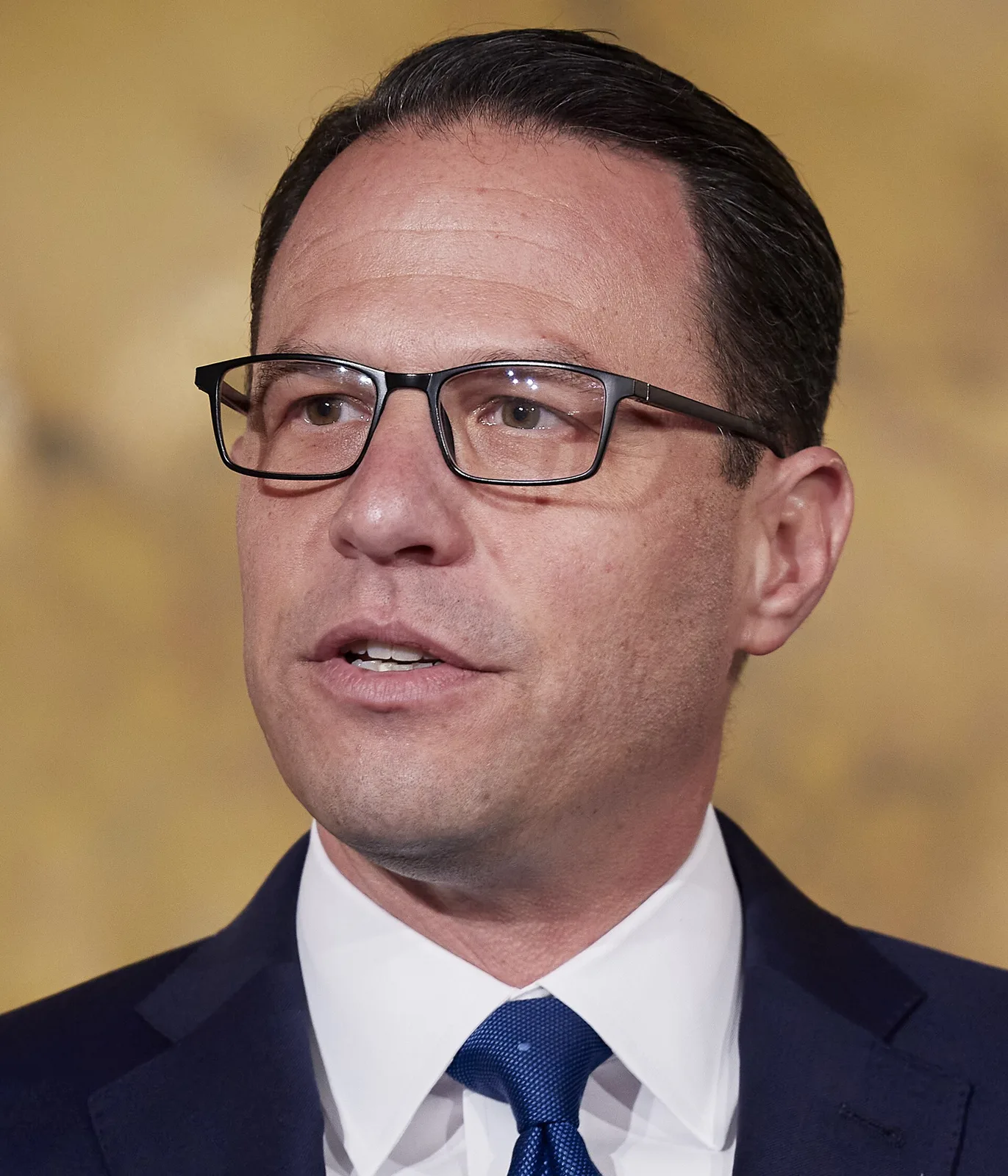
Josh Shapiro
- Party
- Democratic
- In Office Since
- January 17, 2023
- Term Ends
- January 2027
- Born
- June 10, 1973, Philadelphia, Pennsylvania
- Education
- University of Rochester (BA, 1995); Georgetown University Law Center (JD, 1998)
- Prior Roles
- PA Attorney General (2017-2023); PA State Representative (2005-2013)
Josh Shapiro is Pennsylvania's 48th Governor, elected in 2022 with 57 percent of the vote, the largest margin of victory in a Pennsylvania gubernatorial race in 20 years. As Attorney General, Shapiro led the landmark 2018 investigation into sexual abuse in the Catholic Church that produced a grand jury report documenting abuse of over 1,000 children by more than 300 priests across Pennsylvania and catalyzed national Church accountability efforts. As governor he has focused on economic development (attracting the Intel semiconductor campus and other major investments), education funding reform in response to the Commonwealth Court ruling, and infrastructure. He was considered for the 2024 Democratic vice-presidential nomination before Kamala Harris chose Minnesota Governor Tim Walz.
Other Current State Officials
Lieutenant Governor
Austin Davis
In office since January 2023. A former state representative from McKeesport in Allegheny County, Davis became the first Black lieutenant governor in Pennsylvania history when he was inaugurated alongside Shapiro. He has focused on workforce development, community economic development, and broadband expansion in rural and underserved communities. He presides over the State Senate and serves on several state boards and commissions.
Attorney General
Dave Sunday
In office since January 2025. A York County District Attorney who served in that role since 2018, Sunday won the 2024 attorney general race against Democratic candidate Eugene DePasquale. He has focused on public safety, fentanyl trafficking prosecution, and human trafficking enforcement. His election as a Republican in a statewide Pennsylvania race, against the trend of Democratic dominance in statewide offices, reflected the ongoing competitiveness of Pennsylvania's political environment.
State Treasurer
Stacy Garrity
In office since January 2021, re-elected in 2024. A retired Army Reserve Colonel and former businesswoman, Garrity oversees approximately $150 billion in state investments and manages Pennsylvania's unclaimed property program, one of the largest such programs in the country, which has returned billions of dollars to citizens. She has focused on ESG investment restrictions and on reducing the state's exposure to environmental liability in pension portfolios.
The Pennsylvania General Assembly
Pennsylvania State Senate
- Seats: 50 members
- Terms: 4-year staggered terms
The upper chamber. Senators serve 4-year terms with half the seats on the ballot every two years. Republicans currently hold the majority. No term limits. The Senate has been the more conservative chamber and has blocked or significantly modified House-passed legislation on education funding and other progressive priorities.
Pennsylvania House of Representatives
- Seats: 203 members
- Terms: 2-year terms
The lower chamber, and the largest full-time state legislative chamber in the country (New Hampshire's part-time House, at 400 members, is larger). All 203 seats are up for election every two years. Democrats hold a one-seat majority, won in 2022, secured through 2023 special elections, and kept in 2024. No term limits. The chamber's size creates procedural complexity that has contributed to Pennsylvania's chronic budget delays.
Pennsylvania's U.S. Senators
U.S. Senator
John Fetterman
Pennsylvania's senior senator, elected in 2022 in one of the most closely watched Senate races in the country, defeating Republican Mehmet Oz despite suffering a stroke five months before the election. A former mayor of Braddock and Pennsylvania's Lieutenant Governor, Fetterman at 6'8", wearing Carhartt shorts and a hoodie, is one of the most visually distinctive senators in recent history. He has become known for his staunch support of Israel, his break with progressive Democrats on certain issues, and his candid public discussion of his stroke recovery and subsequent depression treatment.
U.S. Senator
Dave McCormick
Pennsylvania's junior senator, elected in November 2024 by defeating three-term incumbent Democrat Bob Casey in the most expensive Senate race in Pennsylvania history. A Bloomsburg-born West Point graduate, Army Ranger, Gulf War veteran, and former CEO of Bridgewater Associates (the world's largest hedge fund), McCormick had previously lost the 2022 Republican primary to Mehmet Oz by fewer than 1,000 votes. He serves on the Armed Services and Banking committees.
Pennsylvania Through the Years
From William Penn's Holy Experiment in religious tolerance to the signing of the Declaration of Independence and the Constitution, from Valley Forge to Gettysburg, from Carnegie's steel empire to Three Mile Island and Flight 93, Pennsylvania has been at the center of the American story from before there was an America to the present day.
The territory William Penn named Pennsylvania ('Penn's Woods') was home to a diverse array of Indigenous peoples whose cultures and territories reflected the varied geography of the region. The Lenape (Delaware), whose territory extended from the Delaware River Valley west through what is now eastern Pennsylvania and south into Delaware and New Jersey, were one of the most diplomatically sophisticated peoples in the colonial Northeast: their confederate structure, their tradition of serving as mediators in disputes between other nations, and their long experience with European traders and settlers gave them political skills that enabled survival long after peoples with less diplomatic tradition had been destroyed.
The Susquehannock (Conestoga), who occupied the Susquehanna River valley in central and southern Pennsylvania, were a powerful Iroquoian-speaking people whose fortified towns and warriors controlled access to the interior fur trade until a catastrophic series of wars and epidemics in the late 17th century reduced them to near-extinction. The Shawnee, historically centered on the Ohio River valley, ranged through western Pennsylvania and became important military allies of the French and later the British in the colonial conflicts that shaped Pennsylvania's frontier.
The Delaware Water Gap, the Susquehanna and Juniata river valleys, and the gaps through the Appalachian ridges that made Pennsylvania the pathway to the American interior had been known and used by Indigenous traders, warriors, and farmers for millennia before European contact.
The Walking Purchase of 1737, a fraudulent land acquisition by William Penn's sons that used professional runners to claim far more Lenape land than the original treaty intended, damaged the reputation Penn had built with the Delaware people and began a deterioration of Pennsylvania's Indian relations that culminated in the frontier wars of the 1750s and 1760s.
On March 4, 1681, King Charles II granted William Penn a charter for the territory west of the Delaware River as payment of a debt owed to Penn's late father, Admiral Penn. The younger Penn, a Quaker who had been imprisoned multiple times in England for his religious beliefs, conceived his colony as a 'Holy Experiment', a place where religious tolerance, just treatment of Native peoples, and government by consent would demonstrate that a society could be governed without coercion.
Penn's Frame of Government (1682) was among the most advanced constitutional documents in the Atlantic world, providing for an elected assembly, freedom of conscience, trial by jury, and the rights of accused persons. Penn traveled to Pennsylvania in 1682 and negotiated a series of treaties with Lenape sachems under the elm tree at Shackamaxon, treaties that, unlike virtually all other colonial agreements in the Atlantic world, were honored by both parties for generations and formed the basis of the most peaceful colonial-Indigenous relationship in early American history.
Philadelphia, planned as a grid city between the Delaware and Schuylkill rivers, grew rapidly: by 1700 it was the second-largest city in British North America after Boston, its growth driven by tolerant immigration policies that attracted Quakers, German Pietists, Welsh Baptists, and eventually people of virtually every Protestant denomination. Penn's guarantee of religious freedom also attracted the Amish, Mennonite, and German Reformed communities that would make Pennsylvania Dutch country one of the most distinctive cultural landscapes in America.
Penn himself died in 1718, never fully realizing his vision, but the tolerance he established as Pennsylvania's founding principle shaped American ideals of religious liberty in ways that the First Amendment would eventually codify.
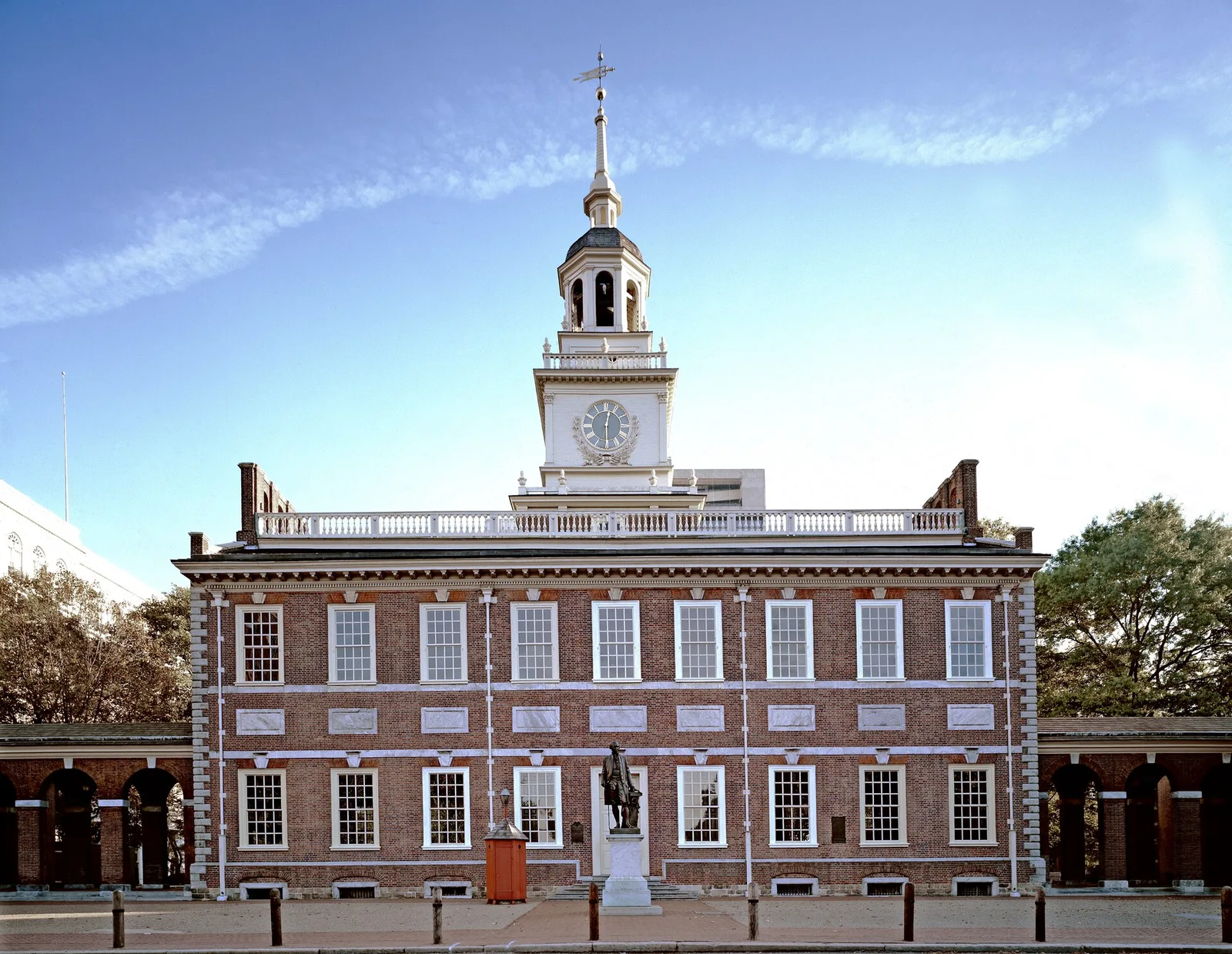
No single city contributed more to the founding of the United States than Philadelphia, and no single building is more central to the American story than Independence Hall, constructed between 1732 and 1756 as the Pennsylvania State House on Chestnut Street. It was in this building that the Second Continental Congress met beginning in May 1775 and named George Washington commander-in-chief of the Continental Army.
It was here, on July 4, 1776, that Congress approved the Declaration of Independence written by Thomas Jefferson (and edited significantly by Benjamin Franklin and John Adams), formally severing the colonies from Britain and declaring that 'all men are created equal, that they are endowed by their Creator with certain unalienable Rights, that among these are Life, Liberty and the pursuit of Happiness.' It was in this same building, eleven years later, that 55 delegates from twelve states gathered for the Constitutional Convention of 1787 and produced the Constitution of the United States, the most enduring written constitution in human history, still in operation 235 years after its signing. Benjamin Franklin, Philadelphia's most celebrated citizen, participated in both the Declaration and the Constitution, the only person to sign both documents, as well as the Treaty of Paris and the Articles of Confederation.
Franklin had founded the first public library (1731), the first fire company (1736), the first hospital (1751), and the University of Pennsylvania (1740) in Philadelphia, shaping the city's institutional landscape as completely as any individual has shaped any American city.
The Liberty Bell, which rang to call citizens to hear the first public reading of the Declaration, cracked in the early 19th century and became, paradoxically because of its imperfection, one of the most powerful symbols of American ideals.
On December 19, 1777, George Washington led 12,000 Continental Army soldiers into their winter encampment at Valley Forge, a plateau 18 miles northwest of Philadelphia along the Schuylkill River. The British had occupied Philadelphia, the American capital, since September.
What followed over the next six months was the crucible in which the Continental Army was transformed from an undisciplined collection of state militias into a professional fighting force capable of confronting the British on equal terms. The conditions at Valley Forge were brutal: inadequate shelter, insufficient food and clothing (some soldiers marched barefoot through snow), rampant disease (typhus, dysentery, pneumonia), and a smallpox epidemic that Washington controlled through mandatory inoculation, one of the first mass vaccination programs in American history.
Approximately 2,000 soldiers died at Valley Forge, more than died in most of the war's major battles. The transformation was produced by Baron Friedrich Wilhelm von Steuben, a Prussian military officer who arrived at Valley Forge in February 1778 and spent the winter drilling the American troops in European military tactics, teaching them to march in formation, reload their muskets under fire, and maneuver as coordinated units.
The army that marched out of Valley Forge in June 1778 was fundamentally different from the one that had struggled in: it had absorbed the news of the French alliance (secured by the Saratoga victory), developed unit cohesion and professional discipline, and produced a corps of officers whose relationships forged at Valley Forge would sustain American military leadership for decades. Valley Forge National Historical Park preserves the encampment site, including reconstructed huts, the house Washington used as his headquarters, and the earthworks the soldiers built.
The Battle of Gettysburg, fought over three days in early July 1863 in the small Pennsylvania town of that name in Adams County, was the largest battle ever fought on American soil and the decisive turning point of the Civil War. General Robert E. Lee's Army of Northern Virginia, 75,000 strong, had invaded Pennsylvania in a campaign intended to threaten northern cities, force a negotiated peace, and relieve pressure on Confederate forces further south.
On July 1, Confederate forces advancing toward Gettysburg encountered Union cavalry under John Buford, and the engagement that followed drew in both armies until over 165,000 men were engaged. The three-day battle produced approximately 51,000 casualties, killed, wounded, and missing, the bloodiest three days in American history.
The Union Army of the Potomac, commanded by General George Meade, held the high ground south of town, repulsed repeated Confederate assaults including the catastrophic Pickett's Charge on July 3 (in which 12,500 Confederate soldiers crossed three-quarters of a mile of open ground under concentrated Union fire, suffering over 50 percent casualties), and forced Lee to withdraw to Virginia, never again to mount an offensive into Union territory. The Gettysburg campaign was also the last time in history that an army invaded the free states of the North.
On November 19, 1863, President Abraham Lincoln attended the dedication of the Gettysburg National Cemetery and delivered a two-minute address that redefined the meaning of the Civil War and of the nation itself. The Gettysburg Address, 272 words long, beginning 'Four score and seven years ago', is the most celebrated speech in American history and one of the most important texts in the English language.
The Pittsburgh region's steel industry in the late 19th and early 20th centuries was the most concentrated manifestation of industrial capitalism in American history, a zone of blast furnaces, rolling mills, and coke ovens along the Monongahela, Allegheny, and Ohio rivers that produced the steel that built modern America and generated fortunes that became the foundation of American philanthropy. Andrew Carnegie, a Scottish immigrant who arrived in Pittsburgh as a child, built Carnegie Steel into the world's dominant steel producer through a combination of vertical integration, relentless cost-cutting, technological innovation, and a willingness to use industrial violence against his workforce when necessary.
The Homestead Strike of 1892, in which Carnegie's partner Henry Clay Frick brought in 300 Pinkerton detectives to break a strike at the Homestead Steel Works (the confrontation resulted in a gun battle that killed 7 strikers and 3 Pinkertons) set the template for labor-capital conflict in the Gilded Age. Carnegie sold his steel empire to J.P. Morgan in 1901 for $480 million (approximately $17 billion today), creating U.S. Steel, the first billion-dollar corporation in American history, and retired to a career of philanthropy that reshaped American civilization: Carnegie libraries (2,509 built worldwide), Carnegie Hall in New York, the Carnegie Endowment for International Peace, Carnegie Mellon University, and dozens of other institutions bear his name and his money.
Henry Clay Frick, whose collection of Old Master paintings and decorative arts forms the Frick Collection in New York City, and who survived an assassination attempt by anarchist Alexander Berkman during the Homestead strike, was the other dominant figure of Pittsburgh's steel age.
At 4:00 AM on March 28, 1979, a combination of mechanical failure, operator error, and inadequate instrumentation at the Three Mile Island Nuclear Generating Station near Middletown, Pennsylvania, on the Susquehanna River, caused a partial meltdown of the reactor core in Unit 2, the most serious nuclear accident in American history. A stuck-open pressure relief valve allowed coolant to escape from the reactor, and confusion about the system's state caused operators to take actions that worsened rather than corrected the situation, leading to significant core damage and the release of radioactive gases into the atmosphere. Pennsylvania Governor Dick Thornburgh advised the voluntary evacuation of pregnant women and young children within five miles of the plant; approximately 140,000 people evacuated voluntarily.
The accident revealed the inadequacy of evacuation planning, the limitations of nuclear industry self-regulation, and the potential for operator error to overwhelm engineered safety systems. The Three Mile Island accident fundamentally changed American nuclear policy: no new nuclear power plant was ordered in the United States for the next 30 years, existing plants faced substantially increased regulatory scrutiny, and the public's relationship with nuclear power was permanently altered.
The nuclear industry argues that no member of the public received a radiation dose large enough to cause measurable health effects; critics and local residents have disputed this claim for decades. Unit 1 at Three Mile Island, which was not affected by the accident, operated until 2019 and was restarted by Constellation Energy in 2024 to provide carbon-free electricity to Microsoft's data centers, a striking coda to the accident's history.
At 10:03 AM on September 11, 2001, United Airlines Flight 93, a Boeing 757 that had departed Newark at 8:42 AM bound for San Francisco, crashed into a reclaimed strip mine field near Shanksville in Somerset County, Pennsylvania, killing all 44 people aboard. The aircraft had been hijacked by four al-Qaeda terrorists who, following the pattern established by the three other hijacked aircraft that morning, intended to crash the plane into a target in Washington DC, most likely the U.S. Capitol or the White House.
What differentiated Flight 93 from the three other hijacked flights that morning was that passengers and crew had received cell phone and airphone calls informing them of the World Trade Center and Pentagon attacks, and had voted to resist the hijackers. The passengers rushed the cockpit; the hijacker pilot, fearing loss of control, rolled the aircraft and then pointed it into the earth at 563 miles per hour.
The cockpit voice recorder captured the final struggle, and the last words of passenger Todd Beamer, 'Let's roll', became the defining phrase of the American response to the September 11 attacks. The passengers of Flight 93 did not know whether they would succeed in retaking the aircraft, but they chose to act rather than wait for a fate they could not change.
The Flight 93 National Memorial near Shanksville, which opened in phases between 2011 and 2015, commemorates all 44 victims on the site where the aircraft came down. The wall of names, the tower of voices (a musical instrument tower that plays recorded birdsong), and the crash site overlook form one of the most moving commemorative landscapes in the United States.
Pennsylvania's Defining Moments in American History
These are the events that didn't just shape Pennsylvania, they changed the nation.
Philadelphia was the crucible of American independence. The Continental Congress met in Pennsylvania's State House, now called Independence Hall, and on July 4, 1776, adopted the Declaration of Independence drafted primarily by Thomas Jefferson.
The document's assertion that 'all men are created equal' and endowed with 'unalienable Rights' to 'Life, Liberty and the pursuit of Happiness' established the moral and philosophical foundation of the American republic. The Liberty Bell, which rang in Philadelphia to announce the Declaration's first public reading, became the symbol of American freedom that it remains today.
Congress had actually voted for independence on July 2, 1776, on a resolution moved by Virginia's Richard Henry Lee, and John Adams predicted the 2nd would be the day Americans celebrated; the 4th was simply the day the wording of the explanatory Declaration was approved. Most delegates signed a formal copy on August 2, and the vote itself was not unanimous, New York abstained until its legislature acted.
Pennsylvania nearly blocked it. Its delegation was split, and John Dickinson, the 'Penman of the Revolution,' argued that independence was premature and voted no; two Pennsylvania delegates deliberately stayed away on July 2 so the state's remaining votes would fall for independence. The colony's own government was overthrown that summer by radicals who wrote the most democratic state constitution of the era, a one-house legislature with no governor.
The 'Liberty Bell' name came later, coined by abolitionists in the 1830s who seized on its inscription, 'Proclaim Liberty throughout all the Land unto all the Inhabitants thereof,' from Leviticus. The famous crack silenced it for good around 1846, and it has been a touring and pilgrimage object ever since, moved to a dedicated pavilion across from Independence Hall in 2003.
In the summer of 1787, delegates from 12 states met in Philadelphia, in the same building where independence had been declared 11 years earlier, to revise the failing Articles of Confederation. What they produced instead was an entirely new form of government: the U.S. Constitution.
Through four months of deliberations, James Madison, Alexander Hamilton, George Washington (who presided), Benjamin Franklin, and their colleagues invented the federal system, the separation of powers, and the framework of American governance that remains in place today. No other city in American history has hosted two events of comparable importance.
The delegates met behind closed windows in a Philadelphia summer, swore themselves to secrecy so they could change their minds freely, and the near-blind 81-year-old Franklin, the convention's elder, was carried to the sessions in a sedan chair by prisoners from the Walnut Street jail. Madison's private notes, published only after his death in 1836, are the fullest record of what was said.
The Constitution was a bundle of compromises reached in Philadelphia: the 'Great Compromise' giving states equal Senate votes and population-based House seats, and the three-fifths clause counting enslaved people for representation and taxation, a concession to Southern states that entrenched slaveholder power for 70 years. The document contained no Bill of Rights; Congress drafted the first ten amendments in 1789 and the states ratified them in 1791.
Franklin, leaving the hall, is said to have answered a woman who asked what kind of government they had made: 'A republic, if you can keep it.' Nine states had to ratify for it to take effect, which happened in June 1788, and the new government first met in New York, not Philadelphia.
On July 1-3, 1863, Union and Confederate forces fought the largest battle ever conducted in the Western Hemisphere in the Pennsylvania farm town of Gettysburg. The battle produced 51,000 casualties and ended General Robert E. Lee's second invasion of the North.
The Confederate failure at Gettysburg, combined with Grant's capture of Vicksburg the following day, marked the beginning of the end for the Confederacy. At the dedication of the Soldiers' National Cemetery four months later, Abraham Lincoln delivered the Gettysburg Address, the most important speech in American history, redefining the war as a struggle for equality.
The armies collided at Gettysburg almost by accident, drawn to a road hub where ten highways met, and the fighting fell into famous set pieces: the first day's retreat through the town, the second day's desperate defense of Little Round Top by the 20th Maine and the slaughter in the Wheatfield and Peach Orchard, and the third day's Pickett's Charge, in which about half of the 12,500 Confederates who crossed the open field were killed, wounded, or captured. Lee lost roughly a third of his army and never invaded the North again.
The town of 2,400 people was left with about 51,000 casualties, thousands of dead horses, and wounded men in every church and barn for weeks. A local attorney organized the purchase of ground for a national cemetery, the first of its kind, and it was its dedication, not a battle anniversary, that brought Lincoln to town in November 1863.
Lincoln's 272 words followed a two-hour oration by Edward Everett and were over in about two minutes; some newspapers dismissed them, but the speech reframed the war around the Declaration's promise that 'all men are created equal' and the survival of 'government of the people, by the people, for the people.' Gettysburg National Military Park now preserves the field with more than 1,300 monuments, more than any battlefield in the world.
For a century, Pittsburgh was the steel capital of the world, producing the structural material that built American cities, bridges, railroads, and military equipment. Andrew Carnegie's steel empire, headquartered in Pittsburgh, made him the world's richest man and funded hundreds of libraries and universities.
The steel mills of the Monongahela Valley employed hundreds of thousands of workers, many of them immigrants from Eastern and Southern Europe, who built the union movement that transformed American labor relations. When Pittsburgh's steel industry collapsed in the 1970s and 80s, its reinvention as a medical and technology hub became a national model for post-industrial transformation.
The industry was born of a specific geography: bituminous coal and coking coal in the surrounding hills, three rivers to move iron ore and finished steel, and cheap immigrant labor. Carnegie drove costs down ruthlessly and reinvested in the newest furnaces, and by 1900 the Pittsburgh district out-produced Britain and Germany combined; the 1901 sale that created U.S. Steel made it the first billion-dollar company in the world.
Labor peace was bought with violence first. The 1892 Homestead strike, in which Henry Clay Frick brought Pinkerton guards up the Monongahela on barges and a day-long gun battle killed about ten men, broke the steelworkers' union for four decades until the New Deal's 1935 Wagner Act and the 1937 recognition of the Steel Workers Organizing Committee (later the United Steelworkers, headquartered in Pittsburgh to this day).
The collapse came fast: between 1979 and 1987 the Mon Valley lost roughly 150,000 steel jobs to imports, mini-mills, and aging plants, gutting towns like Homestead, Braddock, and McKeesport that have not recovered. Pittsburgh proper cushioned the blow with its universities and hospitals, but the region's population is still smaller than it was in 1960.
On March 28, 1979, a series of equipment failures and operator errors at the Three Mile Island nuclear power plant near Middletown, Pennsylvania, led to a partial meltdown of one reactor core. No one died, and radiation releases were minimal. But the accident permanently changed American energy policy.
No new nuclear power plants were ordered in the United States for decades afterward. The accident coincided with the release of The China Syndrome, a film about a nuclear accident, giving the disaster a cultural resonance far beyond its actual consequences. TMI crystallized American anxiety about nuclear power and shaped energy debates for a generation.
The accident unfolded over days of confusion: a stuck valve drained coolant, garbled instrument readings led operators to shut off emergency water, about half the reactor core melted, and a hydrogen bubble in the containment vessel raised fears of an explosion. Conflicting statements from the utility and federal officials, and a poorly explained partial evacuation advisory for pregnant women and small children, sent roughly 140,000 people fleeing central Pennsylvania.
Cleanup of the ruined Unit 2 took 14 years and about a billion dollars, and its fuel was shipped to Idaho; the reactor was defueled but its containment building still stands. Epidemiological studies commissioned since have mostly found no clear rise in cancer, though a minority of researchers and many local residents dispute that, and lawsuits ran for decades.
The undamaged Unit 1 ran until 2019, when it closed as uneconomic against cheap natural gas. In 2024 its owner announced it would restart the reactor under a 20-year power deal with Microsoft to feed artificial-intelligence data centers, and even proposed renaming the site the 'Crane Clean Energy Center,' a striking reversal for the place that ended American reactor construction.
Notable Pennsylvanians
Benjamin Franklin
Born in Boston (1706), but lived most of his consequential life in Philadelphia, which he shaped more completely than any individual shaped any American city. Printer, publisher, scientist (electricity, bifocals, the lightning rod), diplomat (secured the French alliance that won the Revolution), and statesman (signed the Declaration of Independence, the Constitution, the Treaty of Paris, and the Articles of Confederation, the only person to sign all four). Died in Philadelphia, 1790.
Andrew Carnegie
Born in Dunfermline, Scotland (1835), came to Pittsburgh as a child. Built Carnegie Steel into the world's dominant steel producer and sold it to J.P. Morgan in 1901 for $480 million to create U.S. Steel. Spent the rest of his life giving the money away: 2,509 Carnegie libraries worldwide, Carnegie Hall, Carnegie Mellon University, the Carnegie Endowment for International Peace. 'The man who dies rich dies disgraced.' Died 1919.
Fred Rogers
Born in Latrobe, Pennsylvania, March 20, 1928. Creator, host, and puppeteer of Mister Rogers' Neighborhood (1968-2001), one of the longest-running programs in PBS history and one of the most influential educational television programs ever made. An ordained Presbyterian minister, Rogers spent his career telling children that they were special exactly as they were. His 2003 Congressional Gold Medal acceptance speech and his 1969 Senate testimony saving PBS funding are among the most moving uses of television in American history. Died 2003.
Rachel Carson
Born in Springdale, Pennsylvania, May 27, 1907. Marine biologist and author of Silent Spring (1962), the book that launched the modern environmental movement. Her meticulous documentation of the pesticide industry's destruction of bird populations (particularly the bald eagle, osprey, and peregrine falcon through DDT's eggshell-thinning effects) led directly to the ban on DDT in the United States and the creation of the Environmental Protection Agency. She died of breast cancer in 1964, two years after publication. Died 1964.
Joe Biden
Born in Scranton, Pennsylvania, November 20, 1942. The 46th President of the United States (2021-2025), U.S. Senator from Delaware for 36 years (1973-2009), and Vice President under Barack Obama (2009-2017). Biden moved from Scranton to Wilmington, Delaware as a child but has maintained his Scranton identity as central to his political persona, his working-class Catholic Pennsylvania roots have been the touchstone of his political self-presentation throughout his career.
Andy Warhol
Born Andrew Warhola in Pittsburgh, Pennsylvania, August 6, 1928. The most commercially successful and culturally influential American visual artist of the second half of the 20th century. His silkscreened images of Campbell's Soup cans, Marilyn Monroe, Elvis Presley, and Mao Zedong; his Factory studio in New York; his management of the Velvet Underground; and his observation that 'in the future, everyone will be world-famous for 15 minutes' defined Pop Art and anticipated the celebrity and media culture of the digital age. Died 1987. The Andy Warhol Museum in Pittsburgh is the largest museum in the US dedicated to a single artist.
Tina Fey
Born in Upper Darby, Pennsylvania, May 18, 1970. Writer, comedian, actress, and producer who became the first female head writer at Saturday Night Live (1999-2006), created and starred in 30 Rock (2006-2013, receiving 22 Emmy nominations and winning three), and wrote and starred in the film Mean Girls (2004). Her SNL portrayal of Sarah Palin during the 2008 presidential campaign was one of the most watched comedy performances in recent television history.
Arnold Palmer
Born in Latrobe, Pennsylvania (same city as Fred Rogers), September 10, 1929. Golfer whose combination of competitive excellence, personal charisma, and television presence transformed golf from a sport for the wealthy into a mass spectator sport. Won 62 PGA Tour events including seven major championships, and was the first golfer to earn $1 million in career prize money. His eponymous beverage, iced tea mixed with lemonade, has become a permanent part of American food culture. Died 2016.
Will Smith
Born in West Philadelphia, Pennsylvania, September 25, 1968. Rapper (DJ Jazzy Jeff & the Fresh Prince), television actor (The Fresh Prince of Bel-Air, 1990-1996), and film star whose box office success in films including Ali, Men in Black, Hitch, Pursuit of Happyness, and King Richard (Best Actor Oscar, 2022) made him one of the most commercially successful actors in Hollywood history. His 2022 Academy Awards slap of presenter Chris Rock became one of the most discussed moments in recent entertainment history.
Taylor Swift
Born in West Reading, Pennsylvania, December 13, 1989, and grew up in Wyomissing before moving to Nashville to pursue country music. The best-selling music artist of the 21st century, with multiple albums, Fearless, 1989, Reputation, Folklore, Midnights, each generating cultural phenomena upon release. Her Eras Tour (2023-2024) became the highest-grossing concert tour in history, generating over $2 billion, and her economic impact on host cities was studied by multiple central banks and economists.
State Symbols & Quick Facts
| Nickname | "The Keystone State" |
| Capital | Harrisburg |
| Largest City | Philadelphia |
| Statehood | December 12, 1787 (2nd state) |
| Population | ~13.1 million (2025 est.) |
| Area | 46,054 sq miles (33rd largest) |
| State Bird | Ruffed Grouse |
| State Flower | Mountain Laurel |
| State Tree | Eastern Hemlock |
| State Animal | White-tailed Deer |
| State Dog | Great Dane |
| State Insect | Firefly |
| State Fish | Brook Trout |
| State Fossil | Phacops rana (trilobite) |
| State Beverage | Milk |
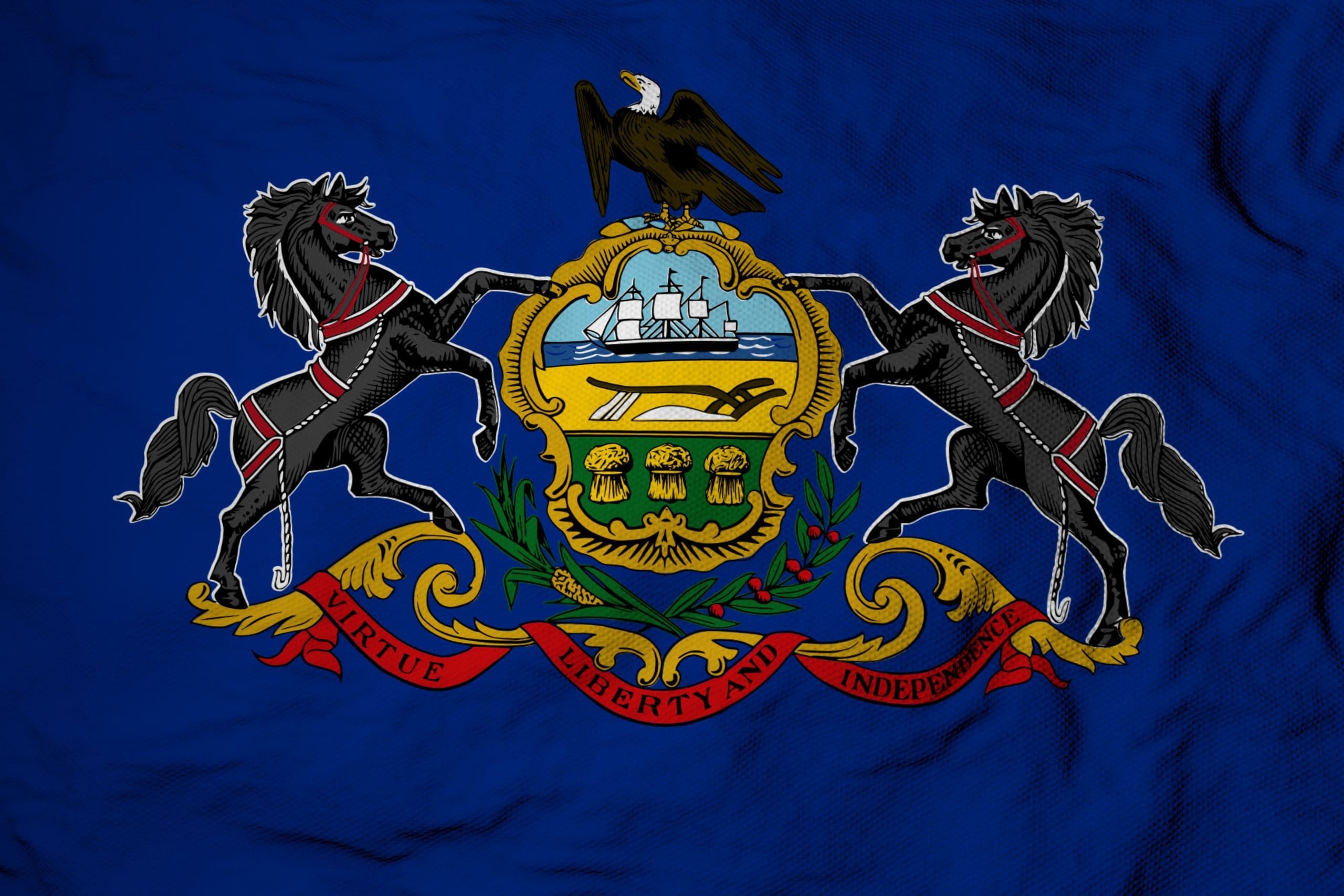
| State Motto | "Virtue, Liberty and Independence" |
| Time Zone | Eastern |
| Bordering States | New York, New Jersey, Delaware, Maryland, West Virginia, Ohio |
Did You Know?
Pennsylvania was the second state to ratify the U.S. Constitution, on December 12, 1787, five days after Delaware. But Pennsylvania was the site where both the Declaration of Independence (1776) and the Constitution (1787) were written and signed, making Philadelphia the intellectual and political birthplace of the United States more completely than any other city.
Pittsburgh has 446 bridges, the most of any major U.S. city and more than Venice (which has approximately 400). The city's geography, at the confluence of three rivers and built on steep hills separated by valleys, required more bridges per square mile than virtually any other city on Earth. The Roberto Clemente Bridge, Andy Warhol Bridge, and Rachel Carson Bridge are named for Pittsburgh's most celebrated sons and daughters.
The mRNA vaccine technology underlying both the Moderna and Pfizer-BioNTech COVID-19 vaccines was developed by Katalin Kariko and Drew Weissman at the University of Pennsylvania in Philadelphia. Their work, which was initially dismissed by academic journals and funding agencies, won the 2023 Nobel Prize in Physiology or Medicine and is credited with saving millions of lives.
Fred Rogers and Arnold Palmer were born in the same small city, Latrobe, Pennsylvania (population approximately 8,000), the gentle television neighbor and the charismatic golf champion, from the same western Pennsylvania mill town. Latrobe is also credited as the birthplace of the banana split.
Pennsylvania's State Capitol dome in Harrisburg, completed in 1906 at a cost of $13 million (the most expensive state building in American history at the time), was modeled on St. Peter's Basilica in Rome and measures 272 feet from the ground to the top of the lantern. The building's interior features a grand staircase modeled on the Paris Opera and murals by Violet Oakley depicting the founding of Pennsylvania.
Kennett Square, Pennsylvania, a small town in Chester County, produces approximately 65 percent of all commercially grown mushrooms in the United States. The mushroom industry, which developed in the area's abandoned forcing sheds in the late 19th century, is now a $600 million industry employing thousands of workers, many of them recent immigrants from Mexico and Guatemala.
The Gettysburg Address, Abraham Lincoln's 272-word speech at the dedication of the Gettysburg National Cemetery on November 19, 1863, is one of the most analyzed texts in the English language. Lincoln reportedly wrote five drafts. Newspaper coverage at the time focused more on the two-hour speech by Edward Everett that preceded Lincoln's; Everett himself later wrote to Lincoln that 'I should be glad, if I could flatter myself that I came as near to the central idea of the occasion, in two hours, as you did in two minutes.'
Pennsylvania is the nation's second-largest natural gas producing state, with the Marcellus Shale formation underlying much of the state's western and northern regions producing over six trillion cubic feet annually. The same state that hosted America's first oil well (Drake's well in Titusville, 1859) and the world's largest steel complex now produces more natural gas than any state except Texas.
The Flight 93 National Memorial near Shanksville honors the 40 passengers and crew who voted to resist their hijackers on September 11, 2001, crashing the plane before it could reach its target in Washington DC. The passengers made their decision after receiving cell phone calls about the World Trade Center and Pentagon attacks, they knew they were likely to die either way, and chose to act.
Pennsylvania's House of Representatives has 203 members, the largest full-time state legislative chamber in the country (only New Hampshire's 400-member citizen House is bigger). The state also has no legislative term limits, meaning long-serving members can accumulate seniority and expertise that shapes policy for decades. The combination produces a legislature of considerable institutional complexity and, critics argue, resistance to change.
Quick Facts and Common Questions
Short answers to the questions people most often ask about Pennsylvania: its abbreviation, who it was named for, its capital, and its place in Congress.
Pennsylvania's two-letter postal abbreviation is PA. The U.S. Census Bureau places it in the Northeast region, in the Middle Atlantic division, and about 13.0 million people lived there in the 2020 census.
Pennsylvania became the 2nd state on December 12, 1787, when its convention ratified the U.S. Constitution, five days after Delaware. Its official name is the Commonwealth of Pennsylvania.
In 1681 King Charles II granted the colony to William Penn, a Quaker, to repay a debt owed to Penn's father, Admiral Sir William Penn. The name means "Penn's woods," combining Penn with the Latin "sylvania," and the king insisted on it to honor the admiral.
Harrisburg has been the capital since 1812. Philadelphia was the capital through the colonial and Revolutionary years, followed by Lancaster from 1799 to 1812. The current State Capitol in Harrisburg was dedicated in 1906.
Independence Hall in Philadelphia, then the Pennsylvania State House, is where the Second Continental Congress adopted the Declaration of Independence in 1776 and where the Constitutional Convention wrote the U.S. Constitution in 1787. Philadelphia also served as the nation's capital from 1790 to 1800.
Pennsylvania borders six states: New York to the north and northeast, New Jersey to the east across the Delaware River, Delaware and Maryland to the south, West Virginia to the southwest, and Ohio to the west. In the northwest it has a short shoreline on Lake Erie.
Pennsylvania is known as "The Keystone State," for its central place among the original 13 colonies. Its motto is "Virtue, Liberty and Independence." Its state bird is the ruffed grouse, its flower is the mountain laurel, and its tree is the eastern hemlock.
Based on the 2020 census, Pennsylvania lost a seat and now has 17 in the U.S. House of Representatives, which gives it 19 votes in the Electoral College.
The Battle of Gettysburg, fought July 1 to 3, 1863, was the largest battle of the Civil War, with about 51,000 soldiers killed, wounded, captured, or missing. On November 19, 1863, President Abraham Lincoln gave the Gettysburg Address at the dedication of the soldiers' cemetery there.
Sources & Further Reading
- Census Regions and Divisions, U.S. Census Bureau
- 2020 Census Apportionment Results, U.S. Census Bureau
- Distribution of Electoral Votes, National Archives
- Pennsylvania Historical and Museum Commission
- Independence National Historical Park, National Park Service
- Gettysburg National Military Park, National Park Service
Fallingwater
Frank Lloyd Wright's Masterpiece, a House Built Over a Waterfall in Pennsylvania's Laurel Highlands
About Fallingwater
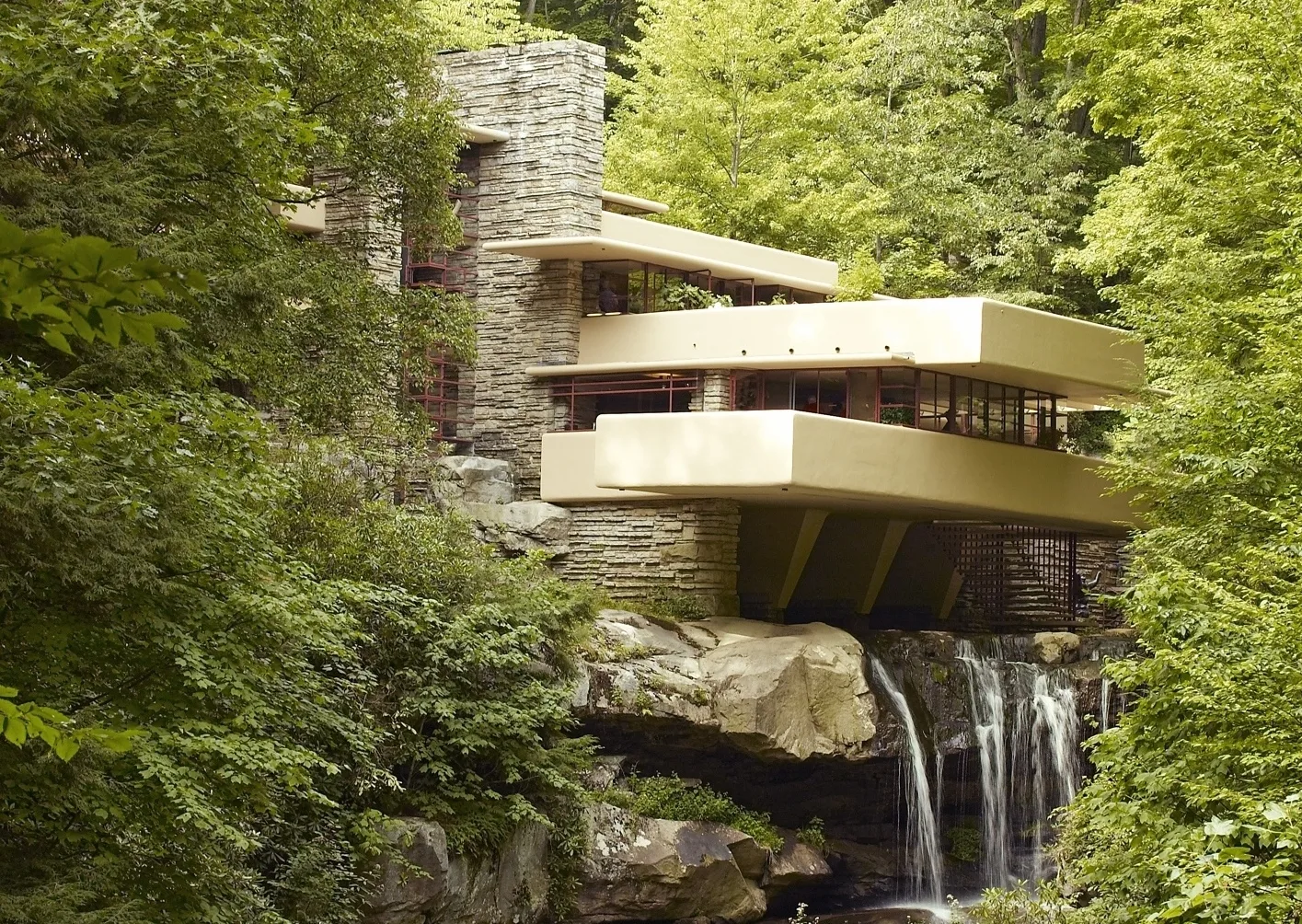
Fallingwater, designed by Frank Lloyd Wright and built between 1936 and 1939, is one of the most celebrated works of American architecture; in 1991 the American Institute of Architects named it the best all-time work of American architecture. Wright designed it for Edgar J. Kaufmann Sr., owner of Kaufmann's Department Store in Pittsburgh, as a weekend house on the family's land along Bear Run in Fayette County, in the Laurel Highlands.
The Kaufmanns expected a house with a view of their favorite waterfall; Wright instead set the house on top of it, cantilevering the main living-room terrace roughly 15 feet past its supports out over the 30-foot falls, so the water is heard but not seen from inside. Wright was 67 and had built little in a decade when the commission came, and Fallingwater revived his career, leading to a 1938 Time magazine cover.
The house cost about $155,000 to build against an original estimate near $35,000, a figure that includes Wright's fee and the custom furnishings. Edgar Kaufmann Jr., the couple's son, had briefly apprenticed with Wright at Taliesin and brokered the commission.
The family used Fallingwater until 1963, when Edgar Kaufmann Jr. entrusted the house, its contents, and about 1,500 acres to the Western Pennsylvania Conservancy, which opened it to the public in 1964. It became a National Historic Landmark in 1966 and, with seven other Wright buildings, a UNESCO World Heritage Site in 2019, and roughly 160,000 to 180,000 people tour it each year.
- Designation
- UNESCO World Heritage Site / National Historic Landmark
- Location
- Fayette County, Laurel Highlands, southwestern Pennsylvania
- Established
- Completed 1939; National Historic Landmark 1966; UNESCO World Heritage Site 2019
- Annual Visitors
- ~170,000
Architecture and Design
Fallingwater's signature is a stack of reinforced-concrete trays that project horizontally over Bear Run, anchored to a masonry core and a rock ledge behind. The first-floor terrace cantilevers about 15 feet past its bolster beams, and the second-floor terrace reaches out even farther above it, with no columns beneath either.
The engineers of record, Mendel Glickman and William Wesley Peters, and the contractor, Walter Hall, doubted Wright's slender design. Hall roughly doubled the reinforcing steel in the main beams without Wright's approval; Wright was furious when he learned of it, and later analysis suggests the extra steel still was not enough and may have added weight that worsened the sag.
The main terrace began drooping before the formwork was removed in 1937, and by the mid-1990s the first-floor beams had deflected about 7 inches from level, with cracks in the concrete and parapets. Monitoring from 1997 confirmed the movement was continuing and the structure was approaching failure.
In 2002 the firm Robert Silman Associates completed a rescue: temporary shoring held the terraces while crews threaded high-strength post-tensioning cables through the concrete beams and stressed them to take up the cantilever load. The terraces have been stable and instrumented ever since, and the project won national preservation-engineering awards.
Bear Run is a small, fast, boulder-strewn stream that drains several square miles of forested plateau before dropping about 30 feet over a ledge of Pottsville sandstone directly under the house and continuing to the Youghiogheny River about a mile away.
Wright made the stream the organizing element of the plan. A glass hatch and suspended concrete stairway in the living room descend to a platform just above the water, pulling the sound and cool air of the falls up into the house, and the famous downstream view frames the terraces directly over the cascade.
The stream also constrains the site's care. Flash floods on Bear Run have repeatedly damaged the access bridge and undercut banks, including a destructive 1956 flood and later high-water events, and the conservancy manages the upstream watershed partly to moderate runoff.
The surrounding Bear Run Nature Reserve, which the Western Pennsylvania Conservancy has expanded to roughly 5,000 acres from the original 1,500-acre Kaufmann gift, protects the whole watershed as second-growth Appalachian forest with more than 20 miles of trails and keeps the water quality high.
The vertical surfaces of Fallingwater, its walls, chimney mass, and piers, are laid up in ledgestone quarried from an old Kaufmann quarry a few hundred yards up the hill. Masons set the stones with irregular projecting courses to echo the weathered outcrops of the streambed.
Wright contrasted that rough native stone with smooth, pale concrete for the horizontal terraces and parapets, tinted a light ochre. He wanted the concrete gold-leafed and the stone painted; Kaufmann refused both, and Wright's associate Edgar Tafel later credited that restraint with saving the house.
Inside, the flagstone floors are waxed to look permanently wet, like the rocks in the stream, and a boulder that had been a favorite Kaufmann picnic spot was left protruding through the living-room floor beside the hearth.
The steel-framed windows and glass doors have no corner mullions, so glass meets glass at the corners and, when the casements open, the walls seem to dissolve. Wright used roughly 2,000 square feet of glass, a large amount for a 1930s house, to keep the forest present in every room.
A separate guest house sits on the hillside above the main house, linked to it by a canopied walkway that curves around a hillside boulder and passes beneath a trellis of concrete beams pierced to let existing trees grow through.
The guest wing, finished in 1939 along with the carport and servants' rooms, has its own living room, bedroom, and a spring-fed plunge pool that overflows continuously into Bear Run below. Its scale is domestic and calm next to the drama of the main house.
The complex totals roughly 5,300 square feet of interior space plus about 2,900 square feet of terraces. Wright also designed almost all of the built-in and freestanding furniture in North Carolina black walnut, built by the Gillen Woodwork Corporation of Milwaukee.
The canopied walk is a classic Wright device for controlling arrival: it compresses the visitor under a low concrete roof, then releases them into the tall living room, a shift from dark and narrow to bright and open that he called compression and release.
Indigenous Peoples of the Laurel Highlands
Lenape (Delaware) Nation
The Laurel Highlands were part of the broad territory used by the Lenape (Delaware), an Eastern Algonquian people whose core homeland lay along the Delaware River but who hunted, traded, and later settled across western Pennsylvania. The Youghiogheny River, which Bear Run joins, served as a travel and fishing corridor.
By the mid-1700s the upper Ohio and Youghiogheny country held mixed Native communities, Lenape, Shawnee, and Seneca (Mingo) among them, pushed westward by colonial expansion. The 1758 Treaty of Easton and the campaigns of the French and Indian War, including Braddock's 1755 march through the region, opened it to European settlement.
Under the 1768 Treaty of Fort Stanwix the Iroquois ceded land south and east of the Ohio, and Pennsylvania's remaining Native residents were forced into Ohio and beyond over the following decades. The federally recognized successors, the Delaware Tribe of Indians and the Delaware Nation, are headquartered in Oklahoma.
The Lenape were displaced from Pennsylvania by European settlement in the 17th and 18th centuries and were removed further west through the 19th century. The Delaware Tribe of Indians and the Delaware Nation, headquartered in Oklahoma, are the federally recognized successors. The Lenape Nation of Pennsylvania is a state-recognized organization that maintains cultural connections to the Pennsylvania homeland.
What to Do
Guided House Tour
The standard guided tour lasts about an hour and covers the main house: the living room with its glass hatch to the stream, the built-in walnut furniture, the cantilevered bedroom terraces, and the stone and glass detailing, led by a guide who explains Wright's ideas and the Kaufmanns' life there.
Tickets are timed and must be reserved in advance through fallingwater.org; peak fall-foliage weekends sell out weeks ahead. Groups are kept small, generally around a dozen people, to protect the floors and furnishings.
Personal photography is allowed on most tours, but bags, backpacks, tripods, and strollers are not permitted inside, and there are stairs and uneven stone surfaces throughout. A limited number of interior spaces are accessible to visitors who cannot climb stairs, and the conservancy offers a virtual tour.
Tours run Thursday through Tuesday for most of the year, with the house closed Wednesdays for maintenance and closed entirely for several weeks in winter. Evening, sunset, and photography tours are offered seasonally.
In-Depth House Tour
The in-depth tour runs about two hours and adds the guest house, the servants' quarters, the fourth-floor study Wright added in 1948, and time on the terraces, with fewer people in each group than the standard tour.
Guides go further into Wright's philosophy of organic architecture, the structural saga of the cantilevers, and the decorative-arts collection, which includes works by Diego Rivera and Pablo Picasso and a Tiffany lamp alongside the family's own art.
These tours run on a limited daily schedule, usually in the early morning before general admission opens, and cost significantly more than the standard tour, so reservations are essential and often needed well in advance.
Both tour types begin at the visitor pavilion, designed in 1979 by Wright's Taliesin Associated Architects, a short walk uphill from the house through the woods that gives the first framed views of the building.
Grounds Walk and Bear Run Trail
A grounds pass, without a house tour, allows walking the paths around the exterior, including the viewing platform downstream that produces the classic photograph of the terraces stacked above the falls, one of the most reproduced images in architecture.
The path continues past the guest house, the plunge pool, and Wright's carport to overlooks of the Bear Run gorge. Total walking is under a mile, but the trail is stone, root, and stair, with roughly 200 feet of elevation change.
The adjoining Bear Run Nature Reserve has more than 20 miles of blazed trails through second-growth hardwood forest, along the run, and up onto the plateau, open free of charge from dawn to dusk from a trailhead separate from the Fallingwater entrance.
The forest is recovering from heavy 19th- and early-20th-century logging and earlier farming; hemlock, tulip poplar, oak, and rhododendron now dominate, and the reserve is managed for water quality, native plants, and low-impact recreation rather than timber.
Conservation and Preservation
Concrete Terrace Deflection
The cantilevered terraces began sagging during construction and never stopped, a mix of concrete creep and too little reinforcing steel. By the 1990s the main first-floor beams had deflected about 7 inches from level, cracks had opened in the concrete and parapets, and engineers judged the house to be at real risk of collapse.
Robert Silman Associates instrumented the terraces in 1997, confirmed the movement was ongoing, and in 2002 carried out a permanent repair: after temporary steel shoring took the weight, crews cut channels in the beams, ran multi-strand post-tensioning tendons through them, and stressed the cables to counteract the cantilever load.
The repair deliberately halted further movement rather than jacking the terraces back to level, since forcing them up risked cracking the historic fabric. Sensors now track the structure continuously, and readings have held steady for more than 20 years.
The Western Pennsylvania Conservancy has spent tens of millions of dollars on Fallingwater's structure and systems since 1963, funded by admissions, memberships, and donors, and treats the 2002 stabilization as the central act of the building's preservation.
Moisture and Mold
A flat-roofed concrete house sitting in the spray zone of a waterfall in a humid Appalachian forest fights water constantly. The Kaufmanns nicknamed it 'Rising Mist' and, less kindly, called it a seven-bucket building for its leaks.
Water gets in through the many roof-and-terrace junctions, through hairline cracks in the concrete, and as vapor driven by the falls' permanent humidity. Left unchecked it corrodes the reinforcing steel, worsening the deflection problem, lifts finishes, and feeds mold on plaster and textiles.
The conservancy re-waterproofed the terraces during the 2001 to 2002 project, maintains climate control and dehumidification indoors, monitors moisture in the walls, and runs a continuous cycle of sealant, flashing, and finish repairs.
Original materials complicate every fix: the cork bathroom floors, the walnut veneer, the steel window frames, and the ochre-tinted concrete all have to be matched or conserved rather than simply replaced, which makes moisture control as much a curatorial task as a maintenance one.
Visitor Impact Management
Fallingwater draws roughly 160,000 to 180,000 visitors a year to a narrow, structurally sensitive house on a steep wooded site with limited parking, about an hour and a half from Pittsburgh.
The conservancy controls wear by requiring timed reservations, capping group sizes at around a dozen, banning bags and tripods inside, routing foot traffic on protective runners, and closing the house one day a week and for a winter maintenance period.
Foot traffic, body heat, and humidity from visitors stress the finishes and the interior microclimate; the guest house and some rooms are shown only on the longer tours to spread out use, and the most fragile spaces are viewed from thresholds.
Away from the house, the conservancy manages the arrival sequence, the 1979 visitor pavilion, cafe, and trails to keep cars and crowds back, and uses the Bear Run reserve to absorb hikers who are not touring the building.
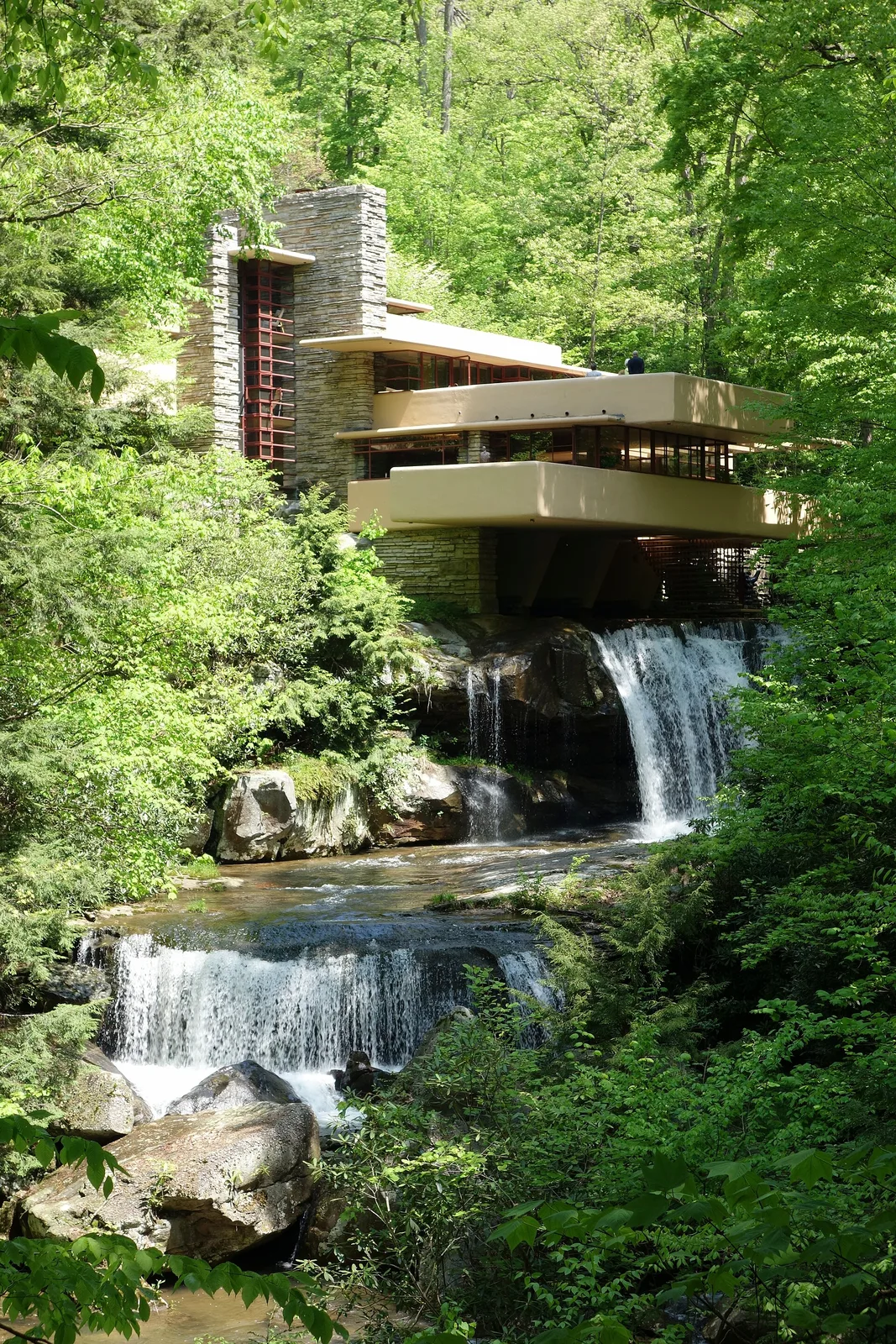
Fallingwater from downstream, the most famous architectural view in America
Fast Facts
Did You Know?
When Edgar Kaufmann revealed Wright's plans for Fallingwater to the engineering firm that was to build it, the engineers were so concerned about the cantilever design that they quietly added more reinforcing steel than Wright had specified, without telling him. Wright was furious when he found out. Decades later, the extra steel was found to be insufficient, and the conservancy added post-tensioned cables in 2002.
Wright's instructions for the sound of the house were that the residents should be able to hear the waterfall from every room. He succeeded: the sound of Bear Run permeates the entire house, from the living room's built-in staircase that descends to the water's surface to the bedrooms on the upper floors. The waterfall is as much a feature of the house as any room or piece of furniture.
In 1991, the American Institute of Architects named Fallingwater the 'best all-time work of American architecture.' In 2019, UNESCO designated it a World Heritage Site as part of a group of eight Frank Lloyd Wright buildings, recognizing it as an outstanding contribution to the development of modern architecture worldwide.
Plan Your Visit
Location
Fayette County, Laurel Highlands, southwestern Pennsylvania
Designation
UNESCO World Heritage Site / National Historic Landmark
Best Seasons
Spring and fall for forest color; summer for full green canopy
Admission
Standard tour $30-35; in-depth tour $75-85 (reservations required)
Address
1491 Mill Run Rd, Mill Run, PA 15464
Tour Hours
Wed-Mon, late March through mid-November (closed Tuesdays)
Getting There
PA-381, 3 miles north of Ohiopyle; 60 miles SE of Pittsburgh
More Info
fallingwater.org