About Minnesota
Minnesota takes its name from the Minnesota River, which the Dakota Sioux called "Mnisota," meaning "cloudy water" or "sky-tinted water," referring to the milky, silt-laden appearance of the river. "Mni" means water in Dakota, and "sota" means somewhat cloudy or sky-blue. French traders who worked with the Dakota adopted the name for the river, and it was applied to the territory when it was organized in 1849. Minnesota became a state in 1858, just three years before the Civil War. The state is home to one of the largest concentrations of lakes in the world, including more than 11,000 lakes, a landscape shaped by glaciers that retreated roughly 10,000 years ago.
Minnesota is the northernmost of the contiguous 48 states, a land shaped by glaciers that left behind more than 11,000 lakes, vast stretches of boreal forest, and some of the most productive agricultural soil on Earth. The Dakota called it 'mni sota makoce', the land where the water reflects the sky. That name has never lost its aptness: the lakes, the rivers, the wetlands, the wild rice paddies all mirror something elemental about the place.
Minnesota's modern identity is built on an unlikely set of foundations. It is home to the Mayo Clinic, one of the world's great medical institutions. It is a corporate powerhouse, Target, Best Buy, 3M, UnitedHealth Group, and a dozen other Fortune 500 companies call the Twin Cities home. Its Iron Range produced the ore that made American steel. Its farms produce turkeys, corn, soybeans, and wild rice at a scale that feeds the world. And from its modest northern cities came two of the most transformative musicians of the 20th century, Bob Dylan and Prince, whose influence on global culture is difficult to overstate.
Minnesota's political culture is distinctive: a progressive, civic-minded tradition rooted in its Scandinavian immigrant heritage, its union-organizing Iron Range, and the Democratic-Farmer-Labor party that Hubert Humphrey helped build in 1944. The state has not voted Republican for president since 1972, the longest such streak of any state in the country. It is not immune to polarization, but it retains a tradition of civic engagement and institutional trust that many states have lost.
Minnesota's Five Regions
Minneapolis and Saint Paul sit across the Mississippi River from each other and together form one of the most livable metropolitan areas in the United States. The two cities have distinct identities, Minneapolis is the larger, more cosmopolitan, more progressive of the two, home to Target Field, the Guthrie Theater, and a warehouse district arts scene; Saint Paul is the state capital, a bit more working-class and neighborhood-oriented, home to the Cathedral of Saint Paul and the Fitzgerald Theater.
The broader metro area of roughly 3.7 million people is the economic, cultural, and political heart of Minnesota and the upper Midwest. It is home to the extraordinary concentration of Fortune 500 companies, the University of Minnesota, and a vibrant music scene that produced Prince, the Replacements, Hüsker Dü, and Soul Asylum.
The Twin Cities have grappled intensely with racial inequality, the murder of George Floyd by a Minneapolis police officer in 2020 sparked a global reckoning, and continue to confront deep disparities between their white and Black and Indigenous communities.
Minneapolis grew as a milling city: by 1880 the Falls of St. Anthony powered the largest concentration of flour mills in the world, giving General Mills and Pillsbury their start, while lumber mills sawed the white pine floated down from the north. St. Paul, the older city and the head of practical steamboat navigation on the Mississippi, became the railroad capital of the Northwest under James J. Hill, whose Great Northern Railway reached Seattle in 1893 from a St. Paul headquarters.
The metro built one of the most-copied regional-government experiments in the country: the Metropolitan Council, created by the legislature in 1967, runs regional transit, wastewater, and land-use planning across seven counties, and a 1971 'fiscal disparities' law pools a share of commercial property-tax growth among all the region's cities to reduce competition for development. The area is also known for its parks, Minneapolis's Chain of Lakes and Grand Rounds byway, and its skyway system of enclosed second-floor walkways, the largest in the world, that lets downtown workers avoid winter entirely.
The Twin Cities have absorbed large recent immigrant communities that reshaped their politics and culture: metro Minneapolis-St. Paul is home to the largest Somali population in the United States, concentrated in the Cedar-Riverside neighborhood and the suburb of St. Cloud, as well as major Hmong (the largest urban Hmong community in the country, in St. Paul), Mexican, Ethiopian, and Karen populations. Ilhan Omar, elected from Minneapolis in 2018, was one of the first two Muslim women in Congress.
Northeastern Minnesota is a world unto itself, a rugged, lake-studded landscape where the culture of the Iron Range mining camps still shapes communities built by waves of Finnish, Slovenian, Croatian, Italian, and Scandinavian immigrants in the late 19th and early 20th centuries. Hibbing, Virginia, Eveleth, and Chisholm were company towns built around the iron mines; their hard-bitten union culture made the Range one of the most reliably progressive regions in the country for generations.
Bob Dylan grew up in Hibbing. Kevin McHale, the NBA Hall of Famer, was born there.
The Mesabi Range stretches 110 miles across the northeast, a scar of open-pit mines and taconite plants that still employ thousands. Duluth, the Range's gateway city at the western tip of Lake Superior, is one of the most geographically dramatic cities in the Midwest, perched on a steep hillside above the world's largest freshwater lake by surface area, serving as the port through which Minnesota's iron ore and grain reach the rest of the world.
The Hull-Rust-Mahoning Mine at Hibbing is the largest open-pit iron mine in the world, more than three miles long and up to 535 feet deep, and the town of Hibbing was physically picked up and moved about two miles south between 1919 and the 1950s because it sat on top of the ore, an episode locals call 'the town that moved.' The Range's other big draw is the Soudan Underground Mine, Minnesota's oldest, now a state park where visitors ride a cage half a mile down.
Duluth-Superior is the busiest port on the Great Lakes by tonnage, moving iron-ore pellets, coal, grain, and wind-turbine components, and the ships pass beneath the Aerial Lift Bridge, a 1905 landmark that raises its span in about a minute for lakers up to 1,000 feet long. The city has reinvented a shrunken industrial economy around health care (Essentia and St. Luke's), the University of Minnesota Duluth, tourism, and, increasingly, its status as a cooler-climate 'climate refuge.'
The Arrowhead's other half is wilderness: the North Shore of Lake Superior runs 150 miles from Duluth to the Canadian border past Split Rock Lighthouse and eight state parks, and behind it lies the Superior National Forest and the Boundary Waters. A long fight over the proposed Twin Metals copper-nickel mine in the Boundary Waters watershed near Ely, and the separate PolyMet (NewRange) project near Hoyt Lakes, has split Range communities that want the jobs from paddlers and downstream towns that fear acidic mine drainage.
Southeast Minnesota is dominated by the blufflands and river valleys of the Driftless Area, a region bypassed by the last glaciation that retains a rugged, hilly topography unlike the flat prairie covering much of the state. Rochester is the crown jewel: a mid-sized city of about 125,000 that punches dramatically above its weight as the home of the Mayo Clinic, which draws patients from around the world and makes Rochester one of the most international small cities in the United States. The presence of Mayo and its thousands of employees and patients has made Rochester exceptionally prosperous and cosmopolitan.
Winona, perched on the Mississippi River bluffs, is one of the most architecturally preserved Victorian cities in the Midwest. The Root River valley and bluffland trails attract cyclists and hikers from across the region.
The Driftless Area, covering the southeastern corner of Minnesota along with adjacent parts of Wisconsin, Iowa, and Illinois, was never bulldozed flat by the last ice sheets, so it keeps deep river gorges, cold spring-fed trout streams, hardwood-forested ridges, and thin karst soils riddled with caves and sinkholes; it is some of the most scenic terrain in the Upper Midwest and a distinct farming region of smaller dairy and organic operations. Lanesboro on the Root River is a hub of the region's cave, canoe, and rail-trail tourism.
Rochester's growth is essentially Mayo's growth: the city has roughly tripled in population since 1970, and in 2013 the legislature designated it a 'Destination Medical Center,' committing about 585 million dollars in state and local infrastructure money over 20 years to leverage a planned 5 billion dollars of Mayo investment, one of the largest economic-development deals in state history. The clinic's founders, W.W. Mayo and his sons, also endowed the Mayo Foundation, whose graduate school helped make Rochester a research center as well as a hospital town.
Winona anchors the river-bluff economy with barge grain terminals, Fastenal (an industrial-supply company that grew into one of Minnesota's largest and is headquartered there), Winona State University, and a stained-glass and polymer-manufacturing base; it and Red Wing (of Red Wing Shoes and Red Wing stoneware) preserve the look of the 1870s lumber-and-wheat river boom that built them.
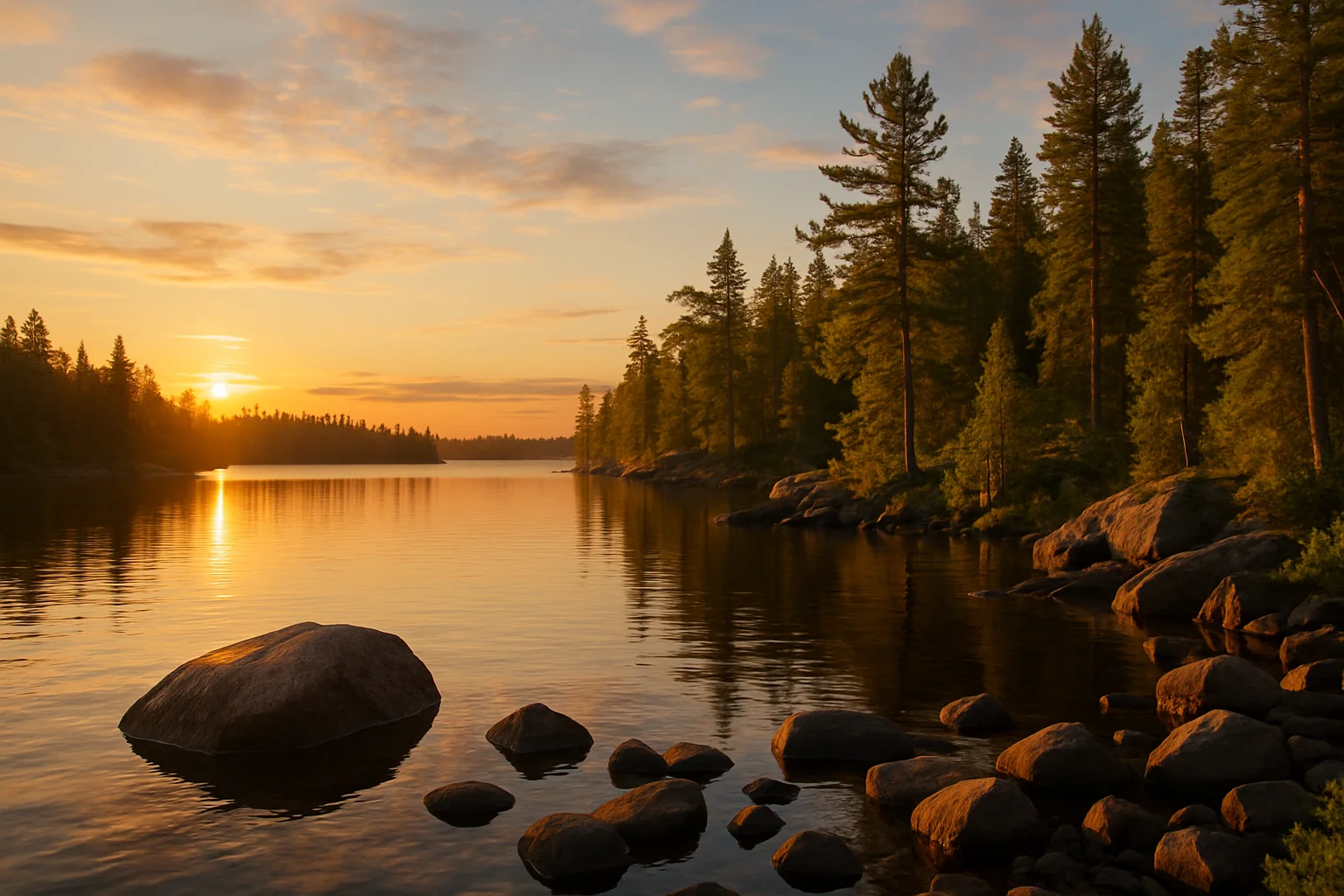
Central and west-central Minnesota is the heartland of the 'Land of 10,000 Lakes' identity, a glacially carved landscape of lakes, bogs, forests, and small resort towns that defines Minnesota summer life. Brainerd is the gateway to the Brainerd Lakes area, one of the most popular resort destinations in the upper Midwest.
Bemidji, on the shores of Lake Bemidji, the hometown Paul Bunyan reportedly called his own, is a regional hub for the vast north-central lake country. The Boundary Waters Canoe Area Wilderness, in the northeast corner, is the most visited wilderness area in the United States, over a million acres of pristine lakes connected by portage trails, accessible only by canoe or on foot, with no motor vehicles permitted.
The fishing culture of central Minnesota is as central to state identity as any other feature, walleye (the state fish) is the obsession that fills ice houses in winter and boat launches in summer.
The Mississippi River rises here, at Lake Itasca in Clearwater County, where a knee-deep outlet marked by a line of stepping stones begins the 2,340-mile journey to the Gulf of Mexico; Henry Rowe Schoolcraft, guided by the Ojibwe leader Ozawindib, identified the true source in 1832, and Itasca became Minnesota's first state park in 1891. The name Itasca is a coined word from the Latin 'veritas caput,' 'true head.'
Central Minnesota's lakes are the summer-cabin heartland: Minnesota has more than 11,000 lakes larger than 10 acres and roughly 130,000 seasonal 'cabin' or 'lake home' properties, and a large share of the metro's population decamps to them on summer weekends, a migration heavy enough to clog the northbound freeways every Friday. Nisswa, Pequot Lakes, and the Gull Lake chain near Brainerd form one of the densest resort clusters in the Midwest.
St. Cloud, on the Mississippi about 65 miles above the Twin Cities, is the region's largest city and industrial center, historically a granite-quarrying town, 'the Granite City,' whose stone faced buildings across the country, and now a manufacturing and university hub whose fast-growing Somali-American community has made immigration a flashpoint in local politics. The vast peatlands and tamarack bogs of north-central Minnesota, among the largest wetlands in the lower 48, lie just beyond the lake country.
Southern and western Minnesota is farm country, flat, fertile, and overwhelmingly agricultural. The southern tier, where glaciation left behind some of the most productive soil in North America, is a landscape of corn, soybeans, hogs, and dairy operations that stretch to the horizon. Mankato, the largest city in southern Minnesota, is a regional hub with Minnesota State University and a growing healthcare sector.
The Red River Valley in the northwest is the most dramatically flat terrain in the state, so flat that spring flooding from the Red River (which flows north toward Canada, unusual for American rivers) regularly inundates communities along the Minnesota-North Dakota border. This region produces enormous quantities of wheat and sugar beets and is among the most agriculturally productive country on the continent.
The Red River Valley is the bed of glacial Lake Agassiz, a body of meltwater larger than all today's Great Lakes combined that drained about 8,000 years ago and left behind lakebed clay so flat and rich that the region became famous in the 1870s and 1880s for 'bonanza farms,' single wheat operations of 20,000 to 100,000 acres run like factories. Because the Red flows north, its spring melt runs into still-frozen channels downstream, and major floods hit Grand Forks and the Fargo-Moorhead area in 1997 and again in 2009.
Mankato, at the great southward bend of the Minnesota River, was the site of the December 1862 mass hanging of 38 Dakota men, the largest execution in U.S. history, now marked by a reconciliation park and an annual memorial ride; the city today anchors a nine-county region around Minnesota State University, Mankato, agribusiness, and a growing food-processing sector. Nearby New Ulm was founded by German freethinkers and Turner societies in the 1850s and remains one of the most self-consciously German towns in the country.
The southwestern corner rises onto the Coteau des Prairies, where the Pipestone quarries, sacred to many Plains nations as the source of the soft red stone carved into ceremonial pipes, are protected as Pipestone National Monument and still worked by Native craftspeople under federal permit. Southern Minnesota also leads the state in hog production and, more recently, in wind power, with large turbine arrays on the Buffalo Ridge.

Economy
Minnesota's economy is one of the most diversified in the nation, anchored by world-class healthcare, Fortune 500 corporate headquarters, agriculture, iron mining, and an extraordinary cultural sector.
The Mayo Clinic in Rochester, founded in 1889 by Dr. William Mayo and his sons, is consistently ranked among the top hospitals in the world and pioneered the concept of integrated, multidisciplinary medicine. Patients travel from every state and dozens of countries for complex diagnoses and treatments unavailable elsewhere. UnitedHealth Group, headquartered in Minnetonka, is the largest health insurance company in the United States and one of the highest-revenue companies in the world.
Medtronic, with deep Minnesota roots and major operations in the Twin Cities, is the world's largest medical device company; its engineers invented the first wearable cardiac pacemaker in 1957, and the company's innovations have touched virtually every field of modern medicine. Together, healthcare and medical technology are Minnesota's most important exports to the world.
The Twin Cities suburb of Fridley is sometimes called 'Medical Alley,' the informal name for a corridor that includes Medtronic, Boston Scientific's large cardiac operations, St. Jude Medical (acquired by Abbott in 2017 for about 25 billion dollars), and hundreds of smaller device firms; Minnesota consistently ranks first among states in medical-device employment per capita. Medtronic itself began in 1949 as a Minneapolis garage repair shop for hospital equipment run by Earl Bakken, who built that first battery-powered wearable pacemaker after a 1957 power outage killed a child on a plug-in unit.
UnitedHealth Group reported revenue above 400 billion dollars in the mid-2020s, making it one of the two or three largest companies in the United States by that measure, and its Optum division has become one of the country's largest employers of physicians; a February 2024 ransomware attack on its Change Healthcare payment unit disrupted claims and pharmacy transactions nationwide for weeks. The company relocated its headquarters within the Minnetonka area but remains Minnesota's largest company.
The Mayo Clinic employs roughly 50,000 people in Rochester alone, more than a third of the city's population, and in 2022 announced 'Bond,' a roughly 5 billion dollar downtown campus rebuild that Minnesota backed with a special tax package. Mayo, the University of Minnesota's academic medical center, and the large nonprofit systems HealthPartners, Allina, and Fairview make health care Minnesota's single largest private employment sector.
Cargill, the largest private company in the United States by revenue, is based in Minnetonka and is one of the world's most important agricultural commodity traders and processors. General Mills, maker of Cheerios, Wheaties, Pillsbury, Betty Crocker, and dozens of other iconic brands, is headquartered in Golden Valley. Hormel Foods (SPAM, Jennie-O turkey) is based in Austin.
Land O'Lakes, one of the nation's largest agricultural cooperatives, is headquartered in Arden Hills. Minnesota's farmers produce corn, soybeans, dairy, hogs, and, notably, more turkeys than any other state in the nation. Wild rice, the only grain native to North America, is the state grain, and Minnesota produces the majority of commercially harvested wild rice.
Cargill, founded in 1865 to store grain along the Iowa railroads and still owned by the Cargill and MacMillan families, employs about 160,000 people in 70 countries and trades, ships, processes, and finances agricultural commodities on a scale that gives it a hand in a large share of the world's food supply; it is regularly the largest privately held company in the United States by revenue. General Mills traces to the 1866 Washburn 'A' Mill at the Falls of St. Anthony, which an 1878 flour-dust explosion leveled, killing 18 workers and prompting the safety redesign of flour mills nationwide.
Minnesota is the top U.S. turkey state, raising more than 40 million birds a year, and among the leaders in sugar beets, sweet corn and peas for canning, hogs, oats, and spring wheat; the state's farmer-owned processing cooperatives, American Crystal Sugar in the Red River Valley and the former land-grant creamery network behind Land O'Lakes, are a distinctive feature of its farm economy. Avian influenza outbreaks in 2015 and again in 2022 forced the culling of millions of Minnesota turkeys and laying hens.
Wild rice (manoomin) holds legal and cultural weight beyond its acreage: it is central to Ojibwe treaty rights and identity, Minnesota law sets a water-sulfate standard to protect wild-rice waters that has been fought over for years, and tribes have secured 'personhood' or rights-of-nature protections for manoomin. Most grain sold as 'wild rice' nationally is now paddy-farmed in Minnesota and California rather than hand-harvested from lakes.
The Twin Cities metro regularly ranks among the top five metro areas in the country for Fortune 500 company density. In addition to UnitedHealth Group, Cargill, General Mills, and Hormel, Minnesota is home to Target Corporation (the nation's eighth-largest retailer, headquartered in downtown Minneapolis), Best Buy (the nation's largest consumer electronics retailer, headquartered in Richfield), 3M (headquartered in Saint Paul, the manufacturing conglomerate responsible for Post-it Notes, Scotch tape, N95 respirators, and thousands of industrial and consumer products), U.S. Bancorp, Ameriprise Financial, and Xcel Energy, among others.
This corporate concentration supports a thriving ecosystem of professional services, finance, law, and technology that gives the Twin Cities an economic sophistication far beyond what its population might suggest.
Minnesota has consistently had around 15 to 20 Fortune 500 headquarters, more per capita than almost any state, and analysts often credit a mid-20th-century business culture of civic investment: in 1976 the Minneapolis and St. Paul chambers formalized a '5% Club' of companies pledging 5 percent of pretax profits to charity, and the Target, Dayton, and Bush family foundations built much of the region's arts and social infrastructure. Target began as the Dayton's department-store chain, opened its first discount store in 1962, and adopted the Target name company-wide in 2000.
3M, founded in 1902 as the Minnesota Mining and Manufacturing Company to quarry a mineral that turned out to be nearly worthless, pivoted to sandpaper and then to a stream of coatings and adhesives, masking tape (1925), Scotch tape (1930), Post-it Notes (1980), and holds tens of thousands of patents; it also faces multibillion-dollar liabilities over 'forever chemicals' (PFAS) it made for decades, settling with the state of Minnesota for 850 million dollars in 2018 and with U.S. public water systems for a sum that could exceed 10 billion dollars in 2023.
The headquarters base has thinned somewhat, Northwest Airlines merged into Delta in 2008, Pillsbury was absorbed by General Mills, and Wells Fargo (heir to a Minneapolis bank) is now San Francisco-based, but the Twin Cities still anchor Ecolab, Polaris, Toro, Hormel, and the grain giant CHS, and the metro routinely ranks among the country's strongest for median income, employment, and homeownership.
Discovered in the early 1890s, the Mesabi, along with the smaller Vermilion and Cuyuna ranges, made Minnesota the source of the iron ore that built American industrial civilization. At the industry's peak in the mid-20th century, Minnesota mines produced over 75% of the nation's iron ore. The ore traveled by rail to Duluth and Two Harbors on Lake Superior, where it was loaded onto massive ore boats bound for steel mills in Ohio, Pennsylvania, and Indiana.
Today, Minnesota's Iron Range produces taconite pellets, a processed, concentrated form of lower-grade iron ore, that still supply American steel mills. The Range has faced severe economic challenges as steel production shifted and declined, but it remains the most productive iron mining region in the United States. The Range's working-class, fiercely union culture has profoundly shaped Minnesota's political identity.
When the rich 'direct-shipping' hematite ran out in the 1950s, University of Minnesota researcher E.W. Davis's decades-long work on processing the abundant low-grade taconite rock saved the industry: crushed taconite is concentrated with magnets and rolled into marble-sized pellets that are about 65 percent iron. Minnesota voters passed a 'taconite amendment' to the state constitution in 1964 promising the industry stable tax treatment, and a wave of new plants followed.
The Range still ships roughly 30 to 40 million tons of pellets a year, about 75 to 80 percent of U.S. iron ore, but employment has fallen from tens of thousands to a few thousand, and the mines are highly exposed to steel-market swings and imports; thousands of workers were laid off in a 2015 to 2016 downturn tied to a flood of cheap foreign steel and again briefly in 2020. The mines are now owned mainly by Cleveland-Cliffs and U.S. Steel, and a proposed direct-reduced-iron plant aims at electric-furnace 'green steel.'
The Range's ore built the ships, rails, cars, and skyscrapers of 20th-century America, on the order of 3 to 4 billion tons mined since 1884, and its multiethnic mining-camp culture produced Minnesota's most radical labor politics: the 1907 and 1916 Mesabi strikes, a strong Communist and Farmer-Labor presence, and, for decades, some of the most reliably left-voting counties in the country, a pattern that has recently shifted sharply toward Republicans.
Bob Dylan, born Robert Allen Zimmerman in Duluth in 1941, is one of the most influential songwriters in history, a Nobel Prize laureate in Literature, and the defining voice of the 1960s folk and protest movements. Prince Rogers Nelson, born in Minneapolis in 1958, was perhaps the most musically gifted performer of the 20th century: a virtuosic multi-instrumentalist who played every instrument on his recordings, produced and arranged everything himself, and created one of the most singular artistic visions in popular music history.
The Twin Cities' arts infrastructure is exceptional for its size: the Guthrie Theater is among the premier regional theaters in the country; the Minneapolis Institute of Art houses one of the finest encyclopedic collections in the Midwest; the Walker Art Center is a leading contemporary arts institution.
Minneapolis had a nationally influential rock scene in the 1980s beyond Prince: Hüsker Dü and the Replacements shaped American indie and alternative rock, and the local First Avenue nightclub, featured in Prince's 1984 film 'Purple Rain,' remains a landmark venue. The state's public radio network, Minnesota Public Radio, grew from a single college station into one of the largest and most-copied public-media organizations in the country, and 'A Prairie Home Companion' broadcast Minnesota's small-town self-image nationally for four decades.
Tourism is anchored by the Boundary Waters Canoe Area Wilderness, a 1.1-million-acre paddling paradise, Voyageurs National Park, and the Mall of America in Bloomington.
Prince built Paisley Park, a recording and performance complex, in the suburb of Chanhassen in 1987 and lived and died there; it opened to the public as a museum in 2016, months after his death from an accidental fentanyl overdose. Bob Dylan's boyhood home in Hibbing, the Dylan-themed mural district in Duluth, and the annual Dylan celebrations there draw music tourists to the Iron Range.
The Mall of America, opened in 1992 on the site of the old Metropolitan Stadium, draws roughly 40 million visitors a year, is one of the most-visited attractions in the country, and benefits from Minnesota's exemption of clothing from sales tax. The Guthrie Theater, founded by Tyrone Guthrie in 1963 as a deliberate alternative to Broadway, helped launch the American regional-theater movement, and the Twin Cities are often cited as having more theater seats per capita than any U.S. metro outside New York.
Northern Minnesota's summer economy runs on lake cabins and canoe country: the Boundary Waters alone gets more than 150,000 visitors a year, making it the most-used unit of the National Wilderness Preservation System, and Voyageurs, the North Shore of Lake Superior, and thousands of resort and cabin properties add hundreds of millions of dollars and a distinctive seasonal rhythm to the state.
The intersection of healthcare, data, and technology has made the Twin Cities a growing hub for health technology companies and digital health startups. 3M's legendary research and development culture, giving researchers time for self-directed exploration, influenced how the entire technology industry approaches R&D, predating Google's famous '20 percent time' by decades. U.S. Bancorp operates one of the nation's largest regional banking networks from Minneapolis.
Ameriprise Financial manages hundreds of billions in client assets. The state's financial services sector is deeper and more sophisticated than its population might suggest.
U.S. Bancorp, headquartered in a downtown Minneapolis tower, is one of the largest banks in the country by deposits, and Ameriprise Financial, spun off from American Express in 2005, traces its roots to Investors Diversified Services, a Minneapolis firm founded in 1894 that pioneered the sale of mutual funds and financial planning to middle-class households. The Federal Reserve Bank of Minneapolis, which covers a six-state Ninth District, has an outsized research reputation and hosts the influential 'Opportunity and Inclusive Growth Institute.'
The University of Minnesota is one of the largest research universities in the country, spending well over a billion dollars a year, and its faculty and labs produced the retractable seatbelt, the black box flight recorder, the implantable pacemaker (with Medtronic), taconite processing, and the antiretroviral drug that became a mainstay of HIV treatment. Its 'U of M' Twin Cities campus enrolls more than 50,000 students on both banks of the Mississippi.
Minnesota's tech workforce is concentrated less in consumer startups than in the software and data operations of its big incumbents, Target's e-commerce and supply-chain engineering, UnitedHealth's Optum data business, the medical-device firms' embedded software, plus a growing agtech and fintech scene, and Minneapolis-St. Paul routinely ranks among the strongest U.S. metros for STEM employment and for the share of workers with a bachelor's degree.
How Minnesota's Government Works
Minnesota's state government follows the standard three-branch structure: the Executive (Governor), the Legislative (the Minnesota Legislature, a 67-seat Senate and 134-seat House of Representatives), and the Judicial (the Minnesota Supreme Court, which has seven justices appointed by the Governor and subject to retention elections).
The Governor serves a four-year term with no term limits. The DFL (Democratic-Farmer-Labor) party has dominated Minnesota politics since the mid-20th century. Minnesota held unified DFL control from 2023 through 2024, producing a significant legislative agenda including free school meals for all students, expanded paid family leave, and major climate and clean energy investments.
Minnesota's judiciary operates on a merit-selection model, the Governor appoints justices to the Supreme Court, who then face nonpartisan retention elections. The state has a strong tradition of judicial independence and professionalism.
Minnesota's main center-left party is the Democratic-Farmer-Labor party, a unique institution formed in 1944 by merging the Democratic Party and the Farmer-Labor Party. The DFL's fusion of urban liberals, rural farmers, and industrial unionists created a political tradition more progressive than most state Democratic parties, and gave Minnesota an outsized role in national Democratic politics for decades, producing Humphrey, McCarthy, Mondale, and Klobuchar.
Governor of Minnesota
Current Governor
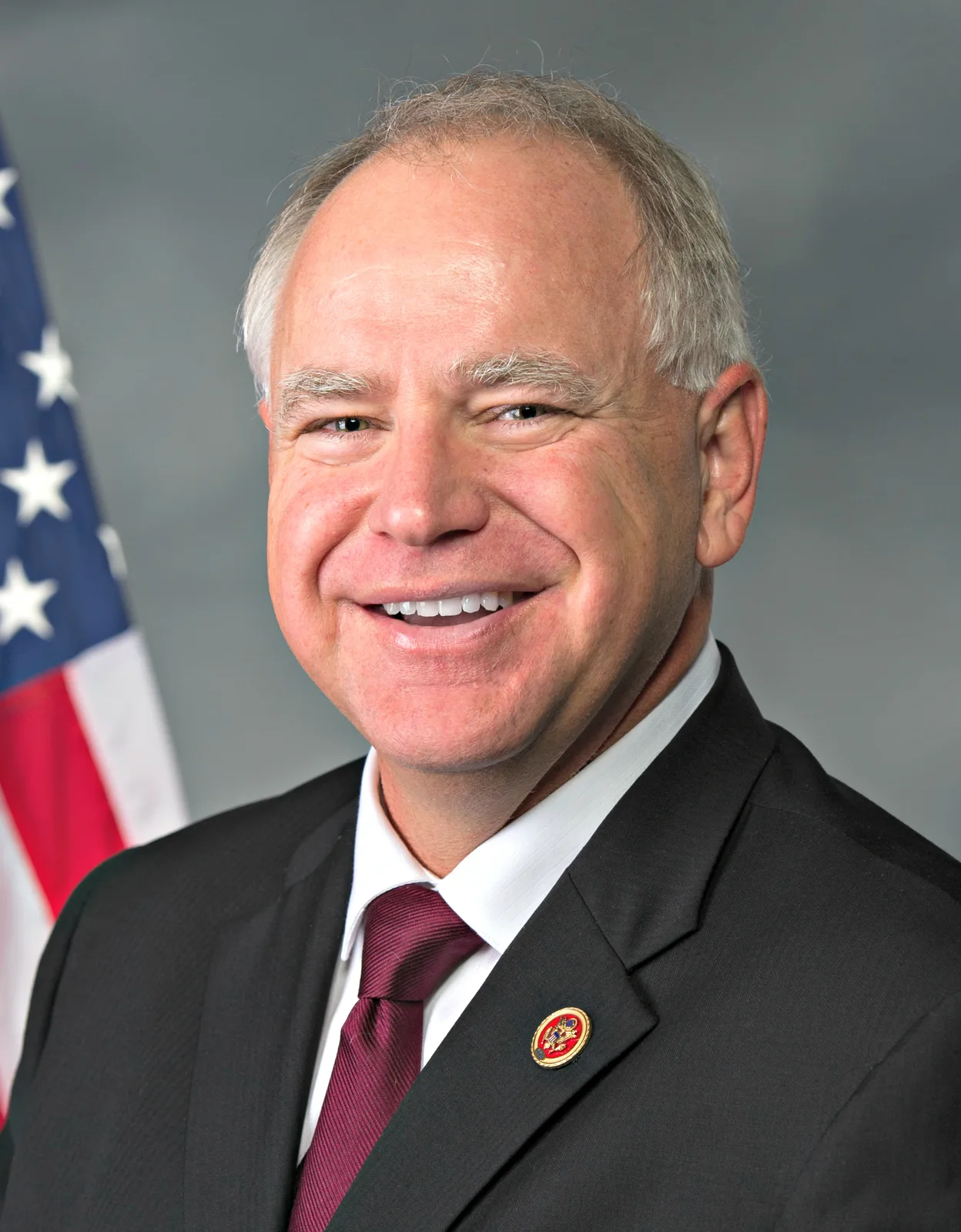
Tim Walz
- Party
- DFL (Democratic-Farmer-Labor)
- In Office Since
- January 7, 2019
- Re-elected
- November 8, 2022
- Term Ends
- January 2027
- Born
- May 6, 1964, West Point, Nebraska
- Education
- Chadron State College (BS, Social Science); Minnesota State University Mankato (MS, Education Leadership)
- Prior Role
- U.S. Representative, MN-1 (2007–2019); Command Sergeant Major, Army National Guard (retired 2005); high school geography teacher and football coach
Tim Walz is Minnesota's 41st Governor. A former geography teacher and football coach at Mankato West High School and a 24-year Army National Guard veteran, Walz represented Minnesota's First Congressional District in the U.S. House for 12 years before winning the governorship in 2018. His administration pursued an ambitious progressive agenda including free school meals for all Minnesota students, expanded paid family and medical leave, and major clean energy legislation. In July 2024, Vice President Kamala Harris selected Walz as her running mate in the 2024 presidential election. The Harris-Walz ticket lost to Donald Trump and JD Vance in November 2024; Walz returned to Minnesota to continue serving as governor through January 2027.
Other Current State Officials
Lieutenant Governor
Peggy Flanagan
In office since January 2019, re-elected 2022. A member of the White Earth Band of Ojibwe, Flanagan is the first Indigenous woman elected to statewide executive office in United States history. She focuses on childcare, early childhood education, and tribal nation relations.
Attorney General
Keith Ellison
In office since January 2019, re-elected 2022. A former U.S. Representative and the first Muslim elected to Congress, Ellison personally led the prosecution of Derek Chauvin for the murder of George Floyd. He has pursued aggressive consumer protection, worker rights enforcement, and antitrust action.
Secretary of State
Steve Simon
In office since January 2015, re-elected multiple times. A former state legislator, Simon has significantly expanded voting access in Minnesota, including automatic voter registration and same-day registration, and has been a leading national voice for election security and integrity.
The Minnesota Legislature
Minnesota State Senate
- Seats: 67 members
- Terms: 4-year terms
The upper chamber. Minnesota senators serve staggered 4-year terms. The DFL held a Senate majority after the 2022 elections, enabling a period of unified DFL government that produced significant legislation in 2023–2024.
Minnesota House of Representatives
- Seats: 134 members
- Terms: 2-year terms
The lower chamber. All 134 seats are on the ballot every two years. After the 2024 elections, the House split exactly 67–67 between DFL and Republicans, requiring a historic power-sharing agreement to organize the chamber.
Minnesota's U.S. Senators
U.S. Senator
Amy Klobuchar
Minnesota's senior senator, Klobuchar is one of the most prominent Democrats in the Senate and ran for the 2020 Democratic presidential nomination. She sits on the Judiciary, Commerce, and Rules committees, focusing on antitrust enforcement, prescription drug pricing, and election security. Known for her bipartisan effectiveness and Midwestern pragmatism, she won re-election in November 2024.
U.S. Senator
Tina Smith
Minnesota's junior senator, Smith was appointed in January 2018 to fill the seat vacated by Al Franken, who resigned amid misconduct allegations. She won a special election in November 2018 and a full six-year term in November 2020. She focuses on healthcare access, mental health, housing affordability, and climate policy. Her seat is up for re-election in November 2026.
Minnesota Through the Years
From early settlement to the present day. Tap any era to read more.
Long before European contact, the land that would become Minnesota was home to two major Indigenous nations with distinct cultures, languages, and histories. The Dakota (Sioux) people lived throughout much of the state's southern and western regions, organized into seven council fires, the Oceti Sakowin, and had inhabited the upper Midwest for thousands of years.
The Ojibwe (Anishinaabe or Chippewa) dominated the northern lake country, arriving in waves of westward migration beginning around 1400 CE and gradually establishing themselves through the northern regions. Minnesota's place names reflect this deep Indigenous heritage: Minnesota itself comes from the Dakota 'mni sota makoce,' meaning 'the land where the water reflects the sky.' Mississippi comes from the Ojibwe 'misi-ziibi,' meaning 'great river.' Minnehaha, Winona, Mankato, Wayzata, nearly all of Minnesota's most evocative names are Indigenous in origin.
The Ojibwe migration west was guided, in oral tradition, by a prophecy to travel until they reached 'the food that grows on the water,' the wild rice of the Great Lakes country, and the two nations fought for generations over the rice lakes and hunting grounds of central Minnesota; a major Dakota-Ojibwe battle at Kathio near Mille Lacs around 1750 pushed the Dakota south and west onto the prairies. Both nations also traded and intermarried extensively with French voyageurs from the 1600s on.
Nineteenth-century treaties dispossessed both peoples of nearly all of Minnesota: the Dakota ceded most of southern Minnesota in 1851 at Traverse des Sioux and Mendota for annuities that were chronically late or stolen, and a series of Ojibwe treaties from 1837 to 1867 opened the north while reserving rights to hunt, fish, and gather on the ceded land, rights the U.S. Supreme Court upheld for the Mille Lacs Band in 1999.
Today Minnesota has eleven federally recognized tribal nations, seven Ojibwe reservations, including White Earth, Leech Lake, and Red Lake, and four Dakota communities, Prairie Island, Shakopee Mdewakanton, Lower Sioux, and Upper Sioux. Red Lake is unusual as a 'closed' reservation whose land was never allotted and is held in common by the band. The Shakopee Mdewakanton, operating the large Mystic Lake casino near the Twin Cities, have become one of the wealthiest tribes per capita in the country and a major philanthropic force for other Native nations.
Father Louis Hennepin, a Belgian-born Franciscan friar traveling with Robert de La Salle's expedition, became the first European to describe the Falls of St. Anthony on the Mississippi River in 1680, the only natural waterfall on the entire length of the Mississippi and the future site of Minneapolis. Hennepin was captured by a band of Dakota warriors and held for several months before being released.
His accounts of the upper Mississippi Valley, published in Europe in 1683, introduced the region to the wider world. The area remained under French and then British influence for over a century before passing to the United States.
Hennepin named the falls for his patron saint, Anthony of Padua, and his later books wildly exaggerated his exploits, claiming he had canoed all the way to the Gulf of Mexico, a boast historians long ago disproved. Earlier French traders, the brothers-in-law Radisson and des Groseilliers, had already reached the western end of Lake Superior in the 1650s and 1660s, and Daniel Greysolon, Sieur du Lhut, for whom Duluth is named, made peace among the Dakota and Ojibwe near the head of the lake in 1679.
The Falls of St. Anthony were the only true waterfall on the Mississippi and later the reason Minneapolis exists: the roughly 50-foot drop powered the sawmills and then the flour mills that made the city, until aggressive tunneling for water power nearly destroyed the falls in 1869 and the Army Corps of Engineers had to encase them in a concrete apron to stop them from eroding upstream.
France's claim to the upper Mississippi passed to Britain in 1763 and to the young United States in 1783, though British fur traders operated on Minnesota soil until Zebulon Pike raised the U.S. flag at the mouth of the Minnesota River in 1805. The North West Company post at Grand Portage on Lake Superior, now a national monument, was the great inland rendezvous of the Montreal fur trade.
The Louisiana Purchase of 1803 transferred an enormous swath of central North America from France to the United States for approximately $15 million, including most of what would become Minnesota west of the Mississippi River. The remainder had already passed to the United States via the Treaty of Paris (1783) and the Northwest Ordinance (1787).
The purchase immediately set American exploration in motion. Zebulon Pike explored the upper Mississippi in 1805 and negotiated with Dakota leaders for land where Fort Snelling would later be built, the strategic confluence of the Minnesota and Mississippi rivers, the heart of what would become the Twin Cities.
Pike's 1805 'treaty' at the river junction the Dakota call Bdote paid roughly 200 dollars in goods and some whiskey for a tract the government later valued at 200,000 dollars; only two of the seven Dakota leaders present signed, and the amount to be paid was left blank. The Army built Fort Snelling on the bluff there between 1820 and 1825, and it anchored U.S. authority over the region for decades.
Fort Snelling has a dark place in the state's history: Dred Scott was held in slavery there in the 1830s by an Army surgeon, a fact central to his later freedom suit, and after the 1862 U.S.-Dakota War the Army interned about 1,600 Dakota, mostly women, children, and elders, in a stockade below the fort through the winter of 1862 to 1863, where more than a hundred died. Dakota people today regard the Bdote area as sacred and as a site of genocide.
The land east of the Mississippi had come to the United States earlier, through the 1783 Treaty of Paris and the 1787 Northwest Ordinance, so for a time the future state was split between two territorial jurisdictions; the boundary explains why St. Paul, on the east bank, and Minneapolis, on the west, grew up as separate cities.
The Territory of Minnesota was organized by an act of Congress on March 3, 1849, with Saint Paul as its capital. Alexander Ramsey was appointed the first territorial governor.
The territory's population exploded through the 1850s, driven by land-hungry settlers from the eastern states and Europe, particularly Scandinavian and German immigrants who would leave an indelible stamp on Minnesota's culture, cuisine, and political character. The first territorial legislature met in a Saint Paul hotel in 1849; within nine years, the territory would achieve statehood.
The 1851 treaties of Traverse des Sioux and Mendota, in which the Dakota ceded nearly 24 million acres, the southern half of the future state, opened the land rush; the non-Native population went from a few thousand in 1849 to more than 150,000 by 1857. St. Anthony, Stillwater, and St. Paul, the 'three cities' of lumber, milling, and government, boomed on the strength of white pine floated down the St. Croix and Rum rivers.
The immigration was distinctly Northern European: Minnesota drew the largest Swedish and Norwegian settlement of any state, along with Germans, Finns, Danes, and Bohemians, so that by 1900 more than a third of Minnesotans were foreign-born and Lutheran and German Catholic institutions shaped civic life. The pattern gave the state its enduring reputation for cooperatives, civic 'niceness,' and clean, activist government.
St. Paul was chosen as territorial and then state capital over rivals, and an 1857 attempt by a legislator to move the capital to St. Peter was famously thwarted when a member allegedly absconded with the bill until the session ended. Minnesota's original territory extended west to the Missouri River; the western portion was left out of the 1858 state and later became part of Dakota Territory.
Minnesota was admitted to the Union on May 11, 1858, as the 32nd state, a free state, entering at a moment when the national debate over slavery was tearing the country apart. Henry H. Sibley became the first governor.
Minnesota men would fight in large numbers in the Civil War that followed, the state was the first to respond to Lincoln's call for volunteers after the fall of Fort Sumter in April 1861. The 1st Minnesota Infantry Regiment suffered catastrophic casualties at Gettysburg in July 1863, charging Confederate lines to buy time for Union forces to regroup, one of the most consequential acts of battlefield sacrifice in the war.
Statehood was delayed for weeks by a partisan deadlock in Congress and by a bizarre episode in which the two houses of Minnesota's own constitutional convention, Republicans and Democrats, refused to meet together and wrote two separate documents that had to be reconciled by a conference committee; the two signed copies still differ in wording. Minnesota entered as the 32nd state on May 11, 1858, with Henry Sibley, a former fur-trade executive, as governor.
Governor Alexander Ramsey happened to be in Washington when Fort Sumter fell and personally offered Lincoln 1,000 men on April 14, 1861, making Minnesota the first state to pledge troops. On July 2, 1863, at Gettysburg, roughly 262 men of the 1st Minnesota charged a Confederate brigade to plug a gap in the Union line; about 215 were killed or wounded in a few minutes, one of the highest loss rates of any Union regiment in a single action, and the regiment held.
Minnesota sent about 24,000 men to the war out of a population near 172,000, and the state's soldiers also captured a Confederate battle flag at Gettysburg that Virginia has repeatedly, and unsuccessfully, asked Minnesota to return.
In August 1862, a desperate Dakota uprising broke out in southwestern Minnesota after years of treaty violations, land seizures, and deliberate starvation by the federal government and corrupt Indian agents. Dakota warriors attacked settlements across the Minnesota River valley, killing hundreds of settlers. The conflict lasted six weeks before the Dakota were defeated. President Lincoln ordered the execution of 38 Dakota men on December 26, 1862, in Mankato, the largest mass execution in United States history.
Over 1,600 Dakota people were subsequently imprisoned in a camp below Fort Snelling in brutal winter conditions where hundreds died of disease. The surviving Dakota were forcibly removed from Minnesota, ending their presence in their ancestral homeland for generations. The U.S.–Dakota War is one of the most painful and contested episodes in Minnesota history.
The war began on August 17, 1862, when four young Dakota men killed five white settlers near Acton, and leaders including Little Crow, who had opposed war, agreed to strike while U.S. troops were away fighting the Confederacy. The trigger was concrete: crops had failed, the annuity payment guaranteed by the 1851 treaties was months late because of Civil War disruptions, and a trader named Andrew Myrick had reportedly told starving Dakota to 'eat grass'; his body was found after the fighting with grass stuffed in his mouth.
Military commissions tried more than 390 Dakota men in trials that sometimes lasted only minutes and sentenced 303 to death. President Lincoln and two aides personally reviewed the records and commuted all but 39, and 38 were hanged together in Mankato on December 26, 1862, still the largest mass execution in U.S. history; one more, Little Crow's associate, was hanged years later.
In 1863 Congress abrogated all Dakota treaties, seized the reservation lands, expelled the Dakota to a barren tract in Dakota Territory, and put bounties on Dakota scalps in Minnesota. Small communities returned over the following decades, and in 2012, on the war's 150th anniversary, Governor Mark Dayton declared it 'a genocide' and a day of remembrance; the state has since removed some commemorative markers and added others.
The discovery of iron ore in the Mesabi Range in 1890, following earlier finds in the Vermilion Range, transformed northeastern Minnesota almost overnight. Vast quantities of high-grade ore lay close to the surface, accessible by open-pit mining at an unprecedented scale. Mining companies backed by Rockefeller and Morgan capital (consolidated into U.S. Steel in 1901) built railroads, dug mines, and recruited workers from across Europe.
Waves of Finnish, Slovenian, Croatian, Italian, and Scandinavian immigrants poured into the Range communities through the 1880s–1910s, creating a polyglot working-class culture that was fiercely union-oriented and politically radical. Simultaneously, the northern pine forests were being clear-cut in one of the most intensive logging operations in American history.
The Merritt brothers, a family of local prospectors, located the main Mesabi ore body in 1890, then lost their railroad and mines to John D. Rockefeller in the 1893 financial panic; Rockefeller and Andrew Carnegie's holdings were folded into J.P. Morgan's U.S. Steel in 1901, which for decades controlled most of the Range through a subsidiary, Oliver Iron Mining. A 1907 strike and the larger 1916 strike, backed by the radical Industrial Workers of the World, were broken by force but seeded the Range's lasting labor politics.
Minneapolis, not the Range, was the milling capital: by the 1880s the water power of the Falls of St. Anthony drove the largest concentration of flour mills in the world, grinding hard spring wheat from the Dakotas and the Red River Valley into Gold Medal (Washburn-Crosby, later General Mills) and Pillsbury flour and shipping it worldwide, and the city held the title 'Flour Milling Capital of the World' from about 1880 to 1930.
The white-pine logging boom that peaked around 1900 cut over roughly two-thirds of the state within a few decades, feeding sawmills at Stillwater, Winona, and Minneapolis and leaving cutover 'stump land' that often failed as farmland; the state and federal governments eventually bought much of it back as the Chippewa and Superior national forests and state forests.
A tornado devastated Rochester on August 21, 1883, killing nearly 40 people. The Catholic Sisters of Saint Francis, who had no hospital, established an emergency response with Dr. William Worrall Mayo. The sisters asked Dr. Mayo to help build a hospital, and in 1889, Saint Marys Hospital opened.
Dr. Mayo's sons, William James Mayo and Charles Horace Mayo, joined the practice and developed a revolutionary concept: instead of a single doctor treating the whole patient, they assembled teams of specialists who collaborated across disciplines to diagnose and treat complex cases. This model, which seems obvious today, was radical at the time.
The Mayo brothers formalized the group practice, put every physician on a straight salary rather than fee-for-service so that no doctor had a financial reason to over-treat, and built a unified patient record that any specialist could pull, all unusual in an era of solo practitioners. They also invested heavily in surgery at a time when antisepsis was new, and 'Dr. Will' and 'Dr. Charlie' became two of the most sought-after surgeons in the country.
In 1919 the brothers gave their assets and most of their income to a nonprofit foundation, ensuring the clinic could never be sold or run for private profit, and in 1915 they had already founded the Mayo Foundation for Medical Education and Research as a graduate school affiliated with the University of Minnesota. Mayo now operates hospitals in Arizona and Florida as well as Rochester and consistently ranks at or near the top of U.S. hospital rankings.
The clinic's scale reshaped Rochester: it employs about 50,000 people there, IBM opened a major plant in the city partly to be near Mayo's computing needs (the IBM System/360 and later the AS/400 were developed in Rochester), and the 2013 'Destination Medical Center' law committed hundreds of millions in public infrastructure money to support a multibillion-dollar Mayo expansion.
Minnesota politics cannot be understood without the Democratic-Farmer-Labor (DFL) party, the center-left political institution that has dominated Minnesota politics for most of the 20th and 21st centuries. The DFL was created in 1944 through the merger of the Minnesota Democratic Party and the Farmer-Labor Party, a progressive third party that had governed Minnesota through the 1930s under Governor Floyd B. Olson.
The merger was engineered largely by a young Minneapolis mayor named Hubert Humphrey, who united the two parties and purged Communist elements from the Farmer-Labor faction. The DFL's fusion of urban liberal Democrats, rural farmers, and industrial unionists created a political coalition unique in American politics, more progressive than the national Democratic Party, with a distinctive tradition of agrarian populism, labor solidarity, and civic engagement.
The Farmer-Labor Party had been the most successful state-level third party in modern U.S. history: it elected governors and U.S. senators through the 1920s and 1930s, and Governor Floyd B. Olson, elected in 1930, pushed a self-described radical program of relief, a mortgage moratorium, and public ownership before his death in office in 1936. By 1944 both the Farmer-Labor Party and the state Democrats were too weak to win alone, which drove the merger.
Minnesota Republicans undertook a parallel rebrand: the state party was officially the 'Independent-Republican' party from 1975 to 1995, distancing itself from the national party after Watergate. The two-party system that resulted, DFL versus IR/GOP, is unique to Minnesota's ballot and political vocabulary.
The DFL has held the governorship for most of the period since 1955 and controlled the state government trifecta again after 2022, when a one-seat Senate majority let it pass paid family leave, free school meals, recreational marijuana, and a large child tax credit in a single session; the party's rural wing, however, has eroded badly as Iron Range and farm counties shifted toward Republicans in the 2010s and 2020s.
The 1960s were Minnesota's great moment on the national political stage. Hubert Horatio Humphrey, the senator from Minnesota who championed the Civil Rights Act of 1964 with extraordinary passion, became Lyndon Johnson's Vice President in 1965. His 1948 Democratic convention speech calling on Democrats to 'walk forthrightly into the bright sunshine of human rights' had changed American politics.
Humphrey won the 1968 Democratic presidential nomination but lost a heartbreaking race to Richard Nixon, brought down by the divisions over Vietnam. His Minnesota colleague Senator Eugene McCarthy challenged Johnson from the left on Vietnam in the 1968 primaries, an insurgency that helped drive LBJ from the race and transformed Democratic primary politics forever.
Humphrey's 1948 convention speech, delivered when he was still mayor of Minneapolis, pushed a reluctant Democratic Party to adopt a strong civil-rights plank and prompted the Mississippi and Alabama delegations to walk out and form the segregationist 'Dixiecrat' ticket under Strom Thurmond; it also helped Humphrey win his U.S. Senate seat that fall.
As Senate majority whip in 1964, Humphrey managed the Civil Rights Act on the floor for 60 working days, holding together a bipartisan coalition to defeat a Southern filibuster, the achievement he considered his life's work. As Johnson's vice president he defended the Vietnam War publicly while privately opposing escalation, a bind that alienated the party's antiwar wing and shadowed his 1968 campaign.
McCarthy's near-upset of Johnson in the March 1968 New Hampshire primary, powered by student volunteers who 'went clean for Gene,' showed a sitting president was vulnerable, and within weeks Robert Kennedy entered the race and Johnson announced he would not run again. The 1968 convention violence in Chicago and Humphrey's narrow loss led the Democrats to rewrite their nominating rules to rely on primaries, reshaping how every later president has been chosen.
Walter Frederick Mondale, Humphrey's protégé, Jimmy Carter's Vice President, and the consummate Minnesota liberal, won the 1984 Democratic presidential nomination and made history by selecting Geraldine Ferraro of New York as his running mate, the first woman on a major-party presidential ticket. Mondale was forthright about his plans to raise taxes to address the federal deficit, telling the Democratic National Convention: 'Mr. Reagan will raise your taxes, and so will I. He won't tell you. I just did.'
The American public chose Reagan's sunny optimism over Mondale's honest austerity. Reagan won 49 states; Mondale carried only his home state of Minnesota, by just 3,761 votes, and the District of Columbia. It was a crushing defeat, but Mondale's candor about the deficits he warned about has aged better than the result.
Mondale had spent his career redefining the vice presidency: as Carter's number two from 1977 to 1981 he was the first VP given a West Wing office, a full intelligence briefing, weekly private lunches with the president, and a genuine advisory role, the template every vice president since has used. He had earlier been Minnesota's attorney general and the U.S. senator appointed to Humphrey's seat in 1964.
After 1984 Mondale served as U.S. ambassador to Japan under Bill Clinton, and in 2002 he was drafted at age 74 to replace Senator Paul Wellstone on the ballot 11 days before the election after Wellstone died in a plane crash; Mondale narrowly lost to Norm Coleman, the only statewide defeat of his long career in his home state.
On May 25, 2020, George Floyd, a 46-year-old Black man, died in Minneapolis after a Minneapolis police officer, Derek Chauvin, knelt on his neck for nine minutes and 29 seconds while bystanders pleaded for his life. The murder was filmed by a teenage bystander and circulated worldwide within hours. Minneapolis, and then hundreds of cities across the United States and around the world, erupted in protests that became the largest in American history. Buildings burned in Minneapolis and Saint Paul.
Derek Chauvin was convicted of second-degree murder in April 2021 and sentenced to 22.5 years in prison. George Floyd Square, at the intersection of 38th Street and Chicago Avenue in Minneapolis, became a permanent memorial.
Floyd had been detained over a suspected counterfeit 20-dollar bill at a corner store, and the roughly ten-minute bystander video shot by 17-year-old Darnella Frazier, who later received a Pulitzer special citation, made the case impossible to dismiss. The third precinct police station was abandoned and burned on the third night, damage across the Twin Cities ran past 500 million dollars, and Governor Tim Walz activated the full Minnesota National Guard for the first time in state history.
The legal outcome was unusually complete: Chauvin was convicted on all counts in state court in 2021 and later pleaded guilty to a separate federal civil-rights charge, and the three other officers present were also convicted federally and in state court. Minneapolis paid Floyd's family a 27 million dollar civil settlement, the largest pretrial settlement of its kind at the time.
The aftermath reshaped Minnesota policy and politics: the legislature and city passed use-of-force, chokehold, and duty-to-intervene rules, the state and federal governments imposed consent decrees on the Minneapolis Police Department, and city voters in 2021 rejected a ballot measure that would have replaced the police department with a broader public-safety agency. Debates over police staffing, response times, and reform continue to dominate Minneapolis elections.
Minnesota's Defining Moments in American History
These are the events that didn't just shape Minnesota, they changed the nation.
In August 1862, with their annuity payments delayed and facing starvation on a reservation far smaller than their original homeland, Dakota warriors launched a desperate uprising in southwest Minnesota. The war killed an estimated 600 settlers and an unknown number of Dakota before being suppressed. In its aftermath, President Lincoln ordered the largest mass execution in American history: 38 Dakota men were hanged simultaneously in Mankato on December 26, 1862.
More than 1,600 Dakota were exiled from Minnesota. The war's legacy continues to shape Minnesota's relationship with its Native communities.
The war grew directly out of broken promises: the 1851 treaties had confined the Dakota to a strip along the Minnesota River and pledged cash annuities that traders and agents skimmed or that arrived late, and in the summer of 1862 gold-inflated federal finances delayed the payment while Dakota families starved and a trader reportedly said they could 'eat grass.' Little Crow warned his people they could not win but agreed to lead once fighting began.
After six weeks of combat, Colonel Henry Sibley's forces defeated the Dakota at Wood Lake, and hundreds surrendered while others fled onto the plains. Hasty military commissions convicted 303 men, many in trials of a few minutes; Lincoln's staff reviewed the transcripts and he reduced the list to 39, then 38, insisting the men be punished for proven murder or rape of civilians rather than for making war.
The 38 were hanged from a single scaffold in Mankato on December 26, 1862, before a crowd of thousands. Congress then voided the Dakota treaties, seized the reservation, and forced the survivors out of Minnesota; the state paid scalp bounties for Dakota killed within its borders into the mid-1860s. In 2012 Minnesota's governor formally called the removal a genocide, and Dakota communities hold an annual memorial ride to Mankato.
On May 25, 2020, Minneapolis police officer Derek Chauvin knelt on George Floyd's neck for nine minutes and twenty-nine seconds, killing him. Bystander video of Floyd's death, shared globally within hours, ignited the largest protest movement in American history. Demonstrations occurred in all 50 states and in dozens of countries.
The Minneapolis Police Department became the most scrutinized in America. Chauvin was convicted of murder in 2021 in a verdict widely seen as a landmark moment for police accountability.
Researchers estimate that 15 to 26 million people took part in Black Lives Matter demonstrations in the United States in June 2020, which would make it the largest protest movement in the nation's history, and polling that summer showed a sharp, if partly temporary, shift in white Americans' views on racism and policing. Corporations, universities, and governments announced diversity commitments and racial-equity reviews on a scale not seen before.
In Minnesota the response was concrete and contested: the legislature banned chokeholds and 'warrior' training and created a duty to intervene, the state Department of Human Rights and the U.S. Justice Department both found the Minneapolis police had engaged in a pattern of race discrimination and imposed settlement agreements, and the department lost hundreds of officers to resignation and disability leave.
The reckoning also produced backlash and unfinished business. Minneapolis voters in 2021 rejected replacing the police department with a public-safety agency, national 'defund' proposals largely failed, some jurisdictions rolled reforms back as crime rose in 2021 and 2022, and by the mid-2020s the durability of the 2020 shift was itself a subject of debate.
The Boundary Waters Canoe Area Wilderness in northern Minnesota is the most visited wilderness area in the United States, a million-acre landscape of more than 1,000 lakes accessible only by canoe or foot. Its protection was hard-won: conservationists fought for decades to ban motorboats and logging, finally achieving full wilderness designation in 1978.
The Boundary Waters represents a foundational American idea: that some places must be preserved from development not for economic value, but because wildness itself has value. Its protection fights continue as mining interests seek access to its watershed.
The area's protection began early: a 1926 U.S. Forest Service policy kept roads out of the interior, a 1930 federal law barred most logging near the shorelines, and a 1949 executive order by President Truman created the first airspace reservation over a wilderness area to stop fly-in resorts and float-plane fishing camps. The conservationist Sigurd Olson of Ely spent decades campaigning for it, often against his own neighbors.
Congress included the area in the original 1964 Wilderness Act but wrote in exceptions for motorboats and logging that satisfied neither side, and the fight culminated in the Boundary Waters Canoe Area Wilderness Act of 1978, which phased out most motors and logging across the million-plus acres; the bill's sponsor, Representative Bruce Vento, faced burned effigies and blockades on the Iron Range.
The modern threat is copper-nickel sulfide mining in the watershed just south of the wilderness: Twin Metals, backed by the Chilean firm Antofagasta, and the separate PolyMet project have moved through a decade of permitting, lawsuits, and reversed federal decisions, with the Obama and Biden administrations imposing a 20-year mining ban on adjacent national-forest land and the intervening administration lifting it. The stakes are that acid drainage from sulfide ore could flow downstream into the pristine lakes.
Minnesota has been a laboratory for American progressive politics. The Farmer-Labor Party, born in Minnesota in the 1920s, pioneered social insurance programs and workers' rights before merging with the Democratic Party. Senator Hubert Humphrey, mayor of Minneapolis, forced the Democratic Party to adopt a civil rights plank in 1948, walking out the Dixiecrats.
Walter Mondale championed the rights of the poor and elderly. Minnesota's progressive tradition has repeatedly pushed the national Democratic Party leftward and shaped the social safety net Americans take for granted today.
The lineage runs deep. Minnesota's Grange and Populist movements of the 1870s and 1890s built farmer cooperatives and railroad regulation, and the Nonpartisan League that swept the Dakotas spilled into Minnesota to help create the Farmer-Labor Party, which under Governor Floyd Olson in the early 1930s enacted relief programs, a progressive income tax, and a mortgage moratorium in the depths of the Depression.
Humphrey carried that tradition to Washington: beyond the 1948 civil-rights plank and floor-managing the 1964 Civil Rights Act, he authored or pushed the Peace Corps, Medicare, the Job Corps, the nuclear test-ban treaty, and the 1978 full-employment act that bears his name. Eugene McCarthy, Walter Mondale, and later Paul Wellstone extended the DFL's national reach.
In the 2020s Minnesota again acted as a policy laboratory: with a narrow DFL trifecta the state in 2023 enacted paid family and medical leave, universal free school breakfast and lunch, a large refundable child tax credit, automatic voter registration, restored voting rights for people on probation, and legal recreational cannabis, a burst of legislation widely studied by other Democratic-run states.
Robert Allen Zimmerman was born in Duluth, Minnesota in 1941 and grew up in Hibbing, a mining town on the Iron Range. As Bob Dylan, he moved to New York and within a few years had reinvented American popular music. Blowin' in the Wind and The Times They Are A-Changin' became anthems of the civil rights and anti-war movements.
His 1965 electric turn at Newport shocked folk purists but opened rock music to literary ambition. In 2016, Dylan became the first songwriter to win the Nobel Prize in Literature, a recognition of his singular influence on American culture.
Dylan has always tied his art to where he came from, growing up Jewish in a Scandinavian-Lutheran mining town, hearing distant radio stations bounce across the Iron Range at night, and absorbing the ballad and labor-song tradition of the north. He took the surname Dylan, he later said, from no single source, and arrived in New York's Greenwich Village folk scene in January 1961 at age 19.
The run of albums from 'The Freewheelin' Bob Dylan' (1963) through 'Highway 61 Revisited' and 'Blonde on Blonde' (1965 to 1966) rewired popular songwriting, proving that a hit single could carry the density and ambiguity of poetry; songs like 'Like a Rolling Stone' and 'Mr. Tambourine Man' became touchstones for the Beatles, and for generations of writers after.
Minnesota keeps a strong claim on him: his Hibbing high school still displays his class photo, Duluth holds an annual Dylan festival and has commissioned murals of him, and in 2021 the University of Tulsa and the George Kaiser Family Foundation opened a Bob Dylan Center archive built around his personal papers, much of which document those Minnesota beginnings.
Notable Minnesotans
Bob Dylan
Born Robert Allen Zimmerman in Duluth, 1941; Nobel Prize laureate in Literature (2016); one of the most influential songwriters in history; the defining voice of the 1960s folk and protest movements
Prince
Born Prince Rogers Nelson in Minneapolis, 1958; virtuosic multi-instrumentalist, producer, and performer; Purple Rain; widely regarded as one of the most singularly gifted musicians of the 20th century
Hubert H. Humphrey
38th Vice President of the United States under LBJ; passionate champion of the Civil Rights Act of 1964; 1968 Democratic presidential nominee; the defining figure of mid-century Minnesota liberalism
Walter Mondale
42nd Vice President under President Carter; 1984 Democratic presidential nominee who chose the first female running mate (Geraldine Ferraro); carried only Minnesota in Reagan's 49-state landslide
Judy Garland
Born Frances Ethel Gumm in Grand Rapids, MN, 1922; starred as Dorothy in The Wizard of Oz (1939); one of the most celebrated actresses and singers of Hollywood's golden age
F. Scott Fitzgerald
Born in Saint Paul, 1896; author of The Great Gatsby, widely regarded as the Great American Novel; defined the literary voice of the Jazz Age
Charles M. Schulz
Born in Minneapolis, 1922; creator of Peanuts, one of the most widely read comic strips in history; Charlie Brown and Snoopy became global cultural icons for over 50 years
Garrison Keillor
Born in Anoka, 1942; creator and longtime host of A Prairie Home Companion on NPR; his 'Lake Wobegon' monologues made Minnesota's reserved, Lutheran, small-town character famous nationwide
Kevin McHale
Born in Hibbing, 1957; NBA Hall of Famer; three-time NBA champion with the Boston Celtics (1981, 1984, 1986); widely regarded as one of the greatest power forwards in basketball history
Jessica Lange
Born in Cloquet, 1949; two-time Academy Award winner (Tootsie, 1983; Blue Sky, 1995); one of the most critically acclaimed and versatile actresses of her generation
State Symbols & Quick Facts
| Nickname | "North Star State" (also: "Land of 10,000 Lakes") |
| Capital | Saint Paul |
| Largest City | Minneapolis |
| Statehood | May 11, 1858 (32nd state) |
| Population | ~5.7 million (2025 est.) |
| Area | 86,936 sq miles (12th largest) |
| State Bird | Common Loon |
| State Flower | Pink and White Lady's Slipper |
| State Tree | Red Pine (Norway Pine) |
| State Fish | Walleye |
| State Mushroom | Morel |
| State Grain | Wild Rice |
| State Song | Hail! Minnesota |
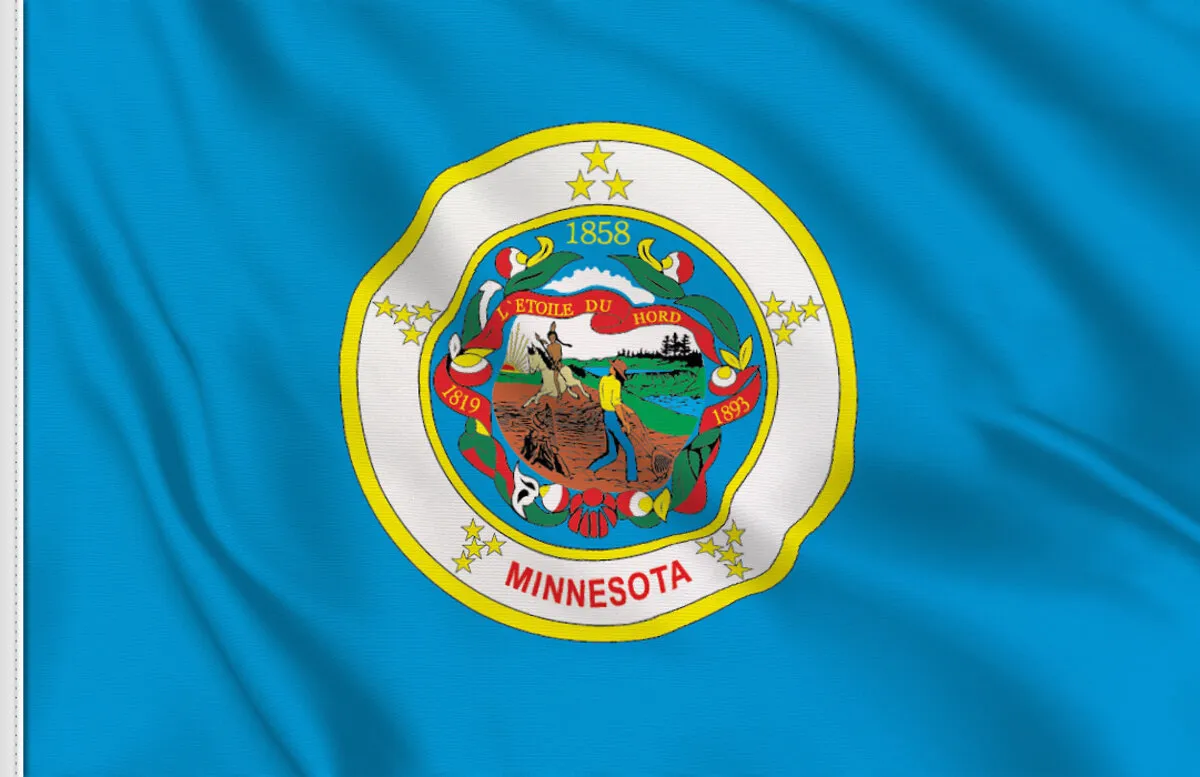
| State Motto | L'Étoile du Nord ("The Star of the North") |
| Time Zone | Central |
| Bordering States | Iowa, Wisconsin, North Dakota, South Dakota |
| International Border | Canada (Ontario and Manitoba) |
Did You Know?
Minnesota actually has more than 14,000 lakes if you count all bodies of water over 2.5 acres, the '10,000 Lakes' nickname, though officially recognized, is a significant undercount.
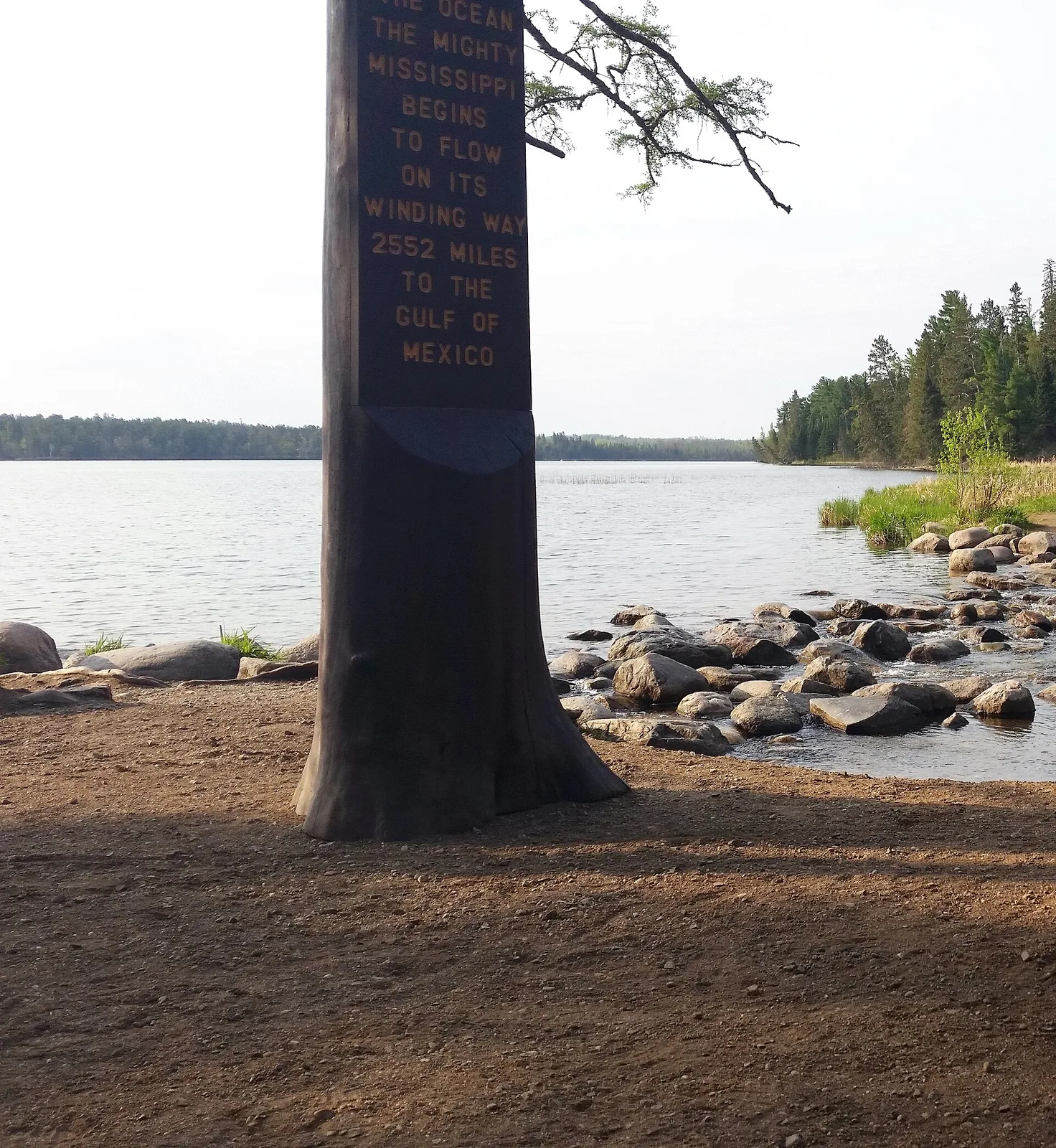
The Mississippi River, the longest river in the United States, begins as a narrow stream barely 20 feet wide at Lake Itasca in northern Minnesota, where you can walk across it on stepping stones in late summer.
Minnesota produces more turkeys than any other state in the nation, and is home to Hormel (makers of SPAM and Jennie-O turkey), General Mills (Cheerios, Wheaties, Pillsbury), and Cargill, the largest private company in the United States.
The Mall of America in Bloomington is the largest shopping mall in the United States by total floor area (5.6 million square feet). It contains an indoor amusement park, an aquarium, and an 18-hole miniature golf course, and Minnesota charges no sales tax on clothing purchases.
Minnesota has voted Democratic in every presidential election since 1976, the longest such streak of any state in the country. Mondale's 3,761-vote margin in 1984 was the only state besides D.C. to resist Reagan's 49-state landslide.
The Boundary Waters Canoe Area Wilderness in northeastern Minnesota spans 1.1 million acres and contains over 1,000 lakes. It is the most visited wilderness area in the United States and accessible only by canoe or foot, no motor vehicles permitted.
Minnesota is home to both Bob Dylan (born in Duluth) and Prince (born in Minneapolis), two of the most influential musicians in the history of popular music. No state of comparable size has produced more transformative artistic talent.
The Mayo Clinic in Rochester has been ranked the #1 hospital in the United States by U.S. News & World Report and draws patients from all 50 states and over 140 countries annually.
Minnesota is one of the two coldest states in the contiguous United States, just behind North Dakota by average annual temperature. International Falls, on the Canadian border, regularly competes with Embarrass, MN for the title of 'Icebox of the Nation', and has recorded temperatures below −50°F.
3M, headquartered in Saint Paul, invented both Scotch tape (1930) and Post-it Notes (1980) and holds more than 100,000 patents worldwide. Its culture of giving researchers time for self-directed projects directly inspired Google's famous '20 percent time' policy.
Quick Facts and Common Questions
Short answers to the questions people most often ask about Minnesota: its abbreviation, what its name means, its capital, and its place in Congress.
Minnesota's two-letter postal abbreviation is MN. The U.S. Census Bureau places it in the Midwest region, in the West North Central division, and about 5.71 million people lived there in the 2020 census.
Minnesota became the 32nd state on May 11, 1858. The land east of the Mississippi River came from the old Northwest Territory and the land to the west from the Louisiana Purchase, and Congress created the Minnesota Territory in 1849.
The name comes from the Dakota words "Mni Sota," the Dakota name for the Minnesota River, usually translated as "cloudy water" or "sky-tinted water."
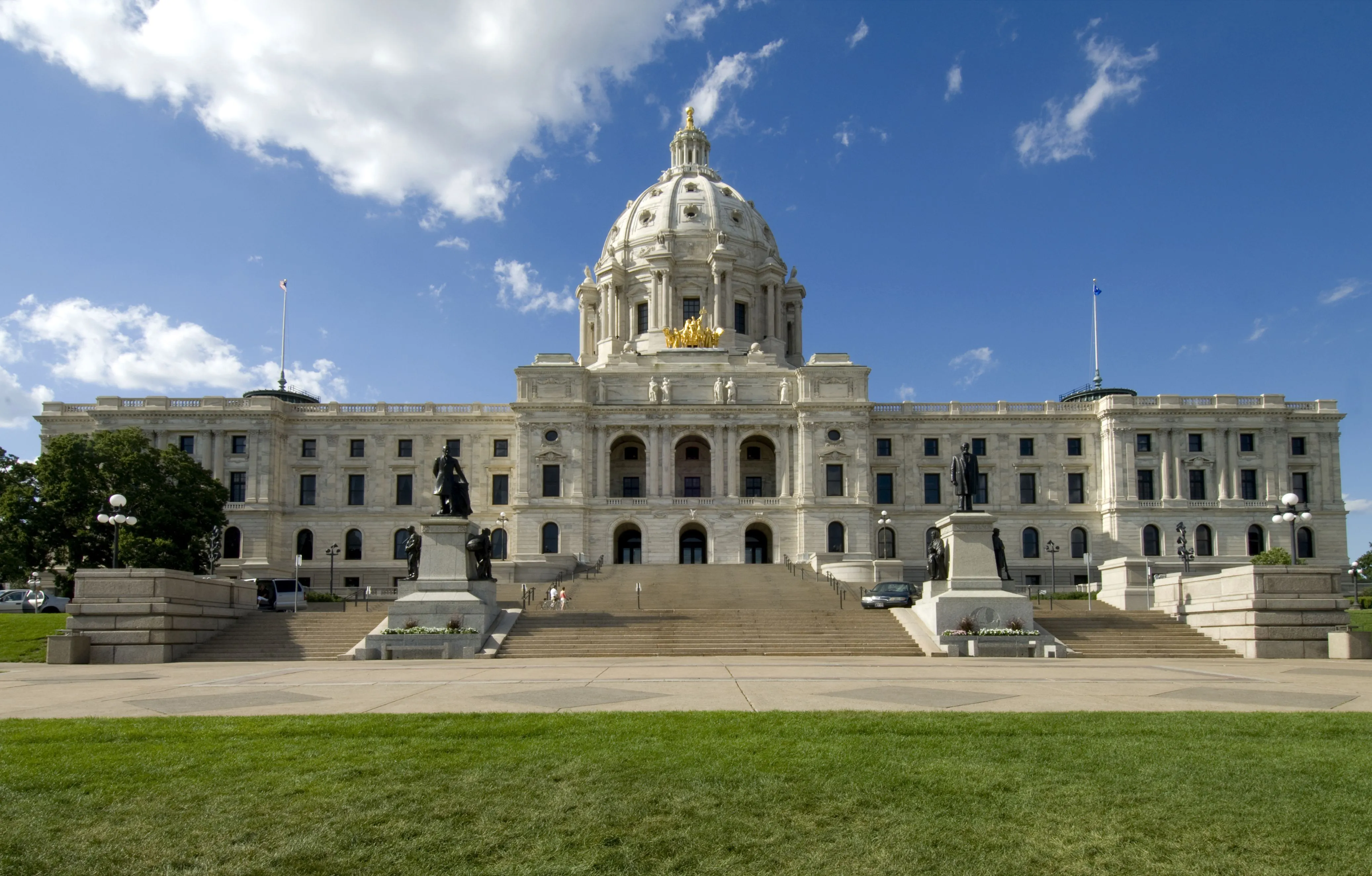
Saint Paul has been the capital since the territory was organized in 1849. In 1857 the legislature voted to move the capital to St. Peter, but territorial lawmaker Joe Rolette took the bill and hid until the session ended, so it was never signed. The current State Capitol, designed by Cass Gilbert, opened in 1905.
Minnesota borders North Dakota and South Dakota to the west, Iowa to the south, and Wisconsin to the east. To the north it borders the Canadian provinces of Manitoba and Ontario, and in the northeast it has a shoreline on Lake Superior. The Northwest Angle, cut off from the rest of the state by Lake of the Woods, is the northernmost point of the 48 contiguous states.
Minnesota's license plates say "Land of 10,000 Lakes," but the Minnesota Department of Natural Resources counts 11,842 lakes of 10 acres or more. The Mississippi River begins at Lake Itasca in northern Minnesota.
Minnesota is called "The North Star State," from its French motto "L'Étoile du Nord" ("The Star of the North"). Its state bird is the common loon, its flower is the pink and white lady's slipper, and its tree is the red pine.
Based on the 2020 census, Minnesota kept its 8 seats in the U.S. House of Representatives, which gives it 10 votes in the Electoral College. Its 8th seat was the last of the 435 seats assigned in the 2020 apportionment, just ahead of New York.
Sources & Further Reading
Voyageurs National Park
A Water-Based Wilderness of 500 Islands and the Route of the Fur Trade Voyageurs
About Voyageurs National Park
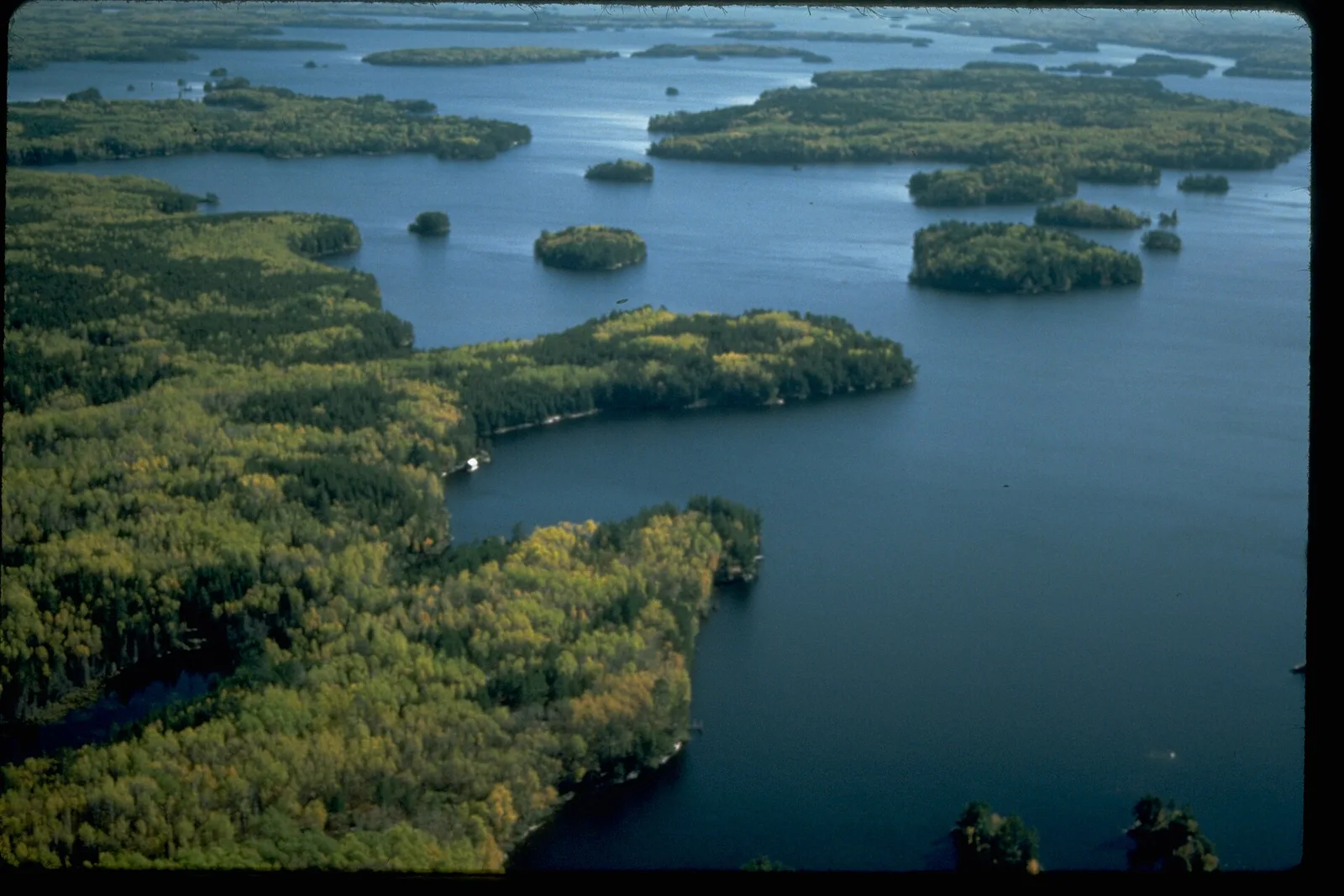
Voyageurs National Park is the most water-dominated park in the lower 48: roughly a third of its 218,000 acres is water, four big interconnected lakes, Rainy, Kabetogama, Namakan, and Sand Point, plus hundreds of bays, channels, and small lakes on the Minnesota-Ontario border.
Most of the park has no roads and is reached only by boat, and its roadless heart, the 75,000-acre Kabetogama Peninsula, is one of the largest roadless tracts in the eastern United States.
It is named for the voyageurs, the French-Canadian canoemen who carried furs and trade goods along this exact chain of lakes between Lake Superior and the Northwest; the 1783 Treaty of Paris made their canoe route the international boundary.
Congress authorized the park in 1971 and established it on January 8, 1975, capping a conservation fight that ran back to the 1920s, when Ernest Oberholtzer and others blocked a plan to dam the whole border-lakes system for hydropower.
- Designation
- National Park
- Location
- Koochiching and St. Louis Counties, northern Minnesota
- Established
- January 8, 1975
- Annual Visitors
- ~270,000
Voyageurs' Landscapes
Rainy Lake, about 345 square miles and more than 200 islands, is the park's largest water body and was the main highway of the North American fur trade.
Its level, and Namakan Lake's, has been controlled since dams were built around 1909 to 1914 at the outlet in International Falls and at Kettle Falls; an international commission sets the 'rule curves' that govern how the lakes rise and fall.
The historic Kettle Falls Hotel, opened in 1910 between Rainy and Namakan lakes and reachable only by boat, still operates inside the park.
The lake holds walleye, northern pike, smallmouth bass, and lake sturgeon, and its glacier-scoured rock shore is Archean bedrock among the oldest exposed on the continent.
The Kabetogama Peninsula, about 75,000 acres, is the park's main land mass, has no roads, and is reached only across the water.
Its boreal forest of spruce, fir, aspen, and birch shelters wolves, moose, black bears, beavers, and one of Minnesota's densest concentrations of nesting loons.
The Voyageurs Wolf Project, a University of Minnesota study running since 2015, has used GPS collars and trail cameras here to document wolves fishing for spawning suckers and hunting beavers, behaviors rarely recorded before.
Interior hiking trails and canoe routes cross the peninsula to a chain of small lakes managed for a quieter fishery than the big border lakes.
The rock under Voyageurs is Archean greenstone and granite roughly 2.7 billion years old, part of the Superior craton and among the oldest exposed rock on Earth.
Glaciers stripped the soil off it, so much of the shoreline is bare, rounded, ice-polished stone with only a thin skin of forest.
Gold-bearing quartz in that ancient rock set off the Rainy Lake Gold Rush of 1893, centered on Little American Island, where a mine shaft and stamp-mill ruins are now a short interpretive trail; the boom collapsed within a few years.
Red ochre pictographs, made by Ojibwe or earlier people, survive on several cliff faces along the Namakan and Kabetogama shores.
Voyageurs sits on a remote stretch of the border with almost no artificial light, and it was certified an International Dark Sky Park in 2020.
On clear nights the Milky Way is plainly visible, and the aurora appears often from late summer through early spring.
The flat, dark lakes double the show by reflecting it, and the park runs astronomy programs and a summer star party.
Winter, with long nights, hard cold, and a frozen lake surface to stand on, is the prime aurora season here.
Indigenous Connections
Ojibwe (Anishinaabe) Nation
Ojibwe people have lived in the Rainy Lake watershed for centuries, moving with the seasons to harvest wild rice in the shallow bays, fish, hunt moose and deer, and tap maple.
The border lakes were an Ojibwe travel corridor long before the fur trade used them, and the voyageurs depended on Ojibwe guides, canoes, food, and knowledge of the routes and portages.
The 1854 Treaty of La Pointe ceded this country to the United States but kept Ojibwe rights to hunt, fish, and gather rice on the ceded land, rights that still apply within the park.
The Bois Forte Band of Chippewa, whose reservation at Nett Lake lies adjacent to the park, has the closest ancestral ties to the Voyageurs landscape. The band maintains treaty fishing and hunting rights in the park and participates in NPS management planning through formal government-to-government consultation.
Exploring Voyageurs
Houseboat or Motorboat Camping
The classic way to see Voyageurs is to rent a houseboat from an outfitter at Rainy Lake or Lake Kabetogama and spend several days anchoring off islands and shorelines.
More than 130 boat-in and canoe-in campsites, most with a tent pad, fire ring, and privy, are scattered through the park and reserved in advance on Recreation.gov.
Distances are large, cell coverage is spotty, and the big lakes can turn rough fast in wind, so the park stresses charts, a full fuel plan, and checking the forecast.
Water taxis and ranger boat tours, including a summer trip to the Kettle Falls Hotel, give visitors without a boat a way onto the water.
Wolf and Wildlife Viewing
Voyageurs has one of the highest wolf densities in Minnesota, roughly 30 to 50 animals in half a dozen or more packs whose ranges cross the park boundary and the border.
Wolves are heard more often than seen; the best odds of a sighting are cruising the shoreline by boat at first light, when wolves, moose, and bears move along the water's edge.
The lakes are full of common loons, bald eagles, and beavers, and cow moose with calves are sometimes seen feeding in shallow bays in early summer.
The Voyageurs Wolf Project posts much of what its cameras capture online, which has made the park's wolves some of the best-known wild wolves in the country.
Winter Snowmobile and Ice Fishing
When the lakes freeze, usually by late December, the park plows an ice road on Rainy Lake and grooms about 110 miles of snowmobile trail across the ice and portages.
Ice fishing for walleye, sauger, and northern pike is a major winter draw, with anglers towing heated shelters onto the ice.
Groomed trails near the visitor centers are set for cross-country skiing and snowshoeing, and the park rents snowshoes.
Ice thickness varies a lot over pressure ridges and current areas, so the park posts thickness reports and warns that a report is a guide, not a guarantee.
Conservation Challenges
Mercury Contamination
Mercury from coal burning, some regional, some carried on the wind from across the continent and overseas, falls on the watershed and is converted by bacteria in wetlands into methylmercury, the form that builds up in food chains.
Walleye and northern pike in the park carry enough mercury that Minnesota issues fish-consumption advisories limiting how often, especially for children and pregnant women, park-caught fish should be eaten.
Loons, otters, mink, and eagles that eat those fish also accumulate mercury, and research at Voyageurs has tracked its effects on loon breeding success.
Sulfate, from historic mining and from peatlands, speeds the methylation, which ties the mercury problem to land use across the whole basin.
Invasive Species
Spiny water flea, a tiny predatory zooplankton, and starry stonewort, a dense aquatic alga, are the invasives of greatest concern, both able to disrupt the base of the lake food web.
Most aquatic invaders arrive on boats, trailers, and in bait buckets, so the park runs mandatory watercraft inspection and decontamination and restricts the use and movement of live bait.
Rusty crayfish and, in the region, zebra mussels and Eurasian watermilfoil are the next threats the monitoring program watches for.
Because the park's lakes connect across the border, invasive control depends on cooperation with Ontario and with the many private and tribal landowners around the water.
Climate Change and Ice Cover
The ice fishing and snowmobile seasons that carry the park's winter economy are shrinking as the lakes freeze later and break up earlier.
Long records for Rainy Lake show ice-out has moved roughly two weeks earlier over the past century, and mid-winter thaws that were once rare are now common.
Shorter, warmer winters also stress cold-adapted species and let more ticks and forest pests survive, which is part of the pressure on the region's declining moose.
Warmer summers raise water temperatures and lengthen the season for harmful algae blooms in the shallow, nutrient-rich bays.
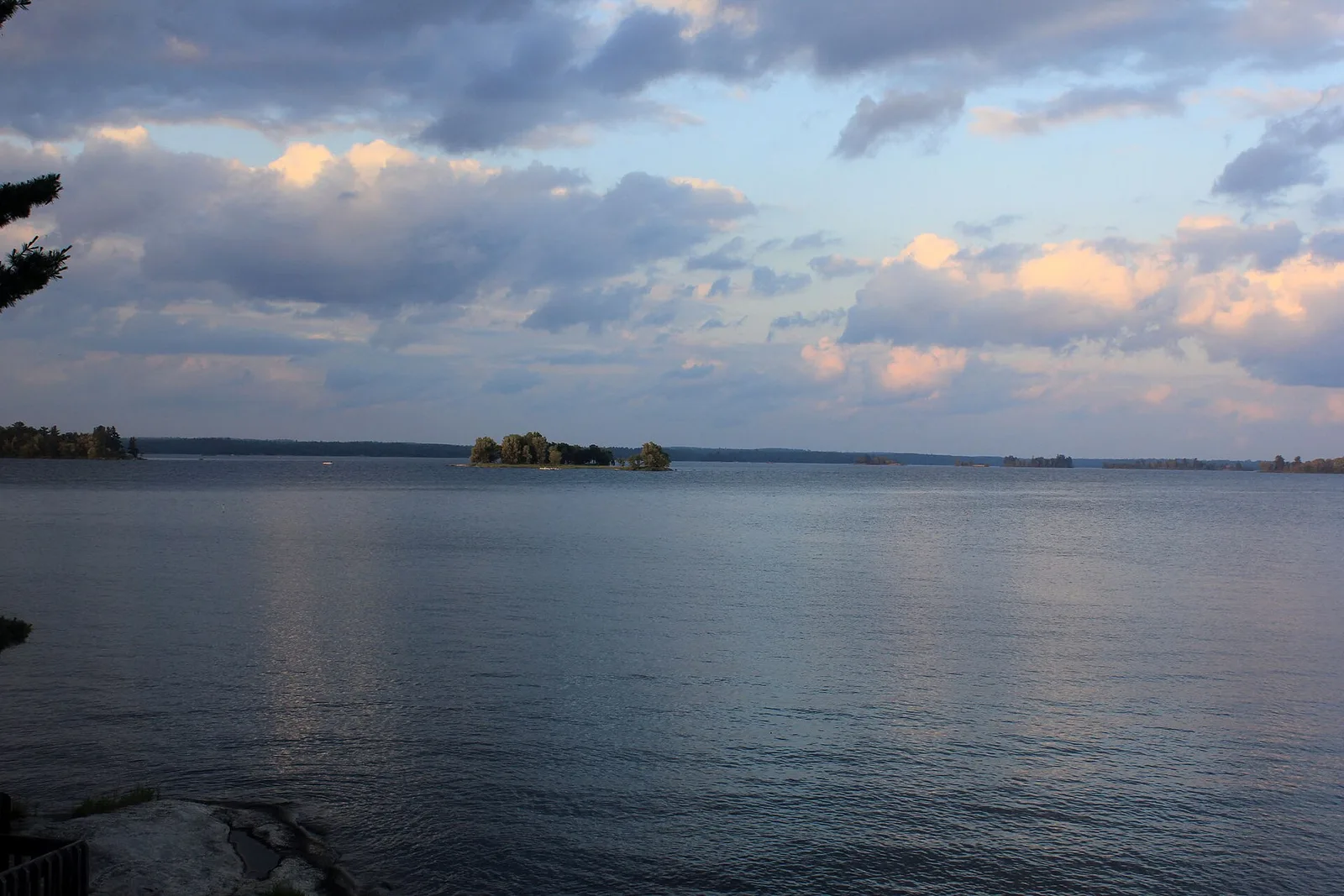
Kabetogama Lake at sunset, one of four large lakes forming the park's wilderness water system
At a Glance
Did You Know?
French-Canadian voyageurs paddled up to 16 hours a day in birchbark canoes, covering 30 to 40 miles, carrying 180-pound packs, and singing paddling songs to maintain rhythm. Their route through the boundary waters is now the US-Canada border.
Voyageurs is one of only a handful of national parks in the lower 48 states designated as an International Dark Sky Park. On clear winter nights, the Milky Way is visible overhead and aurora borealis frequently fills the sky above the frozen lakes.
The bedrock beneath Voyageurs is 2.7 billion years old, among the oldest exposed rock on Earth, dating to the Archean eon when life consisted only of single-celled organisms.
Plan Your Visit
Location
Koochiching and St. Louis Counties, northern Minnesota
Designation
National Park
Best Time to Visit
June through September for boating and wildlife; winter for northern lights, ice fishing, and snowmobiling
Admission
Free; boat launch fees apply; houseboat and canoe rentals available from local outfitters