

About Hawaii
The origin of the name Hawaii is uncertain, but the most widely accepted explanation is that it derives from the Proto-Polynesian word "Hawaiki," which referred to the legendary homeland of the Polynesian people. Polynesian voyagers who settled the Hawaiian Islands roughly 1,500 years ago may have named their new home after the ancestral homeland they had left behind. Another theory holds that the name comes from the Hawaiian word "Hawa'i," a combination of "Hawa" (traditional homeland) and "i" (small or little). Captain James Cook, who made first contact with the islands in 1778, named them the Sandwich Islands after his patron, the Earl of Sandwich, but the indigenous name Hawaii ultimately prevailed.
Hawaii is unlike any other state in the Union, and not just because it is made entirely of islands rising from the middle of the Pacific Ocean. It is the only state with two official languages, the only state that was once a recognized sovereign kingdom, and the only state whose history includes a formal U.S. congressional apology for the role American forces played in overthrowing its government.
Admitted as the 50th state on August 21, 1959, Hawaii was a U.S. territory for 61 years before statehood. The islands had been a recognized independent kingdom for much of the 19th century, maintaining diplomatic relations with the United States, Great Britain, and France before being annexed following the 1893 overthrow of Queen Liliuokalani.
Today, Hawaii is one of America's most visited destinations, and one of its most expensive places to live. The state grapples with the tensions between tourism and quality of life, military presence and indigenous sovereignty, and economic dependency on the mainland and a desire for greater self-sufficiency. The spirit of aloha, a Hawaiian concept encompassing love, peace, compassion, and a mutual regard for all, remains the cultural touchstone of a state that is still working out what it means to be both American and Hawaiian.

The Four Main Islands
Hawaii has eight main islands, each with its own character, landscape, and ecosystem. Four define the state's identity.
Oʻahu is Hawaii's most populous island, home to Honolulu, Waikiki Beach, Pearl Harbor, and over 70% of the state's population. The island is defined by two parallel mountain ranges, the Koʻolau to the east and the Waiʻanae to the west, with a broad central plain between them.
Diamond Head crater overlooks Waikiki. Oʻahu hosts the state's government, its economy, and its most visited tourist destinations, as well as the major military installations of Pearl Harbor-Hickam and Schofield Barracks.
Honolulu is the state capital and Hawaii's only incorporated city; the City and County of Honolulu is a consolidated government that covers the entire island and roughly one million residents. Waikiki alone accounts for a large share of the state's visitor spending. Housing on Oʻahu is among the most expensive in the country, with a median single-family home price above one million dollars, a gap that drives steady out-migration of local families to the mainland.
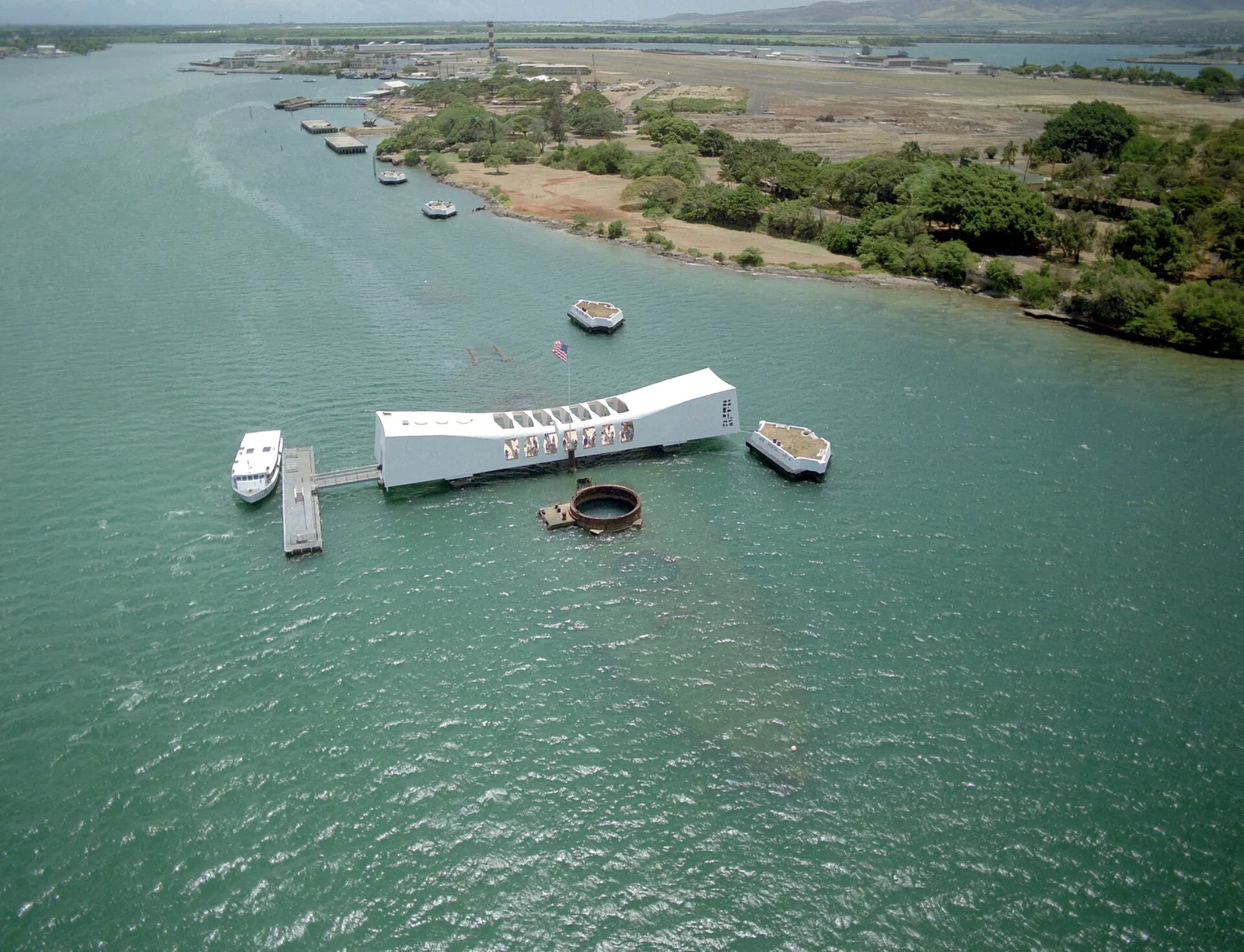
Pearl Harbor is a natural landlocked deep-water harbor and the headquarters of the U.S. Pacific Fleet; the Pearl Harbor National Memorial there includes the USS Arizona Memorial. In 2021 a jet-fuel leak from the Navy's World War II-era underground Red Hill storage facility contaminated the drinking water of about 93,000 people on the base water system, and after state and federal pressure the Pentagon agreed to defuel and permanently close the facility, completing bulk fuel removal in 2024.
Maui is Hawaii's second largest island and one of its most popular visitor destinations. Haleakalā, a massive shield volcano whose summit reaches 10,023 feet, dominates the eastern portion of the island. Watching sunrise from Haleakalā is one of the most iconic experiences in Hawaii.
The historic whaling town of Lahaina on the west coast was long a cultural heart of Maui before a devastating wildfire in August 2023 destroyed much of the town. Maui's Road to Hāna, winding through 64 miles of rain forest and waterfalls, is one of the most famous drives in the Pacific.
Maui County also takes in three smaller islands. Lānaʻi, once the 'Pineapple Island' and site of the world's largest plantation under Dole, is about 98% owned by billionaire Larry Ellison, who bought it in 2012. Molokaʻi is home to the former Kalaupapa leprosy settlement, where people were forcibly exiled from 1866 until the isolation law was repealed in 1969. Kahoʻolawe, uninhabited, was used as a U.S. Navy bombing range from World War II until protests ended live fire in 1990, and it is now a state reserve undergoing cleanup and cultural restoration.
The Lahaina fire of August 8, 2023 killed 102 people, the deadliest U.S. wildfire in more than a century, and destroyed roughly 2,200 structures with damage estimated near 5.5 billion dollars. Investigators pointed to Hawaiian Electric power lines downed by high winds from Hurricane Dora passing far to the south; the utility agreed to a roughly 1.99-billion-dollar settlement in 2024. Lahaina had served as the capital of the Kingdom of Hawaii from 1820 to 1845.
The island of Hawaiʻi, called 'the Big Island' to distinguish it from the state, is the largest island in the chain and the youngest geologically. Kīlauea and Mauna Loa are among the most active volcanoes on Earth; lava has been flowing continuously or intermittently for decades, actively building new land.
The island contains 11 of the world's 13 climate zones within its borders, from tropical rainforest to alpine desert to active lava fields. Mauna Kea, at 13,796 feet above sea level, is the highest peak in Hawaii and hosts some of the world's most important astronomical observatories.
At about 4,028 square miles, the Big Island is larger than all the other Hawaiian islands combined, yet it holds only around 200,000 people and has the state's cheapest land. Hilo, on the wet windward side, is the county seat and largest town; Kailua-Kona, on the dry leeward Kona coast, is the center of tourism and coffee growing. Measured from its base on the ocean floor, Mauna Kea is the tallest mountain on Earth at more than 33,000 feet.
Kīlauea's 2018 eruption in the lower Puna district destroyed more than 700 homes in the Leilani Estates and Kapoho areas and reshaped the coastline. Plans to build the Thirty Meter Telescope near Mauna Kea's summit have been blocked since 2015 by Native Hawaiians who regard the mountain as sacred; a 2019 blockade of the access road drew worldwide attention, and in 2022 the state legislature created a new Mauna Kea Stewardship and Oversight Authority to manage the summit lands and phase out the university's control.
Kauaʻi is the oldest of the main Hawaiian Islands geologically, millions of years of erosion have carved it into some of the most dramatic scenery on Earth. The Nā Pali Coast, towering sea cliffs rising 4,000 feet from the Pacific, is accessible only by boat, helicopter, or a demanding 11-mile trail. Waimea Canyon, often called the 'Grand Canyon of the Pacific,' cuts 10 miles through the island's interior.
Kauaʻi receives up to 460 inches of rain per year at Mount Waiʻaleʻale, making it one of the wettest places on the planet. The island's lush, unspoiled character has made it a prime film location.
Roughly 70% of Kauaʻi is roadless mountain interior, and county rules effectively bar buildings taller than a coconut palm, about four stories, which has kept its towns low-rise. Kauaʻi County also includes Niʻihau, the privately held 'Forbidden Isle' bought by the Sinclair-Robinson family from the Hawaiian Kingdom in 1864, where roughly 80 residents still speak Hawaiian as a first language and outside visitors are barred without an invitation.
Kauaʻi was the one major island Kamehameha never conquered in battle; its ruler Kaumualiʻi agreed to join the kingdom by negotiation in 1810. Hurricane Iniki, the strongest hurricane on record to strike Hawaii, hit Kauaʻi on September 11, 1992, killing six people and damaging or destroying more than 14,000 homes. Films shot on the island include South Pacific, the Jurassic Park series, and the opening jungle sequence of Raiders of the Lost Ark.

Economy
Hawaii's economy rests on tourism and the military, with agriculture, research, and entertainment adding diversification, though the state has long sought to reduce its dependence on any single sector.
Tourism accounts for roughly 20% of Hawaii's GDP and supports hundreds of thousands of jobs. Nearly 10 million visitors arrive each year, spending billions on hotels, restaurants, activities, and retail.
The industry's dominance also creates fragility: the COVID-19 pandemic devastated Hawaii's economy in 2020 when visitor arrivals collapsed by 75%. Hawaii's leaders have grappled with how to diversify the economy while managing 'overtourism' pressures that strain local infrastructure and communities.
Visitor spending reached a record of about 20 billion dollars in 2023. Hawaii charges a 10.25% state transient accommodations tax on lodging, and since 2021 each of the four counties has added its own 3% surcharge on top. In 2025 the legislature raised the state lodging tax again to fund wildfire prevention, beach restoration, and other climate-resilience work, billing it as the first statewide tourism 'green fee' in the nation.
Japan was long Hawaii's largest overseas market, but Japanese arrivals have not returned to pre-pandemic levels, leaving U.S. mainland travelers as the dominant source. After the August 2023 Lahaina fire, officials urged tourists to stay away from West Maui out of respect for survivors; the resulting collapse in bookings deepened the island's economic losses before a slow, phased reopening.
The U.S. military is Hawaii's second-largest economic driver, with over 40,000 active duty personnel and an economic impact exceeding 7 billion dollars annually. Pearl Harbor-Hickam Joint Base hosts the U.S. Pacific Fleet, the largest naval command in the world. Schofield Barracks on Oʻahu is one of the largest Army installations in the country.
U.S. Indo-Pacific Command, headquartered at Camp H.M. Smith on the hills above Pearl Harbor, is the oldest and largest of the unified combatant commands, with an area of responsibility that spans about half the Earth's surface and 36 nations from India to the international date line. Its forward position makes Hawaii central to U.S. planning for any conflict with China or North Korea.
The armed forces control roughly 5% of the land in Hawaii and about a quarter of Oʻahu. Pōhakuloa Training Area, between Mauna Kea and Mauna Loa on the Big Island, is the largest live-fire range in the Pacific. Leases on about 6,300 acres of state land used for training, including part of Pōhakuloa, expire in 2029, and in 2025 the state Board of Land and Natural Resources rejected the Army's environmental review for a renewal, setting up a major dispute over the future of those ranges.
About 100,000 military veterans live in Hawaii. The 2021 Red Hill jet-fuel leak, which sickened thousands of military families drawing water from the Pearl Harbor system, severely strained relations between the Navy and the state and prompted the Pentagon's decision to defuel and close the underground facility, with bulk fuel removed by 2024.
Hawaii's tropical climate supports agriculture found nowhere else in the United States. Kona coffee, grown on the slopes of Mauna Loa on the Big Island, is among the most prized and expensive coffees in the world. Hawaii is the world's largest producer of macadamia nuts.
Taro, the root used to make poi, a staple of traditional Hawaiian cuisine, has deep cultural significance. The sugar and pineapple industries that once dominated the economy have largely disappeared, replaced by diversified specialty crops and niche food production.
Sugar ruled Hawaii's economy for more than a century, but the last mill, Hawaiian Commercial and Sugar on Maui, shut down in 2016, ending 180 years of the industry. Large-scale pineapple canning, once led by Dole and Del Monte, has all but vanished as well. Today an estimated 85 to 90% of the food eaten in Hawaii is shipped in, a food-security worry given the islands' distance from any other land.
Hawaii grows much of the seed corn used to breed new varieties for mainland farms, a business worth well over 100 million dollars a year and concentrated on Kauaʻi and Molokaʻi, where it has drawn lawsuits and county ballot measures over pesticide spraying near homes and schools. The Kona coffee name commands such a premium that mislabeling is a recurring problem; a 2021 state law now requires products labeled 'Kona' to contain at least 51% Kona-grown beans.
The summit of Mauna Kea on the Big Island hosts thirteen major telescopes operated by institutions from eleven countries, including the Keck Observatory, which operates the world's largest optical telescopes. Hawaii's location in the central Pacific and its isolation from light pollution make it one of the finest astronomical observation sites on Earth.
The state also hosts oceanographic research institutions and is a growing hub for clean energy technology, driven by its goal of 100% renewable electricity by 2045.
The University of Hawaii holds the master lease for the Mauna Kea science reserve, an arrangement long criticized because the observatories have paid the state as little as one dollar a year in rent while astronomy adds a few hundred million dollars annually to the Big Island economy. The 2022 law shifting oversight to a new state authority is meant to bring Native Hawaiian representation and market-rate terms to any future telescope agreements.
Hawaii's 2015 law setting a 100%-renewable-electricity target by 2045 was the first of its kind in the nation, and the islands have become a testbed for battery storage, rooftop solar, and geothermal power; the Puna Geothermal Venture plant supplies part of the Big Island's grid. Because nearly all fuel must be imported by ship, Hawaii also has the highest gasoline and electricity prices of any state, which is part of what makes the renewable push economically attractive.
Hawaii's dramatic scenery, volcanic landscapes, tropical rainforests, pristine beaches, and towering sea cliffs, has made it one of the most filmed locations in the world. Jurassic Park, Raiders of the Lost Ark, Pirates of the Caribbean, Jumanji, and dozens of other major films have shot in Hawaii.
The long-running TV series Lost and Hawaii Five-0 were set and filmed there. Film production generates significant economic activity and has helped cement Hawaii's global cultural image.
Hawaii offers a refundable film and television production tax credit of 22 to 27% of qualified spending, capped as of 2022 at 17 million dollars per production and 50 million dollars per year statewide, with a requirement that productions hire locally and contribute to a workforce-training fund. State studies credit the incentive with several hundred million dollars a year in production spending.
Kauaʻi's Nā Pali coast and Manawaiopuna Falls stood in for the parks in the Jurassic Park and Jurassic World films, while Oʻahu's Kualoa Ranch has hosted productions from Jumanji to Godzilla. Hawaii Five-0 ran on CBS from 2010 to 2020 and Magnum P.I. was rebooted on the islands from 2018 to 2024; local crews say the loss of a steady, years-long series is a recurring economic worry between feature shoots.

How Hawaii's State Government Works
Hawaii operates under a three-branch state government established when it became a state in 1959. The Hawaii State Legislature consists of a 25-member Senate and a 51-member House of Representatives, one of the smallest state legislatures in the country, reflecting Hawaii's population.
Hawaii is one of the most reliably Democratic states in the country. It has voted for the Democratic presidential candidate in every election since 1960 and has not elected a Republican governor since 2002. The state legislature has been dominated by Democrats for decades.
Hawaii's unique governance challenges include managing the relationship between state and federal authority over military lands (the federal government controls roughly 25% of the state's land area), addressing Native Hawaiian rights and sovereignty claims, and grappling with some of the highest costs of living and housing prices of any state in the country.
Governor of Hawaii
Current Governor
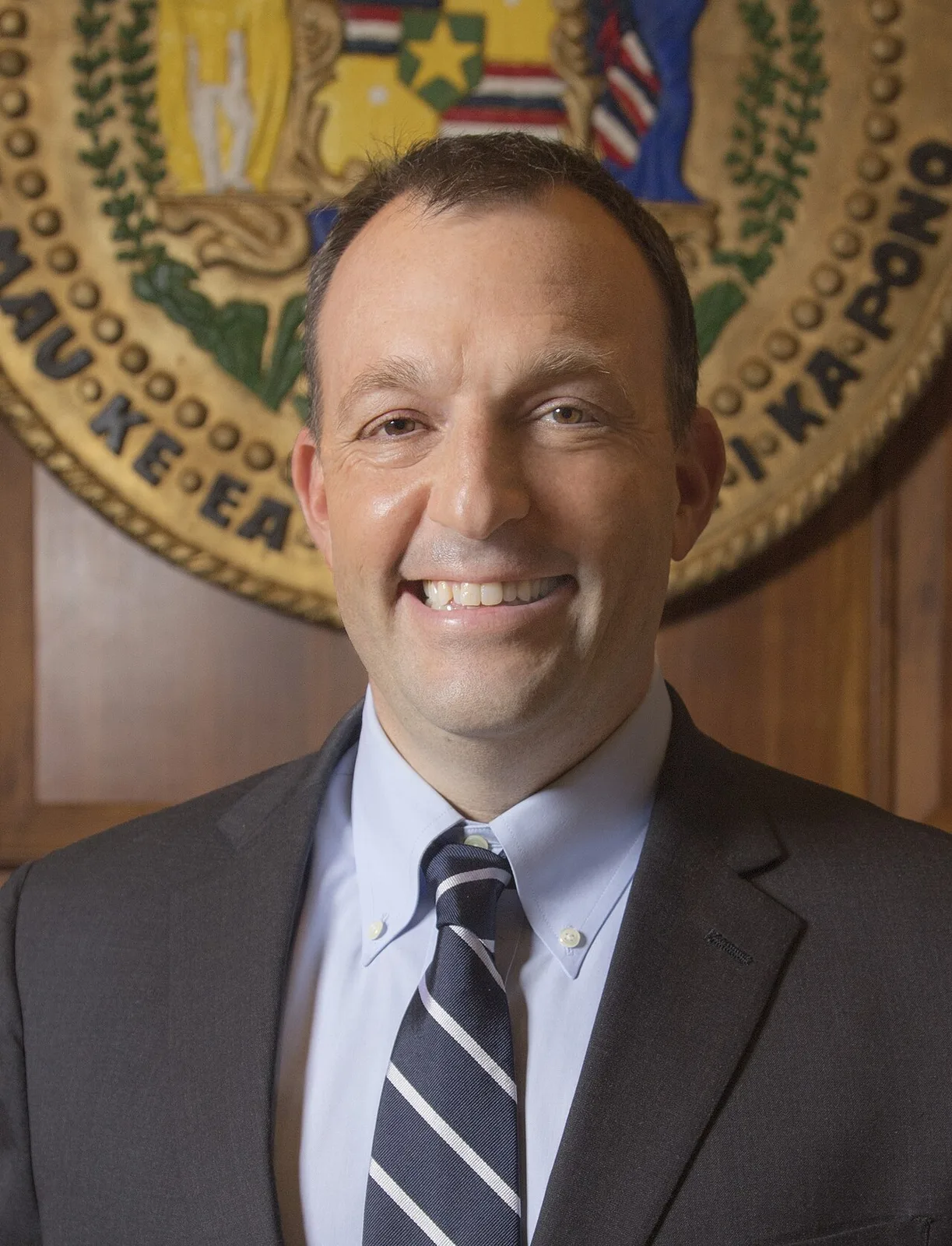
Josh Green
- Party
- Democrat
- In Office Since
- December 5, 2022
- Elected
- November 2022
- Term Ends
- December 2026
- Born
- August 14, 1968, Philipsburg, Pennsylvania
- Profession
- Emergency Medicine physician (MD)
- Prior Role
- Lieutenant Governor (2018–2022)
Josh Green is the 9th Governor of Hawaii. A practicing emergency medicine physician, he served in the Hawaii State Legislature for 14 years and as Lieutenant Governor before winning the governorship. He has focused on housing affordability, homelessness, and Hawaii's recovery, including leading the state's response to the catastrophic 2023 Maui wildfires that destroyed the historic town of Lahaina.
Other Current State Officials
Lieutenant Governor
Sylvia Luke
In office since December 2022. Former longtime state House Finance Committee chair. Focuses on housing, health care, and fiscal policy.
Attorney General
Anne Lopez
Appointed by Governor Green in January 2023. First Latina Attorney General in Hawaii's history. Former public defender and civil rights attorney.
The Hawaii State Legislature
Hawaii State Senate
- Seats: 25 members
- Terms: 4-year terms
The upper chamber. With only 25 senators representing around 1.4 million residents, Hawaii has one of the smallest state senates in the country. Senators serve staggered 4-year terms.
Hawaii House of Representatives
- Seats: 51 members
- Terms: 2-year terms
The lower chamber. Hawaii's House is also relatively small, reflecting the state's compact island geography and population. All 51 seats are on the ballot every two years.
Hawaii's U.S. Senators
U.S. Senator
Brian Schatz
Appointed in December 2012 to fill the seat of the late Senator Daniel Inouye, a World War II hero and the longest-serving senator in Hawaii history. Won election outright in 2014 and re-elected in 2016 and 2022. One of the Senate's leading voices on climate change and clean energy.
U.S. Senator
Mazie Hirono
The first U.S. Senator born in Japan, the first Buddhist senator, the first Asian-American woman elected to the Senate, and the first U.S. Senator to have immigrated to America as a child. Born in Japan, she immigrated to Hawaii with her mother at age eight. Re-elected in 2018 and 2024. Known for her blunt, direct style and advocacy on immigration, veterans' health care, and workers' rights.
Hawaii Through the Years
From early settlement to the present day. Tap any era to read more.
The Hawaiian Islands were settled by Polynesian voyagers, most likely from the Marquesas Islands, who navigated thousands of miles of open Pacific Ocean using the stars, ocean swells, and wind patterns. A second wave of migration from Tahiti arrived around 1000 to 1300 AD, bringing with them a more complex social and religious system.
Hawaiian society developed a sophisticated culture, agriculture, and kapu (sacred prohibition) system over centuries of isolation from the rest of the world.
More recent radiocarbon dating has led many archaeologists to place the first permanent settlement later than older estimates, in roughly 1000 to 1200 AD. The voyagers carried about two dozen 'canoe plants' including taro, breadfruit, sweet potato, sugarcane, and kukui, along with pigs, dogs, and jungle fowl, everything needed to build a new society on bare volcanic islands.
By the time of Western contact the population is estimated at 400,000 to 800,000, divided among competing chiefdoms on each island under aliʻi (chiefs), konohiki (land managers), and a priestly class of kahuna. Dense populations were fed by an elaborate infrastructure of irrigated loʻi (taro terraces) and more than 400 loko iʻa (coastal fishponds), a form of aquaculture found nowhere else in Polynesia at that scale.
British explorer Captain James Cook became the first known European to reach the Hawaiian Islands in January 1778, naming them the 'Sandwich Islands' after his patron, the Earl of Sandwich. Cook's arrival fundamentally changed Hawaii forever, introducing Western goods, diseases, and weapons to a population with no immunity to European illness.
Cook returned to Hawaii in 1779 and was killed in a confrontation with Hawaiians at Kealakekua Bay on the Big Island.
Cook first sighted Oʻahu and went ashore at Waimea on Kauaʻi on January 20, 1778. In the century that followed, introduced diseases, first venereal disease, then epidemics of measles, influenza, whooping cough, and smallpox, cut the Native Hawaiian population by an estimated 80% or more, one of the steepest population collapses recorded anywhere.
Cook was killed on February 14, 1779, in a fight over a stolen boat, only days after being received with honors during the Makahiki season sacred to the god Lono. His voyages opened Hawaii to the Pacific maritime trade; within a few decades chiefs had run up crushing debts to foreign merchants and stripped the mountains of their sandalwood forests to pay them.
After years of warfare, Kamehameha the Great united all the major Hawaiian Islands under a single monarchy in 1810, the first time in history. He established a centralized kingdom that successfully navigated the competing pressures of American and European influence through decades of political turmoil. The Hawaiian Kingdom that Kamehameha founded would last until 1893, maintaining a royal government, foreign treaties, and international recognition as a sovereign nation.
The turning point was the Battle of Nuʻuanu on Oʻahu in 1795, where Kamehameha's warriors drove the island's defenders over the Nuʻuanu Pali cliffs. He had acquired Western muskets and cannon and kept two shipwrecked British sailors, John Young and Isaac Davis, as trusted advisers and gunners. Kauaʻi's ruler Kaumualiʻi submitted by treaty in 1810 rather than be invaded.
Kamehameha proclaimed the Kānāwai Māmalahoe, the 'Law of the Splintered Paddle,' which protected travelers and noncombatants from harm, a principle later written into Article 9 of the Hawaii state constitution. He preserved the kapu system and the traditional gods, settled his court at Kailua-Kona, and died there in May 1819.
Within six months of his death, his son Liholiho (Kamehameha II), together with the powerful widowed queens Kaʻahumanu and Keōpūolani, deliberately broke the eating kapu at a public feast, an act called the ʻAi Noa, or 'free eating.' The old state religion collapsed and its temples were ordered destroyed, just months before the first company of Protestant missionaries arrived from New England in 1820.
A group of American and European businessmen, with support from U.S. Marines from the USS Boston, overthrew Queen Liliuokalani, Hawaii's last reigning monarch, in January 1893.
The queen surrendered under protest to avoid bloodshed, stating she yielded to the 'superior force of the United States.' In 1993, on the 100th anniversary of the overthrow, Congress passed a formal Apology Resolution acknowledging that the United States played an illegal and immoral role in the overthrow of a sovereign nation.
The coup was organized by a 13-member 'Committee of Safety,' mostly American and European sugar interests, and enabled by U.S. Minister John L. Stevens, who ordered 162 sailors and Marines ashore. Liliʻuokalani had triggered the crisis by trying to issue a new constitution to restore powers the monarchy had lost under the 1887 'Bayonet Constitution,' which had been forced on her brother King Kalākaua under armed threat.
President Grover Cleveland called the overthrow an 'act of war,' withdrew the annexation treaty from the Senate, and commissioned the Blount Report, which found the United States had acted improperly. Annexation went through anyway in July 1898 by a simple joint resolution of Congress under President McKinley during the Spanish-American War, and Hawaii became a formally organized U.S. territory in 1900. A failed royalist counter-revolt in 1895 led to the former queen's trial and eight months of house arrest inside ʻIolani Palace.
At 7:55 a.m. on December 7, 1941, the Imperial Japanese Navy launched a surprise attack on the U.S. Naval Station at Pearl Harbor on Oʻahu. The attack killed 2,403 Americans, wounded 1,178 more, destroyed 188 aircraft, and sank or damaged 19 naval vessels, including eight battleships.
The attack ended American neutrality in World War II: Congress declared war on Japan the following day. President Roosevelt called December 7 'a date which will live in infamy.' The USS Arizona Memorial at Pearl Harbor, where the ship rests on the harbor floor with 900 of her crew entombed within, is one of the most visited historic sites in the United States.
The strike came in two waves of 353 planes launched from six aircraft carriers about 230 miles north of Oʻahu. The USS Arizona blew up when a bomb touched off its forward magazine, killing 1,177 crew, almost half of all the American dead that day. The Japanese missed their most important targets: the Pacific Fleet's three aircraft carriers were at sea, and the fuel tank farms, dry docks, and submarine base were left intact.
Martial law was imposed on the territory that afternoon and stayed in force until 1944, the longest period of military rule over U.S. civilians in the country's history. About 1,500 people of Japanese ancestry in Hawaii were interned, a far smaller share than on the mainland because Japanese Americans made up more than a third of the territory's population and much of its labor force. The Arizona still seeps roughly a quart of oil a day, drops that visitors call the 'black tears' of the ship.
Hawaii was admitted to the Union on August 21, 1959, becoming the 50th and most recent state, the last star added to the American flag. Statehood came after years of lobbying; Hawaii had been a U.S. territory since 1898.
In a plebiscite held earlier in 1959, Hawaiians voted 94% in favor of statehood. Hawaii and Alaska (admitted January 3, 1959) are the only non-contiguous states, and Hawaii remains the only state located entirely in the tropics.
Congress had blocked Hawaii statehood bills for decades, partly over Southern opposition to admitting a racially diverse, majority non-white state with powerful labor unions; the ILWU-led sugar strike of 1946 and the 1949 dock strike had demonstrated that power. The path cleared only when Alaska was admitted first in January 1959, pairing a state expected to lean Democratic with one then expected to lean Republican.
The June 1959 referendum offered only two choices, statehood or remaining a territory; independence and a restored monarchy were not on the ballot, a point Native Hawaiian sovereignty activists still raise. John A. Burns, the territorial delegate who had lobbied hardest for admission, went on to serve three terms as governor, and in the first elections Hiram Fong became the first Asian American U.S. senator and Daniel Inouye the first Japanese American member of the U.S. House.
Hawaii's Defining Moments in American History
These are the events that didn't just shape Hawaii, they changed the nation.
The Japanese attack on Pearl Harbor on December 7, 1941 killed 2,403 Americans and thrust the United States into the Second World War. The USS Arizona sank in nine minutes, trapping 1,177 sailors and Marines within her hull, where they remain today.
The attack shattered American isolationism, united a divided nation overnight, and set in motion the chain of events that would make the United States a global superpower. The Arizona Memorial, built over the sunken hull, receives over 1.8 million visitors per year and is one of the most solemn sites in the country.
The Pearl Harbor National Memorial, operated by the National Park Service, also takes in the USS Utah Memorial and, moored nearby, the battleship USS Missouri, on whose deck Japan formally surrendered on September 2, 1945. A visitor can stand at the place where the American war in the Pacific began and, a few hundred yards away, where it ended.
The intelligence failure that let the fleet be caught by surprise led to a 1946 congressional joint investigation and helped drive passage of the 1947 National Security Act, which created the Department of Defense, the CIA, and the National Security Council. 'Remember Pearl Harbor' became the war's rallying cry, and Congress later designated December 7 as National Pearl Harbor Remembrance Day.
The 1893 overthrow of the Hawaiian Kingdom remains a live political and cultural issue. Native Hawaiian sovereignty advocates argue that the U.S. annexation of Hawaii was illegal, built on a fraudulent coup backed by U.S. military force, and that Hawaiian people have never ceded their right to self-governance.
The 1993 Apology Resolution, signed by President Clinton, acknowledged U.S. responsibility for the overthrow. Debates over Hawaiian sovereignty, land rights, and the legal status of the Mauna Kea observatories continue to animate politics in the state.
The Apology Resolution, Public Law 103-150, passed both chambers with bipartisan support and stated that Native Hawaiians never directly relinquished their claims to sovereignty through a plebiscite or referendum. It provided no remedy, and courts have since divided over whether it carries any binding legal weight.
Roughly 1.8 million acres of former crown and government land, known as the 'ceded lands,' passed to the territory and then the state; revenue from them helps fund the Office of Hawaiian Affairs, a state agency created in 1978. Bills to set up a federally recognized Native Hawaiian governing entity, the 'Akaka Bill,' repeatedly passed the U.S. House but died in the Senate between 2000 and 2012, and a 2016 Interior Department rule creating a pathway has gone unused. The blockade of the Thirty Meter Telescope on Mauna Kea has become the movement's most visible modern rallying point.
Barack Obama was born on August 4, 1961 in Honolulu, Hawaii, making him the first U.S. President born outside the contiguous United States and the first from Hawaii. He grew up in Honolulu, graduated from Punahou School, and attended Occidental College before transferring to Columbia University and Harvard Law School.
Obama's Hawaiian roots shaped his multicultural upbringing and worldview. He was elected the 44th President of the United States in 2008, serving two terms from 2009 to 2017.
His mother, Ann Dunham, was a white anthropologist from Kansas; his father, Barack Obama Sr., was a Kenyan graduate student she met in a Russian-language class at the University of Hawaii. The couple divorced when Obama was two, and he was raised largely by his grandparents in Honolulu, with several years of his childhood spent in Indonesia with his mother and stepfather.
False claims that Obama had actually been born in Kenya, the 'birther' conspiracy, trailed him from the 2008 campaign into his presidency, until the Hawaii Department of Health released his long-form birth certificate in April 2011 confirming a Honolulu birth. He has said he still considers Hawaii home, though his presidential center is being built in Chicago, his adopted city and his wife Michelle's hometown.
Notable Hawaiians
Barack Obama
44th President of the United States, born in Honolulu
Daniel Inouye
First Japanese American elected to Congress, Medal of Honor recipient, served 49 years in the Senate
Duke Kahanamoku
Olympic swimmer who popularized surfing worldwide, known as the father of modern surfing
Patsy Mink
First woman of color elected to Congress and inspiration behind Title IX of the Education Amendments
Kamehameha I
Founded the unified Kingdom of Hawaii in 1810, uniting the Hawaiian Islands under one rule
Bruno Mars
Grammy Award-winning musician and performer, born Peter Gene Hernandez in Honolulu
State Symbols & Quick Facts
| Nickname | "The Aloha State" |
| Capital | Honolulu |
| Largest City | Honolulu |
| Statehood | August 21, 1959 (50th and most recent state) |
| Population | ~1.4 million (2025 est.) |
| Area | 10,932 sq mi, 43rd largest state |
| Motto | Ua Mau ke Ea o ka ʻĀina i ka Pono (The life of the land is perpetuated in righteousness) |
| State Bird | Nēnē (Hawaiian Goose) |
| State Flower | Pua Aloalo (Yellow Hibiscus) |
| State Tree | Kukui (Candlenut) |
| State Mammal | Hawaiian Monk Seal |
| State Fish | Humuhumunukunukuāpuaʻa (Reef Triggerfish) |
| State Song | "Hawaii Ponoi" |
| Official Languages | English and Hawaiian, the only state with two official languages |
| Time Zone | Hawaii-Aleutian Standard Time (UTC−10), no daylight saving |
| Borders | Pacific Ocean on all sides, no land borders with any other state |
Did You Know?
Hawaii is the only state made entirely of islands, 137 in total, though only 8 are considered the 'main' islands. The chain stretches 1,500 miles across the central Pacific, making it the longest island chain in the world.
Honolulu is the most isolated major city on Earth, 2,390 miles from San Francisco and 3,850 miles from Tokyo. Hawaii is closer to Japan than to the U.S. mainland by some measures, reflecting its true position in the Pacific.
Hawaii is the only state with two official languages: English and Hawaiian. The Hawaiian alphabet has just 13 letters, the five vowels plus H, K, L, M, N, P, and W, plus the ʻokina (a glottal stop). Despite this simplicity, the language contains extraordinary complexity.
Iolani Palace in Honolulu is the only royal palace in the United States. Built in 1882, it was the official residence of the Hawaiian monarchs and served as the seat of the Hawaiian government until the overthrow in 1893. It is now a museum and National Historic Landmark.
The Big Island of Hawaii is still actively growing. Kīlauea erupted nearly continuously from 1983 to 2018, adding more than 500 acres of new land where lava reached the ocean, and it has erupted repeatedly since, including a long series of lava-fountain episodes that began in December 2024. Hawaii is the only place in the United States where new land is being created in real time.
Quick Facts and Common Questions
Short answers to the questions people most often ask about Hawaii: its abbreviation, how it became part of the United States, its capital, and its place in Congress.
Hawaii's two-letter postal abbreviation is HI. The U.S. Census Bureau places it in the West region, in the Pacific division, and about 1.46 million people lived there in the 2020 census.
Hawaii became the 50th and most recent state on August 21, 1959. President Dwight D. Eisenhower signed the Hawaii Admission Act in March 1959, and in a June 1959 vote more than 90 percent of voters approved statehood.
Hawaii was an independent kingdom until January 17, 1893, when a group of mostly American businessmen, supported by U.S. Marines landed from the USS Boston, overthrew Queen Liliʻuokalani. The group formed the Republic of Hawaii in 1894, Congress annexed the islands by joint resolution in July 1898, and Hawaii became a U.S. territory in 1900. In 1993 Congress passed a resolution formally apologizing for the U.S. role in the overthrow.
The state is named for its largest island, Hawaiʻi, often called the Big Island. The origin of the name is uncertain; Hawaiian tradition links it to Hawaiʻiloa, a legendary Polynesian navigator, and scholars connect it to an ancient Polynesian word for the ancestral homeland.
Honolulu, on the island of Oʻahu, has been the capital since 1845, when King Kamehameha III moved the royal court there from Lahaina on Maui. Honolulu's ʻIolani Palace, completed in 1882, is the only royal palace in the United States. The current State Capitol opened in 1969.
Hawaii is a chain of islands in the central Pacific Ocean, about 2,400 miles from California. It does not border any other state or country, and it is the only state made up entirely of islands. Its eight main islands are Hawaiʻi, Maui, Oʻahu, Kauaʻi, Molokaʻi, Lānaʻi, Niʻihau, and Kahoʻolawe.
Hawaii is known as "The Aloha State." Its motto is "Ua Mau ke Ea o ka ʻĀina i ka Pono," usually translated as "The life of the land is perpetuated in righteousness." Since 1978 its constitution has made English and Hawaiian the state's official languages. Its state bird is the nēnē, its flower is the yellow hibiscus, and its tree is the kukui.
Based on the 2020 census, Hawaii has 2 seats in the U.S. House of Representatives, the same as before, which gives it 4 votes in the Electoral College.
On December 7, 1941, Japanese carrier aircraft attacked the U.S. Pacific Fleet at Pearl Harbor on Oʻahu, killing 2,403 Americans. The next day the United States declared war on Japan and entered World War II. The USS Arizona Memorial, part of Pearl Harbor National Memorial, stands over the sunken battleship.
Sources & Further Reading
Hawaii Volcanoes National Park
Where the Earth Is Still Being Made, Two Active Volcanoes on the Big Island
About Hawaii Volcanoes National Park
Hawaii Volcanoes National Park covers about 335,000 acres of the Big Island, from sea cliffs to the 13,681-foot summit of Mauna Loa, and takes in two of the most active volcanoes on Earth, Kilauea and Mauna Loa.
Congress established it on August 1, 1916, as Hawaii National Park, paired with Haleakala on Maui; the two were split into separate parks in 1961. The publisher Lorrin Thurston and the geologist Thomas Jaggar drove its creation, and Jaggar's Hawaiian Volcano Observatory, founded in 1912, has monitored the volcanoes from within the park ever since.
Kilauea erupted almost without pause from 1983 to 2018, first along the East Rift Zone at Pu'u 'O'o and, after 2008, as a lava lake at the summit. That long eruption ended in May 2018 when magma drained into the Lower East Rift Zone, destroyed about 700 homes in the Puna district, and let the summit caldera floor collapse hundreds of feet.
UNESCO named the park a World Heritage Site in 1987 for both its geology and its living Hawaiian culture. Its ecosystems run from bare, steaming lava to rainforest that shelters honeycreepers found nowhere else, and the summit crater, Halema'uma'u, is the home of the volcano deity Pele in Hawaiian tradition.
- Designation
- National Park, UNESCO World Heritage Site, International Biosphere Reserve
- Location
- Hawai'i Island (Big Island), Hawaii
- Established
- 1916
- Annual Visitors
- ~1.4 million
The Volcanic Landscape
Kilauea's summit sits in a caldera about two miles across; within it, Halema'uma'u, 'house of the 'ama'uma'u fern,' is in Hawaiian tradition the home of Pele, and cultural practitioners still leave offerings at its rim.
A vent opened in the crater in 2008 and held a lava lake for a decade, its glow lighting the night sky over the park until the 2018 collapse drained it away.
Those 2018 collapses, more than 60 of them, each a magnitude-5 earthquake, roughly doubled the crater's width and dropped its floor about 1,600 feet, the largest change to the summit in two centuries.
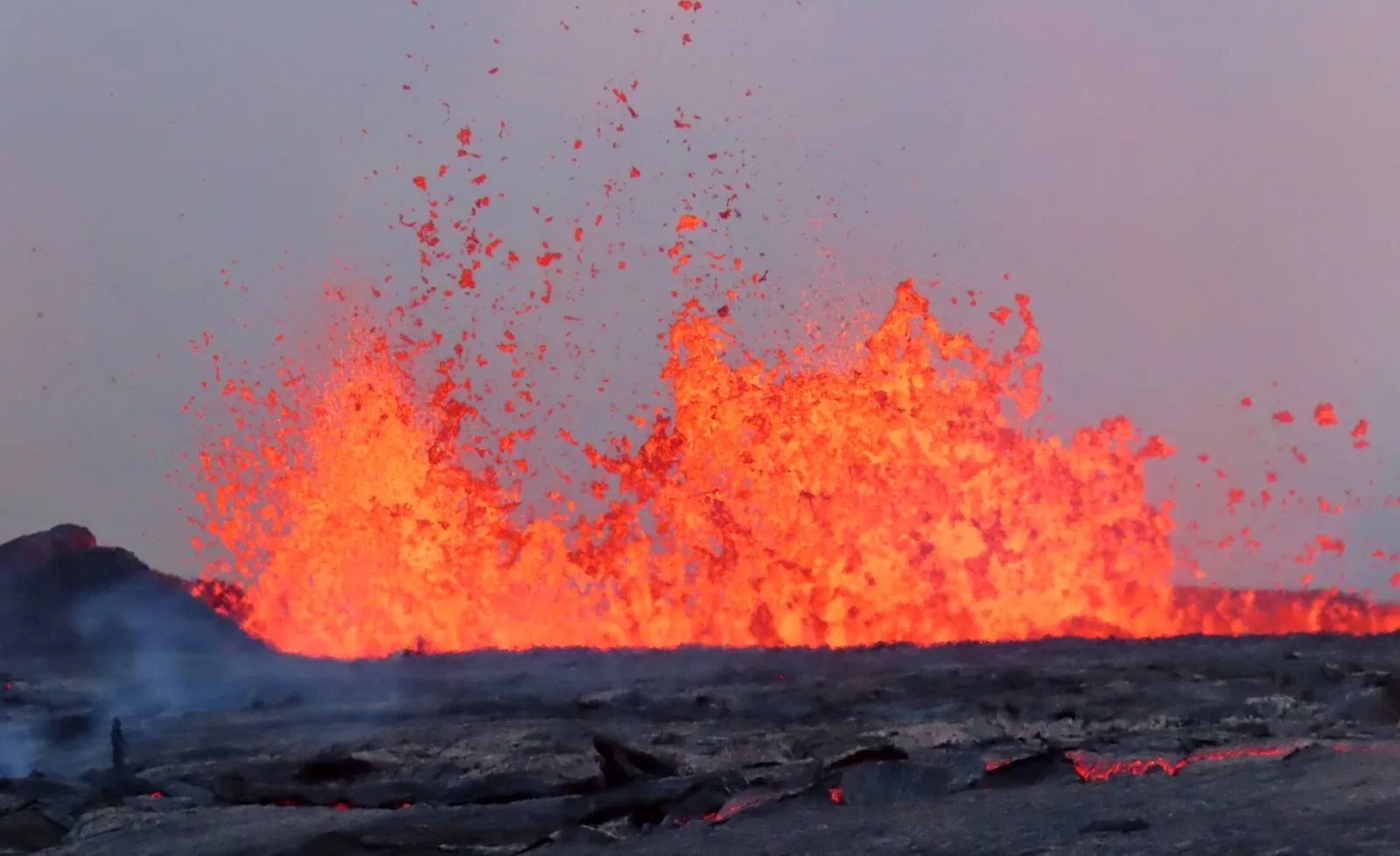
Eruptions returned to Halema'uma'u in December 2020 and have come and gone since in episodes of lava fountaining, again visible from overlooks along the rim when the park is open.
The East Rift Zone is a fracture running from the summit down Kilauea's flank toward the sea, and most of the volcano's recent lava has erupted along it.
The Pu'u 'O'o vent on the rift erupted continuously from 1983 to 2018, the longest rift eruption in recorded Hawaiian history, adding more than 500 acres of new land where flows reached the ocean and burying the town of Kalapana and part of the old coastal road.
In May 2018 magma pushed 25 miles farther down the rift and broke out in fissures in Leilani Estates, a subdivision outside the park; the flows covered about 13 square miles, destroyed roughly 700 structures, and built a new lava delta at Kapoho.
Those 2018 flows are now cooling black rock being colonized by ferns and 'ohi'a seedlings, an early stage of the succession that turns Hawaiian lava into forest over centuries.
Mauna Loa is the largest active volcano on Earth, making up about half of the Big Island and rising 13,681 feet above the sea and roughly 30,000 feet from the ocean floor.
It erupted for two and a half weeks in November and December 2022, its first activity in 38 years; flows from its Northeast Rift Zone stopped less than two miles short of the island's main cross-island highway.
The Chain of Craters Road drops about 3,700 feet over 19 miles from the summit area to the coast, crossing lava flows of many different ages and passing a line of pit craters along the upper rift.
Near the coast the road reaches the Pu'u Loa petroglyphs, more than 23,000 images pecked into the lava and the largest such field in Hawaii, and ends where flows in the 1970s and 2000s buried the pavement.
Up to 120 inches of rain a year feed a native rainforest around Kilauea's summit, one of the last strongholds of Hawaiian forest birds.
Nahuku, the Thurston Lava Tube, formed perhaps 500 years ago when the crust of a lava river hardened while the molten interior kept draining, leaving a tunnel up to 20 feet across; the publisher Lorrin Thurston publicized it after visiting in 1913.
The forest is built on 'ohi'a lehua, a single tree species that ranges from sea level to 8,000 feet and whose red blossoms feed the 'apapane, 'i'iwi, and 'amakihi.
Since about 2014 that keystone tree has been dying from Rapid 'Ohi'a Death, a fungal disease that has killed more than a million trees on the island, and the park asks visitors to scrub their boots between forest areas.
Indigenous Connections
Native Hawaiian People (Kanaka Maoli)
Kanaka Maoli have lived with these volcanoes for many centuries, farming the wetter uplands, gathering forest plants and birds, and reading the eruptions through a large body of chant and genealogy.
Halema'uma'u is the residence of Pele in that tradition, and the wider landscape is understood as an ancestor; hula and other practitioners bring ho'okupu, offerings, to the crater rim.
Explosive eruptions of Kilauea are recorded in Hawaiian history, most famously the 1790 blast whose ashfall killed part of the army of the chief Keoua and left footprints in the hardened ash that the park still protects.
The National Park Service works with the Office of Hawaiian Affairs and Native Hawaiian communities to honor and incorporate Native Hawaiian perspectives in park management. Cultural practitioners have rights to access certain areas for traditional and ceremonial purposes.
Hawaiian Place Names and Oral Tradition
The Hawaiian names carried on features throughout the park hold layers of history: Halema'uma'u, Uwekahuna ('wailing priest'), Keonehelelei ('the falling sands,' for the 1790 ashfall), Puna, Ka'u.
Those names encode genealogy, event, and instruction, and Hawaiian scholars have worked with the Park Service to restore correct spellings and diacritical marks across signs and maps.
Native Hawaiian knowledge of the volcanoes is now presented in the park's interpretation alongside the geology rather than treated as folklore, a shift the park has made deliberately since the 1990s.
The NPS has worked to restore and use proper Hawaiian place names throughout the park, and interpretive programs incorporate Native Hawaiian perspectives alongside scientific understanding of the volcanic processes.
Exploring the Volcanoes
Kilauea Overlook and Crater Rim Drive
Crater Rim Drive once circled the whole summit caldera; the 2018 collapses and toxic gas closed the northwest half, so the open section runs from the Kilauea Visitor Center past the Kilauea Overlook and Volcano House to the Devastation Trail and Nahuku.
When an eruption is active in Halema'uma'u, its glow is usually best seen after dark from the Kilauea Overlook and Keanakako'i.
The Volcano House hotel on the rim has operated in some form since 1846, and the Hawaiian Volcano Observatory building at Uwekahuna was so badly damaged in 2018 that the USGS moved its operations to Hilo.
The Park Service closes overlooks and trails on short notice when sulfur dioxide, ashfall, or ground cracking make them unsafe, so conditions should be checked the day of a visit.
Thurston Lava Tube Walk
A paved 0.4-mile loop drops through fern-hung rainforest, then runs about 600 feet through Nahuku, a lava tube up to 20 feet high, lit for part of its length.
The rainforest stretch is one of the easiest places in the park to see and hear native honeycreepers, 'apapane and 'amakihi, feeding in the 'ohi'a flowers overhead.
The tube formed when a fast lava river roofed over and then emptied; the walls still show the marks left as the flow drained away.
The lot fills early, and the park runs the site as a one-way loop with an unlit back section that visitors can walk with a flashlight for a sense of the tube in the dark.
Chain of Craters Road to the Coast
Chain of Craters Road runs 19 miles and 3,700 feet down from the summit area to the sea, one of the most dramatic drives in the national park system.
It passes a string of pit craters on the upper East Rift, then crosses open flows from the 1969 to 1974 Mauna Ulu eruption and later, ending at a locked gate where the 2003 flow covers the old road toward Kalapana.
A short walk from the road's end leads to Holei Sea Arch, a roughly 90-foot span of layered lava cut by the surf.
Rangers sometimes open a rough emergency route beyond the gate when an eruption threatens to cut the coastal highway, the same stretch buried and reopened several times since the 1980s.
Conservation Challenges
Rapid 'Ohi'a Death
Rapid 'Ohi'a Death is caused by two fungi in the genus Ceratocystis, identified on Hawaii Island around 2014, that clog a tree's water vessels and can kill a mature 'ohi'a within weeks.
'Ohi'a makes up an estimated 80 percent of Hawaii's remaining native forest and is the food and nest tree for most of the surviving native birds, so its loss would cascade through the whole ecosystem.
The disease has killed well over a million trees across more than 200,000 acres on the Big Island and has since turned up on Kauai, Oahu, and Maui, spread partly by boots, tools, and moved wood.
The park sanitizes vehicles and gear, restricts off-trail travel in infected areas, and grows disease-free 'ohi'a for replanting, but there is no cure.
Invasive Species
Hawaii has no native land mammals except one bat, and introduced pigs, goats, rats, mongooses, and cats have hit its ground-nesting birds and understory plants hard.
Feral pigs root up the forest floor and leave wallows where invasive strawberry guava, ginger, and faya tree take hold; the park has fenced tens of thousands of acres and removed pigs from inside the fences.
Mosquitoes, absent from Hawaii until the 1820s, carry avian malaria that has pushed native forest birds into a shrinking band of high, cool habitat, and several honeycreepers have gone extinct with others close behind.
A multi-agency program is now releasing lab-reared male mosquitoes carrying a bacterium that makes wild females' eggs fail, an attempt to crash the mosquito population in the birds' last refuges.
Volcanic Hazards and Access Management
An eruption can close a large part of the park within hours, and the 2018 events shut the summit area for 134 days, the longest closure in its history.
Sulfur dioxide from the vents reacts in sunlight to form 'vog,' a haze that can reach unhealthy levels miles away and is dangerous for people with asthma or heart conditions.
Where lava enters the ocean it produces 'laze,' a corrosive plume of hydrochloric acid and glass shards, and the new benches of lava at the water's edge can collapse without warning.
The park keeps overlooks, trails, and the Chain of Craters Road under constant review with the U.S. Geological Survey and closes them as gas, ashfall, or ground cracking require.
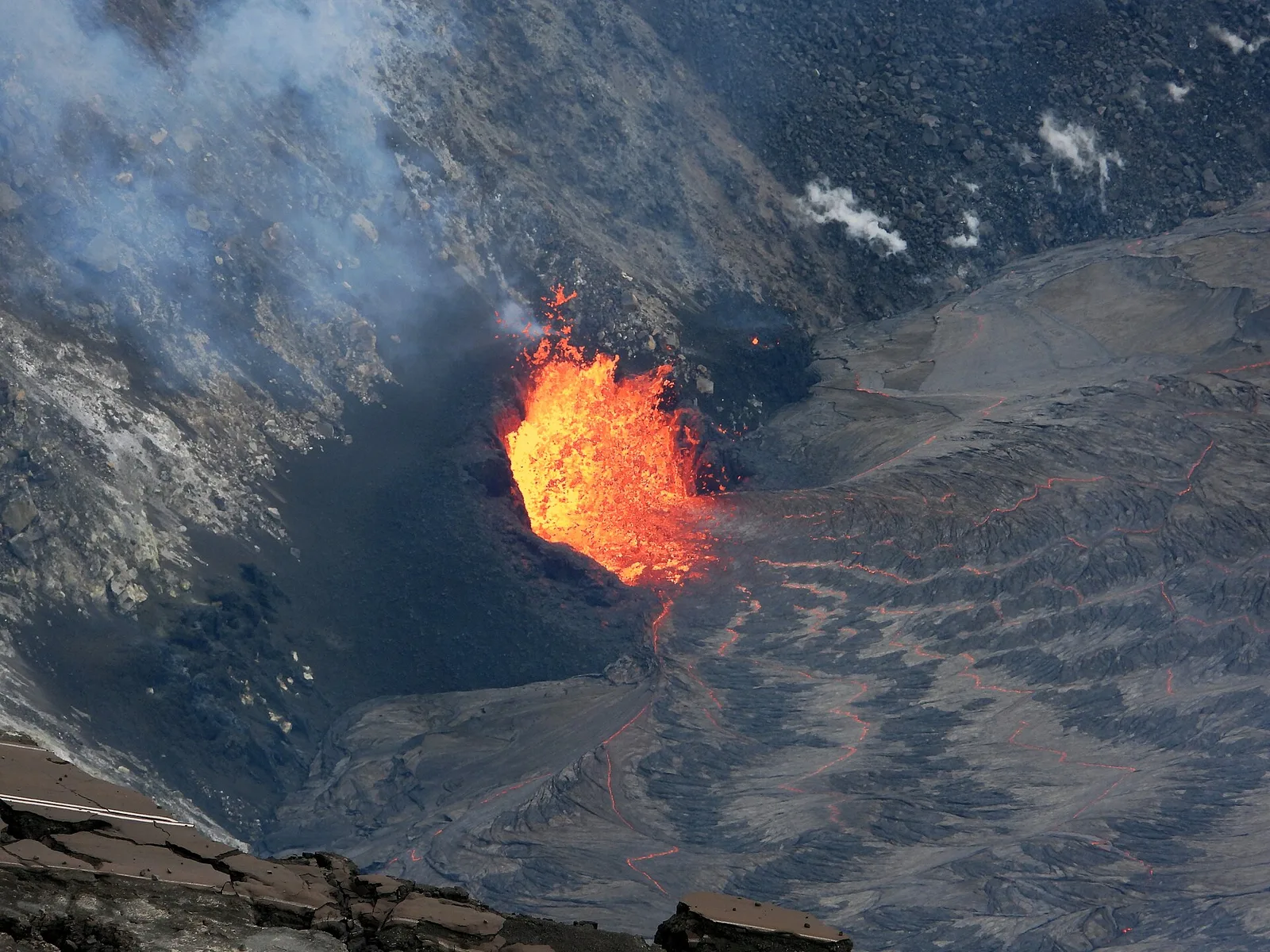
Halema'uma'u crater at Kilauea's summit, sacred home of Pele in Hawaiian tradition
At a Glance
Did You Know?
Kilauea is one of the most active volcanoes on earth. Its 1983-2018 Pu'u 'O'o eruption was the longest rift zone eruption in recorded Hawaiian history, running for 35 years and adding more than 500 acres of new land to the Big Island.
Mauna Loa is the largest volcano on earth by volume, containing enough material to bury the contiguous United States in a layer of lava 3 feet thick. Though its summit sits at only 13,677 feet above sea level, it extends nearly 30,000 feet from the ocean floor.
Hawaii Volcanoes National Park harbors some of the rarest ecosystems on earth. The native Hawaiian rainforests within the park support birds found nowhere else on the planet, including the critically endangered 'alala (Hawaiian crow) and several species of honeycreepers.
New land is continuously being created at the edge of Kilauea's lava flows. The Big Island is growing, slowly adding to its coastline as molten rock enters the ocean and cools into new basalt. You can, quite literally, stand on some of the youngest land on earth.
Plan Your Visit
Location
Hawai'i Island (Big Island), Hawaii
Designation
National Park, UNESCO World Heritage Site, International Biosphere Reserve
Best Time to Visit
Year-round; eruption activity varies and is unpredictable - check park conditions
Admission
$25 per vehicle (valid 7 days); America the Beautiful Pass accepted