About Mississippi
Mississippi takes its name from the Mississippi River, one of the great rivers of the world, whose name derives from the Ojibwe words "misi" (great) and "ziibi" (river), meaning "great river." Other Algonquian-speaking peoples had similar names for the river: the Anishinaabe called it "Misi-ziibi," the Cree called it "Missi Sepe," and French explorers recorded it as "Mechacebe" or "Meschacebe." The French explorer Jacques Marquette and Louis Jolliet were the first Europeans to explore the upper river in 1673, and La Salle descended the entire river to the Gulf in 1682, claiming the whole basin for France and naming it Louisiana. Mississippi became a state in 1817, the 20th state admitted to the union.
Mississippi is the most paradoxical state in America. It is consistently ranked as the poorest state in the nation by income and economic output, and it has produced an extraordinary per-capita share of the artists, musicians, writers, and cultural figures who shaped the modern world. Elvis Presley, Oprah Winfrey, B.B. King, William Faulkner, Jim Henson, Muddy Waters, James Earl Jones, Walter Payton, Jerry Rice, all from Mississippi. No state its size has contributed more to American culture.
That paradox runs through everything about Mississippi. The Mississippi Delta, one of the most fertile and economically desperate regions in the country, is the birthplace of the blues, the musical form that became the root of rock and roll, R&B, soul, and hip-hop. The state whose history is most defined by the violence of slavery and racial terror was also the crucible of the Civil Rights Movement, the place where the nation was forced to confront what it had refused to see. Vicksburg's fall helped end the Civil War; the murders of Emmett Till, Medgar Evers, and the Freedom Summer workers helped end legal segregation.
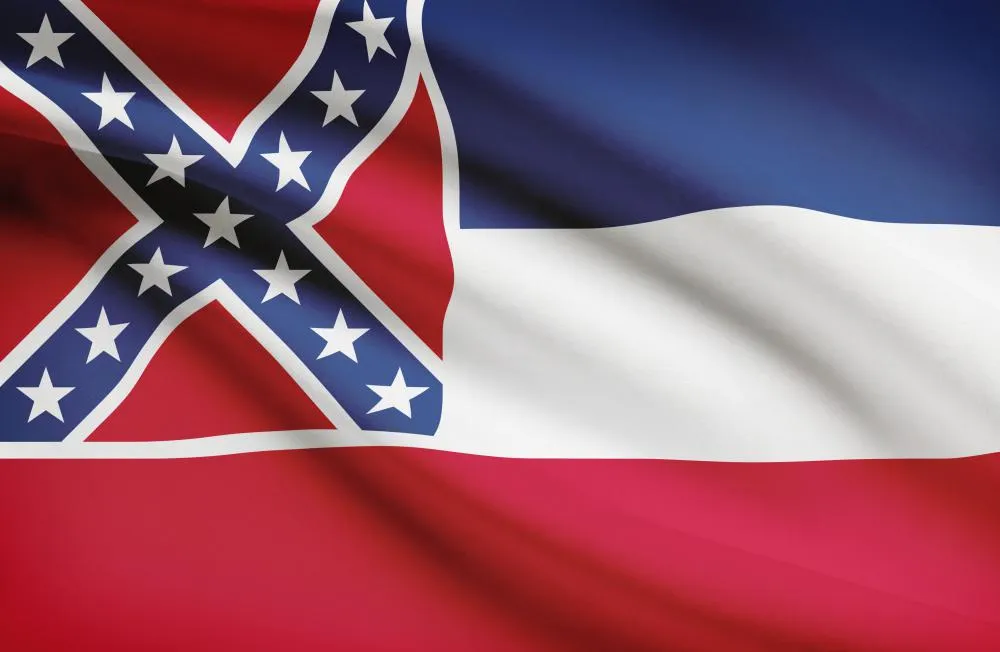
Mississippi today is a state in complicated transition. It has attracted major automotive and defense manufacturing investment. Its Gulf Coast has rebuilt after Katrina. It retired the last Confederate flag in 2020. But the deep structural inequalities of poverty, health, education, and infrastructure persist, and the gap between Mississippi and the rest of the nation in virtually every quality-of-life measure remains one of the most stubborn facts of American life.
Mississippi's Five Regions
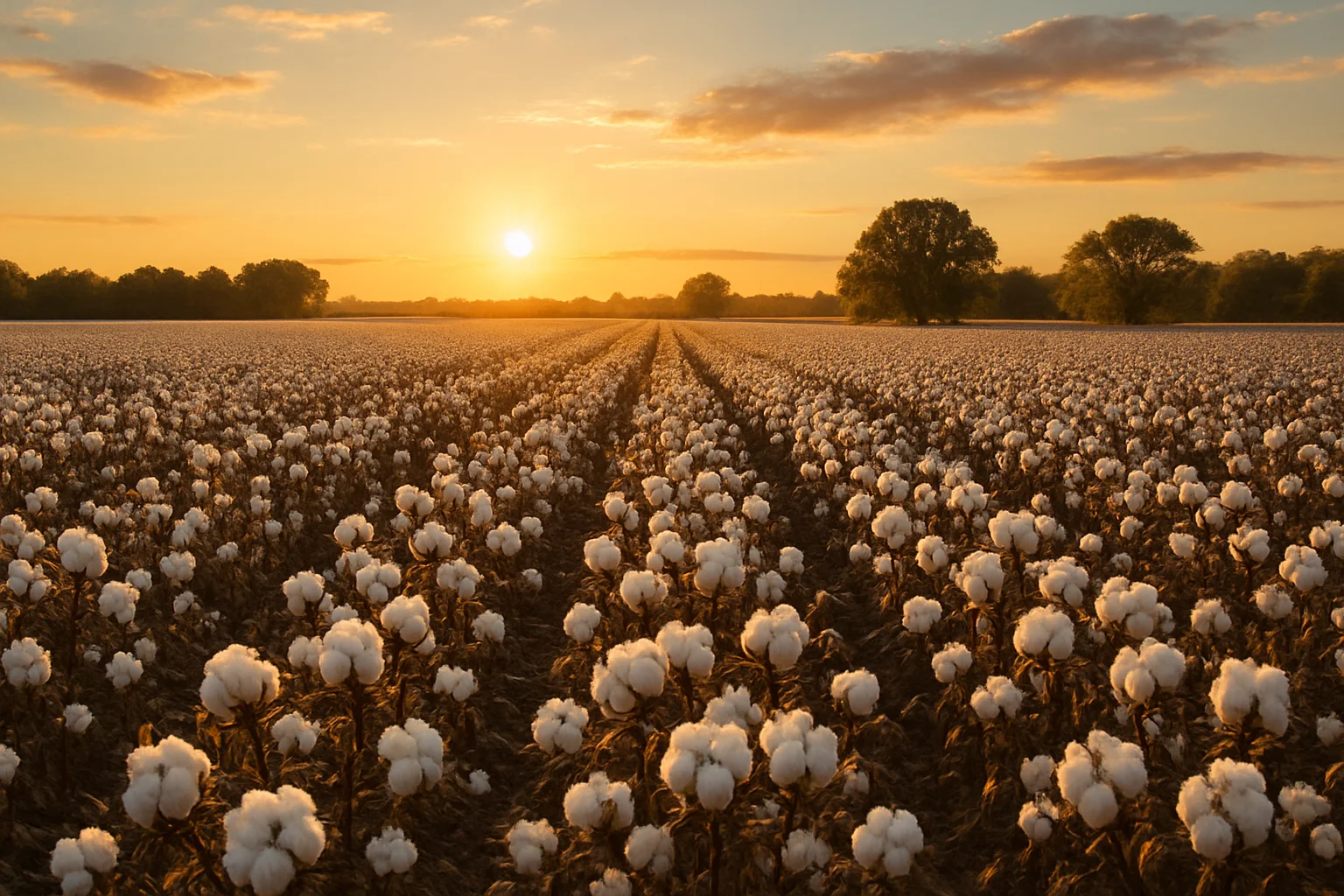
The Mississippi Delta is not the mouth of the river, it is a vast, flat alluvial plain between the Mississippi and Yazoo rivers in northwestern Mississippi, stretching roughly 200 miles from Memphis to Vicksburg. It is among the most fertile land on Earth, and among the most impoverished places in America. The Delta was the heart of the antebellum cotton kingdom, worked by enslaved people and later by sharecroppers in conditions that barely improved after emancipation.
The blues music that emerged from this land in the early 20th century, the sound of unimaginable hardship transformed into art, is Mississippi's most profound gift to the world. Clarksdale, Greenville, Greenwood, Indianola, and the thousands of small communities scattered across the flat cotton fields are the geography of American music history.
The Delta today is one of the most economically distressed regions in the United States, with poverty rates and health indicators that rank among the worst in the developed world. It is also one of the most culturally significant places in America, a landscape that still reverberates with the weight of everything that happened here.
The Delta's soil was laid down by thousands of years of Mississippi River floods and was not widely cleared and planted until after the Civil War, when railroads and a system of levees, and Black labor, first enslaved, then bound by debt, made the swampy 'Yazoo-Mississippi Delta' the richest cotton land in the world. By 1900 several Delta counties were more than 90 percent Black, and enormous plantations such as the Delta and Pine Land Company, then the largest cotton plantation in the United States, dominated whole counties.
The Great Flood of 1927 broke the levees and put much of the Delta under water for months, displacing hundreds of thousands, disproportionately Black sharecroppers who were held in refugee camps and conscripted for levee work, and the disaster helped push the federal government into flood-control responsibility and accelerated Black migration north. Mechanical cotton pickers, in wide use by the 1950s, then eliminated most of the remaining farm labor within a generation.
Isolated by that history, the Delta has some of the worst poverty, hunger, and health outcomes in the country, Bolivar, Coahoma, Sunflower, and Sharkey counties regularly post child-poverty rates above 40 percent, and Sunflower County was the home of both the White Citizens' Council in the 1950s and the voting-rights organizer Fannie Lou Hamer. Parchman Farm, the notorious state penitentiary founded in 1901 on a Delta plantation model, is still in operation.
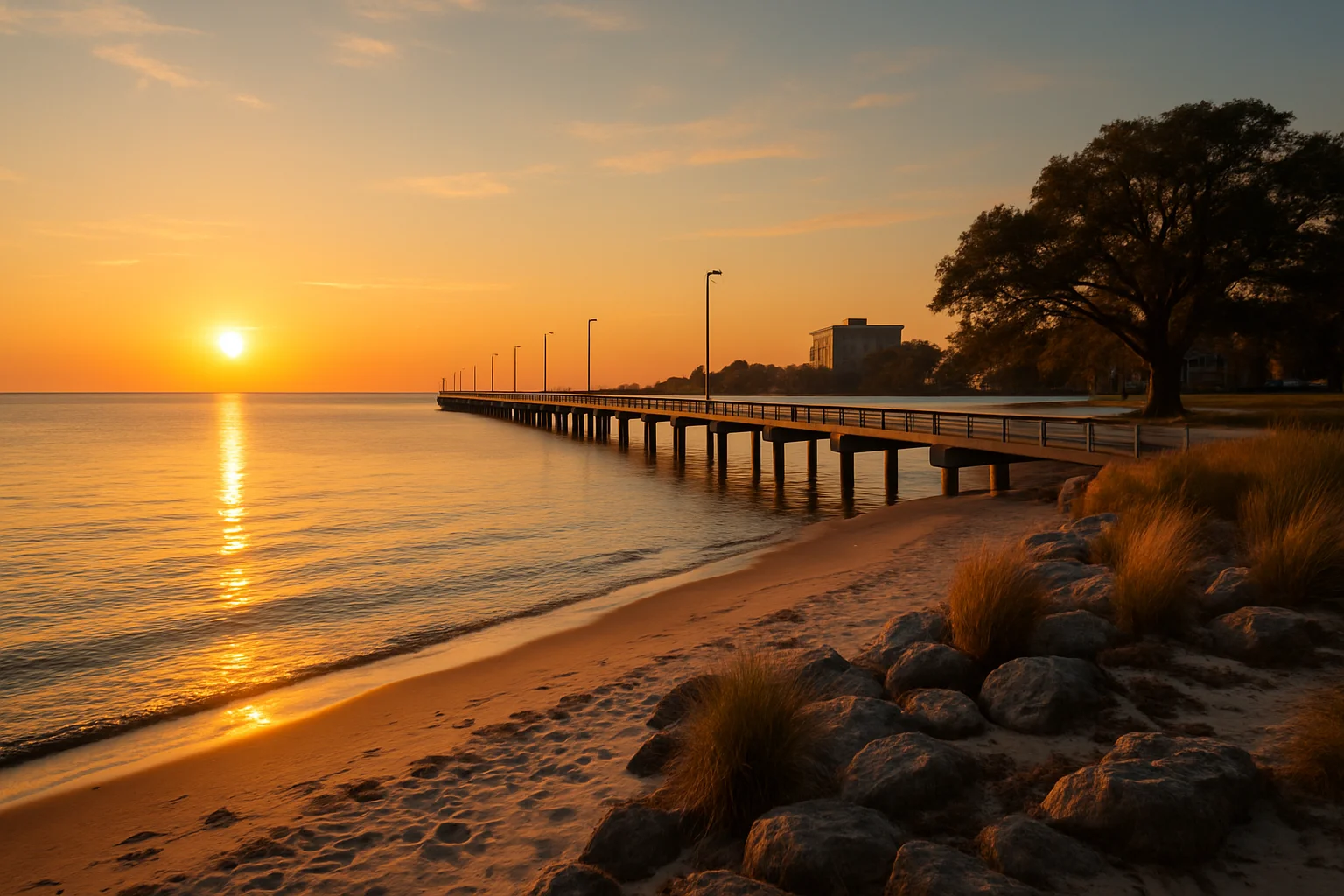
Mississippi's Gulf Coast, 44 miles of shoreline along the Gulf of Mexico, is the state's most economically dynamic region and its most dramatically altered by natural disaster. Biloxi and Gulfport are the twin anchors of the Coast, historically supported by shrimping, oystering, and fishing industries that gave the region a distinct Creole and Vietnamese-American cultural character unlike the rest of Mississippi.
Casino gambling, legalized in 1990, transformed the Gulf Coast into a regional entertainment destination, the casinos of Biloxi became the third-largest casino market in the nation before Hurricane Katrina. On August 29, 2005, Katrina made landfall with a catastrophic storm surge that devastated the Mississippi Gulf Coast even more severely than New Orleans, every structure within a quarter mile of the shore was destroyed, and the damage extended miles inland.
The region has largely rebuilt, with new casinos, a revitalized downtown Biloxi, and continued growth in defense manufacturing (Ingalls Shipbuilding in Pascagoula). The NASA Stennis Space Center, in the far southwestern corner of the state, is the Coast's most globally significant employer.
The Coast's culture has long set it apart from the rest of Mississippi: it was settled by the French a century before statehood, is heavily Catholic, held Mardi Gras and a shrimp-boat 'Blessing of the Fleet' long before casinos, and absorbed thousands of Vietnamese refugees after 1975 who rebuilt the shrimping and oystering fleets around Biloxi and Bayou La Batre. The three coastal counties, Hancock, Harrison, and Jackson, are the state's fastest-growing.
The Coast also carried Mississippi's early civil-rights fight in a distinctive form: Dr. Gilbert Mason organized 'wade-ins' on the whites-only Biloxi beach from 1959 to 1963 that drew mob violence, and a 1968 federal ruling opened the 26-mile man-made sand beach, built with federal money, to everyone. The BP Deepwater Horizon oil spill of 2010 fouled the Mississippi Sound and shut fisheries, and the resulting settlement has funded coastal restoration for more than a decade.
Beyond casinos and shipbuilding, the Coast economy runs on the Port of Gulfport (a major banana and frozen-poultry port), the Chevron refinery in Pascagoula, one of the largest in the country, seafood processing, and tourism built around the beach, Ship Island in the Gulf Islands National Seashore, and the Walter Anderson art legacy in Ocean Springs.
Jackson is Mississippi's capital and only major city, a metro area of roughly 580,000 that concentrates the state's government, healthcare, and professional services. The University of Mississippi Medical Center, the state's major law firms, federal agencies, and state government agencies all anchor the Jackson economy. Jackson is a majority-Black city that has struggled with population loss, infrastructure decay, and fiscal stress, the city's water system failed catastrophically in 2022 when winter storms caused a complete loss of water pressure for weeks, exposing the consequences of decades of deferred infrastructure investment.
The Jackson metropolitan area also includes the bedroom communities of Ridgeland, Madison, Brandon, and Flowood, which have absorbed much of the white and middle-class population that departed Jackson proper over the past 50 years. Interstate 20 connecting Jackson to Birmingham and Dallas, and I-55 running north-south through the state, make Jackson the crossroads of Mississippi's highway system.
Jackson grew from a small trading post at 'LeFleur's Bluff' on the Pearl River, was named for Andrew Jackson and made the capital in 1821, and was burned so thoroughly by Sherman's troops during the 1863 Vicksburg campaign that soldiers nicknamed it 'Chimneyville.' The city's population peaked near 202,000 around 1980 and has since fallen below 150,000, one of the steepest declines of any U.S. city, and it went from majority-white to more than 80 percent Black over the same period.
The 2022 water crisis, when flooding overwhelmed the aging O.B. Curtis treatment plant and left about 150,000 people without safe running water for weeks, followed a 2021 winter-storm failure and years of boil-water notices; a federal judge put the system under a court-appointed private administrator in late 2022, and Congress and the state have since directed hundreds of millions of dollars toward repairs. Jackson and the Republican-led legislature have also clashed over a 2023 law expanding a state-run court and police district within the city.
Despite the strain, the Jackson metro remains the state's economic core: it holds the University of Mississippi Medical Center and its roughly 10,000 employees, the headquarters of the utility Entergy Mississippi and of Trustmark bank, the state's largest concentration of law and lobbying firms, and Jackson State University, an HBCU whose 1970 police killing of two students during campus unrest is memorialized on Lynch Street.
Northeast Mississippi is a geographically and culturally distinct region, the hills here are the tail end of the Appalachian plateau, making this the only part of Mississippi with real topographic relief. Tupelo is the regional hub and most prosperous city in the northeast, and the birthplace of Elvis Presley, born January 8, 1935, in a small shotgun house on Old Saltillo Road.
The Elvis Presley Birthplace museum and the Tupelo Hardware Company, where a young Elvis bought his first guitar, draw visitors from around the world. Tupelo has been recognized multiple times as one of America's 'All-America Cities' and is home to the Toyota plant and a significant furniture manufacturing industry, Lee County is one of the largest furniture manufacturing counties in the United States.
Corinth, site of a significant Civil War battle and the northern terminus of the Natchez Trace Parkway, anchors the far northeastern corner. The Natchez Trace Parkway, a 444-mile scenic road following the ancient Natchez Trace from Natchez to Nashville, is one of the most historic routes in America and a major draw for cyclists, motorcyclists, and road-trippers.
The Tupelo area's manufacturing base grew out of a Depression-era experiment: Tupelo in 1934 became the first city in the country to buy power from the new Tennessee Valley Authority, and cheap electricity plus an aggressive local development council helped seed the upholstered-furniture industry that now makes northeast Mississippi one of the largest furniture-producing regions in the United States, centered on Tupelo, Fulton, and Booneville. The city was nearly destroyed by an F5 tornado in 1936, one of the deadliest in U.S. history, that killed more than 200 people, with the toll among Black residents never fully counted.
Corinth was one of the most strategically important rail junctions in the Confederacy, where the Memphis and Charleston and the Mobile and Ohio railroads crossed, and the reason the armies fought at Shiloh just across the Tennessee line in April 1862; the Union then besieged and took Corinth, and a fierce follow-up battle in October 1862 secured it. The town's Contraband Camp became a large community of formerly enslaved people who farmed and drilled as soldiers.
The hill counties were poorer and less enslaved than the Delta or the river towns before the Civil War, a small-farm 'yeoman' economy that produced pockets of Unionism, and the region's red-clay hills still show the erosion of a century of cotton. Booneville is home to a large community college, and the Appalachian foothills give the northeast the state's only ski-free but genuinely rolling terrain, drained by the Tombigbee, whose valley was turned into the Tennessee-Tombigbee Waterway barge canal completed in 1985.
The Pine Belt cuts diagonally across central and southern Mississippi, a vast landscape of longleaf and loblolly pine, red clay hills, and small industrial cities that grew up around timber and military installations. Hattiesburg is the largest city in the region and home to the University of Southern Mississippi, which provides the educational and economic anchor for the surrounding area.
Camp Shelby, adjacent to Hattiesburg, is one of the largest National Guard training installations in the United States. The De Soto National Forest, covering 530,000 acres of the Pine Belt, provides timber, recreation, and wildlife habitat.
Laurel, the small city that inspired the HGTV show 'Home Town', has become a surprising destination for design tourism, with Ben and Erin Napier's renovation projects drawing visitors to a city that had been struggling with population loss and economic decline. Natchez, at the southwestern tip of the Pine Belt on the Mississippi River, is one of the most historically significant cities in the South, home to more antebellum mansions than any other city in the nation, and to a history of race, slavery, and commerce that defines much of what Mississippi was and is.
Hattiesburg, founded in 1882 where two rail lines met and named for the founder's wife, grew as a lumber and rail town nicknamed the 'Hub City' and now leans on the University of Southern Mississippi (about 13,000 students, and the birthplace of the modern polymer science field) and on Camp Shelby and Forrest General Hospital. William Carey University, a Baptist school, adds a second campus, and the metro is one of the few in Mississippi that has grown steadily in recent decades.
The Pine Belt was the center of a notorious chapter of civil-rights history: the White Knights of the Ku Klux Klan, the most violent Klan faction of the 1960s, was founded near Laurel under Imperial Wizard Sam Bowers, who ordered the 1966 firebombing murder of the Hattiesburg NAACP leader Vernon Dahmer and was finally convicted of it in 1998, and the 1964 Freedom Summer murders in Neshoba County. The region's timber-baron mansions in Laurel's built-for-the-elite historic district sit near mill neighborhoods that never shared the wealth.
Natchez sits atop a 200-foot loess bluff and predates every other permanent settlement in the state; its wealth came from cotton and from being one of the two ends, with New Orleans, of the domestic slave trade, and the 'Forks of the Road' was the second-largest slave market in the Deep South. The Natchez Pilgrimage house tours, running since 1932, long presented a romanticized 'moonlight and magnolias' version of that past and have slowly been revised to include the enslaved majority who built the city.

Economy
Mississippi's economy is anchored by agriculture, defense manufacturing, automotive assembly, and timber, with a cultural economy rooted in blues heritage and Gulf Coast tourism.
The state is the nation's leading producer of farm-raised catfish, the flat, fertile ponds of the Mississippi Delta produce the vast majority of the country's catfish supply, from tiny fingerlings to market-size fish, in one of the most vertically integrated aquaculture operations in the world. Poultry, particularly broiler chickens, is the largest agricultural sector by value, with massive poultry processing operations anchored around companies like Tyson Foods and Sanderson Farms scattered across the state. Soybeans, corn, cotton, rice, and sweet potatoes round out a diverse farm economy.
Timber is another critical resource, Mississippi's extensive pine forests support sawmills, paper mills, and wood products manufacturing across the state. Agriculture and forestry together directly employ tens of thousands of Mississippians and support an enormous downstream processing and logistics sector.
Farm-raised catfish grew from a handful of Delta ponds in the 1960s into a roughly 200 million dollar farm-gate industry centered on Humphreys, Sunflower, and Leflore counties, and Belzoni bills itself the 'Catfish Capital of the World.' The business contracted sharply after 2008 as soaring corn and soybean feed prices and a flood of cheaper imported Vietnamese pangasius drove many growers out; U.S. producers won a partial reprieve when catfish inspection moved from the FDA to the tougher USDA in 2016.
Cotton, the crop that built and cursed the state, now covers only a fraction of its historic Mississippi acreage, around 400,000 to 500,000 acres in recent years versus several million a century ago, displaced by soybeans, corn, and the near-total mechanization that ended sharecropping in the mid-20th century. Mississippi is nonetheless a top-five U.S. producer of cotton, sweet potatoes, and pond-raised catfish.
Poultry is now Mississippi's largest agricultural sector by far, worth well over 2.5 billion dollars a year, and Sanderson Farms, founded in Laurel in 1947 and long the state's flagship agribusiness, was bought in 2022 by Cargill and Continental Grain in a roughly 4.5 billion dollar deal and merged into a company called Wayne-Sanderson Farms. Broiler operations concentrate in the Pine Belt counties around Laurel, Collins, and Forest.
Huntington Ingalls Industries' Ingalls Shipbuilding division in Pascagoula is the largest manufacturing employer in the state, with roughly 11,000 workers building destroyers, amphibious assault ships, and other vessels for the U.S. Navy and Coast Guard. Ingalls has been building U.S. Navy ships for over a century, its workers construct some of the most technologically sophisticated naval vessels ever built, including Arleigh Burke-class destroyers and America-class amphibious assault ships.
The Stennis Space Center in Hancock County, on the Gulf Coast, is NASA's primary rocket engine testing facility, the Saturn V engines that sent astronauts to the Moon were tested here, and Stennis continues to test propulsion systems for the Space Launch System and other next-generation programs. Mississippi's military footprint also includes Keesler Air Force Base in Biloxi (Air Education and Training Command), Columbus Air Force Base, Camp Shelby, and Naval Air Station Meridian.
Ships built at Pascagoula have carried the yard's imprint through the whole modern Navy: the yard opened in 1938, built Liberty ships and destroyers in World War II under the Ingalls family, and later produced Spruance-class destroyers, the Ticonderoga cruisers, and, more recently, all of the San Antonio-class amphibious ships and roughly half the Arleigh Burke destroyer fleet, splitting that program with Bath Iron Works in Maine. It also built the National Security Cutters for the Coast Guard.
Stennis was created in the early 1960s by displacing five small communities and buying out about 700 families across a 200-square-mile 'acoustical buffer zone' so rocket engines could be fired without shattering windows for miles; every Space Shuttle main engine and every RS-25 engine slated for NASA's Artemis Moon program has been proof-tested there. The site now hosts more than 40 other agencies and companies as 'NASA's largest federal city.'
Keesler Air Force Base in Biloxi is one of the largest technical-training centers in the Air Force, schooling tens of thousands of personnel a year in electronics, cyber, and weather, and it is home to the 'Hurricane Hunters,' the 53rd Weather Reconnaissance Squadron that flies WC-130 aircraft into tropical storms. Camp Shelby near Hattiesburg is the largest state-owned National Guard training site in the country and was a major mobilization station in both world wars.
Nissan operates a major assembly plant in Canton (near Jackson) that has produced hundreds of thousands of vehicles annually since opening in 2003, employing thousands of Mississippians in the production of trucks and SUVs. Toyota opened an assembly plant in Blue Springs (near Corinth in northeast Mississippi) in 2011, which produces the Corolla and other vehicles. Both plants represent the kind of large-scale, high-wage manufacturing investment Mississippi has actively pursued to diversify its economy away from agriculture and to provide well-paying jobs for a workforce that historically had few such opportunities.
The automotive supply chain has grown around these anchor plants, attracting dozens of parts suppliers and manufacturers to the state. Mississippi's relatively low labor costs, central location, and business-friendly tax environment have made it attractive to industrial manufacturers across multiple sectors.
The Nissan Canton plant was landed in 2000 with an incentive package eventually valued above 1.3 billion dollars, one of the largest in state history at the time, and the Toyota Blue Springs plant, announced in 2007 and delayed by the recession before opening in 2011, came with roughly 350 million dollars in state and local incentives plus a new access road and rail spur. Both were built in a state with no significant prior auto-assembly history.
The plants are non-union, and repeated United Auto Workers organizing drives at Nissan Canton, whose workforce is majority Black, have failed, most visibly a 2017 vote that the union lost about 62 to 38 percent amid accusations of company intimidation; the outcome became a national test case for Southern auto organizing. Nissan has also relied heavily on lower-paid temporary and contract workers at the plant.
Toyota Blue Springs builds the Corolla, one of the best-selling cars in the world, and employs roughly 2,000 people, while Nissan Canton, with around 5,000 workers, builds the Frontier pickup, the Altima, and, since 2022, has been retooled for future electric-vehicle production. Together with suppliers, the two plants are credited with tens of thousands of Mississippi jobs.
The Mississippi Delta, that flat, hypnotically fertile strip of land between the Yazoo and Mississippi rivers, is the birthplace of the blues, the musical form that became the foundation of virtually all American popular music: rock and roll, R&B, soul, jazz, and hip-hop. Robert Johnson, Charley Patton, Son House, Muddy Waters, B.B. King, Howlin' Wolf, the foundational figures of American music came from or through the Mississippi Delta.
The Delta Blues Museum in Clarksdale, the B.B. King Museum in Indianola, the Mississippi Blues Trail (a network of historical markers at 200+ sites across the state), and the numerous juke joints still operating in the Delta draw music pilgrims from around the world.
The Gulf Coast supports a robust casino tourism industry, Mississippi was among the first states to legalize waterfront casino gambling (1990), and the casinos of Biloxi, Gulfport, and Tunica have become major economic drivers. Natchez, one of the oldest cities in the United States, draws visitors with its antebellum plantation homes and its complex history.
The blues has been slowly, unevenly turned into an economic asset for some of the poorest counties in the country: the Mississippi Blues Trail, launched in 2006, has placed more than 200 markers, the small Delta towns of Clarksdale and Indianola have built museums and festivals (Clarksdale's Juke Joint Festival and Sunflower River Blues Festival draw thousands), and the film-and-tourism image of the 'crossroads' is marketed heavily. Grammy-winning musician and actor Morgan Freeman co-owns the Ground Zero Blues Club in Clarksdale.
Mississippi's casino law originally required the gambling floors to sit over water on barges, a fiction meant to blunt religious opposition, but after Hurricane Katrina picked up Biloxi's floating casinos and dropped them blocks inland in 2005, the legislature let coast casinos rebuild on land within 800 feet of the shore. The Gulf Coast and the Tunica cluster near Memphis together make Mississippi one of the largest commercial casino markets in the country by revenue.
Natchez, founded by the French in 1716, had more millionaires per capita than almost any American city before the Civil War, wealth built on cotton and the domestic slave trade at the 'Forks of the Road' market on its edge, and its roughly 500 surviving antebellum houses now anchor a heritage-tourism economy that has increasingly tried to tell the full story of the enslaved people who built and staffed them.
Longleaf pine, loblolly pine, and hardwood forests cover millions of acres, supporting an extensive timber and forest products industry. Paper mills, sawmills, wood pulp operations, and engineered wood products manufacturing are scattered across the Pine Belt and provide industrial employment in communities that have few other large employers. Mississippi is consistently one of the top ten timber-producing states in the nation.
The De Soto National Forest in southern Mississippi and the Bienville National Forest in central Mississippi protect significant forest acreage while also supporting sustainable timber harvest. The timber industry's history in Mississippi runs deep, the great longleaf pine forests that once covered most of the state were nearly entirely cleared by the early 20th century, and much of what exists today is regrowth from those original clear-cuts.
The 'cut-out-and-get-out' logging boom of roughly 1880 to 1930 stripped the virgin longleaf pine, and towns such as Laurel were built by Midwestern lumber barons who moved on once the big timber was gone, leaving stumps and eroded hills; the six national forests Congress established in Mississippi in the 1930s were largely bought as worn-out cutover land and replanted. Longleaf pine, once dominant across the Southeast, now covers only a small fraction of its former range, and Mississippi is a center of restoration efforts.
Forestry is today Mississippi's second most valuable agricultural commodity after poultry, with more than 19 million acres of timberland, about 65 percent of the state's land area, most of it privately owned in small tracts. The state consistently ranks among the top handful of U.S. producers of softwood lumber and pulp.
The industry has shifted toward pellets and pulp: Mississippi hosts several large wood-pellet plants, including Drax and Enviva facilities that export compressed wood pellets through the Port of Pascagoula to European power stations burning them in place of coal, a trade environmental groups criticize as counting forest carbon incorrectly. Georgia-Pacific, Weyerhaeuser, and International Paper run major mills in the state.
The University of Mississippi Medical Center (UMMC) in Jackson is the state's only academic medical center and Level I trauma center, anchoring a healthcare ecosystem that employs tens of thousands across the Jackson metro area. The state's major universities, the University of Mississippi (Ole Miss) in Oxford, Mississippi State University in Starkville, the University of Southern Mississippi in Hattiesburg, and Jackson State University, collectively enroll over 100,000 students and are among the state's largest employers.
The education and healthcare sectors, often combined as 'eds and meds,' provide a degree of economic stability in a state where private sector employment opportunities have historically been limited. Mississippi has not expanded Medicaid under the Affordable Care Act, leaving hundreds of thousands of low-income residents in the 'coverage gap', a persistent policy debate in a state with one of the nation's highest rates of uninsured residents.
Mississippi has ranked last, or nearly last, among the states in the United Health Foundation's annual health rankings for most of the past three decades, with the nation's highest rates of infant mortality, obesity, and cardiovascular death and the lowest life expectancy, around 71 to 72 years, roughly six years below the national figure. The University of Mississippi Medical Center performed the world's first human lung transplant in 1963 and the first animal-to-human heart transplant in 1964.
Roughly a third of Mississippi hospitals, most of them rural, have been rated at risk of closure, and several, in Newton, Batesville, and elsewhere, have shut or dropped services since 2010; the state's decision not to expand Medicaid is estimated to have forgone billions of federal dollars, and repeated expansion bills have died in the legislature, though a 2024 push came closer than any before it. UMMC and the state's largest commercial insurer fought a months-long contract dispute in 2023 that left many patients out of network.
The historically Black universities Jackson State, Alcorn State (the oldest public land-grant HBCU, chartered 1871), and Mississippi Valley State are major regional employers and educators, and a decades-long federal lawsuit, Ayers v. Fordice, ended in a 2004 settlement directing about 500 million dollars over 17 years to Mississippi's public HBCUs to remedy unequal funding. Ole Miss and Mississippi State together enroll more than 45,000 students.
How Mississippi's Government Works
Mississippi's state government follows the standard three-branch structure: the Executive (Governor), the Legislative (the Mississippi Legislature, a 52-seat Senate and 122-seat House of Representatives), and the Judicial (the Mississippi Supreme Court, which has nine justices elected in nonpartisan district elections serving 8-year terms).
The Governor serves a four-year term and is limited to two consecutive terms. Mississippi holds its state elections in odd-numbered years, out of cycle with federal elections, which significantly affects voter turnout and the national political dynamics that influence state races. Republicans have dominated Mississippi politics at every level since the late 1990s and currently hold supermajorities in both legislative chambers.
Mississippi's political landscape is among the most conservative in the nation. The state was instrumental in the Dobbs v. Jackson Women's Health Organization case (2022), in which the U.S. Supreme Court overturned Roe v. Wade, the case originated from a Mississippi 15-week abortion ban that the state's Attorney General defended to the Supreme Court.
Mississippi is one of the few remaining states that has not expanded Medicaid under the Affordable Care Act. This leaves an estimated 200,000+ low-income Mississippians in the 'coverage gap', earning too much to qualify for traditional Medicaid but too little to afford marketplace insurance. In a state with some of the worst health outcomes in the nation, this is a significant ongoing policy debate.
Governor of Mississippi
Current Governor
Tate Reeves

- Party
- Republican
- In Office Since
- January 14, 2020
- Re-elected
- November 7, 2023
- Term Ends
- January 2028
- Born
- June 5, 1974, Florence, Mississippi
- Education
- Millsaps College (BA, Economics)
- Prior Role
- State Treasurer (2004–2012); Lieutenant Governor (2012–2020)
Tate Reeves is Mississippi's 65th Governor. A lifelong Mississippian who worked his way up through state finance as Treasurer and then Lieutenant Governor, Reeves is one of the most conservative governors in the country. He has opposed Medicaid expansion, championed tax cuts and business incentives, and signed legislation eliminating the state's individual income tax over time, a landmark conservative economic policy move. He won re-election in 2023 against a stronger-than-expected challenge from Democrat Brandon Presley, the grandnephew of Elvis Presley.
Other Current State Officials
Lieutenant Governor
Delbert Hosemann
In office since January 2020, re-elected 2023. A former Mississippi Secretary of State who modernized state government operations, Hosemann is considered a more pragmatic conservative than the governor. As president of the Senate, he wields significant independent legislative influence and has at times differed with the Governor on policy.
Attorney General
Lynn Fitch
In office since January 2020, re-elected 2023. The first woman elected Attorney General in Mississippi history. Fitch argued the state's 15-week abortion ban before the U.S. Supreme Court in Dobbs v. Jackson Women's Health Organization (2022), the case that overturned Roe v. Wade.
Secretary of State
Michael Watson
In office since January 2020, re-elected 2023. A former state senator, Watson oversees elections, business registration, and public lands. He has focused on election security and compliance initiatives.
The Mississippi Legislature
Mississippi State Senate
- Seats: 52 members
- Terms: 4-year terms
The upper chamber. Mississippi senators serve 4-year terms, the same length as the House, and all 52 seats are up for election every four years in odd-numbered years. Republicans hold a supermajority.
Mississippi House of Representatives
- Seats: 122 members
- Terms: 4-year terms
The lower chamber. Mississippi is one of only five states (with Alabama, Louisiana, Maryland, and North Dakota) where House members serve 4-year terms rather than the typical 2-year terms. All 122 seats are elected on the same four-year cycle as the Senate and Governor.
Mississippi's U.S. Senators
U.S. Senator
Roger Wicker
Mississippi's senior senator, Wicker was appointed to the seat in December 2007 when Trent Lott resigned. A former U.S. Representative, Wicker has served on the Armed Services, Commerce, and Environment committees. He has chaired the Senate Armed Services Committee since January 2025 and is a strong advocate for Mississippi's defense manufacturing interests, particularly Ingalls Shipbuilding in Pascagoula. He won re-election in November 2024.
U.S. Senator
Cindy Hyde-Smith
Mississippi's junior senator, Hyde-Smith was appointed in April 2018 to fill the seat vacated by Thad Cochran, who resigned due to health. She won a special election in November 2018 and a full term in November 2020. A former state Agriculture Commissioner, she sits on the Appropriations Committee and focuses on agricultural and rural issues. Her seat is up for re-election in November 2026.
Mississippi Through the Years
From the great Indigenous nations to the cotton kingdom to the Civil War's turning point at Vicksburg, from the birth of the blues to the Civil Rights Movement's most defining moments, Mississippi's history is America's history at its most concentrated and unsparing.
The land that would become Mississippi was home to several major Indigenous nations with sophisticated cultures and complex political organizations. The Choctaw occupied the central and southern regions, one of the largest nations in the Southeast, agriculturalists and traders who built a confederacy of villages and maintained elaborate diplomatic relationships with neighboring peoples.
The Chickasaw controlled the northern regions with fierce military effectiveness; their warriors resisted French, Spanish, and American encroachment for centuries and were never fully defeated in battle. The Natchez, centered on the lower Mississippi River near present-day Natchez, developed one of the most complex hierarchical societies in North America, a theocratic state ruled by a divine king called the 'Great Sun' and organized around a great temple mound complex.
European disease and warfare would devastate all three nations, and the Indian Removal Act of 1830 would ultimately expel the Choctaw and Chickasaw from their Mississippi homelands to Oklahoma.
These nations were themselves the heirs of the Mississippian mound-building world: sites such as the Winterville Mounds near Greenville, the Grand Village of the Natchez, and Emerald Mound, the second-largest pre-Columbian earthwork in the United States, were ceremonial centers built between roughly 1000 and 1730. The Choctaw traced their origin to the sacred mound Nanih Waiya in present-day Winston County, still central to their identity. The Choctaw who avoided removal by taking up private land under the 1830 treaty, and were then largely cheated out of it, are the ancestors of today's federally recognized Mississippi Band of Choctaw Indians, headquartered at Pearl River near Philadelphia.
Spanish conquistador Hernando de Soto led the first European expedition to penetrate the interior of what would become Mississippi in 1540–1541, crossing from present-day Alabama and becoming the first European to see the Mississippi River from its eastern shore. De Soto's expedition was brutal, his soldiers enslaved, tortured, and killed thousands of Indigenous people as they cut a destructive path through the Southeast in search of gold.
De Soto died on the banks of the Mississippi in 1542, likely near present-day Ferriday, Louisiana, and was buried in the river to prevent the Indigenous people from learning that the 'god-like' conquistador was mortal. The expedition left behind a trail of devastation but no permanent settlement, and introduced Old World diseases that killed a significant portion of the region's Indigenous population over the following decades.
De Soto's crossing of the river almost certainly happened in northern Mississippi, and the fierce battle his army fought at a fortified town called Mabila, somewhere in present-day Alabama, in 1540 was one of the bloodiest single engagements between Europeans and Native Americans anywhere in the future United States, with hundreds or thousands of Native dead. The Spanish arrived at a landscape still dense with the towns and mounds of the Mississippian chiefdoms.
The century after De Soto is sometimes called a 'lost century' because the epidemics he and later contacts spread, smallpox, measles, and others to which Native people had no immunity, collapsed those chiefdoms before Europeans returned in force. When the French arrived around 1700 they found a thinner, reorganized Native world of the Choctaw, Chickasaw, and a much-reduced Natchez, rather than the mound-city societies De Soto had passed through.
Spain never followed up its claim with settlement in Mississippi, and De Soto's own chroniclers' accounts, rediscovered and studied for centuries, remain among the only written descriptions of the Mississippian world at its height, though scholars still argue over the expedition's exact route.
Pierre Le Moyne d'Iberville established Fort Maurepas near present-day Ocean Springs, Mississippi, in 1699, the first permanent European settlement in the lower Mississippi Valley. The French colony of Louisiana, which included present-day Mississippi, was established to counter Spanish and English ambitions in North America and to secure control of the Mississippi River. The port at Biloxi served briefly as the capital of French Louisiana before it moved to New Orleans.
French settlement introduced African slaves to the region as early as 1719, beginning the enslaved African presence that would define Mississippi's economy and society for nearly 150 years. The French period ended when Great Britain gained control of the region after the French and Indian War (1763), and British control lasted until the area was transferred to the United States in stages after the American Revolution.
The French built Fort Rosalie on the bluff at Natchez in 1716 and pressed the Natchez people for land and labor until, in 1729, the Natchez rose up and killed more than 230 French colonists in a single day. France answered with a war of extermination, aided by the Choctaw, that by 1731 had destroyed the Natchez as a nation, killing many and shipping about 500 survivors to slavery in the Caribbean; the rest scattered into other Southeastern nations.
Most of what became Mississippi passed to Britain in 1763 and was organized as part of British West Florida, which drew a wave of Loyalist and other Anglo settlers up the Mississippi River, especially around Natchez, in the 1770s. Spain took the Natchez district during the Revolution and held it until 1798, when the United States finally organized the Mississippi Territory.
The Chickasaw in the north, allied with Britain and armed through Charleston traders, defeated two major French invasions in the 1730s and were never conquered, remaining an independent power controlling the trade routes of north Mississippi until they signed a removal treaty in 1832.
Mississippi was admitted to the Union on December 10, 1817, as the 20th state. It was carved from the Mississippi Territory, which had been organized in 1798. David Holmes, the last territorial governor, became the first state governor. Statehood coincided with the beginning of the 'Cotton Kingdom' era, the rapid expansion of cotton cultivation across the Deep South, made possible by Eli Whitney's cotton gin (1793) and powered entirely by the labor of enslaved African Americans.
Mississippi's population grew explosively through the 1820s, 1830s, and 1840s as planters from the Carolinas and Virginia poured into the state with enslaved laborers to clear land and plant cotton. By 1860, Mississippi was the wealthiest state in the nation per capita, and the enslaved population outnumbered the white population. This grotesque wealth would be shattered in four years of civil war.
The cotton boom depended on taking Native land: the 1830 Treaty of Dancing Rabbit Creek, the first major removal treaty signed after the Indian Removal Act, ceded about 11 million acres of Choctaw territory, and the 1832 Treaty of Pontotoc did the same for the Chickasaw, opening roughly the northern two-thirds of the state to white settlement within a few years. Most Choctaw and Chickasaw were forced west to Indian Territory on marches that killed thousands.
Some Choctaw families exercised a treaty clause allowing them to stay as private landowners and citizens; nearly all were then defrauded of their land, but their descendants formed the community that in 1945 became the federally recognized Mississippi Band of Choctaw Indians, the only reservation-holding tribe in the state today.
White migration and the domestic slave trade drove Mississippi's population from about 75,000 in 1820 to 791,000 in 1860, of whom roughly 437,000, about 55 percent, were enslaved, the second-highest enslaved share of any state. Delta and river counties were overwhelmingly Black, and the state's per-capita wealth figure counted enslaved human beings as property.
Mississippi became the second state to secede from the Union on January 9, 1861, one day after South Carolina. The Mississippi Declaration of Secession was unusually direct about the cause: 'Our position is thoroughly identified with the institution of slavery, the greatest material interest of the world.' Mississippi's U.S. Senator Jefferson Davis had resigned his Senate seat and would become the President of the Confederate States of America.
Mississippi contributed enormous human capital to the Confederate cause, its soldiers fought in virtually every major engagement of the Civil War. The state paid a devastating price: an estimated one-third of Mississippi's white men of military age died in the war, and the Confederate surrender in 1865 ended the slave-based cotton economy that had made the state's planter class fabulously wealthy.
Mississippi's secession convention adopted 'A Declaration of the Immediate Causes,' drafted largely by the planter L.Q.C. Lamar, that named slavery as the reason in its opening lines and warned that abolition would mean 'the loss of property worth four billions of money.' Only a minority of delegates, mostly from the poorer, less enslaved hill counties, opposed leaving, and the free state of Jones County in the Piney Woods later became the center of a real, though later mythologized, anti-Confederate insurgency led by Newton Knight.
Vicksburg's 47-day siege in 1863 was fought on Mississippi soil, and Union forces under Grant and Sherman also burned much of Jackson, Meridian, and other towns; roughly 78,000 Mississippians served the Confederacy and an estimated 27,000 or more died. Around 17,000 Black Mississippians escaped to Union lines and enlisted in the U.S. Colored Troops, and Grant's headquarters directed thousands of formerly enslaved refugees into 'contraband' camps and leased plantations.
The war ended the world the planter class had built, but not their land: the 1865 Mississippi legislature enacted the first of the 'Black Codes,' laws restricting the movement, contracts, and gun ownership of freedpeople and forcing them back onto plantations, which so alarmed the U.S. Congress that it helped trigger Radical Reconstruction and federal military rule.
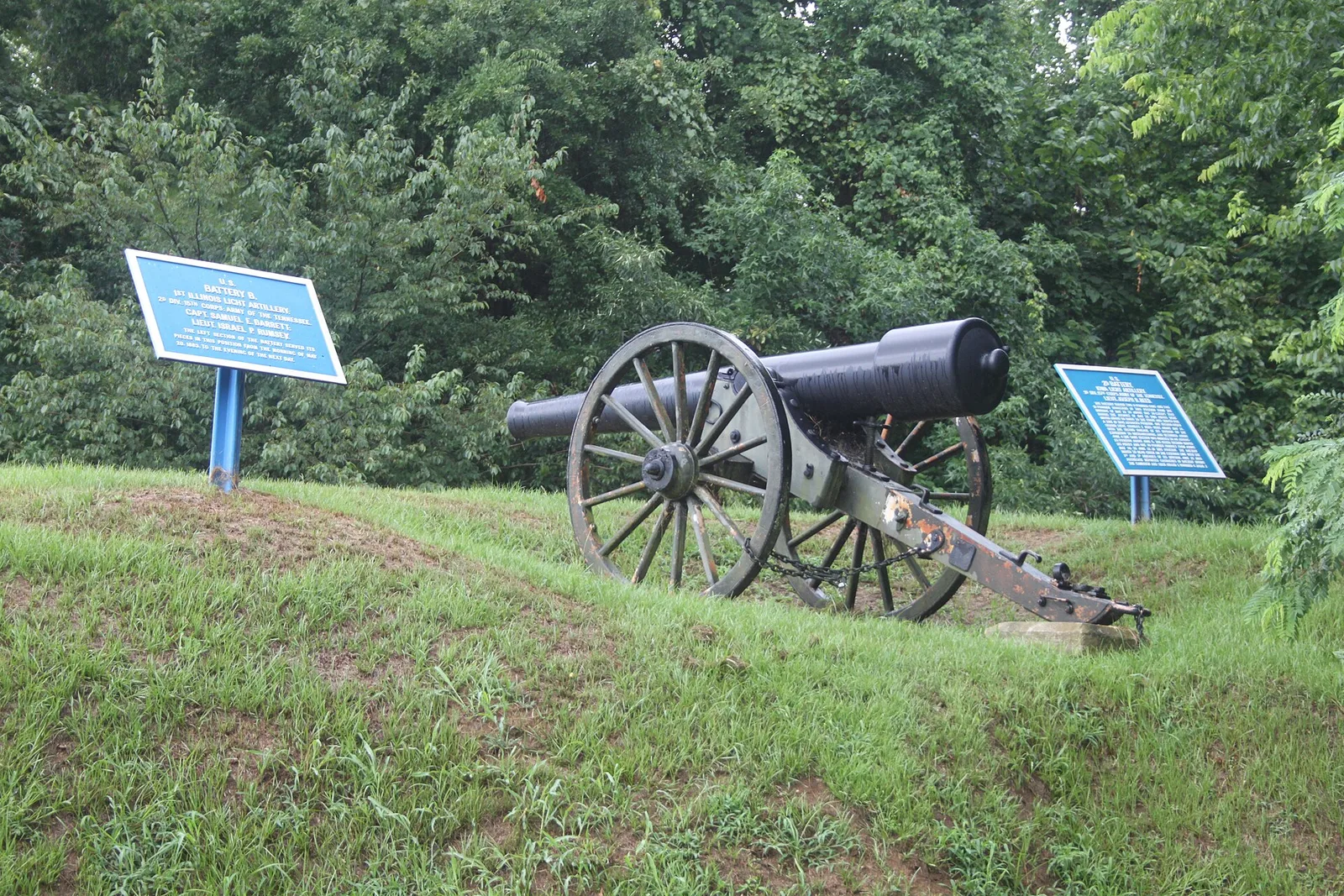
The Siege of Vicksburg, from May 18 to July 4, 1863, was one of the most decisive campaigns of the American Civil War. Union General Ulysses S. Grant executed a brilliant flanking maneuver, crossed the Mississippi River below Vicksburg, and surrounded the Confederate fortress city after winning five battles in 17 days. Grant's forces then besieged Vicksburg for 47 days, cutting off its water, food, and ammunition.
Confederate defenders and the city's civilian population survived in caves and ate mules and rats. The Confederate commander John C. Pemberton surrendered his force of 30,000 soldiers on July 4, the day after the Confederate defeat at Gettysburg.
Vicksburg's fall gave the Union complete control of the Mississippi River, splitting the Confederacy in two. Lincoln wrote: 'The Father of Waters again goes unvexed to the sea.' The fall of Vicksburg was arguably the strategic turning point of the war, and the city of Vicksburg did not celebrate the Fourth of July for 81 years.
Grant's campaign is still taught at military academies for its audacity: he cut loose from his supply line, marched down the Louisiana side of the river, ran gunboats and transports past the Vicksburg batteries at night, ferried his army across at Bruinsburg, and then lived off the country while beating Confederate forces at Port Gibson, Raymond, Jackson, Champion Hill, and the Big Black River before pinning Pemberton inside the city. Champion Hill on May 16 was the campaign's largest and bloodiest battle.
The 1,800-acre Vicksburg National Military Park, established in 1899, is one of the most heavily monumented battlefields in the world, with more than 1,300 markers and monuments placed by veterans of both sides, and it holds the raised, restored ironclad gunboat USS Cairo, sunk by a Confederate mine in the nearby Yazoo River in 1862 and recovered in the 1960s.
Mississippi's Reconstruction period (1865–1875) was the most democratic era in the state's history, formerly enslaved Black men voted, held office, and participated in public life for the first time. Mississippi sent two Black men to the U.S. Senate during Reconstruction: Hiram Revels and Blanche Bruce, the first Black senators in American history. This democratic experiment was violently overthrown.
White paramilitary groups, the Ku Klux Klan and the White League, used systematic terrorism, murder, and electoral fraud to suppress Black political participation. By 1890, Mississippi's new state constitution had effectively disenfranchised nearly all Black voters through poll taxes, literacy tests, and grandfather clauses.
The sharecropping system, which kept formerly enslaved farmers in perpetual debt to white landowners, replaced slavery as the mechanism of economic control. Mississippi's racial terror was so severe and its poverty so entrenched that millions of Black Mississippians fled to northern cities in the Great Migration of the 20th century.
The overthrow was violent and specific. At the Clinton and Vicksburg riots of 1875, white 'rifle clubs' killed dozens of Black Mississippians in the weeks before an election, and the resulting campaign of terror, known as the 'Mississippi Plan,' let Democrats seize the legislature; it became the model for restoring white rule across the South. The 1890 constitutional convention then wrote disenfranchisement into law so effectively that Black registration fell from the majority to near zero, and the framework stood until the 1965 Voting Rights Act.
Between roughly 1877 and 1950 Mississippi recorded more lynchings, at least 650 documented, than any other state, and the practice was public, advertised, and rarely prosecuted. This is the terror that drove the Great Migration: Mississippi's Black population share fell from about 58 percent in 1900 to 37 percent by 1970 as families left for Chicago, Detroit, and St. Louis, many along the Illinois Central Railroad line that ran straight up the Delta.
Out of the Mississippi Delta's cotton fields, levee camps, and juke joints in the early 20th century came the blues, the most influential American musical form ever created and the root of virtually all subsequent popular music. Charley Patton, Son House, Robert Johnson, Bukka White, and dozens of other Delta musicians developed a sound from the pentatonic scale, the call-and-response patterns of field hollers, and the West African musical traditions their ancestors had carried through the Middle Passage.
Charley Patton, based on Dockery Farms plantation near Cleveland, is often called the founder of the Delta style; W.C. Handy, a bandleader who heard a knife-slide guitarist at the Tutwiler train depot around 1903, published 'Memphis Blues' in 1912 and 'St. Louis Blues' in 1914 and became known as the 'Father of the Blues.' Robert Johnson, born in Hazlehurst in 1911, whose legend has him selling his soul at a crossroads for his guitar skill, recorded just 29 songs in two 1936 to 1937 sessions before dying at 27, and those recordings became a foundational text for the 1960s rock generation.
The blues left Mississippi with its people: when Muddy Waters, born McKinley Morganfield near Rolling Fork in 1913 and first recorded on Stovall plantation by folklorist Alan Lomax in 1941, moved to Chicago, he plugged the Delta sound into an amplifier and created the template for the electric blues band, and through it for rock and roll. Willie Dixon, Howlin' Wolf, and Elmore James followed the same road north.
B.B. King, born on a plantation near Itta Bena in 1925, worked as a Delta tractor driver before building a 65-year career that carried the music to global audiences and left the state a museum in his adopted hometown of Indianola. The Delta, one of the poorest regions in the United States, is by common assessment the most musically consequential piece of ground in America.
Mississippi was the most dangerous state in America for Black people and civil rights workers during the 1950s and 1960s, and the site of some of the most pivotal events in the movement's history. On August 28, 1955, 14-year-old Emmett Till, a Black boy from Chicago visiting relatives in Money, Mississippi, was abducted, tortured, and murdered by two white men who claimed he had whistled at a white woman. His mother insisted on an open casket: 'I want the world to see what they did to my boy.' The all-white jury acquitted the killers in 67 minutes.
The case galvanized a generation of civil rights activists, including a young Rosa Parks. In 1962, James Meredith's enrollment at the University of Mississippi, enforced by federal marshals against the violent resistance of Governor Ross Barnett and a white mob, integrated higher education in the state.
NAACP field secretary Medgar Evers was assassinated in his driveway in Jackson on June 12, 1963. Freedom Summer (1964) brought hundreds of college students to Mississippi to register Black voters; civil rights workers James Chaney, Andrew Goodman, and Michael Schwerner were murdered by Ku Klux Klan members with the complicity of local law enforcement, the 'Mississippi Burning' case that shocked the nation and accelerated the passage of the Civil Rights Act of 1964 and the Voting Rights Act of 1965.
The movement in Mississippi was led as much by local people as by national organizations. Fannie Lou Hamer, a Sunflower County sharecropper fired and beaten for trying to register, helped found the Mississippi Freedom Democratic Party, which challenged the seating of the all-white state delegation at the 1964 Democratic National Convention and put Mississippi's disenfranchisement on national television with Hamer's testimony: 'Is this America?'
Justice came late or not at all: Byron De La Beckwith was tried twice in 1964 with hung juries and finally convicted of murdering Evers in 1994; Sam Bowers was convicted in 1998 of ordering the 1966 firebombing that killed Vernon Dahmer; and Edgar Ray Killen was convicted of manslaughter in the Chaney-Goodman-Schwerner case in 2005, 41 years to the day after the murders. In 2004 Mississippi finally opened a civil-rights education requirement in its schools, and the state and federal governments opened a Mississippi Civil Rights Museum in Jackson in 2017.
On August 29, 2005, Hurricane Katrina made landfall near the Louisiana-Mississippi border with maximum sustained winds of 125 mph and a catastrophic storm surge that devastated the Mississippi Gulf Coast with even greater physical destruction than it brought to New Orleans. The storm surge along the Mississippi coast reached 27 to 34 feet in some areas, the highest storm surge ever recorded in U.S. history. Every structure within a quarter mile of the shoreline was destroyed. The cities of Waveland and Bay St. Louis were virtually wiped off the map. Biloxi, Gulfport, and Pascagoula suffered catastrophic damage.
Over 200 Mississippians died. The casinos, which were required by state law to be on floating barges, were smashed miles inland. Ingalls Shipbuilding in Pascagoula sustained significant damage. The Gulf Coast rebuilt over the following decade, but the recovery was uneven, and many communities never fully returned to their pre-Katrina state.
Because national coverage focused on the flooding of New Orleans, the sheer force of the storm on the Mississippi coast, a 90-mile front hit by hurricane-force winds and a surge that pushed water into the second stories of buildings, was slower to register; the Hancock County towns of Waveland and Bay St. Louis lost the large majority of their structures. Roughly 65,000 Mississippi homes were destroyed and about 238 people in the state were killed.
In its first special session after the storm, in October 2005, the Mississippi Legislature repealed the barge requirement and let coast casinos rebuild on land within 800 feet of the water, and the industry came back larger, with new hotel towers, even as several historic casino operators did not return. Federal aid, the Community Development Block Grant program alone sent Mississippi more than 5 billion dollars, rebuilt infrastructure but drew criticism for steering money toward the Port of Gulfport and higher-income areas ahead of low-income renters.
Katrina reshaped coast demographics and land use: some low-lying Black neighborhoods in Biloxi and Gulfport thinned out permanently, property insurance became far more expensive and hard to obtain, and 'wind versus water' disputes between homeowners and insurers over what caused the damage produced years of litigation and a federal fraud case against a large adjusting firm.
On June 28, 2020, in the aftermath of the national reckoning sparked by the murder of George Floyd, the Mississippi Legislature voted to retire the state flag, the last state flag in the nation that still incorporated the Confederate battle emblem. Mississippi had resisted flag change for decades: a 2001 state referendum had retained the old flag 65%–35%.
But the murder of George Floyd and the resulting national conversation about racial justice created political conditions that finally allowed the Legislature to act. The Commission to Redesign the Mississippi State Flag selected a new design featuring a white magnolia bloom, the state flower, centered on a deep blue field, with a red border, 20 white stars representing Mississippi's status as the 20th state, and a single gold star at the center of the magnolia representing Indigenous peoples.
The words 'In God We Trust' appear at the bottom. The new flag was formally adopted on January 11, 2021, ending 126 years of the Confederate battle emblem on the state flag.
The 1894 flag had itself been adopted by a legislature dominated by Confederate veterans during the same period that produced the disenfranchising 1890 constitution and the state's Confederate monuments. After the 2001 referendum kept it, universities, cities, and eventually the Southeastern Conference and NCAA applied pressure by refusing to host championship events in the state, and in June 2020 more than 60 Baptist, business, and sports leaders, including the coaches at Ole Miss and Mississippi State, publicly demanded change; the legislature suspended its own rules to pass the retirement bill within days, and Governor Tate Reeves signed it.
Voters ratified the new 'In God We Trust' magnolia flag by about 71 percent in a November 2020 referendum, and it flew for the first time over the Capitol in January 2021. Mississippi thus became the last state to remove the Confederate battle emblem from its flag, decades after Georgia (2001 to 2003) and South Carolina (which removed the banner from its capitol grounds in 2015).
Mississippi's Defining Moments in American History
These are the events that didn't just shape Mississippi, they changed the nation.
General Ulysses S. Grant's Vicksburg Campaign of 1862-1863 was one of the most strategically brilliant operations of the Civil War. After months of failed attempts to take the city, Grant marched his army south of Vicksburg, crossed the Mississippi River, and attacked from the south and east, winning five battles in 17 days before besieging the city.
When Vicksburg fell on July 4, 1863, the same day as Gettysburg, the Union controlled the entire Mississippi River. 'The Father of Waters,' Lincoln declared, 'again goes unvexed to the sea.' The Confederacy was split in two, never to recover.
Vicksburg mattered because it was the last major Confederate strongpoint on the river, perched on a hairpin bend with batteries that could sink any boat, so as long as it held, the Confederacy could still move troops, cattle, and supplies between its eastern and western halves and the Union could not use the Mississippi as a highway. Lincoln called it 'the key' and said 'the war can never be brought to a close until that key is in our pocket.'
Grant tried for months to reach the city through the bayous and even to dig a canal to bypass it, all failures, before the spring 1863 gamble that finally worked: crossing below the city and fighting inland. The 47-day siege that followed reduced soldiers and civilians alike to eating mules, horses, and rats while sheltering in hillside caves, and Pemberton surrendered about 29,000 men on July 4.
The twin news of Vicksburg and Gettysburg, arriving in Washington within a day of each other, is often taken as the war's turning point, after which Confederate victory became nearly impossible; Grant's success also brought him east to command all Union armies. Vicksburg pointedly did not mark the Fourth of July again until 1945.
The Mississippi Delta, the flat alluvial plain between the Yazoo and Mississippi rivers, is the birthplace of the blues. In the late 19th and early 20th centuries, the descendants of enslaved people working in cotton fields and levee camps created a music that expressed suffering, endurance, yearning, and joy with an emotional directness unlike anything that had come before. Robert Johnson, B.B. King, Muddy Waters, and Howlin' Wolf all came from the Delta, and the blues became the foundation of rock and roll, R&B, jazz, and much of American popular music.
The form fused African musical elements, blue notes, call-and-response, polyrhythm, that had survived slavery in field hollers and spirituals with the European guitar and the ballad, often played on homemade one-string 'diddley bows' before real instruments were available. W.C. Handy's published sheet music in the 1910s carried the sound out of the Delta, and 'race records' aimed at Black buyers in the 1920s made recording stars of Delta musicians like Charley Patton.
Dockery Farms, a cotton plantation near Cleveland, is often called the cradle of the Delta blues because Patton, Son House, Howlin' Wolf, and others lived or played there, and Clarksdale's 'crossroads' of Highways 61 and 49 is marketed as the spot where Robert Johnson supposedly made his deal with the devil. The music left with the Great Migration, and Chicago's postwar electric blues, Chess Records, Muddy Waters, Willie Dixon, was essentially Mississippi music with an amplifier.
British bands of the 1960s, the Rolling Stones took their name from a Muddy Waters song, Led Zeppelin, Eric Clapton, brought the Delta blues back to a mass American audience, and Mississippi has since built the Blues Trail, the Grammy Museum in Cleveland, and museums for B.B. King and others to turn that heritage into a modest economic engine for the region.
In August 1955, 14-year-old Emmett Till, a Black teenager from Chicago visiting relatives in the Mississippi Delta, was abducted, brutally beaten, and murdered after allegedly whistling at a white woman. Two white men were acquitted by an all-white jury after deliberating 67 minutes.
Till's mother, Mamie Till, insisted on an open casket so that 'the world could see what they did to my boy.' Jet magazine published the photographs. The story shocked the nation and is widely credited as a catalyst for the modern civil rights movement, directly motivating Rosa Parks and countless others.
Till, from Chicago and unfamiliar with Mississippi's racial rules, spoke to or whistled at Carolyn Bryant, a white store clerk in Money, and days later her husband Roy Bryant and his half-brother J.W. Milam took the boy from his great-uncle's home, beat him, shot him, weighted his body with a cotton-gin fan, and threw it in the Tallahatchie River. His great-uncle, Moses Wright, then stood in a Sumner courtroom and pointed out the two men, an act of extraordinary courage that did not prevent their acquittal.
Protected by double jeopardy, Bryant and Milam sold a confession to Look magazine in January 1956 for about 4,000 dollars, describing the killing in detail. Decades later, in a 2008 interview and a 2017 book, Carolyn Bryant reportedly acknowledged that the most inflammatory part of her account, that Till had grabbed her and made lewd remarks, was untrue; a fresh Justice Department review closed in 2021 without charges.
Rosa Parks later said she was thinking of Emmett Till when she refused to give up her bus seat in Montgomery three months after the acquittal. Congress passed the Emmett Till Antilynching Act in 2022, and in 2023 a national monument was created at three sites tied to the case in Illinois and Mississippi.
In the summer of 1964, hundreds of student volunteers, most of them white Northerners, joined Black Mississippians to register voters and operate Freedom Schools across the state. The project was called Freedom Summer.
Mississippi responded with violence: three civil rights workers, James Chaney, Andrew Goodman, and Michael Schwerner, were murdered by Klansmen aided by local law enforcement. The killings drew national and international attention to Mississippi's brutal suppression of Black voting rights and built the political pressure that led to the Voting Rights Act of 1965.
The project was run by the Council of Federated Organizations, a coalition led by the young activists of the Student Nonviolent Coordinating Committee, and it deliberately recruited white college students partly because organizers knew, bitterly, that violence against them would draw the national coverage that violence against Black Mississippians did not. Over the summer, roughly 1,000 volunteers faced more than 1,000 arrests, 80 beatings, 37 church burnings, and 30 bombings.
Chaney, a Black Mississippian, and Goodman and Schwerner, white New Yorkers, disappeared near Philadelphia, Mississippi, on June 21, 1964, after being released from the Neshoba County jail into the hands of a Klan mob organized with a deputy sheriff; the FBI found their bodies in an earthen dam 44 days later. Seven men were convicted on federal civil-rights charges in 1967, the first such convictions in Mississippi, and the local organizer Edgar Ray Killen was convicted of state manslaughter charges in 2005.
Freedom Summer's other legacy was the Mississippi Freedom Democratic Party and the roughly 40 Freedom Schools that taught thousands of Black children, and the national revulsion at the summer's violence was a direct spur to the Voting Rights Act that Lyndon Johnson signed in August 1965.
The Civil Rights Act of 1964 and the Voting Rights Act of 1965 were national laws, but Mississippi's resistance to racial equality did more than perhaps any other state to make them necessary and possible. The violence inflicted on civil rights workers in Mississippi, broadcast on national television, shocked white Americans who had been comfortable with an abstract knowledge of Southern racism into demanding federal action.
In a grim irony, Mississippi's brutality created the political will for the most transformative civil rights legislation since Reconstruction.
The change in Mississippi itself was dramatic and measurable: Black voter registration in the state rose from about 7 percent in 1964 to nearly 60 percent within three years of the Voting Rights Act, and Mississippi went from having no Black elected officials to leading the nation in their number by the 1980s. Robert Clark became the first Black member of the state legislature since Reconstruction in 1967.
Federal courts also used Mississippi to build civil-rights doctrine: Alexander v. Holmes County (1969) ordered the state's schools to desegregate 'at once,' ending 15 years of 'all deliberate speed' delay, and United States v. Mississippi and later voting cases struck down the 1890 constitution's devices one by one. The state's white political establishment largely shifted to the Republican Party over the following decades.
The reckoning is unfinished. Mississippi has one of the highest Black population shares of any state, roughly 38 percent, yet racially polarized voting means it has not elected a Black candidate to statewide office since Reconstruction, and battles over redistricting, voter ID, and a felony-disenfranchisement clause written into the 1890 constitution continue in federal court into the 2020s.
Notable Mississippians
Elvis Presley
Born in Tupelo, 1935; 'The King of Rock and Roll'; transformed American popular music in the 1950s; one of the best-selling music artists in history
Oprah Winfrey
Born in Kosciusko, 1954; media mogul, actress, and philanthropist; The Oprah Winfrey Show ran for 25 years; the first Black female billionaire in American history
B.B. King
Born Riley B. King in Itta Bena, 1925; 'The King of the Blues'; 65-year career that brought Delta blues to global audiences; 15 Grammy Awards
William Faulkner
Born in New Albany, 1897; Nobel Prize in Literature (1949); author of The Sound and the Fury, As I Lay Dying, and Absalom, Absalom!; one of the greatest American novelists
Jim Henson
Born in Greenville, 1936; creator of the Muppets; Kermit the Frog, Miss Piggy, Big Bird, and dozens of beloved characters shaped childhoods around the world for generations
James Earl Jones
Born in Arkabutla, 1931; legendary stage and screen actor; voice of Darth Vader in the Star Wars franchise and Mufasa in The Lion King; Presidential Medal of Freedom recipient
Muddy Waters
Born McKinley Morganfield in Issaquena County, 1913; electrified the Mississippi Delta blues in Chicago; directly inspired the Rolling Stones, Eric Clapton, and virtually every subsequent rock musician
Richard Wright
Born near Natchez, 1908; author of Native Son (1940) and Black Boy (1945); one of the first Black writers to reach a large white American audience with searing accounts of racism and its psychological toll
Walter Payton
Born in Columbia, 1954; NFL Hall of Famer; 'Sweetness'; nine-time Pro Bowl running back for the Chicago Bears; held the NFL all-time rushing record for 18 years
Jerry Rice
Born in Crawford, 1962; NFL Hall of Famer; widely regarded as the greatest wide receiver in NFL history; three-time Super Bowl champion with the San Francisco 49ers; 13 Pro Bowl selections
State Symbols & Quick Facts
| Nickname | "Magnolia State" |
| Capital | Jackson |
| Largest City | Jackson |
| Statehood | December 10, 1817 (20th state) |
| Population | ~2.94 million (2025 est.) |
| Area | 48,432 sq miles (32nd largest) |
| State Bird | Northern Mockingbird |
| State Flower | Magnolia |
| State Tree | Magnolia |
| State Fish | Largemouth Bass |
| State Insect | Honeybee |
| State Song | Go, Mississippi |
| State Motto | Virtute et Armis ("By Valor and Arms") |
| Time Zone | Central |
| Bordering States | Tennessee, Alabama, Arkansas, Louisiana |
| Coastline | Gulf of Mexico (44 miles) |
Did You Know?
The Mississippi Delta, not to be confused with the river's actual delta, is a flat alluvial plain between the Yazoo and Mississippi rivers that gave birth to the blues, the root of virtually all modern American popular music: rock, R&B, soul, jazz, and hip-hop.
Mississippi was the last state to formally ratify the 13th Amendment abolishing slavery, passing a ratification vote in 1995 but failing to submit it to the federal government until 2013 due to a clerical oversight, making it official 148 years after the amendment was ratified.
Elvis Presley was born in a two-room shotgun house in Tupelo on January 8, 1935. His birthplace is now a museum, and Tupelo Hardware Company, where his mother bought him his first guitar, is still in business and still sells guitars.
Mississippi is consistently ranked as the poorest state in the nation by median household income, yet it has produced an extraordinary per-capita share of American cultural giants: Elvis Presley, Oprah Winfrey, B.B. King, William Faulkner, Jim Henson, Muddy Waters, James Earl Jones, and Walter Payton all came from Mississippi.
Ingalls Shipbuilding in Pascagoula is the largest manufacturing employer in Mississippi, with roughly 11,000 workers building U.S. Navy destroyers and amphibious assault ships, some of the most technologically sophisticated vessels ever constructed.
The city of Vicksburg did not celebrate the Fourth of July for 81 years after its surrender to Ulysses S. Grant on July 4, 1863, the Confederate defeat that split the Confederacy in two. The city finally resumed Independence Day celebrations in 1944.
Mississippi was the last state in the nation to have a state flag incorporating the Confederate battle emblem. The old flag, which featured the Confederate battle cross, was retired in June 2020 and replaced with a new flag featuring the state flower, the magnolia.
The NASA Stennis Space Center on the Gulf Coast is the primary rocket engine testing facility in the United States, the Saturn V engines that powered the Apollo missions to the Moon were tested here, as are the engines for current NASA programs.
Mississippi produces more farm-raised catfish than any other state in the nation, the flat, warm ponds of the Delta are ideal for catfish aquaculture, and Mississippi catfish reaches tables across the country.
Freedom Summer (1964), when hundreds of civil rights volunteers came to Mississippi to register Black voters, and the subsequent murders of James Chaney, Andrew Goodman, and Michael Schwerner by Klan members directly accelerated the passage of the Civil Rights Act of 1964 and the Voting Rights Act of 1965.
Quick Facts and Common Questions
Short answers to the questions people most often ask about Mississippi: its abbreviation, how it became a state, its capital, and its place in Congress.
Mississippi's two-letter postal abbreviation is MS. The U.S. Census Bureau places it in the South region, in the East South Central division, and about 2.96 million people lived there in the 2020 census.
Mississippi became the 20th state on December 10, 1817. Congress had created the Mississippi Territory in 1798, and when Mississippi became a state, the eastern part of the territory was organized separately as the Alabama Territory.
The state is named for the Mississippi River. The name comes from an Ojibwe word usually written "misi-ziibi," meaning "great river."
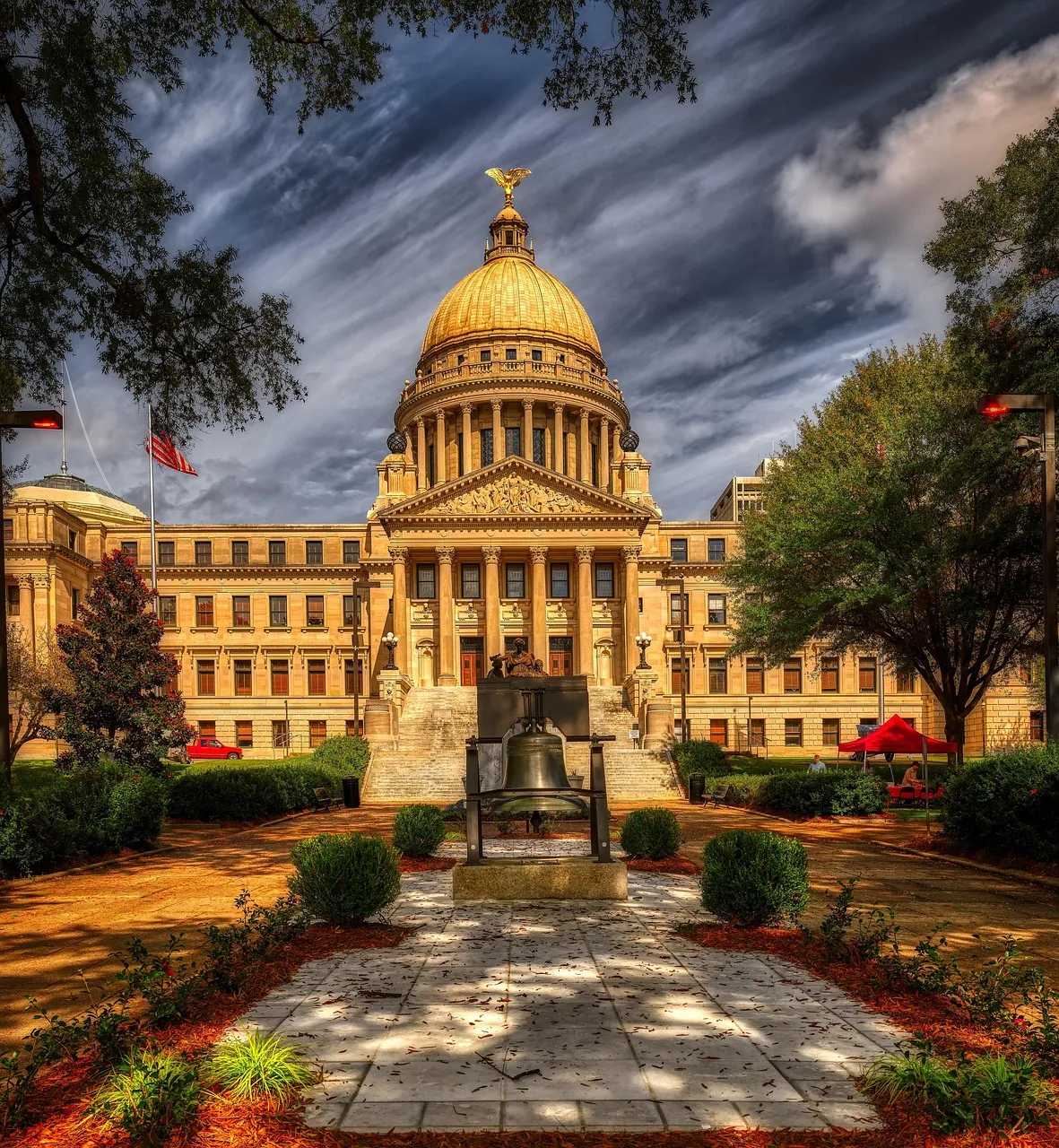
Jackson, named for Andrew Jackson, has been the capital since 1822, when it was chosen for its central location. Earlier seats of government included the town of Washington, near Natchez, and Natchez itself. The Old Capitol was completed in 1839, and the current State Capitol opened in 1903.
Mississippi borders Tennessee to the north, Alabama to the east, and Louisiana and Arkansas to the west, where the Mississippi River forms most of the boundary. To the south it has about 44 miles of coastline on the Gulf of Mexico.
Mississippi is known as "The Magnolia State." Its motto is "Virtute et armis," Latin for "By valor and arms." Its state bird is the northern mockingbird, and the magnolia is both its state flower and its state tree.
In June 2020 the legislature retired the flag adopted in 1894, which included the Confederate battle emblem, and a commission designed a replacement. Voters approved the new flag, with a magnolia blossom in the center, in November 2020, and it became official in January 2021. Learn more about U.S. flag history.
Based on the 2020 census, Mississippi has 4 seats in the U.S. House of Representatives, the same as before, which gives it 6 votes in the Electoral College.
Natchez Trace Parkway
444 Miles of Ancient Trail From Nashville to Natchez, Tracing 10,000 Years of American History
About Natchez Trace Parkway
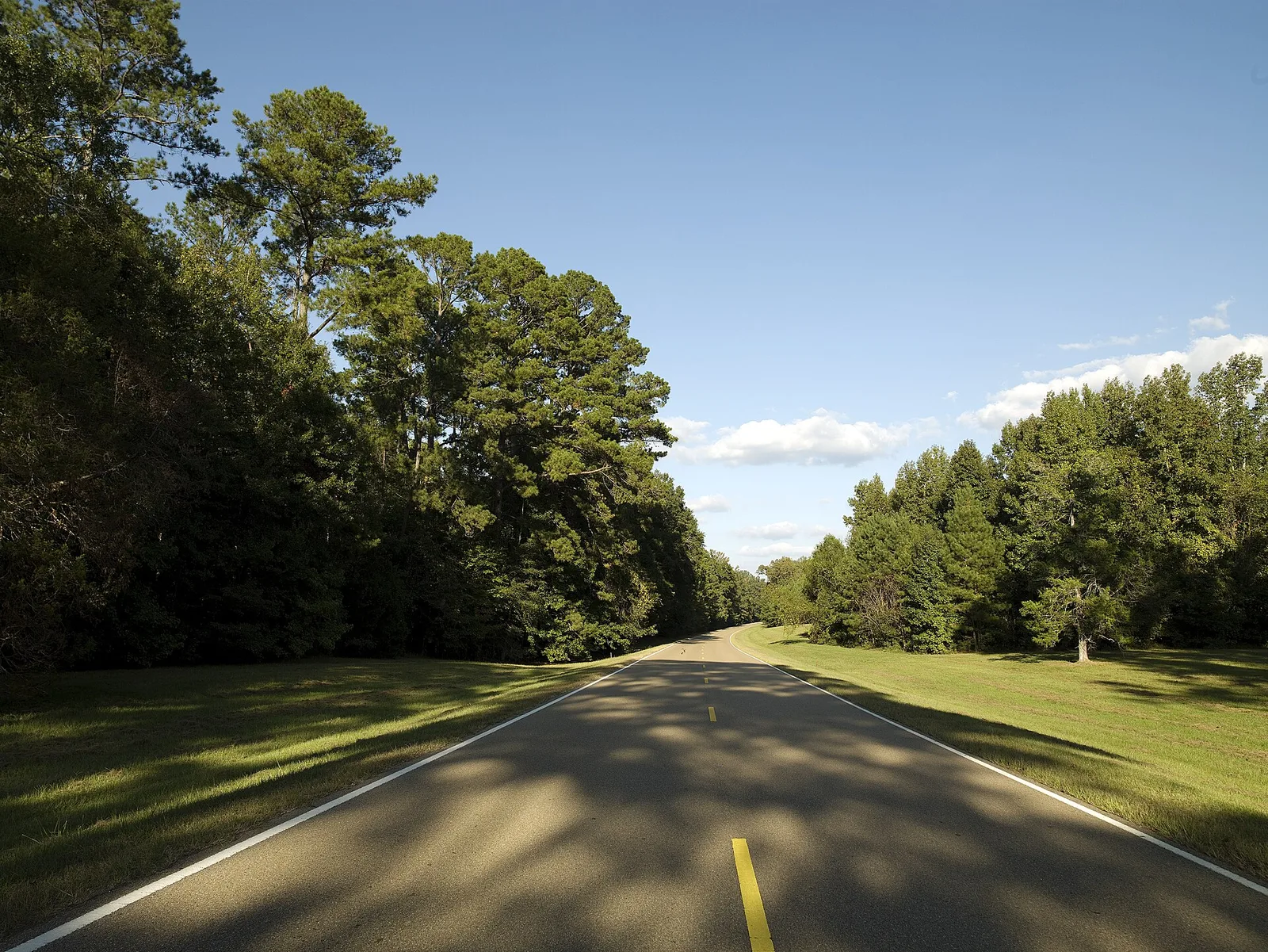
The Natchez Trace Parkway is a 444-mile road from Natchez, Mississippi, to Nashville, Tennessee, that follows the line of one of North America's oldest travel routes, a path first worn by bison and then used by the Natchez, Choctaw, and Chickasaw for thousands of years.
Congress authorized the parkway in 1938, and the Civilian Conservation Corps and later crews built it in pieces over almost 70 years; the last section, near Jackson, opened in 2005.
It has no commercial trucks, a 50-mile-an-hour limit, no billboards or roadside businesses, and a continuous strip of protected land, which makes it one of the most heavily used units in the National Park System, drawing several million visitors a year.
Along it the Park Service protects hundreds of sites: prehistoric mounds, eroded stretches of the original 'sunken' trail, frontier inns, a ghost town, Civil War earthworks, and the grave of Meriwether Lewis.
- Designation
- National Parkway
- Location
- Nashville, Tennessee to Natchez, Mississippi
- Established
- May 18, 1938
- Annual Visitors
- ~6 million
Along the Trace
In several places the original path survives as a 'sunken trace,' a trench worn 10 to 30 feet below the surrounding ground by thousands of years of feet, hooves, and wagon wheels.
It cut so deep because the bluffs here are capped with loess, a fine windblown silt that packs hard but gullies fast once the plant cover is broken.
Short trails at places like milepost 41.5 let visitors walk in the shaded cut, which in wet weather still floods and turns to the sticky mud the boatmen complained of.
The trail linked the Native towns of the region long before Europeans, and after an 1801 treaty the U.S. Army widened it into a rough wagon road and post route.
Near milepost 122 the parkway crosses a cypress-tupelo swamp in an old oxbow of the Pearl River, with a boardwalk loop through it.
Bald cypress and water tupelo grow straight out of the black, still water on flared trunks; some of the trees are well over a century old, though the true giants were logged long ago.
The swamp is full of life that is easy to see from the boardwalk: wood ducks, prothonotary warblers, cottonmouths, and, in spring, a chorus of frogs.
This lowland forest, and the bottomland hardwoods of oak, sweetgum, and hickory along the southern parkway, once covered much of the region and now survive mostly in protected corridors like this one.
The Trace ran straight through the heart of Chickasaw country in northern Mississippi and Choctaw country to the south, and the road itself grew out of their older network of paths.
After the 1801 Treaty of Chickasaw Bluffs and a companion Choctaw treaty, both nations allowed the road to be widened, and Native families or people married into the tribes ran most of the 'stands,' the inns and ferries along the route.
Mount Locust, near Natchez, built about 1780, is the only stand still standing; the Park Service keeps it as a historic house.
Both nations were forced west in the 1830s, the Choctaw by the 1830 Treaty of Dancing Rabbit Creek and the Chickasaw by the 1832 Treaty of Pontotoc Creek, on the removals that became the Trail of Tears.
Emerald Mound, at milepost 10, is a Mississippian platform mound covering about eight acres, the second-largest pre-Columbian earthwork in the country after Monks Mound; ancestors of the Natchez built it between roughly 1250 and 1600.
Meriwether Lewis, three years back from the Pacific and governor of Louisiana Territory, died of gunshot wounds at Grinder's Stand on the Trace on the night of October 11, 1809; most historians rule it suicide, and a broken stone column marks his grave near milepost 386.
Rocky Springs, at milepost 54, is a ghost town: a community that yellow fever, the boll weevil, and eroded farmland emptied out, leaving an 1837 church and a cemetery beside a stretch of the old sunken road.
During the Vicksburg campaign of 1863, Union and Confederate forces fought at Raymond and along the Trace corridor, and earthworks from that fighting survive at several stops.
Indigenous Connections
Choctaw Nation
The Choctaw have lived in central and southern Mississippi for thousands of years, farming corn, building towns around earthen mounds, and playing the stickball game the French called 'raquettes,' an ancestor of lacrosse.
The Trace passed through their territory, and Choctaw people maintained stretches of it, ran ferries and stands, and traded with the boatmen walking home.
The 1830 Treaty of Dancing Rabbit Creek forced most Choctaw west to Indian Territory; the few thousand who stayed and refused to leave became the community now recognized as the Mississippi Band of Choctaw Indians.
The Mississippi Band of Choctaw Indians is a federally recognized nation headquartered in Choctaw, Mississippi. The band operates a casino resort and maintains a vibrant cultural community, including annual tribal fairs and language preservation programs. They are the only federally recognized tribe with a reservation in Mississippi.
Natchez Nation
The Natchez built the largest ceremonial center in the lower Mississippi valley on the bluffs at the southern end of the Trace, ruled by a hereditary leader the French called the Great Sun, with a rigid class system unusual in the region.
In 1729 the Natchez attacked the French at Fort Rosalie, killing more than 200 settlers, after the French demanded a village site for a plantation.
The French and their Choctaw allies destroyed the Natchez in retaliation in 1730 and 1731, killing many, shipping hundreds into slavery in the Caribbean, and scattering the rest among the Chickasaw, Creek, and Cherokee.
The Natchez were largely destroyed or dispersed by French colonial wars in the 1720s and 1730s. Descendants were absorbed into Chickasaw, Cherokee, and Creek communities. The Natchez Nation, a non-federally-recognized organization, works to preserve Natchez cultural heritage and seeks federal recognition.
Experiencing the Natchez Trace
Cycling the Trace
The parkway is one of the best-known long-distance cycling routes in the country: no trucks, a 50-mile-an-hour limit, gentle grades, and a nearly unbroken tree canopy.
Through-riders usually take five to ten days for the full 444 miles, camping at the three free NPS bike-friendly campgrounds and in trace-side towns.
The southern Mississippi third, from Natchez to Jackson, is the most popular for day and weekend rides, with the mounds, Mount Locust, and Rocky Springs strung along it.
There are no gas stations or stores on the parkway itself, so riders plan water and food around the towns the road passes near but not through.
Cypress Swamp Walk
The Cypress Swamp Trail near milepost 122 is a flat, roughly 20-minute boardwalk loop over the water and through the trees.
It is one of the few places on the parkway to walk straight into a southern swamp without a boat, and it is fully accessible.
Early morning is best for birds and for the mirror-still reflections the swamp is known for; midday in summer brings heat, mosquitoes, and the chance of a basking cottonmouth beside the rail.
The nearby River Bend picnic area and the Pearl River overlook round out a short stop.
Sunken Trace and History Stops
Marked pullouts every few miles lead to short walks: a length of sunken trace, an old stand site, a mound, a pioneer cemetery, a waterfall.
The best-known sunken-trace walk is near milepost 41.5, where the path runs about 15 feet deep between mossy loess banks for a few hundred yards.
Rocky Springs, milepost 54, pairs a stretch of the old road with the standing 1837 church and the overgrown town site.
The Park Service's mileposts count up from Natchez, and its official map keys every stop, so the parkway works as a self-guided history drive as much as a scenic one.
Conservation Challenges
Invasive Plant Species
Kudzu, Chinese privet, Japanese honeysuckle, cogongrass, and Bradford pear all press in on the parkway's forest edges along its 444 miles.
Kudzu, planted across the South for erosion control from the 1930s, is the most visible, blanketing whole hillsides where the corridor meets old farmland.
Cogongrass, a fire-carrying grass from Asia, is the fastest-spreading new threat and can turn open pine woods into a monoculture.
Park crews spray and cut year-round, but the length of the corridor and the pressure from surrounding private land mean the work is containment, not eradication.
Road Safety and Wildlife Crossings
White-tailed deer are abundant along the whole route, and deer-vehicle collisions are the parkway's most common serious crash, worst at dawn and dusk in the wooded Mississippi sections.
Wild turkey, armadillo, coyote, and the occasional black bear also cross, and the 50-mile-an-hour limit is set partly to give drivers time to react.
The Park Service has studied fencing and wildlife underpasses for the worst stretches but has built few, given the cost of treating hundreds of miles.
Cyclists share the road with that traffic, and the parkway runs safety campaigns aimed at both drivers and riders.
Historic Site Preservation
The parkway's mounds, sunken-trace segments, cemeteries, and Civil War earthworks all erode, and tree roots and burrowing animals slowly deform the earthworks.
The loess soil that let the trace sink so deep also makes every bare slope a gully waiting to start, so the Park Service works to keep vegetation on the historic cuts without letting invasive trees take hold.
Looting is a continuing problem at the mound sites, and metal-detecting and digging anywhere on the parkway are federal crimes.
Archaeologists survey the sites on a rotation and stabilize the ones most at risk, but the sheer number of them across three states outruns the budget.
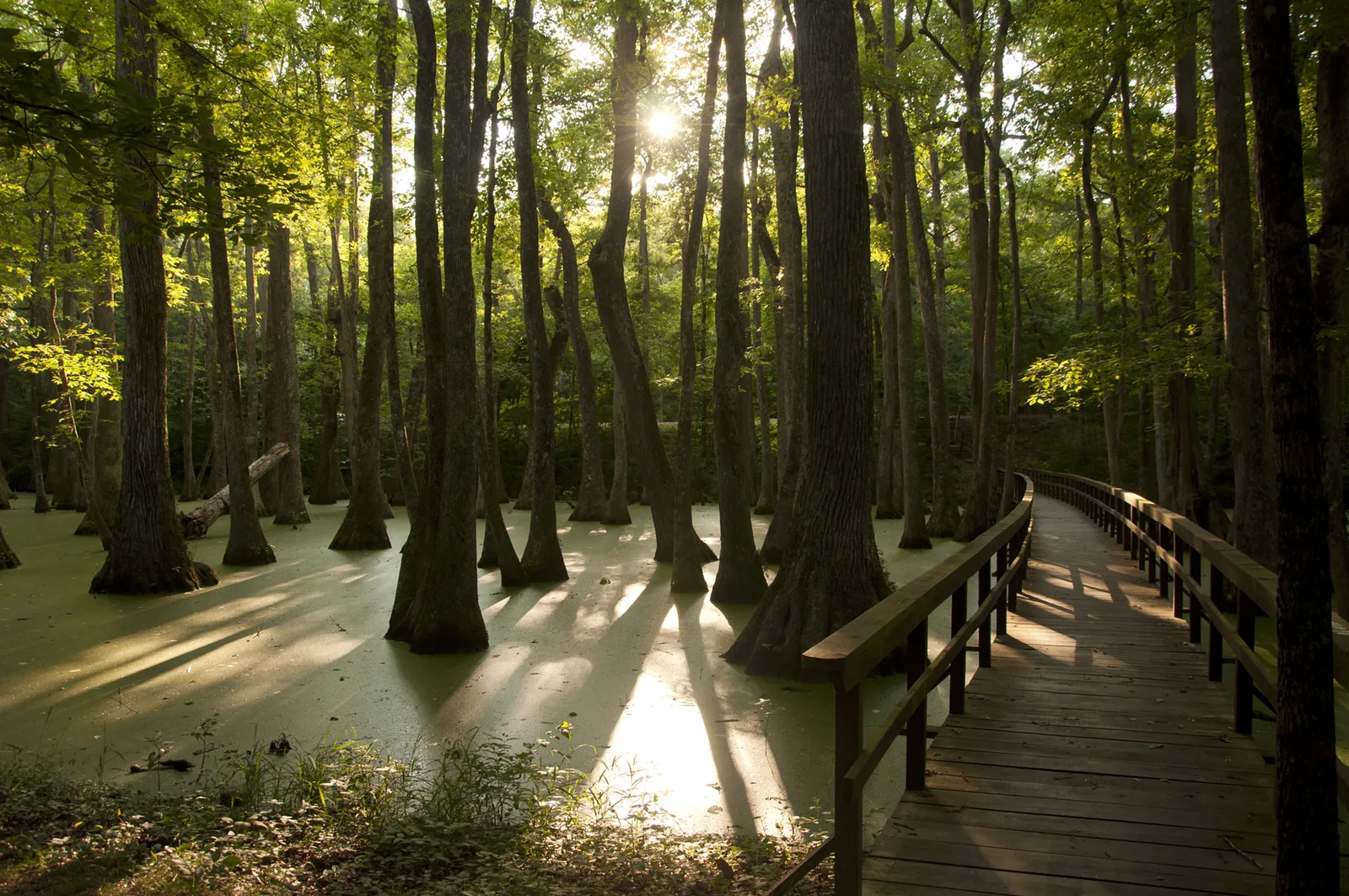
The Cypress Swamp boardwalk, an ancient landscape accessible from the Trace near milepost 122
At a Glance
Did You Know?
From about 1800 to 1820, thousands of flatboatmen who floated goods to New Orleans sold their boats for lumber and walked the 500-mile Trace back home, making it one of the busiest roads in the American frontier era.
Meriwether Lewis, of Lewis and Clark fame, died mysteriously at Grinder's Stand along the Natchez Trace in 1809, just three years after completing the Corps of Discovery expedition. His grave, located near milepost 386, is a National Park Service site.
Emerald Mound, near milepost 10, is the second-largest pre-Columbian earthwork in North America, covering nearly 8 acres. It was built by ancestors of the Natchez people between 1250 and 1600 CE as a ceremonial platform.
Plan Your Visit
Location
Nashville, Tennessee to Natchez, Mississippi
Designation
National Parkway
Best Time to Visit
Spring and fall for mild temperatures; spring wildflowers are exceptional along the Mississippi section
Admission
Free; no entrance fees on the parkway