
What The Justice Department Does
Established 1870, The U.S. Department of Justice is one of the fifteen Cabinet-level departments of the U.S. federal government.
The Justice Department is the federal government's law enforcement and legal arm. It prosecutes federal crimes through the ninety-plus U.S. Attorneys' offices around the country, represents the United States in civil litigation, and enforces federal civil rights, antitrust, and environmental laws.
The Attorney General, the nation's chief law enforcement officer, oversees a sprawling set of law enforcement agencies including the FBI, the Drug Enforcement Administration, the Bureau of Alcohol, Tobacco, Firearms and Explosives, and the U.S. Marshals Service, along with the federal Bureau of Prisons, which houses more than 150,000 inmates.
The department also supervises the federal immigration court system through its Executive Office for Immigration Review, an arrangement that places immigration judges inside the executive branch rather than the independent judiciary, a structural quirk that frequently surprises people learning about it for the first time.
It is both a prosecutor and a defender: its litigating divisions (Criminal, Civil, Civil Rights, Antitrust, Tax, Environment and Natural Resources, and National Security) bring cases, while the Solicitor General decides which cases the government appeals and argues nearly all of the government's cases at the Supreme Court. The Office of Legal Counsel issues written opinions that bind the executive branch on what the law allows a president or agency to do.

The Attorney General
The Attorney General leads The Justice Department, sits on the President's Cabinet, and is confirmed by a majority vote of the U.S. Senate.
Current Attorney General
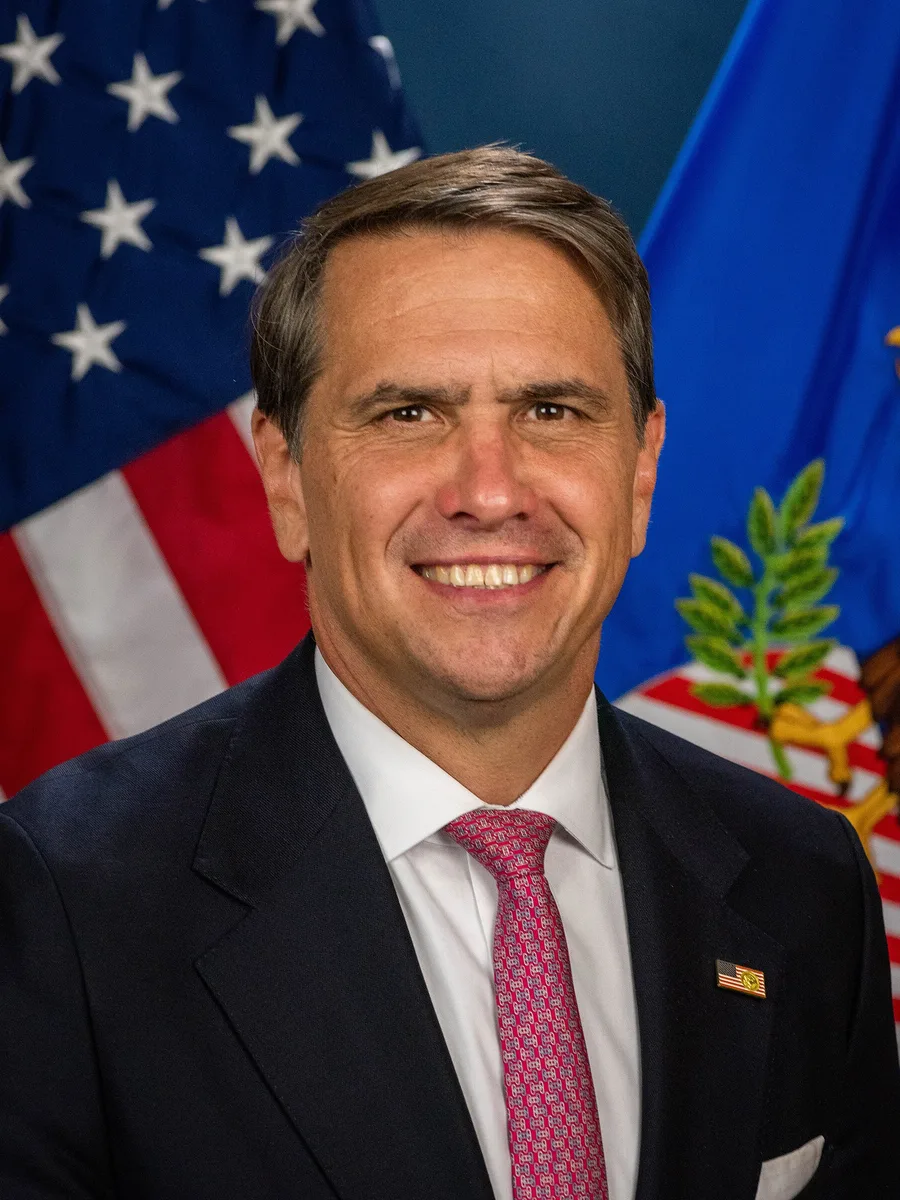
Todd Blanche
In office since
August 8, 2026 (acting from April 2, 2026)
Prior role: Deputy Attorney General; earlier, personal defense attorney to President Trump and former federal prosecutor, U.S. Attorney's Office for the Southern District of New York
Todd Blanche has served as Attorney General since the Senate confirmed him 50-49 on August 8, 2026; he had been Acting Attorney General since April 2, 2026, following the departure of Pam Bondi. He previously served as Deputy Attorney General, the department's second-ranking official, after being confirmed to that post in early 2025.
Before entering government, Blanche spent years as a federal prosecutor in the U.S. Attorney's Office for the Southern District of New York before moving into private practice, where he represented Donald Trump as personal defense counsel in several high-profile criminal cases prior to the 2024 election.
Major Sub-Agencies & Bureaus
The Justice Department carries out its mission through operating divisions and sub-agencies, each with its own specific mandate.
The FBI is the Justice Department's principal investigative agency, with jurisdiction over federal crimes ranging from terrorism and espionage to public corruption, cybercrime, and organized crime. It also serves as the lead domestic counterintelligence and counterterrorism agency in the country.
Created in 1908 and shaped for nearly five decades by its famously long-serving first director, J. Edgar Hoover, the FBI operates 56 field offices across the United States along with dozens of legal attache offices in U.S. embassies abroad, coordinating investigations that cross both state and international borders.
It has roughly 38,000 employees and about 13,000 sworn special agents. It is both a law enforcement and an intelligence agency, a dual role expanded after the September 11 attacks, when the bureau shifted resources toward preventing terrorism and a 2004 commission criticized its earlier failure to "connect the dots."
Since a 1976 law passed after the Church Committee exposed decades of political surveillance, the director serves a single 10-year term to insulate the office from politics. Two directors have been fired by presidents mid-term: William Sessions in 1993 and James Comey in 2017.
The DEA is the lead federal agency for enforcing controlled substances laws, targeting drug trafficking organizations that manufacture and distribute illegal narcotics, including the fentanyl trafficking networks that have driven record overdose deaths in the United States over the past decade.
Created in 1973 by merging several earlier drug enforcement agencies, the DEA also regulates the legal manufacture and distribution of prescription controlled substances, working with the FDA to prevent diversion of legitimate pharmaceuticals into illegal markets.
The DEA classifies drugs into five "schedules" under the Controlled Substances Act of 1970; marijuana was long Schedule I, the most restrictive tier, even as most states legalized it. A final order effective April 2026 moved FDA-approved marijuana products and state-licensed medical marijuana to Schedule III; other marijuana remains Schedule I while a DEA hearing on broader rescheduling, begun in June 2026, is decided.
U.S. overdose deaths rose above 100,000 a year in the early 2020s, driven largely by illicitly made fentanyl, before beginning to decline. The DEA has roughly 10,000 employees and 200-plus domestic offices plus posts in dozens of countries.
The Bureau of Prisons operates the federal prison system, housing more than 150,000 inmates convicted of federal crimes across more than 120 facilities ranging from minimum-security camps to the supermax facility in Florence, Colorado, which holds some of the country's highest-security inmates.
The bureau has faced sustained scrutiny in recent years over staffing shortages, aging infrastructure, and high-profile security failures, including the 2019 death of Jeffrey Epstein in a federal detention facility, which prompted congressional hearings and internal reforms to suicide-prevention protocols.
Founded in 1930, the bureau is the largest single unit in the department by headcount, with about 35,000 employees. Roughly 45 percent of federal inmates are serving time for drug offenses, a far higher share than in state prisons.
The First Step Act of 2018, a bipartisan law, expanded early-release credits for completing rehabilitation programs, eased some mandatory minimum sentences, and required inmates to be housed closer to home; its implementation has been repeatedly criticized by the department's own inspector general as slow and uneven.
The oldest federal law enforcement agency, created by the Judiciary Act of 1789, the U.S. Marshals Service protects federal courts and judges, apprehends federal fugitives, manages the Witness Security Program (widely known as witness protection), and transports federal prisoners.
Marshals also manage and sell assets seized from criminal enterprises through federal asset forfeiture, and the agency's fugitive task forces work closely with state and local police to track down violent offenders wanted on federal warrants.
Historically, marshals conducted the census through 1870, enforced fugitive-slave laws before the Civil War, and escorted James Meredith and Black students integrating Southern schools in the 1960s. The Witness Security Program has protected more than 19,000 witnesses and family members since 1971, and the service says no participant who followed the rules has been harmed.
The agency has about 5,000 deputy marshals and career employees and also oversees roughly 90 presidentially appointed U.S. Marshals, one for each federal judicial district.
From 1870 to Today
The predecessor of The Justice Department was the Office of the Attorney General, a Cabinet-level advisory post since 1789 without a department behind it. Here is how the department reached its current form.
The Judiciary Act of 1789 created the office of Attorney General as a part-time Cabinet legal adviser to the president, without any department or staff to support the role. Early Attorneys General often maintained private law practices alongside their government duties.
For its first eighty years, the Attorney General had no dedicated department, relying instead on outside private attorneys hired case by case to represent the federal government in court, an arrangement Congress eventually found unworkable as federal litigation grew.
Edmund Randolph, the first Attorney General, held the job alongside a private practice and complained that the salary was too low to live on. Legal work for the individual departments was handled by their own "solicitors," a fragmented system with no central control.
Congress created the Department of Justice in 1870, primarily to consolidate the growing legal work of the federal government, especially the surge of civil rights litigation stemming from Reconstruction after the Civil War, under a single unified department led by the Attorney General.
The new department also created the Office of the Solicitor General, established by the same June 22, 1870 law, which remains responsible for representing the federal government before the U.S. Supreme Court to this day.
One of the department's first major tasks was prosecuting the Ku Klux Klan under the Enforcement Acts; it brought thousands of cases in 1871-72 that broke the first Klan, before Reconstruction-era enforcement collapsed later in the decade.
Attorney General Charles Bonaparte created a small force of federal investigators within the department in 1908, over the objections of some in Congress who feared a national police force. This Bureau of Investigation was renamed the Federal Bureau of Investigation in 1935.
J. Edgar Hoover became director in 1924 and led the bureau for 48 years until his death in 1972, transforming it from a minor investigative unit into the dominant federal law enforcement agency, while also amassing controversial surveillance files on political figures and civil rights leaders.
The 1975-76 Church Committee documented Hoover-era abuses, including the COINTELPRO program that surveilled and tried to discredit Martin Luther King Jr. and other activists. Its findings led directly to the 10-year cap on the director's term and to the creation of congressional intelligence oversight committees.
The Civil Rights Act of 1964 and Voting Rights Act of 1965 dramatically expanded the department's Civil Rights Division, giving federal prosecutors new authority to challenge segregation, employment discrimination, and voter suppression across the country, especially in the South.
The department's civil rights lawyers played a central role in desegregating public schools and universities in the years that followed, often working alongside federal marshals to enforce court orders in the face of active local resistance.
The Civil Rights Division had been created in 1957, and after 1965 its lawyers, backed by Voting Rights Act "preclearance," blocked hundreds of discriminatory election-law changes in covered states until the Supreme Court's 2013 Shelby County decision suspended that mechanism.
The Watergate scandal, which included the 1973 'Saturday Night Massacre' firing of a Justice Department special prosecutor investigating President Nixon, led to lasting reforms intended to insulate the department's law enforcement decisions from direct White House political interference.
Congress and subsequent administrations adopted informal norms limiting direct White House contact with department officials on specific criminal investigations, norms that remain a recurring subject of political debate whenever a president is perceived to be pressuring the department on a particular case.
The 1978 Ethics in Government Act created a court-appointed "independent counsel" outside the Attorney General's control; that statute was allowed to lapse in 1999 after both parties concluded such prosecutors had grown unaccountable, and the department replaced it with an internal special-counsel regulation. Successive administrations of both parties have issued written memos restricting who at the White House and the department may talk to whom about pending cases.
Defining Moments
Events that reshaped the department's authority, structure, or public role.
When Special Prosecutor Archibald Cox refused to drop his subpoena for Nixon's White House tapes, Nixon ordered Attorney General Elliot Richardson to fire him. Richardson resigned rather than comply, as did his deputy, before Solicitor General Robert Bork ultimately carried out the firing, in an episode remembered as the Saturday Night Massacre.
The crisis intensified public and congressional pressure that eventually led to Nixon's resignation in 1974, and it remains the historical reference point whenever a president is accused of interfering with an ongoing Justice Department investigation into their own conduct.
The public backlash was immediate: Western Union reported the White House received hundreds of thousands of telegrams in the following days, most opposed. A federal court later ruled the firing illegal, and Nixon was forced to appoint a new special prosecutor, Leon Jaworski, who continued the case.
In July 1974 the Supreme Court ruled unanimously in United States v. Nixon that the president had to turn over the tapes, rejecting an absolute claim of executive privilege. One recording revealed Nixon had approved a cover-up, and he resigned weeks later.
Following the Supreme Court's 1954 Brown v. Board of Education decision striking down school segregation, the Justice Department, particularly after the 1957 Civil Rights Act created its Civil Rights Division, took on the difficult job of enforcing school desegregation orders, sometimes over violent local resistance.
In 1957, the department's enforcement effort culminated in President Eisenhower sending federal troops to Little Rock, Arkansas to protect nine Black students integrating Central High School, one of the most visible moments of direct federal intervention in the civil rights era.
In 1962 the department sent hundreds of U.S. Marshals to escort James Meredith as he became the first Black student at the University of Mississippi; a riot that night killed two people and injured hundreds, and federal troops were deployed to restore order.
The Civil Rights Division still enforces the Fair Housing Act, the Americans with Disabilities Act, the ban on discriminatory policing ("pattern or practice" investigations of police departments), and hate-crime and human-trafficking laws, making it one of the most policy-consequential parts of the department.
The department's special counsel regulations, adopted in 1999 after the earlier independent counsel law expired, have been used in several high-profile investigations into potential wrongdoing connected to sitting or former presidents, giving prosecutors a degree of independence from ordinary department chain of command.
These investigations have repeatedly tested the boundary between prosecutorial independence and presidential authority over the executive branch, a tension inherent in the fact that the Justice Department, unlike some other democracies' justice ministries, sits directly inside the president's own Cabinet.
Under the regulation a special counsel is appointed by the Attorney General, works within the department but with day-to-day autonomy, and can be removed only for cause. Recent examples include Robert Mueller (2017-19, Russian election interference), John Durham (2019-23, review of that investigation's origins), and Jack Smith (2023-25, two cases against former President Trump), as well as counsels examining the handling of classified documents by Presidents Biden and Trump.
Two long-standing Office of Legal Counsel opinions, from 1973 and 2000, conclude that a sitting president cannot be indicted or prosecuted while in office; that position, which no court has ruled on, shaped how several of these investigations were resolved.
Notable Programs & Initiatives
A selection of the programs The Justice Department runs, and what each one is actually for.
The 93 U.S. Attorneys' offices across the country and its territories prosecute the vast majority of federal criminal cases and represent the government in federal civil litigation within their districts, from bank robbery to healthcare fraud to public corruption cases.
U.S. Attorneys are nominated by the president and confirmed by the Senate for each judicial district, and while they report to the Attorney General, they also exercise substantial independent prosecutorial discretion over which cases to bring within their district.
By custom, U.S. Attorneys resign when a new president of the other party takes office, and the incoming administration nominates replacements; interim appointments can be made by the Attorney General or, after 120 days, by the local federal district court. The offices handle roughly 60,000 to 70,000 federal criminal defendants a year.
Some districts wield outsized influence: the Southern District of New York, covering Wall Street, handles a large share of major financial-crime and public-corruption cases and has a tradition of guarding its independence, while border districts in Texas and Arizona carry enormous immigration caseloads.
The Antitrust Division enforces federal laws against anticompetitive business practices, including price-fixing conspiracies and mergers that would substantially reduce competition, working alongside the Federal Trade Commission, which shares jurisdiction over much of federal antitrust enforcement.
The division has brought landmark cases against dominant firms across multiple industries over the decades, from the 1980s breakup of AT&T's telephone monopoly to more recent litigation challenging the market power of major technology platforms.
Its authority rests on the Sherman Act of 1890 and the Clayton Act of 1914. Historic cases include the 1911 breakup of Standard Oil and a decades-long case against IBM that was dropped in 1982; in 2000 a court ordered Microsoft split in two, though an appeals court reversed the remedy and the case settled.
In the 2020s the division and the FTC won a 2024 ruling that Google had illegally monopolized internet search, and both agencies issued tougher merger guidelines in 2023. Criminal antitrust violations, chiefly bid-rigging and price-fixing cartels, can carry prison time for executives.
Established after passage of the Violence Against Women Act in 1994, this office administers grant programs that fund domestic violence shelters, law enforcement training, and legal assistance for survivors of domestic violence, sexual assault, and stalking across the country.
The office has distributed billions of dollars in grants since its creation, and the underlying law it administers has been reauthorized by Congress multiple times, most recently in 2022, generally with substantial bipartisan support.
The original 1994 law also created the National Domestic Violence Hotline and made it a federal crime to cross state lines to commit domestic violence or violate a protective order. A 2013 reauthorization extended protections to LGBTQ survivors and, controversially, restored limited tribal-court jurisdiction over non-Native abusers on reservations.
The 2022 reauthorization added funding for restorative-justice and prevention programs and left the so-called "boyfriend loophole" to the Bipartisan Safer Communities Act, which partially closed it three months later; it also reauthorized the office's roughly two dozen grant programs, which fund thousands of local organizations.
The Civil Rights Division and FBI jointly track and prosecute federal hate crimes, offenses motivated by bias against a victim's race, religion, national origin, sexual orientation, gender, gender identity, or disability, under federal statutes including the Matthew Shepard and James Byrd Jr. Hate Crimes Prevention Act of 2009.
The FBI's annual hate crime statistics report, compiled from data voluntarily submitted by thousands of state and local law enforcement agencies, is the most widely cited national dataset tracking these offenses, though researchers note it likely undercounts actual incidents due to inconsistent local reporting.
The 2009 Shepard-Byrd Act was the first federal law to cover crimes based on sexual orientation, gender, gender identity, or disability, and it removed an earlier requirement that the victim have been engaged in a federally protected activity such as voting or attending school.
Federal hate-crime prosecutions are relatively few, on the order of a couple dozen a year, because most such crimes are charged by states; the department typically steps in for the most serious cases or where local authorities decline, as it did in prosecuting the killers of Ahmaud Arbery and the gunman in the 2015 Charleston church shooting.
How This Affects Everyday Americans
For most Americans, the Justice Department's most visible presence is through the FBI and federal law enforcement responding to crimes that cross state lines or involve federal offenses like bank robbery, drug trafficking, or cybercrime, cases that state and local police typically cannot pursue on their own.
The department's antitrust enforcement directly affects prices and choices consumers see every day, from grocery store mergers to technology platform practices, while its civil rights enforcement shapes protections against discrimination in employment, housing, and voting that individual Americans can rely on.
The department's immigration courts, which sit inside the executive branch, decide the fate of hundreds of thousands of pending immigration cases each year, directly affecting families and communities across the country, and its Bureau of Prisons houses the more than 150,000 people serving federal sentences nationwide.
Its grant-making arms, the Office of Justice Programs, the COPS Office, and the Office on Violence Against Women, send billions of dollars a year to state and local police, courts, victim services, and crime-prevention programs, so a shift in Justice Department priorities is felt at the county courthouse and the local shelter.
Quick Facts & Figures
Key statistics and reference information about The Justice Department.
| Established | 1870 |
| Headquarters | Robert F. Kennedy DOJ Building, Washington, D.C. |
| Current Attorney General | Todd Blanche |
| Annual Budget | ~$38 billion (FY2025 enacted) |
| Employees | ~115,000 |
| Predecessor Office | Office of the Attorney General (1789) |
| Succession Order | 7th in line for the presidency |
| Website | justice.gov |
Did You Know?
The Attorney General is the only Cabinet head whose title isn't 'Secretary,' a naming quirk dating back to 1789, before the department itself even existed.
The U.S. Marshals Service, part of the Justice Department, is the oldest federal law enforcement agency in the country, created in 1789, decades before the FBI or DEA existed.
J. Edgar Hoover led the FBI for 48 years, from 1924 until his death in 1972, longer than any other director in the bureau's history, prompting Congress to later cap the term at 10 years.
The federal Bureau of Prisons houses more than 150,000 inmates, making it one of the largest single prison systems in the world, comparable in size to the entire state prison population of many countries.
Federal immigration judges work for the Justice Department, not the independent judicial branch, a structural detail that surprises many people learning how the immigration court system is actually organized.