
An Organization Born From War
The United Nations was founded to "save succeeding generations from the scourge of war," in the words of its Charter, after the League of Nations had failed to prevent World War II. It is headquartered in New York City and remains the only forum where nearly every country on Earth has a seat.
The UN is an intergovernmental organization whose stated purposes are to maintain international peace and security, develop friendly relations among nations based on equal rights and self-determination, achieve international cooperation on economic, social, and humanitarian problems, and promote respect for human rights.
It is not a world government. It has no standing army of its own, cannot tax member states, and can compel action only through Security Council resolutions that its permanent members choose not to veto. Its influence comes from convening power, funding for humanitarian and development programs, and the legitimacy of near-universal membership.
From Wartime Alliance to Permanent Organization
The idea of the United Nations grew directly out of World War II, from a shipboard meeting between Roosevelt and Churchill in 1941 to a signing ceremony in San Francisco four years later.
President Franklin D. Roosevelt and British Prime Minister Winston Churchill meet aboard warships off Newfoundland and issue a joint declaration of postwar goals, including a permanent system of general security. It becomes the philosophical seed of the United Nations.
Roosevelt and Churchill met aboard the USS Augusta and HMS Prince of Wales in Placentia Bay, Newfoundland, in August 1941, four months before the United States entered World War II. The Atlantic Charter itself never uses the phrase 'United Nations'; it laid out eight shared principles, including self-determination and the disarmament of aggressor nations.
Its points also included freer trade, freedom of the seas, and a peace that would let people "live out their lives in freedom from fear and want," language that echoed Roosevelt's Four Freedoms speech from January 1941.
In September 1941, fifteen more Allied governments and the Free French endorsed the Charter at an Inter-Allied Council meeting in London, turning a two-nation statement into a broad declaration of Allied war aims.
Representatives of 26 nations fighting the Axis powers sign the Declaration by United Nations in Washington, D.C. on January 1. Roosevelt coined the term "United Nations" himself to describe the wartime alliance.
According to Churchill's own memoir and the UN's history, Roosevelt coined the phrase 'United Nations' while Churchill was staying at the White House that December. Each of the 26 signing nations formally pledged to commit its full military and economic resources against the Axis and not to sign a separate peace.
The "Big Four," the United States, Britain, the Soviet Union, and China, signed first on January 1, 1942, with the other 22 nations signing the next day; more than 20 additional states adhered before the war ended.
As the story is usually told, Roosevelt had himself wheeled into Churchill's room, found him in his bath, and proposed the name; Churchill agreed, noting that Byron had used the phrase in Childe Harold's Pilgrimage.
Delegates from the United States, United Kingdom, Soviet Union, and China meet at a Washington, D.C. estate to draft the basic structure of the future organization, its General Assembly, Security Council, and Secretariat.
The talks were held at the Dumbarton Oaks estate in Georgetown and split into two separate phases because the Soviet Union, not yet at war with Japan, refused to negotiate directly alongside Chinese delegates. The unresolved question of Security Council veto power was left for the Yalta Conference to settle months later.
The delegates agreed on a four-organ structure and that the Security Council would carry "primary responsibility" for peace, but they could not settle whether a permanent member could veto a matter to which it was itself a party.
The draft proposals were published for public comment, and the State Department ran an unusual domestic education campaign to build support, keenly aware that the Senate had rejected the League of Nations in 1919 and 1920.
Roosevelt, Churchill, and Soviet leader Joseph Stalin agree on the voting procedure for the Security Council, including veto power for its permanent members, clearing the last major obstacle to founding the organization.
The Yalta Conference took place February 4 to 11, 1945, in Crimea, and covered far more than the UN, including the division of postwar Europe into occupation zones. Stalin also secretly agreed there to enter the war against Japan within three months of Germany's surrender.
The compromise, the "Yalta formula," was that a permanent member could not veto procedural questions or block mere discussion of a dispute, but could veto any substantive enforcement action, including one involving itself. Stalin also won separate General Assembly seats for two Soviet republics, Ukraine and Byelorussia.
Yalta has been criticized ever since for effectively conceding Soviet control of Eastern Europe, though defenders note that the Red Army already occupied the region and that Roosevelt, gravely ill, had little leverage.
Delegates from 50 nations meet in San Francisco from April 25 to June 26 to draft the UN Charter. It is signed on June 26, 1945. Poland signs later, bringing the total founding membership to 51.
Formally called the United Nations Conference on International Organization, the gathering drew more than 850 delegates along with thousands of staff, advisers, and journalists. The Charter was signed in the auditorium of San Francisco's War Memorial Veterans Building, the same building complex that would later host the signing of the 1951 peace treaty with Japan.
Smaller nations pushed back hard against great-power dominance, winning larger roles for the General Assembly and the Economic and Social Council, but they failed to weaken or remove the veto. Around 1,300 accredited nongovernmental representatives also attended, a first for a conference of this kind.
The U.S. delegation was deliberately bipartisan, including Republican Senator Arthur Vandenberg, a former isolationist, to avoid the partisan split that had doomed the League of Nations. The Charter's opening words, "We the Peoples of the United Nations," were modeled on the preamble to the U.S. Constitution.
The UN Charter takes effect on October 24, 1945, after ratification by the United States, the United Kingdom, France, the Soviet Union, the Republic of China, and a majority of the other 46 signatories. October 24 is now marked annually as United Nations Day.
Under Article 110 of the Charter, ratification by the five prospective permanent Security Council members plus a majority of the other signatories was required before the UN could formally exist. Roosevelt, who had championed the plan for years, died in April 1945, months before ratification was completed, leaving Harry Truman to see the organization through to its founding.
The U.S. Senate ratified the Charter on July 28, 1945, by a vote of 89 to 2, a pointed contrast with its rejection of the League of Nations Covenant a generation earlier.
The founding 51 members grew slowly during the Cold War as the superpowers blocked each other's favored applicants, then rapidly during decolonization: membership reached 99 in 1960, the "Year of Africa," and passed 100 in 1961, and reached 193 with South Sudan in 2011.
The first session of the UN General Assembly convenes in London on January 10, 1946. The organization later accepts a donated parcel of land along the East River in Manhattan from John D. Rockefeller Jr. as its permanent headquarters site.
The first General Assembly session convened at Methodist Central Hall in Westminster, London. Before its permanent Manhattan headquarters opened in 1952, the UN operated out of temporary sites in New York, including Hunter College in the Bronx and the Lake Success and Flushing Meadows facilities on Long Island.
That first session elected Trygve Lie of Norway as the first Secretary-General and Paul-Henri Spaak of Belgium as Assembly president, and adopted its first resolution, which called for a commission to plan the elimination of atomic weapons.
Rockefeller's $8.5 million gift in December 1946 secured the Turtle Bay site after proposals to place the UN in Geneva, Boston, Philadelphia, or the Black Hills of South Dakota fell through. The Secretariat tower and General Assembly hall, shaped by an international design team that included Le Corbusier and Oscar Niemeyer, opened in 1950 and 1952.
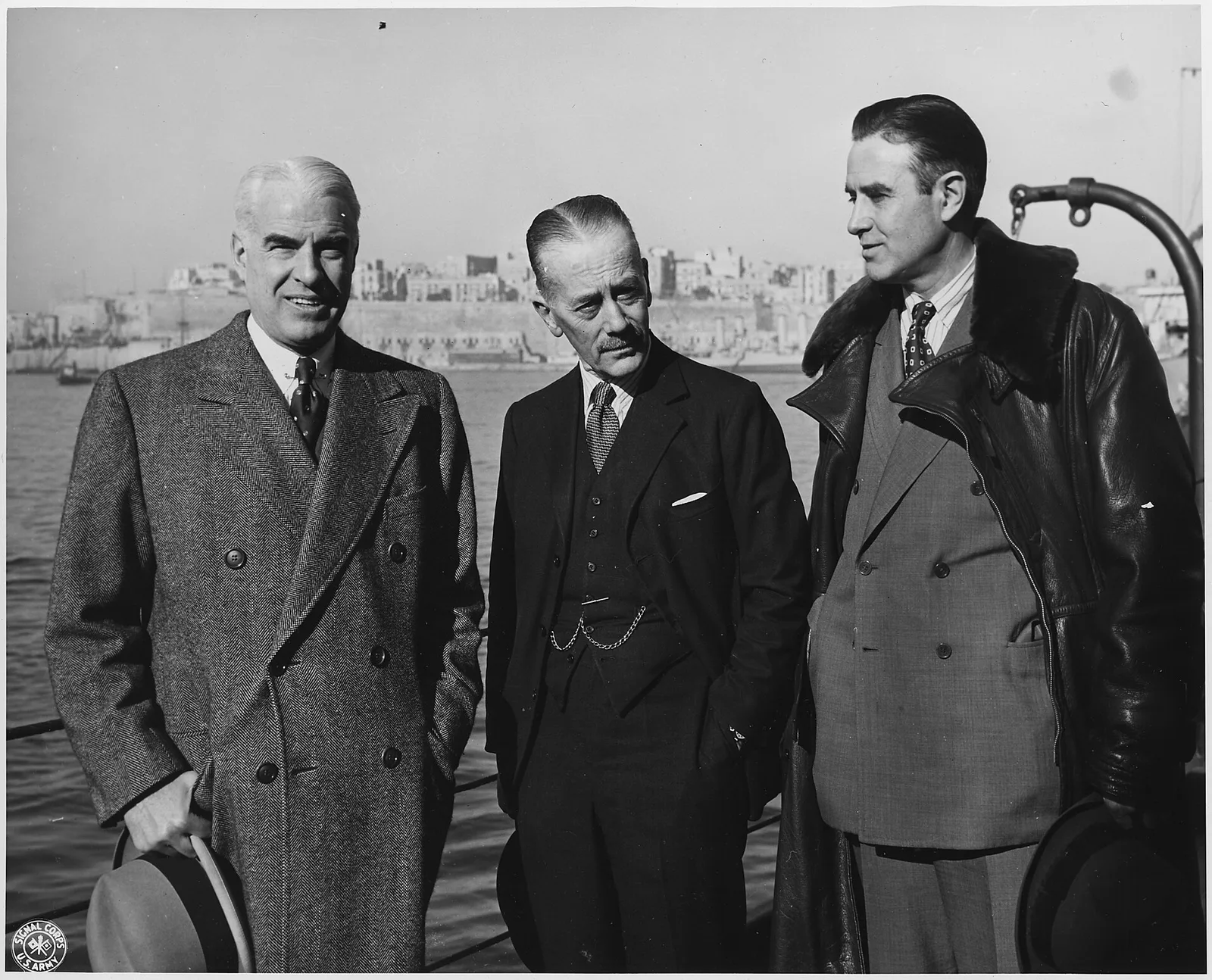
Secretary of State Edward Stettinius, shown with Britain's Alexander Cadogan and Ambassador Averell Harriman, led the U.S. delegation at the San Francisco conference, where the UN Charter was signed on June 26, 1945.
Six Organs, One Charter
The UN Charter created six principal organs to divide its work between deliberation, security enforcement, legal adjudication, administration, and economic and social coordination.
The UN's main deliberative body, where all 193 member states hold one vote each regardless of size or wealth. It debates and makes recommendations on any matter within the Charter's scope, adopts the UN budget, and elects the non-permanent Security Council members.
Its resolutions are generally not legally binding, though they carry political weight, and some, such as the 1948 Universal Declaration of Human Rights, have become foundational reference points for international law.
Most decisions pass by simple majority, but "important questions," including peace and security matters, the budget, and admitting new members, require a two-thirds majority. The Assembly holds a regular session from September to December and can be recalled for special or emergency sessions.
Under the 1950 "Uniting for Peace" resolution, the Assembly can take up a threat to peace when the Security Council is deadlocked by a veto and recommend collective measures, a mechanism used from the Korean War and the 1956 Suez Crisis through the 2022 response to Russia's invasion of Ukraine.
The only UN body that can issue legally binding resolutions and authorize the use of force. It has 15 members: five permanent members with veto power, the United States, United Kingdom, France, Russia (which succeeded the Soviet Union's seat in 1991), and China, plus 10 non-permanent members elected by the General Assembly to two-year terms.
A single veto from any permanent member blocks a resolution regardless of the other 14 votes. An abstention by a permanent member does not count as a veto, a practice accepted since the 1950s and upheld by the International Court of Justice in 1971.
The permanent five, the victors of World War II, reflect the power balance of 1945, not today's. Proposals to add permanent seats for countries such as India, Japan, Germany, Brazil, or an African state have been debated for decades without agreement, because any change requires a Charter amendment that the five can veto.
The Council can impose sanctions, create war-crimes tribunals, as it did for the former Yugoslavia and Rwanda, and authorize peacekeeping missions. More than 70 have been deployed since 1948, with roughly 70,000 uniformed personnel serving in about a dozen missions in the mid-2020s.
The UN's principal judicial organ, seated at the Peace Palace in The Hague, Netherlands. It settles legal disputes between member states and gives advisory opinions on legal questions referred by UN organs.
Its 15 judges are elected to nine-year terms by the General Assembly and Security Council voting separately, and no two may be nationals of the same country. Only states, not individuals or companies, may be parties to its contentious cases.
It has no independent enforcement power. A state that ignores a judgment can be referred to the Security Council, where a permanent member can veto enforcement, as the United States did after losing the 1986 Nicaragua case over the mining of Nicaraguan harbors.
The ICJ should not be confused with the International Criminal Court, a separate treaty-based body, also in The Hague, that prosecutes individuals for genocide, war crimes, and crimes against humanity, and which the United States has never joined.
The UN's administrative arm, led by the Secretary-General, who is appointed by the General Assembly on the Security Council's recommendation, meaning any permanent member can veto a candidate, for a renewable five-year term.
Nine people have held the office since 1946, from Trygve Lie of Norway to António Guterres of Portugal, who began a second term in 2022. By informal custom the post rotates among regions, and no national of a permanent Council member has ever held it.
The Secretary-General is both chief administrative officer, overseeing a global civil service of tens of thousands, and a diplomatic actor who can bring any matter threatening peace to the Security Council under Article 99 of the Charter, and who often mediates crises in person.
Dag Hammarskjold, the second Secretary-General, greatly expanded the role, inventing modern peacekeeping during the 1956 Suez Crisis before his death in a 1961 plane crash in what is now Zambia, a case still disputed.
Coordinates the UN's economic, social, and environmental work and that of its specialized agencies and programs, including the World Health Organization, UNICEF, and the UN Development Programme. It has 54 member states elected to three-year terms.
ECOSOC oversees the regional economic commissions and functional commissions on issues such as the status of women, narcotic drugs, and statistics, and it grants "consultative status" to thousands of nongovernmental organizations, their main formal channel into the UN system.
Since 2015 it has been the central forum for reviewing progress on the 17 Sustainable Development Goals, the successor to the Millennium Development Goals, which UN members have pledged to meet by 2030.
Critics have long argued that ECOSOC is unwieldy and overshadowed by the specialized agencies, which have their own budgets and governing boards. Reform proposals recur, but the body's Charter role has never been substantially changed.
Originally supervised the transition of 11 trust territories toward self-government or independence, including the U.S.-administered Trust Territory of the Pacific Islands.
The trust territories were mostly former League of Nations mandates and lands taken from the defeated Axis powers; the system deliberately excluded the colonies of the victorious Allies, a limitation that decolonization advocates criticized.
The Council suspended operations in 1994 after Palau, the last trust territory, became independent. Its membership had by then shrunk to the five permanent Security Council members.
Proposals to abolish the Council outright, or to repurpose it to oversee the global commons or fragile states, have not advanced, because amending the Charter requires ratification by two-thirds of members including all five permanent Council members. It now exists only on paper, meeting if a need arises.
Founder, Host, and Permanent Member
No country has shaped the United Nations more than the United States, which helped design it, hosts its headquarters, funds its largest share, and holds a permanent veto over its most consequential decisions.
The United States was a founding member in 1945 and has hosted UN headquarters in New York City since 1952, on land purchased with a donation from John D. Rockefeller Jr. The U.S. Ambassador to the United Nations holds cabinet-rank status and represents American interests before the General Assembly and Security Council.
Congress and the UN formalized the arrangement in the 1947 Headquarters Agreement, which grants the UN complex special legal status even though the land remains U.S. territory subject to host-country law. The agreement also technically obligates the U.S. to allow representatives of any member state, including ones without formal diplomatic relations with Washington, to travel to UN Headquarters for official business.
The United States led the drafting at Dumbarton Oaks and San Francisco, and its bipartisan backing, unlike the Senate's rejection of the League of Nations, was decisive; the Senate approved the Charter 89 to 2 in July 1945.
Relations with the host city and country have not always been smooth. New York and the federal government have periodically clashed with the UN over unpaid parking tickets and diplomatic immunity, and U.S. denials of visas to some foreign officials in 2018 and 2019 drew objections that they violated the Headquarters Agreement.
The United States is assessed roughly 22 percent of the UN's regular operating budget and around 27 percent of its peacekeeping budget, the largest share of any member state, under a formula based on national income and population.
The current 22 percent assessment ceiling for the regular budget was itself negotiated by the United States in 2000, which agreed to pay off years of withheld dues in exchange for a lower capped rate. Congress has periodically withheld portions of U.S. dues over policy disputes, a recurring source of friction between Washington and the organization.
Beyond assessed dues, many UN agencies and programs run on voluntary contributions. Counting everything, the United States has often supplied a fifth or more of total UN system funding, well over 10 billion dollars a year in recent years.
The U.S. has repeatedly used funding as leverage: it capped its contribution under the 1985 Kassebaum-Solomon amendment, has left and rejoined UNESCO more than once, cut funding to the UN Population Fund and to the Palestinian relief agency UNRWA at various times, and by law pays peacekeeping at a rate below its assessment. In 2025 the United States began withdrawing from the World Health Organization (effective January 2026), announced another withdrawal from UNESCO, left the UN Human Rights Council, and cut several UN funding lines.
As one of five permanent Security Council members, the United States holds veto power over any substantive Security Council resolution, a position it has used and faced dozens of times across UN history on issues ranging from the Middle East to Cold War disputes.
The Soviet Union cast the very first Security Council veto in 1946, just months after the UN's founding; the United States did not cast its own first veto until 1970. Since then, the U.S. has used its veto most frequently on resolutions concerning Israel and the Middle East.
Through 2024 the United States had cast its veto more than 80 times, second only to Russia and the Soviet Union combined, and the large majority in recent decades have blocked Security Council criticism of, or demands on, Israel.
France and the United Kingdom have not used the veto since 1989; the United States, Russia, and China remain active users. A 2022 General Assembly resolution now requires a debate whenever a veto is cast, adding political cost without changing the rule itself.
Notable U.S. Ambassadors to the United Nations
Edward Stettinius Jr.
First U.S. Ambassador to the UN (1946), and former Secretary of State who led the U.S. delegation at the San Francisco Conference.
Adlai Stevenson II
Two-time Democratic presidential nominee who confronted the Soviet ambassador with photographic evidence during the 1962 Cuban Missile Crisis.
George H.W. Bush
Served as ambassador from 1971 to 1973 before later becoming CIA Director, Vice President, and the 41st President.
Jeane Kirkpatrick
First woman to hold the post, serving under President Reagan from 1981 to 1985 and a member of the National Security Council.
Madeleine Albright
Served as ambassador from 1993 to 1997 before becoming the first woman to serve as U.S. Secretary of State.
Susan Rice
Served from 2009 to 2013 under President Obama before becoming National Security Advisor.
Nikki Haley
Former Governor of South Carolina who served as ambassador from 2017 to 2018 under President Trump.
Mike Waltz
Former U.S. Representative from Florida and White House National Security Advisor, who took office as U.S. Ambassador to the United Nations in September 2025.
UN Secretaries-General
Nine people have served as Secretary-General since 1946, each elected by the General Assembly on the Security Council's recommendation for a renewable five-year term.
Did You Know?
The word "United Nations" was coined by President Franklin D. Roosevelt in 1942 to describe the wartime Allied coalition, three years before the organization itself existed.
The UN Charter was signed by 50 nations in San Francisco; Poland, unable to send a delegation in time, signed later and is still counted among the 51 founding members.
The land under UN Headquarters in Manhattan was purchased with an $8.5 million donation from John D. Rockefeller Jr. in 1946.
The UN has six official languages: Arabic, Chinese, English, French, Russian, and Spanish.
South Sudan became the UN's 193rd and most recent member state in 2011.
Dag Hammarskjold, the UN's second Secretary-General, died in a 1961 plane crash while on a peace mission in the Congo and remains the only person awarded a posthumous Nobel Peace Prize.