It Started as a Seating Arrangement
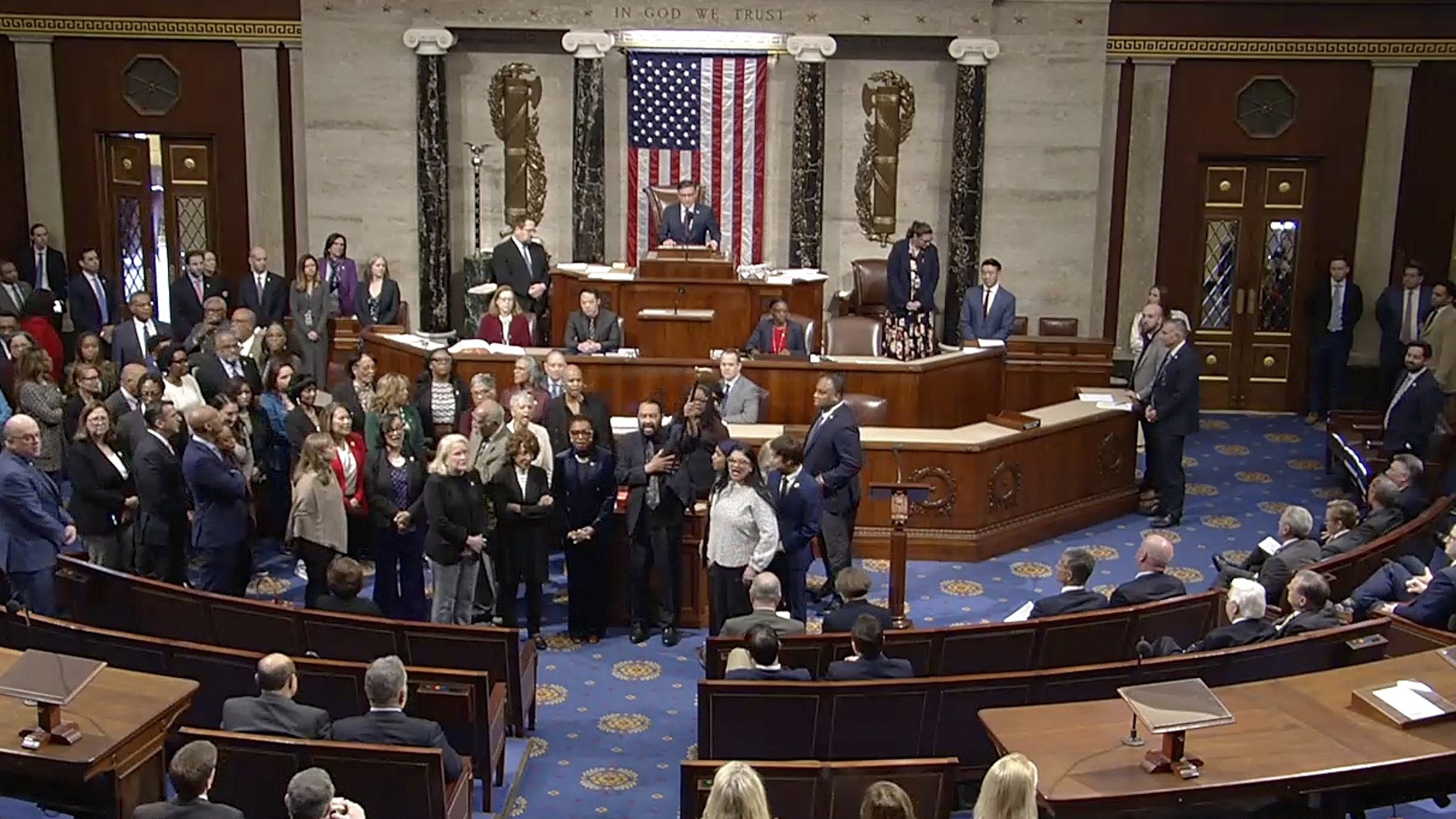
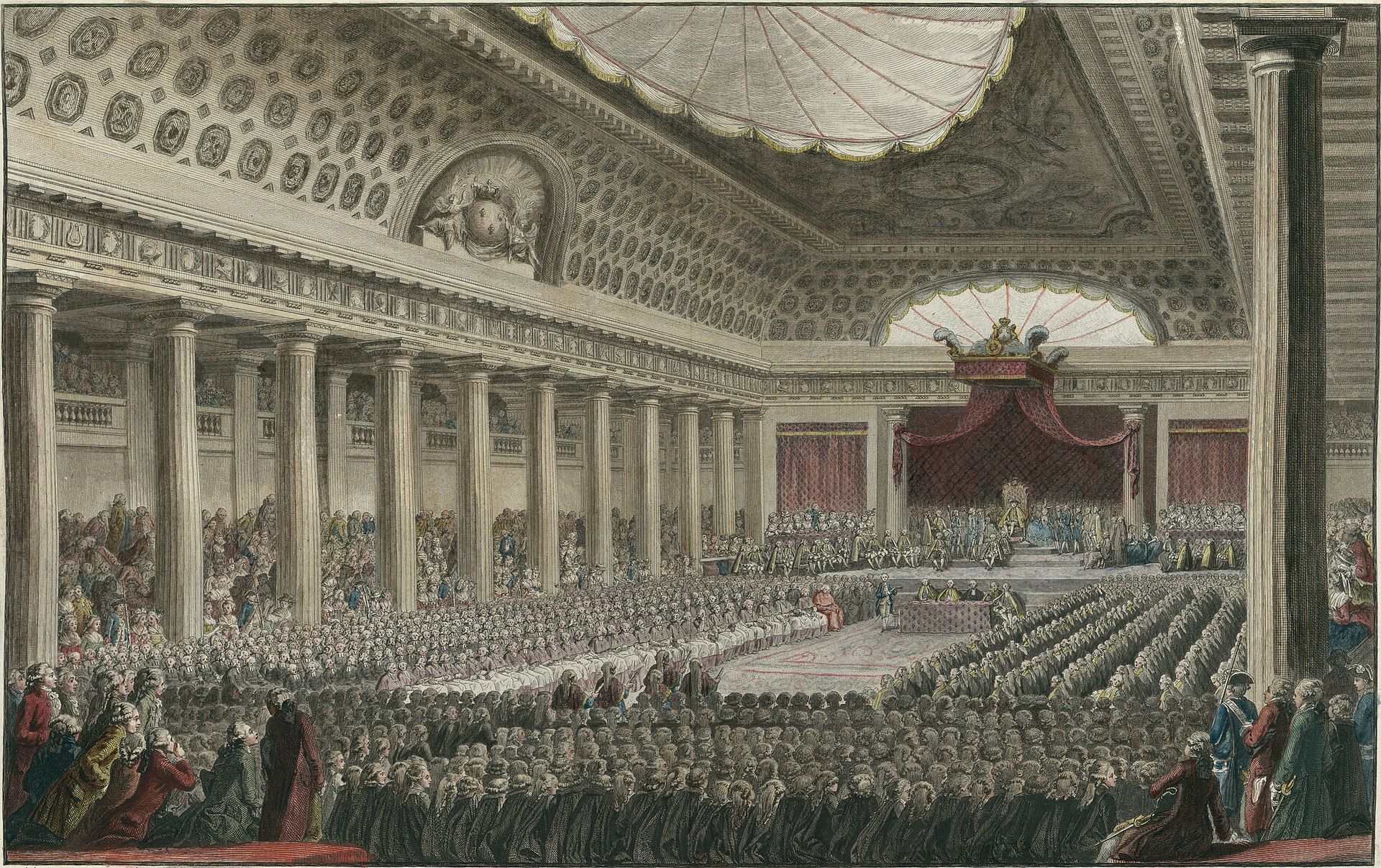
The origin of left and right in politics is not a metaphor. It is a literal description of where people sat. In the French National Assembly of 1789, delegates had to decide a foundational question: how much power should the king retain? Those who wanted to preserve the existing order sat to the right of the presiding officer. Those who wanted to change it sat to the left.
Right meant preserve the existing order. Left meant change it. That is still, after more than 230 years, the most durable and universal definition of the two terms. Everything else, the specific policy positions, the party alignments, the cultural associations, has been layered on top of that original distinction through the accidents of history.
The timeline below traces how those two words traveled from a single chamber in Revolutionary France to the defining vocabulary of American democratic life.
From Paris to America
The key moments in how left and right traveled from a French chamber to the defining frame of American politics.
The origin of left and right in politics is not a metaphor. It is a seating arrangement. In the French National Assembly of 1789, delegates had to decide a single foundational question: how much power should the king retain? Those who wanted to preserve the monarchy and traditional institutions sat to the right of the presiding officer. Those who wanted to limit or abolish royal power and push revolutionary change sat to the left. Right meant preserve the existing order. Left meant change it. That is still the most durable definition of the two terms more than 230 years later.
The specific vote that produced the seating split concerned how much veto power King Louis XVI should retain over the new National Assembly's legislation; delegates favoring a strong royal veto clustered to the president's right, and those favoring a weak or no veto clustered to the left. Contemporaries did not immediately adopt "left" and "right" as fixed political vocabulary, and the labels only fully standardized in French political language over the following decades.
The seating divide hardened through the Assembly's later debates over the Declaration of the Rights of Man, the nationalization of church lands in November 1789, and the Civil Constitution of the Clergy in 1790, which reorganized the church and required priests to swear loyalty to the state. Deputies who defended the prerogatives of church and crown consolidated on the right, while those pressing the revolution forward consolidated on the left.
The terms nearly disappeared during the most radical phase of the Revolution, when the Jacobin-dominated National Convention of 1793 suppressed open factional labels. They revived under the constitutional monarchies of the 1814 to 1848 period, when the Chamber of Deputies again seated members by tendency, and by the Third Republic founded in 1870, gauche and droite were permanent features of French parliamentary language.
The left-right framing spread through European political writing and parliamentary practice across the 19th century. In Britain, Tories (conservatives) and Whigs (reformers) mapped roughly onto the distinction. In Germany, France, and Italy, socialist and labor movements organized explicitly as 'the left,' while nationalist and clerical movements organized as 'the right.' The vocabulary became standard in European political discourse well before it crossed the Atlantic.
The literal seating convention did not transfer to Britain's Parliament, whose government and opposition benches face each other across a rectangular chamber rather than radiating from a central semicircle; as a result, the left-right vocabulary entered British political language as an abstract borrowing from continental Europe rather than a description of Parliament's own physical layout, a distinction that still holds in the House of Commons today.
Continental parliaments that adopted semicircular chambers, modeled loosely on the French design, reinforced the physical metaphor. The German Reichstag after 1871, the Italian Chamber after unification, and later the parliaments of Scandinavia seated socialist and labor blocs on the presiding officer's left and conservative, monarchist, and clerical blocs on the right.
The revolutions that swept much of Europe in 1848 sharpened the vocabulary further. Liberal and nationalist movements demanding constitutions and wider suffrage were routinely described as forces of the left, and the monarchies and aristocracies resisting them as the right. By the late 19th century, socialist parties across the continent, many affiliated with the Second International founded in 1889, openly called themselves parties of the left.
For most of the 19th century, Americans talked about Federalists, Whigs, Republicans, and Democrats, about labor and capital, about slavery and union, but not in any systematic way about left and right. The two major parties did not map cleanly onto the European spectrum. The Republican Party, founded in 1854 as an anti-slavery party, was in some respects the progressive force of its era. The Democratic Party, the party of Andrew Jackson and later of the Solid South, was in many respects conservative. The European labels did not transfer neatly.
By the time European left-right vocabulary might have applied, the American party system had already undergone multiple complete realignments: the Federalist Party had collapsed by the 1820s, the Whig Party rose and then collapsed by the mid-1850s, and the modern Republican Party emerged only in 1854, meaning there was no single stable American party structure for a European-style spectrum to map onto in the first place.
American political conflict in this era ran along several axes that did not resolve into a single spectrum: tariffs versus free trade, hard money versus soft money, states' rights versus federal authority, and above all slavery. A politician could hold what a European would call a left position on one axis and a right position on another, and the coalitions shifted with each question.
The Populist movement of the 1890s, centered on indebted farmers in the South and West, pushed economic demands, government control of the railroads, a federal income tax, and an expanded money supply, that a European would have recognized as left-wing, yet its leaders rarely used that label. The reformers of the Progressive Era that followed described themselves as progressives rather than as men of the left, and that vocabulary choice persisted in American politics.
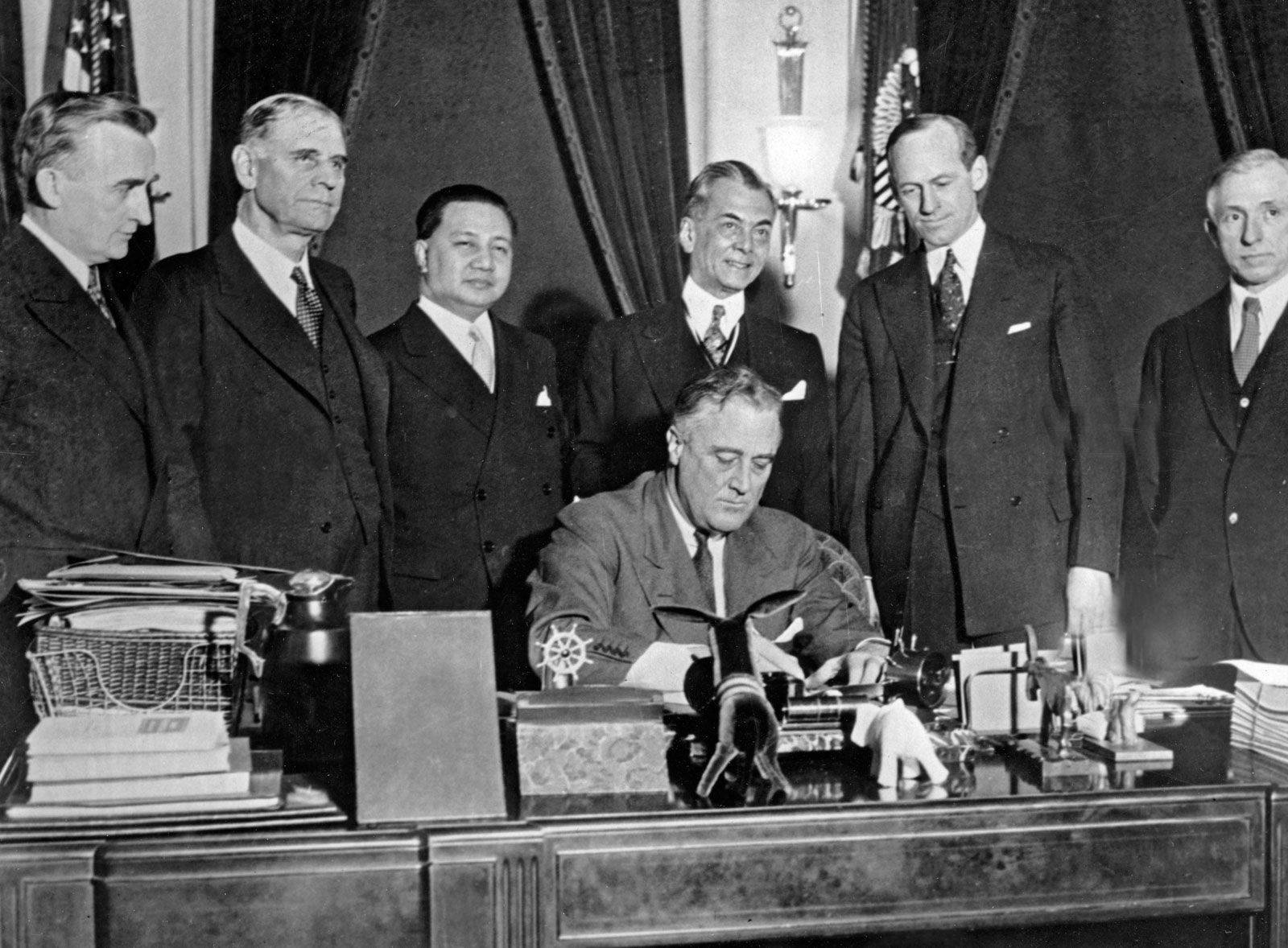
The Great Depression and Franklin Roosevelt's New Deal began crystallizing the modern American version of the left-right divide. FDR's expansion of the federal government consolidated a coalition of labor unions, urban immigrants, Southern whites, and Black voters behind the Democratic Party. Republicans became the party of business, limited government, and fiscal conservatism. Left and right began mapping onto that divide in recognizable ways. The terms entered everyday American political vocabulary during this period.
The New Deal coalition FDR assembled was internally contradictory from the start, uniting segregationist white Southern Democrats with Northern Black voters, urban immigrants, and labor unions under the same party banner. That underlying tension went unresolved for three decades and became direct fuel for the racial realignment described later in this timeline, once civil rights legislation forced the coalition's contradictions into the open.
The 1936 election, which Roosevelt won by 523 electoral votes to 8, is often cited as the moment the New Deal coalition became the dominant force in national politics. Organized labor, newly protected by the 1935 National Labor Relations Act, mobilized voters for Democrats on a scale not seen before, and union membership roughly tripled over the following decade.
Opposition to the New Deal gave Republicans and conservative Southern Democrats a shared cause. The informal Conservative Coalition that formed in Congress after 1937, uniting most Republicans with segregationist Southern Democrats, blocked much further New Deal legislation and remained a working bloc on economic and civil rights votes into the 1960s.
The Cold War added an ideological dimension that dramatically intensified the left-right split. Left became associated in American politics with sympathy toward collectivism, unions, and government programs, and by extension with dangerous proximity to communism. Right became associated with anti-communism, capitalism, individualism, and traditional values. These associations were not always logically coherent but they were politically powerful. Being called 'left-wing' carried genuine danger during the McCarthy era. The Cold War frame shaped American political language for a generation.
Senator Joseph McCarthy, the era's most prominent anti-communist crusader, was formally censured by the Senate in December 1954 after his tactics and unsubstantiated accusations lost broad political support, and his own career effectively ended shortly after. The broader anti-communist political climate he had helped intensify, however, persisted for years past his personal downfall, showing how the era's rhetorical associations outlived the individual politician most identified with them.
The House Un-American Activities Committee, made a standing committee in 1945, and a series of loyalty programs beginning with President Truman's Executive Order 9835 in 1947, institutionalized suspicion of the left across both parties. Thousands of federal employees were investigated, and industries from Hollywood to broadcasting maintained blacklists of suspected radicals.
Anti-communism also reshaped the labor movement. The Congress of Industrial Organizations expelled 11 unions with a combined membership near one million in 1949 and 1950 over alleged communist leadership, and in 1955 the CIO merged with the more conservative American Federation of Labor. The American left that survived the era was smaller and more firmly anti-communist than the left of the 1930s.
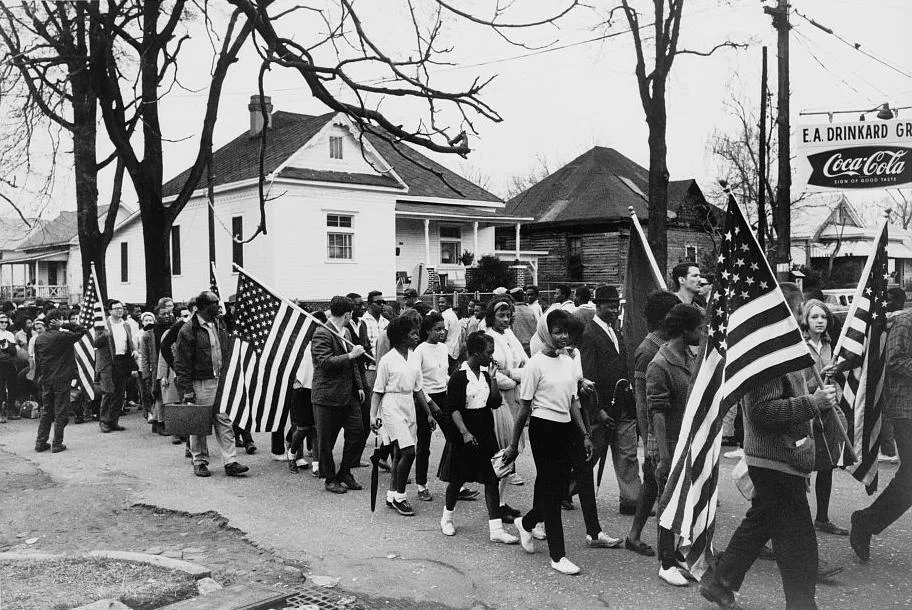
The Civil Rights Act of 1964 and the Voting Rights Act of 1965 were the hinge on which modern American politics turned. Democratic President Lyndon Johnson signed both bills knowing, as he reportedly told an aide, that he was handing the South to the Republican Party for a generation. Southern white conservatives, who had been Democrats since the Civil War as a legacy of Reconstruction, began migrating to the Republican Party. The geographic and racial realignment took roughly 20 years to complete but fundamentally restructured which coalition was 'left' and which was 'right.'
The realignment extended well beyond presidential voting patterns into state and congressional politics, and it took decades longer than the roughly 20-year period often cited for the shift to fully complete: several Southern U.S. Senate seats held by Democrats since Reconstruction did not flip to Republican control until the 1990s and 2000s, illustrating how gradual and uneven the process actually was at the state and local level.
The shift was visible almost immediately at the presidential level. In 1964, Republican nominee Barry Goldwater, who had voted against the Civil Rights Act on constitutional grounds, carried five Deep South states, four of which had not voted Republican since Reconstruction (Eisenhower had won Louisiana in 1956), while losing 44 states overall. Those same Southern states became reliably Republican in presidential elections within two decades.
Black voters completed the mirror-image move. Having split their votes between the parties earlier in the century, Black Americans gave Democratic presidential candidates roughly 90 percent of their votes from 1964 onward, one of the most stable voting patterns in American politics. The parties' racial coalitions after 1965 were close to the reverse of what they had been in 1900.
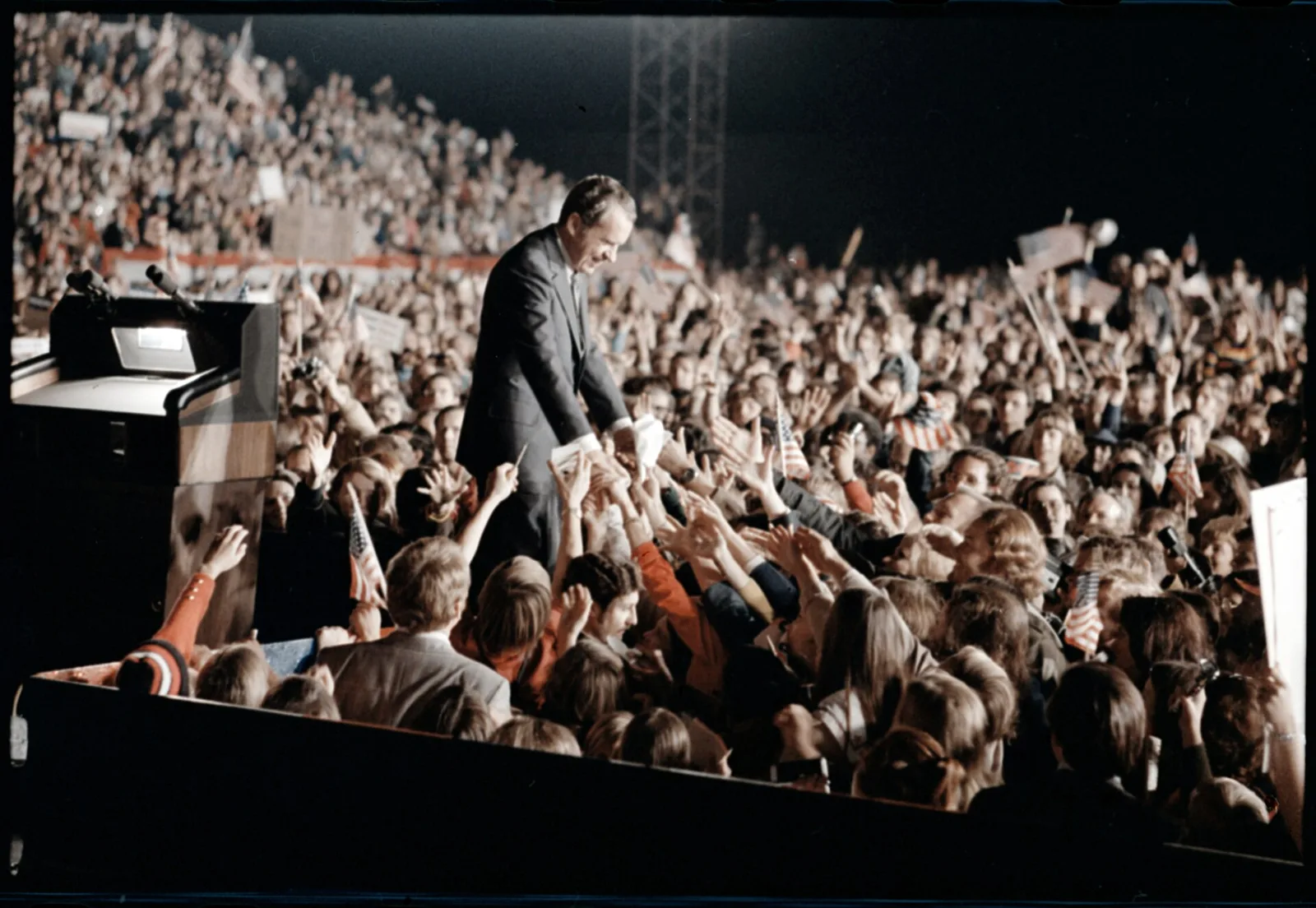
Richard Nixon's 1968 and 1972 presidential campaigns deliberately accelerated the racial realignment by appealing to white Southern voters alienated by the Democrats' civil rights positions. Nixon's strategist Kevin Phillips described the strategy explicitly, arguing that Republican dominance could be built on the votes of white Southerners and working-class ethnic voters who resented the Democratic Party's identification with Black civil rights and urban unrest. The strategy worked electorally and reshaped what 'right' meant in American politics.
The term "Southern strategy" itself comes primarily from later journalistic and scholarly analysis rather than from Nixon's own campaign materials, and historians continue to debate how much of the Southern realignment was the product of a deliberate, centralized campaign strategy versus broader economic and demographic trends, including suburbanization and rising incomes, that were independently pulling white Southern voters toward the Republican Party during the same period.
The 1968 race was complicated by the third-party candidacy of Alabama Governor George Wallace, who ran explicitly against federal civil rights enforcement and carried five Southern states with 46 electoral votes. Nixon's campaign calculated that most Wallace voters would move into the Republican column in future elections, which largely happened by 1972, when Nixon carried every Southern state.
Later Republican officials, including Republican National Committee chairman Ken Mehlman in a 2005 speech to the NAACP, publicly acknowledged that the party had benefited from racial polarization in this period. Historians continue to weigh that appeal against parallel factors, suburban growth, rising Southern incomes, and cultural conservatism on issues beyond race, that were pulling the same voters rightward.
Ronald Reagan's presidency institutionalized the modern conservative identity. His 1981 inaugural declaration that 'government is not the solution to our problem; government is the problem' made small government not merely a policy preference but a core statement of values. Reagan fused economic conservatism (low taxes, deregulation, free markets) with social conservatism (opposition to abortion, support for traditional family structures) and anti-communism into a coherent ideological package that defined the American right for the next four decades.
The fusion Reagan achieved was not universally embraced within his own coalition: Barry Goldwater, the 1964 Republican presidential nominee often credited as Reagan's ideological predecessor, later grew publicly critical of the religious right's expanding influence within the party, illustrating that even prominent conservatives disagreed over how tightly economic, social, and religious conservatism should be bundled together.
Reagan's coalition brought together groups that had not previously aligned: business conservatives, anti-tax activists energized by California's 1978 Proposition 13, Cold War hawks, and a newly mobilized religious right organized through groups such as the Moral Majority, founded by Jerry Falwell in 1979. So-called Reagan Democrats, working-class white voters who crossed party lines, were also central to his 1980 and 1984 victories.
The economic program later called Reaganomics combined the 1981 tax cut, which reduced the top marginal rate from 70 to 50 percent and eventually to 28 percent by 1988, with higher military spending and deregulation. Federal deficits and the national debt roughly tripled during his presidency, a tension between tax cuts and spending priorities that has recurred within the conservative coalition ever since.
Newt Gingrich's Republican Revolution of 1994, which swept Democrats out of the House majority for the first time in 40 years, pioneered a style of politics that treated the opposing party as an enemy to be destroyed rather than an opponent to be defeated. Gingrich distributed memos to Republican candidates coaching them to use words like 'corrupt,' 'sick,' and 'traitors' to describe Democrats. The approach was enormously effective electorally and profoundly changed the tone of American political life. Both parties have since adopted versions of the same confrontational style.
The 1994 campaign was also notable for the "Contract with America," a specific, itemized legislative agenda that most Republican House candidates nationwide signed onto and pledged to bring to a vote within the new majority's first 100 days, an unusually centralized and nationalized campaign approach for congressional races that both parties have periodically tried to replicate in later election cycles.
The most-cited memo, titled 'Language: A Key Mechanism of Control,' was distributed by GOPAC, a political action committee Gingrich chaired, and gave candidates contrasting word lists, optimistic words for themselves and negative words for opponents. Gingrich had spent more than a decade before 1994 using floor speeches carried on the C-SPAN cable network to attack the Democratic majority directly.
The 1994 election produced a 54-seat Republican gain in the House and the party's first House majority since 1954. The confrontational posture contributed to two federal government shutdowns in 1995 and 1996 over budget disputes with President Clinton, and Gingrich resigned the speakership after the 1998 midterms, in which his party unexpectedly lost seats.
By the early 21st century, geographic, cultural, and media sorting had made the left-right divide self-reinforcing. Americans increasingly lived in communities of like-minded people, consumed partisan media that confirmed their priors, and had social networks with little cross-partisan contact. Political scientists documented a dramatic increase in 'negative partisanship,' meaning that voters were motivated less by enthusiasm for their own party than by fear and contempt for the other. The parties themselves sorted ideologically in ways that would have been unrecognizable in 1960, when both parties contained significant liberal and conservative wings.
One measurable indicator political scientists cite for this shift is the shrinking number of "split-ticket" counties, meaning counties that voted for a presidential candidate of one party and a U.S. House candidate of the other in the same election; that share of counties declined sharply from the 1990s to the 2010s and 2020s, providing quantitative evidence for the qualitative sense that ideological sorting had deepened.
Roll-call analysis using the DW-NOMINATE scoring system shows that the ideological overlap between the two parties in Congress, once substantial, had effectively vanished by the 2000s: by most measures the most conservative Democrat in Congress had become more liberal than the most liberal Republican. The last conservative Southern Democrats and liberal Northern Republicans left office or switched parties over this period.
Surveys by the Pew Research Center found that the share of Americans holding consistently liberal or consistently conservative views across a range of issues roughly doubled between 1994 and 2014, and the share expressing highly unfavorable views of the opposing party rose sharply over the same span. Researchers describe the combined effect as ideological sorting layered on top of rising partisan animosity.
The Making of the American Divide
The specific alignment of American left and right is not inevitable. It is the product of particular historical moments, strategic decisions by politicians, and social changes that could have played out differently. Understanding how it was constructed is essential to understanding what it means today, and whether it is permanent.
Four transformations above all others shaped the contemporary divide: the New Deal realignment of the 1930s, the Civil Rights realignment of the 1960s, the Cold War ideological overlay, and the post-1994 institutionalization of partisan conflict as warfare.
None of these were foreordained. Each involved choices, contingencies, and accidents that could have pointed in other directions.
Four Transformations That Made Modern American Politics
The New Deal Realignment (1930s)
Franklin Roosevelt's response to the Great Depression created the coalition that defined the Democratic Party for three decades: labor unions, urban workers, ethnic immigrants, Southern whites, and Black voters in Northern cities. Republicans became the party of business and limited government. For the first time, left and right in America meant something recognizable by European standards.
The Civil Rights Realignment (1964 to 1980s)
The Democratic Party's embrace of civil rights shattered the New Deal coalition. Southern white conservatives began leaving the Democratic Party. Nixon's Southern Strategy accelerated the departure. By Reagan's second term, the regional realignment was complete. The party of Lincoln had become the party of the Southern white voter. The party of Jefferson Davis had become the party of Black Americans. This swap, which would have been inconceivable to anyone alive in 1900, is the single most important fact about modern American political geography.
The Cold War Overlay (1950s to 1991)
The Cold War turned left and right into a question of loyalty as much as policy. Liberal positions were associated by their opponents with sympathy toward communism. Conservatives positioned themselves as defenders of Western civilization against Soviet totalitarianism. When the Soviet Union collapsed in 1991, the Cold War frame lost its organizing power, leaving conservatives searching for a new enemy and opening space for the culture war politics that filled the vacuum.
The Institutionalization of Partisan Warfare (1994 to present)
Newt Gingrich's deliberate strategy of treating politics as warfare, training candidates to dehumanize opponents, shutting down the government as a negotiating tactic, and prioritizing party over country changed the operating norms of American politics. The strategy worked. It also, according to Gingrich's own later reflections, contributed to a political culture that became progressively harder to govern. Both parties adopted versions of the warfare model. The norm of treating opponents as fellow citizens with different priorities largely collapsed.
What the Terms Actually Mean in 2024
The words conservative, liberal, progressive, libertarian, and moderate each carry specific meanings in contemporary American politics, and those meanings are more complicated than their casual usage suggests. None of them map perfectly onto a single coherent philosophy. All of them describe coalitions as much as ideologies.
The descriptions below explain what each term generally means as used in American political life today, including the significant internal disagreements within each camp.
The Major Labels Explained
What each political label means in American usage today, and where the internal divisions run.
In contemporary American politics, conservatism generally encompasses fiscal conservatism (lower taxes, reduced federal spending, opposition to deficit spending), social conservatism (opposition to abortion rights, skepticism toward same-sex marriage, support for traditional family structures and religious expression in public life), and foreign policy hawkishness (strong military, skepticism of international institutions, America-first diplomacy). The Republican Party is the primary vehicle for conservatism. Important internal divisions exist: libertarian-leaning conservatives disagree with social conservatives on many issues; populist nationalists who dominate the Trumpist wing of the party reject the free-trade and small-government orthodoxy of traditional conservatism.
The specific content of American conservatism has shifted even within the modern era itself: the "New Right" coalition that rose to prominence around Reagan explicitly positioned itself against the more moderate, business-oriented "Rockefeller Republican" wing of the party, named for New York Governor Nelson Rockefeller, that had dominated Republican politics through the 1950s and 1960s before losing influence in the decades that followed.
On economic policy, mainstream conservative institutions such as the Heritage Foundation and the Club for Growth have generally advocated cutting marginal tax rates, restraining the growth of entitlement programs, and reducing federal regulation, priorities reflected in the 2017 Tax Cuts and Jobs Act, which lowered the corporate rate from 35 to 21 percent. The conservative legal movement, organized substantially through the Federalist Society founded in 1982, has emphasized originalist interpretation of the Constitution.
The populist-nationalist turn associated with Donald Trump after 2016 broke with parts of this orthodoxy, favoring tariffs over free trade, opposing cuts to Social Security and Medicare, and taking a more restrictive line on both legal and illegal immigration. Surveys of Republican voters show the coalition remains largely united on tax and judicial questions while divided on trade, foreign intervention, and the proper size of entitlement programs.
Contemporary American liberalism generally encompasses support for federal programs and regulation (the Affordable Care Act, environmental regulation, labor protections), expansion of civil rights for historically marginalized groups (racial minorities, women, LGBTQ Americans), progressive taxation, and multilateral foreign policy. The Democratic Party is the primary vehicle for liberalism. Important internal divisions exist: moderate 'establishment' Democrats prioritize electability and incremental change; progressive or democratic socialist Democrats push for more structural transformation (Medicare for All, Green New Deal, student debt cancellation). The label 'progressive' has largely replaced 'liberal' in Democratic internal politics.
The word "liberal" carries a different, older meaning in much of the rest of the world, where classical liberalism refers to an emphasis on individual liberty, limited government, and free markets, positions closer to what Americans would call conservative or libertarian today. American usage narrowed the term toward its current meaning primarily during the early 20th century Progressive Era, a linguistic divergence that can cause confusion when comparing American "liberals" to political parties abroad that also use the liberal label.
On economic policy, the Democratic mainstream has supported a larger federal role through measures such as the 2010 Affordable Care Act, which expanded health coverage to roughly 20 million additional people, and the temporarily expanded Child Tax Credit of 2021. Progressive taxation, meaning higher rates on higher incomes, is a long-standing element, as is federal action on climate through provisions like the clean-energy incentives in the 2022 Inflation Reduction Act.
The party's progressive wing, associated with the Congressional Progressive Caucus and figures such as Senator Bernie Sanders and Representative Alexandria Ocasio-Cortez, pushes further, toward a government-run health insurance option or single-payer system, tuition-free public college, and stronger labor law. Democratic primary contests since 2016 have frequently turned on the balance between this wing and the party's moderates.
Libertarianism combines positions from both conventional categories in ways that fit neither: it opposes government intervention in the economy (like the right) but also opposes government intervention in personal life (like the left). Libertarians typically support drug legalization, same-sex marriage, open immigration, and non-interventionist foreign policy alongside low taxes, deregulation, and opposition to government spending programs. The Libertarian Party is the largest third party in America but rarely wins office. Many voters hold libertarian-leaning views without identifying as libertarians. The ideology is philosophically coherent but electorally marginal.
The Libertarian Party was founded in 1971, in direct reaction to the Nixon administration's wage and price controls, which libertarians viewed as a betrayal of free-market principles by a Republican president. The party has never won a single state's electoral votes in a presidential election, but it regularly achieves ballot access in all 50 states, which remains its most consistent organizational accomplishment relative to other American third parties.
Libertarian thought in America draws on economists such as Milton Friedman and Friedrich Hayek and novelist-philosopher Ayn Rand, and is promoted by institutions including the Cato Institute, founded in 1977. Its core claim is that individual liberty is best protected by strictly limiting government power in both economic and personal matters, a stance that cuts across the conventional left-right bundle.
Libertarian presidential nominees have never exceeded about 3.3 percent of the national popular vote, the figure Gary Johnson reached in 2016. The movement's more lasting influence has come through elected Republicans who describe themselves as libertarian-leaning, such as former Representative Ron Paul and Senator Rand Paul, and through advocacy on specific issues like criminal justice reform, surveillance limits, and drug policy.
Populism is not an ideology with a fixed policy content. It is a political style that frames politics as a conflict between an authentic, virtuous 'people' and a corrupt, self-serving 'elite.' Left-wing populism (associated with figures like Bernie Sanders) directs that anger at economic elites: corporations, Wall Street, billionaires. Right-wing populism (associated with figures like Donald Trump) directs it at cultural and political elites: media, universities, government bureaucracy, cosmopolitan professionals. Both versions challenge mainstream parties and existing institutions. Both draw support from voters who feel economically left behind and culturally disrespected.
The term traces to the People's Party, commonly called the Populist Party, an agrarian farmers' movement of the 1890s that is the direct historical namesake for both left- and right-wing populism today, even though the original party's specific policy demands, including free coinage of silver and government regulation of railroads, do not map cleanly onto either modern usage of the term.
Political scientists such as Cas Mudde define populism as a 'thin' ideology that splits society into the pure people and the corrupt elite and can attach itself to left-wing or right-wing programs. Because it is defined by that framing rather than by fixed policies, populist movements in different countries and eras have demanded very different things while sharing the same rhetorical structure.
In recent American politics, the 2009 Tea Party movement and Donald Trump's 2016 campaign are commonly cited as right-wing populism, emphasizing immigration, trade, and distrust of Washington institutions, while Bernie Sanders's 2016 and 2020 campaigns are cited as left-wing populism, emphasizing corporate power and economic inequality. Both drew disproportionate support from voters who believed the political system was rigged against ordinary people.
Gallup polling consistently finds that approximately 40% of Americans identify as independent, more than identify as either Democrat or Republican. This number is frequently cited as evidence of a vast moderate middle yearning for a third party. The reality is more complicated. Most self-identified independents, when pressed, lean toward one party and vote for it almost as reliably as partisans do. Genuine swing voters, people who actually vote for different parties in different elections based on issues, represent a much smaller share of the electorate, perhaps 5-10%. True moderates who hold consistent positions between the two parties' platforms are also rarer than the independent label suggests.
Political scientists identify "leaners" using a standard survey follow-up question asked of anyone who first says "independent": which party they lean toward. Decades of polling data show that leaners' voting behavior and even their policy attitudes are typically statistically indistinguishable from voters who openly identify with the party they lean toward, a finding replicated across many election cycles and central to why researchers treat most independents as effectively partisan.
The distinction researchers draw is between independent leaners and 'pure' independents, who express no lean and make up only around 7 to 10 percent of adults in Gallup and American National Election Studies data. Pure independents tend to vote at lower rates and to follow politics less closely than either partisans or leaners.
Genuinely persuadable voters, those who might vote for either party depending on the candidates and issues, are a subset even of that small group. Strategists in recent presidential elections have generally concluded that turning out reliable supporters matters more to the outcome than converting the shrinking pool of true swing voters, though close elections can still hinge on them.
The Spectrum Is Not a Line
The conventional image of the political spectrum is a straight horizontal line running from far left to far right with a moderate center in the middle. This image is intuitive and widely used, but it is misleading in several ways.
Political scientists have developed more complex models. A two-dimensional model separates economic views (from left to right, meaning more to less government intervention) from social or authoritarian views (from libertarian to authoritarian, meaning more to less government control over personal behavior). This two-axis model reveals that libertarians and authoritarians, both of whom fall off the conventional spectrum, have coherent positions that the one-dimensional model cannot accommodate.
A Useful Exercise
Think about where the following combinations fit on a simple left-right line: someone who opposes abortion and same-sex marriage but supports marijuana legalization and opposes the death penalty. Someone who wants Medicare for All and stricter immigration enforcement. Someone who supports free markets and free immigration but opposes gun regulation. None of these combinations fit neatly on a single line, but all of them describe real people with coherent values.
Why the Divide Is So Deep
American political polarization is not simply a matter of people disagreeing about policy. It is a structural condition produced by geography, media, institutional incentives, and psychology that reinforce each other in ways that have made the divide progressively harder to bridge over the past 30 years.
Understanding the causes does not make them easier to fix, but it does make the current situation less mysterious and somewhat less alarming. The divide is produced by specific mechanisms, not by some fundamental change in human nature. Mechanisms can in principle be changed.
The Forces Behind Polarization
How It Happened
- +Americans have increasingly sorted themselves geographically by political affiliation over the past 30 years. Cities have become overwhelmingly Democratic. Rural areas have become overwhelmingly Republican. Suburbs are the main battleground.
- +The sorting is self-reinforcing. People choose communities where they feel comfortable, and political compatibility is part of that comfort. Each generation grows up with less cross-partisan contact than the last.
- +Economic geography drives much of the political geography. The knowledge economy, which favors Democratic constituencies, has concentrated in cities. Manufacturing and resource extraction, which favor Republican constituencies, are spread across rural areas.
- +The result is that most Americans live in communities where one party is dominant and rarely encounter serious arguments from the other side in daily life.
What It Produces
- +Geographic sorting has made primaries more important than general elections in most districts, because the general election outcome is predetermined by the partisan composition of the area.
- +When primaries are decisive, the most ideologically consistent voters, who turn out disproportionately in primaries, effectively choose the winner. This pulls both parties toward their respective bases and away from the center.
- +Legislators from safe districts have little incentive to compromise, because their political risk comes from primary challengers to their left or right, not from general election opponents.
- +Geographic sorting also means that policy preferences diverge sharply by state, leading to a patchwork of wildly different laws on issues like abortion, guns, and education across the country.
Context
Political scientist Bill Bishop documented the acceleration of geographic sorting in his 2008 book The Big Sort. The trend has continued and intensified. By the 2020 presidential election, a growing share of Americans lived in landslide counties, where one candidate won by 20 points or more.
The Structural Problem
- +The collapse of a shared national media ecosystem has been one of the most significant structural changes in American politics. In 1980, the three broadcast networks reached the vast majority of Americans with essentially the same news. Today, Americans consume news from thousands of sources with radically different editorial perspectives.
- +Cable news, talk radio, and social media have all created economic incentives for outrage and conflict. Anger drives engagement, engagement drives advertising revenue. A media ecosystem optimized for engagement is structurally biased toward producing content that makes the other side seem menacing.
- +Social media algorithms amplify emotionally provocative content regardless of its accuracy. Research consistently finds that false and misleading information travels faster and further than corrections on social platforms.
- +The result is that partisans on each side are not merely disagreeing about values and priorities. They are operating from fundamentally different factual premises about what is happening in the country.
The Debate About Solutions
- +Some researchers argue that the effects of partisan media are overstated. Most Americans, including most partisans, do not actually consume very much political media, partisan or otherwise. The highly engaged news consumers who watch hours of cable news are a small minority.
- +Others argue that media fragmentation reflects rather than causes polarization. People sought out partisan media because they were already polarized, not the other way around.
- +Calls for media regulation to address polarization raise significant First Amendment concerns. A government empowered to police partisan media would face obvious conflicts of interest.
- +Market solutions, meaning audiences choosing to seek out challenging perspectives, are the approach most consistent with American traditions of press freedom, even if their effectiveness is uncertain.
Context
The relationship between media and polarization is genuinely debated among political scientists. What is clear is that Americans are more likely than at any point in the last 50 years to have never had a meaningful conversation with someone who voted differently than they did.
What the Research Shows
- +Political scientists Alan Abramowitz and Steven Webster documented in 2016 that American politics has shifted from positive to negative partisanship. Voters are now motivated more by fear and contempt toward the other party than by enthusiasm for their own.
- +The share of Americans who view the opposing party not just unfavorably but as a genuine threat to the country's well-being has roughly doubled since the 1990s. This is not merely stronger partisanship. It is a qualitative change in how Americans relate to fellow citizens who disagree with them.
- +Negative partisanship makes compromise nearly impossible because any deal with the other side feels like collaboration with an enemy, not accommodation of a fellow citizen with different priorities.
- +It also makes voters more tolerant of misconduct by politicians on their own side, because the alternative, empowering the other side, seems worse than any specific wrongdoing.
Why It Matters
- +The degree to which mass voters are actually polarized versus merely sorted is debated. On many specific policy questions, Americans are less polarized than their party identifications suggest. Large majorities support background checks for gun purchases, some form of legal status for undocumented immigrants who arrived as children, and action on climate change, regardless of party.
- +What has polarized most dramatically is not necessarily the substance of policy positions but the emotional temperature attached to them. The same policy position that felt like a reasonable compromise in 1990 may feel like a betrayal of fundamental values today.
- +Some scholars argue that polarization is asymmetric, that one party has moved further from the center than the other. This claim is contested and highly politically sensitive.
- +The mechanisms driving negative partisanship, geographic sorting, media fragmentation, primary incentives, reinforce each other in ways that make the problem self-sustaining without obvious policy solutions.
Context
Negative partisanship is arguably the most important structural feature of contemporary American politics and the least discussed. It explains why incumbents survive scandals that would have ended careers in earlier eras, why bipartisan legislation has become almost impossible, and why each election cycle seems to produce higher stakes and more apocalyptic rhetoric than the last.
What Research Suggests
- +A substantial body of research in political psychology suggests that left-right differences may have some psychological roots. Conservatives, on average, tend to score higher on measures of sensitivity to threat, preference for order and hierarchy, and discomfort with ambiguity.
- +Liberals, on average, tend to score higher on openness to experience, tolerance for complexity and ambiguity, and comfort with novelty and change.
- +These psychological tendencies, if they exist, would make sense of why the same alignment of conservatism with order-preservation and liberalism with change has appeared across very different historical contexts and in many countries.
- +Some researchers suggest that political orientation may have a partial genetic component, not because specific political beliefs are inherited but because underlying personality traits that predispose people toward one orientation may be heritable.
The Limits of Psychology
- +The effect sizes in political psychology research are modest. Knowing someone's psychological profile does not reliably predict their political views. Many highly conscientious, order-preferring people are liberal. Many highly open-to-experience people are conservative.
- +The causal direction is genuinely uncertain. Does personality shape politics, or does political socialization shape how personality traits are expressed? Probably both, to varying degrees in different people.
- +Political psychology research is almost entirely conducted in Western democracies and disproportionately on college students. Its generalizability is limited.
- +Explaining political differences through psychology can have the effect of naturalizing them, suggesting the divide is built into human nature rather than produced by specific historical and institutional choices that could in principle be made differently.
Context
The psychology of political orientation is a genuinely interesting research area but should be held lightly. Human political behavior is shaped by history, institutions, incentives, culture, and lived experience as much as by any underlying psychological tendencies. The existence of the psychology does not make the politics inevitable.
What the Labels Get Wrong
Left and right are the most widely used vocabulary in American political life, and for good reason: they capture something real about how political identities and coalitions are organized. But they also systematically distort political reality in ways that are worth understanding.
Knowing the limits of the left-right framework is not about dismissing politics or pretending differences do not exist. It is about thinking more clearly about what those differences actually are and where they come from.
The Limits of the Framework
Six ways in which the left-right binary oversimplifies or misleads.
There is no philosophical reason why opposition to abortion should be bundled with low corporate taxes, or why support for universal health care should be bundled with opposition to school choice. These are coalition positions, assembled through decades of electoral history and interest group bargaining. Fiscal conservatism (small government, low taxes) and social conservatism (government enforcing traditional moral norms) are in genuine tension with each other but both live on the American right. Economic progressivism (redistribution, unions) and civil libertarianism (minimal government interference in personal life) can conflict but both live on the American left. The bundles are real and politically powerful, but they are contingent on American history, not logically necessary.Historical reversals illustrate how contingent these bundles really are: before the New Deal realignment, it was the Republican Party that was more associated with an active federal role in the economy, through protective tariffs and infrastructure spending, while many Democrats of that earlier era favored a more limited federal government, roughly the reverse of the association most Americans take for granted today.Interest-group alignment explains much of the modern bundling. Business associations, gun-rights organizations, and religious conservative groups coordinate largely with Republicans; labor unions, environmental organizations, and civil rights groups coordinate largely with Democrats. A politician who takes the 'wrong' position for their party on one of these issues risks losing the funding, volunteers, and primary support those networks supply.The bundles also shift within living memory. Free trade was championed by Republican presidents from Reagan through George W. Bush and is now contested inside the party; criminal-justice severity was a bipartisan consensus in the 1990s, reflected in the 1994 crime bill that many Democrats supported, and is now a point of division on both sides. What counts as a 'left' or 'right' position on a given issue is not fixed.
A European Christian Democrat is economically moderate, socially conservative, and pro-European Union. That combination does not map onto either American party. A Nordic social democrat supports a large welfare state, strong labor rights, and extensive gun control alongside relatively liberal immigration restrictions and strong national defense, a combination that crosses American left-right lines in multiple places. Japanese conservative politics centers on nationalism and economic development in ways that differ fundamentally from American conservatism. The specific bundling of positions that defines American left and right is a product of American history and is not the only way a political spectrum can be organized.In several Latin American democracies, self-described conservative parties have historically supported an expansive role for the state, and often the Catholic Church, in education and social services, an alignment of the word "conservative" with more government involvement in a specific policy domain, essentially reversed from how the term functions in the United States, another illustration that the American bundle is a product of American history rather than a universal pattern.Many European party systems split economic and cultural questions into separate parties rather than two broad coalitions. Green parties combine strong environmental policy with civil libertarianism; agrarian or center parties combine rural economic interests with cultural moderation; some far-right parties combine welfare-state support for citizens with anti-immigration nationalism. Coalition governments then assemble majorities from several of these blocs after each election.Proportional-representation electoral systems, used across most of continental Europe, let these smaller parties win legislative seats in rough proportion to their vote share, which sustains multi-party competition. The United States' single-member districts and winner-take-all elections force the same range of views into just two parties, one reason the American bundles are broader and more internally contradictory than those in many other democracies.
Polling consistently finds that large numbers of Americans hold cross-cutting views: they support stricter gun regulations (a 'left' position) alongside skepticism of immigration (a 'right' position). They support the death penalty (a 'right' position) alongside marijuana legalization (a 'left' position). They want lower taxes (right) and expanded Medicare (left). These are not confused or uninformed citizens. They are people whose genuine views do not happen to follow the two-party sorting. The binary left-right spectrum is a useful shorthand but a poor description of how most Americans actually think about issues.Political scientists using statistical clustering of large public opinion surveys have identified a meaningful share of the electorate, often estimated in the double digits as a percentage of voters, whose combination of views does not cluster with either party's typical platform; researchers sometimes label this group "conflicted" or "cross-pressured" voters in the academic literature, a formal category distinct from simple political disengagement.The Pew Research Center's 2021 political typology sorted the public into nine groups, only four of which, two on each side, are consistently aligned with a party's full platform; the rest combine, for example, economic progressivism with cultural conservatism, or social liberalism with fiscal restraint. Roughly a quarter of respondents fell into groups with low political engagement and mixed views.Ballot-measure results often show the crossover directly. Voters in the same election have approved minimum-wage increases while backing Republican candidates, and protected abortion access while electing conservative legislators, as happened in several states in 2022. Those outcomes are hard to explain if voters held tightly bundled left-right worldviews, and easier to explain as issue-by-issue judgments.
A common assumption in American political commentary is that the truth and the best policy lie somewhere between the two parties' positions, and that moderates and centrists are by definition more reasonable than partisans. This is not logically sound. On some questions, one side is simply more correct than the other regardless of where the political center is. The political center in 1850 included acceptance of slavery. The political center in 1930s Germany included accommodation of Nazism. Centrism is a description of where the middle of current political opinion happens to be, not a guarantee of wisdom or correctness. Strong convictions are not inherently less legitimate than moderate ones.As recently as the early 1910s, the American political center on women's suffrage still excluded the position that women should be allowed to vote in most states; that mainstream position of the era is now nearly universally rejected, another historical example of how the center of public opinion at a given moment is not a reliable guide to what later generations would judge to be correct.The habit of treating the midpoint of current opinion as the reasonable answer is sometimes called the fallacy of the golden mean, or 'balance as bias.' It assumes truth is always located between two stated positions, which cannot hold when the positions concern verifiable facts, such as whether a policy had a measured effect, rather than value trade-offs.History offers repeated cases where a once-extreme position became the accepted center: the abolition of slavery, women's suffrage, the eight-hour workday, and the end of legal racial segregation were all minority positions before they were majority ones. The reverse also occurs, positions once mainstream, such as the eugenics laws passed by more than 30 states in the early 20th century, are now widely condemned. Where the center sits at any moment is a fact about opinion, not about correctness.
Despite all the limitations of the left-right labels, they retain enormous predictive power. Party identification is the single strongest predictor of voting behavior in America, stronger than income, race, religion, or education. The correlation between identifying as liberal or conservative and voting Democratic or Republican has strengthened significantly since the 1970s. Even Americans who describe their policy views as moderate tend to vote consistently for one party. This suggests that whatever the conceptual limitations of the left-right framework, it captures something real and important about how Americans organize their political identities and loyalties.American National Election Studies survey data, one of the longest-running academic surveys of U.S. voting behavior, shows the correlation between self-identified ideology and party vote choice was measurably weaker in the 1970s, when many self-described conservative white Southerners still voted Democratic out of historical party loyalty, than it is today, when ideology and party vote choice have become much more tightly aligned.Party identification typically forms early, often reflecting family and community, and stays more stable across a person's life than most other political attitudes. Panel studies that follow the same voters over years find that when party ID and a specific policy view conflict, the policy view is the more likely to shift toward the party, evidence that partisanship often drives issue positions rather than only following from them.The predictive power runs down the ballot. Straight-ticket voting, choosing the same party for president, Senate, House, and often state offices, has risen to near-record levels, and in 2016 every state that elected a U.S. senator chose one from the same party as its presidential winner, the first time that had happened in a century; in 2020 Maine was the lone exception, re-electing Republican Susan Collins while voting for Joe Biden.
The United States is not constitutionally required to have a two-party system. The Constitution does not mention parties at all. The two-party dominance is produced by structural features of American elections: single-member districts with first-past-the-post voting, which tend mathematically to consolidate competition into two major parties (Duverger's Law); ballot access laws that make it difficult for third parties to get on the ballot in all 50 states; campaign finance systems that favor established parties; and a winner-take-all Electoral College that punishes vote-splitting. Several alternative electoral systems, including ranked-choice voting and proportional representation, could in principle sustain more than two competitive parties, as they do in most other democracies.Ross Perot's 1992 independent presidential campaign won 18.9 percent of the national popular vote, the strongest third-party or independent performance since Theodore Roosevelt's Progressive "Bull Moose" campaign in 1912, and yet that historic vote share translated into zero electoral votes, a concrete illustration of how the structural, winner-take-all features described above can neutralize even an unusually successful third-party campaign.Duverger's Law, named for French sociologist Maurice Duverger, holds that plurality elections in single-member districts tend over time to produce two dominant parties, because voters abandon third parties to avoid 'wasting' a vote and helping their least-preferred option win. Countries with proportional representation or runoff systems routinely sustain five or more competitive parties.Some U.S. jurisdictions have adopted alternatives: Maine and Alaska use ranked-choice voting for federal elections, and a number of cities use it locally, while Nebraska has a nonpartisan unicameral legislature. These experiments remain limited, and changing the Electoral College or mandating a different federal voting system would require amending the Constitution or federal law, so the two-party structure is likely to persist.
Did You Know?
The terms 'left' and 'right' in politics come from where delegates sat in the French National Assembly in 1789 when deciding how much power the king should keep.
The Constitution does not mention political parties anywhere. George Washington explicitly warned against 'the baneful effects of the spirit of party' in his 1796 Farewell Address.
Until the 1960s, both the Democratic and Republican parties had significant liberal and conservative wings. A Southern conservative Democrat and a Northern liberal Republican were both common types. That overlap has essentially disappeared.
The word 'conservative' entered English political usage in the 1830s when the British Tory Party adopted it as a self-description. The word 'liberal' entered political usage around the same time.
Gallup polling has found for decades that more Americans identify as conservative than liberal, but more identify as Democrat than Republican. This apparent contradiction reflects the cultural stigma attached to the word 'liberal' more than a genuine policy gap.
Kevin Phillips, the Republican strategist who designed Nixon's Southern Strategy, later became a prominent critic of the Republican Party and wrote extensively about the dangers of concentrated wealth and theocratic politics.
Political scientists have found that the U.S. Congress has been more polarized in the 2000s and 2010s than at any point since Reconstruction in the 1870s, when the country was still processing the aftermath of the Civil War.
In most European democracies, the words 'liberal' and 'conservative' mean something different from their American usage. In Europe, a liberal party typically favors free markets and individual rights, which overlaps more with American libertarianism than American liberalism.