

About Indiana
Indiana means simply "land of the Indians," a name that reflects the large indigenous population that lived in the region when European settlers arrived. When Congress organized the Indiana Territory in 1800, it chose a Latin-style name meaning "land of the Indians" to describe the territory west of Ohio that was still largely under indigenous control. The name was unusual in being explicitly descriptive of the people who already lived there rather than honoring a European monarch or place. Indiana became the 19th state in 1816, by which time the indigenous peoples whose presence inspired the name had been largely displaced through treaties and forced removal.
Indiana is called the Hoosier State, though nobody agrees on where the word "Hoosier" comes from. It may derive from "husher" (a frontier brawler), from a contractor named Hoosier who employed workers from Indiana, or simply from the backwoods greeting "Who's here?" Whatever the origin, Hoosier has become one of the most fiercely proud state identities in America.
Indiana sits at the intersection of the industrial Midwest and the agricultural heartland. Its flat northern plains produce corn, soybeans, and popcorn; its Lake Michigan shoreline once anchored one of the world's greatest steel-producing regions; its limestone quarries have supplied building material for America's greatest structures; and its capital city hosts the world's most famous motor race every Memorial Day weekend.
The state is reliably Republican in statewide elections and has been for most of its recent history. It is deeply tied to manufacturing, agriculture, and a working-class political identity that has only strengthened as deindustrialization hit surrounding states harder. Indiana retains more manufacturing jobs per capita than any other state, a source of both economic strength and ongoing vulnerability.

Geography, Four Regions
Indiana is compact, 36,420 square miles, but contains surprising geographic variety from its lakefront dunes to its southern river hills.
The northern tier of Indiana borders Lake Michigan and contains some of the most ecologically distinctive terrain in the Midwest. Indiana Dunes National Park, one of the most biodiverse parks in the national park system, features towering sand dunes, wetlands, oak savannas, and beaches that attract millions of visitors annually.
The cities of Gary and Hammond anchor an industrial lakefront that was once the steel capital of America. South Bend, home to the University of Notre Dame, is the cultural and economic center of the region, a post-industrial city working to reinvent itself around healthcare, education, and technology.
The Indiana Dunes were a birthplace of the science of ecology: botanist Henry Chandler Cowles studied how plant communities change over time there in the 1890s. A decades-long campaign to save the shoreline from being swallowed by industry produced the Indiana Dunes National Lakeshore in 1966, redesignated a national park in 2019, the only national park in the state, with more than 1,100 native plant species along 15 miles of coast.
Gary was founded in 1906 by U.S. Steel and named for its board chairman, Elbert Gary; its Gary Works was for a time the largest steel mill on Earth. The city's population has fallen from about 178,000 in 1960 to under 70,000 today as steel jobs vanished. Farther east, the Elkhart area builds roughly 80% of the nation's recreational vehicles, making it the RV manufacturing capital of the world.
Indianapolis sits almost exactly at the geographic center of Indiana and functions as the state's urban heart. It is the largest city in the state by a wide margin, home to 900,000 people in the city proper and nearly 2.5 million in the metro area. Indianapolis is known as the 'Crossroads of America' for its location at the intersection of multiple interstate highways and is a major logistics and convention hub.
The Indianapolis Motor Speedway, home of the Indy 500, sits just northwest of downtown. The city has successfully reinvented itself as a sports and healthcare destination, hosting the Super Bowl, the NCAA headquarters, and a major pharmaceutical industry.
Indianapolis was laid out in 1821 as a planned capital modeled on Washington, D.C., with a central Monument Circle and diagonal avenues, and the seat of government moved there from Corydon in 1825; the White River proved too shallow to be the shipping route the founders had hoped for. In 1970 the city merged with most of surrounding Marion County under a consolidated government called Unigov, which nearly doubled its official population overnight.
The metro is headquarters to Eli Lilly, the Fortune 20 health insurer Elevance Health (formerly Anthem), and the NCAA, which relocated there in 1999. Indianapolis has built a strategy around hosting events, staging the Super Bowl in 2012, the entire pandemic-era 2021 NCAA men's basketball tournament, and College Football Playoff title games, in a compact downtown organized around its convention center and Lucas Oil Stadium.
Southern Indiana is geologically and culturally distinct from the flat northern plains. The terrain becomes hilly and forested, carved by the Ohio River along the southern border. Lincoln City marks the site where Abraham Lincoln spent his formative years from age 7 to 21, the longest period of his life in any single state.
The Hoosier National Forest covers 200,000 acres of mixed hardwood forest. The region is also home to some of the most remarkable cave systems in the Midwest, including Wyandotte Cave and Marengo Cave. The city of Evansville anchors the southwest corner.
The hill country lies on a belt of soluble limestone that has dissolved into one of the densest concentrations of caves and sinkholes in the country, more than 3,000 known caves statewide. The same rock, quarried around Bedford and Bloomington, is the Salem Limestone that faced the Empire State Building and the Pentagon, and nearby Spring Mill State Park preserves a restored 1800s pioneer village and working gristmill.
New Harmony, on the lower Wabash, hosted two famous experimental communities: the German Harmonist religious settlement from 1814 to 1824, and then Robert Owen's secular socialist colony, which broke up within two years but left a legacy in free public schooling and the first geological survey of the United States. Evansville, the region's largest city, turned out LST landing ships and P-47 Thunderbolt fighter planes by the thousand during World War II.
Eastern Indiana has been an industrial and manufacturing powerhouse since the late 19th century. Fort Wayne, the state's second-largest city, is a diversified manufacturing hub producing auto parts, medical devices, and military equipment.
The corridor between Fort Wayne, Muncie, Anderson, and Kokomo has historically been tied to the auto industry; Kokomo was a major center for Chrysler transmission manufacturing. The region has experienced the classic Rust Belt cycle of industrial boom, decline, and partial reinvention through healthcare, logistics, and precision manufacturing.
The corridor's factories arrived with the Indiana Gas Boom of the late 1880s, when the discovery of a huge natural-gas field, thought at the time to be inexhaustible, drew glassmakers and manufacturers to Muncie, Kokomo, Marion, and Anderson. The gas ran out by around 1910, but the factories stayed. The Ball brothers built a glass-jar fortune in Muncie and endowed Ball State University; sociologists later chose Muncie as the anonymous 'Middletown' in their landmark studies of American life.
Kokomo calls itself the 'City of Firsts' for the 1894 Elwood Haynes automobile and other early inventions, and Stellantis still runs large transmission and casting plants there. Fort Wayne grew at the portage linking the Great Lakes and Mississippi watersheds, the site of Anthony Wayne's 1794 fort, and now makes wire, defense electronics at a large BAE Systems plant, and medical devices.

Economy
Indiana's economy is anchored by manufacturing and life sciences, reinforced by agriculture, motorsports, and its unmatched position as a national logistics hub.
Indiana consistently ranks first among all U.S. states in manufacturing employment as a share of its workforce. The state produces steel, pharmaceuticals, auto parts, medical devices, recreational vehicles, and industrial equipment.
Major employers include Subaru of Indiana Automotive in Lafayette, Honda manufacturing in Greensburg, Toyota in Princeton, and dozens of major auto parts suppliers. Indiana's manufacturing output places it among the top five states in the country in absolute terms.
Manufacturing generates roughly 27% of Indiana's economic output, the highest share of any state, and employs around 550,000 people. Vehicle and parts production is the largest slice, with assembly plants run by Subaru, Toyota, Honda, and General Motors and hundreds of supplier factories feeding them.
The state also leads the nation in recreational-vehicle building, with the Elkhart area making about 80% of U.S. RVs, and in raw steel, with the northwest Indiana mills producing more than a quarter of national output. That concentration leaves Indiana's economy unusually sensitive to trade policy, interest rates, and the shift to electric vehicles, which need far fewer parts than gasoline engines.
Eli Lilly and Company, founded in Indianapolis in 1876, is one of the largest pharmaceutical manufacturers in the world and the city's single largest employer. Indiana's life sciences cluster employs over 60,000 people and includes medical device manufacturers, biotech startups, and research hospitals.
Cook Medical, based in Bloomington, is one of the world's largest privately held medical device companies. The Indiana Biosciences Research Institute has made the state a growing destination for biomedical research.
Eli Lilly is Indiana's most valuable company, and after its GLP-1 drugs tirzepatide (sold as Mounjaro and Zepbound) took off, it became for a time the most valuable health-care company in the world. Since 2020 it has announced more than 13 billion dollars in new Indiana manufacturing, including a large complex in Boone County branded 'LEAP.'
The state's other life-sciences anchors include Roche Diagnostics' North American headquarters in Indianapolis and Zimmer Biomet of Warsaw. Warsaw and the rest of Kosciusko County call themselves the 'Orthopedic Capital of the World,' turning out roughly a third of the global supply of artificial hips and knees.
Indiana's flat, fertile glacial plains make it one of the most productive agricultural states in the country. The state consistently ranks in the top ten for corn and soybean production and is a leading producer of hogs, poultry eggs, and ducks.
Indiana is one of the nation's two leading popcorn producers, along with Nebraska, a fact that surprises most visitors. The agricultural economy is deeply integrated with the state's manufacturing sector, particularly food processing, grain elevators, and agribusiness supply chains.
Indiana has about 94,000 farms covering roughly 15 million acres, close to two-thirds of the state's land, and ranks among the top five states for corn, soybeans, hogs, eggs, and turkeys. Orville Redenbacher developed and first marketed his gourmet popping corn from Valparaiso, Indiana, and the state remains one of the two largest popcorn producers in the country.
The dark muck soils around the Kankakee River, a vast wetland drained in the early 1900s in one of the largest reclamation projects in the country, make Indiana a major producer of mint and, historically, onions. Grain leaves the state through Ohio River terminals near Evansville and by rail toward the Great Lakes, and more than a dozen ethanol plants consume a large share of the corn crop.
The Indianapolis Motor Speedway, built in 1909 and home to the Indianapolis 500 since 1911, is the largest sporting venue in the world by capacity, seating 235,000 with room for 300,000 spectators total. The Indy 500 is the largest single-day sporting event in the world by attendance.
The speedway also hosts the Brickyard 400 NASCAR race. Beyond Indianapolis, Indiana is home to dozens of short tracks, drag strips, and racing facilities, and the motorsports industry supports thousands of jobs in engineering, fabrication, and hospitality.
The Speedway was surfaced with 3.2 million paving bricks in 1909 after its original crushed-stone-and-tar track broke apart and killed drivers and spectators in its first race meet; a three-foot strip of the original brick still marks the start-finish line, the 'yard of bricks.' Founder Carl Fisher also promoted the coast-to-coast Lincoln Highway and helped develop Miami Beach.
The month-long buildup known as the 'Month of May,' along with the 500 Festival parade, is one of the largest annual events in the state. Indiana's racing economy reaches well past the Speedway: a cluster of teams, engine builders, and fabrication shops around Indianapolis and Mooresville supplies IndyCar, drag racing, and sprint-car series across the country.
Indiana's position at the geographic center of the eastern United States, equidistant from many major metro areas, makes it a natural logistics hub. More interstate highways intersect in Indiana than in any other state; the state motto 'The Crossroads of America' is no marketing slogan. FedEx, UPS, and Amazon have major distribution hubs in Indiana.
Indianapolis International Airport is one of the top cargo airports in the country. The state's road, rail, and river infrastructure makes it an essential link in national supply chains.
Indianapolis International is FedEx's second-largest hub in the world after Memphis, a multibillion-dollar operation that anchors a ring of distribution centers and moves more than a million tons of freight a year while ranking outside the top 40 U.S. airports for passengers. Interstates 65, 69, 70, 74, and 80/90 all run through the state.
Northwest Indiana sits within an overnight truck drive of a large share of the U.S. population, which has lined the Lake and Will county corridors with Amazon, Walmart, and Target warehouses. State ports on Lake Michigan at Burns Harbor and on the Ohio River at Mount Vernon and Jeffersonville move steel, grain, and coal, tying Indiana into both the Great Lakes and the Mississippi shipping systems.

How Indiana's State Government Works
Indiana operates a three-branch state government. The Indiana General Assembly consists of a 50-member Senate (four-year terms) and a 100-member House of Representatives (two-year terms). Indiana's governor is limited to two consecutive terms; legislators face no term limits.
Indiana has been a reliably Republican state for most of the modern era. Republicans control the governorship, both U.S. Senate seats, and supermajorities in both chambers of the state legislature. The state has not voted for a Democratic presidential candidate since Barack Obama won it narrowly in 2008, the first time Indiana had voted Democratic at the presidential level since 1964.
Indiana's most distinctive governmental characteristic may be its time zone history. For decades, Indiana was divided among multiple time zones, with some counties observing Eastern Time and others Central, and most refusing to observe daylight saving time at all. The confusion was a running national joke until 2006, when the state finally standardized to Eastern Time statewide.
Governor of Indiana
Current Governor
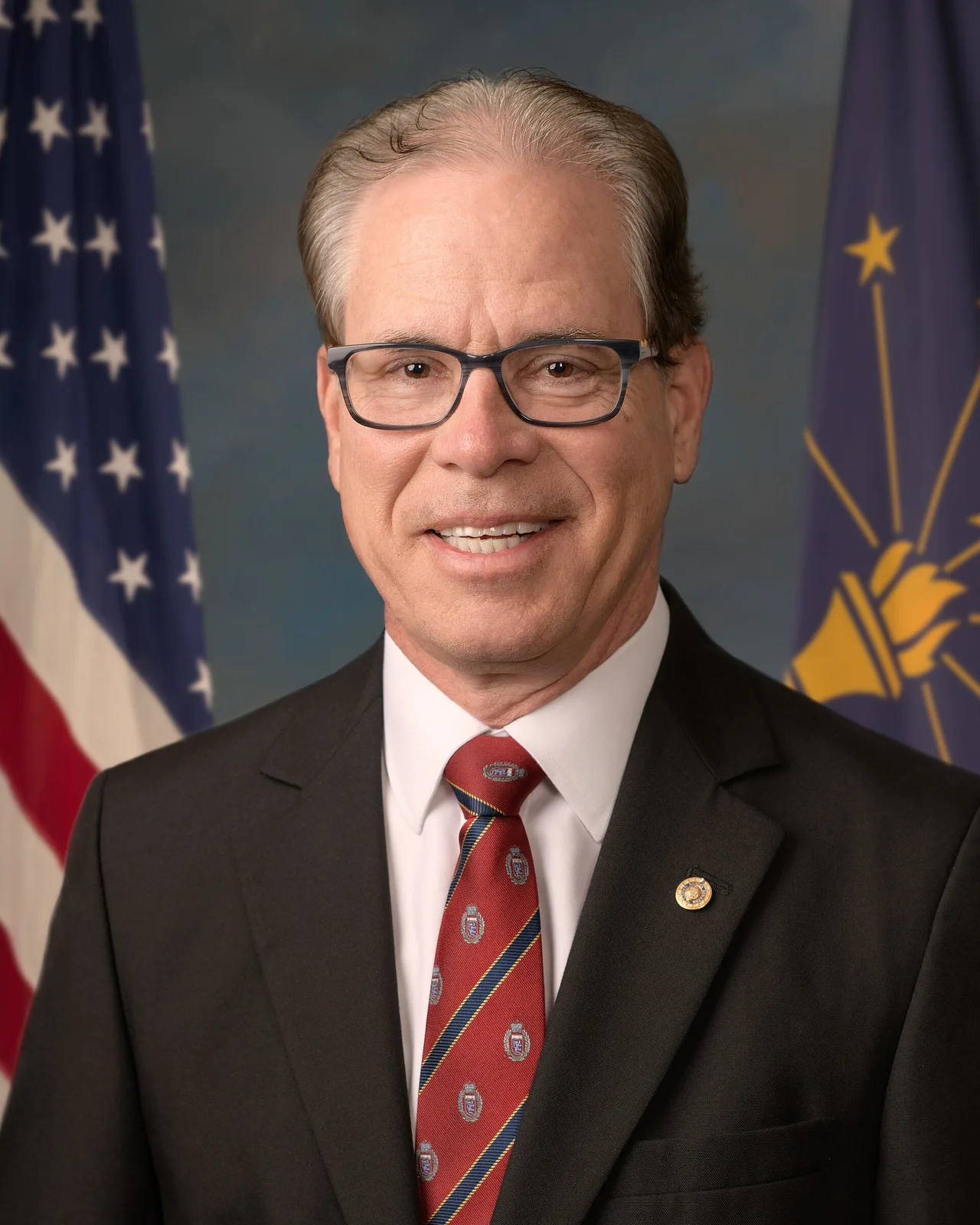
Mike Braun
- Party
- Republican
- In Office Since
- January 13, 2025
- Elected
- November 2024
- Term Ends
- January 2029
- Born
- March 24, 1954, Jasper, Indiana
- Background
- Businessman; founder of Meyer Distributing
- Prior Role
- U.S. Senator, Indiana (2019–2025)
Mike Braun is the 52nd Governor of Indiana. A self-made businessman from Jasper who founded an auto parts distribution company, he upset incumbent U.S. Senator Joe Donnelly in 2018 before leaving the Senate to win the governorship in 2024. He succeeded term-limited Governor Eric Holcomb. He has focused on regulatory reduction, economic development, and fiscal conservatism.
Other Current State Officials
Lieutenant Governor
Micah Beckwith
In office since January 2025. Elected alongside Governor Braun in 2024. Pastor and conservative activist who ran on a faith-based platform.
Attorney General
Todd Rokita
In office since January 2021, re-elected 2022. Former U.S. Representative and Indiana Secretary of State. Focus on election integrity and challenging federal regulations.
Secretary of State
Diego Morales
In office since January 2023. First Latino elected to statewide office in Indiana history. Focus on election administration and voter access.
The Indiana General Assembly
Indiana State Senate
- Seats: 50 members
- Terms: 4-year terms
The upper chamber. Indiana senators serve staggered 4-year terms, with 25 seats up for election in each even-numbered year. Republicans have held a Senate supermajority since 2012.
Indiana House of Representatives
- Seats: 100 members
- Terms: 2-year terms
The lower chamber. All 100 House seats are on the ballot every two years. Republicans have held a supermajority in the Indiana House since 2010.
Indiana's U.S. Senators
U.S. Senator
Todd Young
A Marine Corps veteran and former U.S. Representative who won his Senate seat in 2016 and was re-elected in 2022. Known for bipartisan work on the CHIPS and Science Act, which directed billions toward domestic semiconductor manufacturing, and on national security issues. Focuses on workforce development, innovation, and Indiana's manufacturing economy.
U.S. Senator
Jim Banks
Former U.S. Representative (2017–2025) who won the 2024 Senate race to fill the seat vacated when Mike Braun was elected governor. A Navy Reserve officer who served in Afghanistan. Chaired the Republican Study Committee, the largest caucus in the House, in 2021 and 2022. A prominent voice on China policy, national security, and conservative social issues.
Indiana Through the Years
From early settlement to the present day. Tap any era to read more.
Indiana was home to several powerful Indigenous nations before European settlement. The Miami, Myaamia in their own language, were the dominant people of central and northern Indiana, controlling the Wabash River valley and its trade networks. The Potawatomi inhabited the northern lakes region.
The Lenape (Delaware) were pushed westward into Indiana after being displaced from their eastern homelands. These nations were systematically displaced by a series of treaties, most notably the 1840 Treaty of the Forks of the Wabash, which forced the Miami's removal to Kansas.
The Miami capital, Kekionga, stood where Fort Wayne is today, commanding the short portage between the Maumee and Wabash rivers that connected Lake Erie to the Mississippi. Miami and allied warriors under Little Turtle wiped out two U.S. armies nearby in 1790 and 1791, inflicting at St. Clair's Defeat the worst loss the U.S. Army ever suffered against Native forces, before being beaten by Anthony Wayne at Fallen Timbers in 1794.
In 1838 Indiana militia forced about 850 Potawatomi from the Twin Lakes area on a roughly 660-mile march to Kansas, the Potawatomi Trail of Death, on which more than 40 people died, most of them children. The main Miami removal followed in 1846. Some Miami families whose treaty land was held individually stayed and remain in the state today as the Miami Nation of Indiana, though the federal government has never restored their recognition.
Indiana was admitted to the Union on December 11, 1816, becoming the 19th state. It entered as a free state under the Northwest Ordinance of 1787, which had prohibited slavery in the territory north of the Ohio River.
Despite its free-state status, Indiana's early laws placed severe restrictions on the rights of Black residents, a pattern that persisted well into the 20th century and shaped the state's complex racial history.
The 1816 constitution was drafted at Corydon, tradition says partly in the shade of a large elm later called the 'Constitution Elm,' and it made Indiana the first state carved from the Northwest Territory to promise a tax-supported school system running 'from township schools to a state university,' a pledge that went largely unfunded for decades.
Indiana's 1851 constitution, still the state's governing document, moved the other way on race. Its Article 13 barred Black people from settling in the state and voided any contract made with a Black migrant, one of the harshest such laws in the North. The Indiana Supreme Court set it aside in 1866, and voters formally repealed it only in 1881.
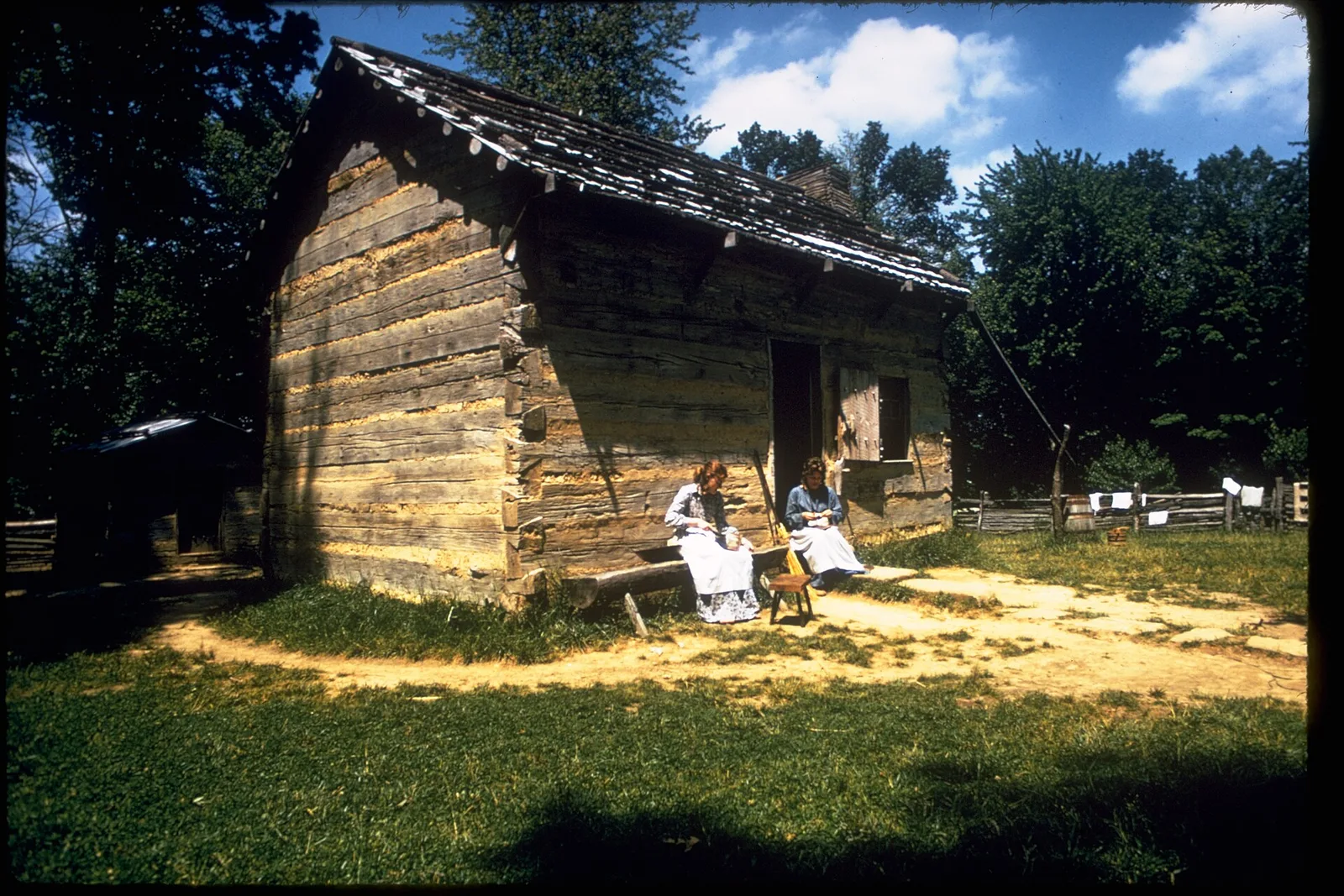
Abraham Lincoln moved to Indiana at age 7 in 1816, the same year the state was admitted to the Union, and lived in the southwestern corner of the state near present-day Lincoln City until age 21. Indiana was where Lincoln grew from a child to a young man, where his mother Nancy Hanks Lincoln died of milk sickness at age 34, and where his father Thomas remarried Sarah Bush Johnston, who became a beloved stepmother.
Lincoln later said his time in Indiana formed his character. The Lincoln Boyhood National Memorial preserves the farm site.
The family settled at Little Pigeon Creek in Spencer County, clearing forest for a hardscrabble farm. Nancy Hanks Lincoln died in 1818 of 'milk sickness,' poisoning that came from drinking milk of cows that had grazed on white snakeroot; the nine-year-old Abraham helped whittle the pegs for her coffin. His only sister, Sarah, died in childbirth in 1828.
Lincoln had under a year of formal schooling in Indiana but read borrowed books by firelight and walked miles to return them. In 1828, at nineteen, he took a flatboat of farm goods down the Mississippi to New Orleans and saw a large slave market for the first time. The Lincolns left for Illinois in 1830, driven partly by a fresh outbreak of milk sickness in the area.
The Indianapolis Motor Speedway opened in 1909 as a test track for the burgeoning automobile industry. On May 30, 1911, the first Indianapolis 500-Mile Race was held, Ray Harroun won in his Marmon Wasp at an average speed of 74.59 mph.
The race was conceived as an engineering proving ground, a way to test automotive technology under grueling conditions. It became the world's most famous motorsport event, drawing drivers and fans from around the globe, and earning its title as 'The Greatest Spectacle in Racing.'
Harroun's yellow Marmon Wasp carried what is often called the first rearview mirror fitted to a car, letting him race without the riding mechanic that every other entrant used to watch for traffic behind. The winner's share was about 14,000 dollars, and the race ran just under seven hours.
Early racing at the track was lethal, and after World War II, when the Speedway sat idle and overgrown, it was nearly sold off for a housing subdivision. Terre Haute businessman Tony Hulman bought it in 1945, rebuilt the grandstands, and revived the 500; his family owned the Speedway until selling it to Roger Penske in 2020.
In the 1920s, Indiana became the state with the largest Ku Klux Klan membership per capita in the country, with an estimated 250,000 to 500,000 members at its peak. The Indiana Klan, led by D.C. Stephenson, wielded enormous political influence, helping elect the governor, the mayor of Indianapolis, and dozens of state legislators.
The organization collapsed rapidly after Stephenson was convicted of the rape and murder of Madge Oberholtzer in 1925. The episode remains a sobering reminder of how quickly hate movements can seize political power.
At the 1924-25 peak, by some estimates roughly one in three native-born white men in Indiana belonged to the Klan, which sold itself less as a group of night riders than as a Protestant fraternal and political movement hostile to Catholics, Jews, immigrants, and Black residents. It effectively ran the state Republican Party and, through Governor Ed Jackson, elected in 1924, much of state government.
Grand Dragon D.C. Stephenson, one of the most powerful figures in Indiana, abducted and violently assaulted Statehouse worker Madge Oberholtzer in March 1925; she took poison and gave a detailed deathbed statement before dying of her injuries, and Stephenson was convicted of second-degree murder that November. When the governor he had helped elect refused to pardon him, Stephenson released records that sent a congressman, the Indianapolis mayor, and other officials to prison, and Klan membership in the state collapsed almost overnight.
Indiana's steel mills along Lake Michigan, especially in Gary, East Chicago, and Hammond, made the state one of the most productive industrial regions in the world during the postwar boom. The auto industry spread deep into the state as Detroit's Big Three and their suppliers built plants across Indiana.
Studebaker, founded in South Bend, was one of the most prominent American car manufacturers before closing in 1963. By the 1970s, Indiana had more of its workers in manufacturing than any other state, a distinction it still holds today.
The Calumet region mills, U.S. Steel's Gary Works, Inland Steel in East Chicago, and Bethlehem Steel at Burns Harbor, formed one of the greatest concentrations of heavy industry anywhere, producing close to a fifth of all U.S. steel by the 1950s. The work drew Black families north in the Great Migration and immigrants from Eastern Europe and Mexico into largely segregated company towns.
Studebaker had built wagons in South Bend since 1852 and cars since 1902 before it shut its U.S. plants in December 1963, throwing roughly 7,000 people out of work at once and becoming an early emblem of Rust Belt decline. Steel employment in northwest Indiana fell from about 70,000 in the late 1970s to under 20,000 two decades later as imports and mini-mills reshaped the industry, though the region still leads the nation in raw steel output.
Indiana's Defining Moments in American History
These are the events that didn't just shape Indiana, they changed the nation.
The Indianapolis 500, held annually on Memorial Day weekend, is the largest single-day sporting event in the world by attendance, drawing up to 300,000 spectators to the Indianapolis Motor Speedway. Since its first running in 1911, the race has been a crucible for automotive innovation: technologies including the rearview mirror, the balloon tire, and disc brakes were all developed or first used in Indy 500 competition.
Drivers who win the race drink milk on the victory stand, a tradition started in 1936.
The format has stayed remarkably fixed: 200 laps of a 2.5-mile rectangular oval for a distance of 500 miles, with a field of 33 cars set in 11 rows of three after multiple days of qualifying time trials. Average winning speeds have climbed from about 75 mph in 1911 to well over 185 mph in recent decades.
The milk custom began when 1936 winner Louis Meyer was photographed drinking buttermilk and a dairy executive seized on the image; every winner since 1956 has been handed milk and now states a preference (whole, 2%, or skim) beforehand. Together with the Monaco Grand Prix and the 24 Hours of Le Mans, the 500 forms motorsport's unofficial 'Triple Crown,' which only Graham Hill has ever swept.
The limestone quarried from Lawrence and Monroe counties in southern Indiana, known as Indiana Limestone or Salem Limestone, is one of the most widely used building materials in American architectural history. It is the stone used to build the Empire State Building, the Pentagon, the National Cathedral, and 35 of the 50 state capitols.
Its uniform texture, workability, and resistance to weathering made it the preferred material for government buildings and monuments throughout the late 19th and early 20th centuries. The Bedford-Bloomington stone belt remains an active quarrying region.
Salem Limestone is a nearly pure calcium-carbonate rock made almost entirely of the fossilized shells of tiny sea creatures laid down about 330 million years ago, when the area lay beneath a shallow tropical sea. It has no bedding planes or directional grain, so it can be sawn and carved in any direction, which is why it became the architect's and sculptor's stone of choice.
Demand jumped after the 1871 Chicago fire and the 1904 Baltimore fire showed that limestone withstood heat that shattered other stone. The Bedford and Bloomington quarries went on to supply the Empire State Building, the Pentagon, Washington National Cathedral, the Yankee Stadium facade, and courthouses and campuses across the country, and the region still marks an annual Limestone Month.
Colonel Eli Lilly founded his pharmaceutical company in Indianapolis in 1876 with a commitment to using rigorous scientific methods to produce medicines, a radical idea at a time when most remedies were unregulated patent medicines. Lilly was the first company to mass-produce penicillin during World War II.
It developed the first commercial insulin product in 1923, transforming diabetes from a death sentence into a manageable condition. In recent years, Lilly's development of tirzepatide (Mounjaro/Zepbound) for diabetes and weight loss has made it one of the most valuable pharmaceutical companies in the world.
Eli Lilly himself was a Union Army colonel and trained pharmaceutical chemist who started the firm to make standardized, accurately dosed drugs. Its 1923 insulin product, Iletin, was made under a nonprofit license from the University of Toronto scientists who discovered the hormone, and within a year it was reaching thousands of diabetic patients who would otherwise have died.
Lilly went on to produce the first mass batches of the Salk polio vaccine in 1955 and to develop Prozac, launched in 1987, which reshaped the treatment of depression. The GLP-1 drugs Mounjaro and Zepbound, approved in 2022 and 2023, pushed the company's market value above 700 billion dollars, briefly making it the most valuable health-care company in the world and by far the largest ever based in Indiana.
Notable Hoosiers
Abraham Lincoln
16th President, spent his boyhood years growing up in Indiana
Benjamin Harrison
23rd President of the United States, lived in Indianapolis
Michael Jackson
King of Pop, the best-selling music artist of all time, born in Gary
Larry Bird
NBA legend and three-time champion with the Boston Celtics, born in West Baden Springs
Ernie Pyle
Beloved WWII correspondent who brought soldiers' humanity to the home front, born in Dana
John Mellencamp
Rock musician and heartland icon known for Jack and Diane, born in Seymour
State Symbols & Quick Facts
| Nickname | "The Hoosier State" |
| Capital | Indianapolis |
| Largest City | Indianapolis |
| Statehood | December 11, 1816 (19th state) |
| Population | ~6.9 million (2025 est.) |
| Area | 36,420 sq mi, 38th largest state |
| Motto | The Crossroads of America |
| State Bird | Northern Cardinal |
| State Flower | Peony |
| State Tree | Tulip Poplar |
| State Stone | Salem Limestone (Indiana Limestone) |
| State River | Wabash River |
| State Song | "On the Banks of the Wabash, Far Away" |
| Time Zone | Eastern Time (UTC−5 / UTC−4) |
| Borders | Michigan (N), Lake Michigan (NW), Ohio (E), Kentucky (S), Illinois (W) |
Did You Know?
Indiana is the #1 manufacturing state per capita in America, more of its workforce is employed in manufacturing than in any other state. The sector produces everything from steel and auto parts to pharmaceuticals and recreational vehicles.
Indiana is the undisputed world capital of recreational vehicle manufacturing. Indiana builds about 80% of all RVs made in the United States, most of them in and around Elkhart County. The town of Elkhart calls itself the 'RV Capital of the World.'
Santa Claus, Indiana is a real town, and it has a ZIP code (47579). The town receives millions of pieces of mail addressed to Santa Claus every December, and volunteers answer every letter. The town also has a theme park called Holiday World.
Indiana limestone was used to build 14 state capitol buildings, the Empire State Building, the Pentagon, and the National Cathedral in Washington D.C. The Lawrence and Monroe county quarries have been supplying American architecture for over 150 years.
Indiana and Nebraska grow most of America's popcorn, and Orville Redenbacher developed his famous hybrid in Valparaiso, Indiana. Popcorn is a special variety of corn whose hard, moisture-sealed hull lets the kernel burst when heated.
Quick Facts and Common Questions
Short answers to the questions people most often ask about Indiana: its abbreviation, what a Hoosier is, its capital, and its place in Congress.
Indiana's two-letter postal abbreviation is IN. The U.S. Census Bureau places it in the Midwest region, in the East North Central division, and about 6.79 million people lived there in the 2020 census.
Indiana became the 19th state on December 11, 1816. Its land was part of the Northwest Territory until Congress created the Indiana Territory in 1800, with future president William Henry Harrison as its first governor.
Indiana means "Land of the Indians." Congress used the name when it created the Indiana Territory in 1800, adding a Latin-style ending to the English word "Indian."
A Hoosier is a person from Indiana, and "The Hoosier State" is Indiana's nickname. The word was in use by the early 1830s, but its origin is unknown; the Indiana Historical Bureau notes several competing explanations, none of them proven.
Indianapolis has been the capital since 1825. The territorial capital was Vincennes, then Corydon, which served as the first state capital from 1816 to 1825. Indianapolis was laid out as a planned capital city near the center of the state, and the current State Capitol was completed in 1888.
Indiana borders Michigan to the north, Ohio to the east, Kentucky to the south across the Ohio River, and Illinois to the west. In the northwest it has about 45 miles of shoreline on Lake Michigan.
Indiana's motto is "The Crossroads of America," a nod to the many highways and rail lines that cross the state. Its state bird is the northern cardinal, its flower is the peony, and its tree is the tulip tree (tulip poplar).
Based on the 2020 census, Indiana has 9 seats in the U.S. House of Representatives, the same as before, which gives it 11 votes in the Electoral College.
The first Indianapolis 500 was held at the Indianapolis Motor Speedway on May 30, 1911, and was won by Ray Harroun. The 2.5-mile oval, opened in 1909, is often called "the Brickyard" because its track was paved with about 3.2 million bricks.
Indiana Dunes National Park
15 Miles of Lake Michigan Shoreline Where Prairie, Forest, and Dune Meet
About Indiana Dunes National Park
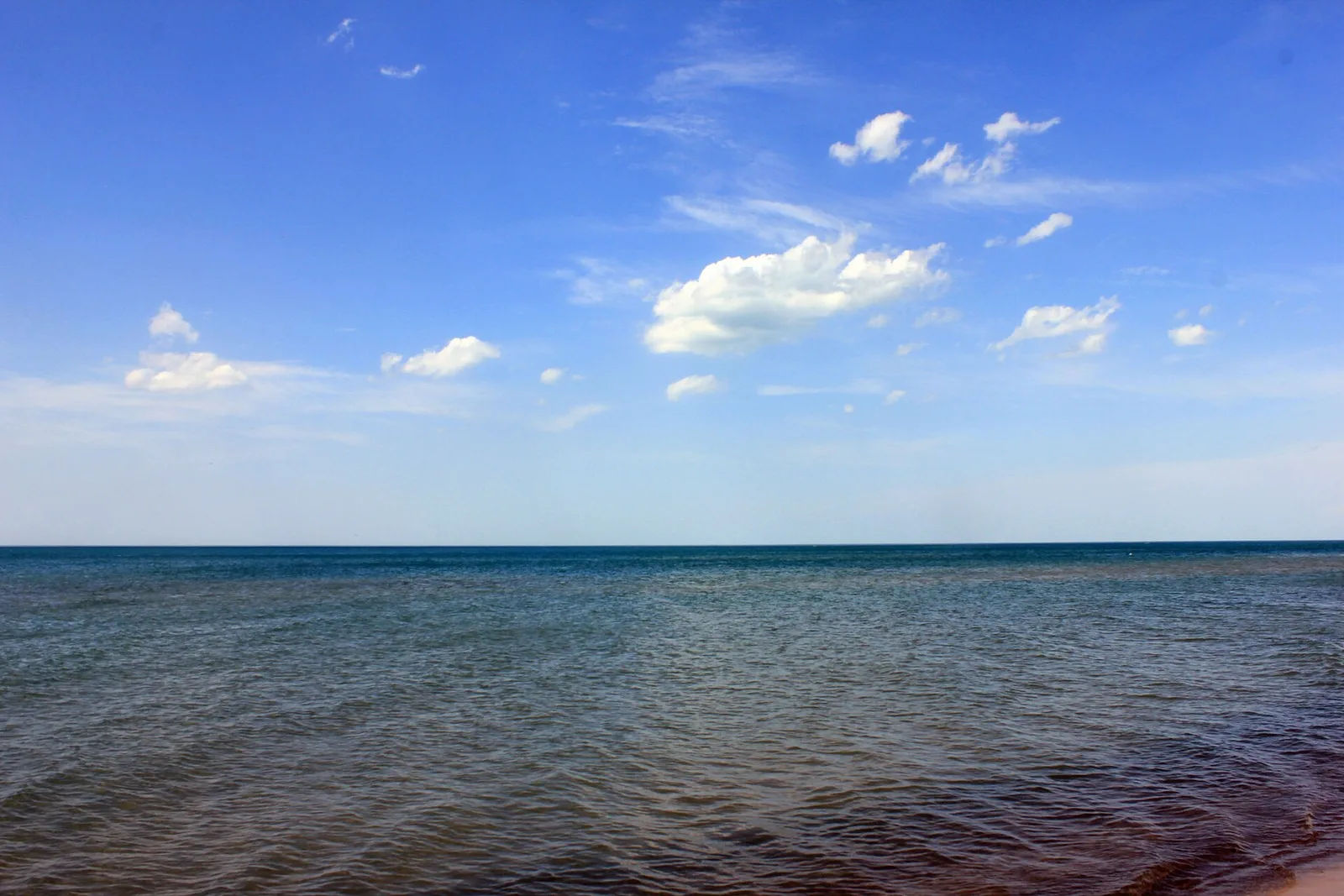
Indiana Dunes National Park stretches along roughly 15 miles of Lake Michigan's southern shore in northwest Indiana, packing beaches, tall dunes, marshes, bogs, oak savanna, and prairie into about 15,000 acres less than an hour from Chicago.
More than 1,100 native plant species grow within that small area, one of the highest counts of any unit in the National Park System, the result of glacial history stacking many habitats side by side.
The dune field records the last 14,000 years: as glacial meltwater lakes drained in stages, each drop left a beach ridge farther out, and the ridges get older as you walk inland, from bare sand to marram grass to cottonwood to pine to old oak forest.
Congress made it Indiana Dunes National Lakeshore in 1966, after a 15-year 'Save the Dunes' campaign and a long push by Senator Paul Douglas of Illinois, and redesignated it a national park in February 2019, the first in Indiana.
- Designation
- National Park
- Location
- Porter, LaPorte, and Lake Counties, Indiana
- Established
- 1966 (Lakeshore), 2019 (National Park)
- Annual Visitors
- ~3.1 million
Habitats of Indiana Dunes
The park's beaches front directly on Lake Michigan; behind them, open dunes still move with the wind, while the state park next door holds the tallest, Mount Tom at about 192 feet.
Mount Baldy, near Michigan City, is a 'wandering' dune roughly 126 feet high that has been marching inland about four feet a year, burying a stand of oaks as it goes.
In 2013 a six-year-old boy was swallowed by a hole that opened suddenly in Mount Baldy and was dug out alive after more than three hours; researchers then found the dune riddled with voids left by decomposed buried trees.
Mount Baldy has been closed to unguided access ever since, and the summit can be reached only on ranger-led hikes up the stable back side.
Long, wet troughs between the dune ridges, the largest called the Great Marsh, form where the water table meets the low ground and serve as stopovers for migrating waterfowl, herons, and marsh birds.
The Great Marsh, the biggest interdunal wetland on Lake Michigan's south shore, had been ditched and drained for farming; an ongoing Park Service project has been plugging ditches and clearing invasive reed to bring the water back.
Pinhook Bog is a true quaking sphagnum bog in a glacial kettle, the only one of its kind in Indiana, and its floating mat trembles underfoot.
The bog holds pitcher plants, sundews, and other acid-loving plants left over from a colder post-glacial climate, and to protect it the Park Service allows entry only on guided hikes.
Inland from the wetlands the park keeps remnants and restorations of black oak savanna and tallgrass prairie, open, grassy, sun-lit woodland that once covered much of the Midwest and now survives in scraps.
These communities need fire; the Park Service burns them on a rotation to kill encroaching brush and trigger the prairie plants, and it has converted old farm fields back toward savanna.
The habitat variety, dune, marsh, bog, savanna, prairie, and forest in a compact area, is why more than 350 bird species have been recorded in the park.
Piping plovers, whose Great Lakes population is federally endangered, have returned to nest on park beaches in recent years under close protection.
Cowles Bog, a National Natural Landmark, is named for the University of Chicago botanist Henry Chandler Cowles, whose 1899 study of the dunes helped found the science of plant ecology in North America.
Cowles saw that walking inland from the beach was like watching time pass: bare sand gave way to grass, then shrubs, then pine, then climax oak forest, a sequence he called ecological succession.
The idea that plant communities develop in a predictable series toward a stable end point shaped ecology for decades and is still taught from these dunes.
The Cowles Bog Trail runs that same gradient today, from a wetland through wooded dunes to the beach, and the 'bog' is technically a fen fed by mineral-rich groundwater rather than a true acid bog.
Indigenous Connections
Potawatomi People
The Potawatomi were the main people of the southern Lake Michigan shore when French traders arrived, with villages along the lake and the rivers, the Calumet, the Little Calumet, and Trail Creek, that drain into it.
The fur trader Joseph Bailly built a trading post on the Little Calumet here around 1822, at the edge of Potawatomi country and on a portage route between the lake and the Kankakee River.
The 1833 Treaty of Chicago took the Potawatomi's remaining land around the lake, and over the following years most were removed west to Kansas; one forced march in 1838 is remembered as the Potawatomi Trail of Death.
After the forced cession of their Lake Michigan territory in the Treaty of Chicago (1833), most Potawatomi were removed to Kansas and Oklahoma. The Pokagon Band of Potawatomi Indians, headquartered in Dowagiac, Michigan, maintains federal recognition and historical connections to the Lake Michigan shoreline region.
Miami and Mascouten Peoples
Before the Potawatomi pushed north and west into the region, the Miami and the Mascouten held parts of the Indiana lakeshore and the Kankakee marshes to the south.
Both were displaced during the upheavals of the Beaver Wars and the fur trade in the 1600s and 1700s, the Mascouten eventually merging into other nations and disappearing as a distinct people.
The Miami stayed a major power in the Wabash valley until the treaties and removals of the 1830s and 1840s split the nation between those forced to Kansas and Indian Territory and those who remained in Indiana.
The Miami Tribe of Oklahoma is the federally recognized Miami nation; the Miami Nation of Indiana, whose federal recognition was ended in 1897, is recognized by the state and keeps a community in the Wabash valley.
Adventures at Indiana Dunes
Mount Baldy Guided Hike
Mount Baldy is open only on ranger-led hikes because of the tree-cast voids that opened in the dune, discovered after the 2013 rescue of a buried child.
The guided route climbs the vegetated back side to the crest rather than the loose, hazardous lakeward face.
From the top, the view runs from the Michigan City lighthouse and power-plant stack to the Chicago skyline across the water on clear days.
Rangers use the walk to show the dune actively burying its oak forest, with dead treetops sticking out of the sand where the crest has passed over them.
West Beach Swimming and Dune Climb
West Beach, on the park's western end near Gary, is the main developed swimming beach, with a bathhouse and summer lifeguards.
The Dune Succession Trail from the parking lot climbs about 270 stairs and a boardwalk through the same sand-to-oak-forest gradient Cowles described.
Connecting loops, the Long Lake Trail and the West Beach Trail, add marsh and interdune pond habitat to the walk.
Lake Michigan has no tide but strong wind-driven currents; rip and structural currents near the breakwaters here have caused drownings, and swimming is limited to the guarded zone.
Birding Migration Watching
The dunes sit on a major migration corridor: birds moving along Lake Michigan's shore in spring and fall funnel around its southern tip and concentrate here.
More than 350 species have been recorded, and the compressed habitat means a single morning can turn up shorebirds, warblers, raptors, and waterfowl.
The park and local Audubon groups run an autumn hawk watch and a spring birding festival, and the Great Marsh and the Heron Rookery are reliable hotspots.
The South Shore Line electric railroad has stops inside the park, so many birders arrive from Chicago or South Bend without a car.
Conservation Challenges
Industrial Adjacency
The park is broken into pieces threaded through one of the most heavily industrialized shorelines in the country: US Steel's Gary Works, the Cleveland-Cliffs Burns Harbor mill, the Port of Indiana, and coal and gas power plants all sit within or against it.
Historic contamination is a live issue; the nearby Grand Calumet River was long one of the most polluted rivers in the Great Lakes and is a federal Area of Concern.
In 2017 a chromium spill from the Burns Harbor mill reached the park's beaches and briefly closed them, one of several plant discharges over the years.
The park works with the mills and the state on air and water monitoring, and decades of Clean Water Act enforcement and dredging have measurably improved the Grand Calumet.
Lake Michigan Water Levels
Lake Michigan's level swings about six feet over cycles of years to decades, with no dams to hold it steady.
It hit a record low in 2013 and a record high in 2020; the high water cut back beaches and bluffs across the park and wrecked stairs, boardwalks, and parking.
Because the shoreline is starved of new sand, partly by breakwaters and harbor structures updrift, eroded beach does not readily rebuild.
The Park Service now plans structures to be movable or expendable and is studying where to let the shoreline retreat rather than armor it.
Invasive Species
Common reed, purple loosestrife, and Japanese knotweed crowd the park's wetlands and disturbed ground, and reed in particular had taken over much of the Great Marsh before restoration began.
Oriental bittersweet and garlic mustard invade the wooded dunes, and the emerald ash borer has killed most of the park's ash trees.
In the lake and rivers, zebra and quagga mussels, round goby, and other aquatic invaders have reworked the food web that feeds the park's fish and birds.
Sitting against a metropolitan area of nine million people, the park faces constant reintroduction, so invasive control here is maintenance rather than a one-time job.
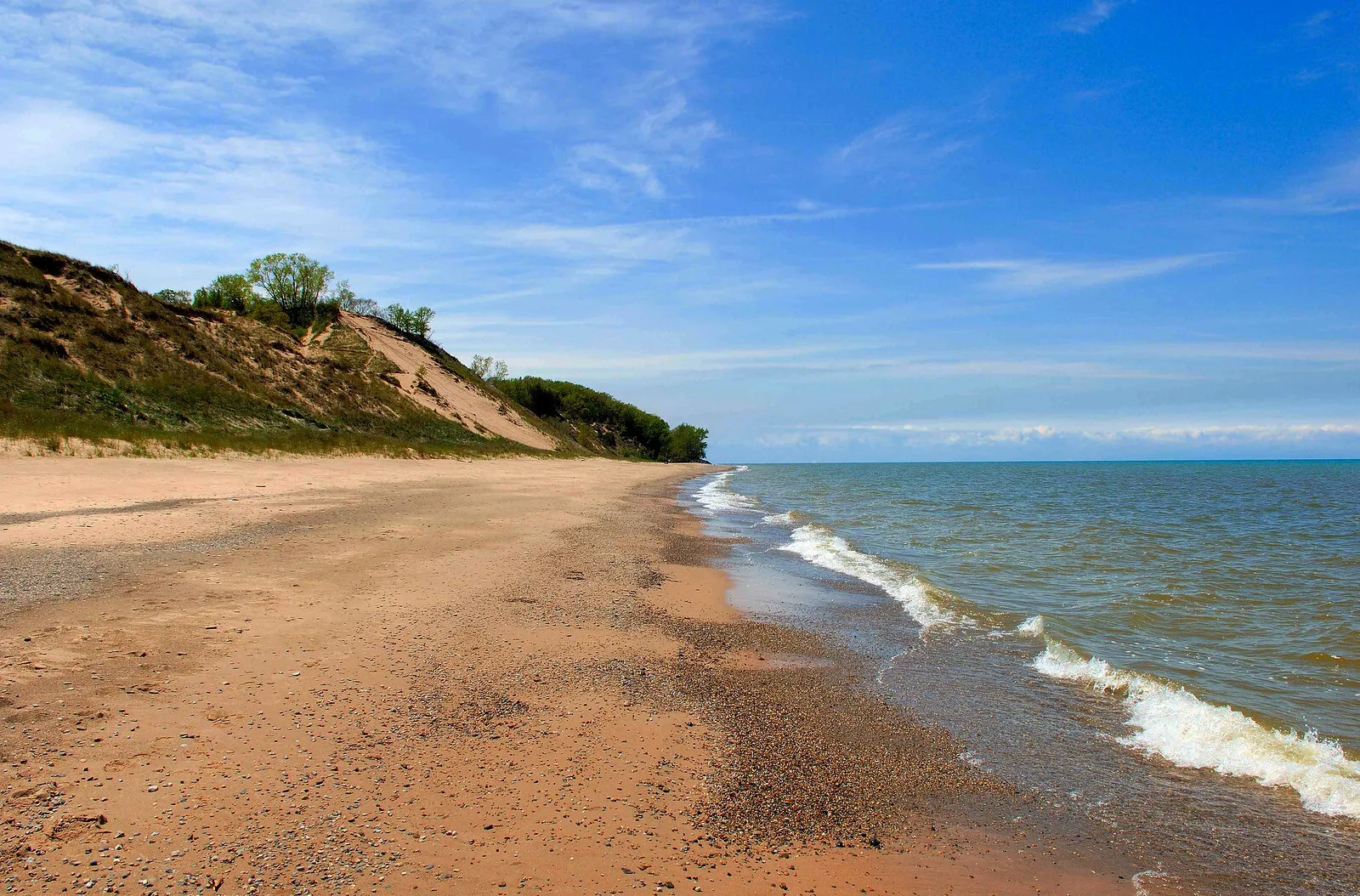
Mount Baldy, the park's tallest active dune, migrating inland several feet per year
At a Glance
Did You Know?
Indiana Dunes National Park ranks fourth among U.S. national parks in plant diversity, with over 1,100 species documented in 15,000 acres, representing nearly half of all plant species found in Indiana.
The science of ecological succession was developed here. Botanist Henry Chandler Cowles used the Indiana Dunes in the 1890s to show how plant communities change over time, establishing one of the foundations of modern ecology.
Indiana Dunes is the only national park where you can see a major city skyline (Chicago) from the park's shoreline, with the city's skyscrapers visible across Lake Michigan on a clear day.
Mount Baldy, the park's largest active dune, has buried entire trees as it migrates inland. In 2013, a 6-year-old boy fell into one of the subsurface tree voids and was trapped for three hours before being rescued.
Plan Your Visit
Location
Porter, LaPorte, and Lake Counties, Indiana
Designation
National Park
Best Time to Visit
Year-round; summer for swimming, fall for migration, winter for storm watching
Admission
Free park entry; parking fees at some areas during peak season