
About North Dakota
North Dakota takes its name from the Dakota people, one of the three divisions of the Great Sioux Nation, whose name means "allies" or "friends" in the Lakota-Dakota-Nakota language. The Dakota Territory was organized by Congress in 1861 to govern the region. When the territory had grown enough to apply for statehood, debate arose over whether to admit it as one large state or divide it into northern and southern halves. Congress chose to divide it, and North Dakota and South Dakota were admitted simultaneously on November 2, 1889. President Benjamin Harrison reportedly shuffled the admission documents so that no one would know which state was technically admitted first.
North Dakota is the most misunderstood state in America. It is simultaneously the least visited, least populated, and most overlooked, and yet it is the nation's agricultural powerhouse, the site of one of the most radical experiments in public enterprise in American history, the landscape that shaped a president, and, for one extraordinary decade, the fastest-growing energy economy in the country. Its 70,000 square miles of rolling prairie, badlands, and river valley hold more history than their quiet surface suggests.
The state's character was formed by three forces acting simultaneously: the extreme climate of the northern Great Plains, which demands a particular toughness and practicality from those who stay; the Scandinavian and German-Russian immigrant culture that settled the prairies and built cooperative institutions to survive together; and the perpetual economic tension between the small farmers who produce the state's wealth and the distant corporations, grain companies, railroads, banks, that have historically extracted it. That tension produced the Nonpartisan League and its radical innovations, the Bank of North Dakota, and a political culture that remains deeply populist beneath its conservative surface.
The Bakken oil boom of the 2000s and 2010s jolted North Dakota into national visibility and strained its institutions, its infrastructure, and its sense of itself. The boom has leveled off, but the questions it raised, about what kind of place North Dakota wants to be, how to sustain rural communities while cities grow, what the Legacy Fund's billions are for, remain unanswered. They are the questions of a state that has been many things to many people, and has not yet decided what it wants to be next.
North Dakota's Five Regions
The Red River Valley, stretching along North Dakota's eastern border with Minnesota, is one of the most remarkable agricultural landscapes on Earth: an almost perfectly flat plain left by the bed of glacial Lake Agassiz, whose deep black soils accumulated over thousands of years of submerged prairie vegetation and sediment deposition. The Red River of the North, one of the few rivers in the continental US that flows northward, draining into Lake Winnipeg and ultimately Hudson Bay, bisects this landscape, forming the North Dakota-Minnesota border.
Fargo, on the valley's western edge, is North Dakota's largest city and primary economic hub, home to NDSU, the region's medical center, and a growing technology and services sector that has diversified the city's economy beyond agriculture. Grand Forks, to the north, is home to the University of North Dakota and Grand Forks Air Force Base.
The valley's flat terrain, while ideal for farming, creates a particular vulnerability to flooding: the Red River floods in spring with clocklike regularity, and the catastrophic 1997 flood, which inundated Grand Forks and forced the evacuation of the entire city, remains one of the most significant natural disasters in North Dakota history. A permanent diversion channel around Fargo, completed in phases through the 2010s and 2020s, is among the largest flood control infrastructure projects in the country.
The valley's agricultural economy, dominated by sugar beets, wheat, soybeans, corn, and sunflowers, supports a processing industry including American Crystal Sugar Company and several grain elevator cooperatives that are among the largest in the world.
The Missouri River cuts through the heart of North Dakota from the northwest to the southeast, dividing the state's plains and providing the corridor through which much of the state's history traveled. Bismarck, the state capital, sits on the Missouri's east bank with Mandan directly across the river, twin cities that together form the state's second-largest urban area and its political center.
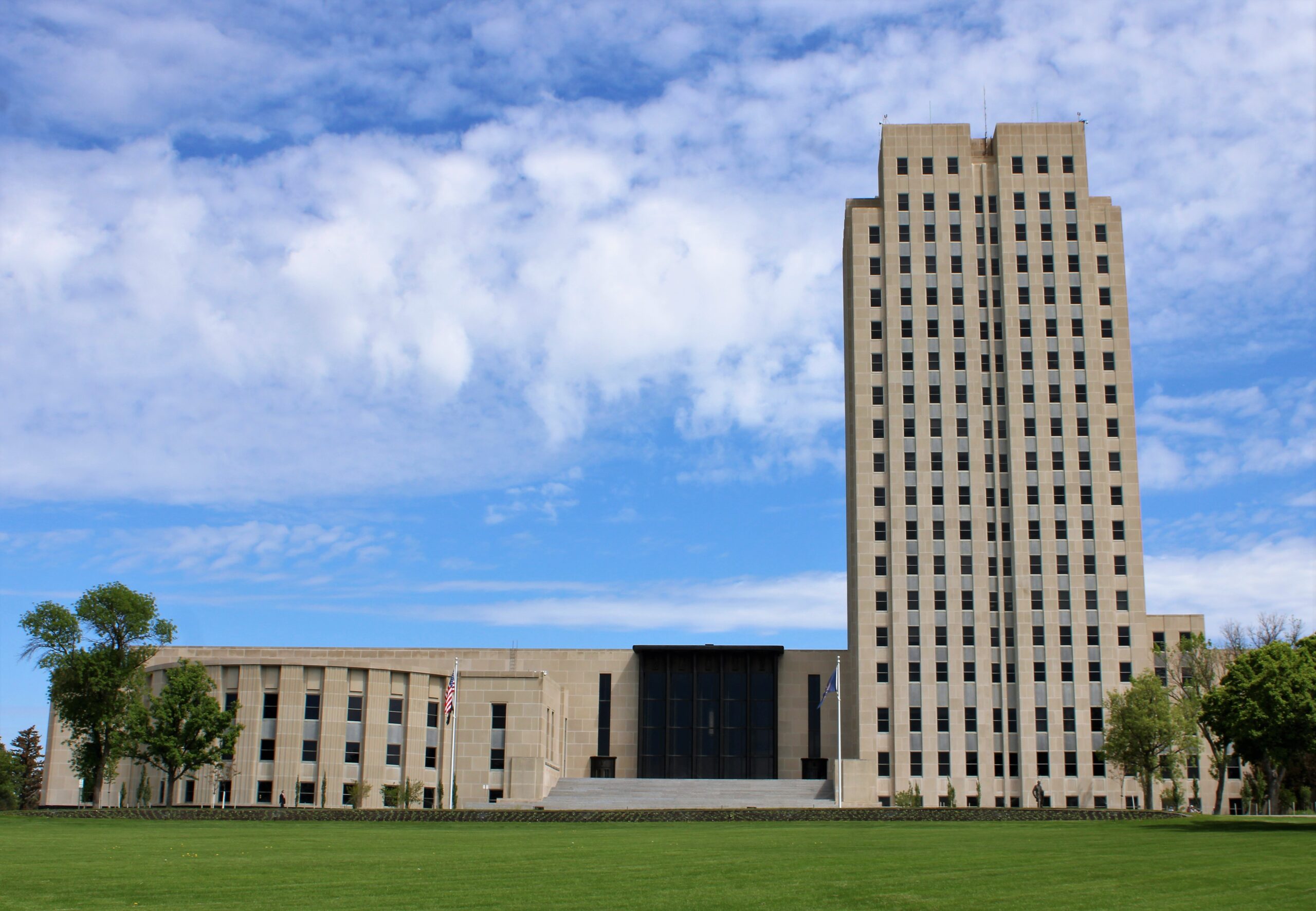
North Dakota's State Capitol is one of the most architecturally unusual capitols in America: not the traditional domed neoclassical building but a 19-story Art Deco skyscraper completed in 1934, the tallest building in North Dakota and nicknamed 'the skyscraper of the prairies.'
The Missouri River corridor is where Lewis and Clark spent the winter of 1804-1805 at Fort Mandan, met Sacagawea and Toussaint Charbonneau, and gathered the geographical knowledge they needed to continue west to the Pacific. The Mandan and Hidatsa village sites at Knife River, some of the largest pre-contact settlements in the northern Great Plains, are preserved as a National Historic Site near Stanton.
The Missouri's flow was dramatically altered in the 20th century by the Pick-Sloan Missouri Basin Program: the Garrison Dam, completed in 1953, created Lake Sakakawea, one of the largest man-made reservoirs in the United States, which stretches nearly 200 miles through western North Dakota. The dam's construction required the forced relocation of the Three Affiliated Tribes (Mandan, Hidatsa, and Arikara) from their Missouri River bottomlands, a displacement from their most productive agricultural land that the tribes call 'the flooding' and which remains a defining trauma in their collective history.
The Williston Basin, a geological depression in western North Dakota and adjacent Montana and Saskatchewan, sits atop the Bakken Shale formation and has been transformed over the past two decades by the hydraulic fracturing revolution into one of the most active oil-producing regions in the world. Williston, the largest city in the basin at the confluence of the Missouri and Yellowstone rivers, became the epicenter of a boom that attracted workers from every state and reshaped the demographics and character of western North Dakota.
At the peak of the boom, Williston ranked as one of the fastest-growing cities in the United States, with a median household income that briefly exceeded that of San Jose, California, driven by oil field workers earning six-figure salaries.
The landscape of the Bakken is distinctive: pump jacks dotting the rolling plains as far as the eye can see; flares from natural gas burn-offs lighting the night sky in patterns visible from space; massive water transport trucks, sand haulers, and heavy equipment convoys turning rural county roads into industrial corridors; and a horizon punctuated by oil storage tanks and processing facilities. Minot, the region's largest city and home to Minot Air Force Base, is the commercial center for the northwestern plains and the northern entry point for the Bakken economy.
The oil boom created an infrastructure crisis: North Dakota's roads, designed for agricultural traffic, were not built to handle hundreds of thousands of truck trips per year, and the state spent billions repairing and upgrading its transportation network. The Legislature's Legacy Fund, a sovereign wealth fund created to save oil revenues for future generations, had accumulated over $10 billion by the mid-2020s.
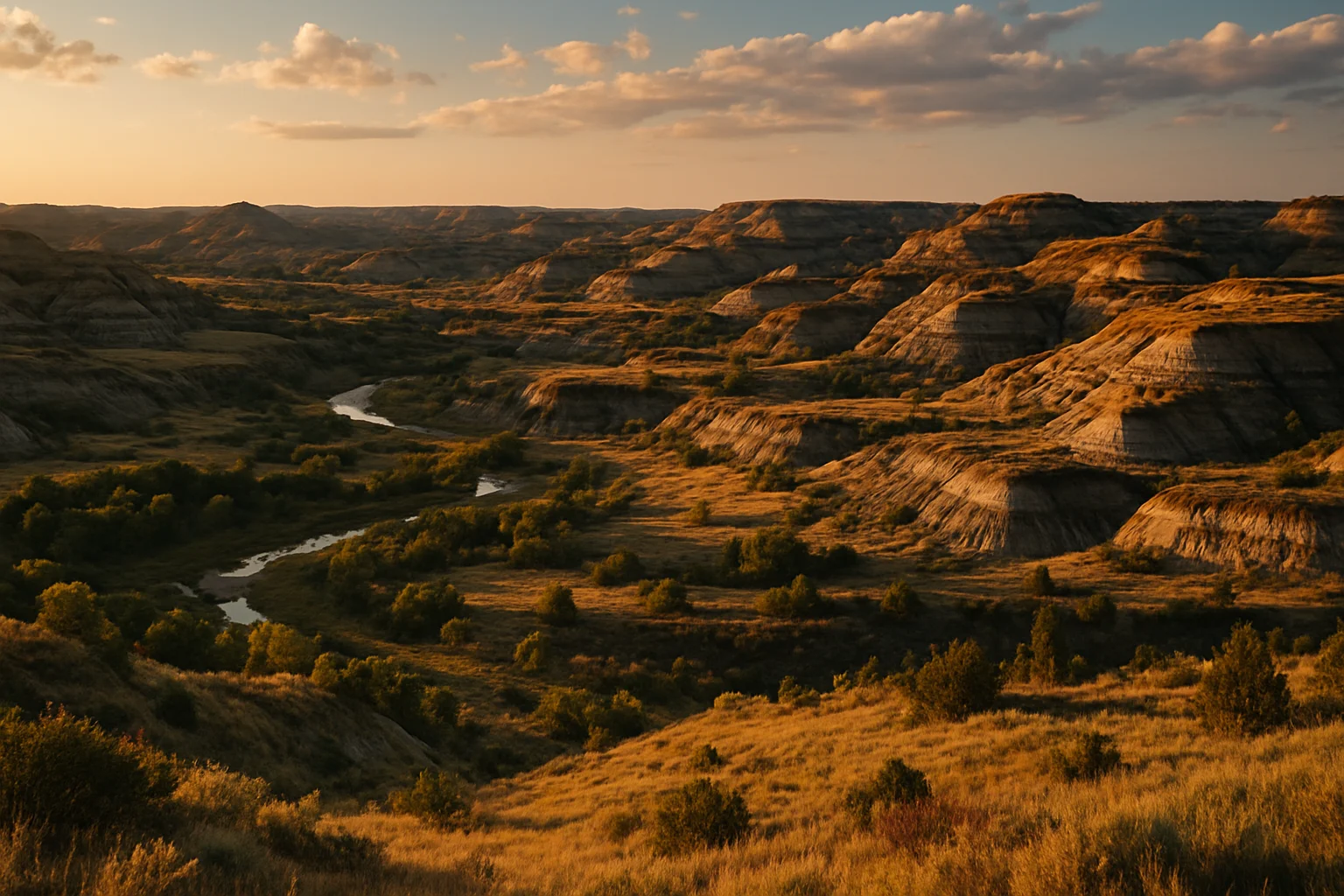
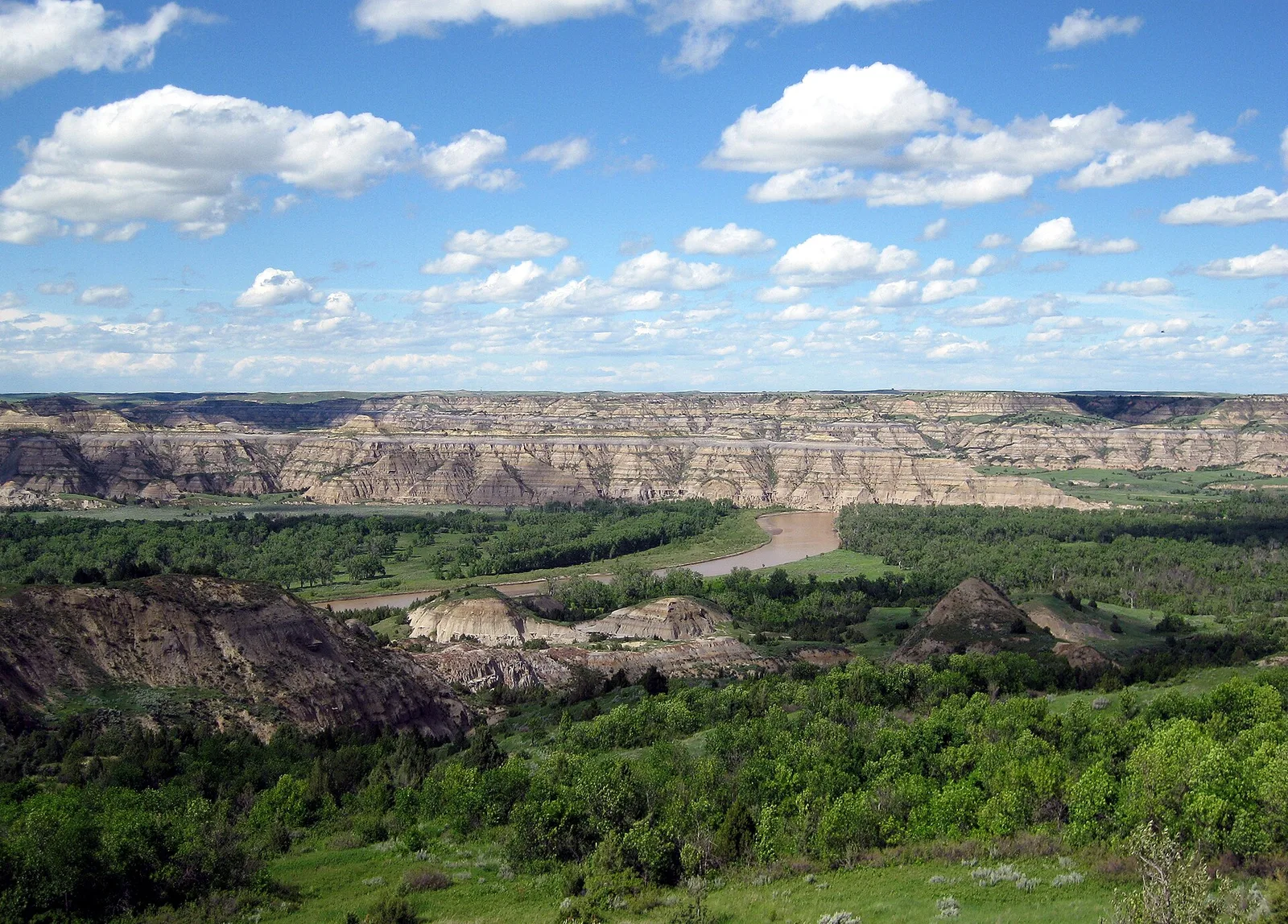
The North Dakota Badlands occupy the southwestern corner of the state, where the Little Missouri River has carved a landscape of buttes, canyons, and colorful layered sediment over millions of years into some of the most dramatic terrain in the American Great Plains.
Theodore Roosevelt National Park, split into a North Unit near Watford City and a South Unit near Medora, preserves the Badlands landscape where the young Theodore Roosevelt came to hunt bison in 1883 and ended up ranching for several years, an experience he credited with making him the man, and the president, he became. The park's mixed-grass prairie and eroded butte landscape supports free-ranging bison herds, wild horses, pronghorn antelope, elk, bighorn sheep, and prairie dog towns that give visitors a sense of what the pre-contact Great Plains ecosystem looked like.
Medora, a small town at the South Unit entrance founded by the Marquis de Morès (a French nobleman who tried and failed to build a cattle empire in the 1880s), has become North Dakota's premier tourism destination, offering the Medora Musical (an outdoor show running every summer since 1964), the Chateau de Morès State Historic Site, and access to backcountry hiking and horseback riding in the park. The Little Missouri National Grassland, surrounding the park, is the largest national grassland in the United States.
The Badlands region has also benefited from the Bakken oil boom: much of the Williston Basin's production is in the badlands geology, and the juxtaposition of oil infrastructure and wilderness landscape is one of the defining visual contradictions of modern North Dakota.
The northern tier of North Dakota, stretching from the Turtle Mountains on the Canadian border east to the Red River Valley and centered on the Devils Lake basin, is one of the least-known regions of the least-known state in America, a landscape of prairie pothole wetlands, migratory waterfowl concentrations, small agricultural cities, and a slow-motion natural disaster that has been reshaping the region for three decades.
Devils Lake, a terminal lake with no natural outlet, has been rising since the early 1990s due to increased precipitation and reduced evapotranspiration, growing from approximately 50,000 acres in 1993 to over 200,000 acres by the 2020s. The rising water has submerged farms, roads, bridges, and parts of small communities, requiring hundreds of millions in federal disaster and infrastructure spending and forcing the construction of a series of pumping and diversion systems to relieve water levels.
Minot, the largest city in the region and home to Minot Air Force Base, is the commercial hub of the northern plains and the site of a catastrophic 2011 flood on the Souris River that inundated several thousand homes and required the evacuation of 12,000 people.
The Turtle Mountains, a low wooded plateau on the Manitoba border, are the only significant forest in an otherwise treeless landscape, a range of hills and lakes covering perhaps 600 square miles that provides habitat, recreation, and a cultural homeland for the Turtle Mountain Band of Chippewa Indians. The International Peace Garden, established in 1932 on the North Dakota-Manitoba border to symbolize the peaceful relationship between Canada and the United States, gives North Dakota its official nickname and hosts gardens, memorials, and a performing arts camp each summer.

Economy
North Dakota's economy is driven by two commodities, wheat and oil, and supported by a military presence, a technology sector growing faster than most outsiders realize, and a set of public institutions unique in American history. It is the economy of a small, self-reliant state that has found ways to punch well above its weight.
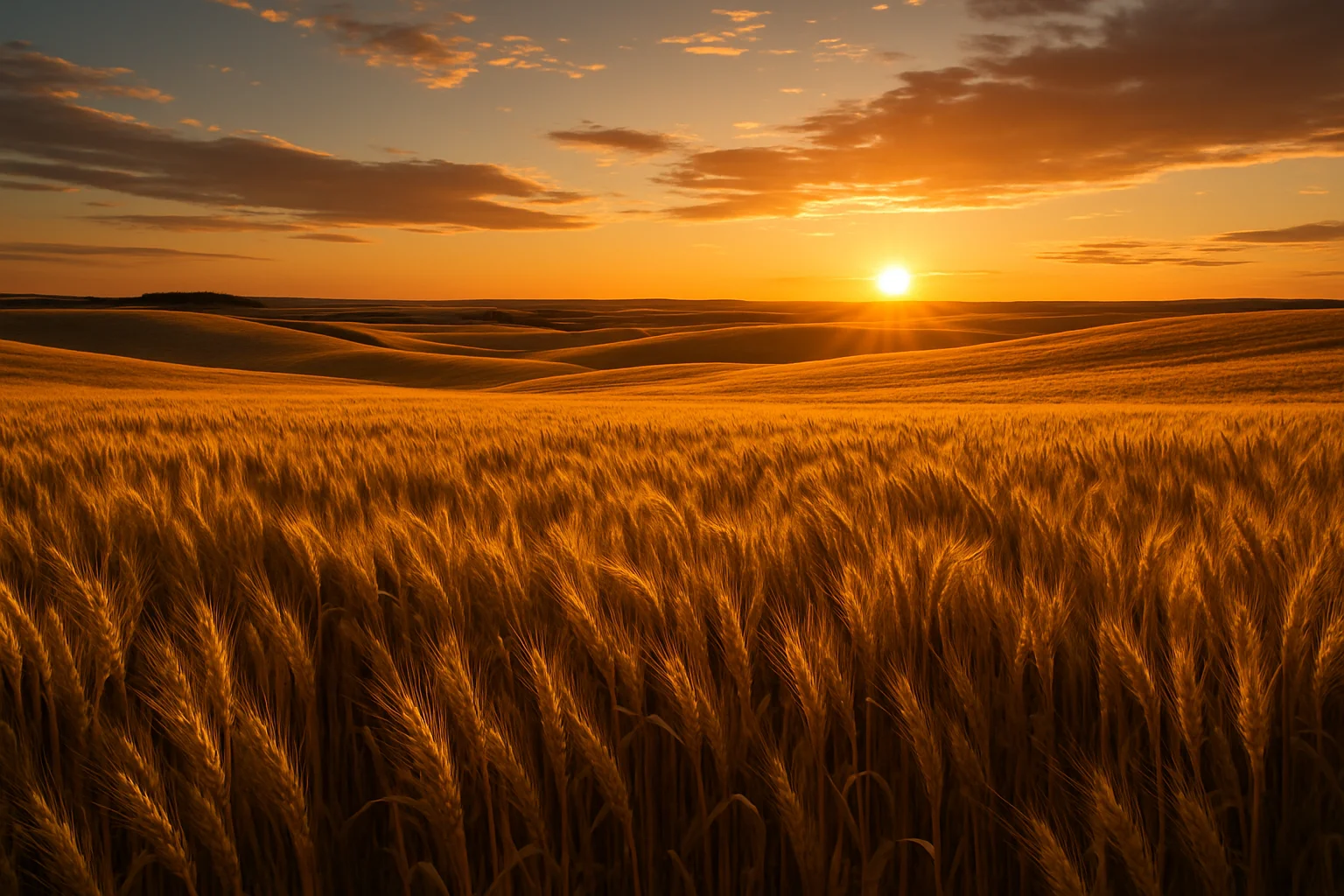
It is the number-one producer of spring wheat, durum wheat (the hard wheat that makes pasta), sunflowers (both oil-type and confection), canola, flaxseed, pinto beans, navy beans, lentils, dry edible peas, and honey, a remarkable concentration of agricultural dominance in a state with fewer than 800,000 people.
The Red River Valley, formed by the bed of glacial Lake Agassiz, is widely regarded as the most productive agricultural land in North America: its deep black soils, accumulated over millennia of prairie grass growth and lacustrine deposition, can reach 200 feet in depth in some areas, and the nearly perfectly flat terrain allows for massive mechanized farming operations. A single North Dakota farm might stretch 10,000 or 20,000 acres, operated by a family with sophisticated GPS-guided equipment that would have been unimaginable a generation ago.
The state's agricultural research infrastructure, centered on North Dakota State University in Fargo, is among the best in the world for cold-climate crop development: NDSU's plant sciences programs have developed wheat, sunflower, and pulse crop varieties that have been adopted across the northern plains and exported to similar climates worldwide.
The challenge facing North Dakota agriculture is the same one facing farming across the Great Plains: farm consolidation continues, rural communities are hollowing out, commodity prices are volatile, and the economics of farming increasingly favor very large operations over family-scale ones. The state's population has been sustained partly by the Bakken oil boom and partly by the stubborn resilience of farm families who have no intention of leaving the land their great-grandparents homesteaded.
When those technologies matured, the result was one of the fastest energy booms in American history. North Dakota's oil production increased from approximately 50,000 barrels per day in 2005 to over 1.4 million barrels per day at its 2019 peak, making it briefly the second-largest oil-producing state in the country.
The economic transformation of western North Dakota was staggering: Williston, a small agricultural city of 12,000 people, grew to nearly 30,000 within a decade, with housing in trailers and makeshift man camps, traffic that turned rural highways into congested corridors, and wages for oil field workers that exceeded what most college graduates earned. The state government collected billions in oil tax revenue that funded infrastructure, education endowments, and the Legacy Fund, a state savings account that had accumulated over $10 billion by the mid-2020s.
The boom also brought the inevitable complications: environmental incidents including the Tesoro pipeline spill of 2013 (one of the largest inland oil spills in US history), the Standing Rock Sioux Tribe's months-long protest against the Dakota Access Pipeline in 2016 (one of the most significant Indigenous rights protests in recent decades), and the bust cycle of 2015-2016 when oil prices collapsed and the state faced sudden budget shortfalls.
The Bakken remains an active producing region, with production stabilized at approximately 1 million barrels per day, and the state continues to balance extraction revenues with environmental and community impacts.
The 91st Missile Wing at Minot operates 150 Minuteman III ICBMs dispersed in hardened silos across a 15,000-square-mile area of the northern prairies, an area larger than Maryland. The 5th Bomb Wing operates B-52H Stratofortress bombers capable of delivering nuclear weapons anywhere in the world within hours. Together, Minot's forces represent a substantial fraction of the US nuclear deterrent.
Grand Forks Air Force Base, in the eastern part of the state, has evolved from a formerly nuclear-armed missile and bomber base into a center for unmanned aerial vehicle (drone) operations and intelligence, surveillance, and reconnaissance missions; it has been designated as the primary training center for RQ-4 Global Hawk and MQ-9 Reaper operations.
The two bases together employ approximately 15,000 military personnel and civilian workers and contribute over $1 billion annually to the state economy, an enormous sum for a state the size of North Dakota.
The military presence also means that North Dakota has a somewhat anomalous relationship with federal spending: despite its political culture of deep fiscal conservatism and suspicion of federal power, the state receives substantially more in federal spending per capita than it contributes in federal taxes, a disparity driven largely by defense expenditures and agricultural subsidies.
Microsoft, which acquired Fargo-based software company Great Plains Software in 2001 for $1.1 billion, maintained and expanded its Fargo operations into one of its significant regional development centers; the acquisition validated Fargo's potential as a tech hub and attracted subsequent investment. Sanford Health, headquartered in Sioux Falls but with major Fargo operations, is both the largest employer in the region and an increasingly significant health technology and research organization.
The agricultural technology sector, centered on companies providing precision agriculture software, drone services, and data analytics to the farming industry, has made Fargo one of the most important ag-tech hubs in the world, a natural development given that the state's agricultural customers are among the most sophisticated technology adopters in any industry.
North Dakota State University's research programs, particularly in materials science, agricultural engineering, and computer science, have produced startup companies and attracted research contracts that have diversified the Fargo economy beyond anything visible from the outside. The entrepreneurial ecosystem, while small in absolute terms, is dense relative to the city's size: organizations like Emerging Prairie have cultivated a startup community that has generated companies in fintech, agricultural software, and health technology.
The University of North Dakota in Grand Forks has long been a center for aviation education and has evolved into a significant drone and unmanned systems research institution as the FAA has designated North Dakota as one of its unmanned aircraft system test sites.
The bank was created for a straightforward purpose: to keep North Dakota farmers' money in North Dakota rather than sending it to Minneapolis or Chicago banks that showed little interest in agricultural lending.
It accepts deposits from state government and political subdivisions, operates as a bankers' bank that partners with (rather than competes against) private community banks, provides student loans to North Dakota residents at below-market rates, and returns its profits to the state general fund as dividends. The Bank of North Dakota reported a profit of over $220 million in fiscal year 2023, contributing substantially to state revenues.
During the 2008-2009 financial crisis, when banks across the country were failing or requiring federal bailouts, North Dakota was the only state in the country to have a budget surplus, a fact that advocates of public banking attribute in part to the stabilizing effect of the BND on the state's financial system, though the Bakken oil boom and the state's conservative fiscal policies also played roles.
The bank remains controversial among fiscal conservatives who question whether government should be in the banking business, and celebrated among progressives who see it as proof that public institutions can perform financial functions effectively. It has inspired public banking advocacy movements in California, New York, and other states.
How North Dakota's Government Works
North Dakota is one of the most consistently Republican states in the country at the statewide level, having voted for the Republican presidential candidate in every election since 1968 and maintaining Republican supermajorities in both chambers of the Legislative Assembly. Yet its political culture retains distinctive populist and communitarian strains, legacies of the Nonpartisan League era, that set it apart from conventional small-government conservatism. North Dakotans support the state-owned Bank of North Dakota and North Dakota Mill with genuine enthusiasm, and the state's cooperative agricultural institutions (grain elevators, credit unions, farm cooperatives) represent a persistent tradition of collective self-help that does not fit neatly into standard left-right categories.
North Dakota has a strong governor system with an independently elected five-member Industrial Commission, consisting of the governor, attorney general, and agriculture commissioner, that oversees the Bank of North Dakota and the North Dakota Mill, and an elected Public Service Commission that regulates utilities. The state has no personal income tax on most earned income (a position it has moved toward through a series of legislative reductions), and relies heavily on oil production taxes and federal revenue sharing for its budget.
The Legacy Fund, created by constitutional amendment in 2010 and funded by 30 percent of oil and gas tax revenues, had accumulated over $10 billion by the mid-2020s. It cannot be spent without a two-thirds vote of the Legislative Assembly. What to do with it, education, infrastructure, tax reduction, or preservation, is the defining fiscal policy debate in North Dakota politics.
Governor of North Dakota
Current Governor
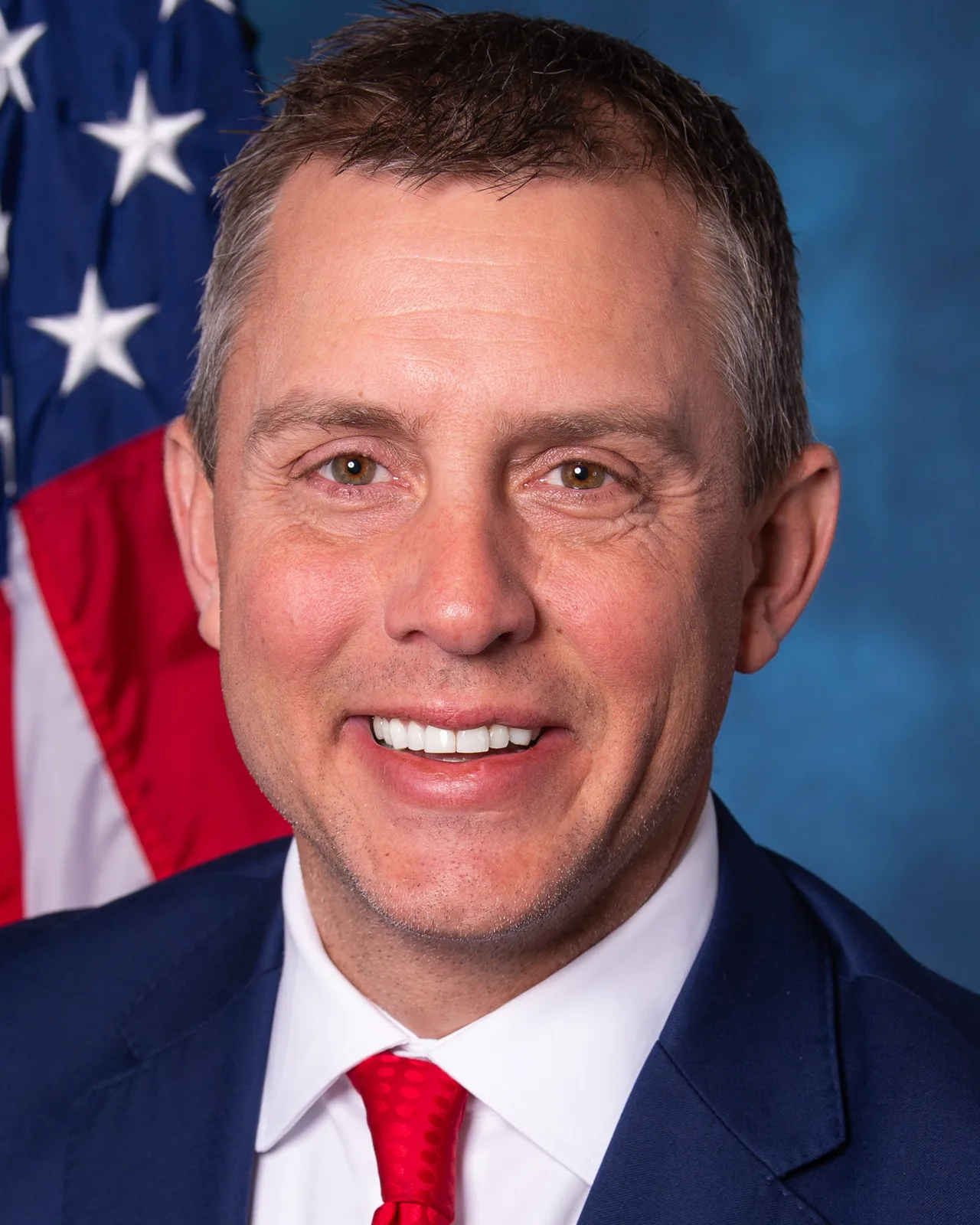
Kelly Armstrong
- Party
- Republican
- In Office Since
- December 15, 2024
- Term Ends
- December 2028
- Born
- October 8, 1976, Dickinson, North Dakota
- Education
- University of North Dakota (BA, 1999); UND School of Law (JD, 2003)
- Prior Role
- U.S. Representative, At-Large (2019-2024); ND State Senate (2012-2018)
Kelly Armstrong is a Dickinson-born attorney and ranching family son who served three terms in the North Dakota State Senate before winning the state's sole U.S. House seat in 2018. In Congress he was known as a pragmatic conservative who worked on judiciary and energy issues and participated in both Trump impeachment proceedings. He won the governorship in November 2024 as incumbent Governor Doug Burgum vacated the office to become U.S. Secretary of the Interior. Armstrong's priorities include infrastructure investment (particularly roads damaged by oil field traffic), workforce development, and managing the Legacy Fund, the $10-billion-plus oil savings account whose purpose remains one of the state's most consequential open policy questions.
Other Current State Officials
Attorney General
Drew Wrigley
In office since January 2022, appointed by Governor Burgum and elected to a full term in 2022. Previously served as U.S. Attorney for the District of North Dakota (2007-2012) and as Lieutenant Governor (2012-2016). As AG he has joined multistate actions on immigration enforcement, pharmaceutical pricing, and technology antitrust matters. He also serves on the Industrial Commission, which oversees the Bank of North Dakota and the North Dakota Mill.
Agriculture Commissioner
Doug Goehring
In office since January 2009, making him one of the longest-serving agriculture commissioners in North Dakota history. A Linton farmer and rancher, Goehring oversees agricultural regulation, rural development, and the state's extensive grain inspection and warehouse programs. He also serves on the Industrial Commission. Under his tenure, North Dakota consolidated its position as the nation's leading producer of numerous agricultural commodities.
State Treasurer
Thomas Beadle
In office since January 2017, re-elected in 2020 and 2024. Beadle oversees the investment of state funds including the Legacy Fund, which crossed $10 billion in assets during his tenure. A CPA and former Bismarck businessperson, he has focused on transparent reporting of the Legacy Fund's performance and on developing a long-term investment strategy for an account whose accumulated balance continues to grow.
The North Dakota Legislative Assembly
North Dakota State Senate
- Seats: 47 members
- Terms: 4-year terms
The upper chamber. Senators serve 4-year staggered terms, with roughly half the seats up for election every two years. Republicans hold a substantial supermajority. The Senate's Industrial Commission oversight role gives it unusual influence over the state's public enterprises.
North Dakota House of Representatives
- Seats: 94 members
- Terms: 4-year terms
The lower chamber. Representatives serve 4-year terms, with the full chamber on the ballot every two years. Republicans hold an overwhelming majority. Each legislative district elects one senator and two representatives, an unusual multi-member district structure.
North Dakota's U.S. Senators
U.S. Senator
John Hoeven
North Dakota's senior senator, first elected in 2010 after serving a decade as governor (2000-2010). Hoeven is one of the most popular politicians in North Dakota history, having won re-election with margins exceeding 75 percent. He serves on the Senate Agriculture and Appropriations committees and has been a consistent advocate for the Bakken oil industry, farm subsidies, and the two Air Force bases. As a former banker and governor, he is one of the most institutionally experienced members of the Senate.
U.S. Senator
Kevin Cramer
North Dakota's junior senator, elected in 2018 by defeating three-term incumbent Democrat Heidi Heitkamp, one of the most consequential Senate defeats in recent North Dakota political history. Previously served two terms as North Dakota's At-Large U.S. Representative (2013-2019) and was one of the earliest congressional endorsers of Donald Trump in 2016. He serves on the Senate Banking and Armed Services committees and has been a vocal advocate for the state's energy and agriculture industries.
North Dakota Through the Years
From the Mandan earth lodge villages that sheltered Lewis and Clark to the Nonpartisan League's radical public enterprises, from Theodore Roosevelt's prairie ranching to the Bakken oil boom and the Standing Rock protests, North Dakota has written pages of American history in a landscape that most Americans have never seen.
The territory that became North Dakota was home to some of the most sophisticated and geographically significant Indigenous civilizations in North America. The Mandan and Hidatsa peoples, semi-sedentary agricultural nations who built large permanent earth lodge villages along the Missouri River, were among the most important trading centers in the continental interior.
Their villages at the confluence of the Missouri and Knife rivers (near present-day Stanton) were major nodes in a trade network that connected the Pacific Coast to the Great Lakes and the Gulf of Mexico, exchanging corn, dried beans, squash, and manufactured goods for buffalo hides, horses, and products from distant places. The Mandan in particular were renowned for their ceremonial life, their distinctive round bull boats, and their corn-growing expertise in a climate where growing seasons were short and unpredictable.
The Arikara, a related people who had migrated north along the Missouri from the southern plains, occupied villages further south. The Lakota (Sioux), a more recently arrived and powerfully nomadic people who had followed the bison herds west from their original Minnesota homeland, dominated the southern and western plains by the 18th century. The Ojibwe (Anishinaabe) occupied the northeastern corner of what became North Dakota.
All of these peoples were severely damaged by the epidemic diseases that preceded European contact: by the time Lewis and Clark arrived in 1804, the Mandan had been reduced by smallpox from perhaps 15,000 people to around 1,800, a collapse that had destroyed entire villages and left the survivors vulnerable. A second epidemic in 1837, spread by a fur trade steamboat, virtually annihilated the Mandan, reducing them to perhaps 125 survivors.
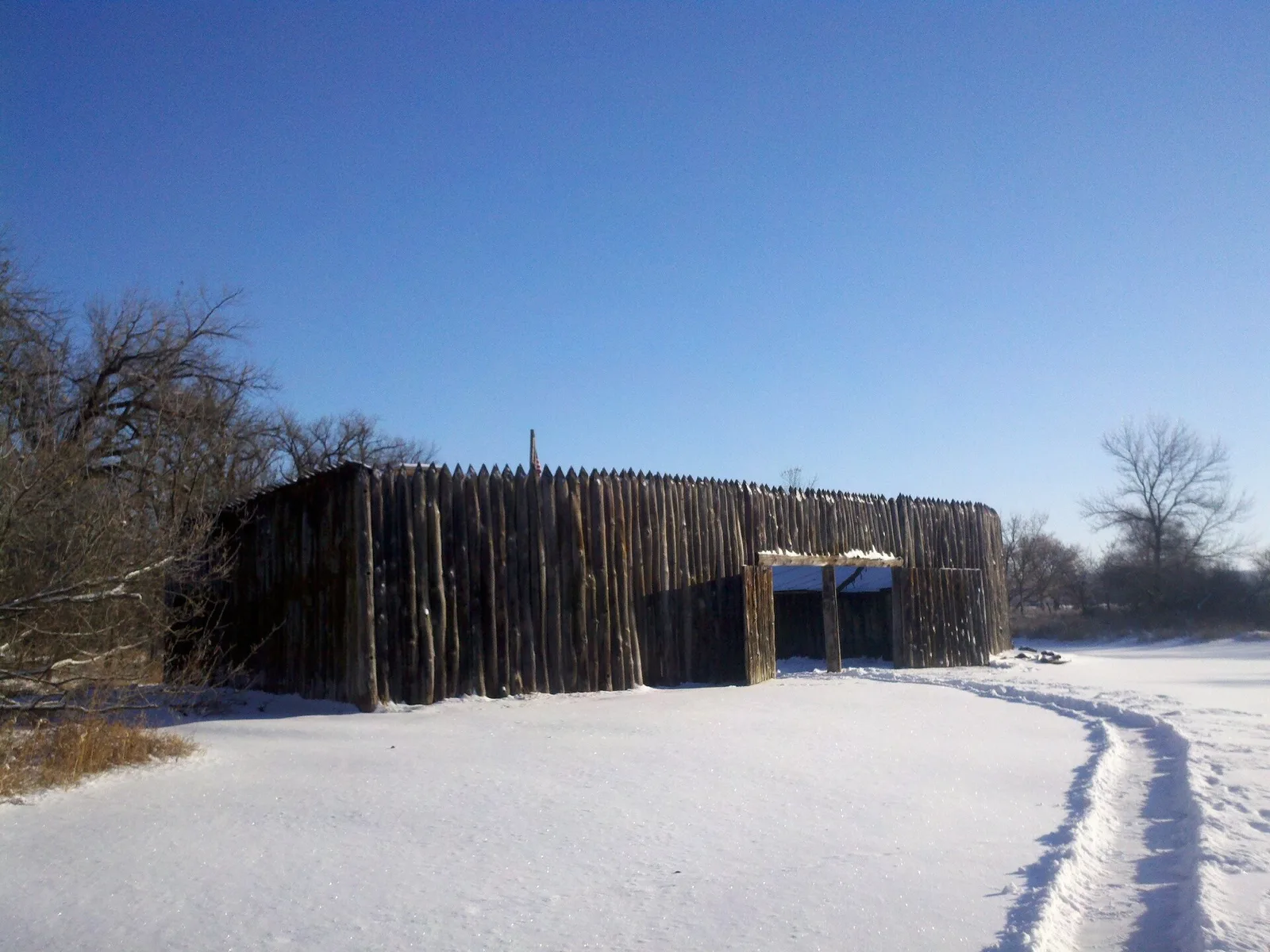
The Lewis and Clark Expedition of 1804-1806 spent more time in what is now North Dakota than in any other present-day state, roughly five months, including the entire winter of 1804-1805. The expedition arrived at the Mandan and Hidatsa villages near present-day Washburn in late October 1804, after ascending the Missouri River from its confluence with the Mississippi at St. Louis.
Captain Lewis and Captain Clark directed the construction of Fort Mandan, a small stockade where the 33-member Corps of Discovery spent the winter in temperatures that plunged to minus forty degrees. The winter at Fort Mandan was far more than a rest: it was where the expedition gathered the geographical and biological knowledge essential to completing its mission. The Mandan and Hidatsa provided detailed accounts of the Missouri River's course westward, the locations of mountain passes, and the distances to the Pacific.
It was at Fort Mandan that Lewis and Clark engaged a French-Canadian trapper named Toussaint Charbonneau and, crucially, his Shoshone wife Sacagawea, who had been captured near the Three Forks of the Missouri as a child and brought to the Hidatsa villages. Sacagawea proved invaluable: she knew the geography of the upper Missouri and the mountain approaches from childhood, her presence signaled to western tribes that the expedition came in peace (war parties did not travel with women and children), and her ability to communicate with Shoshone-speaking peoples at the critical moment of acquiring horses for the mountain crossing was irreplaceable.
The journals Lewis and Clark kept at Fort Mandan, cataloguing plants, animals, and Indigenous cultures with extraordinary scientific precision, constitute one of the most important documents in American natural history.
The transformation of the northern Great Plains from Indigenous homeland to American agricultural territory happened with stunning speed in the 1870s and 1880s, driven by the Northern Pacific Railroad and a land rush that brought tens of thousands of homesteaders, primarily from the Upper Midwest, Scandinavia, Germany, and Russia, to settle a landscape that had barely been surveyed a decade earlier.
The Northern Pacific, chartered in 1864 and completed in 1883, was the key instrument of colonization: it received federal land grants of 40 million acres (every other section of land for 40 miles on each side of its right-of-way) and aggressively marketed North Dakota lands to European immigrants through offices in Hamburg, Oslo, and other European cities. The result was a wave of Norwegian, German-Russian Mennonite, Swedish, and other European settlers who established the ethnic and cultural character of North Dakota communities that persists to this day.
The 'Bonanza farms' of the Red River Valley, enormous operations of 10,000 acres or more established by Eastern capitalists in the 1870s and 1880s using the latest mechanized equipment, demonstrated the valley's extraordinary productivity and attracted further immigration.
The violence of the 'pacification' of the Lakota and other Plains nations, the destruction of the buffalo herds by commercial hunters, the defeat of Sitting Bull's and Crazy Horse's resistance, the confinement to reservations, was the precondition for this colonization. By November 2, 1889, when North Dakota was admitted to the union simultaneously with South Dakota, the territory had a European-American population of approximately 190,000.
In September 1883, a young New York state assemblyman named Theodore Roosevelt, recently married and beginning what seemed like a promising political career, traveled to the Badlands of Dakota Territory to hunt bison, one of the last opportunities to do so before the great herds were exterminated. He killed his bison and was so entranced by the landscape that he invested $14,000 (a very large sum) in a cattle ranch on the Little Missouri River and returned the following year to spend significant time working as a rancher.
The years Roosevelt spent in the Badlands, 1884-1886, were the most personally transformative of his life: he arrived as a grief-stricken young man (his wife and his mother had died on the same day in February 1884) and departed as something close to the Roosevelt of legend, physically hardened, psychologically resilient, and possessed of a direct experience of the American West and its people that no amount of Eastern education could have provided. He worked cattle, rode roundups, tracked horse thieves across hundreds of miles of prairie, and absorbed the democratic character of frontier life.
The destruction of his cattle herd in the catastrophic winter of 1886-1887, which killed perhaps 60 percent of the cattle on the northern ranges, ended his ranching career but not his connection to the place.
As President, Roosevelt set aside more land for conservation than all previous presidents combined, national parks, national forests, national monuments, and federal bird reservations. He consistently credited his North Dakota years as the foundation of his conservation philosophy. Theodore Roosevelt National Park is the only unit of the National Park System named directly in honor of a specific individual.
In the winter of 1914-1915, a former flax farmer named Arthur Townley, having lost his farm to debt and convinced that the problem was structural, that North Dakota farmers were being systematically exploited by Minneapolis grain companies, railroads, and banks, began organizing a political movement unlike anything America had seen. The Nonpartisan League, which Townley built through a fleet of Model T Fords and a subscription sales pitch delivered farmer to farmer across the frozen prairie, had 26,000 members within months and grew to 40,000 by the 1916 elections.
The NPL's program was radical by any measure: state ownership of terminal grain elevators, flour mills, packing plants, and cold storage plants; a state hail insurance program; rural credit at cost; and exemption of farm improvements from taxation. Townley's genius was to work within the Republican Party rather than create a third party, forcing candidates to pledge support for the NPL program as a condition of NPL endorsement.
By 1918, the NPL controlled the governorship and both chambers of the legislature. What followed was the most ambitious experiment in state socialism in American history: the legislature established the Bank of North Dakota (the only state-owned bank in the country, still operating today), the North Dakota Mill and Elevator (the only state-owned flour mill in the country, still operating today), a state hail insurance fund, and a state home-building association.
The political reaction was fierce: the Industrial Commission formed by conservatives nearly dismantled the program in 1921, and the NPL's dominance faded. But the Bank of North Dakota and the Mill and Elevator survived all challenges and operate to this day, a century-old experiment in public enterprise that has become an object of international interest.
On April 4, 1951, the Clarence Iverson No. 1 well struck oil near Tioga in northwestern North Dakota, the first commercial oil discovery in the state and the beginning of a relationship between North Dakota and the petroleum industry that would eventually transform the state more profoundly than any development since the homesteading era.
The 1950s discovery was modest by the standards of what was to come: the Williston Basin's shallower formations produced oil in commercially significant but not spectacular quantities, supporting a small oil industry in the western part of the state and contributing to state revenues without dominating the economy. For decades, North Dakota's oil production remained a minor part of its economic story, dwarfed by agriculture and overshadowed by the massive petroleum states of Texas, Oklahoma, and Louisiana.
The Bakken Formation, a deeper and more extensive layer of oil-bearing shale, was known to geologists but considered economically unrecoverable because its tight rock structure held oil in microscopic pores that conventional drilling could not access. The development of hydraulic fracturing ('fracking') and horizontal drilling techniques in the early 2000s changed everything: by 2006, the first Bakken wells were proving commercially viable, and the rush was on.
The speed of the subsequent transformation, from a state producing 90,000 barrels per day in 2006 to 1.4 million barrels per day in 2019, was without precedent in American energy history, surpassing even the Texas and Pennsylvania oil rushes of earlier eras.
In April 2016, the Standing Rock Sioux Tribe and allied Indigenous and environmental activists began a protest encampment at the confluence of the Cannonball and Missouri rivers in southern North Dakota to oppose the construction of the Dakota Access Pipeline, a 1,172-mile crude oil pipeline that would cross under the Missouri River a half-mile upstream from the Standing Rock reservation boundary and the tribe's primary water supply.
What began as a small prayer camp grew over the following months into one of the largest gatherings of Indigenous peoples in American history, eventually drawing thousands of people from over 300 tribal nations, military veterans, and environmental activists to the remote prairie camp. The protesters called themselves 'water protectors' and framed their opposition in terms of treaty rights, water security, and the environmental and spiritual significance of the Missouri River to the Standing Rock Sioux.
The confrontation became a national and international news story as private security companies deployed attack dogs and pepper spray against protesters, and as North Dakota law enforcement, supplemented by officers from multiple states under emergency mutual aid, used water cannons in freezing temperatures, rubber bullets, and pepper spray to push protesters back from the pipeline construction route.
The Obama administration ordered a pause in construction for an environmental review in December 2016; the Trump administration reversed that decision and ordered the pipeline completed in January 2017. The Dakota Access Pipeline began operating in 2017, but the legal and political battles over its environmental review continued for years afterward. Standing Rock became a symbol of Indigenous rights advocacy and environmental justice that extended far beyond North Dakota.
The Bakken oil boom that transformed western North Dakota beginning around 2006 created a state identity crisis of sorts: North Dakota had long defined itself as an agricultural, rural, deeply traditional Great Plains state, suspicious of outside money and outside influence, committed to a frugal government that spent only what it had. The oil boom poured billions into state coffers and created pressures and possibilities that were genuinely new.
The state built roads and bridges, expanded university budgets, created the Legacy Fund (a sovereign wealth fund that accumulated over $10 billion by the mid-2020s), and attracted workers from every state and country. Fargo continued its steady transformation into a genuine mid-sized tech and services city, growing to a metropolitan population exceeding 250,000. The state that had been hemorrhaging population since the 1930s stabilized and grew modestly.
At the same time, the boom's social costs were visible: drug addiction (particularly methamphetamine) surged in the oil patch; housing costs in Williston exceeded those in major American cities; rural roads were destroyed by heavy industrial traffic; and the oil field's environmental record, including spills, waste water disposal issues, and methane flaring, raised persistent concerns. The 2015-2016 oil price collapse provided a sobering reminder of commodity dependence.
By the 2020s, North Dakota had settled into a mature oil economy, still producing at historically high levels but no longer in boom-town mode, while grappling with questions about what the Legacy Fund is for, how to diversify an economy still heavily dependent on two commodities (wheat and oil), and how to sustain rural communities whose populations continue to age and shrink.
North Dakota's Defining Moments in American History
These are the events that didn't just shape North Dakota, they changed the nation.
Sitting Bull, the Hunkpapa Lakota leader whose spiritual vision helped inspire the victory at Little Bighorn, spent his final years in North Dakota. He surrendered in 1881, performed in Buffalo Bill's Wild West Show, and was killed by Indian police on the Standing Rock Reservation in 1890 during the Ghost Dance crisis.
Two weeks after Sitting Bull's death came the Wounded Knee Massacre in South Dakota, ending organized Native American resistance to U.S. expansion. North Dakota was the stage for the final chapters of the Plains nations' attempt to maintain their way of life.
Sitting Bull was born around 1831 near the Grand River. After the victory at Little Bighorn on June 25, 1876, he led his followers into Canada in 1877 and remained near Wood Mountain, Saskatchewan, for four years, until hunger and the collapse of the northern bison herds forced his surrender at Fort Buford, North Dakota, on July 19, 1881. He was held for two years at Fort Randall before being allowed to return to the Standing Rock Agency.
His single 1885 season touring with Buffalo Bill Cody's Wild West reportedly paid him about $50 a week plus fees for autographs, much of which he gave away to poor children. On December 15, 1890, roughly forty Indian police sent to arrest him at his cabin on the Grand River killed him, his son Crow Foot, and six of his supporters in a gun battle that also killed six policemen. The Ghost Dance movement authorities blamed for the unrest had spread from the Nevada Paiute prophet Wovoka, and two weeks after Sitting Bull died the 7th Cavalry killed roughly 250 Lakota at Wounded Knee.
In 1883, 24-year-old Theodore Roosevelt came to North Dakota's Badlands to hunt buffalo and ended up owning two ranches. The years he spent there, including one brutal winter that nearly wiped him out financially, fundamentally transformed him.
The Badlands hardened his body, expanded his horizons, and deepened his love for the American West and its wild spaces. Roosevelt later said: 'I never would have been President if it had not been for my experiences in North Dakota.' His time there directly shaped his conservation legacy, including the creation of the national park system and the Forest Service.
Roosevelt put about $14,000 into the Maltese Cross Ranch in 1883 and roughly $26,000 more into the Elkhorn Ranch the next year, at one point running some 5,000 head of cattle. He helped found the Little Missouri Stockmen's Association, served as a deputy sheriff, and in 1886 personally tracked down and captured three men who had stolen a boat from his ranch, guarding them for days rather than hanging them.
The winter of 1886 and 1887, remembered on the northern ranges as 'the Big Die-Up,' killed more than half the region's cattle and destroyed most of Roosevelt's investment. He returned east, won the New York governorship in 1898 and the vice presidency in 1900, and became President in September 1901 after William McKinley was assassinated. In office he created the U.S. Forest Service, signed the 1906 Antiquities Act, and placed roughly 230 million acres under federal protection as national forests, parks, monuments, and the first 51 federal bird reservations.
The Garrison Dam, completed in 1953 on the Missouri River in North Dakota, created Lake Sakakawea, one of the largest man-made reservoirs in the United States. It also flooded the heart of the Fort Berthold Reservation, destroying 156,000 acres of the Mandan, Hidatsa, and Arikara Nation's most fertile bottomland, including their towns, farms, and sacred sites.
More than 90% of the reservation's population was forcibly relocated. The project, carried out in the name of flood control and power generation, was later called one of the greatest acts of injustice ever perpetrated by the U.S. government against Native Americans.
The dam was authorized under the 1944 Flood Control Act as part of the Pick-Sloan Missouri Basin Program, a compromise that merged rival Army Corps and Bureau of Reclamation plans for the river. Built between 1947 and 1953, it stretched more than 11,000 feet long and stood 210 feet high, then among the largest earthen dams in the world, and its reservoir, Lake Sakakawea, holds about 24 million acre-feet behind roughly 1,300 miles of shoreline.
The Three Affiliated Tribes were paid $12.6 million in a 1949 settlement for about 152,000 acres, a figure tribal leaders and later historians judged far below fair value; a widely reproduced 1948 photograph shows tribal chairman George Gillette weeping as Interior Secretary Julius Krug signed the agreement. Displaced families lost their timber, gardens, and sheltered river bottomland and were resettled on the exposed prairie above the new lake. Congress awarded the tribes an additional $149.5 million in 1992, and Bakken oil revenue on the reservation has since partly reshaped its economy.
The discovery of the Bakken Formation, a vast shale oil deposit beneath western North Dakota, triggered an energy boom in the 2000s that transformed the state and the nation. Using horizontal drilling and hydraulic fracturing, oil companies unlocked reserves that had been inaccessible with previous technology.
North Dakota briefly became the second-largest oil-producing state in America, surpassing Alaska and approaching Texas. The Bakken boom contributed to America's emergence as a net energy exporter for the first time in decades, reshaping global oil markets and geopolitics.
The formation is named for Henry Bakken, a farmer near Tioga on whose land the oil-bearing shale was first identified in a 1953 well. A 2008 U.S. Geological Survey assessment estimated 3 to 4.3 billion barrels of technically recoverable oil, then the largest continuous oil resource the agency had ever appraised in the lower 48; a 2013 revision roughly doubled the figure by adding the underlying Three Forks formation.
North Dakota's output climbed from about 90,000 barrels a day in 2006 to a peak near 1.5 million in late 2019, passing Alaska and California and trailing only Texas. Severance and extraction taxes fed the Legacy Fund, a sovereign wealth account approved by voters in 2010 that exceeded $10 billion by the mid-2020s. Persistent flaring, which at times burned off roughly a third of the gas produced alongside the oil, prompted state capture targets, and the 2015 and 2016 price collapse showed how sharply North Dakota's budget swings with global crude prices.
North Dakota was part of the vast Louisiana Purchase of 1803, one of the greatest land deals in history. When Lewis and Clark wintered at Fort Mandan in present-day North Dakota in 1804-05, they were among the first Americans to explore this territory.
The journals they kept there, describing the Mandan and Hidatsa peoples and the land itself, were the first detailed accounts of the northern Great Plains available to the American public. North Dakota's history begins as European American settlement begins: with a survey, a treaty, and the slow erasure of the world that existed before.
The United States bought roughly 828,000 square miles from France in 1803 for about $15 million, close to four cents an acre, doubling the size of the country. Nearly all of what became North Dakota lay within the purchase; only a small northeastern strip drained by the Red River toward Hudson Bay came separately, from Britain under the 1818 boundary treaty. President Jefferson sent the Corps of Discovery up the Missouri in 1804 in part to survey the new territory and press an American claim to it.
Fur traders had come first. The North West Company's David Thompson mapped the Mandan and Hidatsa villages in 1797 and 1798, and the American Fur Company ran posts such as Fort Union, built at the present Montana line in 1828, for decades afterward. Dakota Territory was organized in 1861, the Northern Pacific Railroad reached the Missouri at Bismarck in 1873, and North Dakota entered the Union on November 2, 1889, one of the pair whose order of admission President Grover Cleveland deliberately left unrecorded.
Notable North Dakotans
Theodore Roosevelt
Not born in North Dakota, but more shaped by it than anywhere else. Roosevelt ranched in the Badlands from 1883-1886, and later wrote: 'I have always said I would not have been President had it not been for my experience in North Dakota.' He set aside more federal conservation land than all previous presidents combined, and the national park bearing his name preserves the landscape that made him.
Sitting Bull (Tȟatȟáŋka Íyotake)
Born c. 1831 in the Grand River area of present-day South Dakota, Sitting Bull lived much of his later life and died at the Standing Rock Agency in what is now Sioux County, North Dakota. The Hunkpapa Lakota holy man and war chief who led resistance to US expansion onto Lakota lands and whose warriors defeated Custer at the Little Bighorn in 1876, he was shot and killed by Indian Agency police at Standing Rock on December 15, 1890.
Sacagawea
Born c. 1788 near present-day Salmon, Idaho, but central to North Dakota history: captured by Hidatsa raiders as a child and brought to the Knife River villages in what is now North Dakota, she was living at the Hidatsa village near Fort Mandan when Lewis and Clark hired her husband Charbonneau as a guide. Her knowledge of Shoshone geography and language, and her ability to signal peaceful intent to western tribes, made the Lewis and Clark Expedition possible.
Roger Maris
Born in Hibbing, Minnesota, but grew up in Fargo, North Dakota from age five, which claims him as its own. Right fielder for the New York Yankees, Maris hit 61 home runs in 1961, breaking Babe Ruth's single-season record of 60, a record that stood until 1998. He won back-to-back American League MVP awards in 1960 and 1961. The achievement was accompanied by enormous pressure and hostility from the press and fans protective of Ruth's legacy. He died in 1985.
Louis L'Amour
Born in Jamestown, North Dakota, March 22, 1908. The most prolific and commercially successful Western novelist in American history: 89 novels, 14 short story collections, all but two still in print at his death, with cumulative sales exceeding 350 million copies. His novel Hondo was the first mass market paperback original to be reviewed by the New York Times Book Review. L'Amour had little formal education but an encyclopedic knowledge of Western history, geography, and the practical skills of frontier life. Died 1988.
Lawrence Welk
Born in Strasburg, North Dakota, March 11, 1903. Accordionist, bandleader, and television host whose The Lawrence Welk Show ran on national television from 1951 to 1982, a 31-year run that made it one of the longest-running programs in American television history. His 'champagne music' style, combining polkas, waltzes, and popular tunes in an accessible, family-friendly format, appealed to older audiences and became a Saturday-night institution for millions of American households. Died 1992.
Peggy Lee (Norma Deloris Egstrom)
Born in Jamestown, North Dakota, May 26, 1920. One of the most celebrated jazz and popular vocalists of the 20th century, Lee's smoky contralto and precise phrasing influenced generations of singers. She co-wrote and performed 'He's a Tramp' and 'The Siamese Cat Song' for Disney's Lady and the Tramp (1955) and wrote the lyrics to her most famous recording, the existential 'Is That All There Is?' (1969). She received a Grammy Lifetime Achievement Award in 1995. Died 2002.
Eric Sevareid
Born in Velva, North Dakota, November 26, 1912. CBS News correspondent and commentator who covered World War II from Europe (including the fall of Paris and the London Blitz), survived a plane crash in the Burma jungle in 1943, and became one of the founding giants of American broadcast journalism as a member of Edward R. Murrow's CBS team. His nightly commentaries on CBS Evening News (1964-1977) made him one of the most trusted voices in American journalism. Died 1992.
Phil Jackson
Born in Deer Lodge, Montana, but raised in Williston, North Dakota, where his father was a Pentecostal minister. As head coach of the Chicago Bulls (1989-1998) and Los Angeles Lakers (1999-2004, 2005-2011), Jackson won 11 NBA championships, more than any coach in professional basketball history. His coaching philosophy, influenced by Zen Buddhism and Native American spirituality he absorbed growing up in North Dakota, was articulated in his book Sacred Hoops.
Josh Duhamel
Born in Minot, North Dakota, November 14, 1972. Actor best known for his role as William Lennox in the Transformers film franchise, which grossed over $4 billion worldwide. He also starred in the television series Las Vegas (2003-2008) and in multiple romantic films. Duhamel has remained connected to his North Dakota roots and has used his platform to advocate for the state and its communities.
State Symbols & Quick Facts
| Nickname | "The Peace Garden State" |
| Capital | Bismarck |
| Largest City | Fargo |
| Statehood | November 2, 1889 (39th state) |
| Population | ~797,000 (2024 est.) |
| Area | 70,698 sq miles (19th largest) |
| State Bird | Western Meadowlark |
| State Flower | Wild Prairie Rose |
| State Tree | American Elm |
| State Animal | Nokota Horse |
| State Fish | Northern Pike |
| State Grass | Western Wheatgrass |
| State Fossil | Teredo Petrified Wood |
| State Beverage | Milk |
| State Motto | "Liberty and Union, Now and Forever, One and Inseparable" |
| Time Zone | Central (most of state) / Mountain (far west) |
| Bordering States | Montana, South Dakota, Minnesota; and Canada (Manitoba, Saskatchewan) |
Did You Know?
North Dakota ranks first in the nation in the production of more agricultural commodities than any other state, including spring wheat, durum wheat, sunflowers, canola, flaxseed, pinto beans, navy beans, lentils, dry edible peas, and honey, an extraordinary concentration of agricultural dominance from the least-populated state in the lower 48.
The Bank of North Dakota, established by the state legislature in 1919, is the only state-owned, state-operated bank in the United States. It partners with community banks rather than competing against them, provides below-market student loans to North Dakota residents, and returns its profits, over $220 million in fiscal year 2023, to the state general fund.
North Dakota and South Dakota were admitted to the union simultaneously on November 2, 1889. President Grover Cleveland signed the two proclamations with the states' names covered so he could not know which he was signing first. By tradition, North Dakota is listed as the 39th state because 'North' comes before 'South' alphabetically, but neither state officially knows which was technically admitted first.
Minot Air Force Base is the only installation in the United States Air Force that hosts both land-based intercontinental ballistic missiles (ICBMs) and nuclear-capable strategic bombers. The 91st Missile Wing operates 150 Minuteman III ICBMs dispersed in underground silos across a 15,000-square-mile area of northern North Dakota, an area larger than the entire state of Maryland.
Lewis and Clark spent the winter of 1804-1805 at Fort Mandan in present-day North Dakota, more total time in present-day North Dakota than in any other state on their entire journey. It was here that they hired Toussaint Charbonneau and his Shoshone wife Sacagawea, whose knowledge of western geography and whose presence as a signal of peaceful intent made the rest of the expedition possible.
North Dakota's oil production increased from approximately 50,000 barrels per day in 2005 to over 1.4 million barrels per day at its 2019 peak, a 28-fold increase driven by hydraulic fracturing of the Bakken Shale formation. The state briefly became the second-largest oil producer in the country, ahead of states that had been drilling for a century.
Theodore Roosevelt spent significant time ranching in the North Dakota Badlands from 1883-1886, an experience he credited directly with making him a conservationist and, he believed, a president. As president he set aside approximately 230 million acres of public land, more than all previous presidents combined. Theodore Roosevelt National Park is the only unit of the National Park System named directly in honor of a specific president.
The International Peace Garden, established on July 14, 1932 at the midpoint of the 5,525-mile US-Canada border in north-central North Dakota, was created to symbolize the peaceful friendship between the two nations. It straddles the border in the Turtle Mountains, with facilities on both the US (North Dakota) and Canadian (Manitoba) sides, and gives North Dakota its official nickname: 'The Peace Garden State.'
Devils Lake in north-central North Dakota has been rising since the early 1990s due to increased precipitation and has grown from approximately 50,000 acres in 1993 to over 200,000 acres, a fourfold increase that has submerged farms, roads, rail lines, and portions of communities and required hundreds of millions of dollars in emergency infrastructure spending. With no natural outlet, the lake can only be controlled through pumping and diversion projects.
North Dakota is consistently the least-visited state in the continental United States, attracting fewer tourists than any other. Yet it contains Theodore Roosevelt National Park, named for the only president who considered North Dakota his spiritual home, 63 state parks, the nation's only state-owned flour mill, the only state-owned bank, and badlands geology equal to anything in the American West.
Quick Facts and Common Questions
Short answers to the questions people most often ask about North Dakota: its abbreviation, how it and South Dakota became states, its capital, and how it votes.
North Dakota's two-letter postal abbreviation is ND. The U.S. Census Bureau places it in the Midwest region, in the West North Central division, and about 779,000 people lived there in the 2020 census.
North Dakota and South Dakota both became states on November 2, 1889, when the Dakota Territory was divided in two. President Benjamin Harrison shuffled the two proclamations so no one would know which he signed first; North Dakota is listed as the 39th state because it comes first alphabetically.
The name comes from the Dakota people, part of the Great Sioux Nation. In the Dakota language the word is usually translated as "friends" or "allies."
Bismarck has been the capital since 1883, when the Dakota Territory moved its capital there from Yankton, now in South Dakota, and it remained the capital of North Dakota at statehood. After the first capitol burned in 1930, it was replaced by a 19-story Art Deco tower completed in 1934.
North Dakota borders Minnesota to the east across the Red River, South Dakota to the south, and Montana to the west. To the north it borders the Canadian provinces of Saskatchewan and Manitoba.
No. North Dakota is the only state without voter registration; it ended registration in 1951. Voters show identification at the polls to prove they are eligible. Learn more about how elections work.
North Dakota is known as "The Peace Garden State," for the International Peace Garden on its border with Manitoba, dedicated in 1932. Its motto is "Liberty and Union, Now and Forever, One and Inseparable." Its state bird is the western meadowlark, its flower is the wild prairie rose, and its tree is the American elm.
Based on the 2020 census, North Dakota has 1 seat in the U.S. House of Representatives, elected statewide, which gives it 3 votes in the Electoral College, the minimum for any state.
Theodore Roosevelt National Park
The Badlands That Shaped a President and Saved a Nation's Wild Places
About Theodore Roosevelt National Park
Theodore Roosevelt National Park protects about 70,000 acres of the North Dakota badlands along the Little Missouri River, the country in which a young Roosevelt ranched, hunted, and, by his own account, remade himself.
Roosevelt first came out in 1883 to shoot a bison and bought into a cattle ranch; after his wife and his mother died in the same house on the same day in February 1884, he came back and built the Elkhorn Ranch as a place to grieve and work.
His three years of open-range ranching ended with the killing winter of 1886-1887, but the experience shaped the conservation record of his presidency, when he put roughly 230 million acres of forest, refuge, monument, and park under federal protection.
Set aside as a national memorial park in 1947 and made a full national park in 1978, it comes in three separate pieces: the South Unit at Medora, the North Unit about 70 miles away near Watford City, and the remote Elkhorn Ranch site between them.
- Designation
- National Park
- Location
- Billings and McKenzie counties, southwestern North Dakota
- Established
- November 10, 1978
- Annual Visitors
- ~750,000
Geology and Landscape
The badlands are layers of soft Paleocene sandstone, mudstone, clay, and coal, laid down 56 to 60 million years ago in a warm, swampy delta and then carved into buttes and gullies by water and wind.
The bands of color come from different sediments: gray, popcorn-textured bentonite clay, yellow and tan sandstone, black lignite coal, and brick-red 'clinker.'
Clinker forms where a lightning strike or grass fire lights a coal seam, which can smolder underground for years or decades, baking the clay above it into hard red rock.
Bentonite, a clay made from volcanic ash, swells when wet into a slick 'gumbo' and cracks when dry, which is part of why the slopes erode so fast and support so little plant life.
The Little Missouri loops through the park in tight bends, undercutting one bank and building a gravel bar on the other, the work that keeps cutting the badlands deeper.
Before the ice ages the river flowed north toward Hudson Bay; a continental glacier about 640,000 years ago dammed that route and turned it east into the Missouri.
The new, steeper course made the river cut down fast into the soft rock, which is why the badlands here are so sharply eroded compared with the flat prairie around them.
The river bottom's cottonwood galleries and willow thickets are the park's richest wildlife habitat, and the river itself runs brown with sediment and, most summers, nearly dry.
Whole petrified stumps and logs, some several feet across, lie scattered across the badlands, the remains of bald cypress and sequoia-like swamp forests that grew here 56 to 60 million years ago.
As the trees were buried, silica-rich groundwater replaced the wood cell by cell, so the grain, knots, and even insect galleries are preserved in stone.
The southwestern corner of the South Unit, reached by the long Petrified Forest Trail, holds one of the largest concentrations of standing petrified stumps in the country.
The wood is federally protected; picking up even a small piece is illegal, and the exposed logs are slowly weathering out of the rock as the badlands erode around them.
Roosevelt set up the Elkhorn Ranch on the Little Missouri about 35 miles north of Medora in the summer of 1884 and ran cattle from it until 1886.
Only the foundation stones of the ranch house survive, on a cottonwood flat reached by gravel roads and, in low water, a river ford, a site the Park Service keeps deliberately hard to get to.
He wrote much of his early nature writing here and read widely, and he later described this ground as where his conservation thinking took shape.
The Elkhorn Unit is now watched as a 'viewshed' case: oil development on nearby private and federal land has been a long-running fight over what can be built in sight of the ranch.
Indigenous Peoples of the Northern Plains
Mandan, Hidatsa, and Arikara Nation (MHA Nation)
The Mandan, Hidatsa, and Arikara lived in earth-lodge farming towns along the Missouri River, growing corn, beans, and squash and trading across the northern plains; the badlands were hunting and ceremonial ground.
Lewis and Clark spent the winter of 1804-1805 in a fort beside the Mandan and Hidatsa villages, and it was a Hidatsa household that included Sacagawea, who joined the expedition west.
Smallpox in 1837 killed most of the Mandan and much of the Hidatsa and Arikara, and the survivors banded together at the town of Like-a-Fishhook, the origin of the modern Three Affiliated Tribes.
The Three Affiliated Tribes (MHA Nation) are headquartered on the Fort Berthold Reservation in western North Dakota. The reservation was flooded in 1953 when the Garrison Dam created Lake Sakakawea, forcing thousands of tribal members to relocate from the fertile river bottoms to less productive higher ground. The MHA Nation has experienced economic growth from oil production on the reservation in recent decades.
Lakota Sioux
By the mid-1800s the Lakota, moving west onto the plains and following the bison, controlled western North Dakota, including the badlands, which lay in country recognized as theirs by the 1851 and 1868 Fort Laramie treaties.
Roosevelt's ranching years, 1883 to 1886, were the last of free Lakota life here; the Army had already forced most Lakota onto reservations after the 1876-77 war, and the region's bison were nearly gone.
The confinement was sealed by the 1889 breakup of the Great Sioux Reservation into smaller pieces and the killing of Sitting Bull and the Wounded Knee massacre in 1890.
The Standing Rock Sioux Tribe and the Cheyenne River Sioux Tribe are the primary Lakota nations in the Dakotas today. The Standing Rock Reservation straddles the North and South Dakota border along the Missouri River, not far from the national park.
What to Do
Scenic Drive (South Unit)
The South Unit's scenic loop runs about 36 miles through prairie-dog towns, badlands buttes, and river overlooks, and is the surest way to see wildlife.
Bison, feral horses, pronghorn, and mule deer are all regular sights from the road, often close, and prairie dogs stand up along the shoulders.
Wind Canyon, Buck Hill, and the Boicourt overlook are the classic stops for the view over the Little Missouri and, at Buck Hill, one of the highest points in the park.
Part of the loop washes out or slumps most years and is often open only as an out-and-back; dawn and dusk give the best light and the most active animals.
Petrified Forest Hike (South Unit)
The Petrified Forest Trail is a roughly 10-mile loop into the far southwestern corner of the South Unit to reach the standing petrified stumps.
It crosses open prairie and badlands with no shade, no water, and no blazes, following posts and GPS across ground where every butte looks like the next.
A trailhead outside the park at the end of a gravel road cuts the walk to the wood down to about 3 miles round trip.
The Park Service treats it as a wilderness route: heat, thunderstorms, and disorientation are the real hazards, not the distance.
Wind Canyon Trail
Wind Canyon is a short 0.4-mile round-trip walk from the scenic loop to a bench-lined overlook where the Little Missouri swings hard around a wind-sculpted bluff.
The exposed canyon wall shows the flat-lying badlands layers in cross section, from coal to clinker to clay.
It faces west, so it is a popular sunset spot, and bighorn sheep and mule deer are sometimes on the slopes below.
The trail is short, but the drop-offs are unfenced and the clay tread is slick when wet.
Caprock Coulee Trail (North Unit)
The Caprock Coulee Trail is a 4.3-mile loop widely rated the best hike in North Dakota, climbing from the North Unit road through coulees to a ridgeline.
Its first stretch is a self-guiding nature trail explaining the 'caprock' boulders, hard concretions that shield the clay beneath them and leave standing pillars as the rest erodes.
The ridge portion follows the rim with long views over the Little Missouri and the North Unit's badlands.
The North Unit gets a small fraction of the South Unit's visitors, so the loop is usually quiet, and its scenic road passes a longhorn cattle herd kept as a nod to the open-range era.
Conservation Challenges
Oil and Gas Development
The park sits over the Bakken Formation, and the drilling boom that took off around 2008 ringed it with well pads, flares, gravel roads, and heavy truck traffic.
Park instruments have recorded brighter night skies, more haze, and more noise, especially at the isolated Elkhorn Ranch Unit, where the badlands quiet Roosevelt valued is largely gone.
Specific projects near the boundary, a proposed bridge and road near Elkhorn, wells within sight of overlooks, have drawn lawsuits and public campaigns.
The land inside the park line is protected, but its 'viewshed' and 'soundscape' are not, and the park's fight is mostly over what happens just outside it.
Bison Herd Management
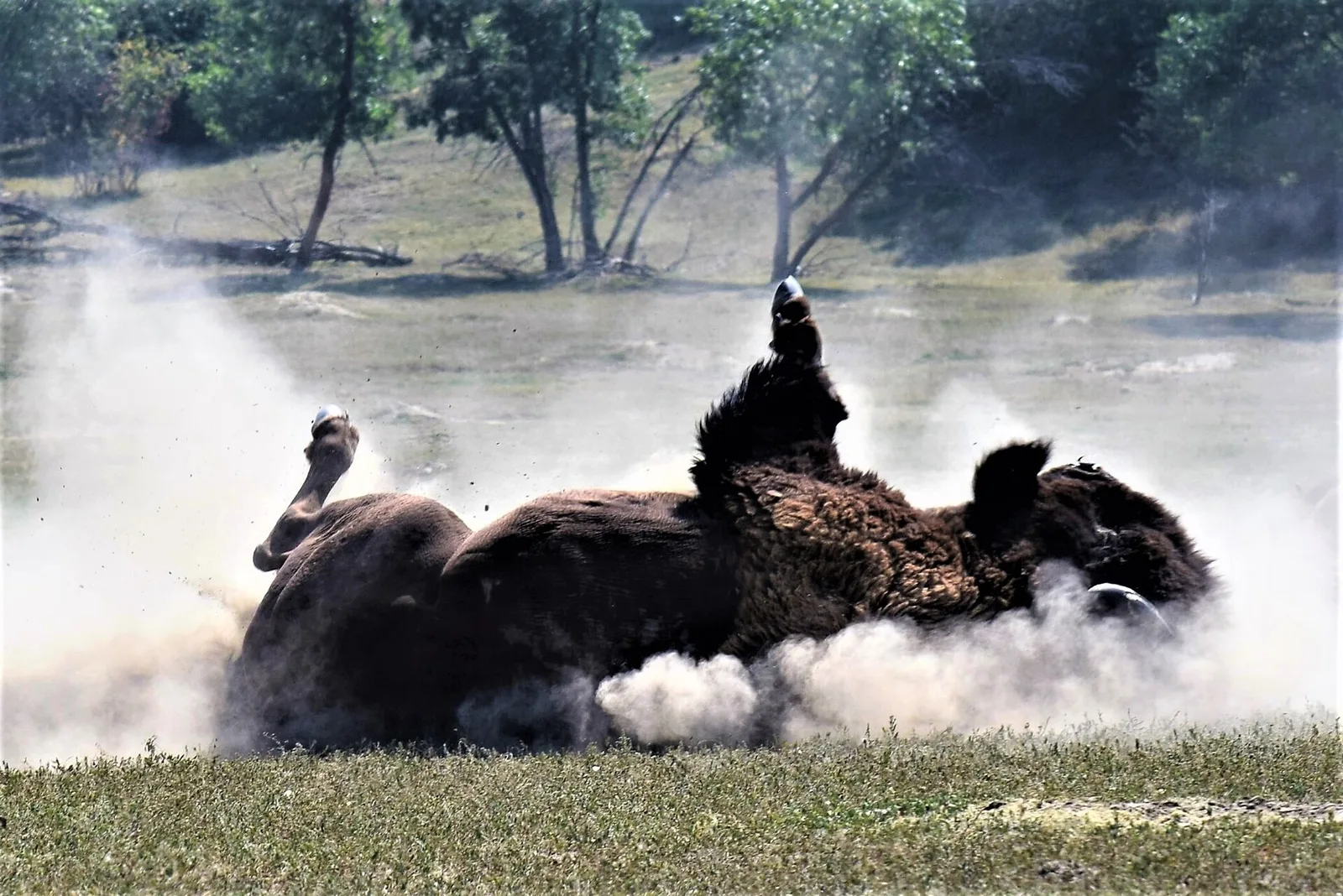
The park's roughly 600 to 700 bison in two fenced herds descend from 29 animals brought from the National Bison Range to the South Unit in 1956, plus 20 sent to the North Unit in 1962.
Because the herds cannot leave, the park rounds them up every few years, tests and vaccinates them, and ships surplus animals to tribes through the InterTribal Buffalo Council and to other conservation herds.
Keeping the numbers matched to the grass, without natural predators or migration, is a constant judgment call, and drought years force deeper cuts.
The park's bison are prized because they carry little or no cattle DNA, which makes them a source herd for restoration elsewhere.
Invasive Species
Leafy spurge, spotted knapweed, and Canada thistle have spread widely across the park's prairie, crowding out native grasses and cutting the forage bison and elk depend on.
Leafy spurge is the worst: it has a deep root system, a milky sap that cattle and most wildlife will not eat, and seed pods that fling seed several feet.
The park releases flea beetles and other insects that feed only on spurge, spot-sprays herbicide, and in places uses goats and sheep that will graze it.
At the scale of 70,000 acres of broken badlands, the goal is to hold the infestations down, not clear them.
Bison on the North Dakota Badlands
Fast Facts
Did You Know?
Theodore Roosevelt came to the Dakota Territory in 1883 as a young New York politician to hunt bison. After the deaths of his wife Alice and his mother on the same day, February 14, 1884, he retreated to his North Dakota ranch to recover. He later wrote: 'I have always said I never would have been President if it had not been for my experiences in North Dakota.'
The bison that roam Theodore Roosevelt National Park today are descended from a small herd introduced in 1956. Before European settlement, tens of millions of bison ranged across North America. By 1889, fewer than 1,000 remained. Roosevelt's presidency was crucial in protecting the bison and other wildlife through the establishment of national forests, wildlife refuges, and parks.
Some badlands buttes in the park glow red because of clinker, a type of baked clay created when underground coal seams ignite and slowly burn for years. Lightning strikes or prairie fires ignite the lignite coal, which can smolder underground for decades, baking the surrounding clay into bright red rock.
Plan Your Visit
Location
Billings and McKenzie counties, southwestern North Dakota
Designation
National Park
Best Seasons
Late spring through early fall; summers hot, winters cold with road closures possible
Entrance Fee
$30 per vehicle (7-day pass)
South Unit Visitor Center
315 2nd Ave, Medora, ND 58645
Hours
Park open year-round; visitor center hours vary seasonally
Getting There
South Unit: I-94 Exit 24 near Medora; North Unit: US-85 near Watford City
More Info
nps.gov/thro