About Washington
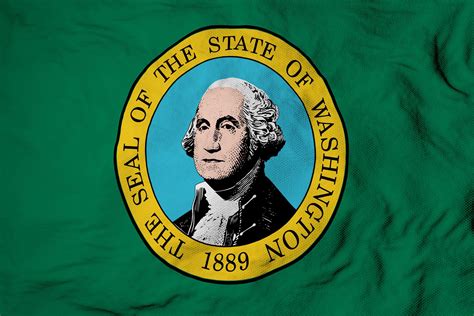
Washington is the only state named after a U.S. president. When Congress organized the territory in 1853, it was carved out of the Oregon Territory and initially proposed to be called Columbia, after the Columbia River. However, to avoid confusion with the District of Columbia, Congress renamed it Washington Territory in honor of George Washington, the first president and the most celebrated figure of the founding generation. Washington became a state in 1889. The naming of the state after Washington, rather than using an indigenous name for the region as many neighboring states did, reflects the mid-19th century tendency to honor national heroes as the country expanded westward.
Washington stands at the meeting point of ancient wilderness and 21st-century economic power. The western half of the state is defined by rain, old growth, volcanoes, and Puget Sound, a vast inland sea that made Seattle one of the great port cities of the Pacific. The eastern half is a different world: sun-drenched, agricultural, conservative, and producing more apples than anywhere else on earth.
The state's Indigenous nations, dozens of distinct peoples who built complex civilizations around the Pacific salmon, have shaped Washington's identity from its earliest days to the present. The 1974 Boldt Decision affirmed tribal fishing rights in a ruling that transformed Pacific Northwest fisheries management and remains one of the most significant federal court rulings in U.S. environmental law.
Modern Washington is the wealthiest state per capita in the nation, driven by the tech empires of Amazon and Microsoft, a world-class aerospace industry built by Boeing, and a knowledge economy that has attracted talent from every corner of the globe. It has no state income tax, votes reliably Democratic in federal elections, and has long been a laboratory for progressive policy, from universal vote-by-mail to early legalization of recreational marijuana and same-sex marriage.
Geography & Four Distinct Regions
The Cascade Range divides Washington into two climatic worlds, a wet, forested west dominated by Puget Sound, and a dry, agricultural east across the Columbia Plateau.
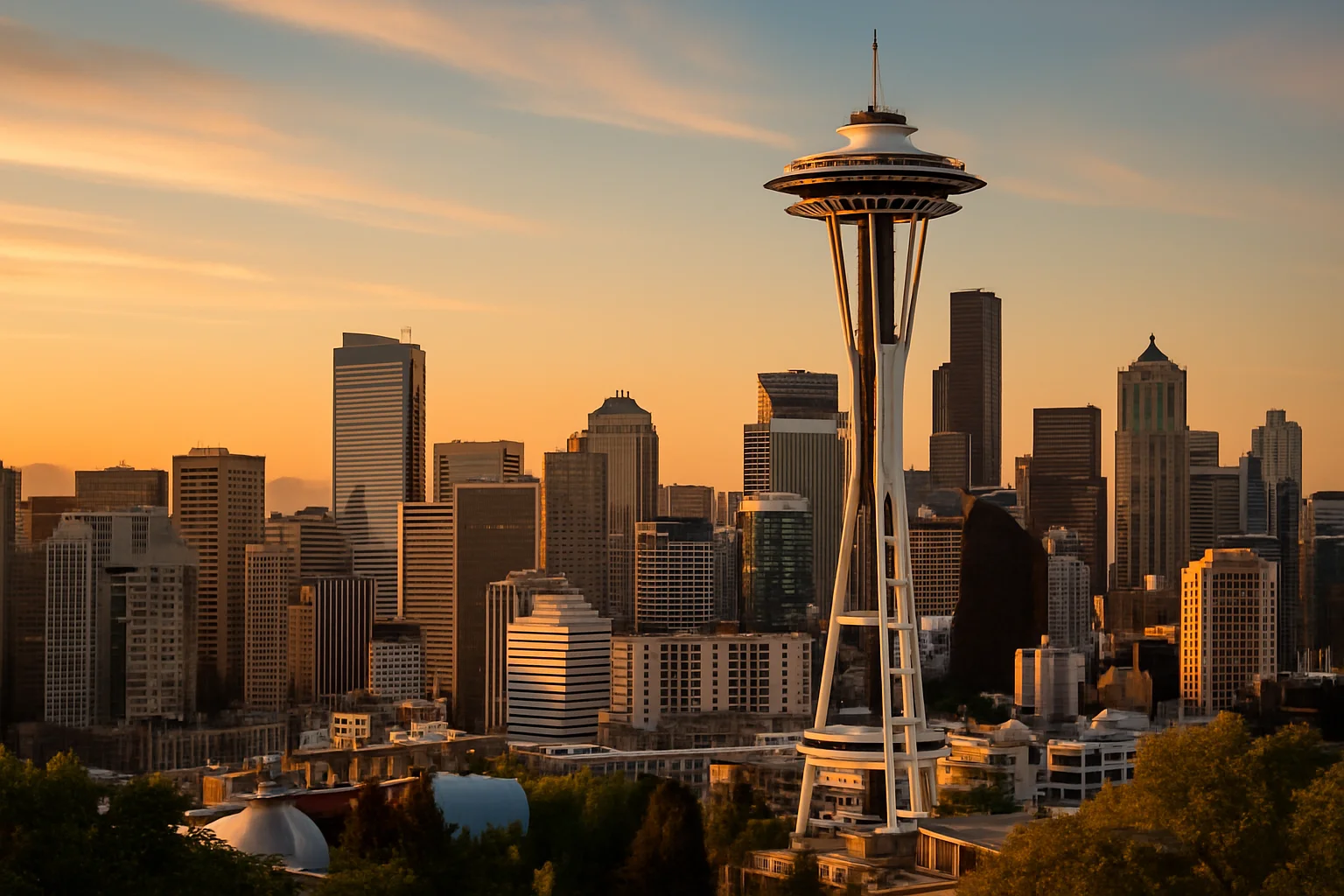
The Puget Sound region is the economic, cultural, and political heart of Washington. Seattle, the state's largest city with a metro population exceeding 4 million, anchors one of the most dynamic economies in the world, home to Amazon, Microsoft, Boeing's commercial division, Starbucks, Costco, REI, and Nordstrom. The city sits between Puget Sound to the west and Lake Washington to the east, in a landscape of hills, water, and towering Douglas firs.
The region receives roughly 37 inches of rain per year, less than New York City but spread across many more overcast days, giving Seattle its reputation for perpetual gray skies. Surrounding cities including Bellevue, Tacoma, Everett, and Redmond have grown into a dense, interconnected metro that rivals the Bay Area for tech industry concentration.
Puget Sound is a system of glacier-carved fjords with more than 2,500 miles of shoreline, connected to the Pacific through the Strait of Juan de Fuca; Washington State Ferries, the largest ferry system in the country, carries about 24 million riders a year across it. Seattle sits on a set of hills between the sound and Lake Washington, and its early-1900s 'regrades' sluiced whole hills into the tideflats to flatten the downtown.
The metro added roughly 800,000 people in the 2010s, one of the fastest growth rates of any large U.S. region, and Amazon alone built more than 40 buildings in Seattle's South Lake Union neighborhood. That growth pushed the median Seattle home price past 800,000 dollars and made homelessness a defining political fight, prompting a 2018 'head tax' on large employers that the city council passed and then repealed within a month under business pressure.
The Olympic Peninsula, jutting into the Pacific northwest of Seattle, is one of the most ecologically diverse places in North America. Olympic National Park, a UNESCO World Heritage Site, encompasses three distinct ecosystems: a glacier-capped mountain range (Mount Olympus reaches 7,980 feet), temperate rainforest valleys receiving over 140 inches of rain annually (the Hoh Rain Forest), and 73 miles of wild Pacific coastline. The peninsula is home to the S'Klallam, Quileute, and Makah peoples, among others, who have fished these waters for thousands of years.
The Makah Tribe holds the only treaty-reserved right to hunt whales among all U.S. tribes, a right that has generated significant national debate. The peninsula's isolation, accessible only by ferry or the long drive around Hood Canal, has preserved both its wilderness and its tight-knit communities.
Olympic National Park grew from a national monument President Theodore Roosevelt created in 1909 to protect the Roosevelt elk, and it is still one of the least roaded large parks in the country, with a single road reaching the alpine meadows at Hurricane Ridge. The 2014 removal of two dams on the Elwha River inside the park, the largest dam removal in U.S. history at the time, has brought salmon back above the old dam sites and rebuilt beaches at the river mouth.
In 1999 the Makah exercised the whaling right reserved in their 1855 treaty and killed a gray whale for the first time in 70 years, drawing protests, lawsuits, and a decades-long federal permitting process that finally cleared a limited hunt in 2024. The peninsula's timber towns, Forks, Aberdeen, and Hoquiam, went into steep decline after the spotted-owl logging restrictions of the 1990s, and Forks later found a second life as the setting of the 'Twilight' novels.
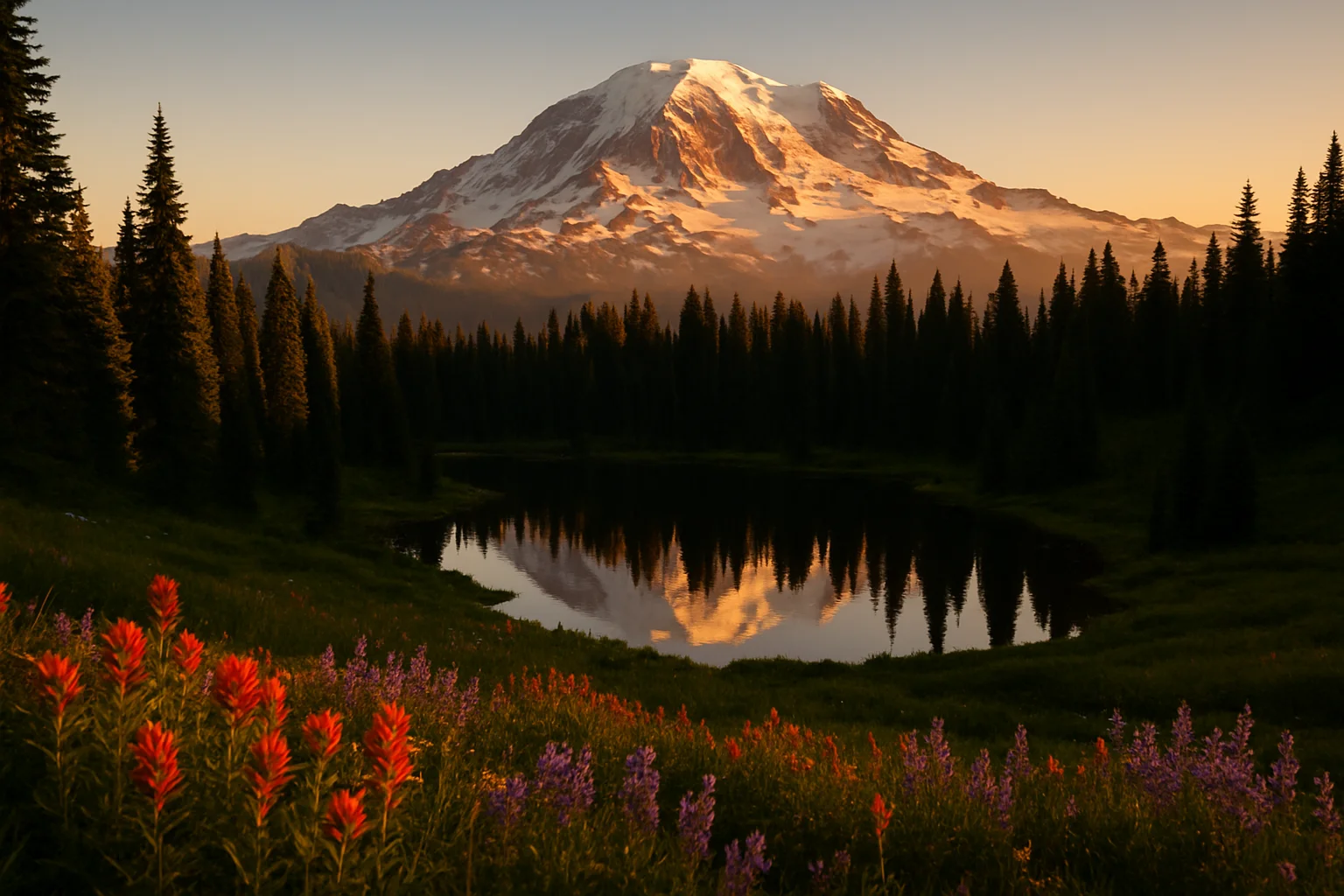
The Cascade Range divides Washington cleanly into two worlds, wet west and dry east. The range includes some of the most dramatic volcanic peaks in North America: Mount Rainier (14,411 feet), the highest point in the state and the most glaciated peak in the contiguous U.S.; Mount Baker; Glacier Peak; and the infamous Mount St. Helens, which erupted catastrophically in 1980. North Cascades National Park, often called the American Alps, contains more glaciers than anywhere else in the contiguous U.S. outside Alaska.
The Cascades create an abrupt rain shadow: the western slopes receive over 100 inches of precipitation per year, while Ellensburg and Yakima, just 100 miles east, sit in near-desert conditions receiving fewer than 9 inches annually. Stevens Pass, Snoqualmie Pass, and White Pass are the primary corridors linking western and eastern Washington.
Mount Rainier is considered one of the most dangerous volcanoes in the world, not for the odds of a big eruption but because its glaciers can turn into lahars, fast mudflows that have repeatedly buried the Puyallup valley where about 90,000 people now live; Orting and other towns run lahar-warning sirens and evacuation drills. The Osceola Mudflow about 5,600 years ago ran all the way to Puget Sound.
The 1990 listing of the northern spotted owl and a 1991 federal court injunction sharply cut logging in the Cascades' federal forests, and the 1994 Northwest Forest Plan set most of the old growth aside. The range is also the state's water tower: Seattle and Tacoma draw their drinking water from protected Cascade watersheds, and the snowpack that feeds the Columbia and Yakima rivers and eastern Washington's irrigation has been shrinking and melting earlier as the climate warms.
East of the Cascades, Washington transforms dramatically. The Columbia Plateau, a vast lava-formed tableland, is one of the most productive agricultural regions in the country. Washington grows more apples than any other state, producing roughly 60% of the nation's apple crop.
The region also dominates in cherries, pears, hops (nearly 75% of U.S. hops production), asparagus, and Concord grapes. The Yakima Valley has emerged as one of the premier wine regions in North America, with over 15,000 acres under vine. Spokane, the largest city in eastern Washington with a metro population near 600,000, serves as the regional hub, a compact, affordable alternative to Seattle known locally as the 'Lilac City.' The Palouse, rolling hills of volcanic silt in the southeast, produces enormous wheat harvests and some of the most beautiful agricultural scenery in the world.
The Columbia Plateau's soil and shape were set by the Missoula Floods, dozens of Ice Age torrents that stripped parts of the region to bare basalt, carving the Channeled Scablands and the 400-foot-deep dry canyon of Grand Coulee. Grand Coulee Dam, finished on the Columbia in 1942, is the largest concrete structure in the country and the biggest U.S. power producer, and the Columbia Basin Project it feeds turned about 670,000 acres of sagebrush into irrigated farmland.
The dam and its reservoir flooded Kettle Falls, a Native fishing site used for thousands of years, and blocked salmon from the upper Columbia entirely, with no fish ladders; the Colville and Spokane tribes are still seeking redress. Southeast of the plateau lies the Hanford site, where wartime reactors made the plutonium for the first atomic test and the Nagasaki bomb, and which is now the most contaminated nuclear site in the Western Hemisphere, the focus of a cleanup expected to cost well over 300 billion dollars and run past 2070.

Economy
Washington's economy is among the most dynamic in the nation, anchored by tech giants, a world-class aerospace industry, and the agricultural bounty of the Columbia Plateau.
Amazon was founded by Jeff Bezos in a Bellevue garage in 1994 and grew from an online bookstore into the world's largest e-commerce platform, cloud computing provider (AWS powers roughly a third of the internet), and logistics company. Microsoft was co-founded by Bill Gates and Paul Allen in Albuquerque in 1975 but moved its headquarters to Redmond, Washington in 1979, where it has been ever since. Together, these two companies have made Washington the wealthiest state per capita in the nation and spawned an enormous ecosystem of startups, venture capital, and talent.
Google, Meta, Apple, Salesforce, and virtually every major tech firm maintain large offices in the Seattle area. The region's combination of elite universities (University of Washington), outdoor quality of life, and no state income tax makes it one of the most powerful talent magnets in the world.
Washington's lack of an income tax is a big part of the draw, but so is Microsoft's and Amazon's role as talent farms: the two have seeded hundreds of local startups and much of the region's venture capital, and California giants have opened Seattle-area engineering offices specifically to hire people who do not want to leave. Amazon is the largest private employer in the state, with more than 60,000 corporate and tech workers in the Seattle area alone.
The boom has strained a tax structure that leans on sales tax and is among the most regressive in the country; in 2021 Washington enacted a 7% tax on large capital gains aimed at the wealthiest residents, and the state Supreme Court upheld it in 2023 against a claim it was an unconstitutional income tax. Seattle separately taxes large employers' payrolls to fund housing, the 'JumpStart' tax passed in 2020 after the failed 2018 head tax.
William Boeing founded the Pacific Aero Products Company in Seattle in 1916, the company that became Boeing, arguably the most influential aerospace manufacturer in history. The B-17 Flying Fortress, built at Boeing's Seattle plants, became the backbone of the Allied bombing campaign in World War II. The 707, 727, 737, 747, 757, 767, 777, and 787 Dreamliner were all designed and originally built in Washington.
Boeing is still one of the largest employers in the state, with major facilities in Everett (the largest building by volume in the world), Renton, and the Puget Sound region. Though Boeing relocated its corporate headquarters to Chicago in 2001 and later to Arlington, Virginia, its manufacturing soul remains in Washington. The 737 MAX crisis (2018-2020) and subsequent quality control controversies have been significant challenges, but Boeing remains a defining institution of Washington's identity.
Boeing's fortunes have long driven Washington's business cycle. A 1969 to 1971 downturn cut Boeing employment in the region from about 100,000 to 38,000 and produced the famous billboard, 'Will the last person leaving Seattle turn out the lights.' In the 2003 fight over where to build the 787, Washington kept the line only after the legislature passed roughly 3 billion dollars in tax breaks, the largest state subsidy in U.S. history at the time, parts of which the World Trade Organization later ruled illegal.
Two 737 MAX crashes in 2018 and 2019 killed 346 people and grounded the fleet worldwide for nearly two years, and a door plug blew out of a MAX in flight in January 2024, triggering federal production caps and new scrutiny of the Renton line. Boeing's roughly 32,000 Washington machinists struck for seven weeks in the fall of 2024, their first walkout since 2008, and won a 38% raise over four years.
Washington is the largest apple-producing state in the nation and has been for decades, growing more than 10 billion apples annually. The state also leads in sweet cherries, pears, and hops, nearly 75% of all U.S. hops come from the Yakima Valley, making Washington indispensable to America's craft beer industry. The Columbia River basin supports massive wheat production in the Palouse region.
Washington's wine industry has exploded since the 1980s: the state now has over 1,000 wineries, with the Columbia Valley and Yakima Valley producing award-winning Cabernet Sauvignon, Riesling, and Syrah. Washington wines consistently rank among the best in North America. The combination of hot, sunny summers, cold nights, and volcanic soils gives Washington grapes an intensity and complexity that rivals Napa.
Nearly all of Washington's tree fruit is grown east of the Cascades under irrigation, much of it in the Wenatchee and Yakima valleys and on the Yakama Reservation, and the harvest depends heavily on seasonal migrant labor, with tens of thousands of workers, many on federal H-2A visas, brought in each fall. Washington State University's breeding program developed the Cosmic Crisp apple, released in 2019 after about 20 years of work, and growers planted more than 12 million trees of it.
The state also leads the nation in potato yield per acre and supplies much of the country's french fries, ships Palouse wheat down the Columbia to Asia, and grows the majority of U.S. hops in the Yakima Valley, including many of the aroma varieties craft brewers prize. Wine went from a handful of producers in 1980 to more than 1,000 wineries, making Washington the second-largest wine-producing state.
Washington is one of the top commercial fishing states in the nation. Pacific salmon, chinook, coho, sockeye, pink, and chum, have been central to the ecology, economy, and culture of Washington since before European contact. The Columbia River and its tributaries once hosted the largest salmon runs in the world; restoring those runs while balancing dam power generation, agriculture, and tribal treaty rights remains one of the most complex environmental and political challenges in the state.
Dungeness crab, Pacific halibut, albacore tuna, oysters, and geoduck clams are also major commercial species. Washington's oyster industry produces some of the most prized oysters in the world. Tribal nations hold treaty rights to 50% of the salmon harvest, rights affirmed by federal courts in the landmark 1974 Boldt Decision, which transformed fisheries management across the Pacific Northwest.
Seattle's Fishermen's Terminal is the home port of much of the North Pacific fleet, and the Bering Sea crab and pollock boats featured on shows like 'Deadliest Catch' are largely based in Washington even though they fish off Alaska. The state's own salmon runs have collapsed by comparison: 14 Northwest salmon and steelhead populations are federally listed as threatened or endangered, and the southern resident orcas that eat chinook have dwindled to about 73 animals.
The debate over removing the four lower Snake River dams to help salmon, and replacing their power, barge transport, and irrigation, has become one of the most contentious in the region; a 2023 federal agreement paused litigation and funded tribal-led restoration while leaving the dams standing for now. Ocean acidification devastated Washington's oyster hatcheries in the mid-2000s, prompting some growers to move operations to Hawaii and spurring pioneering state research on the problem.
Washington has an outsized influence on American consumer life. Starbucks was founded in Seattle's Pike Place Market in 1971 and grew to become the largest coffeehouse chain in the world, with over 35,000 locations globally, and in doing so, transformed American coffee culture from drip coffee to espresso drinks. Costco, the membership warehouse giant, is headquartered in Issaquah and is now one of the largest retailers in the world.
REI, the outdoor cooperative, was founded in Seattle in 1938 and remains headquartered there. Nordstrom, one of the premier fashion retailers in the U.S., was founded in Seattle in 1901 as a shoe store. These companies reflect Washington's combination of outdoorsy culture, premium consumer expectations, and entrepreneurial tradition that predates the tech boom by decades.
Starbucks grew under Howard Schultz, who bought the company in 1987 after a Milan trip convinced him to build espresso bars; it went public in 1992 and by the 2010s was opening a store somewhere in the world every few hours. Its Seattle headquarters and its unionization fights, workers at hundreds of U.S. stores have voted to organize since 2021, keep it in the national news.
Costco, with about 900 warehouses and the second-largest retail revenue in the world after Walmart, is known for paying well above retail-industry wages and for holding its hot-dog-and-soda combo at 1.50 dollars since 1985. Nordstrom, still partly family-run after more than a century, agreed in 2024 to a deal taking it private with the founding family and a Mexican retailer. Older Washington Fortune 500 firms that predate the consumer-brand era include the timber company Weyerhaeuser and the truck maker PACCAR, which builds Kenworth and Peterbilt.
How Washington's State Government Works
Washington operates under a constitution adopted at statehood in 1889, with strong direct democracy provisions that have made citizens, not the legislature, the drivers of some of the most consequential policy changes in state history. The initiative and referendum process has been used to legalize recreational marijuana (2012), approve same-sex marriage (2012), set minimum wages, and pass significant environmental regulations.
Washington has voted Democratic in every presidential election since 1988 and is one of the most reliably blue states in the country. Democrats have controlled the governorship continuously since 1985, a 40-year streak, and hold strong majorities in both legislative chambers. The state is noted for its large contingent of women in elected office and has been a pioneer in progressive policy including environmental regulation, healthcare access, and LGBTQ+ rights.
Washington has no state income tax, relying instead on sales tax and business and occupation taxes. This creates a regressive tax structure that has generated periodic debate, efforts to create a capital gains tax and wealth tax have faced both political and legal challenges. The state's budget is significantly affected by the boom-bust cycles of its tech-driven economy.
Governor of Washington
Current Governor
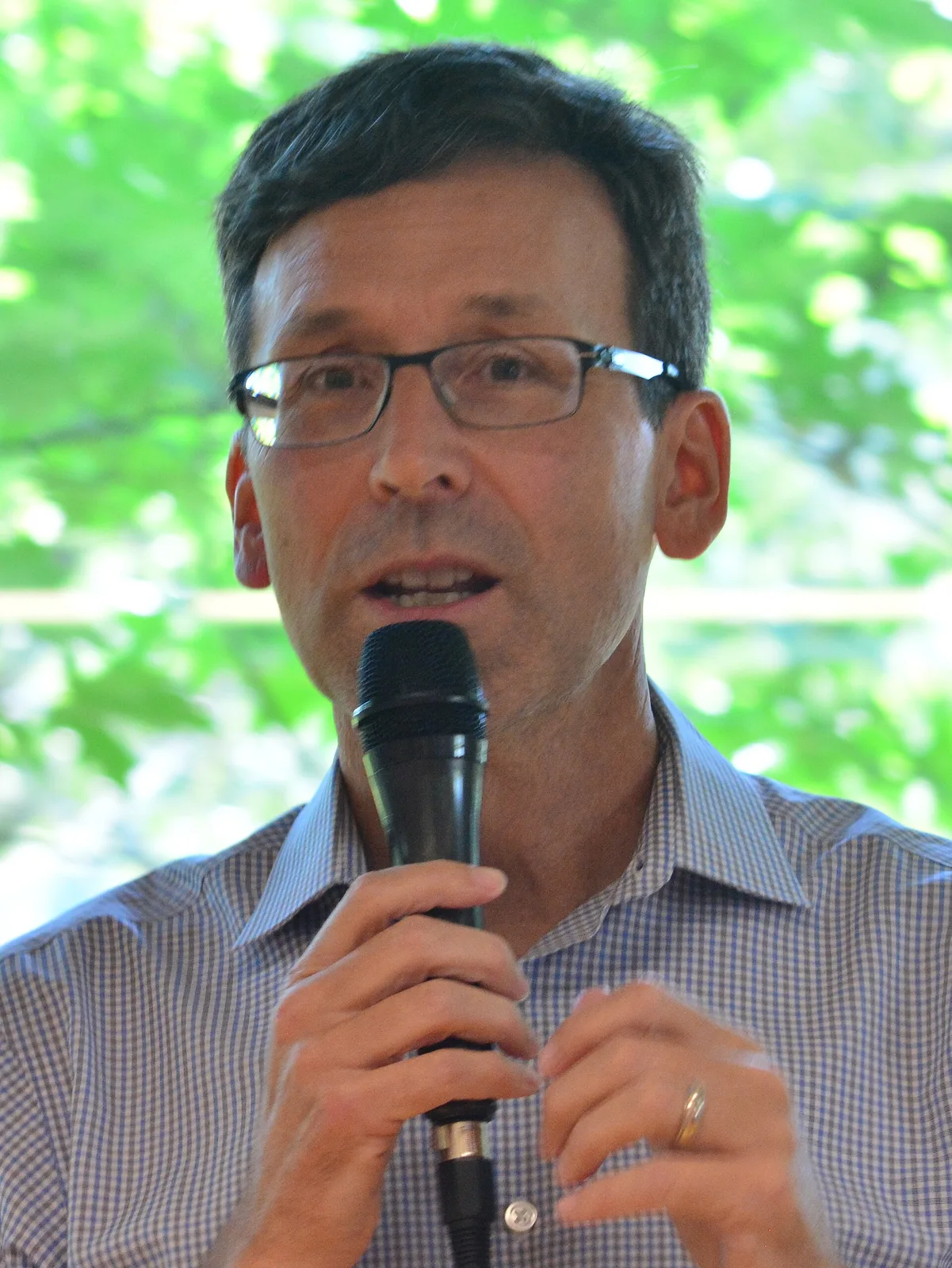
Bob Ferguson
- Party
- Democrat
- In Office Since
- January 2025
- Term Ends
- January 2029
- Prior Role
- Attorney General of Washington (2013-2025)
- Education
- University of Washington (B.A., J.D.)
- Background
- Lawyer; 12-year record as state AG
Bob Ferguson served 12 years as Washington's Attorney General, becoming nationally prominent for filing the first successful legal challenge to President Trump's 2017 travel ban, which was blocked by federal courts. His tenure as AG was defined by aggressive consumer protection enforcement, environmental litigation, and hundreds of legal challenges to federal policies. He won the 2024 gubernatorial election to succeed the term-limited Jay Inslee, who had served since 2013.
Other Current State Officials
Attorney General
Nick Brown
In office since January 2025. Former federal prosecutor and U.S. Attorney for the Western District of Washington. Succeeded Bob Ferguson, who became governor. Focuses on consumer protection, environmental enforcement, and civil rights.
Secretary of State
Steve Hobbs
In office since 2021; re-elected in 2024. Former state senator and U.S. Army National Guard veteran. Oversees elections, business licensing, and the state archives. Washington has been a national leader in vote-by-mail since 2011.
State Treasurer
Mike Pellicciotti
In office since 2021; re-elected in 2024. Former state representative. Manages Washington's investment portfolio and bond issuance. The state's strong credit rating reflects its diversified, tech-driven economy.
The Washington State Legislature
Washington State Senate
- Seats: 49 members
- Terms: 4-year terms (staggered)
The upper chamber. Senators serve 4-year terms in two overlapping classes, roughly half the Senate is up for election every two years. Democrats hold a strong majority. The Senate must confirm many of the governor's executive appointments.
Washington House of Representatives
- Seats: 98 members
- Terms: 2-year terms
The lower chamber. All 98 seats are on the ballot every two years. Washington's House has been a proving ground for significant progressive legislation, including early action on climate change, healthcare access, and workers' rights. Democrats hold a comfortable majority.
Washington's U.S. Senators
U.S. Senator
Patty Murray
One of the most senior and influential members of the U.S. Senate, Patty Murray was first elected in 1992 as a self-described 'mom in tennis shoes' and won an open seat that year, defeating Republican congressman Rod Chandler. She has since become one of the most powerful members of Congress, serving as Senate President Pro Tempore (third in line to the presidency) and Chair of the Appropriations Committee in 2023 and 2024, and as the committee's top Democrat since 2025, and a leading voice on education, veterans' affairs, and healthcare. Murray co-authored the Every Student Succeeds Act (2015), the major rewrite of federal K-12 education law, and has been a fierce advocate for veterans. She is the longest-serving Democratic woman in Senate history.
U.S. Senator
Maria Cantwell
Maria Cantwell was first elected to the Senate in 2000 by fewer than 2,400 votes, one of the closest Senate races in U.S. history, and has won re-election comfortably ever since. A former tech executive (she was a senior vice president at RealNetworks during the dot-com era), Cantwell has been a consistent voice on technology policy, internet privacy, energy, and trade. She chaired the Senate Commerce Committee from 2021 to 2025 and has been its top Democrat since, and has been a strong advocate for tribal nations, clean energy, and trade with Asia. Her background in the tech industry gives her credibility on digital economy issues that few senators can match. She won re-election in 2024 with a comfortable margin.
Washington Through the Years
From early settlement to the present day. Tap any era to read more.
The Pacific Northwest was home to some of the most complex and prosperous Indigenous civilizations in North America. Dozens of distinct nations, including the Chinook, S'Klallam, Makah, Lummi, Yakama, Spokane, and Nez Perce, thrived in a region of extraordinary natural abundance.
The Pacific salmon, returning to rivers in massive runs each year, provided the protein base for dense, settled populations unlike the nomadic cultures common elsewhere. The potlatch, a ceremonial feast in which a host demonstrates wealth and status by giving away possessions, was the defining social institution of many Northwest Coast peoples, governing economics, politics, and social hierarchy.
Northwest Coast art, totem poles, carved cedar canoes, woven baskets, and ceremonial masks, represents one of the great artistic traditions of the Americas. The Makah people of the Olympic Peninsula built the only North American culture outside the Arctic that regularly hunted gray and humpback whales, a tradition documented in extraordinary detail by the Ozette archaeological site, preserved by a mudslide 500 years ago.
Washington now has 29 federally recognized tribes, more than all but a few states, and tribal governments are among the largest employers in several rural counties through casinos, fisheries, and timber. The Ozette dig on the Makah coast, excavated from 1970 to 1981 after a storm exposed it, recovered more than 55,000 artifacts from cedar longhouses buried by a mudslide around 1560, making it one of the richest archaeological sites in North America.
American Captain Robert Gray became the first non-Indigenous person to enter the Columbia River in 1792, naming it after his ship and establishing the U.S. claim to the Pacific Northwest. That same year, British Captain George Vancouver explored Puget Sound in extraordinary detail, naming the sound after his officer Peter Puget and bestowing English names across the region, Hood Canal, Mount Baker, Whidbey Island, most of which survive today.
In November 1805, the Lewis and Clark Expedition reached the Pacific Ocean near present-day Astoria, Oregon, after 18 months of travel from St. Louis, the first overland crossing of the continent by U.S. citizens. Their journals, which documented the Columbia River system and the Northwest's resources in meticulous detail, sparked American interest in the Pacific and set the stage for settlement and the geopolitical contest with Britain.
Gray had already made a fortune in the maritime fur trade, carrying sea otter pelts from the Northwest coast to Canton, China, and his 1792 entry into the Columbia gave the United States its strongest claim to the region a decade before the Louisiana Purchase even reached the Rockies. Vancouver's charts of Puget Sound were accurate enough that the Navy still used them well into the 20th century.
Fur companies followed. The British Hudson's Bay Company built Fort Vancouver on the Columbia in 1825 and effectively governed the region for two decades under Chief Factor John McLoughlin, trading with tribes and provisioning the first American settlers. Epidemics moved faster than the traders: a series of 'fever and ague' outbreaks after 1830 killed an estimated 90% of the Native people of the lower Columbia within a few years.
Both the United States and Britain claimed the Pacific Northwest under competing treaty rights, and for decades the region was jointly occupied. American settlement accelerated through the 1840s via the Oregon Trail, and political pressure in the U.S. to assert full sovereignty grew intense, the slogan 'Fifty-four Forty or Fight!' called for extending U.S. territory all the way to Alaska. The Oregon Treaty of 1846 settled the dispute peacefully, establishing the 49th parallel as the U.S.-Canada border (with a jog around Vancouver Island), the line that still stands today.
In 1853, Washington Territory was carved out of the northern portion of Oregon Territory, with Isaac Stevens appointed as its first governor. Stevens immediately set about negotiating a series of treaties with Indigenous nations that extinguished most tribal land claims but explicitly reserved fishing rights, treaties that would become the subject of bitter conflict 120 years later.
Stevens signed 10 treaties in 1854 and 1855 covering most of the territory, often in a matter of days and through imperfect Chinook Jargon translation, pressing chiefs to sign and relocate to reservations. Resistance broke out almost immediately in the Yakima War and the Puget Sound War of 1855 and 1856, and the Nisqually leader Leschi was hanged in 1858 after a trial for killing a soldier in wartime; Washington's Supreme Court formally exonerated him in 2004.
The treaties' clause reserving the right to fish 'at all usual and accustomed grounds and stations' in exchange for the land cession was the exact language that Judge Boldt would enforce 120 years later. Stevens himself went on to serve as territorial delegate to Congress and was killed leading Union troops at the Battle of Chantilly in 1862.
Washington was admitted to the Union on November 11, 1889, as the 42nd state, the same year as Montana, North Dakota, and South Dakota, a remarkable burst of statehood driven by Republican desire to add reliable states before Democrats potentially retook Congress. Olympia, a small town on the southern tip of Puget Sound, was chosen as the state capital, partly because it had been the territorial capital and partly because the more powerful city of Seattle didn't want the government interference that capital status would bring.
The state's constitution was unusually progressive for its time, including direct democracy provisions that allowed citizens to propose and pass laws by initiative, a mechanism that has shaped Washington policy for over a century. The state was largely rural and timber-dependent at statehood; Seattle had only about 42,000 residents.
Washington came in through the 1889 'Omnibus' statehood act that also admitted Montana and the Dakotas, engineered by Republicans in Congress. The 1889 constitution barred the state from debt, limited legislative favors to corporations after decades of railroad dominance, and denied women the vote, though Washington had briefly granted and then lost women's suffrage in territorial days before restoring it by amendment in 1910, a decade ahead of the 19th Amendment.
1889 was also the year Seattle burned: a June fire destroyed the entire 25-block business district, after which the city rebuilt in brick and stone one story higher, leaving the old street level as the 'Seattle Underground' tourists can still walk. The Klondike Gold Rush of 1897 and 1898 made Seattle the outfitting and departure point for prospectors bound for the Yukon and cemented its role as the commercial gateway to Alaska.
William Boeing launched his first airplane from Lake Union in Seattle in 1916 and founded the Pacific Aero Products Company, renamed Boeing Airplane Company the following year. The company grew steadily through the 1920s and 1930s, but World War II transformed it into a colossus. Boeing's B-17 Flying Fortress and B-29 Superfortress were the backbone of the Allied strategic bombing campaign against Nazi Germany and Imperial Japan.
At peak production, Boeing's Seattle plants employed over 50,000 workers, and the entire Washington economy reorganized around war production. The war permanently transformed the state, it brought tens of thousands of workers to Puget Sound, built out the region's infrastructure, and established Boeing as the anchor of a defense and aerospace economy that would dominate Washington for the next half century.
Wartime shipyards and Boeing plants drew tens of thousands of workers to Puget Sound, including many Black Southerners in the second Great Migration and women who made up nearly half of Boeing's workforce. At the same time, the federal government forcibly removed and incarcerated more than 12,000 Washingtonians of Japanese ancestry in 1942 under Executive Order 9066, most from Seattle's Nihonmachi and the farm districts of the Puyallup and Yakima valleys; the Puyallup fairgrounds served as the 'Camp Harmony' assembly center.
The Hanford Engineer Works, built in secret starting in 1943 on the Columbia in the eastern Washington desert, produced the plutonium for the Trinity test and the Nagasaki bomb; at its peak the site employed about 50,000 people in a new town, Richland, whose purpose most workers did not know. Grand Coulee Dam's power, completed just in time in 1941, ran the Hanford reactors and the aluminum smelters that fed Boeing.
Federal Judge George Boldt issued one of the most consequential rulings in Pacific Northwest history in 1974, determining that the treaties negotiated by Isaac Stevens in the 1850s entitled Native American tribes to 50% of the harvestable salmon catch in Washington, not the tiny fraction they had been receiving. The decision, upheld by the U.S. Supreme Court in 1979, transformed the Pacific Northwest fishing industry and tribal-state relations. Non-Indian commercial and sport fishers were outraged, Boldt was burned in effigy, federal marshals were needed to enforce the ruling, and for years the ruling generated enormous hostility.
But the Boldt Decision ultimately forced Washington to develop one of the most sophisticated cooperative fisheries management systems in the world, shared between tribal, state, and federal managers. It remains the legal foundation of tribal fishing rights across the Pacific Northwest.
The case, United States v. Washington, was brought by the federal government for 14 tribes after years of 'fish-ins,' protest fishing in defiance of state law that led to hundreds of arrests; Marlon Brando and comedian Dick Gregory joined and were arrested at Frank's Landing on the Nisqually River in the 1960s. Judge Boldt spent three years on the case and read the 1850s treaties' promise of fishing 'in common with' settlers to mean an equal 50-50 split.
A 2018 U.S. Supreme Court decision in a later phase of the same case ordered Washington to spend billions replacing culverts under state roads that block salmon from reaching spawning streams, extending the treaty right from harvest to habitat. The tribes have since become co-managers of the state's fisheries and among the largest funders of salmon-recovery science in the region.
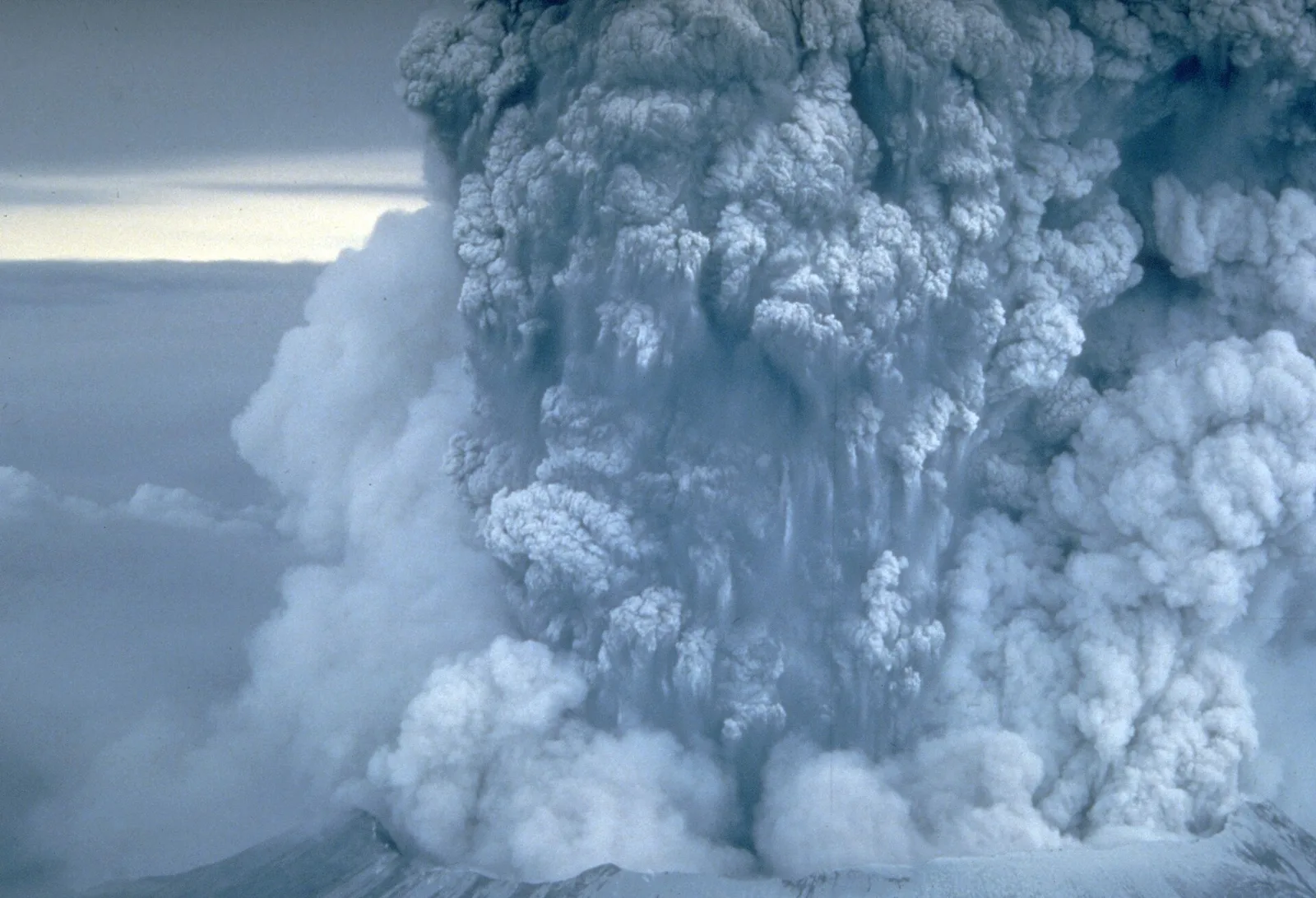
At 8:32 a.m. on May 18, 1980, Mount St. Helens in southwestern Washington exploded in the largest and deadliest volcanic eruption in the recorded history of the contiguous United States. A massive landslide triggered by an earthquake preceded the lateral blast, which flattened 230 square miles of old-growth forest in seconds, an area the size of Chicago, and sent a column of ash 80,000 feet into the stratosphere. Fifty-seven people were killed, including volcanologist David Johnston and innkeeper Harry Truman, who had refused to evacuate.
The eruption deposited ash across 11 states and sent a pyroclastic flow racing down the Toutle River valley. The crater left behind, 2,000 feet deep and a mile wide, was a wasteland of gray ash and fallen trees. The recovery of Mount St. Helens since 1980 has been a landmark study in ecological succession, fascinating scientists worldwide.
Geologists had warned for years that St. Helens was the Cascade volcano most likely to erupt, and it began venting steam and swelling in March 1980, growing a 'bulge' on its north flank that pushed out about five feet a day. The May 18 eruption began when a magnitude-5.1 earthquake shook that oversteepened bulge loose in the largest landslide ever recorded, uncorking the pressurized magma beneath it into a sideways blast.
The eruption left the mountain at 8,363 feet, 1,300 feet lower than before, with a horseshoe crater open to the north. Congress made the area the Mount St. Helens National Volcanic Monument in 1982 and left much of the blast zone to recover on its own, which it has done faster than expected: elk, fireweed, and young forest returned within decades, and a new lava dome has been slowly rebuilding inside the crater since 2004.
The 1990s were a decade of extraordinary transformation for Seattle and Washington. Grunge music, pioneered by Nirvana, Pearl Jam, Soundgarden, and Alice in Chains, turned Seattle into the cultural capital of a generation; Kurt Cobain's death in April 1994 was mourned worldwide.
Amazon was founded in a Bellevue garage in 1994, the same year Jeff Bezos moved to Seattle to launch what he imagined as an internet bookstore. Microsoft, already massive, launched Windows 95 in 1995, putting the PC in millions of homes.
Starbucks, founded in 1971, went national and international in the late 1980s and 1990s, opening its 1,000th store in 1996. By 1999, Seattle was the fastest-growing major city in the country, and the site of one of the defining political events of the decade when tens of thousands of protesters shut down the World Trade Organization ministerial conference, making the Battle of Seattle a landmark in the global justice movement.
The decade's growth also produced a backlash that still shapes Washington politics: the 1999 WTO protests, a run of anti-tax initiatives led by activist Tim Eyman that repeatedly capped car-tab fees and property taxes, and, later, the fights over Amazon's footprint. Paul Allen, Microsoft's co-founder, poured his fortune into Seattle, funding the Allen Institutes for brain and cell science, the Museum of Pop Culture, the South Lake Union redevelopment that Amazon later filled, and the purchase of the Seahawks, whose stadium he built to keep the team in town.
Washington's Defining Moments in American History
These are the events that didn't just shape Washington, they changed the nation.
The May 18, 1980 eruption of Mount St. Helens remains the most destructive volcanic event in U.S. history. The mountain lost 1,300 feet of elevation in seconds as the north face collapsed in the largest landslide ever recorded. The lateral blast, moving at 300 mph, flattened 230 square miles of forest. Ash fell as far as Minnesota.
Fifty-seven people died. The eruption was a vivid reminder that the Cascade Range is an active volcanic zone, Mount Rainier, considered the most dangerous volcano in the U.S. due to the lahar risk to populated Puget Sound valleys, is carefully monitored by the U.S. Geological Survey. Mount St. Helens has since partially rebuilt its dome and remains volcanically active.
The blast leveled forest across 230 square miles in about three minutes, snapping mature Douglas firs like matchsticks and dropping enough ash to close highways and airports across the Northwest and dust cars as far east as Oklahoma. Weyerhaeuser, which owned much of the timber, salvage-logged the dead trees for years and replanted, while the federal monument left an equal area untouched for study.
The eruption reshaped U.S. volcano policy: the U.S. Geological Survey opened the Cascades Volcano Observatory in Vancouver, Washington in 1980 and built the lahar-warning networks that now guard the Puyallup valley below Mount Rainier, where roughly 90,000 people live atop the volcano's old mudflow deposits.
In November 1999, Seattle hosted the World Trade Organization Ministerial Conference, and 50,000 protesters shut it down. A coalition of labor unions, environmental groups, student activists, and anarchists converged on Seattle and blocked delegates from reaching the convention center on the opening day. Police responded with tear gas and rubber bullets; the National Guard was called out; the mayor imposed a curfew.
The ministerial conference collapsed without reaching agreement, partly due to protests, partly due to divisions between wealthy and developing nations. The 'Battle of Seattle' became a defining moment for the anti-globalization movement and established a protest playbook, mass mobilization, direct action, decentralized organization, that shaped activist tactics globally through the 2000s.
The protests caught the city flat-footed. Police ran low on tear gas, downtown stores were vandalized, about 600 people were arrested, and Mayor Paul Schell declared a state of emergency and a 50-block 'no-protest zone.' Seattle's police chief, Norm Stamper, resigned within days and spent much of his later career criticizing the militarized response he had overseen.
The city paid roughly 1.8 million dollars to settle lawsuits over the mass arrests, and a federal jury later found them unconstitutional. The template the protests set, decentralized 'affinity groups,' puppets and street theater, and a mix of nonviolent blockades and property destruction, reappeared at Occupy Wall Street in 2011 and in later movements.
No state has shaped the modern digital economy more than Washington. Microsoft, founded in 1975, created the operating systems that put personal computers on every desk. Amazon, founded in 1994, built the world's largest retail platform and then created AWS, the cloud infrastructure that powers a significant portion of the internet. Together, these two companies have a combined market capitalization exceeding $4 trillion, more than the GDP of Germany.
Washington's tech economy has made it the highest-income state per capita in the nation and attracted talent from around the world. The University of Washington's Paul G. Allen School of Computer Science & Engineering is consistently ranked among the top computer science programs globally. The 'Seattle-Bellevue-Redmond tech corridor' is now spoken of in the same breath as Silicon Valley.
The dominance is narrower than the raw numbers suggest: it rests heavily on Microsoft and Amazon plus the satellite offices of California firms, and Washington has produced relatively few homegrown startups of comparable size. The University of Washington's computer-science school, renamed for Paul Allen in 2017 after a 40-million-dollar gift, feeds much of the local hiring pipeline, and the region has become a hub for cloud computing, machine learning, and generative-AI research.
Amazon's rise made it a lightning rod at home: Seattle's failed 2018 employee 'head tax,' its successful 2020 JumpStart payroll tax, and the company's very public 2017 search for a second headquarters, which ended in northern Virginia, all turned on the strain its growth put on housing and transit. Space is a growing sector too, with Blue Origin, founded by Jeff Bezos, building rockets in Kent and SpaceX running a large satellite-engineering office in Redmond.
Notable Washingtonians
Bill Gates
Co-founder of Microsoft and philanthropist, born in Seattle
Jimi Hendrix
Revolutionary guitarist and Rock and Roll Hall of Famer, born in Seattle
Bing Crosby
Singer and actor whose White Christmas is one of the best-selling singles ever, born in Tacoma
Chief Seattle
Suquamish and Duwamish leader for whom Seattle is named, known for advocating coexistence
Gary Larson
Creator of the beloved Far Side comic strip, born in Tacoma
Kenny Loggins
Grammy-winning singer-songwriter known for Footloose and Danger Zone, born in Everett
State Symbols & Quick Facts
| Nickname | "The Evergreen State" |
| Capital | Olympia |
| Largest City | Seattle |
| Statehood | November 11, 1889 (42nd state) |
| Population | ~7.9 million (2025 est.) |
| Area | 71,298 sq mi, 18th largest state |
| Motto | "Al-ki" (By and By) |
| State Bird | Willow Goldfinch (American Goldfinch) |
| State Flower | Coast Rhododendron |
| State Tree | Western Red Cedar |
| State Fish | Steelhead Trout |
| State Animal | Olympic Marmot |
| State Insect | Green Darner Dragonfly |
| State Song | "Washington, My Home" |
| Time Zone | Pacific |
| Borders | Oregon (S), Idaho (E), British Columbia, Canada (N), Pacific Ocean (W) |
Did You Know?
Washington is the only U.S. state named after a president, George Washington. To avoid confusion with Washington, D.C., the postal abbreviation is WA and residents often call it 'Washington State.' Despite sharing a name, the state and the capital city are on opposite sides of the country.
Washington produces roughly 60% of all the apples grown in the United States, about 10 to 12 billion apples per year. The state's volcanic soil, hot summers, cool nights, and reliable irrigation from the Columbia and Yakima rivers create near-perfect conditions for apple growing. Varieties like Gala, Fuji, Honeycrisp, and the Washington-developed Cosmic Crisp are grown here.
Washington has no state income tax, and no corporate income tax, making it one of only nine such states. This has been a major driver of Amazon and Microsoft's decision to keep enormous workforces in the Seattle area, and it contributes to the state's appeal for high-earning tech workers. The state instead relies heavily on its sales tax, which is among the highest in the nation.
The Boeing Everett Factory, where the 747 was built until 2022 and the 767 and 777 are still assembled (787 assembly moved to South Carolina in 2021), is the largest building by volume in the world, covering 98.3 acres under a single roof. According to a long-told story, clouds once formed near its ceiling before the ventilation system was upgraded.
Washington has been a universal vote-by-mail state since 2011, every registered voter automatically receives a mail ballot for every election. The state has had no polling places for over a decade. Washington consistently ranks among the top states in voter turnout, and its vote-by-mail system has been studied as a model for election administration nationwide.
Quick Facts and Common Questions
Short answers to the questions people most often ask about Washington State: its abbreviation, when it was founded, its capital, and its place in Congress.
Washington's two-letter postal abbreviation is WA. The U.S. Census Bureau places it in the West region, in the Pacific division, and about 7.71 million people lived there in the 2020 census.
Washington became the 42nd state on November 11, 1889. Congress created the Washington Territory in 1853 from the northern part of the Oregon Territory, and the 1846 Oregon Treaty with Great Britain had already set the border with Canada at the 49th parallel.
No. Washington State is in the Pacific Northwest, about 2,300 miles from Washington, D.C., the nation's capital on the East Coast, which is a federal district and not part of any state. Both are named for George Washington, and Washington is the only state named for a U.S. president.
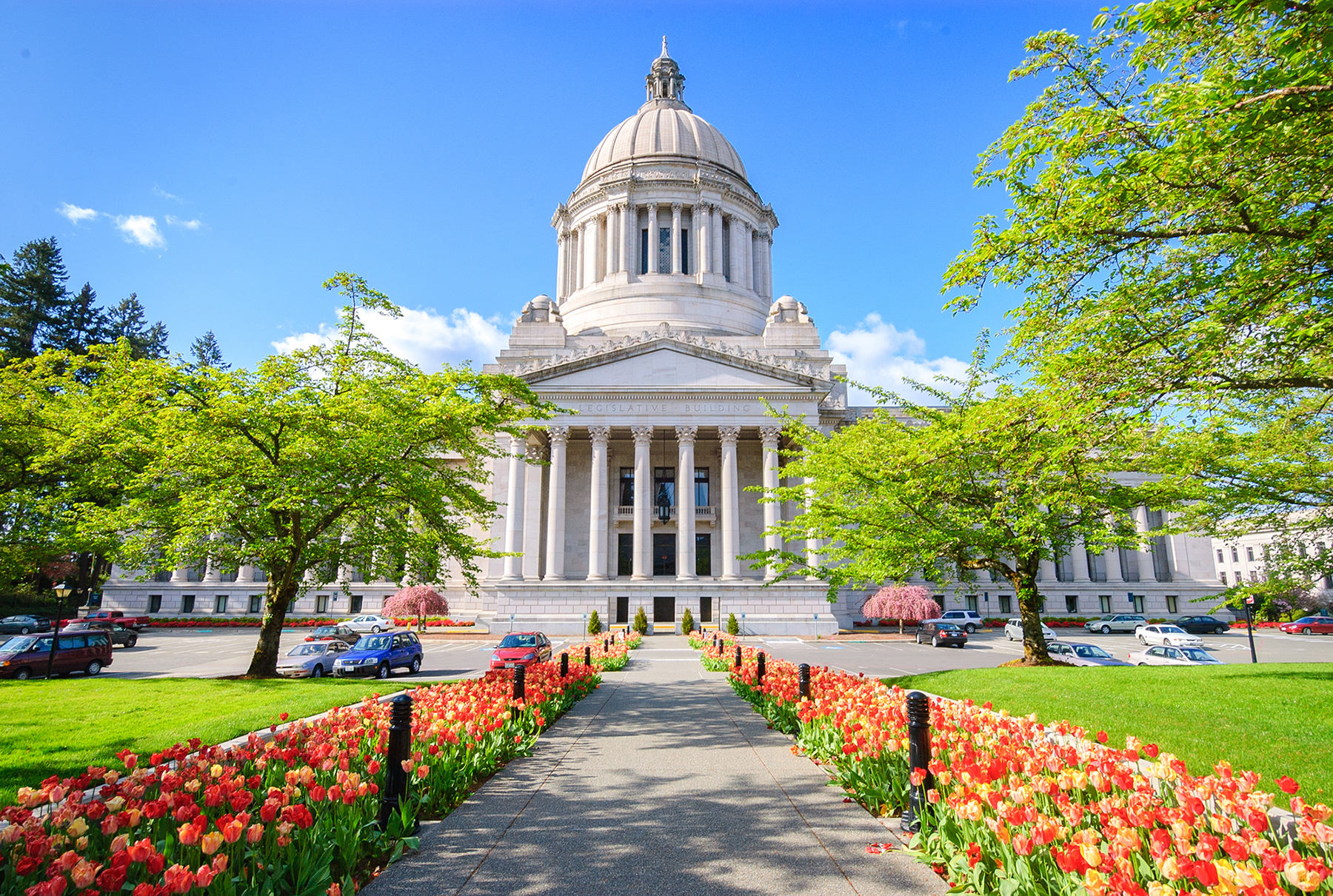
Olympia has been the capital since the Washington Territory was organized in 1853, and voters confirmed it as the state capital after statehood. Its Legislative Building, completed in 1928, has one of the tallest masonry domes in the world. Seattle is the state's largest city.
Washington borders Idaho to the east and Oregon to the south, much of it along the Columbia River. To the north it borders the Canadian province of British Columbia, and its western edge is Pacific Ocean coastline and the inland waters of Puget Sound.
On May 18, 1980, Mount St. Helens in southwestern Washington erupted after a massive landslide removed its north face, killing 57 people and flattening about 230 square miles of forest. It was the deadliest and most economically destructive volcanic eruption in U.S. history, and the area is now Mount St. Helens National Volcanic Monument.
Washington is known as "The Evergreen State," for its vast forests. Its motto is "Al-ki," a Chinook Jargon word meaning "by and by." Its state bird is the willow goldfinch, its flower is the coast rhododendron, and its tree is the western red cedar.
Based on the 2020 census, Washington has 10 seats in the U.S. House of Representatives, the same as before, which gives it 12 votes in the Electoral College.
Sources & Further Reading
- Census Regions and Divisions, U.S. Census Bureau
- 2020 Census Apportionment Results, U.S. Census Bureau
- Distribution of Electoral Votes, National Archives
- Washington State Archives, Office of the Secretary of State
- HistoryLink, the Free Online Encyclopedia of Washington State History
- Mount St. Helens, U.S. Geological Survey
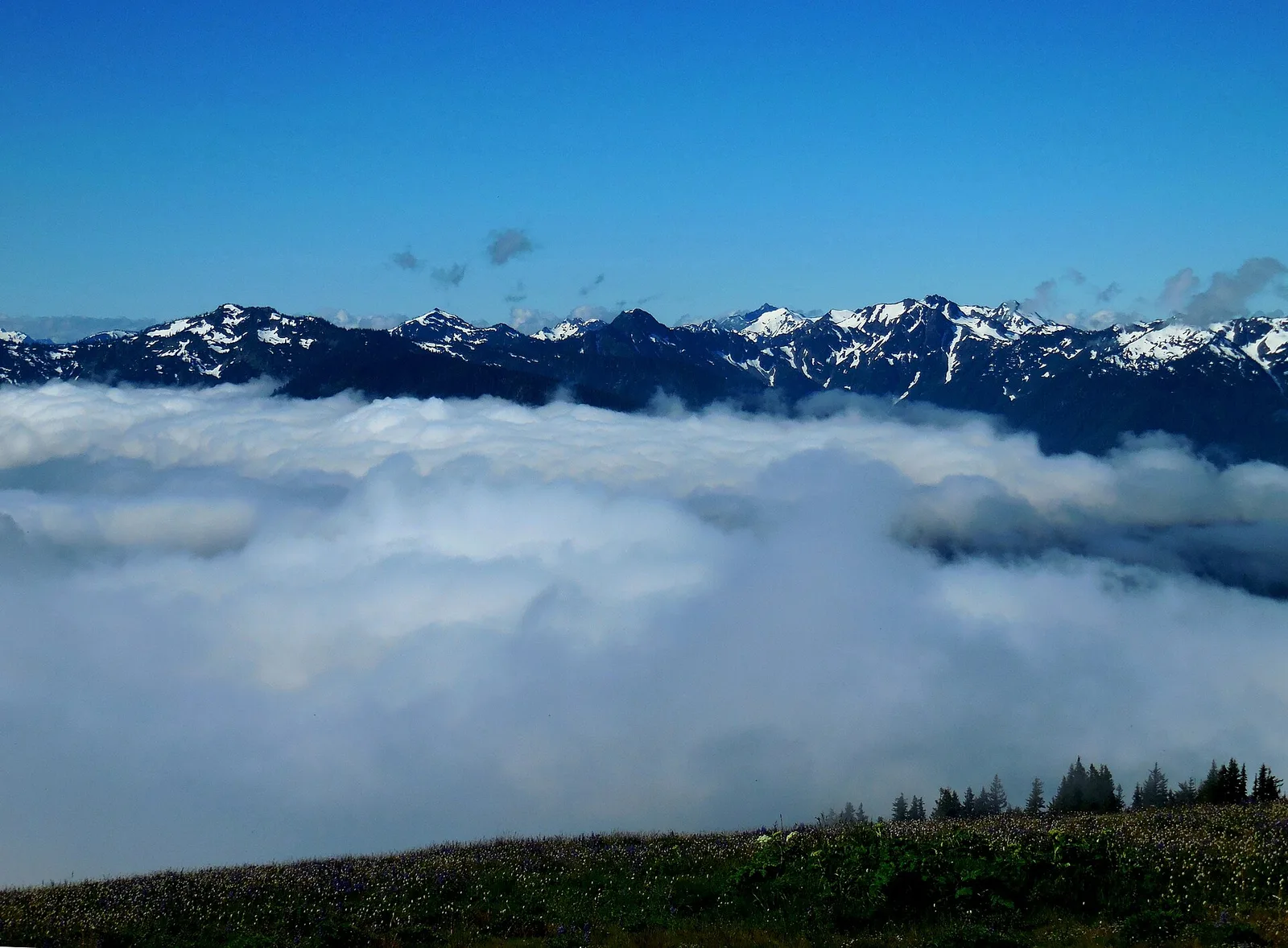
Olympic National Park
Three Wilderness Ecosystems in One Park: Temperate Rainforest, Alpine Peaks, and Wild Pacific Coastline
About Olympic National Park
Olympic National Park covers 922,651 acres of the Olympic Peninsula in northwest Washington, protecting three very different landscapes inside one boundary: glacier-capped mountains, temperate rainforest on the western valleys, and a 73-mile strip of wild Pacific coast. Roughly 95 percent of the park is designated wilderness.
The interior rises from near sea level to 7,980 feet at Mount Olympus in under 40 miles, wringing moisture out of Pacific storms. The Hoh and Quinault valleys on the west side get 12 to 14 feet of rain a year, among the wettest places in the contiguous United States, while Sequim in the northeast rain shadow gets only about 16 inches.
Long isolation between water and mountains has produced species found nowhere else, including the Olympic marmot, the state's only endemic mammal, the Olympic torrent salamander, and Flett's violet. The peninsula also never had some common mainland animals: it has no native mountain goats, pikas, ground squirrels, grizzly bears, or lynx.
The park was set aside in stages: Mount Olympus National Monument in 1909 under Theodore Roosevelt, Olympic National Park in 1938 under Franklin Roosevelt, with the coastal strip added in 1953. It is a UNESCO World Heritage Site (designated 1981) and Biosphere Reserve and draws around 2.5 to 3.5 million visitors a year.
- Designation
- National Park, UNESCO World Heritage Site, UNESCO Biosphere Reserve
- Location
- Port Angeles, Washington, Olympic Peninsula
- Established
- 1938
- Annual Visitors
- ~3 million
Key Features
The Hoh Rain Forest, in a west-side valley of the park, is one of the best-preserved temperate rainforests in the Northern Hemisphere. It receives roughly 140 to 170 inches of rain a year plus heavy fog drip, and the mild maritime climate means it almost never freezes hard or bakes dry.
The dominant trees are Sitka spruce, western hemlock, western redcedar, Douglas fir, and bigleaf maple. Individual Sitka spruce and redcedar here exceed 250 feet tall and 10 to 20 feet in diameter, and several national champion trees grow in the park.
Every surface is layered with life: mosses, spike mosses, licorice ferns, and lichens drape the bigleaf maples in the Hall of Mosses, and epiphytes on a single big tree can weigh several tons. Fallen nurse logs host rows of seedlings, so mature trees often stand in straight colonnades along the line of a long-rotted log.
Roosevelt elk browse the understory and help keep it open and park-like, and the forest is a textbook example of a system shaped by both very high productivity and heavy grazing. The Hoh gets far fewer visitors than Hurricane Ridge, though its road and small campground still fill on summer weekends.
Olympic protects about 73 miles of Pacific coast, the longest stretch of wilderness coastline in the contiguous United States. Most of it is roadless and reached only on foot, with a handful of drive-to points at Rialto Beach, La Push, Ruby Beach, and Kalaloch.
The shore is lined with sea stacks and arches, remnants of headlands left standing as softer rock eroded around them, and with tide pools full of anemones, sea stars, chitons, and urchins. Bald eagles, sea otters (reintroduced to Washington in 1969 and 1970 after being hunted out), and gray whales are common.
Coastal hiking is governed by the tide: several rocky headlands can only be rounded at low water, and hikers use tide tables and, in places, sand ladders and ropes over the headlands to avoid being cut off or caught by a sudden large wave.
At Ozette, a Makah village was buried by a mudslide around 1560 and excavated from 1970 to 1981, yielding tens of thousands of well-preserved wooden and fiber artifacts, one of the richest archaeological finds in North America, now held by the Makah Cultural and Research Center at Neah Bay.
The Olympic Mountains are geologically young, built over the last roughly 35 million years as the ocean floor of the Juan de Fuca Plate scraped off against North America and piled up as folded and faulted marine sandstone, shale, and basalt. The rock is generally weak and shattered, which is why the peaks are steep and heavily eroded rather than towering.
Despite modest elevations, Mount Olympus is only 7,980 feet, the range holds around 250 glaciers and permanent snowfields, fed by enormous snowfall; Mount Olympus carries more glacier ice than any non-volcanic peak in the contiguous United States for its height, because it sits so close to the ocean storm track.
The Blue Glacier on Mount Olympus has been measured continuously since the 1950s by the University of Washington and is one of the best-studied glaciers in the country. Park glaciers have lost roughly a third of their area since 1900, and the smaller ones are expected to vanish within decades.
Melting ice matters downstream: glacial and snowmelt keep the rivers cold and flowing through late summer, which salmon, trout, and the Olympic torrent salamander depend on. The high country is reached almost entirely by trail and is among the most remote terrain in the lower 48.
Two dams built without fish passage, the Elwha Dam (1913) and Glines Canyon Dam (1927), cut the Elwha River's salmon off from more than 70 miles of habitat, most of it inside the national park, and collapsed runs that had once exceeded 400,000 fish, including legendary 100-pound chinook.
After decades of advocacy led by the Lower Elwha Klallam Tribe and a 1992 federal law authorizing removal, the dams came down between 2011 and 2014, the largest dam-removal project in US history. About 20 million cubic yards of trapped sediment then flushed downstream over the following years, rebuilding beaches and the river delta.
Salmon and steelhead moved back above the old dam sites within months and have since reached the upper river inside the park; bull trout, Pacific lamprey, and other native fish have followed. Scientists tracked the response closely as a model for river restoration worldwide.
Recovery is uneven and slow in places, with some runs rebuilding faster than others, but the reservoir beds have revegetated, the river braids and moves again, and nutrients from returning salmon carcasses are feeding the forest and wildlife for the first time in a century.
Indigenous Heritage
Makah, Lower Elwha Klallam, and other Olympic Peninsula nations
People have lived on the Olympic Peninsula for at least 12,000 years, and eight federally recognized tribes have deep ties to the park landscape: the Makah, Lower Elwha Klallam, Jamestown S'Klallam, Port Gamble S'Klallam, Quileute, Hoh, Quinault, and Skokomish. Their villages ringed the coast and the river mouths, based on salmon, halibut, shellfish, whales, and cedar.
The Makah, at Cape Flattery on the northwest tip, are the only tribe in the United States whose treaty, the 1855 Treaty of Neah Bay, explicitly reserves the right to hunt whales; they conducted a legal gray whale hunt in 1999 and have pursued federal authorization to resume limited hunts since.
The Lower Elwha Klallam, whose reservation sits at the river's mouth, led the fight to remove the Elwha dams, which had flooded a site the tribe regards as its place of creation and destroyed its central fishery. Tribal biologists and crews have been central to the restoration, and the park consults formally with all eight nations on management.
The Makah Tribe at Neah Bay maintains an active cultural program and the Makah Cultural and Research Center, which interprets the Ozette archaeological site and Makah culture. The Lower Elwha Klallam Tribe has been actively involved in the Elwha River restoration and continues to exercise fishing rights on the restored river. The park service maintains formal consultation relationships with eight federally recognized tribes with traditional ties to the Olympic Peninsula.
Things To Do
Hoh Rain Forest Hall of Mosses
The Hall of Mosses is a 0.8-mile loop from the Hoh Rain Forest Visitor Center, the park's signature short rainforest walk. It climbs gently into a grove of bigleaf maples so thickly hung with club moss and licorice fern that the light turns green.
Interpretive signs explain nurse logs, epiphytes, and the roles of elk and decay; the visitor center has exhibits, and a second short loop, the Spruce Nature Trail (1.2 miles), reaches the Hoh River itself.
From the same trailhead, the Hoh River Trail runs about 17 miles up-valley to Glacier Meadows and the climbers' route on Mount Olympus, one of the classic long approaches in the park, with backcountry camps and a permit and bear-canister requirement.
The Hoh's single access road ends here and its campground is first-come or limited-reservation, so summer weekends see the road lined with cars and a wait to enter; weekday mornings and the shoulder seasons are far quieter.
Hurricane Ridge
Hurricane Ridge, at about 5,240 feet, is the most accessible high country in the park, reached by a 17-mile paved road climbing from Port Angeles through forest to subalpine meadows with a sweeping view of the glaciated Olympic interior and, north across the Strait of Juan de Fuca, Vancouver Island.
Short paved and dirt trails from the day-lodge area loop through wildflower meadows in July and August; longer trails lead to Hurricane Hill and along the ridge, and Olympic black-tailed deer and Olympic marmots are often seen close to the road.
In winter the road is plowed on a limited schedule, typically Friday to Sunday, for a small downhill ski area, tubing hill, and cross-country and snowshoe routes; chains or traction tires are often required, and the road closes entirely for storms and avalanche control.
The historic 1950s day lodge burned down in 2023, and the park has been running the area with temporary facilities while planning a replacement, so services at the ridge are reduced.
Sol Duc Hot Springs and Waterfalls
Sol Duc, on the park's northwest side, pairs a developed hot-spring resort, three mineral soaking pools and a freshwater pool fed by hot sulfur springs, with old-growth forest along the Sol Duc River. The resort dates to the early 1900s; a grand hotel there burned in 1916.
An easy 1.6-mile round-trip trail leads to Sol Duc Falls, where the river splits into three or four channels and drops into a narrow rock cleft spanned by a footbridge, one of the most photographed waterfalls in the Northwest.
The Sol Duc River is a key salmon stream; in the fall, coho and other salmon can be seen leaping at the falls and at the fish ladder downstream, and the valley's Douglas firs and redcedars are among the largest easily reached in the park.
Longer trails from Sol Duc climb to the High Divide and the Seven Lakes Basin, a classic 18- to 20-mile loop through subalpine lake country with views of Mount Olympus, one of the park's premier backpacking routes.
Coastal Backpacking (Rialto Beach to La Push)
The northern wilderness coast between Rialto Beach and the mouth of the Ozette River is a premier backpacking route: about 20 miles round trip past sea stacks, the arch called Hole-in-the-Wall, tide pools, and forested headlands, with camping on the beach above the drift logs.
Progress depends entirely on the tide. Several headlands are impassable at high water and must be rounded on the sand at low tide or crossed on steep overland trails marked by round orange-and-black targets, some with fixed ropes and ladders.
An overnight wilderness permit and an approved bear canister are required, both for black bears and for the raccoons that raid food on the coast. Water must be collected from creeks and treated, and it can be scarce on long dry stretches.
The coast is fully exposed to Pacific weather, with rain, wind, and fog possible any month, and large logs in the surf zone can be rolled by waves; the park warns hikers to stay well up the beach and never turn their back on the ocean.
Conservation and Challenges
Glacier Retreat and Climate Change
Olympic's roughly 250 glaciers and perennial snowfields have lost about a third of their combined area since the late 1800s, and mapping shows the loss accelerating since the 1980s; several named glaciers, including the Lillian and Anderson, have disappeared or split into stagnant ice patches.
The Blue Glacier on Mount Olympus, monitored by the University of Washington since 1957, has thinned and retreated substantially, and it serves as a benchmark for glacier change across the Pacific Northwest.
Glacial and deep-snow melt is the reservoir that keeps Olympic rivers cold and flowing in August and September. As it shrinks, late-summer flows drop and stream temperatures rise, squeezing salmon, bull trout, and the endemic Olympic torrent salamander, and the Elwha recovery itself is affected.
Warming is also pushing subalpine forest up into the meadows, shrinking the alpine habitat of the Olympic marmot, whose population has declined and which researchers link partly to changing snowpack and to coyotes, a relatively recent arrival on the peninsula, preying on them.
Invasive and Introduced Species
The 2011 Tohoku earthquake and tsunami in Japan swept an estimated 5 million tons of debris into the Pacific; roughly 1.5 million tons floated, and pieces began washing onto the Washington coast within a year, continuing for several years.
Docks, buoys, crates, and vessel hulls arrived carrying living Japanese organisms that had survived the multi-year crossing, including a seastar, a mussel, seaweeds, and shore crabs, an unprecedented rafting of a whole coastal community across an ocean.
Park and state crews inspected and scraped or removed landed debris and monitored the rocky intertidal for establishment. So far no tsunami-borne species is known to have taken hold on the Olympic coast, but a delayed invasion is still watched for.
The bigger long-term problem was inland: non-native mountain goats, brought to the peninsula in the 1920s before the park existed, damaged fragile alpine plants and injured hikers seeking salt; from 2018 to 2020 agencies airlifted about 325 goats to the North Cascades and removed most of the rest, ending the population.
Roosevelt Elk and Absent Predators
Olympic holds the largest wild herd of Roosevelt elk in the world, around 5,000 animals, and the subspecies is named for Theodore Roosevelt, whose 1909 national monument was created largely to protect it. Elk are native and central to the west-side rainforest, where their browsing shapes the open, cathedral-like understory.
In parts of the Hoh and Queets valleys, heavy elk numbers suppress the regeneration of cottonwood, willow, and bigleaf maple along the rivers and hold some areas in grassland, and researchers debate how much of that reflects a natural system versus one missing a key piece.
That missing piece is the wolf. Wolves were hunted and trapped out of the Olympic Peninsula by the 1920s and have not returned; the peninsula is cut off from the recovering wolf populations of the Washington Cascades by the Interstate 5 corridor and development, and no reintroduction has been carried out. Cougars and black bears are now the only large predators, and they take mainly calves.
Biologists have studied reintroducing wolves to Olympic for decades, arguing it could restore a landscape of fear that would move elk off the most heavily grazed river bottoms and let streamside forest recover, but the idea remains a proposal, not a plan, and elk management in the park is currently limited to monitoring.
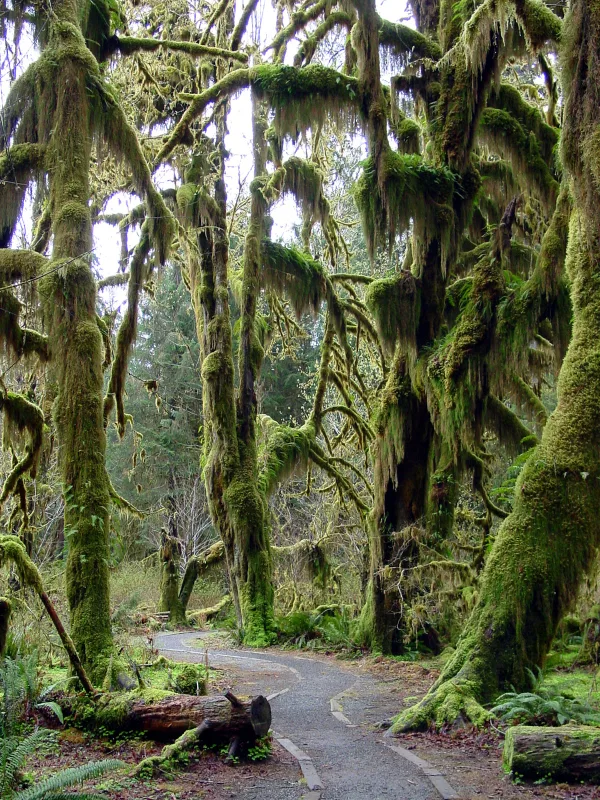
Hoh Rain Forest trail through moss-draped old-growth trees
Fast Facts
Did You Know?
The removal of the Elwha Dam and Glines Canyon Dam between 2011 and 2014, at the request of the Lower Elwha Klallam Tribe, was the largest dam removal project in U.S. history. Within months of removal, salmon began appearing in the upper Elwha River for the first time in over a century. The river's recovery has been faster than scientists predicted, with multiple salmon and steelhead species recolonizing the river and the river delta rebuilding itself with sediment that had been trapped behind the dams for over a century.
The Hoh Rain Forest on Olympic's western slopes receives up to 170 inches of precipitation per year, making it one of the wettest places in the contiguous United States. The moisture comes primarily as rain rather than snow and supports the growth of enormous trees covered in club mosses, lichens, and ferns that create the defining visual character of a temperate rainforest. The Olympic Peninsula lies in the rain shadow of the Cascades for moisture coming from the east but receives enormous quantities of moisture from Pacific weather systems that have no obstacle between them and the peninsula.
Olympic's 73 miles of wild Pacific coastline is one of the longest stretches of undeveloped Pacific coast in the contiguous United States. Unlike most national park coastline, the Olympic coast is not accessible by road: it can only be reached by hiking from specific trailheads or by kayak. The coastline is characterized by enormous sea stacks, explosive surf, ancient forests that grow to the high tide line, and abundant wildlife including sea otters, harbor seals, gray whales, and bald eagles. The remoteness that makes it challenging to access is also what has kept it wild.
Plan Your Visit
Location
Port Angeles, Washington, Olympic Peninsula
Designation
National Park, UNESCO World Heritage Site, UNESCO Biosphere Reserve
Hurricane Ridge Road
The road to Hurricane Ridge can be closed or require chains due to snow even in early June. Check park conditions before making the drive.
Entrance Fee
$35 per vehicle (7-day), or use an America the Beautiful annual pass. Note that the Hoh Rain Forest and Hurricane Ridge are in separate sections requiring separate entries.
Getting There
The main visitor center is in Port Angeles on the north Olympic Peninsula, reached via US-101 from Olympia or via ferry from Victoria, BC. The Hoh Rain Forest is on the west side of the peninsula, about 2.5 hours from Port Angeles via US-101. The park has multiple separate sections; plan driving routes carefully.
Rain and Gear
The west side of the park (Hoh, Quinault, Queets) is extremely wet year-round. Waterproof gear and trail shoes are essential even in summer. The east side (Hurricane Ridge, Elwha) is significantly drier.
Coastal Hiking
Coastal hiking requires careful attention to tide tables. Several headlands can only be rounded at low tide. Download tide charts before your hike. Never camp below the drift log line.