About Wyoming
Wyoming takes its name from the Wyoming Valley in Pennsylvania, the site of a 1778 massacre during the Revolutionary War in which British-allied Loyalists and Seneca warriors killed more than 200 American settlers. The Wyoming Valley's name comes from the Delaware (Lenape) words "maughwauwama," meaning "large plains" or "at the big river flat." The name became well known through a 1809 poem about the massacre called "Gertrude of Wyoming" by Thomas Campbell, which romanticized the valley and made "Wyoming" a familiar word across the country. When Congress organized the Wyoming Territory in 1869, it borrowed the name from the Pennsylvania valley rather than from any local feature or indigenous people. Wyoming became a state in 1890 and was a pioneer in women's suffrage: it granted women the right to vote in 1869, becoming the first territory or state in the nation to do so.
Wyoming is the least populated state in the United States and, in some ways, the most American. It is the state that gave women the right to vote before the rest of the country thought it possible, the state that invented the national park, and the state whose vast energy reserves powered the nation's growth for a century. Roughly the size of the United Kingdom but home to fewer than 600,000 people, Wyoming is a place where the scale of the landscape dwarfs the human presence in a way that few places in the lower 48 can match.
The western third of Wyoming is defined by mountains and parks: the Teton Range, the Wind River Mountains, and Yellowstone's volcanic plateau. The central region is ranching and energy country, the Bighorn Basin and the high plains that have supported cattle, sheep, oil wells, and natural gas fields for more than a century. The northeast is the Powder River Basin, the coal heartland that makes Wyoming the nation's leading coal producer by an enormous margin. And the southeast, anchored by Cheyenne and Laramie, is the seat of government, education, and military power.
Wyoming is navigating a transformation as consequential as any in its history. The coal industry that funded the state for generations is in long-term decline. The energy revenues that allowed Wyoming to operate without a personal income tax are increasingly volatile. The outdoor recreation and resort economy centered on Yellowstone and Jackson Hole is booming but benefiting a narrow slice of the population. How Wyoming charts its path through this transition, while holding onto the independence, the open spaces, and the identity that define it, is the story of the state in the 2020s.
Wyoming's Five Regions
Northwest Wyoming is the most internationally famous corner of the state, home to Yellowstone National Park, Grand Teton National Park, and the resort town of Jackson. Yellowstone, established in 1872 as the world's first national park, sits atop a supervolcanic hotspot that powers Old Faithful, the Grand Prismatic Spring, Mammoth Hot Springs, and thousands of other geothermal features unique on Earth.
The Greater Yellowstone Ecosystem, approximately 22 million acres spanning three states, is the largest intact temperate ecosystem in North America and supports the densest concentration of large mammals in the lower 48, including grizzly bears, wolves, bison, elk, moose, and pronghorn.
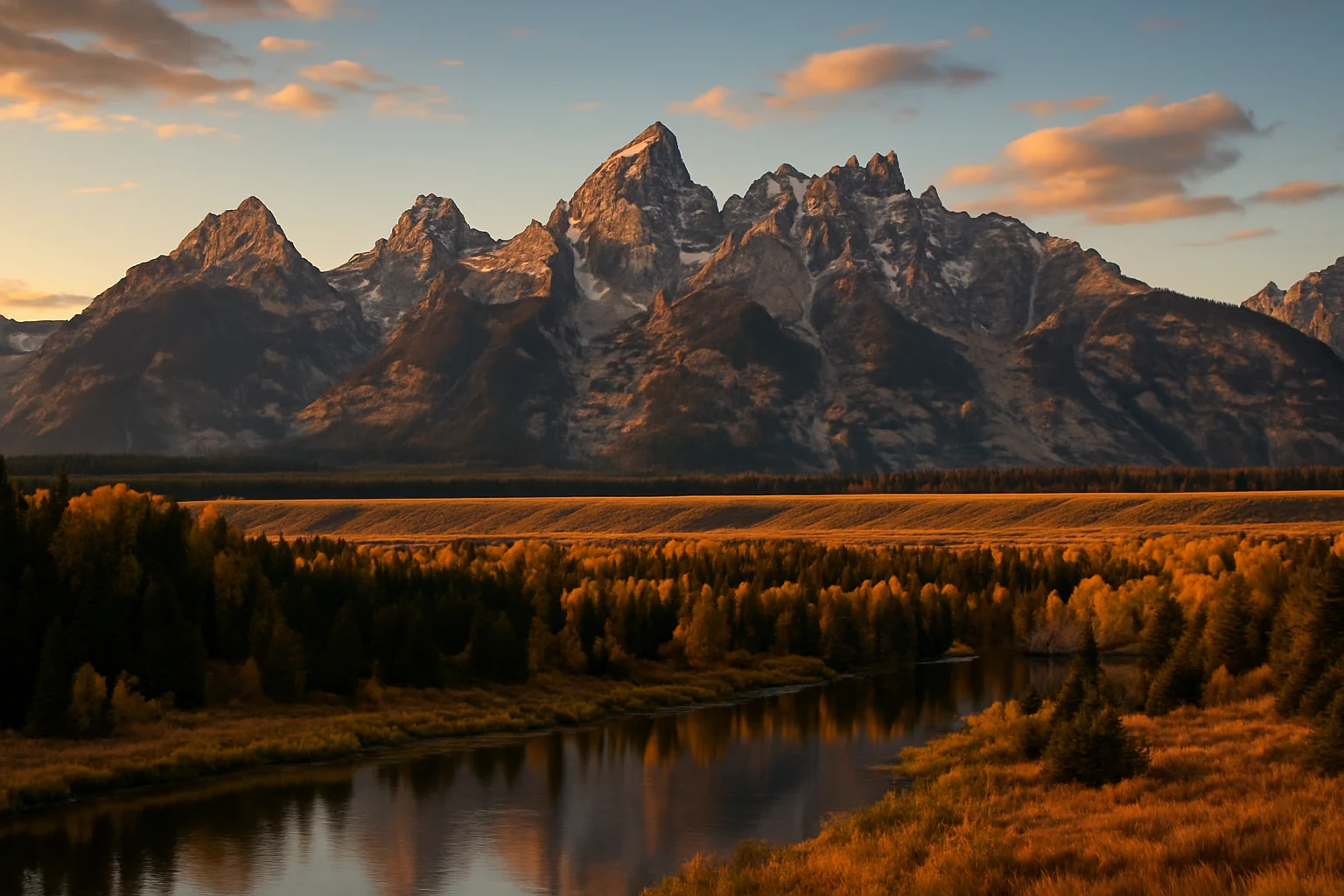
Grand Teton National Park protects the sheer eastern face of the Teton Range, 40 miles of cathedral peaks rising without foothills from the sagebrush flats of Jackson Hole.
Jackson Hole has been transformed from a cattle-ranching valley into one of the most exclusive resort communities in America, with median home prices exceeding $3 million and year-round visitors numbering in the millions.
Central Wyoming is defined by the Wind River Range, the highest and most extensive mountain range entirely within Wyoming and one of the great wilderness areas of North America. The range forms part of the Continental Divide, and its crest is split between the Bridger and Fitzpatrick wilderness areas on the east and the Bridger-Teton National Forest on the west.
The Wind Rivers extend nearly 100 miles from southeast to northwest, containing Gannett Peak at 13,804 feet, Wyoming's highest point, and more than 40 peaks exceeding 13,000 feet, along with the largest concentration of glaciers in the Rocky Mountains south of Canada. Gannett Glacier, the largest single glacier in the American Rockies, and roughly 60 other named ice bodies here have lost more than half their surface area since the mid-20th century, threatening the late-summer streamflow that irrigators downstream depend on.
The range is accessed via Pinedale to the west and Lander to the east, two small communities that serve as gateways to some of the most remote and pristine backcountry in the lower 48. The Cirque of the Towers and Titcomb Basin are among the most sought-after alpine climbing and backpacking destinations in the country, and the old mining camp of South Pass City, now a state historic site, sits at the range's southern end where the Oregon Trail crossed the Divide.
The Wind River Indian Reservation, at 2.2 million acres one of the largest reservations in the United States, encompasses much of the central region and is home to the Eastern Shoshone and Northern Arapaho tribes. The Wind River Basin between the mountains is also significant oil and gas territory, with production from several fields contributing to Wyoming's energy economy.
Southwest Wyoming is the state's high desert region, a vast wind-scoured plateau between 6,000 and 7,000 feet elevation that is one of the most inhospitable and least visited landscapes in the Mountain West.
The Green River Basin, which forms the core of this region, is one of the most prolific natural gas producing areas in the United States, the Jonah Field and Pinedale Anticline containing reserves that made southwest Wyoming a focal point of energy development in the 2000s. Rock Springs and Green River are the twin cities at the heart of the region, economies that rise and fall with energy prices.
The region is also home to Flaming Gorge National Recreation Area, a reservoir in a canyon of startling red rock straddling the Utah border.
The Oregon Trail passed through southwest Wyoming at South Pass, the critical low-elevation crossing of the Continental Divide that made the great overland migration of the 1840s and 1850s possible. Fort Bridger, established by mountain man Jim Bridger in 1843, served as a trading post and rest stop for emigrants bound for Oregon and California.
Southeast Wyoming is the most densely populated part of the state and the seat of its government, culture, and higher education. Cheyenne, the state capital and largest city at roughly 65,000 people, sits at the intersection of Interstates 25 and 80 and was founded in 1867 as a Union Pacific railroad camp that grew almost overnight into a commercial center for the cattle drives of the 1870s.
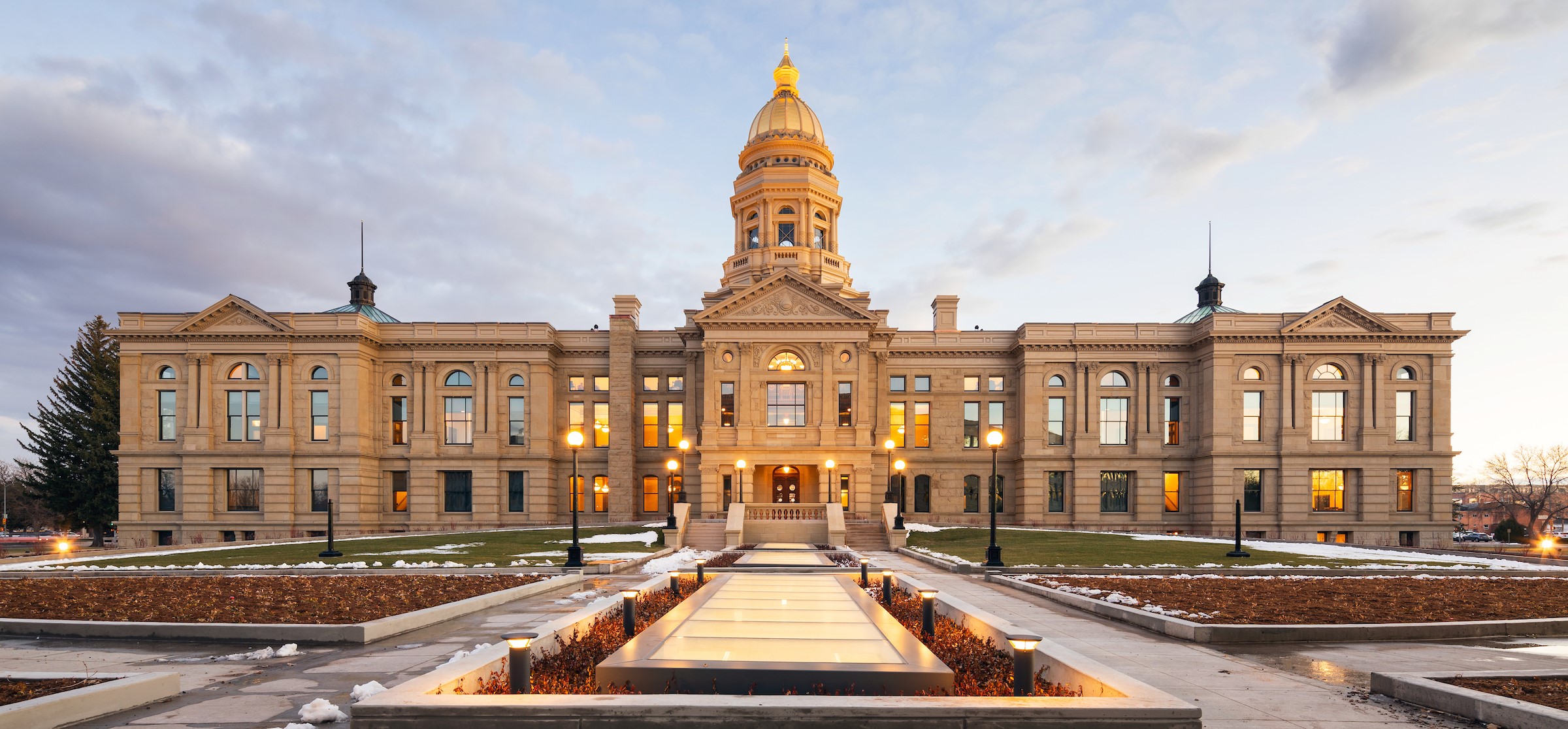
The Wyoming State Capitol, completed in 1888 and crowned with a gold dome visible for miles across the high plains, houses a part-time citizen legislature that meets only for short sessions each year.
Cheyenne Frontier Days, held every July, is the largest outdoor rodeo and western celebration in the world. F.E. Warren Air Force Base, adjacent to Cheyenne, is home to the 90th Missile Wing and one of three Minuteman III ICBM bases in the country.
Laramie, home to the University of Wyoming (the state's only four-year public university), sits at 7,165 feet elevation and has the cool-climate college-town culture typical of mountain West university cities.
Northeast Wyoming is coal country, one of the most productive coal-mining regions on Earth and the heart of the energy industry that has shaped Wyoming's economy for generations.
The Powder River Basin, a broad and relatively flat basin between the Black Hills to the east and the Bighorn Mountains to the west, contains the world's largest accessible low-sulfur coal deposits, with seams 50 to 100 feet thick lying just below the surface in a landscape of rolling sagebrush plains.
Gillette, the self-proclaimed 'Energy Capital of the Nation,' grew from a small ranching town into Wyoming's second-largest city during the coal boom of the 1970s and 1980s, an explosive growth accompanied by serious social disruption. Sheridan, on the eastern slope of the Bighorns, is a more genteel city with an equestrian and polo culture tracing back to wealthy English ranchers of the 1880s.
Devils Tower in the northeast corner, an 867-foot column of igneous rock rising abruptly from the Belle Fourche River valley, became the nation's first national monument in 1906 and gained international fame from Steven Spielberg's Close Encounters of the Third Kind.

Economy
Wyoming's economy is built on an energy foundation unlike any other state: the nation's top coal producer, a major oil and gas state, and increasingly a destination for renewable energy investment, all while ranching and tourism shape the state's identity and daily life.
The oil and gas industry has been the dominant force in Wyoming's economy since commercial production began in earnest in the early 20th century, generating royalties and severance taxes that fund state government without the need for a personal income tax.
The Jonah Field in Sublette County and the Pinedale Anticline are among the most productive natural gas fields in the country, and Wyoming's natural gas exports via pipeline supply utilities and industrial users across the Mountain West and beyond.
Energy price cycles, boom in the 1970s, bust in the 1980s, boom in the 2000s, bust in the 2010s, have defined the rhythms of Wyoming's economic and demographic life, as workers and businesses flood in during high-price years and drain away when prices collapse.
Wyoming's first oil well was drilled in 1883 at Dallas Dome in Fremont County, and the Salt Creek Field north of Casper grew into one of the largest oil fields in the world in the 1910s and 1920s. The state levies a severance tax of roughly 6 percent on oil and natural gas, and mineral revenue has historically funded well over half of the state budget while feeding the Permanent Wyoming Mineral Trust Fund, a constitutionally protected savings account that passed $10 billion in the 2020s. When crude fell below $30 a barrel in early 2016 and again during the 2020 pandemic, Wyoming responded with immediate cuts to public schools and Medicaid, a reminder that a fiscal model built on a nonrenewable resource transmits global price swings straight into the classroom.
The Powder River Basin in northeastern Wyoming contains some of the world's largest and most accessible coal deposits, low-sulfur subbituminous coal that lies close to the surface and can be extracted by enormous strip-mining operations that dwarf anything in Appalachia.
The mines around Gillette, particularly the Black Thunder and North Antelope Rochelle mines, are among the largest surface mines on Earth. At their peak, Powder River Basin mines produced over 400 million tons of coal per year, supplying power plants across the Midwest, South, and West.
The coal industry has faced existential pressure since roughly 2012 from cheap natural gas, rapidly declining renewable energy costs, and changing utility purchasing decisions, with production falling by roughly half from its peak. Several major coal companies operating in Wyoming have gone through bankruptcy proceedings.
North Antelope Rochelle, operated by Peabody Energy south of Gillette, is the largest coal mine in the United States and has shipped well over 2 billion tons since it opened. Peabody Energy and Arch Coal, now Arch Resources, both entered Chapter 11 bankruptcy in 2016, and Blackjewel's abrupt 2019 collapse locked roughly 600 miners out of the Belle Ayr and Eagle Butte mines with bounced paychecks. Wyoming coal output fell from about 438 million tons in 2008 to roughly 230 million tons by 2022, and the state has since funded carbon capture research at the Dry Fork Station near Gillette and passed a 2020 law requiring utilities to seek a buyer before retiring a coal plant.
Yellowstone National Park, established in 1872 as the world's first national park, straddles the Wyoming-Montana-Idaho border and draws over 4 million visitors annually to its geysers (including Old Faithful), hot springs, wildlife, and otherworldly volcanic landscape.
Grand Teton National Park, immediately to the south of Yellowstone, protects one of the most dramatic mountain fronts in North America, the sheer eastern face of the Teton Range rising abruptly more than 7,000 feet above the Jackson Hole valley floor.
Jackson, Wyoming, the gateway community to Grand Teton, has become one of the wealthiest small cities in America, a resort town whose billionaire ranches and luxury ski resorts attract the ultra-wealthy from around the world. Devils Tower National Monument, the Bighorn Canyon National Recreation Area, and Flaming Gorge round out a remarkable concentration of federally protected landscapes.
The Wyoming Office of Tourism reported roughly $4.5 billion in visitor spending in 2022, supporting about 33,000 jobs and making travel the state's second-largest industry after mineral extraction. Yellowstone set a record with 4.86 million recreational visits in 2021, and the June 2022 floods that destroyed the roads at its northern entrance near Gardiner closed the entire park for days and cost gateway towns tens of millions of dollars within weeks. Grand Teton draws a comparable three million visitors a year, and Teton County, anchored by Jackson, has the highest per capita income of any county in the United States, driven mainly by investment income rather than wages.
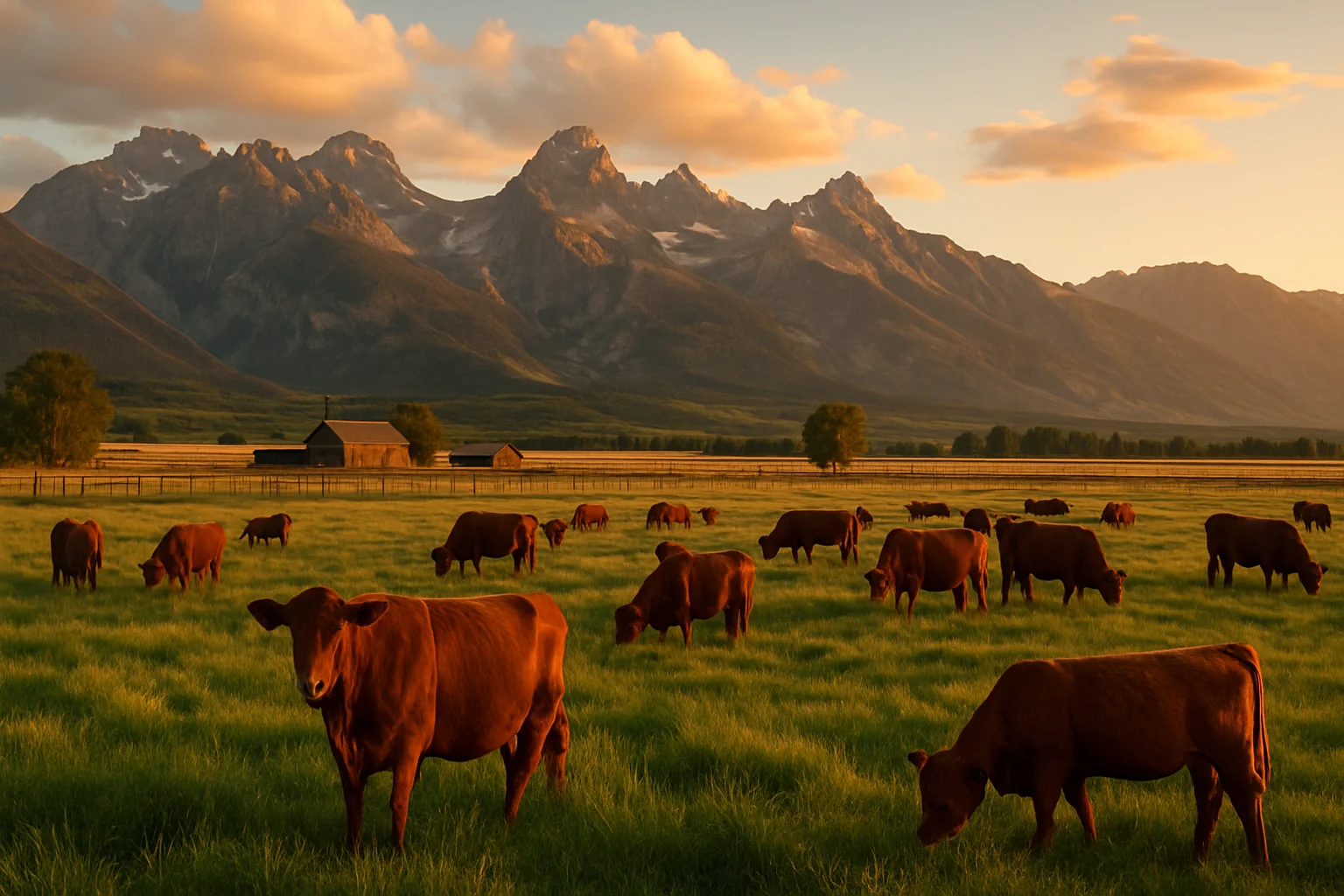
Wyoming's vast grasslands, particularly in the eastern plains and Bighorn Basin, support hundreds of thousands of cattle on ranches that can encompass tens of thousands of acres.
Sheep ranching was historically important as well, and Wyoming remains a significant wool producer. The state's agricultural sector also includes hay, sugar beets, barley, and dry beans.
The tension between the traditional ranching economy and the resort-and-tourism economy is most visible around Jackson Hole, where historic ranches have been purchased by billionaires for recreation while multi-generational ranch families find themselves priced out of communities they built.
Wyoming counted roughly 1.3 million cattle in 2023, more than twice its human population, even though agriculture accounts for only a low single-digit share of state GDP. Brand inspection remains legally required before cattle are sold or moved across county lines, and the state and the University of Wyoming still register tens of thousands of livestock brands. Many ranch operations depend on federal grazing permits on Bureau of Land Management and Forest Service land, which keeps disputes over grazing fees, predator control, and the recovery of wolves and grizzly bears politically charged, and the bucking horse and rider on Wyoming license plates, modeled on a real rodeo horse named Steamboat, is a registered state trademark.
The high plains and mountain passes of eastern and southern Wyoming rank among the most productive wind zones in North America, with sustained winds that make turbines more cost-effective here than almost anywhere else on the continent.
Despite this enormous natural advantage, Wyoming's wind energy development has lagged behind the state's resource potential for years, primarily due to transmission constraints: the high-voltage lines needed to move Wyoming wind power to the population centers of California, Arizona, and the Pacific Northwest have been slow to develop.
Several major transmission projects, including the TransWest Express, are in various stages of development and could transform Wyoming into a major exporter of renewable electricity.
Wyoming is the only state that levies a tax on wind electricity generation, $1 per megawatt-hour under a 2010 law that took effect in 2012, and legislators have repeatedly proposed raising it. The Chokecherry and Sierra Madre project in Carbon County, developed by the Anschutz Corporation, is designed for up to 3,000 megawatts across roughly 900 turbines, which would make it the largest onshore wind farm in North America; construction began in 2016 and the linked TransWest Express line won final federal approval in 2023 to carry Wyoming wind power about 730 miles to the Nevada grid that serves California and the desert Southwest.
The Bureau of Land Management alone oversees about 18 million surface acres in Wyoming, and the Forest Service manages roughly 9 million acres across the Bridger-Teton, Shoshone, Medicine Bow, and Bighorn National Forests. The Shoshone National Forest, adjoining Yellowstone, was set aside in 1891 as the first federally protected forest reserve in the country, and the Bureau of Reclamation operates dams such as Buffalo Bill Dam near Cody that irrigate Wyoming farmland and store water divided among downstream states under interstate river compacts.
This federal land presence creates both economic opportunity, mineral royalties, grazing leases, and tourism infrastructure, and ongoing political tension around development restrictions, grazing regulations, and endangered species protections.
Federal mineral royalties from oil, gas, and coal production on federal lands constitute a significant share of Wyoming's state revenue and are a key reason the state can avoid a personal income tax.
The federal government is also one of Wyoming's largest employers through F.E. Warren Air Force Base in Cheyenne, home to the 90th Missile Wing and Minuteman III intercontinental ballistic missiles, as well as national park operations and the various land management agencies.
How Wyoming's Government Works
Wyoming's state government follows the standard three-branch structure: the Executive (Governor), the Legislative (the Wyoming Legislature, a 30-seat Senate and 60-seat House of Representatives), and the Judicial (the Wyoming Supreme Court, with five justices who are appointed by the Governor and then face retention votes in nonpartisan elections).
The Governor serves a four-year term and is limited to two consecutive terms. Wyoming is one of the most reliably Republican states in the nation in both state and federal elections, and Republicans hold supermajorities in both chambers of the legislature. The state has not elected a Democratic governor since Dave Freudenthal left office in January 2011.
Wyoming has no personal income tax and no corporate income tax, funding state government instead through mineral severance taxes, federal royalties, sales taxes, and investment returns from the Permanent Wyoming Mineral Trust Fund, a sovereign wealth fund established to preserve energy revenues for future generations.
Unlike most states, Wyoming has no separately elected Lieutenant Governor. The Wyoming Constitution designates the Secretary of State as first in the line of succession to the governorship, a structural feature dating to the state's 1889 constitutional convention. If a vacancy occurs, the Secretary of State assumes the powers and duties of Governor until the next general election or the end of the unexpired term, whichever comes first.
Governor of Wyoming
Current Governor
Mark Gordon

- Party
- Republican
- In Office Since
- January 7, 2019
- Re-elected
- November 8, 2022
- Term Ends
- January 2027
- Prior Role
- Wyoming State Treasurer (2011-2019); rancher, Kaycee, Wyoming
Mark Gordon is a fourth-generation Wyoming rancher from the Kaycee area of Johnson County who served as Wyoming State Treasurer from 2011 to 2019 before winning the governorship. As governor, he has navigated Wyoming's difficult energy transition, seeking to protect the state's fossil fuel industries while championing emerging technologies such as carbon capture and advanced nuclear as potential bridges for Wyoming's energy economy. Gordon is generally regarded as a pragmatic and moderate voice within Wyoming's deeply conservative Republican establishment, focused on fiscal stability and energy diversification rather than culture-war legislation.
Other Current State Officials
Attorney General
Keith Kautz
Appointed by Governor Gordon in July 2025, after Bridget Hill (attorney general 2019 to 2025) was named to the Wyoming Supreme Court. Kautz is himself a former Wyoming Supreme Court justice. Wyoming's attorney general is appointed by the governor; the office has led Wyoming's participation in multi-state lawsuits challenging federal energy regulations, public lands policies, and environmental rules that affect Wyoming's dominant extractive industries.
Secretary of State
Chuck Gray
In office since January 2023. A former state legislator from Casper, Gray won the 2022 Secretary of State election on a platform emphasizing election integrity. He has pursued election security measures and has been a prominent voice in Wyoming conservative politics. As Secretary of State, Gray is also first in the constitutional line of succession to the governorship.
State Treasurer
Curt Meier
In office since January 2019. Meier oversees Wyoming's substantial financial assets, including the Permanent Wyoming Mineral Trust Fund, a sovereign wealth fund built from mineral revenues that serves as a fiscal reserve for future generations when energy revenues decline.
Wyoming has no separately elected Lieutenant Governor; the Secretary of State is first in the constitutional line of succession to the governorship.
The Wyoming Legislature
Wyoming State Senate
- Seats: 31 members
- Terms: 4-year staggered terms
The upper chamber. About half of the 31 Senate seats (the chamber grew from 30 after the 2022 redistricting) are elected every two years on a staggered schedule. Wyoming imposes no term limits on state senators, an unusual feature in a state that otherwise favors limited government and citizen legislatures.
Wyoming House of Representatives
- Seats: 62 members
- Terms: 2-year terms
The lower chamber. All 62 seats (up from 60 after the 2022 redistricting) are on the ballot every two years. Like the Senate, the House has no term limits. Republicans hold a supermajority in both chambers, making Wyoming one of the most one-party state legislatures in the country.
Wyoming's U.S. Senators
U.S. Senator
John Barrasso
Wyoming's senior senator, Barrasso was appointed to fill a Senate vacancy in 2007, won a 2008 special election, and was re-elected in 2012, 2018, and November 2024. An orthopedic surgeon by profession, Barrasso serves on the Senate Energy and Natural Resources Committee, where he is a leading voice for fossil fuel production and opponent of federal energy regulations that affect Wyoming. He chaired the Senate Republican Policy Committee and then the Republican Conference (2019 to 2025), and since January 2025 has served as Senate Majority Whip, the second-ranking Republican leader.
U.S. Senator
Cynthia Lummis
Wyoming's junior senator, Lummis previously served as Wyoming's sole U.S. Representative (2009-2017) before winning the Senate seat in 2020. A rancher and businesswoman from Cheyenne, she is one of the most vocal advocates for cryptocurrency and blockchain technology in the U.S. Senate, having introduced legislation to create a comprehensive regulatory framework for digital assets. Her Senate seat is up for re-election in November 2026.
Wyoming Through the Years
From the Shoshone and Crow nations to the mountain men and the Oregon Trail, from the world's first women voters to the nation's first national park, from the coal boom to the energy crossroads of the present, Wyoming's history is as vast and dramatic as its landscape.
Wyoming was the homeland and hunting ground of numerous Indigenous peoples whose presence preceded European contact by thousands of years. The Shoshone, who called themselves Newe ('the people'), inhabited the western valleys and mountains for centuries. Their great 19th-century leader Washakie navigated the era of American expansion with remarkable strategic skill, securing for the Eastern Shoshone one of the largest reservations in the country through diplomacy rather than conflict.
The Crow Nation controlled the Bighorn Basin and northeastern mountains. The Northern Arapaho ranged across the eastern plains and mountains. The Cheyenne and Lakota Sioux were powerful presences on the eastern plains, transformed by the horse culture that swept the Great Plains in the 18th century.
The Wind River Mountains and their surrounding valleys were rich in game, and many nations used the high country seasonally for hunting and spiritual practice.
French and British fur traders arrived in the late 18th century, but their presence was limited and largely transient until the American fur trade era that followed the Lewis and Clark Expedition.
John Colter, a member of the Lewis and Clark Expedition who remained in the West after the main party returned east, became the first Euro-American to explore the region that would become Yellowstone National Park.
In the winter of 1807-1808, while trapping in the Yellowstone country for Manuel Lisa's Missouri Fur Company, Colter traversed a landscape of boiling mud pots, sulfurous steam vents, and spouting geysers so bizarre that when he described it upon returning to civilization, his accounts were dismissed as fantasy. The area was mockingly called 'Colter's Hell.'
Colter's accounts nonetheless drew fur trappers and explorers to the region over the following decades, and subsequent expeditions in the 1850s and 1860s confirmed that his descriptions had been accurate.
The Washburn-Langford-Doane Expedition of 1870 produced the first detailed maps and accounts of Yellowstone's wonders, leading directly to the creation of the national park.
The fur trade era brought the first significant Euro-American presence to Wyoming's mountains and river valleys. Mountain men, the legendary trappers who lived in the wilderness months or years at a time, harvested beaver pelts from Wyoming's rivers to supply the fashionable beaver-felt hat market of eastern cities and Europe.
Jim Bridger explored Wyoming more thoroughly than any other non-Native person of his era, established Fort Bridger in 1843 as a trading post on the Green River, and served for years as the most knowledgeable guide to the region's passes and rivers.
The annual Rocky Mountain Rendezvous, held in the Green River Valley of southwest Wyoming from 1825 to 1840, was the fur trade era's great gathering: trappers, traders, and Native American partners converged each summer to exchange furs for supplies.
The rendezvous system collapsed when the beaver hat fell out of fashion in the early 1840s, leaving many mountain men to reinvent themselves as guides for the wagon trains that were beginning to move west on the Oregon Trail.
Between approximately 1843 and 1869, when the transcontinental railroad made overland wagon travel obsolete, somewhere between 300,000 and 500,000 emigrants crossed Wyoming on their way to Oregon, California, and Utah.
The Oregon Trail entered present-day Wyoming from Nebraska near Fort Laramie, crossed the North Platte and Sweetwater Rivers, climbed to South Pass at 7,412 feet, a broad and gentle crossing of the Continental Divide that made wagon travel feasible, and descended into the Green River Valley toward Fort Bridger.
Wyoming thus became the great passage-ground of the American West, crossed by hundreds of thousands of people who saw its mountains, deserts, and rivers as obstacles to overcome rather than destinations to settle. Fort Laramie, originally a fur trading post built in 1834 and purchased by the U.S. Army in 1849, became the primary military installation and resupply point on the trail.
The discovery of gold in California (1848) and later in Colorado and Montana drew waves of emigrants who wore multiple trails across the Wyoming landscape.
On December 10, 1869, the Wyoming Territory Legislature passed a bill granting women the right to vote, the first government in the world to do so. Governor John A. Campbell signed it into law the same day. The motivations were mixed: some legislators genuinely believed in women's equality, others hoped to attract female settlers to a territory with a severe gender imbalance, and still others wanted national publicity.
Whatever the reasons, Wyoming women exercised their new rights immediately. In 1870, Esther Hobart Morris of South Pass City became the first female justice of the peace in United States history. That same year, Wyoming seated the first all-female jury in U.S. history.
When Wyoming applied for statehood in 1890, Congress threatened to reject it unless women's suffrage was removed from the state constitution. Wyoming legislators famously replied: 'We will remain out of the Union a hundred years rather than come in without women.'
Wyoming became the 44th state with women's suffrage intact, earning its official nickname 'The Equality State.' The 19th Amendment, which extended suffrage nationally, was not ratified until 1920, fifty years later.
On March 1, 1872, President Ulysses S. Grant signed the Yellowstone National Park Protection Act, creating the world's first national park and establishing a concept that would eventually spread to nations around the globe.
The act set aside roughly 2 million acres of northwestern Wyoming, eastern Idaho, and southern Montana as 'a public park or pleasuring-ground for the benefit and enjoyment of the people.' The Yellowstone park idea grew from the Washburn-Langford-Doane Expedition of 1870 and was driven by the conviction that such a landscape was too extraordinary to be left to private exploitation.
The park's establishment was not without cost: the Shoshone, Crow, and other Native peoples who had lived in and used the Yellowstone country for centuries were excluded from the new park, and some were removed by force.
The concept of national parks, born at Yellowstone, would ultimately lead to the establishment of more than 400 units of the National Park System across the United States and inspire similar systems worldwide.
Wyoming was admitted to the Union on July 10, 1890, as the 44th state. The path to statehood had been unusual: Wyoming Territory had the smallest population of any territory seeking statehood in American history, and many in Congress questioned whether so few people warranted a state.
Wyoming's advocates argued that statehood was needed to protect the territory's resources and provide stable government. The women's suffrage question was genuinely contentious in Congress, and Wyoming's insistence on maintaining it in the state constitution was a rare act of political principle under pressure.
The state capital was Cheyenne, the railroad city founded 23 years earlier when the Union Pacific drove its first spike through southern Wyoming.
Wyoming entered the Union committed to equal rights for women, a distinction that would not be matched nationally for another three decades.
On September 24, 1906, President Theodore Roosevelt signed the proclamation designating Devils Tower in northeastern Wyoming as the first national monument in the United States, using the newly passed Antiquities Act of 1906 to protect the extraordinary geological formation.
Devils Tower is an 867-foot column of igneous phonolite porphyry that rises abruptly from the surrounding prairie of the Belle Fourche River valley, its vertical columns of jointed rock formed by the cooling of magma later exposed by erosion over millions of years.
The tower is sacred to numerous Plains Indian tribes, including the Lakota, who call it Bear Lodge (Mato Tipila), and has been a site of ceremony and vision quests for centuries.
The designation of Devils Tower under the Antiquities Act established a precedent that Roosevelt and subsequent presidents would use to protect hundreds of significant natural and cultural sites across the country without requiring an act of Congress.
Two events involving Wyoming defined American political history in the 1920s. The Teapot Dome scandal, the most significant government corruption case in American history before Watergate, centered on Wyoming oil.
Interior Secretary Albert B. Fall secretly leased the naval petroleum reserve at Teapot Dome in central Wyoming to private oil companies in exchange for bribes, becoming the first U.S. Cabinet member convicted of a felony while in office. The scandal damaged the Harding administration and became a byword for corruption.
In 1924, Wyoming Governor William Ross died in office, and his widow Nellie Tayloe Ross ran for and won the special election to complete his term, becoming the first female governor in United States history. She was inaugurated on January 5, 1925, fifteen days before Miriam 'Ma' Ferguson took office in Texas.
Nellie Tayloe Ross later became the first female director of the U.S. Mint (1933-1953), overseeing production of billions of coins through the New Deal era.
Wyoming in the 2020s is navigating a profound economic transformation driven by the decline of its dominant industry. Coal production in the Powder River Basin has fallen by roughly half from its early 2010s peak, as cheap natural gas and rapidly declining renewable energy costs have made coal increasingly uncompetitive in electricity generation.
Major coal companies operating Wyoming mines have gone through bankruptcy, and the communities built around coal mining, particularly Gillette, are grappling with declining tax revenues, population pressure, and the need to diversify economies built on a single extractive industry.
Wyoming's state government, heavily dependent on mineral severance taxes and federal royalties that track energy prices, has faced recurring budget shortfalls. At the same time, Wyoming's extraordinary wind resources and its position as a potential corridor for renewable energy transmission to western markets have attracted significant investor interest.
How Wyoming manages this transition while preserving the character and values of a state defined by energy and wide-open spaces is the central challenge of the present era.
Wyoming's Defining Moments in American History
These are the events that didn't just shape Wyoming, they changed the nation.
On March 1, 1872, President Ulysses S. Grant signed legislation creating Yellowstone National Park, the first national park in the world. The decision to set aside 2.2 million acres of extraordinary wilderness as public land, rather than selling it to private developers, was a revolutionary act.
Yellowstone established the idea that some places belong to all Americans and all of humanity. The national park system that grew from Yellowstone now encompasses 423 sites across 84 million acres and has been called 'America's best idea.' Countries around the world have modeled their own park systems on the American concept born in Wyoming.
The park was administered by the U.S. Army from 1886 to 1918, when cavalry troops based at Fort Yellowstone at Mammoth Hot Springs finally curbed the poaching of bison and elk that civilian superintendents had been powerless to stop. The 1894 Lacey Act, passed after a notorious Yellowstone bison poacher was arrested, was the first federal law protecting wildlife inside a national park, and the newly created National Park Service took over management in 1918.
Yellowstone's boundaries were drawn from the 1871 Hayden Geological Survey, whose photographs by William Henry Jackson and paintings by Thomas Moran did much to persuade Congress to act. The park spans about 3,470 square miles across Wyoming, Montana, and Idaho, sits atop a caldera roughly 30 by 45 miles across, was named a UNESCO World Heritage Site in 1978, and recorded a record 4.86 million recreational visits in 2021.
On December 10, 1869, the territorial government of Wyoming granted women the right to vote and hold office, becoming the first government in the world to do so in the modern era. Wyoming's motivations were partly pragmatic (women were rare in the territory, and legislators hoped the law would attract more), but the law was real and consequential.
Wyoming women served on juries and held public office. When Wyoming sought statehood in 1890, Congress suggested it drop women's suffrage as a condition of admission. Wyoming refused, famously declaring it would 'remain out of the Union a hundred years rather than come in without women.' Congress backed down.
The 1869 bill was introduced by William Bright, a South Pass City saloonkeeper, and signed by territorial Governor John Campbell on December 10; historians still debate whether it was a sincere reform, a partisan maneuver, or a bid for publicity and settlers in a territory with roughly six men for every woman. An 1871 attempt to repeal it passed the legislature but was vetoed, and the veto was sustained by a single vote.
Louisa Swain of Laramie, a seventy-year-old grandmother, cast the first ballot by a woman under an equal-suffrage law on September 6, 1870. Esther Hobart Morris of South Pass City had become the first female justice of the peace in the country earlier that year, and Wyoming impaneled the first trial juries to include women in 1870. Morris is one of the two Wyomingites honored with a statue in the U.S. Capitol, and the state observes December 10 as Wyoming Day.
Fort Laramie, established in Wyoming in 1834 and purchased by the U.S. Army in 1849, was the most important diplomatic and military post on the northern Great Plains. The Fort Laramie Treaties of 1851 and 1868 were the most significant agreements between the U.S. government and the Lakota and other Plains nations, promising vast territories as permanent homelands.
The discovery of gold in the Black Hills and the inexorable westward pressure of American settlement led to the systematic violation of both treaties. Fort Laramie is a monument to American diplomatic promise and the pattern of American betrayal that followed.
The post began in 1834 as Fort William, a private fur-trading stockade built by William Sublette near the meeting of the Laramie and North Platte rivers; the American Fur Company rebuilt it in adobe as Fort John before the Army bought it in 1849 to guard the Oregon Trail. It grew into the largest military post on the northern plains and a relay stop for both the Pony Express and the transcontinental telegraph.
The 1851 Treaty of Fort Laramie, signed by the Sioux, Cheyenne, Arapaho, Crow, and other nations, was the largest Indian treaty council held to that date and granted safe passage along the trail in return for annuities. The 1868 treaty ended Red Cloud's War, abandoned the Bozeman Trail forts, and recognized the Black Hills as part of the Great Sioux Reservation; after gold was found there in 1874 the United States seized the Hills, and in the 1980 case United States v. Sioux Nation the Supreme Court ruled the taking unlawful and awarded compensation that the Sioux have refused to accept.
In April 1892, a group of Wyoming cattle barons hired 50 gunmen and invaded Johnson County to kill small homesteaders and rustlers who threatened their control of the open range. The invaders killed two men before being besieged by 200 local ranchers. The U.S. Cavalry arrived and rescued the cattlemen from justice, and charges were eventually dropped.
The Johnson County War, which inspired Owen Wister's novel The Virginian and countless Western films, exposed the raw relationship between wealth, power, and law in the American West, and the willingness of the powerful to use violence to maintain their economic dominance.
The conflict pitted the Wyoming Stock Growers Association, whose large operators ran territorial politics from their Cheyenne Club, against small ranchers and homesteaders the barons branded as rustlers. The 1889 lynching of Ellen 'Cattle Kate' Watson and James Averell near the Sweetwater River had already shown the association's willingness to kill, and a Johnson County jury's refusal to convict accused rustlers helped trigger the 1892 invasion.
The roughly fifty-man expedition, which included hired Texas gunmen and traveling newspaper reporters, killed Nate Champion and Nick Ray at the KC Ranch on April 9, 1892, then was surrounded by a posse of about two hundred at the TA Ranch. President Benjamin Harrison, reached by Wyoming's two senators, ordered the 6th Cavalry from Fort McKinney to intervene; the invaders were taken into protective custody, moved to Cheyenne, and never brought to trial after Johnson County proved unable to pay the cost of prosecution.
Richard Bruce Cheney, born in Lincoln, Nebraska, made Wyoming his political home, representing the state in Congress from 1979 to 1989 before serving as Secretary of Defense under President George H.W. Bush.
As Vice President to George W. Bush from 2001 to 2009, Cheney was arguably the most powerful vice president in American history, playing a central role in the decisions to invade Afghanistan and Iraq, the authorization of enhanced interrogation techniques, and the expansion of executive power in the post-September 11 era. Wyoming, the least populous state, produced one of the most consequential American political figures of the modern era.
Cheney grew up in Casper, left Yale twice, and finished his degrees at the University of Wyoming before entering government as a congressional aide. He served as White House Chief of Staff to President Gerald Ford from 1975 to 1977, at 34 the youngest person to hold the job, then won Wyoming's single at-large House seat in 1978 and was reelected five times, rising to House Minority Whip.
As Secretary of Defense from 1989 to 1993 he oversaw the 1989 invasion of Panama and the 1991 Persian Gulf War, and he then led the Halliburton Company from 1995 to 2000. His daughter Liz Cheney held the same Wyoming House seat from 2017 to 2023 and lost the 2022 Republican primary by roughly 37 points after voting to impeach President Donald Trump and serving as vice chair of the House committee investigating the January 6 Capitol attack.
Notable Wyomingites
Nellie Tayloe Ross
First female governor in U.S. history, elected in Wyoming in 1924
Dick Cheney
46th Vice President of the United States, raised in Casper
Chief Washakie
Eastern Shoshone leader known for his diplomacy with the U.S. government and military service
Jackson Pollock
Abstract expressionist painter who pioneered the drip technique, born in Cody
Patricia MacLachlan
Author of Sarah, Plain and Tall, winner of the Newbery Medal, born in Cheyenne
Buffalo Bill Cody
Frontier scout, showman, and creator of Buffalo Bill's Wild West, namesake of Cody, Wyoming
State Symbols & Quick Facts
| Nickname | "The Equality State" (also: "The Cowboy State") |
| Capital | Cheyenne |
| Largest City | Cheyenne |
| Statehood | July 10, 1890 (44th state) |
| Population | ~580,000 (2025 est.) |
| Area | 97,914 sq miles (10th largest) |
| State Bird | Western Meadowlark |
| State Flower | Indian Paintbrush |
| State Tree | Plains Cottonwood |
| State Mammal | Bison |
| State Reptile | Horned Lizard |
| State Song | "Wyoming" |
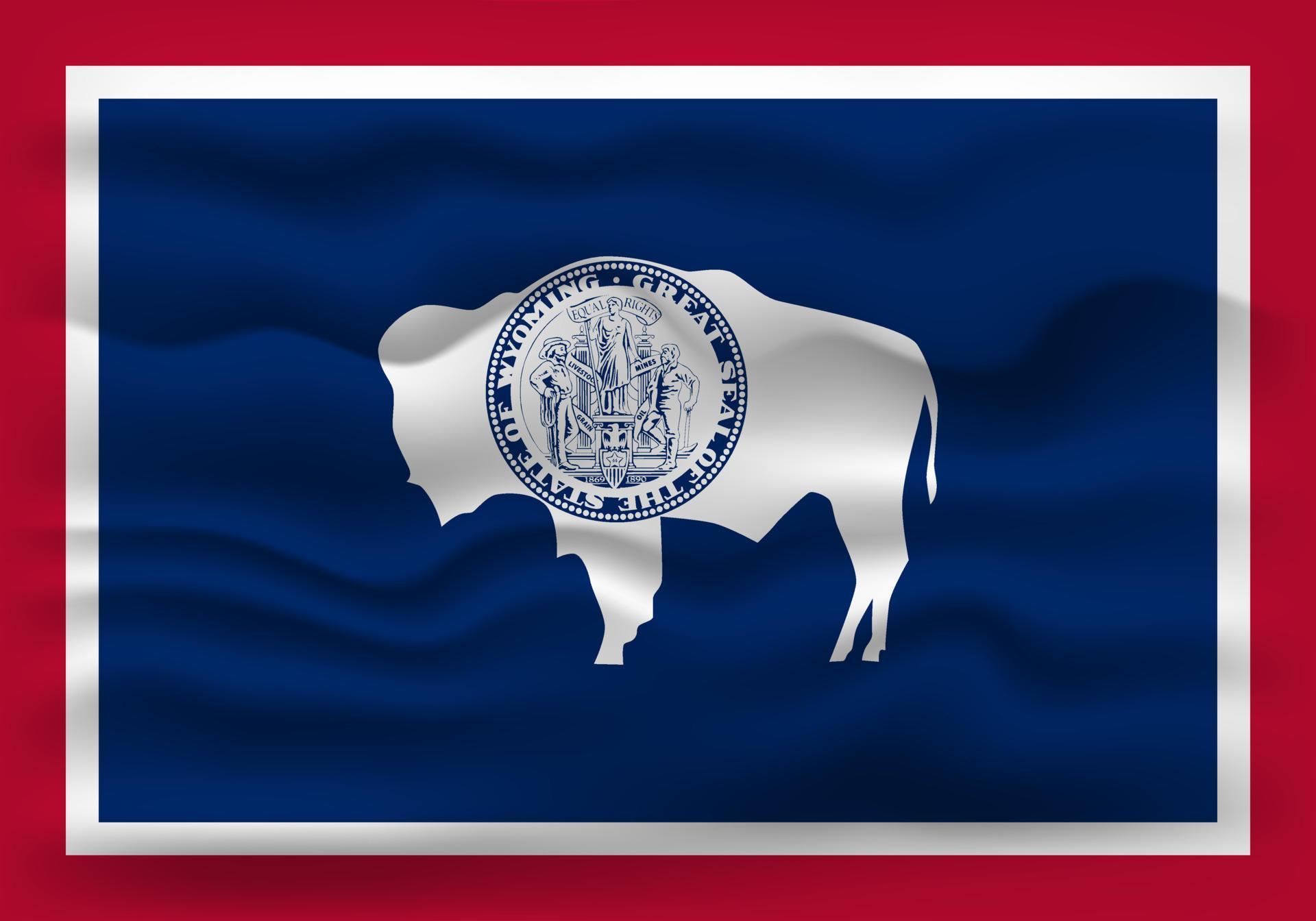
| State Motto | Equal Rights |
| Time Zone | Mountain |
| Bordering States | Montana, South Dakota, Nebraska, Colorado, Utah, Idaho |
Did You Know?
Wyoming Territory was the first government in the world to grant women the right to vote, doing so in December 1869, more than 50 years before the 19th Amendment extended suffrage to American women nationally.
Yellowstone National Park, established by President Ulysses S. Grant on March 1, 1872, was the world's first national park. The concept of national parks, born in Wyoming, was eventually adopted by more than 100 countries.
Wyoming is the least populated state in the United States, with approximately 580,000 residents. It has fewer people than some individual cities, including Washington, D.C., and Louisville, Kentucky.
Wyoming produces more coal than any other state in the country, accounting for roughly 40 percent of U.S. coal production, almost entirely from the Powder River Basin in the northeast.
Wyoming has no state personal income tax and no corporate income tax. State government is funded primarily by mineral severance taxes and federal royalties from oil, gas, and coal production on federal lands.
Devils Tower in northeastern Wyoming, designated by President Theodore Roosevelt in 1906, was the first national monument established in the United States under the Antiquities Act.
Wyoming has more pronghorn antelope than any other state, with an estimated population exceeding 400,000, roughly half of the world's total pronghorn population. In some parts of the state, pronghorn outnumber people.
The Continental Divide runs diagonally across Wyoming from the northwest to the southeast, with all water on the west side draining to the Pacific Ocean and all water on the east side draining to the Atlantic and Gulf of Mexico.
Nellie Tayloe Ross, inaugurated as Wyoming's governor on January 5, 1925, was the first female governor in United States history, serving to complete the term of her late husband, Governor William Ross.
Wyoming is represented in the U.S. House of Representatives by a single at-large member, one of only seven states with just one House seat. Despite having only 3 electoral votes, Wyoming's per-capita influence in the U.S. Senate equals that of California.
Quick Facts and Common Questions
Short answers to the questions people most often ask about Wyoming: its abbreviation, why it is the Equality State, its capital, and its place in Congress.
Wyoming's two-letter postal abbreviation is WY. The U.S. Census Bureau places it in the West region, in the Mountain division. About 577,000 people lived there in the 2020 census, the fewest of any state.
Wyoming became the 44th state on July 10, 1890. Congress created the Wyoming Territory in 1868, from land that had come to the United States through the Louisiana Purchase, the Oregon Country, and the Mexican Cession.
In December 1869 the Wyoming territorial legislature gave women the right to vote and hold office, the first government in the United States to do so. Wyoming insisted on keeping women's suffrage when it joined the Union in 1890, and in 1925 Nellie Tayloe Ross became the nation's first woman governor.
The name comes from a Lenape (Delaware) word usually translated as "at the big river flat" or "large plains." It was first used for the Wyoming Valley in Pennsylvania and was later chosen by Congress for the western territory.
Cheyenne has been the capital since the territory was organized in 1869. The city grew up in 1867 around the Union Pacific Railroad, and the State Capitol was completed in the late 1880s and expanded in 1890 and 1917.
Wyoming borders six states: Montana to the north and northwest, South Dakota and Nebraska to the east, Colorado to the south, Utah to the southwest, and Idaho to the west.
Yellowstone, created by Congress on March 1, 1872, was the first national park in the United States and, by most accounts, in the world. Most of it lies in northwestern Wyoming. Wyoming is also home to the first national monument, Devils Tower, proclaimed in 1906.
Wyoming is called "The Equality State" and "The Cowboy State." Its motto is "Equal Rights." Its state bird is the western meadowlark, its flower is the Indian paintbrush, its tree is the plains cottonwood, and its mammal is the bison.
Based on the 2020 census, Wyoming has 1 seat in the U.S. House of Representatives, elected statewide, which gives it 3 votes in the Electoral College, the minimum for any state.
Yellowstone National Park
The World's First National Park, Where a Supervolcano Powers the Earth's Most Concentrated Geothermal System
About Yellowstone National Park
Yellowstone National Park was established on March 1, 1872, by an act of Congress signed by President Ulysses S. Grant, the first national park anywhere in the world. It set the pattern, land held in public trust for its natural wonders, that spread to well over 100 countries. The park covers about 2.2 million acres, mostly in the northwest corner of Wyoming with slivers in Montana and Idaho.
Yellowstone sits over a volcanic hotspot, a plume of hot rock from deep in the mantle that has fueled three cataclysmic eruptions in the last 2.1 million years and now drives the most concentrated geothermal system on Earth: more than 10,000 hot springs, mudpots, fumaroles, and travertine terraces, and over 500 geysers, roughly half of all the geysers in the world.
Most of the park is a high, forested volcanic plateau at 7,000 to 8,500 feet, ringed by mountains rising above 10,000 feet and drained by the Yellowstone, Snake, and Madison rivers. Lodgepole pine covers about 80 percent of the forest, and Yellowstone Lake, at 7,733 feet, is one of the largest high-elevation lakes in North America.
The park is the core of the roughly 22-million-acre Greater Yellowstone Ecosystem, one of the last nearly intact temperate ecosystems on Earth, with grizzly bears, gray wolves, bison, elk, and pronghorn all still present. It became a UNESCO World Heritage Site in 1978 and now draws around 4 to 5 million visitors a year, most between June and September.
- Designation
- National Park, UNESCO World Heritage Site
- Location
- Yellowstone, Wyoming, northwestern Wyoming (extends into Montana and Idaho)
- Established
- 1872
- Annual Visitors
- ~4.9 million
Key Features
The Yellowstone hotspot has stayed fixed in the mantle while the North American plate slid southwest over it, leaving a 400-mile track of progressively older calderas across the Snake River Plain in Idaho. Three giant eruptions have gone off beneath Yellowstone itself: about 2.1 million, 1.3 million, and 640,000 years ago.
The most recent, the Lava Creek eruption 640,000 years ago, expelled roughly 240 cubic miles of material and dropped a caldera about 30 by 45 miles across, so large it is hard to see from the ground; most of the park's central plateau sits inside it.
Since then, more than 20 eruptions of thick rhyolite lava, the youngest about 70,000 years ago, have filled much of the caldera floor with flows hundreds of feet thick. The US Geological Survey's Yellowstone Volcano Observatory monitors the system with seismometers, GPS, and gas sensors and rates the near-term risk of another giant eruption as very low.
The ground itself breathes: parts of the caldera floor have risen and fallen by up to a few feet over recent decades as magma and hydrothermal fluids move, and swarms of small earthquakes, thousands a year, are routine.
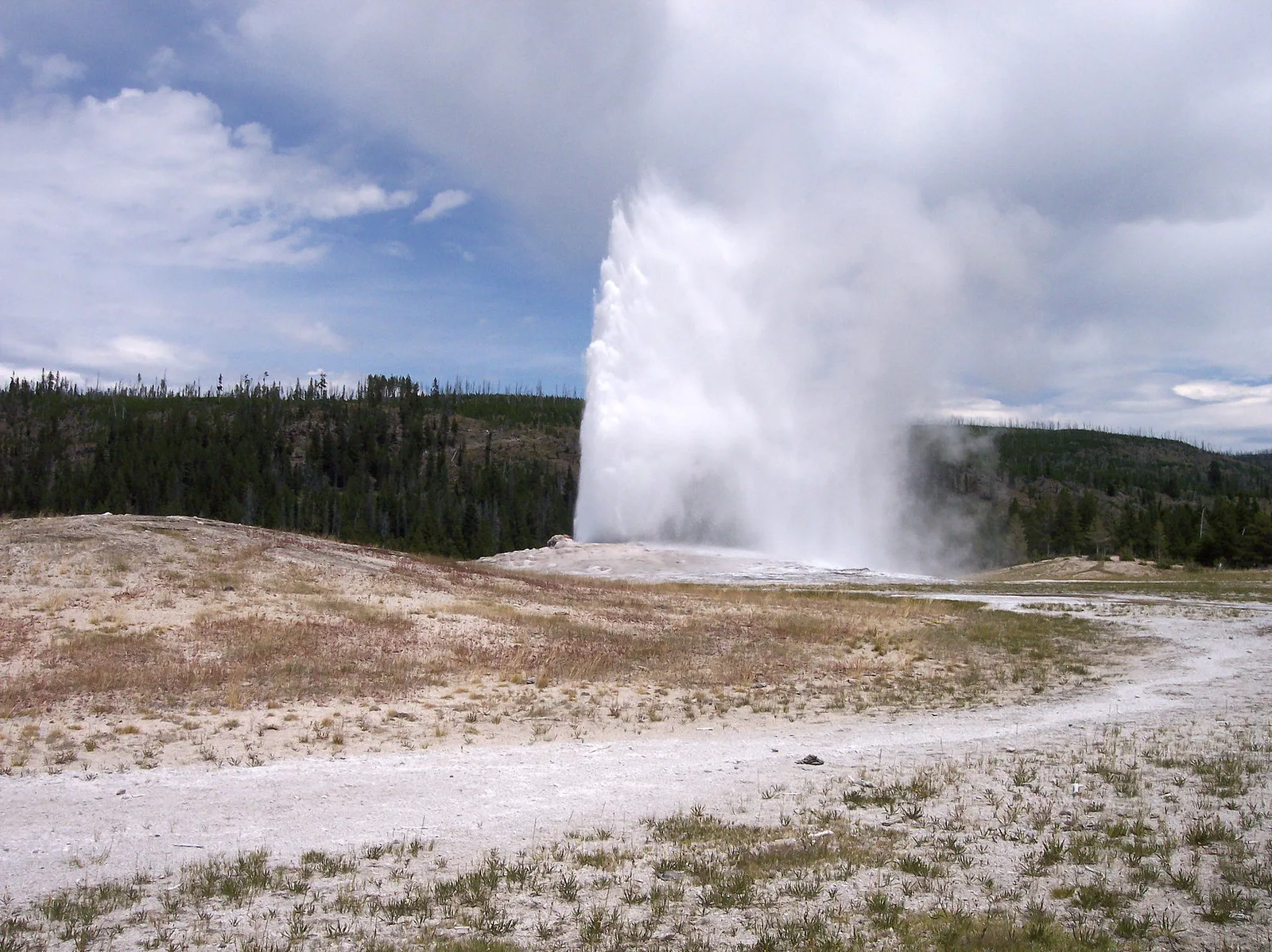
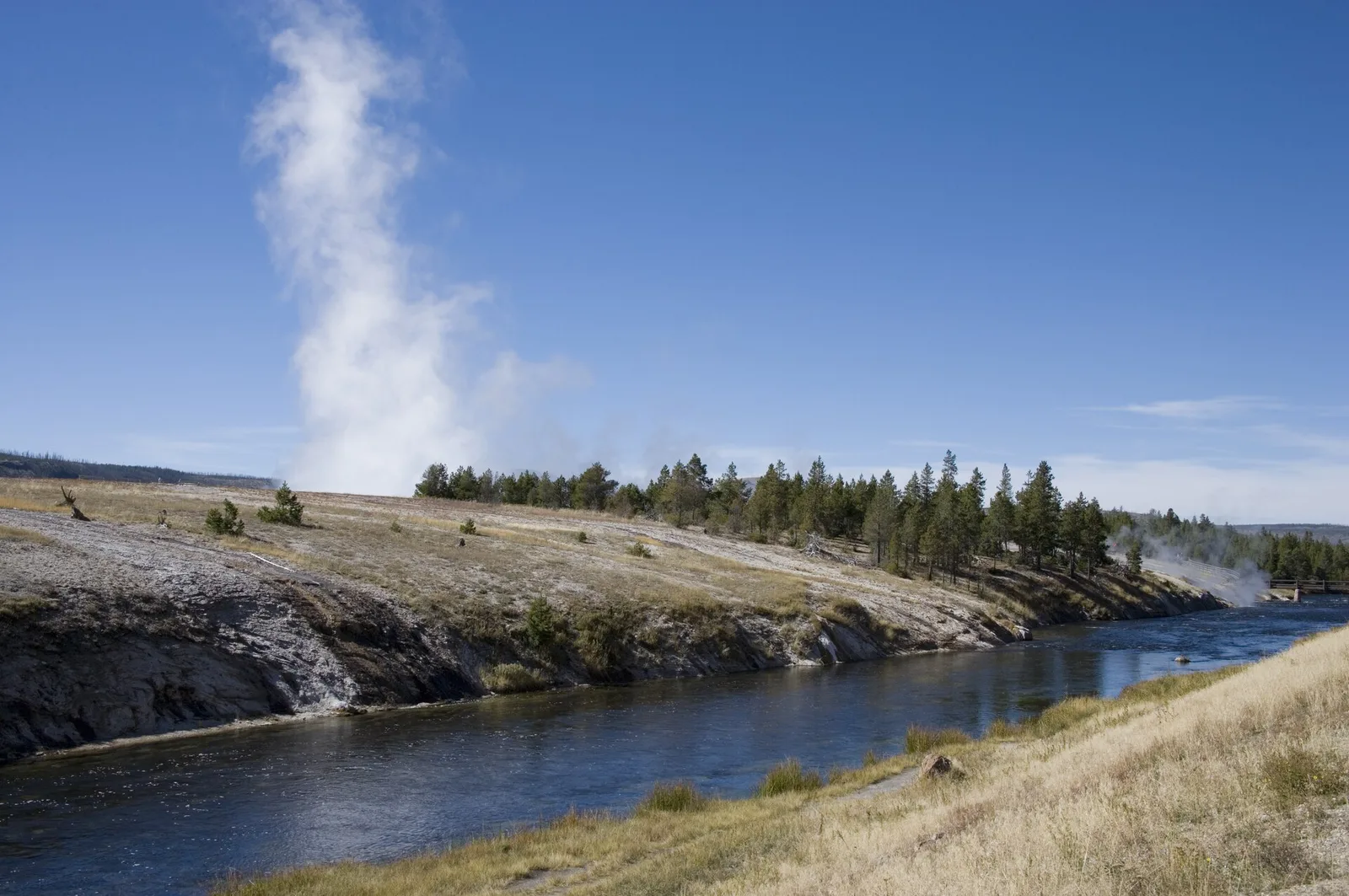
The Upper Geyser Basin, along the Firehole River, holds the densest concentration of geysers on Earth, roughly 150 in one square mile. Old Faithful is the best known but not the biggest; it erupts every 60 to 110 minutes, predictable within about 10 minutes, throwing 3,700 to 8,400 gallons of boiling water 100 to 185 feet for 1.5 to 5 minutes.
A geyser needs three things that occur together almost nowhere else: abundant water, a heat source hot enough to boil it, and a tight, pressure-sealed plumbing system of silica-lined cracks. Yellowstone's rhyolite provides the silica, the hotspot provides the heat, and the plateau's deep snowpack provides the water.
Steamboat Geyser, in Norris Geyser Basin, is the tallest active geyser in the world, shooting water over 300 feet in major eruptions that come at intervals from days to years; it entered an unusually active phase from 2018 through the early 2020s.
The Old Faithful Inn, built over the winter of 1903 to 1904 from local lodgepole pine and rhyolite, is one of the largest log buildings in the world, and its lobby rises about 76 feet to a network of hand-hewn beams; it helped define the parkitecture rustic style.
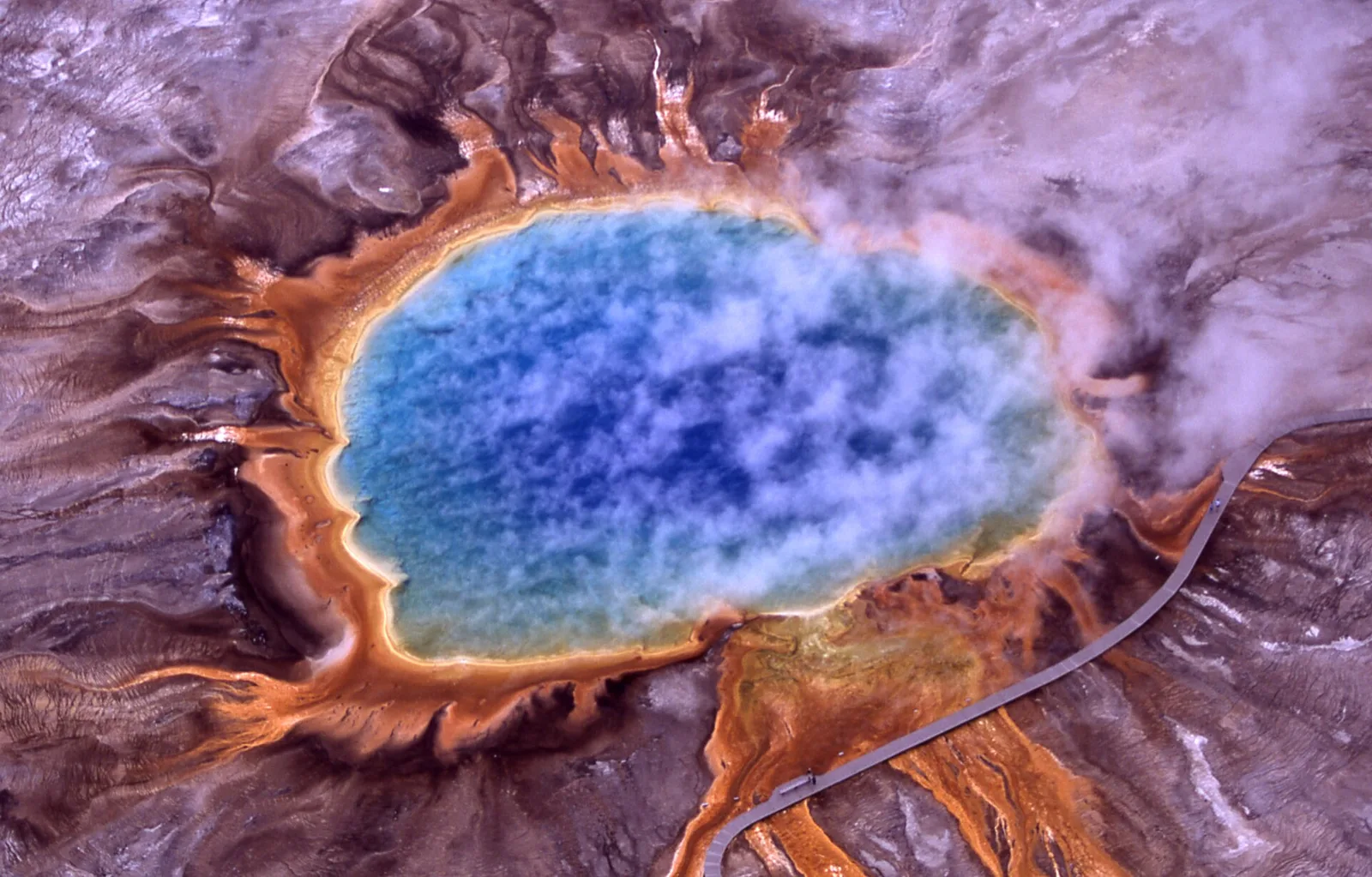
Grand Prismatic Spring, in the Midway Geyser Basin, is the largest hot spring in the United States and the third largest in the world, about 370 feet across and 121 feet deep, discharging roughly 560 gallons per minute of water near 160 degrees Fahrenheit.
Its rings of color are living: the deep blue center is near-boiling and nearly sterile, while cooler water toward the edges supports mats of heat-loving bacteria and archaea (thermophiles) whose pigments shade from yellow and orange to rust-red as the temperature drops.
One of those organisms, Thermus aquaticus, discovered in a Yellowstone hot spring in 1966, yielded the heat-stable enzyme that made the polymerase chain reaction practical, a technique now central to DNA testing, medicine, and forensics.
The spring is seen up close from the Midway boardwalk, but its full form is best appreciated from the Grand Prismatic Overlook on the Fairy Falls Trail, a short climb built in 2017 after visitors kept making an unofficial scramble up the hillside.
The Greater Yellowstone Ecosystem covers roughly 22 million acres across parts of three states and is one of the largest nearly intact temperate ecosystems left on Earth, with the national park at its protected core and surrounding national forests, wildlife refuges, and Grand Teton National Park around it.
Yellowstone has the only bison herd in the United States that has lived wild and continuously since prehistoric times; it fell to fewer than 25 animals in the park by 1902 and has since recovered to around 4,000 to 6,000, managed within limits because of brucellosis concerns when bison leave the park.
Gray wolves, exterminated from the park by the 1920s, were reintroduced from Canada in 1995 and 1996; the population inside the park has since ranged around 100 in roughly 10 packs. Their return is one of the most studied wildlife projects in history and has been linked to changes in elk behavior and streamside vegetation.
The ecosystem also holds one of the two large grizzly bear populations in the lower 48, around 1,000 bears, plus elk, moose, mountain lions, bighorn sheep, and the full native predator-prey system; Yellowstone cutthroat trout, a keystone native fish, has declined sharply from lake trout invasion and drought.
Indigenous Heritage
Shoshone-Bannock, Eastern Shoshone, and others
Native people have used the Yellowstone plateau for more than 11,000 years, since the retreat of the ice-age glaciers; obsidian from Yellowstone's Obsidian Cliff was traded as far as the Ohio Valley and Canada, and old trails, hunting blinds, and campsites are found throughout the park. Twenty-seven tribes have documented connections to the area.
The Tukudeka, or Sheep Eaters, a Mountain Shoshone group, are the only people known to have lived in the high country year-round, hunting bighorn sheep with dogs and making prized sinew-backed bows from sheep horn. They left the park after the 1868 Fort Bridger treaty assigned the Eastern Shoshone to the Wind River Reservation.
The 1877 flight of the Nez Perce (Nimiipuu) crossed the young park over about two weeks as roughly 750 people fleeing the US Army passed through, encountering tourists; the route is now the Nez Perce National Historic Trail. The park consults formally with 27 tribes, and in 2022 opened a Yellowstone Tribal Heritage Center at the Albright Visitor Center.
The Eastern Shoshone and Shoshone-Bannock Tribes both maintain reservations in Wyoming and Idaho and retain cultural and historical connections to the Yellowstone region. The park service consults with 27 federally recognized tribes on management decisions affecting cultural resources. The Crow Tribe, Blackfeet Nation, and several other nations also maintain ancestral ties to the broader Greater Yellowstone Ecosystem.
Things To Do
Old Faithful and Upper Geyser Basin
Watching Old Faithful erupt is the classic Yellowstone experience. Predicted eruption windows, accurate to within about 10 minutes, are posted at the Old Faithful Visitor Education Center, on the NPS app, and at park lodges; arriving 20 to 30 minutes early secures a boardwalk seat.
Old Faithful is only the start: a network of boardwalks and paved paths runs several miles up the Firehole River past Castle, Grand (the tallest predictable geyser, to 200 feet), Riverside, Beehive, and Morning Glory Pool, and the Upper Geyser Basin holds about a quarter of the world's geysers.
The area has the park's largest development, the historic Old Faithful Inn (1904) and its two later lodges, a visitor center, clinic, gas, and stores, and it can be gridlocked at midday in summer; early morning and evening are far calmer and better for photos.
The ground here is a thin crust over boiling water and acid; the park requires visitors to stay on boardwalks and trails, and people have been badly burned or killed stepping off, most recently in incidents at Norris and the Lower Geyser Basin.
Grand Prismatic Spring Overlook
The best view of Grand Prismatic Spring is from the Grand Prismatic Overlook, reached by a 1.2-mile (each way) walk from the Fairy Falls trailhead south of Midway Geyser Basin, climbing about 100 feet to a viewing platform on the hillside.
From the platform the spring's full ring structure, blue center fading through green, yellow, orange, and red, is visible in a way that is impossible from the boardwalk at water level, where the colors dissolve into steam.
The trail continues another 1.6 miles to Fairy Falls, a 200-foot ribbon waterfall, and beyond to Imperial and Spray geysers, making a moderate half-day loop; the trailhead lot is small and fills early on summer mornings.
Down at ground level, the Midway Geyser Basin boardwalk crosses the Firehole River on a bridge stained orange by runoff and passes Grand Prismatic and the Excelsior Geyser crater, which last erupted powerfully in the 1880s and now pours about 4,000 gallons a minute of hot water into the river.
Lamar Valley Wildlife Watching
The Lamar Valley, a broad glacial valley in the park's northeast, is the premier wildlife-viewing area in Yellowstone, sometimes called the Serengeti of North America. Its open sagebrush grassland along the Northeast Entrance Road holds large bison herds year-round, plus elk, pronghorn, and, from roadside pullouts, wolves.
Wolves are most reliably seen at dawn and dusk in the cold months, when the valley's packs, watched daily by researchers and a devoted community of spotters with high-power scopes, hunt elk on the open ground; the road stays plowed all winter to the Northeast Entrance.
Grizzly and black bears feed on the valley slopes in spring, coyotes and red foxes are common, bald eagles and ospreys nest along the Lamar River, and bighorn sheep work the cliffs near the Yellowstone River confluence.
The valley is also the site of the Buffalo Ranch, where the park's bison herd was rebuilt with captive breeding from 1907 into the 1950s after wild bison nearly vanished; the historic ranch buildings now house a field school.
Grand Canyon of the Yellowstone
The Grand Canyon of the Yellowstone is a roughly 20-mile, up to 1,200-foot-deep gorge that the Yellowstone River has cut into rhyolite lava that was chemically altered and softened by hydrothermal activity; iron in the rock oxidizes to the yellows, oranges, pinks, and whites that give the park its name.
The river drops over two waterfalls at the canyon head: the Upper Falls (109 feet) and, a short distance downstream, the Lower Falls at 308 feet, nearly twice the height of Niagara and the park's most photographed scene.
The North Rim (Lookout Point, Grand View, Inspiration Point) and South Rim (Artist Point, Uncle Tom's area) each have a rim drive with short trails to overlooks; steep stairway trails such as Uncle Tom's Trail and the Brink of the Lower Falls descend partway toward the water.
The canyon is still actively forming: rockfalls, repeated trail closures from unstable rims, and continuing hydrothermal alteration mean the Park Service periodically reroutes overlooks and stairs as sections become unsafe.
Conservation and Challenges
Geothermal Feature Damage
Yellowstone's hydrothermal features are delicate plumbing systems: a single thrown object can lodge in a geyser's narrow throat and choke it permanently. Historic vandalism, coins, rocks, logs, and soaping geysers to force eruptions, damaged or destroyed features that took centuries to form, including Handkerchief Pool, once a tourist novelty, which was clogged shut by the 1920s.
Bathing in and walking on thermal features was common into the 1900s and is now banned everywhere the water comes straight from a hydrothermal source. Foot traffic off the boardwalks compacts and breaks the fragile sinter crust and tracks in seeds and microbes.
The park protects the features through a 1970 federal thermal-feature law and its own regulations, extensive boardwalks and fencing, ranger patrols, and heavy fines, and it has closed some basins after ground temperatures spiked.
Incidents still happen: people have been caught draining hot springs, driving into thermal areas, and, in a widely reported 2023 case, cooking food in a hot spring; the park treats these as resource crimes and prosecutes them.
Bison Management and Brucellosis
Yellowstone's bison are the largest herd on public land and the only one descended continuously from wild plains bison; a low point of fewer than two dozen wild animals in the park around 1902 was rebuilt with a few dozen more brought in from private herds.
About half the herd carries brucellosis, a bacterial disease introduced from European cattle a century ago that can cause bison, elk, and cattle to abort; ranchers and the state of Montana fear transmission to livestock, though no documented bison-to-cattle transmission has occurred in the wild.
Under the Interagency Bison Management Plan, in place since 2000, bison leaving the park north and west are hazed back, captured, or removed, and the annual reduction, through treaty hunting by tribes, shipment to tribal herds via the Bison Conservation Transfer Program, and slaughter, has run from a few hundred to well over 1,000 in high years.
A 2024 revised plan aims for a park population of roughly 3,500 to 6,000, more transfers to tribes and fewer slaughters, and expanded tolerance for bison on some lands outside the park, reflecting decades of pressure from tribes and conservation groups.
Wolf Recovery and Livestock Conflict
Gray wolves were deliberately exterminated from Yellowstone by government hunters, the last known pack killed in 1926, as part of a national predator-control policy. Their absence let elk numbers surge and, many ecologists argue, degraded streamside willow and aspen.
In 1995 and 1996, 31 wolves captured in Alberta and British Columbia were released in the park under the Endangered Species Act. The population grew quickly, peaked near 170 in the early 2000s, and has since settled around 100 wolves in roughly 10 packs inside the park.
Researchers have documented a partial trophic cascade: with wolves present, elk avoid open valley bottoms, some willow and aspen stands have rebounded, and beaver and songbird numbers have risen, though drought, bears, and cougars also shape elk numbers and the effect is debated.
Northern Rocky Mountain wolves were removed from the endangered species list in 2011, and Montana, Idaho, and Wyoming now allow wolf hunting up to the park boundary; park wolves that cross the line are legally killed, and heavy harvests near the north edge in 2021 and 2022 killed roughly a fifth of the park population and prompted new state limits.
Grand Prismatic Spring, 370 feet wide, the third-largest hot spring on Earth
Fast Facts
Did You Know?
Yellowstone was established on March 1, 1872, as the world's first national park, a concept without precedent anywhere on Earth at the time. The idea that a government would set aside land permanently and protect it from development for the enjoyment of all citizens rather than selling or granting it for private use was revolutionary. The Yellowstone model spread to other countries over the following decades and eventually inspired a global network of over 100,000 protected areas covering more than 15% of the Earth's land surface.
When wolves were reintroduced to Yellowstone in 1995 after a 70-year absence, scientists observed a phenomenon called a trophic cascade: the wolves changed the behavior of elk, which stopped overgrazing riverside willows and aspens out of fear of predation. As vegetation grew back along riverbanks, it stabilized stream banks and changed the physical shape of rivers. Beavers returned, creating ponds that supported new habitat. Songbirds increased. The reintroduction of wolves changed the physical landscape of the park in ways that went far beyond what anyone expected.
Yellowstone sits atop one of the largest supervolcanoes on Earth, a hotspot that has produced three cataclysmic eruptions in the past 2 million years, each hundreds of times more powerful than the 1980 eruption of Mount St. Helens. The most recent caldera-forming eruption 640,000 years ago ejected more than 240 cubic miles of material. The Yellowstone hotspot is fully monitored by the USGS Yellowstone Volcano Observatory, and while scientists do not anticipate an eruption in the foreseeable future, the supervolcano remains one of the most closely watched geological features in the country.
Plan Your Visit
Location
Yellowstone, Wyoming, northwestern Wyoming (extends into Montana and Idaho)
Designation
National Park, UNESCO World Heritage Site
Best Time to Visit
Late spring through early fall (May through September) offers full road access and the most reliable wildlife viewing, though summer crowds are heavy. Winter transforms the park into a quieter landscape reachable mainly by snowcoach and snowmobile, with many interior roads closed to regular vehicles from early November through April.
Entrance Fee
$35 per vehicle (7-day), or use an America the Beautiful annual pass. The pass also covers Grand Teton National Park next door.
Getting There
The main South entrance is at Jackson Hole, Wyoming, 5 hours from Salt Lake City or Denver. The West entrance at West Yellowstone, Montana is the most used in summer. The North entrance at Gardiner, Montana is open year-round. Fly into Jackson Hole (JAC) or Bozeman (BZN).
Old Faithful Timing
Predicted eruption times are posted at the Old Faithful Visitor Education Center. Predictions are accurate to within 10 minutes. Arrive 20 minutes before the predicted time for a good viewing position. The observation boardwalk fills quickly in summer.
Wildlife Safety
Stay at least 25 yards from bison and elk and 100 yards from bears and wolves. Do not approach wildlife for photos. Bison injure more visitors in Yellowstone than any other animal. Keep your speed below the posted limit to avoid hitting wildlife on roads.
Geothermal Hazards
Stay on boardwalks at all times near geothermal features. The ground can be inches thick over scalding water. Never touch or enter hot springs. Do not collect thermal water. Serious burns and fatalities have resulted from stepping off boardwalks.