The Story of America
From the first Americans to the modern republic, the key events, people, and turning points that made the United States what it is today.
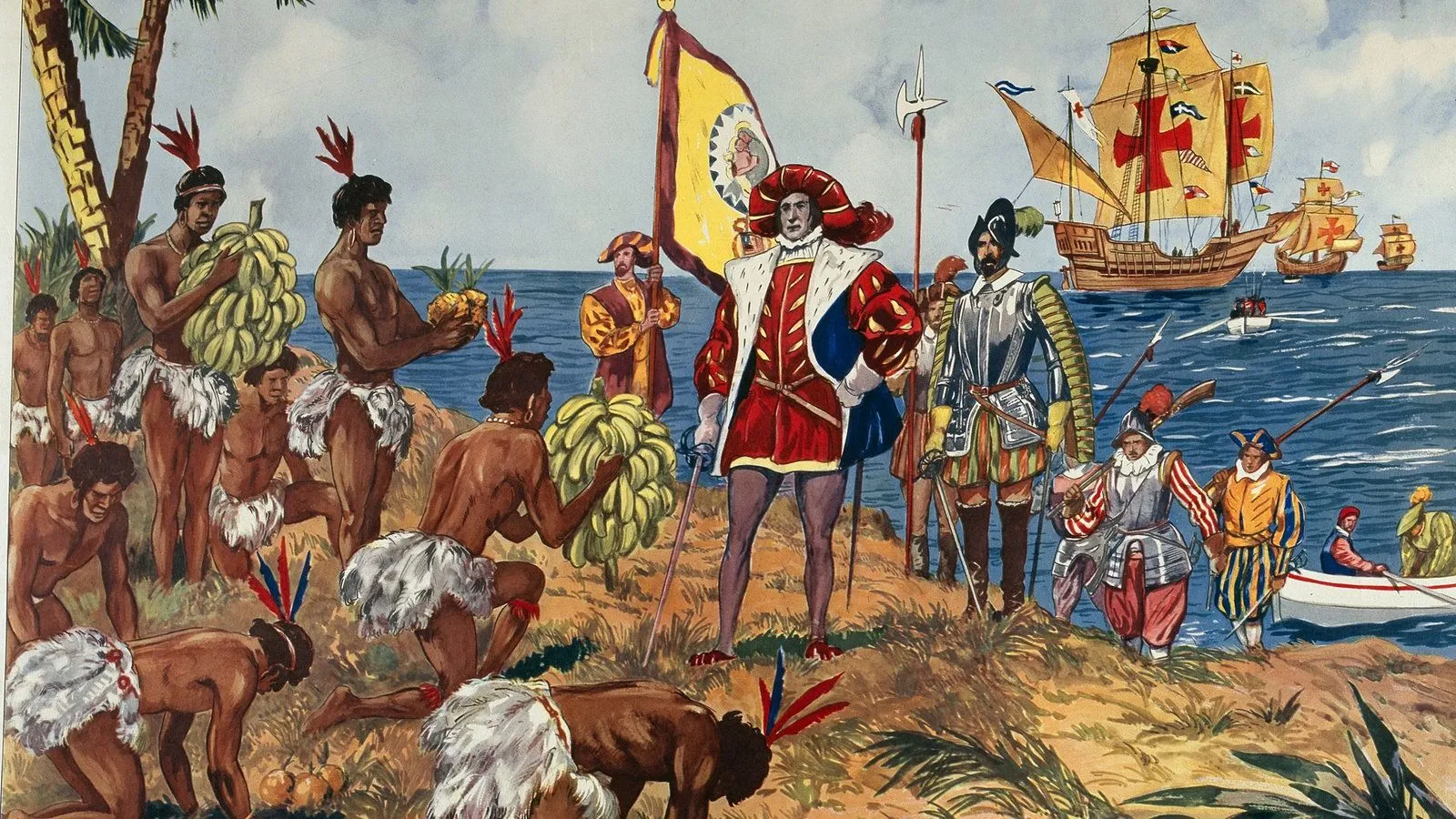
Columbus's 1492 landing initiated centuries of European colonization.
Discovery & Colonization
1492–1763
Long before European explorers arrived, North America was home to tens of millions of Indigenous people, hundreds of distinct nations with their own languages, governments, trade networks, and cultures. European contact changed everything, forever.
Key Events
What Happened
The ancestors of today's Native Americans reached the Americas from Asia, most by way of the Bering land bridge exposed during the last Ice Age, and possibly also along the Pacific coast by boat. Over thousands of years they spread across both continents.
By 1492, estimates of the Indigenous population of the Americas range from 50 to 100 million people, speaking hundreds of languages and organized into hundreds of distinct nations with their own governments, religions, and trade systems.
The Mississippian city of Cahokia, near present-day St. Louis, covered several square miles around 1100 CE and held a population larger than London's at the time; its largest earthwork, Monks Mound, is still the biggest in the Americas.
Recent research has complicated the older single-migration story. Sites such as Monte Verde in Chile point to people living south of the ice sheets more than 14,000 years ago, and DNA studies suggest several distinct founding populations rather than one.
Why It Matters
The history of America does not begin with European arrival. It begins with thousands of years of Indigenous civilization, a fact that shapes debates about land, sovereignty, and identity that continue to this day.
What Happened
On October 12, 1492, Columbus made landfall in the Bahamas, believing he had reached Asia. He had not, but his voyage, backed by Spain, opened the door to sustained European contact with the Americas.
Within decades, Spanish, Portuguese, French, Dutch, and English explorers and colonizers followed. The consequences for Indigenous peoples were catastrophic: European diseases such as smallpox, measles, and influenza, to which Native Americans had no immunity, killed an estimated 50 to 90 percent of the population within a century, often before most Europeans ever reached a given region.
Columbus himself governed the Caribbean island of Hispaniola for Spain, and his administration was harsh enough that the crown arrested him and stripped his titles in 1500. He never accepted that he had reached a new continent, and died in 1506 still calling the region 'the Indies.'
His voyages set off what historians call the Columbian Exchange, the transfer of crops, animals, diseases, and people between the hemispheres. Potatoes, maize, and tomatoes transformed diets across Europe, Asia, and Africa; horses, cattle, wheat, and sugar reshaped the Americas.
Why It Matters
Columbus's voyage initiated what historians call the Columbian Exchange, the transfer of plants, animals, diseases, and people between the Old and New Worlds. It reshaped both hemispheres permanently and set the stage for everything that followed in American history.
What Happened
In May 1607, about 104 English settlers arrived on the James River in present-day Virginia and founded Jamestown, the first permanent English colony in North America, backed by the for-profit Virginia Company of London.
The early years were deadly: disease, brackish water, starvation, and conflict with the Powhatan Confederacy killed most of the settlers. During the 'Starving Time' winter of 1609 to 1610, the colony's population fell from about 300 to 60. Survival came through tobacco, which John Rolfe developed into a profitable export crop after 1612.
The year 1619 brought two developments that would define American history. The Virginia House of Burgesses met for the first time, the first elected legislative assembly in English North America, and the first enslaved Africans, some '20 and odd,' were landed at Point Comfort from a ship that had raided a Portuguese slaver.
The colony nearly failed for good in 1622, when a coordinated Powhatan attack killed about a quarter of the English population, and again before the Crown revoked the insolvent Virginia Company's charter in 1624, making Virginia a royal colony. Representative government and racial slavery, both rooted here, would grow together for the next 250 years.
Why It Matters
Jamestown established the template for English colonization: private company investment, representative government, tobacco agriculture, and African slave labor. The tensions built into 1619, freedom and slavery existing side by side, would define American history for the next 250 years.
What Happened
In November 1620, about 102 passengers aboard the Mayflower, roughly half of them religious Separatists who had left England and then the Netherlands, reached Cape Cod after a 66-day crossing, far north of their intended destination in the Virginia Company's territory.
Because they were outside any chartered government, 41 adult men signed the Mayflower Compact before going ashore, agreeing to form a 'civil body politic' and to make and obey 'just and equal laws' decided by the majority. It was a brief agreement, not a constitution, but an early instance of government by consent in English America.
The first winter killed about half the colonists. The survivors got through with help from the Wampanoag, and from Tisquantum (Squanto), a Patuxet man who had earlier been kidnapped to Europe and spoke English; he showed them how to plant corn and where to fish.
The 1621 harvest feast later mythologized as the 'first Thanksgiving' included about 90 Wampanoag men led by Massasoit. The alliance held for a generation, then collapsed into King Philip's War of 1675 to 1676, one of the deadliest conflicts per capita in American history.
Why It Matters
The Mayflower Compact is one of the earliest precedents for American democratic self-governance, the idea that legitimate government is established by the consent of the governed. The Pilgrims' story became central to American national mythology, though the full story of their relationship with Indigenous peoples is far more complicated.
What Happened
Between 1619 and the end of legal imports in 1808, an estimated 388,000 to 500,000 enslaved Africans were carried directly to Britain's North American colonies and the early United States, a small share of the roughly 12.5 million taken from Africa across the whole Atlantic trade.
Enslaved people worked the tobacco farms of the Chesapeake, the rice and indigo plantations of the Carolina Lowcountry, and, later, the cotton fields of the Deep South. Colonial laws made slavery hereditary through the mother, permanent, and racial, and stripped the enslaved of the right to marry, own property, testify against whites, or, in most colonies, learn to read.
By 1750, roughly 240,000 enslaved people lived in the colonies, about a fifth of the total population, and a majority in South Carolina. Slavery existed in every one of the thirteen colonies, north and south, though it was concentrated in the plantation economies of the South.
Enslaved and free Black people built much of colonial America's physical and economic infrastructure. The wealth slavery generated, in crops, credit, shipping, insurance, and finance, reached deep into the Northern and British economies, not only the Southern one.
Why It Matters
Slavery was not a footnote to American history, it was foundational to American wealth and economic development. The contradiction between the ideals of liberty expressed in the Declaration of Independence and the reality of slavery is widely regarded by historians as the central moral contradiction of American history, one the country is still reckoning with.
What Happened
The French and Indian War, the North American front of the global Seven Years' War, pitted Britain and its colonists and Native allies against France and its own Native allies for control of the continent's interior. It began in 1754 with a skirmish in western Pennsylvania led by a 22-year-old Virginia officer, George Washington.
Britain won decisively. The 1763 Treaty of Paris gave it all of French Canada and all territory east of the Mississippi. But the war roughly doubled Britain's national debt, and Parliament turned to the colonies to help pay it down.
The taxes and controls that followed, the Proclamation of 1763 barring settlement west of the Appalachians, the Sugar Act, the Stamp Act, the Townshend duties, and the Tea Act, would drive the colonies toward revolution within twelve years.
The war also reshaped Native power. Britain's victory removed France as a counterweight the interior nations had played against the British, and Pontiac's War of 1763, a broad Native uprising against British forts, showed how quickly that balance had shifted.
Why It Matters
The French and Indian War created the fiscal crisis that led Britain to tax the colonies, which directly caused the American Revolution. It also established George Washington's reputation and gave the colonists confidence that they could fight effectively.
Sources & Further Reading
- National Archives
- Library of Congress
- Smithsonian National Museum of American History
- Britannica, History of the United States
- American Battlefield Trust
- National Park Service, U.S. History
Dates, casualty figures, vote totals, and population estimates above are drawn from the National Archives, the Library of Congress, the Smithsonian National Museum of American History, and the sources linked here. Where historians' estimates vary, this page states the commonly cited range rather than a single disputed figure.