
An Gorta Mor: The Great Hunger
The Irish did not choose to leave. They were driven out by a catastrophe, the near-total failure of the potato crop, and by a government response that much of the world viewed as a form of abandonment.
In the early nineteenth century Ireland was one of the most densely populated countries in Europe. By 1841 its population had reached about 8.2 million, almost all of it dependent on agriculture. Since the Acts of Union of 1800, which dissolved the Irish Parliament in Dublin, Ireland had been governed directly from London as part of the United Kingdom.
Most land was owned by Protestant Anglo-Irish landlords, many of them absentees living in England, while Catholic tenant farmers worked small plots with no legal security under a "rack-rent" system. Penal-era restrictions had long barred Catholics, roughly three-quarters of the population, from owning significant land or entering many professions; Catholic Emancipation in 1829 removed the political bar but not the poverty.
Farms were repeatedly subdivided among sons until millions of families lived on one or two acres. On holdings that small, only one crop yielded enough calories to survive on: the potato. A single acre of potatoes, with a pig and some milk, could feed a family of six for a year.
By the 1840s roughly one-third of the Irish population depended on the potato as their only food, and about three million of the poorest ate almost nothing else. The variety most widely grown, the high-yielding "lumper," had almost no genetic diversity, which left the entire food supply exposed to a single disease.
In late summer 1845 a water mold, Phytophthora infestans, spread through Ireland's potato fields and rotted the crop in the ground. It returned in 1846 and destroyed almost the entire harvest, eased in 1847 when little seed had been planted, then struck again in 1848.
Between 1845 and 1852 roughly one million people in Ireland died of starvation and of famine diseases such as typhus and dysentery, and at least another million emigrated. The population fell from 8.2 million in 1841 to 6.5 million in 1851 and kept falling for generations; by 1901 it was about 4.5 million. The worst year, 1847, is still called Black '47.
The British government's response was shaped by laissez-faire doctrine, the belief that private markets rather than the state should provide relief, and by moralizing about Irish "dependency." Charles Trevelyan, the Treasury official overseeing relief, wrote of the famine as a providential check on a too-large population. Peel's government imported Indian corn and ran public works in 1845 to 1846; the Whig government that followed wound the works down and shifted the cost of relief onto bankrupt Irish landlords.
Food kept leaving Ireland during the famine, grain, cattle, butter, and eggs exported to Britain, sometimes under armed guard, a fact that has never been forgotten. Historians still debate whether British policy amounted to deliberate genocide or ideological negligence; what is not disputed is that policy choices let the catastrophe reach its full scale.
For those who could raise the fare, emigration was the only alternative to starvation. Hundreds of thousands left in overcrowded, under-provisioned ships, many of them timber or cargo vessels hastily fitted with plank bunks and never meant to carry passengers. The crossing to North America took four to six weeks.
Below decks there was no sanitation, little food or clean water, and no medical care. Typhus, cholera, and dysentery spread through the holds, and these vessels became known as "coffin ships." The cheapest route ran to British North America, present-day Canada, rather than the more tightly regulated United States ports.
In 1847 alone more than 100,000 people sailed for Canada, and an estimated one in five died at sea or soon after landing. At the quarantine station on Grosse-Ile in the St. Lawrence River, thousands of Irish were buried in mass graves in a single summer; the island is now a national historic site and memorial.
Survivors landed at Quebec, Boston, New York, Philadelphia, and Baltimore, often sick, penniless, and speaking only Irish. Many who arrived in Canada walked or took cheap steamers south into New England, so Canadian ports effectively became a side entrance to the United States.
The Great Famine was not the start of Irish migration to America. Protestant settlers from Ulster, the "Scotch-Irish," descendants of Scottish Presbyterians planted in Ireland in the 1600s, began arriving in the colonies in large numbers from the 1710s, driven by rent increases and restrictions on their dissenting faith.
They pushed onto the Appalachian frontier from Pennsylvania south into the Carolinas and became a defining influence on the culture of the American backcountry and South. Their descendants included Presidents Andrew Jackson, James K. Polk, and James Buchanan; by some counts more than a dozen U.S. presidents have Ulster roots.
Catholic Irish had also come since colonial times, and between 1815 and 1845 roughly 800,000 to one million Irish, Catholic and Protestant, crossed to North America, many of them working as laborers on projects like the Erie Canal and the early railroads.
Then the Famine broke the door open. Between 1820 and 1860 the Irish made up more than a third of all immigrants to the United States, and by 1860 about 1.6 million Irish-born people lived in the country, the largest foreign-born group.
The Crossing
The voyage across the Atlantic in overcrowded, disease-ridden ships killed tens of thousands before they ever saw America. Those who survived arrived at the bottom of everything.
The potato blight was first reported in Ireland in September 1845 and ruined perhaps a third to a half of that year's crop. The disease, then not understood, was a water mold later named Phytophthora infestans, probably carried from North America in ship cargo.
Sir Robert Peel's government responded by secretly buying about 100,000 pounds sterling of Indian corn from the United States and setting up local relief committees and public works. The imported meal, hard to mill and cook, was nicknamed "Peel's brimstone."
Peel also used the crisis to push through repeal of the Corn Laws in June 1846, tariffs that kept grain prices high. The move split his party and forced him from office within weeks.
The incoming Whig government under Lord John Russell took a stricter line, holding that relief must not interfere with private trade. As the far worse failure of 1846 unfolded, the scale of the disaster was still not grasped in London.
1847 was the deadliest year of the Famine. The 1846 crop had failed almost completely, and by early 1847 mass starvation and epidemic fever gripped the country.
Under the Temporary Relief Act, government soup kitchens were feeding about three million people a day by the summer of 1847, the largest relief operation of its kind up to that time. It was shut down within months, and responsibility was pushed onto the Irish Poor Law unions, many already insolvent.
The "Gregory clause" of the 1847 Poor Law barred anyone holding more than a quarter-acre from relief, forcing families to give up their land, and often their homes, to be fed. Mass evictions followed, an estimated half a million people put out between 1846 and 1854.
Emigration surged. About 100,000 sailed for British North America in 1847, and roughly one in five died on the coffin ships or in quarantine at Grosse-Ile. Word of shorter, safer, better-regulated crossings pushed the flow toward United States ports in the years after.
The blight returned a third time in 1848, wrecking another harvest just as relief funds ran dry and evictions peaked.
In July 1848 the Young Ireland movement, inspired by that year's revolutions across Europe, attempted a rising. It amounted to a brief skirmish at Ballingarry, County Tipperary, around the Widow McCormack's farmhouse, and collapsed within a day.
Leaders including William Smith O'Brien, Thomas Francis Meagher, and John Mitchel were convicted of sedition and transported to the penal colony of Van Diemen's Land, now Tasmania. Several later escaped to the United States.
In America these exiles became major figures. Meagher raised and led the Union Army's Irish Brigade and served as acting governor of Montana Territory; Mitchel became a fiery pro-Confederate editor. The failure of 1848 also helped inspire the founding of the Fenian Brotherhood in New York in 1858.
1851 was the peak year of Famine emigration to the United States, with more than 200,000 Irish arriving in twelve months; across 1847 to 1854 roughly 1.2 to 1.5 million Irish landed in America.
Most settled in the port cities where they came ashore, New York, Boston, Philadelphia, Baltimore, because they arrived with no money to move on. By 1855 the Irish-born were about 28 percent of New York City's population and close to a third of Boston's.
They entered at the bottom of the labor market as dockworkers, ditch-diggers, domestic servants, and mill hands, and lived in cellars and subdivided tenements. Cholera and tuberculosis rates in Irish districts ran far above the urban average.
Native-born Protestants met them with intense hostility, both anti-immigrant and anti-Catholic, which within a few years fed the rise of the nativist Know-Nothing movement.
On August 1, 1855, New York State opened the nation's first official immigrant depot at Castle Garden, a former fort and concert hall at the Battery on the southern tip of Manhattan.
It was created largely in response to the Irish and German flood and to the "runners" and boarding-house sharks who preyed on bewildered arrivals. At Castle Garden immigrants could exchange money at fair rates, buy rail tickets, find registered lodging, and get help locating work and relatives.
Over 35 years Castle Garden processed an estimated eight million immigrants, more than two-thirds of all arrivals to the United States in that period. For the Irish it was the gateway, and the Emigrant Savings Bank and Irish benevolent societies worked closely with it.
The state closed Castle Garden in 1890 amid corruption complaints, and the federal government took over immigration, opening Ellis Island in 1892. The building survives today as Castle Clinton National Monument.
In March 1863 Congress passed the Enrollment Act, the first federal military draft, which let a wealthy man avoid service by paying a 300-dollar "commutation fee" or hiring a substitute, a sum far beyond a laborer's reach.
When the first names were drawn in New York City on July 11, 1863, days after Gettysburg, Irish and other working-class New Yorkers erupted into four days of rioting, the deadliest civil disorder in American history. Estimates of the dead range from about 120 into the several hundreds.
The violence turned racial. Rioters who competed with Black workers for the lowest-paid jobs, and who resented that Black men were not counted as citizens subject to the draft, attacked Black homes and businesses, lynched at least eleven Black men, and burned the Colored Orphan Asylum on Fifth Avenue, from which 233 children escaped.
Union troops fresh from Gettysburg marched into the city to end the riots by force. The episode exposed how deeply the Irish and Black communities had been set against each other and damaged Irish Americans' standing for a generation, even as tens of thousands of Irishmen fought for the Union.
Ellis Island opened in New York Harbor on January 1, 1892, replacing Castle Garden as the federal immigrant inspection station. The first person processed was Annie Moore, a teenager from County Cork arriving with her two younger brothers.
Irish immigration continued heavily through the turn of the century but never again matched the Famine peak; by 1900 the Irish-born share of the U.S. population was falling as arrivals from southern and eastern Europe rose.
A distinctive feature of Irish emigration in this era was that women outnumbered men, unusual among immigrant groups. Many were young, single, and came alone to work as domestic servants, sending remittances home; their wages helped finance the chain migration of siblings.
Between 1820 and 1930 about 4.5 million people left Ireland for the United States. Emigration became so routine that it was woven into rural Irish life through the "American wake," a farewell gathering for someone leaving who would likely never return.
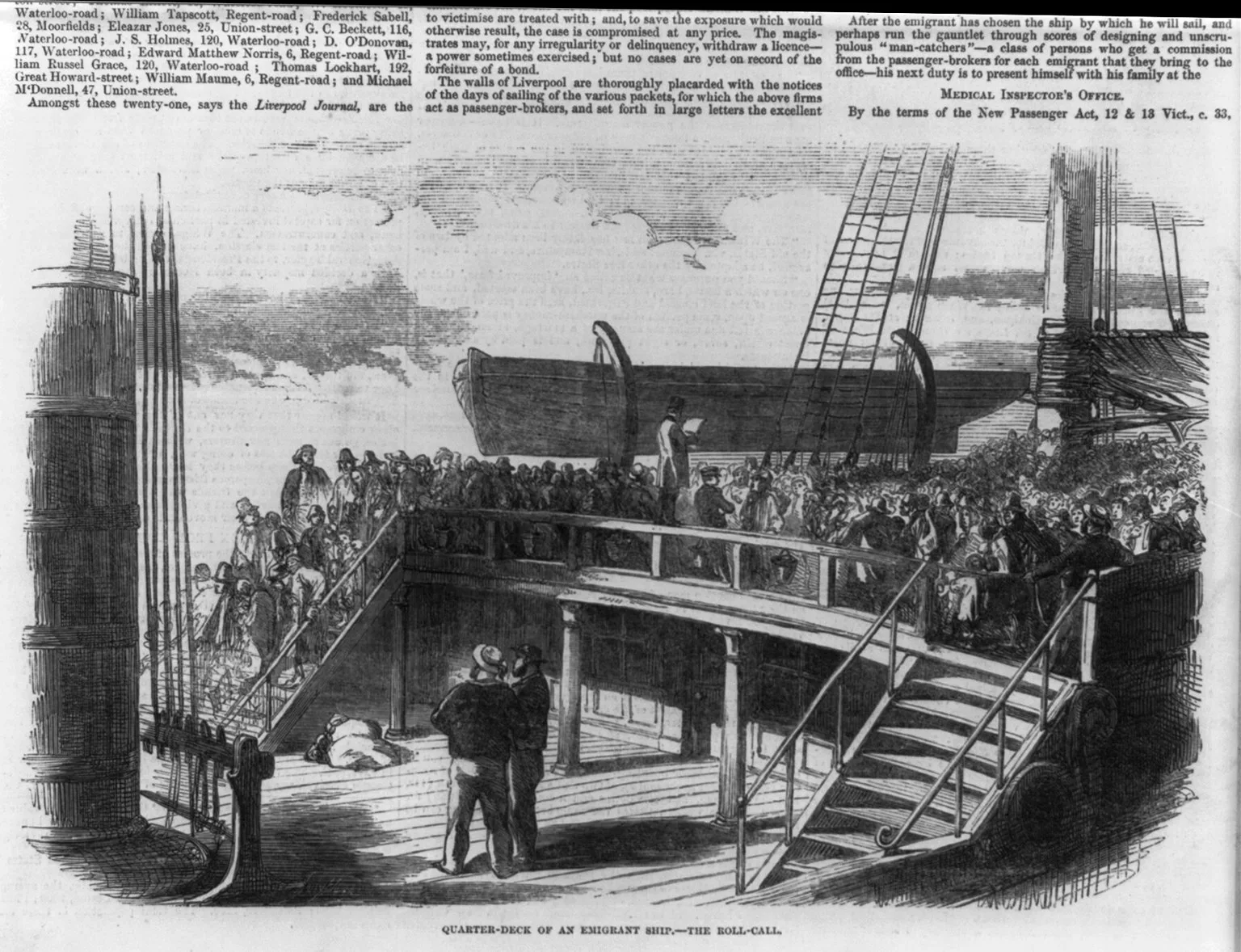
Of the more than 100,000 Irish who sailed to Canada in 1847 alone, an estimated one in five died at sea or shortly after arrival.
No Irish Need Apply
They arrived to hostility, poverty, and discrimination. What they built in response, in the Church, in politics, in the union hall, and on the battlefield, shaped American cities for a century.
In American cities the Famine Irish met open contempt. "No Irish Need Apply" appeared in newspaper job listings and shop windows, especially for domestic and clerical work; the phrase was common enough to inspire a popular 1860s song.
Cartoonists at Harper's Weekly and Puck, including Thomas Nast, drew the Irish with ape-like features, whiskey jugs, and clubs, portraying them as a violent, priest-ridden threat to the Republic. Anti-Catholic violence ran alongside: a Protestant mob had burned an Ursuline convent near Boston in 1834, and the Philadelphia "Bible riots" of 1844 left more than a dozen dead.
In the 1850s the nativist American Party, the "Know-Nothings," turned this feeling into a political force, briefly controlling the Massachusetts legislature and electing governors and dozens of congressmen on a platform of long naturalization waits and keeping Catholics out of office.
Some historians describe the Famine Irish as, for a time, not fully counted as "white" in American racial thinking. The discrimination was real and lasting, but the Irish, unlike Black Americans or Chinese immigrants, faced no laws barring them from citizenship, the vote, or landownership, an advantage they used quickly.
The Catholic Church became the central institution of Irish American life to a degree with few parallels among immigrant groups. Irish priests, and especially Irish nuns, built parishes, parochial schools, hospitals, orphanages, and asylums in every city where the Irish settled.
Catholic numbers exploded, from perhaps 35,000 Catholics in the United States in 1790 to about 3.1 million by 1860, roughly a tenth of the population, and to more than 12 million by 1900, driven overwhelmingly by Irish and German immigration. Catholicism became the largest single denomination in the country.
Facing Protestant-run public schools that used the King James Bible and anti-Catholic textbooks, the American bishops at the Third Plenary Council of Baltimore in 1884 ordered every parish to build a school. The result was the largest private school system in the world and the Baltimore Catechism that taught generations of Catholic children.
The Church also gave the Irish institutional power. Irish-born or Irish-descended clergy dominated the U.S. hierarchy for more than a century, from Archbishop John Hughes of New York, who began St. Patrick's Cathedral, through Cardinals Gibbons and Spellman, making American Catholicism in practice an Irish-led church well into the twentieth century.
The Irish learned fast that in a democracy, numbers were power. Arriving in huge waves just as states dropped property requirements for white male voters, they became the reliable electoral base of urban Democratic machines across the North.
Tammany Hall in New York, founded in 1789 as a patriotic fraternal society, became the vehicle of Irish political power. "Honest John" Kelly took control in the 1870s as its first Irish Catholic boss, and by 1880 Irish Americans effectively ran the organization; Richard Croker and Charles Murphy followed.
The machine ran on exchange. It met ships, helped with naturalization, found newcomers jobs on the docks or in city departments, paid for funerals and coal, and smoothed problems with police and courts; in return it expected the vote. New York elected its first Irish Catholic mayor, William Grace, in 1880, and Boston elected Hugh O'Brien in 1884.
The system was genuinely corrupt, the Tweed Ring looted tens of millions before its 1871 collapse, and machine politics stayed scandal-prone for decades. But it was also collective self-help by people shut out of banks, corporations, and the professions, and it trained the Irish in the organizational politics they carried into the labor movement and the New Deal.
Through the machines, the Irish moved systematically into municipal payrolls, one of the few reliable ladders open to them. A city job meant a steady wage, a pension, and, in uniform, a measure of public authority.
By the late 1880s about three-quarters of New York City's police force and fire department were Irish or of Irish descent, and by 1900 roughly a third of all Irish New Yorkers held a municipal job of some kind. Boston, Chicago, San Francisco, and Philadelphia followed the same pattern.
The link ran deep enough that in some cities an Irish name or brogue was a practical hiring advantage, and families passed police and fire jobs down through generations. Irish Americans also came to dominate the leadership of public-employee and transit unions.
The identification of Irish Americans with law enforcement has long outlived the patronage politics that created it, still visible in institutions like police and fire pipe bands and the uniformed contingents that lead big-city St. Patrick's Day parades.
The Irish were among the chief builders of American organized labor. They dug the canals and laid railroad track in conditions that killed thousands; at Duffy's Cut in Pennsylvania in 1832, 57 Irish laborers died within weeks, some apparently killed amid a cholera panic.
In the anthracite coalfields of Pennsylvania, Irish miners' resistance to brutal conditions was met with the 1876 to 1877 trials of the "Molly Maguires," in which about 20 Irishmen were hanged, largely on evidence from a Pinkerton agent and a railroad-owned private police force.
The Knights of Labor, the first mass American union, was led at its 1880s peak of roughly 700,000 members by Terence Powderly, a machinist born in Pennsylvania to Irish immigrants. Mary Harris "Mother" Jones, born in Cork, became the most famous organizer of the Gilded Age, campaigning for miners and against child labor into her nineties.
Irish Americans went on to lead the building trades, the mine workers, and the transit and teamster unions. Decades of tenant-rights and Land League agitation in Ireland had given them a working vocabulary of rent strikes and mass meetings; the word "boycott" itself comes from an 1880 campaign against a County Mayo land agent, Captain Charles Boycott.
When the Civil War came, Irish Americans served on both sides, but the great majority fought for the Union. At least 144,000 Union soldiers were born in Ireland, and roughly as many again were of Irish descent; Irish immigrants made up about 7.5 percent of the Union Army.
The Irish Brigade, built around New York's 69th Infantry under Thomas Francis Meagher, became the most famous ethnic unit of the war. It was shattered at Antietam and again at Fredericksburg in December 1862, where it charged Marye's Heights and lost more than half its men; by Gettysburg some of its regiments were down to company strength.
Many Irish had enlisted partly out of loyalty to the Union and partly for the bounty and steady pay, and their support cooled sharply after the 1862 Emancipation Proclamation and the 1863 draft, feelings that boiled over in the New York Draft Riots.
Confederate ranks also held Irish soldiers, especially from New Orleans, Charleston, Savannah, and Richmond, where Irish immigrants had settled before the war. Major General Patrick Cleburne, born in County Cork, was among the Confederacy's most respected commanders. Irish battlefield service, North and South, was one of the forces that slowly eroded nativist hostility.
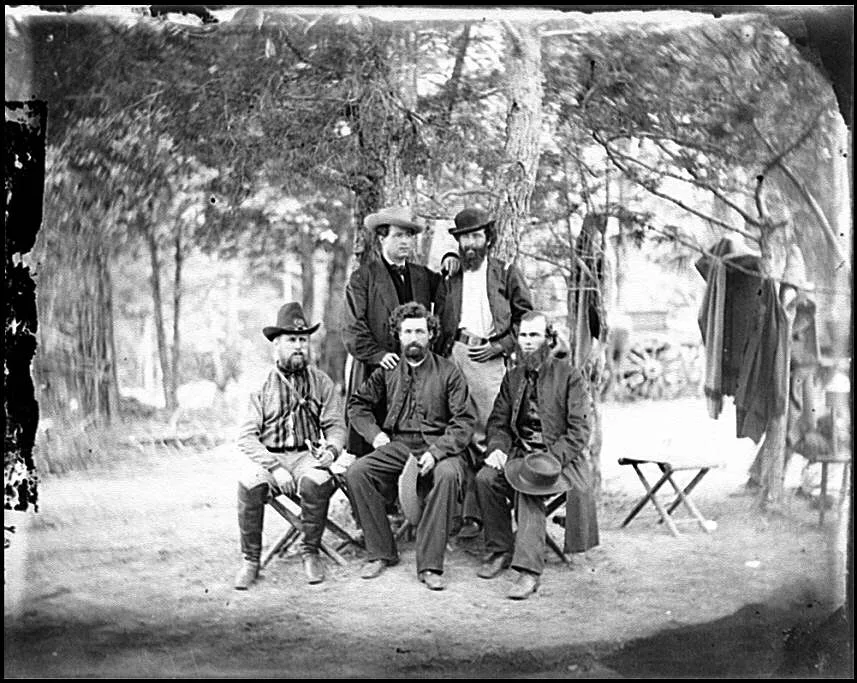
At least 144,000 Union soldiers were born in Ireland. The Irish Brigade suffered some of the heaviest casualties of any unit in the Civil War.
The Know-Nothing Movement
In the early 1850s, the American Party, better known as the Know-Nothings, rose to national prominence on a platform of anti-Catholic and anti-immigrant sentiment directed primarily at the Irish. They won governorships in several states, controlled the Massachusetts legislature, and elected dozens of members of Congress. Their name came from the instruction members received to say they knew nothing about the organization's activities. At their peak, they claimed a million members. Their rapid collapse by the late 1850s, as the slavery crisis overwhelmed all other political questions, did not mean the nativist attitudes they represented had disappeared. Those attitudes would surface again in the 1920s with a new round of immigration restrictions that drastically cut Irish arrivals.
From the Bottom to the Top
Within three generations, the famine Irish went from despised slum-dwellers to the backbone of the American Catholic Church, the Democratic Party, organized labor, and the White House.
The Famine Irish arrived into slums and stayed for a generation or more. New York's Five Points and Boston's North End became bywords for overcrowding, disease, and crime; in 1850s Five Points, tens of thousands lived in cellars and subdivided rooms with no sanitation.
Stability came slowly through several channels at once: municipal and civil-service jobs, union wages, the parish and its schools, and political patronage. Irish home-ownership and small-business rates rose steadily from the 1880s, and the second generation entered teaching, nursing, the clergy, and the skilled trades in large numbers.
After World War II the GI Bill and cheap suburban mortgages moved the third and fourth generations out of the old neighborhoods and into working- and middle-class suburbs. Intermarriage climbed, and by the late twentieth century most Irish Americans married outside the group.
Sociologists often cite Irish assimilation as among the most complete in American history: a people who landed as a despised, racialized underclass became, within roughly three generations, almost indistinguishable within white American Catholic life, their ethnicity now carried mostly through surnames, parades, and family memory.
John F. Kennedy's election as the 35th president in November 1960 marked a symbolic climax of the Irish American story. His great-grandparents had left counties Wexford and Limerick around the time of the Famine; his great-grandfather Patrick Kennedy sailed from New Ross in 1849 and worked as a cooper in East Boston.
Kennedy was the first Catholic elected president and only the second ever nominated by a major party. The first, New York Governor Al Smith, had been crushed in 1928 amid open warnings that a Catholic president would take orders from the Pope, and Ku Klux Klan crosses were burned along his campaign route.
Facing the same charge, Kennedy told a gathering of Protestant ministers in Houston in September 1960 that he believed in an America "where the separation of church and state is absolute," and that he would resign rather than let his church dictate public policy. He won by roughly 112,000 votes out of 68 million cast.
His 1963 visit to Ireland was the first by a sitting U.S. president and drew enormous crowds. Irish America has since produced or claimed many national leaders, including Presidents Reagan, Clinton, both Bushes in part, Obama through a County Offaly ancestor, and Biden, whose maternal line runs to counties Louth and Mayo.
The Irish brought a culture of talk, song, and verbal wit that seeped into American entertainment. Irish performers dominated nineteenth-century minstrelsy and then vaudeville, and George M. Cohan, grandson of Famine immigrants, more or less invented the Broadway musical and wrote "Yankee Doodle Dandy" and "Over There."
In literature, Eugene O'Neill, son of an Irish immigrant actor, won four Pulitzer Prizes and the 1936 Nobel Prize and mined his own family in Long Day's Journey into Night. F. Scott Fitzgerald, raised Irish Catholic in St. Paul, wrote The Great Gatsby; later Irish American voices include Flannery O'Connor, Mary McCarthy, William Kennedy, and Cormac McCarthy.
Irish music, fiddle, pipes, and the ballad tradition, fed American folk, country, and bluegrass through Appalachia, and the step-dancing kept alive in Irish parish halls eventually produced the 1990s global stage phenomenon Riverdance.
St. Patrick's Day, a modest holy day in Ireland, became in America a huge civic festival. New York's parade dates to 1762, before the Revolution, and is now among the largest in the world; Chicago has dyed its river green every March since 1962. The holiday is now marked in dozens of countries, largely on the American model.
Roughly 31 to 33 million Americans report Irish ancestry, about one in ten of the population and the second-largest ancestry group after German Americans in the American Community Survey (third after English and German in the 2020 Census's detailed tables), with several million more identifying separately as "Scotch-Irish."
They are concentrated in the Northeast and industrial Midwest, Massachusetts is the most Irish state by share, but are present in every state, with the largest raw numbers in big states like California, New York, and Pennsylvania.
Irish Americans are today among the most economically and educationally assimilated white ethnic groups, with income and college-completion rates above the national average, a full reversal from the nineteenth century that took about a century to complete.
Their imprint on American public life remains large: heavy representation in the Catholic Church, organized labor, urban politics, law enforcement, the military officer corps, journalism, and entertainment, and a political relationship close enough that members of Congress helped broker the 1998 Good Friday Agreement that ended most of the violence in Northern Ireland.
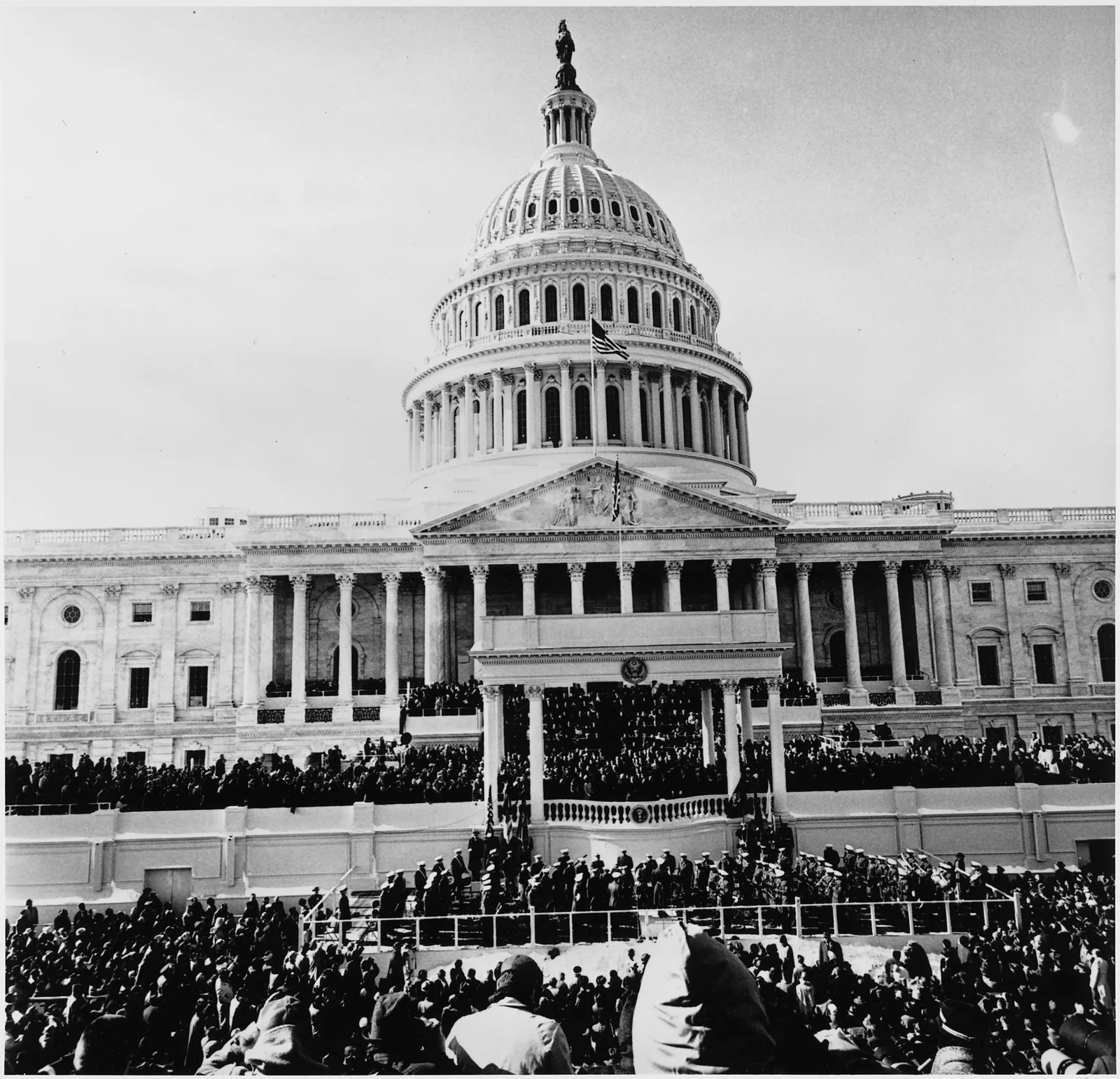
John F. Kennedy's election in 1960 was a milestone for Irish Americans and Catholic Americans alike. His great-grandparents had arrived during the famine.
Notable Irish Americans
John F. Kennedy
35th President of the United States; first Catholic elected to the presidency; great-grandparents arrived during the famine
Mother Jones (Mary Harris Jones)
Labor organizer who fought for miners and against child labor; called the most dangerous woman in America by a U.S. district attorney in West Virginia
Eugene O'Neill
Playwright who won four Pulitzer Prizes and the Nobel Prize in Literature; drew directly on his Irish immigrant family
Andrew Jackson
7th President; son of Scots-Irish immigrants from County Antrim; shaped the populist tradition in American politics
F. Scott Fitzgerald
Novelist and author of The Great Gatsby; born to Irish Catholic parents in Minnesota
Al Smith
Governor of New York and 1928 Democratic presidential nominee; first Catholic to win a major party presidential nomination
Grace Kelly
Hollywood actress who became Princess of Monaco; her father John B. Kelly Sr. won three Olympic gold medals in rowing
Ronald Reagan
40th President; his great-grandfather emigrated from County Tipperary; he visited Ireland and was received with enormous pride
Irish American Presidents
More than twenty U.S. presidents have some Irish ancestry, by the Irish government's count, and at least ten have claimed it publicly. They include:
Sources & Further Reading
- Library of Congress, Irish Catholic Immigration to America
- National Museum of Ireland, Irish Emigration to America
- National Archives, Immigration Records
- Smithsonian, Irish Immigration
- University College Cork, Irish Emigration History
- Britannica, Tammany Hall
Famine death and emigration statistics are drawn from the National Museum of Ireland, University College Cork's emigration research, and the Library of Congress. Civil War service figures are from the National Archives. Population figures are from the Irish Census of 1841 and 1851. Tammany Hall and police/fire department figures are from Britannica and academic sources.