
Two Conditions, Eighteen Words
Eminent domain is the government's power to take private property. The Constitution does not forbid it; it conditions it. The Fifth Amendment requires the taking to be for "public use" and requires "just compensation" in return, and the Fourteenth Amendment is the reason that requirement binds cities and states, not just the federal government. This timeline traces how that framework came together, from 1791 to the present.
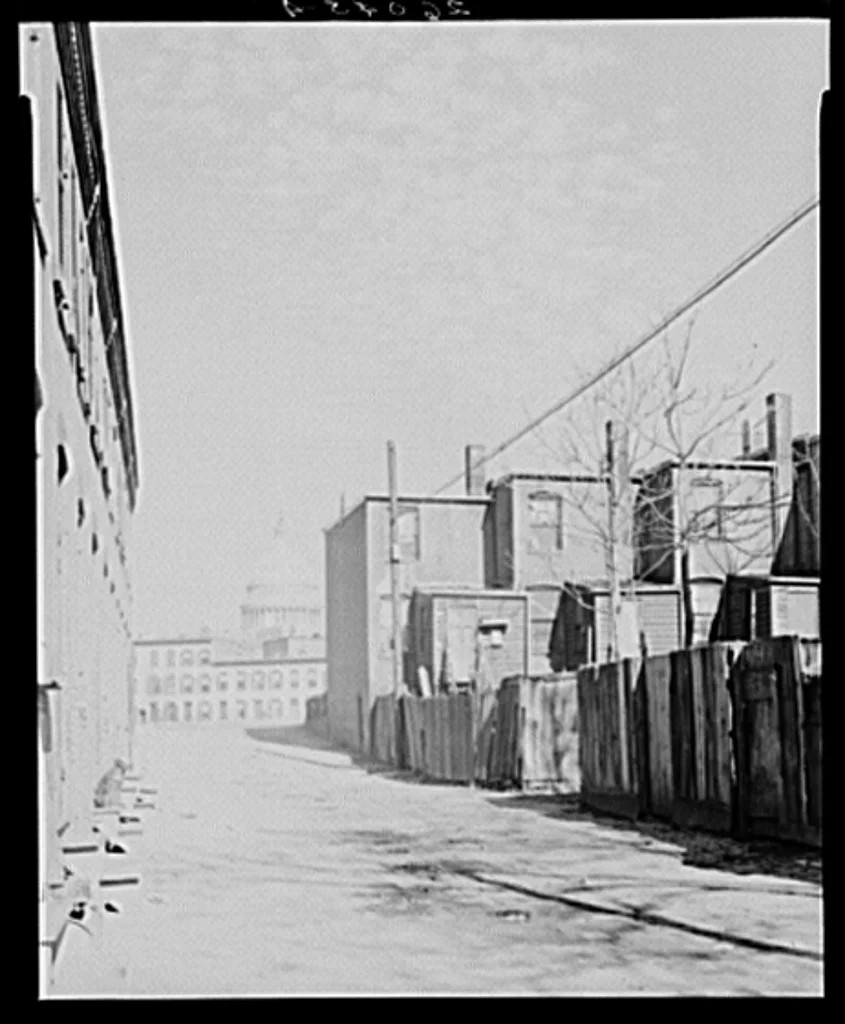
This Southwest Washington, D.C. neighborhood, photographed in 1937, was almost entirely demolished under the redevelopment plan the Supreme Court upheld in Berman v. Parker (1954), covered in the Property Owners Who Lost tab.
Where the Fourth Amendment Fits In
The Fourth Amendment, ratified alongside the Fifth in 1791, protects "the right of the people to be secure in their persons, houses, papers, and effects, against unreasonable searches and seizures." It shares the same underlying constitutional value as the Takings Clause, security in one's property against arbitrary government interference, but it operates through an entirely different legal doctrine, one built around criminal investigations, warrants, and probable cause, not around condemning land for a public project.
The two amendments intersect at one specific, practical point: before formally condemning a property, government appraisers or engineers often need to enter the land to survey it, take soil samples, or assess its condition. Because that entry happens before any condemnation lawsuit has been filed, many states require either the owner's consent or a court order authorizing entry, echoing the Fourth Amendment's own consent-or-warrant framework even though the entry itself is usually governed by a state's own condemnation statute rather than the Fourth Amendment directly.
It is worth distinguishing eminent domain clearly from civil asset forfeiture, a separate and more controversial government power that lets law enforcement seize cash, vehicles, or other property suspected of being connected to a crime, sometimes without ever charging the owner. Forfeiture raises its own serious Fourth and Eighth Amendment concerns, but it is a different constitutional doctrine from eminent domain: forfeiture claims the property was itself connected to wrongdoing, while eminent domain compensates an owner precisely because their property was not accused of anything at all.
Sources & Further Reading
- U.S. Constitution, Bill of Rights Transcript (National Archives)
- Kelo v. City of New London, Oyez Case Summary
- Berman v. Parker, Oyez Case Summary
- Hawaii Housing Authority v. Midkiff, Oyez Case Summary
- Chicago, Burlington & Quincy Railroad Co. v. City of Chicago (Cornell LII)
- County of Wayne v. Hathcock, Justia
- Institute for Justice, Private Property Rights
- Institute for Justice, 50-State Report on Eminent Domain Reform
- Cornell Law School Legal Information Institute, Eminent Domain
- Uniform Relocation Assistance Act, 49 CFR Part 24 (eCFR)
- Federal Energy Regulatory Commission, Natural Gas Pipeline Certificates
- Federal Highway Administration, Highway History
- Library of Congress, Southwest Washington Urban Renewal Area (HABS)
- Library of Congress, Farm Security Administration/Office of War Information Collection
- Congressional Research Service, Reports on Congress.gov
Photo credits
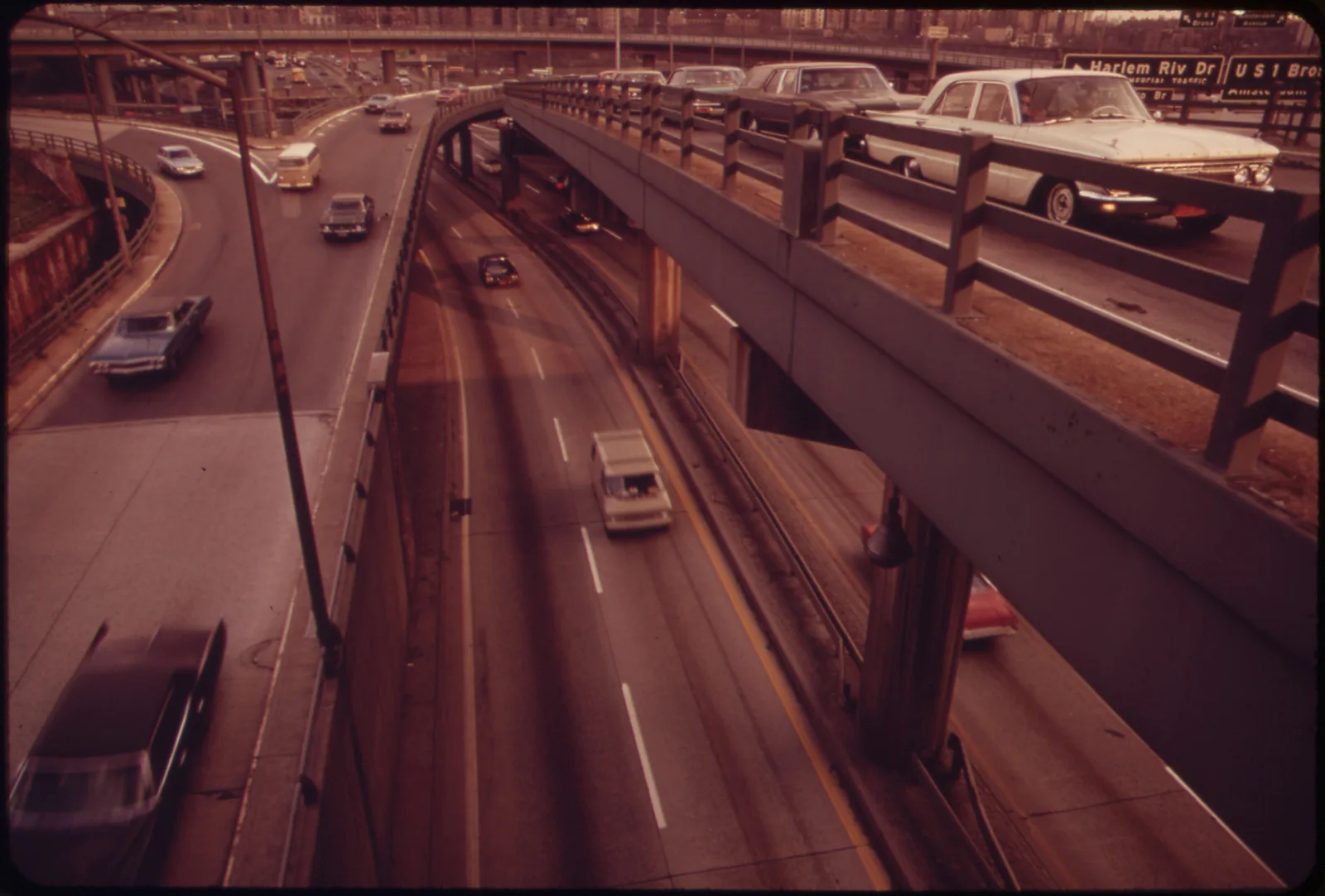
- Hero: "Cross Bronx Expressway," Dan McCoy, U.S. Environmental Protection Agency DOCUMERICA program, April 1973 (public domain, National Archives).
- Alley dwellings, Southwest Washington, D.C., Arthur Rothstein, Farm Security Administration, November 1937 (public domain, Library of Congress).
- Interstate highway urban displacement photograph, reused from this site's Interstate Highway System history page.
Case facts and holdings on this page are drawn from the Supreme Court's own published opinions and Oyez case summaries, state supreme court opinions available through Justia and Cornell Law School's Legal Information Institute, the Institute for Justice's litigation archive and state-by-state eminent domain reform tracking, U.S. Department of Transportation and Federal Highway Administration historical data on interstate construction displacement, and contemporaneous and retrospective news coverage of individual cases and the New York City public grocery store proposal. Figures describing the New York City grocery store pilot are drawn from the proposal's published policy materials and widely reported coverage at the time of writing and may be updated as the program is implemented.