
The Largest Forced Migration in History
Before the chains there were nations. This is the story of how millions of Africans were torn from thriving societies and carried across the Atlantic, and of the resilience they carried with them.
The story of Black America does not begin in chains. It begins in the varied societies of West and Central Africa, home to the great western Sudanese empires of Ghana, Mali, and Songhai and to coastal and forest kingdoms such as Benin, Kongo, Dahomey, and Asante.
These were states with organized government, standing armies, courts, taxation, and long-distance commerce. Mali's fourteenth-century ruler Mansa Musa was likely the wealthiest person of his era, and Timbuktu's Sankore scholars and private libraries held tens of thousands of manuscripts on law, astronomy, and medicine.
Craft and technology were advanced. West African smiths had worked iron for more than two thousand years, and the weavers, goldworkers, and bronze casters of Benin produced work that later astonished European visitors.
Forms of servitude existed in parts of Africa before the Atlantic trade, but they were generally different in kind, often closer to captivity or bond service that did not automatically pass to a person's children. The people carried across the Atlantic were farmers, blacksmiths, midwives, herders, soldiers, scholars, and royalty, each one a person with a name, a lineage, and a homeland.
From the sixteenth century, European powers, led first by Portugal and later by Britain and joined by Spain, France, and the Netherlands, carried out the largest forced oceanic migration in history. The SlaveVoyages database records about 12.5 million Africans put aboard slave ships between 1526 and 1867, of whom about 10.7 million survived to land.
Captives were taken in wars and raids in the interior, marched to the coast, held in fortified trading posts such as Elmina and Bunce Island, and sold to ship captains in exchange for firearms, textiles, iron bars, rum, and cowrie shells.
The trade formed one leg of a triangular Atlantic system: manufactured goods to Africa, captive people to the Americas, and plantation crops back to Europe. It built fortunes in Liverpool, Bristol, Nantes, and Newport, Rhode Island, and helped finance early industrialization.
Only a small share of captives were carried to what is now the United States. About 46 percent went to Brazil and roughly 40 percent to the Caribbean sugar colonies; mainland North America received under 4 percent of the total.
The ocean crossing, known as the Middle Passage, took roughly six to eight weeks. Captives were chained below decks in holds sometimes less than five feet high, packed so tightly they could barely move, and brought up only briefly to be fed and forced to move for exercise.
Dysentery, smallpox, measles, dehydration, and suffocation were constant, and the dead were thrown overboard. Across the whole trade roughly 1.8 million people died at sea, about one in seven of those who embarked, with higher losses on longer voyages and in the earlier centuries.
Africans resisted throughout. Ships' logs record hunger strikes, attempts to leap overboard, and armed revolts; historians have documented more than 400 shipboard insurrections, a few of them successful.
The most infamous atrocity was the 1781 Zong massacre, in which the crew of a British ship threw about 132 living captives into the sea to file an insurance claim. The resulting court case became a rallying point for British abolitionists. The Passage was a horror, but it did not erase the humanity of those who endured it.
Of the roughly 10.7 million Africans who survived the Atlantic, only about 389,000 were carried directly to mainland British North America, fewer than one in twenty; many others arrived indirectly by way of the Caribbean.
The first documented Africans in England's mainland colonies landed at Point Comfort, Virginia, in August 1619, some "20 and odd" people taken from a Portuguese ship. Africans had already lived in Spanish St. Augustine, Florida, since its founding in 1565.
Status hardened over the seventeenth century. A 1662 Virginia law made a child's condition follow the mother's, a 1667 law declared that baptism did not bring freedom, and by the early 1700s a full slave code defined enslaved people, and their descendants, as property for life.
Because North American slavery grew mostly by births rather than continued imports, its enslaved population became, unusually, self-reproducing. Distinct regional communities formed: rice-growing Gullah society on the Carolina and Georgia coast, tobacco society in the Chesapeake, and French-influenced Creole society in Louisiana.
Under American law the enslaved were property, bought, sold, mortgaged, gambled away, and passed down by will. They had no legal right to marry, to keep their own children, to testify against a white person, or, across most of the South after 1830, to learn to read.
Enslaved labor built the plantation economy: tobacco and wheat in the Upper South, rice and indigo in the Lowcountry, sugar in Louisiana, and, after Eli Whitney's 1793 cotton gin made short-staple cotton profitable, cotton across the Deep South. By 1860 cotton made up roughly 60 percent of U.S. exports.
Banning legal imports in 1808 did not shrink slavery. The enslaved population grew from about 700,000 in 1790 to about 4 million in 1860, almost entirely by birth, while a domestic slave trade forcibly moved roughly one million people from the Upper South to the cotton frontier, breaking an estimated one in three enslaved marriages in the exporting states.
By 1860 the market value of those 4 million people, about 3.5 billion dollars, exceeded the combined value of all the nation's railroads and factories. Within this system, enslaved people still built families, faith, and community.
Enslaved people resisted daily, through slowed work, feigned illness, broken tools, and flight. Tens of thousands escaped north or to Canada, Mexico, or Spanish Florida over the antebellum decades, many aided by the loose network called the Underground Railroad.
Open revolt was rarer but real: Gabriel's planned rising near Richmond in 1800, the German Coast uprising in Louisiana in 1811, the largest in U.S. history, Denmark Vesey's alleged Charleston plot in 1822, and Nat Turner's 1831 rebellion in Virginia, which killed about 60 white people and brought roughly 200 Black deaths in reprisal and harsh new laws across the South.
Culture itself was resistance. Enslaved communities preserved African-rooted foodways, music, folktales, and burial customs, blended Christianity with older beliefs, and married and worshiped in defiance of law.
Free and formerly enslaved Black Americans built the movement against slavery. Frederick Douglass, Harriet Tubman, who returned to the South roughly a dozen times to lead others out, Sojourner Truth, David Walker, and Harriet Jacobs put the case for abolition before the nation in their own words.

The Middle Passage carried captive Africans across the Atlantic in conditions that killed roughly 1.8 million people.
The Long Road to Freedom
Freedom was not granted as a gift. It was won, by the enslaved themselves, by abolitionists, on the battlefield, and finally in the Constitution.
William Lloyd Garrison launched the antislavery newspaper The Liberator, and a growing movement of abolitionists, many of them free or formerly enslaved Black Americans, pressed the nation's conscience. Frederick Douglass, who escaped slavery in 1838, became its most powerful orator and writer.
Garrison's paper never reached more than a few thousand subscribers, but its influence far exceeded its circulation. In 1854, Garrison publicly burned a copy of the Constitution, calling it 'a covenant with death' for its protections of slavery.
Abolition was never a single movement. Garrison's wing rejected politics and the Constitution itself; others built the Liberty Party in 1840 and then the antislavery Free Soil and Republican parties. Free Black communities in the North had organized first, holding national conventions from 1830 and founding the first Black-owned newspaper, Freedom's Journal, in 1827.
Formerly enslaved authors gave the movement its sharpest weapon. Douglass's 1845 Narrative sold roughly 30,000 copies in five years, Harriet Jacobs's 1861 Incidents in the Life of a Slave Girl exposed the sexual exploitation of enslaved women, and Harriet Beecher Stowe's 1852 Uncle Tom's Cabin, built from abolitionist accounts, sold 300,000 U.S. copies in its first year.
In one of the most notorious decisions in its history, the Supreme Court ruled that people of African descent could not be citizens of the United States and had no rights the courts were bound to respect. The decision inflamed the conflict over slavery and pushed the nation toward war.
Chief Justice Roger Taney's 7-2 opinion went further than the citizenship question, also declaring the Missouri Compromise of 1820 unconstitutional and holding that Congress had no power to ban slavery in the territories. Dred Scott and his family were freed by a private owner later that same year, though the ruling itself stood until overturned by the Fourteenth Amendment.
Scott, enslaved in Missouri, had sued for freedom because his enslaver took him for years into Illinois, a free state, and into federal territory north of the Missouri Compromise line. The case moved through the courts for eleven years before reaching the Supreme Court.
The decision backfired on its supporters. By striking down any federal limit on slavery in the territories, it energized the new Republican Party, and Abraham Lincoln built much of his 1858 Senate campaign and 1860 presidential run on opposing it.
The dispute over slavery's future erupted into civil war. Over its course, enslaved people fled to Union lines by the thousands, and roughly 200,000 Black men served the Union as soldiers and sailors in the United States Colored Troops, fighting for their own freedom.
The war began with the Confederate bombardment of Fort Sumter, South Carolina, on April 12, 1861. The Bureau of Colored Troops, established in May 1863, organized roughly 175 regiments, and sixteen Black soldiers, and about 25 Black soldiers and sailors in all, earned the Medal of Honor for their service in the war.
At first the Union refused Black enlistment, but escaping people forced the issue: General Benjamin Butler in 1861 declared them "contraband of war" and would not return them, and Congress followed with Confiscation Acts in 1861 and 1862 freeing slaves used by the Confederate military.
Once enlistment opened, Black troops received unequal pay until 1864 and risked enslavement or execution if captured; Confederate forces massacred surrendering Black soldiers at Fort Pillow, Tennessee, in April 1864. The 54th Massachusetts Infantry's assault on Battery Wagner in July 1863 became the war's most famous display of Black valor.
On January 1, 1863, President Abraham Lincoln's Emancipation Proclamation declared enslaved people in the rebelling Confederate states to be free. It did not end slavery everywhere at once, but it transformed the war into a struggle for freedom and opened the way for Black men to enlist in the Union army.
Because it rested on Lincoln's war powers as commander-in-chief, the Proclamation applied only to Confederate territory still in rebellion and left slavery untouched in the Union-loyal border states of Maryland, Kentucky, Missouri, and Delaware. Full, nationwide abolition would require the Thirteenth Amendment two years later.
Lincoln had issued a preliminary proclamation on September 22, 1862, five days after the Battle of Antietam gave him a Union victory to announce it from, warning that slaves in states still in rebellion on January 1 would be "then, thenceforward, and forever free."
The Proclamation also reshaped diplomacy, making it far harder for Britain or France, which had already abolished slavery, to aid the Confederacy. As Union armies advanced, enslaved people left plantations in growing numbers, a movement W. E. B. Du Bois later called a "general strike."
On June 19, 1865, Union troops reached Galveston, Texas, and enslaved people there finally learned they were free, the origin of the Juneteenth holiday. That December, the Thirteenth Amendment was ratified, abolishing slavery throughout the United States. Congress also created the Freedmen's Bureau to aid the millions newly freed.
Union General Gordon Granger delivered the news in Galveston through General Order No. 3, more than two years after the Emancipation Proclamation had technically taken effect. Juneteenth became a federal holiday in 2021, the first new one established since 1983.
The Thirteenth Amendment passed the House on January 31, 1865, after failing once, and was ratified on December 6, 1865. It banned slavery and involuntary servitude "except as a punishment for crime," a clause soon exploited through convict leasing and the Black Codes.
The Freedmen's Bureau distributed food, ran hospitals, negotiated labor contracts, legalized marriages, and founded schools; within five years it had helped establish or support thousands of schools and several future HBCUs before Congress let it lapse in 1872.
The Fourteenth Amendment granted citizenship to all persons born in the United States and guaranteed equal protection of the laws, overturning Dred Scott and laying the constitutional foundation for civil rights for generations to come.
Ratification of the Fourteenth Amendment was made a condition for former Confederate states to regain congressional representation under the Reconstruction Acts of 1867. Its citizenship clause directly reversed the Dred Scott ruling by declaring that all persons born or naturalized in the United States are citizens.
Section 1 also created the Due Process and Equal Protection Clauses that would later underpin school desegregation, voting-rights enforcement, and much of modern civil liberties law. Section 2 threatened to reduce the House representation of states that denied men the vote, though it was never enforced.
The promise went largely unmet for generations. In the Slaughter-House Cases (1873) and the Civil Rights Cases (1883) the Supreme Court read the amendment narrowly, and Plessy v. Ferguson (1896) permitted "separate but equal." Only after Brown v. Board of Education (1954) did it begin to do the work its authors intended.
The Fifteenth Amendment barred the denial of the vote on the basis of race, color, or previous condition of servitude. For a brief period, Black men across the South registered, voted, and ran for office in large numbers.
Within little more than a decade of ratification, Southern states began adopting poll taxes, literacy tests, and grandfather clauses designed to circumvent the amendment, effectively disenfranchising most Black voters by the 1890s. Full federal enforcement did not arrive until the Voting Rights Act of 1965, nearly a century later.
The reversal was stark. By 1870 Black men were voting across the South and about 2,000 held office during Reconstruction, but after federal troops withdrew in 1877, violence and fraud, then formal legal devices, drove them from the rolls. Mississippi's 1890 constitution was the model.
The amendment left openings its drafters underestimated: it barred denial "on account of race" but not by poll tax, literacy or "understanding" test, or the all-white primary, which courts upheld or tolerated for decades. After the Voting Rights Act of 1965, Black registration in the Deep South roughly doubled within two years.
A People Builds Itself
With freedom came the work of building: families reunited, churches and colleges founded, towns and businesses raised. It was met with fierce backlash, and endured.
During Reconstruction, from 1865 to 1877, Black Americans entered public life as full citizens for the first time. Between 1865 and 1880 the southern states elected at least 2,000 Black men to office, from justice of the peace up to the United States Senate.
Two Black senators, Hiram Revels and Blanche K. Bruce, both of Mississippi, and about sixteen Black members of the House served in this period. South Carolina's legislature had a Black majority in its lower house, and Black officials served as lieutenant governors, secretaries of state, and superintendents of education.
Black delegates helped write new state constitutions that, for the first time in the South, created tax-funded public school systems, abolished property requirements for voting and officeholding, and reformed debt and property law in ways that helped poor white southerners as well.
It was a brief experiment. The Ku Klux Klan and allied groups waged a campaign of assassination and terror; the Colfax massacre of 1873 killed roughly 150 Black men in Louisiana; and the disputed 1876 election produced the Compromise of 1877, under which the last federal troops left the South and "Redeemer" governments took power.
The independent Black church became the organizational heart of Black America. The African Methodist Episcopal Church, founded by Richard Allen in Philadelphia after he and others walked out of a segregated white congregation, was organized as a full denomination in 1816; the AME Zion Church and Black Baptist conventions followed.
Under slavery, Black worship was often secret, an "invisible church" meeting in woods and cabins, because white authorities feared it, particularly after Nat Turner, a preacher, led his 1831 revolt.
After emancipation, Black churches multiplied quickly. The National Baptist Convention, formed in 1895, became the largest Black organization in the country. Churches doubled as schools, banks, insurance pools, employment agencies, and political meeting halls.
In the twentieth century the Black church supplied the civil rights movement its leaders, its networks, its buildings, and its mass-meeting culture; the Southern Christian Leadership Conference, founded in 1957, was in effect a coalition of Black ministers.
Freedom released a hunger for schooling. Formerly enslaved people of every age pursued literacy with extraordinary determination, often paying for their own teachers; Black literacy rose from perhaps 10 percent in 1860, when teaching it was illegal in much of the South, to about 55 percent by 1900.
Historically Black Colleges and Universities anchored the effort. A few predated the war, Cheyney (1837), Lincoln University in Pennsylvania (1854), and Wilberforce (1856), and dozens were founded after it with help from the Freedmen's Bureau and missionary societies, among them Howard, Fisk, Morehouse, Spelman, Hampton, and Tuskegee, which Booker T. Washington built from 1881.
The second Morrill Act of 1890 required states with segregated systems to fund Black land-grant colleges, creating public HBCUs such as those now known as Florida A&M, North Carolina A&T, and Alcorn State.
Though chronically underfunded, the roughly 100 HBCUs have produced an outsized share of Black professionals, historically most of the nation's Black doctors, lawyers, judges, and teachers, and graduates including Thurgood Marshall, Martin Luther King Jr., and Vice President Kamala Harris.
Freedpeople founded dozens of self-governing all-Black towns as havens from white violence and control, among them Nicodemus, Kansas (1877), Mound Bayou, Mississippi (1887), and Boley and Langston, Oklahoma; more than 50 such towns were established in Oklahoma alone.
Black business districts grew inside segregated cities. Durham, North Carolina, built a "Black Wall Street" around North Carolina Mutual Life, then the largest Black-owned business in America, and Tulsa's Greenwood district had its own banks, hotels, theaters, newspapers, and professionals.
Greenwood was destroyed on May 31 and June 1, 1921, when a white mob, some of them deputized and armed by city officials, burned about 35 blocks, killed an estimated 100 to 300 people, and left roughly 10,000 homeless. No one was ever convicted, and insurance claims were denied.
Black Americans also built national institutions: mutual-aid and fraternal orders, Black-owned banks, and insurance companies. Madam C. J. Walker, born to formerly enslaved parents, built a hair-care company and became one of the first self-made female millionaires in the country.
The gains of Reconstruction were dismantled after federal troops withdrew from the South in 1877. "Redeemer" state governments passed Black Codes and vagrancy laws, and the convict-lease system rented mostly Black prisoners to mines, railroads, and farms in conditions so lethal that annual death rates in some states approached one in four.
Segregation was written into law across public life and upheld by the Supreme Court's 1896 decision in Plessy v. Ferguson under the doctrine of "separate but equal," which in practice meant separate and unequal, especially in schools.
Disfranchisement came by constitutional convention and statute, poll taxes, literacy and "understanding" tests, and white primaries, cutting Black registration in Louisiana from about 130,000 in 1896 to about 1,300 by 1904.
Racial terror enforced the order: an estimated 4,400 documented lynchings of Black Americans between 1877 and 1950, and white mob attacks that destroyed Black communities from Wilmington, North Carolina, in 1898 to Rosewood, Florida, in 1923. Black Americans organized in response, founding the NAACP in 1909 and the National Urban League in 1910.
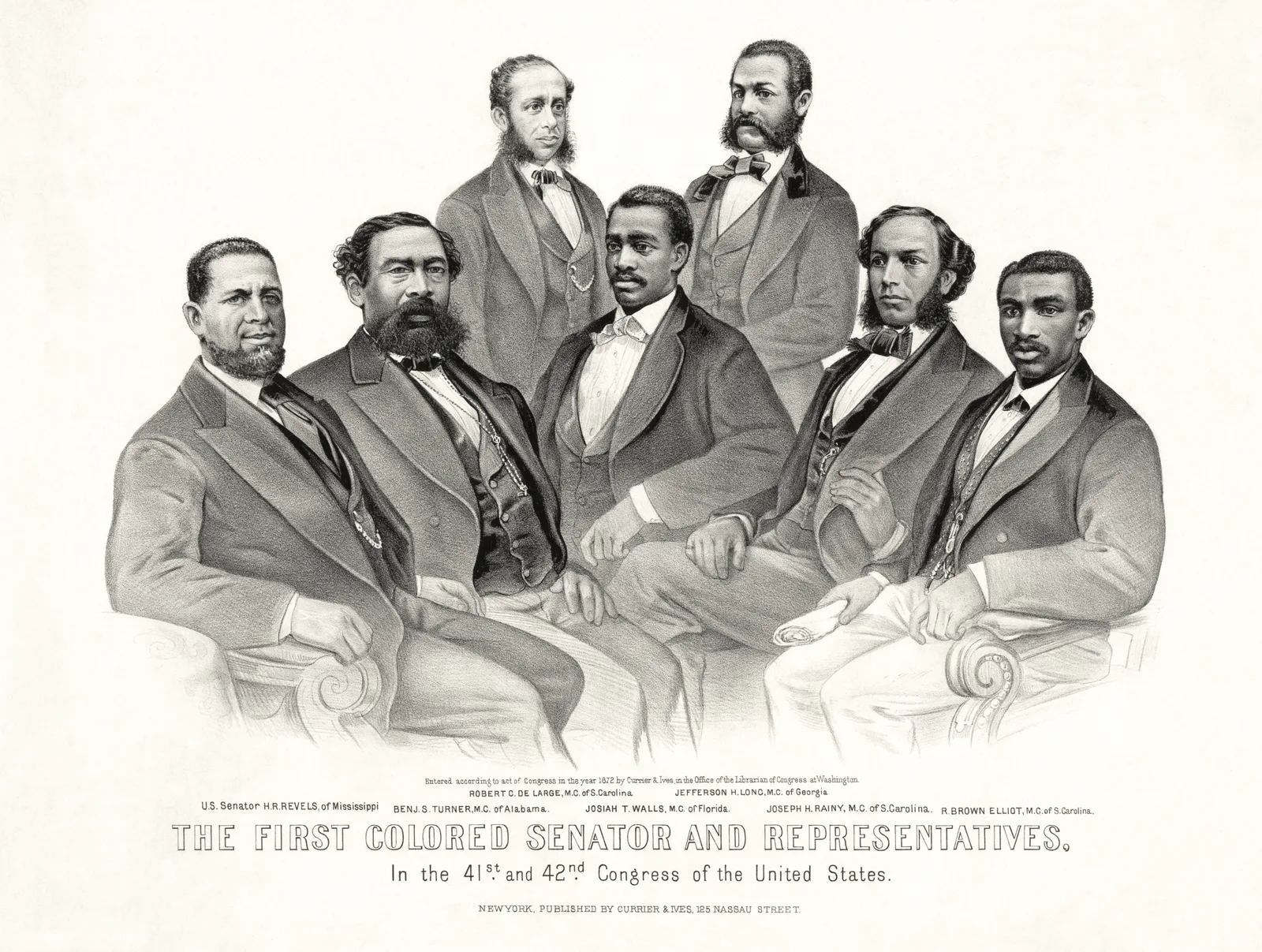
During Reconstruction, southern states elected at least 2,000 Black officeholders, including two U.S. senators.
Migration, Movement, and the Modern Era
In the twentieth century, millions moved north and west in search of freedom and work, reshaping the nation's cities and, through the civil rights movement, its laws.
Between about 1916 and 1970, roughly 6 million Black Americans left the rural South for cities in the North, Midwest, and West, one of the largest internal migrations in the nation's history.
They were pushed by Jim Crow, disfranchisement, lynching, the collapse of cotton tenancy, and the boll weevil, and pulled by wartime industrial jobs. The Chicago Defender, carried south by Pullman porters, urged readers to come north and printed train schedules and job listings.
In 1900 about nine in ten Black Americans lived in the South and most in the countryside; by 1970 only about half lived in the South, and the Black population had become more urban than the country as a whole. Detroit's Black population grew more than twentyfold between 1910 and 1930.
Migrants met new barriers, restrictive covenants, redlining, job ceilings, and violence, and the "Red Summer" of 1919 saw white mobs attack Black neighborhoods in more than two dozen cities. The migration also built the political base for the civil rights era and produced the Harlem Renaissance and the Chicago Black Renaissance in literature, art, and music.
The segregated urban neighborhoods often called ghettos were built by law and policy, not chosen by the people who lived in them. Thousands of subdivisions were sold with racial covenants barring resale to Black buyers, and the Supreme Court upheld their legality in Corrigan v. Buckley in 1926.
From 1933 the federal Home Owners' Loan Corporation graded neighborhoods for lending risk and colored Black and mixed areas red as "hazardous." The Federal Housing Administration and Veterans Administration then declined to insure mortgages there, and into the 1950s the FHA's own manual recommended covenants.
Because the postwar boom in home equity ran on FHA and VA loans, Black families were largely shut out of the biggest engine of middle-class wealth. Blockbusting agents exploited the divide, and urban-renewal clearance and interstate highways were routed through Black districts, displacing hundreds of thousands.
The Supreme Court made covenants unenforceable in Shelley v. Kraemer (1948), and the Fair Housing Act of 1968 outlawed housing discrimination, but the pattern was set. Researchers attribute a large part of the white-Black gap in median household wealth, about six to one in the Federal Reserve's 2022 survey (eight to one in 2019), to twentieth-century housing policy.
A mass movement dismantled legal segregation within a generation. The NAACP Legal Defense Fund, led by Thurgood Marshall, won a chain of cases ending in Brown v. Board of Education (1954), in which a unanimous Court held that segregated public schools were "inherently unequal."
Direct action made the rulings real: the Montgomery bus boycott of 1955 to 1956 after Rosa Parks's arrest, which lasted 381 days and launched Martin Luther King Jr.; the 1960 Greensboro sit-ins; the 1961 Freedom Rides; the 1963 Birmingham campaign; and the March on Washington, where King delivered "I Have a Dream" to about 250,000 people.
Violence against nonviolent protesters, the Birmingham church bombing that killed four girls in 1963, the murders of three organizers in Mississippi in 1964, and the beating of marchers at Selma in 1965, moved public opinion and Congress.
The Civil Rights Act of 1964 banned discrimination in employment and public accommodations; the Voting Rights Act of 1965 suspended literacy tests and sent federal examiners into the South, and Black registration there rose sharply within two years; the Fair Housing Act followed in 1968, days after King's assassination.
Since 1965 Black Americans have risen to the highest levels of national life. Thurgood Marshall became the first Black Supreme Court justice in 1967, Colin Powell chaired the Joint Chiefs and then served as Secretary of State, Barack Obama was elected president in 2008, Kamala Harris became vice president in 2021, and Ketanji Brown Jackson joined the Supreme Court in 2022.
The Black middle class expanded substantially. The share of Black adults holding a bachelor's degree roughly tripled after the 1960s, and Black political power took hold in many cities and in the Congressional Black Caucus.
Deep gaps persist. Black median household wealth remains about one-sixth of white household wealth (2022 Survey of Consumer Finances, up from about one-eighth in 2019), Black Americans are incarcerated at roughly five times the white rate, and disparities in maternal mortality, homeownership, and life expectancy remain wide.
The response to the 2014 Ferguson protests and the 2020 protests after George Floyd's murder, among the largest in U.S. history, kept these questions at the center of national debate. Meanwhile Black American music, language, sport, literature, and style remain central to American culture and among its largest exports to the world.
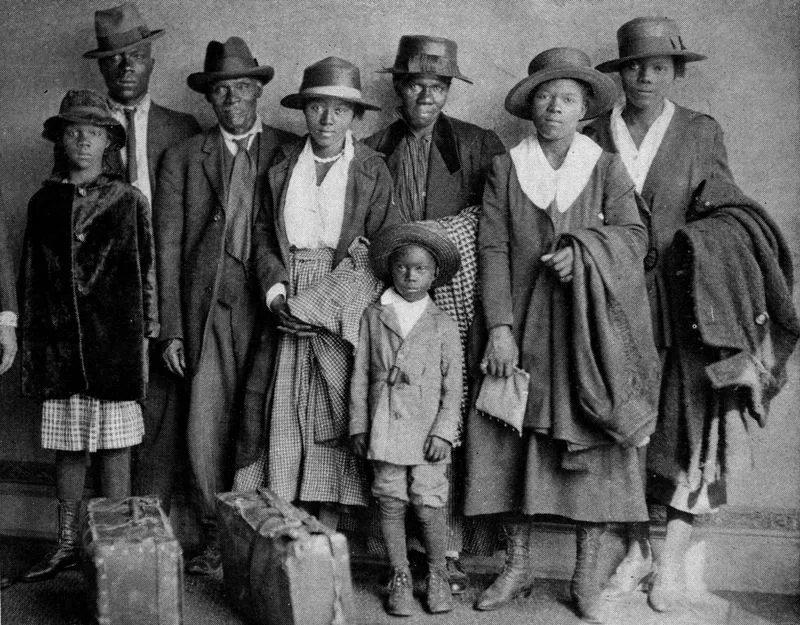
Roughly 6 million Black Americans left the South between 1916 and 1970 in the Great Migration.
A Language and a Sound That Changed the World
From bondage forward, Black Americans forged a dialect of their own and a body of music that became the heartbeat of American culture and a gift to the world.
African American Vernacular English, also called African American English or Black English, is not broken or careless speech. Linguists describe it as a systematic, rule-governed variety with its own consistent grammar and pronunciation, most likely formed from a blend of southern English varieties and West African language patterns.
It expresses distinctions standard English conveys only awkwardly. The "habitual be" in "he be working" marks an ongoing or recurring state, distinct from "he working" right now; other features include the completive "done," negative concord, and regular consonant-cluster reduction.
In 1996 the Oakland, California, school board's "Ebonics" resolution, which proposed recognizing the dialect to help teach standard English, set off a national controversy. The Linguistic Society of America responded that the variety is "systematic and rule-governed like all natural speech varieties."
Carried north in the Great Migration and amplified through blues, jazz, and hip-hop, it has shaped mainstream American English and global youth slang, from "cool" and "hip" to "bad" meaning good, even as its speakers still meet bias in classrooms, courtrooms, and hiring.
Enslaved African Americans created the spiritual, sacred songs that fused West and Central African musical practice, call-and-response, layered rhythm, improvisation, bent "blue" notes, and the ring shout, with the stories and language of the Bible.
Their texts often carried double meanings. Songs about crossing the Jordan or following the "drinking gourd," the Big Dipper pointing north, could express religious hope and, at times, practical encouragement toward escape.
Spirituals reached the concert hall when the Fisk Jubilee Singers toured from 1871 to raise money for Fisk University, introducing audiences across the North and Europe to the music and helping keep the school from closing.
The spiritual is the taproot of nearly all later American popular music: gospel grew directly from it, and its harmonies and phrasing run through blues, jazz, R&B, and rock. It also became the musical language of the civil rights movement, where "We Shall Overcome" was adapted from an older gospel hymn.
The blues took shape in the Mississippi Delta and the wider Deep South in the decades around 1900, growing out of field hollers, work songs, spirituals, and ballads sung by Black laborers and sharecroppers.
W. C. Handy, a bandleader who published "Memphis Blues" in 1912 and "St. Louis Blues" in 1914, earned the title "Father of the Blues" for putting the form into print. "Ma" Rainey and Bessie Smith, "the Empress of the Blues," turned it into a national recording success in the 1920s.
It gave American music a durable architecture: the twelve-bar chord pattern, the AAB lyric stanza, and the flatted "blue" notes that give the music its ache. Delta artists such as Charley Patton, Son House, and Robert Johnson, and later Chicago electric players like Muddy Waters and Howlin' Wolf, carried it north.
The blues is the direct parent of rhythm and blues, rock and roll, and much of country music. Its influence on British bands in the 1960s, the Rolling Stones took their name from a Muddy Waters song, sent it back around the world.
Jazz emerged in New Orleans around 1900 from blues, ragtime, brass-band music, church music, and the Afro-Caribbean rhythms heard in the city's Congo Square. Its hallmark was improvisation over a swinging rhythmic feel.
It spread up the Mississippi and by recording. Louis Armstrong's Hot Five and Hot Seven sessions in the 1920s established the improvising soloist, and the big bands of Duke Ellington and Count Basie made jazz the popular dance music of the Swing Era in the 1930s and 1940s.
After 1945 the music turned virtuosic and inward with the bebop of Charlie Parker and Dizzy Gillespie, then the cool, modal, and free jazz of Miles Davis, John Coltrane, and Ornette Coleman. Davis's 1959 album Kind of Blue is the best-selling jazz record ever made.
In 1987 Congress designated jazz "a rare and valuable national American treasure." It has shaped concert music, film scoring, and popular music worldwide, and it sent Black American artists abroad as unofficial cultural ambassadors during the Cold War.
Gospel music took its modern form in the 1930s when Thomas A. Dorsey, a former blues pianist, set sacred lyrics to blues and jazz harmony; Mahalia Jackson became its defining voice, and the Black church choir became a national institution.
Out of gospel and jump blues came rhythm and blues in the late 1940s, and then soul, gospel fervor with secular themes, in Ray Charles, Sam Cooke, James Brown, and Aretha Franklin. The hit factories of Motown in Detroit and Stax in Memphis defined the 1960s sound.
Black musicians also created rock and roll. Sister Rosetta Tharpe's electric guitar in the 1940s, Chuck Berry's songwriting and showmanship, Little Richard's shouting energy, and Fats Domino's New Orleans piano were the template that Elvis Presley and later white artists built on.
Soul carried political weight, Cooke's "A Change Is Gonna Come" (1964), Brown's "Say It Loud, I'm Black and I'm Proud" (1968), Franklin's "Respect", and it fed directly into funk, disco, and hip-hop. Motown's Berry Gordy built one of the largest Black-owned businesses in the country.
Funk stripped soul down to rhythm in the late 1960s and 1970s. James Brown's band made the "one," the first beat of the bar, and interlocking guitar, bass, and drum parts the whole point of the music.
George Clinton's Parliament-Funkadelic turned the style into Afrofuturist spectacle, with concept albums, a stage mothership, and a mythology of funk as liberation. Sly and the Family Stone and War brought funk to racially integrated bands and rock audiences.
Funk's basslines, horn stabs, and drum breaks became raw material for other genres, sampled heavily in hip-hop and echoed in disco, and its emphasis on groove reshaped how American pop is arranged.
The style also produced some of the most sampled recordings in history; drummer Clyde Stubblefield's break on James Brown's "Funky Drummer" underpins hundreds of later hip-hop and pop tracks.
Hip-hop is usually traced to an August 1973 back-to-school party in the Bronx where DJ Kool Herc extended the instrumental "breaks" of funk records using two turntables. It grew four elements, DJing, MCing, breakdancing, and graffiti, out of Black and Latino youth culture in a borough gutted by disinvestment.
It moved from local to national quickly. "Rapper's Delight" (1979) was the first rap hit, and Run-DMC and Public Enemy carried the music to arenas and to sharp social commentary in the 1980s.
By 2017, hip-hop and R&B together had passed rock as the most consumed music genre in the United States, and hip-hop had become a driving force in fashion, advertising, film, and politics.
Hip-hop is now a worldwide form with local scenes on every continent. From plantation spirituals to hip-hop streamed in every country, this is one unbroken line of Black American musical invention, made under hardship and taken up by the world.
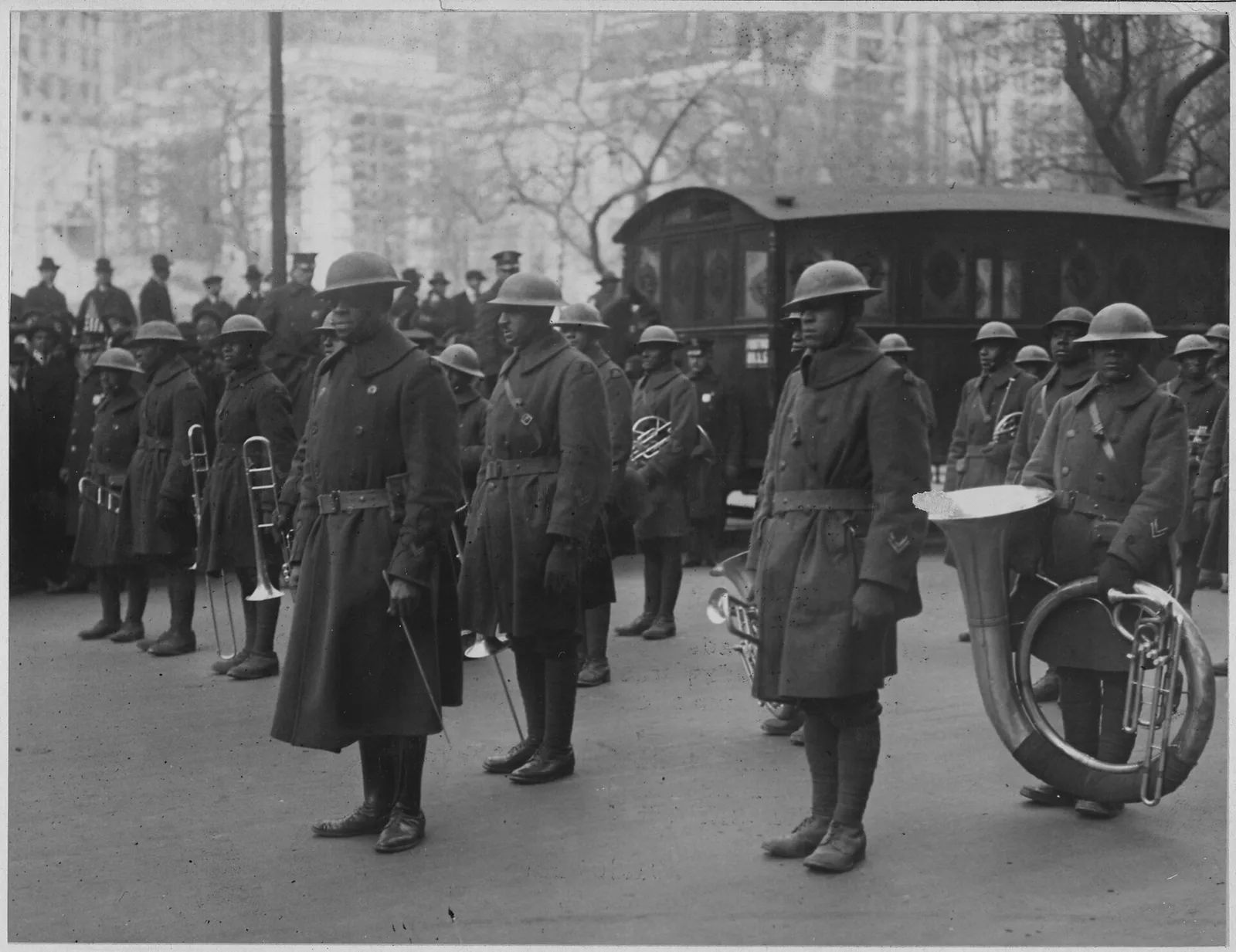
From spirituals to hip-hop, Black American music runs in one unbroken line of innovation.
Sources & Further Reading
- Smithsonian National Museum of African American History and Culture
- National Archives, African American Heritage
- Library of Congress
- SlaveVoyages, Trans-Atlantic Slave Trade Database
- U.S. Census Bureau, The Great Migration
- National Endowment for the Humanities
Figures on the transatlantic trade are drawn from the SlaveVoyages database and the National Endowment for the Humanities. Great Migration and Reconstruction figures are drawn from the National Archives, the U.S. Census Bureau, and university research collections.