The Star-Spangled Banner
Written on the back of a letter aboard an American truce ship held under British guard at dawn on September 14, 1814, officially the national anthem of the United States since March 3, 1931.
The Four Verses
Only the first verse is sung at public events. The other three are almost never performed, yet they reveal far more about what Francis Scott Key was thinking, feeling, and believing on that September morning.
O say can you see, by the dawn's early light,
What so proudly we hailed at the twilight's last gleaming,
Whose broad stripes and bright stars through the perilous fight,
O'er the ramparts we watched, were so gallantly streaming?
And the rocket's red glare, the bombs bursting in air,
Gave proof through the night that our flag was still there;
O say does that star-spangled banner yet wave
O'er the land of the free and the home of the brave?
On the shore dimly seen through the mists of the deep,
Where the foe's haughty host in dread silence reposes,
What is that which the breeze, o'er the towering steep,
As it fitfully blows, half conceals, half discloses?
Now it catches the gleam of the morning's first beam,
In full glory reflected now shines in the stream:
'Tis the star-spangled banner, O long may it wave
O'er the land of the free and the home of the brave!
And where is that band who so vauntingly swore
That the havoc of war and the battle's confusion,
A home and a country, should leave us no more?
Their blood has washed out their foul footsteps' pollution.
No refuge could save the hireling and slave
From the terror of flight, or the gloom of the grave:
And the star-spangled banner in triumph doth wave
O'er the land of the free and the home of the brave!
O thus be it ever, when freemen shall stand
Between their loved homes and the war's desolation.
Blest with vict'ry and peace, may the Heav'n rescued land
Praise the Power that hath made and preserved us a nation!
Then conquer we must, when our cause it is just,
And this be our motto: 'In God is our trust.'
And the star-spangled banner in triumph shall wave
O'er the land of the free and the home of the brave!
The Flag That Inspired the Poem
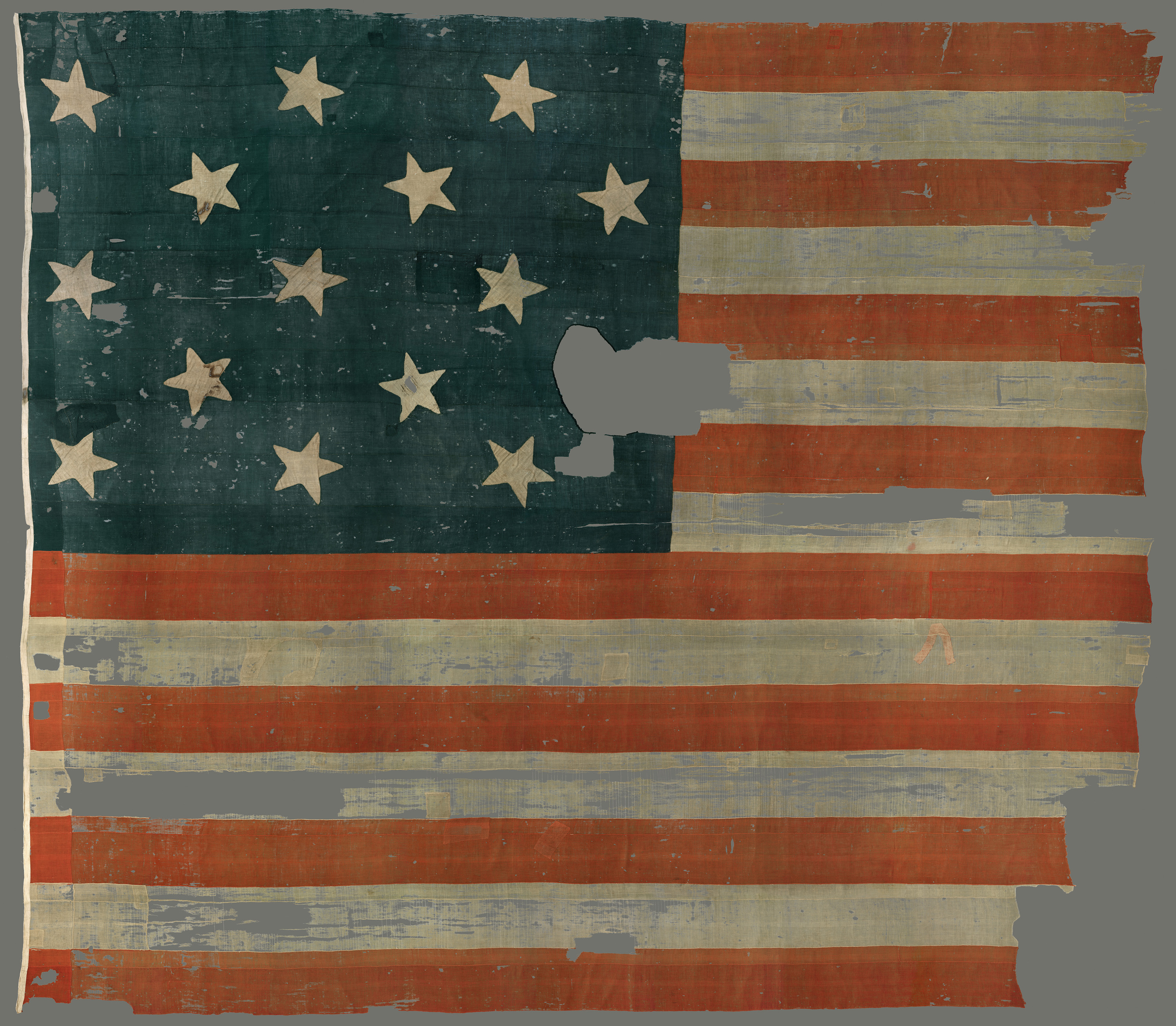
The flag Francis Scott Key saw flying over Fort McHenry was not the familiar modern American flag. It was a garrison flag made specifically to be visible from a great distance: 30 feet tall by 42 feet wide, with 15 stars and 15 stripes, one star and one stripe for each state then in the Union (the current design of 50 stars and 13 stripes had not yet been standardized).
The flag was commissioned by Fort McHenry's commander, Major George Armistead, who reportedly said he wanted "a flag so large that the British would have no difficulty seeing it from a distance." It was sewn by Mary Pickersgill, a Baltimore flag maker, with the help of her 13-year-old daughter, two nieces, and an indentured servant, working on the floor of a brewery because her house was too small. Pickersgill was paid $405.90 for the garrison flag and $168.54 for a smaller storm flag.
The flag flew over Fort McHenry throughout the September 13-14 bombardment. It was later given to Major Armistead as a personal keepsake and remained in his family for decades, with family members cutting pieces off as souvenirs. In 1912 it was donated to the Smithsonian Institution, where it remains today in the National Museum of American History, measuring approximately 30 by 34 feet after the removal of pieces over the years, and still one of the most visited objects in the Smithsonian's collection.
The fifteen stripes reflected a 1794 law that added a star and a stripe for Vermont and Kentucky. As more states joined, the stripes became unwieldy, and the Flag Act of 1818 returned the flag to thirteen stripes, with a new star added for each new state.
Phrase by Phrase, First Verse
Every phrase in the first verse was written by a man watching a real battle from a real ship. The poem is more literal, and more complicated, than most Americans realize.
Key opens with a question, not a declaration. He does not know the answer yet, he is asking in the dark, after a night of bombardment.
Key, a 35-year-old Washington lawyer, had sailed out to the British fleet to negotiate the release of Dr. William Beanes, an elderly physician taken prisoner after the burning of Washington. The British agreed but held them under guard until the attack on Baltimore was over.
The bombardment of Fort McHenry began on the morning of September 13, 1814, and lasted about 25 hours. The military history page covers the War of 1812.
The fort guarded the harbor of Baltimore, then one of the country's largest cities. The Maryland state page covers the battle's place in the state's history.
Key wrote at dawn on September 14. The light was literally just arriving. The phrase is not metaphorical, it is precisely descriptive.
Key began writing that morning, reportedly on the back of a letter he had in his pocket, and finished the poem in a Baltimore hotel after the British released him on September 16.
It was printed as a broadside, a single printed sheet, under the title Defence of Fort M'Henry, and the Baltimore Patriot newspaper published it on September 20, 1814. Within weeks it had been reprinted in newspapers along the East Coast.
The anthem's words are covered in full elsewhere on this page, and the American flag page covers the flag Key was looking for.
The flag they saw flying as darkness fell the evening before the bombardment began. Key last saw it clearly at dusk; by morning he does not know if it is still there.
The fort's commander, Major George Armistead, had ordered two flags from Baltimore flag maker Mary Pickersgill in 1813: a smaller storm flag and a huge garrison flag measuring 30 by 42 feet, so large that the British could not miss it.
According to tradition, the smaller storm flag flew during the rainy night, and the great garrison flag was raised in the morning after the British fleet withdrew, which is the flag Key saw.
That garrison flag survives and is displayed at the Smithsonian's National Museum of American History in Washington. The American flag page tells its story.
Literally accurate: the British used Congreve rockets (which produced a red streak) and mortar bombs (which exploded in the air over the fort). These were the light sources that allowed Key to watch the battle from the ship.
Congreve rockets, developed by British inventor William Congreve in the early 1800s, were notoriously inaccurate but frightening, trailing fire across the sky.
The heavier damage came from bomb ships that fired large mortar shells, many of which fell short or failed to explode. Despite the long bombardment, the fort's defenders suffered only four killed and about two dozen wounded.
The star-shaped fort had been built around 1800 to protect the harbor. The military history page covers how coastal defenses shaped the war.
The explosions, the enemy's weapons, were paradoxically the only proof that the fort had not fallen. If the bombardment stopped, it meant either victory or surrender, and Key could not know which.
The attack on the fort was coordinated with a British land assault. At the Battle of North Point on September 12, the British commander, General Robert Ross, was killed, and after the fleet failed to force the harbor, the British called off the attack on Baltimore.
Three weeks earlier, on August 24, 1814, British troops had burned the Capitol and the White House in Washington, so Baltimore's survival carried great weight for American morale.
The war ended with the Treaty of Ghent, signed on December 24, 1814. The Maryland and military history pages cover the campaign.
The question the entire poem is building to. Key will not answer it until the dawn light reveals the answer.
Key wrote four verses. Only the first ends with this question; the later verses answer it, describing the flag waving in triumph once the smoke cleared.
The words were soon set to the tune of To Anacreon in Heaven, a popular song written for a London gentlemen's music club, the Anacreontic Society, and widely known in America.
Congress made The Star-Spangled Banner the national anthem in a law signed by President Herbert Hoover on March 3, 1931. The Pledge of Allegiance page covers the other patriotic text most Americans learn in school.
The famous closing line. Historians note the irony that Key, a slaveholder who opposed the abolition movement, wrote 'the land of the free', and that the third verse's reference to 'the hireling and slave' targeted, in part, the enslaved people who had escaped and joined British forces seeking their freedom.
Key later served as the U.S. attorney for the District of Columbia from 1833 to 1841, where he prosecuted abolitionists, including a physician tried in 1836 for possessing antislavery pamphlets; the jury acquitted.
His record was mixed. He helped found the American Colonization Society in 1816, which promoted sending free Black Americans to Africa, and he freed some of the people he held in slavery and represented others seeking freedom in court.
During the war, the British recruited formerly enslaved men into a unit called the Corps of Colonial Marines, and some fought in the 1814 Chesapeake campaign. The Black American history page covers this era.
History, From Battle to Anthem
The Star-Spangled Banner was written in a single night during a war most Americans have half-forgotten, and it took 117 years to become the official national anthem.
- June 18, 1812
The War of 1812 Begins
Congress declares war on Britain over impressment of American sailors, interference with American trade, and British support for Native American resistance on the frontier. The war goes badly for the United States in its opening years, American invasions of Canada fail, and the U.S. Army proves unprepared for sustained conflict against British regulars.
It was the closest formal declaration of war in American history: 79 to 49 in the House and 19 to 13 in the Senate, with the Federalist Party and much of New England opposed. President James Madison signed it the same day.
Impressment was the central grievance. The Royal Navy had seized thousands of sailors from American ships since 1803, claiming they were British subjects, and the 1807 Chesapeake-Leopard affair, in which a British warship fired on a U.S. Navy frigate and removed four men, had already brought the two nations near war.
Britain had actually voted on June 16 to suspend the Orders in Council that restricted American trade, but news took weeks to cross the Atlantic, and the war went forward regardless.
- August 24, 1814
Washington D.C. Burns
A British force under General Robert Ross and Rear Admiral George Cockburn marches on Washington, routs the American defenders at the Battle of Bladensburg, and burns the U.S. Capitol, the White House, and other federal buildings. President Madison flees the city. It is the only time since the Revolution that a foreign power has occupied and destroyed the American capital. The British then turn toward Baltimore.
The raid was framed as retaliation for the American burning of York, now Toronto, the capital of Upper Canada, in 1813. British troops torched the Capitol, destroying the roughly 3,000 volumes of the Library of Congress, later replaced by Thomas Jefferson's personal library, and gutted the President's House.
First Lady Dolley Madison delayed her own escape to save a Gilbert Stuart portrait of George Washington, ordering the frame broken and the canvas removed. That painting still hangs in the White House East Room.
A hurricane and an accompanying tornado struck the city the next day, extinguishing many of the fires and killing several British soldiers. The occupation lasted only about 26 hours before the British pulled back to their ships.
- September 12–14, 1814
The Battle of Baltimore & Fort McHenry
Baltimore, a major port and the third-largest American city, is defended by Fort McHenry at the entrance to the harbor. On September 13, a British fleet of 19 vessels, including bomb ships capable of lobbing 200-pound explosive shells from beyond the range of Fort McHenry's cannons, begins a 25-hour bombardment of the fort. The garrison, commanded by Major George Armistead, fires back when ships come within range. The British fire an estimated 1,500 rounds; the fort is hit repeatedly but not silenced. At dawn on September 14, the British fleet withdraws, having failed to suppress the fort or silence its guns. The land assault on Baltimore is also repulsed after British General Ross is killed. Baltimore is saved.
Baltimore had roughly 50,000 residents and was a home base for American privateers who had captured hundreds of British merchant ships; the British press had branded it a 'nest of pirates,' making it a deliberate target.
The land attack stalled at Hampstead Hill, where about 15,000 Maryland militia under General Samuel Smith had dug in behind earthworks. General Robert Ross was killed by an American sharpshooter on September 12, early in the advance, depriving the British of their ground commander.
The bomb vessels and the rocket ship HMS Erebus stayed about two miles offshore, beyond the reach of the fort's roughly three dozen guns. Despite the day-long shelling, only four defenders inside Fort McHenry were killed and about two dozen wounded.
- September 14, 1814
Francis Scott Key Writes the Poem
Francis Scott Key, a 35-year-old Washington lawyer and amateur poet, had sailed out under a flag of truce and met the British fleet aboard HMS Tonnant to negotiate the release of a captured American physician. The British agreed to release the prisoner but kept Key and his party under guard aboard their own American truce sloop, behind the British fleet, during the bombardment, fearing they would report on British positions. Key watched the battle from that sloop, unable to know whether the fort had fallen until dawn revealed the American flag, a massive garrison flag measuring 30 by 42 feet, still flying over Fort McHenry. Overwhelmed, he wrote the poem 'The Defence of Fort McHenry' on the back of a letter he had in his pocket, completing it at a Baltimore hotel after the British released him on September 16.
The prisoner was Dr. William Beanes of Upper Marlboro, Maryland, arrested by the British for jailing stragglers after the Washington raid. Key carried letters from wounded British prisoners attesting to their good care, which helped win Beanes's release.
The flag Key saw had been sewn in Baltimore in 1813 by flagmaker Mary Pickersgill, her daughter, two nieces, and an indentured servant, for $405.90. It carried 15 stars and 15 stripes for the states then in the Union. A smaller storm flag flew during the rain of the bombardment; the large flag was hoisted at dawn.
Key's brother-in-law Joseph Nicholson, a judge who had helped command a Fort McHenry artillery unit, carried the poem to a Baltimore printer within days. The surviving Pickersgill flag, now missing several feet of fabric cut away over the years as souvenirs, is preserved at the Smithsonian's National Museum of American History.
- September 20, 1814
Published as a Broadside
Key's poem is printed as a broadside (a single large sheet) by the Baltimore Patriot under the title 'Defence of Fort McHenry,' with a note that it should be sung to the tune of 'To Anacreon in Heaven', a popular British drinking song with a notoriously difficult melody that had already been used for several American patriotic songs. The song spreads rapidly through newspapers across the country and is immediately popular.
'To Anacreon in Heaven' was the club song of the Anacreontic Society, a London gentlemen's musical club, written around 1775 with music usually credited to John Stafford Smith. Its vocal range of about an octave and a half is the reason the anthem is famously hard to sing.
Key had used the same tune before. In 1805 he wrote 'When the Warrior Returns,' honoring naval heroes of the First Barbary War, a poem that already paired 'star-spangled' with 'the brave.' The new work was soon retitled 'The Star-Spangled Banner' and reprinted in newspapers from Georgia to New Hampshire within weeks.
The Baltimore music publisher Thomas Carr issued the words and melody together in November 1814, fixing the pairing of Key's lyrics to Smith's tune that has held ever since.
- 1814–1890s
Popular but Unofficial
For most of the 19th century, 'The Star-Spangled Banner' is popular but not official. The U.S. Army and Navy both use it ceremonially from the mid-19th century onward, and it is played at major patriotic events, but the country has no official national anthem. 'My Country, 'Tis of Thee,' 'Hail, Columbia,' 'Yankee Doodle,' and 'America the Beautiful' all compete for the role of de facto national anthem depending on the occasion and the region.
The song gained emotional weight during the Civil War, when it was sung at Union rallies and some singers added a defiant new verse by Oliver Wendell Holmes Sr. attacking 'the traitor that dares to defile' the flag.
In 1889 the Secretary of the Navy ordered the song played at the raising of the colors, and the Army adopted a similar order in the 1890s, making it the standard military ceremonial anthem decades before Congress acted.
Objections persisted on two grounds: the melody was a foreign tune, and a drinking song at that, and the lyrics celebrated one battle rather than the nation. Backers of 'America the Beautiful' and other songs pressed those points for years.
- 1916
Wilson Orders It at Military Events
President Woodrow Wilson, by executive order, designates 'The Star-Spangled Banner' as the official anthem for military and naval occasions. This is the first formal presidential recognition of the song, though it still has no statutory standing.
The order came as the United States moved toward entry into World War I, a period of intense official promotion of patriotic display; the country declared war in April 1917.
Performances had drifted into many keys and tempos, so in 1917 the Army and Navy asked a committee of musicians, including Walter Damrosch and John Philip Sousa, to prepare a standard 'service version,' published in 1918.
Baseball helped cement the song's public role. It was played during the seventh-inning stretch of Game 1 of the 1918 World Series between the Cubs and Red Sox, drawing a strong crowd response, and teams increasingly featured it at big games.
- March 3, 1931
Act of Congress, Official National Anthem
After decades of lobbying by veterans' groups, patriotic organizations, and musicians (and despite persistent opposition from those who found the melody too difficult to sing and the lyrics too war-focused), Congress passes and President Herbert Hoover signs a law designating 'The Star-Spangled Banner' as the national anthem of the United States, 117 years after Key wrote it within sight of the British fleet.
The bill was carried in Congress largely by Representative J. Charles Linthicum of Baltimore, who introduced versions of it repeatedly starting in 1918, backed by a Veterans of Foreign Wars petition drive that gathered roughly five million signatures.
At the 1930 House hearing, opponents included a Daughters of the American Revolution music committee and temperance advocates who objected to the drinking-song origin. Two sopranos sang the anthem at the hearing to show that an ordinary voice could manage it.
The designation is now codified at 36 U.S.C. Section 301, which also sets out conduct during the anthem: civilians should face the flag with the right hand over the heart, and those in uniform should render the military salute.
- 1969
Jimi Hendrix at Woodstock
Jimi Hendrix's August 18, 1969 performance of 'The Star-Spangled Banner' at Woodstock, a distorted, feedback-laden electric guitar interpretation that evoked air raid sirens, bombs, and chaos amid the melody, becomes one of the most discussed musical performances in American history. It is variously interpreted as protest, as patriotism, as art, or as all three simultaneously. The performance is now considered one of the defining cultural artifacts of the Vietnam era.
He played it near the end of a roughly two-hour set on the festival's final morning, a Monday, to a crowd that had thinned to perhaps 30,000 to 40,000 of the estimated 400,000 who attended across the weekend.
Asked weeks later on The Dick Cavett Show whether the rendition was 'unorthodox,' Hendrix objected to the word and said, 'I thought it was beautiful.' He had performed the anthem live many times before Woodstock and kept doing so afterward.
Hendrix, a former paratrooper with the Army's 101st Airborne Division, died about 13 months later, in September 1970. The performance survives in the 1970 Woodstock documentary and is a standard reference in scholarship on protest and American symbolism.
- 2016
Kaepernick and the Kneeling Debate
San Francisco 49ers quarterback Colin Kaepernick begins protesting during the national anthem before NFL games in August 2016, first by sitting and, from September 1, by kneeling, to protest police violence against Black Americans. The gesture, chosen in consultation with former Army Green Beret Nate Boyer, who suggested kneeling as more respectful than sitting, triggers a national debate about patriotism, protest, free speech, and the meaning of the anthem itself. Kaepernick is not re-signed by any NFL team after the 2016 season; the debate over anthem protests continues to divide the country.
Kaepernick first sat through the anthem during preseason games; the switch to kneeling followed his September 1, 2016 conversation with Boyer, who had written him an open letter. Kaepernick also pledged $1 million to community organizations, paid out over the following year.
The protests spread across the league and drew sustained criticism from President Donald Trump beginning in September 2017, when he said owners should fire players who knelt. In 2018 the NFL announced, then shelved, a policy requiring players on the field to stand.
Kaepernick and safety Eric Reid filed grievances alleging the owners had colluded to keep them out of the league; the NFL settled with them confidentially in 2019. In 2020, after the murder of George Floyd, Commissioner Roger Goodell said the league had been 'wrong' not to listen to players sooner.
Francis Scott Key, the Man Who Wrote It
Francis Scott Key (August 1, 1779 - January 11, 1843) was a Georgetown, D.C. lawyer, amateur poet, and devout Episcopalian who had no particular military background or political prominence before September 1814. He was a slaveholder who enslaved six people and, as a lawyer, was known for prosecuting abolitionists while occasionally providing pro bono legal services to free Black people, a reflection of the profound contradictions that defined American life in the early republic.
Key was aboard the British flagship HMS Tonnant not as a prisoner but as a negotiator: he had obtained permission from President Madison to seek the release of Dr. William Beanes, an elderly Maryland physician the British had arrested after the burning of Washington. Key successfully negotiated Beanes's release, but the British insisted on detaining Key's party until after the bombardment of Fort McHenry was complete, for fear he would report British positions to American forces.
The poem Key wrote that dawn, originally titled "The Defence of Fort McHenry", was his only significant literary achievement. He practiced law in Washington and Maryland for the rest of his life, served as U.S. Attorney for the District of Columbia under Andrew Jackson (1833-1841), and died in 1843 without knowing that his hastily written poem would become the national anthem of the United States 88 years later.
Key's family ties reached the top of the government. His brother-in-law, Roger B. Taney, became Chief Justice of the United States in 1836 and later wrote the Court's opinion in Dred Scott v. Sandford (1857), which held that Black Americans could not be citizens.
Notable Performances
Whitney Houston
Super Bowl XXV, January 27, 1991
Widely considered the greatest performance of the anthem in history. Recorded to a pre-recorded track (standard practice for outdoor stadiums), Houston's studio recording was released as a single and charted twice, after the Super Bowl and again after September 11, 2001. It remains the best-selling single recording of the national anthem.
Jimi Hendrix
Woodstock, August 18, 1969
A distorted electric guitar interpretation that used feedback and whammy bar to evoke explosions, air raid sirens, and chaos amid the melody. Widely interpreted as an anti-war protest; Hendrix described it as 'beautiful.' Arguably the most discussed instrumental performance of the anthem ever given.
José Feliciano
1968 World Series, October 7, 1968
The blind Puerto Rican guitarist performed a slow, acoustic, Latin-influenced version that shocked audiences expecting the traditional arrangement. He received death threats, and some radio stations pulled his records. The performance is now recognized as a pioneering moment of artistic freedom in anthem performances.
Marvin Gaye
NBA All-Star Game, February 13, 1983
Gaye performed a slow, soul-influenced version accompanied by a drum machine, the first use of a rhythm track at a major anthem performance. Standing ovation from the arena. CBS executives reportedly objected in advance; Gaye performed it anyway.
Roseanne Barr
San Diego Padres game, July 25, 1990
A deliberately off-key performance followed by grabbing her crotch and spitting, intended as a joke but received as an outrage. President George H.W. Bush called it 'disgraceful.' It remains the most notorious anthem performance in American sports history.
Beyoncé
President Obama's second inauguration, January 21, 2013
Beyoncé lip-synced to a pre-recorded version, standard practice at outdoor inaugurations (the Marine Band plays live; soloists often pre-record). The revelation that she had lip-synced generated significant controversy despite the common practice. She answered critics by singing the anthem live, a cappella, at a January 31, 2013 news conference ahead of Super Bowl XLVII, where she performed the halftime show.
The Alternatives, What Almost Became the National Anthem
"The Star-Spangled Banner" won the national anthem designation largely through the lobbying of veterans' organizations, but it had serious competitors that many Americans preferred, and some still do.
America the Beautiful
Words by Katharine Lee Bates (1893), inspired by her view from Pikes Peak. Many Americans prefer it: the melody is easier to sing, the lyrics are optimistic rather than martial, and it celebrates the land rather than a battle. Periodically proposed as a replacement or co-anthem.
My Country, 'Tis of Thee
Written in 1831 by Samuel Francis Smith, sung to the tune of 'God Save the King' (the British national anthem, known as 'God Save the Queen' during the reigns of queens). Effectively served as the de facto national anthem for much of the 19th century before 'The Star-Spangled Banner' was formalized.
Hail, Columbia
The first inaugural march, written in 1798 and long considered the national anthem for formal government ceremonies. Now the official anthem of the Vice President of the United States.
This Land Is Your Land
Woody Guthrie's 1940 folk anthem, written partly as a response to 'God Bless America,' has been proposed as an alternative anthem by those who find it more inclusive and democratic in spirit. Its rarely performed later verses question a 'private property' sign and describe Depression-era relief lines.