
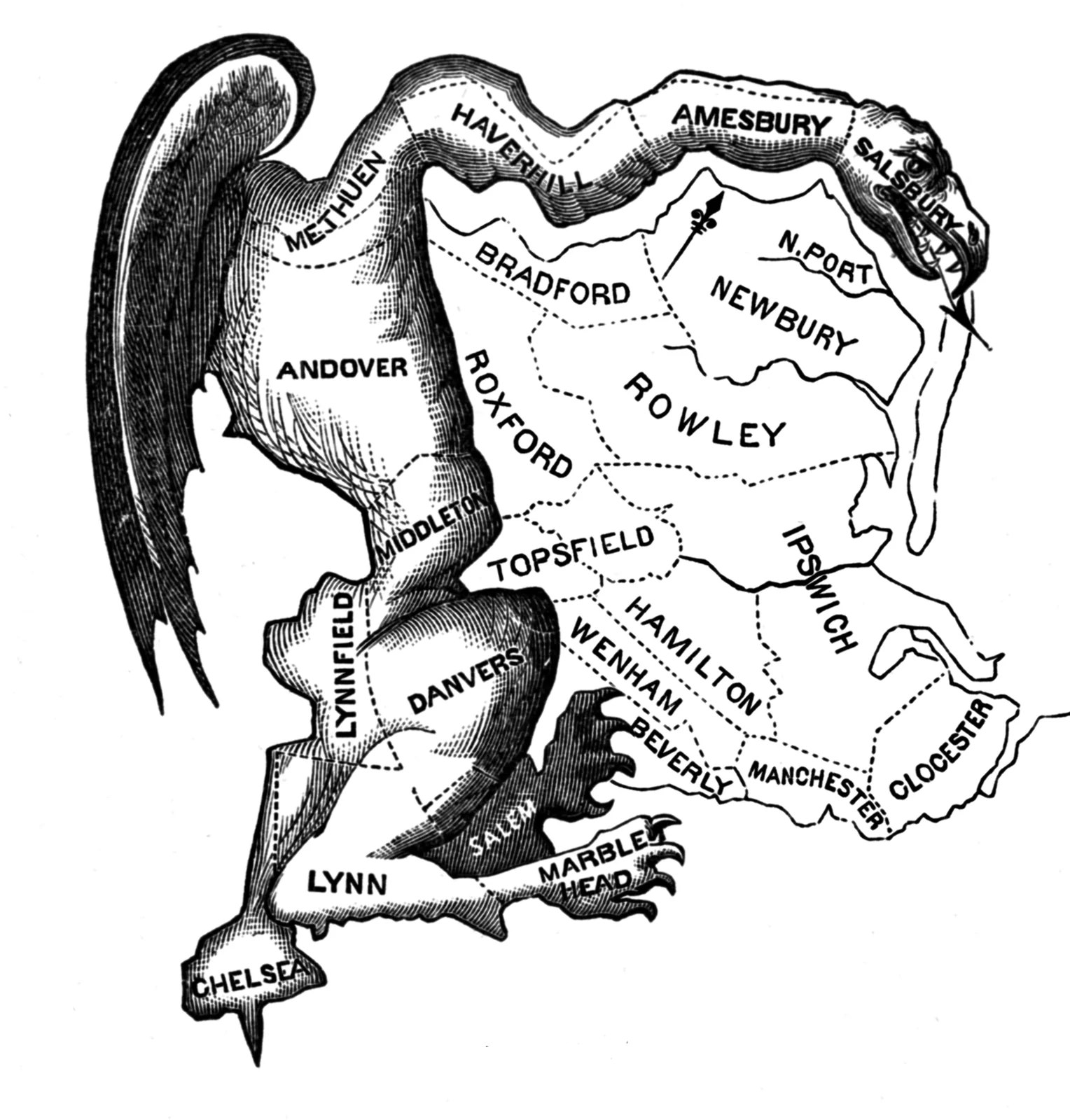
A 214-Year-Old Word for a Problem as Old as Districts Themselves
The word "gerrymander" is over two centuries old, but the underlying temptation, drawing district lines to help yourself politically, is as old as the idea of geographic representation itself. Here's how the word was born and how the legal and technical landscape around it has changed since.
Article I, Section 4 of the Constitution, the Elections Clause, gives each state's legislature the power to set the "times, places and manner" of congressional elections, subject to Congress's power to override those rules by law. Drawing the actual district boundaries was never assigned to any single national authority, which is the root reason redistricting looks so different from state to state today.
The clause's own text, "except as to Places of chusing Senators," reflects that Senators were originally chosen by state legislatures rather than popular districted vote at all, a distinction that changed only with the 17th Amendment in 1913. That history is why redistricting disputes today center almost entirely on the House and state legislative chambers, not the Senate, which has never been divided into districts.
Congress has used its Elections Clause override power for districting only rarely: the single-member district requirement of 1842 and its re-enactments, and the Uniform Congressional District Act of 1967, are the main examples. Bills to set national redistricting standards or ban partisan gerrymandering, such as the various proposals of the 2020s, have at times passed the House but not become law.
Because the clause names "the Legislature of each State," litigants have periodically argued only the elected legislature, not a commission or a state court, may set federal election rules. The Supreme Court rejected the strongest form of that "independent state legislature" theory in Moore v. Harper (2023), holding that state courts may still review legislatures' federal-election maps under state constitutions.
In February 1812, Massachusetts Governor Elbridge Gerry signed a state senate redistricting bill that critics said shamelessly favored his own Democratic-Republican party. Federalist newspaper editors in Boston noticed that one contorted new district in Essex County resembled a salamander, and the Boston Gazette published a cartoon on March 26, 1812, artist Elkanah Tisdale, giving the creature claws, wings, and a dragon-like head labeled to mock the district. The portmanteau "Gerry-mander" stuck immediately and has been used for every unfairly shaped district since, even though Gerry's own name was pronounced with a hard G and the word that bears it is, by long convention, pronounced with a soft one.
Gerry was reportedly unhappy with the district's shape even as he signed the bill into law at his party's urging. He was elected Vice President under James Madison later that same year and died in office in November 1814, meaning he served barely long enough to watch the word coined from his name enter permanent use.
The 1812 law reshaped state senate districts, not congressional ones, and it worked in the short term: in the 1812 elections Gerry's Democratic-Republicans won a large state senate majority even though Federalists won more total votes statewide, an early demonstration of how district lines can invert a popular-vote result.
The cartoon was long attributed to portrait painter Gilbert Stuart, but historians now credit engraver Elkanah Tisdale. Voters turned Gerry out of the governorship that same year, and the redrawn districts were themselves repealed by the incoming Federalist legislature in 1813, though the coined word outlasted both.
Before 1842, several states elected their entire U.S. House delegation on a single statewide "general ticket" rather than by individual districts, a practice that let one party's statewide majority sweep every seat. The Apportionment Act of 1842 required states to elect House members from single-member districts of contiguous territory, establishing the basic geographic-district structure still used today, though it included no enforcement mechanism and some states drifted back to at-large elections for periods afterward.
Congress found it necessary to re-enact the single-member district requirement several more times, in 1862, 1872, and 1901, because a handful of states kept reverting to at-large or multi-member elections between reapportionments. The requirement did not become fully permanent and consistently enforced until the Uniform Congressional District Act of 1967, well over a century after the original 1842 law.
The 1842 Act passed narrowly, and several states defied it outright: New Hampshire, Georgia, Mississippi, and Missouri elected their 1842 delegations at large anyway, and the House debated whether to seat those members before doing so. The episode showed how weak an Elections Clause mandate is without an enforcement mechanism.
Congress omitted the requirement from the 1929 Permanent Apportionment Act, and the Supreme Court held in Wood v. Broom (1932) that the older requirements had lapsed, leaving no federal districting standards for decades. The Uniform Congressional District Act of 1967 finally made single-member districts permanent federal law.
After Congress failed to reapportion House seats at all following the 1920 Census, the first and only decade in American history this happened, largely because rural-dominated state delegations resisted shifting seats to fast-growing cities, Congress passed the Permanent Apportionment Act of 1929. It fixed the total size of the House at 435 seats and created an automatic mathematical formula, applied by the Census Bureau, to reallocate those seats among the states after every census without requiring a new act of Congress each time.
The 1929 law addressed only how many congressional seats each state receives, not how state legislatures draw their own internal maps. Several states left their own state legislative districts essentially unchanged for decades afterward, some for over 60 years, a problem Congress never resolved and the Supreme Court ultimately addressed through the one-person-one-vote rulings that began with Baker v. Carr in 1962, detailed in the Landmark Cases tab.
The 1929 Act also dropped the earlier statutory requirements that districts be contiguous, compact, and roughly equal in population, leaving no federal districting standards at all for more than three decades. States were free to leave maps frozen, and many did: Alabama's legislature had not redistricted since 1901 when Reynolds v. Sims reached the Supreme Court in 1964.
The automatic reapportionment formula it created, the method of equal proportions adopted in 1941, still runs after every census with no congressional vote. What the 1929 law left entirely to the states, the drawing of the actual lines, is the space in which every modern redistricting and gerrymandering dispute occurs.
The Voting Rights Act of 1965 prohibited election rules, including district maps, that deny or abridge the right to vote based on race. In the following decades, courts interpreted the Act to sometimes require states to draw "majority-minority" districts where a racial or language minority group is large and geographically concentrated enough to elect a candidate of its choice, adding a distinct legal requirement that exists alongside, and sometimes in tension with, traditional redistricting criteria.
The Act's Section 5 originally required certain states and localities with histories of discrimination to get federal "preclearance" before changing any election law, including district maps. The Supreme Court's 2013 decision in Shelby County v. Holder effectively ended preclearance by striking down the formula used to decide which jurisdictions were covered, though the Act's separate Section 2 protections against vote dilution, discussed in the Landmark Cases tab, remain in force.
The 1982 amendments to Section 2 made clear a plaintiff need not prove discriminatory intent, only a discriminatory result, and Thornburg v. Gingles (1986) set the three-part test still used: a minority group must be large and compact enough to form a majority in a district, politically cohesive, and usually defeated by bloc voting from the majority.
Section 2 requirements can pull against traditional criteria like compactness, and against mapmakers of either party, depending on the state. The Supreme Court reaffirmed Section 2's application to redistricting in Allen v. Milligan (2023), ordering Alabama to add a second Black-opportunity district. In Louisiana v. Callais (April 29, 2026), however, the Court ruled 6-3 that Louisiana's second majority-Black district was an unconstitutional racial gerrymander because Section 2 did not require it, narrowing how states may use race to comply with the Act.
Beginning in earnest after the 2010 Census, mapmakers gained access to precinct-level voting history, detailed demographic data, and powerful geographic information system (GIS) software capable of testing thousands of map variations for partisan effect before settling on a final plan. Political scientists and courts alike have noted that this technology made maps considerably more durable and precisely tuned than anything possible in earlier decades, intensifying the debate over how much partisan advantage a legislature may deliberately build into district lines.
Mapmakers in this era, in different states and from both parties, began more openly citing partisan advantage as a goal during the drafting process, a shift from decades in which mapmakers typically emphasized only traditional criteria in public even when partisan intent was suspected. Political scientists point to this technological era as a reason maps drawn in the 2020s cycle have proven especially difficult to challenge successfully in court, even where a measurable partisan skew exists.
The 2010 cycle saw coordinated national efforts by both parties to win state legislatures before redistricting, the best-documented being the Republican State Leadership Committee's REDMAP project; Democratic-aligned groups mounted comparable efforts in later cycles. Analysts using metrics like the efficiency gap judged the resulting national congressional map among the most skewed in decades, though estimates of the size and direction vary by method.
Courts struck down maps in Pennsylvania, North Carolina, Florida, and Virginia in the 2010s on state-constitutional or racial-gerrymandering grounds. After Rucho v. Common Cause (2019) removed federal courts from partisan claims, litigation shifted to state courts and to racial-gerrymandering and Voting Rights Act theories, where most 2020s-cycle challenges have been fought.
A Process That Looks Different in Every State
The Constitution assigns redistricting to the states and says almost nothing else about how they must do it, which is why the actual process, who draws the map, what rules they follow, and how much the public gets to see, varies so widely from state to state.
In most states, the state legislature draws both congressional and state legislative district maps directly, subject to the governor's veto in most of those states. A smaller group of states instead use an independent or bipartisan redistricting commission, discussed in the Reform Efforts tab, that draws maps outside the ordinary legislative process. If a state's process deadlocks or a court finds an adopted map unlawful, a state or federal court can end up drawing an interim map itself, a backstop used more often than most voters realize.
The number of states using a commission for congressional maps differs from the number using one for state legislative maps, since a handful of states use a commission for only one of the two. The National Conference of State Legislatures tracks which model each state uses and updates its count after every redistricting cycle as states adopt or repeal commission laws.
As of the 2020 cycle, roughly 33 states had the legislature draw congressional lines, about 8 used an independent or politician commission for congressional maps, and the rest had a single at-large seat or used advisory or backup bodies. The counts for state legislative maps differ because some states use a commission for one chamber but not the other.
Courts drew or heavily revised congressional maps for the 2022 elections in North Carolina, Ohio, New York, and Pennsylvania, among others, after adopted maps were struck down or legislatures deadlocked. Court-drawn maps are meant to be interim, lasting until the state enacts a valid plan, which is why several of those states redrew again before 2024.
Reapportionment is the separate, purely mathematical process, run by the Census Bureau under the 1929 formula, that reallocates the House's fixed 435 seats among the states based on each new census population count; a state can gain or lose seats entirely through this step. Redistricting is the following process, run by each state, of actually drawing the lines for those seats, plus the state's own legislative districts. A state can go through a full redistricting cycle even in a census year where its total number of seats does not change at all.
This is why a state like Texas or California makes national news twice in the same year after a census: once for the apportionment announcement showing whether it gained or lost seats, and again months later when its own legislature or commission releases the actual proposed district maps implementing that count.
A state that neither gains nor loses seats still must redistrict if its population shifted internally, because Wesberry v. Sanders requires near-equal district populations and a decade of uneven growth almost always unbalances the old lines. Only single-seat states skip congressional redistricting entirely.
Reapportionment is fixed and mechanical, decided by the Census Bureau on a set formula and delivered to the President by December 31 of the census year. Redistricting is discretionary and political, and its deadlines are set by each state's own law, which is why the two steps make news months apart.
The U.S. Constitution requires a census every ten years, and redistricting for both Congress and state legislatures normally follows on that same schedule, typically completed in the year or two after the census so new maps are ready for the next regular election. Mid-decade redistricting, redrawing lines outside the normal ten-year cycle, is legal in most circumstances and was long the exception, most notably in Texas in 2003. That changed in 2025-26: by February 2026, Texas, California, Missouri, North Carolina, Ohio, and Utah all had new congressional maps for the 2026 elections, some drawn by legislatures mid-decade and some required by courts or state processes.
Texas's 2003 mid-decade redraw followed a change in which party controlled the state legislature, which moved to replace an existing court-drawn map before the next election, and the state's 2025 mid-decade effort followed a similar pattern of a newly empowered majority revisiting maps outside the normal ten-year window. Both were reviewed by federal courts under the same legal standards applied to any other map. In late 2025 the Supreme Court stayed a lower-court ruling against the 2025 Texas map, allowing the state to use it in 2026.
Most state constitutions or statutes require redistricting in the year after the census; a few run their processes on slightly different schedules. Mid-decade redraws are constitutional under LULAC v. Perry (2006) unless they violate the Voting Rights Act or a racial-gerrymandering standard, but only a handful of states have attempted them.
Some states cap mid-decade action in their own constitutions: Colorado and California, for example, bar redistricting more than once per decade absent a court order, although California voters approved Proposition 50 in November 2025 to temporarily replace the commission's congressional map with a legislature-drawn map for 2026 through 2030. Where no such limit exists, a newly empowered legislative majority can revisit the lines, as Texas did in 2003 and again in 2025 and as other states have periodically debated.
Even where no independent commission is involved, most states direct mapmakers to follow a shared set of traditional redistricting principles: equal population between districts, contiguity (every part of a district must be geographically connected), compactness (avoiding unnecessarily sprawling or convoluted shapes), and respect for existing political subdivisions such as counties and cities and for recognized "communities of interest." These principles are widely cited in litigation, but states differ in how strictly they enforce them and in what order they rank when the criteria conflict with each other.
Some state constitutions write specific criteria directly into law, such as Florida's "Fair Districts" amendments approved by voters in 2010, which made compactness and a ban on intent to favor an incumbent or party legally enforceable standards. In states without such provisions, the same principles function more as customary practice that a reviewing court weighs as evidence rather than as an independently enforceable requirement on their own.
The U.S. Supreme Court has never required compactness or respect for county lines as a federal constitutional matter; it treats them as evidence relevant to a racial-gerrymandering claim rather than independent commands. Equal population is the one criterion federal law strictly enforces, near-zero deviation for congressional districts and generally under 10 percent total for state legislative districts.
Where state law makes the criteria binding, courts enforce them: Pennsylvania's supreme court struck the state's congressional map in 2018 partly for violating the state constitution's compactness and subdivision-splitting standards, and Florida courts have applied the 2010 Fair Districts amendments to invalidate maps for partisan intent.
Most states hold public hearings, before and sometimes after a map is drafted, where residents can testify about community boundaries, and many now allow the public to submit entire proposed maps for consideration using free online mapping tools. How much real weight this input carries varies enormously: some commissions treat public map submissions as a serious starting point, while some legislature-drawn processes treat hearings as a formality with limited effect on the final lines.
Some states set a minimum number of hearings by statute, requiring sessions in multiple regions of the state before any map can be introduced, while others leave the number and format of hearings entirely to legislative discretion. That statutory gap is one reason the depth of public input varies so widely from state to state even when every state technically holds hearings.
The commissions in California, Michigan, and Colorado must hold numerous hearings across the state, before and after draft maps, and publish the data and criteria they use. Legislature-run processes range from Ohio's constitutionally required hearings to states where a map is unveiled and passed within days.
Advocacy groups and universities have built free tools, Dave's Redistricting App, Districtr, and Representable among them, that let residents draw and submit complete maps or communities-of-interest testimony. Commissions have at times used public-submitted maps as starting points; legislative processes more often log them without visible effect on the final lines.
Professional redistricting relies on geographic information system (GIS) software, commercially the most widely used is Maptitude for Redistricting, loaded with block-level Census population and demographic data and, in many states, detailed partisan voting history down to the precinct level. The same underlying Census TIGER/Line shapefile data is available to the public, which is what powers free citizen tools such as Dave's Redistricting App and the academic tracking project PlanScore, letting outside researchers and advocacy groups build and evaluate their own alternative maps.
A several-month, pandemic-related delay in the delivery of detailed block-level census data compressed many states' mapmaking timelines after the 2020 Census compared with prior cycles, forcing legislatures and commissions alike to run map-testing software on a tighter schedule than usual heading into the 2022 elections.
Maptitude for Redistricting, made by Caliper Corporation, is the dominant professional package and is used by most state legislatures and many commissions and courts; ESRI's ArcGIS and specialized tools like autoBound are also used. All draw on the Census Bureau's TIGER/Line geographic files and the P.L. 94-171 population file released after each census.
The 2020 P.L. 94-171 file arrived in August 2021, about four months late, compressing map drawing before the 2022 primaries. Academic projects such as PlanScore and the Princeton Gerrymandering Project now publish partisan-fairness and compactness scores for proposed and enacted maps, giving litigants and the public analyses once available only to insiders.
Two Techniques, One Goal
Nearly every gerrymander, however sophisticated the software behind it, comes down to one of two basic moves: concentrating opposition voters where their votes are wasted, or splitting them up so they're outnumbered everywhere. Here's how mapmakers do it, and how researchers try to measure it after the fact.
Packing concentrates the opposing party's voters into as few districts as possible, so they win those districts by enormous, "wasted" margins while having no meaningful influence anywhere else on the map. A district that a disfavored party wins 85 percent to 15 percent is often a sign of packing: it burns a huge surplus of that party's votes in one place rather than letting them meaningfully compete in several closer districts.
Packing is not automatically illegal on its own. The Voting Rights Act can actually require a degree of packing in certain circumstances, when concentrating a minority community into a single district is the only realistic way to give that community a chance to elect its preferred candidate, an outcome that can look identical on a map to a partisan packing gerrymander even though the legal justification is entirely different.
Because a district only needs 50 percent plus one to elect, every vote a party piles up above that in a packed district is wasted in the efficiency-gap sense. Analysts often flag a cluster of 75-to-90-percent districts for one party alongside a larger set of 55-to-60-percent districts for the other as the statistical fingerprint of a packing-and-cracking strategy.
The Voting Rights Act can require concentrating a cohesive minority community into a majority-minority district under the Gingles test, which looks like partisan packing on a map but rests on a different legal basis. Courts wrestled with the overlap in Alabama v. Milligan, where the state said its map avoided an unnecessary racial classification and the challengers said it cracked a cohesive Black community.
Cracking does the opposite: it splits a concentrated group of opposition voters across several districts, diluting them into minorities in each one so they cannot elect a candidate of their choice anywhere. A single city or county that gets sliced among four or five otherwise rural districts, none of which the city's voters can swing on their own, is a classic sign of cracking.
Cracking a city among several rural districts is one of the most litigated gerrymandering patterns in modern redistricting lawsuits, since precinct-level voting data can often show clearly that a natural community of shared interests was deliberately divided to prevent it from electing a candidate of its choice.
Cracking is often applied to cities, college towns, and minority neighborhoods whose voters lean heavily one way, splitting them among districts anchored in areas that lean the other way. Austin, Texas is a frequently cited example, divided among several districts for much of the 2010s so its large population could not anchor a district of its own.
Because cracking dilutes rather than concentrates, it is the pattern most often challenged under Section 2 of the Voting Rights Act, where plaintiffs use the Gingles test to show a minority group large and compact enough to form a district majority was instead divided. Racial-gerrymandering and Section 2 claims about cracking remain fully available in federal court after Rucho.
These are legally distinct claims. A partisan gerrymander is drawn to advantage one political party over another; as covered in the Landmark Cases tab, the Supreme Court held in 2019 that federal courts cannot hear partisan gerrymandering claims at all, though some state courts can still hear them under their own state constitutions. A racial gerrymander uses race as the predominant factor in drawing a district's lines; those claims remain fully justiciable in federal court under the 14th Amendment's Equal Protection Clause and the Voting Rights Act, and mapmakers can be sued successfully even in states where a partisan-motive claim about the same map would be dismissed.
This distinction matters enormously in practice: a mapmaker defending a map in court can sometimes argue that partisan data, not race, predominantly drove an odd district shape, since partisan motive alone is no longer reviewable in federal court after Rucho. That same defense does nothing to protect a map found to be predominantly race-based under the stricter standard that still applies to racial gerrymandering claims.
In many Southern states race and party are so correlated that the same district can be attacked as a racial gerrymander by one set of plaintiffs and defended as a mere partisan map by the state. The Court struck two North Carolina districts as racial gerrymanders in Cooper v. Harris (2017), then accepted South Carolina's partisan explanation for a challenged district in Alexander v. South Carolina State Conference of the NAACP (2024).
The practical effect after Rucho is an incentive for mapmakers to document a partisan rationale, since partisan intent is not reviewable federally while racial predominance triggers strict scrutiny. Voting-rights advocates argue this lets some race-linked outcomes escape review under a partisan label; states respond that they are following the line the Court itself drew.
Not every distorted map is a one-party power grab. Legislators from both parties sometimes cooperate to draw an "incumbent protection" or bipartisan gerrymander, one that locks in safe seats for sitting members of both parties by carefully avoiding competitive districts anywhere on the map. Political scientists generally treat declining competitiveness, not just partisan imbalance, as its own measurable symptom of gerrymandering.
Analysts have pointed to congressional maps drawn in multiple states over the past two decades as examples where unusually few districts ended up competitive despite one party controlling the process, a pattern researchers attribute partly to incumbent-protection goals layered on top of ordinary partisan advantage rather than partisan advantage alone.
A bipartisan incumbent-protection map trades competitiveness for security: both parties' sitting members get safe seats, and the count of races decided by single digits shrinks. Analysts of California's pre-2010 legislature-drawn maps noted that across hundreds of legislative and congressional elections that decade, only a tiny handful of seats changed party hands.
Political scientists measure this with competitiveness metrics separate from partisan-bias metrics, counting how many districts fall within a few points of even. Independent commissions in California and Arizona produced noticeably more competitive maps in their first cycles, and several long-serving incumbents of both parties lost seats as a result, which reform advocates cite as evidence the dynamic is real.
Political scientists Nicholas Stephanopoulos and Eric McGhee introduced the "efficiency gap" in 2014 as a way to quantify packing and cracking together: it compares each party's total "wasted votes" (votes beyond what a candidate needed to win, plus every vote cast for a losing candidate) across all districts statewide. A large efficiency gap favoring one party is used by researchers and, in some state courts, by litigants as quantitative evidence of a partisan gerrymander, though the Supreme Court's Rucho decision means it cannot currently support a claim in federal court.
The efficiency gap featured prominently in the lower-court proceedings of Gill v. Whitford, a Wisconsin case that reached the Supreme Court in 2018. The Court sent the case back on procedural standing grounds without ruling on whether the efficiency gap itself was a legally valid test, a broader question Rucho effectively closed the following year by removing federal courts from partisan gerrymandering claims entirely.
The measure is computed as the difference between the two parties' wasted votes divided by total votes cast; its authors suggested a threshold around 7 percent for congressional plans as a presumptive red flag. Critics note it can swing with a few close races and can flag maps in states where one party's voters are simply more geographically concentrated for reasons unrelated to line drawing.
In Gill v. Whitford (2018), Wisconsin Democrats used the efficiency gap to challenge a Republican-drawn state assembly map; the Court sent the case back for lack of standing without ruling on the metric. Rucho the next year foreclosed all partisan-gerrymandering claims in federal court, so the efficiency gap now appears mainly in state-court cases and academic scoring.
Because "compact" is a vague instruction on its own, researchers use mathematical compactness scores to flag unusually shaped districts, most commonly the Polsby-Popper score, which compares a district's area to the area of a circle with the same perimeter, and the Reock score, which compares a district's area to the smallest circle that fully contains it. Districts scoring near zero on these tests, extremely elongated or convoluted shapes, are not automatically illegal, but a low score is one of the most common pieces of evidence cited in gerrymandering litigation.
North Carolina's 12th Congressional District, at the center of the Shaw v. Reno case discussed in the Landmark Cases tab, scored so low on standard compactness measures that a state legislator at the time joked the district could be split in two simply by driving down Interstate 85 with your car doors open.
Polsby-Popper and Reock are the most common of several dozen proposed compactness measures; others include the convex-hull ratio and symmetry scores. No score is decisive on its own, since a district can be non-compact for legitimate reasons, following a coastline, a mountain range, or a river, and compact while still being a gerrymander in effect.
The Princeton Gerrymandering Project and PlanScore publish compactness grades for enacted maps alongside partisan-bias scores. Courts treat a low score as corroborating evidence: Pennsylvania's supreme court cited poor compactness in striking the state's 2011 congressional map, and Maryland's 3rd District, once likened to a broken-winged pterodactyl, is a frequently reproduced example on the Democratic side.
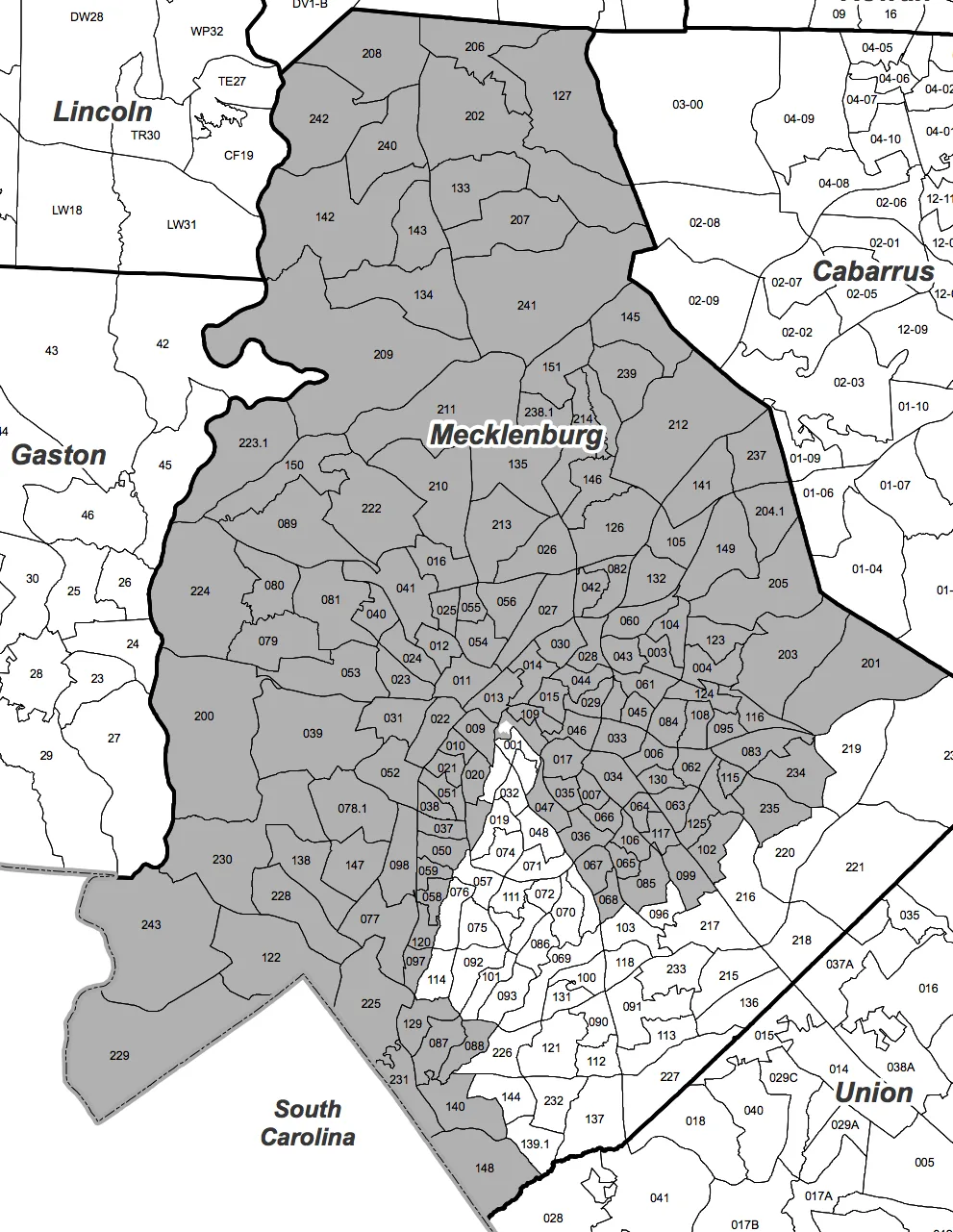
North Carolina's 12th Congressional District, drawn narrow enough for years to be described as barely wider than the interstate highway it followed for much of its length, became the basis for the 1993 Shaw v. Reno racial gerrymandering case.
The Supreme Court Has Drawn Its Own Lines
Federal courts spent decades refusing to touch redistricting at all before reversing course in the 1960s. Since then, the Supreme Court has drawn a sharp and sometimes surprising legal distinction: full authority to police race-based gerrymanders, but none at all over gerrymanders drawn purely for partisan advantage.
For decades, federal courts had treated redistricting as a "political question" they had no power to review at all, leaving some state legislative maps decades out of date with badly unequal populations. In Baker v. Carr, the Supreme Court ruled 6-2 that malapportionment claims were justiciable, meaning federal courts could hear them, opening the door to the wave of one-person-one-vote rulings that followed within two years.
The case originated in Tennessee, where legislative districts had not been redrawn since 1901 despite dramatic population shifts toward cities, meaning some rural districts held equal voting power in the state legislature with barely a fraction of the population of the most crowded urban ones.
Justice William Brennan's majority opinion held that the Equal Protection Clause supplied "judicially discoverable and manageable standards" for malapportionment, setting it apart from truly non-justiciable political questions. Justice Felix Frankfurter's dissent warned the Court was entering a "political thicket," a phrase still quoted in redistricting debate.
Chief Justice Earl Warren later called Baker v. Carr the most important decision of his tenure, ahead even of Brown v. Board of Education, because it forced the redrawing of nearly every legislative map in the country. Within two years the Court decided Wesberry, Reynolds, and companion cases applying one person, one vote nationwide.
Wesberry v. Sanders held that Article I's requirement that representatives be chosen "by the People" means congressional districts within a state must be drawn as close to equal population as practicable, establishing the one-person-one-vote standard for U.S. House districts specifically.
The case arose from a Georgia congressional district that had grown to several times the population of the state's smallest district by the early 1960s without any new map being drawn, illustrating exactly the kind of imbalance the ruling was designed to prevent going forward.
The 6-3 decision grounded the equal-population rule for U.S. House districts in Article I, Section 2's command that representatives be chosen "by the People of the several States," rather than in the 14th Amendment used for state legislatures. Later cases required deviations of even a few people to be justified.
Georgia's Atlanta-area 5th District held about 823,000 people in 1960 while the state's 9th District held about 272,000, roughly a three-to-one gap, yet each elected one member. Karcher v. Daggett (1983) later tightened the congressional standard toward near-zero permissible deviation.
Decided the same year, Reynolds v. Sims extended the one-person-one-vote principle to state legislative districts under the 14th Amendment's Equal Protection Clause, rejecting Alabama's argument that one legislative chamber could be apportioned like the U.S. Senate, by geography rather than population. Chief Justice Earl Warren's opinion declared, "Legislators represent people, not trees or acres."
The ruling required states to redraw legislative maps roughly every ten years to keep pace with population shifts and applied to both chambers of a state legislature, rejecting the so-called "little federal analogy" argument that one chamber could mirror the U.S. Senate's geography-based structure.
The 8-1 decision struck down Alabama's apportionment, based on a 1901 map and a never-implemented 1961 plan, after decades in which the state's underpopulated rural counties held decisive legislative power despite growth that was overwhelmingly urban.
Reynolds triggered redistricting in dozens of states almost immediately and shifted legislative power toward cities and suburbs nationwide. A 1966 proposed constitutional amendment by Senate Republican leader Everett Dirksen to let states apportion one chamber by non-population factors fell short of the two-thirds needed, and the rule has stood since.
Shaw v. Reno recognized, for the first time, that a district drawn predominantly on the basis of race, even one intended to help a minority group elect a candidate of its choice, could itself violate the Equal Protection Clause if race was the overriding factor in its shape, absent a compelling justification. The case involved North Carolina's 12th Congressional District, then a narrow, sprawling majority-Black district that critics said followed little more than the interstate highway for much of its length.
The Supreme Court did not strike down North Carolina's map outright in this decision; it sent the case back to a lower court to apply strict scrutiny, and the district's boundaries were litigated and redrawn multiple more times over the following decade before the dispute was finally resolved.
The 5-4 decision held that a bizarrely shaped district drawn to separate voters by race demands strict scrutiny even without proof of vote dilution, because it can signal that the state viewed citizens primarily by race. The 12th District stretched about 160 miles along Interstate 85, at points barely wider than the highway corridor.
On remand and in follow-on cases, Shaw v. Hunt (1996) and Hunt v. Cromartie (2001), the district was struck, redrawn, and litigated for nearly a decade before a version was upheld on the theory that partisanship, not race, explained its final shape. The case launched the modern racial-gerrymandering claim distinct from vote-dilution claims.
Miller v. Johnson clarified the Shaw standard, holding that strict scrutiny applies whenever race is the "predominant factor" in drawing a district, even if the district's shape looks reasonably compact, and struck down a Georgia congressional district drawn to create a third majority-Black seat.
The ruling relied heavily on evidence from Georgia's own map-drawing files and legislative testimony showing race, not traditional criteria like compactness or county lines, drove the district's shape, establishing that direct evidence of legislative intent, not just a map's appearance, could prove a racial gerrymander.
The 5-4 decision made clear the violation is not an odd shape as such but the state's subordination of traditional criteria to racial targets. It struck Georgia's 11th District, drawn under Justice Department pressure to maximize majority-Black districts under the then-active preclearance regime.
After Miller, the Justice Department could no longer require states to draw the maximum feasible number of majority-minority districts, only to avoid retrogression and vote dilution. The decision, with Shaw, set up a decade of tension between the Voting Rights Act's demands and the Equal Protection Clause's limits on race-based line drawing.
This case reviewed Texas's unusual mid-decade 2003 congressional redistricting, engineered by then-House Majority Leader Tom DeLay to replace a court-drawn map with one far more favorable to Republicans. The Supreme Court allowed most of the new map to stand, ruling mid-decade redistricting for partisan advantage was not by itself unconstitutional, but struck down one district for violating the Voting Rights Act by diluting Latino voting strength.
DeLay was later indicted, in a case legally separate from this redistricting dispute, on campaign-finance charges connected to fundraising that helped Republicans win the Texas legislative majority that made the 2003 map possible; those charges were ultimately overturned on appeal in 2013.
The fractured decision produced no majority opinion on most points. A plurality held that mid-decade redistricting for partisan gain is not unconstitutional per se and that there was still no manageable standard for judging partisan gerrymanders, foreshadowing Rucho 13 years later.
The Court did strike Texas's 23rd District under Section 2, finding the legislature had removed roughly 100,000 Latino residents just as they were about to be able to elect their preferred candidate, then offset the change with a differently drawn Latino district elsewhere that did not cure the violation. The rest of the map stood.
In a 5-4 decision, the Supreme Court held that partisan gerrymandering claims present a political question beyond the reach of federal courts entirely, meaning no matter how extreme a map's partisan bias, federal judges cannot strike it down for that reason alone. The ruling did not touch racial gerrymandering claims, which remain fully reviewable, and it left state courts free to hear partisan gerrymandering claims under their own state constitutions, which several, including Pennsylvania's and North Carolina's, have since done.
The case combined challenges to a Republican-drawn North Carolina congressional map and a Democratic-drawn Maryland congressional map, a pairing the majority opinion cited as evidence that both parties gerrymander when they hold the power to do so and that no neutral, judicially manageable standard existed to separate an ordinary partisan map from an unconstitutional one.
Chief Justice Roberts's majority held that deciding how much partisan advantage is "too much" calls for political judgments federal courts have no legal standard to make. Justice Elena Kagan's dissent, read from the bench, called the decisions "tragically wrong" and argued lower courts had already applied workable multi-part tests.
State Rep. David Lewis, co-chair of North Carolina's redistricting committee, had said the legislature sought a 10-3 Republican delegation "because I do not believe it's possible to draw a map with 11 Republicans." State courts in Pennsylvania (2018) and North Carolina (2022, then reversed by a new state-court majority in 2023), among others, have since struck maps under state constitutions.
In a decision that surprised many observers of the Court's recent voting rights rulings, a 5-4 majority upheld Section 2 of the Voting Rights Act as applied to redistricting and required Alabama to draw a second Black-opportunity congressional district, rejecting the state's argument that any race-conscious remedy under Section 2 was itself unconstitutional. The ruling reaffirmed that race-conscious redistricting to remedy proven vote dilution remains permitted even after Rucho closed the door on partisan gerrymandering claims.
Chief Justice John Roberts and Justice Brett Kavanaugh joined the Court's three more liberal justices to form the majority, a lineup that surprised many legal observers, and Alabama's newly ordered second Black-opportunity district was used in the 2024 congressional elections.
The majority applied the Thornburg v. Gingles framework and upheld the lower court's finding that Alabama's map likely violated Section 2 by packing and cracking the state's roughly 27 percent Black population into a single district out of seven. It rejected Alabama's proposed "race-neutral benchmark" as a rewrite of settled law.
Alabama first responded with a new map that again lacked a second Black-opportunity district; the district court rejected it and installed a court-drawn plan for 2024, under which a second majority-Black district elected a Democratic representative. Louisiana drew a similar second majority-Black district in 2024, but in Louisiana v. Callais (April 29, 2026) the Supreme Court held 6-3, in an opinion by Justice Alito, that the district was an unconstitutional racial gerrymander because Section 2 did not require it.
The Supreme Court has heard redistricting cases regularly since Baker v. Carr in 1962, but its 2019 Rucho decision closed federal courts to partisan gerrymandering claims entirely.
Taking the Pen Away From the Politicians
Since Rucho closed the federal courthouse door on partisan gerrymandering claims, reform energy has shifted toward changing who draws the maps in the first place. A growing number of states have moved some or all of that power out of the legislature's hands.
California voters approved Proposition 11 in 2008, creating the California Citizens Redistricting Commission for state legislative maps, then extended its authority to congressional maps with Proposition 20 in 2010, stripping the legislature of the power to draw either. Fourteen commissioners, five Democrats, five Republicans, and four from neither party, are selected through a multi-stage application and near-random selection process designed to keep sitting legislators and lobbyists out of the room entirely.
The commission's first congressional maps, drawn after the 2010 Census, produced several unusually competitive districts and unseated a handful of long-serving incumbents from both parties, a result commission supporters point to as evidence the model reduces incumbent protection even when it has not eliminated every dispute over the final lines.
State auditors screen applicants for conflicts, legislative leaders may strike a limited number, then 8 commissioners are drawn by lottery and those 8 pick the final 6. Maps need at least 9 of 14 votes, including at least 3 from each party bloc and 3 from the unaffiliated bloc, so no single group can impose a plan.
Reviews by the Public Policy Institute of California found the commission's maps more compact and modestly more competitive than the legislature's prior maps, with fewer county splits. A 2011 controversy over party-aligned groups coaching "unaffiliated" applicants and filing testimony under front-group names led to tighter disclosure rules but no finding that the maps themselves were tainted.
Arizona voters created the Arizona Independent Redistricting Commission by ballot initiative in 2000. The state legislature sued, arguing the Elections Clause gives redistricting authority to "the Legislature" specifically and that voters could not transfer it away by ballot measure. In Arizona State Legislature v. Arizona Independent Redistricting Commission (2015), the Supreme Court disagreed 5-4, holding that "the Legislature" in this context includes the people's own lawmaking power through ballot initiatives, upholding the commission and clearing the constitutional path for other states to adopt similar models.
A related theory, called the "independent state legislature doctrine," later argued state legislatures should have nearly unchecked authority over federal elections. The Supreme Court rejected the strongest version of that theory in Moore v. Harper (2023), reinforcing the same broader reading of "Legislature" the Arizona case had already established for redistricting specifically.
The 5-member Arizona commission has two Republicans, two Democrats, and an independent chair chosen by the other four (or by a state board if they deadlock). The chair's tie-breaking role has made each appointment intensely contested; in 2011 the governor and state senate briefly removed the chair, a move the state supreme court reversed.
The 2015 decision, written by Justice Ginsburg, read "the Legislature" in the Elections Clause to include the people's reserved initiative power. Moore v. Harper (2023) reinforced that reading for state courts, so ballot-initiative commissions and state-constitutional review of federal maps are both settled as permissible.
Michigan voters approved Proposal 2 in 2018 by a wide margin, creating a 13-member Independent Citizens Redistricting Commission, four Democrats, four Republicans, and five independents, chosen from a pool of randomly selected applicants, that draws both congressional and state legislative maps and holds mandatory public hearings across the state before finalizing them.
The commission was created partly in response to Michigan's prior-decade maps, which a federal court later found, in a separate case, contained an unconstitutional partisan gerrymander in several districts (a 2019 ruling later vacated after the Supreme Court's Rucho decision), a ruling that helped build public support for the 2018 ballot measure.
Proposal 2 passed with about 61 percent of the vote. Applicants are screened by the secretary of state and randomly selected, with legislative leaders allowed to strike a limited number; maps require majority support including at least two commissioners from each of the three groups.
The commission's first maps, used in 2022, produced Michigan's most competitive congressional and legislative landscape in decades, and control of the state legislature flipped that year for the first time since the 1980s. A federal court in 2024 ordered several Detroit-area state legislative districts redrawn for over-relying on race, and the commission produced replacements.
Iowa uses a distinct approach dating to 1980: the state's nonpartisan Legislative Services Agency, not a citizen commission, draws maps using only population and contiguity criteria, explicitly barred by law from considering incumbents' addresses or partisan voting data. The legislature must vote the resulting map up or down without amendments; if it rejects two proposals, the agency's third map goes into effect regardless. Iowa's congressional maps are consistently rated among the most competitive and compact in the country under this system.
Because the Legislative Services Agency is barred by law from even considering election results, Iowa's maps have occasionally still drawn criticism from legislators in a given cycle, showing that a strictly nonpartisan process does not guarantee an outcome every lawmaker finds favorable, only one drawn without regard to partisan data.
The agency has drawn maps every cycle since 1981 using only population equality, contiguity, compactness, and respect for county and city lines, and keeps counties whole in congressional maps, a constraint few other states impose.
The legislature has accepted the first or second agency plan in every cycle except 1981, when it rejected the first two and adopted the third. Iowa's four whole-county congressional districts, drawn blind to politics, rank among the nation's most competitive, though the model works partly because Iowa is compact and county-rich.
Several states use a middle-ground model: an advisory commission draws a map and the legislature can accept or modify it, or a backup commission takes over only if the legislature deadlocks. New Jersey's apportionment commission and Ohio's post-2015 reforms, which still allow legislature-passed maps but impose stricter bipartisan-vote requirements for maps meant to last a full ten years, are examples of this hybrid category rather than a fully independent commission.
Ohio's 2015 and 2018 reforms were themselves triggered by public frustration with the state's prior legislature-only process. Even under the new bipartisan-vote requirements, Ohio's commission deadlocked repeatedly during the 2021-2022 cycle, and its maps were struck down multiple times by the state supreme court before a version was allowed to stand for the 2022 election under a court-ordered deadline.
New Jersey uses a 13-member commission with an appointed tie-breaker for legislative maps and a separate commission for congressional maps; the tie-breaker has decided several recent New Jersey maps outright. Ohio's amendments kept the legislature and a politician commission in the loop but required bipartisan votes for a full-length map.
Ohio's hybrid produced repeated deadlock: the state supreme court struck the commission's legislative maps five times and its congressional map twice as unconstitutional partisan gerrymanders, but with primaries looming a federal court allowed a struck map to be used for 2022. Ohio voters then rejected a 2024 initiative that would have created a fully independent commission.
Independent commissions have not ended redistricting controversy where they exist. Commissioner selection processes can still be gamed by party operatives working to get sympathetic "independents" appointed, commissions can deadlock and hand the final map to a court anyway, as happened in California's own first cycle and in several New Jersey and Virginia cycles, and a commission's map can still be challenged in court on racial-gerrymandering or Voting Rights Act grounds like any legislature-drawn map. Political scientists generally find commissions produce more competitive, less extreme maps on average, not maps entirely free of dispute.
Some critics argue commissions can shift disputes rather than resolve them, since a commission's own selection rules, definition of "independent," and tie-breaking procedures become the next target of litigation and political maneuvering, rather than the district lines alone being the sole focus of controversy as under a legislature-only system.
Studies by the Brennan Center and academic researchers generally find commission maps are more compact, split fewer counties, and yield somewhat more competitive districts, but the effect sizes are moderate and vary by state. Commissions have deadlocked and handed maps to courts in California's first cycle, Arizona, Virginia's new commission in 2021, and New Jersey.
Commission designs themselves become litigation targets: who qualifies as "independent," how tie-breakers are chosen, and whether a commission map can be challenged for partisan effect under a state constitution. Reformers respond that no process removes politics entirely, and that the realistic comparison is not a perfect map but a legislature drawing its own districts.
Ten Facts Worth Knowing
A quick-reference set of facts drawn from the sourced material throughout this page, useful for a fast read or a classroom discussion starter.
The word "gerrymander" comes from Massachusetts Governor Elbridge Gerry, but his own name was pronounced with a hard G. The word that immortalized him has always been pronounced with a soft G instead.
The 1812 cartoon that coined the term was for decades misattributed to the famous portrait painter Gilbert Stuart. Historians now credit engraver Elkanah Tisdale as the actual artist.
Congress simply failed to reapportion House seats at all after the 1920 Census, the only time in American history this has happened, largely because rural lawmakers resisted shifting power to fast-growing cities.
The House of Representatives has been fixed at 435 seats since a 1929 law, meaning every congressional district today represents roughly 760,000 people on average, up from about 30,000 when the House was first apportioned.
"Legislators represent people, not trees or acres," Chief Justice Earl Warren wrote in Reynolds v. Sims (1964), rejecting the idea that a state legislative chamber could be apportioned by geography instead of population.
Since the Supreme Court's 2019 Rucho decision, federal courts cannot strike down a map for partisan gerrymandering no matter how extreme it is. Only state courts, under their own state constitutions, still can.
Racial gerrymandering claims are not affected by Rucho and remain fully reviewable in federal court, which is why litigation over maps often turns on proving race, not party, predominantly drove the district's shape.
North Carolina's 12th Congressional District, at the center of the 1993 Shaw v. Reno case, was once so narrow that a state legislator joked you could kill the district by driving down Interstate 85 with your car doors open.
Free public tools like Dave's Redistricting App use the same official Census Bureau shapefile data as professional mapmakers, letting anyone build and test an alternative district map from a home computer.
Iowa's maps are drawn by nonpartisan legislative staff who are legally barred from even looking at incumbents' addresses or partisan voting data, and the legislature can't amend what they produce, only accept or reject it.
Sources & Further Reading
- National Archives, Constitution Annotated: Article I, Section 4 (Elections Clause)
- U.S. Census Bureau, Congressional Apportionment
- U.S. Census Bureau, Redistricting Data Program
- National Conference of State Legislatures, Redistricting Commissions: Congressional Plans
- National Conference of State Legislatures, Redistricting Law 2020
- Oyez / Supreme Court of the United States, Baker v. Carr (1962)
- Oyez / Supreme Court of the United States, Reynolds v. Sims (1964)
- Oyez / Supreme Court of the United States, Shaw v. Reno (1993)
- Supreme Court of the United States, Rucho v. Common Cause (2019)
- Supreme Court of the United States, Allen v. Milligan (2023)
- Cornell Legal Information Institute, Arizona State Legislature v. Arizona Independent Redistricting Commission (2015)
- Stephanopoulos, N. & McGhee, E., "Partisan Gerrymandering and the Efficiency Gap," University of Chicago Law Review (2015)
- Brennan Center for Justice, Redistricting Commissions: What Works
- Encyclopaedia Britannica, Gerrymandering
- PlanScore, Measuring Partisan Bias in District Plans
This page draws on the U.S. Constitution and its Annotated Constitution guide published by Congress.gov, official U.S. Census Bureau documentation of the reapportionment and redistricting process, published Supreme Court opinions and Oyez case summaries, the National Conference of State Legislatures' state-by-state tracking of redistricting rules and commissions, the Brennan Center for Justice's research on commission design, and the peer-reviewed law review article that introduced the efficiency gap metric. Redistricting law and state commission rules change between census cycles; state-specific details are current as of the 2020 Census redistricting cycle and should be verified against a state's own election authority for the most current maps and rules.