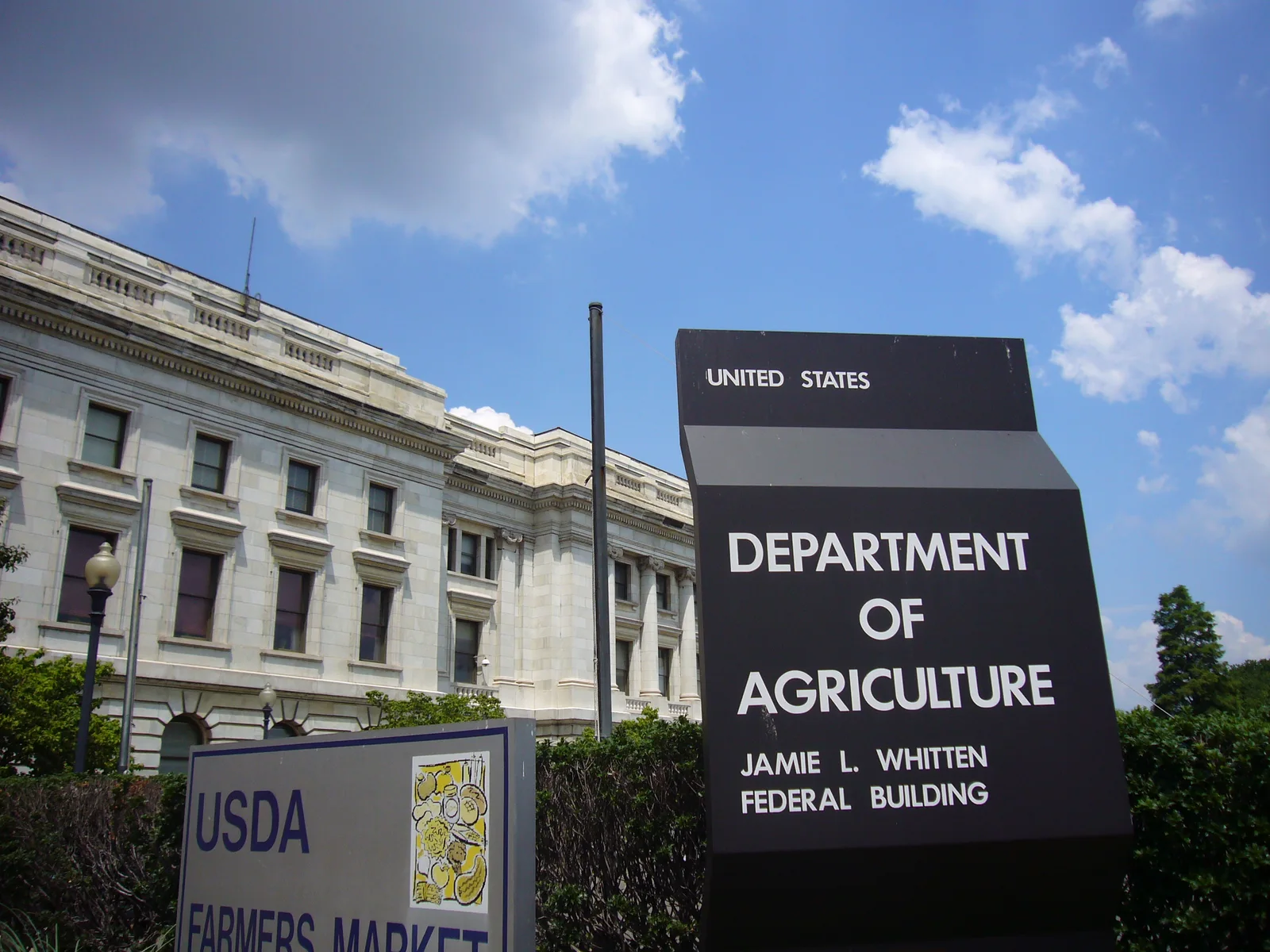
What The Agriculture Department (USDA) Does
Established May 15, 1862, The U.S. Department of Agriculture is one of the fifteen Cabinet-level departments of the U.S. federal government.
The Agriculture Department oversees the food and farm system in the United States, from inspecting meat, poultry, and egg products for safety to administering crop insurance and subsidy programs that support farmers against price swings and weather disasters. It also manages the nation's 154 national forests and 20 national grasslands, covering nearly 200 million acres.
USDA runs the country's largest nutrition assistance programs, including the Supplemental Nutrition Assistance Program (SNAP, formerly food stamps) and the National School Lunch Program, which together account for the majority of the department's total budget, since these programs are legally mandatory rather than subject to annual discretionary funding fights.
The department also funds rural development, including rural housing, utility, and business loan programs, conducts agricultural research through its Agricultural Research Service, and publishes closely watched economic data, including crop production forecasts that move commodity markets worldwide.
USDA is organized into roughly 29 agencies and offices grouped under mission areas such as Farm Production and Conservation, Food, Nutrition, and Consumer Services, and Natural Resources and Environment. It maintains a field presence in nearly every county through the Farm Service Agency and the Natural Resources Conservation Service, a legacy of its New Deal-era expansion into local farm support.

The Secretary of Agriculture
The Secretary of Agriculture leads The Agriculture Department (USDA), sits on the President's Cabinet, and is confirmed by a majority vote of the U.S. Senate.
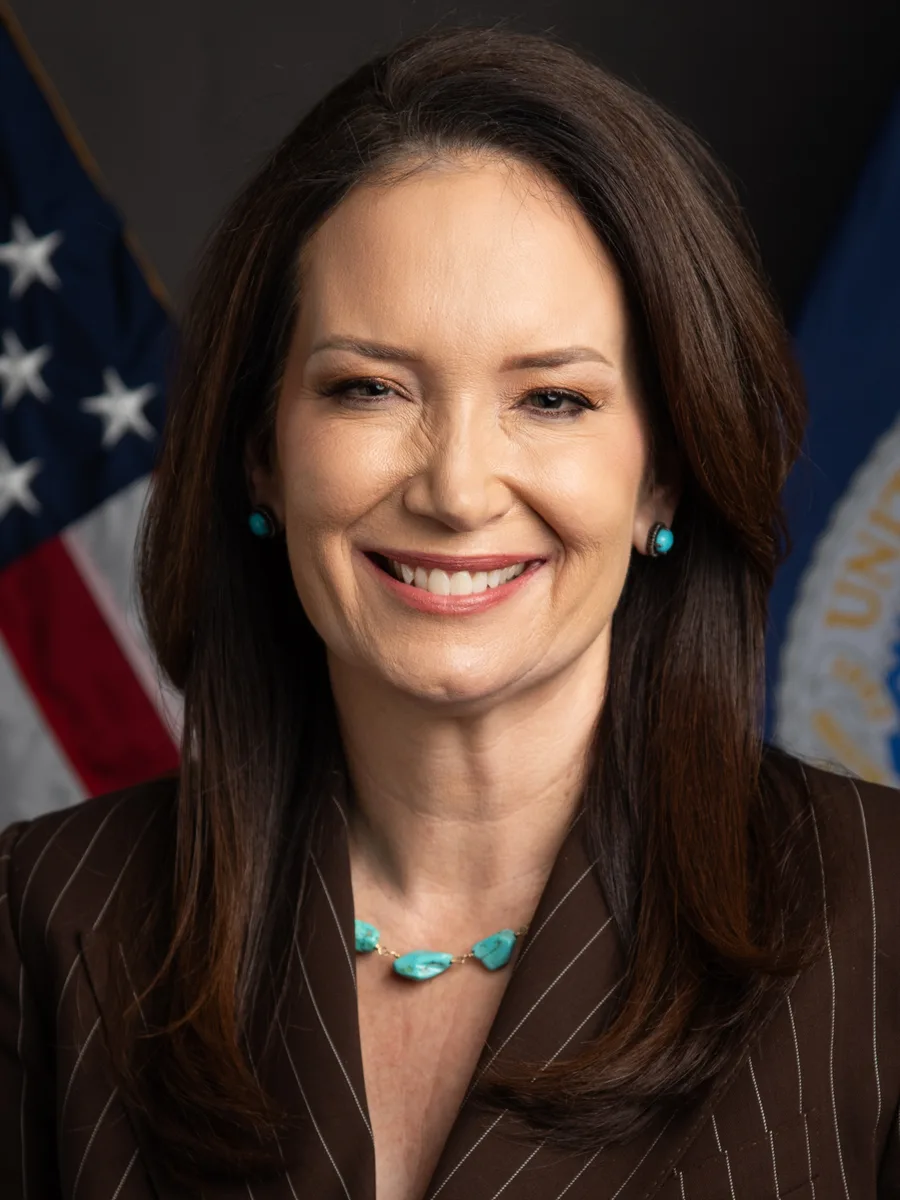
Current Secretary of Agriculture
Brooke Rollins
In office since
February 13, 2025
Prior role: Director of the White House Domestic Policy Council (2019-2021); President and CEO, America First Policy Institute
Brooke Rollins was confirmed as Secretary of Agriculture on February 13, 2025. She previously served as Director of the White House Domestic Policy Council during the first Trump administration and later founded and led the America First Policy Institute, a policy research organization.
Rollins holds a background in agricultural development economics from Texas A&M University, where she also served as a student body president, and before her White House role led the Texas Public Policy Foundation, a state-level think tank, for over a decade.
Major Sub-Agencies & Bureaus
The Agriculture Department (USDA) carries out its mission through operating divisions and sub-agencies, each with its own specific mandate.
FSIS inspectors are stationed in every federally regulated meat, poultry, and egg product processing plant in the country, and no such product can legally be sold in interstate commerce without passing FSIS inspection, one of the most direct hands-on federal regulatory presences in private industry.
The agency's inspection mark, a small USDA stamp, appears on essentially all commercially sold meat and poultry products in the United States, and FSIS also investigates foodborne illness outbreaks linked to these products in coordination with the CDC and FDA, which separately regulates most other food categories.
FSIS employs on the order of 9,000 inspection personnel and carries out continuous inspection under authority that traces to the Federal Meat Inspection Act of 1906 and the Poultry Products Inspection Act of 1957. Unlike much of the FDA's food work, its inspection is mandatory and paid for by taxpayers rather than industry fees.
The agency can detain product and request recalls, but because it cannot order a mandatory recall on its own for most situations, recalls of contaminated meat are almost always technically voluntary actions by the company, prompted by FSIS findings on pathogens such as E. coli O157:H7, Salmonella, and Listeria.
The Food and Nutrition Service administers SNAP, which served roughly 42 million people in 2024, along with the National School Lunch and Breakfast Programs, which together feed tens of millions of children on school days, and WIC, which provides nutrition assistance to low-income pregnant women, new mothers, and young children.
These programs are funded as mandatory spending set by the Farm Bill, the major piece of legislation Congress reauthorizes roughly every five years covering both farm subsidies and nutrition assistance, a pairing that has historically helped the bill draw support from both rural and urban lawmakers.
FNS does not run the programs directly at the point of service; it sets rules and reimbursement rates and channels money through state agencies, school districts, and about 250,000 authorized SNAP retailers. In an average recent year the agency's programs account for more than two-thirds of the entire USDA budget.
Program design details carry large stakes: the benefit formula rests on USDA's Thrifty Food Plan, whose 2021 reevaluation raised average SNAP benefits by roughly 21 percent, and work-requirement rules for able-bodied adults without dependents are among the most frequently litigated and legislated features of the safety net.
The Forest Service manages 154 national forests and 20 national grasslands spanning nearly 200 million acres, more land than the National Park Service oversees, balancing timber production, recreation, watershed protection, and, increasingly, wildfire prevention and response.
Wildfire suppression has come to dominate the agency's budget and mission in recent decades as fires have grown larger and more destructive, with the Forest Service now spending well over half its annual budget on fire-related activities in especially severe years.
The agency was created in 1905 under Gifford Pinchot, who moved the existing forest reserves out of the Interior Department and set the utilitarian mission of managing them for "the greatest good of the greatest number in the long run." It sits in USDA rather than Interior for that historical reason.
Beyond firefighting and timber, the Forest Service runs one of the largest forestry research organizations in the world, provides grants and technical help to state and private forest owners (who hold most U.S. forestland), and manages tens of thousands of miles of trails and thousands of developed recreation sites.
USDA's in-house research arm conducts studies on crop breeding, food safety, animal health, and nutrition, operating more than 90 research locations across the country and abroad, and its findings have historically underpinned major advances like disease-resistant crop varieties and improved livestock breeding techniques.
The agency also maintains the National Plant Germplasm System, a network of gene banks preserving the genetic diversity of crop varieties, an insurance policy against future disease outbreaks or climate shifts that could threaten the narrow genetic base of modern commercial agriculture.
ARS is the largest of USDA's four in-house science agencies and works alongside the National Institute of Food and Agriculture, which instead funds competitive grants and the land-grant university and cooperative extension system created by the Morrill Acts and the Hatch Act. Together they form the backbone of publicly funded U.S. agricultural science.
From May 15, 1862 to Today
The predecessor of The Agriculture Department (USDA) was no predecessor; created as a new agency by Congress and President Lincoln. Here is how the department reached its current form.
President Lincoln signed legislation creating the Department of Agriculture on May 15, 1862, in the middle of the Civil War, at a time when nearly half the American population worked in farming. Lincoln later called it 'The People's Department' in his December 1862 message to Congress.
The new department's early mission focused on distributing seeds to farmers and collecting agricultural statistics, functions that seem modest by modern standards but were considered vital services at a time when reliable farming information was scarce and often locally unreliable.
The same busy 1862 Congress also passed the Homestead Act, opening western land to settlers, and the first Morrill Act, granting states federal land to endow "land-grant" agricultural and mechanical colleges. USDA's research and education work grew up intertwined with those colleges.
Congress elevated the Commissioner of Agriculture to Secretary of Agriculture with full Cabinet rank in 1889, reflecting the growing political and economic importance of the farm sector as the country industrialized and agricultural output became central to the national economy.
Norman Jay Colman became the first Secretary of Agriculture, serving only briefly at the very end of the Cleveland administration before a new administration took office, but the elevation permanently established agriculture as a full Cabinet-level concern going forward.
The move fit a wider late-19th-century pattern of farmers organizing politically, through the Grange and later the Populist movement, to demand that the federal government take their interests as seriously as it took railroads and manufacturing.
Prompted partly by public outrage over unsanitary meatpacking conditions exposed in Upton Sinclair's novel The Jungle, Congress passed the Meat Inspection Act in 1906, giving USDA authority to inspect meat sold across state lines, the direct ancestor of today's Food Safety and Inspection Service.
The same year, Congress passed the Pure Food and Drug Act, which initially operated under USDA's Bureau of Chemistry before that function eventually split off in 1930 to form the independent Food and Drug Administration.
The chief chemist behind the reform, Harvey Washington Wiley, had spent years publicizing food adulteration, including through a volunteer "Poison Squad" that tested preservatives on human subjects. His campaign is why food-safety regulation began inside the agriculture department at all.
The Agricultural Adjustment Act of 1933, part of President Franklin Roosevelt's New Deal response to the Great Depression, created the first major federal farm subsidy programs, paying farmers to limit production in an effort to raise crashing crop prices during a severe agricultural depression.
Though the Supreme Court struck down the original 1933 law's funding mechanism in 1936, Congress quickly rewrote the program in a form that survived legal challenge, and the basic model of federal farm income support established in this era still shapes USDA farm programs today.
The 1930s also gave USDA its lasting local footprint: the Soil Conservation Service (1935), the Farm Security Administration, the Rural Electrification Administration (1935), and county committees of farmers that still help run federal programs. Critics note the early payments favored landowners over the tenant farmers and sharecroppers who worked the land.
The Food Stamp Act of 1964 made permanent a nutrition assistance program that had been tested on a pilot basis earlier in the decade, establishing what eventually became SNAP, today the largest single program in USDA's budget and one of the largest anti-hunger programs in the world.
The program has been reshaped many times since, including a shift from paper stamps to electronic benefit transfer cards in the 1990s and 2000s, and it remains one of the most closely watched and debated components of each new Farm Bill Congress passes.
It was part of President Johnson's War on Poverty, alongside the 1966 Child Nutrition Act that expanded school meals and created the school breakfast program. Nutrition assistance grew from a minor USDA function into the majority of its spending over the following half century.
Defining Moments
Events that reshaped the department's authority, structure, or public role.
The severe drought and soil erosion of the 1930s Dust Bowl devastated farms across the Great Plains, prompting USDA to create the Soil Conservation Service in 1935 to help farmers adopt erosion-control practices like contour plowing and windbreak planting.
The crisis permanently changed how the department approaches land stewardship, embedding soil and water conservation as a core USDA mission alongside its original focus on production and research, a shift still reflected in today's Natural Resources Conservation Service.
At its peak the dust storms carried an estimated hundreds of millions of tons of topsoil, and one 1935 storm darkened the skies over Washington, D.C., as Congress was considering the conservation bill, which soil scientist Hugh Hammond Bennett used to dramatic effect while testifying.
USDA also planted the Prairie States Forestry Project, a belt of more than 200 million trees from Texas to the Dakotas, and used the Resettlement Administration to move families off exhausted land. The episode established that farm policy would thereafter be judged partly on its effect on the land itself.
USDA-funded agricultural research contributed significantly to the mid-20th century Green Revolution, the dramatic increase in crop yields achieved through improved seed varieties, fertilizers, and irrigation techniques that helped avert widely predicted global famines in the 1960s and 1970s.
American agronomist Norman Borlaug, whose wheat-breeding work was closely tied to USDA and land-grant university research networks, won the 1970 Nobel Peace Prize for this work, credited with saving hundreds of millions of lives worldwide.
U.S. corn yields roughly quadrupled between the 1930s and today, and wheat and soybean yields rose sharply, driven by hybrid seed, synthetic nitrogen fertilizer, mechanization, and pest control. The share of Americans working in agriculture fell from about a quarter in 1930 to under 2 percent.
The same productivity gains drew criticism over time for heavy fertilizer and pesticide use, groundwater depletion, loss of crop diversity, and the consolidation of farming into fewer and larger operations, tensions that run through modern debates over USDA conservation and organic programs.
Because farm subsidies and SNAP nutrition benefits are bundled together in the same periodic Farm Bill legislation, the bill has become a recurring five-year political battleground, with disagreements over SNAP work requirements and eligibility rules frequently threatening to derail the broader agricultural policy package.
The pairing of farm and nutrition programs in one bill, originally intended to build a durable urban-rural legislative coalition, has increasingly strained in recent Farm Bill cycles as the two halves of the coalition have grown further apart politically.
In 2013 the House for the first time split the two halves into separate bills before reuniting them in conference, and the 2018 bill passed only after a proposed expansion of SNAP work requirements was dropped. When Congress cannot agree, it typically passes short extensions of the prior bill rather than let farm programs lapse to permanent 1938 and 1949 "permanent law."
Nutrition assistance now makes up roughly 80 percent of projected Farm Bill spending, with crop insurance, commodity supports, and conservation programs splitting most of the rest, so the fight over the bill is largely a fight over SNAP.
Notable Programs & Initiatives
A selection of the programs The Agriculture Department (USDA) runs, and what each one is actually for.
SNAP is the nation's largest food assistance program, providing monthly benefits loaded onto electronic cards that recipients use like debit cards at approved grocery stores, serving roughly 42 million Americans in a typical recent year, more than one in eight people in the country.
Benefit levels are calculated based on household size, income, and the USDA's Thrifty Food Plan, a model diet cost estimate the department updates periodically, and eligibility rules, especially work requirements for able-bodied adults, remain among the most politically contested details of the program.
The federal government pays the full cost of the benefits, roughly $100 billion in a recent year (a 2025 law will require states with high payment-error rates to share benefit costs starting in fiscal 2028), and splits administrative costs with the states, which run the actual enrollment. The average benefit works out to about $6 per person per day.
Research by USDA's Economic Research Service and academic economists generally finds SNAP is one of the more responsive anti-recession programs, expanding automatically when unemployment rises, and studies link childhood access to it to better adult health and economic outcomes; error and fraud rates are low, with retailer trafficking estimated at around one cent per benefit dollar.
Created in 1946, the National School Lunch Program provides low-cost or free lunches to more than 29 million children on a typical school day, making it one of the largest child nutrition programs in the world and a program many schools also pair with USDA's School Breakfast Program.
USDA reimburses participating schools per meal served and sets nutritional standards the meals must meet, standards that have been periodically revised, most notably during the 2010 Healthy, Hunger-Free Kids Act, which tightened nutrition requirements and expanded access to free meals for more students.
The program was signed by President Truman, who framed it partly as a national-security matter after many World War II draftees were rejected for conditions linked to childhood malnutrition. USDA also uses it to move surplus commodities into schools.
The 2010 standards, requiring more whole grains and produce and capping sodium and calories, drew pushback from some school nutrition directors and members of Congress over cost and food waste; the Community Eligibility Provision from the same law now lets high-poverty schools serve free meals to all students without collecting individual applications.
The Risk Management Agency administers the federal crop insurance program, which subsidizes private insurance policies protecting farmers against crop losses from weather, pests, and price drops, and has grown into one of the largest farm safety net programs, covering hundreds of millions of acres of U.S. farmland.
The program has gradually replaced older direct-payment subsidy models as the primary tool of federal farm income support, reflecting a decades-long shift in farm policy toward insurance-based risk management rather than fixed annual subsidy checks.
The government pays about 60 percent of farmers' premiums on average and also covers the administrative costs and a share of losses for the roughly a dozen private companies that sell and service the policies. Total federal cost runs on the order of $10 billion a year, more in disaster years.
The 2014 Farm Bill eliminated the older "direct payments" that went to landowners regardless of need and leaned further on crop insurance. Critics, including the Government Accountability Office, argue the premium subsidies are poorly targeted and flow disproportionately to the largest farms; supporters say near-universal participation is what makes the safety net work.
USDA Rural Development provides loans and grants for rural housing, water and electric infrastructure, and small business financing in communities too small or remote to attract conventional private lending, filling a financing gap that shapes economic opportunity across much of rural America.
The agency's Rural Housing Service alone has helped finance homeownership for millions of low- and moderate-income rural families since its creation, often serving as the only viable mortgage option in areas where major banks maintain little or no local presence.
The programs descend from the Rural Electrification Administration, created in 1935, which brought power lines to a countryside that private utilities had left dark; by 1950 the share of U.S. farms with electricity had risen from roughly 10 percent to about 90 percent.
Today Rural Development runs a loan and grant portfolio in the hundreds of billions of dollars, backing broadband buildout, hospital and school construction, cooperative water systems, and business loans in communities under about 20,000 to 50,000 people depending on the program.
How This Affects Everyday Americans
The USDA inspection stamp on meat and poultry products in every grocery store in the country is one of the most literal, daily touchpoints between a federal agency and the American dinner table, and USDA's food safety recalls directly affect what products get pulled from shelves after contamination outbreaks.
For the roughly 42 million Americans receiving SNAP benefits and the tens of millions of children eating USDA-subsidized school meals each day, the department's nutrition programs are a direct and immediate part of household food budgets, particularly for lower-income families.
USDA's crop insurance and farm subsidy programs help stabilize food prices and farm incomes nationwide, meaning the department's policy decisions ripple from rural farm country all the way to grocery store price tags in cities far from any working farm.
Anyone who hikes, camps, hunts, or fishes on a national forest, checks a USDA hardiness zone before planting a garden, or relies on rural electric or broadband service that a USDA loan helped build is using the department's work, often without noticing the federal role behind it.
Quick Facts & Figures
Key statistics and reference information about The Agriculture Department (USDA).
| Established | May 15, 1862 |
| Headquarters | Jamie L. Whitten Building, Washington, D.C. |
| Current Secretary | Brooke Rollins |
| Annual Budget | ~$213 billion (FY2024, incl. mandatory nutrition spending) |
| Employees | ~100,000 |
| Cabinet-Level Since | 1889 |
| National Forest Land Managed | ~193 million acres |
| Website | usda.gov |
Did You Know?
Abraham Lincoln created USDA in 1862 and personally called it 'The People's Department' in a message to Congress that same year.
USDA runs the national school lunch program that feeds more than 29 million children on a typical school day, one of the largest food programs in the world.
The Food and Drug Administration actually began as a small bureau inside USDA before taking the FDA name in 1930 and moving out of USDA in 1940.
The U.S. Forest Service, part of USDA, manages nearly 200 million acres of national forest and grassland, more land than the entire National Park System.
SNAP served roughly 42 million Americans in a recent year, more than one in every eight people in the country.