
What The War Department Does
Established in 1947 (as the National Military Establishment, renamed the Department of Defense in 1949), The U.S. Department of War is one of the fifteen Cabinet-level departments of the U.S. federal government.
The Department of War organizes, trains, and equips the U.S. armed forces and directs them in military operations to defend the country and its allies. It oversees five of the six military services, the Army, Navy, Marine Corps, Air Force, and Space Force. The sixth, the Coast Guard, sits under the Department of Homeland Security in peacetime and can be transferred to the Navy in wartime or when the president directs.
It is by far the largest federal department. About 1.3 million active-duty service members, roughly 770,000 members of the National Guard and Reserve, and about 780,000 civilian employees work for it, close to 2.9 million people in all according to the department. Its base budget of roughly $850 billion is about half of all federal discretionary spending, the portion of the budget Congress sets each year. You can see how that compares to other agencies on the federal budget breakdown page.
Its work reaches well beyond combat. The department runs one of the largest health care systems in the country through TRICARE, operates about 160 schools for military children, funds research through DARPA that produced the forerunner of the internet, and operates the GPS satellites that phones, farms, banks, and airlines rely on every day.
The Secretary of War, whose legal title is still Secretary of Defense, is the president's principal adviser on military matters and sits sixth in the presidential line of succession. The Secretary is second in the military chain of command, directly below the president, who serves as commander in chief. For how each service is organized, what it does, and how to join, see the U.S. Armed Forces page.
Defense or War? The name question
On September 5, 2025, Executive Order 14347 authorized the department to use "Department of War" and "Secretary of War" as secondary titles in official correspondence, public communications, and ceremonies. The legal name set by Congress in Title 10 of the U.S. Code is still the Department of Defense, and only an act of Congress can change it. Bills to make the change official were introduced in Congress in September 2025. This page calls it the Department of War, the name the department itself now uses, and uses the legal name, Department of Defense, where the law or its history is being described.
The Secretary of War
The Secretary of War leads The War Department, sits on the President's Cabinet, and is confirmed by a majority vote of the U.S. Senate.

Current Secretary of War
Pete Hegseth
In office since
January 25, 2025 (confirmed January 24)
Prior role: Fox News host and U.S. Army National Guard veteran
Pete Hegseth is the 29th Secretary of Defense. A former Army National Guard infantry officer who served in Guantanamo Bay, Iraq, and Afghanistan and later worked as a Fox News host, he was confirmed on January 24, 2025, by a 51 to 50 vote, with Vice President JD Vance casting the tie-breaking vote. It was only the second time a vice president had broken a tie on a Cabinet nomination, after Betsy DeVos for Education in 2017. Since September 2025 he has also used the secondary title Secretary of War.
Hegseth is sixth in the presidential line of succession and second in the military chain of command, directly below the president. His legal title under Title 10 of the U.S. Code is Secretary of Defense; Executive Order 14347, signed on September 5, 2025, lets him use Secretary of War as a secondary title in official correspondence, public communications, and ceremonies.
The Leadership Team
As of September 2026
Steve Feinberg, a co-founder of the investment firm Cerberus Capital Management, was confirmed as Deputy Secretary in March 2025. The Deputy runs the department's internal management, including the budget process, and would act as Secretary if the post became vacant.
General Dan Caine of the Air Force was confirmed as Chairman of the Joint Chiefs of Staff in April 2025. A retired lieutenant general who was recalled to active duty and promoted, he had not served as a service chief or combatant commander, which the law normally expects of a Chairman. The president used the waiver the statute allows.
Below the senior leadership, the department is organized into five main parts, shown below. Names change with each administration and sometimes more often, so check the department's official leadership pages for the latest.
How the Department Is Organized
Office of the Secretary
6 under secretaries
The civilian staff that sets policy, builds the budget, and oversees acquisition, personnel, research, and intelligence.
Joint Chiefs of Staff
8 members
The Chairman, Vice Chairman, five service chiefs, and the Chief of the National Guard Bureau, supported by the Joint Staff.
Military Departments
3 departments, 5 services
Army; Navy and Marine Corps; Air Force and Space Force. They recruit, train, and equip forces.
Combatant Commands
11 commands
Seven geographic and four functional commands that direct operations with forces from every service.
Defense Agencies
About two dozen
Support organizations such as the Defense Logistics Agency, Defense Health Agency, DARPA, and the intelligence agencies.
How It Works Day to Day
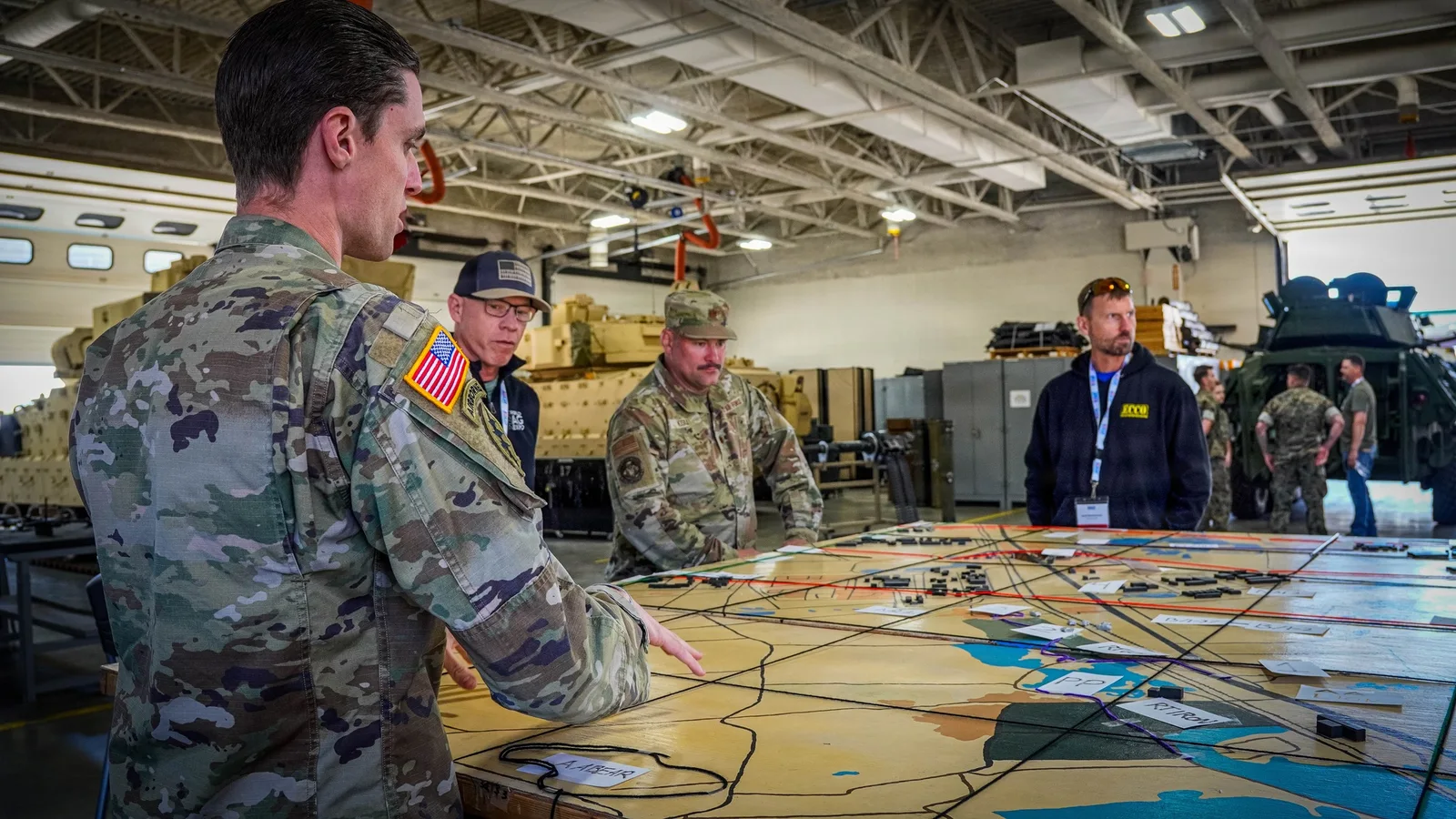
Two separate chains run through the department. The operational chain, used for combat and deployments, runs from the president to the Secretary of Defense and then directly to the commanders of the 11 combatant commands. The administrative chain runs from the Secretary to the secretaries of the Army, Navy, and Air Force and to the service chiefs, whose job is to recruit, organize, train, and equip forces and hand them to the combatant commanders. The services do not command the wars they supply troops for.
The Secretary works through the Office of the Secretary of Defense, a civilian staff led by the Deputy Secretary, who acts as the department's chief operating officer. Six under secretaries oversee policy, acquisition and sustainment, research and engineering, the budget as comptroller, personnel and readiness, and intelligence and security. The research and acquisition jobs became separate under secretaries in 2018, when Congress split up an office that had grown too large to manage.
Around the clock, the National Military Command Center inside the Pentagon monitors world events and links the president and Secretary to forces worldwide, including the systems used to command nuclear forces. Only the president can authorize the use of nuclear weapons. The Secretary's role in that process is to confirm and pass on the order, not to approve it.
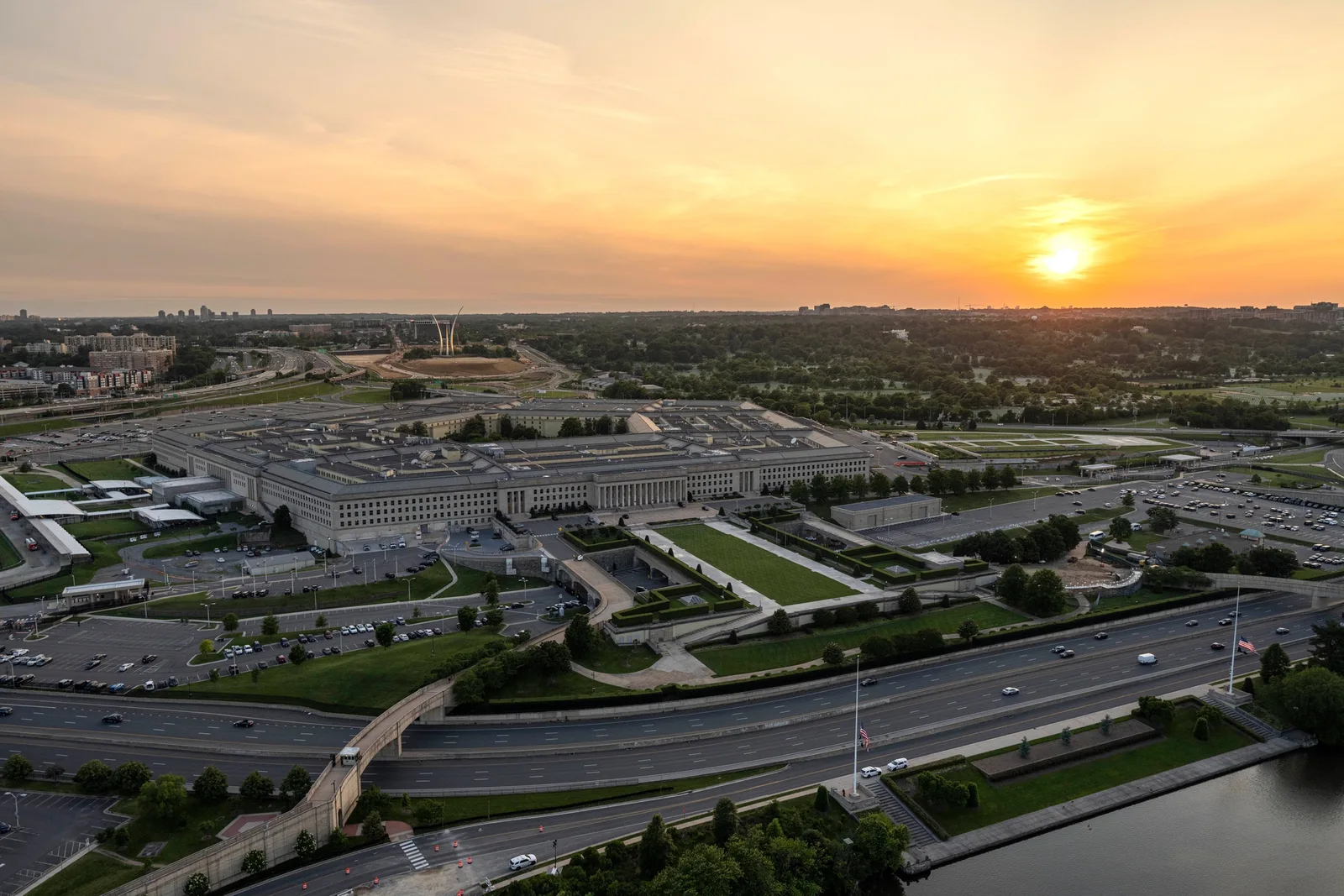
The Pentagon itself is a small city. About 23,000 military and civilian employees and roughly 3,000 support staff work in a building with about 6.5 million square feet of floor space and 17.5 miles of corridors. Its five-ring design means any two offices are, by the Pentagon tour office's count, no more than about seven minutes apart on foot.

Inside the Department
Select any part of the department to see what it does, how it was created, and how it fits into the chain of command.
By law, the operational chain of command runs from the president to the Secretary of Defense and then to the combatant commanders. No one else, including the Chairman of the Joint Chiefs, is in that chain. Orders to deploy forces or begin operations are approved by the Secretary on the president's behalf.
The Chairman may pass orders along from the president and Secretary to the combatant commanders, and usually does, but only as a transmitter. The Chairman advises and communicates. The Chairman does not command.
The rule dates to the 1958 Defense Reorganization Act and was reinforced by the Goldwater-Nichols Act in 1986. Before those laws, service chiefs sometimes directed operations through their own branches, which made joint operations harder to coordinate.
Civilian control is built into every level. The Secretary, the Deputy Secretary, the service secretaries, and the under secretaries are all civilians confirmed by the Senate. Military officers swear an oath to support and defend the Constitution, not any individual leader.
The Department of the Army, the Department of the Navy, and the Department of the Air Force are each led by a civilian secretary. The Navy department includes both the Navy and the Marine Corps, and the Air Force department includes both the Air Force and the Space Force.
Each service has a senior uniformed leader: the Army Chief of Staff, the Chief of Naval Operations, the Commandant of the Marine Corps, the Air Force Chief of Staff, and the Chief of Space Operations. Together with the Chief of the National Guard Bureau, they are members of the Joint Chiefs of Staff.
The military departments run recruiting, basic training, service schools, bases, and the purchase of most weapons and equipment. They also run the service academies at West Point, Annapolis, and Colorado Springs.
Until 1949 the secretaries of the Army, Navy, and Air Force were members of the Cabinet. Today they report to the Secretary of Defense and sit outside both the Cabinet and the operational chain of command.
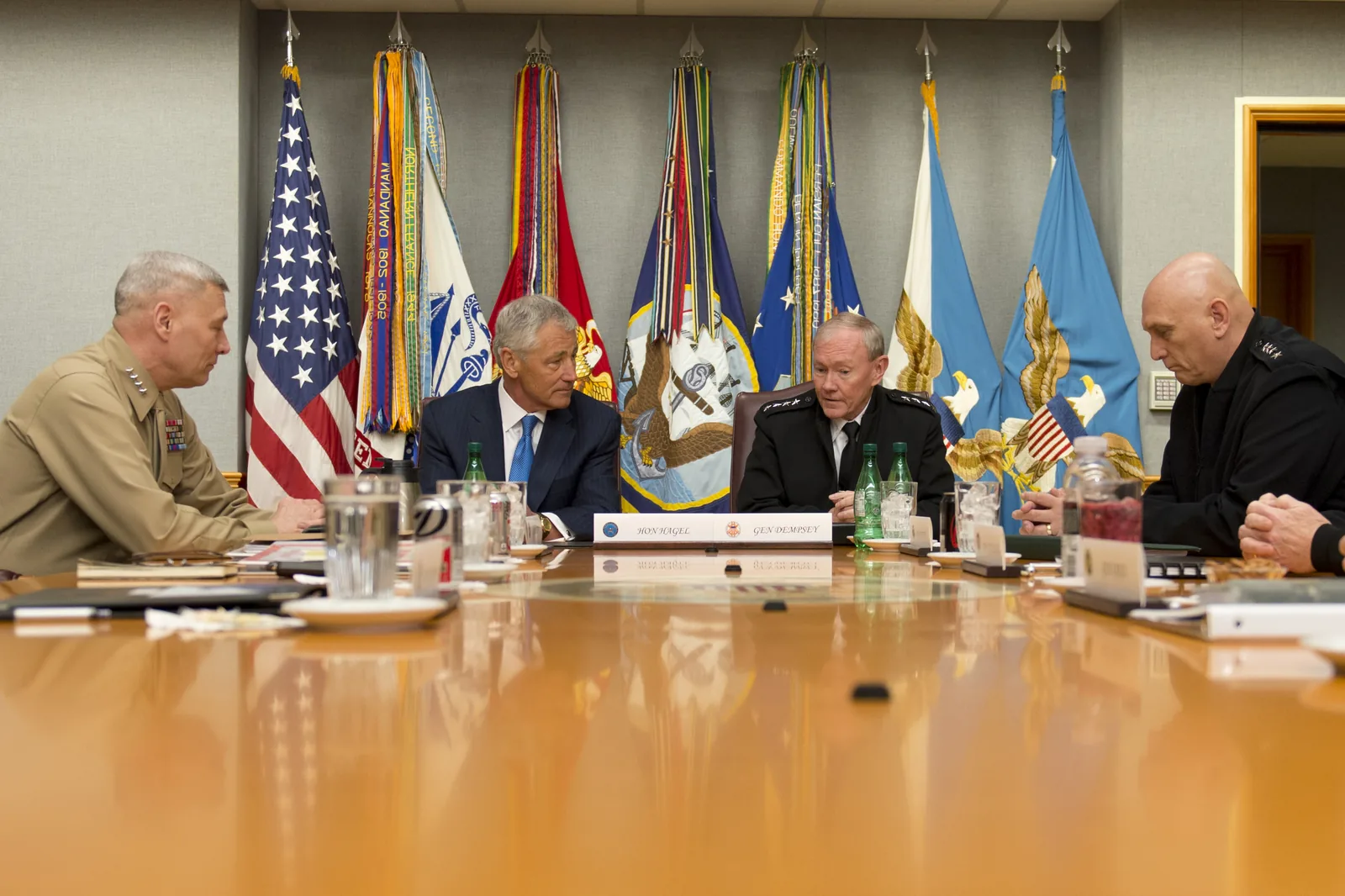
The Joint Chiefs of Staff is made up of the Chairman, the Vice Chairman, the five service chiefs, and the Chief of the National Guard Bureau. They advise the president, the Secretary of Defense, and the National Security Council on military matters. The Chairman is the highest-ranking officer in the U.S. military.
The Chiefs meet in a secure Pentagon conference room known as "the Tank." Any member may give the president advice that differs from the Chairman's, and the law requires that disagreements be passed on when requested.
Since a 2016 change in the law, the Chairman serves a single four-year term instead of two two-year terms. General Colin Powell, Chairman during the 1991 Gulf War, remains the best-known holder of the post.
The Chiefs are supported by the Joint Staff, a body of several thousand officers and civilians from every service who prepare war plans, assess force requirements, and coordinate joint training.
The combatant commands are the headquarters that actually direct military operations. Each takes forces from whichever services it needs, so an Army brigade, a Navy carrier group, and an Air Force wing in the same region all report to one joint commander.
Seven commands cover geographic areas: Northern, Southern, European, Africa, Central, Indo-Pacific, and Space Command. Four are organized by function: Cyber Command, Special Operations Command, Strategic Command, which controls the nuclear forces, and Transportation Command, which moves troops and supplies around the world.
Each command is led by a four-star general or admiral confirmed by the Senate. Africa Command, created in 2007, is headquartered in Stuttgart, Germany, rather than on the continent it covers. Cyber Command, created in 2009, became a full combatant command in 2018.
The Unified Command Plan, a classified document the president approves and updates every few years, sets each command's area and mission. The unified structure itself dates to the end of World War II and was strengthened by Goldwater-Nichols in 1986.
Several members of the U.S. Intelligence Community are part of the department. They include the National Security Agency, which collects signals intelligence and protects government communications, the Defense Intelligence Agency, which analyzes foreign militaries, the National Geospatial-Intelligence Agency, which produces maps and satellite imagery analysis, and the National Reconnaissance Office, which builds and operates spy satellites.
The commander of U.S. Cyber Command has also served as the director of the NSA since Cyber Command was created, an arrangement known as the "dual hat." Officials have debated splitting the jobs for years.
Most intelligence budgets are classified. The government publishes only topline figures, which together run to roughly $100 billion a year for national and military intelligence combined.
In 2013, former NSA contractor Edward Snowden leaked documents showing the agency collected Americans' phone records in bulk. Congress responded with the USA FREEDOM Act of 2015, which ended that bulk collection program.
The Defense Advanced Research Projects Agency was created in 1958, as ARPA, in direct response to the Soviet launch of Sputnik the year before. Its mission is to prevent the United States from being surprised by new technology, and to create technological surprises of its own.
DARPA has a budget of roughly $4 billion a year and only about 100 program managers. It does almost no research itself. Instead, it funds universities and companies, and program managers serve fixed terms of a few years so ideas turn over quickly.
Its projects include ARPANET, the forerunner of the internet, early work on stealth aircraft, and the Grand Challenge robot-car races of 2004 and 2005 that helped launch the self-driving car industry. It also funded early research on mRNA vaccine platforms.
DARPA is one piece of a larger research enterprise overseen by the Under Secretary for Research and Engineering, which also includes the services' own laboratories, such as the Naval Research Laboratory and the Air Force Research Laboratory.
The department plans its spending through a process called Planning, Programming, Budgeting, and Execution. It began as the Planning, Programming, and Budgeting System introduced by Secretary Robert McNamara in 1961 to tie spending to military strategy.
Each budget is built as part of a five-year plan called the Future Years Defense Program. The services draft proposals, the Secretary's staff reviews them, and the department's request goes into the president's budget, which is usually sent to Congress in the first months of each year.
Because the process starts about two years before money is spent, critics say it is too slow for fast-changing technology. A congressional commission on reforming the process issued its final report in March 2024 and recommended replacing it with a simpler, more flexible system.
Once Congress passes the authorization and appropriations bills, the Comptroller distributes the money to the services and agencies. Moving funds between accounts after that usually requires notifying Congress or getting its approval.
The Under Secretary for Acquisition and Sustainment oversees how the department buys and maintains weapons, from rifles to aircraft carriers. The largest purchases are managed as Major Defense Acquisition Programs, with extra reporting to Congress.
Under the Nunn-McCurdy Act of 1982, the department must notify Congress when a major program's unit cost grows by 15 percent over its current baseline. If costs grow by 25 percent, the program must be terminated unless the Secretary certifies that it is essential and that its costs are under control.
The F-35 fighter is the most expensive weapons program in history. The Government Accountability Office has estimated its total cost to buy and operate over its lifetime at more than $1.7 trillion.
A small number of large companies, led for decades by Lockheed Martin, receive a large share of the department's contract dollars. Companies that lose a competition can protest the award to the Government Accountability Office, which issues a decision within 100 days.
Notable Secretaries of Defense
- James Forrestal1947-1949The first Secretary of Defense, who pressed for the 1949 reforms that strengthened the office.
- George C. Marshall1950-1951The first career soldier and the only five-star general to hold the post; Congress passed a waiver so he could serve.
- Robert McNamara1961-1968The longest-serving Secretary, at just over seven years; created the modern budget system and led the department through the Vietnam buildup.
- Donald Rumsfeld1975-1977, 2001-2006Served twice and is both the youngest and the oldest person to hold the office.
- Lloyd Austin2021-2025The first African American Secretary of Defense and a retired four-star Army general who needed a congressional waiver.
- Pete Hegseth2025-presentThe current Secretary, and the first to use the secondary title Secretary of War since 1947.
Where It Came From
From the War Office of 1781 to the unified department of today, and the laws that define what it may do.
The department's roots are older than the Constitution. The Continental Congress created the Continental Army on June 14, 1775, the Continental Navy on October 13, 1775, and the Continental Marines on November 10, 1775, dates each service still celebrates as its birthday. In 1781, under the Articles of Confederation, Congress set up a War Office and named Benjamin Lincoln the first Secretary at War. Henry Knox succeeded him in 1785.
Under the new Constitution, Congress created the Department of War on August 7, 1789. Knox stayed on as its head, making the War Department one of the original executive departments alongside State and Treasury. When the undeclared Quasi-War with France made a separate naval command necessary, Congress created the Department of the Navy on April 30, 1798, with Benjamin Stoddert as its first secretary.
For almost 150 years the Army and Navy were separate Cabinet departments. Each had its own secretary, budget, and war plans, and they coordinated only through the president. World War II exposed the cost of that arrangement. Congressional investigators who studied the December 1941 attack on Pearl Harbor found that the Army and Navy commanders in Hawaii had failed to share information or divide responsibilities clearly. In 1942 the service chiefs began meeting as an informal Joint Chiefs of Staff to match their British counterparts.
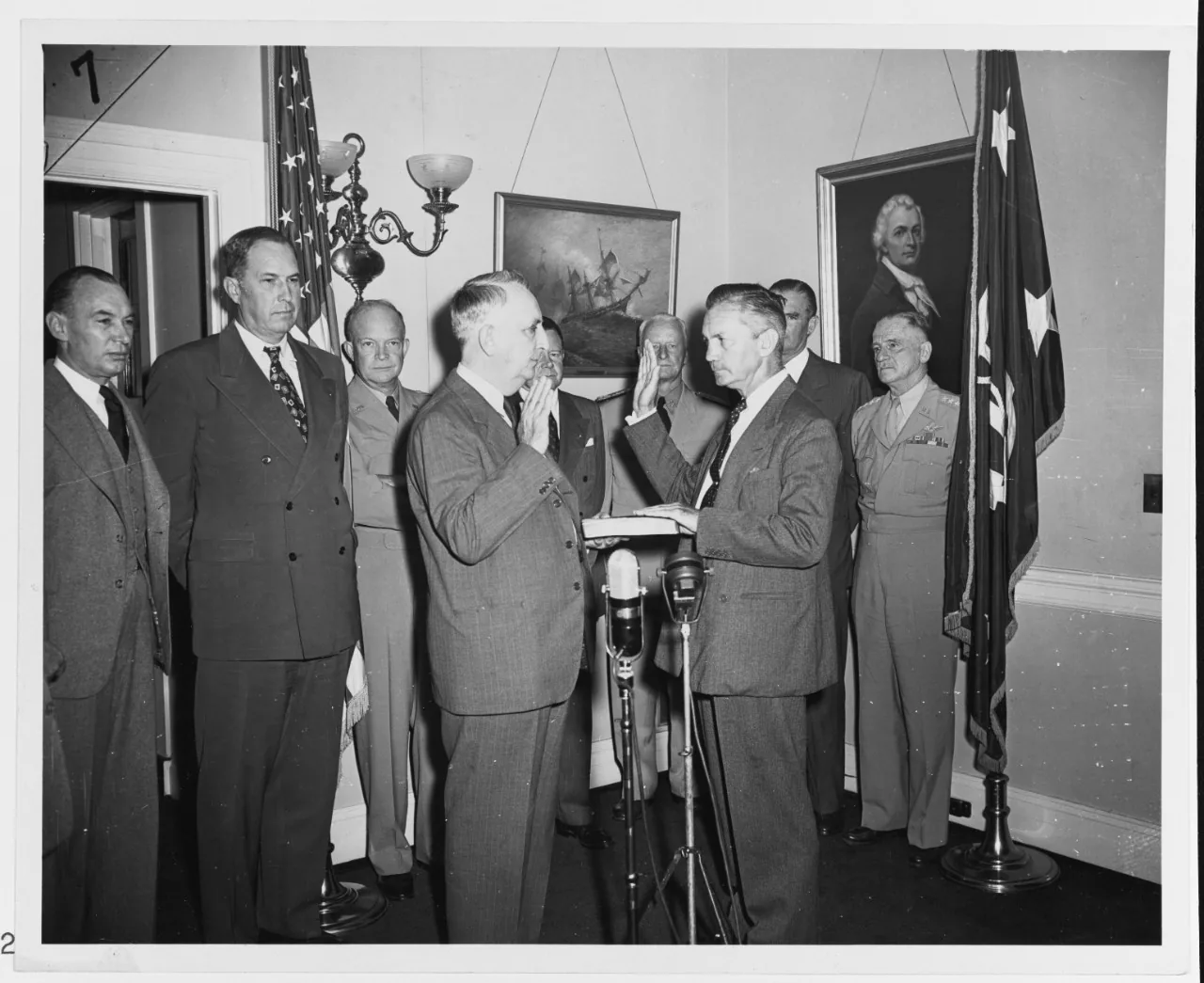
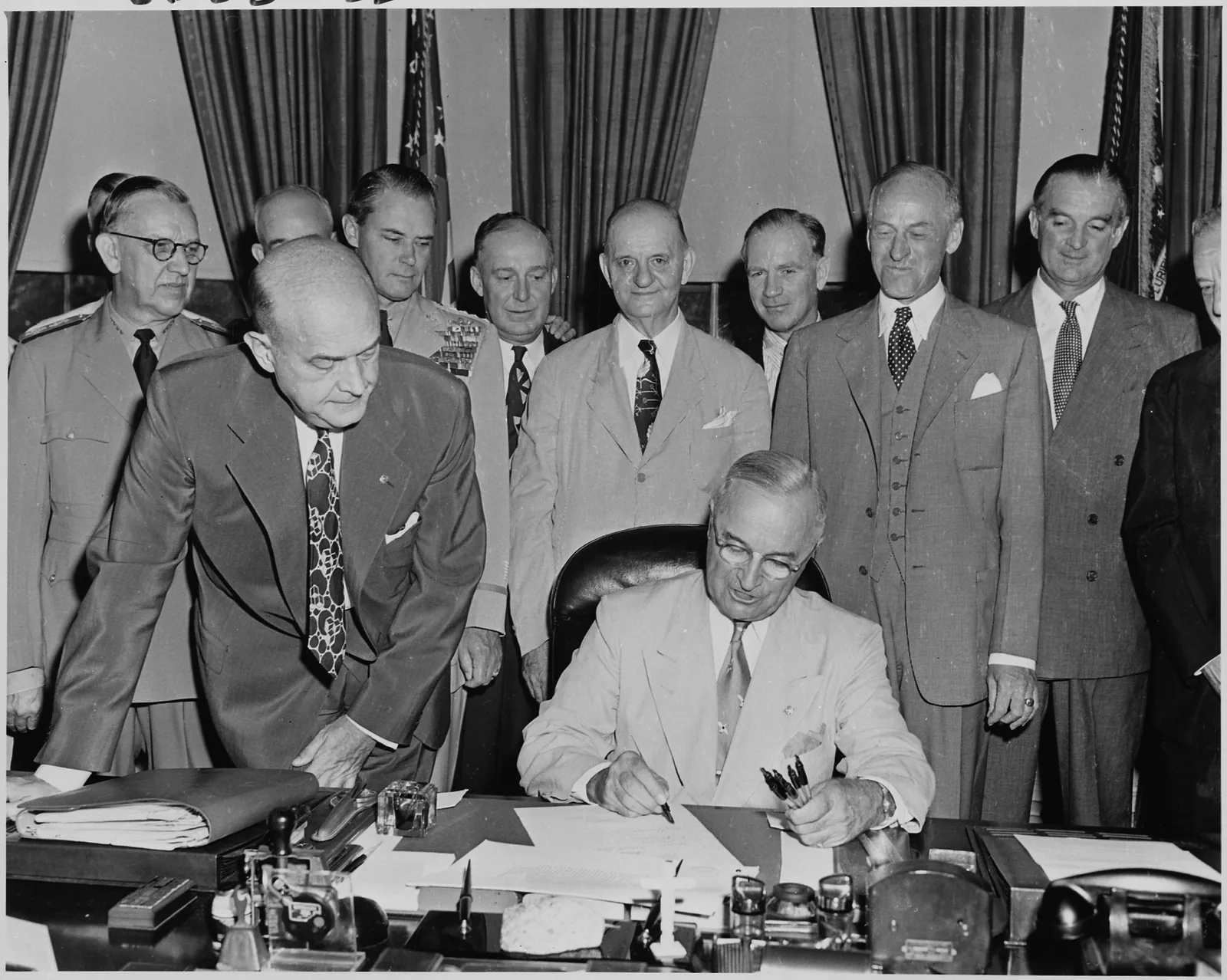
In December 1945, President Harry Truman asked Congress to unify the armed forces under a single department. The Navy resisted, fearing it would lose naval aviation and the Marine Corps to the Army and the new Air Force. The compromise was the National Security Act of 1947, which Truman signed on July 26, 1947. On September 17, 1947, former Navy Secretary James Forrestal was sworn in as the first Secretary of Defense, heading a loose confederation called the National Military Establishment.
Key Moments in the Department's History
Select any year to read what happened and why it still shapes how the department works.
On August 7, 1789, Congress created the Department of War, one of the first executive departments under the new Constitution. Henry Knox, who had served as Secretary at War under the Articles of Confederation, became its first Secretary and a member of George Washington's original Cabinet.
The department was tiny. The regular Army numbered fewer than 1,000 soldiers, and the country depended on state militias for most of its defense. The War Department also handled relations with Native American nations, military pensions, and coastal fortifications, and in 1802 Congress created the U.S. Military Academy at West Point under its control.
Naval affairs were run by the War Department at first. When French privateers began seizing American merchant ships during the undeclared Quasi-War with France, Congress created a separate Department of the Navy on April 30, 1798, and Benjamin Stoddert became the first Secretary of the Navy. Congress re-established the Marine Corps on July 11, 1798.
The War Department ran Indian affairs until 1849, when the Bureau of Indian Affairs, created within the department in 1824, moved to the new Department of the Interior. The two military departments stayed separate, each with a seat in the Cabinet, until 1947.
By 1941 the War Department's growing staff was scattered across 17 buildings in Washington, D.C. In July 1941, Brigadier General Brehon Somervell proposed a single headquarters, and ground was broken in Arlington, Virginia, on September 11, 1941, less than three months before Pearl Harbor.
Construction was overseen by Colonel Leslie Groves of the Army Corps of Engineers, who later directed the Manhattan Project. Working around the clock, crews finished the building in about 16 months. It was completed on January 15, 1943, at a cost of about $83 million.
The five-sided shape came from the first site chosen, a parcel bounded by five roads. When the building was moved to its current location to keep it from blocking the view of Washington from Arlington National Cemetery, the shape was kept. The building has five floors above ground, five concentric rings, and about 6.5 million square feet of floor space.
Although built for the War Department, the Pentagon became the headquarters of the unified Department of Defense after 1947 and has housed its leadership ever since. On September 11, 2001, exactly 60 years after ground was broken, hijackers crashed American Airlines Flight 77 into its west side.
President Truman signed the National Security Act of 1947 on July 26, 1947, aboard his presidential airplane. The law created the National Military Establishment headed by a Secretary of Defense, made the Air Force an independent service, formally established the Joint Chiefs of Staff, and created the Central Intelligence Agency and the National Security Council.
The 1947 structure was weak by design. The Army, Navy, and Air Force each remained an executive department with its own secretary, and the Secretary of Defense had only "general direction, authority, and control" over them with a very small staff. The Navy had insisted on this arrangement to protect its independence.
The act also wrote protections for the Navy into law. It guaranteed that the Navy would keep its own aviation and that the Marine Corps would continue as a distinct combat force, ending fears that both would be absorbed by the Army or the new Air Force.
James Forrestal, who as Navy Secretary had argued for the weak structure, became the first Secretary of Defense on September 17, 1947. He soon concluded the job lacked the authority it needed and recommended the changes Congress made two years later.
The National Security Act Amendments of 1949, signed by Truman on August 10, 1949, turned the National Military Establishment into an executive department called the Department of Defense. The Army, Navy, and Air Force became military departments inside it, and their secretaries lost their seats in the Cabinet.
The amendments also created the post of Chairman of the Joint Chiefs of Staff. General Omar Bradley, a World War II field commander, became the first Chairman in August 1949.
Budget fights followed. In April 1949, Secretary Louis Johnson canceled construction of the Navy supercarrier USS United States. Senior admirals publicly objected, and congressional hearings that October became known as the "Revolt of the Admirals."
In 1958, President Dwight Eisenhower, a former five-star general, pushed through the Defense Reorganization Act. It removed the military departments from the operational chain of command, so combatant commanders reported through the Secretary of Defense rather than through their own services, a principle Congress strengthened again in 1986.
The United States drafted soldiers in every major war of the 20th century and kept a peacetime draft from 1948 into the Vietnam War. In 1970, a commission chaired by former Defense Secretary Thomas Gates recommended replacing the draft with an all-volunteer force paid competitive wages.
The last men were drafted in December 1972, and the government's authority to induct soldiers expired on July 1, 1973. Since then, every member of the U.S. military has volunteered to serve.
Draft registration was suspended in 1975. President Jimmy Carter restored it in 1980 after the Soviet invasion of Afghanistan, and men ages 18 to 25 must still register with the Selective Service System, an independent agency outside the department, so a draft could be restarted quickly if Congress authorized one.
The all-volunteer force changed how the department operates. Recruiting, pay, housing, education benefits, and family support became central to keeping enough people in uniform, and those personnel costs now make up one of the largest parts of the defense budget.
The Goldwater-Nichols Department of Defense Reorganization Act of 1986 is considered the most important reform of the department since 1949. It strengthened the combatant commanders' authority over joint operations and made the Chairman of the Joint Chiefs the principal military adviser to the president and the Secretary of Defense.
The reforms followed years of coordination failures, most visibly the failed 1980 attempt to rescue American hostages in Iran, in which eight servicemembers died, and communication breakdowns during the 1983 invasion of Grenada, where Army and Navy units reportedly could not talk to each other directly.
The law also changed military careers. Officers must now complete an assignment on a joint staff before they can be promoted to general or admiral, which pushes every future senior leader to work outside their own service.
Named for Senator Barry Goldwater of Arizona and Representative Bill Nichols of Alabama, the bill passed the Senate 95 to 0 over objections from much of the Pentagon's leadership. President Ronald Reagan signed it on October 1, 1986.
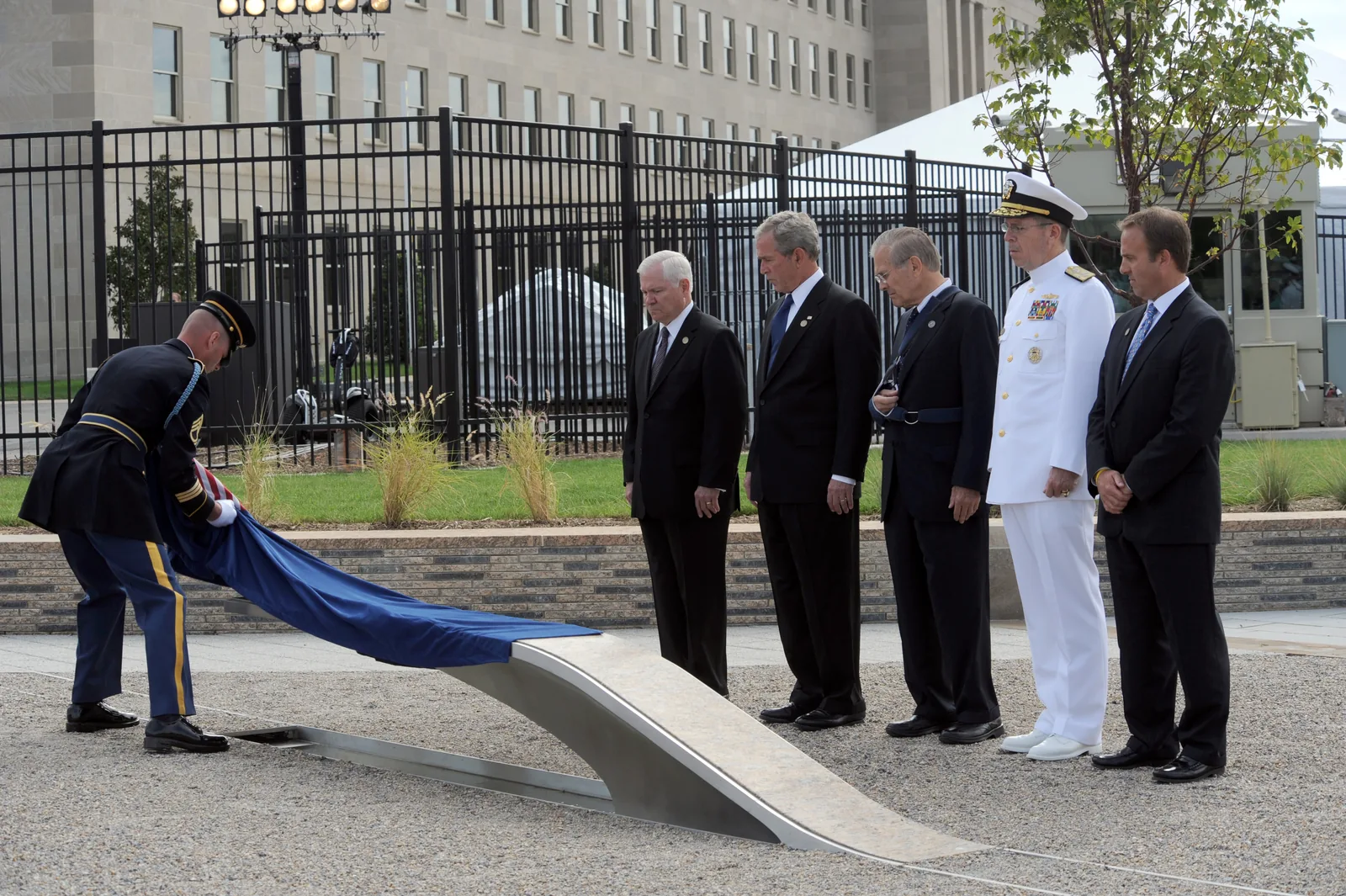
On September 11, 2001, hijackers crashed American Airlines Flight 77 into the Pentagon at 9:37 a.m., killing 125 people in the building and 59 aboard the plane. The damaged section was rebuilt in about a year. The Pentagon Memorial, with one bench for each victim, was dedicated on the attack's seventh anniversary.
The department then led the invasions of Afghanistan in October 2001 and Iraq in March 2003, beginning the longest period of continuous combat in American history. The base defense budget roughly doubled over the following decade, with much of the war funding passed through separate emergency and "overseas contingency operations" accounts.
The Costs of War project at Brown University estimates that the post-9/11 wars cost more than $8 trillion, counting future veterans' care and interest, and that more than 7,000 U.S. service members were killed. The U.S. military withdrawal from Afghanistan in August 2021 ended the country's longest war.
The wars shaped what the department bought, from mine-resistant armored vehicles to armed drones. By the late 2010s, the department's official strategy had shifted back toward preparing for competition with other major powers, especially China and Russia.
The 1993 "Don't Ask, Don't Tell" policy let gay and lesbian Americans serve only if they kept their sexual orientation private. About 13,000 service members were discharged under it. Congress repealed the policy in December 2010, and the repeal took effect in September 2011 after the president, the Secretary of Defense, and the Chairman certified it would not harm readiness.
In December 2015, Defense Secretary Ash Carter opened every military job, including infantry and special operations, to women, ending the last gender restrictions on combat roles. The first women had graduated from the Army's Ranger School earlier that year.
Women now make up roughly 17 to 18 percent of the active-duty force. A congressional commission recommended in 2020 that women be required to register with the Selective Service, but Congress has not made that change.
Policy on transgender service has changed repeatedly: it was opened in 2016, restricted in 2019, reopened in 2021, and restricted again in 2025, when the Supreme Court allowed the new restrictions to take effect while legal challenges continued.
The U.S. Space Force was created on December 20, 2019, when the president signed that year's defense authorization act. It was the first new military service since the Air Force in 1947 and is organized within the Department of the Air Force, much as the Marine Corps is within the Department of the Navy.
The Space Force operates the military's satellites, including the GPS constellation, missile-warning satellites, and satellite communications, and tracks objects in orbit. It absorbed the former Air Force Space Command and space units from the other services.
It is by far the smallest service, with fewer than 10,000 uniformed members, who are called Guardians. U.S. Space Command, a separate combatant command that directs space operations, was re-established a few months earlier, in August 2019.
Supporters cited other countries' anti-satellite weapons as a main reason for the new service, including a 2007 Chinese missile test that destroyed an old weather satellite and created thousands of pieces of orbital debris. A House proposal for a smaller "Space Corps" had failed in 2017.
On September 5, 2025, President Donald Trump signed Executive Order 14347, "Restoring the United States Department of War." It authorized the department and its Secretary to use "Department of War" and "Secretary of War" as secondary titles in official correspondence, public communications, and ceremonial settings.
The order did not change the department's legal name. Title 10 of the U.S. Code still establishes the Department of Defense, and only Congress can rename it. The order directed the Secretary to recommend the legislative and executive steps needed to make the change permanent, and bills to do so were introduced in Congress that month.
The department quickly adopted the title in practice. Its main website moved to war.gov, and signs and official communications began using the new name.
The name "Department of Defense" dates to the 1949 amendments. Supporters of the 2025 change said "War" better reflects the department's purpose, while critics questioned the cost of rebranding and the use of an executive order for a name Congress set by law.
The Constitutional and Legal Basis
The Constitution never mentions a department of defense or of war. It divides control of the military between the two elected branches. Article I gives Congress the power to declare war, raise and support armies, provide and maintain a navy, and make the rules that govern the armed forces. Article II makes the president commander in chief. The department itself exists only because Congress created it by statute, using its power to pass laws "necessary and proper" for carrying out those responsibilities.
The framers distrusted permanent armies, which they associated with the British troops quartered in the colonies. Their main safeguard was financial: no money for the Army can be appropriated for more than two years at a time. In Federalist No. 26, Alexander Hamilton explained that because House members are elected every two years, each new House must decide for itself whether to keep paying for a standing army. The Navy has no such limit, since a fleet was not seen as a threat to liberty at home.
Today's legal framework sits mostly in Title 10 of the U.S. Code. Section 111 declares the department an executive department, and Section 113 creates a civilian Secretary of Defense who must be confirmed by the Senate. To keep civilian control real, a retired officer must wait seven years after leaving active duty before becoming Secretary. Congress has passed special waivers only three times: for George Marshall in 1950, James Mattis in 2017, and Lloyd Austin in 2021.
Congress also controls the department through the annual National Defense Authorization Act, the separate defense appropriations bill, and the Senate's role in confirming senior officials and military officers. Tens of thousands of officer promotions go to the Senate each year, usually approved in large batches by unanimous consent. The president, in turn, commands forces in the field, appoints the department's leadership, and issues orders through the Secretary of Defense.
What the Law Actually Says
The Congress shall have Power ... To declare War, grant Letters of Marque and Reprisal, and make Rules concerning Captures on Land and Water; To raise and support Armies, but no Appropriation of Money to that Use shall be for a longer Term than two Years; To provide and maintain a Navy; To make Rules for the Government and Regulation of the land and naval Forces;
In short: Congress decides whether the country goes to war, how large the military is, how it is paid for, and what rules service members live under. Money for the Army can never be committed for more than two years at a time.
The President shall be Commander in Chief of the Army and Navy of the United States, and of the Militia of the several States, when called into the actual Service of the United States;
In short: Once forces exist, the president directs them. The president also commands state militias, today's National Guard, but only when they are called into federal service.
There is a Secretary of Defense, who is the head of the Department of Defense, appointed from civilian life by the President, by and with the advice and consent of the Senate. A person may not be appointed as Secretary of Defense within seven years after relief from active duty as a commissioned officer of a regular component of an armed force.
In short: The department is always run by a civilian whom the Senate has confirmed. A recently retired officer cannot take the job unless Congress passes a special exception.
The Laws That Shape the Department
Beyond the Constitution, five bodies of law define what the department can do, who controls it, and where its authority stops.
Title 10 of the U.S. Code is the department's organizing statute. It creates the Office of the Secretary of Defense, the Joint Chiefs of Staff, the combatant commands, and the three military departments, and it sets the size limits, pay rules, and promotion system for the armed forces.
It gives each military department secretary the job of recruiting, organizing, supplying, equipping, training, and maintaining their forces, found in Sections 7013 for the Army, 8013 for the Navy, and 9013 for the Air Force. Those duties are often summed up as "organize, train, and equip." Fighting wars is the job of the combatant commanders, not the services.
The National Guard sits under two titles. When a governor calls up Guard members for a state mission, such as a flood or a riot, they serve under state law or under Title 32, which lets the federal government pay for missions a governor controls. When they are called into federal service under Title 10, they answer to the president.
Title 50 of the U.S. Code, which covers war and national defense more broadly, governs intelligence activities and covert action. Defense intelligence agencies operate under both titles, and which title an operation falls under determines which congressional committees must be informed.
Congress has formally declared war 11 times, covering five conflicts: the War of 1812, the Mexican-American War, the Spanish-American War, World War I, and World War II. The last declarations came in June 1942. Every major conflict since, from Korea to Iraq, was fought without one.
Frustrated by the undeclared war in Vietnam, Congress passed the War Powers Resolution over President Richard Nixon's veto on November 7, 1973. It requires the president to report to Congress within 48 hours of sending forces into hostilities and to withdraw them within 60 days, plus 30 days to pull out safely, unless Congress authorizes the action.
Every president since Nixon has questioned whether the law is constitutional. Presidents usually file reports "consistent with" the resolution rather than "pursuant to" it, wording chosen to avoid admitting that it binds them. Congress has rarely used the law to force a withdrawal.
Instead of declaring war, Congress now passes Authorizations for Use of Military Force. The 2001 authorization, passed three days after the September 11 attacks, has been cited as the legal basis for operations in multiple countries for more than two decades.
Using its power to "make Rules for the Government and Regulation of the land and naval Forces," Congress enacted the Uniform Code of Military Justice on May 5, 1950. It replaced the separate Articles of War for the Army and the Articles for the Government of the Navy with a single criminal code for every service.
The code covers ordinary crimes and military offenses that have no civilian equivalent, such as desertion, disobeying a lawful order, and conduct unbecoming an officer. Cases are tried by courts-martial, military courts with military judges and panels of service members serving as jurors.
Appeals go to each service's Court of Criminal Appeals and then to the U.S. Court of Appeals for the Armed Forces, a civilian court of five judges. In some cases, the Supreme Court can review its decisions.
Congress has reformed the code repeatedly. A 2021 change, which took effect at the end of 2023, moved decisions about prosecuting sexual assault, murder, and certain other serious crimes from commanders to independent military prosecutors.
The Posse Comitatus Act of 1878, passed as federal troops were withdrawn from the former Confederate states at the end of Reconstruction, makes it a crime to use the Army as a police force at home unless the Constitution or Congress expressly allows it. It was extended to the Air Force in 1956, and department regulations apply the same limits to the Navy and Marine Corps.
The biggest exception is the Insurrection Act, first passed in 1807, which lets the president use troops to suppress insurrection or enforce federal law when state authorities cannot or will not. It was last invoked in 1992, when California's governor asked for federal help during the Los Angeles riots.
National Guard members serving under a governor's command are not covered by Posse Comitatus, which is why governors can use them for law enforcement support. Once federalized, they fall under the same limits as active-duty troops.
In June 2025, the president federalized California National Guard members under a separate statute, 10 U.S.C. §12406, over the governor's objection. It was the first time since 1965 that a president had federalized a state's Guard without the governor's request, and the decision was challenged in federal court.
Congress controls the department through two separate bills each year. The National Defense Authorization Act sets policy, authorizes programs, and sets personnel levels and pay raises. The defense appropriations bill actually provides the money. A program generally needs both to go forward.
The NDAA has become law every year for more than six decades, one of the longest unbroken records of any major bill. Because it is seen as must-pass, it often carries policy changes that reach well beyond defense, such as the 2019 law that created the Space Force.
The appropriations process has been less reliable. The department starts most fiscal years under a continuing resolution, which holds spending at the prior year's level and generally bars new programs. In March 2025, Congress passed its first ever full-year continuing resolution for the department, covering all of fiscal year 2025.
The House and Senate Armed Services Committees write the NDAA, and the defense subcommittees of the Appropriations Committees write the spending bill. Those four panels, along with the intelligence committees, carry out most of Congress's oversight of the department.
Why It Matters to You
How the department's budget, bases, research, and services reach communities, families, and taxpayers.
The department is the largest employer in the federal government and one of the largest in the world. Military bases operate in every state, and the department signs more than $400 billion a year in contracts, according to USASpending.gov. That money supports shipyards, aircraft plants, and small suppliers in hundreds of congressional districts, which is one reason decisions about base closures and weapons programs draw so much attention in Congress.
Technology the department paid for shows up in ordinary life. GPS started as a military navigation system and is now a free public service that provides timing to banks, power grids, and cell networks as well as directions to drivers. ARPANET, a DARPA project, sent its first message in 1969 and became the foundation of the internet.
The department's budget is also the largest single item in the annual spending bills Congress passes, so its size affects how much room remains for everything else. Whether defense should grow or shrink is an ongoing debate, settled each year between the president's budget request and the final appropriations bills.
Decisions about when and where to use force are among the most consequential any government makes. The Constitution deliberately splits that authority between Congress and the president, and the boundary has been argued over since the Korean War. The Legislative vs. Executive Powers page explains how that tension plays out in practice.
Where the Department Touches Everyday Life
Select a topic to see a specific way the department's work reaches communities, families, and taxpayers.
The Global Positioning System began as a military navigation project. The first satellite launched in 1978, and the system was declared fully operational in 1995. The Space Force now operates a constellation of about 31 satellites.
GPS was opened for civilian use in the 1980s, but a feature called Selective Availability deliberately reduced the accuracy of civilian signals. On May 1, 2000, President Bill Clinton ordered it turned off, and civilian accuracy improved about tenfold almost overnight.
Today GPS provides more than directions. Its precise timing signals keep cell networks, banking transactions, and electric power grids synchronized, and farmers use it to guide tractors to within a few inches.
Other technologies with defense roots include the internet, through DARPA's ARPANET, and the microwave oven, whose inventor discovered the effect while working on military radar during World War II.
Military installations operate in every state, and in many communities a base is the largest employer. The department's most recent public base inventory counted about 4,800 sites worldwide on roughly 27 million acres.
Because closing a base can devastate a local economy, Congress created the Base Realignment and Closure process, known as BRAC. An independent commission recommends a package of closures that Congress must accept or reject as a whole, which keeps any one member from protecting a local base.
There have been five BRAC rounds, in 1988, 1991, 1993, 1995, and 2005. Together they closed or realigned hundreds of installations. The 2005 round was the largest and most expensive, and Congress has not authorized another since.
The department's Office of Local Defense Community Cooperation provides grants and planning help to communities affected by base closures, expansions, or the loss of a major defense contract.
The Defense Health Agency runs TRICARE, the health program that covers about 9.5 million active-duty members, retirees, and their families, along with military hospitals and clinics around the world. It also runs the Uniformed Services University, the military's own medical school in Bethesda, Maryland.
The Department of Defense Education Activity operates about 160 schools serving roughly 67,000 children of military families, on bases in several U.S. states, Guam, Puerto Rico, and about a dozen foreign countries.
Military medicine has driven advances that later reached civilian hospitals. Lessons from Iraq and Afghanistan about tourniquets and blood transfusions changed trauma care nationwide.
Military families move often, typically every two to three years. Programs such as Military OneSource offer free counseling and relocation help, and interstate agreements let children transfer credits between school systems when their families move.
When a disaster overwhelms state and local resources, the department can provide help through a process called Defense Support of Civil Authorities. Requests usually go through the Federal Emergency Management Agency, and the department supplies what civilian agencies lack, such as helicopters, heavy equipment, and field hospitals.
The National Guard is usually first on the scene because governors can call it up directly. After Hurricane Katrina in 2005, about 50,000 Guard members from across the country deployed to the Gulf Coast to help with rescue, security, and supply missions.
The Army Corps of Engineers, part of the Department of the Army, also runs a large civilian mission. It maintains the nation's inland waterways and many ports, operates hundreds of dams and flood-control projects, and builds levees, work funded through a separate appropriations bill rather than the defense budget.
U.S. Northern Command, created in 2002 after the September 11 attacks, coordinates the department's role in defending the homeland and supporting civilian agencies during emergencies.
About 200,000 service members leave the military each year. The Transition Assistance Program, run with the Departments of Veterans Affairs and Labor, is required for nearly everyone leaving active duty and covers job searching, benefits, and financial planning.
The program was overhauled after a 2011 Government Accountability Office report found its quality varied widely between bases. A 2019 law required transition counseling to start at least a year before a service member separates and to be tailored to each person's plans for work, school, or starting a business.
Veterans' unemployment has generally been at or below the civilian rate in recent years. Recently separated veterans and those with service-connected disabilities often face more difficulty, and the GAO has continued to report gaps in follow-up once service members leave.
After separation, most benefits, including the GI Bill, disability compensation, and health care, come from the Department of Veterans Affairs rather than the Department of Defense.
Federal law has required agencies to produce audited financial statements since the 1990s, but the department completed its first full financial audit only in 2018. It has not received a clean opinion in any year since.
The audits are huge undertakings involving well over 1,000 auditors and hundreds of millions of dollars a year. They have found problems such as property records that do not match what is on hand and business systems that cannot track spending from start to finish.
The Government Accountability Office has listed the department's financial management as a high-risk area since 1995. In the defense authorization act for fiscal year 2024, Congress required the department to earn a clean audit opinion by fiscal year 2028.
Supporters of the audit effort say it has still paid off by uncovering inventory the department did not know it had and fixing security weaknesses in its business systems. Progress reports are published each year alongside the audit results.
Quick Facts & Figures
Key statistics and reference information about The War Department.
| Established | 1947 (renamed 1949) |
| Legal name | Department of Defense |
| Secondary title | Department of War (2025) |
| Headquarters | The Pentagon, Arlington, VA |
| Secretary | Pete Hegseth |
| Budget | ~$850B (FY2025 base) |
| Personnel | ~2.9 million |
| Succession | 6th in line |
| Website | war.gov |
Did You Know?
The Pentagon has about 17.5 miles of corridors, yet its ring design means any two points can be reached on foot in roughly seven minutes.
President Truman signed the National Security Act of 1947 aboard his presidential plane, the Sacred Cow.
Counting active duty, Guard, Reserve, and civilians, the department employs close to 2.9 million people, making it one of the largest employers on Earth.
Ground was broken for the Pentagon on September 11, 1941, exactly 60 years before the building was attacked.
The Space Force, created in 2019, was the first new U.S. military service since the Air Force in 1947.
Where to Find It in the Law
- Art. I, §8, Cl. 11-14Congress declares war, raises armies, maintains a navy
- Art. II, §2, Cl. 1President is commander in chief
- 10 U.S.C. §111Creates the Department of Defense
- 10 U.S.C. §113Civilian Secretary, seven-year rule
- 50 U.S.C. §1541-1548War Powers Resolution
Sources & Further Reading
- U.S. Department of War, About the Department
- The White House, Executive Order 14347
- Constitution Annotated, Article I, Section 8
- Constitution Annotated, Article II, Section 2
- 10 U.S.C. §113, Secretary of Defense (Cornell LII)
- War Powers Resolution, 50 U.S.C. ch. 33 (Cornell LII)
- OSD Historical Office, Secretaries of Defense
- Office of the Historian, National Security Act of 1947
- Pentagon Tours, Facts About the Pentagon
- Costs of War Project, Brown University
- USASpending.gov, Department of Defense
- Government Accountability Office
- Congressional Research Service
Personnel and budget figures are rounded and come from the Department of Defense and USASpending.gov. Leadership details are current as of September 2026. Historical dates come from the Office of the Secretary of Defense Historical Office and the U.S. State Department Office of the Historian. Constitutional and statutory text is quoted verbatim from the Constitution Annotated and the U.S. Code. All photographs are U.S. government works in the public domain, from the National Archives, the U.S. Navy, the U.S. Army, and the Department of Defense.