
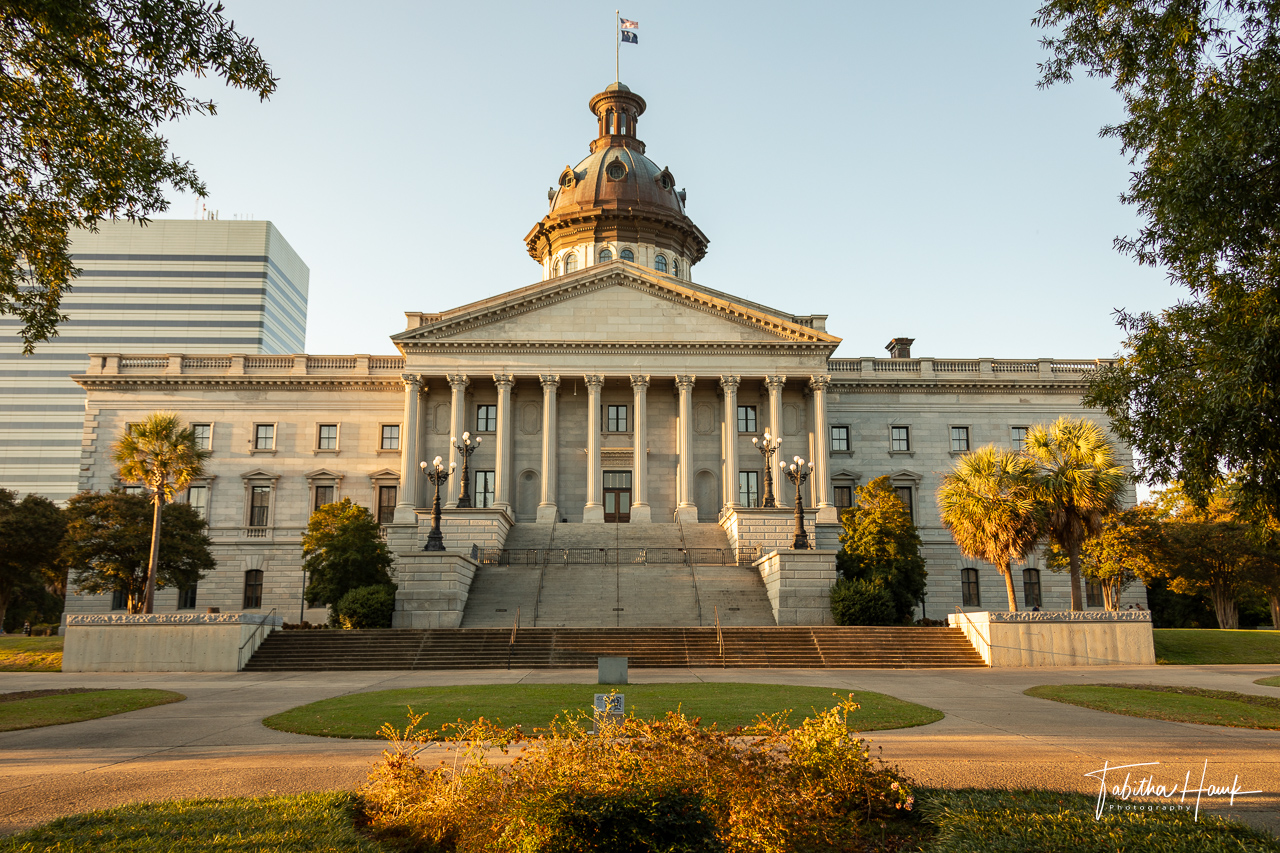
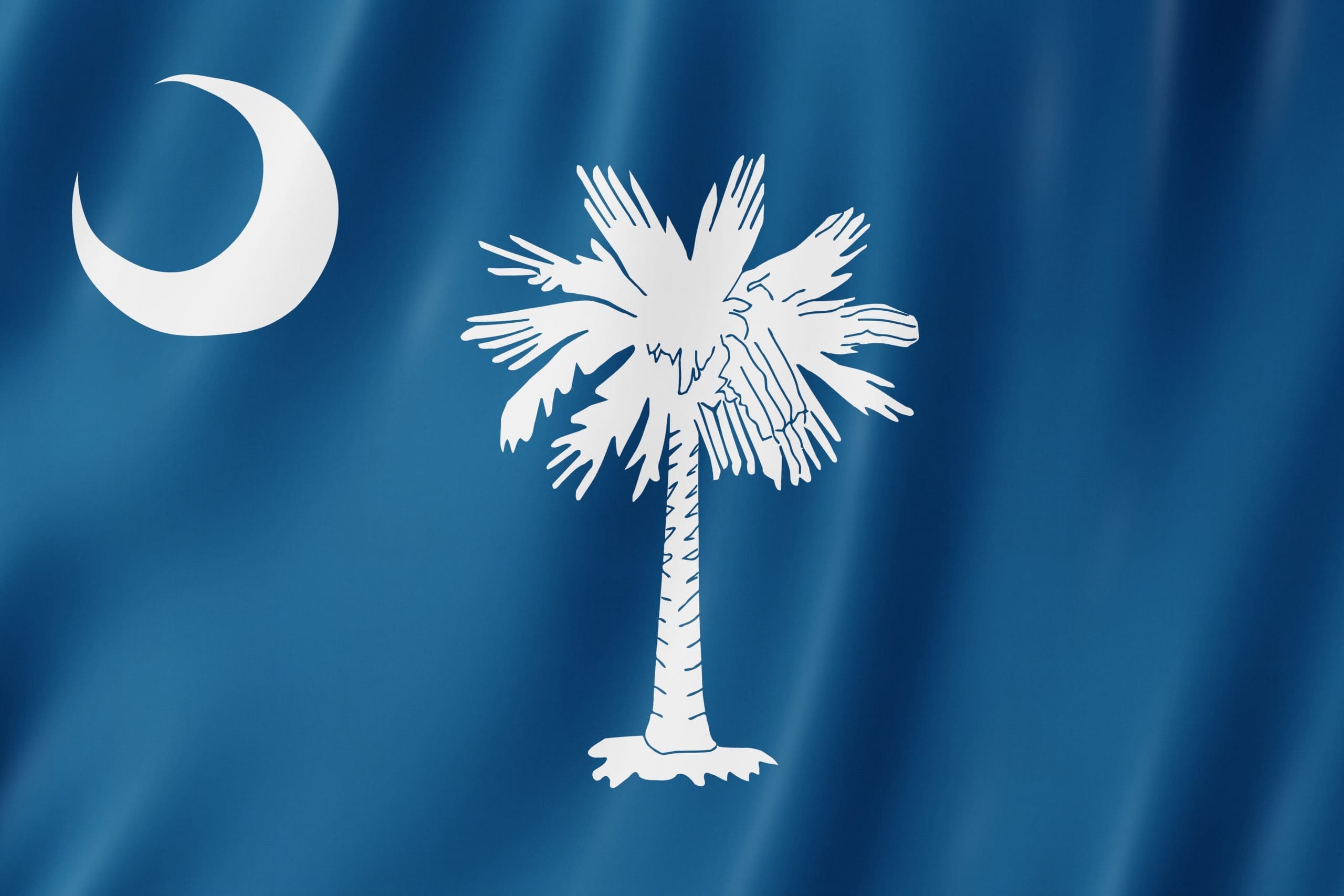
About South Carolina
South Carolina shares its name origin with North Carolina: both derive from the Province of Carolina, named "Carolina" from "Carolus," the Latin form of King Charles II's name, who granted the colonial charter in 1663. The Province of Carolina was a vast territory given to eight Lords Proprietors as a reward for their support of Charles II's restoration to the English throne. The northern and southern settlements of the colony developed separately, with the southern settlement centered on Charles Town (later Charleston), established in 1670. The two halves were formally divided into separate colonies in 1712, and South Carolina became a royal colony in 1729. Charleston became the wealthiest city in the colonial South and a major center of the transatlantic slave trade.
South Carolina sits at the crossroads of American history. It was one of the first colonies to adopt its own revolutionary constitution (March 1776, after New Hampshire's in January), the first state to secede from the Union, and the place where the Civil War's first shots were fired at Fort Sumter. For a small state, 40th in land area, South Carolina has had an outsized impact on the American story.
The state today is a study in contrasts. The Upstate is one of the most dynamic manufacturing regions in the country, home to BMW's largest global plant, Boeing's 787 Dreamliner assembly line, and Michelin's North American headquarters. Charleston is a world-class city of colonial architecture, James Beard Award-winning restaurants, and a thriving international port. Myrtle Beach draws more than 20 million visitors a year to its stretch of Atlantic coastline.
South Carolina's Lowcountry coast, a world of tidal marshes, sea islands, and ancient live oaks draped in Spanish moss, is the homeland of the Gullah Geechee people, one of the most distinctive cultural landscapes in North America. The state's natural beauty, from the Blue Ridge foothills in the northwest to the subtropical barrier islands of the southeast, is matched only by the depth of its history.
Geography, Four Distinct Regions
South Carolina spans from the Blue Ridge foothills in the northwest to subtropical barrier islands and tidal marshes in the southeast, four broad geographic zones in just 200 miles.
The northwestern corner of South Carolina is anchored by Greenville and Spartanburg, one of the most important manufacturing corridors in the American South. BMW's largest manufacturing plant in the world sits in Greer, between the two cities. Michelin's North American headquarters is in Greenville.
The region has transformed itself over the past 30 years from a struggling textile economy into an advanced manufacturing powerhouse, attracting billions in foreign direct investment. The Blue Ridge foothills in the far northwest provide outdoor recreation and scenic beauty, with Caesars Head and Table Rock state parks drawing hikers and nature lovers.
The Upstate was cotton-mill country. By 1920 the corridor around Greenville, Spartanburg, and Gaffney held one of the world's largest concentrations of textile mills, and Greenville called itself the 'Textile Center of the South.' Almost all of that had closed or moved offshore by the 2000s, but the rail lines, the highways, and a non-union labor force helped the region shift to advanced manufacturing.
The turning point came in 1992, when BMW chose a site near Greer for its first full assembly plant outside Germany, drawn by Interstate 85, the Greenville-Spartanburg airport, and the deepwater port of Charleston two hours away. The plant now employs about 11,000 people, is BMW's largest anywhere, and has pulled in a cluster of foreign suppliers that gave the region the nickname 'the Autobahn'; Clemson University runs an automotive research campus in Greenville to train engineers for them.
The Midlands region, centered on Columbia, is the political, educational, and military heart of South Carolina. The state capital sits at the junction of the Broad and Saluda Rivers. Fort Jackson, the largest Army basic combat training installation in the United States, is located just east of Columbia and trains approximately 50,000 soldiers per year.
The University of South Carolina and its famous Gamecocks athletics program are central to Columbia's identity. The Congaree National Park, South Carolina's only national park, protects one of the last old-growth bottomland hardwood forests in the Southeast and is a short drive from the capital.
Columbia was laid out in 1786 as a planned compromise capital, moved inland from Charleston to give the backcountry a fairer share of power, and it was named directly for Christopher Columbus, one of the first places in the country to carry the name. Sherman's troops burned much of the city on February 17, 1865; who set the fires, retreating Confederates torching cotton, Union soldiers, or freed people, is still argued.
Fort Jackson, opened in 1917 and named for President Andrew Jackson, trains roughly half of all new Army soldiers and about 60% of the women who enter the Army each year. The Savannah River Site, a 310-square-mile nuclear-weapons complex built in the early 1950s near Aiken, produced tritium and plutonium for warheads and is now one of the largest environmental cleanup projects in the country.
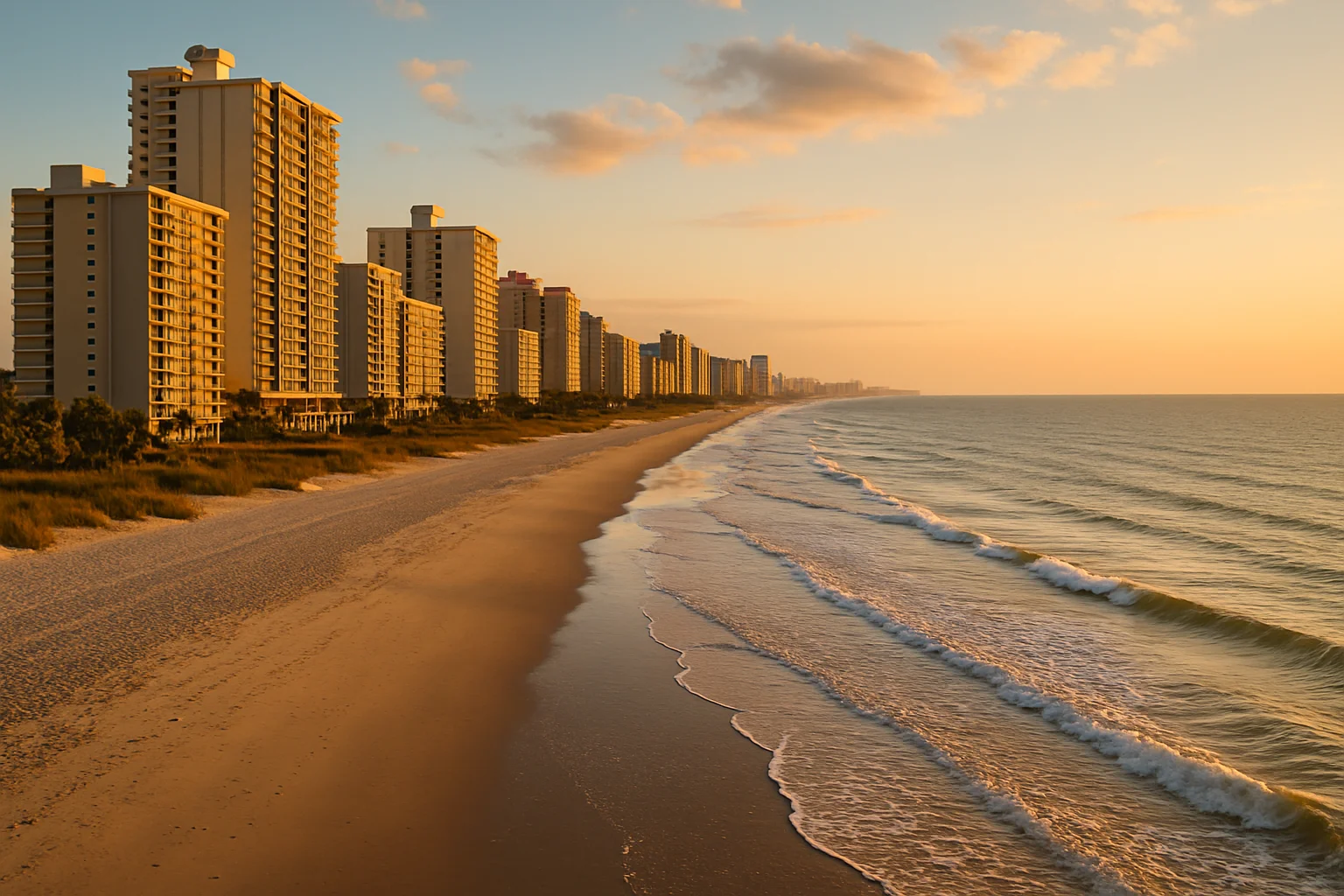
The Grand Strand is a 60-mile arc of uninterrupted Atlantic coastline stretching from the North Carolina border south past Myrtle Beach. It is one of the most popular beach resort destinations on the East Coast, drawing more than 20 million visitors annually.
Myrtle Beach and its surrounding communities host more than 100 golf courses, earning the region the informal title of 'Golf Capital of the World.' The coastal plain inland from the Strand is flat, agricultural, and sparsely populated, transitioning to tobacco farms and timberland as it moves west toward the Midlands.
Myrtle Beach began as a turn-of-the-century railroad resort owned by the Burroughs and Chapin timber company and stayed a modest family beach until air conditioning, the interstate era, and golf turned it into a mass destination. The metro now has more than 90 courses, draws roughly 20 million visitors a year against a permanent population under 400,000, and is one of the fastest-growing metro areas in the country as retirees move in.
The Waccamaw Neck just south, around Georgetown and Pawleys Island, was the center of the antebellum rice economy: in 1860 the Georgetown district grew nearly half the rice produced in the United States and had one of the highest concentrations of enslaved people anywhere in the country. Brookgreen Gardens, laid out on four former rice plantations, is now the largest outdoor sculpture garden in the United States.
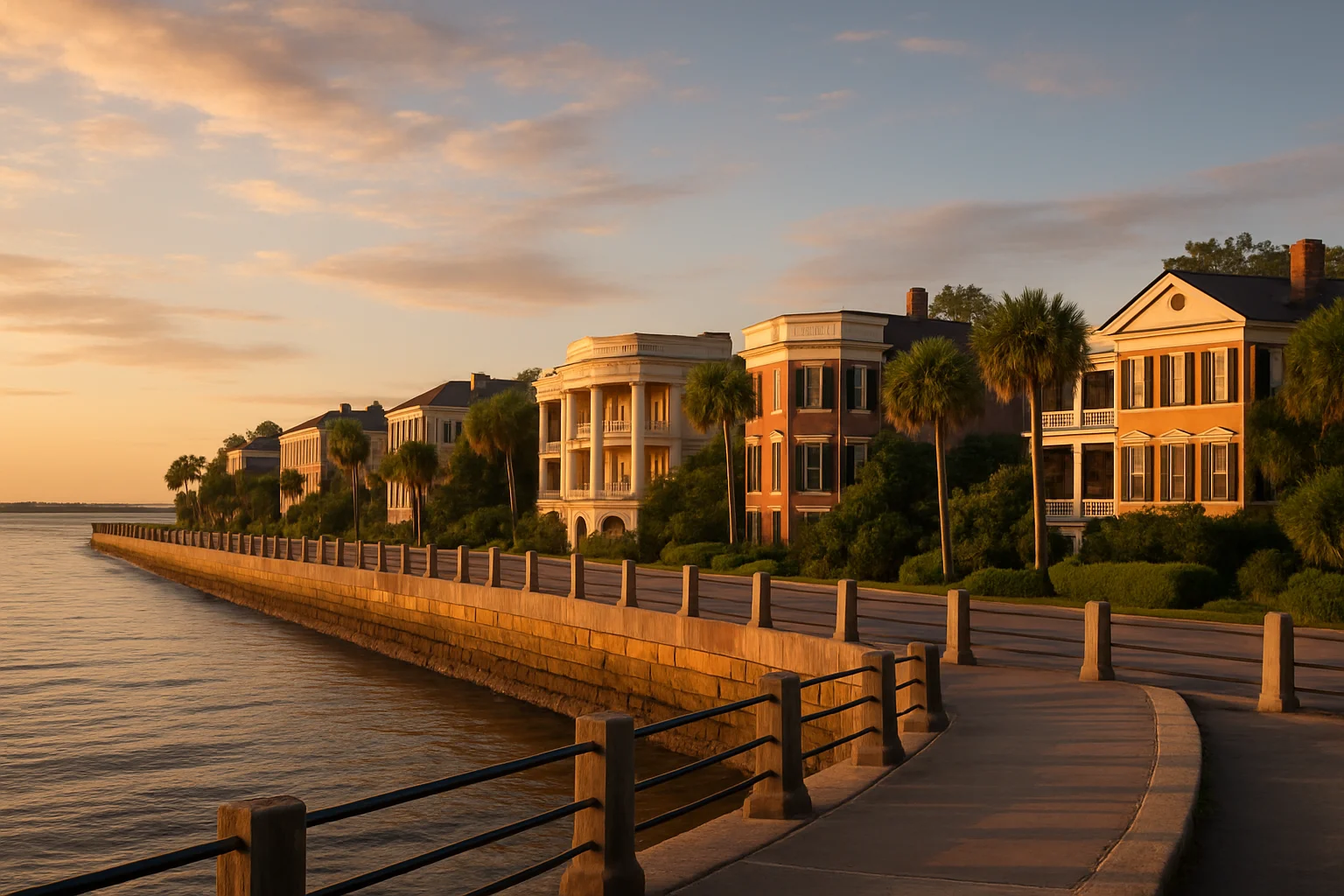
The Lowcountry is South Carolina's most historically rich and ecologically distinct region. Charleston, founded in 1670, is one of America's oldest and most beautiful cities, known for its antebellum architecture, Rainbow Row, the Battery promenade, and its central role in the Civil War, Fort Sumter sits in its harbor.
The tidal marshes, sea islands, and barrier beaches of the Lowcountry are the homeland of the Gullah Geechee people, descendants of enslaved Africans who preserved a distinct language, culture, and culinary tradition. Hilton Head Island is a world-class resort destination, while Beaufort County hosts Marine Corps Air Station Beaufort and the Marine Corps Recruit Depot Parris Island, where every Marine recruit east of the Mississippi receives basic training.
Charleston's wealth came from rice and, before the Revolution, indigo, both grown by enslaved Africans whose knowledge of West African rice cultivation was essential. An estimated 40% of all enslaved Africans brought to British North America entered through the port of Charleston, many quarantined first at Sullivan's Island, which has been called the 'Ellis Island of Black America.' In 1739 the Stono Rebellion south of the city was the largest slave revolt in the colonies and led to harsher slave codes.
The Gullah Geechee, spread along the sea islands from North Carolina to Florida, kept an English-based creole language, African foodways, and crafts such as sweetgrass basketry because the islands stayed isolated until bridges were built in the 20th century. Congress created the Gullah Geechee Cultural Heritage Corridor in 2006. Rising land values and resort development, especially on Hilton Head and Daufuskie, now pressure the heirs'-property land many Gullah families hold.

Economy
South Carolina's economy has transformed dramatically over the past three decades, moving from a textile and tobacco base to a diversified mix of advanced manufacturing, tourism, and logistics.
Tourism is the largest industry in South Carolina by employment. The state attracts more than 35 million visitors annually, generating over $27 billion in economic impact. Myrtle Beach and the Grand Strand draw the majority of visitors, but Charleston's historic district, Hilton Head's resorts, and the state's mountain retreats in the Upstate all contribute significantly.
The golf industry alone, with more than 350 courses statewide, generates several billion dollars annually. Charleston consistently ranks among the top travel destinations in North America.
Tourism supports roughly one in nine jobs in the state. The Grand Strand takes the biggest share, but Charleston has been voted a top U.S. city by travel magazines for more than a decade, and its cruise, convention, and hotel growth has fueled a running fight over 'tourism saturation' in the historic district.
Golf is a signature draw. Kiawah Island's Ocean Course has hosted the Ryder Cup, in 1991, and two PGA Championships; Hilton Head's Harbour Town holds an annual PGA Tour event; and the Masters, just over the line in Augusta, fills Aiken and the western Midlands with visitors every April.
South Carolina's manufacturing sector has been transformed by foreign and domestic investment. BMW's Greer plant is the company's largest manufacturing facility in the world, producing over 400,000 vehicles per year and exporting more cars than any other U.S. factory. Boeing assembles 787 Dreamliners in North Charleston, one of only two 787 final assembly lines in the world.
Michelin's North American headquarters is in Greenville. Volvo assembles vehicles in Berkeley County. The state's business climate, right-to-work laws, and competitive incentives have made it a top destination for manufacturing investment, particularly from European companies.
Manufacturing makes up about 15% of South Carolina's economy, above the national average, and the state leads the nation in the export value of finished passenger vehicles and in tire production, with big plants run by Michelin, Bridgestone, Continental, and Giti. BMW alone has exported more than 10 billion dollars in vehicles through Charleston in a single year.
Boeing's North Charleston site, opened in 2011 after a bitter fight with the Machinists union in Washington State, became the sole final assembly line for the 787 Dreamliner in 2021. Volvo opened its first U.S. car plant near Ridgeville in 2018, and Scout Motors, a Volkswagen-owned brand, is building a roughly 2-billion-dollar electric-truck plant near Blythewood. The state's large incentive packages have drawn criticism over their cost per job.
The military has an enormous economic and cultural presence in South Carolina. Fort Jackson, near Columbia, is the largest Army basic training facility in the country, training a significant share of all U.S. Army recruits. Marine Corps Recruit Depot Parris Island, in Beaufort County, is where every Marine recruit east of the Mississippi receives basic training, a tradition stretching back to 1915.
Shaw Air Force Base, also near Columbia, serves as home to Air Forces Central. MCAS Beaufort operates high-performance fighter jets. Altogether, the military contributes tens of billions to the South Carolina economy.
Parris Island puts about 19,000 Marine recruits through boot camp a year and was among the last Marine depots to train men and women in separate battalions, a practice Congress ordered ended and that was fully phased out in the mid-2020s. Fort Jackson covers 52,000 acres and runs basic training year-round.
The Charleston Naval Base, once the state's largest single employer with more than 20,000 workers, was closed in 1996 in the post-Cold War base realignments, a loss the region took a decade to absorb before the site was redeveloped for port and industrial use. Joint Base Charleston still flies C-17 transport aircraft, and Shaw Air Force Base near Sumter hosts F-16 fighter wings and the headquarters of U.S. Army Central.
Agriculture remains a significant part of South Carolina's economy. South Carolina is typically the second-largest peach producer in the United States after California, consistently outproducing Georgia despite Georgia's famous nickname. The town of Gaffney's water tower, shaped like a giant peach, celebrates this quietly defiant distinction.
The state is also a significant producer of tobacco, soybeans, corn, and cotton. South Carolina's commercial fishing industry, particularly shrimping along the coast, has been a cultural institution for centuries. The Lowcountry's culinary identity, shrimp and grits, she-crab soup, Lowcountry boil, is inseparable from its agricultural and fishing heritage.
Farming and forestry together contribute more than 50 billion dollars a year to the state economy when processing is counted, and forests cover about two-thirds of South Carolina, feeding paper mills and a large wood-pellet export trade to Europe. Broiler chickens and turkeys are the top farm commodity by cash receipts, ahead of the row crops.
The Pee Dee region in the northeast was long the state's tobacco belt, with the town of Mullins as its market center, but flue-cured tobacco acreage collapsed after the 2004 federal buyout ended price supports. Coastal shrimping has shrunk under competition from imported farmed shrimp, and the state has leaned on 'Certified South Carolina' branding, agritourism, and a growing craft-beverage and pecan sector to fill the gap.
The South Carolina Ports Authority operates one of the deepest harbor facilities on the Atlantic Seaboard. The Port of Charleston has undergone major expansion with the Hugh K. Leatherman Terminal, adding significant capacity to handle the world's largest container ships.
Charleston's port is a critical entry point for goods, particularly automotive components and finished vehicles from BMW, Volvo, and other manufacturers, moving in and out of the Southeast. The port directly and indirectly supports hundreds of thousands of jobs in the region and is a major driver of the greater Charleston economy.
A roughly 580-million-dollar deepening completed in 2022 took the harbor to 52 feet, the deepest on the East Coast, so it can handle the largest container ships fully loaded at any tide. The Hugh K. Leatherman Terminal, opened in 2021, was the first new container terminal built in the United States in more than a decade.
The state also runs inland ports at Greer and Dillon that are connected to Charleston by rail, letting Upstate manufacturers load containers near their plants. Auto exports and parts move through Charleston in both directions, and the ports authority estimates its activity supports about one in ten jobs statewide.
How South Carolina's State Government Works
South Carolina operates under a constitution last substantially revised in 1895, a product of post-Reconstruction politics that stripped power from Black South Carolinians. The state has amended that constitution extensively since then. The General Assembly consists of a 46-member Senate and a 124-member House of Representatives.
South Carolina is one of the most consistently Republican states in the nation at the statewide level, having voted for the Republican presidential candidate in every election since 1980. Republicans hold supermajorities in both chambers of the General Assembly. At the same time, the state has produced prominent barrier-breaking figures including Nikki Haley, its first female and first Indian-American governor, and Tim Scott, the first Black U.S. Senator from the South since Reconstruction.
The Governor has relatively limited formal powers compared to executives in many other states, South Carolina historically concentrated power in the legislature. The General Assembly selects state judges, including South Carolina Supreme Court justices, rather than having them appointed by the governor, which is unusual among U.S. states.
Governor of South Carolina
Current Governor
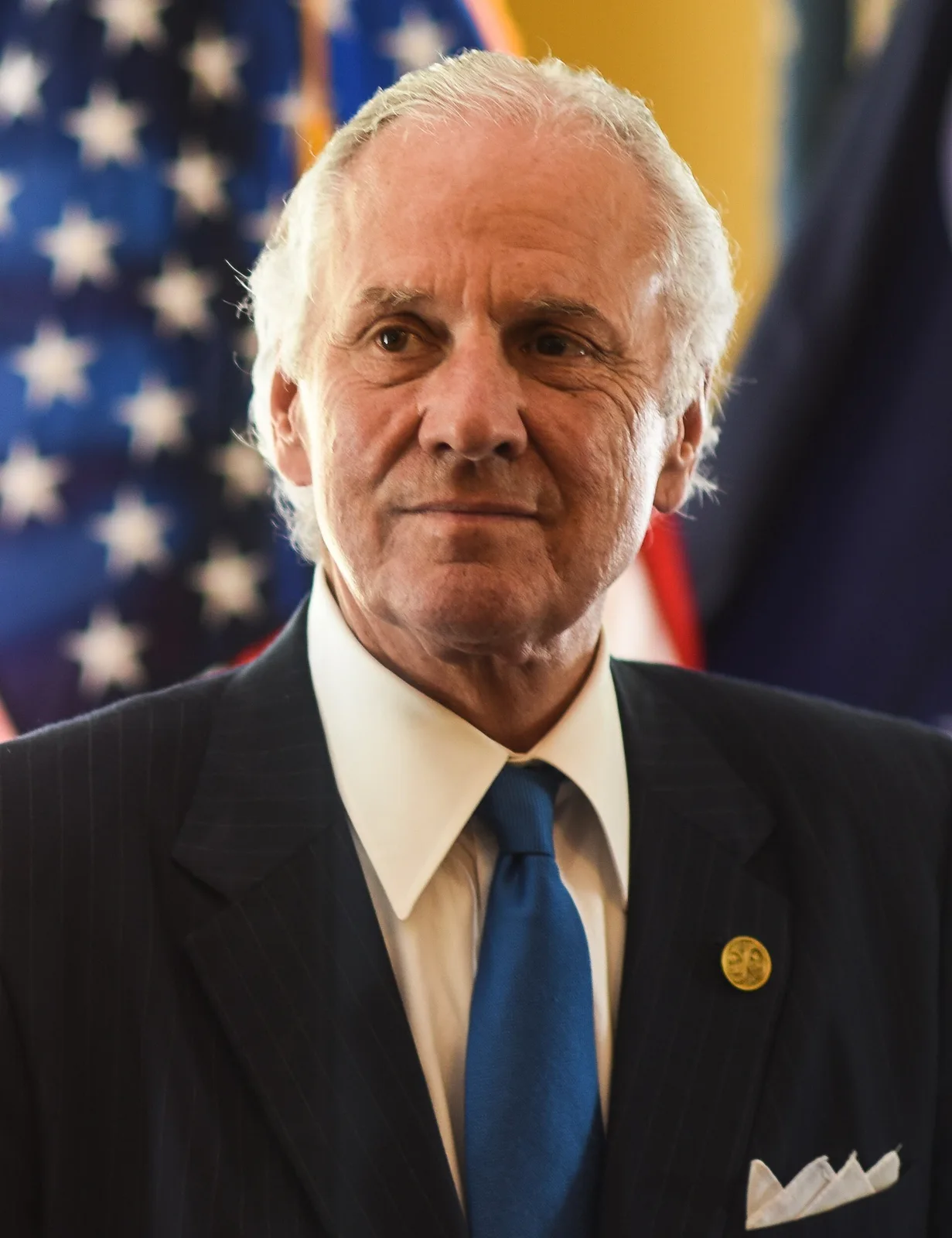
Henry McMaster
- Party
- Republican
- In Office Since
- January 24, 2017
- Elected
- 2018, re-elected 2022
- Term Ends
- January 2027
- Born
- May 27, 1947, Columbia, South Carolina
- Education
- University of South Carolina (BA, JD)
- Prior Role
- Lt. Governor (2011–2017), Attorney General (2003–2011)
Henry McMaster is the 117th Governor of South Carolina. He ascended to the governorship in January 2017 when Governor Nikki Haley was confirmed as U.S. Ambassador to the United Nations, then won election to a full term in 2018 and re-election in 2022. McMaster was the first major statewide elected official to endorse Donald Trump in the 2016 Republican primary, a relationship that has remained central to his political identity.
Other Current State Officials
Lieutenant Governor
Pamela Evette
In office since January 2019. First elected Lt. Governor in South Carolina history, the position was previously appointed. Co-owner of Quality Business Solutions, a human resources company. Focuses on workforce development and economic growth.
Attorney General
Alan Wilson
In office since 2011. Son of U.S. Rep. Joe Wilson. Focuses on opioid enforcement, human trafficking prosecution, and consumer protection initiatives.
Secretary of State
Mark Hammond
In office since 2003, one of the longest-serving Secretaries of State in South Carolina history. Oversees business and charity registrations, notary commissions, and related administrative functions.
The South Carolina General Assembly
South Carolina State Senate
- Seats: 46 members
- Terms: 4-year terms
The upper chamber. Senators serve 4-year staggered terms, so only a portion of the Senate is on the ballot in any given election cycle. The Senate President Pro Tempore historically controls the chamber's agenda and is one of the most powerful positions in state government.
South Carolina House of Representatives
- Seats: 124 members
- Terms: 2-year terms
The lower chamber. All 124 House seats are on the ballot every two years. Republicans have held supermajority control of the House for most of the 21st century, enabling them to override governor vetoes without Democratic support.
South Carolina's U.S. Senators
U.S. Senator
Darline Graham
Darline Graham was appointed by Governor Henry McMaster on July 13, 2026, and sworn in on July 14 to finish the term of her brother, Senator Lindsey Graham, who died on July 11, 2026. She is the first woman to represent South Carolina in the U.S. Senate and the first senator to succeed a sibling. The appointment runs until the term ends in January 2027; the seat is on the November 2026 ballot.
U.S. Senator
Tim Scott
Tim Scott was appointed to the Senate in January 2013 by Governor Nikki Haley, becoming the first Black U.S. Senator from the South since Reconstruction. He won a 2014 special election for the rest of the term, then full terms in 2016 and 2022. Scott ran for the 2024 Republican presidential nomination before suspending his campaign in November 2023, and in the 119th Congress he chairs the National Republican Senatorial Committee.
South Carolina Through the Years
From early settlement to the present day. Tap any era to read more.
South Carolina was home to dozens of Native nations before European contact. The Catawba Nation dominated the Piedmont region and remains a federally recognized tribe today, the only one with a reservation in South Carolina. The Cherokee controlled the Blue Ridge mountains in the northwest. The Yemassee and Westo peoples inhabited the Lowcountry and coastal plain.
These nations had sophisticated trade networks, agricultural systems, and political structures. European contact brought devastating disease epidemics in the early 1500s. The Yemassee War of 1715 to 1717 nearly drove the English settlers from the colony before an alliance with the Cherokee suppressed the uprising.
The Catawba, who call themselves Iswa, 'people of the river,' ceded most of their land in a 1763 treaty and were confined to a small reservation near Rock Hill. South Carolina and the federal government terminated their recognition in 1959, but the tribe won it back in a 1993 land-claim settlement that also provided about 50 million dollars; they are the only federally recognized tribe based in the state.
The Cherokee gave up their South Carolina lands in stages after siding with Britain in the Revolution, when a 1776 Patriot expedition destroyed most of their Lower Towns in the far northwest. Coastal peoples such as the Yemassee, Kiawah, and Edisto were largely gone by the mid-1700s, killed, enslaved and shipped to the Caribbean, or driven to Florida, though state-recognized groups including the Pee Dee and the Edisto Natchez-Kusso survive today.
King Charles II granted the Province of Carolina to eight Lords Proprietors in 1663. The first permanent English settlement was established at Albemarle Point on the Ashley River in 1670, then moved to its current location, the peninsula between the Ashley and Cooper Rivers, in 1680, founding Charles Town (now Charleston). From the beginning, the colony was a major hub of the Atlantic slave trade; enslaved Africans from West and Central Africa were brought in large numbers to work rice and indigo plantations.
Charles Town was one of the largest and wealthiest cities in colonial North America. In 1712, the colony was officially divided into North and South Carolina.
Carolina was designed as a slave society from the start. Many early planters came from Barbados and brought the harsh Caribbean plantation model and its slave codes, and by roughly 1708 South Carolina had a Black majority, the only mainland colony where that was true. Rice, introduced in the 1690s and dependent on enslaved Africans' agricultural knowledge and labor in malarial tidal swamps, made Charleston's planters the richest people in British North America.
Government under the Lords Proprietors was chaotic; settlers overthrew the Proprietors in 1719, and the Crown formally took over in 1729. In 1739 the Stono Rebellion broke out about 20 miles from Charleston when a group of enslaved men, some recently arrived from the Kingdom of Kongo, seized weapons and marched toward Spanish Florida, which offered freedom; roughly 25 white colonists and 35 to 50 rebels were killed, and the assembly responded with the 1740 Negro Act that tightly restricted enslaved people for the next century.
South Carolina was deeply involved in the Revolutionary War. The Palmetto Fort on Sullivan's Island in Charleston Harbor, built from sabal palmetto logs, withstood a British naval bombardment in June 1776, the spongy wood absorbing cannonballs without shattering. This victory inspired both the state's nickname and flag. Francis Marion, 'The Swamp Fox,' led irregular guerrilla warfare against British forces across the state.
The Battle of Cowpens (1781) was a decisive American victory. South Carolina ratified the U.S. Constitution on May 23, 1788, becoming the 8th state. The palmetto tree and crescent moon on the state flag directly honor the Sullivan's Island victory.
More Revolutionary War engagements were fought in South Carolina than in any other state, roughly 200, and much of it was a brutal civil war between Patriot and Loyalist neighbors in the backcountry. The British captured Charleston in May 1780 in the worst American defeat of the war, taking about 5,000 prisoners, then held the Lowcountry while Marion, Thomas Sumter, and Andrew Pickens harassed them from the swamps and hills.
The tide turned at Kings Mountain in October 1780, where 'overmountain men' destroyed a Loyalist force, and at Cowpens in January 1781, a textbook double envelopment by Daniel Morgan. At the 1787 Constitutional Convention, South Carolina delegates led by the Pinckneys and Rutledges won a 20-year guarantee against any ban on the international slave trade and the clause counting enslaved people as three-fifths of a person for representation; the state ratified 149 to 73 in May 1788.
South Carolina was the first state to secede from the Union, on December 20, 1860, following Abraham Lincoln's election. The Confederate attack on the Union garrison at Fort Sumter in Charleston Harbor on April 12 to 14, 1861 began the Civil War. Major Robert Anderson surrendered the fort after a 34-hour bombardment.
The war devastated South Carolina; Sherman's army burned Columbia in February 1865 during its march northward. South Carolina had the highest proportion of enslaved people of any state before the war. The end of the war brought emancipation to approximately 400,000 enslaved South Carolinians and began one of the most turbulent political eras in any state's history.
The secession convention met in Charleston and adopted its ordinance unanimously, 169 to 0, and its formal 'Declaration of the Immediate Causes' named the free states' refusal to enforce the Fugitive Slave Act and their hostility to slavery as the reasons. About 57% of the state's people were enslaved in 1860, the highest share in the nation.
Charleston was blockaded for the rest of the war and its harbor forts endured a Union siege from 1863. In February 1864 the Confederate submarine H.L. Hunley sank the USS Housatonic off the city, the first submarine to sink a ship in combat, then vanished with its crew; it was located in 1995 and raised in 2000. Sherman's troops burned much of Columbia on February 17, 1865.
South Carolina experienced one of the most dramatic Reconstruction periods of any state. Black South Carolinians constituted a majority of the population and held significant political power from 1868 to 1877, electing Black congressmen and a majority in the state House. The end of Reconstruction ushered in a half-century of Jim Crow laws, racial terror, and disenfranchisement.
Briggs v. Elliott, one of the five cases consolidated into Brown v. Board of Education, originated in Clarendon County, SC, making South Carolina a central site in the legal battle to end school segregation. The Orangeburg Massacre of 1968, where state troopers killed three Black students protesting a segregated bowling alley, is one of the most underremembered tragedies of the civil rights era.
South Carolina sent the first Black member of the U.S. House, Joseph Rainey, in 1870, and Black voters and legislators wrote the progressive 1868 state constitution that created the state's first public school system. That order collapsed in the violent, fraud-ridden 1876 election that returned Wade Hampton and the 'Redeemers' to power, backed by paramilitary 'Red Shirts' and the Hamburg and Ellenton massacres.
The 1895 state constitution, engineered by Senator 'Pitchfork Ben' Tillman, added poll taxes and literacy tests that cut Black registration from a majority to almost nothing, and it stood largely intact until the 1965 Voting Rights Act. In Briggs v. Elliott (1950), Clarendon County parents led by the Rev. Joseph DeLaine sued for equal schools; theirs was the first of the five cases folded into Brown v. Board of Education, and the plaintiffs faced firings, eviction, and arson for taking part.
On June 17, 2015, a white supremacist gunman killed nine Black parishioners at Emanuel African Methodist Episcopal Church in Charleston during a Bible study, the 'Mother Emanuel' massacre. The victims' families responded with extraordinary acts of public forgiveness.
The killings prompted then-Governor Nikki Haley to sign legislation removing the Confederate battle flag from the State House grounds, where it had flown since 1962. President Obama delivered a moving eulogy, ending by singing 'Amazing Grace.' The event became a national turning point on Confederate symbolism and sparked debates about race and memory that continue to this day across the country.
Emanuel AME, founded in 1816, is one of the oldest Black congregations in the South. One of its founders, Denmark Vesey, was executed in 1822 for planning a large slave revolt, and the city forced the church to disband; it met in secret until after the Civil War. Among the nine killed in 2015 was the church's pastor, state senator Clementa Pinckney.
The Confederate battle flag had been raised over the State House dome in 1961 and moved to a Confederate monument on the grounds in a 2000 compromise. After the 2015 killings, activist Bree Newsome briefly climbed the flagpole and took the flag down before it was removed legally; the legislature voted to take it down permanently on July 9, 2015, and it now sits in the state's Confederate Relic Room museum. In 2017 the gunman became the first person given a federal death sentence for a hate crime.
South Carolina's Defining Moments in American History
These are the events that didn't just shape South Carolina, they changed the nation.
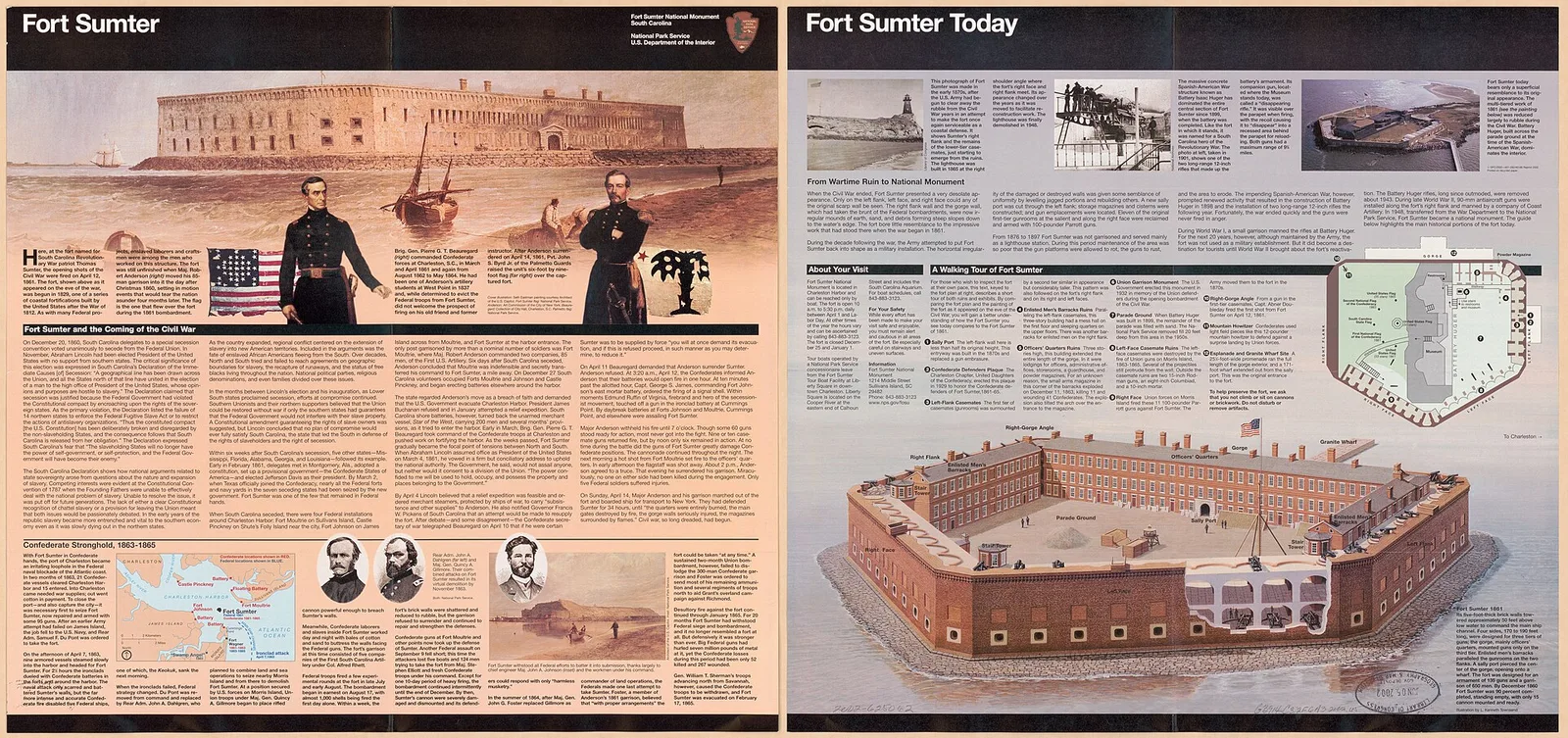
On April 12, 1861, Confederate forces opened fire on the Union garrison at Fort Sumter in Charleston Harbor, beginning the American Civil War. Major Robert Anderson, commanding roughly 80 Union soldiers, surrendered the fort after a 34-hour bombardment. No soldiers were killed in the combat itself, but the shots transformed an escalating political crisis into a shooting war that would last four years and cost more than 600,000 lives.
Fort Sumter is now a National Monument, accessible by ferry from Charleston, and is one of the most visited historic sites in the South. The choice to fire first, made in Charleston, had consequences that reshaped the nation.
The standoff had built for months. Anderson secretly moved his small garrison from the exposed Fort Moultrie to Sumter out in the harbor the day after Christmas 1860, and a January 1861 attempt to resupply the fort aboard the merchant ship Star of the West was turned back by cadet gunners from The Citadel. Lincoln's decision in April to send only food, and to notify South Carolina that he was doing so, forced the Confederacy to choose whether to fire.
The bombardment opened at 4:30 a.m. on April 12 from batteries ringing the harbor; the only deaths came afterward, when a cannon burst during the surrender salute. Two days later Lincoln called for 75,000 volunteers, which pushed Virginia, North Carolina, Tennessee, and Arkansas out of the Union as well. Union guns later pounded the fort to rubble, but it was never retaken by assault.
The June 17, 2015 massacre at Emanuel African Methodist Episcopal Church in Charleston, where nine Black parishioners were murdered during Bible study by a white supremacist, became one of the most galvanizing moments in modern American history. The survivors and victims' families responded with extraordinary public acts of forgiveness at the shooter's bond hearing, stunning the country. Governor Nikki Haley, a Republican, signed legislation removing the Confederate battle flag from the State House grounds within weeks.
President Obama delivered a eulogy for the Rev. Clementa Pinckney that ended with him singing 'Amazing Grace.' The response united South Carolina across political lines in a way rarely seen.
The gunman, who had posted a racist manifesto and photos with the Confederate flag online, sat through most of an hour-long Bible study before opening fire; three of the twelve people present survived. At his bond hearing two days later, relatives of the dead told him one by one that they forgave him, a scene broadcast nationally that shaped how the country responded.
Within weeks major retailers pulled Confederate-flag merchandise, and other Southern states and cities moved to take down flags and monuments, beginning a removal wave that continued through 2020. Congress and the state helped fund a memorial at the church, and in 2017 the gunman became the first defendant sentenced to death under the federal hate-crime law.
South Carolina, a deeply conservative state with a painful racial history, has produced two nationally prominent barrier-breaking politicians in recent decades. Nikki Haley (born Nimrata Randhawa) was elected Governor in 2010, becoming the first female governor of South Carolina and the first Indian-American governor in U.S. history.
She later served as U.S. Ambassador to the United Nations under President Trump and ran for the 2024 Republican presidential nomination. Tim Scott was appointed to the U.S. Senate in 2013, becoming the first Black U.S. Senator from the South since Reconstruction, won a 2014 special election and full terms in 2016 and 2022, and also ran for the 2024 Republican presidential nomination.
Haley grew up in Bamberg, a small town where her Sikh immigrant parents ran a clothing store, and she worked as an accountant and served in the state house before winning the governorship in 2010 with Tea Party support. As governor she signed the flag-removal bill, recruited Volvo and other manufacturers, and declined to expand Medicaid; she resigned in 2017 to become UN ambassador and finished second to Donald Trump in the 2024 Republican primaries.
Tim Scott, raised by a single mother in North Charleston, served on Charleston County Council and in the state house and one term in the U.S. House before Haley appointed him to the Senate seat Jim DeMint vacated in 2013. He won a full term in 2016 as the first Black senator elected in the South since Reconstruction, briefly sought the 2024 Republican presidential nomination, and was re-elected in 2022 to a term running through January 2029.
Notable South Carolinians
James Brown
Godfather of Soul and one of the most influential musicians in history, born in Barnwell
Jesse Jackson
Civil rights leader and two-time Democratic presidential candidate, born in Greenville
Andrew Jackson
7th President of the United States, born near the NC-SC border
Mary McLeod Bethune
Educator, civil rights leader, and advisor to President Roosevelt, born in Mayesville
Darius Rucker
Lead singer of Hootie and the Blowfish and successful country solo artist, born in Charleston
Strom Thurmond
Served 48 years in the U.S. Senate, the longest tenure in its history when he retired in 2003 (since surpassed), born in Edgefield
State Symbols & Quick Facts
| Nickname | "The Palmetto State" |
| Capital | Columbia |
| Largest City | Charleston |
| Statehood | May 23, 1788 (8th state) |
| Population | ~5.3 million (2025 est.) |
| Area | 32,020 sq mi, 40th largest state |
| Motto | "Dum Spiro Spero" (While I Breathe, I Hope) |
| State Bird | Carolina Wren |
| State Flower | Yellow Jessamine |
| State Tree | Sabal Palmetto |
| State Animal | White-tailed Deer |
| State Fish | Striped Bass |
| State Fruit | Peach |
| State Vegetable | Collard Greens |
| State Song | "Carolina" |
| Time Zone | Eastern Time (UTC−5 / UTC−4) |
| Borders | North Carolina (N & W), Atlantic Ocean (E/SE), Georgia (SW) |
Did You Know?
South Carolina actually produces more peaches by volume than Georgia most years, yet Georgia holds the famous 'Peach State' nickname. South Carolina is typically the second-largest peach producer in the U.S. after California. The town of Gaffney even has a water tower shaped like a giant peach visible from Interstate 85.
BMW's largest manufacturing facility in the entire world, larger than any plant in Germany, is located in Greer, South Carolina. It produces more than 400,000 vehicles annually and exports more cars from the United States than any other factory in the country.
The first golf club in America was established in Charleston in 1786. South Carolina went on to become widely known as the 'Golf Capital of the World,' with more than 350 courses statewide, particularly concentrated around Myrtle Beach and the Grand Strand.
South Carolina's sabal palmetto tree is so central to the state's identity that it appears on the state flag alongside a crescent moon. The symbol honors the Battle of Sullivan's Island (1776), where defenders repelled a British naval attack using a fort built from spongy palmetto logs, the wood absorbed cannonballs rather than shattering, saving the garrison.
The Gullah Geechee people of South Carolina's Sea Islands and Lowcountry coast have preserved a distinct African-influenced language, culture, and cuisine for over three centuries. The Gullah language blends English with several West and Central African languages. The Gullah Geechee Cultural Heritage Corridor is a federally recognized national heritage area spanning from northeastern Florida to southeastern North Carolina.
Quick Facts and Common Questions
Short answers to the questions people most often ask about South Carolina: its abbreviation, who it was named for, its capital, and its place in Congress.
South Carolina's two-letter postal abbreviation is SC. The U.S. Census Bureau places it in the South region, in the South Atlantic division, and about 5.12 million people lived there in the 2020 census.
South Carolina became the 8th state on May 23, 1788, when its convention ratified the U.S. Constitution. It was one of the original 13 colonies.
The name Carolina comes from "Carolus," Latin for Charles, honoring King Charles I of England. His son, King Charles II, granted the Carolina charter to eight Lords Proprietors in 1663, and settlers founded Charles Town, now Charleston, in 1670. The northern and southern parts of Carolina became separate royal colonies in 1729.
Columbia has been the capital since 1786, when lawmakers moved the government from Charleston, on the coast, to a new planned city near the center of the state. Union troops burned much of Columbia in 1865, and bronze stars on the unfinished State House mark where Union cannon fire struck it. The building was finally completed in the early 1900s.
South Carolina borders two states: North Carolina to the north and Georgia to the southwest, where the Savannah River forms the boundary. Its southeastern edge is Atlantic coastline.
South Carolina was the first state to secede from the Union, on December 20, 1860, after the election of Abraham Lincoln. The Civil War began on April 12, 1861, when Confederate forces fired on Fort Sumter in Charleston Harbor, which the U.S. Army surrendered the next day.
On June 28, 1776, American defenders in a fort built of palmetto logs on Sullivan's Island turned back a British fleet attacking Charleston; the spongy logs absorbed cannonballs. The fort was renamed Fort Moultrie, and the palmetto tree appears on the state flag and seal. The state's mottoes are "Dum spiro spero" ("While I breathe, I hope") and "Animis opibusque parati" ("Prepared in mind and resources").
Based on the 2020 census, South Carolina has 7 seats in the U.S. House of Representatives, the same as before, which gives it 9 votes in the Electoral College.
Sources & Further Reading
- Census Regions and Divisions, U.S. Census Bureau
- 2020 Census Apportionment Results, U.S. Census Bureau
- Distribution of Electoral Votes, National Archives
- South Carolina Encyclopedia
- South Carolina Department of Archives and History
- Fort Sumter and Fort Moultrie National Historical Park, National Park Service
Congaree National Park
The Largest Intact Expanse of Old-Growth Bottomland Hardwood Forest in the United States
About Congaree National Park
Congaree National Park protects the largest remaining stand of old-growth bottomland hardwood forest in the United States, about 11,000 acres within a 26,000-acre park in the Congaree River floodplain southeast of Columbia. Before the logging era, similar forest covered roughly 30 million acres of the Southeast; less than a fifth of one percent survived, and Congaree holds the biggest single piece.
The forest survived because the land was hard to log. The Santee River Cypress Lumber Company cut cypress here in the 1890s and 1900s but abandoned the wettest ground, and the Beidler family that owned the tract left much of it uncut for decades. When timber prices rose again in the late 1960s, logging resumed and prompted a grassroots campaign led by the Sierra Club and the local advocate Harry Hampton.
Congress made it Congaree Swamp National Monument in 1976, added wilderness in 1988, and redesignated it Congaree National Park in 2003, dropping 'Swamp' because the area is a floodplain forest, not a true swamp: it is dry most of the year and floods only when the river rises. It is also a UNESCO Biosphere Reserve and an Important Bird Area.
The park records roughly 160,000 to 250,000 visitors a year, modest for a national park, and charges no entrance fee. Its best-known features are a canopy among the tallest in eastern North America, a 2.6-mile elevated boardwalk, and a two-week synchronous firefly display each late spring.
- Designation
- National Park, UNESCO Biosphere Reserve, National Natural Landmark
- Location
- Hopkins, South Carolina, 20 miles southeast of Columbia
- Established
- Designated National Monument 1976; National Park 2003
- Annual Visitors
- ~230,000
Key Features
Congaree's canopy is one of the tallest broadleaf forests in the world, averaging over 100 feet with many trees above 130 and a loblolly pine measured at 167 feet. Researchers have described it as the tallest deciduous forest canopy in North America, comparable in height to old-growth stands in the Pacific Northwest.
The park has held more than 20 state and national champion trees over the years, including national champion loblolly pine, sweetgum, cherrybark oak, swamp chestnut oak, and common persimmon. Some baldcypress here are estimated at 500 or more years old, and turn-of-the-century stumps show the forest once held larger trees still.
The giants grow because the floodplain delivers water and fresh sediment while frequent flooding suppresses fire and limits competition. Nutrient-rich alluvial soil, a long growing season, and centuries without clearing combine to push individual trees toward their maximum size.
Hurricane Hugo in 1989 knocked down large trees and opened canopy gaps, and ice storms and lightning continually reshape the forest, but it regenerates in place: downed trunks become nurse logs, and the Park Service manages the area as wilderness with minimal intervention.
The Congaree River overtops its banks and floods the forest an average of about 10 times a year, usually in winter and spring, for periods of days to a couple of weeks. Floodwaters spread across the floor through a network of gut channels, sloughs, and oxbow lakes left by the river's shifting course.
Each flood lays down a thin sheet of nutrient-rich silt and recharges the sloughs, driving high productivity: the floodplain exports leaf litter and invertebrates downstream and supports dense populations of crayfish, amphibians, and fish that in turn feed wading birds, otters, and bobcats.
Flood timing and depth sort the trees into zones. The lowest, wettest ground holds baldcypress and water tupelo with their buttressed trunks and knees; slightly higher flats carry laurel oak, sweetgum, and green ash; the rare high ridges support loblolly pine and species that cannot tolerate long inundation.
Alligators reach the northern edge of their range here, and the park's waters hold cottonmouths, many salamander and frog species, and a rich freshwater mussel fauna. During floods, paddlers can move a canoe directly among the trunks of the old-growth trees.
For about two weeks between mid-May and mid-June, Congaree is one of a handful of places in North America where the firefly Photuris frontalis, a species distinct from the Photinus carolinus of the Great Smoky Mountains, flashes in unison, sending waves of light through the understory after dark.
The males synchronize their quick single flashes, thought to help females pick out their own species amid other fireflies, so whole patches of forest blink on and off together for roughly two hours after full dark. Cool, damp, still nights produce the strongest displays.
The event has grown so popular that since 2017 the park has run a vehicle-pass lottery on Recreation.gov, opening in spring, to cap the number of cars during the peak nights. Visitors park and walk the boardwalk; white light is banned and rangers ask people to cover phone screens, since artificial light disrupts the flashing.
Habitat is the constraint: synchronous fireflies need undisturbed, moist leaf litter and darkness, and light pollution, soil compaction, and pesticides all reduce them. Congaree's protected old-growth floor is one of the few large blocks of suitable habitat left in the region.
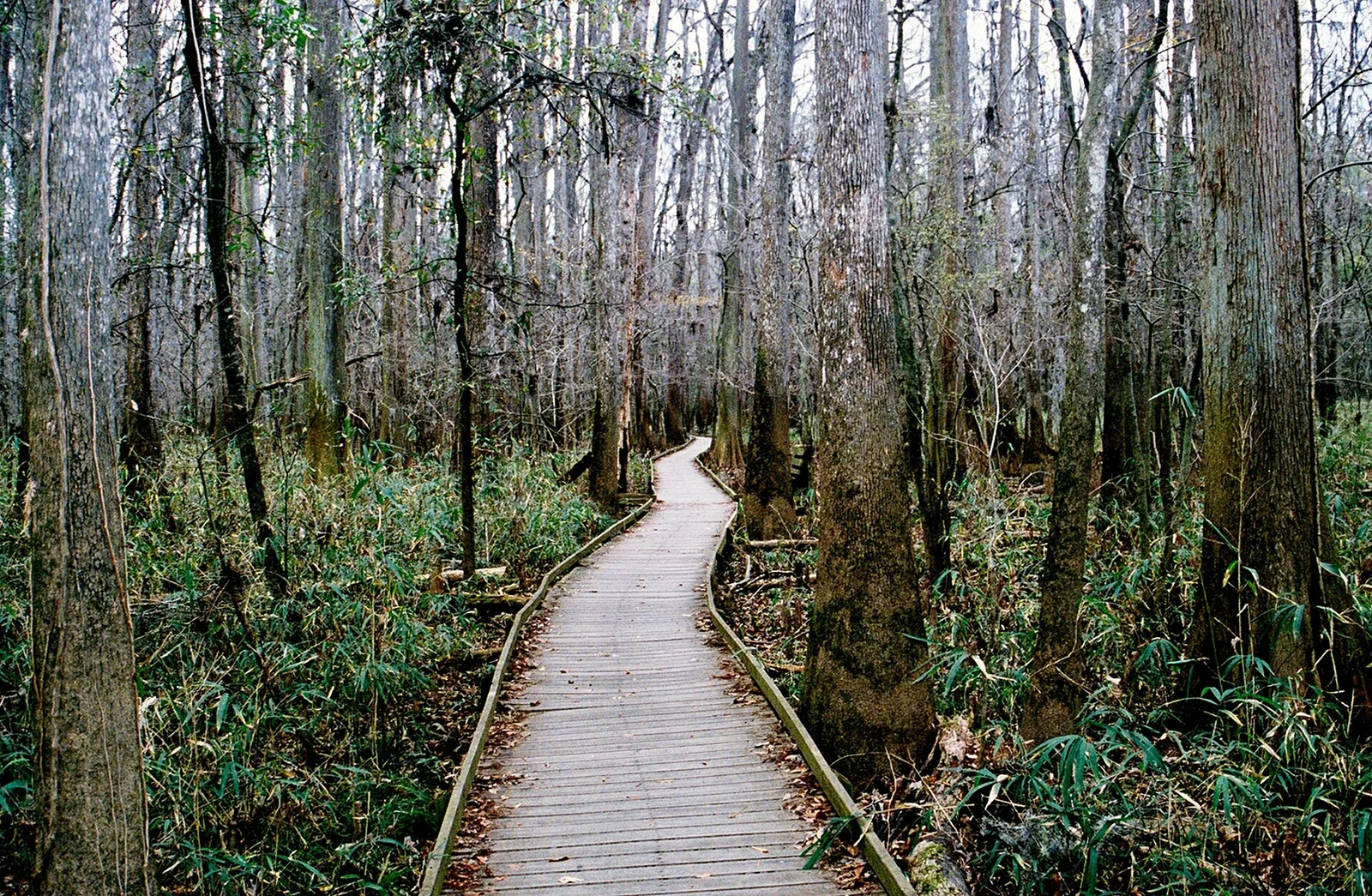
The Boardwalk Loop is a 2.6-mile elevated walkway that leaves the Harry Hampton Visitor Center and circles through the old-growth forest, keeping visitors a few feet above a floor that is muddy or flooded much of the year. It is the park's most-used trail by a wide margin.
The 'low boardwalk' section drops nearer the forest floor through cypress-tupelo swamp with knees rising all around; the 'high boardwalk' runs through drier hardwood flats past some of the largest trees. Numbered stops keyed to a self-guiding brochure explain the ecology.
The structure has been rebuilt more than once. Floods, falling limbs, and rot repeatedly damage it, and a multi-year replacement of large sections with more durable materials was underway in the 2020s, with detours and partial closures.
When the river is high the boardwalk itself goes underwater and closes, so the park posts current water levels because a trip planned around it can be washed out with little notice. In dry conditions the loop is firm enough for wheelchairs and strollers.
Indigenous Heritage
Congaree People
The park is named for the Congaree, a small Siouan-speaking nation who lived in riverside villages along the lower Congaree River and farmed and hunted the floodplain. A 1701 account by the naturalist John Lawson described a Congaree town near the river with cleared fields and bark houses.
Old World disease, especially a smallpox epidemic around 1698 and another in the 1710s, destroyed most of the Congaree within a generation of sustained contact. Some Congaree fought alongside the English in the Tuscarora War (1711 to 1713) and then against the colony in the Yamasee War (1715), after which the survivors withdrew and merged with the Catawba and other piedmont nations.
By the mid-18th century the Congaree existed only as a place name. Their descendants are counted among the Catawba, whose confederation absorbed the remnants of dozens of small Carolina Siouan nations. Archaeological sites in and near the park record thousands of years of Native use of the floodplain.
The Catawba Indian Nation, which absorbed many survivors of the Congaree and other Siouan-speaking peoples of the Carolina piedmont and coastal plain, is headquartered near Rock Hill, South Carolina, and holds federal recognition. The Catawba maintain cultural connections to the broader landscape of South Carolina including the Congaree River watershed.
Things To Do
Boardwalk Loop Trail
The Boardwalk Loop is Congaree's signature walk: a 2.6-mile elevated circuit from the Harry Hampton Visitor Center through the heart of the old-growth forest, past champion trees, cypress knees, and swamp wildlife, doable in one to two hours at an easy pace.
The route combines a lower section through wet cypress-tupelo flats with a higher section through drier hardwoods; benches and numbered interpretive stops line the way, and the visitor center loans out brochures and, seasonally, activity packs for children.
During and after heavy rain the river backs into the forest and can submerge or close the boardwalk entirely, sometimes for weeks. The park posts the Congaree River gauge reading and a boardwalk status online, so check before driving out.
A long-running project to rebuild aging sections of the boardwalk has meant intermittent detours and closures; when finished it replaces wooden decking and pilings with longer-lasting materials better suited to repeated flooding.
Weston Lake Loop Trail
The Weston Lake Loop is a 4.6-mile hike that branches off the boardwalk and follows a dirt path deeper into the floodplain to Weston Lake, an oxbow left behind when the Congaree River cut a new channel and abandoned this bend.
The lake and Cedar Creek along the route are among the best wildlife spots in the park, with regular sightings of great blue and green herons, wood ducks, prothonotary warblers, river otters, and turtles, and the occasional alligator at the northern edge of its range.
The trail passes some of the park's largest trees, including massive loblolly pines and cherrybark oaks, and crosses low ridges and sloughs that show how small elevation differences control which species grow where.
It is rated moderate mainly for distance and footing: roots, mud, and shallow water crossings are common, the trail can be impassable at high water, and hikers should carry a map since blazes are sparse and the flat forest offers few landmarks.
Canoe and Kayak Trails
The Cedar Creek Canoe Trail runs about 15 miles from Bannister Bridge through the wilderness to the Congaree River, winding under the old-growth canopy on a narrow, tea-colored blackwater creek. Shorter out-and-back trips from the put-ins are common for people not doing the full route.
Paddling the forest during or just after a flood, when the floor is under water, lets visitors move directly among the trunks and knees of trees that are otherwise reached only on foot. At normal levels the creek is a tight, twisting channel with frequent logjams to portage around.
The park and volunteers clear the worst deadfall, but Cedar Creek is a wilderness stream and conditions change with every storm; the full trip is a long day and the Park Service recommends it only for experienced paddlers with a shuttle arranged, since there is no loop.
Ranger-guided canoe trips run on a limited schedule, mostly in spring and fall, and fill quickly through Recreation.gov. Outfitters near the park rent boats and run shuttles for the one-way Cedar Creek route.
Synchronous Firefly Viewing
The synchronous firefly display runs for roughly two weeks in mid-to-late May and early June, timed each year to the emergence, which shifts with spring temperatures. The park announces the viewing window and lottery dates a few weeks ahead.
Because a few hundred cars converging on one small lot would overwhelm the park and its dark conditions, entry during the peak nights is by vehicle pass only, drawn in a Recreation.gov lottery that opens in spring and is heavily oversubscribed. Passes are non-transferable and checked at the gate.
Ticket holders park near the visitor center and walk the Boardwalk Loop after dark. Flashlights, phone screens, and headlights in the lot are prohibited or heavily restricted, and rangers use red-filtered light only where needed, because white light suppresses the fireflies' flashing and disrupts mating.
The display peaks in the first hour or two after full dark and is best on warm, still, humid nights; rain, wind, and cold can shut it down entirely. Outside the lottery nights the fireflies are still active but the park limits how many people can be in the forest after hours.
Conservation and Challenges
Invasive Species
Chinese and Japanese privet are the park's worst plant invaders, forming shrub thickets so dense they shade out tree seedlings and native wildflowers across large areas of the understory; floods spread their seeds throughout the floodplain.
Japanese climbing fern, a relatively new arrival in South Carolina, drapes over shrubs and small trees and can carry fire into the canopy in the rare event of a floodplain burn. Other targets include tallow tree (popcorn tree), Japanese stiltgrass, and kudzu along the park's edges.
Feral hogs root up the forest floor, wallow in sloughs, eat native plants, salamanders, and ground-nesting bird eggs, and spread invasive plant seeds. The park traps and removes them but cannot eliminate a population that moves freely across its unfenced boundary.
Control is slow because most of the park is flooded wilderness with almost no roads; crews reach infestations by boat or on foot, and privet regrows from cut stumps unless treated, so the same sites need repeated visits over many years.
Climate Change and Flooding
The old-growth forest is tuned to a particular flood regime, roughly ten pulses a year of limited duration, and its tree zonation reflects centuries of that pattern. Shifts in the timing, frequency, or length of flooding could change which species can regenerate where.
The Southeast has seen more of its rain fall in heavy downpours, and the October 2015 storm that dropped historic rainfall on South Carolina pushed the Congaree River to a record crest, deeply flooding the park, damaging the boardwalk, and killing some trees through prolonged inundation.
Longer or deeper growing-season floods stress species like loblolly pine that need drier feet, while a drying trend would cut the sediment and water subsidy that lets the giants grow; either direction favors a different, likely shorter forest.
Upstream dams and the growth of metropolitan Columbia already alter the river's flow and sediment load, so the park works with the US Geological Survey and state agencies to monitor gauges, water chemistry, and tree growth as an early warning of change.
Air Quality and Acid Deposition
Congaree lies just downwind of Columbia and within reach of power plants, highways, and farms, so despite being wilderness it receives measurable ozone, nitrogen, sulfur, and mercury pollution.
Growing-season ground-level ozone has at times approached or exceeded the level the Park Service considers harmful to vegetation; ozone injures the leaves of sensitive species such as black cherry, sweetgum, and blackberry and reduces their growth.
Nitrogen and sulfur deposition slightly acidify soils and the park's naturally acidic blackwater, and mercury from regional sources is converted in the wetland to methylmercury that builds up in fish, prompting state consumption advisories for some species caught in the park.
The park runs continuous air-quality and mercury monitoring and reports that regional emission controls since the 2000s have improved several measures, but visibility-reducing haze and summer ozone remain the pollutants of most concern for the forest.
The Boardwalk Loop passes through some of the tallest trees in eastern North America
Fast Facts
Did You Know?
Congaree contains what may be the tallest forest canopy in eastern North America. Loblolly pines exceed 160 feet, and the forest as a whole has been compared to a cathedral because of the towering trunks and high closed canopy. Many of the trees were already old when European settlement began and have never been logged, surviving because the land was difficult to farm and too remote to log economically until the conservation movement succeeded in protecting it.
The synchronous firefly display at Congaree is one of only a few places in North America where it occurs. The fireflies flash in coordinated waves across the forest, with individual fireflies apparently timing their flashes to those of their neighbors. Scientists believe the synchrony is a communication mechanism that helps females identify males of their species in a forest with multiple firefly species present. The phenomenon was only reported at Congaree in the 1990s, though it presumably occurred for millennia before.
Congaree's ecosystem depends on the regular flooding of the Congaree River, which nutrients the forest floor and creates the conditions that sustain the giant trees. But this same flooding makes hiking in the park unpredictable. The boardwalk can be submerged for days at a time, and during major flood events, the entire park floor may be underwater. The park website provides current flood conditions. Flooding is not a failure of the park to maintain itself, it is the park working exactly as it should.
Plan Your Visit
Location
Hopkins, South Carolina, 20 miles southeast of Columbia
Designation
National Park, UNESCO Biosphere Reserve, National Natural Landmark
Best Time to Visit
Year-round; the boardwalk may flood and close after heavy rain, and the synchronous firefly event draws the biggest crowds for about two weeks in mid-May to mid-June.
Admission
Free. Congaree is one of the few national parks with no entrance fee.
Getting There
Congaree is located 20 miles southeast of Columbia, South Carolina. Take I-77 south from Columbia, then follow signs to the park via SC-48. There is no public transit to the park. A car is required.
Boardwalk Conditions
The Boardwalk Loop may be flooded and closed during or after heavy rain. Check the park website or call the visitor center for current conditions before visiting, especially from late fall through spring when flooding is most frequent.
Firefly Lottery
For the synchronous firefly event in May-June, register for the vehicle pass lottery on Recreation.gov. The lottery typically opens in April. The event is extremely popular and lottery passes are very limited.
Insects
The floodplain forest has abundant mosquitoes and biting insects from spring through fall. Bring and use insect repellent. Long sleeves and pants are recommended even in warm weather.