
What DHS Does
Established November 25, 2002 (began operations March 1, 2003), The U.S. Department of Homeland Security is one of the fifteen Cabinet-level departments of the U.S. federal government.
DHS is responsible for protecting the United States from terrorism, securing the nation's borders, and coordinating the federal response to natural disasters. Formed by merging 22 previously separate federal agencies, it is the largest cabinet reorganization since the Defense Department's creation in 1947.
The department's components include Customs and Border Protection, which secures the border and staffs official ports of entry, Immigration and Customs Enforcement, which handles interior immigration enforcement, the Transportation Security Administration, which screens airline passengers, and the Federal Emergency Management Agency, which coordinates disaster response.
DHS also houses the Secret Service, which protects the president and other senior officials, the Coast Guard, which normally operates under DHS but shifts to Defense Department control during wartime, and the Cybersecurity and Infrastructure Security Agency, which defends federal networks and critical infrastructure against cyberattacks.
DHS is the third-largest Cabinet department by staff, and its components long predate it: the Coast Guard traces to 1790, the Secret Service to 1865, and the Customs Service to the First Congress. It also includes U.S. Citizenship and Immigration Services (which processes green cards and naturalization on application fees), the Federal Law Enforcement Training Centers, and a large intelligence and analysis office. Its component agencies have repeatedly ranked near the bottom of federal employee-satisfaction surveys, a legacy of the rushed 2003 merger.

The Secretary of Homeland Security
The Secretary of Homeland Security leads DHS, sits on the President's Cabinet, and is confirmed by a majority vote of the U.S. Senate.
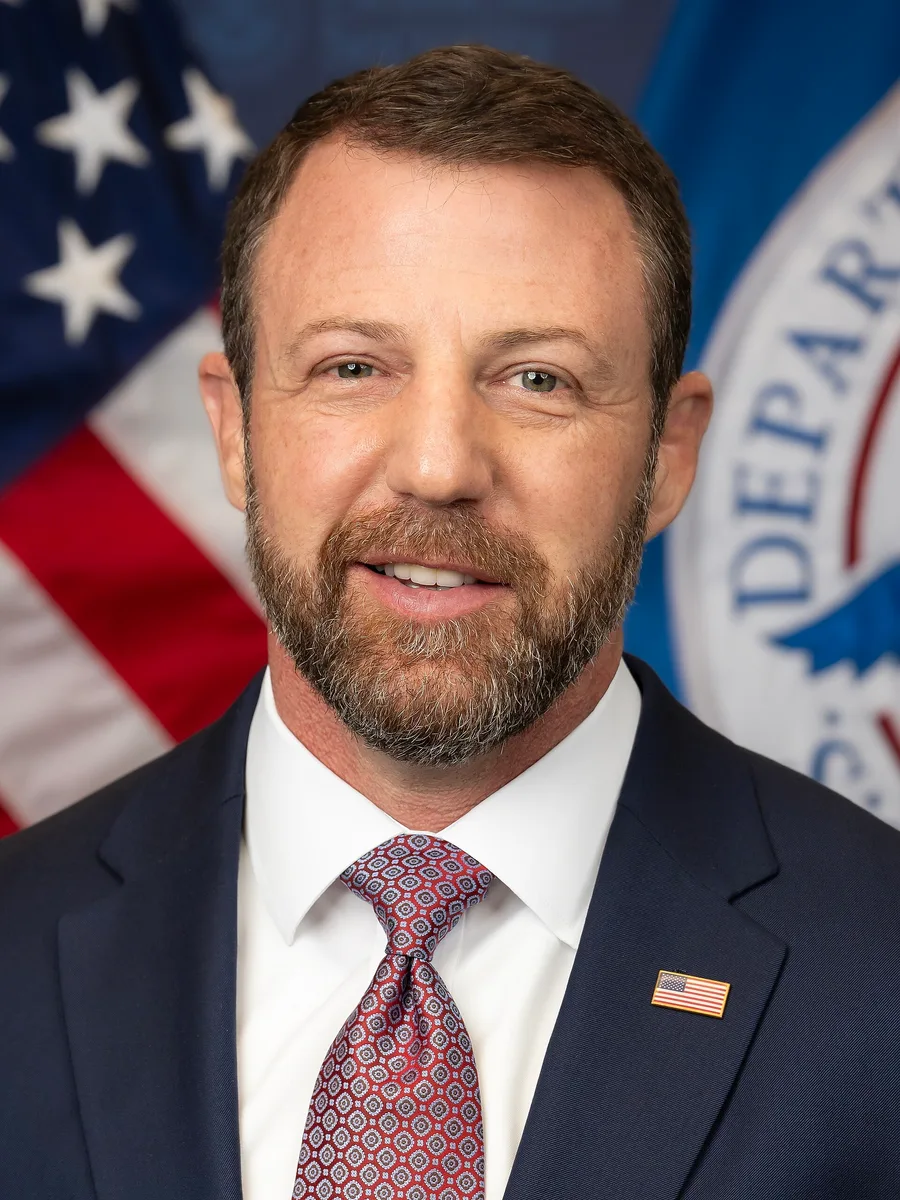
Current Secretary of Homeland Security
Markwayne Mullin
In office since
March 24, 2026
Prior role: U.S. Senator from Oklahoma (2023-2026); U.S. Representative from Oklahoma (2013-2023)
Markwayne Mullin was confirmed as Secretary of Homeland Security on March 24, 2026, succeeding Kristi Noem. He served three years in the U.S. Senate and a decade in the U.S. House representing Oklahoma before his appointment, giving him more than a dozen years of combined congressional experience.
Before entering politics, Mullin ran his family's plumbing business, and he is also a former undefeated professional mixed martial arts fighter with a 5-0 career record, a background distinct from most recent department secretaries drawn from law enforcement, military, or political backgrounds.
Major Sub-Agencies & Bureaus
DHS carries out its mission through operating divisions and sub-agencies, each with its own specific mandate.
CBP is the largest federal law enforcement agency in the country, responsible for securing the nation's borders and staffing official ports of entry, screening both people and cargo entering the United States while also collecting import duties and enforcing customs and agricultural regulations.
The agency operates along both the northern and southern land borders as well as international airports and seaports nationwide, and its Border Patrol component, which handles areas between official ports of entry, has grown substantially in staffing and funding as immigration enforcement has become an increasingly central national political issue.
CBP has about 65,000 employees, including roughly 20,000 Border Patrol agents and 25,000 officers at the roughly 330 air, land, and sea ports of entry, where more than a million people and hundreds of billions of dollars in goods cross legally each day. It also collects tariffs, a revenue source that grew sharply in 2025, though still well behind individual income and payroll taxes.
The Border Patrol's authority to operate "within a reasonable distance" of the border has long been set by regulation at 100 air miles, a zone that includes about two-thirds of the U.S. population and where agents can run checkpoints and, with limits, board buses and trains. CBP also runs an air and marine arm with drones, helicopters, and boats.
ICE enforces immigration law within the interior of the United States, identifying, arresting, detaining, and removing individuals who are in the country unlawfully, and separately investigates transnational crime including human trafficking, drug smuggling, and financial crimes through its Homeland Security Investigations division.
ICE has become one of the most politically contested agencies in the federal government in recent years, drawing both strong support and strong opposition over its enforcement practices, detention conditions, and the scope of interior immigration operations, with funding for the agency significantly expanded under recent legislation.
ICE has two main arms: Enforcement and Removal Operations, which makes arrests and runs a detention system that has held on the order of 30,000 to 50,000 people a day in a nationwide network of mostly contracted facilities, and Homeland Security Investigations, a large criminal-investigation agency whose work extends well beyond immigration to cybercrime, art theft, and trade fraud.
The agency's priorities shift sharply between administrations: some have focused enforcement on people with serious criminal records, others on broad interior enforcement including at courthouses and workplaces. Detention capacity, the use of local jails under "287(g)" agreements, and the treatment of people held in custody are recurring subjects of litigation and inspector-general reports.
TSA screens passengers and baggage at commercial airports nationwide, a function created after the September 11 attacks federalized what had previously been private airport security screening, and also has a role in securing other transportation modes including rail and mass transit systems.
TSA screens roughly 2.5 million airline passengers daily across more than 400 U.S. airports, and its screening procedures, from liquid restrictions to full-body scanners, have periodically drawn both public criticism over convenience and traveler privacy, as well as ongoing scrutiny over their actual effectiveness at detecting threats.
TSA has about 60,000 employees, most of them screening officers, and its budget is partly funded by a per-ticket "September 11 security fee." Internal covert tests by the DHS Inspector General have repeatedly found that undercover agents were able to smuggle mock weapons or explosives past checkpoints a large share of the time, prompting equipment and training changes.
Beyond aviation, TSA writes security rules for freight rail, pipelines, and mass transit, mostly through requirements on the private operators, and it runs the Federal Air Marshal Service. Its screening workforce was long paid on a separate, lower pay scale than the rest of the federal government until Congress moved it onto the standard system in the mid-2020s.
FEMA coordinates the federal response to natural disasters and other large-scale emergencies, providing direct financial assistance to disaster survivors, funding state and local emergency response capabilities, and managing the National Flood Insurance Program, which covers flood risk that most standard homeowner policies exclude.
FEMA's response is triggered when a governor requests and the president approves a federal disaster declaration, and the agency's performance has swung between widely praised responses and heavily criticized failures across different disasters, most notably its widely criticized response to Hurricane Katrina in 2005.
FEMA is comparatively small, a few thousand permanent staff plus a large reserve corps activated for disasters, and it works mostly through money: it reimburses states and localities for most emergency and rebuilding costs and pays survivors capped grants for temporary housing and repairs. It is deliberately a coordinator, not a first responder; local and state agencies lead, and FEMA supports.
The National Flood Insurance Program, which FEMA runs, covers most U.S. flood policies but has borrowed tens of billions of dollars from the Treasury it cannot repay after catastrophic storms, and Congress has kept it alive through dozens of short-term reauthorizations while debating how to price flood risk in a changing climate.
From November 25, 2002 (began operations March 1, 2003) to Today
The predecessor of DHS was 22 separate federal agencies merged from across the government. Here is how the department reached its current form.
The September 11, 2001 terrorist attacks, which killed nearly 3,000 people, exposed significant gaps in coordination among the dozens of federal agencies with some role in counterterrorism, border security, and disaster response, none of which had previously been organized under a single unified command structure.
Within weeks, President Bush created the White House Office of Homeland Security to coordinate the immediate response, an early step that within a year evolved into the push to create a full, permanent Cabinet-level department dedicated to the mission.
The administration at first opposed a new department, preferring a White House coordinator, then reversed course in mid-2002. The 9/11 Commission, which reported in 2004, separately concluded that the government's biggest failure had been a lack of imagination and of information-sharing among agencies, and its recommendations shaped later intelligence reorganizations as much as DHS itself.
Congress passed the Homeland Security Act in November 2002, creating the Department of Homeland Security by merging 22 existing federal agencies, including the Coast Guard, Secret Service, Customs Service, and the Immigration and Naturalization Service, the largest federal government reorganization since the 1947 creation of the Defense Department.
Tom Ridge, who had led the earlier White House Office of Homeland Security, became the department's first secretary when it formally began operations in March 2003, inheriting the enormous logistical challenge of merging so many previously independent agencies' cultures, systems, and missions.
The old Immigration and Naturalization Service was split into three DHS pieces, enforcement (ICE), border inspection (CBP), and benefits (USCIS), ending the long-criticized arrangement in which one agency both policed and served immigrants. A late fight over collective-bargaining rights for the new department's employees delayed the bill and became a 2002 campaign issue.
The formal merger consolidated agencies as varied as the Federal Emergency Management Agency, the Transportation Security Administration (created separately just months after 9/11), and the Federal Protective Service into DHS, a reorganization so large that some analysts still consider it only partially complete decades later.
The merger required combining agencies with vastly different missions, from law enforcement to disaster relief to maritime safety, under one department, a structural challenge that has generated persistent internal coordination difficulties documented in numerous subsequent Government Accountability Office reports.
DHS also answers to more than 90 congressional committees and subcommittees, far more than any other department, a fragmentation the 9/11 Commission urged Congress to fix and that Congress has never consolidated. The department did not open a single headquarters campus until it began moving into the historic St. Elizabeths site in Washington in the 2010s.
DHS and FEMA's widely criticized response to Hurricane Katrina in August 2005, which killed more than 1,800 people and devastated New Orleans and the Gulf Coast, exposed severe coordination and leadership failures within the young department, prompting Congress to pass major FEMA reforms in 2006.
The Post-Katrina Emergency Management Reform Act of 2006 strengthened FEMA's independence within DHS and required the FEMA administrator to have direct disaster management experience, reforms directly aimed at preventing a repeat of the widely documented mismanagement during the Katrina response.
In the merger, FEMA had lost its Cabinet-level standing and much of its disaster-preparedness money to other DHS priorities; a bipartisan Senate report titled "A Nation Still Unprepared" recommended abolishing FEMA, but Congress instead chose to rebuild it inside DHS with a protected budget and a rule that it cannot be broken up again without a new law.
Congress created the Cybersecurity and Infrastructure Security Agency in 2018, elevating DHS's cybersecurity mission into a standalone agency focused on protecting federal networks and coordinating with private companies operating critical infrastructure, including power grids and financial systems, against cyberattacks.
CISA's creation reflected the growing recognition that cyberattacks against infrastructure represented a national security threat comparable to physical attacks, and the agency has since played a central role in securing U.S. elections infrastructure and responding to major ransomware attacks against critical services.
CISA grew out of an older DHS office and is largely voluntary in its authority: it can require federal agencies to patch known-exploited software vulnerabilities and can scan federal networks, but with private infrastructure it mainly shares threat information and offers free assessments. Its election-security role, and its work countering online disinformation, later made it a target of litigation and congressional criticism from officials who saw it as overstepping.
Defining Moments
Events that reshaped the department's authority, structure, or public role.
Katrina remains the most consequential disaster response failure in DHS's history, with widely documented delays in FEMA's assistance, breakdowns in coordination between federal, state, and local officials, and images of stranded survivors that drew intense national and international criticism of the response.
The disaster prompted lasting institutional reforms and remains the standard reference point whenever DHS's disaster response capabilities face renewed scrutiny during subsequent major hurricanes or emergencies.
The failures were shared across all levels of government: the New Orleans levees, built and maintained by the Army Corps of Engineers, failed in more than 50 places; the state and city evacuation and sheltering plans broke down; and FEMA director Michael Brown, who had limited emergency-management experience, was removed from the response within two weeks and resigned days later.
Congress's bipartisan House investigation was titled "A Failure of Initiative." The lessons, pre-positioning supplies, pre-scripted mission assignments, and a stronger FEMA administrator, were credited with markedly better federal responses to later storms such as Hurricanes Gustav (2008) and Sandy (2012), though large disasters continued to expose gaps.
In January 2017, DHS designated U.S. election systems as 'critical infrastructure,' formally extending federal cybersecurity support and coordination to state and local election officials following documented Russian government attempts to probe state voter registration systems during the 2016 election.
The designation, made in the final days of the Obama administration, was controversial among some state officials who viewed it as federal overreach into a traditionally state-controlled function, but it has become a lasting and largely accepted part of how election infrastructure security is now coordinated nationally.
The designation is voluntary for states: it makes DHS help available (network scans, threat briefings, an information-sharing center for election officials) but gives the federal government no authority over how elections are run. By 2020 nearly every state and thousands of local jurisdictions had joined the Election Infrastructure Information Sharing and Analysis Center.
CISA officials publicly called the 2020 election "the most secure in American history" and found no evidence of altered votes, a statement that led to the firing of CISA's director. The agency scaled back its work flagging election misinformation to social media companies after lawsuits and a 2023 court injunction that the Supreme Court later reversed for lack of standing in Murthy v. Missouri (2024).
Secretary Kristi Noem departed in early 2026 following high-profile congressional scrutiny over immigration enforcement operations, including the deaths of two U.S. citizens during operations in Minnesota, and department spending decisions, becoming the first Cabinet-level departure of the second Trump administration.
Markwayne Mullin's subsequent confirmation as her successor in March 2026 came amid a broader wave of Cabinet turnover across the administration that year, with DHS, Justice, and Labor all seeing new leadership within a matter of months.
The Minnesota operations that drew scrutiny were part of an expanded interior-enforcement effort in 2025 and 2026; the incidents remained under review by the department's inspector general and, in one case, by the Justice Department, and this page describes them only as documented use-of-force events that shaped the political debate over the department, without assigning fault.
Cabinet turnover of this scale early in a term is unusual, and Senate confirmation of a sitting senator to run a department that a member of his own party's chamber had been investigating was itself a point of debate during the March 2026 hearings.
Notable Programs & Initiatives
A selection of the programs DHS runs, and what each one is actually for.
CBP administers trusted traveler programs like Global Entry and TSA PreCheck, which allow pre-vetted, low-risk travelers to move through expedited security and customs screening at airports, reducing wait times for enrolled travelers while allowing the department to focus more intensive screening resources on unknown or higher-risk travelers.
These programs have grown to cover tens of millions of enrolled travelers and are widely viewed as one of the department's more successful risk-based security initiatives, balancing security screening needs against the practical realities of a high-volume international travel system.
PreCheck (run by TSA) covers domestic airport screening and lets members keep on shoes, belts, and light jackets; Global Entry (run by CBP) adds an expedited customs kiosk for international arrivals and includes PreCheck. Both require a background check, fingerprints, and an in-person interview, and cost a modest fee for five years, often reimbursed by credit cards and employers.
CBP also runs land-border trusted-traveler lanes (NEXUS with Canada, SENTRI with Mexico) and the Mobile Passport and facial-comparison systems now used at many airports, part of a long-planned biometric entry-exit program Congress first mandated in 1996.
FEMA's Individual Assistance program provides direct financial help to disaster survivors for temporary housing, home repairs, and other disaster-related expenses, while its Public Assistance program reimburses state and local governments for emergency response costs and infrastructure repair after a federally declared disaster.
These programs have paid out tens of billions of dollars in the years following major hurricanes, wildfires, and other disasters, and eligibility and payout speed remain a recurring subject of both praise and criticism depending on the specific disaster and community affected.
Individual Assistance grants are capped (in the low tens of thousands of dollars per household) and are meant to make a home safe and habitable, not to restore it fully, and survivors are pointed to Small Business Administration disaster loans and insurance for the rest. FEMA reworked the program in 2024 to simplify applications after studies and lawsuits found lower-income and minority applicants were denied at higher rates.
Public Assistance, which covers the government's own costs, is the larger program, and after big disasters it can fund rebuilding for years; FEMA typically pays at least 75 percent, with the state and locality covering the rest. Roughly 60 to 130 major disaster declarations are issued in a typical year, and the Disaster Relief Fund that pays for them periodically runs low and requires emergency appropriations from Congress.
CISA works with private companies that operate power grids, water systems, financial networks, and other critical infrastructure to share threat intelligence and help defend against cyberattacks, since the majority of U.S. critical infrastructure is privately owned rather than directly controlled by the federal government.
The agency has played an increasingly central role in responding to major ransomware attacks against infrastructure operators, including the 2021 Colonial Pipeline attack that disrupted fuel supplies across the East Coast, helping coordinate both the immediate response and longer-term infrastructure hardening efforts.
The government recognizes 16 critical-infrastructure sectors, from energy and water to health care and elections. CISA runs the federal .gov network's intrusion-detection system, issues binding directives to agencies to fix known-exploited flaws, publishes advisories on industrial control systems, and staffs regional cybersecurity advisers who offer free scans and exercises to states and companies.
The 2022 Cyber Incident Reporting for Critical Infrastructure Act, still being written into regulation, will for the first time require critical-infrastructure operators to report significant cyberattacks and ransom payments to CISA within days, giving the government a fuller picture of a threat that is now overwhelmingly criminal and often based overseas.
The Secret Service protects the president, vice president, their families, and other senior officials and visiting foreign dignitaries, and separately investigates financial crimes including counterfeiting and certain types of fraud, a dual law enforcement and financial crimes mission dating back to the agency's 1865 founding.
The agency's protective mission has faced periodic high-profile scrutiny following security lapses, prompting internal reforms and congressional oversight hearings aimed at strengthening protocols around presidential and vice-presidential security.
The Secret Service was created to fight rampant counterfeiting after the Civil War, when as much as a third of circulating currency was fake, and only took on full-time presidential protection after William McKinley became the third president assassinated, in 1901. It moved from the Treasury to DHS in 2003 but kept its financial-crimes work, which now centers on cybercrime and payment fraud.
Recent lapses have included a 2014 White House fence-jumper who reached the East Room, a 2011 shooting at the residence that went unnoticed for days, and the July 2024 attempt on Donald Trump's life at a Pennsylvania rally, after which the director resigned and an independent panel found "deep flaws" in planning and coordination. The agency also secures designated "National Special Security Events" such as inaugurations, state funerals, and the UN General Assembly.
How This Affects Everyday Americans
Nearly every American who has flown on a commercial flight has passed through TSA screening, and DHS's disaster response through FEMA directly affects millions of Americans in the aftermath of hurricanes, wildfires, and floods, providing financial assistance that can determine how quickly a family recovers after losing their home.
DHS's immigration enforcement policies, carried out through CBP and ICE, directly affect immigrant communities and mixed-status families nationwide, while its border security operations shape trade flows and border community economies along both the northern and southern borders.
The department's cybersecurity work through CISA increasingly protects the everyday infrastructure Americans depend on, including the power grid and water systems, from attacks that could otherwise cause widespread disruption, even though this protective work is largely invisible until something goes wrong.
DHS also decides most routine questions of who may live and work in the country: USCIS approves or denies green cards, work permits, and naturalization on the applications tens of millions of people and their employers file each year, and the REAL ID standards the department sets now govern which driver's licenses are accepted to board a domestic flight.
Quick Facts & Figures
Key statistics and reference information about DHS.
| Established | November 25, 2002 (operations began March 2003) |
| Headquarters | St. Elizabeths West Campus, Washington, D.C. |
| Current Secretary | Markwayne Mullin |
| Annual Budget | ~$107 billion (FY2025 base appropriation) |
| Employees | ~240,000 |
| Agencies Merged to Create DHS | 22 |
| First Secretary | Tom Ridge (2003) |
| Website | dhs.gov |
Did You Know?
DHS was created by merging 22 different federal agencies into one department, the biggest government reorganization in over 50 years, since the 1947 creation of the Defense Department.
The Coast Guard normally operates under DHS but automatically shifts to Defense Department control during wartime, one of the more unusual chains of command in the federal government.
TSA screens roughly 2.5 million airline passengers every single day across more than 400 U.S. airports.
The Secret Service, now part of DHS, was originally created in 1865 primarily to fight currency counterfeiting, not to protect the president, a mission it only formally took on after President McKinley's 1901 assassination.
DHS is the newest Cabinet department, created directly in response to the September 11, 2001 terrorist attacks.