


About Maine
The origin of the name Maine is uncertain. The most common explanation is that it was named after the French province of Maine in northwestern France, possibly by early French explorers who saw a resemblance to their homeland. Another theory holds that "Maine" was simply a practical term used by fishermen and sailors to distinguish the mainland from the many offshore islands along the coast. English settlers arriving in the early 1600s found the name already in use for the coastal mainland. Maine was part of Massachusetts until 1820, when it was admitted as a separate state as part of the Missouri Compromise, which sought to maintain the balance between free and slave states.
Maine occupies the northeastern corner of the United States, the farthest point from the rest of the country, bordered by only one other American state and sharing a long international border with Canada. It is a place defined by cold water, dense forest, and the rhythms of the sea. Its rocky coastline, indented with hundreds of bays and harbors, stretches longer than California's despite the state being a fraction of the size.
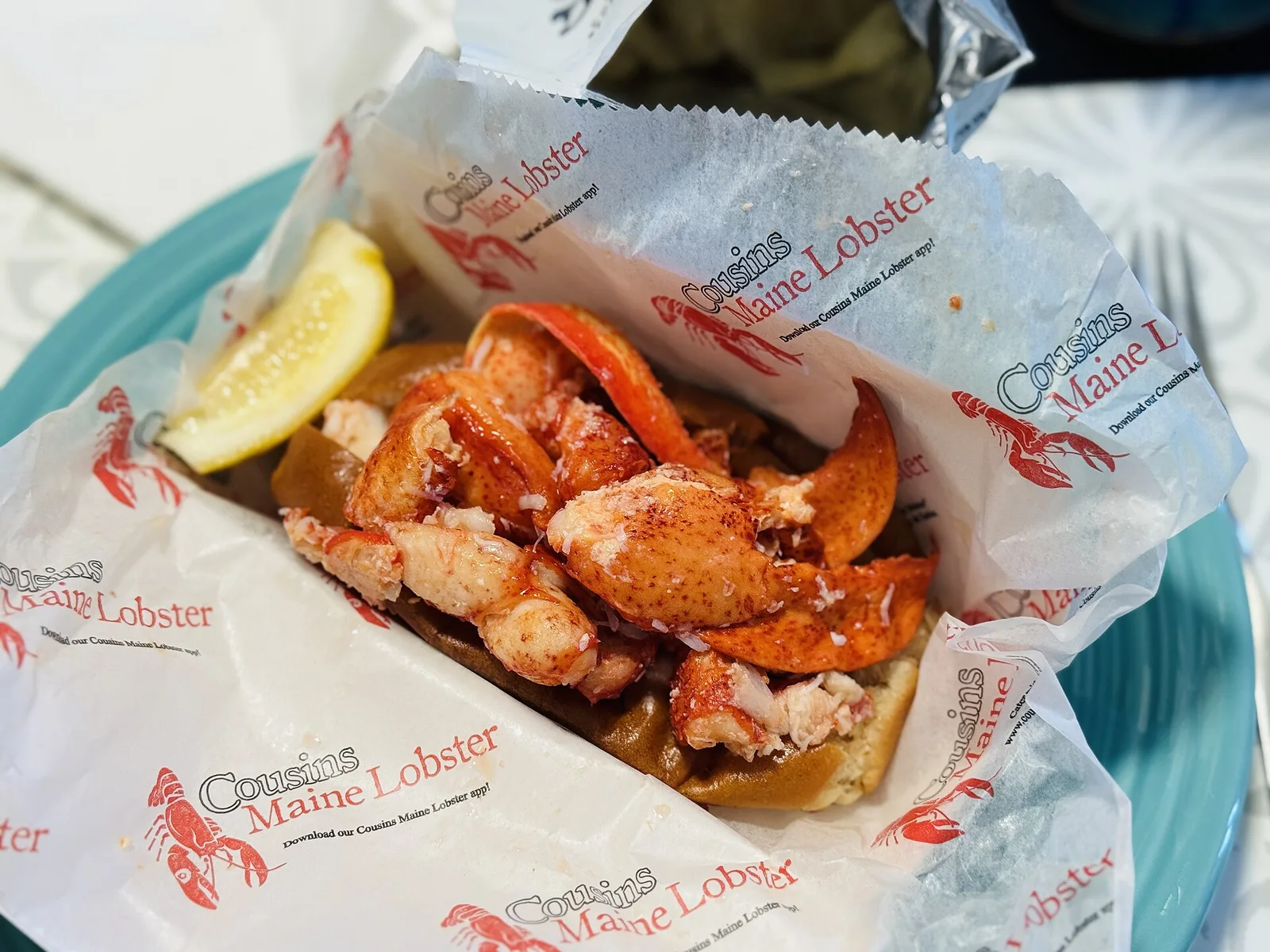
Maine has always been a working state. Its economy was built on timber, fishing, and shipbuilding, industries that go back to the earliest days of European settlement. Today, the lobster industry defines Maine's global identity more than any other single thing; Maine lands roughly 80 percent of the nation's lobster and has led the country for generations. Thousands of licensed lobstermen haul traps off Maine's coast, continuing a tradition that stretches back well over a century.
Politically, Maine is one of the most independent-minded states in the country. It is one of only two states (with Nebraska) that splits its Electoral College votes by congressional district, and it has elected independent candidates to the governorship and the U.S. Senate. Maine was also the first state to adopt ranked choice voting, a reform that has influenced national discussions about elections and representation. Its politics are shaped less by ideology than by a streak of Yankee self-reliance that runs through both parties.

Maine's Five Regions
Portland is Maine's largest city and its cultural and economic center. Despite a population of only about 68,000, Portland punches well above its weight, it is one of the most visited small cities in New England, home to a nationally recognized restaurant scene, a thriving arts community, and a historic Old Port waterfront district.
The greater Portland area, including South Portland, Westbrook, and the bedroom communities of York County, is Maine's most populous and economically dynamic region. Southern Maine's beaches, York, Ogunquit, Old Orchard Beach, Kennebunkport, are among the most popular in New England.
Portland has burned to the ground repeatedly: a Royal Navy squadron shelled and torched the town, then called Falmouth, in October 1775, and the Great Fire of July 4, 1866, set off by a firecracker, destroyed some 1,800 buildings and left much of the city homeless. The rebuilt downtown's dense Victorian brick blocks and the poet Henry Wadsworth Longfellow's boyhood home both date from this era of recovery.
The Portland metro holds close to 40 percent of Maine's population, and the political divide between the fast-growing, service-economy south and the older, resource-economy north runs through nearly every statewide election. That split is formalized in Maine's two congressional districts: the 1st, anchored on Portland, and the 2nd, covering the rural rest of the state.
Maine is one of only two states, with Nebraska, that award electoral votes by congressional district, so the Portland-based 1st District and the rural 2nd District can and do split their presidential votes, as they did in 2016, 2020, and 2024. The city is also the headquarters of Maine's largest bank, its largest law firms, and the Portland Press Herald, the state's paper of record.
The midcoast region, stretching roughly from Brunswick to Bucksport, is defined by peninsulas, harbors, and island-dotted bays that have drawn artists, sailors, and summer visitors for generations. Camden and Rockland are the unofficial capitals of Maine's working waterfront and sailing culture. Bath Iron Works dominates the economy of Bath and the surrounding Kennebec Valley.
The Farnsworth Art Museum in Rockland houses the largest collection of Wyeth family paintings in the world. Midcoast Maine is also home to three of New England's premier liberal arts colleges, Bowdoin in Brunswick, Colby in Waterville, and Bates in Lewiston.
In the age of sail, Searsport alone was home to roughly one in ten American deep-water shipmasters, and the town's Penobscot Marine Museum preserves that history. The region's islands and light gave rise to the art colonies of Monhegan, Ogunquit, and Port Clyde, and Andrew Wyeth painted 'Christina's World' at the Olson farm in Cushing in 1948.
Rockland's Maine Lobster Festival, running since 1947, and Camden's windjammer fleet of historic schooners draw large summer crowds, and the Maine State Ferry Service links the working island communities of Vinalhaven, North Haven, and Islesboro to the mainland. Lewiston and Auburn, the 'Twin Cities' on the Androscoggin, grew as textile and shoe manufacturing centers and later became home to a large Somali refugee community beginning around 2001.
Brunswick anchored the region's economy with Brunswick Naval Air Station until its 2011 closure; the runways have since been redeveloped as Brunswick Landing, a business and aviation park. Bowdoin College, founded in 1794, counts Longfellow, Nathaniel Hawthorne, Franklin Pierce, and Joshua Chamberlain among its 19th-century students.
Downeast Maine, the region east of Penobscot Bay stretching to the Canadian border, is the most remote and rugged part of coastal Maine. Acadia National Park, centered on Mount Desert Island and Bar Harbor, is the crown jewel of the region and the most-visited national park in the Northeast.
Acadia was the first national park established east of the Mississippi River, largely through the philanthropy of John D. Rockefeller Jr., who funded the construction of its famous carriage roads. Washington County, Maine's easternmost and most rural county, is also the poorest in the state, a stark reminder that Maine's tourism economy does not lift all communities equally.
Acadia exists because private citizens assembled and donated the land: George B. Dorr, called the 'father of Acadia,' and Harvard president Charles W. Eliot organized the trust that gave the holdings to the federal government, which named it Sieur de Monts National Monument in 1916, Lafayette National Park in 1919, and Acadia National Park in 1929. A wildfire in October 1947 burned roughly 17,000 acres of Mount Desert Island, including many of the grand Bar Harbor 'cottages' of the Gilded Age.
Downeast has the largest Native presence in Maine: the Passamaquoddy Tribe holds reservations at Pleasant Point (Sipayik) and Indian Township, and the Maine Indian Claims Settlement Act of 1980 returned land and paid 81.5 million dollars to the Passamaquoddy, Penobscot, and Maliseet. The wild blueberry barrens and Maine's few remaining sardine-cannery towns, Eastport and Lubec, define the region's traditional economy.
West Quoddy Head in Lubec, marked by its candy-striped 1858 lighthouse, is the easternmost point of land in the contiguous United States. Eastport, reachable from the rest of Maine only by a long land route around Cobscook Bay or through Canada, has some of the deepest natural harbor water on the East Coast and periodically revives as a cargo and cruise port.
Augusta, the state capital, sits on the Kennebec River in central Maine. At roughly 20,000 people, it is one of the smallest state capitals in the country. State government is the dominant employer.
The Augusta area also includes Waterville, Gardiner, and Hallowell, small cities with historic downtowns that have seen varying degrees of revitalization. The region is more economically typical of rural Maine than the tourist-driven coast, blue-collar, working-class, and facing the same challenges of workforce shrinkage and outmigration that affect much of rural New England.
Augusta became the permanent capital in 1827, moving the seat of government up the Kennebec from Portland, and the granite State House was designed by Charles Bulfinch, architect of the U.S. Capitol dome, and completed in 1832. Old Fort Western, built on the Augusta riverfront in 1754, is the oldest surviving wooden fort in the United States and was the staging point for Benedict Arnold's grueling 1775 march on Quebec.
The Kennebec powered a string of 19th-century mill towns, Waterville, Winslow, Skowhegan, and Fairfield, that made paper, textiles, and lumber, and the river's ice was cut and shipped as far as India before mechanical refrigeration. Colby College, on Mayflower Hill above Waterville, has poured over 100 million dollars into the city's downtown since 2014.
In 1999 the federal government ordered the removal of the Edwards Dam in Augusta, the first time a hydroelectric dam was taken down against its owner's wishes for environmental reasons, and alewives, sturgeon, and striped bass returned to a stretch of the Kennebec closed to them for 162 years. The MaineGeneral Medical Center, opened in Augusta in 2013, consolidated the region's hospitals.
Maine's vast interior, stretching north from Bangor to the Canadian border, is one of the largest stretches of unbroken forest in the eastern United States. This region, home to Baxter State Park and the northern terminus of the Appalachian Trail at Mount Katahdin, has a combined population of only a few thousand people spread across millions of acres.
The North Woods economy is built on timber, sporting camps, hunting, fishing, and white-water rafting. Proposals to create a Maine Woods National Monument or expand protections for the region have been a persistent source of political debate, pitting conservation advocates against the forest products industry and local communities dependent on timber employment.
Most of the North Woods lies in Maine's Unorganized Territory, more than 10 million acres with no municipal government, taxed and served directly by the state and laced with a private logging-road network that the public may use for a fee. Millinocket and East Millinocket, built by the Great Northern Paper Company around 1900, were among the first fully planned company mill towns in the country and lost their mills and most of their population in the 2000s and 2010s.
In 2016 President Obama used the Antiquities Act to create the 87,500-acre Katahdin Woods and Waters National Monument on land donated by Roxanne Quimby, co-founder of Burt's Bees, over strong opposition from the timber industry and many local residents who feared new federal land-use limits. Baxter State Park, a separate 209,000-acre wilderness given to the state by Governor Percival Baxter between 1931 and 1962, is kept 'forever wild' by the terms of his gift and contains Katahdin, Maine's highest peak at 5,269 feet and the northern end of the Appalachian Trail.
The Allagash Wilderness Waterway, a 92-mile ribbon of protected lakes and rivers, was designated by the Maine Legislature in 1966 and folded into the National Wild and Scenic Rivers System in 1970. The region's few year-round towns, Greenville on Moosehead Lake, Jackman near the Quebec line, depend on hunting, snowmobiling, and a shrinking timber workforce.

Economy
Maine's economy is built on the sea, the forest, and the visitors they attract, from lobster and timber to shipbuilding and tourism.
The lobster industry generates hundreds of millions of dollars annually and supports thousands of licensed lobstermen working Maine's cold, rocky coastal waters. The industry is deeply rooted in Maine's cultural identity, generations of fishing families have worked the same stretches of coast for over a century.
Maine's seafood economy also includes clams, sea urchins, mussels, oysters, and shrimp, though warming Gulf of Maine waters are reshaping what marine species thrive here.
Maine's lobster landings peaked near 130 million pounds in 2016, worth over 500 million dollars at the dock, but the Gulf of Maine is warming faster than nearly any ocean water on Earth, and biologists expect the fishery's center to keep shifting north into Canadian waters. A separate fight over gear rules meant to protect the roughly 360 remaining North Atlantic right whales has threatened the fishery's certification and market access.
The industry is unusually decentralized: about 4,500 licensed harvesters fish from small owner-operated boats, and informal 'lobster gangs' control fishing territory in each harbor, sometimes enforced by cutting outsiders' trap lines. Maine also has a fast-growing farmed-shellfish and seaweed sector and is the largest U.S. producer of farmed mussels and of edible kelp.
The forestry and wood products industries have shaped Maine's economy for over two centuries. Timber harvesting, pulp and paper mills, and lumber operations employ tens of thousands of Mainers.
The paper industry, though significantly reduced from its mid-20th century peak due to digital disruption and global competition, remains an important part of Maine's North Woods economy. Sustainable forestry practices are increasingly prominent as the state works to balance conservation and commercial use.
About 94 percent of Maine's forest is privately owned, most of it in the vast roadless 'Unorganized Territory' of the North Woods, and much of that land has changed hands repeatedly since the 1990s as paper companies sold their timberland to investment funds. The state has more miles of logging road than public road.
Maine had more than 20 paper mills at the mid-20th-century peak; fewer than half a dozen still make paper, and closures in Millinocket, East Millinocket, Bucksport, Old Town, and Madison gutted mill towns. Survivors have pivoted toward tissue, packaging, and pulp, and the state has pushed 'mass timber' construction and wood-based biofuels as a next chapter for the North Woods economy.
Visitors come for Acadia National Park, the rocky Maine coast, lighthouses, fall foliage, skiing, and world-renowned seafood. Portland has emerged as one of the hottest food destinations in the country, with a restaurant scene far larger than its population would suggest.
Bar Harbor, Camden, Kennebunkport, and the Kennebec and Penobscot river valleys draw visitors from across the country and internationally. Summer tourism is a lifeline for many coastal communities, though the seasonal nature of the industry creates persistent economic challenges year-round.
Tourism supports roughly one in six Maine jobs, and the state's population swells by hundreds of thousands each summer with visitors and second-home owners; some coastal and lakeside towns are more than half seasonally occupied. Acadia National Park alone draws around 4 million visitors a year and has added a timed-entry reservation for its most popular road.
The 'Vacationland' brand on Maine license plates dates to the 1930s, and L.L. Bean, founded in Freeport in 1912, helped make Maine a Northeast getaway. Winter tourism centers on Sugarloaf and Sunday River in the western mountains, and the pandemic-era surge in visitors and remote-work movers has driven housing costs in Portland and coastal towns to record levels.
A subsidiary of General Dynamics, BIW builds Arleigh Burke-class destroyers for the U.S. Navy and is consistently one of Maine's largest private employers, with thousands of skilled tradespeople, welders, pipefitters, electricians, machinists, working on some of the most sophisticated warships ever built.
The Portsmouth Naval Shipyard, located on the Maine-New Hampshire border in Kittery, is also a major employer and one of the nation's premier submarine repair and maintenance facilities.
Bath Iron Works has built ships on the Kennebec since 1884 and produced roughly a quarter of the U.S. destroyer fleet during World War II, when its yard out-built entire nations. It employs around 6,000 to 7,000 workers today and competes directly with Huntington Ingalls' Pascagoula, Mississippi, yard for each Navy destroyer contract, a rivalry that makes federal shipbuilding budgets a recurring issue in Maine politics.
Portsmouth Naval Shipyard, established in 1800, is the oldest continuously operating shipyard in the U.S. Navy and specializes in overhauling nuclear attack submarines. Maine's defense footprint shrank sharply when Loring Air Force Base in Limestone closed in 1994 and Brunswick Naval Air Station closed in 2011, both under the federal Base Realignment and Closure process, costing thousands of jobs in Aroostook County and the midcoast.
Maine's wild blueberries are smaller and more flavorful than cultivated varieties and are a significant export crop, with most of the harvest processed and frozen for food manufacturers and consumers worldwide. Potatoes, dairy, and maple syrup are also important agricultural products. Maine's maple syrup industry has grown significantly, benefiting from a long sugaring season and growing consumer demand for locally sourced products.
Wild blueberries grow on roughly 44,000 acres of glacial 'barrens' concentrated in Washington and Hancock counties, harvested on a two-year cycle in which each field is burned or mowed one year and cropped the next. A production glut in the mid-2010s pushed prices below the cost of harvest for many growers, and Canada's Maritime provinces now out-produce Maine, squeezing the industry that the University of Maine's blueberry research program helped build.
Aroostook County, 'the County,' is potato country: many schools there still schedule a fall 'harvest break' so students can work the fields, and Maine remains a top-ten potato state. The number of dairy farms has fallen below 200, and Maine runs a state milk price-support program to slow the decline.
The Maine Organic Farmers and Gardeners Association, founded in 1971, is the oldest and one of the largest state organic organizations in the country, and its Common Ground Country Fair each September is a major showcase for small-scale and organic agriculture. Maple syrup production is centered in Somerset County, and Maine is consistently the third-largest maple producer among the states after Vermont and New York.
The University of Maine System and private institutions including Bowdoin College, Bates College, and Colby College are significant economic engines and attract talent to the state. Maine has worked to grow its technology and remote-work economy, particularly after the COVID-19 pandemic accelerated migration of out-of-state workers to Maine's coastal communities, bringing higher incomes and new economic activity, while also driving housing costs to historically high levels.
MaineHealth, whose flagship is Maine Medical Center in Portland, is the largest private employer in the state, and health systems have consolidated as rural hospitals in towns such as Calais and Greenville have cut services or closed. Maine has the oldest population of any state, with a median age around 45, which drives steady demand for healthcare and long-term care while shrinking the working-age labor force.
The University of Maine's main campus in Orono anchors research in forestry, aquaculture, and marine science, and in 2019 unveiled what Guinness certified as the world's largest polymer 3D printer, now central to the university's work on wood-fiber composites and floating offshore-wind platforms for the Gulf of Maine. Colby College has invested more than 100 million dollars in downtown Waterville, building a residential complex, arts center, and hotel to reverse decades of decline in the mill town.
Maine's broadband gaps, worst in the rural north and Downeast, became an economic-development priority after remote work took hold, and the state created the Maine Connectivity Authority in 2021 to expand service. The influx of remote workers and retirees has pushed the statewide median home price to record highs and made housing affordability one of the dominant issues in state policy.

How Maine's Government Works
Like the federal government, Maine's state government is divided into three branches: the Executive (led by the Governor), the Legislative (the Maine Legislature), and the Judicial (the state court system, led by the Maine Supreme Judicial Court, the oldest court of continuous operation with the same name in the United States).
The Governor serves a four-year term and is limited to two consecutive terms. Maine holds its state elections in the same years as federal midterm elections, not presidential elections, which gives the governor's race significant independent visibility.
The Maine Legislature, formally called the Maine State Legislature, is a part-time body consisting of a Senate (35 members, 2-year terms) and a House of Representatives (151 members, 2-year terms). Maine imposes strict term limits: legislators may serve no more than four consecutive terms (8 years) in each chamber. As of 2026, Democrats hold majorities in both chambers.
Maine is one of only two states (along with Nebraska) that allocates its Electoral College votes by congressional district rather than winner-take-all. Maine's 2nd Congressional District has split its electoral vote from the statewide result in recent presidential elections, making it one of the most closely watched districts in the nation.
Governor of Maine
Current Governor
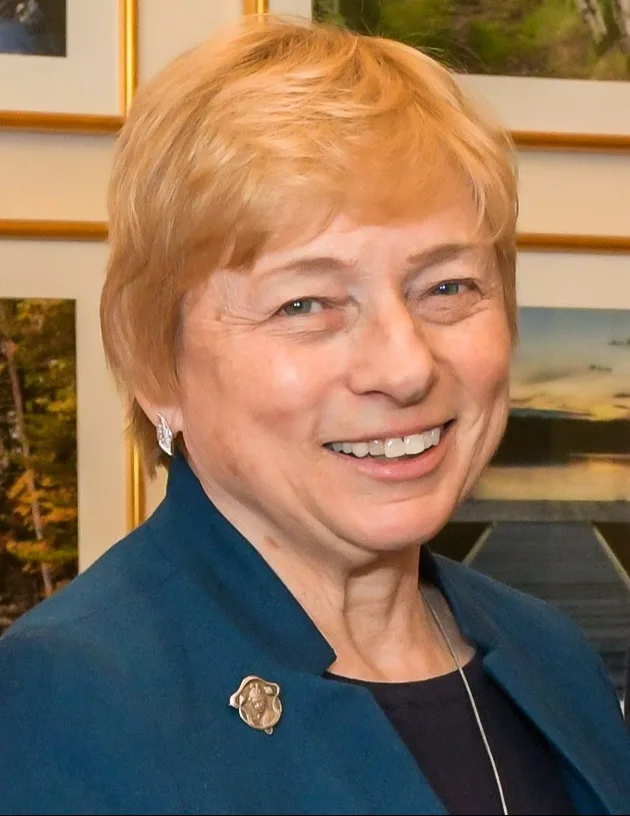
Janet Mills
- Party
- Democrat
- In Office Since
- January 2, 2019
- Re-elected
- November 8, 2022
- Term Ends
- January 2027
- Born
- July 4, 1947, Farmington, ME
- Education
- University of Massachusetts Amherst; University of Maine School of Law (JD)
- Prior Role
- Maine Attorney General (2009–2019)
Janet Mills made history as Maine's first female governor when she took office in January 2019. A Franklin County native and career attorney, Mills served as Maine Attorney General for a decade before winning the governorship. She has focused on expanding healthcare access (Maine was the first state to expand Medicaid by voter referendum, in 2017, and Mills put the expansion into effect in 2019), economic development, and clean energy. She won re-election in 2022 over former Governor Paul LePage.
Other Current State Officials
Attorney General
Aaron Frey
In office since January 2019. Former state representative from Bangor. Unlike most states, Maine's Attorney General is elected by the legislature, not directly by voters. Frey has focused on consumer protection, opioid litigation, and environmental enforcement.
Secretary of State
Shenna Bellows
In office since January 2021. Former state senator and executive director of the Maine ACLU. Like the Attorney General, the Secretary of State is elected by the Maine Legislature. Bellows gained national attention in December 2023 when she ruled Donald Trump ineligible for Maine's primary ballot under the 14th Amendment, a decision that was stayed pending the U.S. Supreme Court ruling.
State Treasurer
Joseph Perry
In office since January 2025, elected by the Maine Legislature. A former state senator and representative from Bangor, he succeeded Henry Beck (treasurer 2019 to 2025). Oversees the management of the state's financial assets, investments, and debt.
The Maine State Legislature
Maine State Senate
- Seats: 35 members
- Terms: 2-year terms
The upper chamber. Maine senators serve 2-year terms and face strict consecutive term limits, no more than 4 terms (8 years) before sitting out. All 35 seats are on the ballot every election cycle.
Maine House of Representatives
- Seats: 151 members
- Terms: 2-year terms
The lower chamber. Maine's House is one of the larger lower chambers for a state its size. All 151 seats are on the ballot every two years, and the same 4-consecutive-term (8-year) limit applies.
Maine's U.S. Senators
U.S. Senator
Susan Collins
Maine's senior senator and one of the most prominent moderate Republicans in the country. Collins has served in the Senate since 1997, making her one of the longest-serving senators from Maine. She is known for her willingness to break with her party on key votes and has been a pivotal swing vote on healthcare, judicial confirmations, and spending legislation. She chairs the Senate Appropriations Committee.
U.S. Senator
Angus King
Maine's junior senator is one of only two Independent senators in the U.S. Senate (the other being Bernie Sanders of Vermont), though he caucuses with the Democrats. King previously served as Maine's Governor from 1995 to 2003, also as an independent. He sits on the Senate Armed Services and Intelligence Committees and is known for his measured, bipartisan approach and his passion for energy policy and cybersecurity.
Maine Through the Years
From the Wabanaki Confederacy to the Missouri Compromise to the birth of ranked choice voting, Maine's history is one of independence, resilience, and a consistent willingness to lead.
Long before European arrival, Maine was home to the Wabanaki Confederacy, an alliance of Algonquian-speaking nations including the Penobscot, Passamaquoddy, Maliseet, Mi'kmaq, and Abenaki peoples. The Wabanaki had inhabited the region for at least 10,000 years, living by fishing, hunting, and seasonal agriculture in the river valleys and coastal areas of what is now Maine.
The Penobscot Nation remains a federally recognized tribe with sovereignty over their island territory on the Penobscot River.
The colonial wars hit the Wabanaki hard. Massachusetts placed bounties on Wabanaki scalps, and in 1724 a Massachusetts raiding party destroyed the village of Norridgewock on the Kennebec and killed the French Jesuit missionary Sebastien Rale, breaking Wabanaki power in the lower river valleys. Repeated epidemics and displacement pushed many Abenaki north into Quebec, where the community of Odanak still traces its roots to Maine.
Today Maine recognizes four tribal governments, the Penobscot Nation, the Passamaquoddy Tribe at Sipayik and Indian Township, the Houlton Band of Maliseets, and the Aroostook Band of Micmacs. Their legal status is unusual: the 1980 Maine Indian Claims Settlement Act made them subject to state law in ways other federally recognized tribes are not, and efforts to revisit that arrangement have been a running dispute in the Legislature into the 2020s.
French explorer Pierre Dugua de Mons established a short-lived settlement on St. Croix Island in 1604, the first European settlement in the region. The English followed in 1607 with the Popham Colony at Fort St. George near the mouth of the Kennebec River.
Though the Popham Colony survived only one winter before being abandoned, its settlers built the Virginia, the first English-built vessel to complete a transatlantic voyage, an early chapter in Maine's long shipbuilding heritage.
The St. Croix settlement was a disaster: cut off by ice on their island, 35 of the 79 Frenchmen died of scurvy over the winter of 1604 to 1605, and the survivors moved the colony to Port-Royal in Nova Scotia the next year. The attempt still predates the founding of Jamestown by three years and of Plymouth by sixteen, and the island is now a U.S. National Historic Site jointly interpreted with Canada.
The Popham Colony was launched the same summer as Jamestown, in 1607, as the northern half of the Virginia Company's charter. When its leader died and its main backer inherited an English estate, the colonists sailed home in 1608, and England largely wrote off northern New England for permanent settlement for another generation, leaving the coast to seasonal fishing and fur-trading stations.
Maine was governed as part of the Massachusetts Bay Colony from 1677 until statehood in 1820. The region's remote geography and long border with French Canada made it a frequent battleground during the colonial wars between England and France.
The town of York suffered the York Massacre in 1692, when French and Wabanaki forces killed or captured hundreds of settlers. Maine's timber resources made it strategically important to the British Crown, and the broad arrow policy, reserving the largest white pines for the Royal Navy, was deeply resented by colonists and fueled resentment toward British authority.
Massachusetts did not inherit Maine so much as buy it: in 1677 it purchased the proprietary claim of the heirs of Sir Ferdinando Gorges for 1,250 pounds, outmaneuvering King Charles II, who had wanted the territory for one of his sons. For the next 143 years Mainers were governed from Boston, sent representatives on a long journey to the General Court, and chafed at policies, such as coastal trade rules, set with the more populous south in mind.
Separation sentiment surged after the War of 1812, when many Mainers felt Massachusetts had failed to defend the district's coast against British occupation of the Penobscot region. A statehood referendum finally carried in 1819, and Massachusetts consented to the split on the condition that it keep title to half of Maine's undeveloped public lands, an arrangement that shaped North Woods land ownership for a century.
The Battle of Machias in June 1775, just two months after Lexington and Concord, is considered the first naval engagement of the American Revolution. Maine patriots captured the British armed schooner HMS Margaretta in a harbor battle near the small coastal town of Machias. Though a small engagement, it demonstrated the fighting spirit of Maine's frontier communities and their early commitment to independence from Britain.
The fight began over lumber: a Loyalist merchant, Ichabod Jones, had come to Machias under escort of the Margaretta to trade supplies for boards the British needed to build barracks in Boston. Townsmen led by Jeremiah O'Brien and Benjamin Foster voted to refuse, seized Jones's sloops, and chased down the Margaretta with muskets, pitchforks, and one small cannon, killing her commander and taking the ship. Some accounts call it 'the Lexington of the seas.'
That October, a Royal Navy squadron under Captain Henry Mowat retaliated against the region by bombarding and burning Falmouth, now Portland, destroying about three-quarters of the town's roughly 400 buildings just as winter set in. The burning of Falmouth was cited in the Declaration of Independence's list of grievances and helped push the Continental Congress toward creating a navy.
Maine's path to statehood was tied directly to one of the most consequential political deals in American history. The Missouri Compromise of 1820 admitted Maine as a free state and Missouri as a slave state simultaneously, maintaining the balance of power between North and South in the U.S. Senate.
Maine became the 23rd state on March 15, 1820. The compromise delayed, but could not prevent, the Civil War that would come 40 years later.
The House had already approved Maine statehood on its own, but the Senate, where free and slave states stood at eleven each, refused to act unless Missouri came in at the same time. Speaker Henry Clay brokered the package, which also drew a line across the Louisiana Purchase at 36 degrees 30 minutes north, banning slavery in future territories above it, except within Missouri itself.
Some Maine delegates opposed the deal, unwilling to have their state's admission used to extend slavery, but the separationists judged that rejecting it would sink statehood entirely. Maine's 1820 constitution was notably democratic for its time: it imposed no property requirement for voting and, unlike most states then, did not bar free Black men from the polls.
Maine passed the first statewide alcohol prohibition law in American history in 1851, decades before the national Prohibition era of the 1920s. The 'Maine Law,' championed by Portland mayor Neal Dow, banned the manufacture and sale of alcoholic beverages.
It became a national model for the temperance movement and was adopted in a dozen other states. Maine would remain largely dry, with various modifications, for most of the next century.
Dow, a Quaker businessman nicknamed the 'Napoleon of Temperance,' enforced the law aggressively as mayor. In June 1855 a crowd gathered outside Portland's city hall, angry that Dow himself held a large stock of liquor for authorized medicinal sale; he ordered the militia to fire, killing one man and wounding several in what became known as the Portland Rum Riot.
By 1855 about a dozen states had passed 'Maine Laws,' though courts and legislatures rolled many of them back within a few years. Maine wrote prohibition into its constitution in 1885 and did not repeal that clause until 1934, a year after national repeal, and the state ran its liquor sales through a government monopoly for decades afterward.
Maine sent approximately 72,000 men to fight for the Union, an enormous proportion of its population of roughly 628,000. Maine's most celebrated Civil War figure is Joshua Lawrence Chamberlain, a Bowdoin College professor who commanded the 20th Maine Infantry at the Battle of Gettysburg.
His defense of Little Round Top on July 2, 1863, ordering a bayonet charge when his men ran out of ammunition, is considered one of the most heroic acts of the war. Chamberlain later received the Confederate surrender at Appomattox and went on to become Governor of Maine.
Roughly one in nine Mainers served, and about 9,000 died, many of disease. The 1st Maine Heavy Artillery, fighting as infantry, lost more men in a single charge than any other Union regiment in the war, about 600 casualties in a few minutes at Petersburg in June 1864.
Maine also supplied Lincoln's first vice president, Hannibal Hamlin of Bangor, who served from 1861 to 1865 before being dropped from the ticket in favor of Andrew Johnson. Chamberlain survived a wound at Petersburg thought to be mortal, was promoted on the field by Grant, served four one-year terms as governor and then as president of Bowdoin, and died in 1914 of complications from that 1864 wound, often called the last Civil War soldier to die of his injuries.
Maine Senator Margaret Chase Smith had already made history in 1948 as the first woman elected to both houses of Congress (she had previously served in the House). In 1964 she became the first woman to have her name placed in nomination for the presidency at a major party's national convention, the Republican National Convention.
Known for her fierce independence, Smith is perhaps best remembered for her 1950 'Declaration of Conscience' speech, in which she condemned Senator Joseph McCarthy's communist witch-hunt before almost anyone else in Congress dared to do so.
Smith first won her House seat in a 1940 special election after the death of her husband, Congressman Clyde Smith, then in 1948 defeated a sitting governor and a former governor in the Republican primary before winning the Senate. She was the first woman to serve on the Senate Armed Services Committee and kept a near-perfect roll-call attendance record over 32 years, famously wearing a fresh rose each day on the Senate floor.
Her June 1, 1950, floor speech, delivered with six Republican co-signers while McCarthy sat a few seats away, warned that the Senate was being 'debased' by 'the Four Horsemen of Calumny, Fear, Ignorance, Bigotry and Smear.' McCarthy mocked her and the co-signers as 'Snow White and the Six Dwarfs' and backed a primary challenger against her in 1954, which failed. Smith lost her seat in 1972 at age 74 and received the Presidential Medal of Freedom in 1989.
Maine became the first state in U.S. history to adopt ranked choice voting (RCV) for statewide elections via a citizen referendum in November 2016. Under RCV, voters rank candidates in order of preference rather than choosing one.
If no candidate wins a majority, the last-place candidate is eliminated and those voters' second choices are redistributed, continuing until a candidate has a majority. Maine has since used RCV in congressional and presidential primaries and general elections, influencing national discussions about electoral reform.
The push for RCV grew out of a run of plurality winners: Paul LePage was elected governor in 2010 with about 38 percent of the vote in a five-way race and re-elected in 2014 with under 49 percent, and nine of Maine's eleven governors between 1974 and 2014 had won without a majority. In 2017 the Maine Supreme Judicial Court advised that the state constitution's 'plurality' language bars RCV for governor and legislature in general elections, so its use is limited to primaries and to federal races.
The first federal contest actually decided by ranked choice came in 2018, when Democrat Jared Golden trailed Republican incumbent Bruce Poliquin on first choices in the 2nd Congressional District but won after second-choice votes were counted, the first time in U.S. history a congressional race was reversed by an instant runoff. Maine used RCV for the presidential race in 2020 and 2024, and Alaska adopted a similar system by referendum in 2020.
Maine's Defining Moments in American History
These are the events that didn't just shape Maine, they changed the nation.
Maine entered the Union on March 15, 1820, not simply as a new state, but as the free half of a political bargain that temporarily preserved the peace between slave and free states. The Missouri Compromise admitted Maine as a free state to balance Missouri's admission as a slave state, and prohibited slavery in the remainder of the Louisiana Purchase above the 36-30 parallel.
Maine's statehood was thus inseparable from the great national crisis over slavery, a crisis that the Compromise only delayed, not resolved.
The Missouri crisis was the first time Congress split openly and sectionally over the future of slavery in the West, and it alarmed the founding generation still living. Thomas Jefferson wrote that the dispute reached him 'like a fire bell in the night' and 'filled me with terror,' and John Quincy Adams privately judged it 'a mere preamble, a title page to a great tragic volume.'
The 36 degree 30 minute line held for 34 years until the Kansas-Nebraska Act of 1854 repealed it, allowing settlers in those territories to vote slavery up or down and touching off the violence of 'Bleeding Kansas.' The Supreme Court then declared the Missouri Compromise unconstitutional in the 1857 Dred Scott decision, ruling that Congress had no power to bar slavery from a territory.
Harriet Beecher Stowe wrote Uncle Tom's Cabin while living in Brunswick, Maine, where her husband was a theology professor at Bowdoin College. Published in 1852, the novel depicted the brutal realities of slavery for a Northern audience that had largely insulated itself from them.
It sold 300,000 copies in its first year and became the best-selling novel of the 19th century. When Lincoln met Stowe in 1862, he reportedly said: 'So you are the little woman who wrote the book that started this great war.'
Stowe later said the book's climactic scene, the death of the enslaved man Tom under Simon Legree's whip, came to her as a vision during a communion service at Brunswick's First Parish Church in February 1851. She went home to the house on Federal Street and wrote it out, and the story ran as a serial in the antislavery paper The National Era for most of 1851 before appearing as a book.
The immediate spur was the Fugitive Slave Act of 1850, which required Northerners to help capture escaped slaves and which Stowe's own family in Cincinnati had defied. In its first year the novel sold about 300,000 copies in the United States and more than a million in Britain, was adapted into countless unauthorized 'Tom shows' on stage, and was banned across much of the South, where possessing it could bring prosecution.
On July 2, 1863, during the second day of the Battle of Gettysburg, Colonel Joshua Chamberlain of the 20th Maine Infantry was ordered to hold the far left flank of the Union line on Little Round Top at all costs. Out of ammunition after repelling repeated Confederate attacks, Chamberlain ordered a bayonet charge downhill, a desperate move that shocked the attackers and held the line.
Military historians credit this action with preventing a Confederate flanking of the entire Union army, potentially changing the outcome of the battle and the war.
The 20th Maine held the extreme end of the entire Union position, roughly 360 men against repeated assaults by the 15th and 47th Alabama over about 90 minutes, taking around 130 casualties. Chamberlain later described ordering the line to swing forward 'like a door' as it charged, catching the exhausted Alabamians by surprise and taking more prisoners than he had men.
Chamberlain was a professor of rhetoric and modern languages at Bowdoin who had taken a leave of absence to enlist. Grant personally promoted him to brigadier general on the field after he was gravely wounded at Petersburg in 1864, chose him to formally receive the Confederate infantry's surrender at Appomattox in April 1865, where he ordered his men to salute the defeated soldiers, and awarded him the Medal of Honor for Gettysburg in 1893.
When the U.S. battleship Maine exploded in Havana Harbor on February 15, 1898, killing 266 sailors, American newspapers, particularly those owned by William Randolph Hearst and Joseph Pulitzer, screamed 'Remember the Maine!' and blamed Spain. The explosion's cause remains disputed to this day, but the media campaign that followed effectively forced the United States into war with Spain.
The Spanish-American War made the U.S. a colonial power, acquiring Cuba, Puerto Rico, Guam, and the Philippines. Maine's tragedy launched the era of American empire.
The Maine had been sent to Havana to protect American citizens and interests during a Cuban revolt against Spain. A U.S. Navy court of inquiry in 1898 concluded a mine had sunk her, but a 1976 study led by Admiral Hyman Rickover found the pattern of damage more consistent with an internal explosion, likely a coal-bunker fire igniting an adjacent magazine, and the question has never been settled.
The slogan 'Remember the Maine, to hell with Spain' ran in papers competing for circulation, and Congress declared war in April 1898. The peace treaty that December gave the United States the Philippines, Guam, and Puerto Rico and touched off the Philippine-American War, and the Supreme Court's Insular Cases of 1901 held that the Constitution did not fully follow the flag into the new territories. The Maine's salvaged mainmast now stands over the ship's dead at Arlington National Cemetery.
For centuries, Maine's rugged coastline, abundant timber, and skilled craftsmen made it one of the most productive shipbuilding regions on Earth. In the 19th century, Maine-built ships carried American commerce to every corner of the globe.
Bath Iron Works, established in 1884, continues to build U.S. Navy ships and remains one of the oldest continuously operating shipyards in the country. Maine's maritime tradition shaped American commercial identity and demonstrated how a small, resource-rich state could punch far above its weight in national importance.
Bath alone earned the name 'the City of Ships' by launching well over 5,000 vessels since the 1740s, and in 1909 the Percy and Small yard there built the Wyoming, a six-masted schooner about 450 feet long and the largest wooden sailing ship ever constructed in the United States. Searsport, further up the coast, sent so many men to sea as captains that at one point it was said to supply roughly a tenth of the nation's deep-water shipmasters.
The shift from wood and sail to iron and steam nearly ended the industry, but Thomas W. Hyde, a Civil War general, founded Bath Iron Works in 1884 to make that transition, winning early Navy contracts for steel gunboats. During World War II BIW built destroyers faster than the shipyards of many countries, and the phrase 'Bath-built is best-built' became a point of state pride that survives in the yard's continuing work on Aegis destroyers today.
Notable Mainers
Henry Wadsworth Longfellow
One of America's greatest poets, born in Portland; author of Paul Revere's Ride and The Song of Hiawatha
Stephen King
Best-selling horror author, born in Portland and long based in Bangor; his Maine settings define his fiction
Margaret Chase Smith
First woman elected to both houses of Congress; first woman to have her name placed in nomination for president at a major party's convention (1964)
Joshua Chamberlain
Civil War hero of Gettysburg's Little Round Top; Medal of Honor recipient and Governor of Maine
Hannibal Hamlin
Abraham Lincoln's first Vice President (1861–1865), from Paris Hill, Maine
Edmund Muskie
Maine Governor, U.S. Senator, and Secretary of State under President Carter; 1968 Democratic vice-presidential nominee
Olympia Snowe
U.S. Senator (1995–2013), known as a key moderate Republican voice in a polarized Senate
George H.W. Bush
41st President of the United States; longtime summer resident of Kennebunkport, Maine
E.B. White
Author of Charlotte's Web and Stuart Little; lived for decades on a saltwater farm in Brooklin, Maine
Roxanne Quimby
Co-founder of Burt's Bees; donated over 100,000 acres of Maine forestland that became Katahdin Woods & Waters National Monument
State Symbols & Quick Facts
| Nickname | "The Pine Tree State" |
| Capital | Augusta |
| Largest City | Portland |
| Statehood | March 15, 1820 (23rd state) |
| Population | ~1.4 million (2025 est.) |
| Area | 35,380 sq miles (39th largest) |
| State Bird | Black-capped Chickadee |
| State Flower | White Pine Cone and Tassel |
| State Tree | Eastern White Pine |
| State Animal | Moose |
| State Fish | Landlocked Salmon |
| State Insect | Honeybee |
| State Song | State of Maine Song |
| State Motto | Dirigo ("I Lead") |
| Time Zone | Eastern Time |
| Bordering State | New Hampshire (only one) |
| International Border | Canada (Quebec & New Brunswick) |
Did You Know?
Maine is the only state in the continental United States that borders just one other state, New Hampshire. Every other direction is ocean or Canada.
Maine has more coastline than California. Its deeply indented bays, peninsulas, and islands give it over 3,500 miles of tidal shoreline, despite being a much smaller state.
Maine lands roughly 80 percent of the nation's lobster catch, according to NOAA Fisheries, making it the undisputed lobster capital of the United States.
Maine is the most forested state in the contiguous U.S., about 89% of its total land area is covered by trees, mostly northern hardwoods and softwoods.
Maine is the only state with a one-syllable name.
West Quoddy Head in Lubec, Maine, is the easternmost point of land in the lower 48 states and gets the country's first sunrise for much of spring and summer; from October to early March, Cadillac Mountain sees it first.
Acadia National Park on Mount Desert Island was the first national park established east of the Mississippi River, largely thanks to the philanthropic vision and funding of John D. Rockefeller Jr.
Maine produces about 99% of the nation's wild (lowbush) blueberries, more than all other states combined.
Maine was the first state in U.S. history to use ranked choice voting in statewide and federal elections, after voters approved it by referendum in 2016.
The moose population of Maine, estimated at 60,000 to 70,000 animals, is the largest of any state in the contiguous United States.
Quick Facts and Common Questions
Short answers to the questions people most often ask about Maine: its abbreviation, how it split from Massachusetts, its capital, and how it votes.
Maine's two-letter postal abbreviation is ME. The U.S. Census Bureau places it in the Northeast region, in the New England division, and about 1.36 million people lived there in the 2020 census.
Maine became the 23rd state on March 15, 1820. For more than a century before that it was part of Massachusetts, known as the District of Maine.
Many residents of the District of Maine wanted their own government, and in 1819 they voted for separation, which Massachusetts allowed. In Congress, Maine's admission as a free state was paired with Missouri's admission as a slave state in the Missouri Compromise of 1820, which kept the Senate balanced between free and slave states.
The origin is uncertain. One theory is that it comes from sailors' use of "the main" or "mainland" to tell the coast apart from its many islands; another links it to the French province of Maine.
Augusta has been the capital since 1832. Portland, Maine's largest city, was the capital from statehood in 1820 until the move. The State House in Augusta was designed by Charles Bulfinch, who also worked on the U.S. Capitol.
Maine is the only state that borders exactly one other state, New Hampshire, to the west. It shares a long border with the Canadian provinces of Quebec and New Brunswick, and its southeastern edge is Atlantic coastline. West Quoddy Head, near Lubec, is the easternmost point of the contiguous United States.
Maine is known as "The Pine Tree State." Its motto is "Dirigo," Latin for "I Lead." Its state bird is the black-capped chickadee, its flower is the white pine cone and tassel, its tree is the eastern white pine, and its animal is the moose.
Based on the 2020 census, Maine has 2 seats in the U.S. House of Representatives, the same as before, which gives it 4 electoral votes. Maine and Nebraska are the only states that can split their electoral votes: two go to the statewide winner and one to the winner of each congressional district.
Yes. Maine voters approved ranked-choice voting in 2016, and in 2018 it became the first state to use it statewide, for primaries and federal general elections. Voters rank the candidates in order, and if no one wins a majority of first choices, the last-place candidate is dropped and those ballots count toward their next choice. Learn more about how elections work.
Sources & Further Reading
Acadia National Park
Where the Mountains Meet the Sea on the Rugged Coast of Downeast Maine
About Acadia National Park
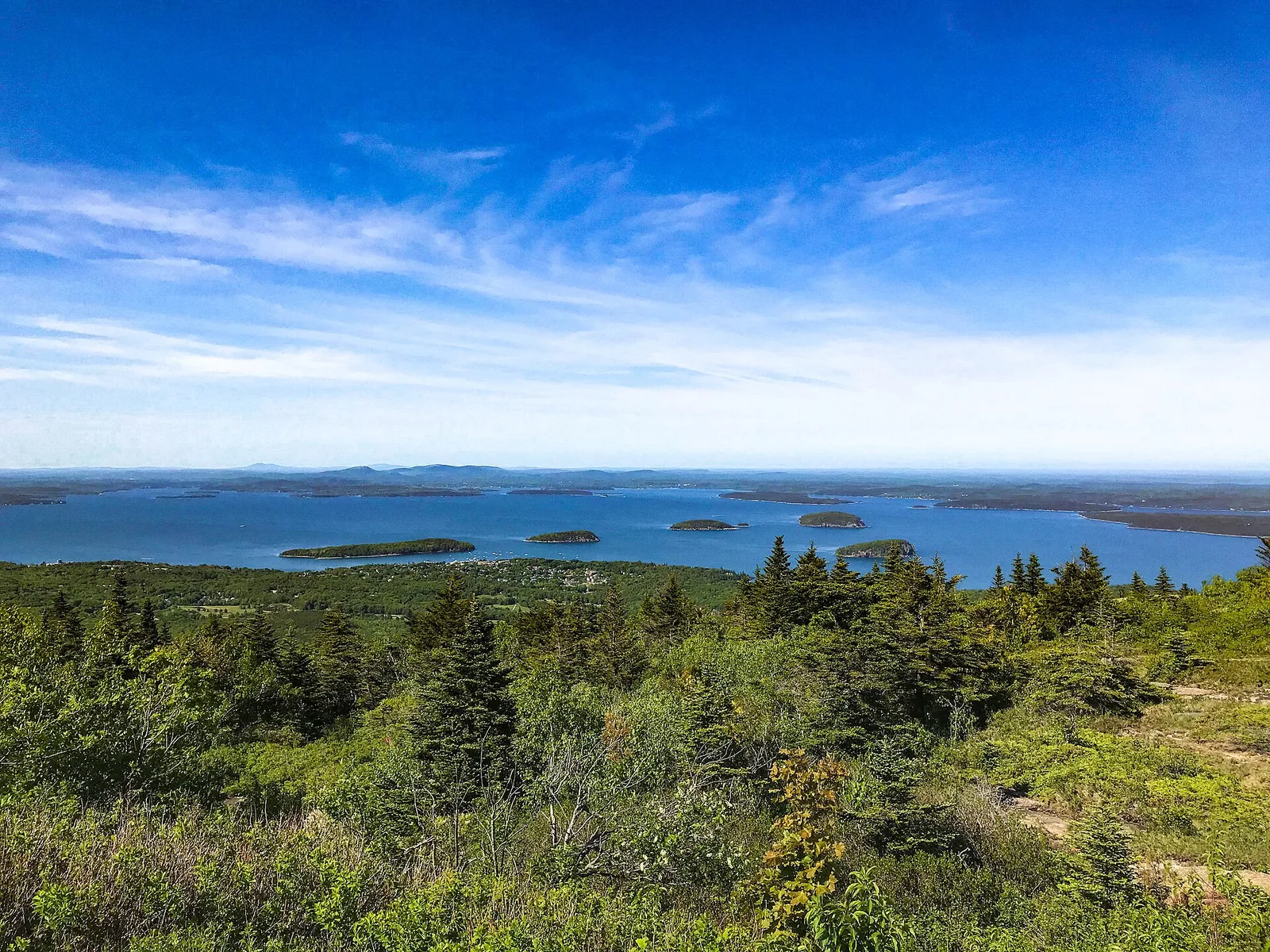
Acadia National Park covers about 49,000 acres of the Maine coast, most of it on Mount Desert Island, where granite mountains rounded by ice rise straight out of the Atlantic.
It grew entirely from donated land, assembled from 1901 on by George Dorr and Charles Eliot through a private land trust; it became Sieur de Monts National Monument in 1916, Lafayette National Park, the first national park east of the Mississippi, in 1919, and Acadia in 1929.
Cadillac Mountain, at 1,530 feet, is the highest point on the North Atlantic seaboard, and from about early October to early March it is the first ground in the United States to catch the sunrise.
John D. Rockefeller Jr. gave roughly 11,000 acres and, between 1913 and 1940, built 45 miles of broken-stone carriage roads with 17 stone bridges, a car-free network that is still one of the park's defining features.
- Designation
- National Park
- Location
- Mount Desert Island and Schoodic Peninsula, Maine
- Established
- February 26, 1919
- Annual Visitors
- ~4 million
Acadia's Natural Zones
Acadia's pink granite formed about 420 million years ago, when a body of magma rose into older rock during a mountain-building collision geologists call the Acadian orogeny.
During the last ice age the mile-thick Laurentide ice sheet ground over the range from the north, rounding the summits, polishing the rock, and leaving the north-south grain of ridges and valleys that shapes the whole island.
The retreating ice dropped 'erratics,' boulders carried from far away, most famously Bubble Rock, a house-sized granite block perched on the edge of a cliff above Jordan Pond.
Cadillac's summit is bare, wind-scoured granite with scattered pitch pine and blueberry, reached today by a road, though a cog railway once ran up it in the 1880s before the park existed.
The tide here rises and falls more than 10 feet twice a day, exposing and drowning bands of life zoned by how long they can stand being out of water: black lichen, then barnacles and periwinkles, then rockweed, then mussels and sea stars in the low zone.
Tide pools left behind hold green crabs, sea urchins, whelks, and anemones, and the park's ranger-led tide-pooling walks are a staple summer program.
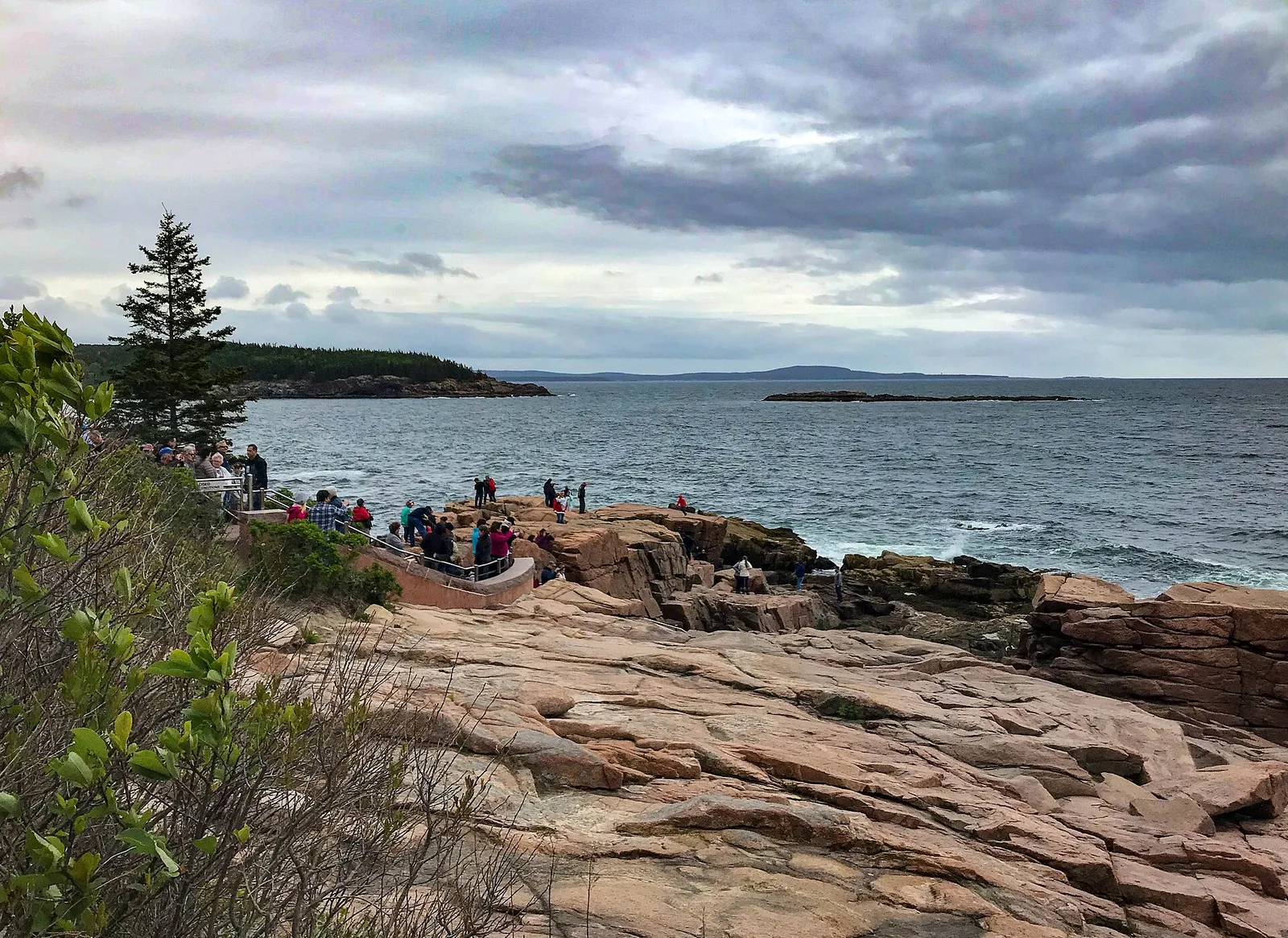
Thunder Hole, a slot in the granite near the Park Loop Road, booms and throws spray when a swell of just the right size compresses air in a small sea cave at its head.
Sand Beach, tucked in a cold pocket between headlands, is unusual for this coast; its 'sand' is mostly ground-up shell and sea urchin, and the water rarely tops the mid-50s Fahrenheit even in August.
Rockefeller laid out the roads himself, walking the routes, to keep cars out of the island's interior as automobiles arrived; they were built for horse-drawn carriages, with broad, gentle grades.
The surface is crushed local granite in three layers, crowned and ditched to shed water and edged with large coping stones nicknamed 'Rockefeller's teeth.'
Seventeen bridges, each faced in cut stone and no two alike, carry the roads over streams, cliffs, and other roads; the architect Grosvenor Atterbury designed two gate lodges to match.
The park and the private group Friends of Acadia rebuilt the roads in the 1990s after decades of neglect, and they are now open to bikes, walkers, horses, and, in winter, skis, but never motor vehicles.
The island's interior is spruce-fir forest with white birch, its floor thick with blueberry, bunchberry, and sphagnum, the southern edge of the boreal forest that covers eastern Canada.
More than two dozen glacier-gouged ponds hold brook trout, loons, and, on the cliffs above some of them, nesting peregrine falcons, brought back to Acadia starting in 1984 after DDT wiped them out.
Jordan Pond, ringed by the two rounded hills called the Bubbles, is the best known; the Jordan Pond House has served popovers and tea on its lawn since the 1870s.
A wildfire in October 1947 burned roughly 10,000 acres of the park and much of Bar Harbor; the burned spruce came back as birch, aspen, and oak, which is why the eastern side of the island turns brighter in fall.
Indigenous Connections
Wabanaki Confederacy (Penobscot, Passamaquoddy, Maliseet, Mi'kmaq, Abenaki)
The Wabanaki, 'people of the dawnland,' have lived on this coast for at least 10,000 years; Mount Desert Island, which they call Pemetic, 'the sloping land,' was a summer place for fishing, clamming, and gathering, reached by birchbark canoe.
French and English claims, disease, and the colonial wars of the 1600s and 1700s pushed the Wabanaki off most of the coast, and by the 1800s Native families summering on the island were selling ash-splint baskets and other work to the resort trade.
That basketmaking tradition, in brown ash and sweetgrass, is still practiced and taught, though the emerald ash borer now threatens the ash trees it depends on; the Abbe Museum in Bar Harbor, a Smithsonian affiliate, is devoted to Wabanaki history.
Four Wabanaki nations are federally recognized in Maine: the Penobscot Nation, the Passamaquoddy Tribe, the Houlton Band of Maliseet Indians, and the Aroostook Band of Micmac. The Maine Indian Claims Settlement Act of 1980 resolved land claims but placed the Maine tribes under state jurisdiction in ways that have fueled decades of sovereignty disputes. The Park Service consults formally with the Wabanaki nations on Acadia's management.
Experiencing Acadia
Cadillac Mountain Summit Sunrise
The Cadillac Summit Road climbs 3.5 miles to the top; from about October 7 to March 6, when the sun rises far enough to the south, this is the first place in the country to see it.
From late May through mid-October a timed vehicle reservation, booked on Recreation.gov, is required to drive up, and the sunrise slots go quickly.
Hikers can skip the reservation by climbing the 4.4-mile round-trip North Ridge Trail or the longer South Ridge Trail, both up open granite ledges with wide views.
The summit is often 15 to 20 degrees colder than the coast and frequently socked in fog, so a clear sunrise is far from guaranteed.
Ocean Path and Thunder Hole
The Ocean Path is a mostly level 2.2-mile trail, 4.4 round trip, along the granite shore from Sand Beach to Otter Point, running parallel to the Park Loop Road.
It passes Thunder Hole, the pink granite ledges, and Otter Cliffs, one of the higher sea cliffs on the U.S. Atlantic coast and a rock-climbing site.
Harbor seals haul out on offshore ledges, and eiders, black guillemots, and cormorants are common along the water.
Rogue waves have swept people off the rocks near Thunder Hole, some fatally, and the Park Service closes the lower viewing platform when the surf is up.
Carriage Road Cycling
The carriage roads give 45 miles of smooth, car-free riding on crushed stone, with easy grades even where they climb between the mountains.
Bikes rent in Bar Harbor, and the free Island Explorer shuttle carries bikes on a rack, so riders can make one-way trips.
The roughly 6-mile loop around Eagle Lake is the most popular ride; longer loops climb past Jordan Pond, around Witch Hole Pond, or onto the Around-Mountain road with its high bridges and views.
The roads are shared with walkers, horses, and carriage tours, and horses have the right of way.
Conservation Challenges
Overcrowding and Traffic Congestion
Acadia draws close to four million visitors a year into a small park with two-lane roads and limited parking, and on summer days the popular lots fill by mid-morning and cars line the shoulders.
The Cadillac Summit Road has required timed-entry reservations since 2021, and the park has repeatedly studied extending reservations to other areas.
The free Island Explorer shuttle, running propane buses since 1999 and funded partly by park fees and L.L. Bean, carries hundreds of thousands of riders a season between the villages, campgrounds, and trailheads.
Even so, most visitors still arrive by car, and managing that traffic without paving over the park is Acadia's central problem.
Sea Level Rise and Coastal Erosion
The Gulf of Maine is warming faster than almost any other patch of ocean on Earth, and sea level along this coast has been rising at an accelerating rate.
Higher water and stronger storms undercut the low carriage roads and shore trails; a January 2024 storm badly damaged the Ocean Path, the Schooner Head area, and other coastal infrastructure.
Warmer water is also reshuffling the marine life the park's tide pools and seabirds depend on, as species such as green crabs expand and cold-water species retreat.
The park is mapping which trails, roads, and buildings are most exposed and, in places, choosing to relocate them rather than rebuild in the same spot.
Forest Health and Invasive Species
The 1947 fire reset much of the eastern island's forest, and the mix of birch, aspen, oak, and returning spruce that grew back is still maturing.
Invasive shrubs, Japanese barberry, glossy buckthorn, and winged euonymus, spread from old estate plantings into the understory, and the park pulls and treats them each year.
The emerald ash borer, found in Maine in 2018, threatens the brown ash that Wabanaki basketmakers depend on, and the park is collecting and storing ash seed as insurance.
Hemlock woolly adelgid and browntail moth, both established in the region, are the next pests the park's forest monitoring is watching for.
Thunder Hole, where Atlantic waves crash into a narrow granite inlet with a booming roar
At a Glance
Did You Know?
From October through early March, Cadillac Mountain is the first place in the contiguous United States to receive the sun's rays each morning, a distinction that draws thousands of visitors for the sunrise experience.
John D. Rockefeller Jr. personally designed and funded Acadia's 45-mile carriage road network, spending over $3.5 million of his own money between 1913 and 1940 to ensure the park would remain accessible to non-motorized visitors.
A massive fire in October 1947 burned 17,188 acres, or about one-third of Mount Desert Island, destroying dozens of grand hotels and summer cottages. The fire's aftermath transformed the island's forest and shaped the park's landscape for decades.
Plan Your Visit
Location
Mount Desert Island and Schoodic Peninsula, Maine
Designation
National Park
Best Time to Visit
May through October; fall foliage peaks in late September; sunrise reservations required in summer
Admission
$35 per vehicle (7-day pass); free with America the Beautiful annual pass