American Political Party History
Two parties have dominated American politics for 170 years. Neither is what it was. This is the full story of how they got here.
The Founders Didn't Want Parties. They Got Them Anyway.
Washington warned against parties in his Farewell Address. Within a decade of his presidency, the country had two of them and the argument that created them, strong federal government versus states' rights, has never really ended.
The framers of the Constitution did not design a party system. Most of them, Washington loudest among them, despised the idea. In his 1796 Farewell Address, Washington warned the nation in the most solemn terms against the baneful effects of the spirit of party, predicting that parties would become potent engines by which unprincipled men would subvert the power of the people. The warning went unheeded almost immediately. The disagreements that split his own cabinet between Alexander Hamilton and Thomas Jefferson were already too deep, too structural, and too rooted in genuine differences of vision to be suppressed by any appeal to unity. Two parties formed anyway, and the American party system was born.
The immediate rupture in Washington's cabinet centered on Hamilton's financial program, including federal assumption of state Revolutionary War debts and the creation of a national bank, both of which Jefferson and Madison opposed as unconstitutional overreach. Despite his warning against parties, Washington himself grew closer to Hamilton's positions by the end of his presidency, and Jefferson's supporters came to view the administration as effectively Federalist in practice, deepening the very division Washington had hoped to prevent.
The split was already public by Washington's second term. By 1792 each faction had its own newspaper, Hamilton's Gazette of the United States and Jefferson's National Gazette, edited by the poet Philip Freneau, and the two attacked each other and the administration by name.
Washington drafted much of the Farewell Address with Hamilton's help and never delivered it as a speech; it was published in a Philadelphia newspaper in September 1796. Its warnings about party spirit and against "permanent alliances" with foreign nations became touchstones quoted in American political argument ever since.
The Federalist Party, led by Alexander Hamilton and centered in New England and the commercial North, was the first organized political party in American history. Federalists believed in a strong national government, a national bank, protective tariffs to encourage industry, and close ties with Britain over revolutionary France. They were the party of merchants, financiers, and the educated elite. John Adams, elected in 1796, was the only Federalist president. The Federalists never developed a true mass base, relying instead on social prestige and the natural authority of educated men, a strategy that became fatal as the electorate expanded. Their fatal blow came when they opposed the War of 1812, meeting at the Hartford Convention in 1814 and floating the idea of New England secession. The party never recovered and had ceased to exist as a national force by 1820.
The Federalists' decline accelerated after Congress, controlled by the party, passed the Alien and Sedition Acts in 1798, which criminalized certain criticism of the federal government; Jefferson and Madison responded with the Kentucky and Virginia Resolutions arguing states could nullify unconstitutional federal laws, and the controversy became a central campaign issue that helped Jefferson defeat Adams in the 1800 election.
In power, the Federalists built much of the machinery of the new government. Hamilton's Treasury funded the national debt, chartered the First Bank of the United States in 1791, and imposed the excise tax that touched off the 1794 Whiskey Rebellion, which Washington suppressed with a militia army he led part of the way himself.
The party's last real influence ran through the courts. John Adams's "midnight" appointments of judges in early 1801, and Chief Justice John Marshall, a Federalist who served until 1835, kept the party's constitutional vision alive for decades after it stopped winning elections.
Thomas Jefferson and James Madison organized the Democratic-Republican Party in opposition to Hamilton's Federalists. Where Federalists wanted a strong central government tied to commercial and financial interests, Jefferson's party stood for states' rights, an agrarian society of independent farmers, limited federal power, and sympathy with France rather than Britain. Jefferson called it a party of the people against the aristocrats. He won the presidency in 1800 in what he called the Revolution of 1800, the first peaceful transfer of power between rival parties in the history of democratic governance, a precedent of enormous importance. The Democratic-Republicans dominated American politics from 1800 to the mid-1820s, winning seven consecutive presidential elections, from 1800 through 1824, under Jefferson, Madison, Monroe, and finally John Quincy Adams.
Despite his party's small-government rhetoric, Jefferson doubled the size of the United States through the 1803 Louisiana Purchase, using a broader interpretation of federal executive power than his own stated constitutional principles technically allowed, an early example of how governing in practice can diverge from a party's founding ideological commitments.
The party built the first grassroots organization in American politics: local "Democratic-Republican societies," committees of correspondence, and a network of partisan newspapers that reached ordinary voters as the franchise slowly widened. Aaron Burr's organizing of New York City through the Tammany society helped deliver the state, and the election, in 1800.
Once in power the Democratic-Republicans adopted much of what they had opposed. Jefferson kept the national bank, Madison signed a new one in 1816, and by the 1820s the party's economic program was hard to distinguish from the Federalism it had defeated, one reason the party soon splintered.
After the War of 1812, the Federalists collapsed entirely and the Democratic-Republicans were left as the only national party. The period from roughly 1816 to 1824 is known as the Era of Good Feelings, a misleading name for what was actually an era of intense personal and factional rivalries within the dominant party. When four Democratic-Republicans ran for president in 1824 and none won a majority of electoral votes, the House decided the election in favor of John Quincy Adams, though Andrew Jackson had received more popular votes. Jackson's supporters cried corruption and spent the next four years organizing a new coalition. When Jackson won in 1828 in a landslide, he did so under a new name: the Democratic Party. The Democratic-Republican Party was finished.
Because no candidate won a majority of electoral votes among the four Democratic-Republican contenders in 1824, the House of Representatives decided the outcome under the 12th Amendment's contingent election procedure. House Speaker Henry Clay, who had finished fourth and was eliminated from consideration, threw his support to Adams; when Adams then named Clay Secretary of State, Jackson's supporters branded the outcome a "corrupt bargain," a grievance that helped fuel Jackson's successful campaign four years later.
The "Era of Good Feelings" phrase came from a Boston newspaper describing President Monroe's 1817 goodwill tour of the country. It masked deep fights: over the Panic of 1819, over the Missouri Compromise of 1820, and over the rival sections and personalities jockeying to succeed Monroe.
The 1824 field, Adams, Jackson, Clay, and William Crawford, were all nominally Democratic-Republicans, so the election was really a contest of factions and regions. Out of its wreckage came two durable new parties: Jackson's Democrats and, opposing them, the National Republicans who soon became the Whigs.
The Six Party Systems
Political scientists divide American party history into six distinct eras, each defined by a different set of issues and coalitions:
Federalists vs. Democratic-Republicans
Federal power, national bank, foreign policy
Democrats vs. Whigs
Jacksonian democracy, states' rights, internal improvements
Democrats vs. Republicans
Slavery, the Civil War, Reconstruction, industrialization
Republicans dominant
Gold standard, tariffs, progressive reform, World War I
Democrats dominant
New Deal, the welfare state, World War II, civil rights
Competitive polarization
Culture wars, ideology, realignment, populism
The Democratic Party: America's Oldest
The Democratic Party, founded by Andrew Jackson in the late 1820s, is the oldest political party in the world still in continuous operation. It has been everything from the party of slavery to the party of civil rights.
Andrew Jackson is the founder of the modern Democratic Party, and Jacksonian Democracy fundamentally changed American politics. Where the Federalists and even many Democratic-Republicans had assumed that educated, propertied gentlemen should govern, Jackson championed the common white man. His coalition swept away property qualifications for voting in most states, built the first true national party organization with patronage, newspapers, and grassroots organizing, and presented the federal government as the enemy of privilege and the champion of ordinary people against banks, monopolies, and concentrated wealth. Jackson's war against the Bank of the United States, which he viewed as an instrument of eastern financial elites, was the defining battle of his presidency. He killed the Bank. The Democratic Party he built would dominate American politics until the Civil War.
Jackson's presidency was also defined by the Indian Removal Act of 1830, which authorized the forced relocation of Cherokee, Creek, Choctaw, Chickasaw, and Seminole nations from their homelands in the Southeast to territory west of the Mississippi River; the removal of the Cherokee Nation in particular became known as the Trail of Tears, during which thousands died from disease, exposure, and starvation along the forced march.
The Bank War dominated 1832 to 1836. Jackson vetoed the Second Bank's recharter, calling it a "monster" that served the rich, won re-election on the issue, then pulled federal deposits and placed them in favored state "pet banks." The resulting swings in credit contributed to the Panic of 1837, which struck just after he left office.
Jacksonian Democracy expanded political participation for white men while narrowing it for others. Several states that dropped property requirements for white voters in this era simultaneously stripped free Black men of the vote, and the era's signature federal policy was Indian removal.
The Whig Party formed in the 1830s as an organized opposition to Jackson, whom they called King Andrew for what they saw as his abuse of executive power. Led by the brilliant Kentucky senator Henry Clay, the Whigs favored a national bank, federal investment in roads and canals, protective tariffs, and a more limited presidency restrained by Congress. The Whigs were the party of economic modernization, education, and moral reform. They elected two presidents, William Henry Harrison in 1840 and Zachary Taylor in 1848, both of whom died in office. The Whigs' fatal problem was slavery. Their coalition included both Northern opponents of slavery's expansion and Southern slaveholders, and when the issue became impossible to evade in the 1850s, the party split and died. Its Northern wing became the founding base of the Republican Party.
The Whig name was chosen deliberately to invoke the American Revolutionary-era Patriots, who had also called themselves Whigs in opposition to the British crown, a rhetorical move casting Jackson as a modern-day monarch and the new party as defenders of constitutional limits against executive overreach, much as their namesakes had positioned themselves against King George III.
The Whigs' 1840 "log cabin and hard cider" campaign for William Henry Harrison was the first modern image campaign, with slogans ("Tippecanoe and Tyler Too"), mass rallies, and merchandise. Harrison died 31 days into his term, and his vice president, John Tyler, a former Democrat, then vetoed the Whig program and was expelled from the party.
The Whigs produced great orators, Clay, Daniel Webster, and briefly a young Illinois congressman named Abraham Lincoln, but never a lasting governing majority. The 1854 Kansas-Nebraska Act finished them: Northern Whigs went to the new Republican Party, while most Southern Whigs eventually moved to the Democrats or the nativist Know-Nothings.
The antebellum Democratic Party was the party of Southern slaveholders and their Northern allies. It defended the expansion of slavery into the western territories, passed the Kansas-Nebraska Act of 1854 repealing the Missouri Compromise, and supported the Dred Scott decision of 1857. The party split entirely in 1860, running two separate presidential candidates: Stephen Douglas for Northern Democrats and John C. Breckinridge for Southern Democrats. This split handed the presidency to Abraham Lincoln and the new Republican Party, which won without carrying a single Southern state. Lincoln's election triggered secession. The Civil War that followed would permanently reshape both parties.
The Dred Scott decision the Democratic-aligned Supreme Court issued in 1857 held that Black Americans, whether enslaved or free, could not be U.S. citizens and that Congress had no constitutional power to ban slavery in the federal territories at all, a ruling that went further than most Democrats had publicly advocated and further inflamed the sectional crisis that culminated in the 1860 election and secession.
For most of the antebellum period the Democrats were the dominant national party, winning the presidency in every election from 1828 to 1856 except 1840 and 1848. Their strength rested on an alliance between Southern planters and Northern urban working-class and immigrant voters, held together by opposition to Whig economic programs and by patronage jobs.
The 1860 split was structural. Northern Democrats under Douglas backed "popular sovereignty"; Southern Democrats demanded a federal slave code for the territories. When the convention could not agree, the two wings nominated separate tickets, and a fourth candidate, John Bell of the Constitutional Union Party, took the border states, leaving Lincoln to win with a plurality.
After the Civil War, Republicans controlled Reconstruction and the federal government. Democrats, discredited by their association with secession and slavery, were driven to the margins nationally. But in the South, white resistance to Reconstruction coalesced into the Democratic Party, which white Southerners used to reassert political control after federal troops withdrew in 1877. The Solid South, the bloc of former Confederate states that voted overwhelmingly Democratic in presidential elections from 1880 until the 1960s (Hoover in 1928 and Eisenhower in the 1950s carried several of them), became one of the defining features of American politics for nearly a century. Southern Democrats, some of whom formed the 1948 "Dixiecrat" breakaway party, were often fiercely conservative on race and states' rights while supporting New Deal economic programs that benefited their white constituents.
Strains within this coalition surfaced publicly in 1948, when South Carolina Governor Strom Thurmond led a walkout of Southern Democrats who opposed the national party's civil rights platform, running as a segregationist third-party "Dixiecrat" presidential candidate and carrying four Southern states, an early symptom of a fracture within the coalition that would widen over the following two decades and ultimately drive many Southern Democrats to the Republican Party.
The instruments of one-party Southern rule were built between 1890 and 1908: state constitutions and laws with poll taxes, literacy tests, and "white primaries" that excluded Black voters, and often poor whites, from meaningful participation. With the general election a formality, the Democratic primary became the real contest, and turnout collapsed.
The Solid South also gave conservative Southern Democrats outsized power in Congress through the seniority system. Committee chairs from safe Southern seats controlled the legislative agenda for decades and used that leverage to shape, and sometimes block, national policy on labor, civil rights, and race.
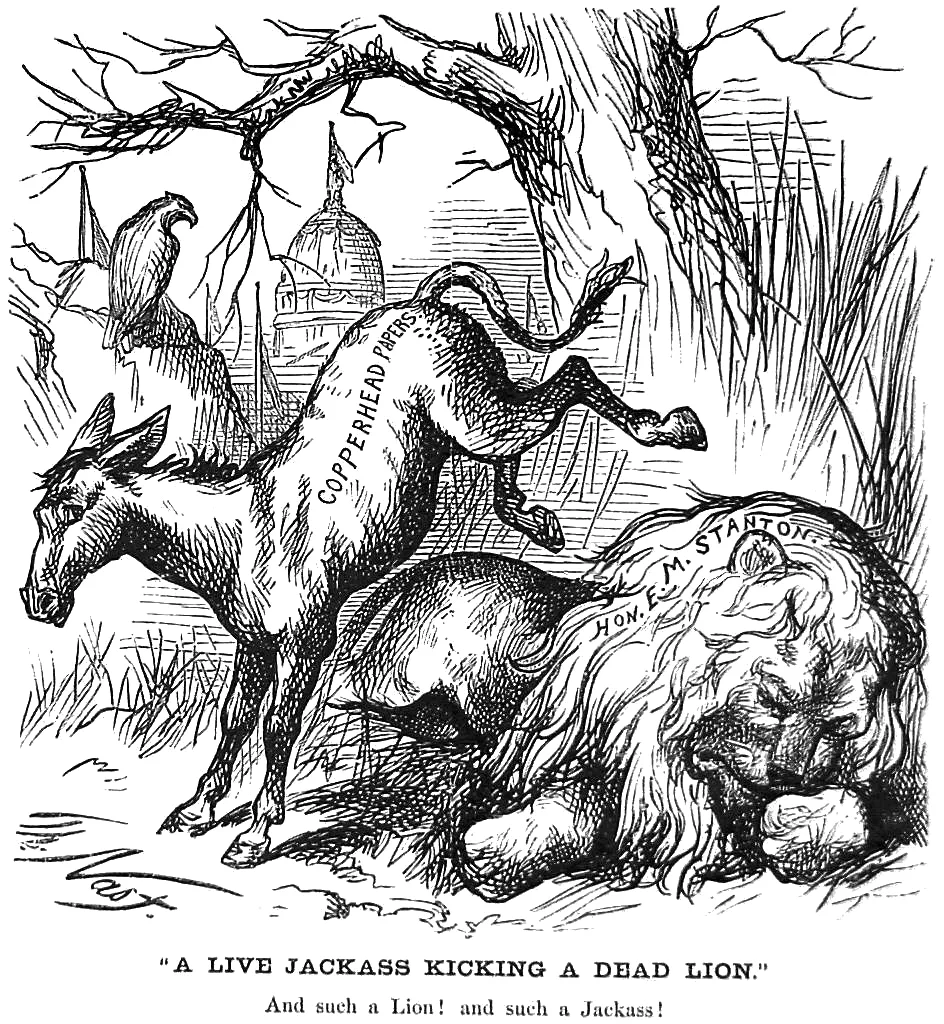
Andrew Jackson, 7th President. His populist coalition of common white men against banking and elite privilege became the Democratic Party.
Democratic Presidents
The Republican Party: Born to Fight Slavery
The Republican Party was founded in 1854 for one purpose: to stop the expansion of slavery. It was six years old when it elected its first president and thirteen when it abolished slavery forever.
The Republican Party was born out of one of the most consequential and explosive pieces of legislation in American history: the Kansas-Nebraska Act of 1854. Illinois Senator Stephen Douglas introduced the bill to organize the territories of Kansas and Nebraska for settlement and to advance his dream of a transcontinental railroad with its eastern terminus in Chicago. To win Southern support, Douglas included a provision repealing the Missouri Compromise of 1820, which had banned slavery north of the 36-30 line. Repeal meant that the settlers of Kansas and Nebraska, not Congress, would decide whether to allow slavery, a principle Douglas called popular sovereignty. The reaction in the North was explosive. Douglas was burned in effigy across the region. Men who had belonged to different parties, Whigs, Free Soilers, anti-slavery Democrats, and abolitionists, found themselves united in outrage.
The Kansas-Nebraska Act's "popular sovereignty" provision triggered years of armed sectional violence in the territory itself, a period known as "Bleeding Kansas," as pro-slavery settlers from neighboring Missouri and anti-slavery settlers organized by Northern emigration societies rushed into Kansas to influence the territory's eventual vote on whether to permit slavery, producing sustained bloodshed years before the Civil War formally began.
The Whig Party had already been weakening over slavery, and the 1854 uproar broke it apart in the North. Many Northern Whigs, along with anti-slavery Democrats and members of the small Free Soil Party, suddenly needed a new political home, and the Republican Party filled the gap within months.
In the same years, the anti-immigrant, anti-Catholic "Know-Nothing" or American Party surged, for a time outpacing the new Republicans. The two competed for former Whigs until the 1856 election, after which the Republicans absorbed most Northern nativists and emerged as the clear anti-slavery-expansion party.
In February 1854, a group of anti-slavery activists met in a small schoolhouse in Ripon, Wisconsin, and resolved to form a new party if the Kansas-Nebraska bill passed. It passed. On March 20, 1854, they reconvened and the Republican Party was formally organized. The name was chosen as a deliberate echo of Thomas Jefferson's Democratic-Republican Party, the original party of the people. The founding coalition was a broad one: former Whigs who had nowhere else to go, Free Soilers who had been fighting the expansion of slavery for years, anti-slavery Democrats who could not stomach their party's direction, and abolitionists who wanted slavery ended entirely. The one thing that united all of them was opposition to the expansion of slavery into the territories. The party's first national convention was held in Pittsburgh in February 1856.
Before settling on "Republican," many of the new party's early local organizations used other names, including "Anti-Nebraska Party," reflecting their immediate opposition to the specific legislation; "Republican" was ultimately adopted nationally because it linked the new coalition to republican self-government ideals stretching back to the founding, rather than tying its identity to a single, temporary piece of legislation.
Ripon is the most famous origin claim, but not the only one. A July 1854 mass convention "under the oaks" at Jackson, Michigan, adopted the name "Republican" for a full statewide ticket and is often cited as the first official state party organization. The movement was genuinely bottom-up, emerging in many places at once.
The party's first presidential nominee, in 1856, was the explorer John C. Frémont, running under the slogan "Free Soil, Free Labor, Free Men, Frémont." He lost to Democrat James Buchanan but carried eleven Northern states, a striking result for a two-year-old party and proof that a purely Northern sectional party could nearly win the presidency.
The Republican Party was just six years old when it elected its first president. Abraham Lincoln, a former one-term Illinois congressman and failed Senate candidate who had become the most articulate voice against the Kansas-Nebraska Act, won the Republican nomination in 1860 and then the presidency. He won without carrying a single Southern state, a fact that triggered the secession crisis almost immediately. South Carolina seceded six weeks after his election. By the time Lincoln was inaugurated in March 1861, seven states had left the Union. The Civil War that followed, at a cost of roughly 620,000 to 750,000 lives, ended slavery and cemented the Republican Party as the dominant national party for the next seventy years. Lincoln's legacy, and the party's role in saving the Union and ending slavery, gave Republicans the political capital they would draw on for generations.
Lincoln won the 1860 election with just under 40 percent of the national popular vote in a four-candidate field, one of the lowest winning popular-vote shares in American presidential history, a result that illustrates how deeply the vote splintered along regional and party lines that year rather than reflecting broad national consensus behind his candidacy.
Lincoln had risen to national attention through the 1858 Lincoln-Douglas debates during his losing Senate race, and through his February 1860 Cooper Union address in New York. He won the nomination on the third ballot at Chicago, chosen over better-known rivals like William Seward partly because he was seen as more electable in the closely divided lower North.
The 1860 Republican platform opposed slavery's spread into the territories but did not call for abolishing it where it already existed. It also promised a homestead act, a transcontinental railroad, and a protective tariff, a program aimed at Northern farmers and industry that the party enacted during the war.
After the Civil War, Radical Republicans in Congress pushed through the Thirteenth, Fourteenth, and Fifteenth Amendments, abolishing slavery, granting citizenship to formerly enslaved people, and guaranteeing voting rights regardless of race. During Reconstruction, Republican governments in the South built public schools, expanded voting rights, and placed Black men in elected office for the first time. When federal troops withdrew in 1877 and Reconstruction ended, Southern states systematically dismantled these gains. The Republican Party, meanwhile, became increasingly aligned with big business, Northern industry, and the financiers who had funded the war and profited from Reconstruction. From 1860 to 1932, Republicans won fourteen of eighteen presidential elections. The party of Lincoln dominated the Gilded Age.
Reconstruction formally ended through what historians call the Compromise of 1877: amid a disputed presidential election, Republican Rutherford B. Hayes was awarded the presidency by a special electoral commission in exchange for agreeing to withdraw the last remaining federal troops from Southern statehouses, effectively ending federal enforcement of Reconstruction-era civil rights protections in the South.
Republicans split during Reconstruction between "Radicals" who wanted deep change in the South and moderates who did not. The party impeached President Andrew Johnson in 1868, though he was acquitted by a single Senate vote, and under Ulysses S. Grant passed Enforcement Acts to break the Ku Klux Klan.
After 1877 the party largely turned away from the freedpeople and toward economic questions, the gold standard, tariffs, railroads, and civil-service reform. A reform faction, the "Mugwumps," bolted in 1884, and the party's Gilded Age dominance rested on the industrial North and the newly admitted Western states.
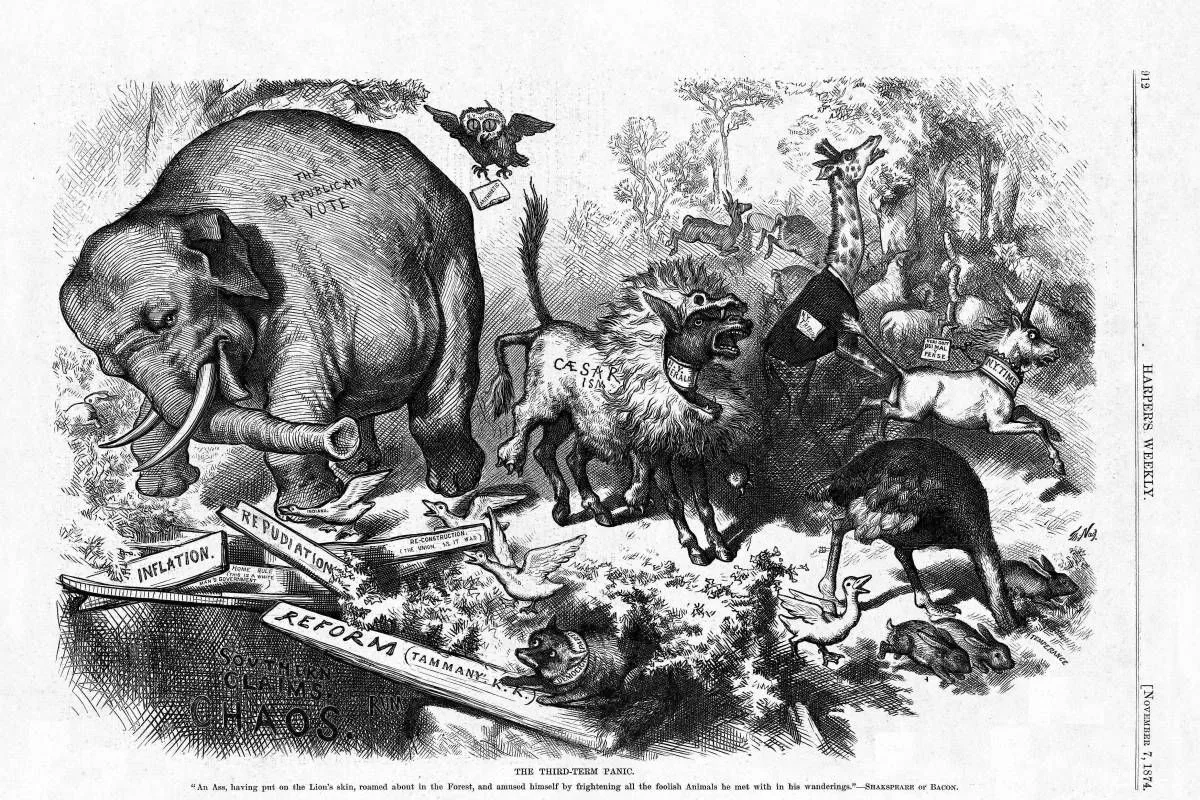
The Republican Party, founded in 1854 to oppose the expansion by the Southern slaveholding elite, elected Abraham Lincoln as its first Republican president in 1860.
Republican Presidents
The Parties Switch Sides
The New Deal, civil rights, and the Southern Strategy produced one of the most dramatic political realignments in democratic history. The parties kept their names but traded their coalitions.
The Great Depression shattered Republican dominance. By 1932, a quarter of Americans were unemployed, banks were failing by the thousands, and the Hoover administration appeared helpless. Franklin Roosevelt won the presidency in a landslide and launched the New Deal, a sweeping program of federal relief, economic regulation, and social insurance that included Social Security, the FDIC, farm price supports, and the National Labor Relations Act, which gave workers the right to organize. Roosevelt assembled the New Deal Coalition: organized labor, urban immigrants, Catholics, Jews, Black Americans in northern cities, white Southerners, and progressive intellectuals. This coalition made the Democratic Party the majority party for most of the next fifty years. Between 1932 and 1980, Republicans won only four presidential elections.
The New Deal's own legislative compromises reflected the coalition's internal tensions: Social Security as originally enacted in 1935 excluded agricultural and domestic workers, occupations disproportionately held by Black Americans in the 1930s, a carve-out that some, including Social Security Administration historian Larry DeWitt, attribute to administrative feasibility but that many historians see as a concession Roosevelt made to secure the votes of Southern Democratic committee chairs whose support the legislation needed to pass.
The realignment showed up in Congress and on the map. Democrats held the House for 58 of the 62 years between 1933 and 1995 and the Senate for most of that span. Roosevelt carried 42 states in 1932, 46 in 1936, 38 in 1940, and 36 in 1944; his 1936 total of 523 electoral votes, 98.5 percent of the total, remains the largest share since 1820 (Reagan's 525 in 1984 is the most in absolute terms).
The New Deal did not go unopposed. After 1938 a "conservative coalition" of Southern Democrats and Republicans blocked further expansion, and Roosevelt's 1937 plan to add justices to a hostile Supreme Court, the "court-packing" plan, failed and cost him political capital.
The civil rights movement of the 1950s and 1960s forced both parties to choose sides on the defining moral issue of the century. Republican President Dwight Eisenhower sent federal troops to enforce school desegregation in Little Rock in 1957. Democratic President Lyndon Johnson, a Texas senator who had voted against civil rights bills earlier in his career, reversed course spectacularly and pushed the Civil Rights Act of 1964 and the Voting Rights Act of 1965 through Congress. When he signed the Civil Rights Act, Johnson reportedly told aide Bill Moyers that he feared he had just delivered the South to the Republican Party for a generation. He was right. Strom Thurmond, the South Carolina senator who had run a segregationist third-party campaign in 1948, switched to the Republican Party in 1964.
That same year, 1964 Republican presidential nominee Barry Goldwater voted against the Civil Rights Act in the Senate and went on to carry several Deep South states in the general election that November, an early electoral preview of the broader partisan realignment to come, even though Goldwater lost the national election to Johnson in a landslide.
The parties' positions had been mixed before this. A higher share of congressional Republicans than Democrats voted for the 1964 Civil Rights Act, because nearly all the "no" votes came from Southern Democrats. What changed over the following generation was which party those Southern conservatives, and their voters, called home.
Black voters, who had leaned Republican into the 1930s as "the party of Lincoln" and then divided their votes under the New Deal, became overwhelmingly Democratic after 1964, giving the party's presidential nominees roughly 80 to 95 percent of the Black vote in every election since.
Richard Nixon's 1968 campaign targeted white Southern voters alienated by the Democratic Party's embrace of civil rights, running on themes of law and order, states' rights, and opposition to federal overreach. Scholars call this the Southern Strategy, and while historians debate its exact character and the degree to which it was explicitly racial versus broadly conservative, its effect is undisputed: over the following two decades, the Solid South, which had voted overwhelmingly Democratic since Reconstruction, flipped to become the most reliably Republican region in the country. The realignment took decades, not years, and was driven by multiple factors including economic development, suburban growth, and religious conservatism as well as the backlash against civil rights. But by 2000, Republicans were winning every Southern state in presidential elections.
Political scientists often cite 1994 as the year the Southern realignment reached a symbolic completion point: that year, Republicans won a majority of Southern U.S. House seats for the first time since Reconstruction, a threshold that took roughly three decades to reach after the Civil Rights Act's passage, underscoring how gradual, rather than immediate, the realignment actually was at the congressional level.
The shift was uneven by office. White Southerners voted Republican for president decades before they did for governor, Congress, or the state legislature, and ticket-splitting was common through the 1980s. Full Republican control of Southern state governments did not arrive until the 2000s and 2010s.
Scholars still disagree about how to weight the causes. Some emphasize racial backlash as the driver; others point to the South's rapid economic growth, an influx of Northern transplants, suburbanization, and the rise of the religious right. Most accounts treat it as several forces compounding over 40 years rather than any single cause.
One of the most important and most misunderstood facts about American political history is that the two major parties today are not the same parties they were in 1860 or 1932. The parties have not simply kept the same names while swapping ideologies overnight, as a popular but oversimplified narrative suggests. What happened was a long, complex voter and coalition realignment that unfolded over roughly four decades between the 1930s and the 1970s. The conservative, states-rights wing of the old Democratic Party, concentrated in the South, gradually moved to the Republican Party. The moderate and liberal wing of the old Republican Party, concentrated in the Northeast, gradually moved to the Democratic Party. By the 1990s, both parties were far more ideologically sorted than they had been in any previous era: Democrats consistently liberal, Republicans consistently conservative, with little overlap between them.
Individual political careers illustrate the broader sorting concretely: South Carolina's Strom Thurmond switched from the Democratic to the Republican Party in 1964, while New York City Mayor John Lindsay, elected as a liberal Republican in 1965, switched to the Democratic Party in 1971, each move reflecting the same underlying multi-decade coalition realignment playing out at the level of individual careers rather than only in aggregate voting statistics.
The realignment was neither symmetrical nor total. Some conservative Democrats stayed in the party for decades, the last of them serving in the Senate into the 2010s, and moderate "Rockefeller Republicans" persisted in the Northeast into the 1990s. The sorting was a trend, not a switch thrown at a single moment.
The clearest evidence is in roll-call voting. Political scientists who score every member of Congress on a left-right scale find that in the 1960s the two parties overlapped heavily; by the 2010s there was essentially no overlap, with the most conservative Democrat sitting to the left of the most liberal Republican.
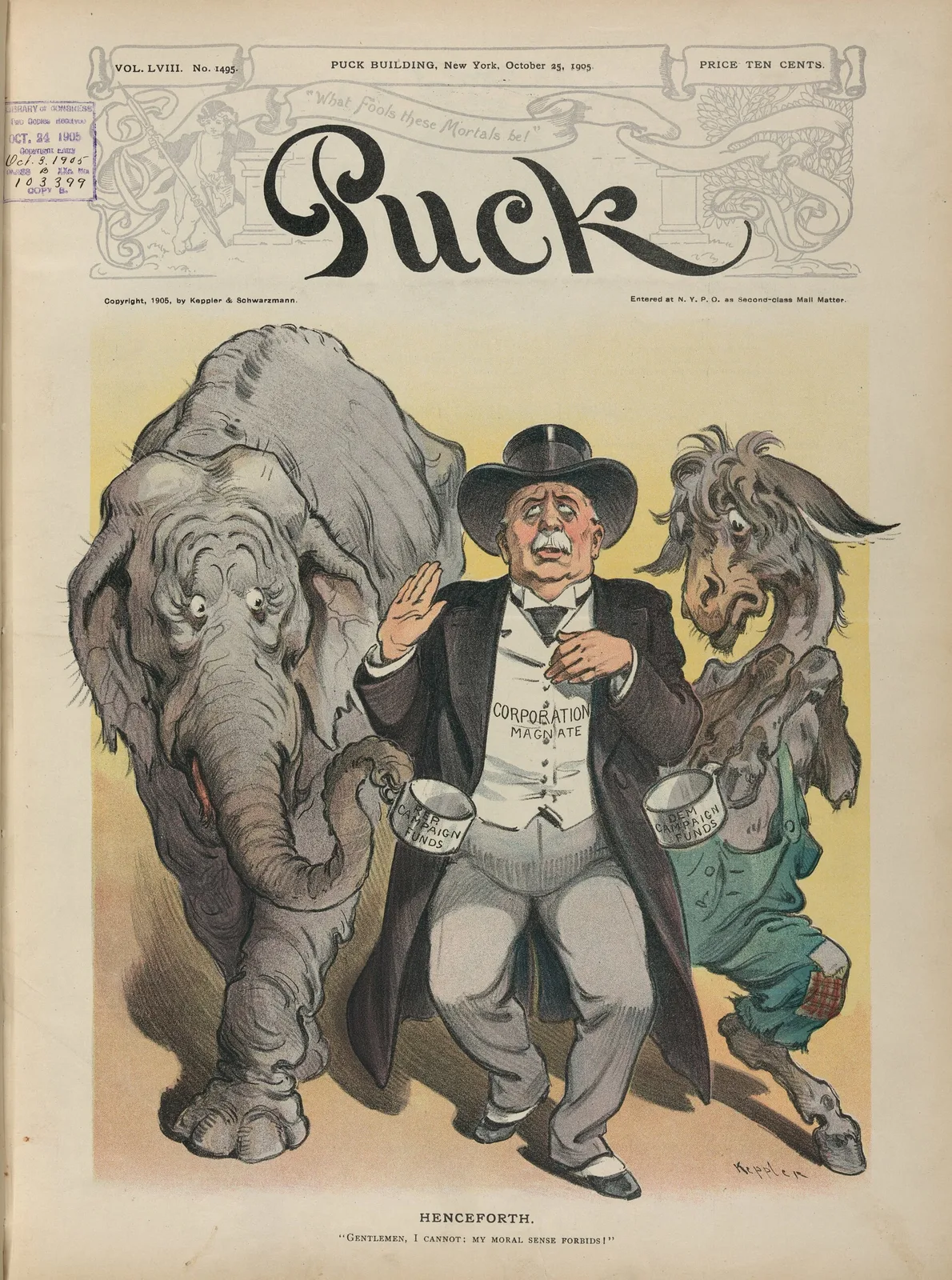
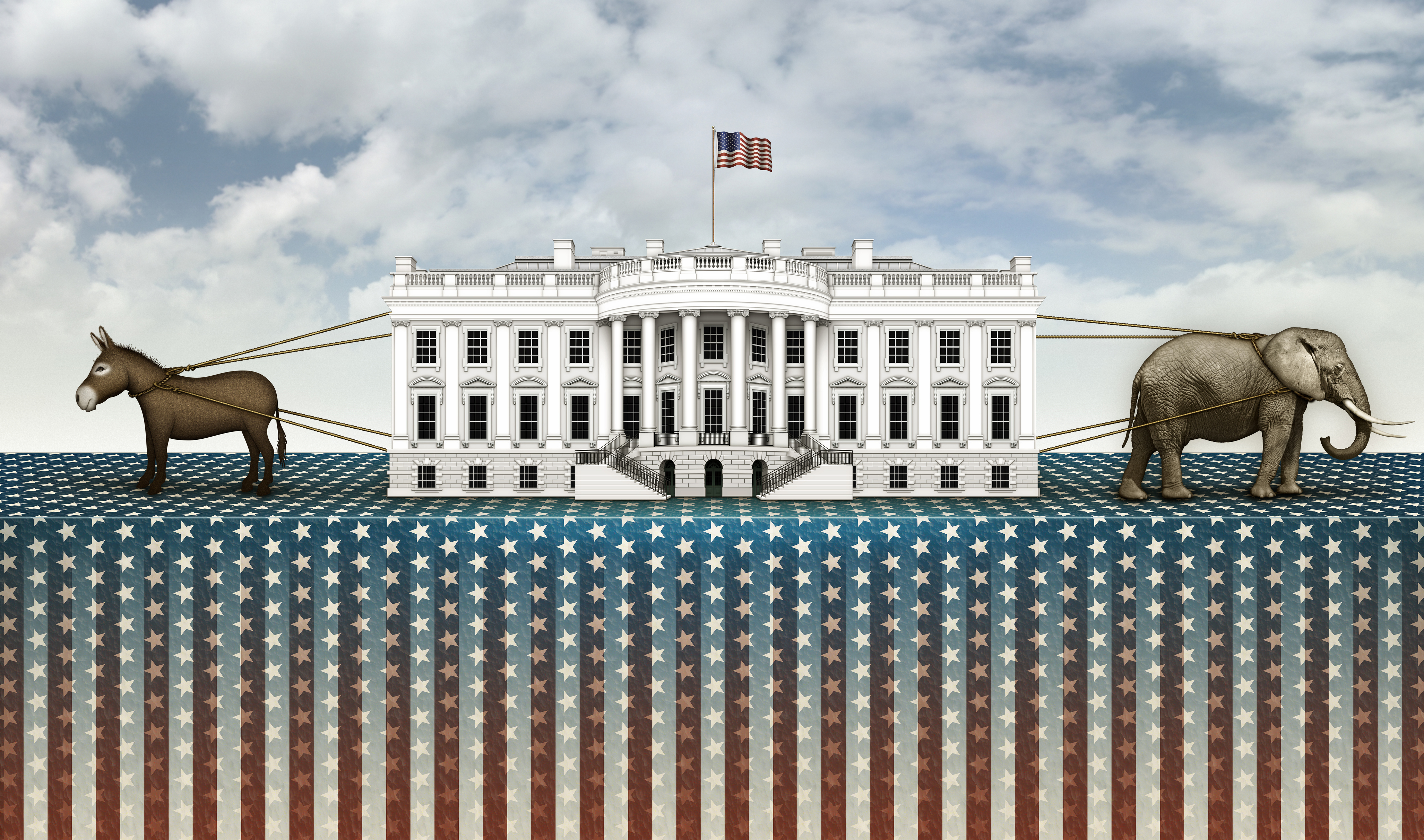
The Democratic donkey and Republican elephant symbols facing each other, representing the party realignment of the 1960s
The Most Important Thing to Understand About Party History
The parties did not "switch" overnight or trade platforms in a single election. What happened was a multi-decade voter realignment. The conservative, white Southern wing of the Democratic Party gradually moved to the Republicans between the 1950s and 1990s. The moderate, Northeastern liberal wing of the Republican Party gradually moved to the Democrats. Both parties ended up more ideologically uniform than they had been in a century. A Southern Democrat like Strom Thurmond who became a Republican in 1964 did not change his views. He changed parties because his views were no longer welcome in one and were very welcome in the other. The labels stayed the same. The coalitions changed.
From Reagan to MAGA
The modern era of American party politics begins in 1980 with Ronald Reagan's revolution against the New Deal consensus and culminates in a populist insurgency that has remade the Republican Party from within.
Ronald Reagan's 1980 victory over Jimmy Carter was a watershed in American political history. Reagan ran on a platform of cutting taxes, reducing the size of the federal government, deregulating the economy, and rebuilding American military strength after what he portrayed as the weakness and malaise of the Carter years. His coalition, which added working-class white Catholic and ethnic voters known as Reagan Democrats to the existing Republican base, produced a 49-state landslide in 1984. Reagan's message that government is not the solution to our problem, government is the problem was a direct repudiation of the New Deal consensus that had governed American politics since 1932. He cut the top marginal income tax rate from 70 percent to 28 percent. The national debt tripled on his watch. He remains the defining figure of modern conservatism.
Reagan survived an assassination attempt just two months into his presidency, on March 30, 1981, and his visible recovery and swift return to public duties were widely credited by contemporaries with boosting his personal popularity heading into that same year's major legislative push for the tax and budget cuts that became the centerpiece of his first-term economic agenda.
Reagan's economic record is contested. The 1981 tax cuts and a sharp Federal Reserve tightening under Paul Volcker were followed by a severe 1981 to 1982 recession, then a long expansion, and while the top marginal rate fell to 28 percent by 1988, Reagan also signed tax increases in 1982 and 1984, and payroll taxes rose in 1983.
On foreign policy he paired a large military buildup and confrontational rhetoric, the "evil empire," with arms-control diplomacy with Soviet leader Mikhail Gorbachev in his second term. His administration was also damaged by the Iran-Contra affair, in which officials secretly sold arms to Iran and diverted the proceeds to rebels in Nicaragua.
The 1970s and 1980s saw the rise of what came to be called the culture wars: a set of battles over abortion, religion in public life, LGBTQ rights, feminism, and the place of traditional values in American society that would define the fault lines of American politics for decades. The Roe v. Wade decision of 1973, which established a constitutional right to abortion, became the single most galvanizing issue in American politics, mobilizing the religious right into the Republican coalition and making abortion rights a defining cause of the Democratic Party. Jerry Falwell's Moral Majority, founded in 1979, channeled evangelical Christian voters into the GOP. These cultural battles increasingly displaced the old economic class conflicts that had defined party politics since the New Deal.
The Moral Majority itself dissolved in 1989, but its organizational playbook of mobilizing evangelical voters through churches and direct mail was carried forward by successor organizations, most notably the Christian Coalition, founded the same year by Pat Robertson, showing that the religious right's political infrastructure outlasted the specific organization that had pioneered it.
The alignment was not immediate. Into the 1970s, prominent figures in both parties held a range of views on abortion; the issue hardened along party lines through the 1980s and 1990s as activists on each side gained influence over primaries and platforms.
Parallel fights ran over the Equal Rights Amendment, which passed Congress in 1972 but fell short of ratification by 1982 after an organized conservative campaign led by Phyllis Schlafly; over school prayer and school textbooks; and, from the 1990s, over same-sex marriage, which the Supreme Court made legal nationwide in 2015.
Georgia congressman Newt Gingrich led Republicans to their first House majority in 40 years in 1994 with the Contract with America, a unified platform of term limits, welfare reform, and fiscal conservatism. His innovations in congressional hardball politics, including deliberately framing Democrats as enemies rather than opponents, using the government shutdown as a negotiating weapon, and treating legislation as a vehicle for base mobilization rather than problem-solving, accelerated the polarization of American politics. His tactics were effective, and they set the template for an increasingly confrontational style of partisanship that both parties would adopt in the years that followed.
The confrontational approach Gingrich pioneered produced two federal government shutdowns in the winter of 1995-96, when Congress and President Bill Clinton could not agree on spending levels; the shutdowns were widely seen at the time as damaging to Gingrich's own public standing, yet the government-shutdown-as-negotiating-tactic he helped popularize has been used repeatedly by both parties in budget standoffs in the decades since.
Gingrich's rise began years before 1994. As a backbencher in the 1980s he used televised C-SPAN floor speeches and an aggressive ethics complaint that helped force Democratic Speaker Jim Wright to resign in 1989, tactics that raised his profile and the temperature of House politics.
He served as speaker from 1995 to 1999 and left after Republicans lost seats in the 1998 midterm and he faced an internal revolt, along with an ethics reprimand and a fine. The nationalized, confrontational style he modeled, however, became standard practice for congressional leaders of both parties.
Barack Obama's election in 2008 and the passage of the Affordable Care Act in 2010 triggered the Tea Party movement, a grassroots conservative uprising that emphasized fiscal austerity, constitutional originalism, and fierce opposition to what its members saw as federal overreach. Tea Party candidates defeated establishment Republicans in primaries across the country and sent a new generation of uncompromising conservatives to Congress in the 2010 midterms. The movement represented a shift in the Republican Party's center of gravity away from the business-oriented establishment conservatism of the Bush era and toward a more populist, anti-government, and culturally conservative base. It was the political precursor to the MAGA movement that followed.
Republicans gained 63 House seats in the November 2010 midterm elections, the largest House seat swing for either party since 1948, a wave that returned control of the chamber to the GOP and installed a large freshman class of Tea Party-aligned members who arrived in Washington committed to resisting compromise with the Obama administration on spending and health care.
The movement combined genuine grassroots energy with heavy support from national conservative groups and donors. Its name invoked the 1773 Boston Tea Party and the slogan "Taxed Enough Already," and its first mass event was a wave of tax-day rallies in April 2009.
In office, Tea Party-aligned members forced a 2011 debt-ceiling standoff that led to the first downgrade of the U.S. credit rating and a 2013 government shutdown over the Affordable Care Act. The intra-party fights they started also contributed to Speaker John Boehner's resignation in 2015.
Donald Trump's 2016 victory over Hillary Clinton represented a departure from the Republican Party's post-Reagan orthodoxy on trade, immigration, and foreign policy. Trump ran on economic nationalism rather than free trade, border restriction rather than immigration reform, and America First disengagement rather than internationalism. He won the Republican nomination by defeating sixteen opponents and the presidency by winning the Electoral College despite losing the popular vote. His presidency, his defeat in 2020, his claims that the election was stolen, the January 6, 2021 attack on the Capitol, his two impeachments, and his return to the presidency in 2024 have made him one of the most polarizing figures in modern American politics; Gallup has recorded the largest partisan gaps in presidential approval in its history during his terms. The Republican Party's relationship to his legacy is the central question of contemporary American conservatism.
Trump won the 2016 election with 304 electoral votes to Clinton's 227, even though Clinton won the national popular vote by roughly 2.9 million votes, marking only the fifth time in American history a candidate has won the presidency while losing the popular vote, following similar splits in 1824, 1876, 1888, and 2000.
Trump's takeover of the party was contested at first, most of its officeholders and donors backed other candidates in 2016, but became near-total by 2020, when the party declined to write a new platform and simply reaffirmed support for the president. A Trump endorsement became the single most valuable asset in Republican primaries.
His 2024 win made him the first president since Grover Cleveland to serve non-consecutive terms and the first to win the office after felony convictions. His movement reoriented the party around immigration restriction, tariffs, skepticism of NATO and aid to Ukraine, and personal loyalty, breaking with much of the post-1980 Republican consensus.
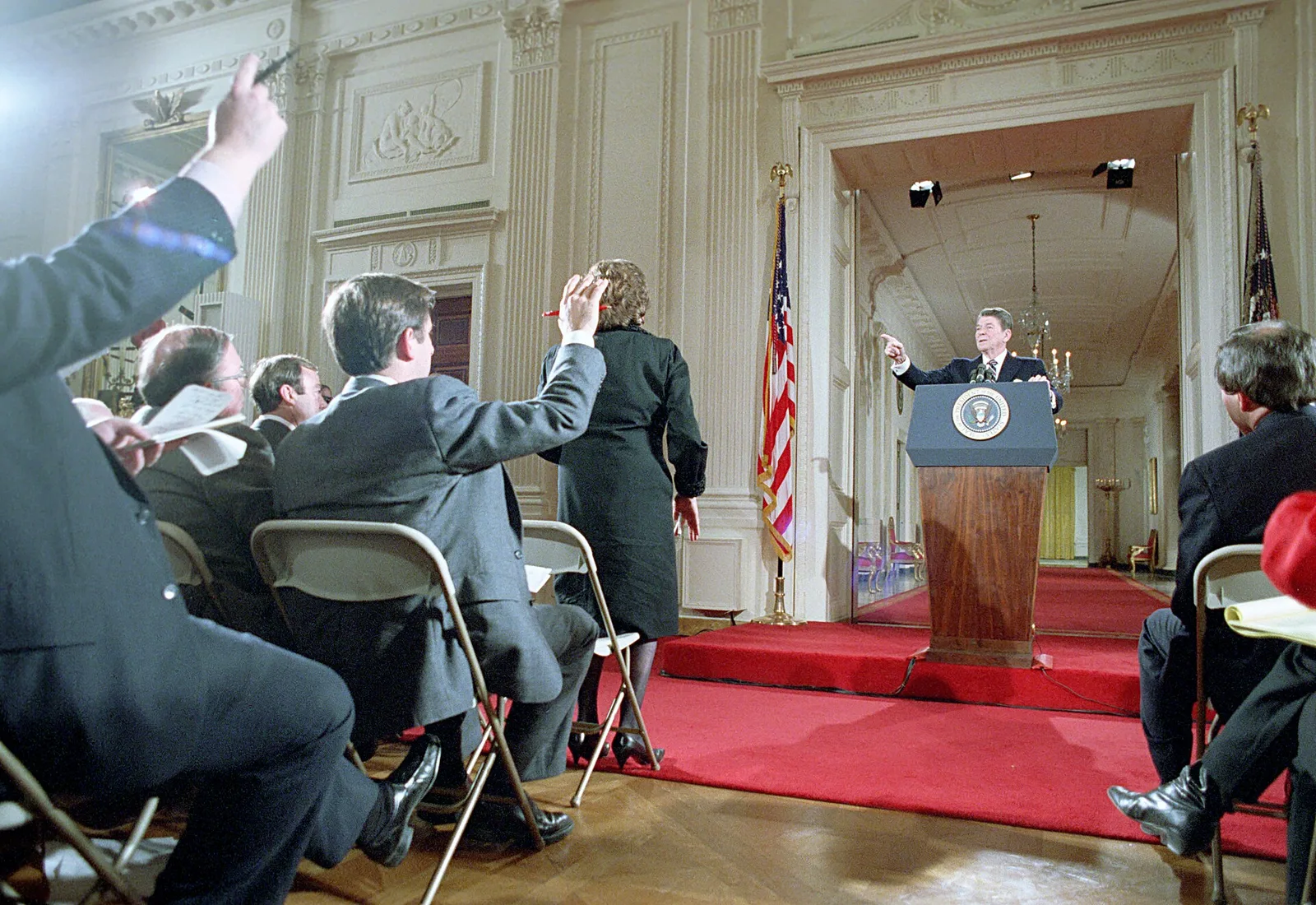
Ronald Reagan's 1980 election marked the beginning of the modern conservative era and a direct challenge to the New Deal consensus that had governed American politics since 1932.
The Two Parties in the Current Era
Both parties have narrowed their coalitions, intensified their ideological commitments, and elevated cultural and identity issues alongside the economic ones that once defined the party divide.
Surveys from Pew Research Center and Gallup find that the economy and health care rank near the top of Democratic voters' priorities, as they do for voters overall. Among the issues that most sharply separate Democrats from Republicans are abortion rights and LGBTQ rights. The Dobbs v. Jackson Women's Health Organization decision of 2022, which overturned Roe v. Wade and returned abortion law to the states, produced a large mobilization among Democratic-leaning voters, most of whom support legal access to abortion. Large majorities of Democrats also support marriage equality and anti-discrimination protections for LGBTQ Americans, including transgender Americans.
Ballot measures protecting abortion access passed in every state where they appeared in 2022, including several Republican-leaning states, and in most states in 2024, but not all: in 2024 Florida's measure won 57 percent, short of its 60 percent threshold, South Dakota's failed, and Nebraska voters approved a competing restriction instead. Strategists in both parties have cited the results as evidence of the issue's power to mobilize voters.
The same surveys consistently place climate change, voting rights, and economic inequality high among Democratic voters' priorities. The party's 2020s coalition leans heavily toward college-educated voters, younger voters, residents of large metropolitan areas, and, in several states, a majority-nonwhite electorate.
The party has real internal divisions, between a progressive wing focused on economic redistribution and structural change and a larger moderate wing focused on incremental policy and general-election electability, that surface in presidential primaries and in fights over issues such as how to finance health care.
Surveys from Pew Research Center and Gallup find that the economy, inflation, and immigration rank near the top of Republican voters' priorities. Among the issues that most sharply separate Republicans from Democrats are gun rights and religious liberty. Most Republicans oppose new restrictions on gun ownership, a view that for many is rooted in rural culture, distrust of government, and the belief that self-defense is a fundamental constitutional right. Many Republicans also place high priority on the right of religious institutions and individuals to act according to their faith, including when it conflicts with anti-discrimination laws, and on free speech on campuses and social media platforms.
Gun policy shows one of the widest partisan gaps in Gallup and Pew Research Center polling, which gives gun-rights positions particular weight in Republican primaries, where the most engaged voters choose nominees.
Immigration and border security in particular have become top-tier priorities for Republican voters since the mid-2010s, alongside inflation and the economy, crime, and opposition to what the party describes as "woke" cultural policy in schools and institutions. The coalition leans toward white voters, voters without a four-year degree, rural residents, and regular churchgoers, with growing support among some Hispanic and working-class voters.
The party has its own internal divisions, between a traditional business-and-defense establishment and a larger populist, nationalist wing skeptical of free trade, foreign intervention, and immigration, that have played out in leadership fights and in disputes over aid to Ukraine and federal spending levels.
Americans regularly express frustration with the two-party system and desire for alternatives, yet third parties virtually never succeed at the national level. The structural reasons are largely built into the electoral system. Winner-take-all elections, where the candidate with the most votes wins regardless of whether they have a majority, punish vote-splitting. The Electoral College amplifies this effect at the presidential level. Ballot access laws in most states make it expensive and difficult for third parties to even appear on ballots. And the two major parties have repeatedly demonstrated the ability to absorb third-party energy: the Populist Party of the 1890s was absorbed by the Democrats under William Jennings Bryan; the Progressive insurgency of Theodore Roosevelt in 1912 faded; Ross Perot's 19 percent in 1992 produced no electoral votes. The Tea Party chose to work within the Republican Party rather than form its own, the historically rational choice.
Perot's own Reform Party, founded after his 1992 run, is a case study in the broader pattern: despite Perot's personal wealth and the party's initial ballot-access advantages nationwide, the Reform Party won zero electoral votes in any presidential election, split into rival factions by the late 1990s, and had effectively dissolved as a national force by the early 2000s, one of the best-funded recent attempts at a durable third party to still ultimately fail.
The last third-party or independent presidential candidates to win any electoral votes were George Wallace in 1968, with 46, and, before him, Strom Thurmond in 1948, with 39, both regional segregationist candidacies. No third party has won a single electoral vote since.
Third parties have still mattered by shaping outcomes and agendas. Theodore Roosevelt's 1912 Progressive run split the Republican vote and helped elect Woodrow Wilson; Ralph Nader's 2000 campaign drew votes in a race decided by a few hundred in Florida; and both major parties have eventually adopted ideas, from the income tax to Social Security to trade skepticism, first raised by insurgents.
American politics today is more ideologically sorted than at any point since the Civil War era. Whereas mid-twentieth-century parties contained both liberals and conservatives, today's Democratic Party is almost entirely to the left of today's Republican Party with virtually no ideological overlap. The parties are also geographically sorted: Democrats dominate cities and dense suburbs; Republicans dominate rural areas and exurbs. This geographic sorting means that most Americans live in communities where their party is dominant, reducing the kind of daily cross-partisan contact that once moderated political views. Polls consistently show that partisan identity has become one of the strongest predictors of how Americans feel about people on the other side, stronger than race, religion, or income. Political scientists call this negative partisanship: voters who are motivated less by what they are for than by their hostility to the other party.
One commonly cited quantitative measure of this geographic sorting is the rising share of U.S. counties that qualify as "landslide counties," meaning counties a presidential candidate wins by 20 percentage points or more; that share has grown substantially since the 1990s, providing measurable evidence for the qualitative sense that Americans increasingly live in politically homogeneous communities.
The sorting shows up in how partisans describe the other side. Surveys find growing shares of each party's voters saying members of the other party are "closed-minded," "immoral," or "a threat to the nation's well-being," and rising numbers who say they would be unhappy if a close relative married someone from the other party.
Political scientists distinguish this "affective" polarization, how partisans feel about each other, from "issue" polarization, how far apart their actual policy views are. The affective gap has widened faster than the issue gap, meaning Americans dislike the other side more than their concrete disagreements alone would predict.
Democratic Party Today
- Reproductive rights and abortion access
- LGBTQ rights and anti-discrimination protections
- Climate change legislation
- Expanded healthcare access
- Immigration reform and a path to citizenship
- Gun safety legislation
- Racial equity and criminal justice reform
- Labor rights and union support
Republican Party Today
- Second Amendment rights and gun ownership
- Religious liberty and free speech
- Border security and immigration restriction
- Lower taxes and reduced federal spending
- Deregulation and free market economics
- Opposition to abortion
- Law enforcement support and public safety
- America First foreign and trade policy
A note on this page: USGovExplained.org presents the history and current positions of both parties factually and without endorsement. The platform positions listed above reflect what each party's voters and elected officials consistently prioritize, based on polling, platform documents, and voting records. Reasonable people disagree deeply about these issues, and that disagreement is the engine of democratic politics.
Sources & Further Reading
- Library of Congress, Formation of Political Parties
- U.S. Senate, About Parties and Leadership
- National Archives, Indian Removal Act and Party History
- HISTORY.com, Republican Party
- HISTORY.com, Republican Party Founded
- Britannica, Political Parties in the United States
- American Battlefield Trust, The Kansas-Nebraska Act
Party founding dates and histories are drawn from the Library of Congress, U.S. Senate historical records, HISTORY.com, and Britannica. Realignment history is drawn from academic political science literature and the National Archives. Contemporary party positions are drawn from official party platforms, Pew Research Center polling, and voting records.