
A Constitutional Right That Became a Regulated Industry
Lobbying is not a modern loophole in American government, it is a protected activity rooted directly in the First Amendment's guarantee that citizens may petition their government for a redress of grievances. What has changed dramatically since 1791 is scale and disclosure, from unregulated Gilded Age influence-peddling to today's detailed federal registration system covering a $5 billion-a-year industry.
The Constitution's First Amendment, ratified in 1791, guarantees the right of the people "to petition the Government for a redress of grievances," the specific constitutional clause that makes organized lobbying a protected activity rather than an illegal one. The Founders themselves petitioned and lobbied constantly, from state ratifying conventions pressured by Federalist and Anti-Federalist writers to the first Congress, which received petitions on subjects ranging from veterans' pensions to the abolition of slavery in its earliest sessions.
The word "lobby" entered American political vocabulary only decades later. Historians trace the first documented use of "lobby member" in print to an 1817 New York state legislature reference to lawmaker William Irving, describing people who worked the hallways outside a chamber to influence votes, a full half-century before the popular myth crediting the term to petitioners cornering President Ulysses S. Grant in the lobby of Washington's Willard Hotel.
Petitioning was a mass activity in the early republic: the first Congress alone received petitions from Quakers seeking an end to the slave trade, Revolutionary War veterans seeking pensions, and merchants seeking tariff protection. The House kept a standing committee to process them, and a citizen's petition was often the only way to raise a private claim against the government.
The petition right is textually paired with speech, press, and assembly in the First Amendment, and the Supreme Court has treated organized advocacy before Congress as protected activity that the government may require to be disclosed but cannot forbid. That principle underlies every modern lobbying-regulation law, which governs transparency rather than the act of petitioning itself.
By the 1830s, the verb "to lobby" had appeared in American print, and paid agents representing railroads, banks, and tariff-seeking manufacturers had become a fixture in state capitols and in Washington. These early lobbyists worked without any registration requirement or public disclosure of who was paying them or how much, since no federal law yet regulated the practice.
The Civil War accelerated the trend, as government contractors and tariff-seeking industries multiplied and Congress worked at a wartime pace with little capacity to vet lobbyist claims. The post-war Gilded Age's industrial growth, especially in railroads, oil, and steel, produced the first calls in Congress for lobbying regulation, though no such law would actually pass for another eight decades.
New York's Albany "Third House" and the taverns around statehouses became recognized centers of paid influence, and by the 1850s state investigations in New York and Pennsylvania documented cash payments to legislators for railroad and canal charters. The word "lobbyist" carried a strongly negative connotation from the start.
At the federal level, tariff schedules, railroad land grants, and military contracts drew the most concentrated lobbying. Sam Ward, known in the 1870s as "King of the Lobby," openly described his trade of dinners and personal cultivation of members and testified about it to a Senate committee in 1875, a sign of how normalized the practice had become without any law governing it.
The Credit Mobilier scandal, exposed by the New York Sun during the 1872 presidential campaign, showed how far unregulated lobbying could go. Union Pacific Railroad executives created a construction company, Credit Mobilier of America, that billed the railroad $94 million for a line that cost about $50 million to build, then used discounted company stock to buy influence with roughly a dozen sitting members of Congress, including Representative Oakes Ames, who distributed the shares, and House Speaker Schuyler Colfax, who by 1872 was serving as vice president.
The House censured Ames and fellow implicated Representative James Brooks on February 27, 1873, but neither the scandal nor the public outrage it generated produced any federal lobbying disclosure law. The United States would go without one for another 73 years, until the Federal Regulation of Lobbying Act of 1946.
Oakes Ames, a Massachusetts congressman and shovel manufacturer, was a director of both Union Pacific and Credit Mobilier, and he distributed shares to colleagues "where they will do most good," in his own words, at prices well below market with dividends that quickly exceeded the purchase price. The scheme surfaced when a falling-out between Ames and a business partner produced letters that reached the New York Sun.
Congressional committees investigated 13 members; the House censured Ames and Representative James Brooks, both of whom died within months. Future president James Garfield and future vice president Henry Wilson were among those named but not punished. Public disgust over the affair contributed to heavy Republican losses in the 1874 midterms but produced no lobbying law.
President Harry Truman signed the Federal Regulation of Lobbying Act in August 1946, the first federal law requiring paid lobbyists to register and periodically disclose their activity, following recommendations from Congress's own Special Joint Committee on the Organization of Congress. The law required groups whose principal purpose was influencing legislation to register and file quarterly reports on their spending.
The Supreme Court narrowed the law's reach in its 1954 decision United States v. Harriss, reading it to apply only to direct, in-person communication with members of Congress on pending legislation in order to save the vaguely worded statute from being struck down as unconstitutional. That narrow reading left the 1946 Act, in the assessment of legal historians reviewing its record, poorly enforced and easy to evade for the next 49 years.
The Act was Title III of the Legislative Reorganization Act of 1946, a broad modernization of Congress that also created professional committee staffs. It required a person who "solicits, collects, or receives money" for lobbying to register with the Clerk of the House and Secretary of the Senate and file quarterly spending reports, with criminal penalties for violations.
United States v. Harriss (1954) upheld the law but read it narrowly, covering only paid lobbyists whose "principal purpose" was influencing legislation through direct contact with members. Grassroots campaigns, contacts with staff, and lobbying of agencies fell outside it, and the vague "principal purpose" test let many groups decline to register at all.
The Lobbying Disclosure Act of 1995 replaced the 1946 law with a far more detailed registration and reporting system still in use today. A lobbyist must register if they make more than one contact with a covered federal official on behalf of a client, spend at least 20 percent of their time for that client on lobbying activities in a three-month period, and the client's lobbying income or the organization's lobbying expenses exceed set dollar thresholds.
Registered lobbyists and their employers file public reports, known as LD-1 registrations and LD-2 activity reports, with the Secretary of the Senate and the Clerk of the House, listing the specific bills, agencies, and issues they lobbied on. A 2007 amendment later increased the filing frequency from semiannual to quarterly, part of the broader post-Abramoff reform covered in the next entry.
The LDA defined a "lobbyist" by objective tests, more than one contact, 20 percent of time, and income or expense thresholds, replacing the "principal purpose" language courts had gutted. It covered contacts with congressional staff and with senior executive branch officials, and required naming the specific issues, bills, and agencies involved.
Enforcement still relies largely on self-reporting; the Government Accountability Office audits a sample of filings each year and routinely finds double-digit percentages with errors or missing contribution reports, and referrals rarely result in prosecution. Critics call the result "shadow lobbying," in which advisers who stay just under the thresholds are not required to register.
Congress passed the Honest Leadership and Open Government Act in the wake of the Jack Abramoff lobbying scandal, and President George W. Bush signed it into law on September 14, 2007. The Act banned registered lobbyists and the entities that employ them from giving gifts, meals, or travel to members of Congress and staff, closing a loophole that had let lobbyists routinely cover lawmakers' meals, golf outings, and event tickets.
The law also lengthened the "cooling-off" period before former officials can lobby their old colleagues, from one year to two years for senators and senior executive branch officials leaving office, while keeping a one-year restriction for former House members and staff. It further required lobbyists to file semiannual LD-203 reports disclosing campaign contributions and fundraising activity, closing a separate gap that had let lobbyists' political money go unreported alongside their lobbying activity.
The gift and travel ban replaced a $50-per-gift, $100-per-year cap that lobbyists had routinely worked around, and it barred lobbyist-funded travel except for one-day trips and certain university events. It also required disclosure of "bundled" contributions, in which a lobbyist gathers checks from many donors and delivers them to a campaign as a package.
The law slowed but did not stop the revolving door. The two-year Senate cooling-off period applies only to lobbying one's former chamber, and former members can immediately advise clients, strategize, and lobby the other chamber or the executive branch; many take "senior adviser" or "policy" titles that keep them below the LDA registration line.
Federal lobbying spending surpassed $5 billion in a single year for the first time in 2025, according to OpenSecrets' analysis of Senate and House disclosure filings, a 14 percent jump over 2024 driven by industries positioning themselves for policy changes in the first year of President Trump's second term. The number of organizations reporting lobbying activity rose to 15,768, up nearly 12 percent from 14,061 the year before.
The registered lobbyist workforce itself grew more modestly, up about 5 percent over the same period, meaning the spending increase reflected existing lobbyists and firms billing more, not primarily new registrants entering the profession. OpenSecrets' series of total reported federal lobbying spending, which follows the Lobbying Disclosure Act, begins in 1998 at about $1.45 billion.
OpenSecrets attributed the 2025 surge to industries preparing for tax, tariff, energy, health, and technology policy changes early in a new administration and Congress. Pharmaceuticals and health products, electronics and internet firms, and business associations were among the top-spending sectors, a pattern that has held for most of the past two decades.
Reported spending understates the industry because it excludes strategic advice, opposition research, coalition management, and grassroots work that do not meet the LDA's contact threshold; academic estimates put true spending on influencing government at two to three times the disclosed figure. Adjusted for inflation, disclosed lobbying spending has roughly doubled since the late 1990s while the registered-lobbyist count has been flat or declining.
Not Just Corporations
When people picture a lobbyist, they often picture a corporate representative, but the interest-group landscape in Washington is far broader, spanning labor unions, professional associations, single-issue advocacy groups, think tanks, public interest nonprofits, foreign governments, and even other levels of government lobbying the federal government.
Trade and business associations represent companies within a single industry, such as the American Petroleum Institute for oil and gas producers or the National Association of Realtors for real estate agents, as well as broad, cross-industry organizations like the U.S. Chamber of Commerce that speak for business interests generally. Member companies pay dues that fund the association's lobbying staff, allowing even mid-sized firms to have a Washington presence they could not otherwise afford individually.
The U.S. Chamber of Commerce has ranked among the single largest annual federal lobbying spenders for years running in OpenSecrets' tracking, regularly outspending any individual corporation, a reflection of how pooling resources through an association can produce more lobbying muscle than any one company deploying its own government-affairs office.
Beyond the Chamber, the largest trade groups by lobbying spending have included the pharmaceutical industry's PhRMA, the National Association of Realtors, and the American Hospital Association, each spending tens of millions a year. Associations also file public comments on regulations, fund research, run advertising, and coordinate their members' individual lobbying.
Membership can create internal tension: a broad association must reconcile the positions of manufacturers, retailers, banks, and tech firms, and companies sometimes quit publicly over a disagreement, as several energy and consumer-goods firms did in the 2010s over the Chamber's climate positions. Narrower trade groups speak with one voice but reach fewer lawmakers.
Labor unions such as the AFL-CIO, a federation of unions representing millions of workers, and individual unions like the Teamsters and the Service Employees International Union lobby on wages, workplace safety, collective bargaining rights, and trade policy on behalf of their dues-paying members. Organized labor has maintained a continuous Washington lobbying presence since the late 19th century, making it one of the oldest categories of American interest group.
Unions also operate political action committees to channel voluntary member contributions to candidates, a practice formalized by the AFL-CIO's Committee on Political Education, known as COPE, founded in 1955 and among the longest-running PACs in American politics.
Union lobbying is concentrated in a handful of large organizations: the AFL-CIO federation, the National Education Association and American Federation of Teachers, the SEIU, and the building-trades unions. Their disclosed federal lobbying spending is far smaller than the business total, but unions add volunteer phone banks, canvassing, and get-out-the-vote operations that money alone does not buy.
Union membership has fallen from about a third of wage and salary workers in the 1950s to roughly 10 percent today, and to about 6 percent in the private sector, which has reduced organized labor's dues base and lobbying reach relative to mid-century. Public-sector workers now join unions at a far higher rate than private-sector workers, and the two groups account for roughly equal numbers of members, about 7 million each (BLS, 2024).
Professional associations represent licensed occupations rather than companies or workers broadly, with the American Medical Association speaking for physicians and the American Bar Association speaking for lawyers among the best known examples. These groups typically focus on licensing standards, liability rules, and the regulatory details of their specific profession rather than broad economic policy.
The American Medical Association's Washington lobbying dates back more than a century to early 20th-century fights over state medical licensing standards, and the AMA played a prominent, well-documented role in the national debate over the creation of Medicare in 1965, illustrating how a professional association's influence can extend well beyond its members' day-to-day practice concerns.
The AMA campaigned against "compulsory health insurance" proposals from the 1940s through the 1960s, coining the label "socialized medicine," and in 1961 funded a recording by Ronald Reagan urging listeners to write Congress against the Medicare bill. After Medicare passed in 1965 the AMA shifted to shaping physician payment rules, and it long controlled the committee that recommends the relative values Medicare uses to price medical services.
Other professional groups, the American Bar Association, the American Institute of CPAs, the American Dental Association, focus tightly on their fields: bar admission and judicial nominations, tax and audit rules, dental-benefit mandates. Their influence often runs through highly technical rulemaking and committee staff rather than floor votes.
Single-issue and ideological groups organize around one specific cause or a broader set of political beliefs rather than an economic sector, spanning the full political spectrum, from the National Rifle Association on gun rights to the Sierra Club on environmental protection to AARP on issues affecting older Americans. These groups typically rely on individual member dues and donations rather than corporate or union funding.
Many single-issue groups publish legislative scorecards rating lawmakers' votes on issues the group tracks, a tactic the League of Conservation Voters pioneered with its National Environmental Scorecard in 1970 and that groups across the ideological spectrum have since adopted to mobilize members around specific incumbents' voting records.
The NRA's Institute for Legislative Action, founded in 1975, and the Sierra Club, founded in 1892 and lobbying federally since the mid-20th century, are frequently cited as bookend examples because both combine paid Washington lobbyists with large dues-paying memberships that can be mobilized to contact Congress. AARP, with tens of millions of members, is among the most-cited groups on Social Security and Medicare.
Political scientists note that intensely motivated single-issue constituencies can outweigh larger but less focused majorities, because members vote and donate on that one issue. Scorecards turn a lawmaker's votes into a grade members see before an election, a mechanism used across the spectrum by the League of Conservation Voters, the NRA, the U.S. Chamber, Americans for Democratic Action, and the American Conservative Union.
Think tanks such as the Brookings Institution, the Heritage Foundation, and the Cato Institute produce policy research, analysis, and recommendations that shape debate in Washington without necessarily engaging in the direct lobbying contacts that trigger Lobbying Disclosure Act registration. Many organize as 501(c)(3) nonprofits, a tax status that legally caps how much of their activity can involve direct lobbying.
A 501(c)(3) organization that wants clearer legal guardrails can elect the 501(h) expenditure test under IRS rules, which sets specific dollar limits on lobbying spending tied to the organization's overall budget, an alternative to the vaguer "substantial part" test that otherwise governs how much lobbying a charitable nonprofit may do without risking its tax-exempt status.
Think tanks range from long-established, relatively nonpartisan institutions like Brookings and the RAND Corporation to explicitly ideological ones like Heritage (conservative), the Center for American Progress (progressive), and Cato (libertarian). Many pair a 501(c)(3) research arm with a separate 501(c)(4) advocacy affiliate that can lobby and campaign more freely.
Because think tanks supply testimony, draft language, and expert staff who later join administrations, critics have questioned the transparency of their funding, especially foreign-government and corporate donations. A 2016 investigation documented cases in which corporate donors shaped think-tank research, prompting several institutions to publish donor lists and adopt disclosure policies.
Public interest and citizen groups such as Common Cause and Public Citizen advocate for causes framed as benefiting the broad public rather than a narrow economic interest, typically funded by small individual donations rather than industry dues. This category expanded significantly during the consumer and government-reform movements of the 1960s and 1970s.
Ralph Nader founded Public Citizen in 1971, several years after his 1965 book "Unsafe at Any Speed" criticized the auto industry's safety record and helped spur passage of the National Traffic and Motor Vehicle Safety Act, establishing a model of small-donor-funded public interest lobbying that other consumer, environmental, and government-accountability groups later followed.
The 1960s and 1970s wave also produced Common Cause (1970), the Public Interest Research Groups, the Environmental Defense Fund, and the Natural Resources Defense Council, groups that combined lobbying with litigation and media campaigns and helped pass the 1974 Freedom of Information Act amendments, the post-Watergate campaign finance law, and major environmental statutes.
Their model, many small donors, an issue framed as the general public interest, and a mix of lobbying, lawsuits, and press work, has been adopted across the spectrum; conservative and libertarian counterparts such as Judicial Watch and various taxpayer groups use the same tools toward different ends, and the "public interest" label is contested precisely because different groups define the public's interest differently.
Foreign governments, foreign political parties, and foreign corporations hire American lobbying, public relations, and law firms to represent their interests in Washington, but these arrangements fall under the Foreign Agents Registration Act of 1938, known as FARA, rather than the Lobbying Disclosure Act. FARA requires registration with the Justice Department, not the Senate or House, along with public filing of many of the materials and communications distributed on the foreign client's behalf.
FARA was enacted in 1938 in response to pro-Nazi propaganda efforts inside the United States, but enforcement stayed relatively light for decades, especially after the Lobbying Disclosure Act passed in 1995 shifted general lobbying oversight toward voluntary compliance. That changed after 2017, when the Justice Department's prosecution of former Trump campaign chairman Paul Manafort for failing to register as a paid agent of Ukraine's government marked, according to legal analysts, a new era of aggressive FARA enforcement.
FARA covers agents of "foreign principals," governments, parties, and, unless an exemption applies, foreign companies and individuals, and requires filing contracts, fees, and copies of distributed "informational materials" with the Justice Department's FARA Unit. A commercial exemption lets many foreign business clients register under the ordinary Lobbying Disclosure Act instead, a gap Congress has repeatedly considered closing.
After 2016, DOJ opened a FARA enforcement push: the Manafort prosecution, an advisory-opinion process, and a rising number of registrations for work on behalf of Gulf states, China-linked entities, and others. A 2016 DOJ inspector general report had found the FARA Unit under-resourced and passive, and Congress has since debated bills to add civil penalties and a dedicated enforcement office.
Cities, counties, states, and public universities also lobby the federal government, hiring Washington representatives or maintaining in-house federal affairs offices to compete for federal grants, shape legislation affecting their jurisdictions, and track regulatory changes, an intergovernmental form of lobbying distinct from private industry or citizen advocacy.
Organizations such as the National Governors Association and the National Conference of State Legislatures register as lobbying entities themselves, representing state governments collectively in Washington even though the states they represent are, constitutionally, separate sovereign governments rather than private interests.
The "Big Seven" intergovernmental groups, the National Governors Association, National Conference of State Legislatures, Council of State Governments, National Association of Counties, National League of Cities, U.S. Conference of Mayors, and International City/County Management Association, lobby Congress on mandates, grants, and preemption. Individual large states, cities, and public university systems also keep their own Washington offices or hire firms.
The Supreme Court held in Garcia v. San Antonio Metropolitan Transit Authority (1985) that the main protection for state interests against federal overreach is political, through representation in Congress, not judicial, which is part of why organized state-and-local lobbying is treated as legitimate. Federal law generally bars using federal grant funds themselves to lobby Congress.
More Than a Handshake and a Steak Dinner
Direct meetings with lawmakers are only one tool in a much larger toolkit. Interest groups also draft bill language, mobilize genuine or manufactured grassroots pressure, fund political action committees, hire former officials for their insider access, build coalitions, and even turn to the courts when Congress and federal agencies are not the most effective venue.
Direct lobbying means personally contacting a "covered official," a member of Congress, congressional staffer, or senior executive branch official, to argue for or against specific legislation or regulatory action, whether through in-person meetings, phone calls, formal testimony at a committee hearing, or written analysis provided to a lawmaker's office.
Because congressional staff often handle the day-to-day workload on any given issue, lobbyists frequently spend more time with committee and personal staff than with members themselves, and the Lobbying Disclosure Act's quarterly reports require registrants to identify the specific covered officials or offices they contacted on each issue, not just the general topic.
A "lobbying contact" under the LDA is any oral, written, or electronic communication to a covered official on legislation, rules, grants, contracts, nominations, or the administration of a program. Certain communications are excluded: testimony in a public hearing, responses to an agency's request for public comment, and communications required by statute.
Effective direct lobbying usually supplies something an office needs, a constituent-impact estimate, draft report language, a list of supporters, a technical fix, rather than a simple ask. Lobbyists also monitor hearings and markups, brief members before votes, and help arrange field visits, work that is legal, disclosed by issue, and central to how detailed legislation gets written.
Interest groups sometimes draft actual bill text and hand it to a sympathetic lawmaker's office to introduce with little or no change, a widely documented and generally legal practice that fills a real capacity gap, since most state legislatures and many congressional offices have far fewer policy staff than the volume of bills they consider would require.
A two-year investigation by USA Today, the Arizona Republic, and the Center for Public Integrity, published in 2019 as "Copy, Paste, Legislate," used a text-comparison algorithm across nearly one million state bills and found at least 10,000 bills almost entirely copied from interest-group model legislation, more than 2,100 of which were signed into law.
The best-known clearinghouse is the American Legislative Exchange Council (ALEC), a network of conservative state legislators and corporate members that approves "model bills" its lawmaker members carry home; progressive counterparts include the State Innovation Exchange. Nonprofits, agencies, and uniform-law commissions also circulate model language.
The "Copy, Paste, Legislate" analysis found model bills from business groups, advocacy organizations across the spectrum, and think tanks, on topics from asbestos-litigation limits to data-privacy rules to tenant protections. Supporters call model legislation an efficient way to spread tested policy; critics say it lets outside interests set state agendas with little public awareness of the source.
Genuine grassroots lobbying involves an interest group mobilizing its own actual members, such as a union's rank and file or an association's dues-paying businesses, to contact their own elected representatives directly, a tactic protected by the same First Amendment right to petition that covers paid lobbyists.
"Astroturfing" describes a manufactured imitation of grassroots support, funded and organized by a moneyed interest but designed to look like spontaneous public sentiment. Texas Senator Lloyd Bentsen coined the term in 1985 after his office received a coordinated flood of form letters promoting insurance industry positions, remarking that "a fellow from Texas can tell the difference between grass roots and AstroTurf."
The LDA does not require disclosure of "grassroots lobbying," communications urging the public to contact officials, so paid campaigns that generate constituent mail, calls, and emails are largely invisible in federal filings, unlike direct contacts. Firms specialize in producing these campaigns, sometimes generating tens of thousands of near-identical messages.
Astroturf abuses have included fabricated letters sent under real constituents' names without their knowledge, exposed in a 2009 case involving a coal-industry campaign against climate legislation, and fake "citizen" groups funded entirely by one company. Some proposed reforms would require disclosure of paid grassroots spending above a threshold.
Many interest groups form political action committees, legally separate entities that solicit voluntary contributions from a company's employees, a union's members, or an association's supporters and then donate those pooled funds to candidates, subject to federal contribution limits.
A "multicandidate" PAC, meaning one with more than 50 contributors that has given to at least five federal candidates, may contribute up to $5,000 to a single candidate per election under Federal Election Commission rules, and because a primary and a general election count as separate elections, a PAC can legally give a candidate up to $10,000 across a single two-election cycle.
Traditional PACs are strictly limited: they may accept up to $5,000 per year from an individual and must disclose donors and spending to the FEC. This is a small sum next to a modern campaign, so a PAC contribution is generally understood as a way to secure access and signal alignment rather than to fund a race.
Super PACs and 501(c)(4) groups, created by post-2010 court rulings, are a separate track that can raise and spend unlimited amounts independently but cannot give directly to candidates or coordinate with them (political parties, whose coordinated-spending limits the Supreme Court struck down in NRSC v. FEC in June 2026, now can). Many lobbyists are also active as "bundlers," gathering and delivering others' checks, which the 2007 law requires campaigns to disclose above a set amount.
The "revolving door" describes the movement of officials between government positions and lobbying jobs, in either direction, a pattern that gives lobbying firms both insider knowledge of how an agency or committee actually operates and personal relationships with the officials still working there.
Research organizations that track the phenomenon, including OpenSecrets' revolving door database, have found that a substantial share of members of Congress who leave office go on to register as lobbyists or take closely related "government affairs" positions that involve lobbying-style work without necessarily crossing the Lobbying Disclosure Act's registration threshold, sometimes called "shadow lobbying."
The door turns both ways: former staff and members bring relationships and process knowledge to firms and clients, while lobbyists and industry figures enter agencies and congressional staff with subject expertise. Cooling-off periods of one to two years restrict lobbying one's former employer but not advising, strategizing, or lobbying elsewhere in government.
Studies by political scientists have found that lobbyists who previously worked for a specific member see their billings drop measurably when that member leaves office, evidence that the relationships, not just the expertise, carry value. Roughly half of departing members in recent Congresses have taken jobs at lobbying or government-affairs firms, though many avoid registering.
Interest groups that might otherwise have little in common frequently form temporary coalitions around a single shared issue, pooling resources and lending each other credibility, such as environmental groups and hunting or fishing organizations jointly opposing a specific development project, or business and labor groups jointly supporting a particular trade measure.
A coalition's public letterhead listing dozens of member organizations is itself a lobbying tool, meant to signal to lawmakers that a position has broad, cross-cutting support rather than reflecting the narrow interest of a single company or group.
"Strange bedfellows" pairings, tech firms and civil-liberties groups on surveillance, criminal-justice reformers spanning the ACLU and Koch-affiliated groups, gun owners and public-lands advocates, are deliberately assembled to show a proposal is not a partisan or single-industry ask.
Ad hoc coalitions often operate under a neutral name run by a lobbying or PR firm, which can obscure who is funding and steering them. Reform proposals have periodically sought to require lobbying coalitions to disclose their members and financial backers, but the LDA still asks only whether a registrant is part of a coalition, not to name every participant or funder.
Interest groups also advocate outside Congress and federal agencies entirely, by filing lawsuits or submitting amicus curiae, Latin for "friend of the court," briefs in major cases to argue for a particular legal outcome, a channel of influence the Lobbying Disclosure Act does not cover at all since it targets legislative and executive branch contacts, not judicial ones.
Citizens United itself began as advocacy litigation, brought by a nonprofit political organization challenging campaign finance restrictions on a film it produced, illustrating how a single interest group's court case can reshape the legal landscape for every other interest group's political spending nationwide.
Groups such as the ACLU, the NAACP Legal Defense Fund, the Pacific Legal Foundation, the Institute for Justice, and industry legal arms bring "impact litigation" aimed at setting precedent, and file amicus briefs in cases they did not bring. In a typical Supreme Court term, high-profile cases attract dozens of amicus briefs from interest groups on all sides.
Litigation is often used when the legislative route is blocked: environmental groups sue to enforce statutes agencies decline to apply, business groups sue to overturn rules, and civil-rights groups sue to strike laws. Because judicial lobbying is not covered by the LDA, this channel of influence, including the funding behind amicus briefs, is disclosed far less than legislative lobbying.
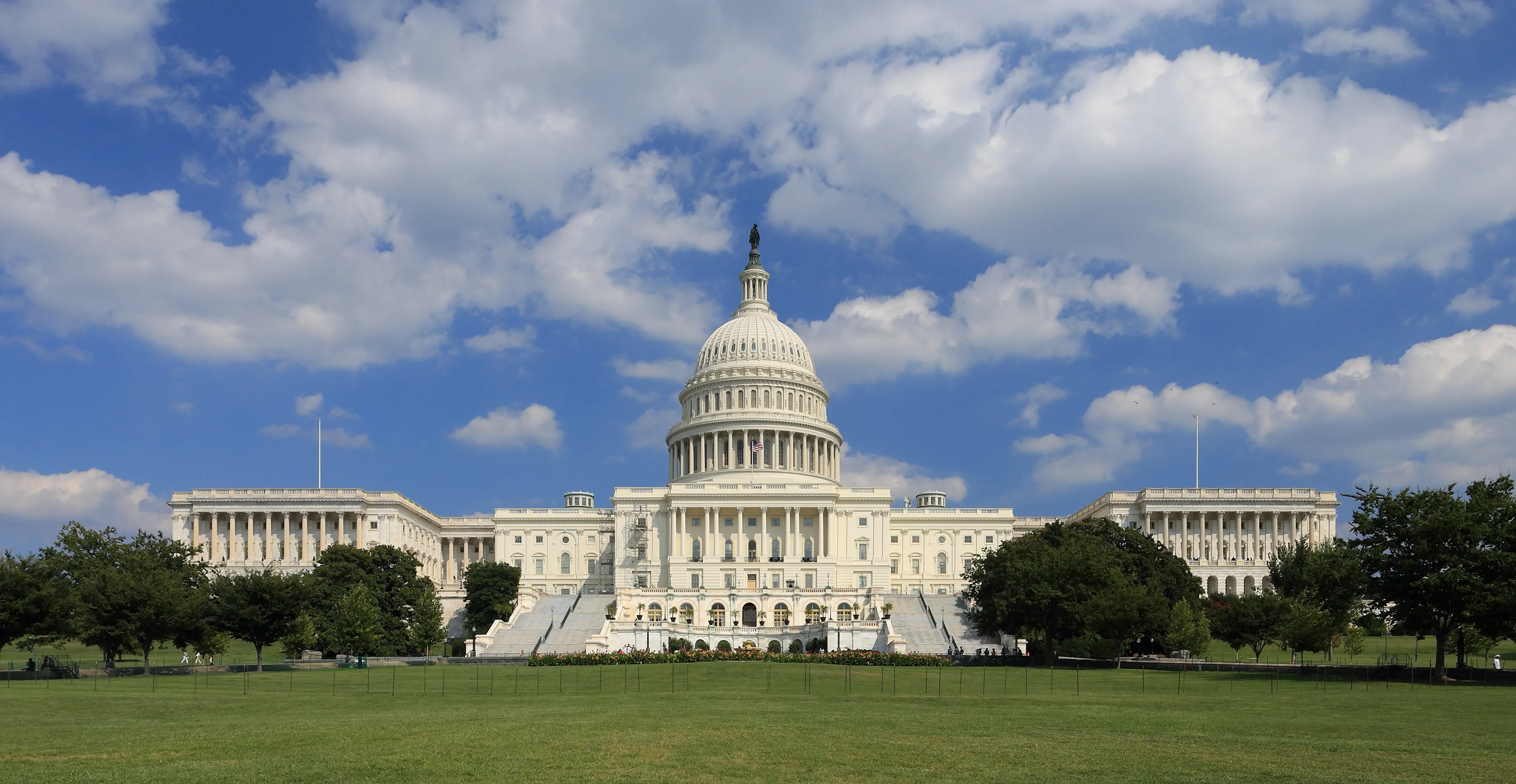
Most direct lobbying activity centers on the Capitol and the congressional office buildings surrounding it, where lobbyists meet with members and staff and testify at committee hearings.
Disclosure, Not Prohibition
Because the First Amendment protects the right to petition government, federal law cannot simply outlaw lobbying, so every major reform since 1946 has instead focused on requiring lobbyists to register, disclose who they represent and what they spend, and follow gift and revolving-door rules meant to limit the appearance of buying access or influence.
Because the First Amendment protects "the right of the people... to petition the Government for a redress of grievances," Congress cannot simply ban lobbying outright, and every major federal lobbying law has instead focused on requiring disclosure of who is lobbying and on whose behalf, rather than prohibiting the activity itself.
The Supreme Court's 1954 decision in United States v. Harriss reinforced this limit directly, narrowing the 1946 Federal Regulation of Lobbying Act's language specifically to avoid striking it down as unconstitutionally vague, and establishing disclosure, not restriction, as the constitutionally durable model that the 1995 Lobbying Disclosure Act and its later amendments have followed since.
Courts have consistently upheld lobbying disclosure as a light burden justified by the public's interest in knowing who is trying to influence government, applying the same "exacting scrutiny" used for campaign-finance disclosure. Outright bans or licensing of lobbyists, by contrast, would face strict scrutiny and almost certainly fail.
The petition right also produces the "Noerr-Pennington doctrine," a line of antitrust cases from 1961 to 1965 holding that businesses that jointly petition the government, even for anticompetitive laws, are generally immune from antitrust liability because petitioning is protected activity. The doctrine has since been extended to lobbying of agencies and to litigation.
Under the Lobbying Disclosure Act of 1995, an individual must register as a lobbyist for a client if they make more than one lobbying contact with a covered federal official and spend at least 20 percent of their time on lobbying activities for that client within a three-month period.
Registration also requires meeting a dollar threshold, generally $3,000 in quarterly lobbying-related income for a lobbying firm representing an outside client, or a higher threshold for an organization's own in-house lobbying expenses, and registered lobbyists must file public LD-2 reports every quarter itemizing the specific bills, agencies, and issues they worked on, searchable through the Senate Office of Public Records and the Clerk of the House's databases.
An organization with its own in-house lobbyists must register once its total lobbying expenses exceed a threshold (about $14,000 per quarter, indexed) and at least one employee meets the individual lobbyist tests. Firms register per client, and quarterly LD-2 reports estimate lobbying income or expense in $10,000 bands and list the issues, bills, and offices contacted.
The registration line is porous: an adviser who makes only one contact, spends 19 percent of their time, or works through registered colleagues need not register personally. GAO's annual audits find many registrants under-report, and non-compliance can be referred to the U.S. Attorney for D.C., but civil penalties up to $200,000 and the rare criminal case are seldom pursued.
The 2007 Honest Leadership and Open Government Act generally bars registered lobbyists and the organizations that employ them from giving gifts, meals, or entertainment to members of Congress and congressional staff, closing loopholes that had let lobbyists routinely pay for lawmakers' meals, golf outings, and sports tickets before the reform.
The same law extended the "cooling-off" period before officials can lobby their former colleagues: two years for senators and for senior executive branch officials before they may lobby their old chamber or agency, and one year for former House members and House staff, restrictions meant to slow, though not eliminate, the revolving door described in the previous tab.
The gift rules have exceptions, "widely attended events," home-state products, personal friendship, campaign events, and charity fundraisers, that critics say still allow lobbyists and lawmakers to mix socially. Enforcement runs through the House and Senate Ethics Committees, which rarely impose public sanctions.
Cooling-off periods vary by role: two years for senators and very senior executive officials, one year for House members and senior staff, and shorter or no restriction for junior staff. None bars a former official from immediately joining a firm and directing others' lobbying, which is why watchdogs describe the revolving door as slowed rather than closed.
Anyone lobbying on behalf of a foreign government, foreign political party, or other "foreign principal" must register under the Foreign Agents Registration Act of 1938 with the Justice Department, a separate and generally stricter regime than the congressional Lobbying Disclosure Act, requiring public filing of many underlying contracts and distributed materials.
FARA enforcement was historically light, especially after 1966 amendments and the 1995 Lobbying Disclosure Act shifted general practice toward voluntary compliance, but the Justice Department's 2018 prosecution of Paul Manafort for concealing his paid work for Ukraine's government, which produced a guilty plea and a five-year sentence on the FARA-related count, marked what legal analysts describe as a new, more aggressive era of FARA enforcement that has continued since.
FARA carries a commercial exemption: a lobbyist working for a foreign company on ordinary business matters may register under the LDA instead, but work for a foreign government or party, or work that primarily serves a foreign government's political interests, requires FARA registration and fuller disclosure of communications and money.
Recent FARA cases have reached beyond Manafort: guilty pleas and prosecutions involving unregistered work for the governments of Turkey, the United Arab Emirates, and China-linked entities, and civil settlements with major law and lobbying firms. Congress has repeatedly introduced bills to give DOJ civil investigative-demand authority and to narrow the LDA exemption, without passing them.
Campaign finance law and lobbying disclosure law are legally distinct but practically intertwined, since interest groups routinely combine direct lobbying with financial support for the campaigns of the lawmakers they lobby. The Supreme Court's 1976 decision in Buckley v. Valeo first established that spending money on political speech is itself a constitutionally protected form of expression, while still allowing Congress to limit direct contributions to candidates as a corruption safeguard.
The Court's 2010 decision in Citizens United v. FEC extended that logic to strike down limits on independent political spending by corporations and unions, and a federal appeals court applied the same reasoning two months later in SpeechNow.org v. FEC to eliminate contribution limits for groups that only make independent expenditures, creating the modern "super PAC," which can raise and spend unlimited sums as long as it does not coordinate directly with a candidate's campaign.
Buckley upheld the post-Watergate contribution limits and disclosure rules while striking expenditure limits and rejecting limits on a candidate's own spending. It set the framework, contributions can be capped to prevent "quid pro quo" corruption or its appearance; independent expenditures generally cannot, that still governs.
McConnell v. FEC (2003) upheld the McCain-Feingold ban on party "soft money," which still stands, so the unlimited money now flows through super PACs and nonprofits rather than the parties. Critics across the spectrum argue the contribution-expenditure line is unstable, but it has constrained every reform proposal for 50 years.
Some politically active nonprofits organize under Section 501(c)(4) of the tax code as "social welfare" organizations, a status that lets them engage in political spending as long as it is not their "primary" activity, and unlike PACs or super PACs, federal law does not generally require them to disclose their donors, a pattern commonly called "dark money."
The IRS has never precisely defined what share of a 501(c)(4)'s spending counts as its "primary" activity, leaving a widely used working assumption that roughly half of a group's budget can go toward politics without jeopardizing its tax status, and nearly $2 billion in dark money flowed through federal elections during the 2024 cycle alone, the most on record according to nonpartisan campaign finance trackers.
501(c)(4)s must report their election spending to the FEC and, in some cases, name donors who gave specifically for that spending, but donors who give to the group generally are not disclosed, which is the "dark" part. The groups also run "issue ads" that stop just short of urging a vote and so may not count as reportable election spending at all.
Both parties' networks use the vehicle: on the right, groups affiliated with Americans for Prosperity and the Judicial Crisis Network; on the left, groups such as the Sixteen Thirty Fund and America Votes affiliates. A handful of states now require disclosure of large donors behind political spending, and the federal DISCLOSE Act has passed the House at times but never the Senate.
The Lobbying Disclosure Act only governs lobbying of the federal government, and each state legislature sets its own separate registration thresholds, gift rules, and disclosure requirements for lobbying state government, meaning a lobbyist who works both Congress and a state capitol must register and report under two entirely different legal regimes.
The National Conference of State Legislatures, itself a registered lobbying organization representing state governments, tracks these state-by-state differences, which range from strict gift bans and low registration thresholds in some states to comparatively light disclosure requirements in others, a patchwork most civics curricula, focused on the federal government, rarely cover.
State rules range widely: some states, Wisconsin and Washington among them, have strict gift bans and detailed reporting; others require only annual registration and minimal disclosure. Thresholds for who counts as a lobbyist differ in every state, and many cities and counties add their own registration systems.
Ballot-measure campaigns add another layer: in the 24 states with citizen initiatives, interest groups spend heavily to qualify and pass or defeat measures, disclosed under state campaign-finance law rather than lobbying law. Because civics education and national media focus on Washington, this large body of state and local influence activity is comparatively under-examined.
A Recurring Fight Over Money and Access
From a Gilded Age railroad scandal that reached a sitting vice president to a 21st-century Supreme Court ruling that created the super PAC, the debate over how much influence money should buy in Washington has never fully settled. Each era's scandal or court decision has reshaped the rules, without ever resolving the underlying tension between free political speech and the risk of undue influence.
The Supreme Court's 1976 decision in Buckley v. Valeo struck down limits on how much candidates and independent groups could spend on political campaigns, ruling that spending money to communicate political views is itself a form of protected speech under the First Amendment, even as the Court upheld limits on direct contributions to candidates as a safeguard against corruption.
That contribution-versus-expenditure distinction, upholding limits on giving money directly to a candidate while striking limits on spending money independently to support one, became the foundational legal framework that every major campaign finance ruling since, including Citizens United and McCutcheon, has built on or modified.
The case challenged the 1974 Federal Election Campaign Act amendments passed after Watergate. The per curiam opinion upheld the $1,000 individual contribution limit, disclosure, and presidential public financing, but struck limits on independent expenditures, on a candidate's personal spending, and on total campaign spending.
Buckley also upheld the FEC's creation but struck the original method of appointing its commissioners, some by Congress, as a separation-of-powers violation, forcing a quick fix. The contribution-expenditure line has survived 50 years and constrains every reform proposal since.
In an operation made public in February 1980, FBI agents posing as representatives of a fictional Arab businessman offered cash bribes to members of Congress in exchange for promises of political favors, an investigation that began as an unrelated stolen-property and organized-crime probe before evolving into a public corruption sting.
The operation produced 19 convictions, including six sitting members of the House and Senator Harrison Williams of New Jersey, and Representative Michael Myers became the first member of Congress expelled for corruption since 1861. Several convicted lawmakers argued the FBI had induced them to commit crimes they otherwise would not have, but federal appeals courts repeatedly rejected the entrapment defense.
Agents videotaped the payments, and clips of Representative Michael Myers taking cash and saying "money talks in this business" were broadcast nationally. Other convicted House members included Frank Thompson, John Jenrette, Raymond Lederer, John Murphy, and Richard Kelly, who was filmed stuffing cash into his pockets.
Myers was expelled by the House in October 1980, the first expulsion since three members were removed for disloyalty in 1861; the others resigned or lost re-election. The operation prompted the Justice Department to adopt written guidelines for undercover "integrity testing" of public officials, requiring high-level approval and predication.
After Republicans won control of the House for the first time in 40 years in the 1994 elections, activist Grover Norquist and House Majority Whip Tom DeLay launched an effort known as the K Street Project in 1995, pressuring major Washington lobbying firms to hire Republicans in senior positions as a condition of access to the new GOP leadership.
The project compiled records tracking the party affiliation of lobbyists at top firms and trade associations, and critics on both sides of the aisle eventually described it as an explicit attempt to fuse lobbying access to partisan loyalty. The effort lost momentum and became politically toxic after federal investigators indicted lobbyist Jack Abramoff, a Norquist ally, in 2005.
The effort grew out of long-standing Republican frustration that trade associations and firms, staffed heavily by former Democratic aides after 40 years of Democratic House control, tilted against the new majority. DeLay's office kept a binder tracking hires, and firms seen as insufficiently cooperative were reported to have lost meetings or floor time.
Ethics complaints and press scrutiny mounted, and Senate ethics rules were amended in 2007 to bar conditioning official action on a firm's hiring decisions. Analysts note both parties have long pressed K Street to hire their alumni; what drew objection to the K Street Project was the explicit, organized linkage of hiring to access.
Lobbyist Jack Abramoff and his partner Michael Scanlon were found to have defrauded Native American tribal clients of an estimated $85 million in fees, in part by secretly orchestrating opposition campaigns against their own clients to pressure them into paying for additional lobbying services. Abramoff pleaded guilty in January 2006 to conspiracy, fraud, and tax evasion charges.
The investigation also implicated sitting members of Congress, including Representative Bob Ney of Ohio, who pleaded guilty to conspiracy and false statement charges for accepting gifts, golf trips, and campaign contributions from Abramoff in exchange for official acts. The scandal directly prompted the 2007 Honest Leadership and Open Government Act's gift ban and extended cooling-off periods.
Abramoff and Scanlon billed tribes with casino interests enormous sums while privately mocking them in emails and, in one case, quietly funding a rival anti-gambling campaign to keep a client paying for protection. Abramoff also used a network of nonprofits, a restaurant, and sports skyboxes to court lawmakers, and took members on golf trips to Scotland.
The investigation led to 21 convictions or guilty pleas, including Representative Bob Ney, two of DeLay's former aides, and several executive-branch officials; Abramoff served about 3.5 years and later became an advocate for lobbying reform.
The Supreme Court's January 2010 decision in Citizens United v. FEC struck down restrictions on independent political spending by corporations and labor unions, ruling 5-4 that the government's anti-corruption interest did not justify limiting this category of political speech, and overturning parts of its own 1990 and 2003 precedents in the process.
A federal appeals court applied Citizens United's reasoning just two months later in SpeechNow.org v. FEC, eliminating contribution limits for groups that spend independently rather than giving directly to candidates. That ruling created the modern super PAC, which can now raise and spend unlimited sums as long as it avoids direct coordination with a candidate's campaign.
The case began when the FEC barred Citizens United, a conservative nonprofit, from advertising "Hillary: The Movie" during the 2008 primaries under McCain-Feingold's ban on corporate-funded "electioneering communications." The Court held the government cannot suppress political speech based on the speaker's corporate identity, overruling Austin v. Michigan Chamber of Commerce (1990).
The decision upheld disclosure and disclaimer requirements 8-1 and did not address contribution limits or foreign money. Supporters call it a vindication of free speech; critics, including in a rare presidential rebuke during the 2010 State of the Union, say it amplified the political voice of wealthy interests.
The Supreme Court's 2014 decision in McCutcheon v. FEC struck down the overall two-year cap on how much an individual donor could contribute in total across all federal candidates, parties, and PACs combined, then set at $123,200, while leaving in place the base per-candidate contribution limit.
Writing for the plurality, Chief Justice John Roberts held that the aggregate limit did nothing to prevent corruption beyond what the base limits already accomplished, meaning a single wealthy donor could, after the ruling, legally spread large contributions across many candidates and committees without the previous overall ceiling.
Shaun McCutcheon, an Alabama businessman, wanted to give the legal per-candidate maximum to more candidates than the aggregate cap allowed. The 5-4 plurality held that the base limits alone address "quid pro quo" corruption and that the aggregate cap restricted how many candidates a donor could support without adding anti-corruption value.
The dissent argued the ruling would let a single donor write multi-million-dollar checks to joint fundraising committees that then distribute the money, effectively circumventing the per-candidate limits. Joint fundraising committees did grow substantially afterward, and the base per-candidate limit remains the last major contribution cap standing.
Former Trump campaign chairman Paul Manafort pleaded guilty in September 2018 to conspiracy charges connected to his failure to register under the Foreign Agents Registration Act while working as a paid political consultant for pro-Russian political parties and officials in Ukraine, receiving a sentence that included time for the FARA-related offense before a later presidential pardon.
Legal analysts widely cite the Manafort case as the moment the Justice Department shifted from the largely voluntary-compliance approach to FARA enforcement that had prevailed since the 1990s toward a more aggressive posture, a shift reflected in a substantial rise in FARA registrations and enforcement actions in the years that followed.
Manafort had earned tens of millions advising Ukraine's Party of Regions and President Viktor Yanukovych, and had directed a Washington lobbying and PR campaign, including through two prominent firms, without registering as a foreign agent until after the fact. He pleaded guilty to conspiracy counts that included the FARA violation and to witness tampering, and was pardoned in 2020.
The case, along with related prosecutions of a lawyer and lobbyists tied to the same Ukraine work, ended a long stretch in which FARA had produced almost no criminal cases. DOJ created new FARA enforcement positions, issued more advisory opinions, and registrations rose sharply, with several major firms entering civil settlements for past unregistered foreign work.
Nonpartisan campaign finance trackers estimated that nearly $2 billion in "dark money," spending by groups that are not required to disclose their donors, flowed through the 2024 federal election cycle, the largest total on record, much of it channeled through 501(c)(4) social welfare organizations exempt from federal donor-disclosure rules.
The scale of undisclosed spending has fueled renewed legislative proposals, including versions of the DISCLOSE Act, that would require groups spending significant sums on elections to reveal donors giving above a set threshold, though no such federal requirement has passed Congress as of this writing.
The roughly $2 billion figure combines spending reported to the FEC by non-disclosing groups with "issue ads" tracked by outside monitors; both parties' aligned nonprofit networks contributed, and a large share was raised by a handful of politically active 501(c)(4)s and their affiliated super PACs. The trend has risen every cycle since 2010.
Proposed fixes include the DISCLOSE Act, FEC or IRS rulemaking to tighten the 501(c)(4) "primary purpose" standard, and state disclosure laws, though the Supreme Court's 2021 Americans for Prosperity Foundation ruling cut the other way by limiting some compelled disclosure. No federal donor-disclosure requirement for these groups has passed.
Ten Facts Worth Knowing
A quick-reference set of facts drawn from the sourced material throughout this page, useful for a fast read or a classroom discussion starter.
Federal lobbying spending topped $5 billion for the first time in 2025, up 14 percent from 2024, according to OpenSecrets.
The verb 'to lobby' appeared in American print in the 1830s, decades before the popular but false legend that the term originated with petitioners cornering President Ulysses S. Grant at the Willard Hotel.
Congress went 155 years, from the First Amendment's 1791 ratification to the Federal Regulation of Lobbying Act's 1946 passage, without any federal law requiring lobbyists to register or disclose their activity.
The 1872 Credit Mobilier scandal implicated a sitting vice president, Schuyler Colfax, in a scheme involving discounted railroad construction company stock distributed to members of Congress.
A multicandidate PAC can legally give a single candidate up to $10,000 across a two-election cycle, $5,000 for the primary and $5,000 for the general, under current FEC rules.
Texas Senator Lloyd Bentsen coined the term 'astroturfing' in 1985 to describe a manufactured flood of form letters that only looked like genuine grassroots support.
A 2019 investigation found at least 10,000 state bills nationwide were copied almost entirely from interest-group model legislation, and more than 2,100 of those bills were signed into law.
Foreign agents register with the Justice Department under a completely different law, the 1938 Foreign Agents Registration Act, than the congressional lobbyists who register under the 1995 Lobbying Disclosure Act.
Nearly $2 billion in undisclosed 'dark money' flowed through the 2024 federal election cycle, the most ever recorded, much of it through nonprofits with no legal obligation to name their donors.
'K Street' remains shorthand for Washington's lobbying industry even though most major lobbying firms relocated away from the actual K Street decades ago.
Sources & Further Reading
- U.S. Senate, Lobbying Disclosure Act of 1995
- U.S. House of Representatives, The Lobbying Disclosure Act of 1995
- Congressional Research Service, The Lobbying Disclosure Act at 20: Analysis and Issues for Congress
- Federal Election Commission, Honest Leadership and Open Government Act of 2007
- Federal Election Commission, Buckley v. Valeo
- Federal Election Commission, Citizens United v. FEC
- Federal Election Commission, McCutcheon, et al. v. FEC
- U.S. Department of Justice, Foreign Agents Registration Act (FARA)
- U.S. Department of Justice, Former Lobbyist Jack Abramoff Pleads Guilty
- Federal Bureau of Investigation, Famous Cases: Abscam
- OpenSecrets, Lobbying firms took in a record $5 billion in 2025
- OpenSecrets, Dark Money Basics
- Library of Congress, This Month in Business History: The Credit Mobilier Scandal
- U.S. House of Representatives: History, Art & Archives, The Credit Mobilier Scandal
- Center for Public Integrity, Copy, Paste, Legislate
- NPR, The K Street Project and Tom DeLay
- Lawfare, Paul Manafort Guilty Plea Highlights Increased Enforcement of the Foreign Agents Registration Act
This page draws on the U.S. Senate's and House's own Lobbying Disclosure Act guidance, Federal Election Commission case summaries for Buckley v. Valeo, Citizens United v. FEC, and McCutcheon v. FEC, Justice Department records on the Foreign Agents Registration Act and the Abramoff and Manafort prosecutions, FBI historical case records on Abscam, OpenSecrets' lobbying and dark money data, and contemporaneous and historical reporting from the Library of Congress, the U.S. House of Representatives' history archives, the Center for Public Integrity, NPR, and Lawfare. The hero cartoon, "The Bosses of the Senate" by Joseph Keppler (1889), is a public domain lithograph held by the Library of Congress.