
About Nebraska
Nebraska takes its name from the Platte River, which the Otoe people, an indigenous Siouan-speaking nation, called "Nibthaska," meaning "flat water" or "broad water," describing the wide, shallow character of the river. French traders recorded similar names: "Riviere Plate" (flat river) in French, and the Omaha called it "Ni Bthasge" (broad river). The name Nebraska was applied to the territory when it was organized in 1854 under the Kansas-Nebraska Act, the legislation that repealed the Missouri Compromise and reignited the national debate over slavery by allowing the territories to decide the question for themselves. Nebraska became a state in 1867, two years after the Civil War ended.
Nebraska occupies the geographic heart of the American continent, a vast, rolling state of 77,000 square miles where the Great Plains stretch from the Missouri River bluffs in the east to the High Plains buttes and badlands of the western Panhandle. It is a state that has been crossed, settled, plowed, grazed, and irrigated for more than a century and a half, yet still contains landscapes of wild beauty that most Americans have never seen: the 19,000-square-mile Nebraska Sandhills, the largest sand dune formation in the Western Hemisphere; the Niobrara River canyon; the weathered volcanic ash formations of the Panhandle; and the Platte River valley, where half a million Sandhill Cranes descend every spring in one of the great wildlife spectacles on Earth.
Nebraska is the Cornhusker State, the name says everything about the agricultural economy that built it. Corn, soybeans, wheat, cattle, and hogs underpin everything else. But Nebraska also punches far above its weight in unexpected ways: Omaha is home to Berkshire Hathaway and Warren Buffett; US Strategic Command controls the entire American nuclear arsenal from Offutt Air Force Base near Bellevue; and Nebraska's unicameral, nonpartisan legislature, the only one of its kind in the nation, is a democratic experiment now nearly nine decades old.
Nebraska's history is written in the wagon ruts still visible at Scotts Bluff, in the sod house foundations disappearing into the prairie, in the Art Deco tower of the State Capitol rising above Lincoln's plains, and in the persistent optimism of a people who built a life in one of the most demanding climates in North America.
Nebraska's Five Regions
The Omaha metropolitan area, including Omaha, Bellevue, Papillion, La Vista, Ralston, and the Iowa suburb of Council Bluffs, is home to nearly half of Nebraska's total population and is the economic engine of the state. Omaha is a city that defies the national expectation of what a Great Plains city should be: it has a vibrant Old Market entertainment district, a world-class zoo (Henry Doorly Zoo, consistently ranked among the top five zoos in the world), a thriving arts scene, a nationally recognized restaurant culture, and one of the most impressive concentrations of corporate wealth relative to population size of any American city. Berkshire Hathaway's annual shareholder meeting draws tens of thousands of visitors every spring.
Offutt Air Force Base in Bellevue makes Omaha the nuclear command-and-control center of the United States. The Missouri River marks Omaha's eastern boundary and separates Nebraska from Iowa; the Bob Kerrey Pedestrian Bridge connects the two states.
The Joslyn Art Museum, with its Art Deco pink granite building and outstanding American West collection, is one of the finest regional art museums in the country. Omaha's Creighton University is a prominent Jesuit institution with a nationally ranked medical school.
The College World Series, the NCAA's Division I baseball championship, has been held in Omaha since 1950, at Rosenblatt Stadium through 2010 and at what is now Charles Schwab Field since 2011, making Omaha synonymous with college baseball. NE-2, the Omaha congressional district, is the only congressional district in Nebraska that has voted for a Democratic presidential candidate in modern times (Obama in 2008, Biden in 2020, Harris in 2024), reflecting the city's more diverse and urban political character.
Lincoln, Nebraska's capital and second-largest city, sits in the rolling hills of southeastern Nebraska where the Great Plains begin their transition from the agricultural heartland to the Missouri River bluffs. As home to the University of Nebraska-Lincoln (UNL), the state's flagship public research university and the home of the Cornhuskers, Lincoln's identity is inextricably tied to the Big Red.
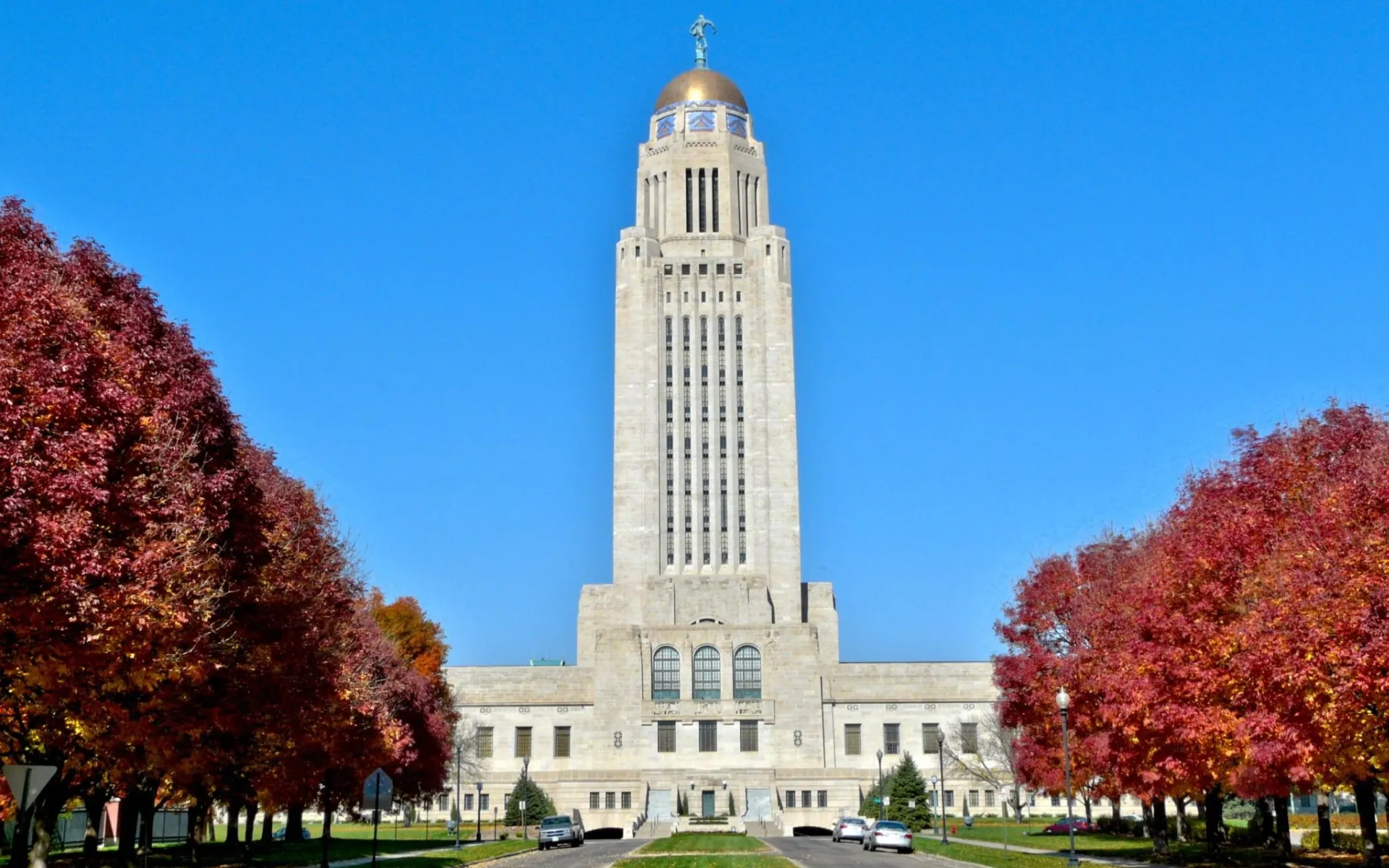
Memorial Stadium, with a capacity of over 90,000, sells out every home game and has maintained a consecutive sellout streak stretching back decades, one of the longest in college football history. The Nebraska State Capitol, completed in 1932, is one of the most architecturally significant state capitol buildings in the nation: a soaring Art Deco tower crowned with a golden dome and the iconic 19-foot bronze statue 'The Sower,' rising 400 feet above the plains and visible for miles in every direction.
Lincoln's economy is diversified across state government, university activities, insurance (Nelnet, Assurity), information technology (Hudl, a sports analytics company founded in Lincoln), and healthcare. Southeast Nebraska beyond Lincoln encompasses the rich agricultural counties of the Platte River drainage, Seward, York, Fillmore, and Saline counties are among the most productive corn and soybean growing counties in the state.
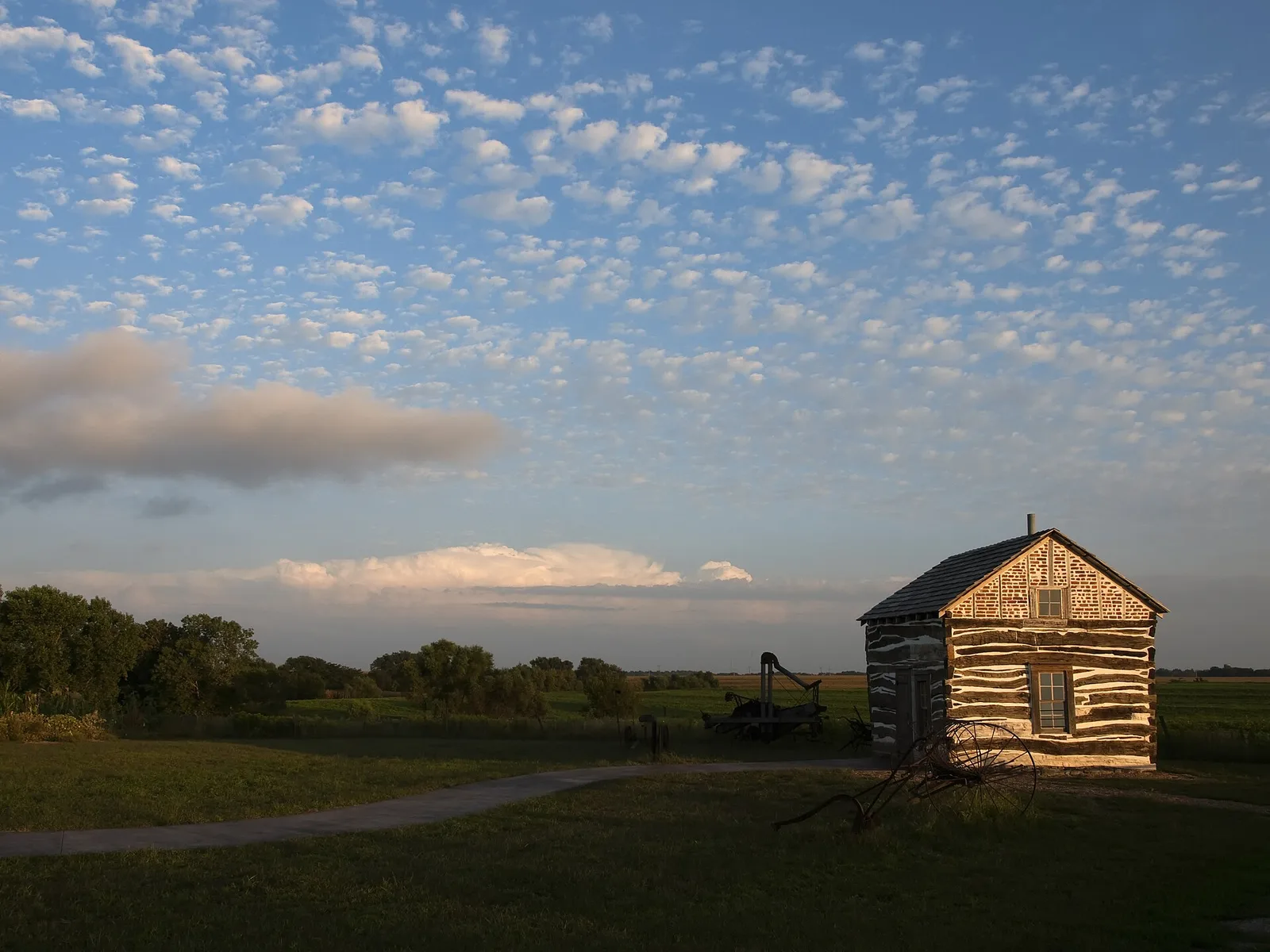
Beatrice, in Gage County south of Lincoln, is the site of the Homestead National Historical Park, where Daniel Freeman filed the nation's first homestead claim on January 1, 1863, the day the Homestead Act took effect.
The Platte River valley, stretching from the Wyoming border east to where the Platte meets the Missouri south of Omaha, is the geographic and agricultural heart of Nebraska. The Platte was the highway of the American West: the Oregon Trail, the California Trail, and the Mormon Trail all followed the Platte valley west because it offered a gentle grade, reliable water, and grass for draft animals.
The transcontinental railroad followed the same route. Today Interstate 80 follows this ancient corridor, and the Platte valley is lined with feedlots, ethanol plants, grain elevators, and irrigation pivots turning in hypnotic circles over fields of corn and soybeans.
Grand Island, the hub of central Nebraska, sits at the intersection of I-80 and U.S. 281 and serves as the commercial center for a vast surrounding agricultural region. Kearney, with its outstanding Archway Monument (a museum spanning the highway celebrating the Great Platte River Road), is a regional center for the western Platte valley.
Hastings, site of a WWII-era ammunition depot that stored more explosives than any other location on Earth, is a manufacturing and agricultural services center. Every spring, the Platte River near Grand Island and Kearney hosts one of the world's great wildlife spectacles: the annual migration of 400,000 to 600,000 Sandhill Cranes, roughly 80% of the world's Sandhill Crane population, which stage on the Platte's wide, shallow sandbars for several weeks before continuing north to their Arctic breeding grounds.
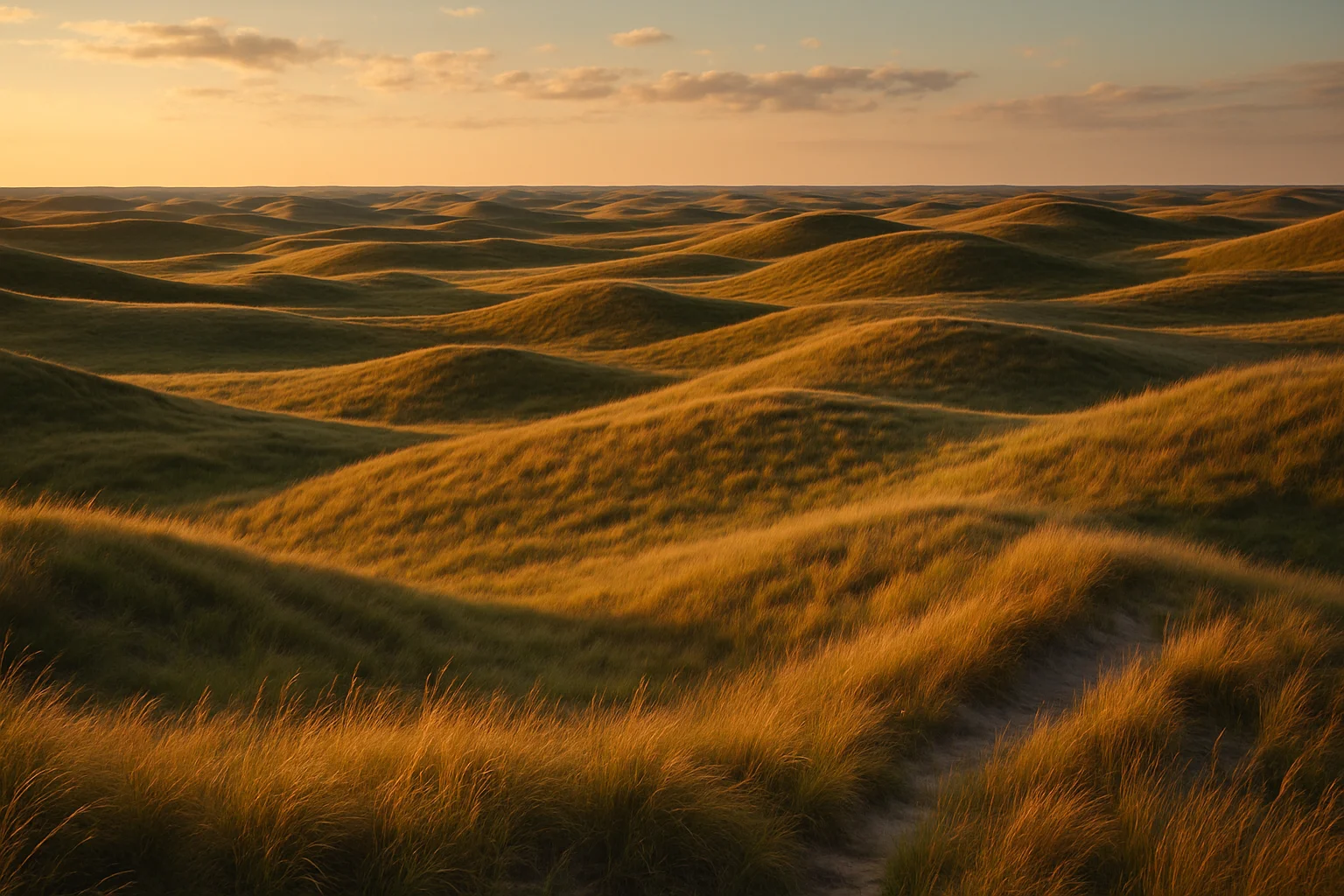
The Nebraska Sandhills occupy roughly 19,000 square miles of north-central Nebraska, an area larger than the state of Connecticut and Rhode Island combined, making them the largest sand dune formation in the Western Hemisphere. The Sandhills were formed by windblown sand deposited after the last Ice Age and are now stabilized by native grass, creating a rolling, surreal landscape of grass-covered dunes that shift and flow to the horizon in every direction.
The region is sparsely populated, the combined population of the Sandhills counties is only a few thousand, and is dominated by vast cattle ranches, many of which have been in the same family for four or five generations. The Sandhills hold a remarkable secret beneath their surface: the dunes are highly permeable, and rainwater percolates quickly into the Ogallala Aquifer below, making the Sandhills one of the primary recharge zones for this critical water table that underlies the entire Great Plains.
The region contains thousands of lakes and wetlands, the result of the water table intersecting the dune surface, that provide critical habitat for migrating waterfowl and support remarkable populations of fish. Valentine, the largest Sandhills town, is a gateway to the Niobrara National Scenic River, one of the most popular canoeing and kayaking rivers in the Great Plains.
The Sandhills are often described by those who know them as one of the most beautiful and least-appreciated landscapes in America.
Western Nebraska's Panhandle is a distinctly different landscape from the rest of the state, high, dry, and dramatic, with buttes and badlands that look more like Wyoming or South Dakota than the cornfields of central Nebraska. The region rises to over 5,000 feet in elevation and receives significantly less rainfall than eastern Nebraska, making dryland wheat farming and cattle ranching the dominant agricultural activities.
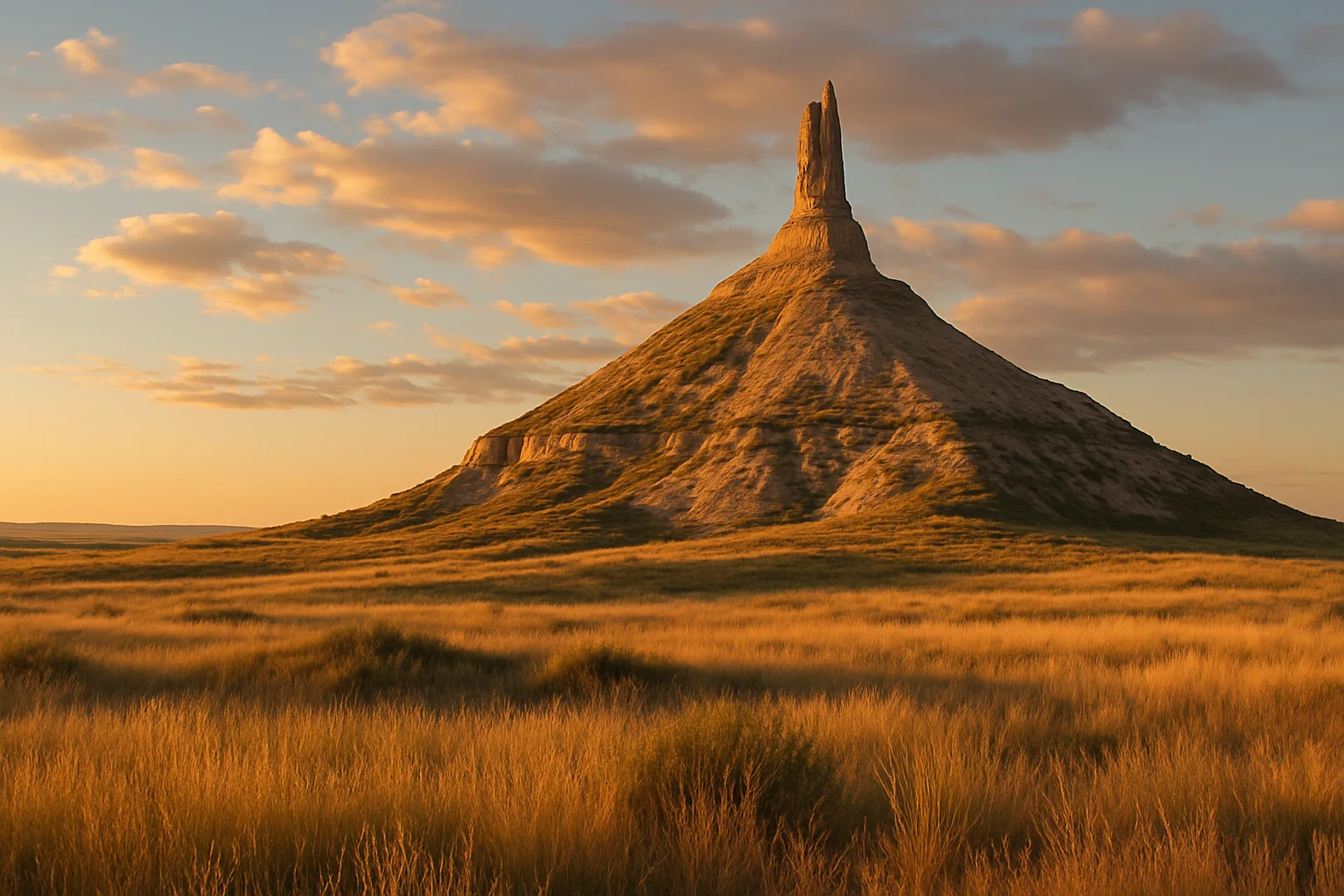
Chimney Rock, a 325-foot spire of ancient volcanic ash rising above the North Platte River valley, was the single most-mentioned landmark in the journals of Oregon Trail pioneers; after weeks of flat plains travel, Chimney Rock's dramatic silhouette announced that the travelers were entering the West in earnest. Today it is a National Historic Site and one of Nebraska's most iconic images.
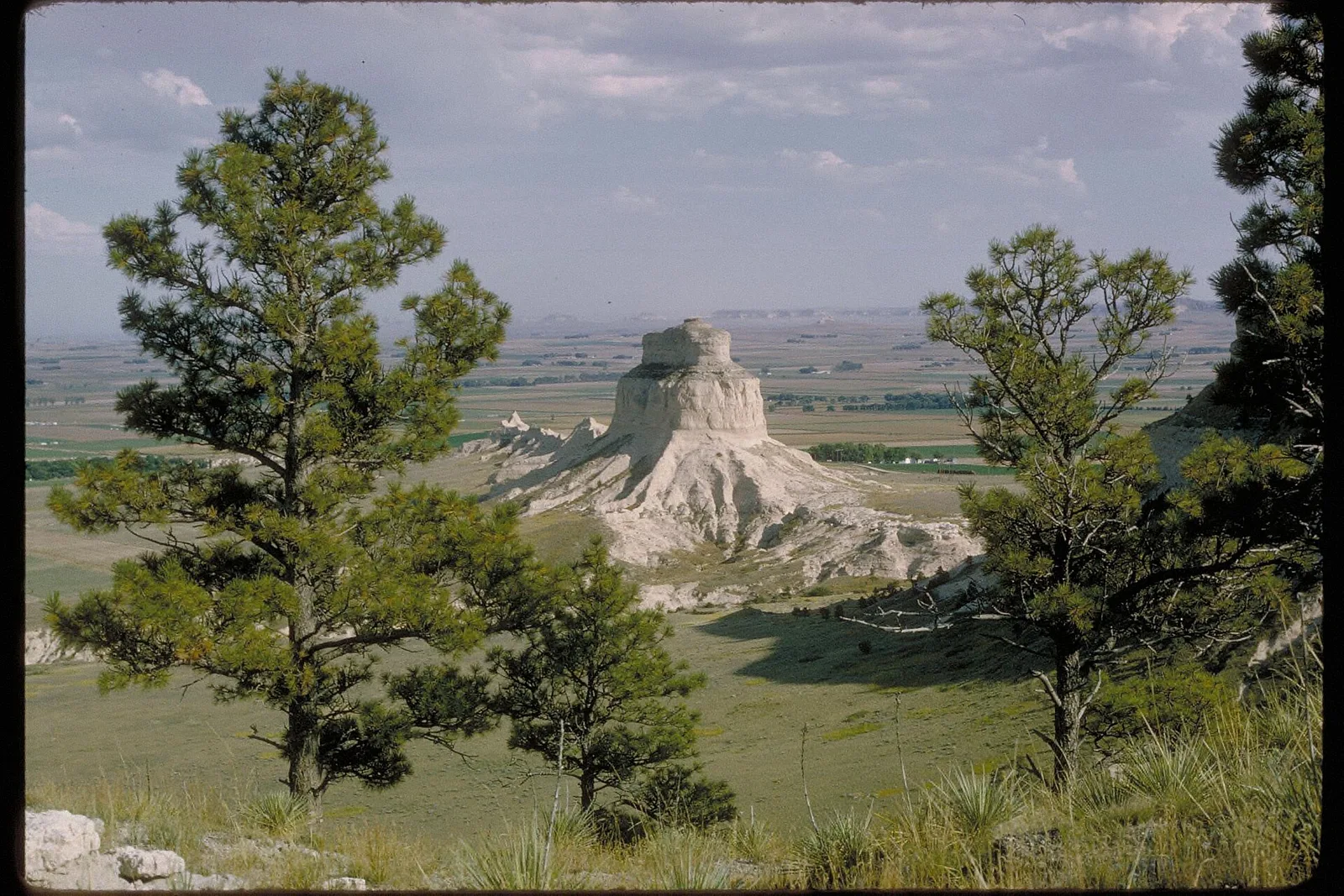
Scotts Bluff, a massive bluff formation near the Wyoming border, rises 800 feet above the valley floor and is preserved as Scotts Bluff National Monument, with wagon ruts from the Oregon Trail still visible on its slopes. The Panhandle's largest city, Scottsbluff, is an agricultural center for the sugar beet, corn, and bean crops grown under irrigation from the North Platte River.
Alliance, in western Box Butte County, is home to Carhenge, a full-scale replica of Stonehenge constructed from 38 vintage automobiles painted gray, created by Jim Reinders in 1987 as a tribute to his father. It is, unironically, one of Nebraska's most visited tourist attractions.

Economy
Nebraska's $80+ billion economy is built on corn, cattle, and meatpacking, but also on financial services, military operations, ethanol, and a transportation network that has served as America's crossroads since the transcontinental railroad broke ground in Omaha in 1863.
Nebraska consistently ranks among the top producers of corn, soybeans, beef cattle, hogs, and poultry in the United States. Corn, the crop that gives Nebraskans their nickname, is grown across roughly 9 million acres and is central to virtually every other sector of the state's economy: it feeds the cattle in Nebraska's feedlots, is converted to ethanol in Nebraska's biorefineries, and is processed into food products in Nebraska's manufacturing plants.
Nebraska's soybeans, grown across millions of additional acres in the eastern and central parts of the state, are exported to Asia and processed domestically for animal feed and cooking oil. The Platte River valley, which bisects the state from west to east, is the agricultural heart of Nebraska, flat, irrigated, and extraordinarily productive.
Nebraska's farmers depend heavily on the Ogallala Aquifer, the vast underground water table underlying the Great Plains, which is being drawn down faster than it recharges, a long-term water sustainability challenge with no easy solution. Nebraska's agricultural sector generates tens of billions of dollars annually and directly employs hundreds of thousands of workers across the state.
Nebraska sits over the thickest and most saturated part of the Ogallala and irrigates more acres than any state but California, roughly 8.5 million, almost all with center-pivot sprinklers, an invention refined in the state by Valmont Industries of Valley, Nebraska, which is now one of the largest pivot makers in the world. Nebraska's aquifer levels have held up better than Kansas's or the Texas panhandle's, partly because of the Sandhills recharge and partly because the state's locally elected Natural Resources Districts, a governance model unique to Nebraska, cap pumping in stressed areas.
Farm ownership is a live political issue. Nebraska's constitution has since 1982 barred most corporations and out-of-state investors from owning farmland or feedlots, a measure known as Initiative 300 that courts partly struck down in 2007, and a 2023 law restricts farmland purchases by entities tied to China and a handful of other countries. Land values have nonetheless roughly tripled since 2000, straining beginning farmers.
The federal farm safety net matters enormously here: crop insurance, commodity payments, ethanol mandates, and trade policy all move Nebraska's farm income, and the 2018 to 2019 trade war with China, a major buyer of Nebraska soybeans and sorghum, cut prices sharply until federal 'Market Facilitation' payments partly offset the loss.
The state's roughly 6.5 million cattle outnumber its people by more than three to one, and Nebraska's feedlots, concentrated in the Platte River valley and the central plains, finish more beef cattle than any other state. The great cattle feeding counties of Dawson, Buffalo, and Adams along the Platte are among the most productive agricultural counties in the country.
Meatpacking is the industrial backbone of cities like Lexington, Schuyler, Dakota City, and Hastings. The industry was transformed beginning in the 1970s and 1980s when IBP (Iowa Beef Processors, founded in Dakota City) pioneered the boxed-beef model, shipping vacuum-sealed primal cuts directly to retailers rather than whole carcasses, and relocated plants from unionized Chicago to rural Nebraska, where labor costs were lower.
This transformation produced Nebraska's largest meatpacking plants and a massive influx of Latino and immigrant workers into small Nebraska towns, fundamentally changing the demographics of communities like Lexington, Schuyler, and Norfolk. Today, Tyson Foods, JBS, and Cargill operate Nebraska's major processing facilities.
Nebraska also processes pork (Pillen Family Farms, Iowa Premium) and poultry (Costco's Fremont plant is one of the largest poultry processing facilities in the country). Agriculture and food processing together account for a substantial share of Nebraska's economic output.
The city is home to Berkshire Hathaway, Warren Buffett's conglomerate and one of the largest and most valuable companies in the world, with a market capitalization routinely exceeding $900 billion. Berkshire's annual shareholder meeting in Omaha, attended by tens of thousands of investors and called 'Woodstock for Capitalists,' is the largest single annual gathering of investors anywhere on Earth and a significant economic event for the city.
But Berkshire is far from Omaha's only financial institution. Mutual of Omaha, founded in 1909 and headquartered in its landmark Omaha building, is one of the nation's largest insurance companies.
TD Ameritrade, founded in Omaha and acquired by Charles Schwab in 2020, built its headquarters there and brought substantial financial services employment. First Data, Fiserv, and a concentration of financial technology companies have established major operations in Omaha.
Omaha is also a hub for Union Pacific Railroad, the western leg of the transcontinental railroad, headquartered in Omaha since 1862, and for Kiewit Corporation, one of the largest construction and engineering companies in North America. The city's combination of low taxes, business-friendly regulations, lower cost of living than coastal cities, and strong educational institutions has made it an increasingly attractive destination for financial services firms.
The ethanol industry is deeply intertwined with Nebraska's corn economy, it provides an additional market for Nebraska corn, raises corn prices for farmers, and generates employment in rural communities that might otherwise have lost significant population. Nebraska also has substantial wind energy resources: the state's flat terrain and consistent High Plains winds make it one of the best wind power sites in the country, and wind energy development has grown dramatically in the past decade, with Nebraska wind farms generating an increasing share of the state's electricity.
Nebraska is one of the few states in the country where essentially all retail electricity is provided by publicly owned utilities, the Nebraska Power Review Board has prohibited investor-owned electric utilities since 1949, a legacy of the Populist and Progressive movements that championed public ownership of utilities. The result is some of the lowest electricity rates in the country.
Nebraska also has significant oil production in the western Panhandle region (the Denver-Julesburg Basin) and natural gas production, though these are modest relative to energy-producing neighbors like Colorado and Wyoming.
Nebraska became a national pipeline battleground over the proposed Keystone XL, a line meant to carry Canadian tar-sands crude across the state to Gulf refineries. A coalition of ranchers, farmers, and the Ponca Tribe, organizing as 'Bold Nebraska,' fought the route for a decade over its path near the Sandhills and the aquifer, the state routing fight reached the Nebraska Supreme Court twice, and the project was finally canceled in 2021.
The all-public-power system, the only one of its kind in the country, is run by three big entities, the Nebraska Public Power District, the Omaha Public Power District, and the Lincoln Electric System, plus dozens of rural districts and municipal utilities, all governed by elected boards. That structure has kept rates low but also made the state slower than some neighbors to add wind and solar, though OPPD has committed to a net-zero goal by 2050 and is retiring coal units.
Cooper Nuclear Station near Brownville and, until its 2016 closure, the Fort Calhoun plant north of Omaha supplied a large carbon-free share of Nebraska's power; Fort Calhoun was nearly flooded by the Missouri River in 2011 and shut early on economic grounds, and Cooper is now the state's only reactor.
Offutt is the home of United States Strategic Command (USSTRATCOM), the combatant command responsible for the United States' entire nuclear deterrence mission, space operations, and integrated missile defense. STRATCOM controls and could authorize the launch of every nuclear weapon in the American arsenal, a responsibility that makes Offutt one of the most consequential military installations on earth.
The base has been at the center of American nuclear strategy since World War II: Offutt's predecessor facilities produced components of the atomic bombs dropped on Japan, and the base became the headquarters of Strategic Air Command (SAC) in 1948 under General Curtis LeMay. On September 11, 2001, President George W. Bush was flown to Offutt Air Force Base before returning to Washington, the base was chosen because of its secure command facilities and its role as a nuclear command-and-control node.
Offutt employs over 10,000 military and civilian personnel, making it one of the largest employers in the Omaha-Council Bluffs metro area and contributing several billion dollars annually to the regional economy. The military presence in Nebraska also includes significant Nebraska Army National Guard installations in Lincoln, Hastings, and elsewhere.
Offutt is also home to the 55th Wing, which flies the RC-135 Rivet Joint and Cobra Ball reconnaissance aircraft that collect electronic and missile-telemetry intelligence worldwide, and to the 'Doomsday plane,' the E-4B National Airborne Operations Center that would serve as a flying command post for the president in a nuclear crisis. Boeing runs a large aircraft-modification operation nearby that keeps this fleet flying.
A March 2019 'bomb cyclone' storm burst levees on the Missouri and Platte and flooded roughly 3,000 acres of Offutt, damaging or destroying about 130 buildings and putting the base's flight line under several feet of water; the Air Force has since committed well over a billion dollars to rebuild on higher ground. The flood was part of a wider disaster that also inundated large parts of eastern Nebraska farmland and towns.
Nebraska's other big defense footprint is industrial: Kiewit and other Omaha firms are major military construction contractors, and the state's National Guard, one of the more heavily deployed per capita since 2001, runs a large training area and airfield near Mead and the Camp Ashland site along the Platte.
The completion of the transcontinental railroad in 1869 transformed Omaha from a river crossing and Missouri River frontier town into a major American city, the gateway through which the nation's agricultural and mineral wealth would flow to eastern markets and the world. That geographic logic, Omaha as a continental crossroads, has never changed.
Union Pacific, still headquartered in Omaha, operates one of the world's largest railroad networks. Werner Enterprises, one of the nation's largest trucking companies, is based in Omaha.
The city's position at the center of the Interstate Highway system (I-80, I-29, I-680) makes it a natural logistics and distribution hub. Amazon, Walmart, and hundreds of other companies maintain major distribution and fulfillment operations in the Omaha-Lincoln corridor.
Nebraska's ports on the Missouri River, while less significant than they were in the steamboat era, still handle agricultural commodities. The state's agriculture depends on this transportation infrastructure to move billions of dollars worth of grain, cattle, and processed foods to domestic and export markets.
How Nebraska's Government Works
Nebraska's state government follows the standard three-branch structure, Executive (Governor), Legislative (the Nebraska Legislature), and Judicial (the Nebraska Supreme Court), with one fundamental difference from every other state in the nation: Nebraska's legislature is unicameral and nonpartisan. There is no Senate and House competing for position, no conference committee resolving differences between chambers, and no party labels on the legislative ballot. All 49 members of the Nebraska Legislature hold the title of Senator and are elected in contests where candidates' party affiliations do not appear on the ballot.
The Governor serves a four-year term and is limited to two consecutive terms. Nebraska is reliably Republican in statewide elections, it has voted Republican in every presidential election since 1968, though it maintains the congressional district electoral vote allocation that occasionally delivers a single electoral vote to the Democratic candidate (as happened in 2008, 2020, and 2024 when the Omaha-based NE-2 district voted Democratic).
The Nebraska Supreme Court consists of seven justices selected through a merit selection system (the Governor appoints from a list provided by the Judicial Nominating Commission, and justices then face retention elections every six years). Nebraska's legal system also includes the Nebraska Court of Appeals, district courts, county courts, and specialized courts.
Nebraska's unicameral, nonpartisan Legislature is the only one of its kind in the United States. Created by constitutional amendment in 1934 and operational since 1937, it was championed by U.S. Senator George Norris as a more transparent, efficient, and accountable alternative to the bicameral model used by every other state. The legislature meets annually in Lincoln.
Governor of Nebraska
Current Governor
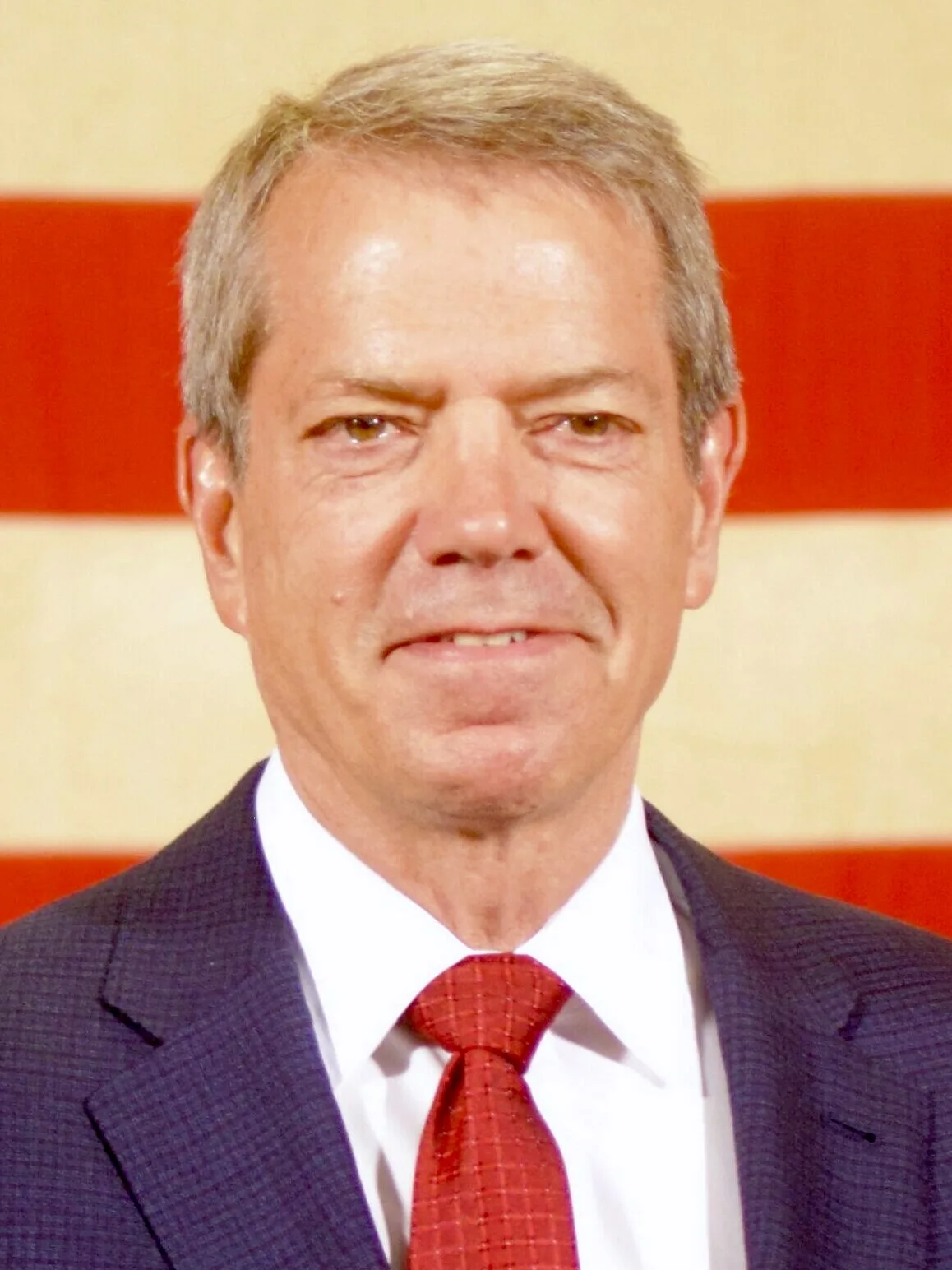
Jim Pillen
- Party
- Republican
- In Office Since
- January 5, 2023
- Term Ends
- January 2027
- Born
- April 13, 1960, Columbus, Nebraska
- Education
- University of Nebraska-Lincoln; Kansas State University (Doctor of Veterinary Medicine, 1985)
- Prior Role
- Member, University of Nebraska Board of Regents (2014–2023); owner and operator, Pillen Family Farms
Jim Pillen is Nebraska's 41st Governor, a pig farmer and veterinarian from Columbus who built Pillen Family Farms into one of the largest pork production operations in the country. A former University of Nebraska-Lincoln walk-on who became a starting defensive back for Tom Osborne's Cornhuskers in the early 1980s, Pillen was endorsed by outgoing Governor Pete Ricketts and won the 2022 Republican primary before defeating Democratic challenger Carol Blood in November. His administration has focused on property tax relief, K-12 education funding reform, and agricultural policy, and has signed legislation reflecting Nebraska's conservative majority on social issues including abortion restrictions.
Other Current State Officials
Lieutenant Governor
Joe Kelly
In office since January 2023. A retired Army Brigadier General and former Omaha city councilman, Kelly oversees economic development and rural affairs. He serves as the state's chief emergency management officer and chairs the Nebraska Investment Finance Authority.
Attorney General
Mike Hilgers
In office since January 2023. A former Speaker of the Nebraska Legislature, Hilgers has led Nebraska's participation in multi-state actions on border security, federal regulatory overreach, and energy policy. He has also pursued significant consumer protection and antitrust actions.
Secretary of State
Bob Evnen
In office since January 2019, re-elected 2022. Oversees elections, business registrations, and state records. Nebraska has maintained relatively smooth election administration. Evnen has focused on election security and voter roll maintenance while defending Nebraska's existing election procedures.
The Nebraska Legislature, America's Only Unicameral
Nebraska Legislature (The Unicameral)
- Seats: 49 senators
- Terms: 4-year terms (staggered)
The upper, and only, chamber. Nebraska abolished its bicameral legislature in 1934 and replaced it with this single 49-seat body. Senators are subject to a two-consecutive-term limit (8 years), after which they must sit out at least one term.
Nonpartisan Elections
- Seats: No party labels on ballot
- Terms: Primary narrows to top 2
Nebraska's legislative elections are officially nonpartisan, no party label appears beside a candidate's name. A top-two primary narrows the field; the two highest vote-getters advance to the general election regardless of party. In practice, most senators caucus with a party, but the formal nonpartisan structure shapes the legislature's culture.
Nebraska's U.S. Senators
U.S. Senator
Deb Fischer
Nebraska's senior senator, Fischer was elected in 2012, re-elected in 2018, and re-elected again in 2024. A rancher from Valentine, Nebraska, she serves on the Armed Services and Commerce committees. Her Armed Services work is particularly significant given Nebraska's Offutt AFB and STRATCOM. She has been a consistent vote for defense spending and agricultural policy important to Nebraska.
U.S. Senator
Pete Ricketts
Nebraska's junior senator, Ricketts was appointed in January 2023 by Governor Jim Pillen to fill the vacancy left when Ben Sasse resigned to become president of the University of Florida. Ricketts served two terms as Nebraska's Governor (2015–2023) before joining the Senate. A member of the TD Ameritrade founding family, he is one of the wealthiest members of Congress and has focused on fiscal conservatism, agricultural policy, and opposition to federal regulations.
Nebraska Through the Years
From the Pawnee earth lodges along the Platte to the wagon ruts of the Oregon Trail, from the homesteaders' sod houses to Warren Buffett's Berkshire Hathaway empire, Nebraska's story is one of extraordinary resilience on a demanding landscape, and of the quiet, lasting institutions a people can build when they take their democratic responsibilities seriously.
Nebraska was home to several distinct Indigenous nations when Europeans first encountered the region. The Pawnee, one of the most populous and sophisticated nations of the Central Plains, had lived along the Loup and Platte rivers for centuries, maintaining complex village societies with semi-permanent earth lodge towns, extensive corn agriculture, and rich ceremonial traditions.
The Omaha and Ponca nations occupied the Missouri River bluffs of eastern Nebraska, living in earth lodges and practicing a mixed economy of agriculture and bison hunting. The Lakota and their allies, the most powerful military force on the Northern Plains after the acquisition of the horse in the 18th century, dominated the western Sandhills and Panhandle, competing for territory with the Pawnee and other nations.
The Otoe-Missouria and Iowa occupied the southeastern corner of present-day Nebraska. The arrival of European trade goods, and European diseases, disrupted these societies profoundly before any sustained European-American contact.
Smallpox epidemics in the late 18th and early 19th centuries devastated the Pawnee, reducing their population from perhaps 10,000 to 12,000 to a few thousand in a matter of decades.
The Corps of Discovery ascended the Missouri River through present-day Nebraska in the summer of 1804, camping along the river's bluffs and conducting the expedition's first diplomatic council with an Indigenous nation, meeting with the Oto and Missouri tribes near present-day Fort Calhoun on August 3, 1804, in the first formal diplomatic encounter between the United States government and a Great Plains nation. Lewis and Clark observed the Nebraska landscape with a scientist's eye: the great herds of elk, deer, and bison; the prairie dog towns that extended for miles; the cottonwood-lined river banks; the loess bluffs rising 200 feet above the Missouri.
At the mouth of the Platte River, which they reached on July 21, 1804, the expedition marked the beginning of the 'Upper Missouri' country, which would become the American West. Charles Floyd, a Kentucky sergeant, died on August 20, 1804, near present-day Sioux City, the only member of the Corps to die on the whole journey; his symptoms point to a burst appendix, which no surgeon of the era could have treated.
The August 3, 1804, council at 'Council Bluff,' a spot on the Nebraska side later moved from by the town of that name, set the template for U.S.-tribal diplomacy on the Plains: Lewis and Clark handed out peace medals, a flag, and military coats, delivered a speech announcing a new 'Great Father' in Washington, and fired the air rifle to impress their hosts. The Otoe and Missouria leaders were polite but noncommittal, and the expedition's real diplomatic failure came weeks later when a tense standoff with the Lakota near the future South Dakota line nearly turned to violence.
The Corps wintered far to the north among the Mandan in North Dakota, not in Nebraska, and passed back down the Missouri quickly in September 1806, reaching St. Louis to a hero's welcome. Almost nothing physical survives of their Nebraska passage; Fort Atkinson, the Army's first post west of the Missouri, was built in 1820 near the council site and is now a state historical park with reconstructed walls.
Nebraska's most enduring historical identity is as the corridor through which 400,000 Americans passed on their way to a new life in Oregon, California, Utah, and beyond. The Great Platte River Road, encompassing the Oregon Trail, the California Trail, the Mormon Trail, and the Pony Express route, was the most traveled overland migration route in world history.
Beginning in earnest in the early 1840s and continuing through the 1860s, wagons carrying emigrants, missionaries, and gold seekers crossed the Missouri River at Council Bluffs/Omaha and followed the Platte River west across Nebraska's flat, grass-covered plains. The route's genius was the Platte: shallow enough to ford at multiple points, gentle enough in gradient to spare the oxen, wide enough to accommodate thousands of wagons simultaneously, and lined with enough grass, water, and timber to sustain a months-long journey.
Landmarks became household names among emigrants: Courthouse Rock, Chimney Rock, Scotts Bluff. The ruts worn by hundreds of thousands of wagon wheels are still visible in several locations along the trail in Nebraska, a ghostly reminder of one of the largest voluntary migrations in American history.
The Mormon Trail, the route taken by Brigham Young and the Church of Latter-day Saints pioneers beginning in 1847, ran along the north bank of the Platte, parallel to but separate from the main Oregon Trail on the south bank.
The Kansas-Nebraska Act of 1854, one of the most consequential and ultimately catastrophic pieces of legislation in American history, created Nebraska Territory (and Kansas Territory) and repealed the Missouri Compromise of 1820, which had prohibited slavery north of the 36°30' line. The act's author, Illinois Senator Stephen Douglas, designed it to resolve the question of slavery in the territories through 'popular sovereignty', letting the settlers of each new territory vote on whether to allow slavery.
In Nebraska Territory, the population was small and predominantly Northern in origin, and the slavery question was never seriously contested. But in Kansas, the result was 'Bleeding Kansas', a savage guerrilla war between pro-slavery and anti-slavery settlers that served as a preview of the Civil War to come.
The Kansas-Nebraska Act destroyed the Whig Party, fatally divided the Democratic Party, and gave rise to the Republican Party, which was founded in direct opposition to the expansion of slavery. Abraham Lincoln's political career was revived by his opposition to the act's principles.
The act also displaced the Iowa and Omaha tribes from Nebraska Territory to reservations, continuing the pattern of forced removal that had defined federal Indian policy since the 1830s.
Three events in five years permanently transformed Nebraska from a wilderness territory into an agricultural state. The Homestead Act of 1862, signed by President Lincoln, promised 160 acres of public land to any citizen who lived on and improved it for five years, and Nebraska was the primary proving ground.
Daniel Freeman filed the nation's first homestead claim on January 1, 1863, near Beatrice, Nebraska. Over the following decades, hundreds of thousands of homesteaders, including substantial numbers of Scandinavian, German, and Czech immigrants, claimed Nebraska land and built the sod houses that gave the state its early settlers the name 'sodbusters.' The Pacific Railway Act of 1862 authorized the transcontinental railroad and designated Omaha as the eastern terminus of the Union Pacific.
Ground was broken in Omaha on December 2, 1863, and the first spike driven on July 10, 1865. The railroad's construction employed thousands of Irish workers pushing west from Omaha while Chinese workers pushed east from Sacramento, and the two lines were joined at Promontory Summit, Utah, on May 10, 1869.
Nebraska achieved statehood on March 1, 1867, the 37th state, with a population of about 122,000, most of them homesteaders and railroad workers who had arrived within the previous decade.
The decades following statehood were a grinding education in the limits of the Great Plains. Homesteaders who arrived in the relatively wet 1870s discovered in the droughts of the 1880s and 1890s that 160 acres could not support a family when rainfall was adequate, and could not support anyone when it wasn't.
Grasshopper plagues in 1874 and 1876 destroyed entire harvests; drought years in the late 1880s and early 1890s drove thousands of homesteaders off their claims and out of the state. ('In God we trusted, in Nebraska we busted' read many a wagon heading east.) The economic devastation of the 1890s, falling crop prices, crushing mortgage debt, and the power of the railroads and grain elevator operators over farmers' lives, produced the Populist movement, and Nebraska was its heartland.
William Jennings Bryan, the 'Boy Orator of the Platte,' a Nebraska congressman, electrified the 1896 Democratic National Convention with his 'Cross of Gold' speech denouncing the gold standard and advocating free silver coinage. Bryan won the Democratic nomination for president three times (1896, 1900, 1908), losing each time, but his campaigns permanently established federal intervention in the economy and regulation of corporations as mainstream political positions.
The Populist legacy would shape Nebraska politics, and American progressive politics, for generations.
The 1930s brought a double catastrophe to Nebraska. The Great Depression collapsed agricultural prices at the same moment that the worst drought in recorded history turned the southern Great Plains into the Dust Bowl. While Nebraska was not as severely affected as Oklahoma and Kansas to the south, large swaths of western and central Nebraska experienced crop failures, foreclosures, and outmigration that depopulated entire counties.
Farm families who had built their lives over two generations lost everything in a single year. In the same decade, Nebraska made a decision that would distinguish it from every other state in the Union.
In 1934, Nebraskans voted by constitutional amendment to abolish the bicameral legislature and replace it with a unicameral, nonpartisan body, the only such legislature in the United States. The driving force behind the reform was U.S. Senator George Norris, the legendary progressive Republican from McCook who also championed the Tennessee Valley Authority and rural electrification.
Norris argued that a two-chamber legislature was inefficient, expensive, and prone to lobbyist manipulation, that a single smaller chamber would be more accountable and more transparent. Nebraska's unicameral Legislature, with 49 senators elected in nonpartisan contests, has operated since 1937 and remains, nine decades later, an experiment without peer in American democratic governance.
When the Cold War began in earnest in the late 1940s, the United States military made a decision that would permanently define Omaha's place in American strategic history: Strategic Air Command (SAC), the branch of the U.S. military responsible for nuclear deterrence, was headquartered at Offutt Air Force Base near Bellevue, Nebraska, in 1948, under the command of General Curtis LeMay. The logic was geographic: Omaha was in the center of the continental United States, far from either coast and thus harder for Soviet bombers to reach.
SAC's bombers, first B-29s, then B-47s, then B-52s, stood ready around the clock to deliver nuclear weapons anywhere in the world on command from Offutt's command bunker. At its Cold War peak, SAC controlled over 2,000 aircraft and thousands of nuclear weapons.
The command evolved through the decades, becoming US Strategic Command (USSTRATCOM) in 1992 after the Cold War ended, but Offutt retained its role as the nerve center of American nuclear deterrence, space operations, and strategic planning. On September 11, 2001, President George W. Bush was flown to Offutt while the threat to Washington was being assessed, and he conducted his first National Security Council conference call from its secure underground command center.
No single figure has done more to define 21st-century Omaha's image than Warren Buffett, the 'Oracle of Omaha,' born in the city in 1930, who built Berkshire Hathaway from a failing textile company into one of the largest and most valuable corporations in the history of American capitalism. Buffett's investment approach, buying undervalued companies with durable competitive advantages and holding them indefinitely, produced decades of market-beating returns and made him one of the wealthiest people in the world.
His continued residence in the same Omaha house he bought in 1958 for $31,500, his modest public persona, and his annual shareholder letters (models of plain-spoken business analysis) made him a cultural phenomenon as much as a financial one. Berkshire Hathaway's annual shareholder meeting, held every spring in Omaha's CHI Health Center, attracted 40,000 to 50,000 attendees by the 2010s, filling Omaha's hotels and restaurants for a weekend of investment discussions, ethics debates, and Buffett's folksy wisdom.
The Omaha of the early 21st century was also shaped by the growth of financial services (TD Ameritrade, Mutual of Omaha, First National Bank of Omaha), corporate logistics (Werner Enterprises, CSX), and a construction boom that transformed the city's downtown and suburban landscape.
Nebraska in the 2020s is a study in the tensions of a rural state navigating a changing America. The state's economy has diversified, Omaha has attracted technology companies and financial services firms, Lincoln's startup scene has grown, and the ag-tech sector is bringing innovation to the traditional farming economy, but agriculture remains the foundation.
Water, specifically the drawing down of the Ogallala Aquifer that irrigates millions of acres of Nebraska cropland, is the most serious long-term challenge the state faces, one that has no politically easy solution. The Nebraska Legislature, the nation's only unicameral nonpartisan body, has been under increasing pressure as national partisan polarization erodes the informal norms that once made its nonpartisan structure function.
Senators who once would have declined partisan labels are increasingly open about their Republican or Democratic affiliations, and filibuster reform has become a recurring battleground. Nebraska passed a near-total abortion ban in 2023, reflecting its conservative lean, while Omaha's increasingly diverse and liberal NE-2 congressional district continues to produce close elections and occasionally votes Democratic for president.
The question of Nebraska's future, whether its deep agricultural roots, its unique democratic institutions, and its relative economic success can weather the pressures of a polarized nation and a changing climate, is the defining story of the state in the decade ahead.
Nebraska's Defining Moments in American History
These are the events that didn't just shape Nebraska, they changed the nation.
From 1843 to the late 1860s, an estimated 400,000 pioneers traveled the Oregon Trail, the primary route westward to Oregon, California, and Utah. The trail followed the Platte River Valley across the entire width of Nebraska, making the state the great corridor of westward migration.
Emigrants faced disease, weather, river crossings, and exhaustion; Nebraska's cholera graves and cart ruts are still visible in some places. The Platte River road was so well-traveled that a traveler in the 1850s remarked it looked like a city street.
The Platte itself was the reason the road ran through Nebraska: 'a mile wide and an inch deep,' 'too thick to drink and too thin to plow,' it was useless for boats but perfect for wagons, offering a nearly level grade, water, and grass for a 450-mile stretch. Wagon trains typically left the Missouri in late April to reach the Sierra passes before the snows, and a normal day covered 10 to 15 miles.
Cholera, spread by contaminated water at crowded campsites, was the biggest killer, and estimates of total deaths on the overland trails run to 20,000 or more, roughly one grave for every 200 yards of trail; wagons were often driven over the graves to hide them from wolves and looters. Far fewer emigrants died in conflict with Native people than the popular image suggests.
The 1856 to 1860 Mormon handcart companies pushed wooden two-wheeled carts up the north bank of the Platte, and two late-starting 1856 companies were caught by early blizzards in Wyoming, where more than 200 died in the worst disaster of the western migration. Chimney Rock, Courthouse Rock, and Scotts Bluff, all in the Nebraska Panhandle, were the trail's most-noted landmarks, and wagon ruts are still cut into the sandstone at Mitchell Pass.
The Homestead Act of 1862, signed by Abraham Lincoln, granted 160 acres of public land to any American citizen who agreed to farm it for five years. The first claim under the act was filed on January 1, 1863 by Daniel Freeman near Beatrice, Nebraska.
The Act fundamentally transformed the Great Plains, drawing hundreds of thousands of settlers, including many immigrants from Scandinavia, Germany, and Bohemia who built the agricultural communities that still define Nebraska. Homestead National Historical Park in Beatrice commemorates the spot where America's great land distribution experiment began.
The law was radical for its time: 160 acres of federal land, free except for a small filing fee, to any adult citizen or immigrant intending to naturalize, including single women and, after 1866, formerly enslaved people, who could 'prove up' by living on and improving it for five years. It passed only after Southern members, who feared it would fill the West with free-soil farmers, left Congress with secession.
The reality on the ground was harsher than the promise. Much of Nebraska west of the 100th meridian gets too little rain for 160 acres to feed a family, railroads and speculators had already claimed the best land in checkerboard grants, and a large share of homestead claims failed or were filed fraudulently on behalf of timber and cattle companies. Only about 40 percent of Nebraska claims were ever 'proven up.'
Still, roughly 45 percent of Nebraska's land area, about 22 million acres, passed into private hands through homesteading, more than in any state but a couple, and the sod house, cut from the tough prairie root mat because there were no trees, became the state's founding icon. The Homestead Act was not fully repealed until 1976 (1986 in Alaska).
The Union Pacific Railroad, one of the two companies that built the Transcontinental Railroad, began its westward construction from Omaha, Nebraska, in 1865. The connection of the Union Pacific and Central Pacific at Promontory Summit, Utah, in 1869 bound the American continent together for the first time.
Before the railroad, the journey from the Missouri River to California took months by wagon. Afterward, it took days.
Congress chose Omaha as the eastern terminus in 1863 largely on the word of Abraham Lincoln, who as a young railroad lawyer had surveyed the area and who signed the executive order; the choice made Omaha a city almost overnight. The Union Pacific's construction crews, many of them Irish immigrants and Civil War veterans, laid track west along the Platte at up to several miles a day, living in the rolling tent-and-saloon settlements that trailed the railhead and were called 'Hell on Wheels.'
The project ran on federal land grants and per-mile subsidy bonds, an incentive that encouraged crooked, roundabout routes and shoddy track, and it produced the Credit Mobilier scandal of 1872, in which Union Pacific insiders skimmed construction profits through a dummy company and bribed members of Congress with its stock, one of the worst corruption cases of the 19th century.
The railroad also broke the Plains nations: it cut the bison range in two, carried hide hunters and soldiers west, and made the reservation system enforceable. Union Pacific never left Omaha, and it remains one of the largest freight railroads in the world and one of Nebraska's biggest employers, its downtown headquarters tower a fixture of the skyline.
Willa Cather moved to Nebraska as a child and grew up among immigrant communities on the Divide, the high prairie of south-central Nebraska. The landscape and its people became her great subject.
My Antonia, O Pioneers!, and Death Comes for the Archbishop are among the defining works of American regional literature. Cather captured the emotional reality of Great Plains life, the loneliness, the beauty, the resilience of immigrant women, with a precision and depth that no writer before or since has matched.
Cather's family moved from Virginia to a farm near Red Cloud, Nebraska, in 1883, when she was nine, and the shock of the treeless prairie and the Bohemian, Scandinavian, and German immigrant neighbors, one of whom, Annie Sadilek Pavelka, became the model for Antonia, gave her the material she mined for the rest of her life. She left for the University of Nebraska, then journalism and editing in Pittsburgh and New York, and did not write her prairie novels until she was past 40.
The Nebraska books came in a rush between 1913 and 1918, 'O Pioneers!,' 'The Song of the Lark,' and 'My Antonia,' and made her reputation; she won the Pulitzer Prize in 1923 for 'One of Ours,' a novel about a Nebraska farm boy in World War I. Her later work ranged to the Southwest and Quebec, but critics and readers kept pulling her back to Nebraska.
Red Cloud has preserved a half-dozen buildings from her childhood as the National Willa Cather Center, and much of the surrounding prairie is protected as a Cather Memorial Prairie; the town of about 1,000 people draws literary pilgrims from around the world, and 'Cather country' is a recognized region of south-central Nebraska.
From 1948 to 1992, Offutt Air Force Base near Omaha, Nebraska, housed the headquarters of Strategic Air Command (SAC), the branch of the Air Force responsible for America's nuclear bomber and missile forces. SAC was the operational heart of the Cold War nuclear deterrent, with bombers and missiles on constant alert, capable of launching within minutes of an order from the president.
On September 11, 2001, Air Force One carrying President George W. Bush flew to Offutt while America processed the morning's attacks. For half a century, Omaha was the city where the nuclear standoff with the Soviet Union was managed.
SAC was built by General Curtis LeMay, who took over a slack peacetime command in 1948 and drilled it into a force that kept nuclear-armed bombers airborne or on runway alert around the clock; his doctrine of overwhelming retaliation, and later his blunt public advocacy of using it, made him one of the most controversial officers of the era and a partial model for the film 'Dr. Strangelove.' Offutt also housed the Single Integrated Operational Plan, the master target list for a nuclear war.
The base ran an underground command center from which a general officer was always on watch, and a fleet of 'Looking Glass' EC-135 aircraft flew continuously from 1961 to 1990 so that a survivable command post would remain aloft if Offutt itself were destroyed. The 1983 TV movie 'The Day After,' set in nearby Lawrence, Kansas, made the Omaha-area target a national preoccupation.
After the Cold War, SAC was dissolved in 1992 and its missions folded into U.S. Strategic Command, still at Offutt, which now oversees nuclear forces, missile defense, and much of military space and cyber operations from a 1.3 billion dollar command-and-control building completed in 2019. A March 2019 Missouri River flood inundated about a third of the base and forced a major, still-ongoing rebuild.
Notable Nebraskans
Warren Buffett
Born in Omaha, 1930; Chairman and CEO of Berkshire Hathaway; one of the wealthiest people in history; known as the 'Oracle of Omaha'; his annual shareholder letters are considered essential reading in the investment world
Willa Cather
Grew up in Red Cloud, Nebraska; author of O Pioneers! (1913), My Ántonia (1918), and Death Comes for the Archbishop (1927); her prairie novels are among the definitive literary portraits of the immigrant American West
Fred Astaire
Born Frederick Austerlitz in Omaha, 1899; dancer, actor, singer, and choreographer; widely considered the greatest male dancer in the history of film; his partnership with Ginger Rogers produced 10 classic musicals
Marlon Brando
Born in Omaha, 1924; actor considered by many the greatest in American film history; starred in A Streetcar Named Desire, On the Waterfront (Academy Award), The Godfather (Academy Award), and Apocalypse Now
Henry Fonda
Born in Grand Island, Nebraska, 1905; actor whose career spanned five decades; starred in The Grapes of Wrath, 12 Angry Men, Once Upon a Time in the West, and On Golden Pond (Academy Award, 1982)
Johnny Carson
Grew up in Norfolk, Nebraska; host of The Tonight Show Starring Johnny Carson (1962–1992) for 30 years; widely considered the master of late-night television and one of the most influential entertainers in American TV history
Malcolm X
Born Malcolm Little in Omaha, 1925; civil rights leader, minister, and Black nationalist; his autobiography, co-written with Alex Haley, is one of the most important works in American literature
William Jennings Bryan
Lived and represented Nebraska in Congress; 'The Great Commoner'; three-time Democratic presidential candidate (1896, 1900, 1908); his 'Cross of Gold' speech at the 1896 Democratic convention is among the most famous political orations in American history
Gerald Ford
Born in Omaha, 1913; 38th President of the United States (1974–1977); the only person to serve as both Vice President and President without being elected to either office; pardoned Richard Nixon after Watergate
George Norris
U.S. Senator from Nebraska (1913–1943); championed the Tennessee Valley Authority, rural electrification, and Nebraska's unicameral nonpartisan legislature; one of the most consequential progressive legislators in Senate history
State Symbols & Quick Facts
| Nickname | "The Cornhusker State" |
| Capital | Lincoln |
| Largest City | Omaha |
| Statehood | March 1, 1867 (37th state) |
| Population | ~2.0 million (2025 est.) |
| Area | 77,358 sq miles (16th largest) |
| State Bird | Western Meadowlark |
| State Flower | Goldenrod |
| State Tree | Eastern Cottonwood |
| State Mammal | White-tailed Deer |
| State Insect | Honeybee |
| State Fish | Channel Catfish |
| State Rock | Prairie Agate |
| State Song | Beautiful Nebraska |
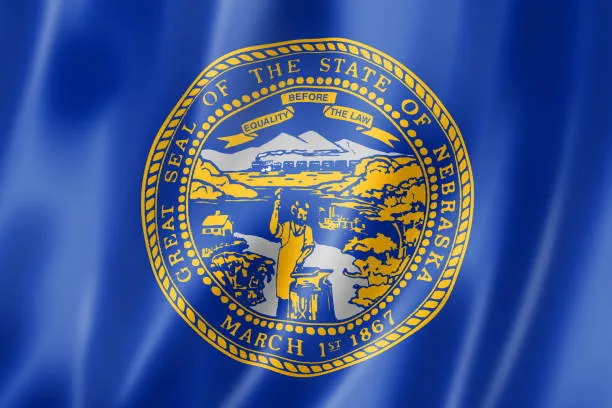
| State Motto | Equality before the law |
| Legislature | Unicameral, 49 senators, nonpartisan |
| Time Zone | Central (most) / Mountain (Panhandle) |
| Bordering States | SD, IA, MO, KS, CO, WY |
Did You Know?
Nebraska is the only state in the United States with a unicameral (one-chamber) nonpartisan legislature. All other states have a bicameral (two-chamber) legislature with party labels on the ballot. Nebraska's legislature was created by constitutional amendment in 1934 at the urging of U.S. Senator George Norris.
Omaha is home to Berkshire Hathaway, Warren Buffett's conglomerate and one of the most valuable companies in the world. Buffett still lives in the same house in Omaha he bought in 1958 for $31,500. Berkshire's annual shareholder meeting draws over 40,000 investors to Omaha every spring.
Nebraska is the nation's largest beef-producing state. The state has roughly 6.5 million cattle, more than three times its human population. The cattle feeding counties along the Platte River valley finish more beef than any other region in the country.
US Strategic Command (USSTRATCOM), which controls the entire U.S. nuclear arsenal, is headquartered at Offutt Air Force Base near Bellevue. On September 11, 2001, President George W. Bush was evacuated to Offutt and conducted his first National Security Council call from its underground command center.
Every spring, 400,000 to 600,000 Sandhill Cranes, roughly 80% of the world's entire Sandhill Crane population, stage along the Platte River near Grand Island and Kearney, Nebraska for several weeks before continuing north to their Arctic breeding grounds. It is one of the greatest wildlife spectacles in North America.
The Nebraska Sandhills are the largest sand dune formation in the Western Hemisphere, 19,000 square miles of grass-stabilized dunes containing thousands of lakes and wetlands. They are also a primary recharge zone for the Ogallala Aquifer, which underlies the entire Great Plains.
Daniel Freeman filed the nation's very first homestead claim under the Homestead Act of 1862 on January 1, 1863, near Beatrice, Nebraska. The site is now the Homestead National Historical Park, commemorating the act that brought hundreds of thousands of settlers to the Great Plains.
Chimney Rock, a 325-foot volcanic ash spire near Scottsbluff in western Nebraska, was the most frequently mentioned landmark in the diaries and journals of Oregon Trail pioneers. After weeks of flat Plains travel, it announced the Rocky Mountains and the West lay just ahead.
Nebraska and Maine are the only two states in the country that allocate electoral votes by congressional district rather than winner-take-all. Nebraska's 2nd Congressional District (Omaha) voted for Barack Obama in 2008, Joe Biden in 2020, and Kamala Harris in 2024, the only Nebraska district to vote for a Democratic presidential candidate in modern times.
The College World Series, the NCAA Division I baseball championship, has been held in Omaha since 1950, making it one of the longest-running single-city championship sites in American sports. It is held annually at Charles Schwab Field Omaha and draws tens of thousands of fans to the city every June.
Quick Facts and Common Questions
Short answers to the questions people most often ask about Nebraska: its abbreviation, its one-house legislature, its capital, and how it votes for president.
Nebraska's two-letter postal abbreviation is NE. The U.S. Census Bureau places it in the Midwest region, in the West North Central division, and about 1.96 million people lived there in the 2020 census.
Nebraska became the 37th state on March 1, 1867, after Congress overrode President Andrew Johnson's veto of its statehood bill. Its land was part of the Louisiana Purchase, and the Kansas-Nebraska Act created the Nebraska Territory in 1854.
The name comes from an Otoe word meaning "flat water," referring to the Platte River. The French name Platte also means "flat."
Lincoln has been the capital since 1867. Omaha was the territorial capital, but after statehood lawmakers moved the capital to the village of Lancaster and renamed it Lincoln, after the recently assassinated president. The current State Capitol, with a 400-foot tower, was completed in 1932.
Nebraska borders six states: South Dakota to the north, Iowa and Missouri to the east across the Missouri River, Kansas to the south, and Colorado and Wyoming to the west.
In 1934 Nebraska voters approved a constitutional amendment, championed by U.S. Senator George Norris, to replace the two-chamber legislature with a single chamber. The Unicameral first met in 1937 and has 49 senators elected in nonpartisan races, the only one-house and officially nonpartisan state legislature in the country.
Nebraska is known as "The Cornhusker State." Its motto is "Equality Before the Law." Its state bird is the western meadowlark, its flower is the goldenrod, and its tree is the eastern cottonwood.
Based on the 2020 census, Nebraska has 3 seats in the U.S. House of Representatives, the same as before, which gives it 5 votes in the Electoral College. Nebraska and Maine are the only states that can split their electoral votes: two go to the statewide winner and one to the winner of each congressional district.
Arbor Day began in Nebraska. It was proposed by J. Sterling Morton of Nebraska City, and on the first Arbor Day, April 10, 1872, Nebraskans planted an estimated one million trees. Morton later served as U.S. secretary of agriculture.
Chimney Rock National Historic Site
The Most Recognized Landmark on the Oregon Trail, Guiding Pioneers Westward Since the 1840s
About Chimney Rock National Historic Site
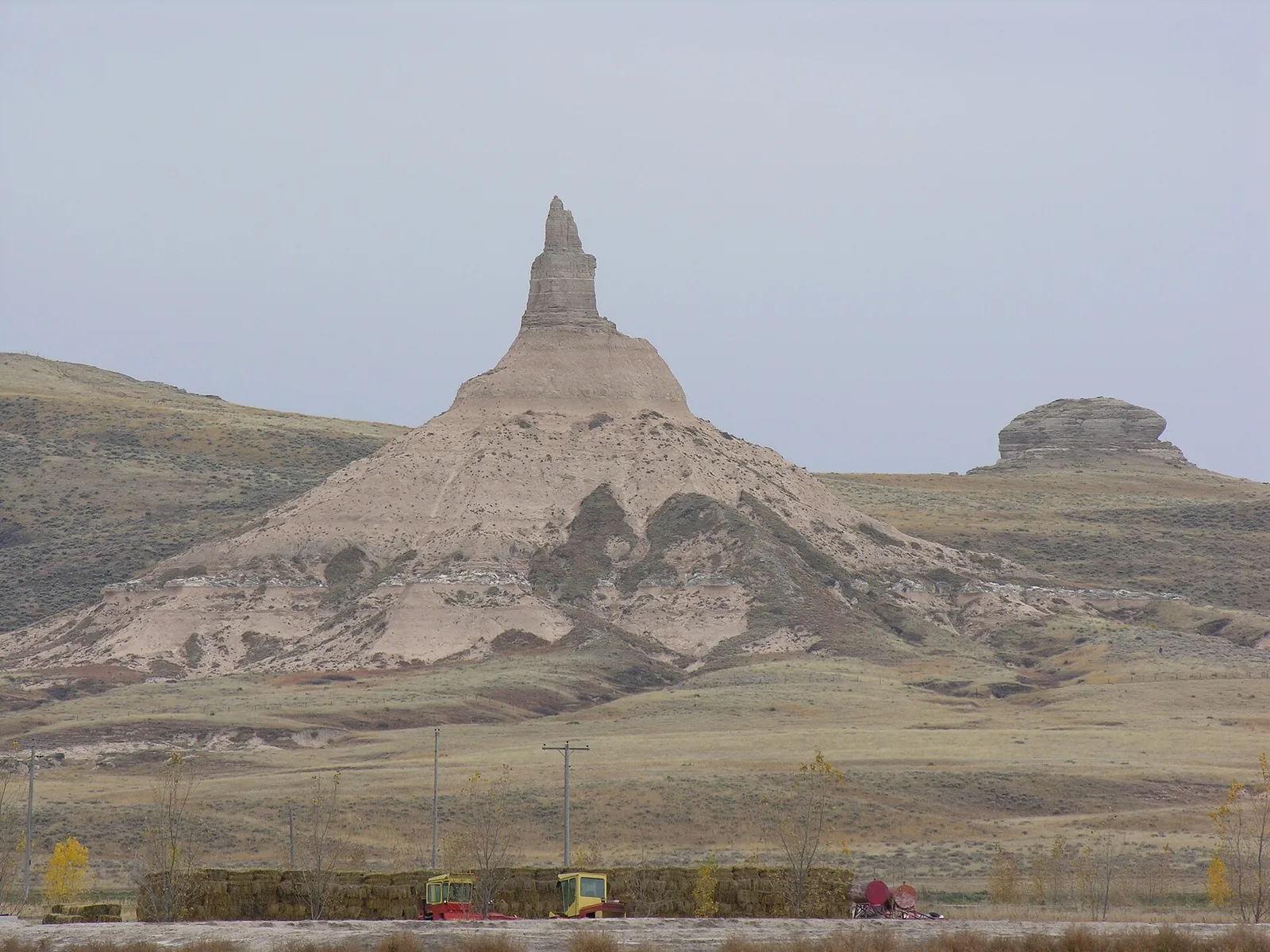
Chimney Rock rises about 325 feet above the North Platte River valley in the Nebraska Panhandle, a slender spire of soft clay and volcanic ash left standing as the bluff around it wore away.
It was the most anticipated landmark on the Oregon, California, and Mormon trails: from the flat plains it was visible 30 to 40 miles off, and its first sighting told emigrants they had crossed the prairie and were a third of the way to the Rockies.
More surviving trail diaries mention Chimney Rock than any other feature on the route; travelers sketched it, wrote home about it, and carved their names at its base, though weathering has since erased the carvings.
The rock is an affiliated area of the National Park Service, managed by History Nebraska; it was designated a national historic site on August 9, 1956, and a visitor center opened at its foot in 1994.
- Designation
- National Historic Site
- Location
- Morrill County, western Nebraska, near Bayard
- Established
- August 9, 1956
- Annual Visitors
- ~100,000
Geology and Landscape
Chimney Rock is built of Brule Formation siltstone and claystone, about 30 to 34 million years old, capped by harder Gering and Arikaree sandstone that has protected the column beneath it.
The soft lower rock erodes far faster than the cap, which is why a spire is left standing where the rest of the bluff has washed and blown away.
Lightning strikes the top regularly, and travelers reported that an earthquake in 1867 knocked material off; some estimates put the loss since the trail era at 30 to 40 feet, though the exact figure is debated.
Wind, rain, and winter freeze-and-thaw keep wearing at it, and History Nebraska and the Park Service monitor the rock but let the erosion run its course.
The main emigrant trails ran along the south side of the North Platte here, and wagon trains passed within a mile or two of Chimney Rock, often camping at its base to rest stock and draw water.
Roughly 400,000 to 500,000 people traveled the Oregon, California, and Mormon trails between about 1841 and 1869, with the heaviest years in 1849 through 1852 during the California Gold Rush.
Parallel ruts and swales cut by the wagons are still visible across the Panhandle, and the deepest are 22 miles west at Scotts Bluff.
The railroad reached across Nebraska in 1867, and within a few years wagon migration on this route had all but ended.
The North Platte valley is a natural east-west corridor across the plains, with water, grass, and a firm route, and people had followed it for thousands of years before the wagon trains.
It was hunting ground and a travel road for the Pawnee, whose homeland lay to the east, and then for the Lakota, Cheyenne, and Arapaho pushing onto the plains in the 1700s and 1800s.
The same valley carried the Oregon, California, and Mormon trails, then the Pony Express and the first transcontinental telegraph in 1861, then the Union Pacific Railroad, then a U.S. highway.
Where the trail could no longer follow the river bottom, at Scotts Bluff, it climbed through Mitchell Pass, and earlier through Robidoux Pass to the south.
Scotts Bluff, 22 miles west, is a set of bluffs rising 800 feet above the valley; the trail had to leave the river and cross them at Mitchell Pass.
The bluffs are named for Hiram Scott, a fur-company clerk who died near them around 1828 after, by legend, being left behind by his companions.
The wagon ruts through Mitchell Pass are among the deepest and best-preserved on the entire trail, worn into the sandstone in a broad swale.
A 1930s road with three tunnels climbs to the summit for a view over the valley, Chimney Rock, and the Wildcat Hills, and the monument holds a large collection of the trail artist William Henry Jackson's paintings.
Indigenous Peoples of the Plains
Lakota (Sioux) Nation
The Lakota knew Chimney Rock and called it, plainly, 'elk penis' for its shape; the North Platte valley was part of the vast bison country they had moved onto over the previous century.
In 1851 some 10,000 Lakota, Cheyenne, Arapaho, and others gathered just west of here for the Treaty of Fort Laramie, which set tribal territories and promised safe passage for the wagons in exchange for payments.
The treaty broke down almost at once: an 1854 clash near Fort Laramie led the Army to attack a Lakota camp at Blue Water Creek, near Ash Hollow on the trail, in 1855, killing about 86 people.
The Oglala Lakota Nation is headquartered at Pine Ridge, South Dakota. The Lakota and other Plains nations ultimately lost their territory to the US government through a combination of broken treaties and military campaigns following the Civil War. The 1868 Fort Laramie Treaty, which would have given the Lakota most of the territory including the Oregon Trail corridor, was violated when gold was discovered in the Black Hills in 1874.
Pawnee Nation
The Pawnee were the dominant people of central Nebraska, living in large earth-lodge towns along the Loup and Platte rivers and farming corn while ranging west to hunt bison.
They generally kept peace with the United States and supplied the Pawnee Scouts, who rode with the Army against the Lakota and Cheyenne in the 1860s and 1870s.
Pressed hard by Lakota raids, including an 1873 attack that killed dozens of Pawnee hunters at Massacre Canyon in southwestern Nebraska, the Pawnee ceded their last Nebraska land and were removed to Indian Territory in 1874 and 1875.
The Pawnee Nation is headquartered in Pawnee, Oklahoma, where the tribe was removed in 1875 from Nebraska. The tribe maintains cultural connections to their Nebraska homeland and has worked with NPS on interpretive programs that include Indigenous perspectives on the Oregon Trail era.
What to Do
Visitor Center and Exhibits
The Ethel and Christopher J. Abbott Visitor Center, opened in 1994, has exhibits on the trail, a covered-wagon replica, and displays on how the rock formed and is still eroding.
A short film covers the emigrant journey, and staff answer questions and run occasional living-history programs.
Windows and a terrace frame the rock about a mile to the southwest, the standard photo spot; morning light is best.
The site is run by History Nebraska, so it charges its own admission and keeps state, not federal, hours.
Rock Viewing Trail
A packed-earth path of about a mile round trip leads from the visitor center toward the rock, ending well short of the base at a viewing area.
It gives the closest legal approach; climbing on the fragile formation is prohibited, and the last stretch of ground is private ranch land.
From the trail the view takes in the North Platte valley, the Wildcat Hills, and, to the west, the outline of Scotts Bluff.
There is no shade and the Panhandle wind is constant, so the walk is easiest early or late in the day.
Oregon Trail Rut Walking at Scotts Bluff
At Scotts Bluff National Monument, 22 miles west, the Oregon Trail Pathway runs from the visitor center out to Mitchell Pass along the actual trail route.
The wagons cut a broad swale here, and in places the ruts are still several feet deep in the sandstone and packed clay.
The monument's Saddle Rock Trail climbs 1.6 miles and about 435 feet to the summit for the view the emigrants did not have time to take.
It is a national monument, a full Park Service unit, so an America the Beautiful pass covers entry, and it pairs naturally with Chimney Rock on the same day.
Conservation Challenges
Wind and Water Erosion
Chimney Rock is one of the fastest-eroding named landmarks in the country: it is made mostly of soft, poorly cemented clay and ash that sheds with every hard rain and windstorm.
Photographs and survey data going back to the 1800s show the spire has lost noticeable height and bulk, and small rockfalls happen every year.
Freeze-and-thaw in winter pries the clay apart, and summer thunderstorms cut new gullies into the base.
Managers have chosen not to stabilize or armor the rock, treating its slow disappearance as part of its story rather than a problem to fix.
Lightning Strikes
As the tallest thing for miles on the open plain, Chimney Rock draws lightning, and strikes have blown chunks off the top over the years.
A lightning rod installed on the summit carries the worst strikes to ground and has reduced, though not ended, the damage.
Trail diaries record the rock being hit during the storms that roll across the Panhandle most summer afternoons.
Each strike that removes material speeds the natural erosion that is slowly taking the spire down.
Visitor Access and Interpretation
The site is small, about 83 acres, remote, and lightly staffed, which limits how much of the trail story it can tell on the ground.
For most of its history the interpretation centered on the emigrants, treating the land they crossed as empty; recent work with the Lakota, Cheyenne, and Pawnee nations has added their side of the same decades.
The rock itself sits on land the site does not own, so visitors cannot walk up to it, and the experience is mostly the view and the exhibits.
History Nebraska and the Park Service share responsibility for the affiliated site, an arrangement that stretches a thin budget further but also splits decisions.
Scott's Bluff National Monument, 22 miles west of Chimney Rock
Fast Facts
Did You Know?
Chimney Rock was mentioned in more pioneer diaries, letters, and journals than any other feature on the Oregon Trail. For the tens of thousands of emigrants who had never seen a landform like it, the spire was proof that their extraordinary journey was real.
Chimney Rock was significantly taller in the 1840s than it is today. Wind, rain, lightning, and earthquake have eroded the soft clay and volcanic ash, and the rock continues to shrink by measurable amounts each year.
The Oregon Trail crossed directly through the territory of the Lakota, Cheyenne, Arapaho, and Pawnee nations. What emigrants saw as empty wilderness was actually the heartland of nations who had lived on those plains for centuries, and whose way of life was fundamentally disrupted by the mass migration.
Plan Your Visit
Location
Morrill County, western Nebraska, near Bayard
Designation
National Historic Site
Best Seasons
Spring and fall for mild weather; summers are hot and dry
Admission
Free (no entrance fee)
Address
9423 County Road 75, Bayard, NE 69334
Visitor Center Hours
Daily 9am to 5pm (Mountain Time)
Getting There
2 miles south of US-26 near Bayard; 22 miles west of Scottsbluff
More Info
nps.gov/chro