
What Happens When a U.S. Senator Dies in Office?
Senator Lindsey Graham of South Carolina passed away on July 11, 2026. Here is what the Constitution says happens next.
In Memoriam
Senator Lindsey Graham (R-SC) served the people of South Carolina in the United States Senate from 2003 until his passing on July 11, 2026, a span of 23 years. Before the Senate, he served four terms in the U.S. House of Representatives and served six years on active duty in the U.S. Air Force Judge Advocate General's Corps, then in the Air National Guard and Air Force Reserve until retiring as a colonel in 2015 and earning a Bronze Star. He chaired the Senate Judiciary Committee from 2019 to 2021 and served on the Appropriations and Budget Committees. Our thoughts are with his family and the people of South Carolina.

Senator Lindsey Graham served South Carolina in the U.S. Senate for 23 years.
What Does the Constitution Actually Say?
Most Americans know how senators are elected, but very few know what happens when one dies before their term ends. The Founders thought about this, and the answer evolved over time through constitutional amendments and state law.
Originally, Article I of the Constitution gave state legislatures the power to fill Senate vacancies. But in 1913, the 17th Amendment changed that. It established direct election of senators by the people, and it gave states the option to let their governors make temporary appointments when a seat opens up.
17th Amendment, Ratified April 8, 1913
"When vacancies happen in the representation of any State in the Senate, the executive authority of such State shall issue writs of election to fill such vacancies: Provided, That the legislature of any State may empower the executive thereof to make temporary appointments until the people fill the vacancies by election as the legislature may direct."
Source: U.S. Constitution, Amendment XVII
In short: the governor of the state gets to appoint a temporary senator, and then voters elect a permanent replacement through a special election. The exact rules, how quickly that election must happen, whether the governor must pick someone from the same party, and how long the appointee serves, vary state by state.
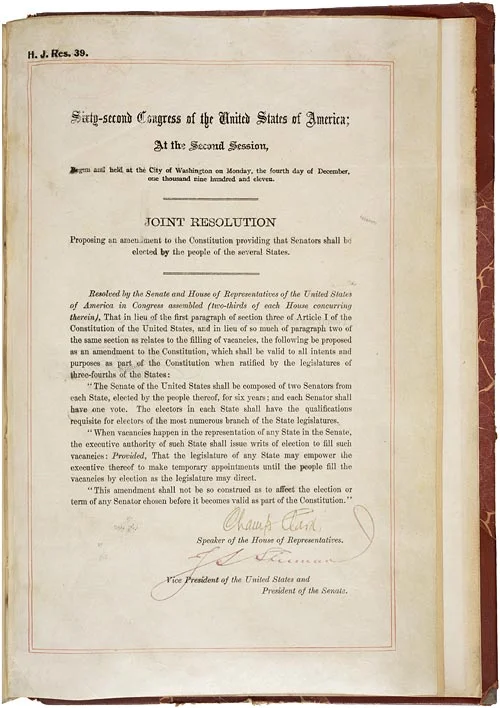
The 17th Amendment, ratified in 1913, established both direct election of senators and the vacancy-filling process used today.
Why This Matters Beyond South Carolina
Senate vacancies happen more often than most people realize. In recent years alone, vacancies were triggered by the deaths of Senators John McCain (Arizona, 2018) and Dianne Feinstein (California, 2023), and by the resignation of Ben Sasse (Nebraska, 2023).
Because the Senate operates with 100 members and many key votes pass by a single-vote margin, a single vacancy can matter enormously, to the passage of legislation, the confirmation of federal judges, and the day-to-day function of the federal government. This is why the Founders built a rapid-replacement mechanism into the constitutional framework.
The Vacancy Process, Step by Step
Here is exactly how a Senate vacancy plays out under federal and state law, from the moment the seat becomes empty to the day a new senator is sworn in.
The vacancy is officially declared
When a senator dies, resigns, or is expelled, the seat is immediately considered vacant. There is no waiting period. The process begins right away, and the Senate notifies the governor of the affected state.
The mechanism comes from the 17th Amendment, ratified in 1913. Its second paragraph provides that when a Senate vacancy happens, "the executive authority of such State shall issue writs of election to fill such vacancies," and it allows a state legislature to "empower the executive thereof to make temporary appointments until the people fill the vacancies by election." Every state except a handful has passed a law granting the governor that appointment power.
The trigger differs by cause. A death or an expulsion (the Senate has expelled 15 members, 14 of them in 1861 and 1862 for supporting the Confederacy) takes effect at once. A resignation takes effect on the date the senator specifies in a letter to the governor and the Senate, which is sometimes set weeks in the future so a successor can be lined up.
Until 1913, senators were chosen by state legislatures, and a vacancy that opened while a legislature was out of session could leave a seat empty for a year or more. The direct-election system was designed in part to close those long gaps and to end the deadlocks that had left seats vacant, Delaware went without one of its senators for two full years in the 1890s.
The governor appoints a temporary replacement
In 45 states the governor has the power to appoint a temporary senator. That person can begin serving almost immediately and holds the seat until voters elect a permanent replacement. The appointee must meet the same constitutional requirements as any senator: at least 30 years old, a U.S. citizen for at least 9 years, and a resident of the state.
State laws vary on who the governor may choose. Six states, Hawaii, Maryland, North Carolina, Utah, West Virginia, and Wyoming, require the governor to pick from a short list submitted by the same political party as the senator who left, so the seat does not switch parties by appointment. Arizona and Montana require the appointee to belong to the same party without a list. Most other states leave the choice entirely to the governor's discretion.
Appointed senators have full voting power from the moment they take the oath, which the vice president or a designated senator administers on the floor. They can chair subcommittees, sit on the same committees as the departed senator, and cast decisive votes; roughly 200 people have entered the Senate this way since 1913.
Appointees historically struggle to keep the seat. Studies by the Senate Historical Office and political scientists have found that a majority of appointed senators either choose not to run or lose the special election, which is one reason governors sometimes appoint a caretaker who publicly pledges not to seek the seat.
A special election is scheduled
Voters get the final say. A special election is scheduled according to state law. In some states it coincides with an already-scheduled general election; in others it is held on its own accelerated timeline.
The timing rules are set entirely by each state. Some require the vote at the next regular November election if the vacancy occurs before a cutoff date; others mandate a stand-alone election within a fixed number of weeks. When Massachusetts Senator Ted Kennedy died in August 2009, state law required a special election within 145 to 160 days, which put the vote in January 2010.
Party nominees for a special election are usually chosen in a special primary rather than by the normal caucus and convention calendar, and filing windows are compressed to a week or two. Because turnout in off-cycle special elections is typically far lower than in a presidential year, both parties pour resources into what can become nationally watched races.
Five states, Kentucky, North Dakota, Oregon, Rhode Island, and Wisconsin, skip the appointment step entirely and fill the seat only by special election, which can leave it empty for months while the vote is organized.
The elected senator serves out the remainder of the term
Whoever wins the special election serves only the rest of the original senator's six-year term, not a fresh full term. If they want to keep the seat, they must run again in the next regular election for that seat.
This means a state can hold Senate elections for the same seat in back-to-back cycles. After John McCain died in 2018, Arizona filled his seat by appointment (Jon Kyl in 2018, then Martha McSally in 2019), voted in a 2020 special election that Mark Kelly won for the remainder of the term, and voted again in 2022 when Kelly ran for a full six-year term.
The Constitution divides the Senate into three classes so that only about a third of seats are up in any election year. A vacancy does not change which class the seat belongs to, so the special-election winner simply steps into the existing schedule.
An appointee who serves before the special election still counts toward Senate seniority and pension rules for the days actually served, but the special-election winner is treated as the start of a continuous tenure for committee-seniority purposes if there is no gap.
The appointed senator steps aside
Once the election results are certified by the state, the governor's temporary appointee vacates the seat and the elected senator is sworn in, usually by the vice president in their capacity as president of the Senate.
There is normally no gap in representation: the appointee serves right up to the moment the certified winner takes the oath. In 2010, appointed Massachusetts Senator Paul Kirk served until Scott Brown was sworn in on February 4, weeks after the January 19 special election, while the result was certified.
The handover can matter for a single pending vote. Kirk's departure cost the Democratic caucus its 60th vote and forced a change in strategy on the 2010 health care law, which the House ultimately passed using the Senate's already-approved version.
Former appointed senators receive the same post-service courtesies as any other ex-member, including floor privileges, and several have later returned to the Senate by winning election outright.
Did You Know?
Five states do not allow governors to appoint a temporary senator at all: Kentucky, North Dakota, Oregon, Rhode Island, and Wisconsin. In those states, the vacancy can only be filled by a special election, meaning the seat may remain empty for months while an election is organized.
What Happens Specifically in South Carolina?
Graham's death on July 11, 2026 triggered two separate legal processes in South Carolina, one to fill his current Senate seat, and another to replace him on the November ballot. Both have now run their course.

The South Carolina State House in Columbia. Governor Henry McMaster holds appointment authority under state law.
Under South Carolina law the governor appoints a temporary senator, who represents the state in Washington until a successor is elected and sworn in. The appointee takes office as soon as the oath is administered and holds full voting rights.
South Carolina places no same-party restriction on the choice, unlike the six states that require the governor to pick from a list supplied by the departed senator's party. The governor's selection is final and is not subject to confirmation by the state legislature or the U.S. Senate.
The appointee must satisfy the U.S. Constitution's qualifications for a senator: at least 30 years old, a U.S. citizen for at least nine years, and, when elected, an inhabitant of South Carolina.
When a party's nominee for a general election dies after winning the primary, South Carolina law provides for the party to select a replacement nominee rather than leaving the ballot line empty.
Under South Carolina Code Section 7-11-55, candidate filing for the replacement nomination opens on the second Tuesday after the vacancy is declared and stays open for one week. The party then holds a special primary to choose its new nominee for the November general election.
The winner of that special primary appears on the regular November general-election ballot against the other parties' already-chosen nominees, so voters still make the final decision on the same day as every other race.
The special-election winner serves only the unexpired portion of the six-year term that was interrupted, not a new full term.
Because Senate terms end in early January of an odd-numbered year, a seat won in a November special election may run for only a short remainder before the seat is up again on the regular cycle.
To stay in office beyond that point, the senator must run again in the next regularly scheduled election for that Senate class, this time for a full six-year term.
No. The U.S. Senate has no role in selecting a replacement. Its only function is to seat whoever emerges from the constitutional process, first the governor's appointee, then the certified election winner.
All of the decision-making happens at the state level: the governor makes the temporary appointment, the state schedules the election, state parties nominate candidates, and the state's voters and election officials certify the result.
This reflects the 17th Amendment's design, which deliberately moved the choice of senators away from any body of officeholders and put it with the people of each state.
South Carolina's Two-Track Process
Most Senate vacancies require only one process: the governor appoints, voters elect. South Carolina faced two simultaneous processes because Graham had already won the Republican primary for November's election before he passed away.
- Track 1:Governor McMaster appointed Darline Graham, the late senator's sister, on July 13, 2026. She was sworn in on July 14 and serves until the term ends in January 2027.
- Track 2:No candidate won a majority in the August 11, 2026 special Republican primary, so a runoff was held on August 25. Darline Graham defeated Rep. Ralph Norman with 52.5 percent and faces Democratic nominee Annie Andrews on the November 3, 2026 ballot.
Senate Vacancies Through History
This process has played out many times across American history. Here are some notable examples.
Cooper, a longtime senator who later served as the first U.S. ambassador to East Germany (1974-1976), did not seek re-election in 1972, and the seat opened at the end of his term rather than mid-term.
Because Cooper retired at the end of his term, there was no mid-term vacancy to fill, and the seat passed directly to the next elected senator. (Kentucky allowed gubernatorial appointments at the time; its election-only law dates from 2024.) Democrat Walter Huddleston won the 1972 general election to succeed Cooper and took office in January 1973.
Cooper was one of only a handful of senators to serve non-consecutive terms in the 20th century, first elected in 1946 to fill a vacancy, out after 1948, back in 1952, out after 1954, then elected again in 1956, 1960, and 1966. His career is a reminder that special and vacancy elections have long been a normal feature of Senate turnover.
Kennedy died of a brain tumor on August 25, 2009, after nearly 47 years in the Senate, one of the longest tenures in the chamber's history.
Massachusetts had changed its law in 2004 to strip the governor of appointment power, then changed it back in 2009 at Kennedy's own urging so the seat would not sit empty during the health care debate. Governor Deval Patrick appointed Kennedy's longtime friend Paul Kirk as a non-candidate caretaker.
The special election on January 19, 2010 was won by Republican Scott Brown, who defeated state Attorney General Martha Coakley in a heavily Democratic state. Brown's victory removed the Democrats' 60-seat supermajority.
The result reshaped the Affordable Care Act's path: unable to break a filibuster on a House-Senate compromise, Democrats had the House adopt the Senate's already-passed bill and made changes through a separate budget-reconciliation measure.
McCain died on August 25, 2018, of glioblastoma, holding the seat he had first won in 1986. Arizona law lets the governor appoint a same-party replacement to serve until the next general election.
Governor Doug Ducey first appointed former Senator Jon Kyl, who had retired from the same seat in 2013. Kyl agreed to serve only through the end of 2018 and resigned in December.
Ducey then appointed Representative Martha McSally, who had just narrowly lost Arizona's other Senate race to Kyrsten Sinema. McSally served in 2019 and 2020.
In the November 2020 special election for the remainder of McCain's term, Democrat Mark Kelly, a retired astronaut, defeated McSally. Kelly won a full six-year term in 2022, meaning the seat was on the ballot in both 2020 and 2022.
Sasse announced in October 2022 that he would leave the Senate to become president of the University of Florida, and he formally resigned in January 2023, less than two years into his second term.
Nebraska law gives the governor broad appointment authority. Governor Jim Pillen appointed former Governor Pete Ricketts, who had term-limited out of the governorship weeks earlier and had publicly sought the appointment.
Ricketts then had to defend the seat in a 2024 special election for the remaining two years of Sasse's term, which he won, and the seat is scheduled to be up again for a full term in 2026.
Feinstein died on September 29, 2023, at age 90, the oldest sitting senator and, at the time, the longest-serving woman in Senate history. She had already announced she would not run again in 2024.
Governor Gavin Newsom, who had earlier pledged to appoint a Black woman if the seat opened, named Laphonza Butler, president of the abortion-rights group EMILY's List and a former labor leader. Butler was sworn in on October 3.
Butler announced within weeks that she would not run in 2024, leaving the field to the candidates already competing. Her appointment briefly restored the Democratic caucus to full strength during a narrow 51-49 majority, which mattered for judicial confirmations moving through the Judiciary Committee.
Representative Adam Schiff won both the 2024 general election for the full term and a concurrent special election for the final weeks of Feinstein's term, and was sworn in early in December 2024.
The South Carolina seat became vacant in July 2026. Under state law the governor holds authority to appoint a temporary senator to serve in Washington until a successor is chosen by the voters.
Because the vacancy occurred in a regular election year, the seat is scheduled to be filled at the November 2026 general election rather than in a separate stand-alone contest.
The situation involves South Carolina's two-track rule: one process fills the current Senate seat, and a separate process under Section 7-11-55 lets the party choose a replacement nominee for the November ballot after its primary winner is no longer available.
Frequently Asked Questions
Common questions about Senate vacancies and the constitutional process.
Five states require Senate vacancies to be filled only by special election, with no gubernatorial appointment: Kentucky, North Dakota, Oregon, Rhode Island, and Wisconsin. In those states, voters directly elect a replacement on an accelerated schedule.
The 17th Amendment permits but does not require a state to give its governor appointment power; each legislature decides. These five have chosen to keep the choice entirely with voters, accepting that the seat may sit empty for weeks or months.
The gap can have real consequences. By contrast, when Minnesota's Paul Wellstone died 11 days before the 2002 election, Minnesota, which allows appointments, had Governor Jesse Ventura name Dean Barkley to serve the final weeks while Walter Mondale replaced Wellstone on the ballot and lost; in a no-appointment state a mid-term death at a bad moment on the calendar can leave a state with only one senator through a major vote.
Oregon has debated adding an appointment option several times but has kept the election-only rule, citing the democratic principle behind the 17th Amendment.
In most states the governor has wide discretion and could, in theory, appoint someone from the opposite party, though it almost never happens.
Several states have written same-party rules into law to prevent a seat from flipping by appointment. Hawaii, Maryland, North Carolina, Utah, West Virginia, and Wyoming require the governor to choose from names (usually three) submitted by the state party of the senator who left. Arizona and Montana require the appointee to be of the same party as the departed senator.
These laws were often passed in moments of divided government. Hawaii's list requirement drew national attention after the 2012 death of Senator Daniel Inouye, when Governor Neil Abercrombie chose Brian Schatz from the Democratic Party's list of three rather than Colleen Hanabusa, whom Inouye had requested. Wyoming and West Virginia added their versions to guard Republican seats.
Where no such law exists, the political cost of appointing an opposing-party senator is usually prohibitive, so governors appoint from their own side even without a legal requirement.
The original Constitution had state legislatures, not voters, elect senators, under Article I, Section 3. A vacancy was filled by the legislature, and if it was in recess the governor could make a temporary appointment until it reconvened.
That system produced frequent deadlocks. Between 1891 and 1905, legislative stalemates left Senate seats vacant in Delaware, Montana, Oregon, and other states, sometimes for years, and accusations of bribery in legislative elections were common.
The 17th Amendment, ratified April 8, 1913, established direct popular election of senators and rewrote the vacancy rule: the governor must call an election, and the legislature may authorize a temporary gubernatorial appointment in the meantime.
The amendment passed Congress in 1912 after decades of failed attempts and a growing number of states that had already adopted party primaries or advisory votes to bind their legislatures' choices.
Yes. With only 100 senators, one seat can decide whether a majority can pass legislation, confirm judges, or ratify treaties, especially in the narrowly divided Senates of recent decades.
When Ted Kennedy's seat flipped to Republican Scott Brown in early 2010, Democrats lost the 60th vote needed to end a filibuster and had to change how they passed the Affordable Care Act.
Temporary vacancies also matter. During the weeks in 2023 before Laphonza Butler was seated, the 51-49 Democratic majority operated at 50-49, which slowed committee votes on nominations that split along party lines.
The rapid-replacement mechanism in the 17th Amendment, immediate appointment followed by a prompt election, exists precisely so that a state is not left short a vote for long and a chamber's balance is not frozen by an unfilled seat.