
A World Before Columbus
For at least 15,000 years, the peoples of North America built nations, developed civilizations, and called this continent home. The story of Native America does not begin in 1492.
The ancestors of today's Native Americans reached the Americas at least 15,000 to 20,000 years ago, and some archaeological sites, such as Monte Verde in Chile and the Gault site in Texas, point to an even earlier presence. They came from northeast Asia, crossing the Bering land bridge on foot and moving down the Pacific coast by boat.
Genetic and linguistic evidence suggests several migration streams over thousands of years rather than one event. By the end of the last Ice Age, distinct peoples had spread from the Arctic to the southern tip of South America.
Estimates of North America's population in 1492 range from about 2.5 million to more than 18 million; for the whole hemisphere, estimates run from roughly 50 million to over 100 million. The wide range reflects how completely later epidemics erased the record.
Whatever the precise figure, the continent was a densely inhabited homeland with cities, farms, roads, and long-distance trade, not a wilderness awaiting discovery. The European narrative of an empty New World was written after those societies had already been devastated.
The peoples of North America spoke an estimated 300 or more distinct languages from dozens of unrelated families, a diversity comparable to that of Europe and Asia combined. They were hundreds of separate nations, not one people.
Around 1100 CE, Cahokia, near present-day St. Louis, covered several square miles and held perhaps 10,000 to 20,000 people, making it larger than London at the time; its central Monks Mound is still the largest earthwork in the Americas.
The Haudenosaunee (Iroquois) Confederacy of five, later six, nations governed itself under the Great Law of Peace, a constitution kept and recited orally. Benjamin Franklin invoked it in 1751 when urging the colonies to unite, and Congress formally acknowledged its influence on American institutions in 1988.
Elsewhere, Ancestral Puebloans built multi-story stone villages at Mesa Verde and a road network centered on Chaco Canyon; Northwest Coast nations built cedar-plank towns sustained by salmon; and Woodlands and Plains nations farmed maize, beans, and squash together. These were complex political and economic systems, not a single way of life.
Beginning in the late 1400s, Europeans introduced smallpox, measles, typhus, influenza, and other diseases to which Native peoples had no acquired immunity. Epidemics often ran ahead of the settlers themselves, carried along Native trade routes.
Many historians estimate that introduced disease killed 50 to 90 percent of the Indigenous population of the Americas within a century or two of contact, among the largest demographic collapses in recorded human history.
The New England coast the Pilgrims settled in 1620 had been swept by an epidemic in 1616 to 1619 that killed a large share of the Wampanoag. The survivors' cleared fields and stored corn were much of what kept the colony alive through its first winter.
In most cases the diseases spread without intent, though there are documented later exceptions, such as the distribution of smallpox-infected blankets during Pontiac's War in 1763. Intended or not, the effect was near-total in region after region.
Spain, France, England, and the Netherlands approached Native nations differently, but all sought the same things: land, resources, and religious conversion. Spain built missions and forced-labor systems in the Southwest and Florida; France and the Netherlands built trade relationships across the Great Lakes and Hudson Valley.
The fur trade pulled Native nations into the Atlantic economy, creating new wealth, new firearms, and new dependencies, and intensifying wars such as the seventeenth-century Beaver Wars over hunting territory and trade routes.
Native nations made strategic alliances: many Haudenosaunee sided with the English, many Algonquian-speaking nations with the French, and those choices helped decide a century of colonial wars culminating in the French defeat in 1763.
Throughout, Native peoples were active political players, negotiating, playing rivals against each other, and at times defeating colonial forces outright, as in the 1622 and 1644 Powhatan attacks in Virginia and King Philip's War in New England in 1675 to 1676.
Broken Treaties and Forced Removal
The United States signed approximately 375 treaties with Native nations. It violated nearly every one of them. What followed was a century of war, displacement, and mass death.
In September 1778 the United States signed its first treaty with a Native nation, the Treaty of Fort Pitt with the Lenape (Delaware), promising a defensive alliance and even raising the possibility of a Native-led state within the Union.
Over the next century the federal government ratified roughly 370 to 375 treaties with Native nations, trading recognitions of sovereignty and guarantees of land, hunting rights, annuities, and services for enormous cessions of territory.
Nearly every treaty was later broken, narrowed, or unilaterally overridden by Congress. In 1871 Congress ended treaty-making with tribes altogether, though existing treaties remained legally binding.
Those treaties are still living law. Modern Supreme Court cases on fishing rights in 1979 and on reservation boundaries in McGirt v. Oklahoma (2020) have turned on the exact wording of nineteenth-century treaty text.
In 1803 the United States bought about 828,000 square miles of the Mississippi watershed from France for roughly 15 million dollars, nearly doubling the national territory. France was selling a claim; dozens of Native nations actually lived on and governed the land, and none were consulted or paid.
President Jefferson had already privately proposed using the new territory as a destination for the forced relocation of eastern tribes, an idea that became federal policy a generation later.
The Lewis and Clark expedition of 1804 to 1806 was sent partly to assert U.S. authority over these nations and to pull the fur trade away from British Canada.
Within about 90 years the purchase area would be almost entirely removed from Native control through treaties, wars, and allotment, and carved into more than a dozen states.
President Andrew Jackson signed the Indian Removal Act on May 28, 1830, authorizing the president to negotiate the exchange of Native homelands east of the Mississippi for western territory, and funding the relocation.
The bill passed narrowly, 102 to 97 in the House, after fierce debate. Opponents included Senator Theodore Frelinghuysen and Congressman Davy Crockett, and the measure drew one of the era's largest citizen petition campaigns, organized in part by Christian women's groups.
The law was framed as voluntary, but the treaties that followed were routinely signed by unauthorized minorities and enforced by the Army. Jackson was himself a longtime speculator in frontier land.
The five large southeastern nations targeted, the Cherokee, Choctaw, Muscogee (Creek), Chickasaw, and Seminole, had adopted written constitutions, plantation agriculture, and, among the Cherokee, a syllabary and a newspaper. Adopting Anglo-American ways did not protect them.
After Georgia extended state law over Cherokee territory and gold was discovered on Cherokee land, the Cherokee Nation sued in the Supreme Court to block the state. In 1831 Chief Justice John Marshall held that the Cherokee were a "domestic dependent nation," not a foreign state, so the Court lacked original jurisdiction, but he affirmed their right to self-government.
The following year, in Worcester v. Georgia (1832), Marshall ruled squarely that the Cherokee Nation was a distinct political community in which Georgia's laws had "no force," and that relations with the tribe were exclusively federal.
President Jackson is popularly quoted as saying, "John Marshall has made his decision; now let him enforce it." The quotation is likely apocryphal, but the federal government did decline to protect the Cherokee, and Georgia ignored the ruling.
Marshall's opinions became the foundation of federal Indian law. The "domestic dependent nation" concept and the rule that tribal sovereignty is subject to federal but not state authority are still cited by courts today.
Cherokee removal was carried out under the Treaty of New Echota (1835), signed by a faction representing a small minority and repudiated by Principal Chief John Ross and a petition of some 16,000 Cherokee. The Senate ratified it by a single vote.
In 1838, about 7,000 U.S. and state troops under General Winfield Scott herded roughly 16,000 Cherokee into stockades, then marched them more than 1,000 miles to Indian Territory, in present-day Oklahoma, mostly through the winter of 1838 to 1839.
An estimated 4,000 Cherokee died of exposure, disease, and hunger in the camps and on the route. The Cherokee name for it, Nunna daul Tsuny, means "the trail where they cried."
Across the five southeastern nations, removal between 1830 and 1850 displaced roughly 60,000 people (about 100,000 counting other nations removed in the same era) and killed an estimated 15,000 or more. The Choctaw removal of 1831 to 1833 and the Muscogee removal of 1836 were comparably deadly.
On November 29, 1864, about 675 Colorado volunteer cavalry under Colonel John Chivington attacked a Cheyenne and Arapaho camp on Sand Creek whose leaders, among them Black Kettle, had been told they were under Army protection and were flying a U.S. flag and a white flag.
The troops killed roughly 230 people, about two-thirds of them women, children, and the elderly, and mutilated many bodies. Chivington's men later displayed scalps and body parts on a Denver stage.
Three federal inquiries, including the Joint Committee on the Conduct of the War, condemned the attack as a massacre. Captain Silas Soule, who had refused to let his company take part, testified against Chivington and was murdered on a Denver street soon after.
Sand Creek destroyed the peace faction among the Plains nations and set off a decade of war across the central Plains. Congress authorized the Sand Creek Massacre National Historic Site in 2000, and it was formally established in 2007; in 2014 Colorado Governor John Hickenlooper issued a formal apology on the state's behalf.
By 1876 the government was pressing the Lakota, Northern Cheyenne, and Arapaho to give up the Black Hills, guaranteed to them by the 1868 Fort Laramie Treaty, after gold was found there in 1874.
On June 25 and 26, 1876, a large village on the Little Bighorn River in Montana, associated with leaders including Sitting Bull and Crazy Horse, destroyed five companies of the 7th Cavalry and killed Lieutenant Colonel George Custer and about 268 soldiers and attached men.
It was the greatest Native victory of the Plains wars, and it enraged the public in the nation's centennial year. The Army rushed in reinforcements, and within a year most bands had surrendered or fled to Canada; Crazy Horse was killed in custody in 1877.
Congress then unilaterally seized the Black Hills in 1877. In 1980 the Supreme Court ruled the taking illegal and ordered compensation, since grown past a billion dollars; the Sioux nations have refused the money and continue to demand the land itself.
The General Allotment Act of 1887, sponsored by Senator Henry Dawes, authorized the president to break up communally held reservation land into individual parcels, typically 160 acres to a family head, held in federal trust for 25 years.
"Surplus" land left after allotment was sold to non-Native settlers. Reformers sold allotment as a route to citizenship and self-sufficiency; western land interests backed it for the opposite reason.
Between 1887 and 1934, Native land holdings fell from about 138 million acres to about 48 million, a loss of roughly 90 million acres, and much of what remained was arid or fragmented into unusable "checkerboard" and heirship parcels.
Allotment also produced a trust-accounting scandal, as the Interior Department mismanaged the money it held for individual allottees. The resulting lawsuit, Cobell v. Salazar, ran for 14 years and settled in 2010 for 3.4 billion dollars.
On December 29, 1890, the 7th Cavalry surrounded a band of Lakota under Spotted Elk (Big Foot) near Wounded Knee Creek on the Pine Ridge Reservation and tried to disarm them. A shot was fired, and the troops opened up with rifles and rapid-fire Hotchkiss cannon.
Between about 250 and 300 Lakota were killed, more than half of them women and children, many shot as they fled across open ground. About 25 soldiers also died, several apparently from their own crossfire.
The killings followed months of federal alarm over the Ghost Dance, a nonviolent religious movement predicting the world's renewal. The Army had been sent onto the reservations, and Sitting Bull had been killed by Indian police two weeks earlier.
Wounded Knee is generally treated as the close of the Indian Wars. Twenty soldiers received the Medal of Honor for the action; Native nations and repeated bills in Congress have sought to have those medals rescinded.
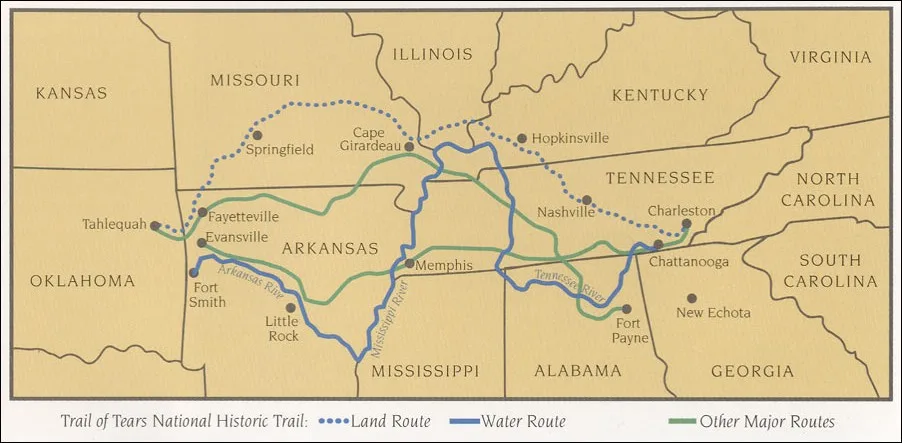
About 60,000 people from the five southeastern nations, and roughly 100,000 Native Americans in all when other removed nations are counted, were forced from their homelands during the removal era. An estimated 15,000 died during relocation.
Kill the Indian, Save the Man
After the Indian Wars, the federal government shifted strategy. Instead of destroying Native peoples with bullets, it would destroy them with schools, land laws, and the suppression of everything that made them who they were.
In 1879, Army officer Richard Henry Pratt opened the Carlisle Indian Industrial School in Pennsylvania, summarizing his goal as to "kill the Indian" in the child and "save the man." Carlisle became the model for a national network of off-reservation boarding schools.
Children as young as four or five were taken from their families, sometimes under threat of withholding food rations, given English names and military-style uniforms and haircuts, forbidden to speak their languages on pain of physical punishment, and set to manual labor for half of each day.
By 1926 the government reported that about 83 percent of Native school-age children were in boarding schools. The United States operated or funded more than 400 such schools across dozens of states between 1819 and 1969.
A federal investigation completed between 2022 and 2024 documented at least 973 child deaths and identified marked and unmarked burial sites at dozens of schools; independent estimates put the true toll far higher. In October 2024 the president issued a formal U.S. apology for the system.
The Dawes Act and its successors cut tribal land from about 138 million acres in 1887 to about 48 million by 1934. Roughly 60 million of those acres were declared "surplus" and opened to homesteaders; tens of millions more allotted acres passed out of Native hands through sale once trust protections lapsed.
Much of the retained land was desert or broken into a checkerboard of Native and non-Native parcels that made grazing, farming, and governance almost impossible. Land that stayed in Native hands was frequently the least productive available.
As original allottees died, parcels were divided among all heirs without partition. Today a single 160-acre tract can have hundreds or thousands of fractional owners, a problem Congress is still working to consolidate.
The Oklahoma "land runs" of 1889 to 1895, celebrated in American film and folklore, were the opening of former Indian Territory "surplus" to settlers, and the Curtis Act of 1898 forced allotment onto the Five Tribes the Dawes Act had exempted, abolishing their courts.
From 1883 the Interior Department's Code of Indian Offenses, enforced by Courts of Indian Offenses on the reservations, made traditional dances, ceremonies, and the work of medicine men punishable by loss of rations or up to 30 days in jail.
The Sun Dance was effectively banned from the 1880s, and after 1890 the Ghost Dance was suppressed by force. In the Pacific Northwest, federal agents worked to stamp out the potlatch, central to law, kinship, and the economy, which Canada criminalized outright from 1885.
Sacred objects were confiscated, boarding-school children were required to attend Christian services, and Native languages were punished in school and discouraged by agents on the reservations.
These restrictions were not lifted until the Indian Reorganization Act ended the assimilation program in 1934, and religious freedom was not explicitly guaranteed until the American Indian Religious Freedom Act of 1978, nearly a century after the ban began.
The Constitution excluded "Indians not taxed" from the population count for representation, and in Elk v. Wilkins (1884) the Supreme Court held that a Native man who had left his tribe was still not a U.S. citizen and could not vote.
Citizenship came piecemeal, through particular treaties, through allotment (the Dawes Act made allottees citizens), and through military service, before the Indian Citizenship Act of June 2, 1924 granted it to all Native Americans born in the United States.
Citizenship did not carry the vote, which states controlled. Arizona and New Mexico barred Native residents from voting until state courts struck the bans down in 1948, and Utah was the last to allow it, around 1957 to 1962.
Even after the formal bars fell, literacy tests, English-only ballots, long distances to the polls, and at-large districts kept Native turnout low. The Voting Rights Act of 1965, its 1975 language-assistance provisions, and continuing litigation remain the main enforcement tools.

By 1926, more than 80 percent of Indigenous school-age children attended federal or church-run boarding schools. A federal investigation confirmed at least 973 children died in these institutions.
The 2024 Federal Investigation
The U.S. Department of the Interior spent three years reviewing more than 100 million pages of federal records as part of its Federal Indian Boarding School Initiative. The final report, released in 2024, identified 417 institutions across 37 states and territories, documented at least 973 confirmed child deaths at 74 burial sites, and called for a formal national apology. Secretary of the Interior Deb Haaland, herself a member of the Laguna Pueblo, stated that the federal government had taken "deliberate and strategic actions to isolate children from their families, deny them their identities, and steal from them the languages, cultures and connections that are foundational to Native people." A Washington Post investigation using additional sources estimated the actual death toll may exceed 3,000.
Resistance, Sovereignty, and the Long Road Back
Native peoples never stopped fighting for their rights, their lands, and their survival. The twentieth century saw a hard-won reversal of the worst assimilation policies and the beginning of a new era of tribal self-determination.
The Indian Reorganization Act of June 1934, the "Indian New Deal," ended allotment, extended the trust status of Native land indefinitely, authorized tribes to adopt constitutions and form federally chartered corporations, and set up a revolving credit fund.
It was driven by Commissioner of Indian Affairs John Collier, who had lived among the Pueblos, and by the 1928 Meriam Report, which had documented catastrophic poverty, disease, and death rates in federal Indian programs and schools.
Tribes voted whether to accept the Act. About 181 accepted it and 77 rejected it, including the Navajo Nation, whose "no" was tied to anger over a federal livestock-reduction program. Roughly 2 million acres were restored to tribal ownership in the years that followed.
Critics then and since note that the model constitutions imposed a uniform elective, majority-rule structure that often displaced older consensus and clan-based governance. Even so, the Act stopped the land loss and remains the legal backbone of modern tribal government.
In 1953 House Concurrent Resolution 108 declared it federal policy to end tribes' special status "as rapidly as possible," and Public Law 280 handed criminal and civil jurisdiction over many reservations to certain states without tribal consent.
Between 1953 and 1964 Congress terminated federal recognition of more than 100 tribes and bands, covering roughly 12,000 people and over a million acres. The Menominee of Wisconsin and the Klamath of Oregon, both relatively prosperous, lost their reservations, federal services, and tax-exempt status.
The parallel Voluntary Relocation Program, begun in 1952, gave Native families one-way bus fare, a month's rent, and job placement in cities such as Los Angeles, Chicago, Denver, and the Bay Area. By 1980 more than half of all Native Americans lived in urban areas.
Termination is now regarded as a failure. The Menominee were restored to federal recognition in 1973 and the Klamath in 1986, and most terminated tribes eventually regained status, though land and resources were rarely recovered.
The American Indian Movement was founded in Minneapolis in July 1968 by Dennis Banks, Clyde Bellecourt, George Mitchell, and others, first to patrol and document police treatment of Native people in the city and to run survival schools and housing and jobs programs.
It became a national force alongside the 19-month occupation of Alcatraz Island from 1969 to 1971 by the group Indians of All Tribes, which drew wide public attention to treaty rights and self-determination.
In November 1972 AIM and allied groups led the Trail of Broken Treaties caravan to Washington and occupied the Bureau of Indian Affairs headquarters for six days, leaving with records and a 20-point position paper.
In 1973 AIM members and Oglala Lakota residents occupied the hamlet of Wounded Knee on Pine Ridge for 71 days in an armed standoff with federal forces; two Native men were killed and a federal agent was paralyzed. Later prosecutions of AIM leaders collapsed over government misconduct, and the 1975 Pine Ridge shootout led to the disputed conviction of Leonard Peltier, whose sentence was commuted to home confinement in 2025.
President Nixon's 1970 message to Congress repudiated termination and called for Native self-determination "without termination," setting the direction for the laws that followed.
The Indian Self-Determination and Education Assistance Act of 1975, signed by President Gerald Ford, let tribes take over, by contract or compact, the operation of federal programs, schools, clinics, and services that the Bureau of Indian Affairs and Indian Health Service had run.
The Indian Child Welfare Act of 1978 answered surveys finding that 25 to 35 percent of all Native children had been removed from their homes, most placed with non-Native families or in institutions, by giving tribes a central role in custody proceedings.
The American Indian Religious Freedom Act of 1978, the Tribal Self-Governance Act of 1994, and later statutes extended the framework. Federal courts have narrowed parts of it, but the contracting model has put a large share of on-reservation services under tribal management.
The Native American Graves Protection and Repatriation Act of 1990 requires museums and agencies that receive federal funds to inventory Native human remains and funerary, sacred, and patrimonial objects and to repatriate them to lineal descendants or affiliated tribes on request.
It followed the 1989 law creating the National Museum of the American Indian, which placed similar duties on the Smithsonian. Together the laws reached institutions holding the remains of well over 100,000 individuals.
Compliance has been slow. More than three decades on, the remains of tens of thousands of people and hundreds of thousands of funerary objects still had not been repatriated, prompting stricter federal rules that took effect in 2024 and led several major museums to close or cover exhibits.
NAGPRA also makes it a federal crime to traffic in Native remains and cultural items, and it gives tribes a voice over discoveries on federal and tribal land. Some repatriations have returned thousands of ancestors at once from a single university collection.
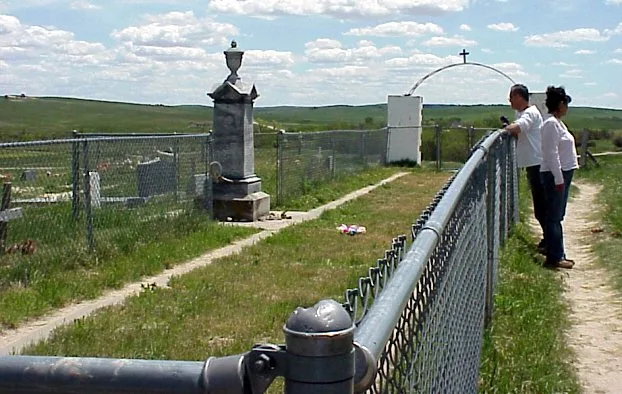
Wounded Knee, South Dakota: site of the 1890 massacre of roughly 250 to 300 Lakota people, and the 1973 American Indian Movement occupation that lasted 71 days.
Key Legislation for Native Rights
Indian Reorganization Act
Ended allotment, restored some lands, encouraged tribal self-governance
Indian Civil Rights Act
Extended most Bill of Rights protections to people under tribal jurisdiction
Indian Self-Determination Act
Allowed tribes to contract to operate their own federal programs
Indian Child Welfare Act
Protected Native children from removal into non-Native homes
American Indian Religious Freedom Act
Formally protected Native peoples' rights to practice traditional religions
Indian Gaming Regulatory Act
Established the framework for tribal gaming operations
NAGPRA
Required return of Native remains and sacred objects held by museums and federal agencies
Surviving, Governing, and Thriving
Native Americans are not a historical people. They are a present people, with sovereign governments, living languages, and a future they are shaping on their own terms.
The United States recognizes 574 tribal nations, each with a government-to-government relationship with the federal government; about 230 of them are in Alaska. Recognition can also come from state governments or acts of Congress.
Tribes are "domestic dependent nations" with inherent sovereignty that predates the Constitution. They set their own membership, run courts and police, levy taxes, regulate land use, and make and enforce civil and much criminal law within their territory.
That sovereignty is bounded by federal power. Congress claims "plenary" authority to limit it, the Supreme Court's Oliphant decision (1978) barred tribes from criminally prosecuting non-Indians, and the 2022 Castro-Huerta decision let states prosecute some crimes on reservations.
Recent law has pushed the other way. The reauthorized Violence Against Women Act (2013 and 2022) restored limited tribal criminal jurisdiction over non-Native domestic abusers, and McGirt v. Oklahoma (2020) affirmed that much of eastern Oklahoma remains "Indian country" for major-crimes purposes.
The Supreme Court's California v. Cabazon Band decision (1987) held that states could not regulate gaming on tribal land where similar gaming was otherwise legal. Congress responded with the Indian Gaming Regulatory Act of 1988, which created a federal commission and required tribal-state compacts for casino-style games.
Tribal gaming has grown into a roughly 40-billion-dollar-a-year industry across about 245 tribes and 500 facilities. By law, the revenue must fund tribal government, member welfare, economic development, and charitable purposes.
The benefits are uneven. A small number of tribes near major cities earn most of the money, many rural reservations run modest operations or none, and per-capita payments to members are the exception rather than the rule.
For nations that had no economic base for generations, gaming has funded housing, water systems, language programs, scholarships, and health clinics, and has made some tribes significant employers and political donors within their states.
About 9.7 million people identified as American Indian or Alaska Native, alone or in combination, in the 2020 census, up from 5.2 million in 2010 and from a low of roughly 250,000 around 1900. Changes in self-identification account for part of the increase.
The largest groupings by ancestry or enrollment include the Navajo, Cherokee, Choctaw, and Sioux nations. The states with the most Native residents, counting people who report Native ancestry alone or in combination, include California, Texas, Oklahoma, Arizona, and New Mexico (2020 Census), and roughly 70 percent of Native people now live in urban areas.
Disparities remain wide. Native Americans have had the highest poverty rate of any racial group in several recent census years, and their life expectancy, already several years below the national average, fell sharply during the COVID-19 pandemic.
Active issues include the crisis of missing and murdered Indigenous women, addressed by the 2020 Savanna's Act and Not Invisible Act; water-rights settlements; and disputes over sacred sites such as Oak Flat and pipeline routes such as the Dakota Access Pipeline.
Roughly 300 or more Indigenous languages were spoken in what is now the United States at contact. About 150 are still spoken today, and only around 20 are still being learned by children as a first language.
The federal Native American Languages Act of 1990 reversed a century of suppression by making it U.S. policy to "preserve, protect, and promote" Native languages, and later Esther Martinez grants fund immersion programs.
Nations run their own efforts. The Cherokee Nation operates a Cherokee-only immersion school and a master-apprentice program, and the Wampanoag, whose last fluent speaker died in the nineteenth century, have reconstructed and revived their language from seventeenth-century documents, producing a first new first-language speaker in the 2010s.
Because a language carries law, ceremony, place-names, and relationships to land that do not fully translate, many nations treat its survival as existential, declaring language emergencies and investing casino and settlement revenue in teaching it.
Deb Haaland of Laguna Pueblo became the first Native American Cabinet secretary when she was confirmed to lead the Interior Department in 2021. Charles Curtis of the Kaw Nation had earlier served as the only Native American vice president, under President Hoover from 1929 to 1933.
In both world wars, Native "code talkers," Choctaw soldiers in 1918 and Comanche, Meskwaki, and roughly 400 Navajo Marines in the Pacific, transmitted battlefield messages in codes based on their languages that enemy cryptographers never broke.
Jim Thorpe, Sac and Fox, won Olympic gold in the pentathlon and decathlon in 1912 and played professional football and baseball; a mid-century Associated Press poll named him the greatest athlete of the half-century. Maria Tallchief, Osage, became America's first major prima ballerina.
In letters, N. Scott Momaday, Kiowa, won the 1969 Pulitzer Prize for Fiction for House Made of Dawn, opening what critics call the Native American Renaissance, and Louise Erdrich, Turtle Mountain Ojibwe, won the 2021 Pulitzer for The Night Watchman, based on her grandfather's fight against termination.
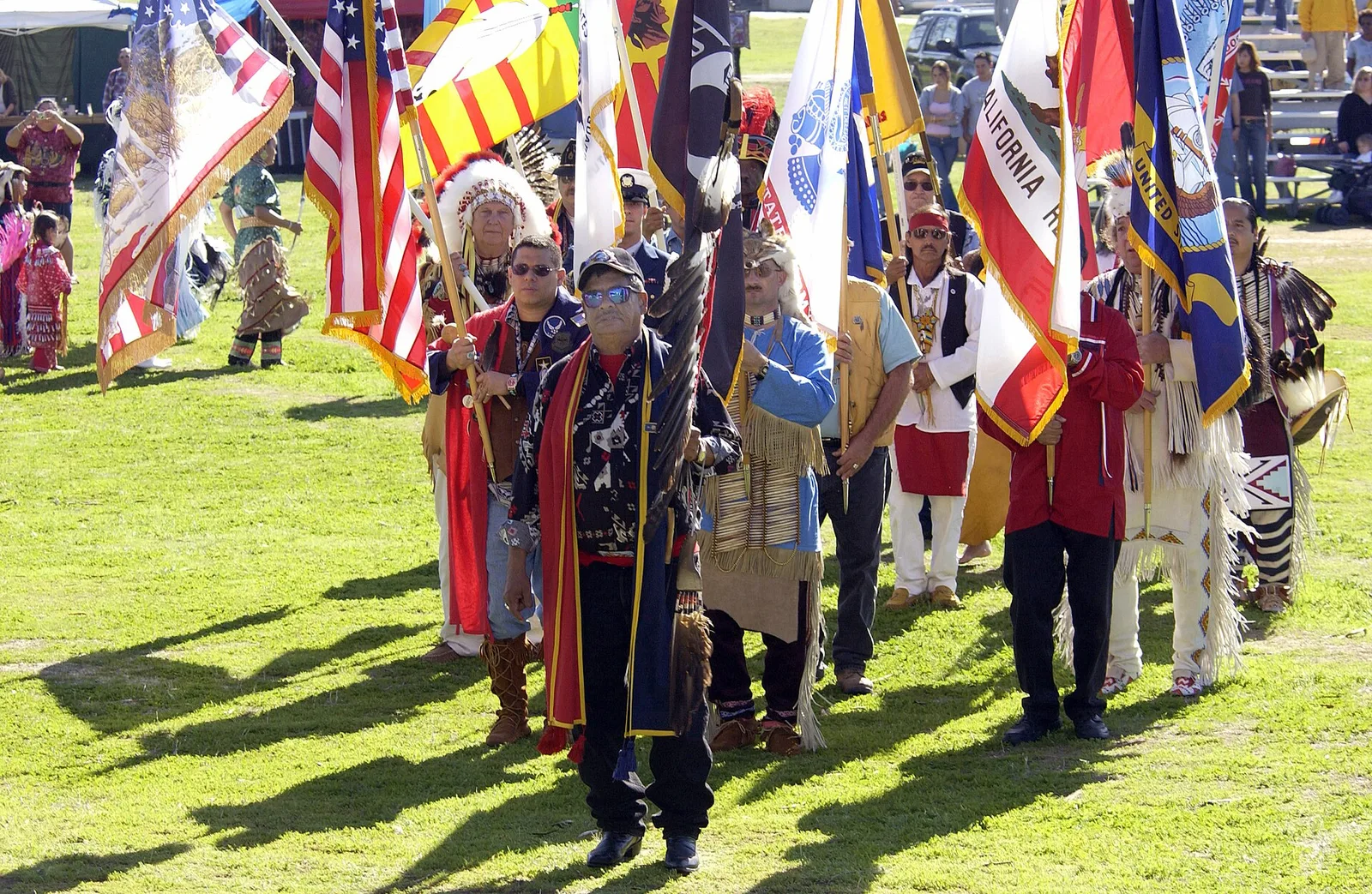
Notable Native Americans
Deb Haaland (Laguna Pueblo)
First Native American to serve in a U.S. Cabinet, as Secretary of the Interior under President Biden
Jim Thorpe (Sac and Fox)
Won gold medals in the pentathlon and decathlon at the 1912 Olympics; widely regarded as the greatest all-around athlete in American history
Navajo Code Talkers
Navajo Marines used their language as an unbreakable military code in World War II, contributing decisively to Pacific Theater operations
Maria Tallchief (Osage)
Considered one of the greatest ballet dancers in American history; prima ballerina of the New York City Ballet
N. Scott Momaday (Kiowa)
Won the Pulitzer Prize for Fiction in 1969 for House Made of Dawn, the first Native American author to win the award
Louise Erdrich (Ojibwe)
Novelist who won the Pulitzer Prize for The Night Watchman and the National Book Award; one of the most celebrated American writers of her generation
Wilma Mankiller (Cherokee)
First female Principal Chief of the Cherokee Nation; transformed tribal governance and became a national symbol of Native leadership
Vine Deloria Jr. (Standing Rock Sioux)
Author of Custer Died for Your Sins (1969), a foundational text of the Native rights movement; transformed how Americans thought about Indigenous peoples
Sources & Further Reading
- National Archives, Indian Removal Act
- Library of Congress, Native American Collections
- Bureau of Indian Affairs, Frequently Asked Questions
- Smithsonian National Museum of the American Indian
- National Endowment for the Humanities, Trails of Tears
- U.S. Department of the Interior, Federal Indian Boarding School Initiative
- Britannica, Native American History
Pre-contact population estimates are drawn from Britannica and recent PNAS research. Trail of Tears figures are from the National Archives and Britannica. Boarding school statistics are from the U.S. Department of the Interior's Federal Indian Boarding School Initiative (2022 and 2024) and the National Native American Boarding School Healing Coalition. Tribal sovereignty and recognition figures are from the Bureau of Indian Affairs.