About Kansas
Kansas takes its name from the Kansa people, a Siouan-speaking nation whose name means "people of the south wind." French explorers who encountered the Kansa along the river that now bears their name recorded it as "Kansas" or "Kansez," and the name was applied to the river and eventually the territory. When Kansas Territory was organized in 1854, it was at the center of one of the most violent political disputes in American history: the question of whether it would be admitted as a free or slave state. The resulting violence gave it the nickname "Bleeding Kansas." It was admitted as a free state in 1861, just months before the Civil War began.
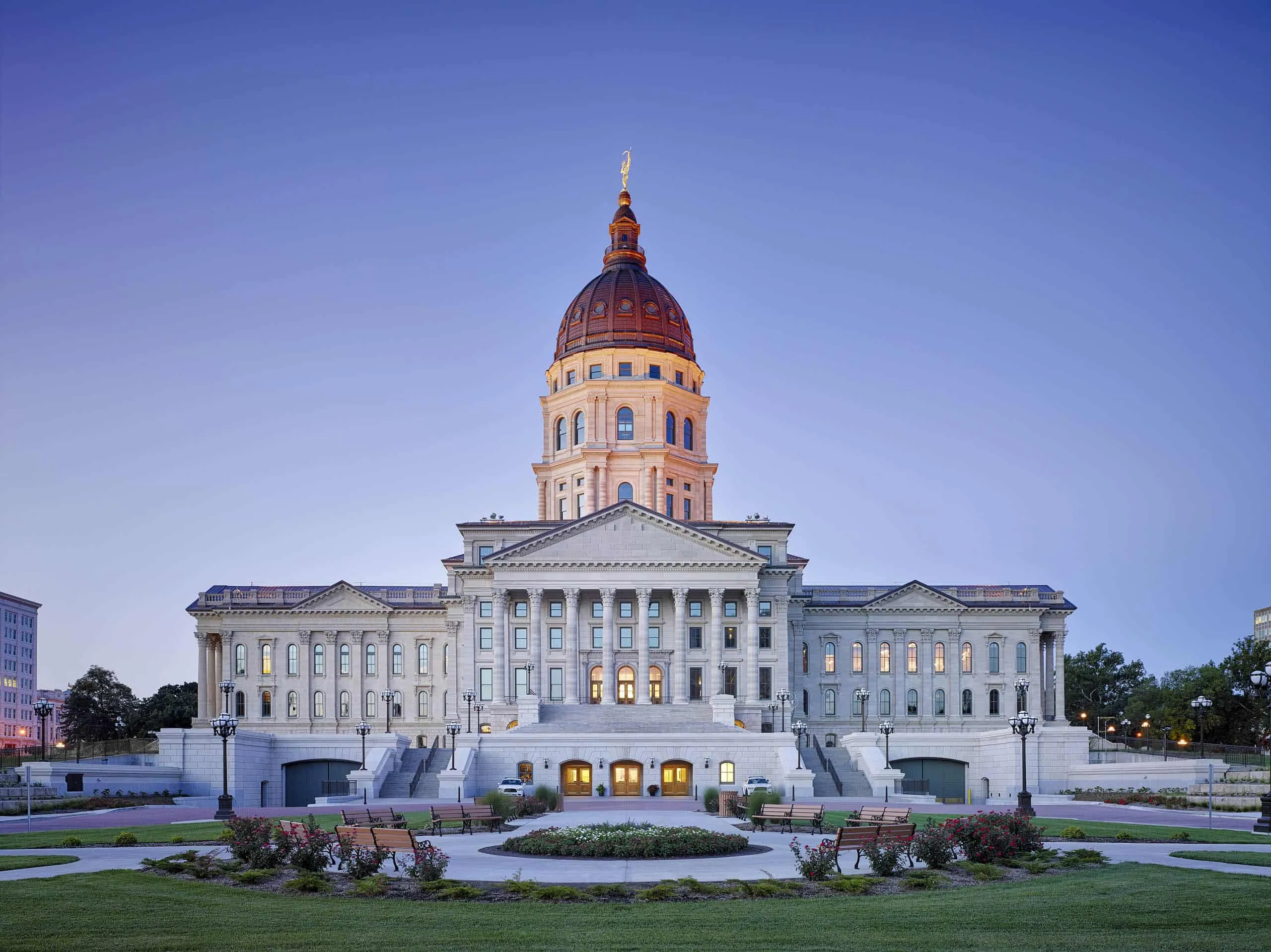
Kansas occupies the geographic center of the lower 48 states, and in many ways it occupies the center of American mythology. The state's sweeping plains, its tornado-prone skies, its cattle trails and sunflower fields, and its role as the battleground where America fought its first proxy war over slavery have all lodged Kansas deep in the national imagination.
The land is flatter than its reputation, and richer. The ancient marine sediments beneath Kansas created the Ogallala Aquifer, a vast underground reservoir that irrigates one of the most productive agricultural regions on Earth. The same geology deposited the oil and natural gas fields that have powered the state's economy for over a century. And the flat, windy terrain that makes Kansas an uncomfortable place to cross at highway speed is ideal for growing wheat and generating wind power.
Politically, Kansas has been reliably Republican for most of its history, a legacy of the Civil War and its free-state origins. But the state has shown flashes of independence, electing Democratic governors in recent years even as it votes heavily Republican in federal races. Its motto captures something true about the Kansan character: whatever difficulties arise, the stars are still out there.
Geography, Four Distinct Regions
Kansas runs 400 miles east to west, and the landscape changes dramatically from the tallgrass prairies of the east to the shortgrass high plains of the west.
Eastern Kansas is the most densely populated and topographically varied part of the state. Wichita, the state's largest city, sits along the Arkansas River and anchors the south-central economy. Topeka, the capital, lies in the northeast along the Kansas River (locally called the Kaw).
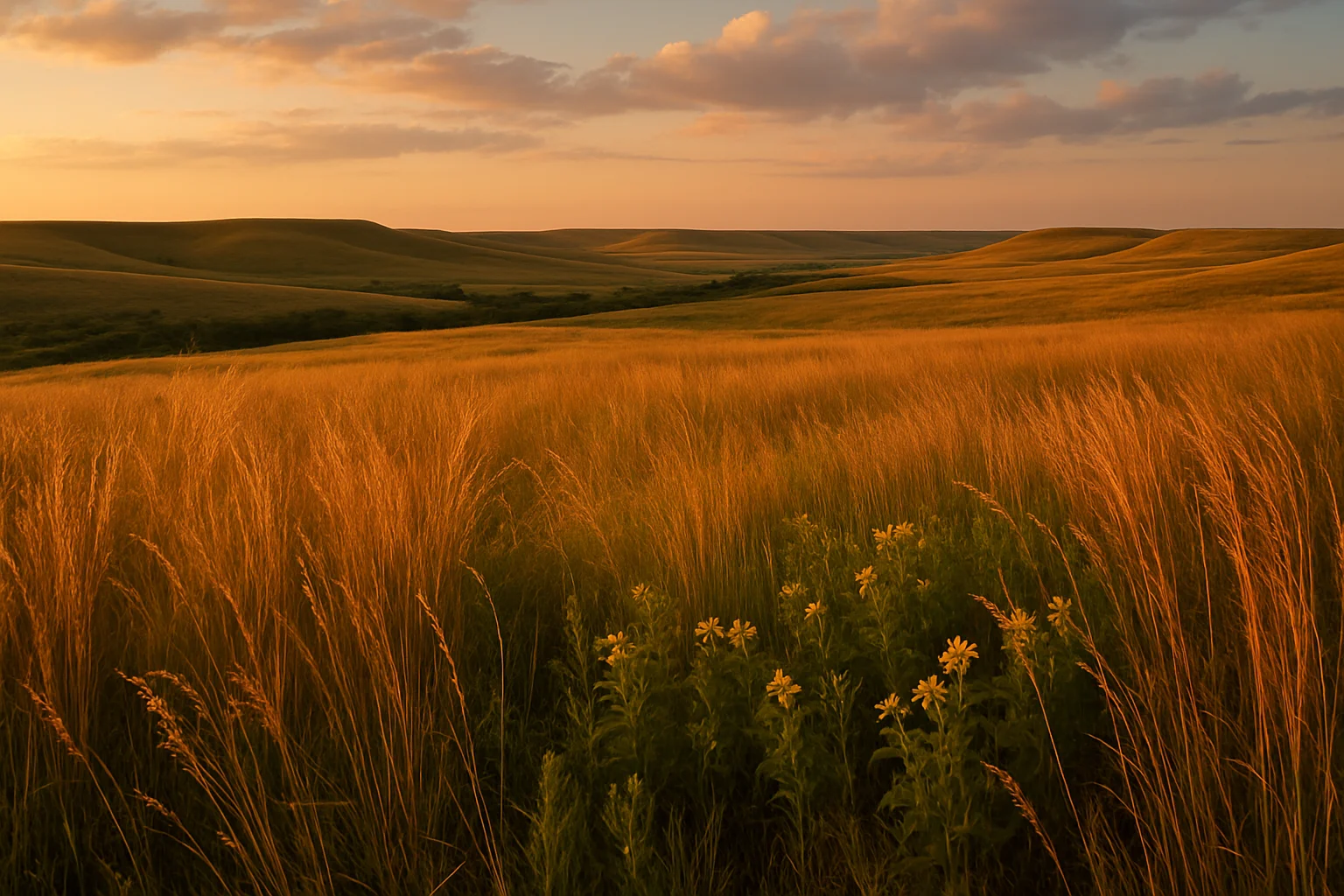
The Kansas City suburbs extend into the northeast corner. The Flint Hills, running north-south through the eastern third of the state, preserve the largest remaining tract of tallgrass prairie on Earth, a rolling, wind-swept landscape of extraordinary ecological richness that once covered 140 million acres of North America.
The Kansas side of the Kansas City metro carries much of the state's population and wealth. Johnson County, home to Overland Park, Olathe, and Lenexa, has more than 600,000 residents and the highest median income in Kansas, while Lawrence, between Topeka and the metro, is the state's main college town as the home of the University of Kansas.
This corner of the state receives around 40 inches of rain a year, roughly double the far west, which is why it supports row-crop farms, river-bottom hardwood forest, and towns rather than open range. The Kaw, or Kansa, people for whom the state and its river are named lived along these valleys until they were removed to Indian Territory in 1873.
The Flint Hills are one of the most ecologically significant landscapes in North America, the last large expanse of intact tallgrass prairie on Earth. The region's cherty limestone bedrock made it impossible to plow, inadvertently preserving what fire and bison once maintained across the entire midcontinent. The Tallgrass Prairie National Preserve protects a portion of this landscape.
Each spring, ranchers conduct prescribed burns, intentional fires that mimic the natural fire cycle and keep the prairie healthy. The Flint Hills are also home to the Konza Prairie Biological Station, one of the most important long-term ecological research sites in the world.
The hills run roughly 200 miles from near the Nebraska line south into Oklahoma, where the same formation is called the Osage Hills. Because the shallow, rocky soil defeated the plow, the land is used instead for grazing: a large share of the U.S. beef herd spends part of its life on Flint Hills grass, with steers trucked and railed out each summer.
The Tallgrass Prairie National Preserve near Strong City, created in 1996 on the former Spring Hill Ranch, is unusual in the park system for being made mostly of land owned by a nonprofit, The Nature Conservancy. In 2009 bison were returned to the preserve, the first free-ranging bison in the Flint Hills in more than a century, and the herd now numbers in the hundreds.
Central Kansas is the heart of the American wheat belt, a vast, gently rolling plain where winter wheat is planted in the fall, lies dormant through winter, and is harvested in June. The red-roofed grain elevators that punctuate the horizon in every direction are the cathedrals of the Kansas plains. Salina and Hutchinson anchor the regional economy.
Hutchinson is home to the world-famous Kansas Underground Salt Museum, carved into an ancient salt deposit 650 feet below the surface. The central region transitions gradually from the more humid east into the drier high plains of the west.
Winter wheat came to Kansas with Mennonite families who emigrated from the Russian steppes in the 1870s, bringing hard red Turkey wheat bred for cold, dry ground; it turned Kansas into the country's leading wheat state, and Kansas now grows roughly a fifth of all U.S. wheat, most of it milled into bread flour.
Hutchinson hosts the Kansas State Fair and the Cosmosphere, a Smithsonian-affiliated space museum that holds the largest collection of American and Russian spaceflight hardware outside Washington and Moscow, including the actual Apollo 13 command module. The working salt mine beneath the city is also used to store original Hollywood film reels in its stable, climate-controlled chambers.
Western Kansas is classic high plains, flat, semi-arid, and thinly populated, lying at elevations between 2,500 and 4,000 feet above sea level. The Ogallala Aquifer beneath the surface supplies irrigation water for one of the world's most productive agricultural regions, though the aquifer is being depleted far faster than it recharges. Dodge City, legendary frontier cattle town, sits in the southwest.
Liberal and Garden City are major beef processing centers. Oil and natural gas extraction dots the landscape with pump jacks and pipeline infrastructure stretching toward Oklahoma.
The Ogallala Aquifer, water left behind by Ice Age rivers, underlies about 30% of Kansas and made large-scale irrigated corn and cattle feeding possible once center-pivot sprinklers spread in the 1960s. In parts of southwest Kansas the water table has dropped more than 150 feet, and state studies project that much of the aquifer under the state could be effectively exhausted within about 50 years at current pumping rates.
Dodge City and the feedlot counties around Garden City and Liberal are now among the most heavily Latino places in Kansas, with packing plants drawing workers from Mexico, Central America, Somalia, and Myanmar and several school districts turning majority Hispanic. The chalk formations of Monument Rocks and Little Jerusalem in Gove County are remnants of the same inland sea that makes western Kansas one of the world's richest sources of marine reptile and pterosaur fossils.

Economy
Kansas blends its agricultural heritage with an aerospace industry of global scale, a growing energy sector, and a financial services cluster in the Kansas City metro.
Kansas is the undisputed wheat capital of the United States, consistently producing more winter wheat than any other state. The annual harvest, typically in June, is one of the great spectacles of American agriculture, with combines working around the clock from Oklahoma north through Kansas as the crop ripens.
Kansas is also a top-five beef-producing state, with massive feedlots and processing plants concentrated in the southwest. The state produces significant quantities of grain sorghum, soybeans, and corn as well.
Kansas leads the nation in wheat and in flour milling, grinds a large share of the country's grain sorghum, and ranks first or near first in cattle on feed. It has about 58,000 farms and ranches spread across roughly 45 million acres, close to 89% of the state's land, one of the highest farmland shares in the country.
Farming here is heavily exposed to weather and trade. A multi-year drought from 2011 to 2014 and a 2017 spring blizzard each sharply cut wheat and cattle output, and Kansas exports of sorghum and beef to China rise and fall with tariff disputes. In poor years, federal crop insurance and farm-program payments become a major share of Kansas farm income.
Wichita's aerospace industry is one of the most remarkable industrial concentrations in America. Spirit AeroSystems, spun off from Boeing, manufactures the fuselage for the Boeing 737 in Wichita and is one of the largest commercial aerostructures manufacturers in the world. Textron Aviation (formerly Beechcraft and Cessna) builds a large share of the world's business jets and piston aircraft in Wichita.
Learjet has produced its iconic business jets there for decades. The city produces roughly one-third of all civilian aircraft manufactured in the United States.
The cluster began in the 1920s with Clyde Cessna, Walter Beech, and Lloyd Stearman, and during World War II Wichita built more than 1,600 B-29 bombers, including the Enola Gay. Aviation still employs roughly 30,000 people in the metro, more per capita than anywhere else in the country.
The industry now hinges heavily on Spirit AeroSystems, which Boeing spun off in 2005 and agreed to buy back in 2024 after quality failures on the 737 MAX fuselages Spirit builds in Wichita, including the door plug that blew out of an Alaska Airlines jet in January 2024. Textron Aviation, parent of Cessna and Beechcraft, and the Learjet line, whose production ended in 2022, round out the base.
Kansas has a long history of oil and natural gas production, particularly in the southwest and south-central regions. The Hugoton Gas Area in southwestern Kansas is one of the largest natural gas fields in North America.
Wind energy has grown dramatically in recent years, Kansas consistently ranks in the top five states for wind energy generation, and the state has set goals to expand its renewable portfolio significantly. The flat terrain and reliable winds of the Great Plains make Kansas ideal for large-scale wind development.
The Hugoton field, straddling southwest Kansas, the Oklahoma Panhandle, and Texas, has produced natural gas since the 1920s and is one of the largest gas fields ever found in North America, though it is now deep in decline. Kansas oil output peaked in the 1980s, the state still counts thousands of low-volume 'stripper' wells, and the refinery at El Dorado is one of the oldest continuously operating in the country.
Wind has scaled up fast: by the early 2020s Kansas drew more than 45% of its electricity from wind, one of the highest shares of any state, and it hosts several of the largest wind farms in the nation. A 2009 law requiring utilities to reach 20% renewables was met years ahead of schedule and then repealed in 2015 under pressure from conservative groups, but wind kept expanding on cost alone.
The cattle industry has defined western Kansas since the days of the great cattle drives, and it remains central to the state's economy today. Massive feedlots in the southwest, some holding 100,000 cattle at a time, feed animals for processing at plants in Dodge City, Garden City, and Liberal operated by Tyson Foods, Cargill, and National Beef.
Kansas consistently ranks among the top three states in cattle on feed. The beef processing industry employs tens of thousands and is a critical link in America's food supply chain.
The modern industry dates to Iowa Beef Packers moving slaughter out of cities and into rural southwest Kansas in the 1960s and 1970s, next to the feedlots and cheap land. Plants at Holcomb, Dodge City, Garden City, and Liberal each process thousands of cattle a day, and the Tyson plant at Holcomb is among the largest beef plants in the world.
A 2019 fire closed the Holcomb plant for months and briefly took roughly 5% of U.S. beef slaughter offline, and the packing plants were early COVID-19 hot spots in 2020. The workforce is heavily immigrant and refugee, and Garden City, once nearly all white, is now a majority-minority town as a direct result of the packing economy.
The Kansas City metropolitan area straddles the Kansas-Missouri border, with Kansas-side suburbs like Overland Park and Leawood hosting major corporate offices, financial firms, and a growing technology sector. Sprint (now T-Mobile) was headquartered in Overland Park. H&R Block maintains major operations in the area.
Garmin, the GPS technology company, is headquartered in Olathe, Kansas. The region's lower costs relative to coastal cities have made it an attractive destination for companies seeking to relocate or expand operations.
Johnson County's corporate corridor along Interstate 435 is anchored by Garmin in Olathe, which employs several thousand people making navigation devices for aviation, boating, driving, and fitness, along with the engineering firm Black and Veatch and large local operations of the electronic-health-records company Cerner, now part of Oracle Health.
The former Sprint headquarters campus in Overland Park, a 200-acre corporate village built in the 1990s, sat largely empty after the 2020 T-Mobile merger and is being redeveloped. For years the Kansas and Missouri sides of the metro poached companies from each other with tax incentives across the state line, a 'border war' the two states finally agreed to halt in 2019.
How Kansas's State Government Works
Kansas operates a three-branch state government. The Kansas Legislature consists of a 40-member Senate (four-year terms) and a 125-member House of Representatives (two-year terms). The governor serves four-year terms and is limited to two consecutive terms.
Kansas presents one of the most interesting political paradoxes in the country: a state that votes heavily Republican in federal races but has twice elected Democratic governors in recent years. Governor Laura Kelly defeated a well-funded Republican incumbent in 2018 and was re-elected in 2022, even as Kansas voted for Republican candidates up and down the ballot. This reflects a Kansas tradition of pragmatic, moderate governance at the state level, voters who will elect a Democratic governor when they feel state government has gone too far ideologically.
Kansas also made national news in 2022 when voters rejected a constitutional amendment that would have removed abortion rights protections from the state constitution, by a margin of 59% to 41%. The vote was the first direct referendum on abortion rights in the nation after the Supreme Court's Dobbs decision, and the result surprised many national observers.
Governor of Kansas
Current Governor
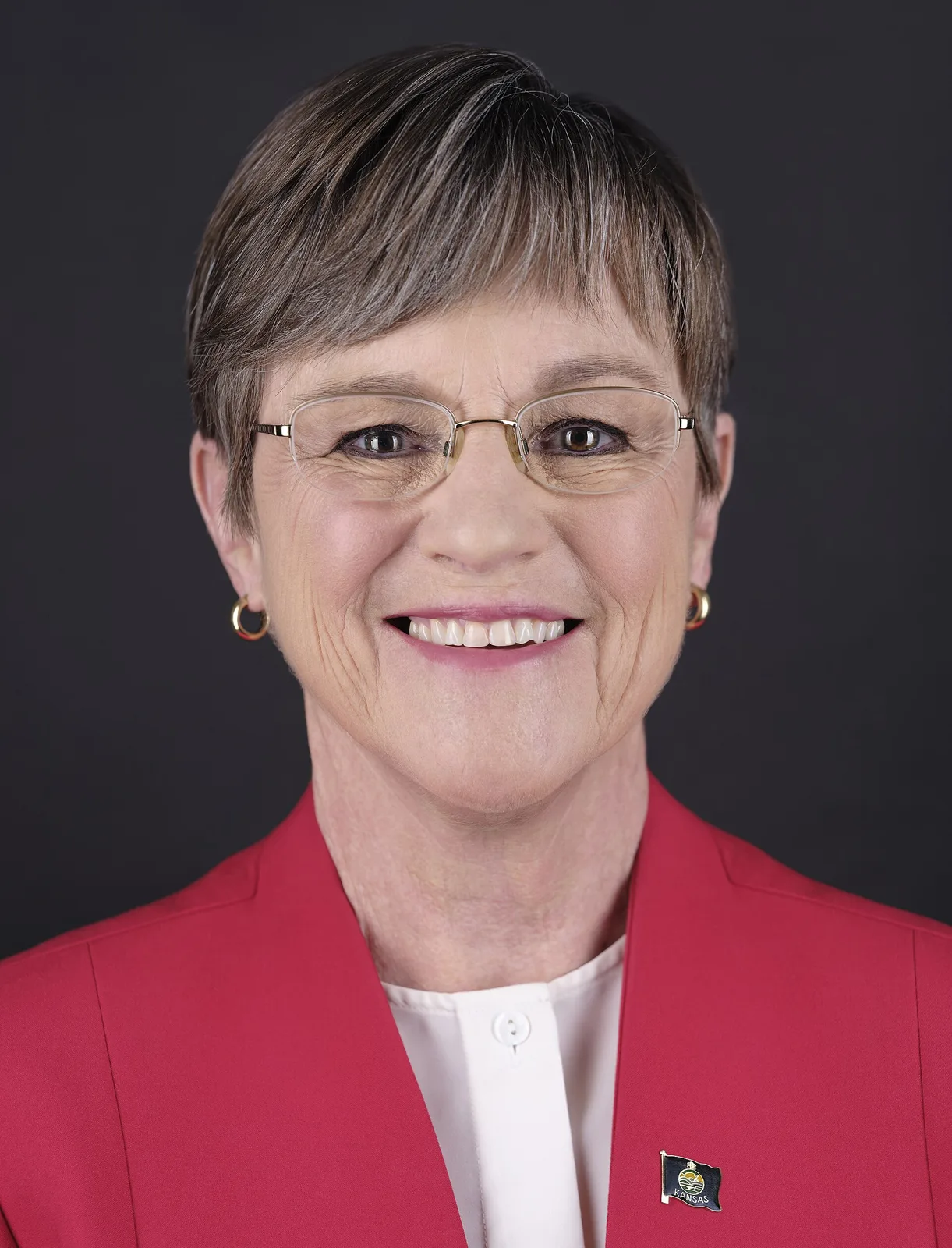
Laura Kelly
- Party
- Democrat
- In Office Since
- January 14, 2019
- Elected
- 2018, re-elected 2022
- Term Ends
- January 2027 (term-limited)
- Born
- January 25, 1950, New York City
- Education
- Monmouth College, University of Kansas
- Prior Role
- Kansas State Senator (2005–2019)
Laura Kelly is the 48th Governor of Kansas and the third woman to serve as governor in state history. A longtime state senator focused on education, disability services, and Medicaid expansion, she defeated incumbent Republican Kris Kobach in 2018 by running as a pragmatic moderate. Her re-election in 2022 made her one of the few Democrats elected statewide in Kansas in the modern era.
Other Current State Officials
Lieutenant Governor
David Toland
In office since January 2019. Former CEO of Thrive Allen County, a rural economic development nonprofit. Focuses on rural economic development and workforce policy.
Attorney General
Kris Kobach
In office since January 2023. Former Kansas Secretary of State (2011–2019) and national figure on immigration enforcement and election law. Known for aggressive voter roll purges and anti-immigration litigation.
Secretary of State
Scott Schwab
In office since January 2019, re-elected 2022. Focuses on election administration and business services modernization.
The Kansas State Legislature
Kansas State Senate
- Seats: 40 members
- Terms: 4-year terms
The upper chamber. Kansas senators serve staggered 4-year terms. Republicans have held the Senate majority for decades, though intra-party battles between moderate and conservative Republicans have defined much of Kansas politics.
Kansas House of Representatives
- Seats: 125 members
- Terms: 2-year terms
The lower chamber. Kansas has one of the larger lower chambers relative to its population, with 125 members. All seats are on the ballot every two years.
Kansas's U.S. Senators
U.S. Senator
Jerry Moran
A former Kansas state legislator and U.S. Representative who has served in the Senate since 2011. Chairs the Senate Veterans' Affairs Committee and is a leading voice on veterans' health care, rural broadband, and agricultural policy. Known for his accessibility and constituent service in a state where personal relationships with elected officials still matter.
U.S. Senator
Roger Marshall
A physician (OB-GYN) from Great Bend who served in Congress before winning the 2020 Senate race. A strong voice on agricultural trade, health care policy, and fiscal conservatism. Serves on the Senate Agriculture and Health committees, a combination that reflects Kansas's dual identity as both a farming state and one focused on rural health care access.
Kansas Through the Years
From early settlement to the present day. Tap any era to read more.
The Kansas plains were home to multiple powerful Indigenous nations before European contact. The Kansa (Kaw) people, for whom the state is named, inhabited the river valleys of northeastern Kansas. The Osage controlled the southeastern woodlands.
The Wichita built permanent grass-lodge villages along the Arkansas River. The Pawnee inhabited the Republican and Loup River valleys. The great bison herds of the plains sustained all of these nations, a resource that would be deliberately destroyed by the U.S. Army in the 1870s to undermine Plains Indian resistance.
Coronado's Spanish expedition reached central Kansas in 1541, searching for a rich city called Quivira and finding instead Wichita farming villages, the earliest documented European visit to the state. French traders worked the river routes through the 1700s, and the region passed to the United States in the 1803 Louisiana Purchase.
In the 1820s and 1830s the federal government relocated more than two dozen eastern tribes, among them the Shawnee, Delaware, Kickapoo, Potawatomi, and Wyandot, onto reservations in eastern Kansas that were promised as permanent 'Indian Country.' The rush of white settlement after 1854 pushed nearly all of them south into present-day Oklahoma within a generation; four tribes, including the Prairie Band Potawatomi and the Kickapoo, still hold small reservations in the northeast.
The Kansas-Nebraska Act of 1854 established the principle of 'popular sovereignty', allowing settlers to decide whether Kansas would enter the Union as a slave or free state. What followed was one of the bloodiest episodes in American political history. Pro-slavery 'Border Ruffians' from Missouri crossed into Kansas to vote illegally and terrorize free-state settlers.
Abolitionist settlers, including John Brown, retaliated with violence. The sacking of Lawrence, Brown's Pottawatomie Massacre, and dozens of smaller clashes made 'Bleeding Kansas' a preview of the Civil War, and helped make the conflict inevitable.
The 1855 territorial elections were openly stolen, with thousands of armed Missourians crossing the border to cast fraudulent votes, which installed a pro-slavery legislature at Lecompton that made it a crime even to question slavery. Free-state settlers responded by organizing their own rival government at Topeka, leaving the territory with two competing legislatures at the same time.
On May 21, 1856 a pro-slavery posse looted and burned much of Lawrence; days later John Brown and his sons killed five pro-slavery settlers with broadswords along Pottawatomie Creek. Congress deadlocked over three rival territorial constitutions before finally accepting the free-state Wyandotte Constitution. About 55 people died in the fighting, and Brown left Kansas in 1859 for his raid on the federal arsenal at Harpers Ferry.
After years of territorial violence, Kansas was admitted to the Union on January 29, 1861 as a free state, just months before the Civil War began. The state's admission helped tip the balance against slavery in Congress.
Kansas supplied troops to the Union throughout the war and became fiercely Republican in its political identity, a loyalty that persisted for over a century. The state's motto, 'Ad Astra per Aspera' (To the Stars Through Difficulties), was adopted at statehood and perfectly captured the spirit of a people who had earned their freedom through extraordinary struggle.
Kansas paid for its Union loyalty in blood. On August 21, 1863, Confederate guerrillas under William Quantrill raided Lawrence and killed roughly 150 men and boys, one of the worst civilian atrocities of the war, and the 1864 Battle of Mine Creek in Linn County was among the largest cavalry engagements fought west of the Mississippi.
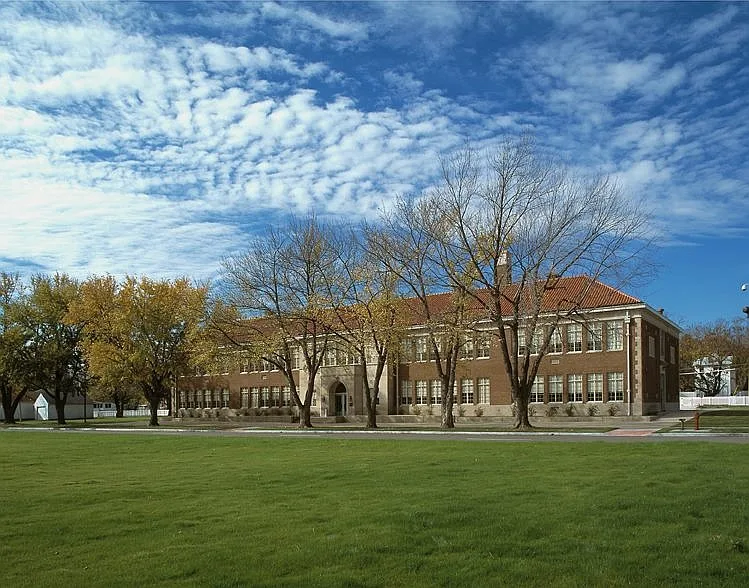
After the war Kansas drew Black migrants fleeing the South: about 20,000 'Exodusters' arrived in 1879 and 1880, founding all-Black towns such as Nicodemus, now a national historic site. Kansas still permitted segregated elementary schools in its larger cities, and in 1951 Topeka parents led by Oliver Brown sued the school board; the U.S. Supreme Court's decision in Brown v. Board of Education on May 17, 1954 struck down 'separate but equal' in public schools nationwide, and the case is memorialized at the former Monroe Elementary School in Topeka.
After the Civil War, millions of longhorn cattle grazed freely across Texas. Kansas became the endpoint of the great cattle drives, the Chisholm Trail led north from Texas to Abilene, and later to Ellsworth, Wichita, and Dodge City, where the railroads waited to ship cattle east to Chicago's meatpacking plants.
Abilene, with legendary Marshal Wild Bill Hickok, and Dodge City, with Wyatt Earp and Doc Holliday, became the most famous towns in the American West. The cattle drive era lasted only about twenty years before barbed wire, the railroad's westward expansion, and the collapse of the open range ended it, but it defined the mythology of the American West forever.
Between 1867 and the mid-1880s an estimated 5 to 6 million Texas cattle were driven north to Kansas railheads. Joseph McCoy opened stockyards at Abilene in 1867 to meet the Kansas Pacific Railroad, and as homesteaders and quarantine laws against Texas tick fever pushed the trade steadily west, the 'cowtown' title passed from Abilene to Ellsworth to Wichita and finally to Dodge City by the late 1870s.
The cowtowns were dangerous only during short cattle seasons, and the famous lawmen, Wyatt Earp, Bat Masterson, Wild Bill Hickok, mostly enforced ordinances requiring visitors to check their guns at the edge of town. Barbed wire, patented in 1874, railroads reaching into Texas, and the brutal winter of 1886-87 that killed much of the open-range herd ended the long drives, and Dodge City's last big cattle season was 1885.
The Dust Bowl, the worst man-made ecological disaster in American history, hit Kansas harder than almost any other state. Years of drought, combined with decades of overplowing that had destroyed the native grasses holding the soil in place, turned the Great Plains into a wasteland. Black blizzards, walls of dust sometimes 8,000 feet high, buried farms, suffocated livestock, and caused 'dust pneumonia' in thousands of people.
Southwestern Kansas was in the heart of the 'Dirty Thirties.' Hundreds of thousands of Kansans fled west to California. The Dust Bowl prompted the first serious federal conservation programs and the replanting of windbreaks across the plains.
The hardest-hit zone centered on the Oklahoma Panhandle and reached into southwest Kansas, southeast Colorado, and the Texas and New Mexico panhandles. Its worst single day was April 14, 1935, 'Black Sunday,' when a rolling dust cloud turned afternoon to full darkness; a reporter traveling the region, Robert Geiger, coined the phrase 'Dust Bowl' in a dispatch the next day.
The federal response was sweeping: the Soil Conservation Service in 1935, the Prairie States Forestry Project that planted roughly 220 million trees in shelterbelts from Texas to North Dakota, the Taylor Grazing Act, and government purchase and re-grassing of ruined farmland into what are now national grasslands. Rain returned by 1940, but later irrigation from the Ogallala Aquifer made the same counties among the most productive in the country, deferring rather than resolving the underlying problem.
Wichita's aerospace industry began in the 1920s when pioneering aviators recognized the flat terrain and steady winds as ideal for flight. Clyde Cessna, Walter Beech, and Lloyd Stearman all founded their legendary companies in Wichita. The city became a major military aircraft production center during World War II, turning out B-29 bombers that flew over Japan.
Boeing, Cessna, Beechcraft, Learjet, and Spirit AeroSystems have all called Wichita home. Today the city produces more general aviation aircraft than anywhere else on Earth, a quiet industrial legacy that makes Kansas central to American transportation.
The boom started with an oil fortune: in 1919 Wichita businessman Jake Moellendick bankrolled the E.M. Laird aircraft company, and by the late 1920s the city had more than a dozen aircraft makers building a quarter of all U.S. commercial planes. Olive Ann Beech ran Beech Aircraft for decades and became one of the most powerful women in American industry.
World War II turned Wichita into a boomtown: Boeing's Plant II built 1,644 B-29 Superfortresses and the population jumped by tens of thousands. The industry has since ridden a boom-bust cycle tied to business-jet demand and defense budgets, with mass layoffs in the early 1990s, after 2001, and in 2008 and 2009, but Wichita still builds a large share of the world's general-aviation aircraft and keeps the 'Air Capital' title.
Kansas's Defining Moments in American History
These are the events that didn't just shape Kansas, they changed the nation.
The violence that erupted in Kansas Territory from 1854 to 1861 was the clearest signal that the American political system could no longer contain the slavery question peacefully. John Brown's raids, the burning of Lawrence, and the fraudulent pro-slavery Lecompton Constitution all demonstrated that popular sovereignty, the idea that settlers could democratically decide the slavery question, would produce not democracy but civil war.
'Bleeding Kansas' radicalized the abolition movement, hardened Southern resistance, and set in motion the chain of events that led to Fort Sumter.
The Kansas-Nebraska Act, driven through Congress by Senator Stephen Douglas in 1854, repealed the 1820 Missouri Compromise line that had kept slavery out of the northern Louisiana Purchase and handed the decision to territorial voters. The backlash broke apart the Whig Party and led directly to the founding of the Republican Party that same year.
Northern 'emigrant aid' societies recruited and armed free-state settlers, shipping them rifles that became known as 'Beecher's Bibles' after the preacher Henry Ward Beecher. In 1856 Senator Charles Sumner was beaten nearly to death with a cane on the Senate floor by a South Carolina congressman after a speech attacking pro-slavery forces in Kansas, an assault Southerners celebrated and Northerners took as proof the two sections could no longer share a government.
The Dust Bowl of the 1930s was a direct consequence of unsustainable agricultural practices, the mass plowing of native grasslands that had stabilized the prairie soil for millennia. The ecological catastrophe displaced hundreds of thousands of families, destroyed livelihoods across a generation, and helped spur the New Deal conservation programs that replanted windbreaks and introduced soil conservation practices across the plains.
The lesson, that industrial agriculture can destroy the ecosystem it depends on, has not been fully absorbed: the Ogallala Aquifer beneath the modern Kansas plain is being depleted at a rate that points toward a future crisis.
The disaster reached deep into American culture: it is the backdrop of John Steinbeck's 'The Grapes of Wrath' and the songs of Oklahoma-born Woody Guthrie, and Dorothea Lange's and Arthur Rothstein's photographs for the federal Farm Security Administration fixed its images in the national memory. About 2.5 million people left the Plains states during the 1930s, though farm mechanization and the Depression pushed out as many as the dust did.
The government bought up the most eroded ground and turned it into the Cimarron and other National Grasslands, and it promoted contour plowing, crop rotation, and shelterbelts through the new Soil Conservation Service. No-till farming later spread across Kansas, but severe droughts in the 1950s and from 2011 to 2014 showed the plains remain fragile, and the steady drawdown of the Ogallala is the same problem in a new form.
Dwight D. Eisenhower grew up in Abilene, Kansas, the son of a creamery worker in a modest house that still stands as a museum. He rose from that Kansas childhood to command the Allied forces in Europe during World War II, overseeing the D-Day invasion of Normandy on June 6, 1944.
He served as the 34th President of the United States from 1953 to 1961, presiding over postwar prosperity, the Interstate Highway System, and the early Cold War. His presidential library and museum in Abilene is one of the finest presidential museums in the country.
Eisenhower was actually born in Texas, but his family moved to Abilene when he was two, and he grew up poor there, one of six brothers, before winning an appointment to West Point in 1911. As president he sent the 101st Airborne to enforce school desegregation in Little Rock in 1957, signed the 1956 law that created the Interstate Highway System, and warned in his 1961 farewell address against the influence of a permanent 'military-industrial complex.'
He chose to be buried in Abilene rather than at Arlington or West Point, and he lies in a small chapel on the grounds of the Eisenhower Presidential Library alongside his wife Mamie and their first son, who died in infancy. Kansas placed his statue in the U.S. Capitol's National Statuary Hall, and his name is carried by schools, highways, and the presidential library across the state.
Notable Kansans
Dwight D. Eisenhower
34th President and Supreme Allied Commander in WWII, raised in Abilene
Amelia Earhart
Aviation pioneer and first woman to fly solo across the Atlantic Ocean, born in Atchison
Langston Hughes
Poet and author of the Harlem Renaissance, raised in Lawrence
Bob Dole
U.S. Senator, WWII hero, and 1996 Republican presidential nominee, born in Russell
Charlie Parker
Jazz saxophone legend and bebop pioneer, born in Kansas City
William Allen White
Influential small-town newspaper editor whose writing shaped national politics, born in Emporia
State Symbols & Quick Facts
| Nickname | "The Sunflower State" |
| Capital | Topeka |
| Largest City | Wichita |
| Statehood | January 29, 1861 (34th state) |
| Population | ~3.0 million (2025 est.) |
| Area | 82,278 sq mi, 15th largest state |
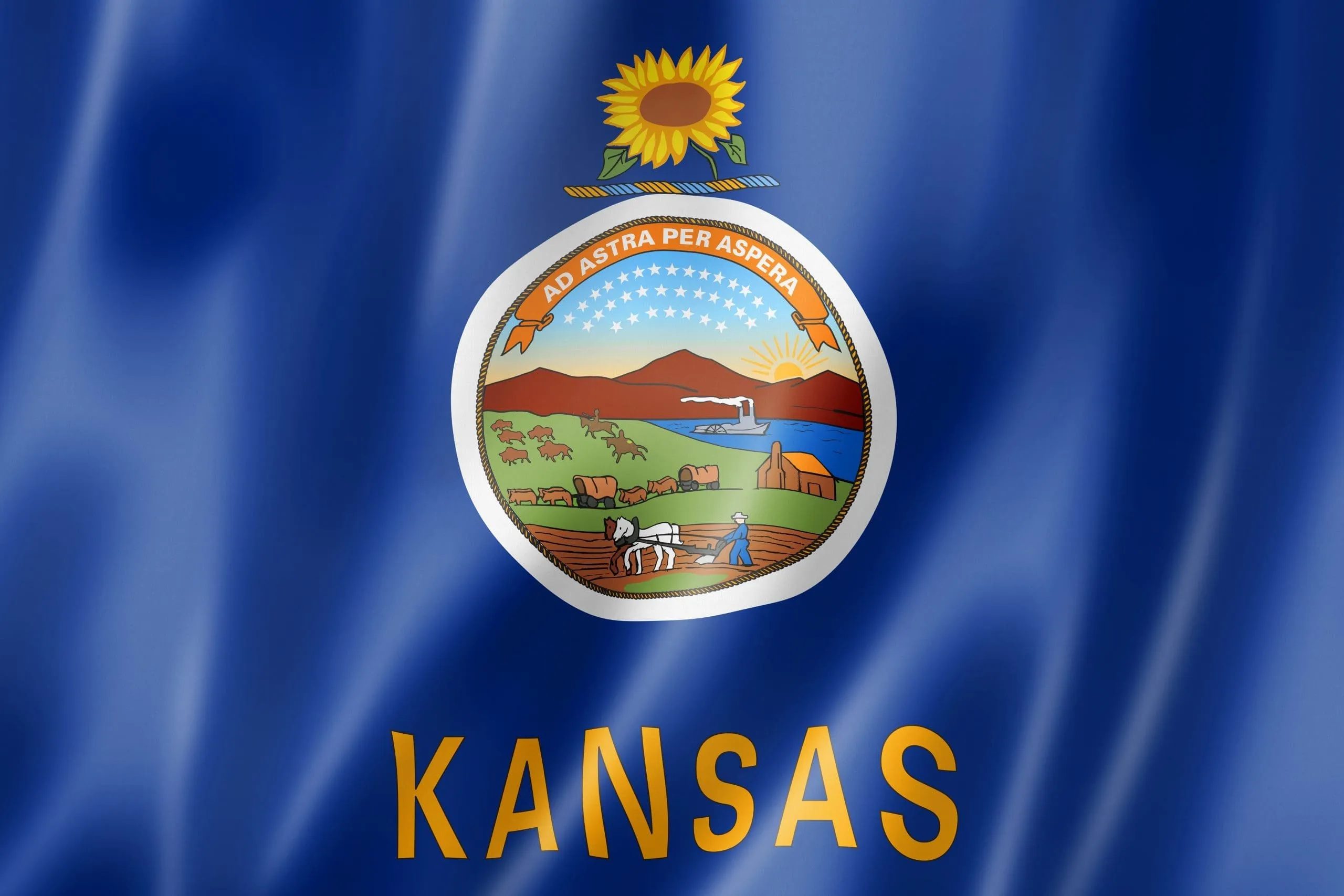
| Motto | Ad Astra per Aspera (To the Stars Through Difficulties) |
| State Bird | Western Meadowlark |
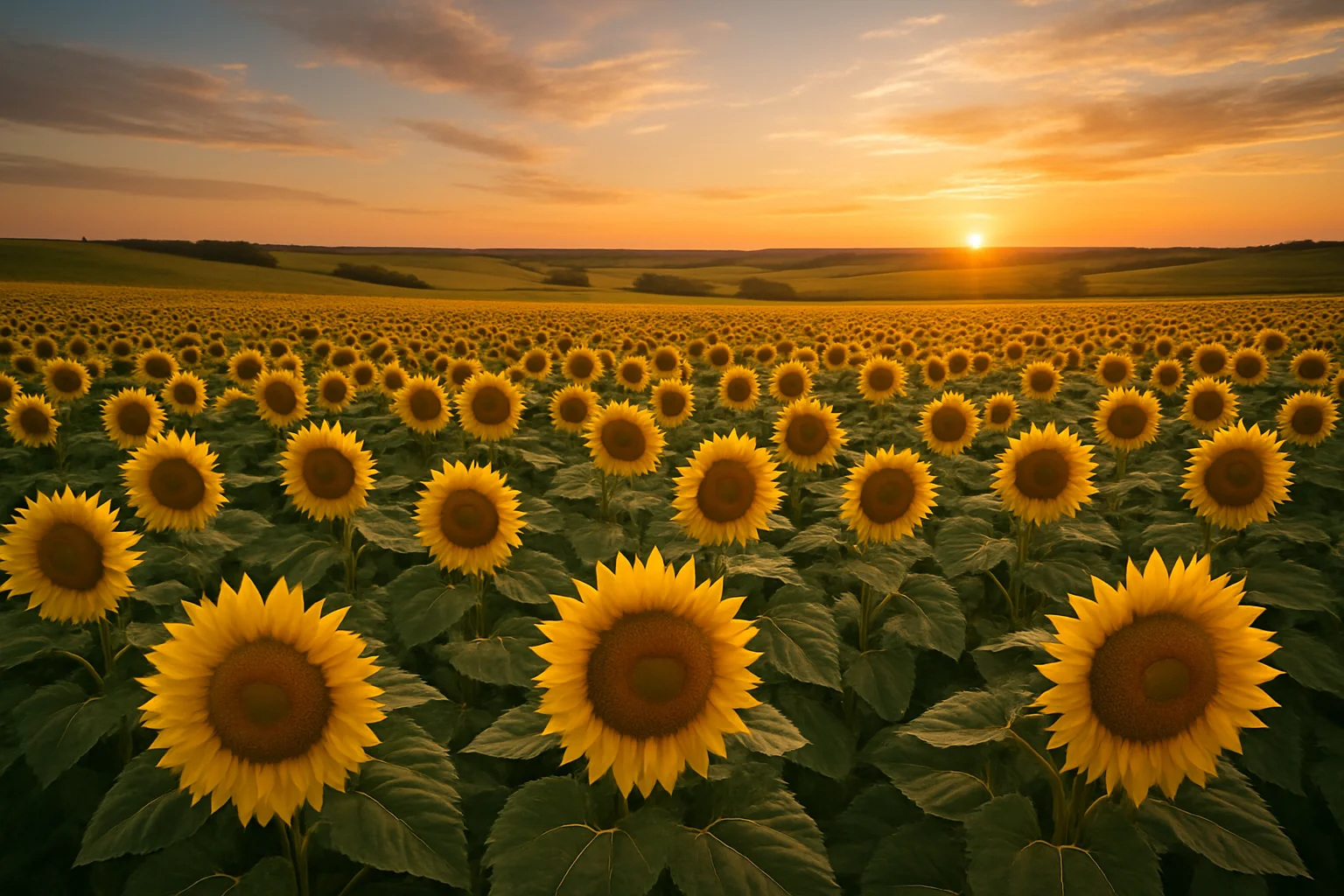
| State Flower | Sunflower |
| State Tree | Cottonwood |
| State Animal | American Bison (Buffalo) |
| State Fish | Channel Catfish |
| State Insect | Honeybee |
| State Song | "Home on the Range" |
| Time Zone | Central Time (most of state) / Mountain Time (small western counties) |
| Borders | Nebraska (N), Missouri (E), Oklahoma (S), Colorado (W) |
Did You Know?
Lebanon, Kansas is the geographic center of the contiguous 48 states. A small stone monument in a field north of Lebanon marks the exact point where the lower 48 balance, the literal middle of America.
Kansas grows enough wheat each year to bake approximately 36 billion loaves of bread, enough to feed every person on Earth for about two weeks. A single Kansas wheat farmer produces enough food to feed 25,000 people annually.
Wichita is called the 'Air Capital of the World' for good reason: the city has produced more general aviation aircraft than anywhere else on Earth. Cessna, Beechcraft, Learjet, and Spirit AeroSystems all call Wichita home.
The Kansas Underground Salt Museum in Hutchinson sits 650 feet underground inside an ancient salt deposit. The caverns, naturally maintained at 68°F year-round, are also used to store irreplaceable documents and film reels, including original negatives from Hollywood studios.
Kansas has more tornadoes per square mile than any other state in the country. 'Tornado Alley' is centered on Kansas, and the state typically sees 50 to 100 tornadoes per year. The 1939 film The Wizard of Oz, set in Kansas, has made the state synonymous with the American tornado experience.
Quick Facts and Common Questions
Short answers to the questions people most often ask about Kansas: its abbreviation, how it became a state, its capital, and its place in Congress.
Kansas's two-letter postal abbreviation is KS. The U.S. Census Bureau places it in the Midwest region, in the West North Central division, and about 2.94 million people lived there in the 2020 census.
Kansas became the 34th state on January 29, 1861, as a free state, just weeks after Southern states began to secede and less than three months before the Civil War began.
The Kansas-Nebraska Act of 1854 let the settlers of each new territory decide whether to allow slavery, a principle called popular sovereignty. Supporters and opponents of slavery rushed into Kansas, rival governments formed, and from 1854 to 1859 violence between the two sides, including the sacking of Lawrence and John Brown's killings at Pottawatomie Creek in 1856, earned the territory the name "Bleeding Kansas."
Kansas is named for the Kansa (Kaw) people, whose name is often translated as "people of the south wind." The Kansas River carried the name first.
Topeka has been the capital since statehood in 1861, after voters chose it that year. During the territorial years the seat of government moved several times, and Lecompton, home of the pro-slavery territorial legislature, served as the official territorial capital from 1855 to 1861.
Kansas borders four states: Nebraska to the north, Missouri to the east, Oklahoma to the south, and Colorado to the west. The geographic center of the 48 contiguous states lies in Kansas, near the town of Lebanon.
Kansas is known as "The Sunflower State." Its motto is "Ad astra per aspera," Latin for "To the stars through difficulties." Its state bird is the western meadowlark, its flower is the sunflower, its tree is the cottonwood, and its animal is the American bison.
Based on the 2020 census, Kansas has 4 seats in the U.S. House of Representatives, the same as before, which gives it 6 votes in the Electoral College.
Brown v. Board of Education of Topeka began when Oliver Brown and other Black parents sued the Topeka school board over segregated schools. On May 17, 1954, the Supreme Court ruled unanimously that state-mandated school segregation was unconstitutional, one of its most important landmark cases. Topeka's former Monroe Elementary School is now a National Historical Park.
Tallgrass Prairie National Preserve
The Last Great Tallgrass Prairie, Home to Roaming Bison and Endless Sky
About Tallgrass Prairie National Preserve
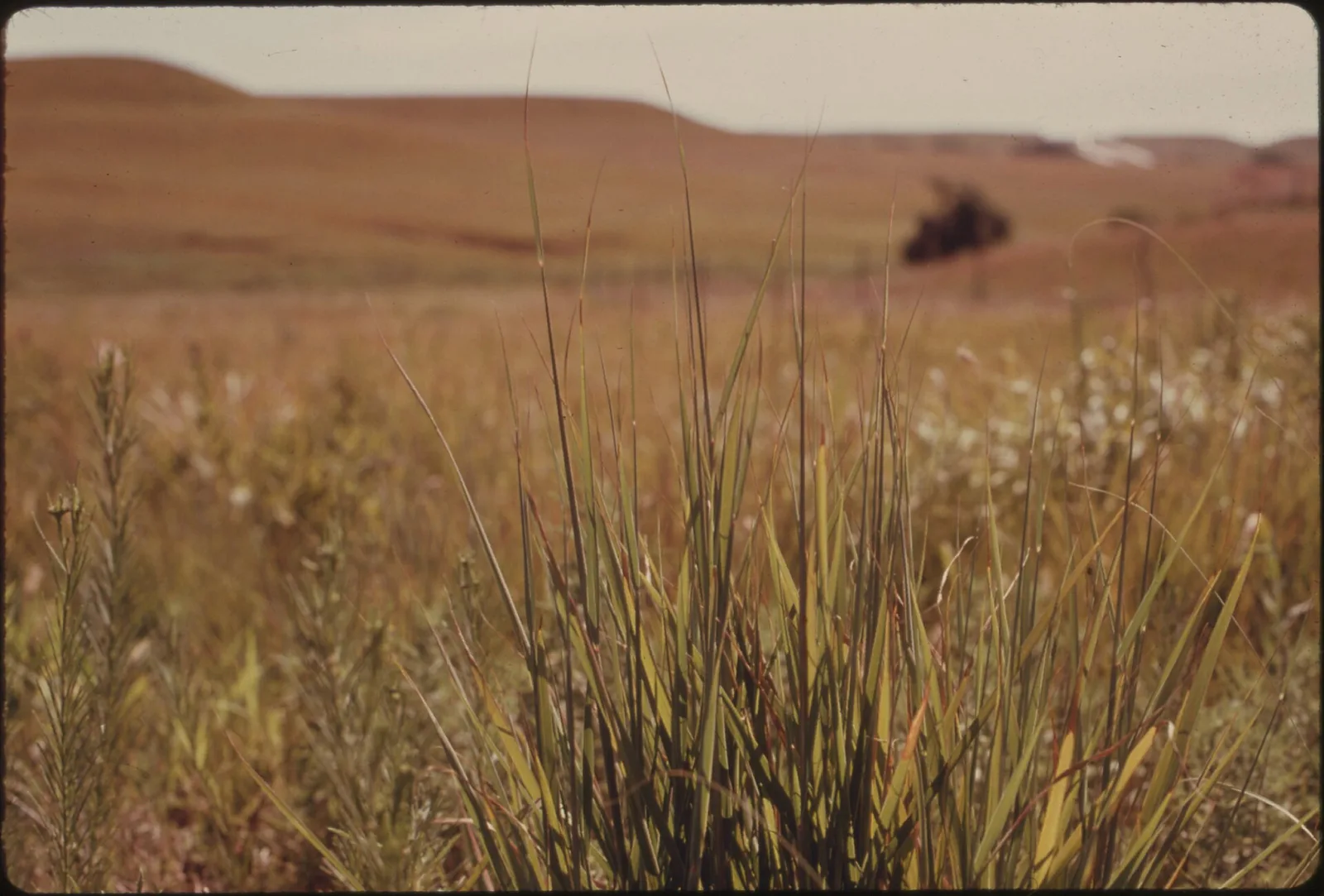
Tallgrass Prairie National Preserve protects nearly 11,000 acres of the tallgrass prairie that once ran across 170 million acres of North America, from Manitoba to Texas, and that now survives on less than 4 percent of that ground.
Almost all of what is left lies in the Kansas Flint Hills, roughly four million acres of unplowed ranchland and the largest intact stretch of tallgrass on the continent; the preserve is a sample of it near Strong City in Chase County.
It runs on an unusual partnership: The Nature Conservancy owns most of the land and the National Park Service operates the site, an arrangement worked out in 1996 after 60 years of failed attempts to create a federal prairie park over ranchers' objections.
The preserve is built around the Spring Hill Ranch, a cattleman's stone house, barn, and one-room school from the 1880s, and since 2009 it has carried a herd of bison descended from a genetically important, cattle-gene-free line.
- Designation
- National Preserve
- Location
- Strong City, Chase County, Kansas
- Established
- November 12, 1996
- Annual Visitors
- ~150,000
Prairie Layers and Geology
Big bluestem, little bluestem, Indiangrass, and switchgrass are the signature grasses; big bluestem, also called turkeyfoot for its split seed head, can top eight feet in a wet year.
Their roots reach 8 to 12 feet down, more mass below ground than above, which lets them ride out drought and fire and packs deep prairie soils with carbon.
The grasses evolved with fire and grazing and depend on both: burning clears the thatch that would smother new shoots, and grazing keeps any one species from taking over.
Flint Hills ranchers now burn roughly two million acres each spring, the largest routine prescribed burn on the continent, and the smoke regularly pushes air-quality alerts into Kansas City and beyond.
More than 500 plant species grow on the preserve, and most are not grasses but 'forbs,' broadleaf wildflowers such as compass plant, purple prairie clover, blazing star, and pale purple coneflower.
Different species bloom in waves from April through October, so the color of the prairie changes month to month.
That plant variety feeds a matching variety of insects, including the regal fritillary, a large orange-and-black butterfly that has vanished from most of its former range and holds on in Flint Hills prairie.
The surrounding cropland supports almost none of this, which makes the preserve and the ranches around it an island of pollinator and insect diversity.
The Nature Conservancy brought bison back in October 2009 with 13 animals from Wind Cave National Park, chosen because that herd carries no cattle genes.
The herd is held around 75 to 100 head on about 1,100 acres in the preserve's north end and is rounded up each fall to check health and move surplus animals to other prairies and to tribes.
Bison graze, wallow, and move differently from cattle: they favor grass over wildflowers, dig bare dusty wallows that become seasonal ponds, and their patchy grazing builds the uneven structure that grassland birds need.
Visitors can hike among the bison on the north trails, with the standard caution to keep well back from animals that weigh up to a ton and can outrun a person.
The hills are layered limestone and chert, or flint, laid down in shallow Permian seas about 250 to 270 million years ago.
The chert bands do not weather into soil, so the hillsides are studded with rock and the ground is thin and stony.
That is why the tallgrass survived here: the land defeated the plow, and 19th-century settlers ran cattle on it instead of breaking it for corn and wheat as they did on the deeper soils east and west.
The same rock built the place: the Spring Hill Ranch house, barn, and school were all quarried from limestone on the property.
Indigenous Connections
Kanza (Kaw) Nation
The Kanza, or Kaw, 'people of the south wind,' lived along the Kansas River and hunted bison across the Flint Hills; the state takes its name from theirs.
Treaties in 1825 and 1846 shrank their land to a small reservation near Council Grove, just north of the present preserve, where crop failure, disease, and raids by other nations cut the population sharply.
In 1873 Congress removed the last roughly 500 Kaw to Indian Territory and sold their Kansas land to settlers; Charles Curtis, later a United States Vice President, was a Kaw tribal member born near Topeka.
The Kaw Nation is headquartered in Kaw City, Oklahoma, after being removed from Kansas in 1873. The nation maintains cultural connections to the Flint Hills region and participates in discussions about the management of lands within their ancestral territory.
Osage Nation
The Osage controlled a large territory from the Missouri River south across present Kansas and into Oklahoma and were the dominant power on the tallgrass prairie for much of the 1700s and 1800s.
They hunted the Flint Hills bison herds and pushed the Kanza and other neighbors toward the edges of the grass.
Cessions between 1808 and 1870 took their Kansas land, but they bought their Oklahoma reservation outright, which let them keep the mineral rights beneath it, the legal basis of the Osage oil wealth of the early 1900s.
The Osage Nation is headquartered in Pawhuska, Oklahoma, located in what was once the heart of their Kansas territory. The nation became famously wealthy in the early 20th century due to oil discovered beneath their Oklahoma reservation.
Experiencing the Preserve
Bottomland Nature Trail
This flat, accessible loop of about 1.75 miles runs through the wooded bottomland along Fox Creek near the ranch buildings.
The gallery forest of bur oak, hackberry, and cottonwood along the creek is a different world from the open hills and draws white-tailed deer, wild turkey, and woodland and migrant birds.
Interpretive signs use the walk to explain how the prairie, the creek, and the Cottonwood River watershed fit together.
It is the easiest trail on the preserve and the one most used for school groups and ranger programs.
Southwind Nature Trail
The Southwind Trail climbs from the ranch complex onto the Flint Hills ridgeline, about four miles round trip with 250 feet of gain, for the classic view of unbroken grass to the horizon.
In late summer big bluestem along the path can close overhead, giving the sensation of walking through a sea of grass.
The route passes the 1882 Lower Fox Creek School, a one-room limestone schoolhouse restored and open on summer weekends.
There is no shade and no water on the ridge, and the Flint Hills sun and wind make it a hard walk on a hot afternoon.
Bison Range and Prairie Bus Tour
The bison herd lives in the Windmill Pasture in the preserve's north end, reached on foot by the Scenic Overlook and Bison Loop trails.
From spring through fall the preserve runs a guided prairie bus tour on a ranch road deep into the backcountry, the only motorized way to see the interior.
Bison are wild and unpredictable, and the Park Service tells hikers to give them at least 100 yards and to back away if a herd moves toward the trail.
Early morning and evening are the best times to find the herd near a trail, and the animals are most active in the fall rut and after a burn, when they seek out fresh green grass.
Conservation Challenges
Prairie Fragmentation
At about 11,000 acres the preserve is large for a prairie remnant but small for the species that need room: greater prairie-chickens, upland sandpipers, and Henslow's sparrows range over far more ground than it contains.
It is not truly isolated, though, because it sits inside the four-million-acre Flint Hills grazing region, so its real conservation value depends on the ranches around it staying in grass.
The Park Service and The Nature Conservancy work with neighboring ranchers and with Conservation Reserve Program lands to keep a connected block of prairie rather than an island.
Grassland birds are the fastest-declining group of birds in North America, down by more than half since 1970, which raises the stakes for holding the Flint Hills together.
Invasive Eastern Redcedar
Eastern redcedar, a native juniper, is the single biggest threat to tallgrass prairie across the Great Plains: without fire it spreads from fencerows and yards into open grass and, within a few decades, turns prairie into closed cedar woodland.
A mature cedar drinks large amounts of water, shades out the grasses and wildflowers, and its resinous foliage makes any later fire far more dangerous.
The preserve fights it with prescribed burning on a roughly two- to four-year rotation, plus cutting the trees that survive or seed in from outside the boundary.
Across Kansas as a whole, cedar is estimated to be claiming hundreds of thousands of acres of grassland a year, so the preserve's work is a small piece of a regional problem.
Climate Variability
The tallgrass prairie sits at the wet edge of the Great Plains, and its makeup shifts with rainfall: wet years favor the tall grasses, dry years the short ones and the forbs.
Longer and deeper droughts, and rain that arrives in fewer, harder storms, stress the plant communities and shift the timing of blooming and seed set.
Hotter, drier springs also narrow the safe window for prescribed burns, the main tool for keeping cedar out and grass vigorous.
Long-term monitoring plots on the preserve track how the grasses, forbs, and birds respond, and managers adjust burn and grazing timing from that data.
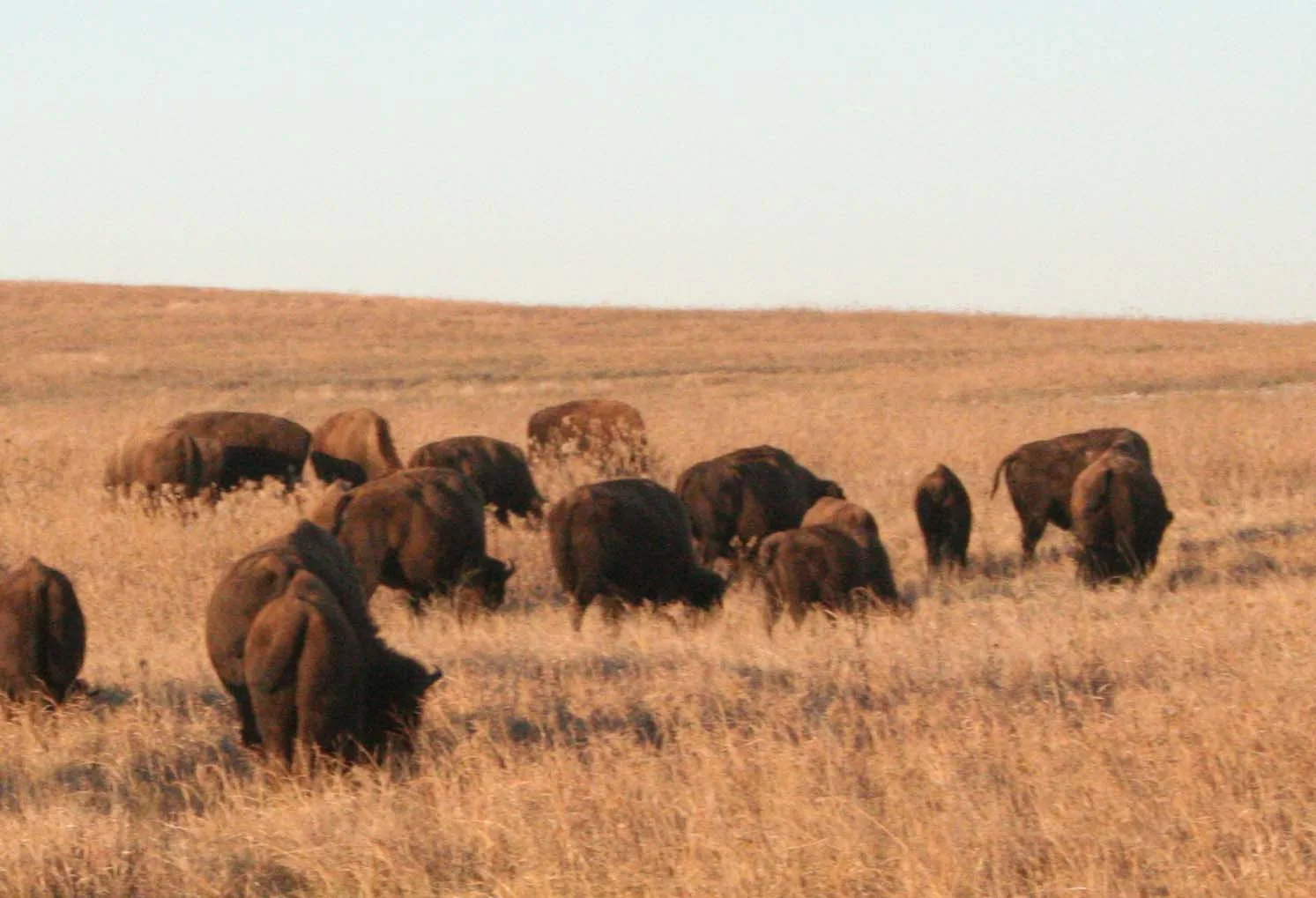
The free-roaming bison herd, reintroduced in 2009 to restore the ancient prairie ecosystem
At a Glance
Did You Know?
Tallgrass prairie roots can extend 15 feet underground, storing more carbon per acre than many forests and making the ecosystem one of the most effective natural carbon sinks on Earth.
Before European settlement, an estimated 30 to 60 million bison roamed North America's grasslands. By 1889, hunting had reduced the population to fewer than 1,000 animals.
Prairie grasses evolved to thrive after fire. The Kanza and Osage nations used controlled burns to manage grasslands and attract bison for thousands of years, a practice NPS continues today.
Plan Your Visit
Location
Strong City, Chase County, Kansas
Designation
National Preserve
Best Time to Visit
Late spring for wildflowers; summer for tall grass at full height; fall for golden colors
Admission
Free; guided tours and ranger programs available seasonally