


About Tennessee
Tennessee takes its name from the Cherokee village of "Tanasi," which sat along the Little Tennessee River in present-day Monroe County. When European traders and explorers encountered the Cherokee in the 1700s, they recorded the name of the river and the settlement, applying it first to the river and then to the region. The exact meaning of "Tanasi" in the Cherokee language is not certain, as the word may predate the Cherokee's own recorded history in the area. Tennessee was carved out of the western territory of North Carolina and admitted as the 16th state in 1796, the first state admitted after the original thirteen. It was the home state of three U.S. presidents: Andrew Jackson, James K. Polk, and Andrew Johnson.
Tennessee is three states in one, East, Middle, and West, each with its own geography, history, economy, and cultural identity, bound together by a state government in Nashville and a set of shared experiences that somehow produced both the blues and country music, both the atomic bomb and Dolly Parton, both the Scopes Trial and the most progressive sit-in movement of the civil rights era.
The Great Smoky Mountains in the east draw more visitors than any national park in America. Nashville in the middle has grown from Music City into the healthcare capital of the nation and one of the most rapidly expanding metropolitan areas in the country. Memphis in the west sits at the junction of the Mississippi River and American musical history, the city where Elvis recorded his first single, where Otis Redding made his records, and where Martin Luther King was killed, a city still working through what all of that means.
Tennessee earns its nickname. The Volunteer State sent more soldiers per capita than almost any state to the War of 1812 and the Mexican-American War. It has been first to many things in American history, first to readmit a Confederate state after the Civil War, first to put the evolution debate on national trial, first to secretly build a nuclear weapon. It is a state that consistently finds itself at the center of American arguments, whether it wants to be there or not.

Tennessee's Five Regions
Middle Tennessee, centered on Nashville at the bend of the Cumberland River, is the economic and cultural engine of the state, a region of rolling limestone hills, horse farms, and one of the fastest-growing major metropolitan areas in the United States. Nashville, with a metropolitan population exceeding 2.1 million and growing, has been the nation's hottest real estate market for much of the 2010s and 2020s, drawing migrants from the Northeast, Midwest, and California attracted by lower taxes, lower cost of living (now rapidly rising), a genuine music and food culture, and the economic opportunities of the healthcare and tech sectors.
The city's skyline has transformed dramatically in the past decade: the Batman Building (AT&T Building), the Bridgestone Arena, the new Nashville Yards development, and dozens of new hotel and residential towers have given Nashville a skyline befitting a major American city. The Parthenon, a full-scale replica of the Athens Parthenon built in Centennial Park in 1897, is Nashville's most singular architectural monument and a symbol of the city's 19th-century self-image as the 'Athens of the South.' The surrounding Middle Tennessee counties, Williamson County (Franklin, Brentwood), Wilson County (Lebanon), Rutherford County (Murfreesboro, home of MTSU), form one of the most rapidly growing suburban landscapes in the South, with technology campuses, corporate headquarters, and residential development spreading across the former farms of the Highland Rim.
The Jack Daniel's distillery in Lynchburg, the Natchez Trace Parkway (a 444-mile scenic route tracing a historic Native American and frontier travel corridor), and the Civil War battlefields at Franklin and Murfreesboro are the region's most significant historical sites.
Williamson County, just south of Nashville, is one of the wealthiest counties in the South, its median household income roughly double the state's, and its explosive suburban growth around Franklin and Brentwood, corporate campuses for Nissan North America, Community Health Systems, Mars Petcare, and others, has made Middle Tennessee's politics a study in contrasts: a deep-blue urban core in Davidson County ringed by fast-growing, heavily Republican suburbs. Nashville's efforts to run its own affairs have repeatedly been overridden by the state legislature, which in 2023 halved the size of the Metro Council and has stripped city control over the airport, sports authority, and elections board.
The Central Basin's limestone soils made Middle Tennessee a horse country from the 1800s, and Rutherford County's Murfreesboro, home to Middle Tennessee State University and near the exact geographic center of the state, has grown into one of the fastest-expanding cities in the country. The 1864 Battle of Franklin, five hours of close combat that killed or wounded roughly 9,500 men and six Confederate generals, is preserved through a decades-long effort to buy back and demolish the strip malls and a pizza restaurant that had been built over the battlefield.
East Tennessee, geographically the most dramatic part of the state with its Great Smoky Mountains, Ridge and Valley farmland, and Appalachian cultural heritage, was the most distinctive region during the Civil War and remains so today: the only part of Tennessee that voted against secession in 1861 and has maintained a Unionist-Republican political tradition that predates the modern Republican Party's Southern alignment by more than a century. Knoxville, East Tennessee's largest city with a metropolitan population approaching 900,000, is home to the University of Tennessee (whose 100,000-seat Neyland Stadium is one of the largest sports venues in the world and whose Vol orange is the state's signature athletic color), the Tennessee Valley Authority's headquarters, and a growing technology and healthcare economy.
Oak Ridge, 25 miles west of Knoxville, was built as a secret city during World War II to house the gaseous diffusion and electromagnetic separation plants that enriched uranium for the Manhattan Project, the city did not appear on any map until after the war, and its 75,000 residents worked without knowing what they were producing. Oak Ridge National Laboratory remains one of the most important science research institutions in the United States.
The Great Smoky Mountains, rising to 6,643 feet at Clingmans Dome, straddle the Tennessee-North Carolina border and encompass the most biodiverse temperate forest in North America, over 19,000 documented species of plants, animals, and fungi, including the world's greatest diversity of salamander species. Gatlinburg and Pigeon Forge at the park's northern entrance have developed into the most heavily visited tourist corridors in the South, drawing families to Dollywood (Dolly Parton's beloved theme park), white-water rafting, and the kitschy strip of shops and attractions that defines Pigeon Forge.
East Tennessee's Unionism was rooted in geography and class: the ridges and narrow valleys never supported large plantations, so enslaved people were a small share of the population, and in 1861 the region voted more than two to one against secession and tried, through the Greeneville Convention, to split off and stay in the Union, the mirror image of West Virginia. Confederate authorities occupied and imposed martial law on East Tennessee, bridge-burning raids by Unionist saboteurs in 1861 were answered with public hangings, and the memory kept the region reliably Republican for a century before the rest of the South followed.
The Tri-Cities of Bristol, Kingsport, and Johnson City anchor the far northeast, where Bristol's State Street runs down the Tennessee-Virginia line, the 1927 Bristol Sessions gave the town a claim as the birthplace of country music, and Bristol Motor Speedway packs about 150,000 fans into a half-mile oval that is one of NASCAR's loudest venues. Chattanooga and Knoxville have both leaned into the outdoor-recreation economy of the Cumberland Plateau escarpment and the TVA lakes, and Knoxville hosted a 1982 World's Fair whose Sunsphere still marks the skyline.
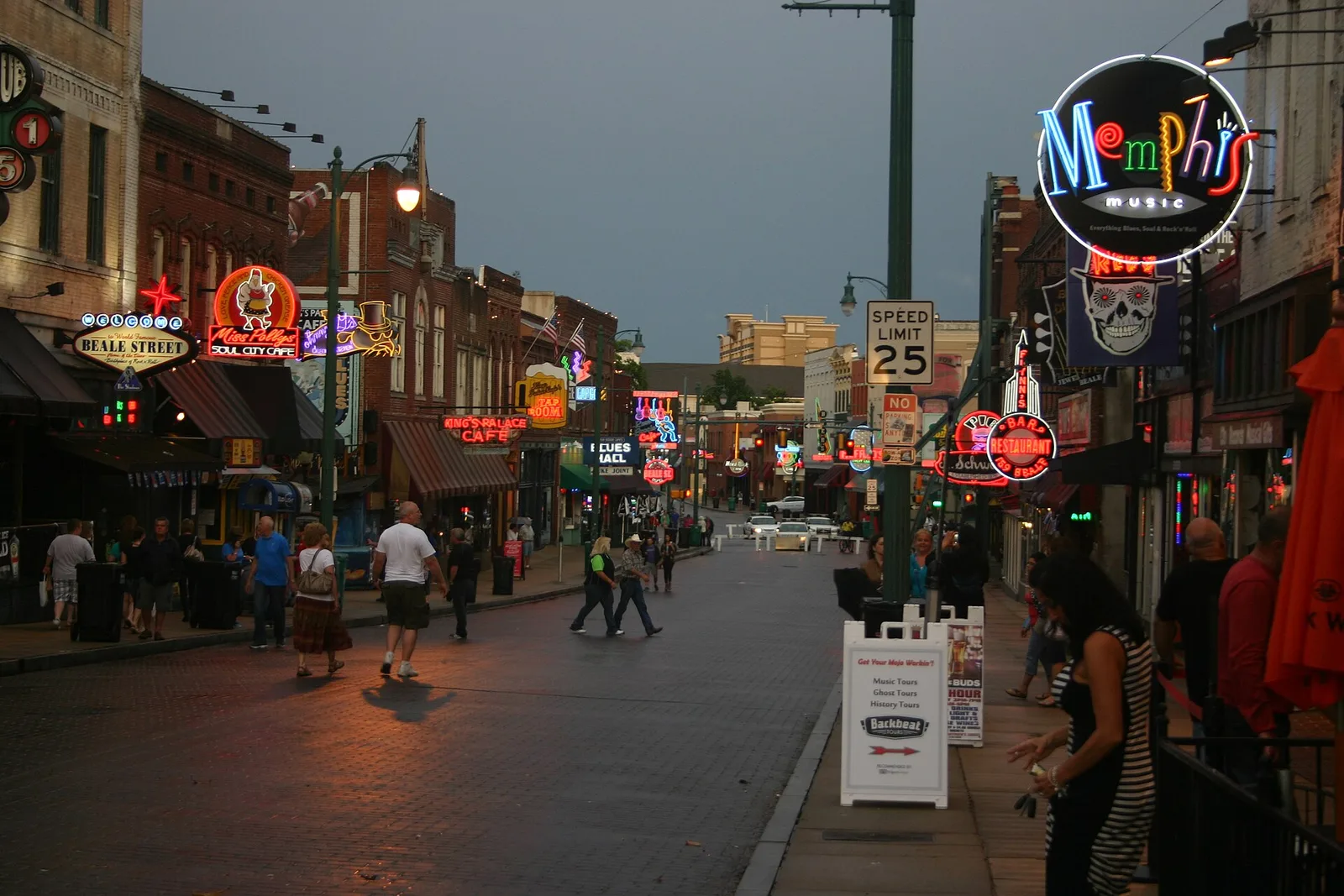
Memphis, Tennessee's second-largest city with a metropolitan population exceeding 1.3 million, sits on the bluffs above the Mississippi River at the southwestern corner of the state and is one of the most historically significant and culturally consequential cities in America, the city where the blues took its urban form, where rock and roll was first recorded, where soul music found its most powerful expression, and where Martin Luther King Jr. was assassinated on April 4, 1968, at the Lorraine Motel. Beale Street, the entertainment district that W.C. Handy made famous when he wrote 'Memphis Blues' (1912) and 'St. Louis Blues' (1914), is the spiritual birthplace of American popular music in a city that also gave the world Sun Studio (where Elvis Presley, Johnny Cash, Jerry Lee Lewis, Roy Orbison, and Carl Perkins all recorded in the early 1950s), Stax Records (where Otis Redding, Sam & Dave, Isaac Hayes, and Booker T. & the MGs defined the Southern soul sound), Hi Records, and a musical culture that flowed directly from the Black churches and juke joints of the Mississippi Delta into every genre of popular music that followed.
The National Civil Rights Museum, built into the Lorraine Motel where King was shot on the balcony of Room 306, is one of the most powerful historical sites in the United States. Graceland, Elvis Presley's home from 1957 until his death in 1977, draws more visitors annually than any private home in America except the White House. FedEx's global air hub at Memphis International Airport, through which 4 million packages pass every night, is the economic anchor of modern Memphis, a city that has struggled with poverty, population loss, and violent crime even as its cultural heritage draws visitors from around the world.
Memphis is one of the largest majority-Black cities in the country, roughly two-thirds Black, and its history is bound up with the river cotton trade: it was one of the largest slave-trading markets in the antebellum South, the site of a white-mob massacre of Black residents in 1866 that helped shape Reconstruction, and the city Ida B. Wells left after being run out for her anti-lynching journalism in 1892. The 1878 to 1879 yellow-fever epidemics killed thousands and drove out so many residents that Memphis lost its city charter for a dozen years.
The metro straddles three states, spilling into DeSoto County, Mississippi, and Crittenden County, Arkansas, and much of its white and middle-class population growth has gone to those suburbs, leaving the core city with a shrinking tax base. St. Jude Children's Research Hospital, founded by entertainer Danny Thomas in 1962 and funded largely by a national fundraising operation, treats children worldwide at no cost and is one of Memphis's largest and most prominent institutions.
The Cumberland Plateau, an elevated tableland rising 1,000 to 2,000 feet above the valleys on either side of it, stretches diagonally across Tennessee from the northeastern corner near the Virginia border to the Alabama line in the south, forming a natural barrier between East and Middle Tennessee that shaped both the state's settlement patterns and its Civil War loyalties. The plateau's sandstone caprock, thin soils, and forested ridges were never as suitable for plantation agriculture as the valleys below, and the subsistence farming communities that settled the plateau during the early 19th century developed a culture of independence and self-reliance that aligned naturally with Unionist sentiment when the Civil War began.
The coal seams beneath the plateau's surface drove 20th-century mining operations that have largely ceased, leaving behind communities that have struggled to find post-coal economic identities. The Sequatchie Valley, a remarkable linear valley that bisects the plateau from northeast to southwest through a structural fault, is one of the most distinctive geological features in Tennessee, visible from satellite imagery as a clean straight line cutting through the forested plateau surface.
Fall Creek Falls State Park, on the western escarpment of the plateau in Van Buren and Bledsoe counties, contains Fall Creek Falls itself, at 256 feet, one of the highest waterfalls in the eastern United States, and is one of the most visited state parks in Tennessee. The plateau's white-water rivers, including the Obed and Big South Fork of the Cumberland, provide exceptional kayaking and rafting that draws outdoor recreation visitors to communities seeking post-coal economic diversification.
The plateau holds some of Tennessee's most stubborn poverty. Northeastern plateau counties such as Scott, Fentress, Morgan, and Campbell have long ranked near the bottom of the state in income and health, and the region's mid-20th-century coal economy left behind acid-drainage streams and, in the southern plateau, some of the most contested mountaintop-removal permits in the state before a 2010s state law effectively ended new ridge-top surface mining. Scott County, furious that Tennessee had left the Union, declared itself the 'Free and Independent State of Scott' in 1861 and, as a matter of local lore, did not symbolically rejoin the state until 1986.
The plateau has also drawn utopian and intentional communities: the English colony of Rugby, founded in 1880 by the author Thomas Hughes as a cooperative settlement for the younger sons of British gentry, survives as a preserved Victorian village, and the Highlander Folk School near Monteagle, which trained labor and then civil-rights organizers including Rosa Parks and Martin Luther King Jr., was raided and had its charter revoked by the state of Tennessee in 1961 before relocating.
Chattanooga, at Tennessee's southeastern corner where the Tennessee River cuts through the last ridges of the Appalachian system before entering Alabama, has become one of the most frequently cited examples of American urban revitalization, a former industrial city that was once named the most polluted city in America and has transformed itself into a model of environmental cleanup, downtown redevelopment, and outdoor recreation tourism. The Tennessee Aquarium, opened in 1992 on the revitalized riverfront, was the catalyst that sparked Chattanooga's turnaround: its freshwater and saltwater exhibits draw over a million visitors annually and established the riverfront as a destination.
The Walnut Street Bridge, restored as a pedestrian bridge across the Tennessee River, is among the longest pedestrian bridges in the world and the symbolic center of the city's revitalization. The city became internationally famous in 2015 when its municipal utility installed a gigabit fiber internet network available to every home and business in the city, making Chattanooga the first American city with a community-wide gigabit internet network and attracting remote workers and technology companies.
Lookout Mountain, the Civil War site of the 'Battle Above the Clouds' (November 24, 1863, in which Union forces under Hooker drove Confederate defenders off the mountain in a battle fought partially in fog and cloud cover), now hosts Ruby Falls (an underground waterfall at 1,120 feet below ground), Rock City Gardens, and the Incline Railway, one of the steepest passenger railways in the world. The entire Tennessee River valley was transformed by TVA's dam-building program: Chickamauga Dam, Watts Bar Dam, and the other TVA impoundments have created a chain of lakes that support recreational boating, fishing, and waterfront real estate development across the region.
Chattanooga was a critical rail junction, which is why the armies fought so hard for it in 1863: four rail lines met there, and taking the city opened the 'gateway to the Deep South' that Sherman used to reach Atlanta. The industrial economy that grew on those rails, iron and steel, textiles, and the bottling plant that made Chattanooga the first Coca-Cola franchise bottler in 1899, also made it one of the dirtiest cities in America; a federal report in 1969 called its air the worst in the nation, and the cleanup that followed became the template the city sold to the world.
Volkswagen chose Chattanooga for its only U.S. assembly plant in 2008, on the site of a former Army ammunition works, and in April 2024 its roughly 4,000 workers voted to join the United Auto Workers, the union's first win at a foreign-owned car plant in the South after two earlier defeats. The city's EPB municipal utility, which built the gigabit fiber network in 2010, has since sued and been sued by Comcast and AT&T over its right to expand, making Chattanooga a national test case for public broadband.

Economy
Tennessee's $470 billion economy is built on an unlikely combination of music, medicine, manufacturing, and logistics, four industries that together have made Nashville one of the fastest-growing cities in America and Tennessee one of the more economically resilient states in the South.
The city's position as the center of country music is so complete that it has become self-reinforcing: the presence of every major country record label, publishing house, management company, booking agency, and production studio means that every artist serious about a country music career eventually comes to Nashville. But Nashville's music economy has long since expanded beyond country: it is a major center for Christian music (the Contemporary Christian Music genre was essentially invented and is still predominantly produced in Nashville), for Americana and folk, and increasingly for pop, hip-hop, and rock production.
Music Row, the cluster of recording studios, record labels, and publishers concentrated on 16th and 17th Avenues South, is the physical and institutional heart of the industry, a neighborhood where the density of music publishing catalogs alone represents hundreds of billions of dollars in intellectual property. The Ryman Auditorium, the 'Mother Church of Country Music,' where the Grand Ole Opry was broadcast from 1943 to 1974, remains one of the most acoustically perfect and emotionally powerful music venues in the world.
The Grand Ole Opry itself, now in its purpose-built facility east of Nashville, has broadcast continuously since November 5, 1927, making it the longest-running live radio program in American history. The broader entertainment economy includes the CMA (Country Music Association) Awards, the CMT Music Awards, multiple major music festivals, and a tourism economy estimated at over $7 billion annually in Nashville alone.
Tennessee's music economy did not begin in Nashville. It began in Bristol on the Virginia line in 1927, when Ralph Peer's field recordings for Victor, the 'Bristol Sessions,' captured the Carter Family and Jimmie Rodgers in what the U.S. Congress in 1998 recognized as 'the Big Bang of country music,' and it runs through Memphis's blues and soul and, more recently, a fast-growing Nashville pop, rock, and hip-hop production scene that drew Jack White's Third Man Records and a wave of major-label satellite offices.
The 2019 relocation of country-label and touring headquarters into new downtown towers, the growth of Belmont University's music-business program into one of the largest in the country, and the arrival of a National Museum of African American Music in 2021 have broadened 'Music City' beyond the historic Music Row, parts of which have been demolished for condos despite preservation fights. Bonnaroo, held on a farm near Manchester since 2002, is one of the largest multi-day festivals in the country.
HCA Healthcare, the largest for-profit hospital company in the United States with approximately 180 hospitals and 2,000 care sites in 20 states and the United Kingdom, is headquartered in Nashville and is the city's largest private employer. Community Health Systems, Envision Healthcare, LifePoint Health, Acadia Healthcare, and dozens of other major healthcare companies are also headquartered in Nashville, making the Nashville metropolitan area home to more healthcare company headquarters per capita than any city in America outside New York.
The concentration dates to the 1960s and 1970s, when Jack Massey (who had previously sold Kentucky Fried Chicken) and Thomas Frist Sr. and Jr. founded Hospital Corporation of America (later HCA) in Nashville and created the template for the investor-owned hospital industry. The healthcare management expertise, capital, and talent that accumulated around HCA over the following decades created a gravitational pull that drew subsequent healthcare companies to Nashville.
Vanderbilt University Medical Center, one of the major academic medical systems in the South, anchors the academic medicine sector and contributes research and specialist training that supports the broader healthcare industry. The healthcare sector employs over 300,000 people in the Nashville metropolitan area and contributes approximately $46 billion annually to the regional economy, a number that dwarfs the music industry despite Nashville's identity as Music City.
HCA's history is also a case study in the industry's controversies: the company pleaded guilty in 2000 and 2003 to Medicare and Medicaid fraud in the largest health-care fraud settlement in U.S. history to that point, more than 1.7 billion dollars, an episode that unfolded while Thomas Frist Jr.'s brother, Bill Frist, was a U.S. senator and later Senate majority leader. The Frist family fortune underwrote the Frist Art Museum and much of Nashville's civic philanthropy.
Tennessee has not expanded Medicaid under the Affordable Care Act, one of the ten holdout states, and its 'TennCare' program was a 1990s national experiment in managed-care Medicaid that nearly bankrupted the state before being cut back sharply in 2005; more than a dozen rural Tennessee hospitals have closed since 2010, the second-highest total of any state, even as the Nashville headquarters economy boomed, a stark split between the industry that runs hospitals nationally and the care available in much of the state.
Nissan North America's primary US manufacturing facility in Smyrna, opened in 1983 as one of the first Japanese transplant auto factories in the South, produces the Nissan Leaf (the world's best-selling electric vehicle for much of the 2010s), Altima, and Rogue models and employs approximately 8,500 workers. Volkswagen's North American manufacturing facility in Chattanooga, opened in 2011, produces the Atlas and ID.4 models and represents a $1 billion investment in Tennessee's economy.
General Motors' Spring Hill plant assembles Cadillac XT5 and XT6 models, and a growing cluster of automotive suppliers supports these assembly plants. Ford's joint venture with SK Innovation, BlueOval SK, is building a massive electric vehicle battery plant in Stanton, in western Tennessee, as part of Ford's $11 billion US EV investment.
Beyond automotive, Tennessee is a major manufacturer of chemicals (Eastman Chemical in Kingsport, one of the largest chemical companies in the United States, headquartered in East Tennessee since 1920), food processing (Jack Daniel's Tennessee Whiskey in Lynchburg is one of the most exported American consumer products in the world), and aluminum (Alcoa's Tennessee operations). The federal government's Oak Ridge National Laboratory, the largest science and energy national laboratory in the Department of Energy system, provides a research infrastructure that supports advanced manufacturing development across the region.
Tennessee has aggressively used incentives to land factories, offering Volkswagen and Ford packages worth hundreds of millions of dollars each, and its right-to-work status and non-union tradition are central to the pitch; a 2014 union vote at the Chattanooga VW plant failed narrowly amid open opposition from the governor and legislature, but a rerun in April 2024 passed decisively, the first successful UAW organizing of a foreign-owned auto plant in the South. The BlueOval City complex near Stanton, on a 3,600-acre 'megasite' the state assembled over two decades, is one of the largest single manufacturing investments in U.S. history at roughly 5.6 billion dollars.
Oak Ridge remains an economic engine on its own: beyond the national laboratory, the Y-12 National Security Complex processes and stores the nation's enriched uranium and is undergoing a multibillion-dollar modernization, and a growing cluster of nuclear-fuel and small-modular-reactor companies, including a planned TVA reactor at Clinch River, has formed around the lab's expertise. Kingsport's Eastman, spun off from Eastman Kodak in 1994, has repositioned around advanced plastics recycling.
FedEx, founded by Fred Smith in 1971 and flying from its Memphis hub since 1973, built its global express delivery empire around a hub-and-spoke system centered on Memphis International Airport, through which an average of 4 million packages pass each night. FedEx is the largest private employer in Memphis with approximately 30,000 local employees and handles approximately 15 million packages per day globally.
The Memphis hub's position within the FedEx network reflects Tennessee's geography: a truck driving overnight from Memphis can reach approximately 60 percent of the US population by the next morning. AutoZone (automotive parts), Dollar General Corporation (discount retail), and Dollar Tree's Family Dollar (both headquartered in the Nashville area) demonstrate that Tennessee's logistics advantages extend to retail distribution.
Nashville's position near the geographic center of the eastern United States has made it a major trucking and distribution hub in its own right, with Amazon, Walmart, and dozens of other retailers operating major distribution centers in the Nashville and Memphis metropolitan areas.
FedEx has been the political and economic pivot of Memphis for half a century, and founder Fred Smith, who died in 2025, financed civic projects, the University of Memphis football stadium bears his name, and used the company's clout in Washington on trade and aviation policy; the airport's designation as a global 'aerotropolis' has drawn medical-device, e-commerce, and cold-storage operations to the surrounding warehouses. The company's 2023 restructuring and a 2024 announcement that it would spin off its trucking arm added uncertainty for a city where roughly one job in twenty is FedEx-related.
The Mississippi River itself is a fourth logistics artery: the Port of Memphis is one of the largest inland ports in the country by tonnage, handling grain, steel, cement, and petroleum on barge tows, and the fifth-largest rail gateway in the U.S. runs through the city, where five Class I railroads interchange. Amazon operates one of its largest fulfillment and air-hub footprints in the Memphis area.
Great Smoky Mountains National Park, shared with North Carolina, draws over 12 million visitors annually, more than twice as many as any other national park. Its accessibility from the densely populated I-81 corridor and its lack of an entrance fee (a condition of the land transfer from Tennessee and North Carolina; a paid parking tag has been required since 2023) contribute to visitor numbers that strain the infrastructure of gateway towns like Gatlinburg and Pigeon Forge.
Nashville's Lower Broadway district, the honky-tonk strip along the Cumberland River waterfront, and the broader Nashville entertainment zone have made the city one of the premier destination cities in America for bachelorette parties, bachelor parties, music tourism, and convention business. The construction of new hotels and entertainment venues has transformed downtown Nashville at a pace matched by few American cities.
Graceland, Elvis Presley's home in Memphis, draws approximately 650,000 visitors annually and is the second-most visited private home in America after the White House. The entire Memphis tourism economy, Beale Street, the National Civil Rights Museum at the Lorraine Motel (where Martin Luther King Jr. was assassinated), the Memphis Rock 'n' Soul Museum, and Sun Studio (where Elvis, Johnny Cash, Jerry Lee Lewis, and Roy Orbison all recorded), generates billions annually.
The Great Smokies' visitor load, more than 13 million a year with no gate to meter it, has forced workarounds: the park now charges a parking 'tag' fee, its first paid access in 90 years, and gateway Sevier County, home to Gatlinburg, Pigeon Forge, and Dollywood, has become one of the most tourism-dependent economies in the country, with a year-round population under 100,000 hosting tens of millions of visitors. The 2016 Chimney Tops 2 wildfire that spread into Gatlinburg killed 14 people and destroyed roughly 2,500 structures, a reminder of the risk that development on the park's edge carries.
Nashville's tourism has surged so fast that it has become a civic issue: 'transportainment' party vehicles, pedal taverns, and tractor-pulled wagons on Lower Broadway prompted city regulation, short-term rentals reshaped whole neighborhoods, and the city drew more than 16 million visitors in a recent year. Tennessee has no state lodging tax cap and funnels much of the revenue into a convention center and a new domed Titans stadium, approved in 2023 with about 1.26 billion dollars in public money, one of the largest public stadium subsidies ever.
Soybeans, corn, and cotton are the primary crops of West Tennessee's flat coastal plain. The Highland Rim and Central Basin of Middle Tennessee support cattle ranching, horse breeding (Tennessee is one of the premier horse breeding states in the country, with the Tri-Star region around Shelbyville the center of the Tennessee Walking Horse industry, a breed known for its distinctive running walk that won the World Grand Championship at the Shelbyville Celebration every August), and tobacco production.
Tennessee whiskey, a style distinct from Kentucky bourbon by virtue of the Lincoln County Process (filtering the new spirit through sugar maple charcoal before aging), is one of the most successful American export products in the world. Jack Daniel's Tennessee Whiskey, produced in Lynchburg in Moore County (ironically a dry county where the distillery operates by special permit), is the best-selling American whiskey brand globally and one of the most recognized consumer brands in the world.
George Dickel, Tennessee Whiskey's other major producer, is made in Cascade Hollow in Grundy County. The success of these brands has spawned dozens of craft distilleries across the state and generated enormous export revenue for American agriculture.
'Tennessee Whiskey' was written into state law in 2013, a Jack Daniel's-backed statute requiring the charcoal-mellowing step and other bourbon-like rules; smaller distillers and Diageo, which owns George Dickel, fought it as an attempt to lock in the market leader's method, and the fight continues in the legislature. Tennessee also finally repealed, in 2009, a Prohibition-era law that had confined legal distilling to just three counties, touching off the craft boom.
The Tennessee Walking Horse industry around Shelbyville has been shadowed for decades by 'soring,' the deliberate injuring of a horse's legs with chemicals or weighted shoes to exaggerate its high-stepping gait; the federal Horse Protection Act of 1970 banned it, but enforcement has been weak, industry self-policing has repeatedly failed, and a stricter USDA rule finalized in 2024 was a long-sought reform. Cotton, once the West Tennessee staple, has largely given way to soybeans and corn, and the state's row-crop belt now competes on scale with the Delta across the river in Arkansas and Mississippi.

How Tennessee's Government Works
Tennessee is one of the most consistently Republican states in the South, with the GOP holding supermajorities in both chambers of the General Assembly and dominating statewide elections. The state has voted Republican in every presidential election since 1976. Its political culture is deeply conservative on social issues, low-tax, and skeptical of federal authority, though the state has historically accepted significant federal spending on the TVA, military installations, and Oak Ridge.
Tennessee's governmental structure includes several features unusual among American states: the Lieutenant Governor is constitutionally the Speaker of the Senate (elected by Senate members, not statewide voters), and the Attorney General is appointed by the Tennessee Supreme Court for an eight-year term, making Tennessee the only state whose attorney general is chosen by its supreme court (voters also do not elect the attorney general in several other states, where the governor or legislature makes the choice).
Tennessee has no individual income tax on wages and salaries (it had a tax on investment income, the Hall Income Tax, until it was phased out in 2021). The state relies on sales tax, which at 7% is among the highest in the nation, plus local option sales taxes that can bring the combined rate to 9.75% or higher. The no-income-tax policy is a significant driver of in-migration from higher-tax states and a source of ongoing political identity.
Tennessee's appellate judges, on the Supreme Court, Court of Appeals, and Court of Criminal Appeals, are chosen under the 'Tennessee Plan,' a modified Missouri Plan: the governor appoints from a slate submitted by a judicial nominating commission, and sitting judges then face uncontested yes-or-no retention elections rather than run against an opponent. A 2014 constitutional amendment, Amendment 2, confirmed this gubernatorial-appointment method (subject to legislative confirmation) after years of legal uncertainty over whether it satisfied the state constitution's requirement that judges be 'elected by the qualified voters.' Trial court judges, on the circuit, chancery, and criminal courts, are chosen in contested popular elections instead.
Governor of Tennessee
Current Governor
Bill Lee

- Party
- Republican
- In Office Since
- January 19, 2019
- Term Ends
- January 2027 (term-limited)
- Born
- August 9, 1959, Nashville, Tennessee
- Education
- Auburn University (BS, Agricultural Science, 1981)
- Prior Role
- CEO, Lee Company (mechanical contracting, Franklin, TN)
Bill Lee is Tennessee's 50th Governor, a Williamson County businessman with no prior elected experience who won the 2018 Republican primary and general election on a socially conservative platform emphasizing faith, education, and workforce development. Re-elected in 2022 with 65 percent of the vote. He is term-limited and cannot run for re-election in 2026. His tenure has been marked by significant education legislation (Education Freedom Scholarships, a school choice voucher program), criminal justice reform measures, and the aftermath of the Covenant School shooting in March 2023, which killed three nine-year-old children and three staff members and triggered the legislative expulsion controversy that drew national attention.
Other Current State Officials
Lt. Governor / Speaker of the Senate
Randy McNally
In office as Lt. Governor and Speaker of the Senate since January 2017. A pharmacist and longtime Oak Ridge state senator, McNally holds a constitutionally unique position: in Tennessee, the Lt. Governor is not elected statewide but is instead the Speaker of the Tennessee Senate, chosen by the Senate members themselves. He is one of the most powerful officials in state government.
Speaker of the House
Cameron Sexton
In office since August 2019, elected by House members after Glen Casada resigned amid a scandal. A Crossville attorney and longtime Crossville-area state representative, Sexton presides over a House Republican caucus with a supermajority. He led the chamber during the April 2023 expulsion of two Democratic members following a gun control protest, a move that drew national condemnation and ultimately backfired when both expelled members were reappointed and reelected.
Attorney General
Jonathan Skrmetti
In office since September 2022, appointed by the Tennessee Supreme Court (not elected or appointed by the governor, the only state that uses this system). A former federal prosecutor and Yale Law graduate, Skrmetti has been one of the most active Republican attorneys general in multistate litigation, including challenges to federal transgender healthcare guidance, DEI programs, and social media age restrictions.
The Tennessee General Assembly
Tennessee State Senate
- Seats: 33 members
- Terms: 4-year staggered terms
The upper chamber. Senators serve 4-year terms with roughly half the seats on the ballot every two years. Republicans hold a supermajority (more than two-thirds). The Speaker of the Senate simultaneously serves as Lt. Governor, a constitutionally unusual arrangement unique to Tennessee.
Tennessee House of Representatives
- Seats: 99 members
- Terms: 2-year terms
The lower chamber. All 99 seats are up for election every two years. Republicans hold a supermajority exceeding two-thirds. No term limits. The chamber made national news in April 2023 when it expelled two Democratic members for participating in a gun control demonstration from the House floor, a move later seen as counterproductive after both were reappointed and reelected.
Tennessee's U.S. Senators
U.S. Senator
Marsha Blackburn
Tennessee's senior senator, first elected in 2018 by defeating former Democratic Governor Phil Bredesen and re-elected in 2024. A Brentwood businesswoman and former Tennessee state representative, Blackburn served seven terms in the U.S. House (2003-2019) before moving to the Senate. She serves on the Judiciary and Commerce committees and has been a consistent conservative voice on social media regulation, tech antitrust, and national security. Known for her combative questioning style in Senate hearings.
U.S. Senator
Bill Hagerty
Tennessee's junior senator, elected in 2020 to fill the seat of retiring Senator Lamar Alexander. A Gallatin-born businessman and private equity executive, Hagerty served as U.S. Ambassador to Japan under President Trump (2017-2019) before returning to Tennessee to run for the Senate. He serves on the Banking, Foreign Relations, and Appropriations committees and has been a close ally of President Trump, frequently cited as a potential future presidential or vice-presidential candidate.
Tennessee Through the Years
From the Cherokee Nation's mountain civilization to Andrew Jackson and Indian removal, from the Civil War's bloodiest western battles to the Scopes Trial and Oak Ridge's secret atomic city, from Sun Studio and the birth of rock and roll to Martin Luther King's assassination, Tennessee has lived an outsized American history.
Tennessee's territory was home to a succession of sophisticated Indigenous cultures before European contact, culminating in the two nations that dominated the region historically: the Cherokee in the east and the Chickasaw in the west. The Cherokee, one of the most politically sophisticated Indigenous nations in North America, occupied the entire Appalachian region of East Tennessee, western North Carolina, and adjacent states in a confederacy of towns governed through a combination of clan-based social structure, town councils, and a National Council that functioned as a federal body for the whole nation.
Cherokee towns such as Chota, Tanasi (which gave Tennessee its name, through the corrupted form 'Tanasi' → 'Tennessee'), and Echota were major settlements with populations numbering in the hundreds or thousands. The Mississippian culture that preceded the Cherokee in the Tennessee River valley left the Pinson Mounds site near Jackson, the largest mound complex in the eastern United States by volume, with some mounds reaching 72 feet in height, as evidence of a ceremonial and political center of considerable power.
The Chickasaw, a smaller but formidably warlike nation, controlled the Mississippi River bluffs of West Tennessee and the surrounding territory, and were able to resist both French and English encroachments far longer than most southeastern nations. By the time of European contact, Tennessee was a contested borderland between Cherokee, Chickasaw, Shawnee, Creek, and other peoples whose territories overlapped in complex and fluid ways.
Hernando de Soto's Spanish expedition passed through in 1540 to 1541, likely the first Europeans to see the site of Memphis, and left epidemics that collapsed Mississippian towns before the Cherokee and Chickasaw consolidated the region. French traders operating from the Mississippi and English traders pushing west from Carolina then spent the 1700s arming the two nations against each other and against the French, culminating in a decisive Chickasaw victory over a French army at the Battle of Ackia near present-day Tupelo in 1736.
The Cherokee ceded their Tennessee land in a run of treaties from the 1770s through 1819, and the Chickasaw sold the whole western third of the state in the 1818 'Jackson Purchase,' negotiated by Andrew Jackson and Isaac Shelby, opening West Tennessee to cotton and to the founding of Memphis in 1819. Both nations were forced west on the removals of the 1830s, and Tennessee today has no federally recognized tribe headquartered within it, though the Eastern Band of Cherokee's Qualla Boundary lies just across the North Carolina line.
The Euro-American settlement of Tennessee was driven by a distinctive class of frontier figures, the 'long hunters' who made extended hunting expeditions into the Tennessee country beginning in the 1760s, followed by permanent settlers who crossed the Appalachians despite treaty prohibitions and Cherokee resistance. Daniel Boone explored the region in 1769-1771.
James Robertson and John Donelson led the first permanent settlements on the Cumberland River in 1779-1780, founding Fort Nashborough (later Nashville). The Overmountain Men, backcountry settlers from the Watauga settlements of East Tennessee and adjacent Virginia and North Carolina, played a decisive role in the American Revolution at the Battle of Kings Mountain (October 7, 1780), where they defeated a British and Loyalist force under Major Patrick Ferguson in a 65-minute engagement that helped turn the tide of the war in the South.
John Sevier, who led the Overmountain Men at Kings Mountain, became the first and six-time governor of Tennessee after statehood. Tennessee's path to statehood was complicated: the settlers in the Watauga and Cumberland regions formed the State of Franklin (1784-1789), an unrecognized state that attempted to gain federal recognition before Tennessee was formally admitted to the Union on June 1, 1796, as the 16th state.
The Watauga settlers had governed themselves as early as 1772 through the Watauga Association, sometimes called the first written constitution adopted by American-born people west of the mountains, and they leased their land directly from the Cherokee, defying the Crown's 1763 Proclamation line. In 1775 the Transylvania Company's private purchase of a vast tract at Sycamore Shoals prompted the Cherokee leader Dragging Canoe to warn that the settlers had bought 'a dark and bloody ground,' and his Chickamauga faction waged war on the frontier settlements for nearly 20 years.
North Carolina ceded its western lands to the federal government in 1789 to 1790, creating the 'Territory South of the River Ohio,' and Tennessee was carved from it, becoming the first state admitted from a federal territory rather than from one of the original 13. It came in as a slave state, and its 1796 constitution, drafted at Knoxville, was notable for briefly allowing free Black men who met a property requirement to vote, a right Tennessee stripped away in 1834.
Andrew Jackson of Nashville, who had made his reputation as an Indian fighter in campaigns against the Creek Nation (1813-1814) and as the hero of the Battle of New Orleans (January 8, 1815), became the seventh President of the United States in 1829 on a wave of populist support from frontier voters who identified with his frontier character and democratic rhetoric. Jackson's most consequential and most condemnable policy was the Indian Removal Act of 1830, which authorized the forced relocation of the Five Civilized Tribes, including the Cherokee, who had built a constitutional government, established a newspaper (the Cherokee Phoenix), and developed an economy of farms and even plantations in the foothills of East Tennessee and western North Carolina, from their homelands to Indian Territory west of the Mississippi.
Jackson pressed removal with brutal persistence despite a Supreme Court ruling (Worcester v. Georgia, 1832) that the Cherokee had legal rights to their territory, reportedly saying 'John Marshall has made his decision; now let him enforce it.' The Cherokee removal of 1838-1839, conducted by the U.S. Army after Jackson left office, became known as the 'Trail of Tears': approximately 16,000 Cherokee were marched to Indian Territory in winter conditions, and an estimated 4,000-8,000 died along the way.
Tennessee's role in this history, as the home state of the president who designed removal and as the territory the Cherokee lost, is central to any honest reckoning with the state's past.
Removal was not universally supported in Tennessee. Davy Crockett, then a U.S. representative from West Tennessee, broke with Jackson and voted against the Indian Removal Act, saying he would not 'be a party' to it and expecting, correctly, that it would end his political career. The 1835 Treaty of New Echota, which ceded the remaining Cherokee land, was signed by a small unauthorized faction and rejected by the National Council and a petition of some 16,000 Cherokee, but the Senate ratified it by a single vote.
The largest Cherokee internment camps were in southeast Tennessee, at places like Rattlesnake Springs near Charleston, where the detachments gathered in the summer of 1838 before the westward march; roughly a quarter of the northern route, the 'Trail of Tears' itself, ran across Middle and West Tennessee. The Hermitage, Jackson's cotton plantation near Nashville worked by more than 100 enslaved people, is now a museum that has substantially revised its interpretation to center slavery and removal alongside Jackson's political career.
Tennessee was the last Confederate state to secede from the Union (June 8, 1861, more than two months after Fort Sumter) and was deeply divided in its loyalties: East Tennessee, with its Unionist mountain communities and small-farm economy, voted heavily against secession and produced significant numbers of Union soldiers; Middle and West Tennessee, with their plantation economies and closer cultural ties to the Deep South, were Confederate. The state saw more Civil War battles, approximately 1,462 military engagements, than any state except Virginia, with major battles at Shiloh (April 1862, one of the bloodiest battles of the war with nearly 24,000 casualties in two days), Stones River (December 1862-January 1863, fought in the cold and mud near Murfreesboro), Chickamauga (September 1863, the second-bloodiest two-day battle of the war), Chattanooga (November 1863, where Grant's forces cracked the Confederate siege and opened the path to Atlanta), and Franklin (November 30, 1864, where Confederate General John Bell Hood sent his army in a suicidal frontal assault that destroyed the Army of Tennessee as a fighting force, killing six Confederate generals).
The fall of Nashville to Union forces in February 1862 gave the Union control of the state's largest city for the rest of the war.
Andrew Johnson, Tennessee's wartime governor (a Democrat who opposed secession), was chosen as Lincoln's running mate in 1864 specifically because of his Southern Unionist credentials, becoming Vice President and then, after Lincoln's assassination, the 17th President.
About 31,000 white Tennesseans and roughly 20,000 Black Tennesseans, most of them formerly enslaved, fought for the Union, more Union soldiers than any other Confederate state; families in East Tennessee split, and guerrilla and bushwhacker violence there rivaled the misery of Missouri. Nathan Bedford Forrest, a Memphis slave trader turned Confederate cavalry general, commanded at the April 1864 capture of Fort Pillow on the Mississippi, where roughly 300 mostly Black U.S. soldiers were killed after the fort fell, an event Congress investigated as a massacre; Forrest was later the first national leader of the Ku Klux Klan, founded in Pulaski, Tennessee, in 1866.
Tennessee was readmitted to the Union first among the Confederate states, in July 1866, because a Unionist state government under Governor William 'Parson' Brownlow had already ratified the 14th Amendment, and so it was the only former Confederate state not placed under military Reconstruction. That government also seated a Black legislator, Sampson Keeble, in 1872, before the state's white Democratic 'Redeemers' regained control and imposed a poll tax and segregation.
In the spring of 1925, the Tennessee legislature passed the Butler Act, making it unlawful to teach 'any theory that denies the story of the Divine Creation of man as taught in the Bible, and to teach instead that man has descended from a lower order of animals.' The American Civil Liberties Union offered to defend any teacher who would challenge the law, and John Scopes, a 24-year-old substitute teacher in Dayton, Tennessee, agreed to be the test case. What followed in July 1925 was one of the most theatrical legal proceedings in American history, pitting two giants of the era against each other: Clarence Darrow, the most celebrated defense attorney in America and an agnostic humanist, against William Jennings Bryan, three-time Democratic presidential candidate and the most famous orator in the country, who served as special prosecutor for the state.
The trial's most dramatic moment came when Darrow called Bryan as a witness on the Bible, the only time in American legal history that a prosecutor was called to testify by the opposing side, and exposed the contradictions and literalistic assumptions of Bryan's biblical interpretation in front of national radio audiences. Scopes was convicted and fined $100 (later overturned on a technicality).
Bryan died five days after the trial ended, exhausted, in Dayton. The Scopes Trial did not resolve the evolution debate, but it established the frame of an argument, science versus religious authority in the public-school curriculum, that persists in Tennessee and American politics; H.L. Mencken's relentlessly mocking dispatches from Dayton, and later the play and film 'Inherit the Wind' (1955, 1960), shaped the national image of Tennessee and the rural South for generations.
The whole affair was partly staged. Dayton civic boosters, meeting at Robinson's drugstore, recruited Scopes to be prosecuted as a way to put their fading town on the map, and Scopes, who mainly coached football, could not clearly remember whether he had actually taught evolution from the state-approved textbook. The judge barred most of the defense's scientific experts, so Darrow's cross-examination of Bryan on the courthouse lawn, on whether Jonah could survive inside a fish and whether the Earth was made in six 24-hour days, became the trial's whole substance.
The Butler Act stayed on Tennessee's books until 1967, when the legislature repealed it a year before the U.S. Supreme Court, in Epperson v. Arkansas, struck down all such laws. The fight never fully ended in the state: Tennessee passed a 2012 'academic freedom' law that critics call a back door for teaching creationism and intelligent design, and evolution and now climate change remain recurring flashpoints in its school-standards debates.
Two of the most consequential federal projects in American history were centered in Tennessee within a decade of each other. The Tennessee Valley Authority, established by Congress on May 18, 1933, as one of the first and most ambitious New Deal programs, was a federally owned corporation charged with developing the economic resources of the entire Tennessee River watershed, a region where per capita income was among the lowest in the nation, malaria was endemic, floods were regular catastrophes, and the majority of rural families had no electricity.
The TVA built 29 major dams (beginning with Norris Dam in 1936) and hundreds of miles of transmission lines, brought electricity to 1.5 million homes and farms that had never had it, controlled floods that had devastated riverside communities for generations, and became the model for large-scale government economic development that influenced New Deal policy and inspired similar projects worldwide. Wendell Willkie, the 1940 Republican presidential candidate, made his reputation attacking the TVA as socialist; Franklin Roosevelt made his reputation defending it as essential.
In 1942, the federal government secretly constructed the city of Oak Ridge in Anderson County, Tennessee, as part of the Manhattan Project, the effort to develop nuclear weapons before Nazi Germany. Oak Ridge's uranium enrichment facilities, powered by the TVA's electricity, produced the enriched uranium used in the bomb dropped on Hiroshima.
The city was built in less than two years, housed 75,000 workers at its wartime peak, and was so secret that it did not appear on any maps; workers were told only to do their jobs and ask no questions.
Oak Ridge's K-25 gaseous-diffusion plant was, when completed, the largest building in the world under one roof, and the electromagnetic 'calutrons' at Y-12 were operated largely by young women recruited from East Tennessee farms and towns, the 'Calutron Girls,' who tuned dials all shift without being told they were separating uranium isotopes for a bomb. The uranium in the 'Little Boy' weapon dropped on Hiroshima on August 6, 1945, came from Oak Ridge.
The town was also a segregation story: Black workers were housed separately in windowless plywood 'hutments' with a fence and a curfew, could not bring their families, and were barred from the better jobs, an arrangement documented and later challenged as one of the starker examples of federal wartime discrimination. TVA power, about one-seventh of the utility's entire output at the peak, made the whole enrichment complex possible, and the lab it left behind, Oak Ridge National Laboratory, has been a center of nuclear, materials, and supercomputing research ever since.
Two of the most important cultural and political developments of the 20th century centered on Tennessee in the 1950s and 1960s. At 706 Union Avenue in Memphis, Sam Phillips opened Sun Studio in 1950 and began recording local blues musicians.
In July 1954, a 19-year-old truck driver named Elvis Presley recorded 'That's All Right' at Sun, and the synthesis of Black blues and R&B with white country music that he and Sam Phillips created, soon joined at Sun by Johnny Cash, Jerry Lee Lewis, Roy Orbison, and Carl Perkins, launched rock and roll and permanently transformed American and global popular culture. Memphis's Stax Records, which opened in 1960 in a former movie theater in South Memphis, created a different but equally revolutionary sound: the raw, church-soaked soul of Otis Redding, Sam & Dave, Carla Thomas, and Wilson Pickett, produced by the interracial house band Booker T. & the MGs in a building where Black and white musicians worked together before such integration was common or safe.
The civil rights movement was equally powerful in Tennessee: the Nashville sit-in movement of 1960, organized by divinity students including John Lewis and James Lawson using Gandhian nonviolent direct action techniques, was one of the most disciplined and successful of the early civil rights campaigns, desegregating Nashville lunch counters by May 1960 and producing a generation of movement leaders.
The Nashville workshops that Lawson ran, drawing Diane Nash, C.T. Vivian, Bernard Lafayette, and Lewis, became the training ground for the whole movement: when the 1961 Freedom Rides were abandoned after mob violence in Alabama, it was the Nashville students who insisted on continuing them, and Nash coordinated the ride from a Nashville phone. Earlier, Clinton, Tennessee, had been the first Southern state high school to desegregate under the Brown decision, in 1956, an effort met with dynamite that destroyed the school in 1958.
The 1968 Memphis sanitation strike, over the deaths of two Black workers crushed in a garbage truck and over 'I AM A MAN' dignity as much as wages, drew King to the city; he gave his 'I've Been to the Mountaintop' speech on April 3 and was shot the next evening on the balcony of the Lorraine Motel. The assassination set off unrest in more than 100 cities and helped push the Fair Housing Act through Congress within a week; the Lorraine is now the National Civil Rights Museum.
The transformation of Nashville from a mid-sized Southern city best known for country music into one of the most economically dynamic and fastest-growing major metropolitan areas in the United States is the defining story of modern Tennessee. The growth has been driven by the convergence of multiple forces: the healthcare industry concentration that made Nashville the nation's healthcare company headquarters capital; the music economy's evolution from a Nashville-centric industry to a global brand; the growth of Vanderbilt University into a major research institution that attracts talent; the state's lack of an income tax (Tennessee has no individual income tax on wages and salaries) that attracts high-income migrants; and the city's genuine food, music, and cultural vitality that makes it a desirable place to live.
The Nashville metropolitan area grew by approximately 500,000 people between 2010 and 2025, making it one of the fastest-growing large metro areas in America. This growth has brought the inevitable tensions: housing affordability crises, infrastructure strain, displacement of long-term residents, and the homogenization of a city that traded local character for growth.
The contrast between Nashville's boom and Memphis's ongoing struggles, with persistent poverty, population loss, and violent crime rates that make it one of the more dangerous large American cities, illustrates the uneven geography of Tennessee's 21st-century prosperity.
Nashville also became a battleground between city and state. The Republican legislature has repeatedly overridden Metro Nashville, killing the city's 2018 transit-tax referendum's successors, blocking its plan to shrink the fairgrounds speedway, taking over its airport and sports authorities, and in 2023 voting to cut the Metro Council from 40 seats to 20 (a court blocked it) after the council declined to host the 2024 Republican National Convention. The GOP supermajority also drew new congressional maps in 2022 that split Democratic-leaning Davidson County among three districts, ending its ability to elect a Democrat to Congress.
The state's growth has been powered by having no income tax on wages, a status locked in by a 2014 constitutional amendment, which leaves Tennessee more dependent on sales tax than almost any state and gives it one of the most regressive tax structures in the country. Fast in-migration, a large 2023 Ford and battery investment, and record tourism have kept revenues strong, but rural hospital closures, some of the nation's lowest per-pupil school funding, and thin social services show the tradeoffs.
Tennessee's Defining Moments in American History
These are the events that didn't just shape Tennessee, they changed the nation.
Andrew Jackson, who built his political career as a frontier fighter and Tennessee militia general, signed the Indian Removal Act in 1830 as the nation's seventh president. The Act authorized the forced relocation of Native American tribes from the Southeastern United States to Indian Territory in present-day Oklahoma.
The Cherokee Nation, one of the Five Civilized Tribes, challenged the removal in court and won (Worcester v. Georgia, 1832), but Jackson reportedly ignored the ruling. The forced march that followed, conducted in brutal winter conditions, killed an estimated 4,000 of the 16,000 Cherokee who made the journey.
The land at issue was Tennessee's: the Cherokee heartland lay in the state's southeastern corner, and the town of Tanasi on the Little Tennessee River gave the state its name. The Cherokee there had adopted a written constitution, a syllabary, a bilingual newspaper, farms, mills, and, for a wealthy minority, enslaved workers, precisely the 'civilization' that removal advocates had once said would let Native people stay.
The treaty used to justify removal, the 1835 Treaty of New Echota, was signed by about 100 men with no authority from the Cherokee government and repudiated by Principal Chief John Ross and a petition of roughly 16,000 Cherokee; the U.S. Senate ratified it by one vote. In the summer of 1838 the Army rounded up families across East Tennessee into stockades before the march west, and Tennessee's own delegation to Congress had included Davy Crockett, who lost his seat partly for voting no on removal.
The Tennessee Valley Authority, established in 1933 as part of Franklin Roosevelt's New Deal, was the most ambitious government economic intervention in American peacetime history. The TVA built 16 dams on the Tennessee River and its tributaries, providing flood control, navigation, and above all electricity to a region where barely 3% of farms had power.
The TVA transformed one of the poorest regions of the country, bringing light, manufacturing, and economic opportunity to millions of rural Southerners. It remains the nation's largest public power utility and a model for rural electrification programs worldwide.
The agency was born from a fight over a single site: the government's World War I nitrate and dam works at Muscle Shoals, Alabama, which Senator George Norris of Nebraska spent a decade defending against Henry Ford and private utilities that wanted to buy it, until Franklin Roosevelt folded the idea into a regional-development authority for the whole seven-state watershed. Private power companies challenged the TVA as unconstitutional; the Supreme Court upheld it in Ashwander v. TVA (1936).
Building the dams displaced people, too. TVA reservoirs flooded farms and whole towns and forced the removal of an estimated 15,000 families over the program's life, disproportionately poor and Black households that received little help relocating, a cost that later histories weigh against the electrification and flood control. The 1953 to 1955 sale of contested farmland at Norris and the ongoing eminent-domain acquisitions made 'the TVA' a mixed word in parts of the valley.
Since the 1950s TVA has run largely on coal and, later, nuclear power rather than hydro, and it has had its own disasters, notably the 2008 Kingston coal-ash spill in Roane County, one of the largest industrial spills in U.S. history, whose cleanup workers later won illness lawsuits. It still sells power to about 10 million people across parts of seven states and takes no federal appropriation.
In 1954, 19-year-old Elvis Presley walked into Sun Studio in Memphis and recorded 'That's All Right,' synthesizing Black rhythm and blues with white country in a way that had never quite been done before. It was the opening shot of the rock and roll revolution.
Sam Phillips' Sun Records, Beale Street's blues clubs, and Memphis's unique position at the intersection of Black and white Southern culture produced not just Elvis but Jerry Lee Lewis, Carl Perkins, and Johnny Cash. The Memphis sound, raw and electric, spread globally and remade popular music for the next century.
Phillips had been recording Memphis's Black artists since 1950, and Sun's first big hit was arguably 'Rocket 88' by Jackie Brenston and Ike Turner's band in 1951, which many historians call the first rock and roll record; Phillips reportedly said he could 'make a billion dollars' if he found a white singer with a Black feel, and in 1954 Presley walked in. Sun also cut Rufus Thomas, Little Milton, and Howlin' Wolf before Phillips sold Elvis's contract to RCA for 35,000 dollars.
Memphis produced a second revolution a few miles away. Stax Records, opened in a former South Memphis movie theater in 1960, built the grittier Southern-soul sound of Otis Redding, Sam and Dave, Carla Thomas, and Isaac Hayes around the racially integrated house band Booker T. and the MGs, an integration that was itself a quiet act of defiance in the segregated South; the label collapsed in 1975 and was bulldozed, then rebuilt in 2003 as the Stax Museum of American Soul Music.
The city keeps the heritage as an industry, Sun Studio still records and gives tours, the Rock 'n' Soul Museum was created by the Smithsonian, Beale Street is a protected entertainment district, and 'Memphis' itself is shorthand in music history for the moment American popular music stopped being segregated on the record even while the city around it was not.
In 1942 the federal government seized about 60,000 acres of farm valley in Anderson County, evicting roughly 1,000 families with a few weeks' notice, and built the secret city of Oak Ridge to enrich uranium for the world's first atomic bombs. The site was chosen for its isolation, its rail access, and, above all, the vast supply of cheap electricity from the TVA, which at the peak devoted about a seventh of its entire output to the plants.
Oak Ridge grew to 75,000 people in under two years, a city with no name on any map, ringed by fences and guard gates, where workers signed secrecy oaths and were told only to do their jobs. Its K-25 gaseous-diffusion building was the largest structure in the world under one roof, and the electromagnetic separators at Y-12 were run largely by young Tennessee women, the 'Calutron Girls,' who monitored dials for a product they were never told the nature of.
The enriched uranium in the 'Little Boy' bomb dropped on Hiroshima on August 6, 1945, came from Oak Ridge; the plutonium bomb used at Nagasaki came from the parallel Manhattan Project site at Hanford, Washington. Only after the bombings did most Oak Ridge workers learn what they had made.
Oak Ridge became a permanent center of federal science. Oak Ridge National Laboratory is now the Department of Energy's largest multipurpose lab, home to some of the world's fastest supercomputers, and the adjacent Y-12 complex still processes and stores the nation's stockpile of weapons-grade uranium, undergoing a modernization budgeted in the billions.
Martin Luther King Jr. came to Memphis in March and April of 1968 to support a strike by Black sanitation workers who carried signs reading 'I AM A MAN.' On April 4, 1968, he was assassinated on the balcony of the Lorraine Motel by James Earl Ray. King's death set off riots in more than 100 American cities, killing 43 people and causing $65 million in property damage.
The Civil Rights Act of 1968, which prohibited housing discrimination, was passed by Congress within a week. The Lorraine Motel is now the National Civil Rights Museum. King's Memphis assassination remains one of the most consequential acts of political violence in American history.
The strike that brought King to Memphis began after two Black sanitation workers, Echol Cole and Robert Walker, were crushed to death in a malfunctioning garbage truck in February 1968, and the roughly 1,300 strikers, forbidden by Mayor Henry Loeb to unionize, marched behind placards reading simply 'I AM A MAN.' An earlier march King led on March 28 turned violent and was broken up by police, and he returned on April 3 determined to prove nonviolent mass action still worked, giving the 'I've Been to the Mountaintop' speech that night.
James Earl Ray, an escaped convict, was arrested at Heathrow Airport in London two months later, pleaded guilty in 1969 to avoid the death penalty, then spent the rest of his life trying to withdraw the plea and claiming a conspiracy; a 1979 House committee concluded Ray fired the shot but that a conspiracy was 'likely,' and King's own family came to doubt Ray's sole guilt. No other person was ever charged.
Memphis settled the strike within days of the assassination, recognizing the union and raising wages, and the city has spent decades reckoning with the killing: the National Civil Rights Museum opened at the Lorraine in 1991, the surviving 1968 strikers received pensions and a settlement from the city only in 2017, and April 4 is marked in Memphis each year.
Notable Tennesseans
Andrew Jackson
Born in the Waxhaw region of the Carolinas (1767), but made Tennessee his home from his 20s onward, living at The Hermitage plantation near Nashville. The 7th President (1829-1837), war hero of the Battle of New Orleans, founder of the Democratic Party, champion of white working-class 'Jacksonian democracy,' and architect of the Indian Removal Act. The most consequential Tennessee politician in American history. Died 1845.
Elvis Presley
Born in Tupelo, Mississippi (January 8, 1935), but moved to Memphis at age 13 and lived there until his death. Recorded 'That's All Right' at Sun Studio in 1954, purchased Graceland in 1957, and created a synthesis of Black and white musical traditions that launched rock and roll, permanently transforming American and global culture. Died at Graceland on August 16, 1977. Graceland receives more visitors annually than any private home in America except the White House.
Dolly Parton
Born in Locust Ridge, Sevier County, January 19, 1946, the fourth of twelve children in a sharecropping family in the Great Smoky Mountains. Country music icon, songwriter (I Will Always Love You, Jolene, Coat of Many Colors), actress, and philanthropist whose Imagination Library program has donated over 200 million books to children worldwide. She funded the Moderna COVID-19 vaccine research with a $1 million donation and turned down both the Presidential Medal of Freedom and a Congressional Gold Medal, then accepted both. A genuine Tennessee original.
Aretha Franklin
Born in Memphis, Tennessee, March 25, 1942 (though raised in Detroit from age five). The 'Queen of Soul' whose recordings for Atlantic Records in Muscle Shoals and New York (Respect, Chain of Fools, (You Make Me Feel Like) A Natural Woman, Think) defined soul music and represent some of the most powerful vocal performances in recorded music history. Recipient of the Presidential Medal of Freedom, 18 Grammy Awards, and the first woman inducted into the Rock and Roll Hall of Fame. Died 2018.
Al Gore
Born in Washington D.C. (1948) but raised in Carthage, Tennessee. U.S. Representative (1977-1985), U.S. Senator (1985-1993), and 45th Vice President of the United States (1993-2001) under Bill Clinton. Won the popular vote in the 2000 presidential election but lost the Electoral College after the Supreme Court's Bush v. Gore decision. Won the 2007 Nobel Peace Prize for his climate change advocacy and the documentary An Inconvenient Truth (2006).
Davy Crockett
Born near Limestone, Tennessee, August 17, 1786. Frontiersman, bear hunter, Tennessee state legislator, U.S. Representative (1827-1831, 1833-1835), and folk hero whose image, popularized by stage shows, novels, and almanacs during his lifetime, became the template for the American frontier hero. Famously voted against Andrew Jackson's Indian Removal Act. Died at the Alamo on March 6, 1836, during the Texas Revolution. The coonskin cap remains his emblem.
Wilma Rudolph
Born in Clarksville, Tennessee, June 23, 1940, the 20th of 22 children. Contracted polio as a child, wore a leg brace until age 12, and became the first American woman to win three gold medals in a single Olympics (1960 Rome), setting a world record in the 100m sprint. Called 'the fastest woman in the world,' she returned to a Clarksville celebration that became one of the first integrated public events in the city's history, she had refused to attend unless it was desegregated. Died 1994.
Cormac McCarthy
Born in Providence, Rhode Island (1933) but raised in Knoxville, Tennessee, which shapes the landscape and language of his early novels. One of the greatest American novelists of the 20th century: Suttree (1979, set in 1950s Knoxville), Blood Meridian (1985), All the Pretty Horses (1992, National Book Award), No Country for Old Men (2005), The Road (2006, Pulitzer Prize). His prose style, spare, biblical, without quotation marks, is among the most recognizable in American fiction. Died 2023.
James K. Polk
Born in Mecklenburg County, North Carolina (1795), but represented Tennessee in Congress and served as Tennessee's 14th Governor (1839-1841) before becoming the 11th President of the United States (1845-1849). His single term was the most territorially expansive in American history: the Oregon Territory, Texas, and the Mexican Cession (California, New Mexico, Arizona, Nevada, Utah, Colorado) were all acquired. He died three months after leaving office, the shortest post-presidential life of any president. Died 1849.
Justin Timberlake
Born in Memphis, Tennessee, January 31, 1981. Pop music star and actor who achieved fame as a member of NSYNC before launching a solo career that produced SexyBack, Mirrors, Can't Stop the Feeling, and multiple Grammy-winning albums. His career has encompassed acting (The Social Network), producing, and a return to Memphis roots in his later work. One of the best-selling music artists of the 21st century.
State Symbols & Quick Facts
| Nickname | "The Volunteer State" |
| Capital | Nashville |
| Largest City | Nashville |
| Statehood | June 1, 1796 (16th state) |
| Population | ~7.1 million (2025 est.) |
| Area | 42,144 sq miles (36th largest) |
| State Bird | Mockingbird |
| State Wildflower | Passion Flower |
| State Flower | Iris |
| State Tree | Tulip Poplar |
| State Animal | Raccoon |
| State Insect | Firefly (Lightning Bug) |
| State Gem | Tennessee River Pearl |
| State Rock | Limestone |
| State Fossil | Pterotrigonia thoracica |
| State Songs | "Rocky Top," "Tennessee Waltz," and more than ten others |
| State Motto | "Agriculture and Commerce" |
| Time Zone | Eastern (most of state) / Central (far west, including Memphis) |
| Bordering States | Kentucky, Virginia, North Carolina, Georgia, Alabama, Mississippi, Arkansas, Missouri |
Did You Know?
Great Smoky Mountains National Park receives over 12 million visitors annually, more than twice as many as any other national park. It is the most visited national park in the United States by a wide margin, in part because it charges no entrance fee.
Nashville is home to more major healthcare company headquarters per capita than any American city outside New York. HCA Healthcare (the largest for-profit hospital company in the US), Community Health Systems, Envision Healthcare, and dozens of other healthcare giants are headquartered in Nashville, earning it the nickname 'the Silicon Valley of healthcare.'
FedEx, founded by Fred Smith in 1971 and flying from Memphis since 1973, makes Memphis International the busiest cargo airport in the United States and second in the world after Hong Kong. Approximately 4 million packages pass through the Memphis hub every night. Smith reportedly conceived the hub-and-spoke delivery model in a Yale term paper and received a 'C' grade on it.
Tennessee borders 8 other states, Kentucky, Virginia, North Carolina, Georgia, Alabama, Mississippi, Arkansas, and Missouri, tied with Missouri for the most of any state in the US. Its east-west span of approximately 440 miles crosses two time zones (Eastern in the east, Central in the west including Memphis).
The Scopes Trial of July 1925 in Dayton, Tennessee, in which high school teacher John Scopes was prosecuted for teaching evolution, featured Clarence Darrow versus William Jennings Bryan in a nationally broadcast confrontation that defined the debate between science and religious authority in American public education. Bryan died five days after the trial ended.
Oak Ridge, Tennessee was built in secret in 1942-1943 as part of the Manhattan Project. The city of 75,000 workers, powered by TVA electricity, enriched the uranium used in the atomic bomb dropped on Hiroshima. Oak Ridge did not appear on any public map until after World War II ended.
Tennessee has more official state songs than any other state, more than a dozen by 2026, including 'Tennessee Waltz,' 'Rocky Top,' and 'My Homeland, Tennessee.' Rocky Top, written in ten minutes in 1967, is also the fight song of the University of Tennessee and is arguably the most recognized state song in America.
Dolly Parton's Imagination Library program, which began in Sevier County in 1995 by mailing free books to every child under five, has donated over 200 million books worldwide to children in the US, Canada, UK, Australia, and Ireland. The program has been credited with measurably improving childhood literacy rates in areas where it operates.
Tennessee's Attorney General is appointed by the Tennessee Supreme Court, not elected by voters or appointed by the governor. No other state uses this method (Maine's attorney general, for example, is elected by the legislature). The Tennessee AG serves an eight-year term.
In April 2023, the Tennessee House of Representatives expelled two Democratic members, Justin Jones of Nashville and Justin Pearson of Memphis, for participating in a gun control protest from the House floor following the Covenant School shooting that killed three nine-year-old children. Both were subsequently reappointed by their respective city councils and won special elections to return to the same seats within weeks.
Quick Facts and Common Questions
Short answers to the questions people most often ask about Tennessee: what state it is, how it became a state, its capital, and its role in women's suffrage.
Tennessee's two-letter postal abbreviation is TN. The U.S. Census Bureau places it in the South region, in the East South Central division, and about 6.91 million people lived there in the 2020 census.
Tennessee is a southern U.S. state stretching about 440 miles from the Appalachian Mountains in the east to the Mississippi River in the west. It is traditionally divided into three "Grand Divisions": East, Middle, and West Tennessee, each with its own landscape and economy, and its largest cities are Nashville and Memphis.
Tennessee became the 16th state on June 1, 1796. It was the first state created from a federal territory, the Southwest Territory, after North Carolina gave the land to the national government in 1790.
The name comes from Tanasi, a Cherokee town on the Little Tennessee River. Spanish explorers recorded a similar name in the 1500s, and the spelling "Tennessee" became standard in the 1700s.
Nashville has been the capital since 1826 and was made the permanent capital in 1843. Earlier capitals included Knoxville, the territorial and first state capital, and Murfreesboro. The State Capitol was completed in 1859; its architect, William Strickland, is buried in its walls, and President James K. Polk is buried on its grounds.
Tennessee borders eight states, tied with Missouri for the most of any state: Kentucky and Virginia to the north, North Carolina to the east, Georgia, Alabama, and Mississippi to the south, and Arkansas and Missouri to the west across the Mississippi River.
On August 18, 1920, Tennessee became the 36th state to ratify the 19th Amendment, providing the final state needed to add it to the Constitution and guarantee women the right to vote. The vote in the state House was decided when 24-year-old legislator Harry Burn changed his vote to yes. Read more about the constitutional amendments.
The nickname comes from the large numbers of Tennesseans who volunteered to fight in the War of 1812, especially at the Battle of New Orleans under Andrew Jackson, and later in the Mexican-American War. The state motto is "Agriculture and Commerce," its bird is the mockingbird, its cultivated flower is the iris, and its tree is the tulip poplar.
Based on the 2020 census, Tennessee has 9 seats in the U.S. House of Representatives, the same as before, which gives it 11 electoral votes.
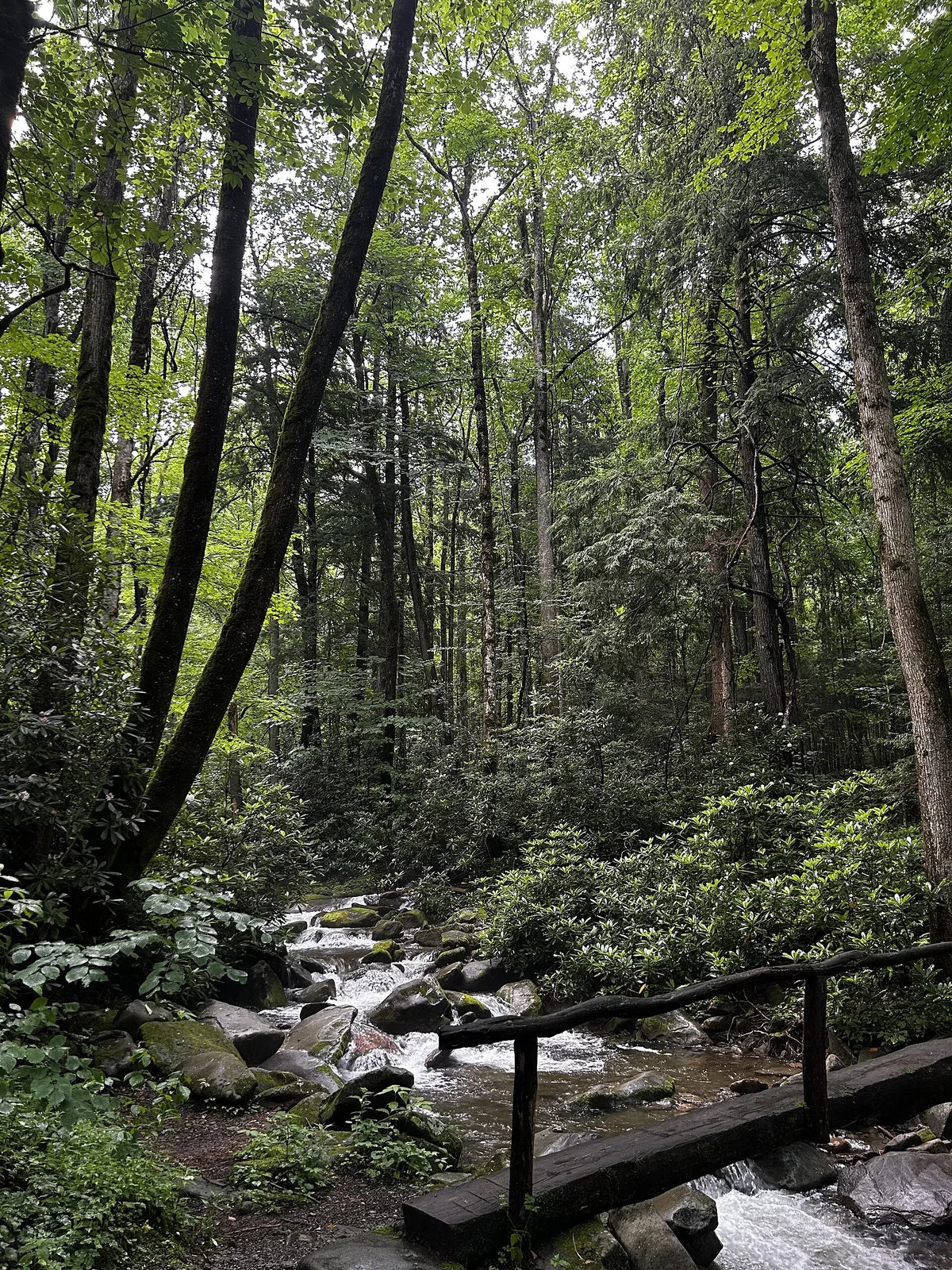
Great Smoky Mountains National Park
The Most Visited National Park in America, Where Ancient Appalachian Forests Meet Misty Mountain Peaks
About Great Smoky Mountains National Park
Great Smoky Mountains National Park is by far the most visited national park in the United States, drawing roughly 12 to 14 million recreation visits a year, more than the next two parks combined. It spans 522,427 acres along the Tennessee-North Carolina line, from about 875 feet elevation in the foothills to 6,643 feet at Clingmans Dome.
The park protects one of the most biologically rich temperate zones on Earth. More than 21,000 species have been documented through the All Taxa Biodiversity Inventory begun in 1998, and researchers estimate the true total may exceed 60,000 to 80,000 when microbes and undescribed invertebrates are included; over 1,000 species new to science have been found here.
The land was assembled in the 1920s and 1930s from thousands of small farms and large timber tracts, with matching money from the Rockefeller family and a federal appropriation, and thousands of residents were bought out or relocated. Congress authorized the park in 1926, it was established for full development in 1934, and President Franklin Roosevelt dedicated it in 1940.
Tennessee and North Carolina transferred the land on the condition that no toll ever be charged on the old state road through the gap, so the Smokies remain one of the few national parks with no entrance fee. The park is a UNESCO World Heritage Site (1983) and an International Biosphere Reserve.
- Designation
- National Park, UNESCO World Heritage Site, UNESCO Biosphere Reserve, International Biosphere Reserve
- Location
- Gatlinburg, Tennessee and Cherokee, North Carolina
- Established
- Established 1934; designated UNESCO World Heritage Site 1983
- Annual Visitors
- ~13 million (most visited national park in the US)
Key Features
The Smokies hold the largest block of old-growth forest in the eastern United States, roughly 187,000 acres that escaped the logging boom of 1900 to 1930, when logging railroads had reached most of the range and were cutting toward the high peaks as the park movement stopped them.
Elevation stacks distinct forest types into a small area: cove hardwood forest in sheltered valleys, with tulip poplars over 150 feet and 500-year-old trees; pine-oak forest on dry ridges; northern hardwood higher up; and a spruce-fir forest on the peaks that resembles the forests of Canada and is a relict of the last ice age.
Albright Grove and the coves along the Porters Creek and Ramsey Cascades trails preserve some of the biggest trees, including record tulip poplars, eastern hemlocks, and yellow buckeyes, and the park has one of the richest spring wildflower displays in North America, with roughly 1,500 kinds of flowering plants.
Chestnut blight, which arrived around 1925, killed the American chestnut that had made up a quarter or more of the canopy, and its gray standing trunks were a defining sight in the early park; oaks and other species have since filled the gaps.
The park is often called the Salamander Capital of the World: about 30 species live here, including many lungless salamanders that breathe through their skin and never leave the moist forest. Several, like the Jordan's (red-cheeked) salamander, are found only in these mountains.
The All Taxa Biodiversity Inventory, run since 1998 by the nonprofit Discover Life in America, aims to identify every living thing in the park. It has added more than 10,000 species to the park's known list and described over 1,000 species entirely new to science, from beetles and flies to fungi and tardigrades.
The park has more tree species (over 100) than all of northern Europe, along with roughly 200 bird species, 67 native fish, more than 80 reptiles and amphibians, and an estimated 1,500 black bears, about two per square mile, one of the densest populations anywhere.
Elk, wiped out of the region by the mid-1800s, were reintroduced in 2001 near Cataloochee, and a few hundred now range the park's eastern valleys. High rainfall of up to 85 inches a year on the peaks, varied terrain, and forest never scraped bare by glaciers explain the richness.
Clingmans Dome, at 6,643 feet, is the highest point in the park, the highest in Tennessee, and the third-highest mountain east of the Mississippi. It sits on the state-line ridge, and the Appalachian Trail crosses its summit, the highest point on the entire 2,190-mile trail.
A steep half-mile paved path climbs from the parking area to a 45-foot concrete observation ramp built in 1959, a spiral tower that lifts visitors above the trees for a 360-degree view said to reach seven states in clear air, though haze often cuts that to a few miles.
The summit is cloaked in Fraser fir and red spruce, a southern outpost of the boreal forest. The balsam woolly adelgid killed most of the mature Fraser firs here after the 1960s; the dead gray snags are still visible, though a new generation of firs is growing up beneath them.
The Eastern Band of Cherokee call the peak Kuwohi, 'mulberry place,' and in 2024 the US Board on Geographic Names approved restoring that name at the tribe's request, replacing the name of Thomas Lanier Clingman, a Confederate general and senator.
The Appalachian Trail runs about 71 miles through the park, almost entirely along the Tennessee-North Carolina state-line ridge, from Fontana Dam in the southwest to Davenport Gap in the northeast, and it includes the trail's highest stretch over Clingmans Dome.
This section is prized for its open, grassy 'balds' such as Andrews Bald and Silers Bald, high meadows of uncertain origin, possibly cleared by grazing, fire, or Native land use, that the park now mows to keep them from growing back to forest.
All backpackers in the park must reserve a spot and stay at designated shelters or campsites; the AT shelters have bear cables and, in most, a chain-link front added decades ago after bear incidents. Thru-hikers, who mostly pass through in April and May, get a limited number of flexible spaces.
Historic sites along the ridge include the fire tower on Mount Cammerer, a stone-and-timber lookout built by the Civilian Conservation Corps in the 1930s and restored in 1995, and the Spence Field and Russell Field grassy ranges used for cattle before the park.
Indigenous Heritage
Eastern Band of Cherokee Indians
The Cherokee (Aniyvwiya) have lived in the southern Appalachians for well over a thousand years, with towns along the rivers on both sides of the Smokies. They called the mountains 'Shaconage,' roughly 'place of the blue smoke,' the same haze that names the park today, and peaks, gaps, and streams throughout carry Cherokee names and stories.
After the state of Georgia and the federal Indian Removal Act of 1830 forced the issue, the fraudulent 1835 Treaty of New Echota ceded all Cherokee land east of the Mississippi. In 1838 the US Army rounded up roughly 16,000 Cherokee into stockades and marched them west on the Trail of Tears; about 4,000 died of disease, cold, and hunger.
Several hundred Cherokee in the Smokies avoided removal, some sheltering in the high mountains near the Oconaluftee River under a leader remembered as Tsali, whose surrender and execution are tied in tradition to their being allowed to stay. Their descendants are the Eastern Band of Cherokee Indians.
The Eastern Band of Cherokee Indians represents approximately 1,000 people who remained in North Carolina by hiding or otherwise evading removal, and their descendants. The tribe's Qualla Boundary (reservation) borders the park on the North Carolina side and the town of Cherokee, NC is the gateway to the park from the south. The tribe operates Harrah's Cherokee Casino and the Museum of the Cherokee Indian, and maintains cultural and spiritual connections to the park lands.
Things To Do
Clingmans Dome (Kuwohi)
The trail is a half mile each way on pavement from the parking area at the end of the seven-mile Clingmans Dome Road, climbing about 330 feet to the observation tower. It is steep enough that the park rates it moderate and provides benches along the way.
The tower's ramp spirals up to a platform at 6,643 feet with a full-circle view over the ridges of the park and, on rare very clear days, into as many as seven states. More often the summit sits in cloud, and visibility can drop to a hundred feet within minutes.
Clingmans Dome Road is closed December 1 through March 31 and whenever it is icy; in winter the summit can be reached only on foot or skis by a longer route. The high elevation keeps summit temperatures 10 to 20 degrees colder than Gatlinburg, with frequent wind and rain.
The parking area is small and fills by mid-morning on summer and fall weekends, so the park encourages early arrival or a sunrise or sunset visit, which are also the best times for photography and for ranger-led dark-sky and bird-migration programs.
Alum Cave Trail
The Alum Cave Trail climbs 4.4 miles round trip and about 1,200 feet from Newfound Gap Road, passing Arch Rock (a natural tunnel with stone steps), the heath-covered outcrop of Inspiration Point, and the 'cave,' actually an 80-foot concave bluff of dry, mineral-streaked rock.
Companies mined the bluff for alum, saltpeter, and Epsom salts in the 1830s to 1850s, and a Confederate operation worked it briefly for saltpeter to make gunpowder during the Civil War.
Hikers can continue past the bluff another 2.5 miles to the summit of Mount Le Conte, at 6,593 feet the third-highest peak in the park, where LeConte Lodge, reachable only on foot, has offered rustic cabin lodging with no electricity since 1934 and books up a year ahead.
The trail is one of the busiest in the park; its lower section was rebuilt with rock steps and cabling in a multi-year project completed in 2020, and trailhead parking along Newfound Gap Road overflows early most days.
Roaring Fork Motor Nature Trail
The Roaring Fork Motor Nature Trail is a narrow, one-way, roughly 5.5-mile loop that leaves Gatlinburg on the Cherokee Orchard Road and winds through old-growth forest beside a fast, boulder-strewn mountain stream, gaining and losing elevation on tight curves.
It passes several preserved farmsteads of the pre-park Roaring Fork community, including the Noah 'Bud' Ogle cabin and its wooden flume water system, the Ephraim Bales place, and the Alfred Reagan cabin and tub mill, with a park brochure keyed to numbered stops.
Short trails from the road lead to Rainbow Falls, an 80-foot drop that is the park's highest single-drop waterfall, and to Grotto Falls, the only Smokies waterfall you can walk behind, on the Trillium Gap Trail used by llamas resupplying LeConte Lodge.
The road is closed in winter and to RVs, buses, and trailers year-round because of its width and grade; it is a favorite for autumn color and, at dusk, for black bear sightings.
Firefly Viewing
For about two weeks in late May or early June, the synchronous firefly Photinus carolinus flashes in unison in the forest around Elkmont, one of the largest displays of the behavior in the Western Hemisphere. Males produce five or six flashes, then all go dark together for several seconds.
Demand far outstrips the small viewing area, so since 2016 the park has run a vehicle-pass lottery on Recreation.gov, opening in late April, with only a few hundred passes per night. Pass holders ride a shuttle from the Sugarlands area to Elkmont after dark.
Once at Elkmont, viewers walk a short section of the old Elkmont resort road and the Little River Trail; flashlights must be covered with red cellophane and pointed at the ground, and leaving the trail or catching fireflies is prohibited.
The peak dates shift each year with temperature and are announced only a week or two ahead, based on monitoring by park biologists. The fireflies are active for roughly two hours after full dark, and rain, wind, or cold dampens the show.
Conservation and Challenges
Hemlock Woolly Adelgid
The hemlock woolly adelgid, a tiny sap-feeding insect from East Asia, was found in the park in 2002 and within a decade had killed the great majority of the park's mature eastern and Carolina hemlocks, an estimated 90 percent or more in many stands.
Hemlock is a foundation species along Smokies streams: its dense shade keeps water cold for brook trout and salamanders and its litter shapes the soil. Its loss opens the canopy, warms streams, and lets rhododendron and invasive plants take over.
The park has treated hundreds of thousands of individual hemlocks in accessible conservation areas with systemic insecticide and has released several species of predatory beetles as a long-term biological control, protecting scattered stands and seed sources.
Some treated trees are surviving, and biologists hope beetle populations will eventually hold the adelgid in check, but most of the park's hemlock forest is now standing dead or down, and full recovery, if it happens, will take a century or more.
Air Quality and Ozone
Sitting downwind of Ohio Valley and southeastern power plants and near the interstate corridor, the Smokies had some of the worst air of any national park through the 1980s and 1990s: average natural visibility of about 93 miles was cut to under 25 on many summer days by sulfate haze.
Ground-level ozone on the high ridges regularly exceeded federal health limits and visibly damaged dozens of plant species, from black cherry to milkweed, with stippled and bronzed leaves; ozone here was sometimes worse than in nearby cities because pollution is carried up and concentrated at elevation.
Acid deposition pushed the pH of some high-elevation streams and soils down far enough to leach aluminum, stress spruce and fir, and harm brook trout, and nitrogen deposition altered soil chemistry across the park.
Clean Air Act rules, the 1999 regional haze program, and the shutdown or scrubbing of many coal plants have sharply cut sulfate and ozone since the 2000s; visibility and stream chemistry are measurably better, though the park still records unhealthy ozone on some hot days.
Overcrowding and Traffic
With 12 to 14 million visits a year on a road system built for a fraction of that, the park sees daily summer and fall gridlock at Cades Cove, Laurel Falls, Alum Cave, Clingmans Dome, and along Newfound Gap Road, and search-and-rescue and medical calls have risen with the crowds.
Cades Cove, an 11-mile one-way loop through a historic valley, can take three or more hours to drive on a peak afternoon; the park closes it to cars on Wednesday mornings in the warm season for cyclists and walkers.
Because the park charges no entrance fee, it long lacked the per-visitor revenue other big parks use for shuttles and staffing. In 2023 it introduced a 'Park It Forward' parking tag, required for stopping more than 15 minutes, which is not an entrance fee but funds maintenance and rangers.
The gateway towns of Gatlinburg, Pigeon Forge, and Sevierville have grown into a dense tourist strip whose traffic backs up to the park boundary, and the 2016 Chimney Tops 2 fire, which started in the park and spread into Gatlinburg, killed 14 people and destroyed thousands of buildings.
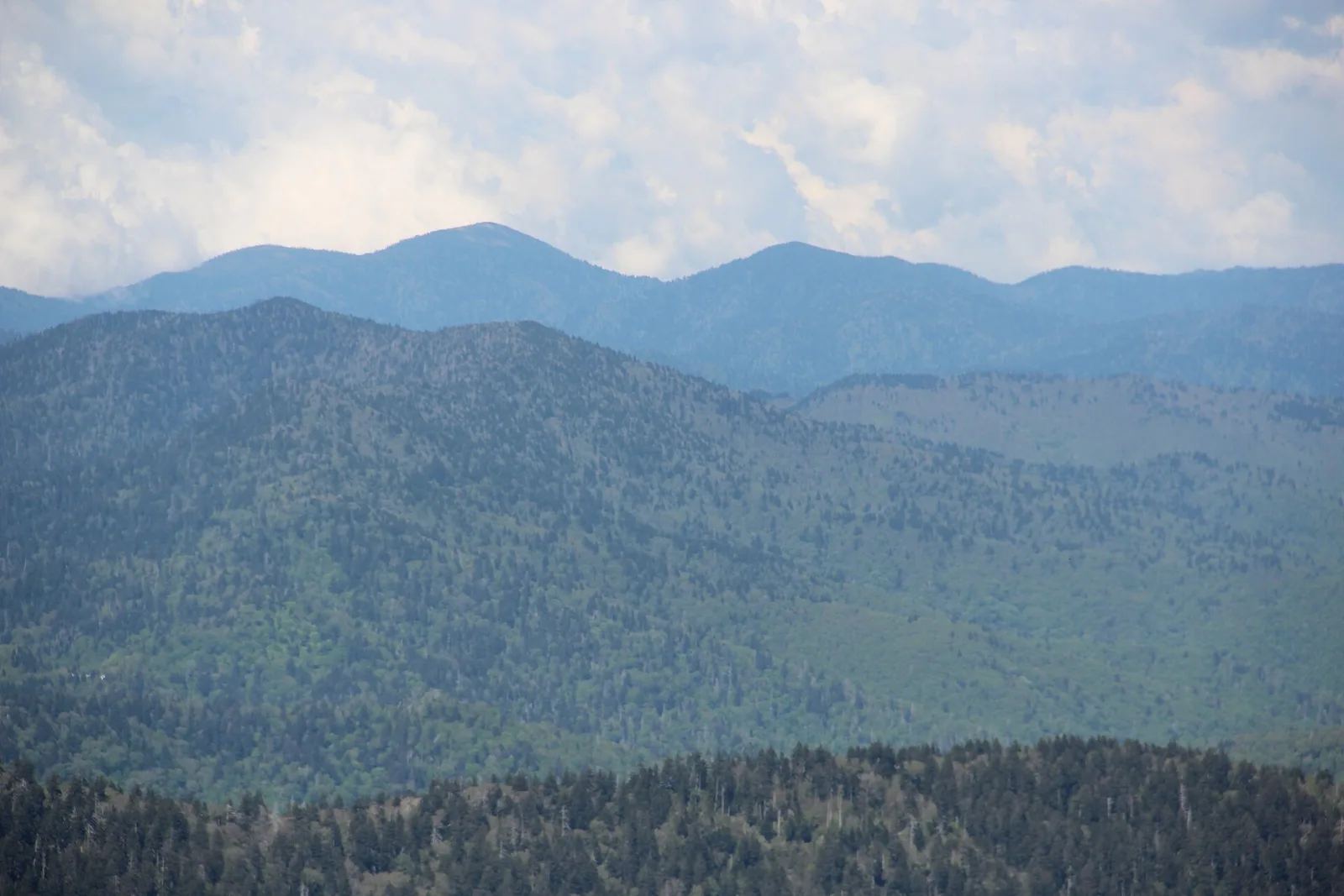
Clingmans Dome at 6,643 feet, the highest point in the Smokies
Fast Facts
Did You Know?
Great Smoky Mountains National Park has never charged an entrance fee. When the land was assembled from private owners in the 1920s and 1930s, Tennessee and North Carolina contributed state funds on the condition that the park would always remain free. The federal government honored that commitment, and today the Smokies welcome more visitors than any other national park at no charge, making it genuinely accessible to families regardless of income.
The Great Smoky Mountains are sometimes called the Salamander Capital of the World, with 30 species recorded in the park, more than anywhere else on the planet. The park's clean streams, diverse habitats, and undisturbed old-growth forest create ideal conditions for amphibians. Salamanders are ecological indicators: their presence and health reflects the overall condition of the ecosystem. Scientists have used salamander population trends in the Smokies to track the effects of air pollution and climate change on the Appalachian ecosystem.
The Cherokee word for the Smoky Mountains, Shaconage, means place of blue smoke, describing the same natural haze that Europeans later named the park for. The Cherokee have lived in these mountains for thousands of years and their presence is reflected in many of the park's place names and in the Eastern Band of Cherokee Indians who still live on the Qualla Boundary adjacent to the park's North Carolina entrance. The Trail of Tears, which forced most Cherokee from their homelands in 1838, passed near the park.
Plan Your Visit
Location
Gatlinburg, Tennessee and Cherokee, North Carolina
Designation
National Park, UNESCO World Heritage Site, UNESCO Biosphere Reserve, International Biosphere Reserve
Crowds
Summer weekends and fall foliage season (mid-October) are extremely crowded. The Sugarlands and Laurel Falls areas near Gatlinburg can be gridlocked. Arrive before 9am or after 5pm for parking. Midweek is significantly less crowded.
Entrance Fee
Free. Great Smoky Mountains is the only major national park with no entrance fee, a condition of the original park agreement.
Getting There
The park has three main entrances: Gatlinburg, TN (most popular); Cherokee, NC; and Townsend, TN. No public transit serves the park. A car is required.
Synchronous Fireflies
Reserve firefly lottery passes on Recreation.gov starting in April. Passes are required during the 2-week event period in May-June and are extremely limited.
Wildlife
Black bears are common in the park. Store all food properly, never feed wildlife, and maintain a 50-yard distance from bears at all times.