

About Alabama
The name Alabama comes from the Alabama people, a Muscogean-speaking nation who lived along the river that now bears their name. The word "Alabama" is believed to derive from the Choctaw words "Alba" (vegetation or plants) and "Amo" (to clear or gather), possibly meaning "those who clear the thicket" or "those who collect plants." When Spanish explorers arrived in the region in the 1500s, they recorded the name of the river and the people who lived there, and the name was carried forward into the English colonial period and eventually given to the state.
Alabama sits in the Deep South, covering about 52,000 square miles between Mississippi to the west and Georgia to the east. It's a state of real geographic variety, from the southern tail of the Appalachian Mountains in the northeast, across broad fertile plains in the center, down to a narrow strip of Gulf Coast beaches in the south.
More than most states, Alabama carries the full weight of American history. It was a center of the antebellum plantation economy, the first capital of the Confederacy, and then, a century later, the epicenter of the movement that dismantled legal segregation in America. The Edmund Pettus Bridge in Selma and the Saturn V rocket in Huntsville are both Alabama's story, and the tension between those two things is never far from the surface.
Today Alabama has a diversified economy built on aerospace, automotive manufacturing, agriculture, and healthcare, with Huntsville emerging as one of the fastest-growing tech and defense cities in the South.

Geography, Five Distinct Regions
Alabama is more geographically diverse than most people expect. From mountains to beaches, the state spans five very different landscapes. Tap any region to learn more.
The northern strip of the state, carved out by the Tennessee River. This region is home to Huntsville, Alabama's largest city and its tech and aerospace hub. The river was tamed by a series of TVA dams during the New Deal era, providing cheap electricity that helped fuel industrial growth.
The Tennessee Valley Authority built Wheeler Dam and several other dams along the river in the 1930s as part of the New Deal, and decades later Huntsville's Redstone Arsenal became the base where Wernher von Braun's team designed the Saturn V rocket that carried Apollo astronauts to the moon.
Huntsville passed Birmingham as Alabama's largest city in the 2020 census, its population nearly doubling since 1990 on the strength of Redstone Arsenal, Cummings Research Park (the second-largest research park in the country), and companies including Boeing, Blue Origin, and the Mazda Toyota joint-venture plant that opened in 2021.
The valley is also Alabama's Tennessee River corridor for barge traffic, linked to the Tombigbee and the Gulf by the Tennessee-Tombigbee Waterway that opened in 1985. Wheeler National Wildlife Refuge near Decatur, created on TVA reservoir land, is the southernmost wintering ground for large flocks of sandhill cranes and, in recent years, endangered whooping cranes.
The northeast corner where the tail end of the Appalachian Mountains enters Alabama. Cheaha Mountain, the state's highest point at 2,413 feet, sits here. The ridges and valleys run northeast to southwest, shaped by millions of years of folding and erosion. Good for hiking, not so great for farming.
Much of this region falls within the Talladega National Forest, Alabama's largest national forest, and the Talladega Scenic Byway winds along the ridge past waterfalls and overlooks popular with hikers on the Pinhoti Trail.
The ridges hold Alabama's coal and iron seams. Birmingham, at the southern end of this province, was one of the few places on Earth with coal, iron ore, and limestone close together, which is why it became 'the Pittsburgh of the South' after its founding in 1871. The convict-lease system that supplied those mines and furnaces with mostly Black prisoners lasted until 1928, among the last in the nation to end.
Cheaha State Park, built by the Civilian Conservation Corps in the 1930s, sits at the summit, and the 335-mile Pinhoti Trail connects through Georgia to the Appalachian Trail. Nearby Anniston grew up around Fort McClellan, an Army post that trained chemical-warfare and military-police units until it closed in 1999; parts of the base and surrounding neighborhoods are Superfund sites tied to decades of PCB pollution from a chemical plant in town.
A transitional zone of rolling hills between the mountains and the flat coastal plain. This region historically supported small farms and today has a mix of manufacturing towns and rural communities.
Sylacauga, in this region, has been quarried for its unusually pure white marble since the 1830s, prized for statues and building facades across the country.
The Piedmont's thin soils were largely worn out by cotton by the early 20th century, and much of the land was replanted in pine; it is now one of the most heavily forested parts of the state, feeding pulp and paper mills. Alexander City is the longtime home of Russell Athletic, once one of the largest makers of T-shirts and sweatshirts in the world.
Sylacauga marble is fine-grained enough that it was used in the U.S. Supreme Court Building and other national landmarks, and the town holds an annual marble festival. The region also produced Alabama's own gold rush: a strike in the 1830s around Arbacoochee and Chulafinnee drew thousands of prospectors, most of whom left for California in 1849.
The broad, flat lower half of the state, Alabama's agricultural heartland. The 'Black Belt' runs through here, named for its dark, fertile soil. This region was the center of Alabama's cotton plantation economy before the Civil War and remains important for farming, particularly poultry, cattle, and soybeans.
The region includes Dallas County and the city of Selma, where the soil's rich cotton-growing capacity built a plantation economy dependent on enslaved labor before the Civil War, a legacy still visible in the county's demographics today.
The Black Belt's cotton economy made antebellum Alabama one of the wealthiest states per free person in the country, built entirely on the labor of enslaved people, who by 1860 made up about 45 percent of the state's population. After the Civil War the same counties became the heart of sharecropping, and today the Black Belt is among the poorest regions in the United States, with counties that have lost more than half their population since 1900.
The plain also holds Alabama's peanut country around Dothan in the southeast, which calls itself the 'Peanut Capital of the World,' and its longleaf pine forests, once covering most of the coastal plain and now reduced to a small fraction, are the focus of one of the largest ecosystem-restoration efforts in the South. The Alabama and Tombigbee rivers join near Coffeeville to form the Mobile River.
Alabama's slender 53-mile coastline on the Gulf of Mexico, the shortest coastline of any coastal state. Mobile Bay is the dominant feature: a large estuary that made Mobile one of the South's most important port cities for over three centuries. The white-sand beaches of Gulf Shores draw millions of visitors each year.
Mobile has flown five different national flags in its history, French, British, Spanish, Confederate, and American, a legacy it commemorates each year during its Mardi Gras celebrations, the oldest in the United States.
The Port of Mobile is the state's only deep-water seaport and among the ten largest in the country by tonnage; a channel-deepening project of about $366 million, completed in 2025, lets it handle the largest container ships. Airbus opened its first U.S. commercial-aircraft assembly line in Mobile in 2015 and now builds A220 and A320-family jets there.
In 1860 the schooner Clotilda smuggled 110 kidnapped Africans into Mobile Bay in the last known slave ship to reach the United States, more than 50 years after importing enslaved people was banned. Some of the survivors founded Africatown north of Mobile, and the Clotilda's wreck was located in the Mobile River in 2019. The coast was also battered by Hurricane Katrina in 2005 and by the 2010 Deepwater Horizon oil spill, which closed beaches and fisheries across the region.

Economy
Alabama's economy has transformed dramatically over the past 50 years, from one heavily dependent on agriculture and steel to a diversified mix of high-tech industries. Tap any sector to learn more.
Huntsville's Redstone Arsenal is home to NASA's Marshall Space Flight Center, the birthplace of the Saturn V rocket that sent Americans to the moon. Today it houses the Army's aviation and missile command. The Huntsville metro is one of the most concentrated aerospace engineering communities in the world.
Redstone Arsenal began in 1941 as a World War II-era chemical weapons manufacturing plant before being repurposed in 1950 for Wernher von Braun's rocket team, which had recently relocated from Fort Bliss, Texas.
Marshall Space Flight Center manages the propulsion for NASA's Space Launch System, the rocket for the Artemis moon program, and runs the Payload Operations Integration Center that controls science experiments aboard the International Space Station around the clock. Redstone also hosts the FBI's second headquarters campus and the Missile Defense Agency, and roughly 45,000 people work on the arsenal.
The 2021 decision to base U.S. Space Command in Huntsville rather than Colorado Springs was reversed in July 2023, when the Biden administration kept the headquarters in Colorado, and then reinstated in September 2025, when the Trump administration announced the move to Redstone Arsenal, a back-and-forth worth thousands of jobs that became a running political fight between the two states. Huntsville keeps growing regardless: Blue Origin builds BE-4 and BE-3 rocket engines there, and the metro's median household income is among the highest in the South.
Alabama is a major auto-manufacturing state. Mercedes-Benz (Tuscaloosa), Honda (Lincoln), Toyota (Huntsville), and Hyundai (Montgomery) all have major assembly plants here, producing hundreds of thousands of vehicles a year. The auto industry supports tens of thousands of jobs directly and indirectly.
The industry is relatively recent: Mercedes-Benz broke ground on its Tuscaloosa County plant in 1993, the first foreign automaker to build cars in Alabama, and its success drew Honda, Hyundai, and Toyota to the state within the following decade.
Alabama assembled more than a million vehicles in 2023, consistently ranking it among the top three or four auto-producing states. Mercedes builds its GLE and GLS and its electric EQE and EQS SUVs near Tuscaloosa, Honda builds the Odyssey, Pilot, Passport, and Ridgeline near Talladega, Hyundai builds the Santa Fe, Santa Cruz, and Tucson in Montgomery, and the Mazda Toyota plant in Huntsville builds the Corolla Cross and Mazda CX-50.
The plants pay well above the state's median wage but are not unionized; a closely watched 2024 vote to organize the Mercedes plant, seen as a test of the UAW's push into the South, failed. The state has offered hundreds of millions of dollars in incentives to land each plant, a strategy credited with transforming the economy of central Alabama and criticized for its cost per job.
Alabama is one of the top poultry-producing states in the nation, broiler chickens are the single most valuable agricultural product. Cattle ranching, cotton, peanuts, soybeans, and timber round out the agricultural economy. The Black Belt region remains an important farming area despite decades of population decline.
The town of Enterprise, Alabama, erected a monument to the boll weevil in 1919, an insect that had devastated cotton crops in the early 1900s and forced farmers to diversify into peanuts and other crops, indirectly crediting the pest for the region's renewed prosperity.
Alabama raises well over a billion broiler chickens a year, and poultry and eggs make up roughly two-thirds of the state's farm cash receipts; the industry is concentrated in the northern counties around Cullman and Marshall and relies heavily on immigrant labor in its processing plants. Timber covers about 70 percent of the state, more forested acreage than nearly any other, and forest products are a multibillion-dollar industry.
Cotton, once the whole economy, is now a modest crop grown mostly in the Tennessee Valley and Black Belt. Alabama is a leading producer of farm-raised catfish, centered on the Black Belt's Hale and Dallas counties, where clay soils hold ponds well, and its peanut, pecan, and sweet-potato crops are significant. The 1919 boll weevil monument in Enterprise is still the only monument in the world honoring an agricultural pest.
Birmingham was built on iron and steel, sitting atop deposits of iron ore, coal, and limestone, it became a major industrial center in the late 1800s. While the steel industry shrank dramatically in the 20th century, manufacturing remains important statewide, including steel mini-mills, chemicals, and medical equipment.
Birmingham was founded in 1871 specifically as an industrial city and named after Birmingham, England, chosen because it was one of the few places on Earth where iron ore, coal, and limestone, the three raw materials needed to make steel, could all be found within a few miles of one another.
U.S. Steel's Fairfield Works near Birmingham, once the largest steel plant in the South, has shrunk to a single electric-arc mini-mill, and the Sloss Furnaces that ran from 1882 to 1971 are now a National Historic Landmark and event venue in the middle of the city. The blast furnace at nearby ABC Coke is the last one still operating in the district.
Modern manufacturing is more varied: pipe and tube makers, stainless and carbon steel mills run by Nucor and Outokumpu, and the shipbuilder Austal USA in Mobile, which builds Navy littoral combat and support ships. Birmingham has also reinvented itself around UAB and biomedical research, and its downtown has drawn tech and finance offices as the cost of living stays low relative to larger Southern cities.
The University of Alabama at Birmingham (UAB) is Alabama's largest employer and one of the nation's leading academic medical centers. The University of Alabama (Tuscaloosa) and Auburn University are also major economic drivers, together these anchor significant research, healthcare, and education economies.
UAB traces its roots to the Medical College of Alabama, which relocated to Birmingham in 1945 and became an independent campus within the University of Alabama System in 1969. It now regularly ranks among the top public universities nationally for National Institutes of Health research funding.
UAB employs more than 25,000 people, making it the single largest employer in Alabama, and its hospital is among the largest in the country by bed count. Its researchers were central to early HIV/AIDS science, and the university brings in more than $700 million a year in research funding.
The University of Alabama and Auburn together enroll more than 70,000 students, and their athletic programs are an economic force in themselves; Alabama football alone generates over $200 million a year. The state has also had a rural hospital crisis: Alabama has not expanded Medicaid, and more than a dozen rural hospitals have closed or ended inpatient or maternity care since 2010.
Tourism is a significant industry, driven by Gulf Shores and Orange Beach beaches, the civil rights heritage trail (Birmingham, Montgomery, Selma), the U.S. Space & Rocket Center in Huntsville, and the massive college football culture around Alabama and Auburn. The Robert Trent Jones Golf Trail also draws golfers from around the world.
The Robert Trent Jones Golf Trail, which opened its first courses in 1992, was built using state pension fund investment as a deliberate economic development project, and now spans 26 courses across 11 sites statewide.
The beaches at Gulf Shores and Orange Beach draw the largest share of tourist spending, and the coast has rebuilt repeatedly after hurricanes, most severely after Ivan in 2004 and Sally in 2020. The Hangout Music Festival on the Gulf Shores sand and the annual 'Mullet Toss' at the Flora-Bama bar on the state line are among the coast's signature events.
Civil rights tourism has grown into a major draw, anchored by the Legacy Museum and the National Memorial for Peace and Justice, which opened in Montgomery in 2018 to confront the history of slavery, lynching, and mass incarceration. The U.S. Civil Rights Trail links sites in Montgomery, Birmingham, Selma, and Tuscumbia, and the Edmund Pettus Bridge in Selma, a National Historic Landmark, draws pilgrimages each March.

How Alabama's State Government Works
Like the federal government, Alabama's state government is divided into three branches: executive, legislative, and judicial. The state operates under its own constitution, ratified in 1901 and one of the longest and most amended constitutions in the world, with over 900 amendments. A new, streamlined state constitution took effect in November 2022 after voters approved a recompiled version.
Alabama has a strong executive branch tradition. The governor serves a four-year term and can serve up to two consecutive terms. Unlike some states, the lieutenant governor in Alabama was historically elected separately from the governor, meaning the two could be from different parties. A 2022 constitutional amendment changed this going forward, putting them on a joint ticket.
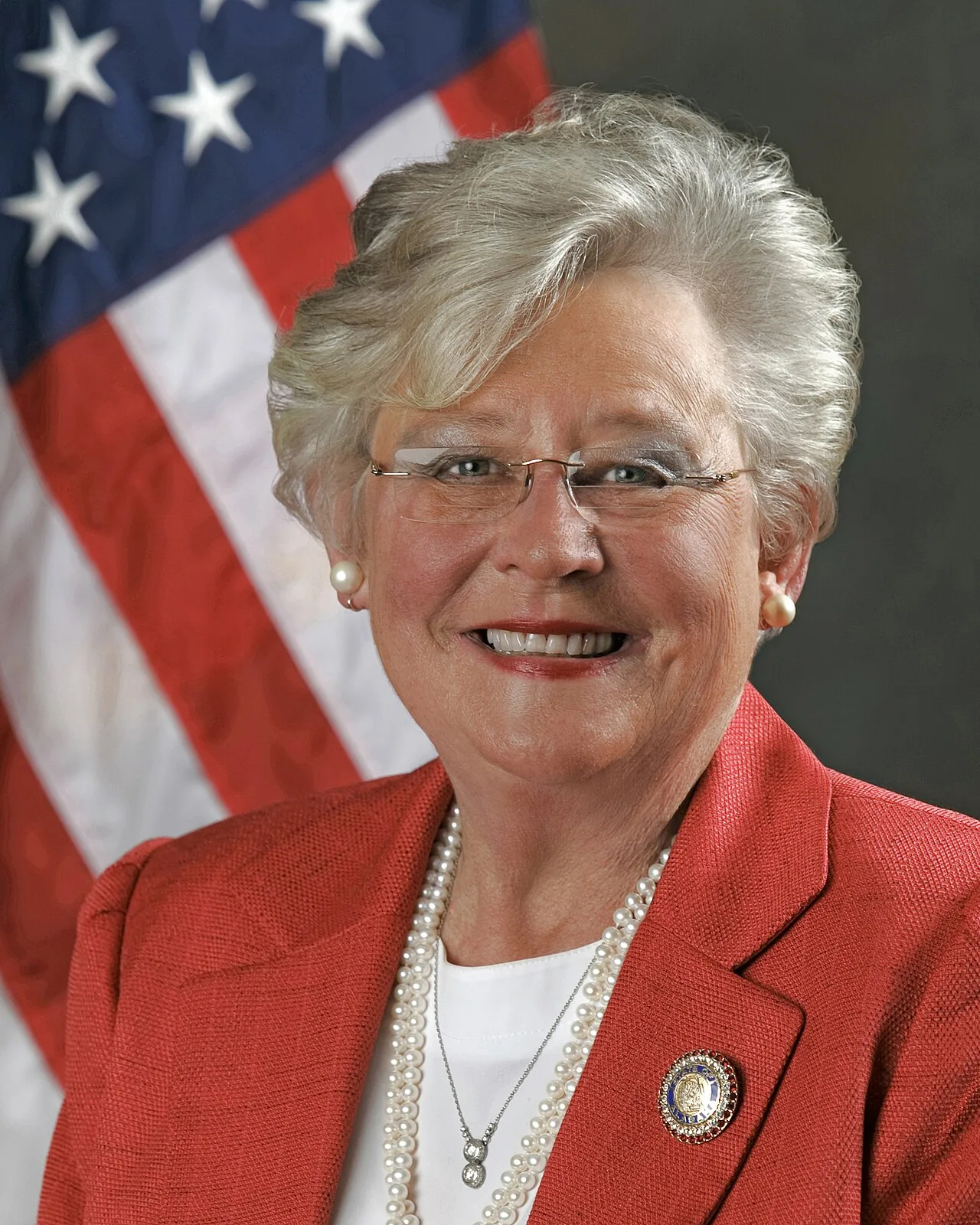
Governor of Alabama
Current Governor
Kay Ivey
- Party
- Republican
- In Office Since
- April 10, 2017
- Elected
- 2018 (full term), re-elected 2022
- Term Ends
- January 2027
- Born
- October 1, 1944, Camden, AL
- Education
- B.S., Auburn University (1967)
- Prior Role
- Lt. Governor (2011-2017)
- Before That
- Alabama State Treasurer (2003-2011)
Kay Ivey became governor when Robert Bentley resigned amid scandal in 2017. She won her first full term in 2018 by a wide margin and was re-elected in 2022, making her one of the longest-serving current governors in the South. She is Alabama's second female governor, after Lurleen Wallace (1967-1968).
Other Current State Officials
Lieutenant Governor
Will Ainsworth
First Lt. Governor to hold expanded powers under the 2023 constitutional amendment.
Attorney General
Steve Marshall
In office since 2017.
Secretary of State
Wes Allen
In office since 2023.
State Treasurer
Young Boozer
In office since 2011.
* Official information as of early 2025. Always verify current officeholders at alabama.gov.
The Alabama Legislature
Alabama Senate
- Seats: 35 members
- Terms: 4-year terms
The Senate is the upper chamber. Each senator represents a geographic district. The Lieutenant Governor presides over the Senate.
Alabama House of Representatives
- Seats: 105 members
- Terms: 4-year terms
The House is the larger lower chamber. The Speaker of the House is elected by members and is one of the most powerful positions in state government.
Alabama's U.S. Senators
Every state gets exactly two U.S. Senators, regardless of population. Alabama's senators serve 6-year terms and represent the entire state.
U.S. Senator
Tommy Tuberville
Former Auburn University head football coach who won election in 2020, defeating incumbent Democrat Doug Jones.
U.S. Senator
Katie Britt
Elected in 2022 at age 40, the youngest Republican woman ever elected to the U.S. Senate. Former aide to Senator Richard Shelby.
Alabama's U.S. House Delegation
Alabama has 7 seats in the U.S. House of Representatives, based on its population. Each member represents a congressional district and serves 2-year terms.
In 2023, the U.S. Supreme Court ruled in Allen v. Milligan that Alabama's congressional map violated the Voting Rights Act by packing Black voters into a single district (District 7) rather than creating a second district where Black voters could also have meaningful representation. Alabama was required to redraw its map, and the new map was in effect for the 2024 elections.
📋 Verify Current Members
House membership changes every two years. For the current names and districts, visit house.gov and search Alabama.
Alabama Through the Years
Few states have been more central to the defining chapters of American history. Tap any era to read more.
Before European contact, Alabama was home to several powerful Native nations: the Cherokee in the northeast, the Creek (Muscogee) across the central and eastern regions, the Choctaw in the southwest, and the Chickasaw in the northwest. The name 'Alabama' likely comes from the Alabama people, a branch of the Creek Confederacy. It may mean 'thicket clearers' or 'vegetation gatherers' in their language.
The Mississippian culture that preceded these nations built Moundville, on the Black Warrior River south of Tuscaloosa, into one of the largest cities in North America around 1200-1400 CE, with more than two dozen earthen mounds around a central plaza and a population in the thousands. It is preserved today as an Alabama archaeological park.
The Creek War of 1813-14, a civil war within the Creek Nation that drew in the United States, ended at the Battle of Horseshoe Bend in east-central Alabama, where Andrew Jackson's forces killed roughly 800 Red Stick Creeks. The Treaty of Fort Jackson that followed took about 23 million acres, more than half of present-day Alabama, from the Creeks, including from the Creek factions that had fought alongside Jackson.
Over the next two decades the United States forced the Creek, Cherokee, Choctaw, and Chickasaw out of Alabama on the routes remembered as the Trail of Tears, with the last major Creek removal in 1836-37. Only the Poarch Band of Creek Indians, descended from Creeks who managed to stay, holds federal recognition and a reservation in Alabama today.
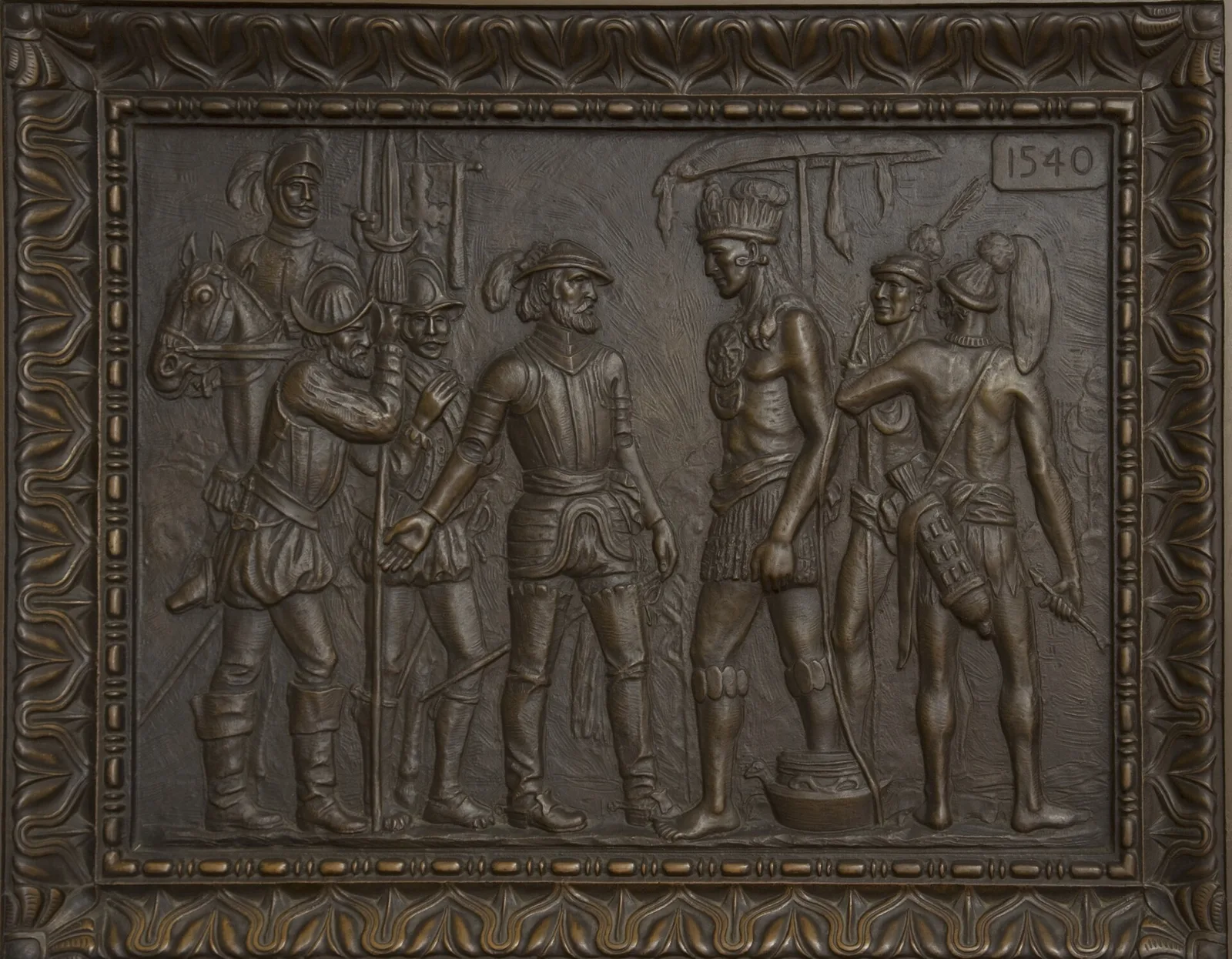
Spanish explorer Hernando de Soto led an expedition through the region, encountering fierce resistance. The Battle of Mabila (1540) was one of the bloodiest conflicts between Europeans and Native Americans in the Southeast. De Soto's forces defeated the forces of Chief Tuskaloosa, but suffered heavy losses themselves.
De Soto's expedition of some 600 men and 200 horses cut across the Southeast from 1539 to 1543 looking for gold, seizing food and taking Native people as porters and guides in chains. At Mabila, near modern Selma, Tuskaloosa's warriors ambushed the Spanish inside a fortified town; the Spanish burned it and killed most of those inside but lost many men and nearly all their supplies and pearls.
The expedition itself found little gold, but the diseases it and later Europeans carried, smallpox above all, collapsed the Mississippian chiefdoms of the region within a century or two. By the time French and English traders arrived, the great mound towns were mostly abandoned and the survivors had regrouped into the Creek and other confederacies.
No permanent European settlement followed for more than 160 years. Spain, France, and Britain traded claims to the Gulf Coast in the meantime. The city of Tuscaloosa, the Black Warrior River, and Tuscaloosa County all carry a version of the chief's name, which means 'black warrior' in Choctaw.
French colonizers established Fort Louis de la Mobile, the first permanent European settlement in Alabama (and one of the earliest in the entire Mississippi Valley). Mobile would change hands between the French, British, and Spanish before becoming American territory. Remarkably, Mobile also claims the first Mardi Gras celebration in what is now the United States (1703), predating New Orleans.
The French moved the settlement to the present site of Mobile in 1711 after repeated floods, and it served as the capital of French Louisiana until that role passed to New Orleans in 1720. Mobile went to Britain in 1763, to Spain in 1780, and was seized by the United States in 1813, the only part of Alabama taken directly from a European power rather than from Native nations.
Mobile's Carnival tradition began under French rule, and its modern Mardi Gras, revived after the Civil War by a clerk named Joe Cain, predates and helped inspire the New Orleans celebration. The city's mystic societies, some dating to the 1830s, still stage the parades each year.
The port grew on cotton shipped down the Alabama and Tombigbee rivers, and by 1860 Mobile was the second-largest cotton-exporting port in the country after New Orleans and the only city of real size in the state. The Battle of Mobile Bay in 1864, where Admiral David Farragut is said to have ordered 'Damn the torpedoes, full speed ahead,' closed the last major Gulf port open to the Confederacy.
Alabama was admitted to the Union on December 14, 1819, as the 22nd state. Montgomery was not yet the capital, the first capital was Huntsville (where the constitution was drafted), then Cahaba, then Tuscaloosa, before Montgomery became the permanent capital in 1846.
Statehood came at the peak of 'Alabama Fever,' a land rush that followed the Creek cession. White settlers and enslaved people poured in from Georgia, the Carolinas, and Virginia, and the non-Native population jumped from a few thousand in 1810 to more than 125,000 by the 1820 census. Public land sales at Huntsville and Cahaba financed the new government.
The 1819 constitution written at Huntsville was liberal for its time on white male suffrage, dropping property requirements, but it protected slavery and counted enslaved people as three-fifths of a person for legislative apportionment, tilting power toward the Black Belt planters who would dominate Alabama politics until the Civil War.
The capital's four moves in 27 years, Huntsville, Cahaba, Tuscaloosa, and finally Montgomery in 1846, tracked the population shifting south and east toward the Black Belt and the rivers. Cahaba, the second capital, was abandoned after repeated flooding and is now a ghost town preserved as a state historic site.
When Southern states seceded, Montgomery served as the first capital of the Confederate States of America. Jefferson Davis was inaugurated as Confederate President on the steps of the Alabama State Capitol on February 18, 1861, the same steps that would later be the destination of the 1965 Selma to Montgomery voting rights marches. The Confederate capital moved to Richmond, Virginia just four months later.
Delegates from six seceded states met in Montgomery in February 1861, wrote the Confederate constitution, and chose Davis as president; the order to open fire on Fort Sumter was telegraphed from Montgomery's Winter Building. The capital moved to Richmond in May 1861, mainly to keep Virginia in the Confederacy and closer to the fighting.
Alabama sent about 120,000 men into Confederate service, and roughly a third died. The northern hill counties, with few enslaved people and little stake in the plantation economy, resisted secession; Winston County's 'Free State of Winston' episode became local legend, and thousands of Alabamians, Black and white, fought for the Union.
Union cavalry under General James H. Wilson swept through the state in the final weeks of the war in 1865, burning the ironworks and the University of Alabama campus at Tuscaloosa and capturing the Selma arsenal. Alabama was readmitted in 1868, then rewrote its constitution in 1901 explicitly to disenfranchise Black voters and poor whites; that document, the longest constitution in the world, was replaced only in 2022.
Alabama was the epicenter of the American Civil Rights Movement. Rosa Parks refused to give up her bus seat in Montgomery (December 1955), sparking a 381-day bus boycott led by the young Reverend Dr. Martin Luther King Jr. The Birmingham Campaign (1963) shocked the nation with images of fire hoses and police dogs turned on peaceful protesters.
The 16th Street Baptist Church bombing (September 15, 1963) killed four young girls at Sunday school. The Selma to Montgomery marches (1965), including Bloody Sunday on the Edmund Pettus Bridge, led directly to the Voting Rights Act of 1965.
The Freedom Riders were beaten by mobs in Anniston and Birmingham in May 1961, and a bus was firebombed outside Anniston. George Wallace, elected governor in 1962 on the pledge of 'segregation now, segregation tomorrow, segregation forever,' staged his 'stand in the schoolhouse door' at the University of Alabama in June 1963 before stepping aside for federalized National Guard troops.
Alabama's resistance produced the laws that ended legal segregation nationally: the Birmingham images helped force the Civil Rights Act of 1964, and Bloody Sunday led directly to the Voting Rights Act of 1965. Black voter registration in Alabama rose from about 19 percent of voting-age Black adults in 1965 to more than half within two years.
The Saturn V rocket that carried humans to the moon was designed and built in Huntsville, Alabama, by Wernher von Braun's team at NASA's Marshall Space Flight Center. On July 16, 1969, the Saturn V launched Apollo 11, the mission that landed Neil Armstrong and Buzz Aldrin on the moon. Huntsville's space and missile heritage earned it the nickname 'Rocket City,' a title it still carries proudly.
Von Braun and about 120 members of his team came to the United States after World War II under Operation Paperclip, having built the V-2 ballistic missile for Nazi Germany using slave labor from the Mittelbau-Dora concentration camp, a history the U.S. downplayed for decades. The team moved from Fort Bliss, Texas, to Redstone Arsenal in 1950 and built the Army's Redstone and Jupiter missiles.
After the Soviet Union launched Sputnik in 1957, a modified Jupiter-C rocket built by the Redstone team launched Explorer 1, America's first satellite, in January 1958. NASA created the Marshall Space Flight Center at Huntsville in 1960 with von Braun as its first director, and Marshall designed all three stages of the Saturn V.
Huntsville's population roughly tripled through the 1950s and 1960s as the space program grew. The U.S. Space & Rocket Center, home of Space Camp since 1982 and of a horizontal Saturn V that is a National Historic Landmark, draws hundreds of thousands of visitors a year, and Marshall now leads propulsion work for the Artemis moon rockets.
Alabama's Defining Moments in American History
These are the events that didn't just shape Alabama, they changed the nation.
On December 1, 1955, Rosa Parks, a seamstress and NAACP secretary, refused to give up her seat in the 'colored' section of a Montgomery city bus to a white passenger. She was arrested. Over the next 381 days, Black residents of Montgomery organized a near-total boycott of the city's bus system, carpooling and walking miles to work.
The Supreme Court ultimately ruled bus segregation unconstitutional. It was the opening battle of the modern Civil Rights Movement.
Parks was not simply tired: she was a trained activist, secretary of the Montgomery NAACP, and had attended the Highlander Folk School. Nine months earlier, 15-year-old Claudette Colvin had been arrested for the same act, but movement leaders chose Parks as the test case. The boycott made the 26-year-old Martin Luther King Jr., barely a year into his first pastorate, a national figure.
The legal challenge, Browder v. Gayle, was brought in the names of four other Montgomery women, and the Supreme Court affirmed a lower-court ruling that bus segregation was unconstitutional in November 1956; the boycott ended after 381 days when the order took effect that December. Boycotters had run a private carpool of some 300 cars, and the city retaliated by indicting King and 88 others under an anti-boycott law.
Dr. King and the Southern Christian Leadership Conference deliberately chose Birmingham, then one of the most segregated cities in America, for a series of nonviolent demonstrations in the spring of 1963. Public Safety Commissioner Bull Connor responded with fire hoses and police dogs.
The images were broadcast around the world, horrifying the nation and creating enormous pressure on the Kennedy administration to act. The Civil Rights Act of 1964 was a direct result.
When adult volunteers ran low, organizers launched the 'Children's Crusade' in early May 1963: hundreds of schoolchildren marched and were arrested, filling the jails. It was the images of dogs and fire hoses used on children that broke the stalemate and brought the city's business leaders to the negotiating table.
King wrote his 'Letter from Birmingham Jail' while held during the campaign, answering white clergy who had called the protests 'unwise and untimely' with a defense of civil disobedience that became one of the most-read documents of the movement. Birmingham's downtown stores desegregated within weeks, and the campaign is widely seen as the turning point that made the 1964 Civil Rights Act possible.
On September 15, 1963, two weeks after the March on Washington, members of the Ku Klux Klan bombed the 16th Street Baptist Church in Birmingham during Sunday school. Four young girls were killed: Addie Mae Collins (14), Cynthia Wesley (14), Carole Robertson (14), and Carol Denise McNair (11).
The bombing galvanized public opinion and accelerated the push for federal civil rights legislation.
Two more Black youths were killed in Birmingham the same day, one shot by police and one by white teenagers, bringing the day's toll to six. The FBI identified four Klansmen as suspects within weeks but, under director J. Edgar Hoover, withheld the evidence, and no one was tried for years.
Alabama attorney general Bill Baxley reopened the case and won a conviction of Robert Chambliss in 1977. Two more men, Thomas Blanton and Bobby Frank Cherry, were finally convicted in 2001 and 2002 after the FBI released its files. The four girls were posthumously awarded the Congressional Gold Medal in 2013.
On March 7, 1965, about 600 civil rights marchers, led by John Lewis and Hosea Williams, attempted to march from Selma to Montgomery to demand voting rights. On the Edmund Pettus Bridge, state troopers attacked them with clubs and tear gas on live television. The day became known as Bloody Sunday.
Two weeks later, with federal protection, marchers completed the 54-mile journey to the state capitol. The Voting Rights Act of 1965 was signed into law that August.
The march had been called after Jimmie Lee Jackson, a 26-year-old deacon, was shot by a state trooper during a night protest in nearby Marion in February 1965. In the days after Bloody Sunday, a white Boston minister, James Reeb, was beaten to death by white men in Selma, and a Detroit homemaker, Viola Liuzzo, was murdered by Klansmen while driving marchers back from Montgomery.
President Johnson responded with a televised address to Congress on March 15, using the movement's own phrase 'we shall overcome,' and sent the Voting Rights Act to Capitol Hill days later. Federal judge Frank M. Johnson ordered the state to permit the march, and about 25,000 people reached the Montgomery capitol on March 25. The bridge is named for Edmund Pettus, a Confederate general and Klan leader, and there have been repeated calls to rename it.
The most powerful rocket ever built was conceived, designed, and tested in Huntsville, Alabama. The Saturn V, 363 feet tall and generating 7.6 million pounds of thrust, launched all of the Apollo moon missions.
The team behind it, led by German-born engineer Wernher von Braun at Marshall Space Flight Center, pulled off what many considered the greatest engineering achievement in human history. A full Saturn V lies on its side at the U.S. Space & Rocket Center in Huntsville today.
The Saturn V flew 13 times between 1967 and 1973 without ever losing a crew, carrying every Apollo lunar mission and, on its final flight, lofting the Skylab space station. Its first stage burned more than 13 tons of fuel per second, and it was long the most powerful rocket ever to fly, a mark now passed by the Space Launch System also built at Marshall.
Von Braun's Nazi past, he had been an SS officer and the V-2 was assembled by concentration-camp prisoners, was known to the U.S. government but kept quiet during the space race and has been reckoned with more openly since. He left Huntsville for NASA headquarters in 1970, and the city he helped build is now the largest in Alabama and still calls itself Rocket City.
Helen Keller was born on June 27, 1880, in Tuscumbia, Alabama. At 19 months old she became deaf and blind after a severe illness. With the help of her teacher Anne Sullivan, she learned to communicate and went on to become the first deafblind person to earn a bachelor of arts degree.
She became one of the most influential authors and advocates of the 20th century. Her childhood home, Ivy Green, is still a museum in Tuscumbia.
Keller graduated cum laude from Radcliffe College in 1904 and wrote more than a dozen books. She was a founder of the American Civil Liberties Union in 1920, a suffragist, a socialist, and a lifelong campaigner for people with disabilities and for the American Foundation for the Blind, for which she raised money and lobbied Congress for decades.
The moment Anne Sullivan spelled 'water' into Keller's hand at the Ivy Green pump is dramatized in 'The Miracle Worker,' a play and a 1962 film. Keller received the Presidential Medal of Freedom in 1964, and Alabama put her likeness and the water pump on its 2003 state quarter, the only U.S. circulating coin to include Braille.
Notable Alabamians
Helen Keller
Author and disability rights advocate who overcame deafblindness, born in Tuscumbia
Rosa Parks
Civil rights pioneer whose refusal to give up her bus seat sparked the Montgomery Bus Boycott
Harper Lee
Pulitzer Prize-winning author of To Kill a Mockingbird, born in Monroeville
Jesse Owens
Olympic gold medalist who won four events at the 1936 Berlin Games, born in Oakville
Hank Williams
Country music legend who shaped modern country and pop, born in Georgiana
Condoleezza Rice
First Black female U.S. Secretary of State, born in Birmingham
State Symbols & Quick Facts
| Nickname | "The Heart of Dixie" |
| Capital | Montgomery |
| Largest City | Huntsville |
| Statehood | December 14, 1819 (22nd state) |
| Population | ~5.1 million (2023 est.) |
| Area | 52,420 sq mi (30th largest) |
| Motto | We Dare Defend Our Rights |
| State Bird | Yellowhammer (Northern Flicker) |
| State Flower | Camellia |
| State Tree | Longleaf Pine |
| State Song | "Alabama" |
| State Fossil | Basilosaurus (ancient whale) |
| State Horse | Racking Horse |
| State Stone | Marble |
| Time Zone | Central (UTC−6/−5) |
| Borders | TN (N), GA (E), FL & Gulf of Mexico (S), MS (W) |
Did You Know?
Alabama has one of the largest inland waterway systems of any state, more than 1,400 miles of navigable rivers linking its interior to the Gulf of Mexico.
The first Mardi Gras in what is now the United States was celebrated in Mobile, Alabama in 1703, over 15 years before New Orleans even existed.
The word 'Alabama' is one of the oldest place names in the United States, predating English colonization by over a century.
Auburn University's football team and the University of Alabama's team meet annually in 'The Iron Bowl', one of college football's most intense rivalries.
Cheaha Mountain (2,413 ft) is the highest point in Alabama, and by geographic standards, one of the lowest 'highest points' of any state.
Alabama is one of only a few places in the world where you can find the rare 'Cahaba lily' (Hymenocallis coronaria), a white spider lily that blooms in river shoals.
The Basilosaurus, Alabama's state fossil, was an ancient whale that lived 40 million years ago. Its fossils were so common in Alabama that early settlers thought they were sea serpents.
Huntsville is home to more Ph.D. holders per capita than almost any other city in the United States, thanks to its aerospace and defense industries.
Montgomery's Dexter Avenue King Memorial Baptist Church, where Dr. King preached and planned the bus boycott, sits just one block from the Alabama State Capitol where Jefferson Davis was inaugurated as Confederate President.
The 'rocking horse' is NOT Alabama's state horse. The Racking Horse, a real gaited horse breed developed in Alabama, is. It's known for its smooth, four-beat gait.
Quick Facts and Common Questions
Short answers to the questions people most often ask about Alabama: its abbreviation, how it became a state, its capital, and its place in Congress.
Alabama's two-letter postal abbreviation is AL. The U.S. Census Bureau places it in the South region, in the East South Central division, and about 5.02 million people lived there in the 2020 census.
Alabama became the 22nd state on December 14, 1819. It had been organized as the Alabama Territory in 1817, when the western part of the Mississippi Territory became the state of Mississippi.
The state is named for the Alabama River, which in turn was named for the Alabama (Alibamu) people, a Muskogean-speaking tribe that was part of the Creek Confederacy. The original meaning of the word is debated; one common explanation links it to Choctaw words meaning "thicket clearers" or "vegetation gatherers."
Montgomery has been the capital since 1846. Before that the seat of government moved from St. Stephens (the territorial capital) to Huntsville in 1819, Cahaba in 1820, and Tuscaloosa in 1826. In February 1861 the Alabama State Capitol in Montgomery also became the first capitol of the Confederacy, before the Confederate government moved to Richmond that May.
Alabama borders four states: Tennessee to the north, Georgia to the east, Florida to the south and southeast, and Mississippi to the west. In the southwest it has a short coastline on the Gulf of Mexico around Mobile Bay.
Alabama is known as "The Heart of Dixie," and has also been called the Yellowhammer State and the Cotton State. Its motto is "Audemus jura nostra defendere," Latin for "We Dare Defend Our Rights." Its state bird is the yellowhammer (northern flicker), its flower is the camellia, and its tree is the longleaf pine.
Based on the 2020 census, Alabama has 7 seats in the U.S. House of Representatives, the same as before, which gives it 9 votes in the Electoral College (its 7 House seats plus its 2 senators).
On December 1, 1955, Rosa Parks was arrested in Montgomery for refusing to give up her bus seat, which led to the 381-day Montgomery Bus Boycott. In 1956 the Supreme Court upheld a ruling that bus segregation was unconstitutional. In March 1965 the marches from Selma to Montgomery, including "Bloody Sunday" on the Edmund Pettus Bridge, helped lead Congress to pass the Voting Rights Act that August.
NASA's Marshall Space Flight Center opened in Huntsville in 1960, and the team led there by Wernher von Braun developed the Saturn V rocket that carried Apollo astronauts to the Moon. The Army's Redstone Arsenal, where the center is located, had already made the city a center for rocket work in the 1950s.
Sources & Further Reading
- Census Regions and Divisions, U.S. Census Bureau
- 2020 Census Apportionment Results, U.S. Census Bureau
- Distribution of Electoral Votes, National Archives
- Alabama Department of Archives and History
- Encyclopedia of Alabama
- Selma to Montgomery National Historic Trail, National Park Service
- Marshall Space Flight Center, NASA
Russell Cave National Monument
10,000 Years of Human History in a Single Cave
About Russell Cave National Monument
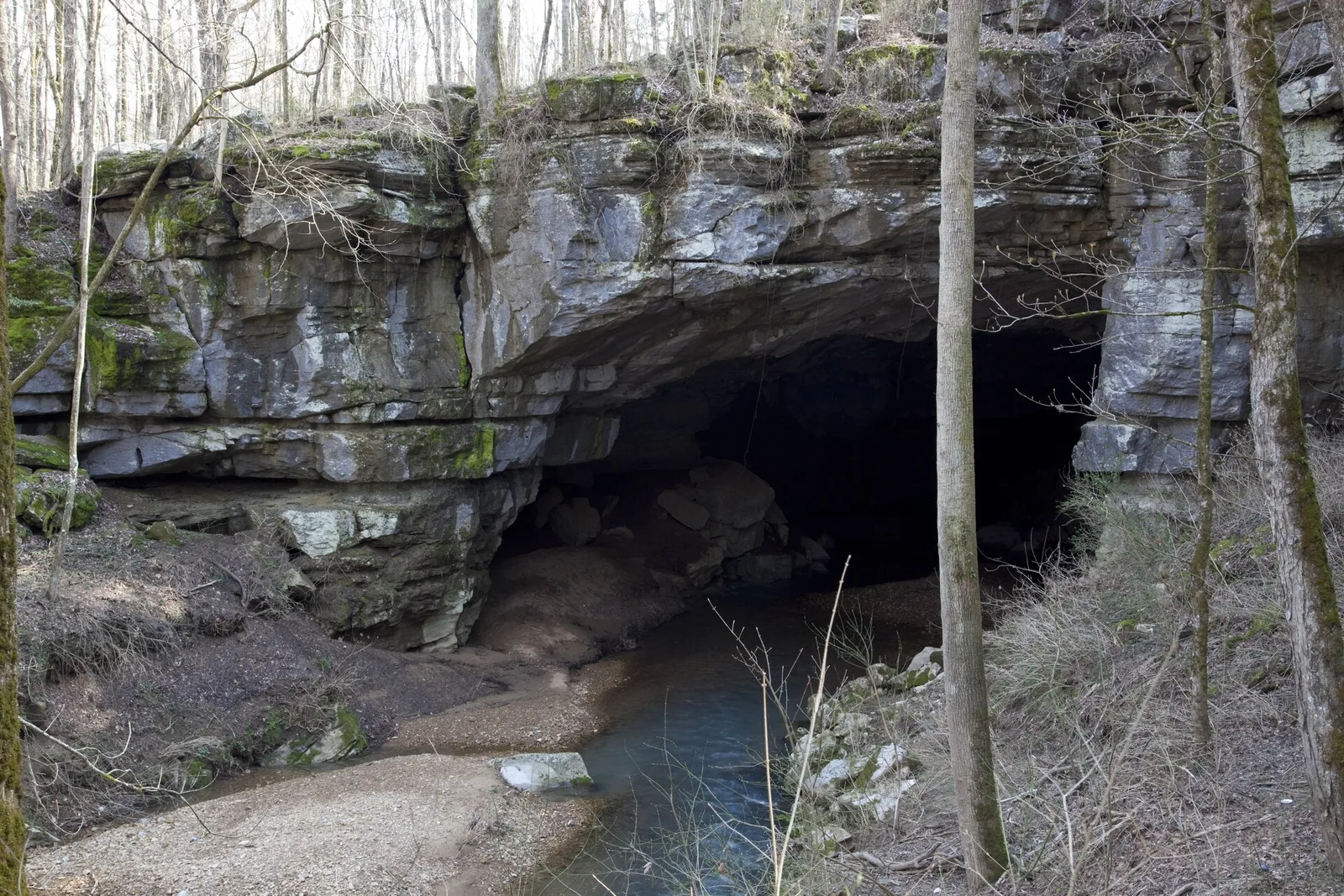
Russell Cave, in a limestone bluff in Doran Cove near Bridgeport in far northeastern Alabama, sheltered people for more than 10,000 years, one of the longest records of human use in the eastern United States. The usable shelter is a chamber opened when part of the cave roof collapsed; a stream still runs through the system, and a natural opening in the ceiling vented smoke from cooking fires.
Occupation runs from the late Paleo-Indian era, with the lowest hearths radiocarbon-dated to roughly 6500 to 7000 BCE, through the Mississippian period and into the 1600s. Excavators recovered stone points, bone awls and fishhooks, pottery, and at least two human burials from deposits that reach more than 30 feet deep in places.
Members of the Tennessee Archaeological Society first tested the site in 1953. The National Geographic Society then sponsored full excavations by the Smithsonian Institution from 1956 to 1958 under archaeologist Carl F. Miller, bought the surrounding 310 acres, and donated the land to the American people.
President John F. Kennedy proclaimed Russell Cave a national monument on May 11, 1961, and the Smithsonian returned for further digging in 1962. At about 310 acres it is one of the smallest units of the National Park System, drawing on the order of 25,000 visitors a year, yet one of the most important archaeological sites in the Southeast.
- Designation
- National Monument
- Location
- Jackson County, Alabama
- Established
- 1961
- Annual Visitors
- ~25,000
Thousands of Years at a Glance
The deepest deposits date to the end of the Paleo-Indian period, when small, highly mobile bands used the shelter only briefly. The lanceolate and early notched stone points from these levels are among the oldest artifacts documented in the cave.
By the time people were camping here, the largest Ice Age animals were already gone from the region. The bone refuse even in the lowest layers is dominated by white-tailed deer, turkey, and small game rather than megafauna.
Radiocarbon dates from charcoal in the lowest hearths cluster around 6500 to 7000 BCE, placing the first substantial use of the cave near the Paleo-Indian to Archaic transition.
These earliest visitors left only thin deposits, a sign the cave was then an occasional stop on a wide seasonal round; the heavy, sustained use came later.
The Archaic period produced the thickest and richest deposits at Russell Cave, built up over thousands of years of repeated seasonal camping. Dense middens hold deer and turkey bone, freshwater mussel shell, charred hickory nut, and thousands of chipped and ground stone tools.
Atlatl weights and the bone hooks and gorges used for fishing the nearby streams appear in quantity in these layers, marking a broad-spectrum foraging economy rather than reliance on any single food.
Both of the site's well-documented human burials, an adult and an infant, came from Archaic deposits, along with bone awls and needles that point to hide working and basketry.
The sheer depth of the Archaic midden, several feet of accumulated living debris, is the main reason archaeologists rank Russell Cave among the region's benchmark stratified sites.
Woodland inhabitants brought pottery and, later, the bow and arrow. Fabric- and cord-marked ceramic sherds from these levels help archaeologists trace the spread of pottery traditions across the Tennessee Valley.
Small triangular arrow points replace the larger dart points of earlier levels, one of the clearest technological markers of the shift from atlatl to bow roughly 2,000 years ago.
Non-local materials such as marine shell and exotic stone show the cave's people were tied into exchange networks that reached toward the Gulf Coast and the Midwest.
Squash and native seed crops begin to supplement wild foods in this era, though Russell Cave stayed a seasonal hunting and gathering camp, not a village.
By the Mississippian period, intensive maize farming supported large towns with earthen platform mounds along the Tennessee River and its tributaries in the valleys below the cave.
Use of the shelter fell off as permanent riverside villages offered better housing, but pottery and tools confirm people still came, most likely as a hunting stop.
The people of this era were the direct ancestors of the Cherokee, Muscogee (Creek), and other historic Southeastern nations who held the region when Europeans arrived.
The thin uppermost deposits carry the site's youngest material and taper out around 1650 CE, after which the cave saw little further use.
Indigenous Connections
Cherokee Nation
Cherokee towns occupied northeastern Alabama, including the Doran Cove area around Russell Cave, for generations before European colonization. The cave and its bluff sat within lands used for hunting deer and gathering plants and stone.
This corner of Alabama, where the state meets Tennessee and Georgia, lay near the Cherokee towns of the upper Tennessee drainage and along trails that later carried the Federal Road and its traffic of settlers.
Cherokee land in the region was ceded piecemeal through treaties in the early 1800s, ending with the 1835 Treaty of New Echota, which a minority faction signed and which the United States used to justify removal.
Following forced removal on the Trail of Tears (1838-1839), the Eastern Band of Cherokee Indians is now headquartered in North Carolina, while the Cherokee Nation and United Keetoowah Band are based in Oklahoma.
Muscogee (Creek) Nation
The Creek Confederacy's territory covered most of what is now Alabama, and ancestors of the Muscogee were among the region's Mississippian-era and later inhabitants.
The Creek homeland was opened to seizure after the 1814 Treaty of Fort Jackson, which took roughly 23 million acres, more than half of the confederacy's land, following the Creek War.
Most Creek people were forced west to Indian Territory in the 1830s along their own trail of tears; a minority who remained in southern Alabama became the community now known as the Poarch Band.
The Muscogee (Creek) Nation is headquartered in Okmulgee, Oklahoma. The Poarch Band of Creek Indians, near Atmore, is the only federally recognized tribe based in Alabama today.
What to Do at Russell Cave
Cave Entrance Trail
A short paved, accessible path runs from the visitor center to the cave mouth, where a boardwalk lets visitors stand at the edge of the excavated shelter floor.
The cave holds near 58 degrees Fahrenheit year round, so a jacket is useful even in an Alabama summer, and the stream running through the passage is audible from the entrance.
Ranger talks at the entrance explain the stratigraphy still visible in the cut bank, where thousands of years of occupation are stacked in distinct bands of soil, ash, and shell.
A separate, larger cave passage extends beyond the shelter and is gated; it is not part of the public visit and is protected for bats and for undisturbed deposits.
Archaeological Demonstration Area
Rangers regularly demonstrate atlatl, or spear-thrower, casting at an outdoor range beside the cave, letting visitors try the weapon that preceded the bow for most of the site's history.
Friction fire-making, hide scraping, and cordage and basketry techniques are shown at the same area, each tied to a class of tool recovered from the cave.
Flintknapping demonstrations show how the points and drills in the deposits were shaped from local Fort Payne chert, the stone that outcrops throughout this part of the Cumberland Plateau.
The programs are built around the actual Smithsonian findings, so each demonstrated skill corresponds to artifacts pulled from the 1950s excavations and now in federal collections.
Forest Hiking Trails
About 1.2 miles of trail climb from the cave through mature hardwood forest of oak, hickory, and beech, close to the woodland the cave's inhabitants would have foraged.
The nature trail passes limestone outcrops, sinkholes, and a small spring, showing the karst landscape whose slow dissolution created the cave itself.
Spring brings trout lily, trillium, and other wildflowers, and the same hickory and oak mast that fed prehistoric foragers still drops here each fall.
The trail gains only about 100 feet but reaches a rise above Doran Cove, giving a sense of the sheltered valley that made the site attractive for 10,000 years.
Conservation Challenges
Cave Microclimate Preservation
Fragile deposits remain in place on and below the shelter floor, and their preservation depends on stable temperature and humidity, so the Park Service limits group size and keeps entry to guided visits.
Heat, moisture, and carbon dioxide from visitors' bodies and breath can shift the cave environment, so the developed area is held to the boardwalk at the shelter mouth rather than the deeper passage.
Water is both the cave's maker and a threat: the through-flowing stream can flood the shelter, and runoff from the surface carries silt and contaminants into the karst system.
Monitoring of temperature, humidity, and the resident bat colony guides seasonal decisions about how much access to allow.
White-Nose Syndrome in Bats
Russell Cave shelters bats that help control night-flying insects across Doran Cove, and the region's caves are also used by the endangered gray bat and Indiana bat.
White-nose syndrome, caused by the cold-loving fungus Pseudogymnoascus destructans, reached the Southeast after 2006 and has killed millions of hibernating bats across eastern North America.
The Park Service monitors the colony and closes the deeper passage during hibernation and maternity seasons to reduce disturbance when the animals are most vulnerable.
Because the fungus can travel on clothing and boots, the guided-only rule for the public shelter also serves as a disease-spread precaution, and visitors are asked not to enter with gear used in other caves.
Unexcavated Archaeological Deposits
The Smithsonian dug only part of the shelter in the 1950s and returned for more in 1962; large portions of the floor have never been excavated.
The Park Service preserves those deposits deliberately, on the principle that future archaeologists will have better methods, as radiocarbon dating itself was still new when the site was first worked.
Everything in the ground is federal property under the Archaeological Resources Protection Act, and digging or collecting anywhere in the monument is a federal crime.
The site remains open to approved research, and re-study of the original Smithsonian collections, now split between the National Park Service and the Smithsonian, continues to refine the cave's chronology.
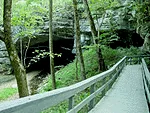
The cave interior, where archaeological layers span 10,000 years of habitation
At a Glance
Did You Know?
The Smithsonian Institution conducted the first major excavations at Russell Cave in the 1950s, and the discoveries were so significant that the site received national monument designation just a few years later.
Significant portions of the cave floor remain unexcavated, preserved for future researchers with more advanced techniques than those available today.
The same cave that sheltered humans for 10,000 years still shelters wildlife today, with a bat colony that roosts in the cave ceiling and helps control insect populations in the surrounding forest.
At just 310 acres, Russell Cave is one of the smallest national monuments in the NPS system, but one of the most archaeologically important sites in the eastern United States.
Plan Your Visit
Location
Jackson County, Alabama
Designation
National Monument
Best Time to Visit
Year-round, cave stays 58°F regardless of outside temperature
Admission
Free, National Park Service