

About New Jersey
New Jersey was named by Sir George Carteret, one of the two original proprietors who received the territory from the Duke of York in 1664, after the Isle of Jersey in the English Channel, where Carteret had been born and where he had served as governor and military commander during the English Civil War. The island of Jersey had been one of the last royalist holdouts against the Parliamentarian forces, and Carteret had defended it heroically before eventually fleeing. Naming the new territory after his home island was both a sentimental gesture and a tribute to his loyalty to the Crown. New Jersey served as a critical battleground during the Revolutionary War, with more than 100 military engagements fought on its soil.
New Jersey is a study in contradictions. It is the most densely populated state in the nation, 9.3 million people packed into 8,723 square miles, yet it preserves 1.1 million acres of genuine wilderness in the Pine Barrens. It bears the nickname "The Garden State" while hosting the world's most concentrated pharmaceutical industry and the busiest port on the East Coast. It lies in the shadow of two of America's greatest cities, New York and Philadelphia, yet possesses a fierce and unmistakable identity entirely its own.
The state's strategic position between the Hudson and Delaware rivers made it the central battleground of the American Revolution and the laboratory for Hamilton's vision of American industrialization. It gave the world the light bulb, the phonograph, the transistor, the Unix operating system, and the C programming language, all invented within its borders. Its pharmaceutical corridor between Princeton and Newark contains more drug company headquarters than any comparable stretch of land on Earth. Its Route 1 corridor has been called, without much exaggeration, the most economically productive strip of real estate in American history.
New Jersey is also a state of deep complexity and ongoing struggle. Its cities, Newark, Trenton, Camden, Paterson, carry the weight of 20th-century deindustrialization and demographic displacement while showing real signs of revival. Its Shore communities balance the joy of a century of summer tradition against increasing vulnerability to sea level rise and extreme weather. Its politics are fierce, often corrupt at the edges, and always interesting. No state produces more federal indictments of public officials per capita than New Jersey, and no state produces more proud, defensive, self-aware identity in its residents.

New Jersey's Six Regions
The northeastern corner of New Jersey, encompassing Bergen, Passaic, Essex, Hudson, and Union counties, is one of the most densely populated and economically complex regions in the United States, a seamless extension of the New York metropolitan area that happens to be across a state line. Hudson County, which contains Jersey City and Hoboken directly across the Hudson River from lower Manhattan, has undergone one of the most dramatic urban transformations of any American county in the past three decades.
Jersey City, long a working-class city of immigrants and longshoremen, has become a global financial center in its own right, with Goldman Sachs, JP Morgan, and dozens of other financial firms operating major back-office and technology operations in its gleaming waterfront towers. Hoboken, a square-mile city on the river famous as Frank Sinatra's birthplace and as one of the most crowded urban communities in the country, has been transformed by young professionals priced out of Manhattan.
Bergen County, suburban New Jersey's wealthiest and most populous county, is a mosaic of bedroom communities, shopping corridors (the Meadowlands area contains some of the densest retail concentration in the world), and immigrant enclaves. The Meadowlands, a complex of marshes, former landfills, and industrial sites that has been partially reclaimed as sports and entertainment facilities, contains MetLife Stadium (home of the Giants and Jets NFL franchises), the American Dream mega-mall, and the site of numerous industrial legacies including Superfund contamination.
This corner of the state is intensely diverse. Bergen County has one of the largest Korean American populations in the country, centered on Palisades Park and Fort Lee; Paterson and its Passaic County neighbors hold one of the largest Arab American and Palestinian communities in the U.S., anchoring 'Little Ramallah' on South Main Street; and the Ironbound section of Newark is a Portuguese and Brazilian enclave famous for its restaurants. More than half the residents of some of these towns speak a language other than English at home.
The region carries the state's heaviest environmental burden. The Passaic River through Newark and Newark Bay is one of the most contaminated waterways in the country, a Superfund site where decades of dioxin and chemical discharge, much of it from an Agent Orange defoliant plant, has produced a multibillion-dollar cleanup fight, and the state's densest cluster of oil tanks, chemical plants, and the Newark and Elizabeth container terminals sit within a few miles of neighborhoods with the worst air quality in New Jersey.
New Jersey's major cities tell the story of American urban history in compressed and sometimes painful form. Newark, the state's largest city with about 300,000 residents, is one of the oldest cities in America (founded 1666 by Connecticut Puritans) and one of the most complex.
It is simultaneously home to Prudential Financial's towering headquarters, one of the busiest airports in the Northeast (Newark Liberty International), a thriving arts district anchored by the New Jersey Performing Arts Center, and persistent concentrated poverty in neighborhoods still recovering from the 1967 uprising and decades of disinvestment. Newark's Penn Station is one of the busiest rail stations in the country, connecting the city to New York, the Jersey Shore, Philadelphia, and the national rail network.
Paterson, founded as Alexander Hamilton's planned industrial city in 1791, retains extraordinary 19th-century industrial architecture around the Great Falls of the Passaic River, now a National Historical Park. Its silk mills and locomotive works made it a national industrial power; today it is one of the most diverse mid-sized cities in America, with large communities from Latin America, the Middle East, and West Africa.
Trenton, the state capital, sits on the Delaware River opposite Pennsylvania; its manufacturing past (Roebling wire rope, pottery, rubber) has largely vanished. Camden, directly across the Delaware from Philadelphia, is one of the most economically distressed cities in the United States despite the presence of Campbell's Soup (headquartered there for over a century), Rutgers-Camden, and a significant waterfront development investment.
Central New Jersey, encompassing Middlesex, Somerset, Mercer, and parts of Monmouth and Morris counties, is the state's economic engine and its most intellectually concentrated region. The Route 1 corridor from New Brunswick through Princeton Junction to Trenton passes through the heart of the global pharmaceutical industry, lined with the research campuses and corporate headquarters of Johnson & Johnson, Bristol-Myers Squibb, Sanofi, and dozens of other major companies.
New Brunswick, Rutgers University's flagship campus city, is both a major research university town and a center of pharmaceutical manufacturing, with J&J's New Brunswick campus employing thousands directly adjacent to the university. Princeton, home to Princeton University, is one of the great university towns in the world: its Nassau Hall is one of the most historically significant buildings in America (it served as the national capital briefly in 1783), and its Institute for Advanced Study (where Albert Einstein spent his final 22 years) has been home to some of the most distinguished mathematicians and scientists of the 20th century.
The Princeton area has attracted technology and pharmaceutical firms that want proximity to the university's research output, creating a dense innovation cluster. Edison (formerly named Menlo Park, but renamed for Thomas Edison who built his first research laboratory there) sits at the center of the corridor.
The New Jersey Turnpike, the most heavily traveled toll road in the United States, runs through this corridor, connecting the commercial and logistics infrastructure that supports the pharmaceutical and technology economies.
The Jersey Shore, running approximately 130 miles from Sandy Hook in the north to Cape May at the southern tip, is one of the most beloved and economically significant recreational coastlines in America, generating billions in tourism revenue and providing summer identity for millions of New Jerseyans and visitors from across the mid-Atlantic region. The Shore is not a monolithic place but a collection of distinct communities with sharply different characters: Asbury Park, once a faded resort town, has become one of the most vibrant arts and music scenes on the East Coast, its rock-and-roll legacy including Bruce Springsteen and a creative community that has transformed its boardwalk into a cultural destination.
Point Pleasant Beach, Seaside Heights (made nationally famous and somewhat notorious by the MTV reality show Jersey Shore), Island Beach State Park (one of the most pristine barrier beach environments on the East Coast), Long Beach Island (a 18-mile barrier island of family resorts and fishing communities), and Atlantic City (with its casinos and the famous Boardwalk) each represent different dimensions of the Shore experience. Cape May, at the southern tip, is architecturally one of the most remarkable towns in America, a Victorian-era resort community of 600+ preserved Victorian buildings that has reinvented itself as a sophisticated bed-and-breakfast and birding destination.
Superstorm Sandy in October 2012 devastated much of the Shore, damaging or destroying thousands of homes and businesses; the recovery, largely complete a decade later, demonstrated both the Shore communities' resilience and the increasing vulnerability of coastal development to extreme weather.
The Shore has its own political and cultural geography. Ocean and Monmouth counties are among the most reliably Republican in the state, Ocean County anchored by Lakewood, home to one of the fastest-growing Orthodox Jewish communities in the country, whose population has more than doubled since 2000 and reshaped local schools, zoning, and busing politics. Monmouth County's Bruce Springsteen mythology, Asbury Park, Freehold, the Stone Pony, is a genuine tourism draw.
New Jersey guarantees public access to its tidal beaches under the centuries-old 'public trust doctrine,' reaffirmed by the state Supreme Court in cases against private beach clubs, but many towns charge for beach 'badges' in summer, a system found almost nowhere else on the U.S. coast. After Sandy, the state and the Army Corps spent well over a billion dollars rebuilding protective dunes, and a long fight forced holdout oceanfront owners to grant easements so the dunes could cross their property.
The New Jersey Pine Barrens, known officially as the Pinelands National Reserve, is one of the most improbable natural wonders in America: 1.1 million acres of wilderness, the largest undeveloped tract of land on the Eastern Seaboard between Boston and Washington, lying within 50 miles of the most densely populated corridor in the nation. The Pinelands sit atop the Kirkwood-Cohansey aquifer, a vast underground lake containing an estimated 17 trillion gallons of some of the purest freshwater in the United States.
The sandy, acidic, nutrient-poor soils of the Pine Barrens support a unique ecosystem of pitch pine and scrub oak forest, bogs and cedar swamps, carnivorous plants (including pitcher plants and sundews), rare orchids, and dozens of plant and animal species found nowhere else. The New Jersey Pine Barrens tree frog, the barred owl, and numerous rare plant species depend on this ecosystem.
The region also harbors the legend of the Jersey Devil, a mysterious creature said to haunt the pines since 1735, which has become one of the most enduring pieces of American folklore. The Pinelands was designated a National Reserve by Congress in 1978 and a UNESCO Biosphere Reserve in 1983, creating a regulatory framework that has successfully limited development pressure that might otherwise have consumed the region.
Blueberry and cranberry cultivation thrives in the bogs; glassblowing and bog iron production were historically significant industries. The unique 'Piney' culture of the Barrens' long-settled communities is a subject of both academic study and local pride.
South Jersey, encompassing Camden, Gloucester, Salem, Cumberland, and Cape May counties, occupies the southwestern corner of the state between the Delaware River and the Atlantic Ocean, and is in many ways the most distinctly 'Jersey' of the state's regions: agricultural, politically independent, culturally distinct from the New York-influenced northern counties, and historically tied to Philadelphia across the river rather than to Manhattan. Camden directly across the Delaware from Philadelphia is the largest city, with all the challenges of an economically distressed post-industrial urban center alongside the assets of a developing waterfront district, the presence of Rutgers-Camden and Rowan University, and the historical significance of being the city where Walt Whitman spent his final years.
Cherry Hill and Voorhees are prosperous Philadelphia suburbs that feel entirely different from the New York suburbs of Bergen County. Salem, one of the oldest cities in New Jersey (founded 1675 by Quaker John Fenwick), has a remarkable collection of colonial architecture but an economy hollowed out by the decline of glass and chemical manufacturing.
The Salem Nuclear Power Plant on the Delaware provides significant energy to the regional grid. Vineland, in Cumberland County, is the center of New Jersey's southern agricultural economy, a market city surrounded by productive farmland growing blueberries, cranberries, peppers, and sweet potatoes.
Cumberland County's coast along Delaware Bay supports an important fishing and crabbing industry. The region voted heavily for Donald Trump in 2016 and 2020, a reflection of the cultural and economic divergence between South Jersey and the more Democratic northern counties.

Economy
New Jersey's $700+ billion economy, one of the largest of any state, is built on a uniquely dense concentration of pharmaceuticals, financial services, technology, logistics, and port activity, all packed into one of the smallest geographic footprints in the country.
The corridor running from Princeton through New Brunswick, Edison, and up to the Parsippany-Morris County area contains a density of pharmaceutical research, manufacturing, and corporate headquarters that has no equal anywhere on the planet. Johnson & Johnson, founded in New Brunswick in 1886 and still headquartered there, is one of the largest healthcare companies in the world. Merck & Co., headquartered in Kenilworth (now Rahway), is one of the oldest and most significant pharmaceutical companies in America, dating its New Jersey presence to 1891.
Novartis operates major research facilities in East Hanover. Bayer's North American operations are based in Whippany. Bristol-Myers Squibb maintains significant operations in the state.
Becton Dickinson, the medical device company, is headquartered in Franklin Lakes. The concentration is extraordinary: at its peak, New Jersey was home to 15 of the world's 20 largest pharmaceutical companies, earning the state's Route 1 corridor the informal nickname 'Drug Alley.' Rutgers University, with its extensive pharmacy, medicine, and biomedical engineering programs, supplies the sector with a steady stream of trained researchers.
The pharmaceutical industry provides some of the highest-paying private sector employment in the state, anchoring the middle and upper-middle class economies of central New Jersey's suburbs. It is also the foundation of New Jersey's identity as an innovation state, drawing PhD scientists, clinical researchers, and biomedical engineers from around the world.
Prudential, which pioneered 'industrial insurance' sold door-to-door to working-class families, grew into one of the largest insurance and financial services companies in the world, and its Rock of Gibraltar logo remains one of the most recognized corporate symbols in American business. Its distinctive brick skyscraper towers in downtown Newark still anchor the city's skyline.
The financial services sector in New Jersey is broader than insurance: Morristown and the Morris County corridor have attracted major investment banks, hedge funds, and financial technology firms seeking proximity to Wall Street without Manhattan's costs. Hackensack and Bergen County host numerous financial services firms serving the New York metropolitan market.
Fidelity Investments has significant New Jersey operations. New Jersey is also home to major back-office and processing operations for many of Wall Street's largest institutions, which chose suburban New Jersey locations for their data centers, check processing, and technology operations.
The sector's concentration in New Jersey reflects the state's position as an extension of the New York metropolitan financial economy, close enough to participate fully in the capital markets but operating at significantly lower real estate costs.
Bell Labs is where the transistor was invented (John Bardeen, Walter Brattain, and William Shockley, 1947), where information theory was formulated (Claude Shannon, 1948), where the laser was developed (1960), where the Unix operating system was written (Ken Thompson and Dennis Ritchie, 1969), where the C programming language was created (1972), where the CCD image sensor used in all digital cameras was invented (1969), and where cellular telephone networks were first conceived and designed. Bell Labs researchers have won nine Nobel Prizes in Physics, making it one of the most decorated scientific institutions in history.
The facility continues to operate as Nokia Bell Labs following the acquisition of Alcatel-Lucent by Nokia. Beyond Bell Labs, New Jersey has hosted a remarkable concentration of telecommunications infrastructure: AT&T built much of the national telephone network from its New Jersey operations.
Comcast, Verizon, and other major telecommunications companies maintain large New Jersey operations. Thomas Edison's invention factories at Menlo Park and West Orange, while predating the formal tech sector, established New Jersey's identity as the place where the modern technological world was created.
Contemporary technology companies are clustered particularly in the Princeton area, the Parsippany corridor, and the Hudson County waterfront communities of Jersey City and Hoboken, which have become extensions of New York's tech ecosystem.
The port complex is centered on Port Newark and the Elizabeth-Port Authority Marine Terminal in Newark Bay, the largest container port on the East Coast, with additional facilities at Red Hook in Brooklyn and Staten Island. The port handles a staggering variety of cargo: consumer electronics, automobiles (it is the primary auto import terminal for the East Coast, handling millions of vehicles annually), clothing, food products, petroleum, and chemicals.
The economic multiplier effect of the port is enormous: every port job supports multiple additional jobs in trucking, warehousing, rail, customs brokerage, and logistics. New Jersey's extensive highway network, centered on the New Jersey Turnpike (Interstate 95) and the Garden State Parkway, makes the state a premier logistics location.
The Amazon fulfillment center network, FedEx and UPS regional hubs, and dozens of major distribution centers are concentrated along the Turnpike corridor. Newark Liberty International Airport, one of the three major airports serving the New York metropolitan area, adds an air freight dimension to the logistics economy.
The combination of sea, air, road, and rail access makes New Jersey one of the most important freight distribution nodes in the United States.
The decision was made by NJ voters via referendum after years of economic decline in a city that had been a premier resort destination in the early 20th century but was devastated by the rise of air travel (which enabled Americans to vacation farther from home) and the deterioration of its aging resort infrastructure. Resorts International opened the first Atlantic City casino in 1978, and the city briefly became the most visited tourist destination in the United States, with casino revenues far exceeding Las Vegas.
The industry attracted enormous investment through the 1980s and 1990s: Trump's Taj Mahal, Caesars, Bally's, the Borgata, the Showboat, and dozens of other properties transformed the Boardwalk into a gambling mecca. But the city's dependence on gambling proved fragile: the legalization of casinos in surrounding states, the expansion of Native American gaming, and eventually the growth of online gambling eroded Atlantic City's regional monopoly.
Multiple casinos closed in 2014 alone. Today, a smaller but more stable casino economy survives, anchored by the Borgata (owned by MGM Resorts), Hard Rock Atlantic City, Caesars, and a few others.
Online sports betting, legalized in New Jersey in 2018, has become a significant revenue source: New Jersey is consistently one of the largest sports betting markets in the nation. The state's early online gambling regulatory framework became a model for other states.
New Jersey produces more blueberries than almost any other state in the nation and has been a top producer for over a century, the sandy, acidic soils of the Pine Barrens and Burlington County being ideal blueberry habitat. New Jersey pioneered blueberry cultivation: Elizabeth White of Whitesbog collaborated with botanist Frederick Coville to develop the first commercially cultivated blueberry varieties in 1916.
The state is also a major cranberry producer, with the bogs of Burlington and Ocean counties representing one of the significant cranberry growing regions in the country. Sweet corn, tomatoes, peppers, peaches, apples, and leafy greens all have significant New Jersey production, with the black dirt farming region of Sussex County producing extraordinary yields of onions and root vegetables from its rich muck soils.
Rutgers University's New Jersey Agricultural Experiment Station has been one of the most productive agricultural research institutions in the country for over a century, developing widely adopted plant varieties including the Rutgers tomato, once the dominant commercial tomato in the Northeast. The proximity of New Jersey farmland to the New York and Philadelphia metropolitan markets, the two largest food markets in the country, makes small and mid-sized farming economically viable in ways impossible in more remote agricultural regions.

How New Jersey's Government Works
New Jersey's state government follows the standard three-branch structure but with a few distinctive features. The governor is the strongest in the nation by most assessments: New Jersey is one of only a handful of states where the governor has a line-item veto, no lieutenant governor ran separately from the governor until a 2009 constitutional amendment (the Senate President was previously next in line), and the governor appoints all state judges and cabinet officers without the checks that other states impose.
New Jersey's political culture is defined by its county political machines, which retain more power than in virtually any other state. The county party organizations control ballot positioning through the county line, a system in which endorsed candidates are placed advantageously on the ballot and receive the full organizational backing of the county party. This system has historically given county party bosses extraordinary influence over who wins primaries and thus who governs. A 2024 federal court ruling struck down the county line system as unconstitutional; the ruling is being appealed and its ultimate effect on NJ politics remains to be seen.
New Jersey is a reliably Democratic state in federal elections, having voted for the Democratic presidential candidate in every election since 1992. Its U.S. Senate seats have been held by Democrats continuously since 2002. The state legislature has been predominantly Democratic in recent years. However, Republican governors have won frequently, with Chris Christie serving two terms (2010-2018) as perhaps the most prominent example.
New Jersey has historically had one of the highest rates of federal corruption prosecutions of state and local officials of any state in the country. The U.S. Attorney for the District of New Jersey has brought major cases against mayors, city council members, state legislators, and a U.S. Senator (Bob Menendez, convicted in 2024). This tradition of corruption coexists with genuinely effective government at the state level, and it is one reason New Jersey is often counted among the most corruption-investigated states.
Governor of New Jersey
Current Governor
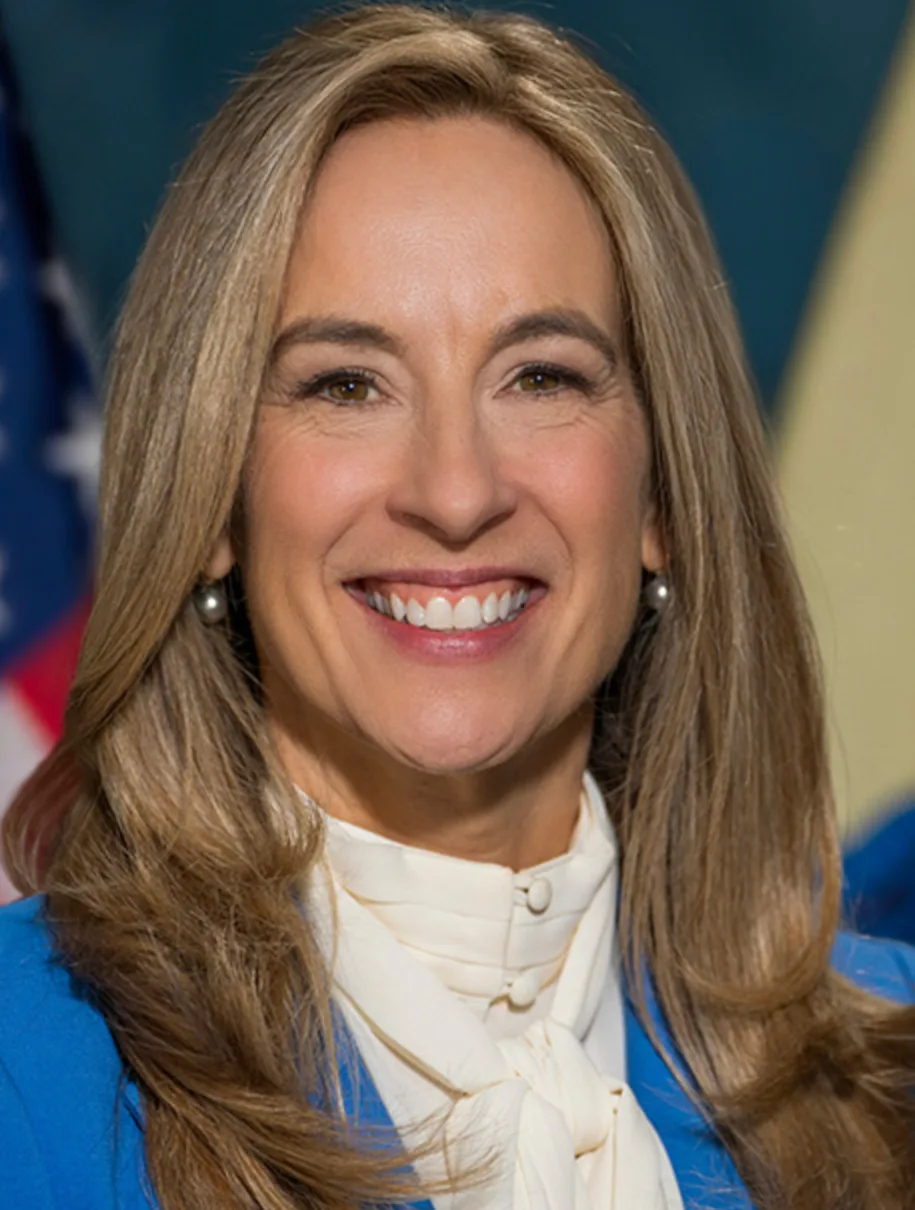
Mikie Sherrill
- Party
- Democratic
- In Office Since
- January 2026
- Term Ends
- January 2030
- Born
- January 19, 1972, Norfolk, Virginia (military family)
- Education
- U.S. Naval Academy (BS, 1994); Georgetown University Law Center (JD, 2007)
- Prior Role
- U.S. Representative, NJ-11 (2019-2025); federal prosecutor, DOJ; Naval helicopter pilot (10 years, multiple deployments)
Mikie Sherrill is New Jersey's 57th Governor, elected in November 2025 succeeding two-term Democratic Governor Phil Murphy. A graduate of the Naval Academy who flew helicopters for a decade, Sherrill served as a federal prosecutor before winning a House seat in the Republican-held 11th district in 2018 and holding it until she resigned in November 2025 after winning the governorship. Her biography as a military veteran, prosecutor, and centrist Democrat defined her appeal in a competitive general election. As governor she has focused on property tax relief, public safety, and economic competitiveness.
Other Current State Officials
Attorney General
Jennifer Davenport
Nominated by Governor Sherrill and confirmed by the state Senate in February 2026. A former first assistant attorney general, she succeeded Matthew Platkin (attorney general 2022 to 2026). New Jersey's attorney general is appointed by the governor with Senate consent and oversees the state's Division of Law, State Police, and criminal justice agencies.
Secretary of State
Shirley Emehelu (Acting)
Named acting Secretary of State on September 25, 2026, when Lieutenant Governor Dale Caldwell, who had also served as Secretary of State since January 2026, resigned after a state ethics report; the lieutenant governor's office is vacant. New Jersey's lieutenant governor, elected on the governor's ticket since the office was created in 2009, has traditionally also been named Secretary of State, overseeing elections and official filings. Caldwell succeeded Tahesha Way, the first Black woman to serve as NJ lieutenant governor.
State Treasurer
Aaron Binder
Sworn in in March 2026 under Governor Sherrill, succeeding Elizabeth Maher Muoio (treasurer 2018 to 2026). Oversees New Jersey's finances, budget management, and debt operations. NJ carries one of the highest per-capita debt loads of any state, and the treasurer's office manages ongoing pension system funding challenges that have been a defining fiscal issue for the state for decades.
The New Jersey Legislature
New Jersey State Senate
- Seats: 40 members
- Terms: 4-year terms (staggered cycle)
The upper chamber. NJ Senate terms follow an unusual 2-4-4 year election cycle within each decade tied to redistricting. Democrats hold a majority. The Senate President is one of the most powerful figures in state government and serves as acting governor when the governor and Lt. Governor are both unavailable.
New Jersey General Assembly
- Seats: 80 members
- Terms: 2-year terms
The lower chamber. All 80 seats are on the ballot every two years. Each of NJ's 40 legislative districts elects one senator and two Assembly members. Democrats hold a majority in the Assembly. The Speaker of the General Assembly is a powerful figure in state lawmaking.
New Jersey's U.S. Senators
U.S. Senator
Cory Booker
New Jersey's senior senator, first elected in a special election in October 2013 following the death of Frank Lautenberg. Re-elected in 2014 and 2020. A former mayor of Newark known for moving into a drug-infested housing project to dramatize urban poverty, Booker is one of the most visible Democrats in the Senate, a frequent cable news presence, and a 2020 presidential candidate. He serves on the Judiciary, Foreign Relations, and Commerce committees.
U.S. Senator
Andy Kim
New Jersey's junior senator, elected in November 2024 to a full six-year term after running in both the Democratic primary (against the party organization's preferred candidate) and the general election. A former three-term House member from NJ-3 and a former National Security Council official under President Obama, Kim was photographed on the night of January 6, 2021, alone on the Capitol floor helping clean up debris, an image that captured national attention. He succeeded appointed senator George Helmy, who briefly held the seat after Bob Menendez's resignation.
New Jersey Through the Years
From the Lenape people who called themselves the original people, to the crossings and battles that saved the American Revolution, to the invention factories that gave the world electric light, recorded sound, and the transistor, New Jersey's history is inseparable from the history of the American experiment.
The Indigenous people of what is now New Jersey called themselves Lenape, meaning 'original people' or 'genuine people,' and they had inhabited the Delaware River valley and its surrounding lands for thousands of years before European arrival. The Lenape were Algonquian-speaking, organized in small, mobile bands rather than centralized political structures, and deeply knowledgeable about the landscape they inhabited.
They farmed the river valleys, cultivating corn, beans, and squash; fished the Delaware, Raritan, and Hudson rivers during the spring salmon and shad runs; gathered shellfish from the coastal estuaries; and hunted deer, turkey, and bear across the forested interior. The Lenape were organized into three clans: the Turkey, the Turtle, and the Wolf, with descent traced through the mother's line.
They were skilled traders, exchanging wampum (beads made from quahog clam shells), furs, and food with neighboring peoples across a network extending through much of the northeastern woodlands. European contact brought catastrophic disease epidemics in the early 17th century, killing perhaps 75% of the Lenape population before sustained European settlement began.
Through a combination of outright fraud, diplomatic manipulation, and overwhelming force, the Lenape were progressively dispossessed of their homeland over the following century. Most Lenape had left New Jersey by 1800, dispersed westward through Pennsylvania and Ohio; their descendants today are found primarily in Oklahoma (the Delaware Nation and the Delaware Tribe of Indians), Ontario (the Munsee-Delaware Nation), and Wisconsin (the Stockbridge-Munsee Community).
New Jersey's colonial history involved three European powers in rapid succession. Henry Hudson, sailing for the Dutch East India Company, explored Newark Bay and the river that bears his name in 1609, giving the Dutch their initial claim to the region. Dutch traders established the colony of New Netherland in the 1620s, with trading posts and small settlements on both sides of the Hudson.
The Swedes complicated the picture by establishing New Sweden along the lower Delaware River beginning in 1638, with Fort Christina (modern Wilmington, Delaware) as their capital and settlements on the New Jersey shore. Swedish Governor Johan Printz administered New Sweden from Tinicum Island near Philadelphia; the colony was small but notable for introducing the log cabin to North America, a building form that spread westward with the frontier.
The Dutch governor Peter Stuyvesant conquered New Sweden in 1655 with a superior military force. Nine years later, in August 1664, an English fleet appeared in New York harbor under Colonel Richard Nicolls; Stuyvesant lacked the forces to resist and surrendered without a fight.
King Charles II had already granted the territory to his brother James, Duke of York, who transferred the land between the Hudson and Delaware rivers to two friends, Sir George Carteret and Lord John Berkeley, who named it New Cesarea, or New Jersey, after the Channel Island of Jersey where Carteret had served as royal governor. The colony was divided into East Jersey and West Jersey in 1676 and reunited as a single royal colony in 1702.
New Jersey earned its historical designation as 'the Cockpit of the American Revolution' honestly: no other colony had more Revolutionary War battles fought on its soil, and no campaign more clearly turned the tide of the war than Washington's New Jersey operations of December 1776 and January 1777. After the catastrophic defeats in New York in the summer and fall of 1776, Washington led his depleted, demoralized army in full retreat across New Jersey, pursued by British forces under Lord Cornwallis, crossing the Delaware River into Pennsylvania in early December. The Continental Army seemed on the verge of dissolution, with enlistments expiring and desertions mounting.
Thomas Paine, accompanying the army, wrote 'These are the times that try men's souls.' Washington's response was one of the most audacious decisions in military history: on the night of December 25-26, 1776, he led 2,400 troops back across the ice-choked Delaware in a nighttime crossing captured forever in Emanuel Leutze's famous painting, and launched a surprise attack on the Hessian garrison at Trenton. The Hessians were overwhelmed in 45 minutes; nearly 900 were captured.
Victory at Princeton on January 3 followed. These back-to-back victories revived American morale and kept the Revolution alive.
Morristown served as Washington's winter headquarters twice (1776-77 and 1779-80), the second winter even more brutal than Valley Forge. The Battle of Monmouth on June 28, 1778, the last major engagement in the North, ended in a tactical draw but demonstrated the Continental Army's improved professionalism under Baron von Steuben's winter training.
Alexander Hamilton, the first Secretary of the Treasury, was the most sophisticated economic thinker in Washington's cabinet, and his vision for America's future was grounded in manufacturing rather than the agrarian republic Jefferson preferred. In his landmark Report on Manufactures (1791), Hamilton argued that the United States needed to develop its own industrial base to achieve economic independence from Britain. To demonstrate the concept, he organized the Society for Establishing Useful Manufactures (S.U.M.) and chose a site on the Passaic River at its Great Falls, a 77-foot waterfall that could provide hydraulic power for mills, as the location for America's first planned industrial city.
The city was designed by Pierre Charles L'Enfant, who also designed Washington, D.C. (before being fired from that project). Hamilton's vision took decades to fully materialize, but by the mid-19th century, Paterson had become one of the leading industrial cities in America. It was known as 'Silk City' for its dominance of American silk manufacturing, producing more silk than any other city in the country for decades.
Paterson's Colt Gun Mill produced the famous Colt revolvers that armed the American West. Its locomotive works built the engines that pulled trains across the continent.
The Paterson textile strike of 1913, which drew national attention when radical labor organizers the Industrial Workers of the World (the 'Wobblies') led silk workers in a five-month walkout, was one of the defining labor conflicts of the Progressive Era. Paterson's Great Falls became a National Historical Park in 2009, recognizing the city's foundational role in American industrial history.
Thomas Edison was not born in New Jersey (he was born in Milan, Ohio, in 1847), but New Jersey is where he invented the modern world. Edison came to Newark in 1870 as a young telegraph operator and inventor, and established his first independent laboratory there.
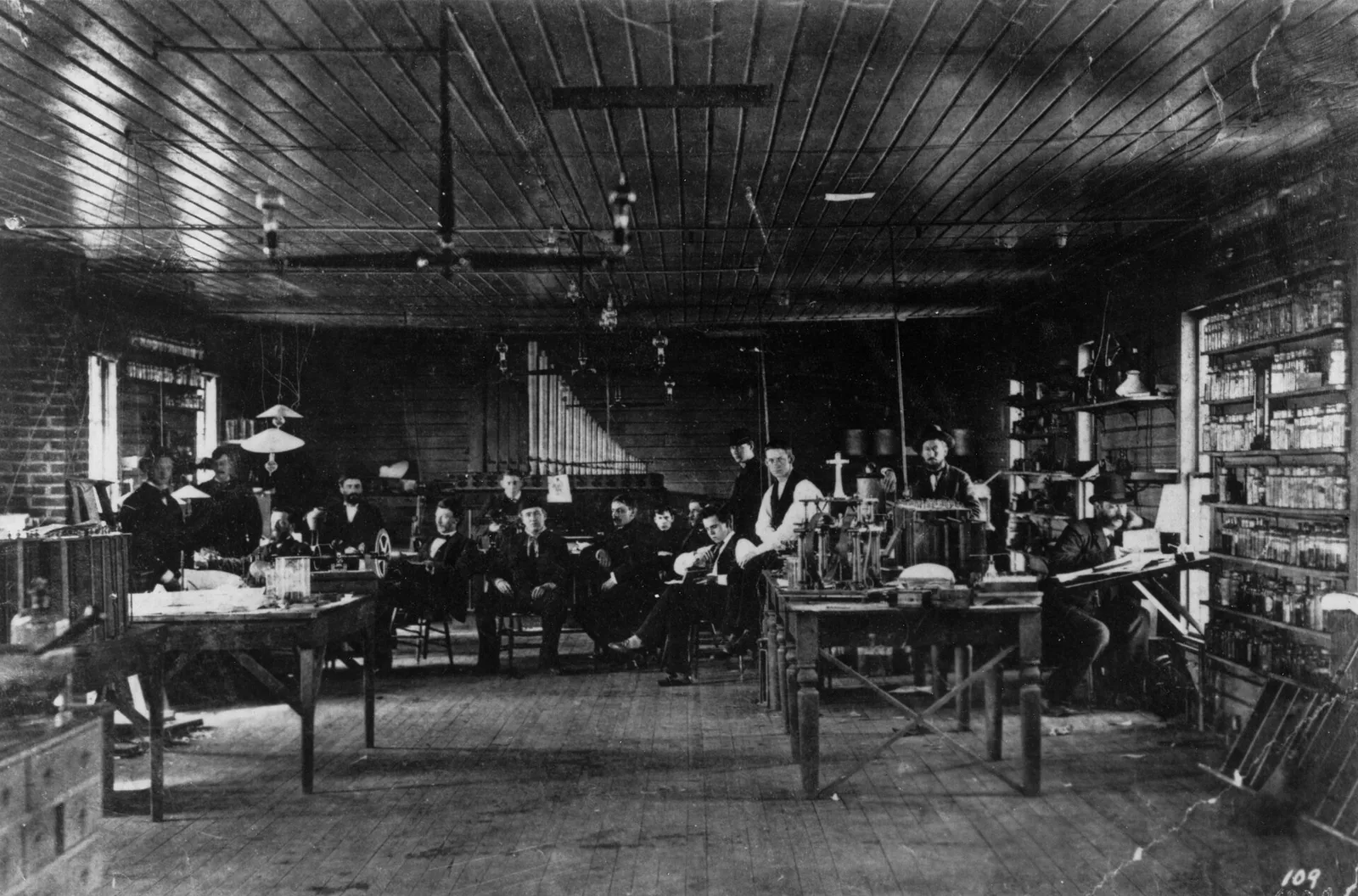
In 1876, at the age of 29, he built his 'invention factory' at Menlo Park, NJ, the world's first industrial research laboratory: a facility staffed by a permanent team of scientists, machinists, and glassblowers whose explicit purpose was to produce a 'minor invention every ten days and a big thing every six months or so.' From Menlo Park came the phonograph (1877), which seemed almost supernatural to contemporaries, and then the practical incandescent light bulb (1879), demonstrated in a spectacular public display that drew thousands to Menlo Park by special train. Edison electrified lower Manhattan in 1882 with the world's first commercial electrical distribution system, powered from the Pearl Street Station in lower Manhattan.
His larger West Orange laboratory complex (1887) continued the pace of innovation: motion pictures (the kinetoscope, 1891), the alkaline storage battery, the fluoroscope. The Black Maria, a small tar-paper building on the West Orange grounds, was America's first movie studio.
By his death in 1931, Edison held 1,093 U.S. patents. The Menlo Park site, now in the city named Edison in his honor, and the West Orange laboratory complex (Thomas Edison National Historical Park) preserve the physical settings of this extraordinary creative output.
On December 23, 1947, three scientists at Bell Telephone Laboratories in Murray Hill, New Jersey, performed a demonstration that is arguably the most consequential single moment in the history of technology. John Bardeen and Walter Brattain, working under the direction of William Shockley, showed that their new semiconductor device, which they would call the transistor, could amplify an electrical signal. The transistor replaced the vacuum tube as the fundamental switching and amplification device in electronic equipment, enabling the miniaturization of electronics that made possible modern computers, mobile phones, satellites, medical devices, and virtually every other electronic technology in the contemporary world.
The three shared the Nobel Prize in Physics in 1956. But the transistor was just the beginning of Bell Labs' extraordinary output from Murray Hill.
The same facility produced information theory, the mathematical foundation of digital communication (Claude Shannon, 1948); the laser (1960); the CCD image sensor (1969); the Unix operating system (1969); the C programming language (1972); the concept of cellular telephone networks (1970s); and fundamental contributions to quantum physics, acoustics, and materials science. Bell Labs researchers have accumulated nine Nobel Prizes in Physics, more than most nations have ever won in any scientific field.
The facility continues operating today as Nokia Bell Labs, the research arm of the Finnish telecommunications company that acquired the Alcatel-Lucent assets including Bell Labs. Its Murray Hill campus remains one of the most historically significant scientific sites in the world.
New Jersey's 20th century was shaped by two transformative demographic forces: the massive immigration from Southern and Eastern Europe in the late 19th and early 20th centuries, and the Great Migration of African Americans from the South that accelerated from World War I onward. Newark by the 1920s had become one of the most diverse cities in America: large communities of Irish Americans (many running city government and the police and fire departments), Italian Americans (the largest Italian-born population in NJ), Jewish Americans from Eastern Europe (who dominated the garment industry and retail trade), and German Americans coexisted in a city of extraordinary ethnic complexity.
Jersey City under Democratic boss Frank Hague (mayor 1917-1947) was the quintessential machine-politics city: Hague controlled patronage, elections, and city contracts with iron discipline, delivered reliably for Franklin Roosevelt (whom he helped nominate) in exchange for federal money and tolerance of his methods. The African American community grew dramatically in Newark, Trenton, Camden, and other NJ cities during the Great Migration, as Southern Black workers came north seeking industrial jobs and escaped the Jim Crow South, only to find systematic discrimination in housing and employment in the North.
By 1967, the combination of police brutality, housing discrimination, urban poverty, and decades of political powerlessness had created the conditions for the Newark uprising of July 1967, one of the most destructive civil disturbances of the era. Six days of violence left 26 dead, hundreds injured, and the commercial district of one of New Jersey's most important cities in ruins from which it would not fully recover for decades.
The immediate spark was the beating of a Black cab driver, John Smith, by Newark police on July 12, 1967, but the deeper grievances included a plan to clear a large Black neighborhood in the Central Ward for a new medical school and a city power structure that remained overwhelmingly white in a city that had just become majority Black. Most of the dead were Black residents killed by police and National Guardsmen, several of them bystanders and children, and later state and federal commissions found the Guard had fired recklessly into apartment buildings.
The revolt accelerated white and business flight, and Newark's population fell from about 405,000 in 1960 toward 275,000 by 1990, its tax base collapsing with it. It also transformed Black political power in the state: Kenneth Gibson was elected Newark's first Black mayor in 1970, poet Amiri Baraka helped organize the 1970 Congress of African People and the 1972 National Black Political Convention in Gary, and the medical school was built only after a hard-won 'Newark Agreement' guaranteeing housing, jobs, and community control.
Modern New Jersey is a state in complex, ongoing reinvention. The cities that seemed irreversibly declining in the 1970s and 1980s have experienced different trajectories: Jersey City and Hoboken have been transformed by financial services and technology workers into among the most expensive real estate markets in the country, their proximity to Manhattan by PATH train and ferry making them practical alternatives to Brooklyn and Queens.
Newark has seen significant investment in its downtown, airport, and arts districts under mayors Cory Booker and Ras Baraka, with the New Jersey Performing Arts Center, Prudential Center arena (home of the New Jersey Devils NHL franchise), and Rutgers-Newark providing anchors for urban revival, even as concentrated poverty persists in many neighborhoods. New Jersey's political culture remains distinctive: the state has a long tradition of bipartisan governance at the local level, of machine politics, and of colorful corruption cases that have made it fertile ground for federal prosecutors.
The state is also one of the most progressive on LGBTQ+ rights, gun control, and environmental protection. Its highway culture, diner culture, and Shore culture are deeply embedded identity markers that distinguish New Jerseyans from their neighbors.
Superstorm Sandy (October 2012) devastated the coastline and inland communities, causing over $30 billion in damage in New Jersey alone and underscoring the state's acute vulnerability to sea level rise and extreme weather. The 2025 gubernatorial election brought Mikie Sherrill, a former Navy helicopter pilot and federal prosecutor, to the statehouse, as New Jersey continues to navigate its extraordinary complexity.
New Jersey's Defining Moments in American History
These are the events that didn't just shape New Jersey, they changed the nation.
On the frigid night of December 25-26, 1776, General George Washington led 2,400 Continental soldiers across the ice-choked Delaware River into New Jersey for a surprise attack on the Hessian garrison at Trenton. The victory was crushing and nearly bloodless.
Ten days later, Washington defeated the British at Princeton. The 'ten crucial days' transformed a dying revolution.
Washington's army had been losing everywhere; desertion was rampant; enlistments were expiring. New Jersey's winter battles breathed new life into the Continental Army and convinced wavering colonists that independence was achievable.
The crossing itself was a logistical feat carried out in a sleet storm by John Glover's Marblehead mariners, using flat-bottomed Durham cargo boats to move troops, horses, and 18 cannon; two other planned crossings downstream failed in the ice, so Washington's column struck Trenton alone. About two Hessians died and none of Washington's men were killed in action at Trenton, though several froze to death on the march.
At Trenton the Americans captured roughly 900 of the roughly 1,400 Hessians and their supplies. A week later Washington slipped his army around Cornwallis's advancing force at night, leaving campfires burning as a decoy, and mauled British regulars at Princeton on January 3, 1777, where General Hugh Mercer was bayoneted and died of his wounds.
The victories had strategic weight beyond morale: they forced the British to pull back from most of New Jersey to a narrow strip near New York, kept France interested enough to keep sending covert aid, and persuaded the Continental Congress to grant Washington near-dictatorial emergency powers for six months. Historian David Hackett Fischer's 'Washington's Crossing' won the 2005 Pulitzer Prize for its account of the ten days.
Thomas Edison built his Menlo Park laboratory in New Jersey in 1876 and proceeded to change the world. Working with a team of researchers in what he called an 'invention factory,' Edison patented the phonograph (1877), perfected the incandescent light bulb (1879), developed an electrical distribution system, and built the first motion picture studio.
Menlo Park became a symbol of organized industrial research, a model for the corporate laboratories that would drive American technological innovation throughout the 20th century. Edison held 1,093 U.S. patents when he died.
The Menlo Park lab, built in 1876 on a rural rail stop, was the first facility anywhere organized purely to invent, with machinists, chemists, glassblowers, and a library under one roof and a stated goal of 'a minor invention every ten days and a big thing every six months.' The press dubbed Edison 'the Wizard of Menlo Park' after the phonograph, a device so unexpected that some listeners assumed a trick.
The 1879 incandescent lamp was less an invention than a system: Edison's team tested thousands of filament materials, then built dynamos, meters, sockets, fuses, and underground wiring, and lit a demonstration district around the lab that drew crowds by special train on New Year's Eve. The 1882 Pearl Street Station in Manhattan put the whole system into commercial use.
Edison outgrew Menlo Park and moved to a much larger complex in West Orange in 1887, where his teams developed motion pictures (the Black Maria was the first movie studio), the alkaline storage battery, and improved phonographs and cement. Menlo Park's buildings were later dismantled, some pieces moved by Henry Ford to his museum in Michigan, and the New Jersey town renamed itself Edison in 1954; the West Orange labs are now a national historical park.
Woodrow Wilson served as president of Princeton University and then as governor of New Jersey before being elected the 28th President of the United States in 1912. As president, Wilson oversaw the Federal Reserve Act, the Clayton Antitrust Act, and the direct election of U.S. senators.
He led America through World War I and proposed the League of Nations at the Paris Peace Conference, though the Senate refused to ratify U.S. membership. New Jersey's progressive political climate gave Wilson the executive experience and national profile that propelled him to the presidency.
Wilson was an academic with no elected experience when Democratic machine bosses, led by James Smith Jr. of Newark, recruited him to run for governor in 1910 expecting a pliable figurehead; instead he turned on them, pushed through a direct-primary law, a corrupt-practices act, workers' compensation, and utility regulation in a single 1911 session, and became a national reform figure within a year, exactly the arc the bosses had not foreseen.
That record made him the compromise choice at the deadlocked 1912 Democratic convention, and he won the presidency in a three-way race after Theodore Roosevelt split the Republican vote. His first-term 'New Freedom' agenda created the Federal Reserve (1913), the Federal Trade Commission, and the Clayton Antitrust Act, and the 16th and 17th Amendments (income tax and popular election of senators) were ratified early in his term.
Wilson's record is deeply contested. He kept the U.S. out of World War I through 1916 and then led it in, his Fourteen Points shaped the peace, and he won the 1919 Nobel Peace Prize, but he also re-segregated the federal civil service, screened 'The Birth of a Nation' at the White House, and jailed wartime dissenters under the Espionage Act; Princeton removed his name from its public-policy school in 2020.
Ellis Island, situated in New York Harbor between New Jersey and New York, processed more than 12 million immigrants between 1892 and 1954. For generations of Europeans, Ellis Island was their first sight of America, the place where names were sometimes changed, health was inspected, and the dream of a new life began or ended.
Today, approximately 40% of Americans can trace their ancestry through Ellis Island. Its immigration station stands as the most concrete symbol of the immigrant experience that built modern America, and it is administered jointly by New Jersey and New York.
Most of Ellis Island is physically closer to New Jersey than to New York, and the island grew from about 3 acres to 27 acres almost entirely from landfill, much of it earth excavated for New York's subway. A 1998 U.S. Supreme Court case, New Jersey v. New York, ruled that the roughly 24 acres of that added land belong to New Jersey while the original island and the main brick immigration building remain New York, a genuinely split jurisdiction.
The 'name changing at Ellis Island' story is largely a myth: inspectors worked from passenger manifests written at the port of departure and rarely recorded names at all, and most name changes happened later, chosen by immigrants themselves. What the station did impose was a medical and legal gauntlet, a 'six-second physical,' a chalk mark for suspected illness, and detention or return for those judged 'likely to become a public charge'; roughly 2 percent were sent back.
The station's volume collapsed after the 1924 Immigration Act imposed strict national quotas, and it operated mostly as a detention and deportation center until closing in 1954. It reopened as a museum in 1990 after a large private restoration, and its computerized passenger records now let visitors search for arriving ancestors.
On the evening of October 30, 1938, Orson Welles and the Mercury Theatre on the Air performed an adaptation of H.G. Wells's 'The War of the Worlds' as a CBS radio drama, updating the story so that Martian war machines landed not in England but at Grover's Mill, a real hamlet near Princeton, New Jersey, and advanced on New York across the Jersey countryside.
The first two-thirds of the hour was staged as breaking news: dance music interrupted by field reports, a shaken announcer at the crash site, a government scientist, the 'Secretary of the Interior.' Listeners who tuned in late, after the program's opening disclaimer, or who were switching from a popular competing show, heard what sounded like a live catastrophe unfolding in New Jersey.
Newspapers reported mass panic the next day, and the episode became a lasting parable about the power and danger of broadcast media. Later scholarship has argued the panic was greatly exaggerated by a press eager to discredit radio, its advertising rival, but real listeners did call police and relatives, and some in central New Jersey drove toward or away from Grover's Mill.
The Federal Communications Commission received hundreds of complaints and pressed broadcasters toward clearer labeling of dramatizations; CBS agreed not to use simulated news bulletins in fiction again. Grover's Mill, still a crossroads in West Windsor Township, put up a monument to the broadcast in 1988, and the episode is a fixture in media-studies courses.
Notable New Jerseyans
Albert Einstein
Not born in NJ, but spent his final 22 years (1933-1955) in Princeton as a faculty member of the Institute for Advanced Study, doing his deepest work on unified field theory and writing some of his most significant political statements. He died in Princeton on April 18, 1955.
Thomas Edison
Born in Ohio, but built his first industrial research laboratory in Menlo Park, NJ in 1876 and invented the practical light bulb, phonograph, and motion picture camera there and at his West Orange laboratory. Holder of 1,093 U.S. patents, he is the most productive inventor in American history.
Frank Sinatra
Born in Hoboken on December 12, 1915. The son of Italian immigrants, Sinatra became one of the most influential popular musicians of the 20th century, defining the American Songbook with recordings that remain the standard for popular vocal performance. His Hoboken birth is a source of fierce local pride.
Bruce Springsteen
Born in Long Branch on September 23, 1949, raised in Freehold. 'The Boss' created some of the most enduring rock and roll of the 20th century, his albums The Wild, the Innocent & the E Street Shuffle (1973) and Born to Run (1975) defining the sound of Jersey Shore working-class America. Winner of 20 Grammy Awards.
Woodrow Wilson
Governor of New Jersey (1911-1913) and 28th President of the United States (1913-1921). Wilson led Princeton University before entering politics and transformed NJ's government as governor. As president, he led America through World War I and championed the League of Nations. Born in Virginia, he is claimed by both states.
Grover Cleveland
Born in Caldwell, NJ, on March 18, 1837, the only U.S. president born in New Jersey. Cleveland served as the 22nd and 24th president (one of only two presidents to serve non-consecutive terms, with Donald Trump), 1885-1889 and 1893-1897. Known for his bedrock honesty and anti-corruption stance in an era of Gilded Age excess.
Whitney Houston
Born in Newark on August 9, 1963. One of the greatest voices in the history of popular music, Houston sold over 200 million records worldwide, won six Grammy Awards, and is famous for recordings including I Will Always Love You, Greatest Love of All, and I Wanna Dance with Somebody. Died 2012.
Buzz Aldrin
Born in Montclair on January 20, 1930. The second person to walk on the Moon, following Neil Armstrong by approximately 19 minutes during the Apollo 11 mission on July 20, 1969. A former Air Force combat pilot with 66 combat missions in Korea and a doctorate from MIT. Advocate for Mars exploration throughout his long life.
Philip Roth
Born in Newark on March 19, 1933. One of the greatest American novelists of the 20th century, Roth's Newark trilogy, including American Pastoral (Pulitzer Prize, 1998), I Married a Communist, and The Human Stain, transformed his birthplace into one of the great settings of American fiction. Died 2018.
Walt Whitman
Born in Long Island, NY, but spent the final 19 years of his life (1873-1892) in Camden, NJ, where he revised and expanded Leaves of Grass, received admirers from around the world, and died in the modest clapboard house on Mickle Street that is now a state historic site. Camden honored him with one of the great literary shrines in America.
State Symbols & Quick Facts
| Nickname | "The Garden State" |
| Capital | Trenton |
| Largest City | Newark |
| Statehood | December 18, 1787 (3rd state) |
| Population | ~9.3 million (2025 est.) |
| Area | 8,723 sq miles (47th largest) |
| State Bird | Eastern Goldfinch (American Goldfinch) |
| State Flower | Common Blue Violet |
| State Tree | Northern Red Oak |
| State Animal | Horse |
| State Insect | Honey Bee |
| State Fish | Brook Trout (freshwater) / Bluefish (saltwater) |
| State Shell | Knobbed Whelk |
| State Dinosaur | Hadrosaurus foulkii |
| State Motto | "Liberty and Prosperity" |
| Time Zone | Eastern |
| Bordering States | New York, Pennsylvania, Delaware |
Did You Know?
New Jersey is the most densely populated state in the United States, packing approximately 9.3 million people into 8,723 square miles, a density of about 1,263 people per square mile. Despite being the 47th smallest state by area, it is the 11th most populous. The entire state lies within a day's drive of over 50 million people.
The transistor, the most important invention of the 20th century, was invented at Bell Telephone Laboratories in Murray Hill, NJ on December 23, 1947. The transistor made possible modern computers, mobile phones, satellites, and every other electronic device in contemporary life. The three inventors, John Bardeen, Walter Brattain, and William Shockley, shared the Nobel Prize in Physics in 1956.
The first college football game in history was played on November 6, 1869 in New Brunswick between Rutgers and Princeton. Rutgers won 6 goals to Princeton's 4, under rules closer to soccer than modern football. The game is recognized as the birth of American college football.
New Jersey is famous for having the most diners per capita of any state in the country. The diner is a fundamental institution of Jersey culture, operating 24 hours a day, serving massive laminated menus of comfort food to truckers, night-shift workers, teenagers, and families alike. The classic stainless steel diner, manufactured in NJ by companies like Silk City Diners, is an American icon.
Alexander Hamilton, the first Secretary of the Treasury and founding father immortalized in the Broadway musical bearing his name, was killed in a duel with Vice President Aaron Burr at Weehawken, NJ on July 11, 1804. The Weehawken dueling ground on the Hudson Palisades, where the duel was fought, is marked with a small monument today.
The Hindenburg, the German hydrogen-filled airship, exploded and burned at Naval Air Station Lakehurst, NJ on the evening of May 6, 1937, killing 36 people and ending the era of commercial airship travel. Radio reporter Herb Morrison's live account, 'Oh, the humanity!', recorded as the disaster unfolded, is one of the most famous broadcasts in radio history.
New Jersey pioneered blueberry cultivation. Elizabeth White of Whitesbog in Burlington County collaborated with USDA botanist Frederick Coville to develop the first commercially cultivated blueberry varieties between 1911 and 1916. Before their work, blueberries were only available from wild plants; the entire global commercial blueberry industry descends from their New Jersey experiments.
Hadrosaurus foulkii, the first nearly complete dinosaur skeleton ever found anywhere in the world, was discovered in a marl pit in Haddonfield, NJ in 1858 by amateur paleontologist William Foulke. The skeleton, mounted and displayed at the Academy of Natural Sciences in Philadelphia, proved for the first time that dinosaurs were bipedal. New Jersey designated it the official state dinosaur.
New Jersey has more Fortune 500 company headquarters per square mile than any other state. The pharmaceutical, financial services, and technology sectors have concentrated an extraordinary density of large corporate headquarters in the state, particularly in the Route 1 corridor between Princeton and New Brunswick and the Morris County area near Morristown.
Cape May, at the southern tip of New Jersey, is one of the oldest seaside resort communities in the United States, with tourism dating to the 1760s when Philadelphia residents first traveled there by schooner for the sea air. Today it is a National Historic Landmark district for its collection of over 600 preserved Victorian buildings, one of the largest concentrations of Victorian architecture in the country.
Quick Facts and Common Questions
Short answers to the questions people most often ask about New Jersey: its abbreviation, who it was named for, its capital, and its place in Congress.
New Jersey's two-letter postal abbreviation is NJ. The U.S. Census Bureau places it in the Northeast region, in the Middle Atlantic division. About 9.29 million people lived there in the 2020 census, making it the most densely populated state.
New Jersey became the 3rd state on December 18, 1787, when its convention unanimously ratified the U.S. Constitution. It was one of the original 13 colonies.
New Jersey is named for the Isle of Jersey in the English Channel, the home of Sir George Carteret, who received the colony from the Duke of York in 1664 along with Lord John Berkeley.
Trenton has been the capital since 1790; before that the colonial and early state government met in Perth Amboy and Burlington. The New Jersey State House, first built in 1792, is one of the oldest state capitols in continuous use. Both Princeton, in 1783, and Trenton, in 1784, briefly served as meeting places for the Confederation Congress.
New Jersey borders New York to the north and east, Pennsylvania to the west across the Delaware River, and Delaware to the southwest across the Delaware River and Bay. Its eastern and southern edges are Atlantic coastline.
On the night of December 25, 1776, George Washington led the Continental Army across the icy Delaware River and surprised Hessian troops at Trenton the next morning, capturing nearly 900 soldiers. The victory, followed by another at Princeton on January 3, 1777, revived American morale at a low point of the Revolutionary War.
New Jersey is known as "The Garden State." Its motto is "Liberty and Prosperity." Its state bird is the eastern goldfinch, its flower is the common blue violet, its tree is the northern red oak, and its animal is the horse.
Based on the 2020 census, New Jersey has 12 seats in the U.S. House of Representatives, the same as before, which gives it 14 votes in the Electoral College.
Thomas Edison set up his research laboratory at Menlo Park, New Jersey, in 1876, where he developed the phonograph and a practical incandescent light bulb. He later moved to a larger laboratory in West Orange, now Thomas Edison National Historical Park.
Delaware Water Gap National Recreation Area
70,000 Acres of River, Ridge, and Waterfall Straddling the New Jersey-Pennsylvania Border
About Delaware Water Gap National Recreation Area
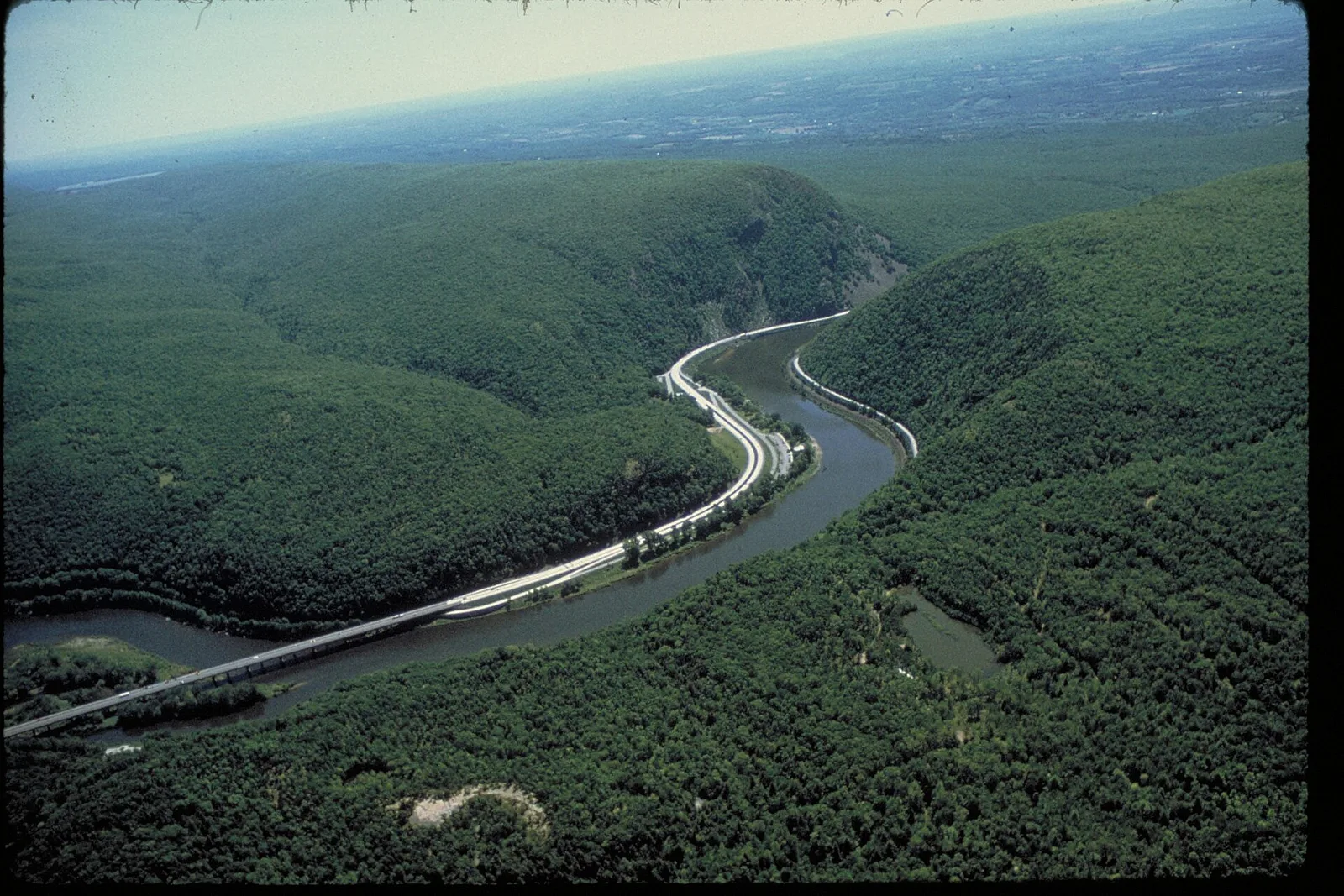
Delaware Water Gap National Recreation Area protects about 40 miles of the Middle Delaware River and the Kittatinny Ridge above it, some 70,000 acres straddling the line between northwestern New Jersey and northeastern Pennsylvania.
It exists because of a dam that was never built: the Tocks Island Dam, authorized in 1962, would have flooded 37 miles of the valley, and the government condemned about 15,000 parcels and cleared thousands of families and homes before the project collapsed under cost, geology, and public opposition.
When the dam was shelved, Congress turned the assembled land into a national recreation area in 1965; the dam was not formally deauthorized until the 1990s, and abandoned house foundations and cemeteries still dot the park.
The Delaware here is the longest undammed river east of the Mississippi and a source of drinking water for millions; a 1978 Wild and Scenic designation and an interstate basin commission have kept it unusually clean for a river within a two-hour drive of 25 million people.
- Designation
- National Recreation Area
- Location
- Warren and Sussex counties, northwestern New Jersey (and Monroe County, PA)
- Established
- September 1, 1965
- Annual Visitors
- ~4.7 million
Geology and Landscape
The Middle Delaware through the park is undammed and largely undeveloped, one of the last long stretches of a major river in the Northeast that can say that.
Congress named it a National Scenic and Recreational River in 1978, and the Delaware River Basin Commission, a compact of four states and the federal government, manages water quality and flow across the whole basin.
The current is gentle, with only a few easy rapids, which makes the river a favorite for beginner canoeists and for lazy multi-day float trips camping on the islands.
Its clean, cool water holds American shad that run up from the sea each spring, along with smallmouth bass, walleye, and stocked trout in the tributaries.
Kittatinny Ridge, called Blue Mountain on the Pennsylvania side, is a long, narrow crest of hard Silurian quartzite that runs the length of the park.
The Appalachian Trail follows the ridge for more than 25 miles here, the longest ridge walk in New Jersey, with views west into Pennsylvania and east over the Highlands.
Sunfish Pond, a 44-acre glacial lake at 1,380 feet on the ridge, was saved in the 1960s from being used as a reservoir for the dam project, an early New Jersey environmental victory, and is now a National Natural Landmark.
Autumn draws thousands of hawk-watchers to the ridgeline lookouts, where broad-winged hawks, ospreys, and eagles stream south along the mountain on the wind.
The Water Gap is the cleft where the Delaware cuts about 1,300 feet straight through Kittatinny Ridge between Mount Tammany on the New Jersey side and Mount Minsi on the Pennsylvania side.
Geologists call it a water gap of the antecedent or superimposed type: the river was already flowing on this line and kept cutting down as the ridge rose or was exhumed around it, rather than going around.
In the 1800s the gap was a fashionable resort, 'the Switzerland of America,' ringed with grand hotels reached by rail from New York and Philadelphia.
The Dunnfield Creek trail and the steep Mount Tammany loop climb the New Jersey wall of the gap for the classic view down the river.
Streams dropping off the ridge into the Delaware have cut a string of waterfalls, most of them a short walk from the road.
On the Pennsylvania side, Dingmans Falls plunges 130 feet down a mossy grotto reached by a boardwalk, with the narrow 80-foot Silverthread Falls beside it; Raymondskill Falls nearby is the tallest in the state.
On the New Jersey side, Buttermilk Falls tumbles about 85 feet in stepped cascades and is usually called the tallest waterfall in New Jersey.
Van Campens Glen and the falls in Childs Park round out the set, all fed by rain and snowmelt and reduced to a trickle in dry summers.
Indigenous Peoples of the Delaware Valley
Lenape (Delaware) Nation
The upper and middle Delaware valley, which the Lenape called the 'Minisink,' was one of the most heavily settled parts of Lenape country, with farming towns and fishing camps along the river the Lenape knew as Lenapewihittuk.
The Munsee-speaking Lenape of this region lost their land through a run of one-sided deals, above all the 1737 'Walking Purchase,' in which the Penn family used hired runners over a day and a half to claim about 1.2 million acres.
By the 1760s most Lenape had been pushed west into the Ohio country, the start of a long displacement through Indiana, Kansas, and Oklahoma, with other communities settling in Wisconsin and Ontario.
The Lenape were displaced from New Jersey through a series of land purchases and treaties in the 17th and 18th centuries, and many were removed to the Ohio Valley and then to Kansas and Oklahoma. The Delaware Tribe of Indians and the Delaware Nation, both headquartered in Oklahoma, are the federally recognized descendants of the New Jersey Lenape. The Nanticoke Lenni-Lenape Tribal Nation in New Jersey is state-recognized. NPS works with these communities on cultural interpretation programs at the park.
What to Do
Canoeing and Kayaking the Delaware
The 40 miles of river through the park have frequent public boat launches, so trips can be built to almost any length, from a two-hour paddle to a three-day float.
Backcountry campsites on the river islands and banks are first-come, permit-free, and reachable only by boat, which keeps them quiet.
Local outfitters rent canoes, kayaks, tubes, and rafts and run shuttle vans between the launches.
The river is forgiving at normal levels but rises fast and turns dangerous after heavy rain, so paddlers check the Montague and Delaware Water Gap gauges before setting out.
Appalachian Trail Ridge Walk
The Appalachian Trail runs the full length of the park on the New Jersey ridge, with road access at the Water Gap, Millbrook, and Culvers Gap.
A popular out-and-back climbs from the Kittatinny Point visitor center to the Sunfish Pond glacial lake, about 8 miles round trip along the crest.
The ridge is dry, so water has to be carried, and its rock is sharp, slow, and hard on ankles, the terrain that gives the New Jersey and Pennsylvania AT its 'rocksylvania' reputation.
The Catfish Fire Tower and the Raccoon Ridge lookouts on the crest are among the best fall hawk-watch spots on the East Coast.
Buttermilk Falls Trail
A short, steep trail with wooden staircases climbs alongside Buttermilk Falls, which drops about 85 feet in a chain of cascades and is generally called New Jersey's tallest waterfall.
The half-mile round trip to the base is easy; continuing up the stairs connects to the ridge and the Appalachian Trail for a longer loop.
The last few miles of gravel road to the trailhead are rough and can be impassable in winter and mud season.
The falls run hardest in spring and after storms and slow to a thin veil by late summer.
Swimming at Milford Beach
The park runs guarded swimming beaches on the river in summer at Milford Beach and Smithfield Beach, both on the Pennsylvania side but reached from New Jersey.
The Delaware here is clean enough for swimming, with a gravel bottom and a slow current at the beaches.
Away from the guarded areas the river has undercut banks, sudden drop-offs, and stronger current, and most of the park's drownings happen where people swim on their own.
The beaches also serve as canoe launches and picnic areas, so they fill up on hot weekends.
Conservation Challenges
Water Quality Protection
The Delaware supplies drinking water to roughly 13 to 15 million people, including, through interbasin transfers, much of New York City, so its condition matters far beyond the park.
The Wild and Scenic designation blocks big dams and dredging in the park reach, but farm runoff, road salt, treated sewage, and warming water are ongoing pressures.
The Delaware River Basin Commission, which has coordinated the four basin states since 1961, imposed a permanent ban on natural-gas fracking in the watershed in 2021.
Long-term monitoring shows the river has stayed clean or improved over decades, a rare trend for a river this close to major cities.
Invasive Species
Japanese barberry, multiflora rose, garlic mustard, and mile-a-minute vine have taken over large areas of the park's forest understory and old fields.
Japanese knotweed forms dense stands along the riverbanks and island shores, shading out native plants and leaving bare, erodible soil when it dies back in winter.
Spotted lanternfly, a planthopper first found in Pennsylvania in 2014, has spread across the region and stresses trees and grapevines.
Park crews cut, pull, and spot-spray the worst infestations, but with 70,000 acres and constant reintroduction from surrounding land, the work is containment.
Hemlock Woolly Adelgid
The hemlock woolly adelgid, a tiny sap-feeding insect from Asia, has killed most of the eastern hemlock across the park since it arrived in the 1990s.
Hemlocks shaded the ravines and lined the cold trout streams, and their loss has warmed those streams, opened the canopy, and let invasive plants move in.
The Park Service has released predatory beetles that feed only on the adelgid and treats a few high-value groves with systemic insecticide, but there is no way to save the hemlock forest as a whole.
Van Campens Glen, the Dingmans Falls trail, and other places named for their dark hemlock cover are slowly becoming hardwood.
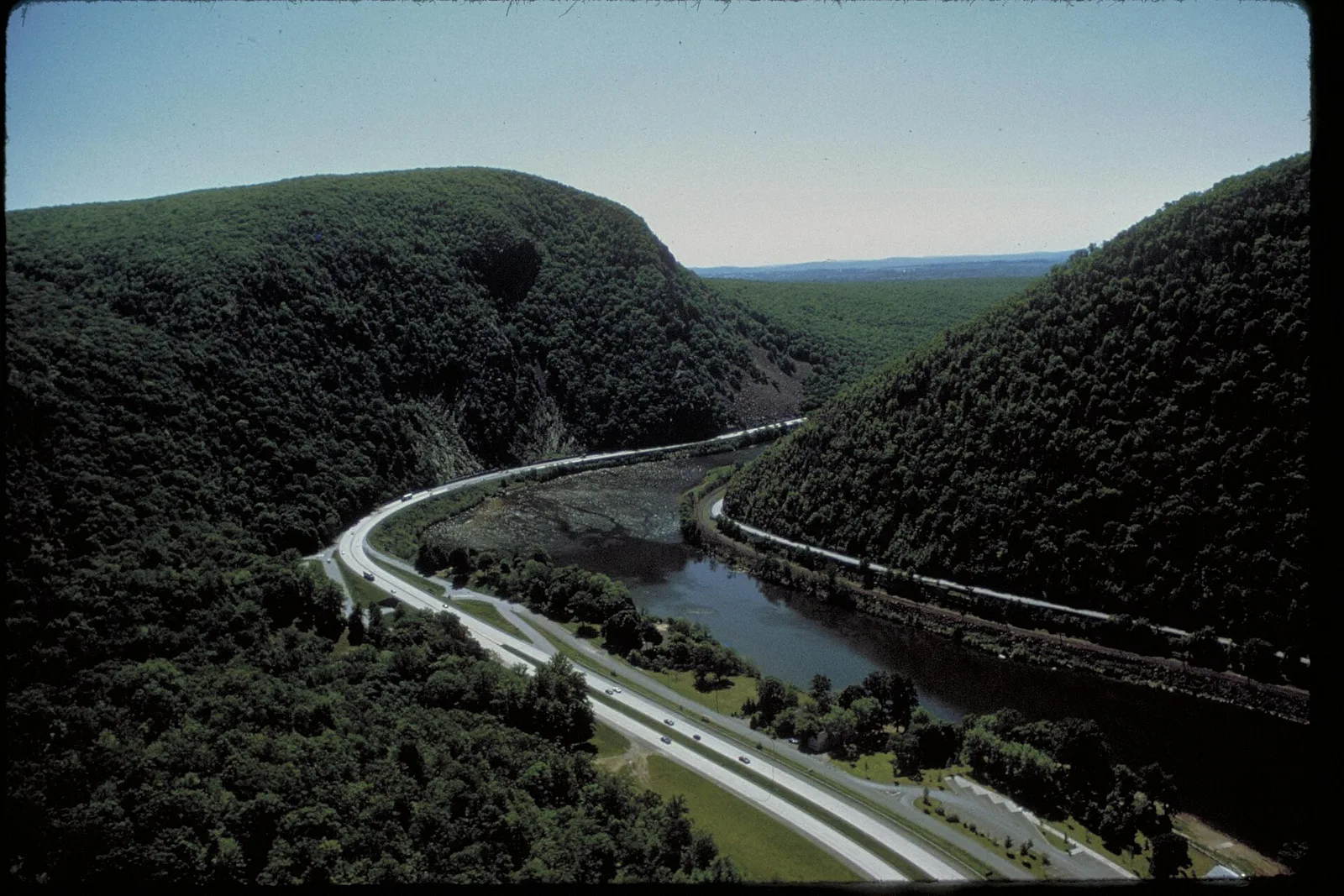
The Delaware River, Delaware Water Gap NRA
Fast Facts
Did You Know?
The Delaware Water Gap National Recreation Area exists partly because of a dam that was never built. The Tocks Island Dam, proposed in the 1960s, would have flooded 37 miles of the Delaware Valley. After years of public opposition, the dam was defeated and the land preserved as a national recreation area instead.
The Delaware River is the longest undammed river east of the Mississippi River. The combination of the Wild and Scenic designation (1978) and the defeat of the Tocks Island Dam has preserved a remarkable stretch of the river that provides drinking water for approximately 15 million people.
The park is one of the most accessible wilderness areas in the United States, located within 70 miles of New York City and within 75 miles of Philadelphia. More than 25 million people live within a two-hour drive, making it one of the most visited units in the National Park System.
Plan Your Visit
Location
Warren and Sussex counties, northwestern New Jersey (and Monroe County, PA)
Designation
National Recreation Area
Best Seasons
Summer for swimming and paddling; fall for foliage; spring for waterfalls
Admission
Free (parking fees at some sites)
NJ Visitor Center
One Recreation Road, Bushkill, PA 18324 (main visitor center)
Getting There
I-80 at the Water Gap; Route 209 runs through the NJ side of the park
More Info
nps.gov/dewa