About Ohio
Ohio takes its name from the Ohio River, the great tributary of the Mississippi that forms the state's southern boundary. The name comes from the Seneca language of the Haudenosaunee Confederacy. "Ohio" is believed to mean "great river," "large creek," or "great water" in Seneca. French explorers in the 17th century recorded the Seneca name for the river and applied it to the region. The Ohio River was one of the most important geographical features of early American expansion, serving as the primary route for settlers moving west and as the boundary between the Northwest Territory (where slavery was prohibited by the Northwest Ordinance of 1787) and the slave states to the south. Ohio was the first state carved from the Northwest Territory, admitted in 1803.
Ohio is the state where the American experiment has been tested most repeatedly, in the most consequential ways, at the most important moments. It was the first state carved from the Northwest Territory, the first application of the Northwest Ordinance's ban on slavery that drew the line between free and slave America. It produced eight presidents, more than any state except Virginia. Its sons made the first powered flight, orbited Earth first, and walked on the Moon first. Its industrial cities built the Arsenal of Democracy in two world wars and then became the face of deindustrialization.
Ohio sits at the geographic and demographic center of the country in ways that go beyond location. Its eleven million people are more racially, economically, and culturally diverse than any simple narrative can capture: the cosmopolitan growth of Columbus, the industrial heritage and genuine cultural sophistication of Cleveland and Cincinnati, the proud and battered working-class communities of the Mahoning Valley, the Amish farms of Holmes County, and the Appalachian poverty of the southeastern hills all exist within the same state borders.
The opioid epidemic hit Ohio harder than almost anywhere else. The political realignment of the working class has reshuffled Ohio's electoral map more dramatically than almost any other state. And yet Columbus keeps growing, Cleveland keeps producing world-class medicine and music, and Ohio keeps finding itself at the center of whatever America is arguing about. It earns its reputation as the bellwether state not by being average, but by containing multitudes.
Ohio's Five Regions
Ohio's economic and cultural geography breaks into five distinct areas, from the industrial cities of the northeast to the flat farmland of the northwest. Tap any region to learn more.
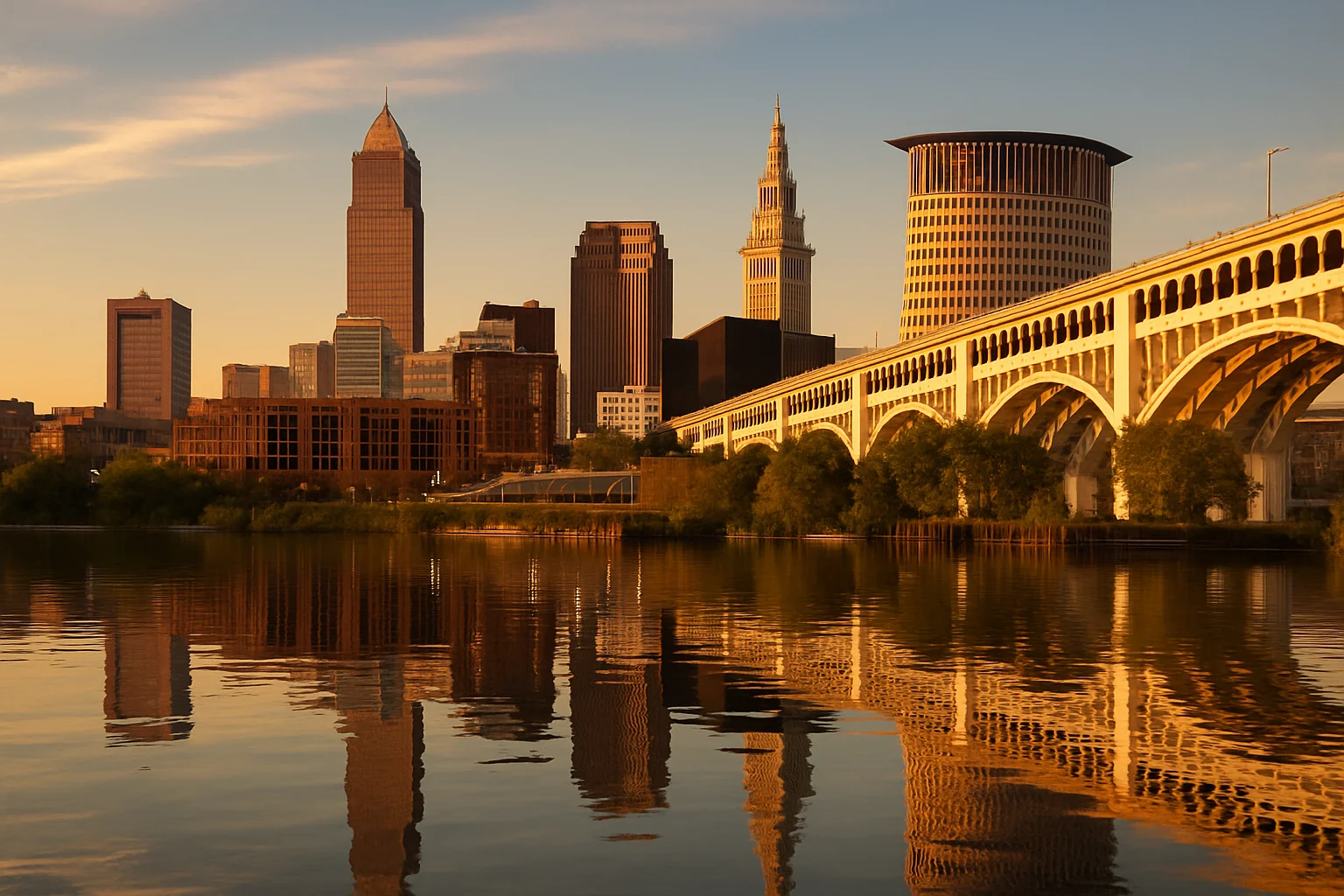
Northeast Ohio, the corner of the state anchored by Cleveland, Akron, Youngstown, and Canton, is the region most associated in the national imagination with the Ohio story: great industrial wealth built on steel, rubber, and manufacturing; a long and painful deindustrialization; and an uneven recovery that has left some communities revitalized and others still struggling. Cleveland, the largest city in the region and the state's second-largest city, sits at the mouth of the Cuyahoga River on Lake Erie's southern shore.
Its industrial history is written in the landscape: the Flats industrial valley where the Cuyahoga River flows to the lake, the lakefront steelworks that are now mostly silent, the grand cultural institutions of University Circle (the Cleveland Museum of Art, one of the great art museums in the world; the Cleveland Orchestra, consistently ranked among the finest in the world; the Cleveland Museum of Natural History; Case Western Reserve University) that were built by Gilded Age industrial wealth. The revival of the Cleveland waterfront, the Playhouse Square theater district (the largest performing arts complex outside New York City), and the Rock and Roll Hall of Fame on the lakefront have made Cleveland a cultural destination that surprises first-time visitors.
Akron, 40 miles south of Cleveland, was the Rubber Capital of the World for most of the 20th century and has reinvented itself as a polymer science, biomedical research, and entrepreneurship hub, with the University of Akron's polymer science program and the Bounce Innovation Hub anchoring a new economic identity.
Youngstown and the Mahoning Valley represent the starkest version of the Rust Belt story: once producing more steel per capita than anywhere in the world, devastated by the 1977 'Black Monday' mill closures, and still working toward an economic reinvention that has not fully arrived.
Columbus, the state capital and Ohio's largest city, is the great exception to the Ohio economic narrative of decline: a metropolitan area that has grown from 1.5 million people in 2000 to nearly 2.2 million in 2025, driven by Ohio State University, healthcare, government, insurance, and a technology sector that has made the city one of the most watched economic success stories in the Midwest. Columbus is unusual among state capitals in that it is also the state's dominant city; most large Midwestern states (Illinois, Michigan, Indiana) have their capital in a smaller city while the major commercial center is elsewhere.
In Ohio, Columbus is both. The city's growth has been sustained by a combination of advantages that planners elsewhere envy: Ohio State University generates 60,000 students, billions in research, and a constant flow of talent that stays or returns; the healthcare economy anchored by the OSU Wexner Medical Center and Nationwide Children's Hospital is one of the largest employers in the state; and the business services, insurance, and logistics economy centered on downtown and the sprawling suburbs has created a stable employment base resistant to the manufacturing cycle.
The Intel semiconductor investment in New Albany, east of Columbus in the exurban fringe, represents the next chapter in the city's growth story. The Short North arts district, the German Village historic neighborhood, and the explosive restaurant and craft brewery scene have made Columbus one of the more culturally interesting mid-sized American cities.
The Columbus metropolitan area accounts for an estimated 30 percent of Ohio's GDP, a concentration that has fueled debate about whether the rest of the state is being left behind.
Southwest Ohio, anchored by Cincinnati on the Ohio River and Dayton to the north, is one of the most historically significant and culturally rich regions in the Midwest, and one whose contributions to American life are routinely underestimated. Cincinnati, founded in 1788 at the confluence of the Ohio and Licking rivers, was the largest city in the American interior for much of the early 19th century, the Queen City of the West, gateway to the frontier, and a manufacturing and commercial center of national importance before Chicago's explosive rise.
It was a center of the abolitionist movement: Cincinnati, directly across the Ohio River from the slave state of Kentucky, was a key stop on the Underground Railroad, and Harriet Beecher Stowe wrote Uncle Tom's Cabin while living there, basing her observations on what she witnessed of both Kentucky slavery and Ohio abolitionism. Cincinnati's German immigrant community, which constituted a majority of the city's population in the 1850s, created an enduring cultural infrastructure, the Cincinnati Symphony Orchestra (founded 1895), the Cincinnati Art Museum, the Cincinnati Zoo and Botanical Garden (the second-oldest in the United States), that has made the city one of the most culturally developed in the Midwest.
Procter & Gamble, founded in Cincinnati in 1837, has shaped the city's physical and economic landscape for nearly two centuries.
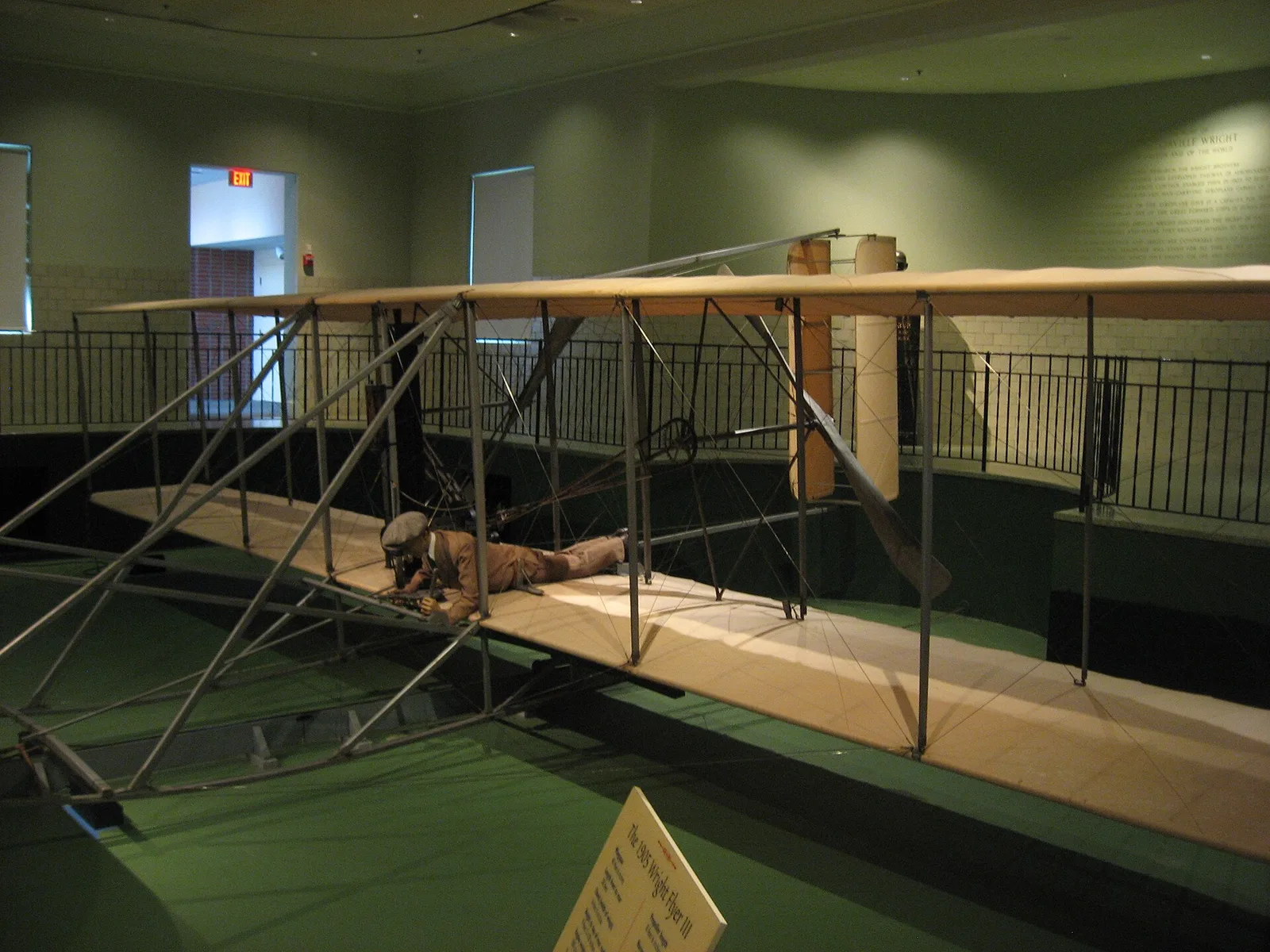
Dayton, birthplace of the Wright Brothers and home of Wright-Patterson Air Force Base, has an aviation heritage that no other American city can match: the National Museum of the United States Air Force in Dayton is the largest and oldest military aviation museum in the world, and the city's Carillon Historical Park preserves the Wright Brothers' original 1905 Flyer III, the first practical airplane, in the building where it was restored.
Northwest Ohio, the flat agricultural plain surrounding Toledo at the western end of Lake Erie, is defined by two historical facts: it was once the Great Black Swamp, one of the most impenetrable wetland barriers to westward migration in American history, and after its 19th-century drainage it became some of the most productive farmland in the Midwest. The Great Black Swamp stretched roughly 120 miles from the Sandusky Bay area westward into Indiana, and its dense hardwood forest, standing water, and impenetrable mud halted the movement of settlers and armies (the region played a role in the War of 1812's disastrous early campaigns) for decades.
The construction of drainage tile, fired clay pipes laid in systematic grids beneath the fields, transformed the swamp into farmland between roughly 1860 and 1890, one of the largest artificial landscape transformations in American history. Today, the black muck soils of the old swamp produce record yields of soybeans and corn, and the agricultural drainage that made this possible is also the primary source of the phosphorus loading that has turned western Lake Erie into one of the most algae-afflicted large lakes in the world.
Toledo, the region's commercial center, was an important Great Lakes port city whose glass industry (Owens Illinois, Owens Corning, both founded in Toledo, made the city the glass capital of the world for most of the 20th century) and auto assembly plants defined its 20th-century economy.
The city has struggled with deindustrialization and population loss, but retains the Toledo Museum of Art (one of the finest art museums in the Midwest, with a spectacular glass collection befitting the city's industrial heritage), the Toledo Zoo, and the University of Toledo.
Southeastern Ohio, the portion of the state that rises into the foothills and low ridges of the Appalachian Plateau, is the most economically distressed and most overlooked region in a state that itself is sometimes overlooked. The region's counties, Athens, Meigs, Gallia, Lawrence, Jackson, Vinton, and their neighbors, have poverty rates, opioid addiction rates, and unemployment rates that routinely rank among the worst in Ohio and in the Appalachian region more broadly.
The coal mining economy that sustained many of these communities for the first half of the 20th century has been largely destroyed by the decline of coal-fired power generation and the competition from cheaper Western coal; the manufacturing economy that supplemented it has also largely departed. Athens County, home of Ohio University (one of the older public universities in the US, founded 1804, the first university chartered in the Northwest Territory), is an island of relatively prosperous academic community in a sea of rural poverty.
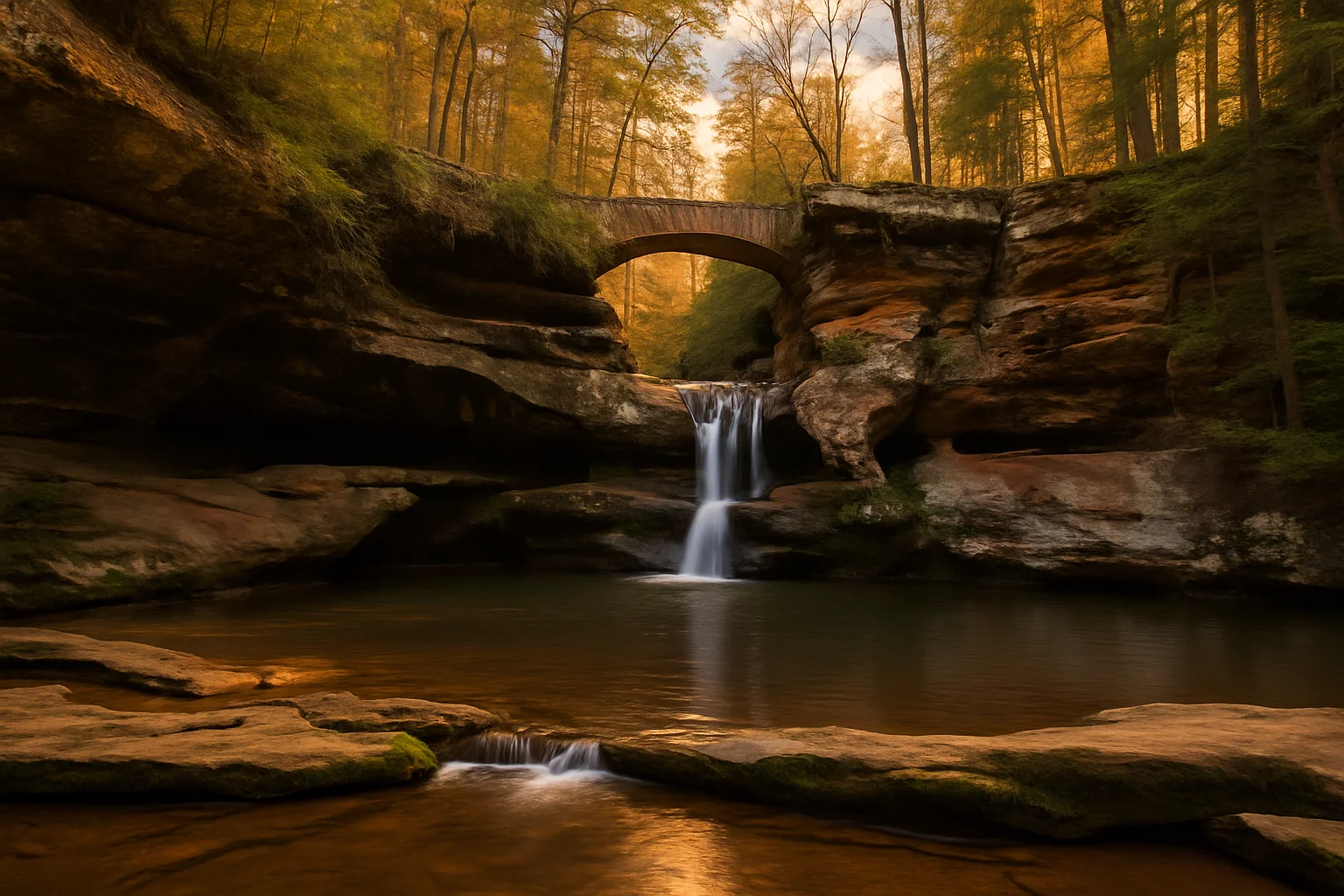
The Hocking Hills region, a spectacular landscape of sandstone gorges, waterfalls, caves, and old-growth hemlock forests centered on Hocking Hills State Park and adjacent Logan, is the state's most visited natural attraction and an increasingly important economic driver for the region, drawing hikers, photographers, and outdoor recreation visitors from across Ohio and the Midwest. Old Man's Cave, Cedar Falls, Ash Cave, and Conkle's Hollow offer geological scenery of surprising grandeur in a state not typically associated with dramatic landscape.
The region's proximity to Columbus, roughly an hour's drive south, has made it a weekend destination for the state's growing urban population, and the development of rental cabins, zipline tours, and outdoor recreation businesses represents the most viable economic development model for communities with few other comparative advantages.

Economy
Ohio's $850 billion economy, the seventh largest in the nation, is one of the most diversified in America, spanning advanced manufacturing, world-class healthcare, technology, corporate services, and agriculture. It is an economy in the middle of a generational transition, shedding the heavy industry of the 20th century and building the knowledge economy of the 21st. Tap any sector to learn more.
Ohio remains the seventh-largest manufacturing state in the country, employing over 700,000 workers in sectors ranging from automotive assembly to aerospace components to advanced materials. The automotive industry, anchored by Honda's massive Marysville assembly plant (which began production in 1982 as Honda's first US manufacturing facility), the Jeep plant in Toledo (the oldest continually operating automotive assembly plant in the world, tracing its lineage to 1941), and General Motors operations in multiple Ohio locations, is the backbone of the state's manufacturing economy.
Steel, which once defined the Mahoning Valley around Youngstown and drove the Cleveland economy, has largely departed, but specialty steel and advanced alloy production persists. The rubber industry that made Akron the Rubber Capital of the World for most of the 20th century, Goodyear (still headquartered in Akron, the only remaining major tire manufacturer with US headquarters), Firestone, Goodrich, has transformed into a polymer science and advanced materials economy centered on the University of Akron's polymer science program, one of the best in the world.
Ohio's manufacturing transformation has been supported by JobsOhio, a private nonprofit economic development organization created by Governor Kasich in 2011 that took over from the state's development department, with the power to use bond proceeds and state liquor revenues to attract and retain companies. Intel's announcement in 2022 of a $20 billion semiconductor fabrication facility in New Albany near Columbus, the largest single private-sector investment in Ohio history, is the most dramatic evidence of the manufacturing reinvention underway.
The scale of the earlier decline is easy to understate: Ohio factory employment peaked near 1.3 million in 1969, fell below 620,000 by 2010, and has since recovered only to roughly 700,000, though manufacturing still generates about 17 percent of state economic output. The industry is now pivoting toward electric vehicles and batteries. Honda's Marysville-area operations build close to a million vehicles and engines a year and began a $700 million electric-vehicle retooling in 2024, while Honda and LG Energy Solution are building a $4.4 billion battery plant in Fayette County. Lordstown, where General Motors closed its assembly plant in 2019 after 53 years, is now the site of Ultium Cells, a GM and LG battery joint venture, and First Solar, the largest United States-based solar panel maker, runs its biggest factories near Toledo.
The Cleveland Clinic, founded in 1921 by four physicians who created what was then a radically novel model of group practice and research integration, is consistently ranked the number-one hospital in the United States for cardiac care and among the top two or three overall. Its campus in Cleveland's Fairfax neighborhood has expanded across the street from its original building to encompass dozens of structures, and its global reach, with facilities in Abu Dhabi, London, Toronto, and elsewhere, has made it one of the most internationally recognized brands in American medicine. University Hospitals, also in Cleveland and affiliated with Case Western Reserve University, is a major research and teaching hospital in its own right.
The Ohio State University Wexner Medical Center in Columbus is one of the largest and most comprehensive academic medical centers in the country, with particular strengths in cancer treatment (the James Cancer Hospital), neurology, and transplant surgery. Nationwide Children's Hospital in Columbus is consistently ranked among the top children's hospitals in the US.
The life sciences sector, concentrated in Columbus, Cleveland, and Cincinnati, employs approximately 100,000 people and has been the focus of sustained state and private investment. The growth of biotech startups, medical device companies, and clinical research organizations around Ohio's academic medical centers has created a life sciences corridor that rivals those of more celebrated coastal hubs.
The Cleveland Clinic is the largest private employer in Ohio, with more than 75,000 workers; it performed the first coronary artery bypass graft in 1967 and the first near-total face transplant in the United States in 2008. Ohio State's Wexner Medical Center and the affiliated Arthur G. James Cancer Hospital anchor a Columbus health campus that has added more than $2 billion in new towers through the 2010s and 2020s. Cincinnati Children's Hospital is one of the largest pediatric research centers in the country and helped develop an early rotavirus vaccine. Battelle Memorial Institute, headquartered in Columbus, is the world's largest independent nonprofit research and development organization and helps operate several United States national laboratories.
The state's association with aviation did not end with the Wrights. Wright-Patterson Air Force Base, located on the eastern edge of Dayton and covering over 8,000 acres, is the largest Air Force base in the United States by some measures and one of the most important military installations in the country: it is the home of Air Force Materiel Command, Air Force Research Laboratory, the National Air and Space Intelligence Center, and the Air Force Institute of Technology, making it the intellectual and research center of American air power. The National Museum of the United States Air Force, on the grounds of Wright-Patterson, is the oldest and largest military aviation museum in the world, with over 360 aircraft and missiles on display including prototype stealth aircraft, captured Soviet jets, and the only intact Boeing B-29 Superfortress with an atomic bomb bay.
The Dayton region's aerospace manufacturing cluster, including Standard Register, NCR, and dozens of defense contractors, makes it one of the most important aerospace economies in the Midwest. Neil Armstrong, the first human to walk on the moon, was born in Wapakoneta, Ohio, and trained at Wright-Patterson.
John Glenn, the first American to orbit Earth and later a U.S. Senator, was born in New Concord. Ohio has sent more astronauts into space than any other state, a fact Ohioans invoke with consistent pride.
NASA's Glenn Research Center, on the western edge of Cleveland at Lewis Field, was founded in 1941 and specializes in aircraft propulsion, space power, and microgravity research; its Plum Brook Station near Sandusky houses the world's largest space environment simulation chamber. Wright-Patterson employs roughly 30,000 military and civilian workers, making it the largest single-site employer in Ohio, and its intelligence arm, now the National Air and Space Intelligence Center, is the origin of much of the Cold War folklore about crash recovery and reverse engineering because it received and analyzed foreign aircraft and materials. GE Aerospace, which builds many of the jet engines on the world's airliners and military aircraft, is headquartered in Evendale near Cincinnati and employs thousands across the region.
The engine of this growth is a combination of Ohio State University's research output and talent pipeline, a relatively low cost of living compared to coastal cities, and deliberate public and private investment through JobsOhio and the Columbus Partnership. Amazon Web Services operates significant data center infrastructure in the Columbus metropolitan area, attracted by the city's reliable power grid, central location, and fiber connectivity. Nationwide Insurance, one of the largest insurance companies in the US, is headquartered in Columbus and represents the financial technology dimension of the local economy.
The Intel investment in New Albany, two semiconductor fabrication plants that are part of a planned $100 billion campus, the largest private investment in Ohio history when announced in 2022, is transforming the Columbus exurbs into a semiconductor manufacturing hub of national significance, although in 2025 Intel pushed completion of the first plant back to 2030 to 2031. The Defense Innovation Unit and various federal research agencies have invested in Ohio's technology ecosystem.
Ohio State University itself, with over 60,000 students and research expenditures exceeding $1.5 billion annually, functions as an economic engine that sustains not just Columbus but the broader state economy through startup formation, talent retention, and research commercialization. The Cleveland tech scene, centered on University Circle's constellation of Case Western Reserve, Cleveland Clinic, and associated research institutions, has produced significant companies in health informatics, biotech, and advanced materials.
Columbus was picked in 2016 over 77 other cities to win the U.S. Department of Transportation's $40 million Smart City Challenge, funding connected-vehicle and transit-technology pilots. The region sits within a one-day truck drive of roughly half the U.S. population, an advantage that has drawn enormous data-center construction: Amazon, Google, Meta, and Microsoft have together committed more than $12 billion to central Ohio data centers by the mid-2020s, straining regional electricity and water planning. Homegrown successes include CoverMyMeds, a pharmacy-software firm acquired by McKesson for roughly $1.4 billion in 2017, one of the largest technology acquisitions in Ohio history, which built a large campus on Columbus's Scioto Peninsula.
Ohio is one of the top ten states in the production of soybeans, corn, eggs, tomatoes, and greenhouse and nursery products, with the northwestern part of the state, the former Great Black Swamp, drained by ambitious 19th-century tiling projects, producing some of the most fertile farmland in the Midwest. The Maumee River watershed in northwestern Ohio is both one of the most productive agricultural regions in the state and one of the most environmentally stressed: agricultural runoff, particularly phosphorus from fertilizer and hog and poultry operations, has been a primary driver of the algal blooms in Lake Erie that have periodically threatened Toledo's water supply (the 2014 Lake Erie algal bloom shut off drinking water to 400,000 Toledo residents for three days).
Ohio is the second-largest egg-producing state in the country, with massive laying operations concentrated in the north-central part of the state. Swiss and Amish communities in Holmes, Tuscarawas, and adjacent counties form the largest Amish population in the world (exceeding even Lancaster County, Pennsylvania), contributing to a distinctive agricultural and craft economy based on small-scale, diversified farming, woodworking, and food production that draws significant agritourism.
The Hocking Hills region in southeastern Ohio, while not primarily agricultural, draws hundreds of thousands of visitors to its waterfalls, caves, and old-growth forest remnants each year.
Ohio ranks first in the country in Swiss cheese production, is a leading maple syrup state east of Vermont, and is a major grower of processing tomatoes, pumpkins, and greenhouse crops. The 2014 Toledo water crisis, when the microcystin toxin from a Lake Erie algal bloom left 400,000 people unable to drink tap water for three days, pushed the state to pass Senate Bill 1 in 2015 restricting winter manure and fertilizer spreading in the western basin, and Governor DeWine's H2Ohio program, launched in 2019, has since committed hundreds of millions of dollars to wetlands and farm-runoff reduction. The Amish and Mennonite communities of Holmes County and its neighbors, numbering more than 35,000, sustain a dense network of small dairy, produce, and furniture operations and draw several million tourists a year.
Columbus is the home of Nationwide Mutual Insurance (one of the largest insurance companies in the world), L Brands (Victoria's Secret, Bath & Body Works), Cardinal Health (one of the largest pharmaceutical distributors in the US), Huntington Bancshares, and a dozen other major corporations. Cincinnati has been a corporate headquarters city since the 19th century: Procter & Gamble, founded in Cincinnati in 1837 when William Procter and James Gamble combined their candle and soap businesses, has grown into one of the largest consumer goods companies in the world with over 65 brands, nearly $80 billion in annual revenue, and a presence in 180 countries. Kroger, the largest supermarket chain in the United States, is headquartered in Cincinnati.
Fifth Third Bank, Western & Southern Financial Group, and Great American Insurance are among the major Cincinnati financial and insurance companies. Cleveland hosts KeyCorp, one of the larger US regional banks.
The concentration of corporate headquarters in Ohio's major cities has made the state one of the most economically complex in the Midwest, capable of financing and managing enterprises of national and global scale. This corporate density also means that Ohio's economy is more sensitive to corporate restructuring decisions, headquarters relocations, mergers, outsourcing, than states whose economies are built primarily around smaller firms.
Ohio is home to about 20 to 25 Fortune 500 headquarters, typically ranking behind only New York, California, Texas, and Illinois. Marathon Petroleum in Findlay is the state's largest company by revenue, well over $150 billion, having spun off from Marathon Oil in 2011 and acquired the refiner Andeavor in 2018. Progressive Corporation, based in Mayfield Village near Cleveland, pioneered drive-in claims service and usage-based auto insurance and is now one of the largest car insurers in the country. Parker Hannifin, Goodyear, Sherwin-Williams, and Owens Corning round out a roster spread across Cleveland, Akron, Toledo, and Findlay rather than concentrated in one metro.
How Ohio's Government Works
Ohio's state government reflects the state's political complexity: a recently Republican-dominated legislature and statewide executive landscape, with an electorate that has shown genuine independence on ballot issues and the capacity to produce surprise results. Republicans have held the governorship continuously since 2011 and have maintained legislative supermajorities that have allowed them to override Democratic governors' vetoes and redraw legislative maps over the objections of the state Supreme Court.
The state's direct democracy tradition, Ohio's constitutional initiative process allows citizens to place constitutional amendments directly on the ballot with sufficient signatures, has produced several landmark outcomes that legislative majorities could not have achieved. The 2023 abortion rights amendment (Issue 1, approved 57-43) and marijuana legalization are recent examples of the electorate moving ahead of the legislature on social issues.
Ohio's redistricting controversies have been among the most prolonged and contentious in the country. The Ohio Supreme Court struck down Republican-drawn legislative maps seven times between 2022 and 2023, finding them to be unconstitutional partisan gerrymanders, before the maps were ultimately used for the 2022 elections after the deadline for court intervention passed. The episode exposed structural weaknesses in Ohio's redistricting commission process.
Ohio voted for Barack Obama in 2008 and 2012, then swung to Donald Trump by 8 points in 2016 and 2020, becoming one of the country's clearest examples of a state realigning around the white working-class vote. The Columbus metropolitan area, now roughly 30 percent of the state's population, votes substantially Democratic, while the rest of the state has shifted heavily Republican, a geographic polarization that is reshaping every statewide election.
Governor of Ohio
Current Governor
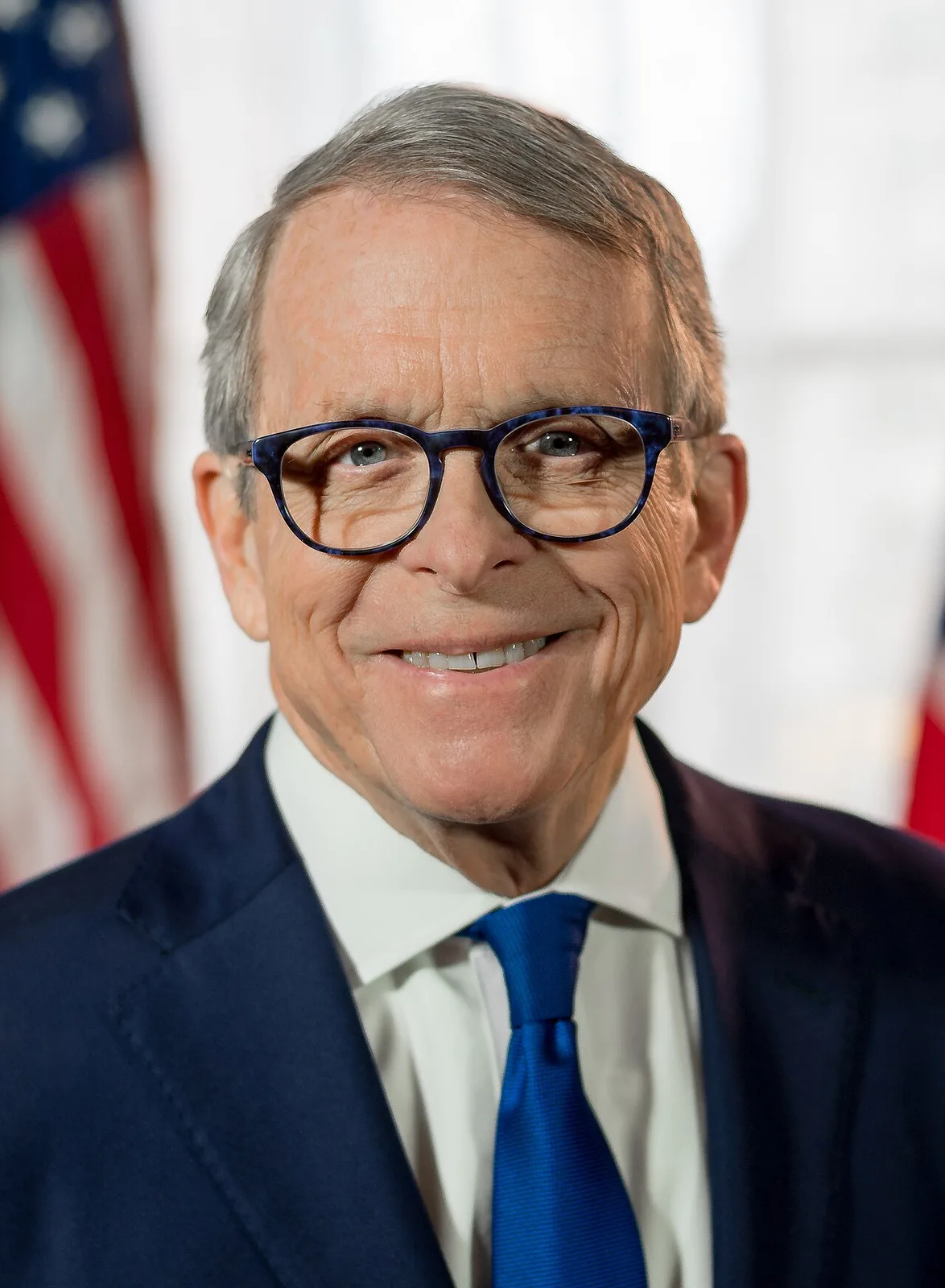
Mike DeWine
- Party
- Republican
- In Office Since
- January 14, 2019
- Term Ends
- January 2027
- Born
- January 5, 1947, Yellow Springs, Ohio
- Education
- College of Wooster (BA, 1969); Ohio Northern University, Pettit College of Law (JD, 1972)
- Prior Roles
- Ohio AG (2011-2019); U.S. Senator (1995-2007); U.S. Representative (1983-1991)
Mike DeWine is one of the longest-serving elected officials in Ohio history, having held public office in nearly every major role in the state and federal government across five decades. As governor, he has pursued a moderate Republican agenda with particular emphasis on child welfare (children in the opioid epidemic), mental health, and criminal justice reform. His handling of the COVID-19 pandemic, early and aggressive restrictions followed by faster reopening, made him a nationally watched figure and drew both praise and criticism within his own party. His response to the February 2023 East Palestine train derailment, which released toxic chemicals and required a controlled burn that alarmed the community, tested his administration's crisis management. He won re-election in 2022 with 62 percent of the vote.
Other Current State Officials
Attorney General
Dave Yost
In office since January 2019, re-elected in 2022. Previously Ohio State Auditor (2011-2019) and Delaware County Prosecutor. As AG, Yost pursued major opioid litigation that resulted in multibillion-dollar settlements from manufacturers and distributors, challenged federal agency actions, and joined multistate legal coalitions on tech antitrust matters. He ran unsuccessfully in the 2022 Republican gubernatorial primary.
Secretary of State
Frank LaRose
In office since January 2019, re-elected 2022. A former Ohio State Senator and Army Green Beret, LaRose has overseen Ohio's elections and administered some of the most scrutinized ballot measures in the country, including the 2023 Issue 1 abortion rights amendment. He ran unsuccessfully for U.S. Senate in 2024, losing the Republican primary to Bernie Moreno.
State Treasurer
Robert Sprague
In office since January 2019, re-elected 2022. A former Ohio state representative from Findlay, Sprague oversees the investment of approximately $25 billion in state funds and manages Ohio's debt obligations. He has focused on cybersecurity for state financial systems and on expanding the GrowNOW program that provides reduced-rate loans to small businesses that keep jobs in Ohio.
* Official information as of early 2025. Always verify current officeholders at ohio.gov.
The Ohio General Assembly
Ohio State Senate
- Seats: 33 members
- Terms: 4-year staggered terms
The upper chamber. Senators serve 4-year terms with half the seats on the ballot every two years. Republicans hold a supermajority. Subject to 8-year term limits (2 terms). The Senate President is one of the most powerful figures in Columbus.
Ohio House of Representatives
- Seats: 99 members
- Terms: 2-year terms
The lower chamber. All 99 seats are up every two years. Republicans hold a supermajority. Subject to 8-year term limits (4 terms). The House has been the site of significant corruption prosecutions including former Speaker Larry Householder's racketeering conviction related to an energy company bailout scheme.
Ohio's U.S. Senators
Every state gets exactly two U.S. Senators, regardless of population. Ohio's senators serve 6-year terms and represent the entire state.
U.S. Senator
Jon Husted
Appointed by Governor DeWine in January 2025 to fill the seat vacated when JD Vance became Vice President. Husted had served as Ohio's Lieutenant Governor since 2019, and before that as Secretary of State (2011-2019) and Ohio House Speaker (2009-2011). A Montpelier native with a long career in Ohio Republican politics, Husted is expected to run for a full term in 2026.
U.S. Senator
Bernie Moreno
Elected in November 2024, defeating three-term incumbent Democrat Sherrod Brown in one of the most expensive Senate races in U.S. history. A Cleveland-area auto dealership entrepreneur born in Colombia, Moreno won the Republican primary with Donald Trump's endorsement after a contested three-way race. His victory over Brown, one of the last Democrats to win statewide in Ohio, marked a significant shift in Ohio's Senate representation.
Ohio's U.S. House Delegation
Ohio has 15 seats in the U.S. House of Representatives, based on its population, down from a high of 24 seats at its mid-20th-century population peak. Each member represents a congressional district and serves 2-year terms.
Ohio's congressional map, like its legislative maps, was struck down by the Ohio Supreme Court in 2022 for unconstitutional partisan gerrymandering, though a divided court allowed the disputed map to stand for the 2022 elections after the drawing deadline passed. A November 2024 ballot measure, Issue 1, that would have replaced the mapmaking process with an independent citizens redistricting commission was defeated at the polls, roughly 54 percent to 46 percent, leaving the existing process, and the seven-member commission of elected officials, in place.
📋 Verify Current Members
House membership changes every two years. For the current names and districts, visit house.gov and search Ohio.
Ohio Through the Years
From the mound-building civilizations that constructed geometric earthworks larger than Stonehenge, to the Northwest Ordinance that first banned slavery in American territory, to the Wright Brothers, Neil Armstrong, and eight presidents, Ohio has been present at more American turning points than any state has a right to claim.
The territory that became Ohio was home to some of the most architecturally ambitious prehistoric civilizations in North America. The Adena culture, which flourished in the Ohio River valley from roughly 1000 BCE to 100 CE, built hundreds of earthen burial mounds across Ohio and neighboring states, including Miamisburg Mound in Dayton, the largest conical burial mound in the eastern United States at 68 feet high. The Hopewell culture, which succeeded and partially overlapped with the Adena from roughly 100 BCE to 500 CE, built earthworks of far greater complexity and scale: geometric enclosures of enormous size, precisely aligned with astronomical events, connected by hundreds of miles of straight earthen roads, and filled with artifacts made from materials, obsidian from Yellowstone, copper from the Great Lakes, mica from the Carolinas, shark teeth from the Gulf of Mexico, that demonstrate a trade network spanning the continent.
The Newark Earthworks in Licking County, Ohio, are the largest complex of geometric earthen enclosures in the world: the Great Circle Earthwork encloses 26 acres and the Octagon Earthworks encloses 50 acres, with walls precisely oriented to track the 18.6-year lunar cycle. Cahokia Mounds in Illinois is the most famous mound site, but the Ohio Hopewell sites represent a more mathematically sophisticated and geographically extensive civilization.
The Fort Ancient culture followed, building the massive hilltop enclosure at Fort Ancient in Warren County around 900-1600 CE. By the time European explorers arrived, these cultures had vanished, replaced by the historically known Erie, Shawnee, Lenape, Miami, Wyandot, and Ottawa peoples whose territories would be contested and ultimately destroyed by American expansion.
The labor involved was immense. The Hopewell moved an estimated seven million cubic feet of earth at Newark alone, carried in baskets, with no draft animals and no wheel. In 2023 UNESCO inscribed the Hopewell Ceremonial Earthworks, eight sites in central and southern Ohio including Newark and the Mound City group near Chillicothe, as a World Heritage Site, the first in the state. Early Ohioans destroyed most of the mounds without a second thought: the town of Circleville was laid out inside a circular Hopewell earthwork in 1810 and then demolished it lot by lot over the following decades, and the Great Serpent Mound in Adams County, a 1,300-foot effigy attributed to the later Fort Ancient culture and radiocarbon-dated to around 1070 CE, is the largest surviving serpent effigy in the world.
On July 13, 1787, while the Constitutional Convention was simultaneously drafting the Constitution in Philadelphia, the Confederation Congress passed the Northwest Ordinance, widely regarded as the most important piece of legislation in American history after the Constitution itself. The ordinance established the framework for governing the territory north of the Ohio River and east of the Mississippi (the future states of Ohio, Indiana, Illinois, Michigan, and Wisconsin) and, crucially, specified that slavery would be permanently prohibited in the territory: 'There shall be neither slavery nor involuntary servitude in the said territory.' This was the first legal prohibition on slavery in any American jurisdiction, and it established the Ohio River as the boundary between free and slave territory that would remain politically explosive for the next 75 years.
The ordinance also established the framework for how territories would become states, a template that governed the admission of all subsequent American states, with provisions for civil liberties, public education (the famous Article 3: 'Religion, morality, and knowledge, being necessary to good government and the happiness of mankind, schools and the means of education shall forever be encouraged'), and the rights of territorial residents. Ohio was the first state admitted under the Northwest Ordinance's framework, in 1803, and its admission confirmed that the free-soil principle of the ordinance would extend into statehood.
The Ohio River border between free Ohio and slave Kentucky and Virginia was one of the most significant geographical boundaries in American history, a daily reminder of the nation's fundamental contradiction that made Cincinnati and other border cities centers of abolitionist activity.
The antislavery clause was porous in practice. Ohio, Indiana, and Illinois all tolerated long-term indentured servitude and passed 'black laws' restricting where free Black residents could live and testify, and enslaved people were still held illegally in parts of the region into the 1820s. The first organized settlement under the ordinance was Marietta, founded at the mouth of the Muskingum River on April 7, 1788, by the Ohio Company of Associates, a group of New England Revolutionary War veterans led by Rufus Putnam. The ordinance also set aside section 16 of every surveyed township to fund public schools, a land-grant principle later applied nationwide, and Ohio University at Athens, chartered in 1804, was endowed from such reserved lands.
Ohio became the 17th state on March 1, 1803, the first state carved from the Northwest Territory and the first state admitted to the Union from the area west of the original thirteen colonies. Chillicothe, in the Scioto River valley, was the first state capital, a choice reflecting the settlement patterns of the Virginians who had crossed the Ohio River to claim bounty land warrants from their Revolutionary War service.
The early Ohio statehood story is inseparable from the conflict with the Native nations of the region: the Delaware, Miami, Shawnee, Wyandot, and other peoples whose territories were guaranteed by treaty were systematically dispossessed through a combination of military campaigns, fraudulent treaties, and relentless settler pressure in the decades following statehood. The Battle of Fallen Timbers in 1794, and the subsequent Treaty of Greenville, had nominally settled the question of Indian title in most of Ohio before statehood, but the process of removal continued through the 1840s.
Ohio's early growth was explosive: the state had approximately 45,000 European-American residents at statehood in 1803 and nearly 600,000 by 1820, one of the fastest population growths in American history, driven by the completion of the National Road through the state's center and by canal construction that opened the interior to commerce. The Ohio and Erie Canal (connecting Cleveland to Portsmouth on the Ohio River, completed 1832) and the Miami and Erie Canal (connecting Toledo to Cincinnati, completed 1845) transformed Ohio into one of the most economically dynamic states in the nation and set the stage for the industrialization that would follow.
Ohio was admitted without Congress ever passing a formal act of admission; lawmakers approved its constitution and organized its government in early 1803, but the oversight was not corrected until 1953, when Congress retroactively declared statehood effective March 1, 1803. The 1803 constitution gave the legislature nearly all the power, denied the governor a veto, and restricted voting and militia service to white men, a compromise that troubled several delegates. A border dispute with Michigan over the Toledo Strip produced the bloodless 1835 'Toledo War,' which Congress settled in 1836 by awarding the strip to Ohio and compensating Michigan with the western Upper Peninsula. By 1850 Ohio was the third most populous state in the country, behind only New York and Pennsylvania.
On September 10, 1813, a 28-year-old naval officer named Oliver Hazard Perry commanded a hastily built American fleet in the Battle of Lake Erie against a British squadron and won one of the most decisive naval victories in American history. The battle was fought off the coast of present-day Put-in-Bay on South Bass Island in Lake Erie. Perry's flagship, the USS Lawrence, was so badly damaged that he transferred his command flag to the USS Niagara by rowboat under fire and continued fighting.
His victory message to General William Henry Harrison, 'We have met the enemy and they are ours,' became one of the most famous dispatches in American military history. The battle gave the United States control of Lake Erie for the remainder of the War of 1812, forced the British to abandon Detroit, and enabled Harrison's subsequent victory at the Battle of the Thames (where Tecumseh, the Shawnee leader and architect of a pan-Indian confederacy that might have permanently blocked American westward expansion, was killed).
Perry's Island, now South Bass Island, and the Perry's Victory and International Peace Memorial, a 352-foot Doric column erected in 1915, the tallest monument to any naval engagement in the world, remain major tourism destinations in the Lake Erie islands. The battle is also notable for having been fought on waters that have since become the subject of environmental catastrophe: Lake Erie's western basin, where the battle took place, is the same area most severely affected by agricultural runoff and algal blooms today.
Perry's nine-vessel squadron was built almost from scratch at Presque Isle, now Erie, Pennsylvania, over the winter of 1812 and 1813 using green local timber, and it was crewed by soldiers, Kentucky militiamen, and free and enslaved Black sailors with little naval experience. His battle flag, stitched with the dying words of Captain James Lawrence, 'Don't Give Up the Ship,' is preserved at the U.S. Naval Academy. The Treaty of Ghent that ended the war in December 1814 restored the prewar borders, but the death of Tecumseh at the Thames removed the last organized Native barrier to American settlement of Ohio and the Northwest. Perry himself died of yellow fever in 1819 at age 34 while on a diplomatic mission to Venezuela.
Ohio's contribution to the Union cause in the Civil War was enormous and disproportionate to its population. The state provided approximately 320,000 soldiers to Union forces, more than any state except New York and Pennsylvania, and its industrial capacity in steel, iron, rubber, and food processing made it indispensable to the Union war effort.
Cincinnati, directly across the Ohio River from Kentucky, was a crucial supply and logistics base for Western campaigns. The state produced two of the Union's most important generals: Ulysses S. Grant, from Point Pleasant in southwestern Ohio, who became the Union's supreme commander and the architect of the Confederacy's defeat; and William Tecumseh Sherman, from Lancaster, Ohio, whose March to the Sea through Georgia in 1864 established the doctrine of total war that broke the Confederacy's will to continue.
Ohio's wartime governor Salmon P. Chase served simultaneously as Lincoln's Treasury Secretary and financed the war through the issuance of greenbacks (paper currency not backed by gold) and the creation of the national banking system. The war's political legacy for Ohio was remarkable: of the eight presidents associated with Ohio, seven served after the Civil War, Grant, Hayes, Garfield, Benjamin Harrison, McKinley, Taft, and Harding, a dominance of presidential politics that earned Ohio the nickname 'Mother of Presidents.' The pattern reflected Ohio's position as the largest swing state of the Gilded Age, making it indispensable for any presidential coalition, and the depth of Ohio's Civil War veteran community, which provided a natural pool of presidential candidates with military credentials.
Ohio also gave the Union cause Edwin Stanton of Steubenville, Lincoln's relentless Secretary of War, and Philip Sheridan, raised in Somerset, who laid waste to the Shenandoah Valley in 1864. The war briefly reached Ohio soil in July 1863, when Confederate cavalry under John Hunt Morgan rode more than 700 miles across southern Indiana and Ohio before surrendering near West Point in Columbiana County, the northernmost point any Confederate force reached in the war. Antiwar 'Copperhead' sentiment ran strong in the state: former congressman Clement Vallandigham was arrested for a disloyal speech in 1863, banished by Lincoln to the Confederacy, and then ran for governor from exile in Canada, losing badly. Camp Chase in Columbus held as many as 10,000 Confederate prisoners, and more than 2,000 who died there are buried on the site.
Sixty-six years separated two Ohio moments that define the history of human flight: December 17, 1903, when Orville Wright made the first powered airplane flight at Kill Devil Hills, North Carolina, in a machine he and his brother Wilbur had designed and built in their Dayton, Ohio bicycle shop; and July 20, 1969, when Neil Armstrong, born and raised in Wapakoneta, Ohio, became the first human being to walk on the surface of the Moon. Between those two dates, Ohio accumulated an extraordinary aerospace legacy that no other state can match. Wright-Patterson Air Force Base, established on the site of the Wrights' original flying field east of Dayton, became the command, research, and testing center of American air power.
John Glenn, born in New Concord, became the first American to orbit Earth on February 20, 1962, and then served four terms in the U.S. Senate before returning to space in 1998 at age 77, the oldest person ever to fly in space. The list of Ohio astronauts is remarkable in its length and distinction: Armstrong, Glenn, Jim Lovell (commander of the near-catastrophic Apollo 13 mission), Judith Resnik (who died in the Challenger explosion), and dozens of others.
The National Museum of the United States Air Force on Wright-Patterson's grounds houses the most extensive collection of military aircraft in the world, including the only surviving examples of the Wright Military Flyer, the XB-70 Valkyrie, and multiple presidential aircraft. Ohio's aviation legacy is not merely historical: it remains one of the most important aerospace manufacturing states in the country.
The road from Dayton to the Moon had detours. The Wrights spent years after 1906 in a patent war, chiefly against Glenn Curtiss, that historians say slowed American aircraft development so badly the government forced manufacturers into a cross-licensing pool in 1917 as the country entered World War I. Huffman Prairie outside Dayton, where the brothers had perfected the airplane, became the first civilian flying school and trained several of the Army's earliest pilots from 1910. NASA's Lewis Research Center in Cleveland, now the Glenn Research Center, opened in 1941 and developed the liquid-hydrogen upper-stage technology later used on the Saturn V. Ohio has produced 25 astronauts, more than any state except California and Texas.
The collapse of Ohio's steel, rubber, and heavy manufacturing economy between roughly 1975 and 1990 was one of the most severe economic disasters in any American state's peacetime history. The Mahoning Valley around Youngstown experienced the most concentrated devastation: on September 19, 1977, 'Black Monday,' the Youngstown Sheet and Tube Company announced the immediate closing of its Campbell Works, eliminating 5,000 jobs in a single day. The closures cascaded through the subsequent years, as U.S. Steel, Republic Steel, and other mills followed, eliminating approximately 50,000 steel jobs in the valley by 1985.
The social consequences were severe and lasting: population loss, abandonment of neighborhoods, collapse of tax bases, spike in addiction and suicide rates, and a political radicalization that sent the Mahoning Valley, once reliably Democratic, swinging toward populist candidates of both parties. The story was repeated in differing degrees across Ohio: Akron's rubber industry departed to lower-cost locations, Cleveland's industrial base contracted severely, and dozens of smaller manufacturing cities lost their economic reasons for being.
The Cuyahoga River's dramatic fire in June 1969, the river had been so polluted by industrial waste that it caught fire, the most famous of multiple such incidents, became a symbol of industrial excess and contributed directly to the creation of the Environmental Protection Agency and the passage of the Clean Water Act in 1972. The river and Lake Erie have recovered dramatically since then, a genuine environmental success story, but the human cost of deindustrialization proved far harder to reverse.
The demographic damage is written into the census. Ohio gained population every decade from statehood until growth essentially stopped near 11.5 million in 1970, and the state has lost congressional seats in every reapportionment since 1960, falling from 24 U.S. House seats to 15. Cleveland dropped from a 1950 peak of 914,000 people, then the seventh-largest city in the country, to under 400,000 by the 2010s, and in 1978 it became the first major American city since the Depression to default on its debts. Youngstown lost more than 60 percent of its population and drew national attention in 2010 for a formal 'shrinking cities' plan that razed thousands of vacant houses. In Ohio, later factory losses in the 2000s are widely blamed on the 1994 North American Free Trade Agreement and China's 2001 entry into the World Trade Organization.
The defining tensions of 21st-century Ohio are visible in the gap between Columbus's extraordinary growth and the persistent stagnation of the state's smaller cities and rural communities. Columbus has added roughly 700,000 metropolitan residents since 2000, attracted Intel's historic semiconductor investment, cultivated a genuine tech and healthcare economy, and maintained the kind of population diversity and cultural vibrancy that makes cities resilient. Meanwhile, communities like Chillicothe, Portsmouth, and dozens of smaller Ohio cities have been at the epicenter of the opioid epidemic: OxyContin, Percocet, and then heroin and fentanyl devastated working-class communities already weakened by deindustrialization, and Ohio for several years had the highest opioid overdose death rate in the nation.
The legal battle against opioid manufacturers and distributors, pursued aggressively by Ohio's attorneys general, resulted in multibillion-dollar settlements that have been channeled into treatment and prevention programs. Ohio's political evolution has been equally dramatic: the state voted for Barack Obama twice (2008, 2012) and then swung hard toward Donald Trump in 2016 and 2020, becoming one of the most conclusive bellwethers of the white working-class political realignment that has reshaped American politics.
Columbus and its suburbs remain competitive, but much of the rest of the state has shifted decisively Republican. In November 2023, Ohio voters approved Issue 1, enshrining abortion rights in the state constitution with 57 percent of the vote, a result that illustrated both the limits of Ohio's Republican tilt and the persistent independence of its electorate.
Ohio's long run as the country's premier presidential bellwether, voting with the national winner in every election from 1964 through 2016, ended when it backed the losing candidate in 2020, and both parties now spend far less there than they once did. J.D. Vance, whose 2016 memoir Hillbilly Elegy drew on his childhood in Middletown, won a U.S. Senate seat from Ohio in 2022 and was elected Vice President in 2024. Ohio's share of the national opioid settlements exceeds $2 billion, and in 2021 a federal jury in Cleveland found CVS, Walgreens, and Walmart liable for flooding two Ohio counties with prescription pills. The February 2023 derailment of a Norfolk Southern train carrying vinyl chloride at East Palestine, near the Pennsylvania line, became a national test of railroad safety regulation.
Ohio's Defining Moments in American History
These are the events that didn't just shape Ohio, they changed the nation.
Seven U.S. presidents were born in Ohio: Ulysses S. Grant, Rutherford B. Hayes, James A. Garfield, Benjamin Harrison, William McKinley, William Howard Taft, and Warren G. Harding. An eighth, William Henry Harrison, lived in Ohio when he was elected.
This extraordinary concentration of presidential talent reflects Ohio's status in the 19th and early 20th centuries as the nation's most politically competitive state, a crossroads of North and South, East and West, urban and rural, immigrant and native-born, that forced its political leaders to develop genuine coalitional skills.
The run began with Ulysses S. Grant in 1868 and effectively ended with Warren Harding in 1920, a stretch in which an Ohioan held the White House for roughly half of a 52-year span. Three of them, Hayes, Garfield, and McKinley, had commanded Ohio regiments in the Civil War, and Garfield and McKinley were both assassinated, in 1881 and 1901. Hayes reached the presidency only after the disputed 1876 election was resolved by a congressional commission and the bargain that ended Reconstruction.
The pattern faded as the parties professionalized and the country's population center shifted west and south. William Howard Taft, the last Ohio-born president, later became Chief Justice of the United States, the only person ever to head two branches of government. No president since Harding has come from Ohio, though the state produced the defeated 1920 nominee James Cox and remained the nation's foremost swing state well into the 2010s.
Wilbur and Orville Wright were born in Indiana but grew up in Dayton, Ohio, where they ran a bicycle shop that funded their aviation experiments. The mechanical skills and systematic problem-solving they developed repairing and building bicycles directly contributed to their achievement at Kitty Hawk.
After the 1903 flight, the Wrights returned to Dayton's Huffman Prairie, where they perfected their aircraft design in relative obscurity for two years before demonstrating it publicly. Ohio rightfully claims 'Birthplace of Aviation' as its own, and Wright-Patterson Air Force Base in Dayton remains one of America's most important military aviation research centers.
Neither brother finished high school or married, and they paid for the work entirely from the Wright Cycle Company, their Dayton bicycle shop. Their decisive insight was control rather than power: they studied how soaring birds banked and devised 'wing-warping,' twisting the wingtips to turn the aircraft, and after finding the published aerodynamic tables to be wrong they built a small wind tunnel in 1901 to gather their own data.
They won a U.S. Army contract in 1908 and flew before large crowds in France the same year, becoming worldwide celebrities. Wilbur died of typhoid fever in 1912 at age 45; Orville sold the company in 1915 and lived until 1948, long enough to see jet aircraft and the atomic bomb. Their original 1903 Flyer hung in a London museum for two decades during a feud with the Smithsonian and did not reach Washington until 1948.
Neil Armstrong, born in Wapakoneta, Ohio, on August 5, 1930, became the first human being to set foot on the Moon on July 20, 1969. 'That's one small step for man, one giant leap for mankind,' he transmitted to Earth, though he later said he intended 'a man.' Armstrong's achievement was the culmination of a decade of American commitment to the space program following Kennedy's 1961 challenge, representing the largest peacetime mobilization of human and scientific resources in history.
An Ohio farmboy had traveled a quarter of a million miles to walk on another world.
Armstrong earned a student pilot's license before he had a driver's license, flew 78 combat missions in the Korean War, and worked as a civilian test pilot at Edwards Air Force Base, reaching the edge of space in the X-15 rocket plane. As command pilot of Gemini 8 in 1966 he carried out the first docking of two spacecraft in orbit, then, when a stuck thruster threw the joined craft into a violent spin, executed an emergency reentry that NASA credited with saving the crew.
On Apollo 11 he took manual control of the lunar module in the final minute, steering past a boulder-strewn crater to land with roughly 25 seconds of fuel to spare. He largely withdrew from public life afterward, teaching aerospace engineering at the University of Cincinnati from 1971 to 1979 and rarely granting interviews. He died in Cincinnati in 2012 from complications after heart surgery and was buried at sea.
On May 4, 1970, National Guard troops opened fire on student protesters at Kent State University in Ohio, killing four students and wounding nine others. The students were protesting President Nixon's announcement that the U.S. was bombing Cambodia, extending the Vietnam War. The killings triggered a national student strike that closed hundreds of colleges and universities.
Neil Young's Crosby, Stills, Nash & Young song 'Ohio' was recorded and released within days. Kent State accelerated the erosion of public support for the war and became one of the defining moments of generational conflict in American history.
The confrontation escalated over four days. After Nixon's April 30 Cambodia announcement, downtown Kent saw window-breaking on May 1, the campus ROTC building burned on May 2, and Governor James Rhodes, then in a close U.S. Senate primary, sent in the Ohio National Guard and called the protesters 'worse than the brownshirts.' Guardsmen fired 67 rounds in 13 seconds on May 4; the four students killed were Allison Krause, Jeffrey Miller, Sandra Scheuer, and William Schroeder, two of whom had simply been walking to class.
Eleven days later, on May 15, 1970, police killed two students and wounded twelve at Jackson State College in Mississippi, a Black institution, in a shooting that drew far less national attention. A federal grand jury indicted eight guardsmen in 1974, but a judge dismissed the charges; a 1979 civil settlement paid $675,000 to the wounded and to the families of the dead along with a statement of regret from the state. The shooting site was added to the National Register of Historic Places in 2010.
Ohio's location on the north bank of the Ohio River, the boundary between slave and free states, made it the primary corridor for the Underground Railroad, the network of safe houses and activists who helped enslaved people escape to freedom. Hundreds of Ohio communities from Ripley to Oberlin participated in sheltering freedom seekers. John Rankin's house in Ripley, Ohio, was said to have sheltered more than 2,000 freedom seekers.
Harriet Beecher Stowe lived in Cincinnati and was directly inspired by what she observed. Ohio's role in the Underground Railroad was the foundation on which its abolitionist political movement was built.
Ripley, on a bluff above the river, was one of the busiest hubs on the whole network: John Rankin kept a lantern burning in his hilltop house as a signal, and John Parker, a formerly enslaved man, crossed back into Kentucky again and again to guide others out. The flight of an enslaved woman across the breaking river ice near Ripley became the model for the Eliza scene in Uncle Tom's Cabin.
Oberlin College, founded in 1833, was the first U.S. college to admit Black students and women alongside white men, and in the 1858 Oberlin-Wellington Rescue a crowd of townspeople and students freed a recaptured fugitive from federal marshals, drawing a mass indictment under the Fugitive Slave Act. Ohio nonetheless kept discriminatory 'black laws' requiring bonds and registration from Black residents until 1849, and it ratified the 15th Amendment guaranteeing Black men the vote by only a single vote in January 1870.
Notable Ohioans
Neil Armstrong
Born in Wapakoneta, Ohio, August 5, 1930. Naval aviator, test pilot, and NASA astronaut who became the first human being to walk on the surface of the Moon on July 20, 1969, during the Apollo 11 mission. 'That's one small step for man, one giant leap for mankind.' A professor of aerospace engineering at the University of Cincinnati after his NASA career, Armstrong remained characteristically modest about his historic achievement until his death in 2012.
Ulysses S. Grant
Born in Point Pleasant, Ohio, April 27, 1822. Commanding General of the Union Army whose relentless pressure campaigns defeated the Confederacy, and the 18th President of the United States (1869-1877). His Memoirs, written while dying of throat cancer to secure his family's financial future, are considered one of the great works of American autobiography. Died 1885, four days after completing the manuscript.
Orville Wright
Born in Dayton, Ohio, August 19, 1871. With his brother Wilbur (born in Indiana, raised in Dayton), designed and built the first successful powered airplane in their Dayton bicycle shop and flew it at Kill Devil Hills, North Carolina on December 17, 1903. Orville lived to see jet aircraft, the sound barrier broken, and the beginning of the Cold War missile age. He died in 1948, 45 years after the first flight.
John Glenn
Born in New Concord, Ohio, July 18, 1921. Marine Corps pilot, test pilot, and the first American to orbit Earth (February 20, 1962, three orbits in Friendship 7). After his NASA career, Glenn served four terms as a U.S. Senator from Ohio (1974-1999) and in 1998 returned to space aboard the Space Shuttle Discovery at age 77, becoming the oldest person to fly in space. He died in 2016.
Toni Morrison
Born in Lorain, Ohio, February 18, 1931. Nobel Prize-winning novelist (1993) whose works, Beloved, Song of Solomon, The Bluest Eye, Sula, Jazz, constitute the most profound body of fiction about the African American experience in American literature. She was the first African American woman to win the Nobel Prize in Literature. Her novels inhabit a moral and psychological territory that no other American writer has mapped with equal power. Died 2019.
William McKinley
Born in Niles, Ohio, January 29, 1843. The 25th President of the United States (1897-1901), whose presidency presided over the Spanish-American War, the acquisition of the Philippines, Guam, and Puerto Rico, and the assertion of American power in the Pacific. A Civil War veteran and former Ohio governor, McKinley was the last president to have served in the Civil War. He was assassinated in Buffalo, New York in September 1901, making Theodore Roosevelt president.
LeBron James
Born in Akron, Ohio, December 30, 1984. Widely considered the greatest basketball player of his generation and one of the two or three greatest in the history of the sport. He won NBA championships with the Miami Heat (2012, 2013), the Cleveland Cavaliers (2016, breaking Cleveland's 52-year major sports championship drought), and the Los Angeles Lakers (2020). His foundation has invested more than $100 million in education in the Akron community.
Jesse Owens
Born in Oakville, Alabama, September 12, 1913, but moved to Cleveland at age nine and grew up in Ohio. Track and field athlete who won four gold medals at the 1936 Berlin Olympics, the 100m, 200m, long jump, and 4x100m relay, in a performance that directly contradicted Nazi racial ideology in front of Adolf Hitler. Ohio State University, where Owens competed before the Berlin Games, has a Jesse Owens Memorial Stadium in his honor.
Harriet Beecher Stowe
Born in Litchfield, Connecticut (1811), but wrote her most important work while living in Cincinnati, Ohio. Uncle Tom's Cabin (1852), written after Stowe witnessed slavery firsthand across the Ohio River in Kentucky and was aided by Cincinnati's Underground Railroad community, sold 300,000 copies in its first year and is credited with crystallizing Northern opposition to slavery. When Lincoln met her in 1862, he reportedly said: 'So you are the little woman who wrote the book that started this great war.' Died 1896.
Thomas Edison
Born in Milan, Ohio, February 11, 1847. Inventor of the phonograph (1877), the practical incandescent light bulb (1879), the motion picture camera, and over 1,000 other patents. Edison's inventions defined the electrical age and created the modern research laboratory as an institution. His birthplace in Milan is a museum. He spent his adult career in New Jersey and Florida, but Ohio claims him as one of its most consequential native sons. Died 1931.
State Symbols & Quick Facts
| Nickname | "The Buckeye State" |
| Capital | Columbus |
| Largest City | Columbus |
| Statehood | March 1, 1803 (17th state) |
| Population | ~11.8 million (2025 est.) |
| Area | 44,825 sq miles (34th largest) |
| State Bird | Northern Cardinal |
| State Flower | Scarlet Carnation |
| State Tree | Ohio Buckeye |
| State Animal | White-tailed Deer |
| State Insect | Ladybug |
| State Gemstone | Ohio Flint |
| State Fruit | Pawpaw |
| State Fossil | Trilobite (Isotelus maximus) |
| State Rock Song | "Hang On Sloopy" |
| State Motto | "With God, All Things Are Possible" |
| Time Zone | Eastern |
| Borders | Michigan (N), Pennsylvania & West Virginia (E), Kentucky & West Virginia (S), Indiana (W) |
Did You Know?
Ohio has produced more U.S. presidents than any state except Virginia, eight presidents were Ohioans at the time of their election: Ulysses S. Grant, Rutherford Hayes, James Garfield, Benjamin Harrison, William McKinley, William Howard Taft, and Warren Harding were born in Ohio; William Henry Harrison lived there when elected. No other state has contributed so many presidents in such a concentrated era.
Neil Armstrong (first human on the Moon) and John Glenn (first American to orbit Earth) were both born and raised in Ohio. Ohio has sent more astronauts into space than any other state, a fact that locals attribute to the Wright Brothers' gravitational pull on the state's aerospace ambitions.
The Hopewell culture, centered in Ohio roughly 2,000 years ago, built geometric earthworks of extraordinary mathematical precision that are larger in scale than Stonehenge and aligned with the 18.6-year lunar cycle. The Newark Earthworks in Licking County are the largest complex of geometric earthen enclosures in the world, covering four square miles, a civilization whose sophistication was not appreciated by European settlers who plowed most of it under.
The Northwest Ordinance of 1787, which established the framework for governing the territory that became Ohio, was the first American law to prohibit slavery in any territory. It established the Ohio River as the boundary between free and slave territory, a line that made Cincinnati one of the most important Underground Railroad cities in America and contributed directly to the tensions that produced the Civil War.
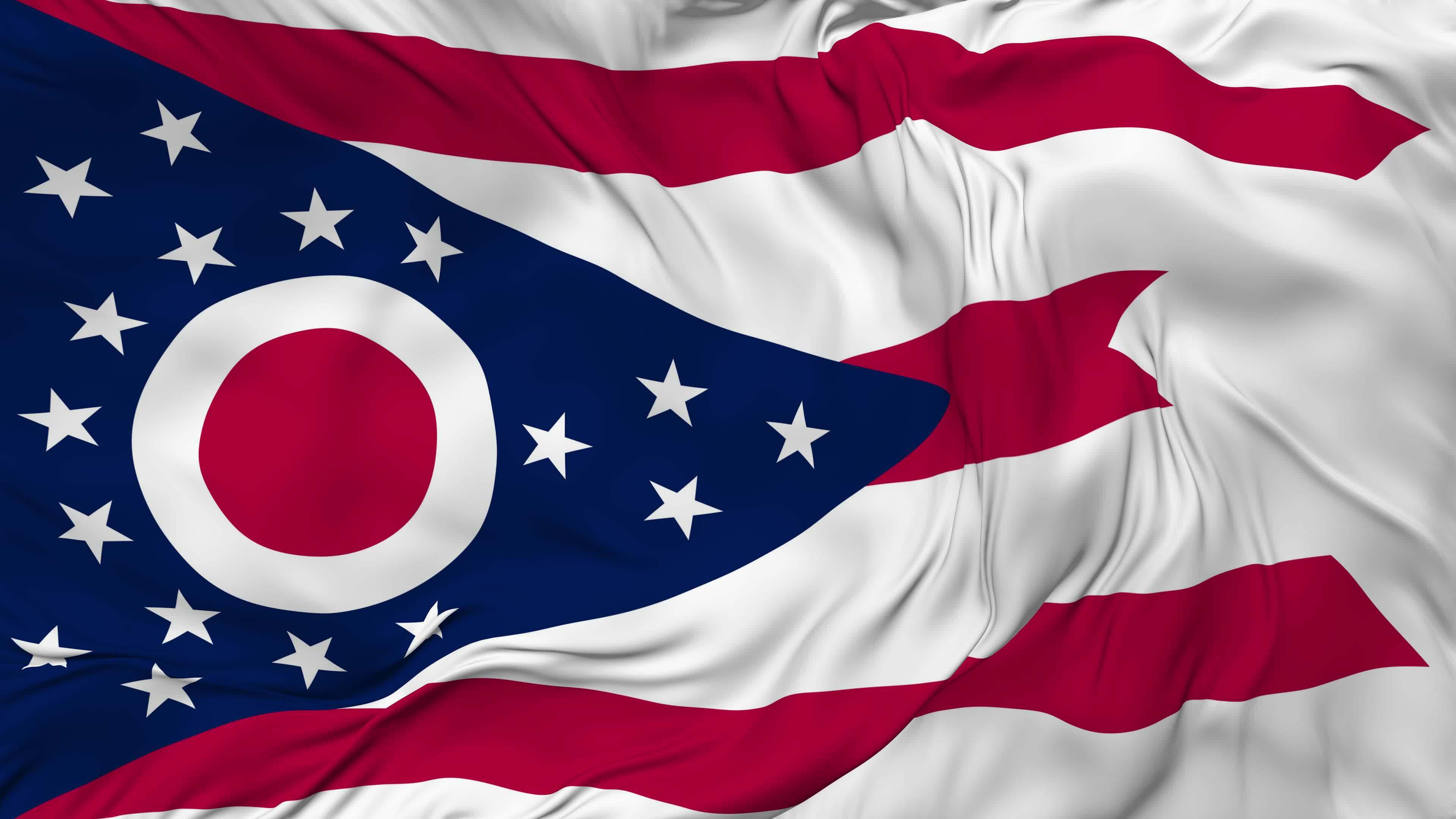
Ohio is the only U.S. state whose flag is a burgee (a swallowtail pennant shape) rather than a rectangle. The Ohio flag was designed by John Eisemann and adopted in 1902; among national flags, only Nepal's is likewise non-rectangular.
The Cleveland Clinic was the first hospital to perform a coronary artery bypass surgery (1967) and remains consistently ranked the number-one hospital in the United States for cardiac care. It is one of the most internationally recognized American medical institutions, with facilities in Abu Dhabi, London, and Toronto.
Procter & Gamble, founded in Cincinnati in 1837 when a candle maker and a soap maker became business partners, has grown into one of the largest consumer goods companies in the world, maker of Tide, Pampers, Gillette, Oral-B, Bounty, and over 65 other brands sold in 180 countries with nearly $80 billion in annual revenue. P&G is the most important corporate institution in Cincinnati's history.
The Pro Football Hall of Fame is located in Canton, Ohio, because Canton claims to be the birthplace of professional football, the American Professional Football Association (which became the NFL) was founded in Canton in 1920. The Akron Pros and Canton Bulldogs were among the founding teams. Jim Thorpe, the most celebrated early professional player, played for Canton.
Ohio voters approved Issue 1 in November 2023, enshrining abortion rights in the state constitution with 57 percent of the vote, one of the clearest popular votes on reproductive rights following the Supreme Court's Dobbs decision. The result surprised many analysts given Ohio's recent Republican lean and demonstrated the persistent independence of the Ohio electorate on social issues.
Intel's announcement in January 2022 of a $20 billion semiconductor fabrication campus in New Albany, Ohio, which Intel said could grow to as much as $100 billion, is the largest private-sector investment in Ohio history and one of the largest in any state, though in 2025 the company delayed completion of the first plant to 2030 to 2031. The project, intended to produce leading-edge chips for artificial intelligence and consumer electronics, represents a fundamental shift in American semiconductor manufacturing strategy away from Asia.
Quick Facts and Common Questions
Short answers to the questions people most often ask about Ohio: its abbreviation, its unusual statehood story, its capital, and its place in Congress.
Ohio's two-letter postal abbreviation is OH. The U.S. Census Bureau places it in the Midwest region, in the East North Central division, and about 11.8 million people lived there in the 2020 census.
Ohio became the 17th state on March 1, 1803, the first state carved from the Northwest Territory. Congress had approved its admission process and seated its members, but it never passed a final resolution formally admitting Ohio. Congress fixed the oversight in 1953 with a resolution, signed by President Dwight D. Eisenhower, that confirmed statehood retroactively to 1803.
The state is named for the Ohio River. The name comes from a Seneca (Iroquoian) word usually translated as "great river" or "good river."
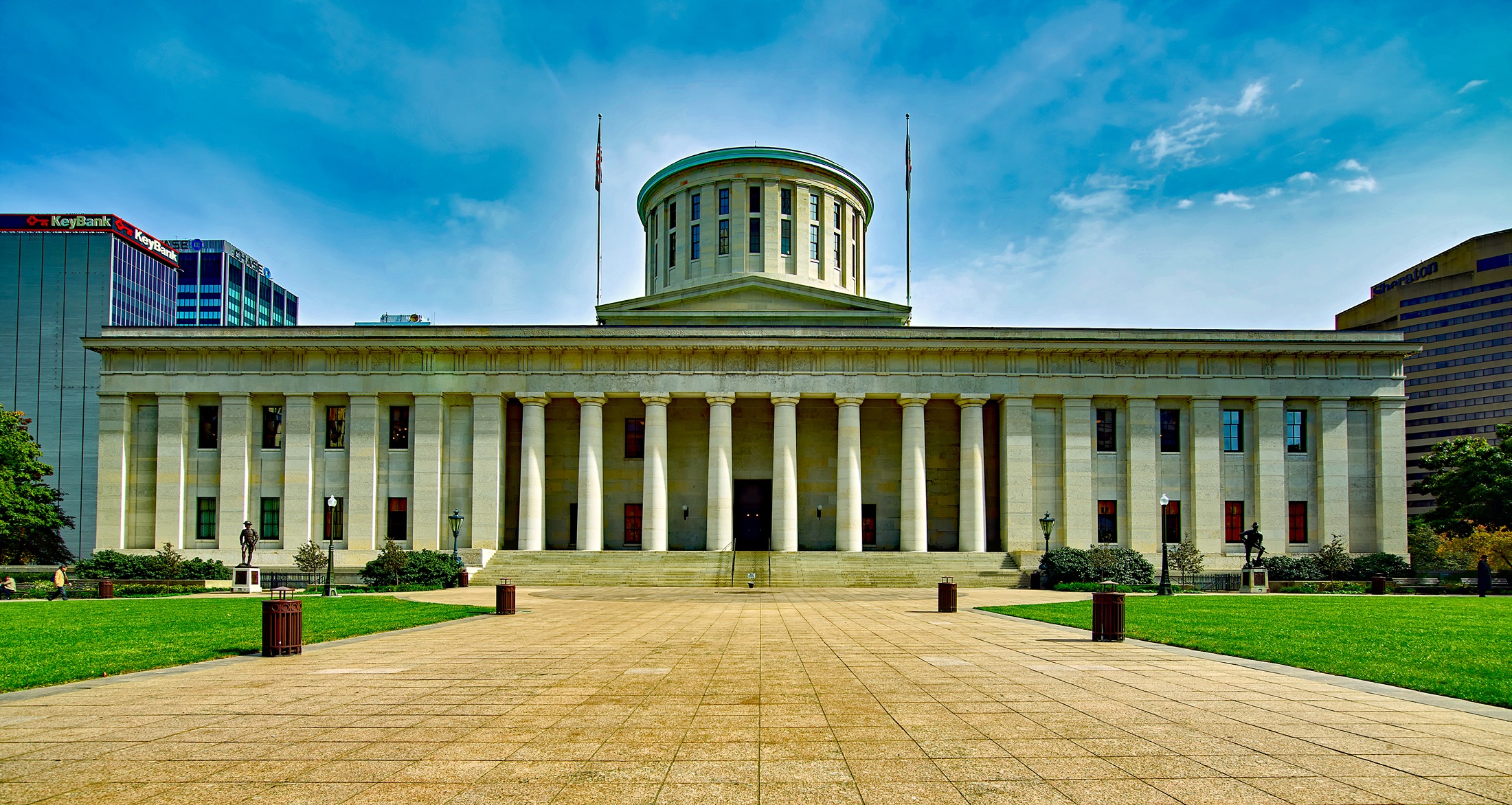
Columbus has been the capital since 1816. Chillicothe was the first capital, from 1803 to 1810, followed by Zanesville from 1810 to 1812, and Chillicothe again until the move to Columbus, a city planned near the center of the state. The Ohio Statehouse was completed in 1861.
Ohio borders Michigan to the north, Pennsylvania to the east, West Virginia and Kentucky to the south and southeast across the Ohio River, and Indiana to the west. Its northern shore lies on Lake Erie, across which is the Canadian province of Ontario.
Seven presidents were born in Ohio: Ulysses S. Grant, Rutherford B. Hayes, James A. Garfield, Benjamin Harrison, William McKinley, William Howard Taft, and Warren G. Harding. William Henry Harrison, born in Virginia, also lived in Ohio, which is why the state sometimes claims eight.
Ohio's flag is the only U.S. state flag that is not a rectangle. Adopted in 1902, it has a swallowtail shape, called a burgee, with a red circle and 17 stars for Ohio's place as the 17th state. Learn more about U.S. flag history.
Ohio is known as "The Buckeye State," for the buckeye trees that once covered the region. Its motto is "With God, All Things Are Possible." Its state bird is the northern cardinal, its flower is the scarlet carnation, and its tree is the Ohio buckeye.
Based on the 2020 census, Ohio lost a seat and now has 15 in the U.S. House of Representatives, which gives it 17 votes in the Electoral College.
Hocking Hills State Park
Ancient Sandstone Caves, Waterfalls, and Hemlock Gorges in the Heart of Ohio's Hill Country
About Hocking Hills State Park
Hocking Hills State Park protects one of the most striking natural landscapes in the eastern United States: sandstone recess caves, box canyons, waterfalls, and hemlock-shaded gorges cut into Black Hand sandstone in Hocking County, southeastern Ohio. Its signature features are Old Man's Cave, Ash Cave (the largest recess cave in Ohio), Cedar Falls, and Conkle's Hollow. The park covers roughly 2,356 acres and adjoins the larger Hocking State Forest.
The bedrock is Black Hand sandstone, a coarse quartz sandstone laid down about 320 to 350 million years ago in a Mississippian-age delta at the edge of a shallow sea. It has three zones of differing hardness: resistant upper and lower layers around a softer, loosely cemented middle zone that weathers back faster, which is what hollows out the overhanging recess caves. These are not true caves but rock shelters formed by freeze-thaw, groundwater seepage, and slaking of the middle sandstone.
Eastern hemlock, Canada yew, teaberry, and partridgeberry survive on the cool, damp gorge floors as relict populations left behind when the post-glacial climate warmed, while the plateau above carries a typical Appalachian oak-hickory forest, so the park stacks a northern forest beneath a southern one within a few vertical feet. The Wisconsinan ice sheet stopped a short distance north of here about 20,000 years ago, and meltwater helped cut the gorges.
The land became a state park through purchases that began in 1924, when Ohio bought 146 acres around Old Man's Cave; the Civilian Conservation Corps built the trails, stone stairways, tunnels, and bridges through the gorges in the 1930s. Hocking Hills now draws roughly 4 to 5 million visitors a year, making it the most visited unit in Ohio's state park system, and a dedicated visitor center opened in 2023 to consolidate the main trailheads.
- Designation
- State Park
- Location
- Hocking County, southeastern Ohio, Logan area
- Established
- 1924
- Annual Visitors
- ~5 million
Geology and Landscape
Old Man's Cave is the centerpiece of Hocking Hills: a half-mile gorge with Upper, Middle, and Lower Falls, natural arches, and a large recess cave overhanging the creek. It is named for Richard Rowe, a hermit who lived in the shelter from about 1796 and is said to be buried nearby; two brothers, Nathaniel and Pat Rayon, had wintered in the same cave earlier.
The gorge trail, built largely by the Civilian Conservation Corps between 1933 and 1937, threads stone stairs cut into the cliff, two short tunnels blasted through rock spurs, and an arched stone bridge over the Upper Falls. At 'Devil's Bathtub,' the creek has drilled a churning pothole into the streambed sandstone.
Old Man's Creek has cut roughly 150 feet down through the Black Hand sandstone. The narrowing at 'Sphinx Head' and the natural bridge at the lower end formed where the resistant caprock kept spanning a gap after the softer rock beneath it washed away.
The 6-mile trail linking Old Man's Cave, Cedar Falls, and Ash Cave is the Grandma Gatewood Trail, named for Emma Gatewood, the Ohio woman who in 1955 became the first woman to solo thru-hike the Appalachian Trail and who promoted the Hocking Hills route. The park's Winter Hike along it, held every January since 1965, regularly draws several thousand people.
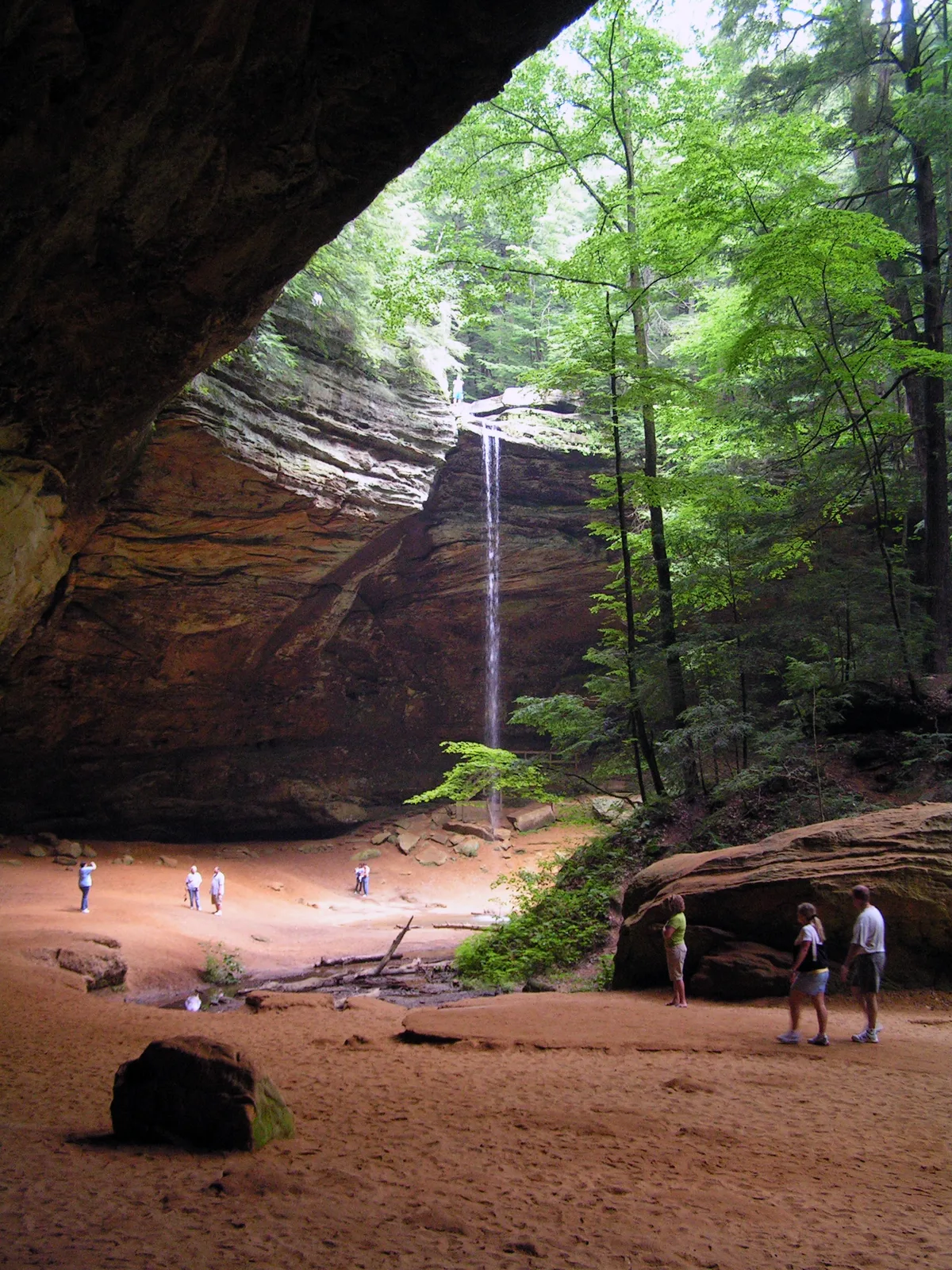
Ash Cave is the largest recess cave in Ohio: a horseshoe alcove about 700 feet from end to end, 100 feet deep, and 90 feet high at the rim, with a seasonal waterfall dropping roughly 90 feet from the plateau into a plunge pool.
It is named for a deposit of ashes, reported by early settlers as several feet deep and covering a wide area, the residue of centuries of fires by Native people who sheltered there. Nineteenth-century accounts describe finding animal bones, points, and pottery in and under the ash, most of which was carried off before any systematic study.
The half-mile lower trail is paved and wheelchair-accessible, running through a hemlock ravine along Queer Creek. Because the alcove is dry and sheltered, it was used for church services and gatherings in the 1800s, and its curved back wall gives it a natural amphitheater acoustic.
Ash Cave sits at the downstream end of the same gorge system as Cedar Falls, both cut into Black Hand sandstone by Queer Creek. The rim above the alcove is fenced because the overlook stands directly above the drop, and it has been the site of fatal falls.
Conkle's Hollow is a slot gorge with sandstone walls up to about 200 feet high and, in places, only a few dozen feet apart, one of the deepest and narrowest gorges in Ohio. It is a state nature preserve within the park complex, managed for protection rather than recreation.
It is named for W.J. Conkle, who carved his name and the date 1797 into the west wall, still visible today. The gorge floor holds hemlock, Canada yew, rhododendron, birch, and a dense fern and moss layer in a microclimate measurably cooler and wetter than the plateau.
The gorge-floor trail is paved and nearly level for about two-thirds of a mile to the box-canyon head, where a small waterfall drops in during wet weather. The separate rim trail, an unpaved 2.5-mile loop, runs along unfenced cliff edges and has been the site of several fatal falls; the preserve posts explicit warnings against approaching the edge.
As a nature preserve, Conkle's Hollow bans climbing, rappelling, and leaving the trail. The Ohio Department of Natural Resources' Division of Natural Areas and Preserves treats the hemlock stands here as a priority for adelgid control because the gorge is a reference example of the relict hemlock community.
Cedar Falls is the highest-volume waterfall in Hocking Hills, a roughly 50-foot cascade where Queer Creek pours over a lip of Black Hand sandstone into a broad plunge pool. Early settlers misidentified the surrounding hemlocks as cedars, and the name stuck despite there being no cedar at the falls.
A grist mill operated at the falls in the mid-19th century, using the drop to turn a water wheel, and pioneers called the spot 'Cedar Mills'; low stone foundations and iron fittings from the mill era survived along the creek into the 20th century.
The falls are framed by a large recess cave and overhanging ledges, and the short trail down passes through mature second-growth hemlock and hardwood. Flow peaks in March and April with snowmelt and spring rain and can slow to a trickle by late summer.
Cedar Falls is the midpoint of the Grandma Gatewood Trail between Old Man's Cave and Ash Cave, so its parking area serves both day hikers and through-hikers. Ohio State Parks enlarged the lot and added restrooms in the 2010s to relieve pressure on Old Man's Cave.
Indigenous Peoples of the Ohio Valley
Adena and Hopewell Cultures
Southeastern Ohio was a heartland of the Adena (roughly 800 BCE to 100 CE) and Hopewell (roughly 100 BCE to 500 CE) traditions, mound-building societies whose earthworks cluster along the Scioto, Hocking, and Muskingum drainages. The Hopewell Ceremonial Earthworks about 40 miles west near Chillicothe were named a UNESCO World Heritage Site in 2023.
These peoples used the Hocking Valley and its rock shelters for hunting, gathering nuts and plants, and toolmaking; excavations at rock shelters elsewhere in the Hocking drainage have produced dart points, pottery, and charred plant remains spanning thousands of years. The deep ash bed in Ash Cave is generally attributed to this long record of Indigenous fire use.
Adena and Hopewell are archaeological traditions rather than single tribes, and there is no unbroken line to one modern nation. Later Native residents of the valley included the Shawnee and, seasonally, Delaware (Lenape) and Wyandot people, all forced out of Ohio by the early 19th century.
The Adena and Hopewell cultures declined before European contact. Their descendants are believed to include many of the historical Algonquian-speaking peoples of the Ohio Valley, including the Shawnee, Delaware, and Miami Nations. The Shawnee were the primary occupants of the Hocking Hills area when European settlers arrived in the 18th century, and today the Shawnee Tribe is headquartered in Miami, Oklahoma.
Shawnee Nation
The Shawnee were the principal Native people of the Hocking Valley at the time of European contact. The Hocking River's name comes from the Shawnee and Delaware word 'hockhocking,' commonly translated 'bottle river,' for a bottle-shaped narrows on the river near present-day Lancaster.
Shawnee towns in the wider region, such as those on the Scioto and Pickaway Plains, were centers of resistance to American expansion. Shawnee fighters were central to the defeats of General Harmar in 1790 and General St. Clair in 1791, and to the confederacy led by Tecumseh and his brother Tenskwatawa until the Battle of the Thames in 1813.
By the 1830s Ohio's Shawnee had been removed west under a series of treaties, ending with the 1831 cession of the Wapakoneta and Hog Creek reserves. Their descendants today are the three federally recognized Shawnee nations, all headquartered in Oklahoma.
The Shawnee Tribe and the Eastern Shawnee Tribe of Oklahoma are the federally recognized Shawnee nations today. Both are headquartered in Oklahoma, to which the Shawnee were removed in the 19th century. The Absentee Shawnee Tribe of Indians of Oklahoma is a third federally recognized Shawnee nation.
What to Do at Hocking Hills
Gorge Trail (Old Man's Cave)
The Gorge Trail is the most iconic hike in Hocking Hills, running about a mile one way through the Old Man's Cave gorge past the Upper, Middle, and Lower Falls, the main recess cave, and a natural rock arch, roughly 2.5 miles round trip as an out-and-back.
Much of the route is 1930s Civilian Conservation Corps construction: stone steps cut into the cliff, two short tunnels blasted through rock spurs, and an arched stone bridge over the Upper Falls. The trail drops about 150 feet into the gorge and stays in the cool, shaded streambed the whole way.
Landmarks along the trail include the 'Devil's Bathtub,' a churning pothole in the creek bed; 'Sphinx Head,' a rock profile on the gorge wall; and the natural bridge at the lower end. Interpretive signs mark Richard Rowe's cave and the spring that made it habitable.
This is the busiest trail in Ohio's state park system, and on peak weekends the gorge can hold thousands of people at once. Ohio State Parks opened a large visitor center and expanded parking in 2023, closes the gorge after ice storms, and asks visitors to hike weekday mornings to spread out use.
Ash Cave Trail
A paved, wheelchair-accessible path runs a half mile through a hemlock ravine along Queer Creek to Ash Cave, Ohio's largest recess cave. It is the easiest major trail in the park and the one most suited to strollers, wheelchairs, and visitors with limited mobility.
The seasonal 90-foot waterfall at the back of the alcove is fullest in March and April and often freezes into a tall ice column in winter. In dry months it can shrink to a thin ribbon or stop entirely, exposing the plunge-pool basin.
The alcove's curved back wall and 90-foot ceiling create strong natural acoustics; it was used for outdoor church services in the 1800s and is the end point of the January Winter Hike. Early accounts describe the ash deposit that named the cave as several feet deep before settlers hauled it away.
A separate rim trail climbs to the top of the falls, where a fenced overlook stands directly above the 90-foot drop. The rim has been the site of fatal falls, and Ohio State Parks warns against climbing the railing or walking onto the wet rock at the lip.
Rim Trail (Conkle's Hollow)
The Conkle's Hollow Rim Trail is a roughly 2.5-mile unpaved loop along the top edges of one of Ohio's deepest gorges, with drop-offs of up to 200 feet to the hemlock canopy below. Ohio State Parks rates it strenuous and specifically not appropriate for young children or anyone uneasy with heights.
The trail climbs steeply from the parking area to the rim, follows narrow sandstone ledges around the head of the box canyon, and descends on stone steps to rejoin the paved gorge-floor path, with total elevation change around 400 feet.
The rim is unfenced for most of its length. Several people have died in falls from the Conkle's Hollow rim over the decades, and the preserve posts signs at the trailhead and along the edge urging hikers to stay back; wet leaves, ice, and loose rock are the main hazards.
Because Conkle's Hollow is a state nature preserve, rock climbing, rappelling, and off-trail travel are prohibited. The gorge-floor trail, paved and nearly level for about two-thirds of a mile, is the recommended route for families and anyone not comfortable on the exposed rim.
Cedar Falls Trail
The Cedar Falls Trail descends about a quarter mile of stone steps from the parking area to the base of Cedar Falls, the highest-volume waterfall in the park, then continues along Queer Creek. Walked with the connecting loops it runs about 2.4 miles round trip.
The trail passes a large recess cave beside the falls and mature second-growth hemlock and hardwood forest. In the mid-1800s a grist mill stood at the falls and the settlement was called 'Cedar Mills'; stone foundations from the mill era were visible along the creek into the 20th century.
Cedar Falls is the midpoint of the 6-mile Grandma Gatewood Trail linking Old Man's Cave and Ash Cave, so the parking area serves both day hikers and through-hikers. Ohio State Parks enlarged the lot and added restrooms in the 2010s to relieve pressure on Old Man's Cave.
Flow over the falls peaks with March and April snowmelt and rain and can drop sharply by late summer. The plunge pool and wet rocks below the falls are a frequent scene of slip injuries, and swimming and wading are prohibited parkwide.
Conservation Challenges
Hemlock Woolly Adelgid
The hemlock woolly adelgid, a sap-feeding insect native to Japan, was first confirmed in Ohio in 2012 and reached the Hocking Hills area within a few years. It kills eastern hemlock by feeding at the base of the needles, usually within four to ten years of infestation.
Hemlock is the defining tree of the Hocking Hills gorges. Its dense evergreen canopy keeps the gorge floors cool, shaded, and humid year-round, holds stream temperatures down, and supports the relict northern plants and cold-water stream life found nowhere else in the region. Losing it would convert the gorges into warmer hardwood ravines.
The Ohio Department of Natural Resources treats hemlocks in the park and adjoining state forest with systemic insecticides (imidacloprid and dinotefuran) applied by soil injection or trunk spray, prioritizing the most visited and most ecologically important stands, and has released predatory beetles as a longer-term biological control.
Treatment can protect individual trees for several years but cannot cover every hemlock across thousands of acres, and adelgid numbers rebound in mild winters. Managers expect continued hemlock loss on untreated slopes and describe the effort as buying time for the signature stands rather than removing the threat.
Overcrowding and Trail Erosion
Hocking Hills draws roughly 4 to 5 million visitors a year, concentrated on a short list of trails at Old Man's Cave, Ash Cave, Cedar Falls, and Conkle's Hollow, making it by far the most heavily used park in Ohio's system.
The crush has caused deep trail erosion, widening of paths as people walk around mud and roots, trampling of the spring wildflower flats, soil compaction over hemlock roots, and social trails cut to unofficial viewpoints and swimming holes. Litter and human waste at peak times add to the load.
Ohio State Parks has responded with hardened trail surfaces and boardwalks, one-way foot traffic through the Old Man's Cave gorge on busy days, additional rangers, and the 2023 visitor center that moved parking and orientation away from the gorge rim. Officials have discussed but not adopted timed-entry reservations.
Search-and-rescue callouts have risen with visitation; the Hocking Hills area records dozens of rescues a year for falls, injuries, and lost hikers, several of them fatal, most on or near the gorge rims and on icy winter trails.
Non-Native Plant Species
Japanese barberry, garlic mustard, multiflora rose, Japanese stiltgrass, and privet have spread through the park's forests, crowding out native groundcover and shrubs. Garlic mustard is especially damaging because it releases compounds that suppress the soil fungi native tree seedlings and wildflowers depend on.
The spring wildflower bloom is one of the park's main draws, with large displays of trillium, trout lily, bloodroot, Dutchman's breeches, hepatica, and mayapple on the gorge slopes. Invasive groundcover directly displaces these species and shortens the bloom.
The Ohio Department of Natural Resources and volunteer groups run pull days, targeted herbicide treatment, and prescribed burns on the plateau to hold invasives back, focusing on the wildflower slopes and the Conkle's Hollow preserve.
Deer browsing compounds the problem: high deer numbers eat native wildflowers and tree seedlings while leaving bitter or spiny invasives like barberry untouched, tilting the understory further toward non-native plants over time.
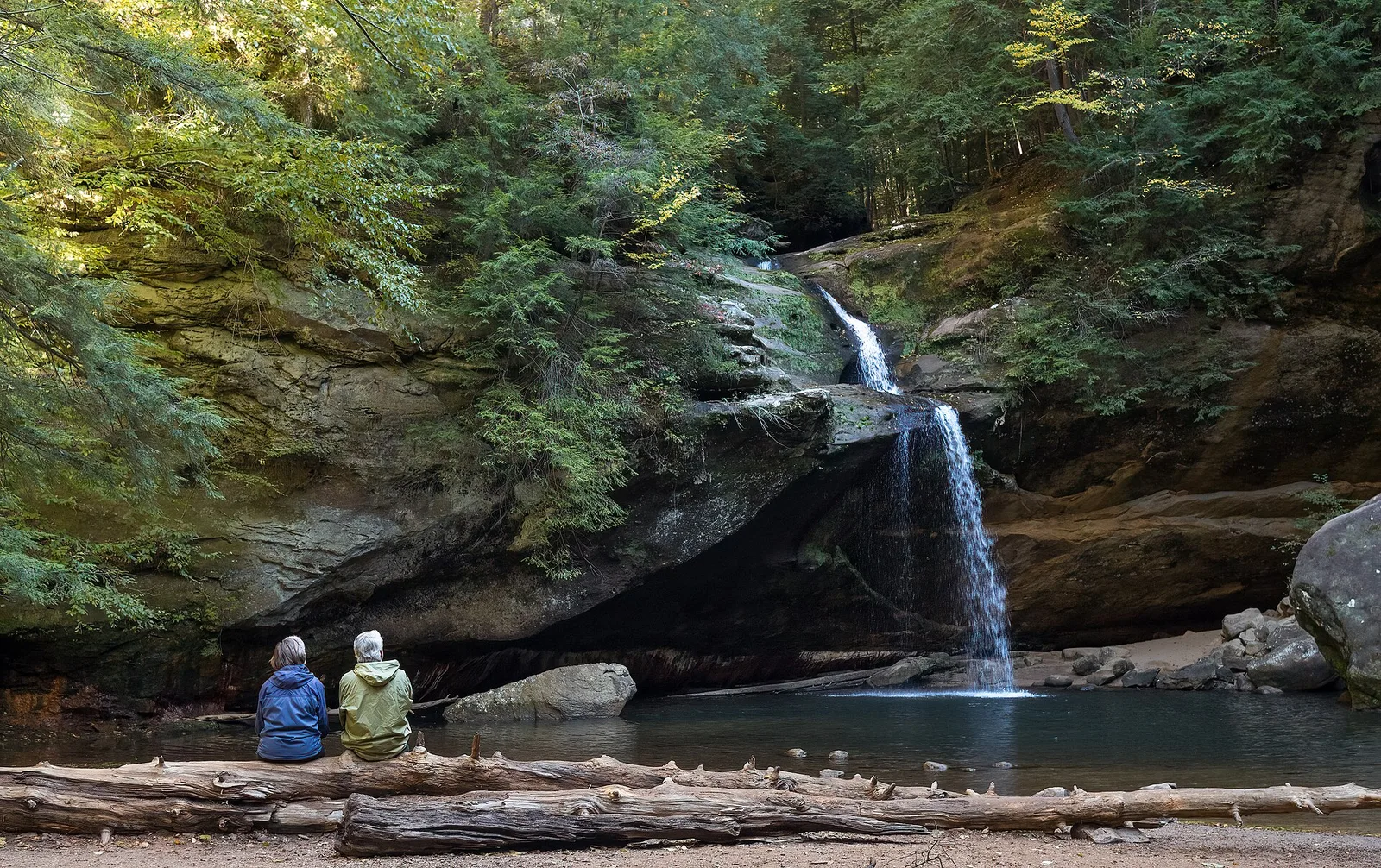
Old Man's Cave, Hocking Hills State Park
Fast Facts
Did You Know?
The hemlock forests in Hocking Hills gorges are relict populations from a cooler climate, surviving today only because the deep, shaded gorges stay significantly cooler and wetter than the surrounding plateau. These hemlock communities have persisted since the last ice age, when the entire region was cooler and hemlocks grew across the Ohio Valley.
The name 'Ash Cave' comes from the large deposits of ash found inside by early European settlers. These deposits were left by Indigenous peoples who used the enormous cave for shelter and ceremony over thousands of years. The cave's natural acoustics made it a powerful place for ceremonial gatherings.
In the early 19th century, a hermit named Richard Rowe lived in Old Man's Cave for years, hunting and trapping in the surrounding hills. When he died, he was reportedly buried in the cave. The cave was named for him, and 'old man' in his era was a respectful term for an experienced woodsman or frontiersman.
Plan Your Visit
Location
Hocking County, southeastern Ohio, Logan area
Designation
State Park
Best Time to Visit
Spring for waterfalls and wildflowers; fall for foliage; avoid summer weekends (very crowded)
Admission
Free; parking fees apply at some lots
Address (Old Man's Cave Area)
19852 OH-664, Logan, OH 43138
Park Hours
Open daily, 6am to 11pm; daylight hours for trails
Getting There
US-33 to OH-664 south of Logan; 1 hour SE of Columbus
More Info
parks.ohiodnr.gov/hockinghills