
About Montana
Montana takes its name from the Spanish word "montana," meaning "mountain" or "mountainous," a straightforward description of the terrain that dominates the western portion of the state. The name was applied to the territory when it was organized in 1864, during the gold rush era when prospectors flooded into the region. Montana was carved out of the western portion of the Dakota Territory and portions of Washington and Idaho territories. It became a state in 1889 as part of a wave of admissions that also included North and South Dakota, Washington, and Wyoming, adding six stars to the American flag in a single year.
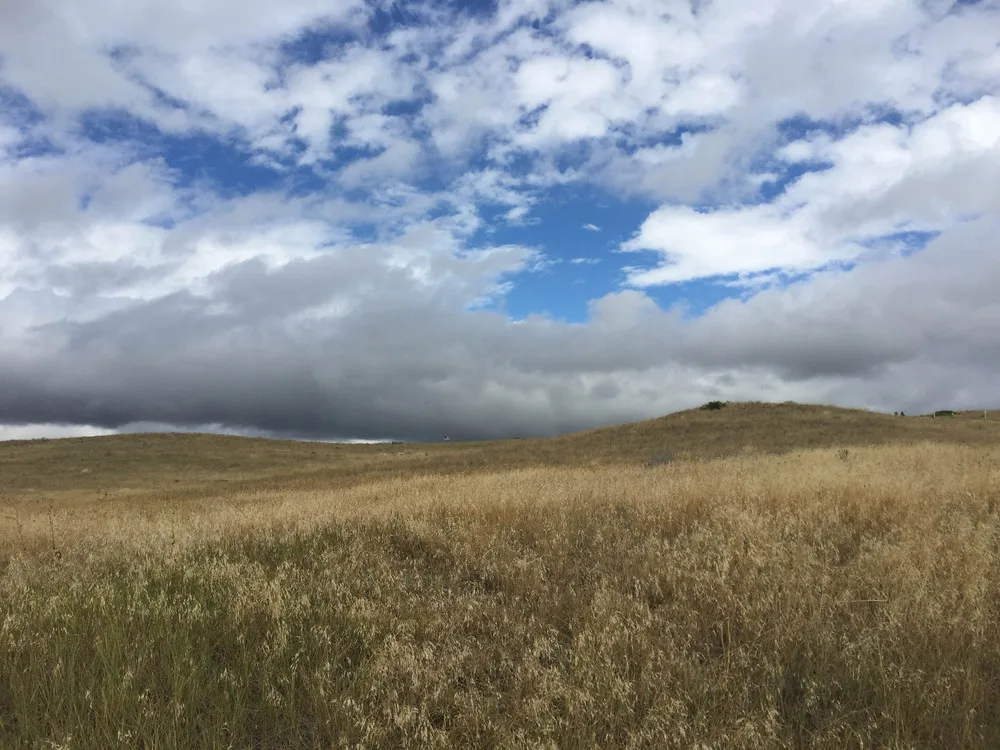
Montana is the fourth-largest state in the United States and one of the least densely populated, a place where you can drive for hours without seeing another car, where the horizon stretches unobstructed in every direction, and where grizzly bears, wolves, and mountain lions still roam wild in numbers that would have been unimaginable in most of the lower 48. 'Big Sky Country' is not a marketing invention; it is a physical fact. The scale of the Montana landscape is simply different from what most Americans experience.
Montana's history is as layered as its landscape. It was a land of many Indigenous nations, Blackfeet, Crow, Assiniboine, Cheyenne, Salish, Kootenai, and others, before Lewis and Clark passed through in 1805. Gold miners arrived in 1862 and built boomtowns overnight. Copper turned Butte into one of the most industrial cities in the American West. The Battle of the Little Bighorn, Custer's Last Stand, happened on Montana soil. Jeannette Rankin, the first woman elected to Congress, was from Missoula.
Montana today is undergoing the most rapid demographic and economic transformation in its history. The pandemic-era influx of remote workers and wealthy migrants, particularly from California, has driven housing costs to levels that are pricing out longtime residents, changing the character of communities that had been working-class ranch and mining towns for generations. Montana's Legislature is also constitutionally limited to 90 legislative days every two years, meeting only in odd-numbered years, a frontier-era design that reflects a deep Montanan suspicion of professional politicians and leaves the Governor with broad executive authority between sessions. The tension between the old Montana and the new is the defining story of the state in the 2020s.
Montana's Five Regions
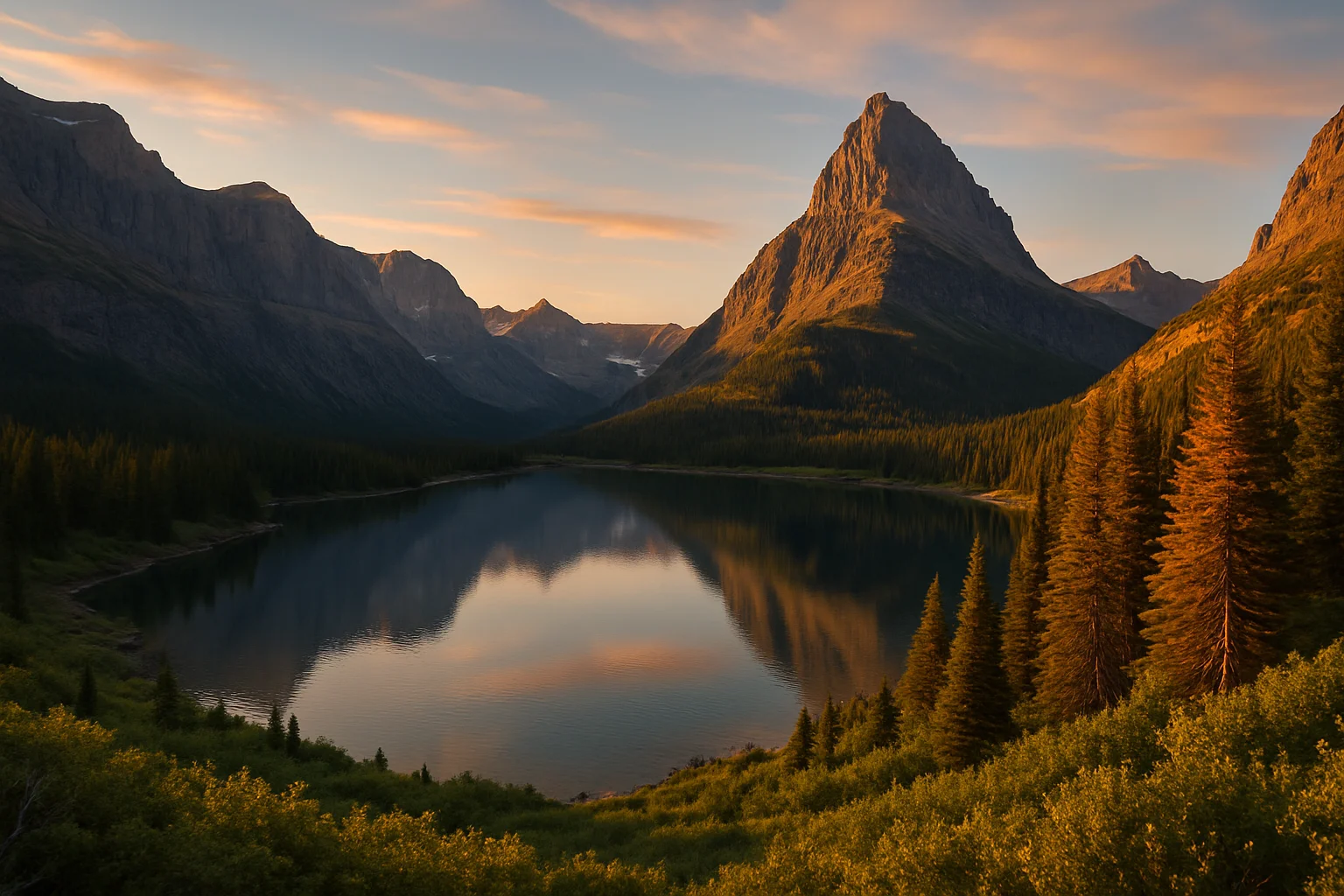
Northwest Montana is defined by Glacier National Park and the chain of mountain ranges, valleys, and lakes that surround it. The Flathead Valley, anchored by Kalispell, Whitefish, and the resort town of Bigfork, is one of the fastest-growing areas in the state, drawing wealthy retirees and remote workers to its combination of outstanding natural beauty, world-class skiing (Whitefish Mountain Resort), and proximity to Glacier.
Flathead Lake, 28 miles long and 15 miles wide, is the largest natural freshwater lake west of the Mississippi River and a centerpiece of the region's recreational economy. The Flathead Indian Reservation, home to the Confederated Salish and Kootenai Tribes, occupies much of the southern Flathead Valley.
Missoula, at the junction of five mountain valleys in the south of this region, is Montana's second-largest city and its most liberal, home to the University of Montana, a vibrant arts scene, and an outdoor recreation culture that has made it a magnet for writers, musicians, and adventurers since Norman Maclean set A River Runs Through It here.
The Flathead Reservation is unusual in that a federal 'allotment' policy opened it to homesteading in 1910, so the Confederated Salish and Kootenai Tribes are a minority on their own reservation; in 2021 the tribes regained full ownership and operation of the National Bison Range near Moiese, a herd descended from animals Salish and Pend d'Oreille people hauled over the mountains in the 1870s, ending a century of federal control. The reservation also holds the Kerr (now SélišKsanka Q̓lispé) Dam, which the tribes bought in 2015, the first time a tribe has owned a major hydroelectric dam.
The northwest's economy has swung from timber and aluminum, the Anaconda Aluminum smelter at Columbia Falls ran from 1955 until 2009 and is now a Superfund site, to tourism and in-migration, and the Flathead Valley is one of the state's fastest-growing areas. Missoula, by contrast, has anchored its economy on the university, a regional hospital hub, and the Rocky Mountain Elk Foundation and other conservation nonprofits headquartered there, and its 2018 vote to buy the private Mountain Water utility after a long condemnation fight was a notable municipal-ownership case.
Southwest Montana is the state's historical heartland, the site of the gold rush that triggered Montana Territory's creation, the copper boom that built fortunes and destroyed landscapes, and the capital city that has governed the state since 1875. Helena, Montana's capital (population about 35,000), sits in a valley of the Rocky Mountain Front Range where Last Chance Gulch, the historic mining district now converted into a pedestrian mall, preserves the memory of the gold strike that made the city.
Butte is the most historically significant city in Montana, at its peak in the early 20th century it was one of the largest and most cosmopolitan cities in the American West, teeming with Irish, Cornish, Finnish, Chinese, and Eastern European miners working for the Anaconda Copper Mining Company. Butte's Berkeley Pit, its Victorian architecture, and its unapologetically working-class identity make it unlike anywhere else in Montana.
Bozeman, at the eastern edge of the region, has been transformed in the past two decades from a college town (Montana State University) and gateway community into one of the fastest-growing cities in the country, a high-tech, high-income boomtown that bears little resemblance to its ranch-town origins.
Butte's mining left a wound and a heritage industry: the mile-wide Berkeley Pit is filling with acidic water that must be pumped and treated forever, the Uptown district's cast-iron and terra-cotta commercial buildings form one of the largest National Historic Landmark districts in the country, and the city still holds Montana's biggest St. Patrick's Day celebration and an Irish festival tied to its Cornish and Irish mining roots. Anaconda, the company town Marcus Daly built for his smelter, is marked by a 585-foot brick smokestack, the tallest free-standing masonry structure in the world, preserved as a state park after the smelter closed in 1980.
Bozeman's growth has been the sharpest in the state: Gallatin County's population roughly doubled between 2000 and the mid-2020s, Montana State is the state's largest university with more than 16,000 students and a strong engineering and optics research base, and the Bozeman Yellowstone airport is now Montana's busiest, feeding the Big Sky and Yellowstone tourist economies. Helena, smaller and slower-growing, remains a government town where a large share of jobs are with the state, and its 1935 earthquake sequence, one of the most damaging in U.S. history at the time, still shapes local building codes.
The south-central region of Montana is defined by the Yellowstone River, the longest undammed river in the contiguous United States, and the Beartooth and Absaroka mountain ranges that separate it from Yellowstone National Park to the south. Billings, Montana's largest city (population about 120,000), anchors this region as the commercial, healthcare, and energy hub of southeastern Montana and the northern Great Plains.
Billings has a more conservative, business-oriented character than Bozeman or Missoula, a city of oil refineries, railyards, and agricultural commerce that serves the ranching economy of a vast surrounding region. The Beartooth Highway from Red Lodge over the 10,947-foot Beartooth Pass to Cooke City is widely considered one of the most spectacular drives in the United States.
Red Lodge itself is a classic Western mountain town with a mining history and a ski area. The Crow Indian Reservation, the largest in Montana by land area, occupies the region's southeastern corner, surrounding the Little Bighorn Battlefield National Monument.
Billings sits in the Yellowstone Valley below a line of sandstone cliffs called the Rimrocks, was founded in 1882 as a Northern Pacific Railroad town, and grew into 'the Magic City' as an oil-refining, sugar-beet, and wholesale-distribution center serving a trade area that reaches into Wyoming and the Dakotas; three oil refineries still line the river east of downtown. Pompeys Pillar, a sandstone butte downstream, carries the only surviving physical evidence of the Lewis and Clark expedition on the landscape, William Clark's 1806 signature carved into the rock.
The Crow (Apsáalooke) Reservation covers about 2.3 million acres, and its economy leans on coal, the Absaloka Mine on tribal land has been a major revenue source and a point of tension as coal markets shrink, on farming and ranching leases, and on Little Bighorn tourism; the tribe's Crow Fair each August is one of the largest powwows in North America. The neighboring Northern Cheyenne Reservation, whose people fought at the Little Bighorn and then were marched to Oklahoma before fleeing home in the 1878 'Cheyenne Exodus,' sits atop large low-sulfur coal reserves it has repeatedly declined to strip-mine.
Central Montana is the vast, sparsely populated agricultural heartland of the state, a rolling landscape of wheat fields, cattle ranches, coulees, and badlands bisected by the Missouri River as it flows eastward toward the Dakotas. Great Falls, the third-largest city in Montana, sits at the confluence of the Sun and Missouri rivers, the site of the 'Great Falls' that Meriwether Lewis described in his journal as 'the grandest sight I ever beheld' and that required the Corps of Discovery to portage around for 18 days in 1805.
The region takes its tourism name from Charles Marion Russell, the 'cowboy artist' who lived in Great Falls from 1897 until his death in 1926 and painted the vanishing frontier West with a combination of nostalgia and precision that made him one of the most beloved American artists of his era. The C.M. Russell Museum in Great Falls holds the world's largest collection of his work, and one of his oils sold for more than 5 million dollars in 2005, a record for Western art at the time.
Great Falls itself was a company creation, laid out in 1883 by the entrepreneur Paris Gibson around the Missouri's waterfalls and their hydroelectric potential, and it grew as a smelting, refining, and, from 1942, a military-aviation town: Malmstrom Air Force Base outside the city has controlled a field of about 150 buried Minuteman III nuclear missiles across the surrounding plains since the 1960s, one of three such ICBM wings in the country and a major local employer.
The Missouri River Breaks, a rugged corridor of eroded buttes, coulees, and cottonwood bottoms along the Wild and Scenic stretch below Fort Benton, are among the wildest landscapes in the Lower 48; President Clinton designated about 375,000 acres as the Upper Missouri River Breaks National Monument in 2001, a decision ranchers and county governments fought for years. Fort Benton, at the head of steamboat navigation on the Missouri, was the busiest inland port in the West in the 1860s, the end of the line for boats carrying miners and freight to the goldfields.
Eastern Montana is the most sparsely populated corner of an already sparsely populated state, a vast, flat-to-rolling landscape of mixed-grass prairie, sagebrush flats, badlands, and river breaks that extends without interruption into North Dakota and the Dakotas. This is cattle country and wheat country and, increasingly, oil country, the Bakken formation that produced the North Dakota oil boom extends into eastern Montana, and the Williston Basin produces significant natural gas and oil.
Miles City, the 'Cowboy Capital,' grew from the cavalry post of Fort Keogh after the Little Bighorn, boomed as the railhead where Texas trail herds met the Northern Pacific in the 1880s, and still holds its Bucking Horse Sale each May, a rodeo-and-auction that is one of the oldest events of its kind. Glendive and Sidney, near the North Dakota line, ride the edge of the Bakken oil play and process sugar beets and, at Sidney, sunflowers.
The region contains two landmark sites. The Little Bighorn Battlefield National Monument marks where George Armstrong Custer and about 210 men of his immediate command were killed on June 25, 1876; the site's markers were for a century devoted only to the soldiers, and an Indian Memorial honoring the Lakota, Cheyenne, and Arapaho defenders was added only in 2003. Fort Peck Dam, an earthen structure more than four miles long built between 1933 and 1940, employed as many as 10,000 New Deal workers, spawned 18 shantytowns, and appeared on the first cover of Life magazine in 1936; a 1938 slide during construction killed eight men, six of whose bodies are still entombed in the dam.
Fort Peck Lake, the reservoir behind the dam, is ringed by the roughly 1.1-million-acre Charles M. Russell National Wildlife Refuge, a stretch of Missouri Breaks badlands that is one of the largest and least-visited refuges in the Lower 48 and home to bighorn sheep, elk, prairie dogs, and one of the country's few remaining populations of the black-footed ferret, reintroduced there and on nearby tribal land.

Economy
Montana's economy is built on cattle, wheat, copper, coal, timber, and tourism, and increasingly on the real estate and service economy driven by an influx of wealthy Americans who have discovered Big Sky Country.
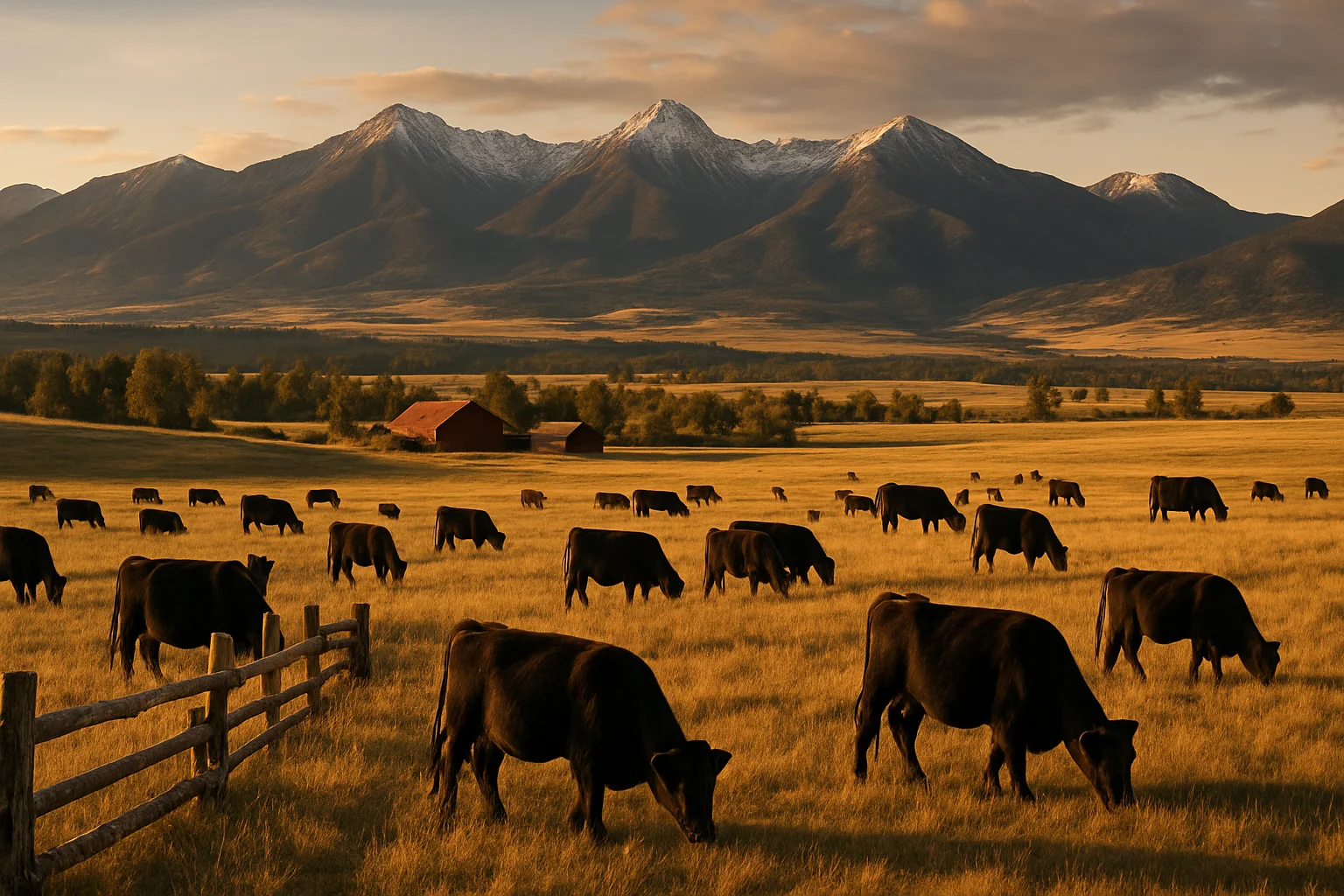
Montana is consistently one of the top beef cattle states in the nation, the state's vast grasslands, stretching from the eastern High Plains to the river valleys of the Rockies, support roughly 2.5 million cattle, outnumbering the human population more than two to one. The wheat that blankets eastern Montana's rolling plains makes the state one of the top wheat-producing states in the country, Montana winter wheat is prized for its high protein content, and much of it is exported to Asia and the Middle East.
Montana is the nation's leading producer of dry peas and lentils and among the leaders in barley (much of it grown under contract for Anheuser-Busch and Coors maltsters), chickpeas, and durum wheat, and it ranks near the top in certified organic acreage; sugar beets are grown under irrigation in the Yellowstone and Milk river valleys and processed at plants in Billings and Sidney. The 2012 farm bill's crop-insurance expansion and the pulse-crop boom reshaped eastern Montana rotations away from summer-fallow wheat.
Ranching's economics are precarious. Most Montana cattle are shipped out as calves or feeders to be fattened and slaughtered in the corn belt, so ranchers are price-takers dependent on a handful of national meatpackers, and drought, the 2017 and 2021 to 2022 dry years cut herds statewide, plus rising land and hay costs squeeze margins. Country-of-origin labeling and packer-concentration complaints have made Montana ranchers a persistent voice in national farm politics.
The iconic Montana cattle ranch, sprawling acres of native grassland worked by families for generations, is close to a cultural ideal for many Montanans even as out-of-state buyers acquire historic spreads for recreation and conservation; media figures and hedge-fund principals now own some of the state's largest ranches, and the Rock Creek Cattle Company and similar 'ranch resort' developments have converted working land to amenity real estate.
The gold rush at Bannack in 1862 and Virginia City in 1863 drew thousands of prospectors to Montana Territory and triggered the political process that led to statehood. But it was copper that made Montana a player in the industrial age: Butte's Berkeley Pit was for decades the largest open-pit copper mine in the world, and the Anaconda Copper Mining Company, one of the largest corporations in early 20th-century America, dominated Montana's economy and politics with a grip so total it was known as simply 'The Company.' Today, the Berkeley Pit is an EPA Superfund site filled with toxic acidic water, a monument to the extractive economy's legacy.
Montana's modern mining sector is anchored by the Stillwater Mine in Stillwater County, the only primary platinum group metals (PGM) mine in the United States, producing palladium and platinum critical for catalytic converters and industrial applications. Coal mining in the Powder River Basin (eastern Montana and Wyoming) has historically been significant, though market pressures have reduced output.
The Stillwater complex, owned by South Africa's Sibanye-Stillwater since 2017, laid off about 700 workers in 2024 as the palladium price collapsed, exposing how a single global commodity swing can shake a rural Montana county. Elsewhere, the proposed Black Butte copper mine near White Sulphur Springs and the reopened Golden Sunlight and Montanore projects keep hard-rock mining a live political fight over water quality in the headwaters of the Missouri and the Clark Fork.
Montana's mining legacy is largely a cleanup story. The upper Clark Fork River is the largest Superfund site in the country, a roughly 120-mile stretch of river, floodplain, and old smelter and mine ground from Butte to Milltown Dam contaminated with arsenic, lead, and copper tailings, and a series of settlements with the Anaconda Company's corporate heir, Atlantic Richfield (ARCO), has funded decades of remediation, including the 2008 removal of Milltown Dam. The Berkeley Pit's rising acidic water, which killed a flock of migrating snow geese in 2016 and again in 1995, is pumped and treated in perpetuity.
The state constitution adopted in 1972 contains an unusually strong guarantee of a 'clean and healthful environment,' which the Montana Supreme Court has cited in mining and climate cases, and a 2023 youth lawsuit, Held v. Montana, produced the first U.S. court ruling that a state's fossil-fuel permitting practices violated a constitutional environmental right.
Glacier National Park in the northwest corner, 1.1 million acres of glacially carved peaks, turquoise lakes, and alpine meadows along the Continental Divide, is one of the most spectacular landscapes in North America and draws over 3 million visitors annually. The Going-to-the-Sun Road, which crosses the Continental Divide through the heart of the park, is one of the most dramatic mountain roads in the world.
Yellowstone National Park extends into Montana's southern border region, and the gateway communities of Gardiner and Cooke City serve the millions who enter Yellowstone from the north. Big Sky Resort near Bozeman is one of the largest ski resorts in North America by acreage.
The Beartooth Highway, connecting Red Lodge to Cooke City, is routinely named one of the most beautiful drives in America. Hunting and fishing, for elk, deer, antelope, bear, mountain goat, sheep, walleye, trout, and dozens of other species, generate hundreds of millions in annual spending from nonresident hunters and anglers.
Montana's outdoors economy has grown substantially with the pandemic-era influx of remote workers and affluent retirees attracted by the state's space, wildness, and beauty.
The heavily timbered mountains of western Montana, where the national forests of the Northern Rockies contain vast stands of ponderosa pine, Douglas fir, lodgepole pine, and western larch, have supplied sawmills and paper mills that provided blue-collar employment in communities like Missoula, Libby, and Kalispell. The timber industry has declined substantially from its mid-20th-century peak, a result of mechanization, environmental regulations protecting old-growth forest and spotted owl habitat, and the decline of the domestic paper industry.
Montana had more than 30 sawmills in the 1980s and has roughly a half-dozen operating today; the closure of the Smurfit-Stone containerboard mill near Missoula in 2010, which had employed hundreds and is now itself a Superfund cleanup on the Clark Fork floodplain, and the 2020 shutdown of the last mill in Libby marked the end of an era in several timber towns.
Libby also carries the state's worst industrial-health disaster: a W.R. Grace vermiculite mine there operated from the 1960s to 1990 and exposed workers and townspeople to asbestos-laced dust, sickening thousands and killing hundreds; the EPA declared a public health emergency in 2009, the first ever under the Superfund law, and the cleanup and a federal health-screening program continue.
Ongoing debates over how to manage Montana's federal forests, which are a majority of the western Montana landscape, pit timber interests, conservation groups, and federal agencies against each other, though 'collaboratives' such as the Blackfoot Challenge and legislation like the 2014 Rocky Mountain Front Heritage Act have produced some negotiated logging-and-wilderness compromises. Wood-products manufacturing remains a real but diminished part of the rural western Montana economy, increasingly focused on higher-value products and on wood for biomass energy.
The Powder River Basin coal deposits of southeastern Montana contain billions of tons of coal, low-sulfur subbituminous coal that historically supplied power plants across the Midwest and West. Montana's coal industry, centered on the strip mines near Colstrip, has faced severe headwinds from cheap natural gas and renewable energy that have shuttered several Colstrip power plant units, with significant economic consequences for the communities that depended on them.
The Colstrip Power Plant, built in the 1970s and 1980s to burn Rosebud Mine coal beside it, is one of the largest coal plants in the West and is co-owned by six utilities across four states; Washington and Oregon laws requiring their utilities to exit coal by 2025 and 2030 forced the retirement of two of Colstrip's four units in 2020 and put the town's future in doubt, a fight that has run through the Montana legislature and the courts for years.
Hydroelectric dams on the Missouri, the Flathead, and the Clark Fork, many of them former Montana Power Company assets now owned by NorthWestern Energy or the Confederated Salish and Kootenai Tribes, who bought Kerr Dam in 2015, provide a large carbon-free share of in-state electricity. The 1997 deregulation of Montana Power and its disastrous pivot into telecom, which wiped out the company and many employees' pensions, left the state unusually wary of energy restructuring.
Montana has among the best wind resources in the country along the Rocky Mountain Front and the High Plains, but it is a long way from big customers, so wind build-out has been throttled by the lack of high-voltage transmission; long-proposed lines and the northern leg of the TransWest Express have moved slowly. Oil and gas production, concentrated in the Williston Basin of the far northeast (the Montana end of the Bakken) and older fields near Cut Bank, is modest compared with North Dakota's.
The pandemic accelerated a trend already underway: remote workers discovered they could do their jobs from Bozeman or Whitefish and still attend meetings in San Francisco or New York virtually. Home prices in Bozeman, Missoula, and other desirable Montana cities roughly doubled between 2019 and 2024, pricing out longtime residents and fundamentally changing the character of communities that had been working-class ranch and timber towns.
Montana's population grew about 10 percent in the 2010s and kept rising in the early 2020s, almost entirely from domestic migration, and Bozeman's Gallatin County has been one of the fastest-growing counties in the country; the state added enough people to nearly regain a second U.S. House seat, which it had lost after the 1990 census and recovered in the 2020 reapportionment.
The affordability collapse became a defining political issue: with no state sales tax, Montana leans heavily on property taxes, and a 2023 assessment cycle sent many longtime homeowners' bills up 20 to 40 percent as newcomers bid up values, prompting rebate checks and a 2024 to 2025 legislative fight over how to rebalance the tax between resident homeowners and second-home and short-term-rental owners.
The 'Zoom-town' boom brought restaurants, retail, professional services, and luxury construction, plus tech employers, RightNow Technologies (bought by Oracle in 2012) and onX, the digital hunting-maps company, both grew up in Bozeman, but it also drove out teachers, nurses, and service workers priced out of the towns they serve, and it sharpened a cultural divide between the coastal-transplant enclaves and the rural conservative majority that still controls the legislature.
How Montana's Government Works
Montana's state government follows the standard three-branch structure: the Executive (Governor), the Legislative (the Montana Legislature, a 50-seat Senate and 100-seat House of Representatives), and the Judicial (the Montana Supreme Court, with seven justices elected in nonpartisan elections serving 8-year terms).
The Governor serves a four-year term limited to two consecutive terms. Republicans have dominated Montana state government for most of the modern era. Montana is a reliably Republican state in presidential elections, it has voted Republican in every presidential election since 1992, though it elected Democratic senators and governors at times in the intervening decades. Jon Tester's defeat in 2024 gave Republicans a Senate sweep of the state for the first time in years.
Montana's Supreme Court operates independently and has often ruled against the conservative legislature on environmental, campaign finance, and individual rights issues, creating ongoing friction between the court and the Republican-controlled branches of government.
Montana's Legislature is constitutionally limited to 90 legislative days every two years, meeting in odd-numbered years from January through April. This frontier-era design reflects a deep Montanan suspicion of professional politicians. Between sessions, the Governor has broad executive authority, and a small interim committee system handles oversight. In practice, many legislators hold full-time jobs in agriculture, law, or business.
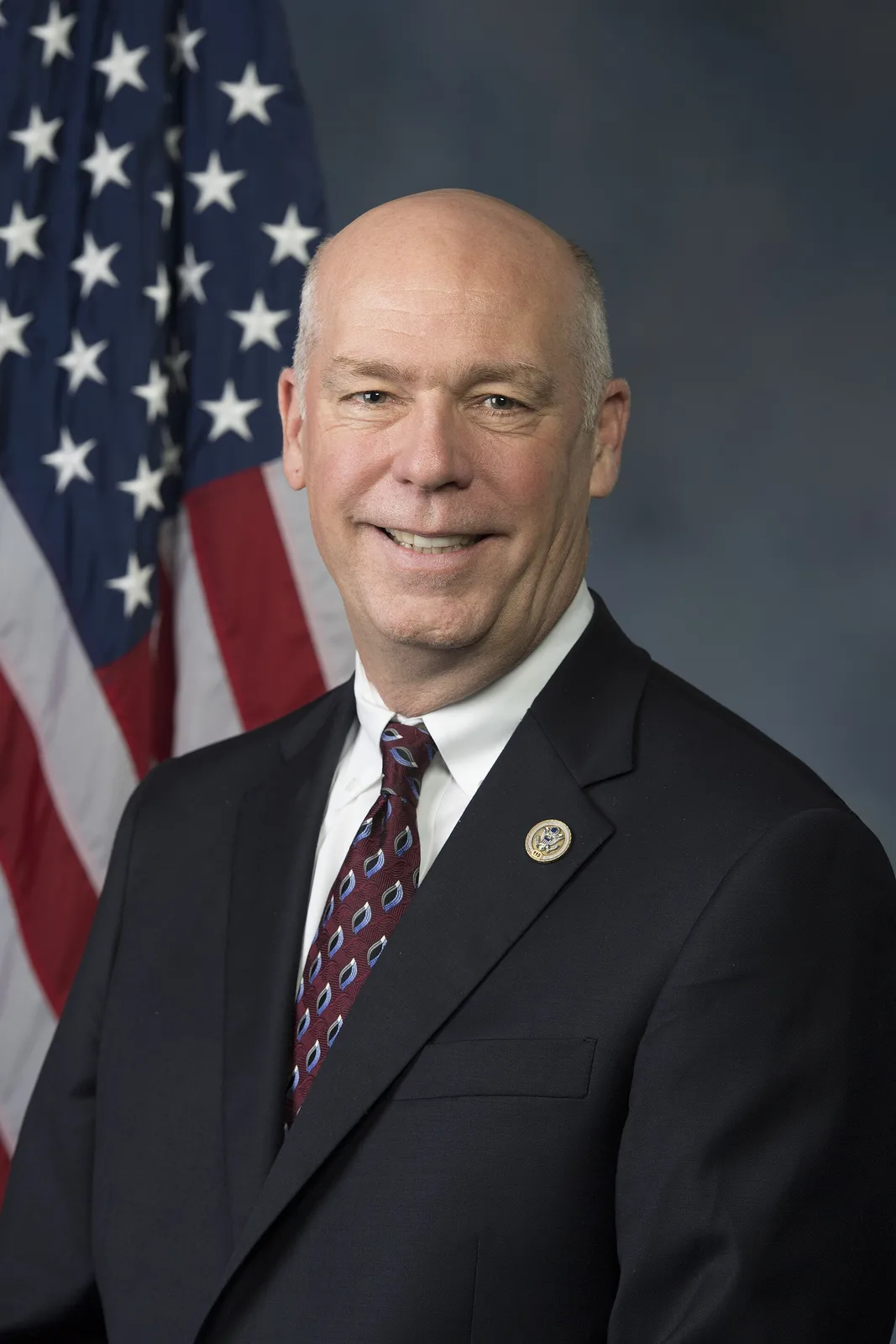
Governor of Montana
Current Governor
Greg Gianforte
- Party
- Republican
- In Office Since
- January 4, 2021
- Re-elected
- November 8, 2024
- Term Ends
- January 2029
- Born
- April 17, 1961, San Diego, California
- Education
- Stevens Institute of Technology (BS, MS, Electrical Engineering)
- Prior Role
- Founder & CEO, RightNow Technologies (sold to Oracle for $1.5B, 2012); U.S. Representative, Montana At-Large (2017–2021)
Greg Gianforte is Montana's 25th Governor and the first Republican governor of Montana in 16 years when he was elected in 2020. A technology entrepreneur who founded RightNow Technologies in Bozeman and sold it to Oracle for $1.5 billion in 2012, Gianforte is one of the wealthiest people in Montana. He gained national attention in May 2017, the night before his first congressional election, when he body-slammed a Guardian reporter who asked him about the Republican healthcare bill; he pleaded guilty to misdemeanor assault and won the election anyway. As governor he has signed sweeping conservative legislation on taxes, guns, gender-affirming care, and election rules, making Montana one of the most active conservative legislative states in the country.
Other Current State Officials
Lieutenant Governor
Kristen Juras
In office since January 2021, re-elected alongside Governor Gianforte in 2024. A former University of Montana law professor and county attorney, Juras oversees economic development and workforce initiatives. She was the first woman to serve as Montana's Lieutenant Governor.
Attorney General
Austin Knudsen
In office since January 2021, re-elected 2024. A former Roosevelt County Attorney and state legislator, Knudsen has led Montana's participation in multi-state lawsuits against federal regulations on energy, immigration, and public lands, reflecting the state's deep tensions with federal land management.
Secretary of State
Christi Jacobsen
In office since January 2021, re-elected 2024. A former state legislator, Jacobsen has pursued election security measures and has been involved in ongoing disputes over voter registration and mail ballot rules. Montana's relatively straightforward election administration has periodically been complicated by litigation over voting access rules.
The Montana Legislature
Montana State Senate
- Seats: 50 members
- Terms: 4-year terms
The upper chamber. Half of the 50 Senate seats are elected every two years in a staggered schedule. Senators are limited to 2 consecutive terms (8 years) but may run again after sitting out a term. Republicans hold a supermajority.
Montana House of Representatives
- Seats: 100 members
- Terms: 2-year terms
The lower chamber. All 100 seats are on the ballot every two years. Representatives are limited to 4 consecutive terms (8 years), after which they must sit out a term before running again. Republicans hold a supermajority.
Montana's U.S. Senators
U.S. Senator
Steve Daines
Montana's senior senator, Daines won in 2014 and was re-elected in 2020. A former Procter & Gamble executive and U.S. Representative, Daines serves on the Appropriations, Finance, and Energy committees. He has focused on public lands access, energy development, and agriculture issues critical to Montana. On March 4, 2026, the filing deadline, he announced he would not seek a third term; his seat is on the November 2026 ballot.
U.S. Senator
Tim Sheehy
Montana's junior senator, Sheehy defeated three-term Democratic incumbent Jon Tester in November 2024 in one of the most closely watched Senate races of the cycle. A Navy SEAL veteran and founder of Bridger Aerospace, a drone company based in Bozeman, Sheehy campaigned on border security, energy independence, and support for Montana's agricultural economy.
Montana Through the Years
From the Blackfeet and Crow nations to Lewis and Clark, from Custer's Last Stand to the first woman in Congress, from the copper kings who owned a state to the remote workers reshaping it today, Montana's history is written in a landscape that has always been larger than the people who inhabit it.
Montana was home to more Indigenous nations than almost any other region of North America, a consequence of its extraordinary ecological diversity and its position at the intersection of the Great Plains, the Rocky Mountains, and the Columbia Plateau. The Blackfeet Confederacy (Niitsitapi) controlled the northern plains and mountain front as a horse-mounted buffalo-hunting power that held Euro-American traders at arm's length well into the 19th century, the Crow (Apsáalooke) dominated the Yellowstone Valley and the Bighorns, and the Assiniboine and Gros Ventre held the northeastern plains.
West of the Continental Divide, the Salish (Flathead), Pend d'Oreille, and Kootenai lived in the mountain valleys and crossed east in organized parties to hunt bison. The Northern Cheyenne ranged the southeastern plains, the Shoshone the southwest, and the Chippewa and Cree (whose Montana descendants, long landless, finally received the Rocky Boy's Reservation in 1916) moved down from Canada.
The horse, reaching Montana from the south in the early-to-mid 1700s, transformed these cultures within a couple of generations, making long-distance bison hunting, raiding, and trade far more efficient and touching off decades of shifting territorial war, the Blackfeet pushing the Shoshone and Salish west, the Crow and Sioux contesting the Yellowstone country. European diseases arriving ahead of Europeans themselves also swept the region: a smallpox epidemic in 1837, carried up the Missouri by steamboat, killed a large share of the Blackfeet and devastated the Assiniboine and other river nations.
Today Montana has seven reservations and eleven federally recognized tribes, and Native people are about 6 to 7 percent of the state's population, one of the higher shares in the country; the 1972 state constitution uniquely commits Montana to preserve 'the distinct and unique cultural heritage of the American Indians,' the basis for the state's Indian Education for All program in public schools.
The Corps of Discovery entered present-day Montana on April 26, 1805, where the Yellowstone River meets the Missouri. Over the following months, the expedition traveled up the Missouri through the spectacular White Cliffs section (which Lewis described as 'scenes of visionary enchantment'), portaged around the Great Falls, crossed the Continental Divide via Lemhi Pass with the help of Sacagawea's Shoshone relatives, and eventually descended to the Pacific via the Columbia River.
On their return journey in 1806, the party split, Clark explored the Yellowstone River while Lewis explored the Marias River, and both groups traversed Montana before reuniting at the Yellowstone-Missouri confluence.
Lewis and Clark's journals provided the first detailed American scientific and geographic description of Montana's landscape, peoples, plants, and animals, and opened the region to the wave of fur traders, trappers, and missionaries who followed.
Montana held two of the expedition's tensest moments. The month-long portage around the Great Falls in June and July 1805 was far harder than expected, five cascades over 12 miles, hauling dugout canoes on cottonwood wheels through prickly pear and hailstorms, and it nearly broke the Corps. And on July 27, 1806, on the Two Medicine River, Lewis's small return party had the expedition's only deadly clash with Native people, killing two Blackfeet men during a scuffle over guns and horses, an incident that colored Blackfeet-American relations for decades.
The Corps' descriptions drew the fur trade fast: within a few years Manuel Lisa's Missouri Fur Company and later the American Fur Company built posts such as Fort Union (1828) and Fort Benton (1847) on the upper Missouri, and mountain men like Jim Bridger trapped the Montana Rockies through the 1830s until beaver hats went out of fashion.
Gold discovered at Grasshopper Creek in 1862 produced a rush to Bannack, Montana's first territorial capital, and a second strike at Alder Gulch in 1863 created Virginia City almost overnight, drawing thousands of prospectors. By the standards of the age, the mining camps were extraordinarily violent.
The outlaw gang led by sheriff Henry Plummer, who was secretly organizing robberies and murders of miners, was ultimately hanged by the Montana Vigilantes in January 1864 in a wave of frontier justice that left 21 men dead. The population influx, and the desire of miners to organize their own government separate from Idaho Territory (of which Montana was then a part), drove Congress to create Montana Territory on May 26, 1864, with Bannack as capital.
Virginia City soon replaced it. The gold rush played out relatively quickly, but it established the population base and political infrastructure that would eventually lead to statehood.
Alder Gulch was one of the richest placer strikes in North American history, yielding an estimated 30 to 40 million dollars in gold, well over a billion in today's money, in its first three years, and Virginia City swelled to perhaps 10,000 people almost overnight before fading as the easy gold ran out. Both Bannack and Virginia City survive as state-park ghost towns, among the best-preserved in the West.
Montana's territorial politics were shaped by the war back east: the goldfields drew many Confederate sympathizers and Missouri 'bushwhackers,' Democrats dominated the territorial legislature while Republican-appointed governors and judges tried to run it, and the friction was sharp enough that Congress voided the first two territorial legislatures' laws. The vigilante hangings of 1863 to 1864, whatever their justification against real road-agent violence, also became a durable and troubling piece of Montana identity; the numbers '3-7-77,' the vigilantes' warning sign, still appear on the Montana Highway Patrol's shoulder patch.
On June 25–26, 1876, along the Little Bighorn River in southeastern Montana, Lt. Colonel George Armstrong Custer led five companies of the 7th Cavalry Regiment in a disastrously miscalculated attack on the largest gathering of Plains Indians in American history. Lakota, Northern Cheyenne, and Arapaho warriors, led by Sitting Bull, Crazy Horse, Gall, and other commanders, killed Custer and all 268 of his men in less than an hour of fighting on June 25.
The battle was the most complete U.S. Army defeat in the Indian Wars and sent shockwaves through the nation, which was in the middle of centennial celebrations. The U.S. Army responded with a massive campaign that forced most of the surviving Lakota and Cheyenne onto reservations within a year.
The battlefield, now the Little Bighorn Battlefield National Monument, is one of the most visited historic sites in Montana and one of the most significant in American history.
The fight was one part of a larger 1876 campaign the Army launched to force the Lakota and Cheyenne onto reservations after the government failed to buy the Black Hills, where gold had been found in 1874 in violation of the 1868 Fort Laramie Treaty. Custer's Seventh Cavalry was a scouting column that stumbled onto a village of perhaps 7,000 people, 1,500 to 2,000 of them fighting men, far larger than the Army believed possible; Custer split his roughly 600 troopers into three battalions, and his own five companies were wiped out while the others survived a two-day siege on a hilltop.
The victory was brief. Public fury at the news, arriving as the nation marked its centennial, funded a relentless winter pursuit: within a year most bands had surrendered, Crazy Horse was killed under guard at Fort Robinson in 1877, and Sitting Bull led his followers into exile in Canada before returning to surrender in 1881. Archaeology after a 1983 grassfire, mapping thousands of cartridge cases across the field, largely confirmed Native accounts of a fast-moving rout rather than the fixed 'last stand' of popular art, and the site was renamed from Custer Battlefield to Little Bighorn Battlefield in 1991.
In the summer and fall of 1877, Chief Joseph (Hinmatóowyalahtq̓it) and the Nez Perce Nation undertook one of the most remarkable military retreats in American history, a 1,170-mile flight through Idaho, Wyoming, and Montana toward Canada, pursued by U.S. Army forces under General O.O. Howard.
The Nez Perce, who had refused to be confined to a reservation in Idaho, fought off or evaded one Army force after another, winning tactical victories at White Bird Canyon, Clearwater, and the Big Hole in Montana. At the Big Hole in southwestern Montana, Army troops surprised the Nez Perce camp at dawn, killing many women, children, and elders before the warriors rallied and repelled the attack.
The Nez Perce continued north but were finally surrounded and forced to surrender just 40 miles from the Canadian border at the Battle of Bear Paw in October 1877. Chief Joseph's surrender speech, 'From where the sun now stands, I will fight no more forever', became one of the most famous statements in American history.
The Big Hole battle on August 9, 1877, was the war's bloodiest: Colonel John Gibbon's soldiers attacked the sleeping camp before dawn, and roughly 60 to 90 Nez Perce were killed, most of them women, children, and old people, before the warriors counterattacked, pinned the troops down for a day, and let the families escape. The Big Hole National Battlefield preserves the site.
About 750 Nez Perce had set out; some 200 slipped across the border to join Sitting Bull after Bear Paw while roughly 430 surrendered with Joseph. Despite General Nelson Miles's promise that they could return to Idaho, the government instead shipped the survivors to Indian Territory in Oklahoma, where many died of disease over the next several years; a public campaign, joined by Miles himself, finally won their return to the Pacific Northwest in 1885, though Joseph's band was sent to the non-Nez Perce Colville Reservation in Washington rather than home.
Montana was admitted to the Union on November 8, 1889, as the 41st state, on the same day as North Dakota, South Dakota, and Washington, in a single batch of new states that nearly doubled the number of western states in the Union. President Grover Cleveland signed the proclamations for all four states in rapid succession, reportedly shuffling the papers so he wouldn't know which state was signed first (and thus which was 41st, 42nd, 43rd, or 44th).
Helena was confirmed as the state capital after a contentious battle with Anaconda, copper magnate Marcus Daly's company town, that was ultimately decided by a statewide vote in 1894.
The timing of statehood coincided with the peak of Montana's first great economic boom: the railroads had arrived (Northern Pacific in 1883, Great Northern in 1893), cattle ranching was at its height, and Butte's copper mines were beginning the era of production that would make Montana one of the most important mining states in the nation.
The open-range cattle boom had just been shattered, though. The winter of 1886 to 1887, remembered as 'the Great Die-Up,' brought blizzards and deep cold to overstocked ranges, and huge outfits lost 50 to 90 percent of their herds; Charlie Russell's postcard sketch of a starving cow, 'Waiting for a Chinook,' became the image of the disaster and ended the era of turning cattle loose on unfenced public grass.
Montana's 1889 constitution was written by delegates heavily influenced by the mining and railroad companies, and it taxed mine 'net proceeds' so lightly that for decades the state's biggest industry paid a tiny fraction of what farms and homes paid, a grievance that ran through Montana politics until a 1972 constitutional convention rewrote the document. The 1894 popular vote that made Helena, not Marcus Daly's Anaconda, the permanent capital was itself a proxy battle between the Copper Kings, with Daly and William A. Clark each spending fortunes to sway it.
The decades around the turn of the 20th century were defined by the extraordinary battle between Montana's three 'Copper Kings', Marcus Daly (founder of the Anaconda Copper Mining Company and builder of the city of Anaconda), William Andrews Clark (banker, mine owner, and senator), and F. Augustus Heinze (a calculating young engineer who found ways to challenge Anaconda's dominance in the courts). The war between these industrial titans involved bribery of judges, newspapers purchased to sway public opinion, legislative corruption on a staggering scale, and legal battles over ore vein ownership that consumed millions in legal fees.
Clark bribed the Montana Legislature to elect him to the U.S. Senate in 1899, the Senate refused to seat him, and he was forced to run legitimately in 1901. The Anaconda Company eventually absorbed or defeated all its rivals and continued to dominate Montana's economy and politics until the 1970s.
Montana's 'captive press', the newspaper chains owned by Anaconda, controlled the news read by most Montanans for decades.
The Company owned most of the state's daily newspapers from 1900 until it sold them to Lee Enterprises in 1959, and their coverage of labor, taxes, and politics was so slanted that national journalists used Montana as the textbook case of a corporation owning a state's information; the resentment it built helped make Montana receptive to the direct-democracy tools, the initiative and referendum, added to the constitution in 1906, and to a run of Progressive and later New Deal reforms.
The corruption was extraordinary even by Gilded Age standards. William A. Clark's 1899 attempt to buy a U.S. Senate seat by paying Montana legislators, some receiving envelopes of cash on the statehouse floor, was so blatant that the Senate refused to seat him and it became a leading argument for the 17th Amendment, which in 1913 moved Senate elections from state legislatures to the voters. Mark Twain wrote that Clark 'is as rotten a human being as can be found anywhere.'
Butte itself paid the price of the war: reckless underground mining honeycombed the 'richest hill on earth' with thousands of miles of tunnels, the 1917 Speculator Mine fire killed 168 men in the deadliest hardrock-mining disaster in U.S. history, and the labor violence that followed, including the lynching of IWW organizer Frank Little that same year, made Butte one of the most turbulent labor cities in the country.
Glacier National Park was established by Congress on May 11, 1910, protecting 1.1 million acres of the most spectacular mountain landscape in North America along the Continental Divide in northwestern Montana. The park contains more than 700 miles of trails, 762 lakes, and at the time of its establishment, over 150 glaciers.
The railroads, particularly the Great Northern, which had been promoting the region for tourism since the 1890s, and the enthusiastic advocacy of naturalists and preservationists drove the push for park status. The Going-to-the-Sun Road, completed in 1932 after 11 years of construction through some of the most challenging terrain on the continent, opened the park's interior to automobile visitors and became one of the most celebrated engineering achievements of the New Deal era.
By 2025, fewer than 30 of the park's original glaciers remain, the rest have melted as a consequence of rising temperatures, making Glacier National Park one of the most vivid illustrations of climate change anywhere in North America.
The park's creation had a coerced backstory: the mountains east of the Divide had been part of the Blackfeet Reservation until an 1895 agreement, negotiated with a starving tribe after the bison were gone, transferred the 'ceded strip' to the government for mineral prospecting that found little; that land became the park's eastern half, and the Blackfeet still assert treaty rights to hunt, fish, and gather there, a dispute never fully resolved.
In 1932 Glacier and Canada's adjoining Waterton Lakes park were joined as the world's first International Peace Park, a designation by the two national governments and the local Rotary clubs, and the pair was later named a UNESCO World Heritage Site and Biosphere Reserve. The Great Northern Railway built the park's grand Swiss-chalet-style lodges, Many Glacier, Glacier Park Lodge, Lake McDonald, in the 1910s to give its passengers a reason to ride the line.
Glacier is a linchpin of the Crown of the Continent, one of the few places in the Lower 48 where grizzly bears, wolves, wolverines, lynx, and all their historic prey still coexist; the 1910 park was also the scene, in 1967, of the 'Night of the Grizzlies,' when two women were killed by different bears on the same night, an event that forced the entire national-park system to rethink garbage handling and bear management.
On November 7, 1916, Jeannette Rankin of Missoula became the first woman elected to the United States Congress, four years before the 19th Amendment gave women the right to vote nationally. Rankin, a suffragist, social worker, and pacifist, won a seat in the U.S. House of Representatives as a Republican from Montana, which had granted women the right to vote in 1914.
In April 1917, she voted against U.S. entry into World War I, one of only 50 House members to oppose it. She did not seek re-election in 1918, ran unsuccessfully for Senate, and then left politics for decades of social activism.
Elected to Congress again in 1940, she became the only member of Congress to vote against U.S. entry into World War II after Pearl Harbor, a vote that ended her political career but that she never regretted. 'You can no more win a war than you can win an earthquake,' she said.
Rankin remains one of Montana's most extraordinary figures and a pioneering symbol of American women in public life.
The 2020s have brought dramatic and contested change to Montana. The pandemic-era remote-work migration sent waves of wealthy professionals, many from California and other coastal states, into Bozeman, Missoula, Whitefish, and Kalispell, and home prices in Bozeman roughly doubled between 2019 and 2024, turning an affordable college and ranch town into one of the priciest markets in the Mountain West. The influx was large enough to help Montana regain a second U.S. House seat in the 2020 census.
The newcomers brought different politics and lifestyles into towns that had been predominantly white, rural, and conservative, creating friction over land use, housing, and public access. Rising property values triggered a 2023 assessment shock and a running legislative fight over shifting the tax burden between resident homeowners and out-of-state and short-term-rental owners.
The state's Republican-controlled government, holding every statewide office and a legislative supermajority by 2023, used the period to enact conservative priorities on abortion, transgender health care, guns, and judicial selection, several of which were quickly blocked by Montana courts under the 1972 constitution's privacy and environmental clauses; a young-plaintiffs' climate case, Held v. Montana, won at trial in 2023 and was upheld by the Montana Supreme Court in 2024.
The defining tension is what Montana becomes, a preserved wilderness-and-amenity economy, a tech-and-tourism boom corridor along the western valleys, or a rural extraction state, and the different answers pull the western cities and the eastern plains in opposite political directions.
Montana's Defining Moments in American History
These are the events that didn't just shape Montana, they changed the nation.
On June 25-26, 1876, Lieutenant Colonel George Armstrong Custer led the 7th Cavalry Regiment into a devastating ambush near the Little Bighorn River in present-day Montana. Lakota, Northern Cheyenne, and Arapaho warriors under Sitting Bull and Crazy Horse killed Custer and all 268 soldiers under his direct command.
It was the greatest military victory ever achieved by Native Americans against the U.S. Army, and it made Custer, in defeat, one of the most mythologized figures in American history. The battle accelerated the Army's final campaign to subdue the Plains nations.
The campaign that led to it began because the government wanted the Black Hills, promised to the Lakota 'in perpetuity' by the 1868 Fort Laramie Treaty, after Custer's own 1874 expedition confirmed gold there; when bands refused to sell or move onto reservations, the Army declared them hostile and sent three converging columns to force them in. Custer's Seventh Cavalry found a village along the Little Bighorn far larger than expected, perhaps 7,000 people, and he divided his roughly 600 men, sending Reno and Benteen elsewhere while his own five companies were surrounded and killed within about an hour.
The public reaction, arriving during the July 1876 centennial, was national shock and a demand for revenge, and Congress funded a punishing winter pursuit. Within a year Crazy Horse had surrendered and was killed in custody, Sitting Bull had fled to Canada, and the remaining Lakota and Cheyenne bands were confined to reservations; in 1877 Congress passed an act unilaterally taking the Black Hills.
The battle's meaning has been re-litigated ever since. A 1980 Supreme Court decision, United States v. Sioux Nation, ruled the Black Hills seizure an unconstitutional taking and awarded compensation now worth more than a billion dollars, which the Lakota nations have refused to accept because they want the land back; and the battlefield itself, long a shrine to Custer, added an Indian Memorial in 2003 and now interprets the fight from both sides.
The most grueling section of Lewis and Clark's 1804-1806 Corps of Discovery Expedition was the crossing of the Continental Divide through what is now Montana. The explorers followed the Missouri River to its headwaters, crossed Lemhi Pass into Idaho, then returned to Montana's Bitterroot Valley before crossing the Rocky Mountains.
Sacagawea, the Lemhi Shoshone woman who joined the expedition in North Dakota, was essential to their survival in Montana, helping them obtain horses from the Shoshone people that made the mountain crossing possible. Their journals documented a landscape of breathtaking scale and beauty.
The expedition spent more time in present-day Montana than in any other state, roughly a quarter of the entire journey, and its harshest ordeals happened there: the month-long portage around the Great Falls in the summer of 1805, dragging dugout canoes on makeshift wheels through cactus and hail, and the anxious search for the Missouri's headwaters at the Three Forks, where the party had to gamble on the correct branch with no map.
At Lemhi Pass in August 1805, the Corps reached the Continental Divide expecting an easy downhill run to the Pacific and instead saw range after range of mountains, the end of any hope of an all-water route across the continent. That the party got over the Bitterroots at all depended on the horses and a guide obtained from Sacagawea's own Shoshone band, whose chief, Cameahwait, turned out to be her brother.
Montana was also the site of the expedition's only bloodshed: on July 27, 1806, on the Two Medicine River, Lewis's four-man party killed two young Blackfeet men in a fight over guns and horses, then rode 100 miles in a day to escape, and the incident helped keep the Blackfeet hostile to American traders for a generation. William Clark's carved signature at Pompeys Pillar, dated July 25, 1806, is the only physical trace of the expedition still on the landscape.
On November 7, 1916, Montana elected Jeannette Rankin to the U.S. House of Representatives, making her the first woman to serve in the U.S. Congress, four years before women had the constitutional right to vote nationwide. Rankin was a committed pacifist; she voted against U.S. entry into World War I, losing her seat in the process, and returned to Congress to cast the only vote against declaring war after Pearl Harbor.
She remained a peace activist for the rest of her long life, leading anti-Vietnam War marches in her 80s. Montana gave America its first female voice in Congress.
Rankin ran for the House in 1916 as one of Montana's two at-large members, campaigning across a huge state largely by car, and her brother Wellington, a well-connected Republican lawyer, managed and helped bankroll the effort; she had already led the successful 1914 campaign that gave Montana women the vote. Her first act in Congress, days into the term, was the 1917 war vote.
Her 1941 vote against declaring war on Japan was cast alone, 388 to 1, the day after Pearl Harbor; colleagues urged her to at least abstain, and she had to shelter in a phone booth from an angry crowd afterward. She said she 'could not vote for war' as the only woman in Congress and as a pacifist, and she did not run again.
Rankin spent the following decades organizing for peace, studying Gandhi in India, and, in 1968 at age 87, leading the 'Jeannette Rankin Brigade,' a march of several thousand women on the Capitol against the Vietnam War. She is one of two Montanans, with Charles M. Russell, whose statue represents the state in the U.S. Capitol's National Statuary Hall.
In the late 19th century, Butte, Montana was one of the most important cities in America. Its mines produced the copper that wired American homes and cities for electricity, at a time when electrification was transforming daily life.
The Anaconda Copper Mining Company, which dominated Butte's economy and eventually Montana's politics, became one of the most powerful corporations in the country. Butte's mines also created one of America's most remarkable ethnic communities, drawing miners from Ireland, Cornwall, China, and dozens of other nations who built unions, newspapers, and neighborhoods in the shadow of the Berkeley Pit.
Butte called itself 'the richest hill on earth,' and in the early 20th century its mines supplied a large share of U.S. and world copper just as the country wired itself for electricity, the telephone, and the electric streetcar. The city's population passed 90,000, it had one of the largest Irish communities per capita of any American city, and its Miners' Union, founded in 1878, was for a time the strongest local labor organization in the country.
The cost was borne underground and on the surface. The 1917 Granite Mountain-Speculator fire killed 168 miners, the deadliest hardrock disaster in U.S. history; company gunmen and, later, federal troops broke strikes; the IWW organizer Frank Little was dragged from his boarding house and lynched from a railroad trestle in 1917; and a century of mining and smelting left Butte and the Clark Fork downstream as the largest Superfund complex in the country.
Anaconda's power over the state, its ownership of most Montana newspapers until 1959, its light 'net proceeds' tax, its sway over legislatures and courts, made 'the Company' a synonym for corporate capture, and breaking that grip was a central project of Montana progressives and a stated purpose of the reform-minded 1972 state constitution. Anaconda was bought by ARCO in 1977 and shut its Montana operations within a few years.
Montana's vast, largely undeveloped landscape has been at the center of American conservation battles for over a century. Glacier National Park, established in 1910, preserves one of the most spectacular mountain ecosystems in North America.
The Bob Marshall Wilderness Complex, the Selway-Bitterroot Wilderness, and the Greater Yellowstone Ecosystem in southern Montana represent some of the largest intact temperate ecosystems remaining on Earth. Montana's ongoing battles over mining, grazing, logging, and energy development on public lands have made the state a national testing ground for American environmental values.
The 1.5-million-acre 'Bob,' named for Forest Service planner and Wilderness Society co-founder Bob Marshall, was protected administratively in the 1940s and written into law by the 1964 Wilderness Act, and its Chinese Wall escarpment and grizzly population make it the ecological core of the Rocky Mountain Front. Roughly 30 percent of Montana is federal public land, national forests, BLM range, refuges, and parks, open to hunting, fishing, and grazing, and that access is treated across the political spectrum as a birthright.
That consensus has frayed at the edges. A long-running fight over 'stream access' was settled by the Montana Supreme Court in favor of the public's right to wade and float any stream between the high-water marks, even through private ranches; more recently, disputes over 'corner crossing' onto landlocked public parcels and over a Wilks brothers ranch that closed a historic public road near the Crazy Mountains have pitted new absentee landowners against hunters and hikers.
Montana also fights over what happens just outside its parks: a proposed gold mine at the northern edge of Yellowstone near Gardiner was blocked by a 1996 federal buyout and a 2019 mineral withdrawal, the Smith River, a coveted float trip, faces a proposed upstream copper mine, and the reintroduction of wolves to Yellowstone in 1995 and the recovery of grizzlies have made state hunting and management rules a recurring national controversy.
Notable Montanans
Jeannette Rankin
Born near Missoula, 1880; first woman elected to Congress (1916), four years before women won the vote nationally; the only member of Congress to vote against both World War I and World War II
Gary Cooper
Born in Helena, 1901; Academy Award-winning actor; starred in High Noon, Sergeant York, For Whom the Bell Tolls, and Mr. Deeds Goes to Town; one of Hollywood's greatest leading men
Evel Knievel
Born Robert Craig Knievel in Butte, 1938; daredevil motorcycle stunt performer whose attempted Snake River Canyon jump and Caesars Palace crash defined a generation's idea of American spectacle and bravado
David Lynch
Born in Missoula, 1946; filmmaker, artist, and composer; created Twin Peaks, Blue Velvet, Mulholland Drive, and Eraserhead, works that defined American surrealist cinema and influenced every subsequent generation of filmmakers
Phil Jackson
Born in Deer Lodge, 1945; NBA coach and former player; won 11 NBA championships as head coach (6 with the Chicago Bulls, 5 with the Los Angeles Lakers), the most of any coach in NBA history
Dana Carvey
Born in Missoula, 1955; comedian and actor; Saturday Night Live cast member (1986–1993); his impersonations of George H.W. Bush, Ross Perot, and Church Lady are among the most celebrated in SNL history
Norman Maclean
Born in Clarinda, Iowa, but raised in Missoula and inseparably identified with Montana; author of A River Runs Through It (1976), the defining literary portrait of fly fishing, family, and the Montana landscape
Charles M. Russell
Born in St. Louis, but spent his adult life in Great Falls, 1864–1926; 'The Cowboy Artist'; painted the vanishing frontier West with technical mastery and deep affection; the C.M. Russell Museum in Great Falls holds the world's largest collection of his work
Mike Mansfield
Born in New York City, raised in Great Falls, 1903–2001; U.S. Senator from Montana (1953–1977) and Senate Majority Leader (1961–1977), the longest-serving Majority Leader in Senate history; subsequently U.S. Ambassador to Japan (1977–1988)
Dirk Benedict
Born in White Sulphur Springs, 1945; actor best known as Templeton 'Faceman' Peck on The A-Team (1983–1987) and Lt. Starbuck in the original Battlestar Galactica (1978–1979)
State Symbols & Quick Facts
| Nickname | "Big Sky Country" (also: "Treasure State") |
| Capital | Helena |
| Largest City | Billings |
| Statehood | November 8, 1889 (41st state) |
| Population | ~1.1 million (2025 est.) |
| Area | 147,040 sq miles (4th largest) |
| State Bird | Western Meadowlark |
| State Flower | Bitterroot |
| State Tree | Ponderosa Pine |
| State Fish | Westslope Cutthroat Trout |
| State Mammal | Grizzly Bear |
| State Song | Montana |
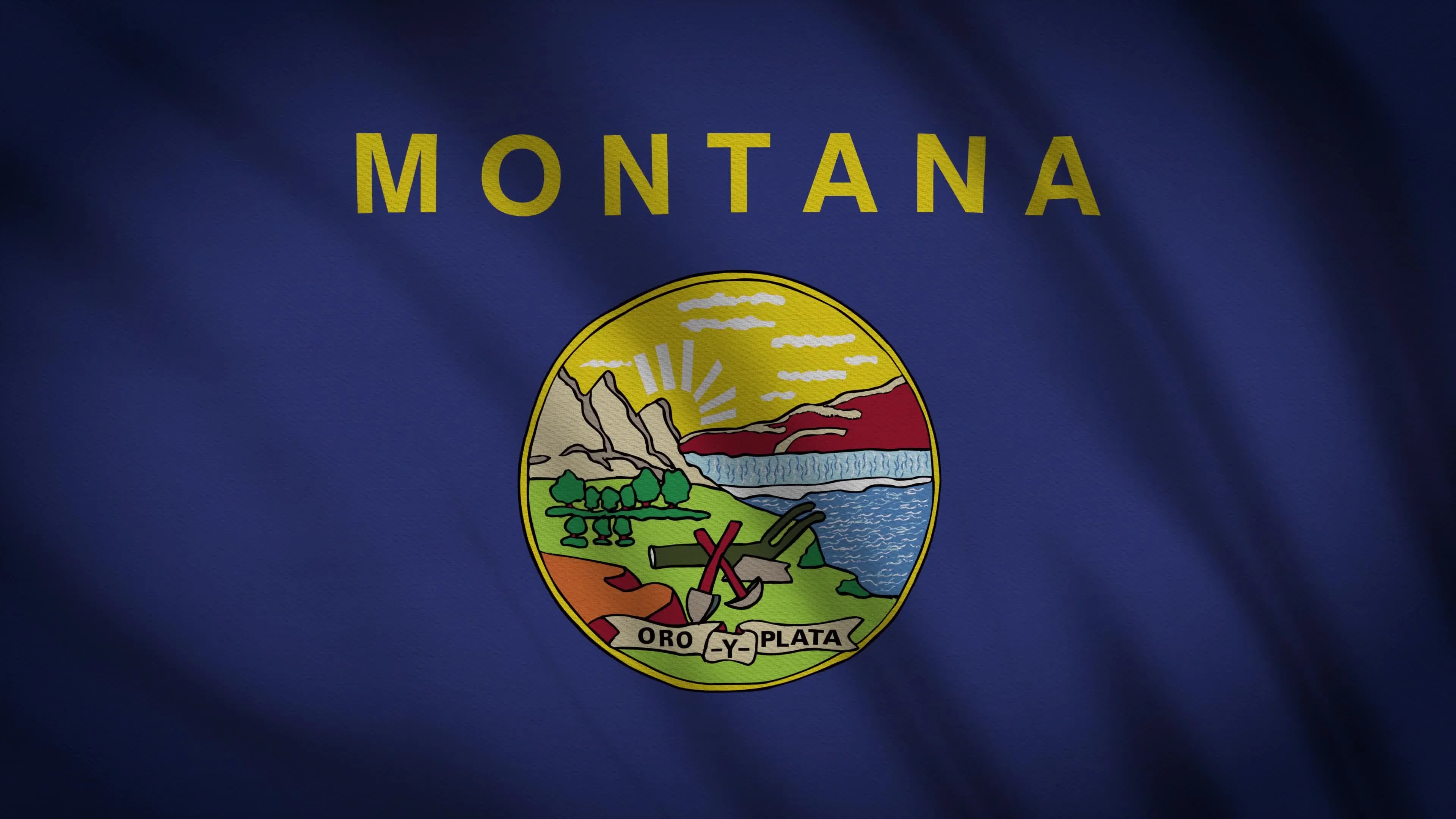
| State Motto | Oro y Plata ("Gold and Silver") |
| Time Zone | Mountain |
| Bordering States | North Dakota, South Dakota, Wyoming, Idaho |
| International Border | Canada (British Columbia, Alberta, Saskatchewan) |
Did You Know?
Montana is the fourth-largest state by area but has a population of only about 1.1 million, one of the least densely populated states in the country. Montana has more cattle (roughly 2.5 million) than people.
Glacier National Park originally contained more than 150 glaciers when it was established in 1910. By 2025, fewer than 30 remain, the rest have melted. The park has become one of the most documented illustrations of climate change anywhere on Earth.
Jeannette Rankin of Montana was the first woman elected to the United States Congress (1916), four years before women won the right to vote nationally with the 19th Amendment. She later became the only member of Congress to vote against both World War I and World War II.
The Battle of the Little Bighorn on June 25–26, 1876, in which Lt. Colonel George Armstrong Custer and 268 soldiers of the 7th Cavalry were killed by Lakota, Northern Cheyenne, and Arapaho warriors, took place in Montana. It was the most complete U.S. Army defeat in the Indian Wars.
Montana borders three Canadian provinces, British Columbia, Alberta, and Saskatchewan, giving it one of the longest international land borders of any U.S. state. The line between Montana and Canada stretches nearly 550 miles.
The Stillwater Mine in Stillwater County, Montana, is the only primary platinum group metals (PGM) mine in the United States. It produces palladium and platinum used in catalytic converters and industrial processes.
Montana's Going-to-the-Sun Road in Glacier National Park, 50 miles of two-lane mountain road crossing the Continental Divide at Logan Pass (elevation 6,646 feet), took 11 years to build (1921–1932) and is considered one of the greatest feats of road engineering in American history.
Butte, Montana, was once one of the largest and most cosmopolitan cities in the American West, a mining boomtown teeming with Irish, Finnish, Cornish, Chinese, and Eastern European immigrants working the copper mines. Its Berkeley Pit is now one of the largest Superfund sites in the United States.
Montana's Flathead Lake is the largest natural freshwater lake west of the Mississippi River, 28 miles long and 15 miles wide, with water so clear you can see the bottom at 100 feet depth in calm conditions.
Phil Jackson, born in Deer Lodge, Montana, won 11 NBA championships as a head coach, 6 with the Chicago Bulls (Michael Jordan era) and 5 with the Los Angeles Lakers (Shaquille O'Neal and Kobe Bryant era), the most championships of any head coach in NBA history.
Quick Facts and Common Questions
Short answers to the questions people most often ask about Montana: its abbreviation, what its name means, its capital, and its place in Congress.
Montana's two-letter postal abbreviation is MT. The U.S. Census Bureau places it in the West region, in the Mountain division, and about 1.08 million people lived there in the 2020 census.
Montana became the 41st state on November 8, 1889, days after North Dakota and South Dakota and days before Washington. Most of its land came from the Louisiana Purchase, and Congress created the Montana Territory in 1864 during a gold rush.
Montana comes from the Spanish word "montaña," meaning "mountain" or "mountainous region," a fitting name for a state with the Rocky Mountains across its west.
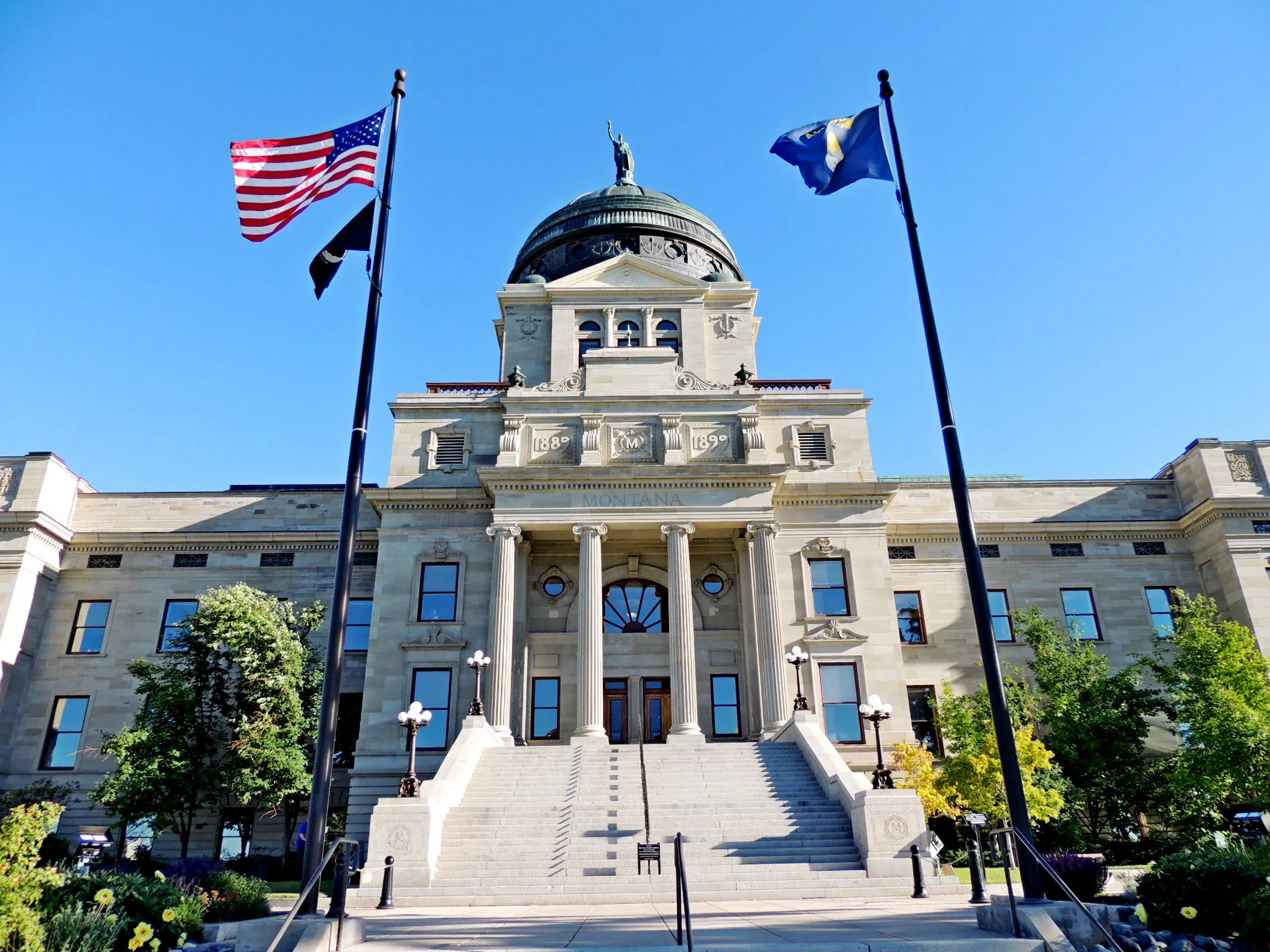
Helena has been the capital since 1875. The first territorial capital was Bannack, from 1864 to 1865, followed by Virginia City from 1865 to 1875, both gold-rush towns. In an 1894 statewide vote Helena narrowly defeated Anaconda to remain the permanent capital, and the State Capitol was completed in 1902.
Montana borders North Dakota and South Dakota to the east, Wyoming to the south, and Idaho to the west. To the north it borders three Canadian provinces: British Columbia, Alberta, and Saskatchewan.
Montana's official nickname is "The Treasure State," for its mineral wealth, and it is widely known as "Big Sky Country." Its motto is "Oro y Plata," Spanish for "Gold and Silver." Its state bird is the western meadowlark, its flower is the bitterroot, its tree is the ponderosa pine, and its animal is the grizzly bear.
Based on the 2020 census, Montana regained a second seat in the U.S. House of Representatives, which it had lost after the 1990 census. That gives it 4 votes in the Electoral College.
Jeannette Rankin of Montana became the first woman elected to Congress in 1916, four years before the 19th Amendment guaranteed women the vote nationwide; Montana had granted women the vote in 1914. She served two terms, 1917 to 1919 and 1941 to 1943, and voted against U.S. entry into both World War I and World War II.
The Battle of the Little Bighorn was fought on June 25 and 26, 1876, along the Little Bighorn River in what is now southeastern Montana. Lakota, Northern Cheyenne, and Arapaho warriors defeated the U.S. Army's 7th Cavalry, killing Lieutenant Colonel George Armstrong Custer and more than 260 soldiers. The site is now Little Bighorn Battlefield National Monument.
Sources & Further Reading
- Census Regions and Divisions, U.S. Census Bureau
- 2020 Census Apportionment Results, U.S. Census Bureau
- Distribution of Electoral Votes, National Archives
- Montana Historical Society
- Rankin, Jeannette, History, Art and Archives, U.S. House of Representatives
- Little Bighorn Battlefield National Monument, National Park Service
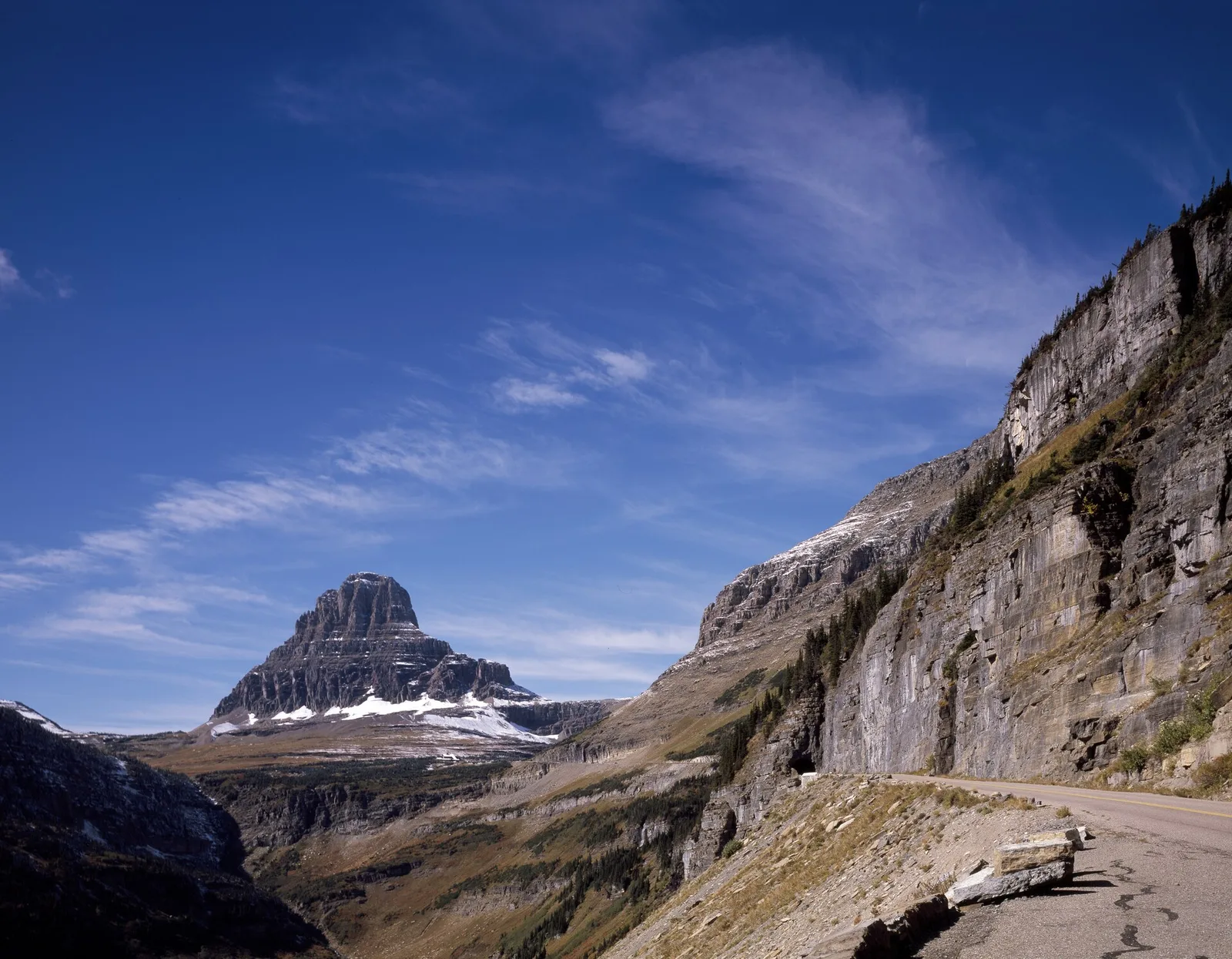
Glacier National Park
The Crown of the Continent, Where Rocky Mountain Peaks and Ancient Glaciers Meet the Great Plains
About Glacier National Park
Glacier National Park protects more than a million acres of the northern Rocky Mountains along the Canadian border, a landscape George Bird Grinnell called the 'Crown of the Continent' for the way its ice-carved peaks rise between the plains and the Pacific slope.
Congress established it on May 11, 1910; the Great Northern Railway then built the grand lodges and backcountry chalets and marketed the park with a 'See America First' campaign, and its 1930s red 'jammer' tour buses still run.
In 1932 the United States and Canada joined Glacier to Waterton Lakes National Park in Alberta as Waterton-Glacier International Peace Park, the first of its kind in the world; the pair is a UNESCO World Heritage Site.
The park's namesake glaciers are vanishing: roughly 150 filled these valleys in 1850, about 25 remain, most below the 25-acre size that defines a glacier, and models suggest the largest will be gone within a few decades.
- Designation
- National Park, UNESCO World Heritage Site, International Biosphere Reserve
- Location
- Flathead and Glacier Counties, northwestern Montana
- Established
- May 11, 1910
- Annual Visitors
- ~3 million
Glacier's Iconic Landscapes
The 50-mile Going-to-the-Sun Road crosses the Continental Divide at Logan Pass, 6,646 feet, and is both a National Historic Landmark and a landmark of civil engineering.
Crews blasted it from cliff faces through the 1920s and dedicated it in 1933; it is faced with hand-laid stone walls and was designed to fit the landscape rather than cut straight through it.
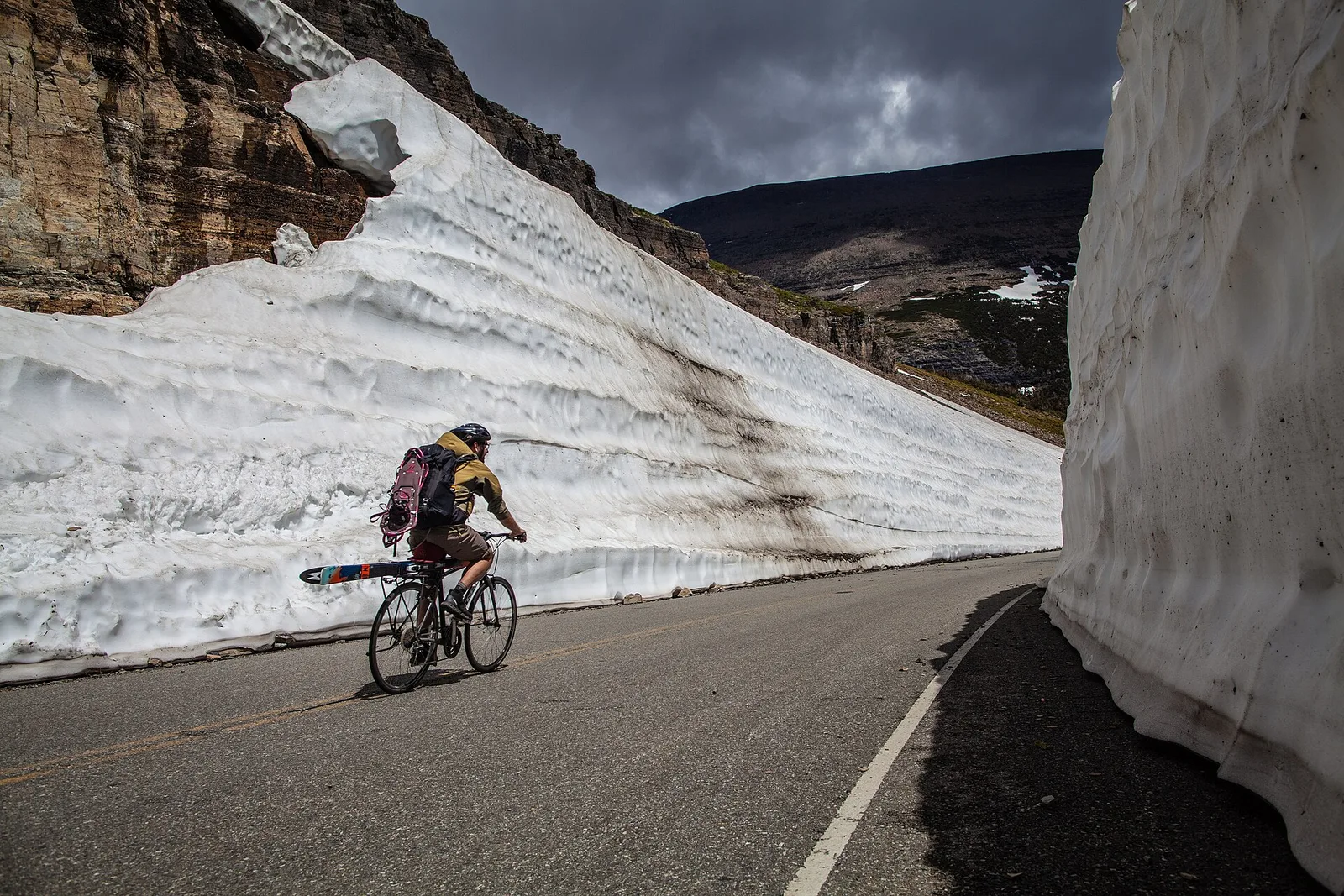
Snow closes it more than half the year: plows work about ten weeks each spring to clear drifts up to 80 feet deep near Logan Pass, and it usually opens fully in late June or early July.
Since 2021 the corridor has required a timed-entry vehicle reservation in summer, and a free shuttle runs its length to cut the number of cars.
Ice-age glaciers, not the small modern ones, cut the park's U-shaped valleys, knife-edged ridges, cirques, and pyramid peaks between roughly 20,000 and 12,000 years ago.
The rock they carved is Belt Supergroup sediment, about 1.5 billion years old and among the best-preserved Precambrian rock on Earth, with visible ripple marks, mudcracks, and fossil algal mounds called stromatolites.
The Lewis Overthrust shoved a slab of that ancient rock about 50 miles east and up over Cretaceous shale a tenth its age, which is why the peaks look layered and why old rock sits on top of young.
Chief Mountain, a freestanding block of the overthrust left behind by erosion and sacred to the Blackfeet, is the clearest example of that older-over-younger arrangement.
Glacier anchors the Crown of the Continent Ecosystem, one of the few places in the lower 48 that still has grizzly bears, wolves, wolverines, lynx, and mountain lions all present alongside their prey.
The grizzly population is around 300, one of the densest south of Canada, and the park has one of the most closely studied wolverine populations anywhere.
On the night of August 12, 1967, grizzlies killed two young women in separate attacks in the park, the 'Night of the Grizzlies,' which forced the Park Service to close garbage dumps and require bear-proof food storage across the system.
Mountain goats, the park's symbol, and bighorn sheep are common on the high crags, and moose and elk work the valley willow and meadow.
Lake McDonald, 10 miles long and 472 feet deep, is the park's largest and deepest lake, filling a glacier-gouged trough at the west entrance.
Its western shore is famous for smooth multicolored pebbles, red and green argillite whose color comes from whether the iron in the rock oxidized in air or stayed buried.
The valley around it holds western redcedar and hemlock rainforest, the driest, easternmost reach of the Pacific coastal forest, with trees over 200 feet tall along the Trail of the Cedars.
That forest has burned repeatedly in recent large fires, including the 2018 Howe Ridge Fire on the lake's north shore and the 2017 fire that destroyed the historic Sperry Chalet, since rebuilt.
Indigenous Connections
Blackfeet Nation
The Blackfeet, part of the Blackfoot Confederacy, held the plains and east front of the Rockies here and call the mountains Miistakis, the 'Backbone of the World,' a sacred landscape in their tradition.
In an 1895 agreement the Blackfeet sold the mountainous eastern strip that is now the park's eastern half to the United States for $1.5 million, understanding that they kept the right to hunt, fish, and gather timber there.
When the park was created in 1910 the government treated those rights as extinguished; the Blackfeet have never accepted that reading, and the dispute over the 'Ceded Strip' continues today.
The Blackfeet Nation, headquartered in Browning, Montana, borders the park's eastern boundary. The tribe has a formal partnership with NPS, with rights to gather traditional plants and conduct ceremonies within the park. The eastern entrance to Glacier is located on the Blackfeet Reservation.
Salish and Kootenai Peoples
Salish, Pend d'Oreille, and Kootenai people used the park's western valleys for thousands of years, fishing the rivers and lakes, hunting elk and deer, and crossing the passes to hunt bison on the plains.
They dug camas in the lowland prairies and traveled well-worn trails over Marias and other passes, routes the Blackfeet also used and often contested.
The 1855 Hellgate Treaty confined the western tribes to the Flathead Reservation south of the park while reserving off-reservation hunting and fishing rights on open, unclaimed land.
The Confederated Salish and Kootenai Tribes are headquartered on the Flathead Reservation adjacent to the park's southwestern boundary. The tribe is nationally recognized for its progressive natural resource management programs, including the restoration of bull trout to streams that flow into the park.
Experiencing Glacier
Going-to-the-Sun Road Drive or Bike
The road is the park's signature experience, climbing from valley forest through switchbacks below the Garden Wall to alpine tundra at Logan Pass.
A summer vehicle reservation is required to enter the corridor between about 7 a.m. and 3 p.m.; outside those hours, and on the shuttle, no reservation is needed.
Cyclists ride it too, but the Park Service bans bikes on the busiest stretch, Apgar to Logan Pass, between 11 a.m. and 4 p.m. in peak season because the road is narrow and has no shoulder.
In spring, before it opens to cars, the lower plowed sections are a popular bike-and-hike with walls of snow on both sides.
Highline Trail
The Highline Trail leaves Logan Pass and runs about 11.6 miles along the Garden Wall, staying near the Continental Divide with almost no elevation change but constant exposure.
The first quarter mile crosses a narrow ledge blasted into the cliff, with a hand cable bolted to the rock for balance above a long drop.
Mountain goats and bighorn sheep graze right along the tread, and grizzlies use the meadows, so hikers carry bear spray and make noise.
Most people hike it one way to the Loop and ride the shuttle back; a steep side trail climbs to the Grinnell Glacier Overlook.
Grinnell Glacier Hike
From the Many Glacier valley the trail climbs about 1,600 feet in roughly 5.5 miles to the foot of Grinnell Glacier, the park's most accessible.
It passes above the turquoise Grinnell and Josephine lakes, whose color comes from glacial 'rock flour,' fine ground stone suspended in the meltwater.
Signs along the way show the glacier's edge in past decades; it has lost more than 40 percent of its area since the 1960s and over 90 percent since 1850.
A boat shuttle across the two lower lakes can cut about 3.4 miles off the round trip; bears are frequent here, and this is often the first trail to close for bear activity.
Conservation Challenges
Glacier Recession and Climate Change
The U.S. Geological Survey has tracked the park's glaciers with repeat photography for decades: about 150 in 1850, roughly 25 today, and several of those now too small to move and flow.
The park once posted signs saying the glaciers would be gone by 2020 or 2030; it revised them around 2019 because the exact date is uncertain, though the trend is not.
Losing the ice changes the rivers: less cold summer meltwater raises stream temperatures and threatens cold-adapted species such as bull trout and a rare stonefly found only in these glacial streams.
Glacier has become one of the most-visited illustrations of climate change in the country, and the Park Service leans into that in its interpretation.
Overcrowding and Vehicle Traffic
Visitation approached 3 million a year in the late 2010s, almost all of it aimed at Going-to-the-Sun Road and a handful of trailheads that fill by dawn.
The timed-entry vehicle reservation system, in place since 2021, has spread arrivals out and cut the worst of the midday jams but has not ended congestion or the frustration of getting a permit.
The free shuttle helps on the Sun Road but does not reach Many Glacier or Two Medicine, where parking simply runs out.
The park keeps studying options, from bigger transit to reservations for more areas, against the limits of a 1930s road that cannot be widened.
Whitebark Pine Decline
Whitebark pine grows at treeline and produces fat, energy-rich seeds that grizzly bears, red squirrels, and Clark's nutcrackers depend on in the fall.
It is dying across the northern Rockies from white pine blister rust, an introduced fungus, made worse by mountain pine beetle outbreaks and by fire suppression that lets other trees crowd it.
Glacier's crews collect cones from the few trees that show rust resistance, grow seedlings, and plant them in burned and cleared high country.
Whitebark pine was listed as threatened under the Endangered Species Act in 2022, formal recognition of a decline the park has watched for 40 years.
Going-to-the-Sun Road, one of the most spectacular drives in North America
At a Glance
Did You Know?
In 1910 when the park was established, it contained approximately 150 glaciers. By 2023, only 26 named glaciers remained, and scientists estimate the last ones will disappear within decades as warming continues.
Glacier National Park is part of the Crown of the Continent Ecosystem, one of the few remaining places in the lower 48 states where all the species present when Lewis and Clark came through are still here, including grizzly bears, wolves, wolverines, and mountain lions.
A tiny stream crossing a rock near Triple Divide Peak in Glacier National Park sends water to three oceans: drops that go east reach the Gulf of Mexico, drops that go northwest reach the Pacific, and drops that go north reach Hudson Bay and the Arctic Ocean.
Plan Your Visit
Location
Flathead and Glacier Counties, northwestern Montana
Designation
National Park, UNESCO World Heritage Site, International Biosphere Reserve
Best Time to Visit
July and August for full Going-to-the-Sun Road access; September for fall color and fewer crowds
Admission
$35 per vehicle (7-day pass); vehicle reservations required for the Sun Road in summer