
The Electoral
College
Why Americans don't directly elect their president, and why that was a deliberate, carefully considered decision that still shapes every election today.
What Is the Electoral College?
When you vote for president, you are not directly voting for the candidate. You are voting for a group of people, called electors, who are pledged to that candidate. Those electors then cast the official votes for president in December. The winner of the presidential election is the candidate who earns at least 270 of 538 electoral votes, not necessarily the one who gets the most individual votes nationwide.
This system, the Electoral College, is one of the most distinctive and debated features of American democracy. It was not an accident or a compromise forced by circumstance. It was a deliberate choice, built on a specific philosophy about how a large, diverse republic should select its leader.
Why Did the Founders Create It?
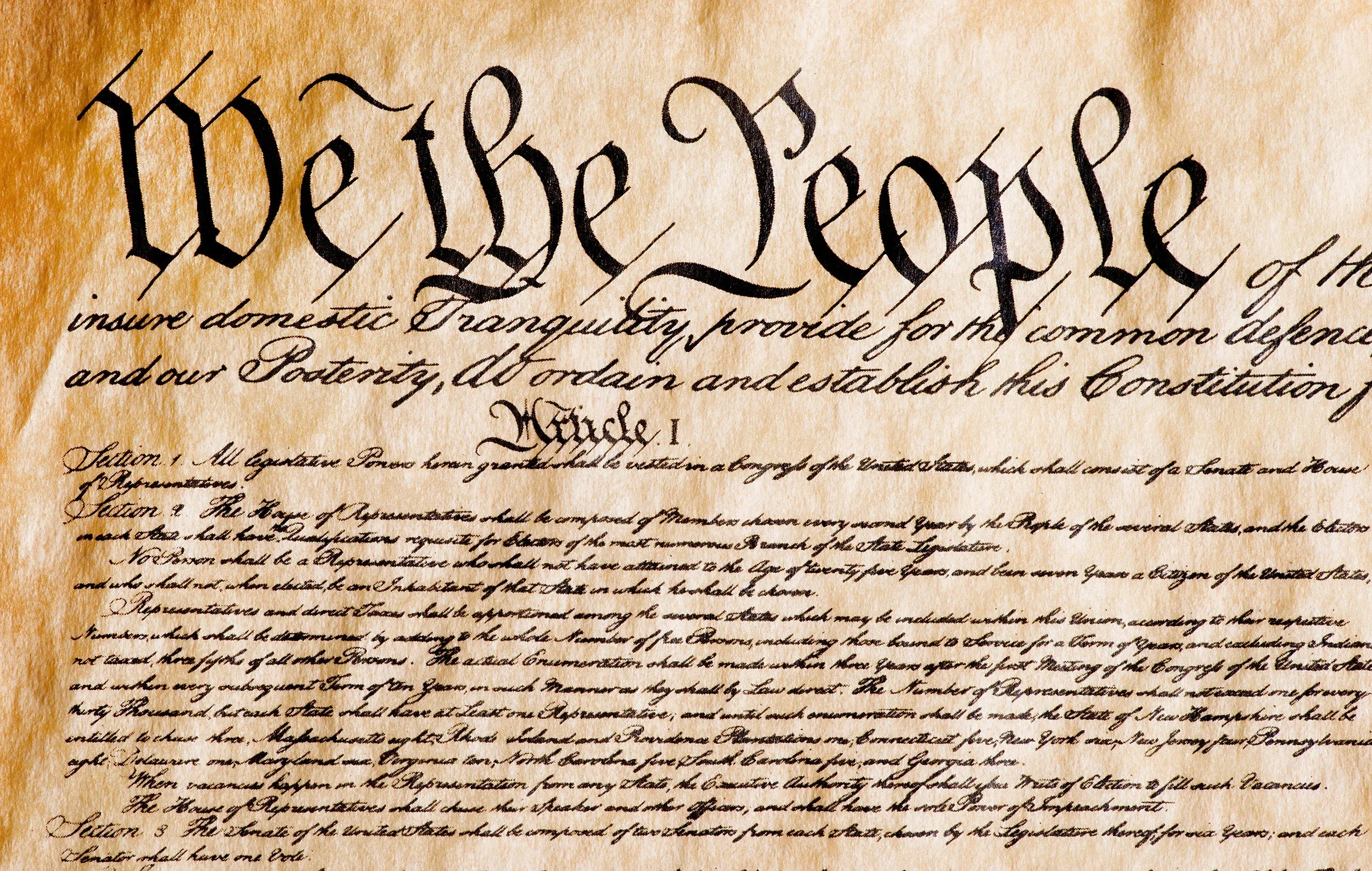
Article II, where the Electoral College is established (Public Domain)
In 1787, the founders faced a fundamental question: how should a nation of 3.9 million people, spread across 13 states with wildly different populations, economies, and interests, choose a single national leader, fairly?
A direct national popular vote was proposed and seriously debated. The founders rejected it, and not out of ignorance or laziness. They rejected it for specific, carefully reasoned concerns that are still relevant today.
Fear of Urban Dominance
In a pure popular vote, candidates would only need to win the most populated areas. In 1787, that meant a few large cities and coastal states. The vast majority of Americans, farmers, small-town citizens, frontier settlers, would have essentially no say. The founders wanted a president who represented the entire nation, not just the population centers.
Protecting the Federal Compact
The United States is not just a collection of individuals, it is a union of states. Each state, regardless of size, joined that union as an equal partner in the federal compact. The Electoral College reflects that structure: states matter, not just raw population numbers. A candidate must build a coalition across the country, not just pile up votes in a few large places.
Concern About Informed Voting
In 1787, there was no national media, no instant communication, and most citizens outside major cities had little information about candidates from other states. The founders created a layer of electors, informed citizens in each state, who would make the final decision with full knowledge of the candidates. This concern is less relevant today but shaped the original design.
Checks Against Mob Rule
The founders were deeply wary of 'pure democracy', they had studied history and seen how direct popular rule could be manipulated by charismatic demagogues. They wanted deliberative filters in the system. The Electoral College was one of those filters, a step between the raw popular vote and the final result.
The Case for Smaller States and Rural America
Supporters of the Electoral College consider this one of the strongest arguments for keeping it. They argue that without it, presidential elections would be decided almost entirely by a handful of major urban population centers, and much of the rest of the country would get little attention from campaigns. Critics respond that under a national popular vote every vote would count equally wherever it was cast, so candidates would still have reason to seek rural votes.
The Concentration Argument
Supporters often point to how concentrated the U.S. population is. These six metropolitan areas alone are home to a large share of Americans:
Those six metro areas alone account for roughly 63 million people, about 19% of the U.S. population. No candidate could win a national popular vote with those areas alone, since they hold fewer than one in five Americans, but supporters argue a popular-vote system would pull campaigns toward densely populated regions, leaving states such as Wyoming, Montana, Idaho, and the Dakotas, and rural regions from the Midwest to Appalachia, with less influence. Critics note that today's system also concentrates attention, on a handful of closely divided battleground states.
The Math: Electoral Votes vs Population
The Electoral College gives smaller states a slight advantage. Every state gets a minimum of 3 electoral votes, 2 for its senators plus at least 1 for its House member, regardless of population. This means a Wyoming voter has somewhat more electoral weight per person than a California voter. Supporters see this as a deliberate protection for smaller states; critics see it as giving some citizens' votes more weight than others.
| State | Electoral Votes | Population | People Per Electoral Vote |
|---|---|---|---|
| California | 54 | 39.5M | 731K per vote |
| Texas | 40 | 30.0M | 750K per vote |
| Florida | 30 | 22.6M | 753K per vote |
| New York | 28 | 19.8M | 707K per vote |
| Wyoming | 3 | 581K | 194K per vote |
| Vermont | 3 | 647K | 216K per vote |
| Alaska | 3 | 733K | 244K per vote |
| North Dakota | 3 | 779K | 260K per vote |
Green = smaller states with more electoral weight per resident, a result of the minimum 3-vote floor every state receives.
What This Means in Practice
Supporters argue that because of the Electoral College, presidential candidates must build a geographic coalition that reaches beyond population centers, addressing the concerns of groups such as:
The 2016 Election
The 2016 presidential election is the most-cited modern example in this debate. Donald Trump lost the national popular vote to Hillary Clinton by approximately 2.9 million votes, yet won the presidency with 306 pledged electoral votes. How?
Trump built a geographic coalition across the industrial Midwest. He won Michigan by 10,704 votes, Wisconsin by 22,748 votes, and Pennsylvania by 44,292 votes, a combined margin of fewer than 80,000 votes across three states, which delivered 46 electoral votes and the presidency.
Supporters of the Electoral College say this shows the system working as intended, pushing candidates to compete for voters in regions hit hard by factory closures and economic decline. Critics say it shows the system's central flaw: the candidate with fewer votes nationwide won, and the outcome turned on fewer than 80,000 votes in three states.
How It Actually Works, Step by Step
Electoral Votes Are Assigned
Each state gets electoral votes equal to its total members of Congress, House seats plus 2 senators. California has 54 (52 House + 2 Senate). Wyoming has 3 (1 House + 2 Senate). Washington DC gets 3 under the 23rd Amendment, even though it has no voting representation in Congress.
The House portion is redistributed after each decennial census, so a state's electoral vote count can rise or fall between elections. After the 2020 census, Texas gained two votes and Florida, Colorado, Montana, North Carolina, and Oregon gained one each, while California, New York, Illinois, Michigan, Ohio, Pennsylvania, and West Virginia each lost one.
Because every state gets its two Senate-based votes regardless of size, the smallest states are mathematically overrepresented: Wyoming has one elector per roughly 195,000 residents, while California has one per roughly 730,000. The total is fixed at 538, so a majority is 270.
The Constitution leaves the manner of choosing electors entirely to each state legislature. All states now use a statewide popular vote, but for the first several decades many legislatures appointed electors directly, and South Carolina did so until the Civil War.
Election Day, November
Voters go to the polls and cast their ballots for president. In 48 states and DC, it's winner-take-all, whoever wins the most votes in that state wins ALL of its electoral votes. Maine and Nebraska are exceptions, they can split their electoral votes by congressional district.
Federal law sets Election Day as the Tuesday after the first Monday in November, a date fixed by Congress in 1845. Ballots technically list slates of electors pledged to each candidate, though most modern ballots show only the candidates' names.
Maine has used its district method since 1972 and Nebraska since 1992. Under it, two electoral votes go to the statewide winner and one to the winner of each congressional district, so Nebraska split its votes in 2008, 2020, and 2024, and Maine split in 2016, 2020, and 2024.
Winner-take-all is a matter of state law, not the Constitution, and the Supreme Court has long held that states have broad power to choose how their electors are appointed (McPherson v. Blacker, 1892); challenges to winner-take-all under the Constitution have not succeeded. It concentrates campaigns on a small number of closely divided "battleground" states while leaving reliably one-party states with little attention.
Electors Are Appointed
Each state's winning party sends its slate of electors to cast the official votes. These are real people, usually party loyalists, local officials, or community leaders, chosen by state parties before the election. There are 538 electors total, one for each electoral vote.
The Constitution bars sitting members of Congress and anyone "holding an Office of Trust or Profit under the United States" from serving as an elector, which is why they are typically retired officials, activists, and donors rather than current officeholders.
Parties nominate their slates months in advance, at state party conventions or through a party committee. Only the slate belonging to the candidate who wins the state's popular vote is actually seated.
The 14th Amendment's Section 3 also disqualifies from serving as an elector anyone who engaged in insurrection after having taken an oath to support the Constitution, a provision that had rarely been litigated before the 2020s.
Electors Vote, December
On the first Tuesday after the second Wednesday in December, electors meet in their state capitals and cast their official votes for president and vice president. In most states, they are legally bound to vote for their pledged candidate.
States must resolve any disputes over their results by a "safe harbor" deadline six days before the electors meet; results certified by then are, by federal law, conclusive and cannot be second-guessed by Congress.
An elector who breaks their pledge is called a "faithless elector." It has happened 165 times in U.S. history and has never changed an outcome. As of the 2020s, roughly 33 states and D.C. have laws binding electors, and some cancel and replace a faithless vote.
The Supreme Court ruled unanimously in Chiafalo v. Washington (2020) that states may enforce an elector's pledge, including by fining or removing a faithless elector, ending decades of uncertainty about whether electors retained personal discretion.
Congress Counts the Votes, January 6
The electoral votes are sealed and sent to Congress. On January 6, a joint session of Congress meets to officially count the votes, with the Vice President presiding. The candidate with 270+ votes is declared the winner.
The Electoral Count Reform Act of 2022 rewrote the rules for this step after the disputed 2021 count. It states explicitly that the Vice President's role is only ceremonial, with no power to reject or delay any state's votes.
The 2022 law also raised the threshold to lodge an objection to a state's electoral votes from one member of each chamber to one-fifth of each chamber, making frivolous objections much harder to force onto the floor.
If an objection does meet the threshold, the House and Senate separate and debate it for up to two hours; an objection is sustained only if both chambers vote to uphold it by majority. No objection has ever been sustained.
Inauguration, January 20
The president-elect is sworn into office on January 20. If no candidate reached 270, the House of Representatives chooses the president, each state delegation gets one vote regardless of size.
The January 20 date was set by the 20th Amendment in 1933; before that, inaugurations were held on March 4, leaving a four-month "lame duck" gap that proved dangerous during the secession winter of 1860-61 and the banking crisis of 1932-33.
In a House contingent election, a candidate needs an absolute majority of state delegations, 26 of 50, and the House votes only among the top three electoral-vote finishers. The Senate separately picks the Vice President from the top two, with each senator casting one vote.
This has happened only twice, in 1801 and 1825. If the House cannot choose a president by January 20, the 20th Amendment provides that the Vice President-elect (or, failing that, an officer designated by Congress) acts as president until the deadlock breaks.
Winner-Take-All: Why Strategy Matters
The winner-take-all rule, used by 48 states, is what makes presidential campaign strategy so interesting and so different from a simple popularity contest. Because winning a state by 1 vote earns the same electoral votes as winning by 1 million votes, the way you allocate campaign resources matters enormously.
Safe States (Non-Competitive)
States that reliably vote for one party year after year, like California (Democrat) or Wyoming (Republican), receive very little campaign attention. The outcome is already known. Candidates spend minimal time and money there.
Result: Large predictable states matter less; smaller swing states matter more.
Swing States (Battlegrounds)
States that could go either way receive enormous attention, rallies, advertising, ground operations, policy promises. In 2024, Pennsylvania alone saw billions in campaign spending and dozens of presidential visits. Every vote there genuinely matters.
Result: Genuinely competitive states have outsized influence on policy.
Why This Forces Geographic Outreach
Because of winner-take-all, a candidate who wants to win needs to appeal to voters in many different states with many different concerns. A campaign can't just maximize votes in New York and California, those states are already decided. They have to compete in Pennsylvania's steel towns, Michigan's auto communities, Wisconsin's dairy farms, Arizona's border communities, and Nevada's union workers. The Electoral College turns a national election into 50 state contests, and that forces candidates to be broadly relevant, not just popular in a few places.
Five Times the Popular Vote Winner Lost
It has happened five times in American history that the candidate who received more individual votes nationwide did not win the presidency. Each case is a clear illustration of how the Electoral College can, and sometimes does, produce a different result than a simple national popular vote:
Electoral College Winner: John Quincy Adams
Andrew Jackson (won popular vote)
Four candidates split the vote, all members of the same Democratic-Republican party, and none reached a majority of the 261 electoral votes. Jackson led with 99 electoral votes and about 41 percent of the popular vote (in the 18 states that then chose electors by popular vote); Adams had 84.
Under the 12th Amendment, the choice went to the House of Representatives, voting by state delegation from among the top three finishers. On the first ballot, February 9, 1825, the House chose Adams with 13 of 24 state delegations.
Speaker of the House Henry Clay, who had finished fourth and was eliminated, threw his support to Adams; when Adams then named Clay Secretary of State, Jackson's supporters called it a "corrupt bargain." Jackson won a rematch against Adams in 1828.
Electoral College Winner: Rutherford B. Hayes
Samuel Tilden (won popular vote)
Tilden won about 51 percent of the popular vote to Hayes's 48 percent and led 184 to 165 in undisputed electoral votes, one short of the 185 then needed for a majority. Twenty electoral votes from Florida, Louisiana, South Carolina, and Oregon were disputed, with rival slates of electors submitted.
With no constitutional procedure to resolve competing slates, Congress created a 15-member Electoral Commission of five senators, five representatives, and five Supreme Court justices. It split 8 to 7 along party lines and awarded every disputed vote to Hayes, giving him exactly 185.
The outcome was tied to the informal Compromise of 1877, under which the incoming Hayes administration agreed to withdraw the remaining federal troops from the South, effectively ending Reconstruction. The dispute also prompted the Electoral Count Act of 1887, which governed the counting of electoral votes until it was overhauled in 2022.
Electoral College Winner: Benjamin Harrison
Grover Cleveland (won popular vote)
Cleveland, the incumbent, won about 90,000 more popular votes nationally, roughly a 0.8-point margin, but lost the Electoral College 233 to 168. He ran up very large margins in the solidly Democratic South while narrowly losing several competitive Northern states.
The decisive state was Cleveland's own home state of New York, which Harrison carried by about 14,000 votes out of 1.3 million, taking its 36 electoral votes. Indiana, another close state and Harrison's home, also flipped.
The tariff was the central issue; Cleveland favored lowering it and Harrison favored keeping it high to protect domestic industry. Cleveland won a rematch in 1892, making him the first president to serve two non-consecutive terms (Donald Trump became the second in 2025).
Electoral College Winner: George W. Bush (271)
Al Gore (won by ~540,000 votes)
Gore led the national popular vote by about 543,000 votes, a 0.5-point margin. The Electoral College came down to Florida, where the initial count showed Bush ahead by a few hundred votes out of about 6 million, triggering an automatic machine recount and then manual recounts in selected counties.
After 36 days of litigation, the U.S. Supreme Court ruled 7 to 2 that the varying standards used across Florida counties violated equal protection, and 5 to 4 that no constitutionally adequate recount could be completed by the December 12 safe-harbor deadline, effectively ending the recount in Bush v. Gore.
The certified Florida margin was 537 votes, delivering the state's 25 electoral votes and a 271-266 national total (one Gore elector from D.C. abstained). Congress later replaced Florida's punch-card ballots and other outdated equipment through the Help America Vote Act of 2002.
Electoral College Winner: Donald Trump (306)
Hillary Clinton (won by ~2.9M votes)
Clinton led the national popular vote by about 2.87 million votes, a 2.1-point margin, with much of that margin coming from California, which she won by more than 4 million. Trump won the Electoral College with 306 pledged electors to Clinton's 232.
Three traditionally Democratic-leaning states decided it: Trump carried Michigan by 10,704 votes, Wisconsin by 22,748, and Pennsylvania by 44,292, a combined margin of under 78,000 votes across the three, worth 46 electoral votes.
The 2016 vote also produced a record number of faithless electors: seven cast votes for someone other than their pledged candidate, five of them pledged to Clinton. The Supreme Court unanimously upheld state laws binding electors four years later, in Chiafalo v. Washington (2020).
The important context: In each of these cases, the winning candidate didn't just randomly win, they built a coalition that won more states and more geographic breadth, even if they lost the raw national vote count. The Electoral College rewarded geographic reach over concentrated popularity. Whether that's the right tradeoff is the heart of the reform debate.
What the Constitution Says
"Each State shall appoint, in such Manner as the Legislature thereof may direct, a Number of Electors, equal to the whole Number of Senators and Representatives to which the State may be entitled in the Congress..."
"The Electors shall meet in their respective States, and vote by Ballot for two Persons..."
In short: Each state appoints electors equal to its total number of senators and representatives. Those electors meet in their states and vote. The candidate with the most votes (if a majority) becomes president.
The 12th Amendment (1804), A Critical Fix
The original system had a serious flaw: electors voted for two candidates without specifying president vs. vice president. Whoever got the most votes became president; second place became VP. In 1800, Thomas Jefferson and Aaron Burr, running mates, each got the same number of votes, throwing the election to the House of Representatives (which chose Jefferson after 36 ballots).
The 12th Amendment fixed this by requiring electors to cast separate votes for president and vice president, the system still used today.
The Reform Debate, Both Sides
The Electoral College is one of the most debated institutions in American government. Here are the strongest arguments on both sides, presented fairly:
The Case FOR the Electoral College
Protects geographic diversity
Forces candidates to build national coalitions. Without it, rural states, small states, and non-coastal communities would be strategically irrelevant. A candidate could win by concentrating entirely on 5-6 urban population centers.
Maintains the federal structure
The US is a union of states, not just a population. State-based elections reflect that structure. Presidential elections should require winning across the country, not just winning one region by a large margin.
Produces clear winners
The EC tends to amplify victory margins, producing clear decisive outcomes. A candidate who wins narrowly in the popular vote can win convincingly in the Electoral College, giving the new president a stronger mandate.
Contains recounts and disputes
In a pure popular vote, a close national race would require recounting every vote in every precinct across all 50 states, a logistical nightmare. The EC limits disputed recounts to individual states, making close elections more manageable.
Preserves small-state relevance
The minimum 3-vote floor ensures that Wyoming, Vermont, Alaska, and other small states have a seat at the table. In a pure popular vote, these states would be politically invisible to national campaigns.
The Case AGAINST the Electoral College
One person, one vote?
A voter in Wyoming has roughly 3.7 times more electoral weight per person than a voter in California. Many argue this violates the basic democratic principle that every citizen's vote should count equally regardless of where they live.
Swing states get all the attention
The winner-take-all system means campaigns ignore safe states entirely. Most Americans live in states that are already decided, they receive no campaign attention, no policy promises, and no visits. Only swing state voters are truly courted.
The popular vote winner can lose
It has happened five times. Many argue it's fundamentally undemocratic for the candidate with more votes to lose. In 2016, Clinton received nearly 3 million more votes than Trump but lost the presidency.
Faithless electors are a risk
Electors are real people who can, in some states, vote for whoever they want. While it has never changed an election outcome, the theoretical possibility of electors ignoring their state's vote is a structural vulnerability.
The system has changed dramatically
The founders designed the EC for a pre-democratic era with no political parties and no popular vote in most states. The modern system, with parties, primaries, and universal suffrage, looks nothing like what they intended.
Frequently Asked Questions
Click any question to expand the answer.
Yes, and it has happened five times. The Electoral College is the only vote that legally counts for president. A candidate can lose the national popular vote by millions of votes and still win the presidency by carrying the right combination of states. This follows from the design: the founders chose electors over a national popular vote, though whether that choice is a strength or a flaw is one of the central questions in the debate over the Electoral College.
A swing state (also called a battleground state) is one where neither party has a reliable majority. In a winner-take-all system where most states consistently vote for one party, campaigns concentrate their time, money, and attention on the handful of states that could go either way. Pennsylvania, Michigan, Wisconsin, Arizona, Georgia, and Nevada have been the most contested in recent elections. Critics argue this gives swing state voters disproportionate influence. Supporters say it forces candidates to appeal to genuinely persuadable voters.
If no candidate wins 270 electoral votes, the election goes to the House of Representatives. Each state delegation gets ONE vote, so California's 52 representatives have the same weight as Wyoming's 1. The House chooses from the top three Electoral College vote-getters. The Senate separately chooses the Vice President. This has happened twice: 1800 (Jefferson vs. Burr) and 1824 (Adams vs. Jackson).
A faithless elector is one who votes for someone other than the candidate they were pledged to support. It has happened 165 times in US history, though never enough to change an election outcome. As of 2020, 33 states and DC have laws binding electors to their pledged candidate. The Supreme Court ruled in 2020 that these laws are constitutional. In states without binding laws, electors can technically vote for anyone.
Abolishing it would require a constitutional amendment, a 2/3 vote in both chambers of Congress plus ratification by 38 states. That's an enormously high bar. Small states, which benefit from the Electoral College's minimum-3-vote floor, would almost certainly block any amendment. A more realistic reform is the National Popular Vote Interstate Compact, an agreement among states to award all their electoral votes to the national popular vote winner, which would take effect once states totaling 270+ electoral votes sign on. As of 2026, states and D.C. totaling 222 electoral votes have joined, after Virginia signed on in April 2026.
Quick Facts
Where to Find It
Did You Know?
The word 'Electoral College' isn't in the Constitution
The Constitution never uses the phrase 'Electoral College.' It describes the system of electors but doesn't name it. The term developed through common usage over time and became the standard way to refer to the system.
Hawaii once sent two sets of electors
In 1960, the Hawaii result was disputed. While a recount was ongoing, Democrats sent their electors to vote for Kennedy anyway. Republicans also sent electors to vote for Nixon. Congress ultimately accepted the Democratic slate after the recount confirmed Kennedy's win.
Electors meet in their state capitals
On the designated day in December, all 538 electors travel to their respective state capitals to cast their votes. They don't all meet in one place, it's 51 separate meetings happening simultaneously across the country (50 states plus DC).
Some states award EC votes by congressional district
Maine and Nebraska use a district-based system, two EC votes go to the statewide winner and one vote goes to the winner of each congressional district. This means these states can split their electoral votes between candidates, something that has actually happened.