
The Process Congress Designed Isn't the Process Congress Uses
The law requires 12 standalone appropriations bills, each debated and passed on its own before October 1. Since the modern budget process began, Congress has managed that only four times. Here's the seven-part explanation for why regular order gave way to continuing resolutions, omnibus packages, and shutdowns as the default.
Congress is supposed to pass 12 separate appropriations bills, one per spending category, each debated and voted on its own merits. Because standalone bills routinely stall in one chamber or the other, leadership has increasingly defaulted to one of two workarounds: bundling most or all of the unfinished bills into a single giant omnibus (or partial 'minibus') package voted on just before a deadline, or simply extending the prior year's funding levels through a continuing resolution, sometimes for the entire fiscal year.
What began as an occasional emergency measure has become the default operating mode. The Bipartisan Policy Center and the Congressional Research Service both track this shift: since the late 1990s, full-year CRs and last-minute omnibus votes have covered a growing share of total federal discretionary spending in a typical year, leaving the 12-bill process that Congress designed for itself increasingly theoretical.
The scale of the packages is part of the objection. The fiscal 2023 omnibus ran about 4,155 pages and roughly $1.7 trillion, and was released a few days before a Christmas-week vote, giving members little time to read it. Critics in both parties argue this concentrates real decisions in a handful of leadership offices and appropriations 'cardinals' rather than the full membership.
Full-year continuing resolutions carry their own cost. Because a CR generally funds programs at the prior year's dollar level and bars 'new starts,' a year-long CR, used for much of the government in fiscal 2013 and again in fiscal 2025, when it covered the Defense Department for the first time, locks agencies into last year's priorities and forces them to keep paying for things Congress may have intended to cut.
For decades, House and Senate leaders used earmarks, funding directed to a specific project in a specific member's district or state, as a tool to secure individual votes for large spending packages. A lawmaker on the fence about an appropriations bill could often be persuaded by a local bridge, courthouse, or research grant tucked into the text.
After a string of 'Bridge to Nowhere'-style controversies, House and Senate Republicans banned earmarks starting in 2011, and the ban largely held across both parties for a decade. Leadership lost a key lever for building majorities on spending bills in the process.
The specific scandals that ended the practice included a roughly $223 million earmark for the 'Bridge to Nowhere' connecting Ketchikan, Alaska, to a lightly populated island in a 2005 highway bill, and the 2006 corruption conviction of lobbyist Jack Abramoff, whose dealings involved directed spending. Public pressure made 'earmark' a political liability for years afterward.
Earmarks returned in 2021, rebranded as 'Community Project Funding' or 'Congressionally Directed Spending' with new rules: a cap of about 1 percent of discretionary spending, public posting of every request, a limit on how many each member may submit, a ban on requests that benefit the member financially, and a bar on for-profit recipients. Senate Republicans initially kept their own conference ban before rejoining the practice.
Passing a spending bill has always required building a coalition large enough to survive floor votes in both chambers. That task has gotten harder as House and Senate majorities have shrunk to single digits in many recent Congresses and as party-line voting has become more consistent than in prior decades, leaving leadership with less room to lose votes from either side of the aisle.
Divided government, one party controlling the White House while the other holds a chamber of Congress, has also been the norm for much of the period since the mid-1990s. Every layer of disagreement between the House, Senate, and president over spending priorities adds another point where the process can stall, and stalling is what produces both continuing resolutions and shutdowns.
Political scientists who measure congressional voting patterns, using tools such as the DW-NOMINATE score, find the ideological gap between the two parties in Congress is the widest it has been since the late 19th century, with almost no overlap between the most conservative Democrat and the most liberal Republican. The bloc of 'cross-pressured' members who once made bipartisan spending deals routine has largely disappeared.
Narrow majorities compound the effect. In the 118th Congress (2023-25) Republicans held the House by only a handful of seats, meaning a group of four or five members could block any bill the minority opposed, and the Senate has been at or near a 50-50 or 51-49 split for much of the period since 2021.
An informal norm known as the 'Hastert Rule,' named for former Speaker Dennis Hastert, holds that a Republican Speaker should not bring a bill to the floor unless it has the support of 'a majority of the majority,' meaning more than half of the Speaker's own party conference. Since its founding in 2015, the House Freedom Caucus, a bloc of several dozen hardline conservative members, has repeatedly withheld support from leadership-negotiated spending levels it considers too high.
When that happens, a Republican Speaker faces a choice with no good option: violate the informal Hastert Rule by passing a bill mostly with Democratic votes, or allow a shutdown. Both choices carry a real political cost to the Speaker personally, which is exactly what played out in the fall of 2023.
The Hastert Rule has never been written down or enforced by any procedure. Speakers Boehner, Ryan, and McCarthy each set it aside on must-pass measures, including the January 2013 'fiscal cliff' tax deal, Hurricane Sandy relief, debt-limit increases, and stopgap funding bills, each time passing the bill with a minority of Republicans plus most Democrats.
The Freedom Caucus does not publish a full membership list, but it is generally estimated at 30 to 45 members. In a House that Republicans controlled by only about nine seats, that is more than enough to deny leadership a floor majority on a party-line vote, which is the leverage the group used against McCarthy's own stopgap bill in September 2023.
In January 2023, to secure the votes needed to become Speaker, Kevin McCarthy agreed to lower the threshold for a 'motion to vacate the chair,' the procedure for removing a sitting Speaker, to just a single member. On September 30, 2023, McCarthy passed a stopgap continuing resolution with substantial Democratic support to avert a shutdown hours before the deadline.
Days later, Rep. Matt Gaetz (R-FL) forced a vote on a motion to vacate, citing McCarthy's reliance on Democratic votes among other grievances. On October 3, 2023, the House voted 216-210, with eight Republicans joining every Democrat, to remove McCarthy from the speakership, the first successful ouster of a sitting Speaker in U.S. history.
McCarthy's election itself had taken 15 ballots over five days, the most for a speakership since 1859, and the concessions he made to win included the one-member motion to vacate, seats for Freedom Caucus members on the Rules Committee, and a promise to hold fiscal 2024 spending to fiscal 2022 levels, a promise that collided with the bipartisan caps he had just signed into law in the debt-ceiling deal.
After the ouster the House had no Speaker for three weeks and could conduct no floor business. Republicans cycled through nominees Steve Scalise, Jim Jordan, and Tom Emmer before electing Mike Johnson of Louisiana on October 25, and a further stopgap CR was still needed weeks later. The episode made concrete what had been a theoretical risk: passing a bipartisan funding bill could now cost a Speaker the job.
Most appropriations legislation needs 60 votes to overcome a Senate filibuster and reach a final vote, regardless of which party holds the majority. A simple majority is not enough, which means the minority party effectively must agree to let funding bills proceed, giving it real leverage to demand policy concessions as the price of its cooperation.
That 60-vote threshold has been the direct chokepoint in nearly every major standoff of the modern era, including 1995-96, 2013, 2018-19, and the record 2025 shutdown, where the majority party held enough votes to pass a bill but not enough to overcome a filibuster, forcing a period of negotiation, or stalemate, before a deal that could clear 60 votes was reached.
The threshold is a Senate rule, not a constitutional requirement. The Senate created a way to cut off debate (cloture) in 1917 at a two-thirds vote and lowered it to three-fifths, or 60 of 100 senators, in 1975. Unlike judicial and executive nominations, which the Senate exempted from the filibuster in 2013 and 2017, appropriations bills remain fully subject to it, and neither party has moved to change that.
The practical result is that a bipartisan agreement on overall spending levels, such as the Ryan-Murray deal of 2013 or the Bipartisan Budget Acts of 2015, 2018, and 2019, almost always has to come first, before the detailed bills can pass. When leaders cannot reach that topline handshake, the individual bills stall no matter how far along they are in committee.
The debt ceiling and annual appropriations are legally separate questions. Raising the debt ceiling authorizes the Treasury to pay for spending Congress has already approved; appropriations authorize new spending in the first place. In practice, the two have repeatedly become linked as leverage points in the same political standoffs.
The 2011 debt-ceiling fight produced the Budget Control Act and its automatic sequestration cuts, and coincided with Standard & Poor's first-ever downgrade of the U.S. credit rating. The 2023 debt-ceiling fight, resolved with the Fiscal Responsibility Act, played out in the shadow of the same dysfunction that led to Kevin McCarthy's ouster just months later.
Congress created a statutory debt limit in the Second Liberty Bond Act of 1917 and has since raised, extended, or suspended it roughly 100 times. The 2011 Budget Control Act paired an increase with about $900 billion in caps plus a 'supercommittee' that was supposed to find $1.2 trillion more; when it failed, automatic sequestration cuts took effect in 2013.
The 2023 Fiscal Responsibility Act suspended the ceiling through January 1, 2025 and set discretionary caps for fiscal 2024 and 2025, tying the two questions together explicitly. Each of these episodes has treated the government's ability to pay its existing bills as a bargaining chip in the same negotiations that decide new spending, so a stalemate on one routinely stalls the other.
From Weekend Gaps to a 76-Day Shutdown
Not every funding gap on this list closed an agency door, the earliest ones didn't even trigger furloughs. But the pattern, brief lapses becoming longer and more disruptive over five decades, tells its own story about the collapse of regular order.
Between the start of the modern budget process in FY1977 and 1980, six separate funding gaps occurred, ranging from 8 to 18 days, over disputes including a Ford veto of Labor and HEW spending levels, a fight over Medicaid funding for abortion, and a Carter veto tied to defense and public-works spending. None of them closed a single federal office.
Federal agencies at the time simply kept operating on the assumption that Congress would eventually pass the money, an informal practice with no explicit legal basis. That ambiguity is exactly what would end in 1980, when a legal opinion changed the rules for every funding gap that followed.
The longest of the six, an 18-day gap in the fall of 1978, stemmed from President Carter's veto of a defense authorization bill over a nuclear aircraft carrier he considered wasteful, and a separate veto of a public-works bill. Even then, the practical effect on the public was essentially nil.
The recurring fight over the Hyde Amendment, the rider barring most federal Medicaid funding for abortion, drove funding gaps in both 1977 and 1978 as the House and Senate deadlocked over its exact wording, an early example of an unrelated policy dispute attaching itself to a must-pass spending bill.
After years of funding gaps that produced no visible consequences, President Carter asked Attorney General Benjamin Civiletti to formally interpret the Antideficiency Act of 1870, the Reconstruction-era law barring federal agencies from spending money Congress hasn't appropriated. Civiletti concluded that agencies may not keep operating without an appropriation, except for functions 'necessary for the safety of human life or the protection of property.' A follow-up opinion in 1981 allowed agencies to take the specific steps needed to wind down operations in an orderly way.
That legal reading, not any new statute, is the direct basis for every furlough and agency closure in every shutdown since 1981. The first agency to actually send employees home under the new interpretation was the Federal Trade Commission, briefly furloughed in 1980 while the opinions were still being finalized.
The Antideficiency Act itself carries criminal penalties, up to two years in prison, for a federal official who knowingly spends or obligates money that has not been appropriated. No official has ever been prosecuted under it, but the threat is why agency lawyers take the 'no appropriation, no spending' rule literally once a lapse begins.
Each agency now maintains a detailed contingency plan, filed with the Office of Management and Budget, listing which employees are 'excepted' (they keep working, unpaid) and which are furloughed. Those plans are why the effects of a modern shutdown, closed parks, paused inspections, delayed loans, are broadly predictable in advance.
Ten funding gaps of three days or fewer occurred from 1981 through the end of the decade, most falling over a weekend and producing little visible disruption to the public. Causes ranged from a Reagan-era standoff over budget cuts, to a dispute over Contra aid and the Fairness Doctrine, to a fight over linking crime legislation to water-projects funding.
Even though these gaps were short, each one still triggered the Civiletti-era shutdown procedures: agencies had to formally plan for and, in some cases, briefly execute furloughs before funding was restored, a bureaucratic cost that doesn't show up in headlines but does show up in agency time and paperwork.
The largest of the decade, a roughly one-day furlough of about 500,000 workers in November 1981, followed President Reagan's veto of a stopgap bill he said did not cut spending enough. It was the first time a president had deliberately used a veto to force a funding lapse as leverage.
The pattern of the 1980s, frequent but trivial weekend gaps, is why the word 'shutdown' did not enter common political usage until the 1990s. Lawmakers treated a lapsed appropriation as an administrative nuisance to be cleaned up on Monday, not as a crisis.
A five-day shutdown, November 14 to 19, 1995, opened when President Clinton vetoed a Republican-written continuing resolution, arguing it would force unacceptable cuts to Medicare, education, and environmental protection, and would raise Medicare premiums for seniors. The dispute set the stage for a far longer confrontation weeks later.
The two sides were also fighting over which economic forecast, the Congressional Budget Office's or the administration's, should be used to certify that a proposed seven-year plan would actually balance the federal budget, a technical disagreement with enormous political stakes attached.
About 800,000 federal workers were furloughed in this first round. It was the opening move in the broader confrontation between the new Republican majority elected in 1994, led by Speaker Newt Gingrich, and a president the Republicans believed they could force to accept their budget priorities.
Clinton's veto message framed the fight in terms he would repeat for weeks: he would accept a balanced budget but not 'on the backs' of Medicare beneficiaries, students, and the environment. That framing is widely credited by historians with helping him win the public-opinion battle over the shutdowns.
The second and far longer shutdown of the standoff ran from December 16, 1995, to January 6, 1996, a full 21 days, centered on the same fight over balancing the budget in seven years and whose economic assumptions to trust. Speaker Newt Gingrich later said publicly that dismissive treatment from the Clinton White House during a trip aboard Air Force One had stiffened Republican resolve, a remark Democrats seized on as evidence the standoff had turned personal.
It was the longest shutdown in American history until 2018-19 surpassed it 23 years later. Senate Majority Leader Bob Dole, then preparing his own 1996 presidential run, grew visibly impatient with the strategy as it dragged on, telling reporters the fight had 'gotten to the point where it's a little ridiculous as far as this senator is concerned.'
Roughly 280,000 workers were furloughed and about 475,000 more worked without pay in the second round, which was narrower than the first because Congress had by then passed several of the individual appropriations bills. The Office of Management and Budget later put the combined cost of the two 1995-96 shutdowns at more than $1.4 billion.
Public opinion turned sharply against congressional Republicans, and most accounts credit the episode with strengthening Clinton's position going into his 1996 re-election. The experience made both parties wary of shutdown brinkmanship for nearly two decades afterward.
A 16-day shutdown, October 1 to 17, 2013, followed House Republicans passing spending bills that would defund or delay the Affordable Care Act. Senate Democrats stripped those provisions and sent the bill back repeatedly, and neither chamber would yield before the October 1 deadline arrived.
The standoff produced one of the era's most memorable floor moments: Sen. Ted Cruz (R-TX) held the floor for 21 hours and 19 minutes starting September 24, reading aloud from Dr. Seuss's Green Eggs and Ham as part of a broader argument against the law, though procedurally it fell short of a true filibuster since a cloture vote was already scheduled. The shutdown ended with a clean continuing resolution and a debt-limit increase; the Affordable Care Act was untouched.
About 850,000 employees were furloughed each day at the peak. Standard & Poor's estimated the shutdown took $24 billion out of the economy, and it coincided with the botched launch of the HealthCare.gov insurance exchange, so the health-care law dominated the news for reasons on both sides.
The deadline pressure came from a near-simultaneous debt-limit 'X-date' around October 17. The final deal, negotiated primarily by Senate leaders Harry Reid and Mitch McConnell, reopened the government through mid-January and suspended the debt limit into February, setting up the Ryan-Murray budget agreement that December.
Senate Democrats withheld the votes needed to advance a funding bill for three days, January 20 to 22, 2018, seeking a legislative fix protecting recipients of Deferred Action for Childhood Arrivals (DACA) from an announced end to the program. Some media outlets dubbed it the 'Schumer shutdown' after Senate Minority Leader Chuck Schumer.
It ended after Senate Majority Leader Mitch McConnell promised a floor vote on immigration legislation. A separate, roughly nine-hour gap on February 9, 2018, caused by Sen. Rand Paul (R-KY) single-handedly delaying a budget-deal vote to protest deficit spending, produced no operational effects at all.
The lapse fell over a weekend and included the one-year anniversary of President Trump's inauguration, limiting its practical effect. The Senate reopened the government on a 81-18 vote after Democrats accepted the promise of a later immigration debate, which ultimately produced no bill.
The February vote Paul briefly blocked was the Bipartisan Budget Act of 2018, which raised discretionary caps by about $300 billion over two years. His objection was that the deal abandoned the spending limits set in 2011, a complaint he would repeat almost verbatim against future packages.
From December 22, 2018, to January 25, 2019, the government endured a 35-day partial shutdown after President Trump refused to sign spending bills that did not include $5.7 billion for a U.S.-Mexico border wall, and newly House-majority Democrats refused to fund it. It became the longest shutdown in American history at the time, furloughing roughly 380,000 federal workers, while about 420,000 more in essential roles worked without pay.
The Congressional Budget Office later found the shutdown permanently cost the economy about $3 billion, on top of $8 billion in economic activity that was delayed but eventually recovered, an $11 billion total reduction in the level of GDP. It ended with a three-week continuing resolution and no wall funding; the fight over the wall itself was never resolved through the appropriations process.
It was a partial shutdown because Congress had already enacted five of the twelve appropriations bills, so the Defense Department, Labor, Health and Human Services, and others stayed funded. The lapse hit Homeland Security, Justice, Agriculture, Interior, Transportation, and the IRS.
As the shutdown wore into a second unpaid pay period, a spike in unpaid TSA screeners and air traffic controllers calling in absent slowed major airports and briefly halted flights at New York's LaGuardia on January 25; the deal to reopen the government was announced hours later. Trump subsequently declared a national emergency to redirect other funds toward wall construction.
The prior continuing resolution expired October 1, 2025, opening a shutdown centered on the impending expiration of enhanced Affordable Care Act premium tax credits, along with broader disputes over spending levels and rescissions. Senate Democrats blocked GOP-backed funding measures more than a dozen times over six weeks, insisting on a health-care resolution before agreeing to reopen the government, while neither side could reach the 60 votes needed for cloture.
The Senate finally invoked cloture 60-40 on November 10, with eight Democratic-aligned senators crossing over, funding most agencies through January 30, 2026 alongside three full-year appropriations bills; the House passed it 222-209 and President Trump signed it November 12. At 43 days it became the longest shutdown in American history, surpassing 2018-19.
The Congressional Budget Office estimated $7 to $14 billion in permanently lost GDP depending on the shutdown's length; at its actual duration the loss landed near $11 billion. At least 670,000 federal employees were furloughed and roughly 730,000 more worked without pay, with nearly 3 million missed paychecks totaling almost $14 billion in withheld wages, later paid as back pay.
The eight senators who crossed over, including Jeanne Shaheen, Maggie Hassan, and independent Angus King, said continued negotiation had made clear that Republicans would not address the health-care subsidies as part of shutdown talks and that prolonging the lapse only deepened the harm. The subsidy question was left to a later, separate vote.
When the January 30, 2026 funding deadline set by the deal that ended the 2025 shutdown arrived, roughly half of federal departments lapsed again for four days, January 31 to February 3, 2026, while negotiations over the remaining, unfinished appropriations bills continued.
The gap traced to the same underlying dispute that would soon produce a far longer, department-specific shutdown: on January 24, 2026, Border Patrol agents fatally shot Alex Pretti, a 37-year-old Department of Veterans Affairs nurse, during an immigration-enforcement operation in Minneapolis. The shooting, which remained under review, immediately complicated the separate negotiations over Department of Homeland Security funding.
Because the November 2025 deal had already enacted full-year funding for a few departments, this lapse was narrower than the one before it. Congress cleared a short bridge measure within four days to keep talks going on the bills that were still open.
The brief gap functioned mainly as a warning of the deeper stalemate ahead: negotiators could keep most of the government funded, but not the Homeland Security bill, which had become entangled with an unresolved dispute over immigration enforcement.
In the wake of the Pretti shooting, Senate Democrats withdrew support for the Department of Homeland Security's funding bill, which covers Customs and Border Protection and Immigration and Customs Enforcement, and pushed instead for immigration-enforcement reforms before funding those agencies. When talks stalled, DHS funding lapsed on its own, separately from the rest of the government, from February 14 to April 30, 2026, a 76-day gap, the longest funding lapse for any single federal department in U.S. history.
The lapse disrupted Customs and Border Protection, Immigration and Customs Enforcement, FEMA, the Coast Guard, and the Transportation Security Administration, all of which continued only essential operations without pay for the duration.
Because most of DHS's workforce is classified as essential to safety and security, the department kept functioning day to day, but with the great majority of its roughly 260,000 employees working unpaid, a strain the DHS inspector general and employee unions warned was unsustainable as it passed the two-month mark.
President Trump signed a bill restoring most DHS funding on April 30, 2026, though funding specific to CBP and ICE required a separate, later legislative process. Because the Pretti shooting remained a contested, actively reviewed matter, this page describes it strictly as a documented federal use-of-force incident that shaped the ensuing funding dispute, without taking a position on fault.
What Senators Actually Said, in Their Own Words
Twelve senators, Republicans and Democrats, spanning three decades of shutdowns, on the strategy, the standoffs, and the process itself. Every quote below is sourced to a floor transcript, an official statement, or a direct news account of the moment it was said.
As the 21-day shutdown dragged into its final days in early January 1996, Dole, who was simultaneously running for the Republican presidential nomination, broke publicly with his own party's strategy of continued brinkmanship with the Clinton White House.
He told reporters the standoff had "gotten to the point where it's a little ridiculous as far as this senator is concerned," a comment credited with helping push Senate Republicans toward the deal that reopened the government on January 6, 1996. Source: NPR retrospective, "The Longest Government Shutdown In History, No Longer," January 12, 2019.
Days before the October 2013 shutdown began, Reid took to the Senate floor to condemn the House Republican strategy of tying continued government funding to defunding the Affordable Care Act.
He said the American people "will not be extorted by Tea Party anarchists," a line that captured the Democratic framing of the standoff as an illegitimate use of the funding deadline as leverage. Source: Slate, September 28, 2013.
Cruz held the Senate floor for 21 hours and 19 minutes starting September 24, 2013, arguing against a continuing resolution that funded the Affordable Care Act. Partway through, he read the entirety of Dr. Seuss's Green Eggs and Ham aloud, using it as an extended metaphor for public resistance to the health-care law.
The verbatim line he read into the Congressional Record, "I do not like green eggs and ham. I do not like them, Sam I am," became one of the most widely covered moments of the entire 2013 standoff. Source: The Washington Post, "Sen. Cruz ends anti-Obamacare talkathon after more than 21 hours," September 25, 2013.
Speaking on the Senate floor in September 2017 about the defense budget's repeated reliance on continuing resolutions, McCain didn't mince words about who was responsible.
He said, "A continuing resolution is a crutch we rely on when we can't pass actual appropriations bills," adding, "having to pass a continuing resolution by all accounts is a failure by the Congress of the United States to fund the federal government. Quite simply, we've not been doing our job." He cited testimony from Defense Secretary Jim Mattis that the Pentagon had already been funded by CR 30 times in the prior decade. Source: Washington Examiner, September 7, 2017.
As the 35-day shutdown over border wall funding approached in late 2018, Schumer argued repeatedly that responsibility for any lapse rested with the president, who had said on camera he would be 'proud' to shut the government down over wall funding.
In a floor statement around late November 2018, Schumer said, "make no mistake: the president is the only person who holds the ultimate responsibility for a government shutdown," a framing Democrats maintained throughout the 35-day standoff that followed. Source: CNBC, November 29, 2018.
In early January 2019, as the border-wall shutdown entered its third week, Collins pushed for the Senate to pass the several appropriations bills that had already cleared committee with bipartisan agreement, separately from the unresolved wall fight.
She argued, "I see no reason why the bills that are ready to go and on which we've achieved an agreement should be held hostage to this debate over border security," an early crack in Republican unity that foreshadowed the eventual reopening later that month. Source: Bangor Daily News, January 4, 2019.
Paul has been one of the most consistent Senate critics of both continuing resolutions and the omnibus packages that typically follow them, from either party. In a February 2018 floor speech opposing a two-year budget deal built on the CR pattern, he called the approach a 'terrible, rotten, no-good way to run government.'
Four years later, opposing the FY2023 omnibus, he wrote, "the omnibus spending bill will be 3,000 pages, we'll get it 2 hours before the vote, and no-one will read it. Republicans have completely abdicated the power of the purse." Sources: RealClearPolitics video, February 8, 2018; official Senate account, December 14, 2022.
Days before an October 2023 shutdown deadline, ultimately averted by a last-minute stopgap CR, Romney argued that shutdown brinkmanship itself was a failed strategy regardless of the underlying policy dispute: 'our country's spending and national debt have gotten out of control and must be reined in; but history has shown that government shutdowns do nothing to help achieve meaningful reform.'
Days later, reacting to Speaker Kevin McCarthy's ouster, he offered a blunter diagnosis of the dynamic driving the dysfunction: "there is a faction in both parties, but certainly most visibly in mine, that wants to perform and be seen, as opposed to actually legislate and govern." Source: Deseret News, September 29 and October 4, 2023.
As a full-year continuing resolution, rather than negotiated appropriations bills, emerged as an option in 2025, Murray warned it would shift budget power away from Congress entirely.
She said a yearlong CR would "give Donald Trump and Elon Musk more power over federal spending, and more power to pick winners and losers, which threatens families in blue and red states alike," arguing that Congress, not the executive branch, is supposed to hold the constitutional power of the purse. Source: official statement, Senator Patty Murray's office, 2025.
Five days before the October 2023 shutdown deadline, Durbin pressed House Republicans to move forward with a funding deal rather than continue toward a lapse.
His office's statement framed it directly: "we're five days away from a government shutdown, and House Republicans still haven't taken their responsibility to the American people seriously." Source: office of Sen. Dick Durbin, press release, September 26, 2023.
Shaheen was one of eight Senate Democratic-aligned members who broke ranks to end the 43-day 2025 shutdown without securing the Affordable Care Act subsidy extension Democrats had demanded. She said, "there is no one in the Senate who wants to see these tax credits extended more than me," but added that continued negotiations had made clear Republicans 'will not address health care as part of shutdown talks, waiting longer will only prolong the pain Americans are feeling because of the shutdown.'
King, an independent who caucuses with Democrats and helped broker the deal alongside Shaheen and Sen. Maggie Hassan, offered a terser assessment of the shutdown-as-leverage strategy itself: "it wasn't working." Sources: New Hampshire Public Radio, November 10, 2025; Maine Public, November 13, 2025.
Stopgap Government Isn't Free
A shutdown has an obvious, visible cost. A continuing resolution that never technically lapses has a quieter one: delayed contracts, frozen hiring, and, according to all three major credit-rating agencies, a less trustworthy federal government. Here's what the numbers actually show.
The Congressional Budget Office measured the 35-day 2018-19 shutdown's effect in hard numbers: it reduced GDP by $3 billion in the fourth quarter of 2018 and by another $8 billion in the first quarter of 2019, an $11 billion total reduction in the level of GDP. Of that, CBO estimated roughly $3 billion was permanently lost, while the remaining $8 billion was eventually recovered as delayed government activity, contracting, and compensation resumed.
For the 43-day 2025 shutdown, CBO modeled three scenarios in advance by likely end date, projecting $7 billion, $11 billion, or $14 billion in permanently lost GDP depending on how long the lapse ran, with fourth-quarter annualized real GDP growth reduced by 1.0 to 2.0 percentage points. The shutdown ended in mid-November, aligning almost exactly with CBO's $11 billion mid-range estimate.
The mechanism is straightforward: furloughed workers stop spending normally, federal contractors stop billing, permits and loans stop being issued, and none of that activity is fully made up later. CBO notes that unlike federal employees, most affected contractors receive no back pay, so their lost income is a permanent hit to household spending.
These figures capture only the measurable macroeconomic effect. They do not attempt to price harder-to-quantify losses such as delayed medical research at the National Institutes of Health, a pause in new drug and food inspections, closed national parks and the surrounding tourism economy, or the added borrowing cost if investors demand a premium for U.S. debt during a standoff.
The 2018-19 shutdown furloughed roughly 380,000 of the federal government's 2.1 million civilian workers, while about 420,000 more in essential, 'excepted' roles kept working without pay until funding was restored. Every furloughed and excepted employee was ultimately paid retroactively once the shutdown ended.
The 2025 shutdown was larger still: at least 670,000 employees were furloughed and roughly 730,000 more worked without pay, and by the time funding passed, nearly 3 million individual missed paychecks had accumulated across the government, totaling almost $14 billion in temporarily withheld wages, all later issued as back pay under the same legal framework used in prior shutdowns.
Guaranteed back pay is relatively new. For decades Congress passed a retroactive-pay bill after each shutdown as a discretionary choice; the Government Employee Fair Treatment Act of 2019 made back pay automatic for federal employees, though it still does not cover contractors or the private businesses that depend on federal operations.
Because the workers are paid anyway, a shutdown does not save the government money, and by most estimates it costs more: agencies spend staff time shutting down and starting back up, lose productivity from experienced staff who take other jobs, and in 2018-19 saw a spike in Transportation Security Administration and air-traffic-controller absences that slowed airports as the lapse wore on.
A shutdown is not the only way stopgap funding does damage. The Government Accountability Office studied six federal agencies operating under continuing resolutions and found every one of them reported delaying hiring, contract awards, or both, with effects reaching from grant processing and program oversight to food and drug inspection and intelligence analysis, even though the government never technically closed.
That's because a CR typically freezes spending at the prior year's levels and forbids 'new starts,' meaning agencies cannot launch new programs or expand existing ones no matter how badly they're needed, until Congress finally passes real appropriations. The longer the CR lasts, the longer that freeze persists.
CRs also create bursts of wasteful activity. Agencies often obligate money in short, inefficient increments matched to each stopgap's expiration date, then rush to award a backlog of contracts in the weeks after full-year funding finally arrives, paying more and getting less favorable terms because vendors know the government is against a deadline.
The uncertainty has a recruiting cost too. GAO and agency officials have reported that repeated CRs make it harder to hire, because job offers cannot be confirmed while funding is provisional, and harder to retain skilled staff who move to the private sector or to state governments with more predictable budgets.
GAO's review of 74 Defense Department acquisition programs found that 36 of them, roughly half, experienced schedule effects from continuing resolutions: delayed contract awards, delayed equipment deliveries, or both. In one case, funding constraints during an FY2022 CR delayed a hardware-kit contract for the F-15 Eagle Passive Active Warning Survivability System, risking parts shortages down the line.
The effects reach into force readiness itself. Program officials for the F-35 fighter told GAO they 'constantly replan their budget during a CR' and estimated 20% of financial-management staff time goes toward managing CR-driven budget adjustments rather than other work. During the FY2024 CR, U.S. Indo-Pacific Command could not fund planned shipping to the Philippines, forcing the cancellation of a training event within Exercise Balikatan, a real-world military exercise scrapped because of a domestic budget dispute.
Defense is especially exposed because a CR blocks the department from starting new weapons programs or increasing production rates on existing ones, even when threat assessments call for it. Senior Pentagon officials have testified to Congress dozens of times that they consider a long CR functionally equivalent to a budget cut for planning purposes.
The Defense Department has been funded by CR for at least part of every fiscal year but a handful since the late 1990s, and in fiscal 2025, for the first time, by a full-year CR (in fiscal 2013 it received a full-year appropriation while much of the government ran on a CR). Then-Armed Services Committee chairman John McCain cited testimony that the Pentagon had operated under a CR about 30 times in the decade before 2017 alone.
In August 2011, in the middle of that year's debt-ceiling standoff, Standard & Poor's downgraded the United States' long-term credit rating from AAA to AA+, the first downgrade in the nation's history. S&P's statement pointed squarely at the political process itself, warning that 'political brinkmanship' had made the government's ability to manage its finances 'less stable, less effective, and less predictable.'
Fitch Ratings followed with its own downgrade to AA+ in August 2023, citing 'a steady deterioration in standards of governance over the last 20 years, including on fiscal and debt matters,' and specifically pointing to 'repeated debt limit political standoffs and last-minute resolutions' as having eroded confidence in U.S. fiscal management.
Moody's, the last of the three major agencies to hold the United States at its top grade, cut its rating one notch to Aa1 in May 2025, again citing the failure of successive administrations and Congresses to agree on measures to reverse large deficits, and again framing the problem partly as one of governance rather than pure arithmetic.
Ratings analysts distinguish the debt's size, which markets have long absorbed, from the risk that the political system will not act in time to pay it. All three downgrades leaned heavily on the second concern, and each downgrade slightly raises the interest the Treasury must offer, a cost borne by every taxpayer.
Ten Facts Worth Knowing
A quick-reference set of facts drawn from the sourced material throughout this page, useful for a fast read or a classroom discussion starter.
Congress has passed all 12 regular appropriations bills on time only 4 times since FY1977: FY1977, FY1989, FY1995, and FY1997.
In 13 of the last 15 fiscal years, Congress failed to pass even a single regular appropriations bill by October 1.
Since FY1998, the final regular spending bill of the year has become law an average of about 117 days, nearly four months, after the fiscal year began.
FY2017's final spending bill wasn't signed until May 2017, more than seven months into the fiscal year it was funding.
The April 15 deadline for Congress to adopt a budget resolution has been missed or skipped entirely in 45 of the last 51 fiscal years.
The Dec 2018-Jan 2019 shutdown permanently cost the economy about $3 billion, on top of $8 billion in temporarily delayed activity, according to CBO.
At 43 days, the Oct-Nov 2025 shutdown became the longest full government shutdown in U.S. history, permanently costing an estimated $11 billion in GDP.
The Feb-Apr 2026 Department of Homeland Security shutdown ran 76 days, the longest funding lapse for a single federal department in U.S. history.
About half of the 74 Defense Department acquisition programs GAO reviewed had contract awards or equipment deliveries delayed by continuing resolutions.
All three major credit agencies have now stripped the U.S. of a top rating, S&P in 2011, Fitch in 2023, and Moody's in 2025, each citing governance and repeated fiscal brinkmanship, not just the size of the debt.
Sources & Further Reading
- CRS, "Past Government Shutdowns: Key Resources" (R41759)
- CRS, "Shutdown of the Federal Government: Causes, Processes, and Effects" (RL34680)
- CRS, "Federal Funding Gaps: A Brief Overview" (RS20348)
- CBO, "The Effects of the Partial Shutdown Ending in January 2019"
- CBO, "A Quantitative Analysis of the Effects of the Government Shutdown on the Economy Under Three Scenarios" (2025)
- GAO, "Defense Budget: Effects of Continuing Resolutions on Selected Activities and Programs Critical to DOD's National Security Mission" (GAO-26-107065)
- GAO, "Federal Budget: Selected Agencies and Programs Used Strategies to Manage Constraints of Continuing Resolutions" (GAO-22-104701)
- Pew Research Center, "Congress has long struggled to pass spending bills on time"
- Committee for a Responsible Federal Budget, Government Shutdowns Q&A
- U.S. House of Representatives, Office of the Historian
- Bipartisan Policy Center, Continuing Resolutions Explainer
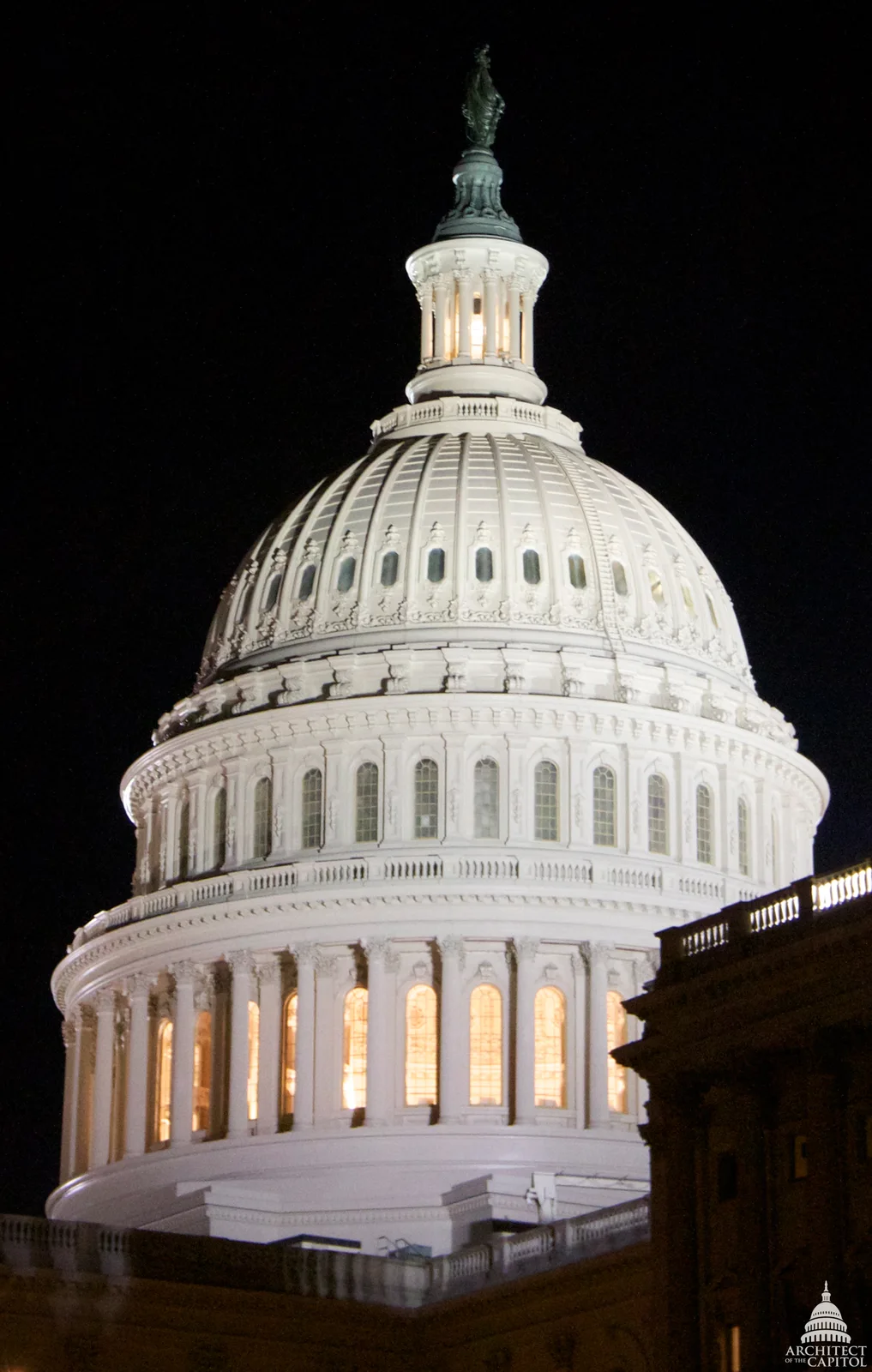
This page draws on Congressional Research Service reports on funding gaps and shutdowns, Congressional Budget Office analyses of the 2018-19 and 2025 shutdowns' economic effects, Government Accountability Office reports on continuing resolutions' effects on federal agencies and defense programs, and Pew Research Center's tracking of on-time appropriations since FY1977. The January 2026 shooting of Alex Pretti and its effect on 2026 Department of Homeland Security funding are described strictly as a documented event shaping the funding dispute, consistent with this site's nonpartisan standard, and were still under official review as of this page's publication. The hero photograph of the Capitol dome at night is a public domain U.S. government work by the Architect of the Capitol, via Wikimedia Commons.