

About New York
New York was named in honor of James, Duke of York, the brother of King Charles II of England, who was granted the territory after English forces seized it from the Dutch in 1664. The Dutch colony of New Netherland had been established in 1624, with New Amsterdam at the southern tip of Manhattan as its capital. When an English fleet arrived in 1664, Dutch Governor Peter Stuyvesant surrendered without a fight. The Duke of York renamed the colony and its capital after himself: New Netherland became New York and New Amsterdam became New York City. When James became King James II in 1685, New York became a royal colony. New York City would serve as the first capital of the United States under the Constitution, and George Washington took his first oath of office there in 1789.
New York is the state that argues most successfully for the proposition that America is the most extraordinary country in the history of civilization. The city that bears its name, 8.3 million people packed into 302.6 square miles, is the financial capital of the world, the cultural capital of the English-speaking world, home to the United Nations, the most visited tourist destination in the United States, and a living demonstration that people from every nation, speaking every language, can build something together that is greater than any of them could build separately.
But New York is far more than its city. The state stretches 330 miles from the Bronx to the Canadian border, encompassing the wild Adirondack wilderness, the agricultural valleys of the Mohawk and the Finger Lakes, the industrial cities of Buffalo and Rochester that powered America's manufacturing age and now navigate its transition, and the historic Hudson Valley corridor along which the nation's founding history is concentrated like nowhere else. These two New Yorks, the city and the state, are in constant tension: politically, economically, and culturally, they often seem to be different countries sharing a name.
The Erie Canal, the Triangle Shirtwaist Fire, Ellis Island, Saratoga, the New York City subway, Wall Street, Broadway, the Harlem Renaissance, hip-hop, abstract expressionism, punk rock, the AIDS crisis, 9/11, the history of New York is inseparable from the history of America. No other state has absorbed as many immigrants, produced as many presidents, invented as many cultural forms, or concentrated as much economic power. No other state has fallen as far and risen as dramatically. Its motto, "Excelsior," ever upward, has been tested as severely as any state motto ever has, and New York has earned it.

New York's Six Regions
New York City, population 8.3 million within its five boroughs, is the most consequential urban concentration in the world, the center of global finance, media, culture, fashion, and diplomatic activity. Its five boroughs, Manhattan, Brooklyn, Queens, the Bronx, and Staten Island, each constitute a distinct city in its own right, with populations that dwarf most American cities.
Manhattan, 13.4 miles long and 2.3 miles wide at its widest point, packs more economic activity per square mile than anywhere else on Earth: Wall Street and the financial district in the south; the government and civic institutions clustered around City Hall; the shops, theaters, and skyscrapers of Midtown; the cultural institutions, parks, and luxury residences of the Upper East and West Sides; and the neighborhoods of Harlem, Washington Heights, and Inwood in the north. Brooklyn, which would be the fourth-largest American city if it were independent, has been transformed over the past three decades from a post-industrial borough of working-class neighborhoods into a global destination for creative industries, craft food, arts, and tech startups; its waterfront, once lined with warehouses and shipping facilities, is now among the most valuable real estate in the world.
Queens is the most ethnically diverse urban county in the United States and often called the most linguistically diverse place on Earth; New York City as a whole is home to speakers of an estimated 700 to 800 languages. The Bronx is home to Yankee Stadium, the New York Botanical Garden, the Bronx Zoo, and Fordham University, as well as some of the city's most challenging poverty and most inspiring community resilience.
Staten Island is the city's most suburban borough, connected to the rest by the free Staten Island Ferry, whose 25-minute passage provides one of the great free views of the Manhattan skyline.
Long Island, extending 118 miles east-northeast from New York City into the Atlantic Ocean, is the most populous island in the contiguous United States, home to approximately 7.6 million people in Nassau and Suffolk counties. The western half of the island, particularly Nassau County and western Suffolk, constitutes part of the dense New York metropolitan suburban belt, a landscape of post-WWII housing developments (Levittown, built by William Levitt beginning in 1947, was the prototype for postwar American suburbia), shopping malls, and commuter rail corridors that send hundreds of thousands of workers daily into Manhattan on the Long Island Rail Road.
The eastern half of Suffolk County thins out considerably, its North Fork and South Fork separated by the Peconic Bay and distinguished in character: the North Fork, with its maritime-climate vineyards and farm stands, is a working agricultural and fishing community that has attracted wine tourism; the South Fork, the Hamptons, is the summer playground of New York's wealthy elite, its oceanfront estates occupied seasonally by financiers, celebrities, and media figures who turn Southampton, Bridgehampton, East Hampton, and Montauk into some of the most expensive real estate zip codes in the country.
Fire Island, a 26-mile barrier beach accessible only by ferry, is home to no cars, several distinctive communities (including the historically significant LGBTQ+ communities of The Pines and Cherry Grove), and a national seashore of dune ecology and ocean beach that provides a rare wilderness experience within reach of the city.
Long Island carries a heavy defense and aerospace legacy: Charles Lindbergh took off from Roosevelt Field in Garden City for Paris in 1927, and Grumman in Bethpage built the Navy fighters of World War II and then the Apollo Lunar Module, every one of which flew from Long Island; the industry's post-Cold-War collapse and the closure of Grumman and of several Air Force bases hit central Suffolk hard. Brookhaven National Laboratory, a Department of Energy physics lab on the pine barrens, has produced seven Nobel Prizes and left a groundwater-contamination Superfund cleanup.
The Island's western suburbs were also the crucible of American residential segregation: Levittown's original leases barred non-white buyers, federal and bank redlining steered Black families away, and Nassau and Suffolk remain among the most residentially segregated suburbs in the country, a pattern documented by a 2019 Newsday investigation that sent testers to Long Island real-estate agents. Hempstead and Wyandanch are among the built-out Black and Latino communities ringed by wealthier white towns.
The Hudson Valley, the corridor running north from New York City along the Hudson River for about 150 miles to the Albany area, is one of the most historically significant and scenically beautiful regions in the United States. The river itself, flanked by the dramatic Palisades cliffs on the west and the rolling hills of Westchester on the east, was the route by which the Dutch settled New York in the 17th century, the strategic waterway whose control nearly decided the Revolutionary War (Saratoga and West Point both lie on or near the Hudson), and the inspiration for the Hudson River School of painting, the first major American art movement, whose works by Thomas Cole, Frederic Church, and Albert Bierstadt defined a distinctly American aesthetic vision in the 19th century.
The valley is lined with historic estates: Franklin Roosevelt's Springwood in Hyde Park, the Vanderbilt Mansion, Martin Van Buren's Lindenwald, and Washington Irving's Sunnyside at Tarrytown, where Irving wrote The Legend of Sleepy Hollow. West Point, on a bend in the river where the Hudson cuts through the Highlands, has housed the United States Military Academy since 1802.
The Catskill Mountains to the west of the valley were the original American resort destination, their grand hotels (the Catskill Mountain House, the Grossinger's) hosting generations of vacationers. The Catskills' Jewish resort belt, the 'Borscht Belt,' was the incubator of American comedy for decades, launching the careers of Jerry Seinfeld, Mel Brooks, Rodney Dangerfield, and dozens of other comedians.
The valley's northern reaches drove two American environmental milestones. The 1963 to 1980 fight against Con Edison's proposed Storm King Mountain pumped-storage plant established, in Scenic Hudson v. FPC (1965), that citizens' groups have legal standing to sue over aesthetic and ecological harm, a founding case of U.S. environmental law; and General Electric's decades of dumping PCBs into the upper Hudson from its Fort Edward and Hudson Falls plants produced one of the largest Superfund dredging projects in the country, running from 2009 into the 2020s.
New York City reaches deep into the region for its water: the Catskill and Delaware watershed reservoirs, built between 1907 and the 1960s by flooding about two dozen mountain towns and displacing thousands of residents, supply roughly 90 percent of the city's drinking water by gravity, unfiltered, under a landmark 1997 agreement in which the city pays to protect upstate land rather than build a multibillion-dollar filtration plant.
The Hudson itself is a tidal estuary, the Lenape called it 'the river that flows both ways,' navigable and salty as far north as Poughkeepsie, and the Palisades cliffs on its west bank were saved from quarrying by a 1900 interstate park commission, one of the first bi-state conservation efforts in the country.
The Adirondack Park, created by the state legislature in 1892 and protected since 1894 by the state constitution's 'forever wild' clause prohibiting logging of state lands, is the largest publicly protected area in the contiguous United States: six million acres, larger than Yellowstone, Yosemite, Grand Canyon, Olympic, and Glacier National Parks combined. Its landscape of 2,000 lakes and ponds, 30,000 miles of rivers and streams, and 46 peaks over 4,000 feet (the 'High Peaks' that draw 'Adirondack 46er' climbers attempting all of them) is the great wilderness of the American Northeast, an ecological island of forest and water surrounded by the most densely populated region of the country.
The Adirondacks are not a wilderness park in the Western sense, however: approximately 130,000 people live year-round within the park boundary, and their communities, from the Olympic village of Lake Placid (which hosted the Winter Games in 1932 and 1980, the latter producing the 'Miracle on Ice' when the US hockey team defeated the Soviet Union) to the resort town of Saranac Lake, are embedded in a unique mix of forest preserve and inhabited landscape.
The North Country, extending west from the Adirondacks to the St. Lawrence River and Lake Ontario border with Canada, is a sparsely populated region of dairy farms, Great Lakes shore communities, and the 1000 Islands archipelago where the St. Lawrence River exits Lake Ontario, a recreational paradise of 1,864 islands (most privately owned) scattered across 50 miles of river.
The 'forever wild' clause is one of the most protective conservation provisions in any state constitution: since 1894 the state forest preserve within the park cannot be sold, leased, or logged, and even minor exceptions, a ski trail, a power line, a highway curve, require a statewide constitutional amendment passed by two consecutive legislatures and the voters. The park's other 3.4 million acres are private land, so the state's Adirondack Park Agency, created in 1971, regulates development on private property across an area the size of Vermont, a source of enduring resentment in the small towns it governs.
The park is a patchwork rather than a pristine wilderness: it holds working timberland, former Gilded Age 'Great Camps' built by the Vanderbilts and Rockefellers, mining and railroad scars, and towns losing population and school enrollment. Acid rain from Midwestern coal plants severely damaged its high-elevation lakes and spruce-fir forests from the 1970s on, and recovery has been slow even after federal emissions cuts.
The St. Lawrence Seaway, opened in 1959 by the U.S. and Canada, drowned rapids and several villages to let ocean freighters reach the Great Lakes, and the Moses-Saunders and Niagara power projects built alongside it made the North Country a major hydroelectric producer. Fort Drum, near Watertown, is one of the Army's largest posts and the region's economic anchor, home of the 10th Mountain Division.
Albany, New York's capital since 1797, sits at the confluence of the Hudson River and the Erie Canal's eastern terminus, a position that made it the commercial hub of 19th-century New York and gave it the political significance it retains today. Albany is one of the oldest continuously inhabited European settlements in the United States, established by Dutch traders in 1614 as Fort Nassau, and its State Capitol, an elaborate French and Romanesque Revival structure completed in 1899 after 32 years of construction at a cost of $25 million (the most expensive government building in the world at the time), is one of the architectural masterpieces of American government.
The Capital District encompasses Schenectady (once home to the General Electric research laboratories where many important 20th-century technological innovations were made), Troy (birthplace of the detachable collar that outfitted 19th-century America), and Saratoga Springs (site of the pivotal Battle of Saratoga in 1777, the turning point of the Revolutionary War, and still home to a famous horse racing track and spa tradition). The Mohawk Valley to the west, following the Mohawk River through Rome and Utica, was the corridor through which the Erie Canal was built and through which millions of westward migrants and immigrants traveled in the 19th century.
The region hosts significant history: the site of the Battle of Oriskany (1777), one of the bloodiest engagements of the Revolution, and the Erie Canal Museum in Syracuse, which preserves the engineering marvel that transformed American commerce.
Albany was long run by one of the most durable political machines in America, the O'Connell-Corning Democratic organization that controlled the city for roughly 80 years; Erastus Corning 2nd served as mayor from 1942 until his death in 1983, the longest mayoral tenure of any major U.S. city. The state government it grew alongside is New York's own giant industry: tens of thousands of state workers, and a lobbying and advocacy economy around the Capitol, make government the Capital District's largest employer.
The area has bet heavily on high-tech reinvention. GlobalFoundries built a multibillion-dollar semiconductor 'fab' in Malta, Saratoga County, in 2009 on a state-assembled 'Luther Forest' technology park, the University at Albany opened a nanotechnology college that later spun into SUNY Polytechnic, and a 2022 federal and state package aims to expand the cluster; the effort has also produced scandal, with the 2018 federal 'Buffalo Billion' bid-rigging convictions of Governor Cuomo's economic-development aides.
Troy preserves one of the best-kept collections of 19th-century iron-front commercial architecture in the country because it was too poor to redevelop it, and it is home to Rensselaer Polytechnic Institute, founded in 1824, the oldest technological university in the English-speaking world. Cohoes, Watervliet, and the old collar-and-shirt mill towns along the Mohawk still show the bones of the region's industrial past.
Western New York, anchored by Buffalo and Rochester and centered on the eleven glacier-carved Finger Lakes, is a region of great natural beauty, industrial history, and ongoing economic transition. Buffalo, situated on Lake Erie at the head of the Niagara River, was one of the great American industrial cities of the late 19th and early 20th centuries: its grain elevators (still the largest collection in the world, now being converted to arts and residential spaces) processed the agricultural output of the Midwest, its steel mills and auto parts factories employed tens of thousands, and its architecture, including buildings by H.H.
Richardson, Louis Sullivan, and Frank Lloyd Wright, reflected its Gilded Age prosperity. The collapse of manufacturing devastated Buffalo from the 1960s onward, but the city has experienced a genuine if uneven revival in recent years, with medical research (Roswell Park Comprehensive Cancer Center), university growth (University at Buffalo), and a creative economy energizing its neighborhoods.
Niagara Falls, 20 miles north, draws 12 million visitors annually to both the American side (New York State Park) and the Canadian side; the Niagara River, the short connecting channel between Lake Erie and Lake Ontario, drops 167 feet over the falls in one of the most powerful natural spectacles in North America. Rochester, 75 miles east of Buffalo on Lake Ontario, was home to Eastman Kodak Company (which defined American photography for most of the 20th century) and Xerox Corporation (which invented the photocopier and laid the foundation for personal computing at its Palo Alto Research Center).
The Finger Lakes, eleven long narrow lakes running north-south through central New York like the fingers of a hand, are surrounded by vineyards, state parks, waterfalls, and gorges that make the region one of the most spectacular in the state.

Economy
New York's $2+ trillion economy is the largest of any state and would rank as the world's eighth or ninth largest economy if it were an independent nation. It is built on an unrivaled concentration of finance, media, healthcare, education, and the creative industries that have made the state's largest city the indispensable node of the global economy.
The New York Stock Exchange, founded under a buttonwood tree at 68 Wall Street in 1792, is the largest stock exchange on Earth by market capitalization, with listings whose combined value exceeds $25 trillion. The NASDAQ, headquartered in Times Square, is the world's second largest.
The Federal Reserve Bank of New York, the most operationally important of the twelve Federal Reserve banks, holds more monetary gold than any other vault in the world and conducts open market operations that set the effective federal funds rate. The concentration of financial power in lower Manhattan is staggering: JPMorgan Chase, Citigroup, Goldman Sachs, Morgan Stanley, and dozens of other major financial institutions are headquartered or have their principal operations there.
The hedge fund and private equity industries, while increasingly dispersed to Greenwich, Connecticut and other suburbs, are centered on New York in ways that make the city the ultimate arbiter of global capital allocation. New York's financial sector employs approximately 450,000 people directly in the city and generates an outsize share of both city and state tax revenue: a good year on Wall Street can single-handedly close a state budget gap.
The 2008 financial crisis, which began on Wall Street and spread to devastate the global economy, was the most vivid illustration of this concentration's downside. New York's regulatory environment, shaped by the New York Department of Financial Services (DFS) and the powerful New York Attorney General's office, has historically been one of the most important sources of financial regulation in the United States, often acting where federal regulators did not.
Broadway, the legitimate theater district centered on the blocks around Times Square, is the most important theatrical venue in the world, with 41 active theater houses generating over $1.8 billion in annual ticket revenue at its pre-pandemic peak, drawing millions of tourists, and setting the standard for theatrical performance globally. The publishing industry, long dominated by the 'Big Five' trade publishers (Penguin Random House, HarperCollins, Simon & Schuster, Hachette, and Macmillan), all headquartered in New York, makes the city the undisputed center of English-language book publishing and the arbiter of literary culture.
The advertising industry, centered on Madison Avenue (a name synonymous with advertising itself), the fashion industry (New York Fashion Week is one of the four global fashion capitals), and the magazine industry all find their apex in New York. The music industry, while more geographically dispersed than in the era of the major labels, remains centrally connected to New York: hip-hop was born in the Bronx in the 1970s, punk emerged from Manhattan's Lower East Side and CBGB, and New York's classical music institutions, the Metropolitan Opera, the New York Philharmonic, Carnegie Hall, Lincoln Center for the Performing Arts, form the most significant concentration of serious music in the Western Hemisphere.
The television industry, concentrated at 30 Rockefeller Center (NBCUniversal), One World Trade (CBS), and dozens of production facilities across the boroughs, contributes billions in economic activity.
Film and TV production has become a genuine industrial sector rather than just a glamour trade: New York State's film tax credit, expanded to roughly 700 million dollars a year, underwrites shooting at large studio complexes in Brooklyn (Steiner) and Queens (Kaufman Astoria, Silvercup), and the industry employs tens of thousands of unionized craft workers. The 2007 to 2008 and 2023 Hollywood writers' strikes, run largely from the Writers Guild's New York and Los Angeles chapters, shut much of that work down and showed how concentrated the creative economy's labor risk is.
NewYork-Presbyterian Hospital, affiliated with both Cornell and Columbia medical schools, is one of the nation's top-ranked hospitals and a global referral center for complex cases. NYU Langone Health, Mount Sinai Health System, Northwell Health (the state's largest employer with 80,000+ workers), and Montefiore Medical Center round out a healthcare ecosystem of extraordinary depth.
Weill Cornell Medicine and Columbia University Irving Medical Center together form one of the most prolific biomedical research enterprises in the world. Memorial Sloan Kettering Cancer Center is universally recognized as one of the world's premier cancer treatment and research institutions, drawing patients from every continent.
The Rockefeller University, founded in 1901 as the first biomedical research institution in the United States, has produced more Nobel Prize laureates in the sciences than any other institution in the country and remains one of the most productive basic research centers in the world. Cold Spring Harbor Laboratory on Long Island, founded in 1890, has been a center of genetics research since the early 20th century and is where James Watson and Francis Crick's double helix model of DNA was first widely circulated to the American scientific community.
New York State's healthcare sector employs over one million people, making it the single largest employment sector in the state economy, and healthcare costs are among the largest items in the state budget.
Columbia University in Morningside Heights, founded as King's College in 1754, is one of the oldest and most distinguished universities in America and a member of the Ivy League; its journalism school, founded by Joseph Pulitzer's bequest, is the home of the Pulitzer Prizes. New York University, the largest private university in the United States by enrollment, with campuses in Greenwich Village and scattered across Lower Manhattan, is a global institution drawing students from over 130 countries.
Cornell University in Ithaca is both an Ivy League institution and the state's land-grant university, with a remarkable range from engineering and agriculture to hotel management and veterinary medicine. The State University of New York (SUNY) system, with 64 campuses and approximately 400,000 students, is the largest comprehensive public university system in the United States.
The City University of New York (CUNY), with 25 campuses primarily serving New York City, enrolls approximately 275,000 students and has been one of the great engines of social mobility in American history, educating generations of immigrants and working-class New Yorkers who went on to distinguished careers. CUNY alumni include over a dozen Nobel Prize winners.
Research universities in New York collectively receive more federal research funding than any other state.
New York opened American higher education in specific ways. CUNY's City College charged no tuition from 1847 until the 1976 fiscal crisis and educated so many future laureates in the 1930s and 1940s that it was called 'the proletarian Harvard'; Cornell was founded in 1865 by Ezra Cornell and Andrew Dickson White as a deliberately non-sectarian, coeducational university where 'any person can find instruction in any study.' Vassar (1861) was among the first degree-granting colleges for women, and West Point pioneered engineering education in the country.
The system is also chronically underfunded relative to its ambitions: SUNY and CUNY tuition were frozen for years and then allowed to rise, the 2017 Excelsior Scholarship made SUNY and CUNY nominally free for middle-income families but with residency strings, and the state's private universities depend heavily on the TAP grant program. Columbia and NYU, meanwhile, are among the largest landowners in Manhattan and recurring antagonists in neighborhood expansion fights.
The city's attractions, the Statue of Liberty and Ellis Island, Central Park, the Metropolitan Museum of Art (with a collection of over two million objects), the American Museum of Natural History, the 9/11 Memorial and Museum, Times Square, the High Line, Brooklyn Bridge, Rockefeller Center, and the Empire State Building, constitute the most concentrated array of major attractions of any urban destination on Earth. International visitor spending in New York City alone exceeds $20 billion annually, making tourism one of the city's largest economic sectors.
Upstate New York contributes enormously to the state's tourism economy: Niagara Falls on the Canadian border is one of the most recognizable natural wonders in the world and draws 12 million visitors annually to the American and New York State Park sides combined. The Adirondack Park, at six million acres the largest publicly protected area in the contiguous United States, offers wilderness recreation, ski resorts including Lake Placid (twice an Olympic venue), and fall foliage that rivals New England.
The Finger Lakes wine region, encompassing eleven lakes in central New York, has developed into one of the premier American wine destinations, with over 130 wineries producing particularly distinguished Riesling, Gewurztraminer, and Cabernet Franc. The Catskill Mountains, a short drive from NYC, have been a summer resort area since the 19th century and have experienced a renaissance as a second-home and creative-class destination.
Tourism is deeply politicized in New York. The state runs the long-running 'I Love NY' campaign, created in 1977 during the fiscal crisis with a logo by designer Milton Glaser, and city and state officials fight over hotel-occupancy and 'Airbnb' rules: New York City effectively banned most short-term rentals in 2023 to protect housing supply and hotel jobs. The Broadway and museum economy also proved fragile, shutting entirely for more than a year during the COVID-19 pandemic and taking several seasons to recover attendance.
New York is consistently among the top states in dairy production, with the Mohawk Valley, the St. Lawrence plain, and the Southern Tier maintaining substantial dairy farming operations. New York's dairy industry produces the milk that goes into Kraft, Chobani (founded in South Edmeston, NY in 2005 and now the largest Greek yogurt brand in the United States), and dozens of artisan cheese producers who have made the Hudson Valley and Finger Lakes competitive with Vermont for farmstead cheese quality.
Apples are so central to New York agriculture that the apple is the state fruit; the Hudson Valley's apple orchards have been producing since the 17th century, and New York remains one of the top apple-producing states. The Finger Lakes wine region, discussed above, has grown into an agricultural and economic force of its own.
Long Island's North Fork has a wine industry that produces world-class Merlot and Cabernet Franc in a maritime climate reminiscent of Bordeaux. The Hudson Valley has become a center of the farm-to-table movement, with small farms supplying directly to New York City's restaurants in a relationship that has transformed how top American restaurants source their ingredients.
New York maple syrup production, concentrated in the Adirondack foothills and the Catskills, makes the state one of the top maple producers in the country.

How New York's Government Works
New York's state government has historically been characterized by extraordinary concentration of power in the executive and in legislative leadership, and by persistent and high-profile corruption that has landed governors, legislative leaders, and local officials in federal prison with dismaying regularity. The state's political culture has been shaped by strong party organizations, the outsized influence of New York City's Democratic machine, and the structural tension between the city's interests and those of the rest of the state.
The legislature was historically dominated by the 'three men in a room' dynamic: the Governor, the Senate Majority Leader, and the Assembly Speaker made all major decisions in private, then presented them to their chambers for largely pro forma votes. This system, while informal, concentrated extraordinary power and produced the conditions for the corruption scandals that sent Assembly Speaker Sheldon Silver and Senate Majority Leader Dean Skelos both to federal prison in 2015. Reforms have somewhat opened the process, but Albany's culture of centralized power remains distinctive.
New York is a deeply Democratic state in statewide elections, having voted for the Democratic presidential candidate in every election since 1988. Both U.S. Senate seats have been held by Democrats continuously since 1999. The state legislature has been controlled by Democrats in both chambers in recent years. Republican governors have occasionally won, however, particularly when corruption or fiscal mismanagement weakened the Democratic brand.
The tension between New York City and Albany runs through nearly every debate in state government. New York City generates approximately 40 percent of the state's GDP and roughly half its tax revenue, and the perpetual friction between city officials, who feel the city subsidizes the rest of the state, and upstate representatives, who feel the city dominates state politics, is one of the defining dynamics of New York governance. Issues from transit funding to criminal justice policy routinely fracture along city-versus-upstate lines.
Governor of New York
Current Governor
Kathy Hochul

- Party
- Democratic
- In Office Since
- August 24, 2021
- Term Ends
- January 2027
- Born
- August 27, 1958, Buffalo, New York
- Education
- Syracuse University (BA, 1980); Catholic University of America, Columbus School of Law (JD, 1983)
- Prior Role
- Lieutenant Governor (2015-2021); U.S. Representative NY-26 (2011-2013); Erie County Clerk (2007-2011)
Kathy Hochul is New York's 57th Governor and the first woman to hold the office. A Buffalo native and moderate Democrat, she became governor when Andrew Cuomo resigned in August 2021 amid sexual harassment allegations and a nursing home COVID-19 scandal. She won a full term in November 2022. Her administration has focused on housing construction to address the state's severe affordability crisis, transit investment (particularly the MTA), and economic development across upstate New York. She navigated a difficult post-pandemic recovery and managed the state's congestion pricing program, which faced political opposition and legal challenges.
Other Current State Officials
Lieutenant Governor
Antonio Delgado
In office since May 2022 (appointed) and elected in November 2022. A former three-term U.S. Representative from NY-19 (a competitive Hudson Valley and Catskills district), Delgado is a Harvard Law graduate and former Rhodes Scholar who released a hip-hop album before entering politics. As Lt. Governor he has focused on rural economic development and broadband access.
Attorney General
Letitia James
In office since January 2019; re-elected in 2022. The first Black woman elected as New York Attorney General and the first woman of color elected to statewide office in New York. James brought the civil fraud case against the Trump Organization that resulted in a $454 million judgment in 2024. She has pursued major cases against pharmaceutical companies, social media platforms, and financial institutions.
State Comptroller
Thomas P. DiNapoli
In office since 2007, DiNapoli is one of the longest-serving state comptrollers in New York history. He oversees the New York State and Local Retirement System, one of the largest public pension funds in the world with over $250 billion in assets, audits state agencies, and serves as the state's independent fiscal watchdog. His longevity in the role reflects strong nonpartisan credibility.
The New York State Legislature
New York State Senate
- Seats: 63 members
- Terms: 2-year terms
The upper chamber. All 63 seats are on the ballot every two years. Democrats hold a large majority, 41 of 63 seats in the 2025-2026 session, one short of two-thirds. The Senate Majority Leader is one of the most powerful figures in state government, historically one of the 'three men in a room' who effectively ran the state.
New York State Assembly
- Seats: 150 members
- Terms: 2-year terms
The lower chamber. All 150 seats are up for election every two years. Democrats hold an overwhelming majority. The Assembly Speaker, the third figure in the historic 'three men in a room' dynamic, has historically been among the most powerful state legislative leaders in the country.
New York's U.S. Senators
U.S. Senator
Chuck Schumer
New York's senior senator and the Senate Democratic Leader (Majority Leader 2021-2025, Minority Leader thereafter). First elected in 1998 by defeating three-term incumbent Alfonse D'Amato. Brooklyn-born and Harvard-educated, Schumer is one of the most powerful and media-savvy legislators in Senate history, known for his weekly Sunday press conferences outside the Capitol. He was the lead Democratic negotiator on the Inflation Reduction Act (2022) and the Bipartisan Infrastructure Law (2021).
U.S. Senator
Kirsten Gillibrand
New York's junior senator, appointed in January 2009 by Governor Paterson to fill Hillary Clinton's seat when Clinton became Secretary of State. Re-elected in 2010, 2012, 2018, and 2024. A former House member who represented a conservative upstate district, Gillibrand shifted significantly leftward after moving to the Senate. She has been a leading advocate for survivors of military sexual assault and led the successful push to establish the National Suicide Prevention Lifeline and pass the 9/11 Victims Compensation Fund extension.
New York Through the Years
From the Haudenosaunee Confederacy whose democratic principles may have inspired the founders, to the Erie Canal that made America a continental power, to Ellis Island that reshaped the nation's population, to September 11 and its aftermath, New York has been at the center of the American story in every generation.
The Indigenous peoples of what is now New York were among the most politically sophisticated in the Americas. The Haudenosaunee, known to Europeans as the Iroquois Confederacy, was a political union of originally five nations (Mohawk, Onondaga, Cayuga, Oneida, and Seneca, joined by the Tuscarora as a sixth nation in the early 18th century) that had governed themselves under a constitution, the Great Law of Peace (Gayanashagowa), since at least the 12th century and possibly earlier.
The Haudenosaunee Confederacy operated under principles of representative governance, with a Grand Council in which each nation had a voice and decisions required consensus, checks and balances between clan mothers (who held the power to appoint and remove leaders), and protections for individual rights that many historians believe influenced the thinking of Benjamin Franklin, James Madison, and other framers of the U.S. Constitution. The Onondaga nation, at the geographic center of the confederacy's territory, served as the Confederacy's capital.
The Mohawk, the 'keepers of the eastern door,' were the first to encounter European traders and settlers and became crucial intermediaries in the fur trade. The Haudenosaunee were a military and diplomatic power that European colonists could not ignore: they allied with the British against the French in a series of conflicts that shaped the fate of North America, and their political system was sophisticated enough to negotiate with multiple European empires simultaneously.
The American Revolution split the Confederacy along national lines, effectively ending it as a functioning political entity; the Haudenosaunee nations continue to exist as sovereign peoples, with reservations in New York and Canada, and their assertion of treaty rights and sovereignty remains an active legal and political issue.
Henry Hudson, sailing for the Dutch East India Company, explored the river that bears his name in September 1609, reporting rich beaver habitat to his sponsors. The Dutch moved quickly to capitalize: a trading post was established at Fort Nassau (modern Albany) by 1614, and the Dutch West India Company established the colony of New Netherland in 1621.
The island of Mannahatta (Manhattan), purchased from the Lenape in a transaction worth approximately 60 guilders in trade goods in 1626 by Peter Minuit, became the colony's center as New Amsterdam, a small, polyglot trading port at the island's southern tip. New Amsterdam was extraordinarily diverse from its founding: within a few decades it had residents speaking 18 different languages, including Dutch, English, French, German, Swedish, Portuguese, and various African languages (enslaved Africans constituted a significant portion of the colony's population from its earliest years).
The Dutch colony was more commercially driven than the English colonies to the north and south, with less emphasis on religious conformity and more tolerance of ethnic and religious diversity. Peter Stuyvesant, the one-legged Dutch governor who served from 1647 to 1664, was an effective administrator and vigorous builder but also an autocrat who fought constantly with his colonists over representation in government.
In 1664, an English fleet of four warships appeared in the harbor; Stuyvesant wished to fight but his colonists refused to support him, and New Amsterdam surrendered without a shot. The colony was renamed New York in honor of James, Duke of York, the future King James II.
The American Revolution was fought most intensely in New York, which was both the most strategically important state and the one where British forces made their deepest penetration. After early American defeats in the Battle of Long Island (August 1776, the largest battle of the entire war) and the subsequent fall of Manhattan, Washington's Continental Army retreated northward and then across New Jersey in a withdrawal that seemed to presage total defeat.
New York City remained in British hands for the entire war, from September 1776 until November 1783, serving as the British military and political headquarters for North America, drawing Loyalist refugees and becoming a center of British power in the occupied country. The turning point of the entire war came in upstate New York in the fall of 1777.
A British strategy to split the colonies by driving south from Canada through the Lake Champlain corridor failed at the twin Battles of Saratoga (September-October 1777), where an American army under Horatio Gates forced the surrender of British General John Burgoyne's entire force of 6,000 men. Saratoga was the most significant American victory of the war: it convinced France to enter the conflict as an American ally, transforming it from a colonial rebellion into a global war and ultimately ensuring American independence.
West Point, which Washington called 'the key to America' for its commanding position on the Hudson River, was held throughout the war and was the subject of Benedict Arnold's treasonous attempt to surrender it to the British in 1780. The Haudenosaunee Confederacy was torn apart by the war: most nations allied with Britain, while the Oneida and Tuscarora sided with the Americans, leading to a tragic civil war within the Confederacy.
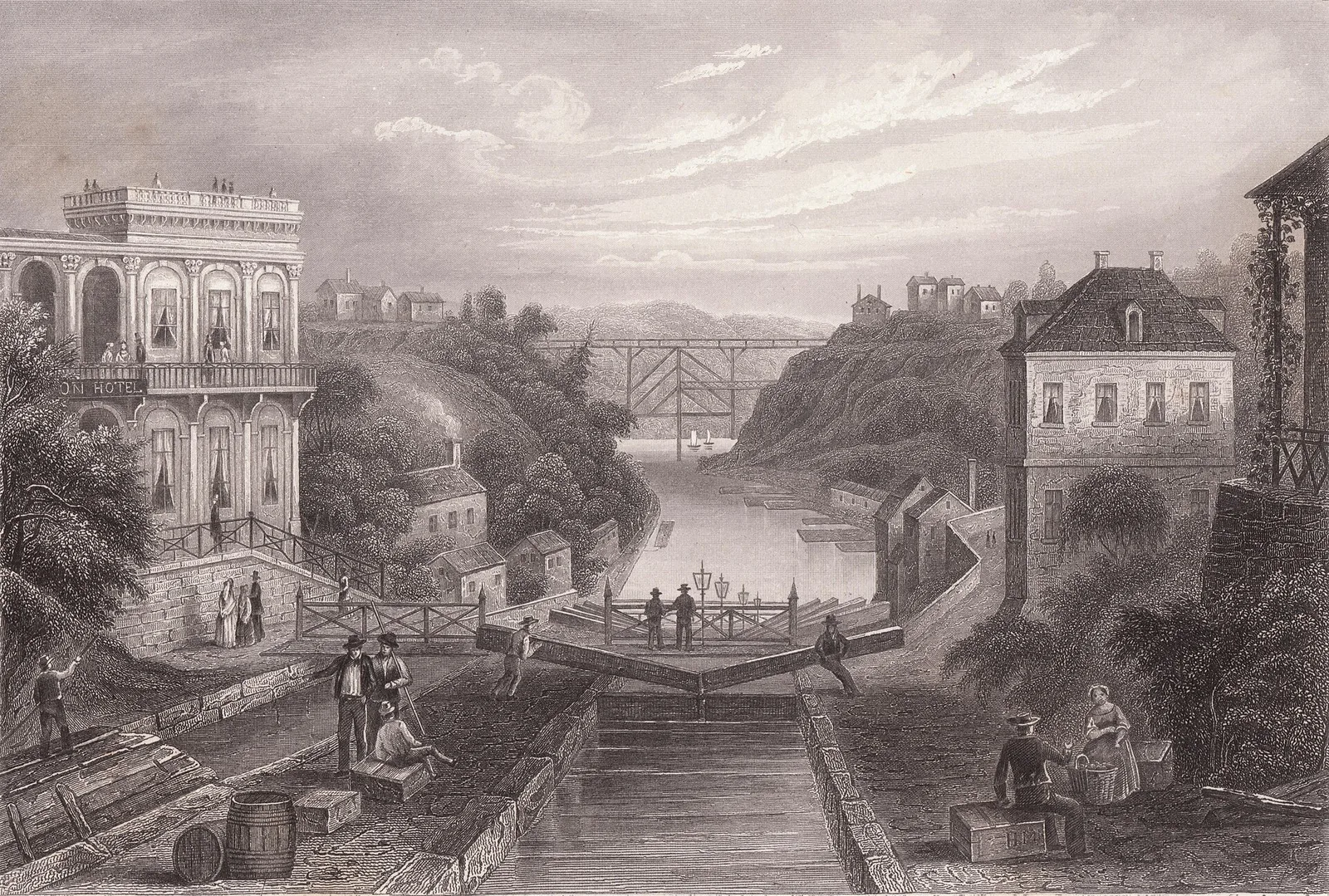
The completion of the Erie Canal on October 26, 1825, was one of the most consequential infrastructure achievements in American history, the project that made New York the Empire State and transformed the economic geography of the continent. Governor DeWitt Clinton had championed the canal against widespread skepticism, its 363-mile length from Albany on the Hudson to Buffalo on Lake Erie earning it the nickname 'Clinton's Ditch.' It was, at the time of its construction, the longest artificial waterway in the Western world, climbing 568 feet from the Hudson River to Lake Erie through a series of 83 locks.
The canal cut the cost of shipping goods between Buffalo and New York City by approximately 95%, from $100 per ton to about $5, and reduced the travel time from 20 days to 8. The effect on American settlement and commerce was immediate and dramatic: within a year of opening, New York City surpassed Philadelphia as the largest city in the United States and never looked back.
The canal made Chicago possible, enabling the development of the Midwest's agricultural economy by providing an economical route to Eastern markets, and it directed the primary axis of American westward expansion through New York rather than through the Southern routes that had previously dominated. New York City became the dominant American port not because of geography but because of this engineering decision, one of the earliest and most successful demonstrations of state-directed economic development in American history.
The canal's success sparked a national canal-building frenzy and set the template for the federal infrastructure investments that followed.
Between 1840 and 1924, approximately 12 million immigrants entered the United States through New York Harbor, the majority after 1892 passing through the federal immigration station at Ellis Island in Upper New York Bay. The waves came in succession: the Irish, driven by the catastrophic famine of 1845-1852 that killed a million people and forced another million to emigrate; the Germans, fleeing the political aftermath of the failed 1848 revolutions; then, from the 1880s onward, the 'New Immigration' from Southern and Eastern Europe, Italians from the Mezzogiorno, Jews from the Pale of Settlement of the Russian Empire escaping pogroms and poverty, Poles, Czechs, Hungarians, Greeks, and dozens of other nationalities.
They came to New York and many stayed, transforming the Lower East Side of Manhattan into the most densely populated neighborhood in the world at the turn of the 20th century, building communities and institutions, enduring exploitation in the garment factories and construction sites, and gradually, over generations, moving up the economic and social ladder. Jacob Riis documented their living conditions in his 1890 photographic exposé How the Other Half Lives, shocking middle-class New Yorkers into awareness of the tenement conditions that constituted daily reality for hundreds of thousands.
Tammany Hall, the Democratic Party machine that controlled New York City politics from the 1830s through the early 20th century, was simultaneously an instrument of exploitation and a genuine social service provider for new immigrants, supplying jobs, housing assistance, and legal help in exchange for loyal votes. The Immigration Act of 1924 sharply curtailed the flow, effectively ending the era.
At 4:40 PM on March 25, 1911, a fire broke out on the eighth floor of the Triangle Waist Company building in Greenwich Village, Manhattan. The factory employed primarily young immigrant women, most of them Jewish and Italian, who worked 12-hour days producing shirtwaists. In 18 minutes, 146 workers died, most of them women between the ages of 16 and 23.
Many jumped from the ninth-floor windows rather than burn; others were trapped because the factory owners had locked the stairwell doors to prevent unauthorized breaks and theft. The fire was witnessed by thousands of New Yorkers on the street below.
The Triangle fire became the catalyst for one of the most significant expansions of worker protection law in American history. Frances Perkins, then a young social worker who witnessed the fire from the street, would later serve as Franklin Roosevelt's Secretary of Labor and help design the New Deal's labor protections; she called the New Deal 'the Triangle fire's legacy.' The International Ladies' Garment Workers' Union, already growing before the fire, expanded rapidly afterward.
New York's Factory Investigating Commission, led by state legislators Robert F. Wagner (later the author of the National Labor Relations Act) and Al Smith (later governor), conducted investigations that produced 60 new state laws covering fire safety, factory inspection, worker compensation, working hours, and child labor. New York's legislative response to the Triangle fire became the model for federal labor legislation a generation later.
The mid-20th century saw New York reach its cultural apotheosis and then experience one of the most severe urban crises of any American city. In the postwar decades, New York's creative economy was at full intensity: abstract expressionist painters (Jackson Pollock, Mark Rothko, Willem de Kooning) in Greenwich Village lofts reinvented painting; the New York School poets redefined American poetry; Broadway produced Rodgers and Hammerstein, Stephen Sondheim, Leonard Bernstein; jazz flourished in Harlem and in the clubs of 52nd Street; publishing, advertising, and television concentrated unprecedented creative talent in a single metropolitan area.
Robert Moses, New York's unelected 'Master Builder,' wielded more power over the physical shape of the city and its suburbs than any figure in American urban history, building highways, bridges, parks, and housing projects that reshaped the metropolitan landscape, often at the cost of destroying working-class neighborhoods and entrenching racial segregation. By the late 1960s, the city was in crisis: manufacturing had departed for the South and overseas, the middle class had fled to the suburbs, the tax base had eroded, and social dysfunction had followed poverty into neighborhoods from the South Bronx to Bed-Stuy.
The city's near-bankruptcy in 1975 forced a dramatic financial restructuring; the Daily News headline 'Ford to City: Drop Dead' captured the moment. The Son of Sam murders (1977), the 1977 blackout and looting, and the crack cocaine epidemic of the 1980s deepened the sense of catastrophe.
Then, through a combination of demographic renewal (new immigrant communities, particularly from Asia, Latin America, and the Caribbean), economic revival driven by the finance and real estate sectors, and more effective policing strategies, New York's turnaround in the 1990s became one of the most studied urban reversals in history.
At 8:46 AM on September 11, 2001, American Airlines Flight 11, hijacked by al-Qaeda terrorists, struck the North Tower of the World Trade Center in lower Manhattan. Seventeen minutes later, United Airlines Flight 175 struck the South Tower. At 9:59 AM, the South Tower collapsed.
At 10:28 AM, the North Tower fell. 2,977 people died in the attacks in New York, at the Pentagon, and on Flight 93 in Pennsylvania, the deadliest terrorist attack in American history and the most deadly foreign attack on American soil since Pearl Harbor. The World Trade Center's twin towers, completed in 1972 and 1973 and rising 1,368 and 1,362 feet above lower Manhattan, had been the tallest buildings in the world when completed and remained iconic elements of the New York skyline.
Their destruction was an assault on symbols as much as on structures: the towers represented American financial power and global commerce, and their collapse was watched live by hundreds of millions of people around the world. The immediate human response of New York City, the professionalism and courage of the firefighters and police officers (343 FDNY firefighters died, the largest loss of life in the history of any fire department anywhere in the world), the outpouring of volunteer and donor support, and the resilience of the city's residents became one of the defining national narratives of the early 21st century.
One World Trade Center, the 1,776-foot skyscraper built on the site, opened in 2014. The 9/11 Memorial & Museum, occupying the footprints of the original towers, is one of the most visited sites in New York City.
New York's Defining Moments in American History
These are the events that didn't just shape New York, they changed the nation.
New York City served as the first capital of the United States under the new Constitution. It was here that George Washington took his first oath of office as president on April 30, 1789, at Federal Hall on Wall Street.
The first Congress and the first Supreme Court convened in New York. The city's time as capital was brief (the capital moved to Philadelphia in 1790 and then to Washington), but the concentration of financial, commercial, and governmental power that was established in those early years permanently shaped New York's character as the nation's economic and cultural capital.
New York had actually been a national capital before, twice: the Confederation Congress met in New York City from 1785 to 1788, and it was in that period, at Fraunces Tavern in 1783, that Washington had bid farewell to his officers. When the new government convened in 1789 it used the old City Hall on Wall Street, remodeled by Pierre L'Enfant into 'Federal Hall,' and Washington took the oath on its balcony before a crowd in the street below.
The First Federal Congress that sat in New York did the founding work of the executive branch: it created the departments of State, Treasury, and War, established the federal judiciary through the Judiciary Act of 1789, and drafted the twelve constitutional amendments, ten of which became the Bill of Rights, that James Madison introduced there in June 1789.
The capital moved south under the 1790 Compromise, in which Hamilton secured federal assumption of the states' Revolutionary war debts, a policy that fixed the nation's credit market in New York, in exchange for Jefferson and Madison's agreement to place the permanent capital on the Potomac. New York kept the money; Washington got the government.
When the Erie Canal opened in 1825, it connected the Hudson River at Albany to Lake Erie at Buffalo, creating a navigable water route from the Atlantic Ocean to the interior of the continent. Freight costs from Lake Erie to New York City dropped by 95%.
New York City, already large, became the dominant commercial city in America, a status it has never relinquished. The canal also opened the Midwest to settlement and made the agricultural products of Ohio, Indiana, and Illinois accessible to Eastern markets.
De Witt Clinton's 'Big Ditch' transformed the economic geography of an entire continent.
The engineering was improvised by self-taught surveyors, James Geddes and Benjamin Wright, who had never built a canal, and the project trained a generation of American civil engineers; a specially bred mule-drawn crane and a stump-puller were invented on the job. Building it also killed an unknown number of laborers, many of them Irish immigrants, in the malarial Montezuma Marsh section west of Syracuse.
The canal transformed the towns strung along it, Rochester grew from a village to America's first inland 'boom town' as a flour-milling center, and Syracuse, Utica, Rome, and Buffalo all owe their scale to canal commerce. The 'Burned-Over District' of intense religious revival that produced Mormonism, the Millerites, and the Fox sisters' spiritualism spread along the same corridor, as did the abolition and women's-rights movements, Seneca Falls sits on a canal feeder.
The state repaid the canal's roughly 7 million dollar cost from tolls within about a decade, and it was enlarged repeatedly and finally rebuilt as the Barge Canal in 1918. Freight moved to rail and then to trucks, but the modern Erie Canalway, now mostly a recreational corridor, is a National Heritage Corridor and the spine of a cross-state bike trail.
On March 25, 1911, a fire broke out at the Triangle Waist Company in lower Manhattan. The building's exit doors were locked to prevent theft and unauthorized breaks.
Of the 146 garment workers who died, most were young immigrant women, many of them Italian and Jewish. The tragedy horrified New York and the nation.
Frances Perkins, who witnessed the fire, dedicated the rest of her life to workers' rights; as FDR's Secretary of Labor, she became the architect of the New Deal's labor protections. The Triangle fire produced fire safety codes, building regulations, and labor laws that protect American workers to this day.
The victims had been organizing. Triangle workers had walked out during the 1909 'Uprising of the 20,000,' the largest strike by women in U.S. history to that point, and management had refused to recognize the union or unlock the doors, the practice that trapped them in 1911. Two years earlier a fire drill or unlocked exits might have saved most of the 146.
The owners, Max Blanck and Isaac Harris, were tried for manslaughter and acquitted in December 1911, then lost a civil suit that paid 75 dollars per dead worker; a few years later Blanck was fined 20 dollars for again locking a factory door. The 350,000-person funeral procession up Fifth Avenue in April 1911 became a turning point in New York politics.
New York's Factory Investigating Commission spent three years touring workplaces statewide, and its findings drove 36 new laws, sprinklers, fire drills, unlocked and outward-swinging doors, limits on hours for women and children, that made New York's labor code the most advanced in the country and the template Wagner and Perkins carried into the New Deal.
A gift from France to the United States, the Statue of Liberty was dedicated on October 28, 1886, in New York Harbor. For decades, she was the first sight of America for millions of immigrants arriving by ship, the embodiment of the promise inscribed on her pedestal: 'Give me your tired, your poor, your huddled masses yearning to breathe free.'
The statue originated with the French abolitionist Edouard de Laboulaye as a monument marking the alliance of the two republics and the end of American slavery, a broken chain and shackle lie at Liberty's feet, and the sculptor Frederic-Auguste Bartholdi and engineer Gustave Eiffel built her copper skin over an iron frame. France paid for the statue; the American side was responsible for the pedestal, and fundraising stalled until Joseph Pulitzer's New York World ran a campaign that drew about 120,000 small donors.
Emma Lazarus wrote the sonnet 'The New Colossus' in 1883 to help raise pedestal money, recasting the figure from an emblem of Franco-American friendship into the 'Mother of Exiles'; the poem was largely forgotten until a friend had it cast on a bronze plaque and mounted inside the pedestal in 1903. The immigrant meaning attached to the statue only afterward, reinforced by the opening of the Ellis Island station in 1892.
Liberty Island and Ellis Island are both in New Jersey waters but administered as a federal national monument; the statue was closed for a two-year, 30-million-dollar restoration for its 1986 centennial, when the corroded torch was replaced with a gold-leafed copy, and again after Hurricane Sandy flooded the island in 2012.
On September 11, 2001, Al-Qaeda terrorists hijacked four commercial airplanes, crashing two into the World Trade Center towers in lower Manhattan, one into the Pentagon, and one into a field in Pennsylvania after passengers fought back. Nearly 3,000 people died.
The attacks were the deadliest on American soil since Pearl Harbor. They launched two wars in Afghanistan and Iraq, transformed American airport security, created the Department of Homeland Security, led to the USA PATRIOT Act, and triggered the most profound restructuring of American foreign policy and domestic security since World War II.
In New York alone 2,753 people were killed, including 343 New York City firefighters, 37 Port Authority police officers, and 23 NYPD officers, the largest single-day loss of emergency responders in U.S. history; workers from more than 90 countries died, and the youngest victim was two years old. The towers, at 1,368 and 1,362 feet, had been the tallest buildings in the world when finished in 1972 and 1973.
The 16-acre site burned for 99 days, and the cleanup, called 'the pile' and then 'the pit,' ran until May 2002. Tens of thousands of responders and downtown residents later developed respiratory disease and cancers linked to the toxic dust, and Congress created the World Trade Center Health Program and, in 2011 and permanently in 2019, the September 11th Victim Compensation Fund; by the 2020s more responders had died of 9/11-related illness than were killed on the day itself.
Rebuilding took two decades of design fights. One World Trade Center, symbolically 1,776 feet tall, opened in 2014; the National September 11 Memorial, twin sunken pools in the tower footprints inscribed with every victim's name, opened on the tenth anniversary in 2011, and the museum below it in 2014.
Notable New Yorkers
Theodore Roosevelt
Born at 28 East 20th Street, Manhattan, October 27, 1858. The 26th President of the United States (1901-1909) and the youngest president in American history (age 42). A New York State Assemblyman, Civil Service Commissioner, NYPD Commissioner, and Governor of New York before ascending to the presidency. Won the Nobel Peace Prize in 1906 for mediating the Russo-Japanese War. Died 1919.
Franklin D. Roosevelt
Born in Hyde Park, Dutchess County, January 30, 1882. The 32nd President of the United States (1933-1945) and the only person elected to four presidential terms. Led the country through the Great Depression and World War II; the New Deal he designed remains the foundation of the American social safety net. He governed from a wheelchair, having been paralyzed by polio in 1921. Died in office, April 1945.
Eleanor Roosevelt
Born in Manhattan, October 11, 1884. First Lady (1933-1945), United Nations delegate, chair of the UN Commission on Human Rights that drafted the Universal Declaration of Human Rights (1948), and one of the most consequential American public figures of the 20th century. She redefined the role of First Lady from ceremonial to activist, championing civil rights, women's rights, and the rights of workers. Died 1962.
Alexander Hamilton
Born in Nevis, British West Indies (1755), but made entirely his career in New York. Columbia (King's College) graduate, Washington's aide-de-camp, Federalist Papers co-author, first Secretary of the Treasury, and founder of the Bank of New York and the New York Post. His financial architecture, the national bank, federal assumption of state debts, and promotion of manufacturing, defined the American economic system. Killed in a duel with Aaron Burr in Weehawken, NJ, July 11, 1804.
Frederick Douglass
Born enslaved in Talbot County, Maryland (c. 1818), but made Rochester, NY his home from 1847 to 1872. From Rochester he published The North Star, later renamed Frederick Douglass' Paper, the most influential abolitionist newspaper in America. His three autobiographies are among the most important documents in American literature. After the Civil War he held several federal appointments and continued advocating for civil rights until his death in 1895.
Susan B. Anthony
Born in Adams, Massachusetts (1820), but lived most of her adult life in Rochester, NY. The foremost leader of the women's suffrage movement, Anthony was arrested in 1872 for casting a ballot in Rochester and convicted in a federal court. She co-founded the National Woman Suffrage Association and the National American Woman Suffrage Association. She died in 1906, 14 years before the 19th Amendment ratified women's right to vote.
Sojourner Truth
Born enslaved as Isabella Baumfree in Swartekill (Ulster County), NY, c. 1797. Escaped slavery in 1826, became one of the most powerful abolitionist voices in America, and delivered what became known as the 'Ain't I a Woman?' speech at the 1851 Women's Rights Convention in Akron, Ohio. Advocated for the rights of formerly enslaved people during and after the Civil War. Died in Battle Creek, Michigan, 1883.
Lou Gehrig
Born in Yorkville, Manhattan, June 19, 1903. First baseman for the New York Yankees (1923-1939), known as the 'Iron Horse' for playing 2,130 consecutive games, a record that stood for 56 years. Hit .340 lifetime, with 493 home runs and 1,995 RBIs. His farewell speech at Yankee Stadium on July 4, 1939, after being diagnosed with ALS (now often called Lou Gehrig's disease), is one of the most moving moments in sports history.
Jonas Salk
Born in the East New York neighborhood of Brooklyn, October 28, 1914. Virologist who developed the first safe and effective polio vaccine, announced on April 12, 1955. Polio had terrified American parents for decades, killing and paralyzing thousands of children each year; Salk's vaccine effectively eliminated the disease in the United States within a decade. When asked who owned the patent on the vaccine, Salk replied: 'The people. Could you patent the sun?' Died 1995.
Herman Melville
Born in Pearl Street, Manhattan, August 1, 1819. Author of Moby-Dick (1851), widely considered the greatest American novel. Melville drew on his experiences as a sailor on whaling ships out of New Bedford, Massachusetts, to write a novel that is simultaneously an adventure story, a philosophical meditation on obsession and fate, and an encyclopedia of 19th-century whaling. Largely overlooked in his lifetime, Melville was rediscovered in the 1920s and is now recognized as one of the towering figures of world literature. Died 1891.
State Symbols & Quick Facts
| Nickname | "The Empire State" |
| Capital | Albany |
| Largest City | New York City |
| Statehood | July 26, 1788 (11th state) |
| Population | ~19.5 million (2025 est.) |
| Area | 54,555 sq miles (27th largest) |
| State Bird | Eastern Bluebird |
| State Flower | Rose |
| State Tree | Sugar Maple |
| State Animal | Beaver |
| State Fish | Brook Trout |
| State Insect | Nine-spotted Ladybug |
| State Fruit | Apple |
| State Fossil | Eurypterus remipes (Sea Scorpion) |
| State Motto | "Excelsior" (Ever Upward) |
| Time Zone | Eastern |
| Bordering States | New Jersey, Pennsylvania, Connecticut, Massachusetts, Vermont |
Did You Know?
New York City's population of 8.3 million would make it the 12th most populous U.S. state if it were independent, larger than 38 states. The New York City metropolitan area, with approximately 20 million people, is the largest in the United States and one of the largest in the world.
New York City is home to speakers of an estimated 700 to 800 languages, many of them in Queens, often called the most linguistically diverse urban area on Earth. The neighborhood of Jackson Heights alone has speakers of over 160 languages, a density of linguistic diversity found nowhere else on the planet.
The Erie Canal, completed in 1825, reduced the cost of shipping goods between Buffalo and New York City by 95%, from $100 per ton to about $5 per ton. Within one year of its opening, New York City had surpassed Philadelphia as the largest city in the United States, a position it has never relinquished.
The Adirondack Park, created in 1892 and protected by the state constitution's 1894 'forever wild' clause, covers six million acres, larger than Yellowstone, Yosemite, Grand Canyon, Olympic, and Glacier National Parks combined. Approximately 130,000 people live year-round within the park's boundaries.
The Lake Placid region of New York hosted the Winter Olympic Games twice: in 1932 and in 1980. The 1980 Games produced the 'Miracle on Ice,' when the United States hockey team, composed of college players and minor leaguers with an average age of 21, defeated the heavily favored Soviet national team 4-3 in the medal round on February 22, 1980.
The New York City subway system has 472 stations, the most of any rapid transit system in the world, spread across 245 miles of routes operating 24 hours a day, 7 days a week, 365 days a year. It is the only major rapid transit system in the world that never closes. Approximately 3.5 million riders use it daily.
The Haudenosaunee Confederacy (Iroquois Confederacy), the political union of five (later six) Indigenous nations centered in what is now New York, operated under a written constitution, the Great Law of Peace, centuries before the United States existed. Benjamin Franklin studied it closely, and historians debate the degree to which it influenced the framers of the U.S. Constitution at the 1787 Philadelphia convention.
New York was the site of the Battle of Saratoga in September-October 1777, which produced the American Revolution's most decisive victory: the surrender of British General Burgoyne's entire army of 6,000 men. The victory convinced France to enter the war as an American ally, transforming a colonial rebellion into a global conflict and ultimately ensuring independence.
The Triangle Shirtwaist Factory fire of March 25, 1911, which killed 146 garment workers in Greenwich Village, directly produced 60 new state laws on workplace safety, fire protection, and worker rights. The legislative response, led by state legislators Robert Wagner and Al Smith, became the template for the New Deal's federal labor legislation 20 years later.
New York State produces more varieties of wine from more appellations than any other state in the eastern United States. The Finger Lakes region, with its glacially formed deep lakes that moderate the climate, is particularly noted for Riesling, which New York wine critics argue is among the finest produced anywhere in the world.
Quick Facts and Common Questions
Short answers to the questions people most often ask about New York: its abbreviation, who it was named for, its capital, and its place in Congress.
New York's two-letter postal abbreviation is NY. The U.S. Census Bureau places it in the Northeast region, in the Middle Atlantic division. About 20.2 million people lived there in the 2020 census, the fourth most of any state.
New York became the 11th state on July 26, 1788, when its convention ratified the U.S. Constitution by a narrow 30 to 27 vote. It was one of the original 13 colonies.
New York was named for the Duke of York, the future King James II of England. In 1664 English forces took the Dutch colony of New Netherland, and its main town, New Amsterdam, became New York City.
Albany has been the capital since 1797. During the Revolutionary War the state government met in several places, including Kingston and Poughkeepsie, and New York City served as the capital in the 1780s. The current State Capitol in Albany was completed in 1899 after more than 30 years of construction.
Yes. New York City was the first capital under the Constitution. George Washington took the oath as the first president at Federal Hall on April 30, 1789, and Congress met there until the capital moved to Philadelphia in 1790.
New York borders five states: New Jersey and Pennsylvania to the south, and Connecticut, Massachusetts, and Vermont to the east. To the north it borders the Canadian provinces of Ontario and Quebec, partly along the St. Lawrence River, and it has shorelines on Lake Erie, Lake Ontario, and the Atlantic Ocean.
New York is known as "The Empire State." Its motto is "Excelsior," Latin for "Ever Upward." Its state bird is the eastern bluebird, its flower is the rose, its tree is the sugar maple, and its animal is the beaver.
Based on the 2020 census, New York lost a seat and now has 26 in the U.S. House of Representatives, which gives it 28 votes in the Electoral College. The Census Bureau reported that New York would have kept the seat with 89 more residents counted.
The Erie Canal, completed in 1825, ran about 363 miles from Albany on the Hudson River to Buffalo on Lake Erie. By linking the Great Lakes to the Atlantic, it cut shipping costs dramatically and helped make New York City the nation's leading port.
Sources & Further Reading
Niagara Falls State Park
The Oldest State Park in the United States, Home to One of the World's Great Natural Wonders
About Niagara Falls State Park
Niagara Falls State Park, established in 1885, is the oldest state park in the United States. It grew out of the 'Free Niagara' campaign of the 1870s and 1880s, in which landscape architect Frederick Law Olmsted, his partner Calvert Vaux, painter Frederic Church, and editor Jonathan Baxter Harrison lobbied Albany to buy back the falls from the mills, fences, and paid viewing platforms that had walled off public access. The New York Legislature authorized the Niagara Reservation in 1883, condemned the private holdings, and opened the land free of charge on July 15, 1885.
Olmsted and Vaux delivered a formal landscape plan for the reservation in 1887, calling for the shoreline and Goat Island to be restored as close to natural woodland as possible and for structures to be kept to a minimum. That principle still governs the park: a major 2010s revitalization removed a large asphalt parking lot at Prospect Point and replanted lawns and native trees along the original Olmsted lines.
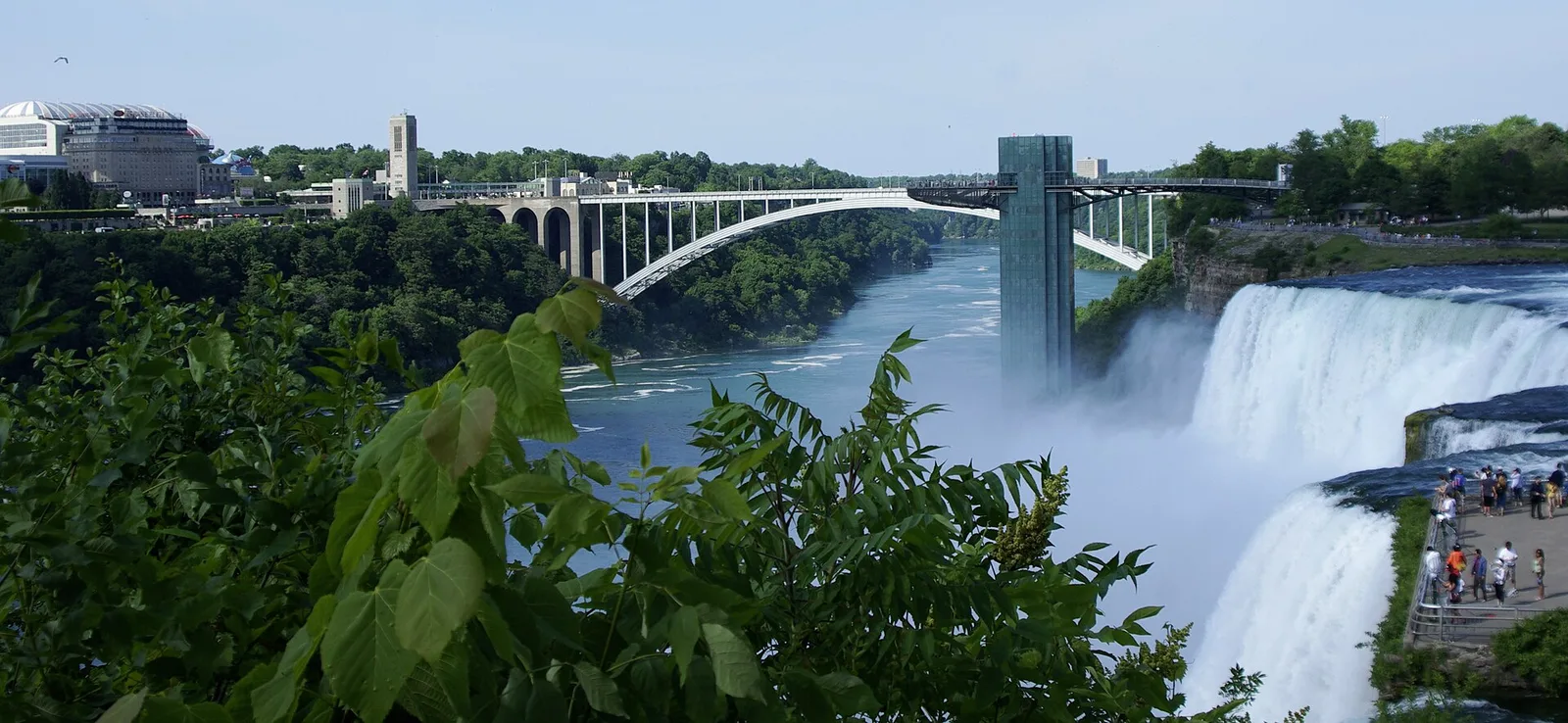
The falls are three separate cascades: the American Falls and the narrower Bridal Veil Falls on the United States side, and the much larger Horseshoe Falls straddling the international border. The Niagara River carries the outflow of four of the five Great Lakes, Superior, Michigan, Huron, and Erie, from Lake Erie down to Lake Ontario, a drop of about 326 feet over the river's 36 miles, roughly 167 feet of it at the falls themselves.
In peak tourist flow more than 3,160 tons of water per second pour over the crest, and the falls move more water than any other in North America. About 8 million people visit each year, making the park one of the most heavily visited state parks in the country, and the New York State Office of Parks, Recreation and Historic Preservation operates it alongside the Niagara Gorge, Whirlpool, Devil's Hole, and Artpark units downstream.
- Designation
- State Park (oldest in the US)
- Location
- Niagara County, western New York, on the US-Canada border
- Established
- 1885
- Annual Visitors
- ~8 million
Geology and Landscape
Horseshoe Falls on the US-Canada border is the largest and most powerful waterfall in North America by volume, carrying roughly 90 percent of the Niagara River's flow. Its curved crest, about 2,600 feet wide, concentrates the water into the thundering plunge and permanent mist cloud that define the falls, dropping approximately 167 feet into the plunge pool below.
Before large-scale water diversion, the falls retreated upstream an estimated 3 to 6 feet per year as the hard caprock collapsed; since flow was reduced for hydropower, that rate has fallen to about 1 foot per year or less. Over some 12,000 years the falls have cut their way about 7 miles upstream from the Niagara Escarpment near Lewiston to their present position.
The International Niagara Control Works, a gated weir completed in 1957 and lengthened in 1963 just above the Horseshoe crest, lets operators from the International Niagara Board of Control spread the remaining flow evenly across the lip. This both improves the unbroken 'curtain' visitors see and slows erosion at the flanks where the falls had been wearing back fastest.
Under the 1950 Niagara Treaty a minimum scenic flow of 100,000 cubic feet per second must go over the falls during daylight hours in the April to October tourist season, dropping to 50,000 at night and in winter. Because Horseshoe Falls carries the bulk of the river, most of that guaranteed scenic water passes over the Canadian cataract rather than the American side.
The American Falls fall between about 70 and 110 feet to a massive talus pile of broken rock, over a crest roughly 830 to 950 feet wide on the United States side. Goat Island separates the American and Bridal Veil Falls from Horseshoe Falls, and tiny Luna Island splits the main American Falls from the slender Bridal Veil Falls beside it.
The base is buried in rubble from repeated collapses of the dolostone caprock, including a large fall in 1931 and a dramatic failure at Prospect Point on January 17, 1954 that dropped roughly 185,000 tons of rock into the gorge and forced the rebuilding of the overlook.
From June to November 1969 the US Army Corps of Engineers built a rock cofferdam across the head of the American Falls, diverting its entire flow to the Canadian side, so geologists could drill test bores, map fractures, and study whether to remove the talus and bolt the cliff face. The Corps concluded that stabilization would cost tens of millions of dollars and that the rockpile actually buttresses the cliff, so it recommended minimal work and flow was restored.
New York State Parks briefly dewatered the American Falls again in 2019, this time to replace two stone pedestrian bridges built around 1900 that carry visitors from the mainland to Goat Island, showing that short, engineered shutoffs of a Niagara cataract are now a routine maintenance tool.
The Niagara Gorge is the 7-mile canyon the river has cut below the falls, running from the current brink down to Lewiston, where the water leaves the bedrock and spreads onto the Lake Ontario plain. It is up to about 200 feet deep, and its walls expose the full Silurian rock sequence of the region.
Hard Lockport dolostone caps the rim; beneath it lie much softer layers of Rochester shale, Irondequoit limestone, and, near the water, Queenston shale. Spray, seepage, and freeze-thaw undercut the soft shale until unsupported slabs of caprock break away, which is the mechanism that drives the falls steadily upstream.
Midway along the gorge the river makes a sharp right-angle turn into the Niagara Whirlpool, a rotating basin formed where the retreating falls intersected the buried St. David's Gorge, a channel cut during an earlier interglacial period and later filled with glacial debris. The Whirlpool Rapids above and below it are rated among the most violent navigable-scale whitewater on the continent.
The gorge has long doubled as an industrial corridor: the Great Gorge Route trolley line ran at water level from 1895 until rockslides shut it for good in 1935, and the Spanish Aero Car has crossed above the Whirlpool on the Canadian side since 1916. Today the Niagara Gorge Trail system carries hikers along the same benches, subject to periodic closures for rockfall.
The Niagara Escarpment is a long cuesta, a ridge with a gentle back slope and a steep face, that arcs roughly 1,000 miles from Niagara in New York through Ontario, where it forms the Bruce Peninsula and Manitoulin Island, across the Upper Peninsula of Michigan, and down the Door Peninsula of Wisconsin toward Lake Winnebago.
Its resistant caprock is dolostone of the Lockport Group, deposited about 430 million years ago during the Silurian Period in a warm, shallow sea along the rim of the Michigan Basin, when this part of North America lay near the equator.
That same dolostone layer is the rock the falls pour over. Where the Niagara River first crossed the escarpment near Lewiston at the end of the last ice age, it began the plunge and the upstream erosion that created the modern gorge and cataracts.
The escarpment shapes waterfalls and cliffs far beyond Niagara, from the Genesee River falls in Rochester to the many ravine falls of Hamilton, Ontario. In 1990 UNESCO designated the Ontario portion a World Biosphere Reserve, and the Bruce Trail follows the ridge for more than 550 miles.
Indigenous Peoples of the Niagara Region
Haudenosaunee Confederacy (Iroquois)
The Niagara River and falls lie within the traditional territory of the Haudenosaunee (Iroquois) Confederacy, and specifically of the Seneca, the Onodowahgah or 'People of the Great Hill,' the westernmost of the original Five Nations, which became Six Nations when the Tuscarora were adopted around 1722. The name Niagara comes from an Iroquoian word, often recorded as Onguiaahra, generally translated as 'the strait' or 'thundering water.'
The falls and the portage around them were a strategic chokepoint in the fur trade and in colonial warfare. The 1764 Treaty of Niagara, negotiated by Sir William Johnson with some 2,000 delegates from about two dozen nations after Pontiac's War, reaffirmed the Covenant Chain alliance and included a Seneca cession of a four-mile strip along the portage road on the American bank.
Seneca landholding in western New York collapsed over the following decades. The 1794 Treaty of Canandaigua recognized the Haudenosaunee homeland, but the 1797 Treaty of Big Tree extinguished most remaining Seneca title, confining the nation to a handful of reservations. The popular 'Maid of the Mist' legend of a maiden sent over the falls as a sacrifice is regarded by Haudenosaunee people as a Victorian invention with no basis in their traditions.
The Seneca Nation of Indians is the federally recognized successor nation to the Seneca people of western New York. It governs the Allegany and Cattaraugus Territories and operates the Seneca Niagara Resort and Casino in the city of Niagara Falls, while the broader Haudenosaunee Confederacy, with its council fire at Onondaga near Syracuse, remains an active political and cultural institution.
What to Do
Maid of the Mist Boat Tour
The Maid of the Mist has carried passengers toward the foot of the American Falls and into the basin below Horseshoe Falls since 1846, when it started as a steam ferry across the river. It became purely a sightseeing run after the Niagara Falls Suspension Bridge opened in 1848 and took away its crossing traffic, and it is now among the oldest continuously operating tourist attractions in North America.
Riders are handed recyclable ponchos before the boat pushes into the wall of spray at the base of Horseshoe Falls. Since 2014 the United States tours have run independently of the Canadian boats, and the two current American vessels, launched in 2020, are fully battery-electric and recharge at the dock between trips, the first such passenger boats in US service.
The tour boards at the base of the Prospect Point Observation Tower, reached by elevator down the gorge wall, and runs roughly from late May into October as ice allows. The boats are hauled out of the water and stored ashore every winter.
The most famous voyage in the vessel's history came in 1861, when captain Joel Robinson ran a Maid of the Mist down through the Whirlpool Rapids to deliver it to a buyer, one of the very few times any boat has survived that stretch of whitewater.
Cave of the Winds
The Cave of the Winds experience drops visitors about 175 feet by elevator through the gorge wall to the base of Bridal Veil Falls on Goat Island, where a network of wooden decks and stairways leads out to within roughly 20 feet of the falling water.
The topmost platform, the Hurricane Deck, is hit by tropical-storm-force winds and driving spray thrown off the cascade. Ponchos and souvenir sandals are issued at the top, and lockers are provided because anything not sealed away is soaked within minutes.
The attraction is named for an actual cavern behind Bridal Veil Falls, about 130 feet high, that guided tours entered from the 1840s onward. A rockfall in 1920 made it unsafe, and in 1955 the park deliberately dynamited the overhang for visitor safety, so the modern walkways recreate the close approach without the now-vanished cave.
Ice and rockfall would wreck any permanent structure at that spot, so park crews take the walkways apart every autumn and rebuild them every spring using tens of thousands of board feet of lumber. A scaled-back winter version keeps the lower decks open on a limited schedule.
Goat Island and Three Sisters Islands
Goat Island, about 70 acres, sits in the middle of the river and splits the American and Bridal Veil Falls from Horseshoe Falls. Loop paths and roads lead to viewpoints all around it, including Terrapin Point at the very brink of the Horseshoe. It takes its name from goats that settler John Stedman pastured there in the 1770s, most of which died in one hard winter.
The Three Sisters Islands, reached by stone footbridges from the south side of Goat Island, step out into the upper rapids just above Horseshoe Falls, where the river accelerates to around 25 miles per hour before the drop. They are named for the daughters of General Parkhurst Whitney, a prominent early Niagara innkeeper.
Goat Island itself was nearly industrialized: in the 1860s promoters floated schemes to line it and the adjacent shore with rapids-powered mills, and it was exactly that threat of enclosure and machinery that pushed Olmsted and his allies into the Free Niagara campaign. Olmsted named the island's woods the scenic heart of the reservation.
The island still holds a remnant of rare riverine forest. Nineteenth-century botanists including Asa Gray remarked on its unusually rich plant life, and the park manages it today for native species against the pressures of invasive plants and heavy foot traffic.
Niagara Falls Observation Tower
The Prospect Point Observation Tower, opened in 1961, cantilevers out over the gorge and stands about 282 feet above the river below. It is the only place on the American side where visitors can take in all three falls at once from a single vantage point.
A glass-walled deck at the top stays open year-round, and an elevator inside the tower carries visitors down to the gorge floor, where the Maid of the Mist dock and the Crow's Nest walkway toward the foot of the American Falls are located.
The tower stands next to the site of the 1954 Prospect Point collapse, when roughly 185,000 tons of rock broke away from the overlook, and later stabilization work reinforced the surviving point with rock bolts and concrete.
It is one of the few deliberate intrusions into the Olmsted landscape, and its presence has been argued over for decades. The 2010s park renovation kept the tower but stripped out an adjacent surface parking lot and rebuilt the lawns and plantings toward the 1887 Olmsted and Vaux design.
Conservation Challenges
Water Diversion Agreements
The 1950 Niagara River Water Diversion Treaty between the United States and Canada, administered through the International Joint Commission and the International Niagara Board of Control, guarantees a minimum scenic flow over the falls: at least 100,000 cubic feet per second during daylight hours in the tourist season, and 50,000 cubic feet per second at night and through the winter.
Everything above that floor, more than half the river's average discharge, may be split evenly between the two countries for hydroelectric generation. On the American side the Robert Moses Niagara Power Plant, run by the New York Power Authority and opened in 1961, can produce about 2,700 megawatts, and Ontario's Sir Adam Beck stations add roughly 2,000 megawatts more.
The diverted water is drawn from intakes well upstream of the falls, carried through tunnels and canals to the plants near Lewiston and Queenston, and returned to the lower river, so the reduced flow is invisible to most visitors. Without the treaty ceiling it would be economically rational to divert nearly the entire river.
The gated International Niagara Control Works above Horseshoe Falls, finished in 1957, lets operators redistribute the water that does go over the crest, which both smooths the scenic curtain and slows erosion at the edges. A steel ice boom strung each winter across the river's outlet from Lake Erie handles the separate problem of ice jams.
Erosion and Rock Face Stability
The Niagara caprock is hard Lockport dolostone sitting on soft Rochester shale. Spray, groundwater seepage, and repeated freezing and thawing eat away the shale until unsupported slabs of the caprock shear off, the process that has moved the falls about 7 miles upstream in roughly 12,000 years.
Before large-scale diversion, Horseshoe Falls retreated an estimated 3 to 6 feet a year; reduced flow and the control works have cut that to about 1 foot a year or less, which is what protects the hotels, viewing platforms, and boat docks clustered at the present brink.
The American Falls barely moves because it carries so little water, but its face is fractured and buried under talus from historic collapses, including large falls in 1931 and the 1954 Prospect Point failure of about 185,000 tons. The 1969 Army Corps dewatering studied whether to clear that rubble and bolt the cliff, and concluded the talus should be left because it braces the wall.
New York State Parks now runs continuous rock-slope monitoring in the gorge and at Terrapin Point, where thousands of cubic yards of unstable rock were removed and the edge was anchored and capped with concrete in 1969 and again in the 1980s. Rockslides from the gorge walls still periodically close stretches of the Niagara Gorge Trail.
Chemical Legacy and Groundwater
The city of Niagara Falls became a center of the chemical industry after 1900 because abundant cheap hydropower favored electrochemical manufacturing. By mid-century, companies including Hooker Chemical ran large plants along the river and the gorge rim.
Love Canal, a partly excavated canal in the LaSalle neighborhood, was used by Hooker Chemical as a waste pit and filled with an estimated 21,000 tons of chemical waste, then capped and transferred to the local school board in 1953. A school and hundreds of homes were built on and around the covered dump.
After years of chemical odors, surface seepage, and contaminated basements, President Jimmy Carter declared federal emergencies at Love Canal in 1978 and 1980, and about 950 families were relocated. The disaster directly drove Congress to pass the 1980 Superfund law, and Occidental Petroleum, which had acquired Hooker, later paid roughly 129 million dollars in cleanup settlements.
The state park lies upstream of these sites and is not part of the contaminated area, but the wider city still contains multiple listed hazardous-waste sites, and the lower Niagara River is a designated Great Lakes Area of Concern with ongoing sediment cleanup and fish-consumption advisories.
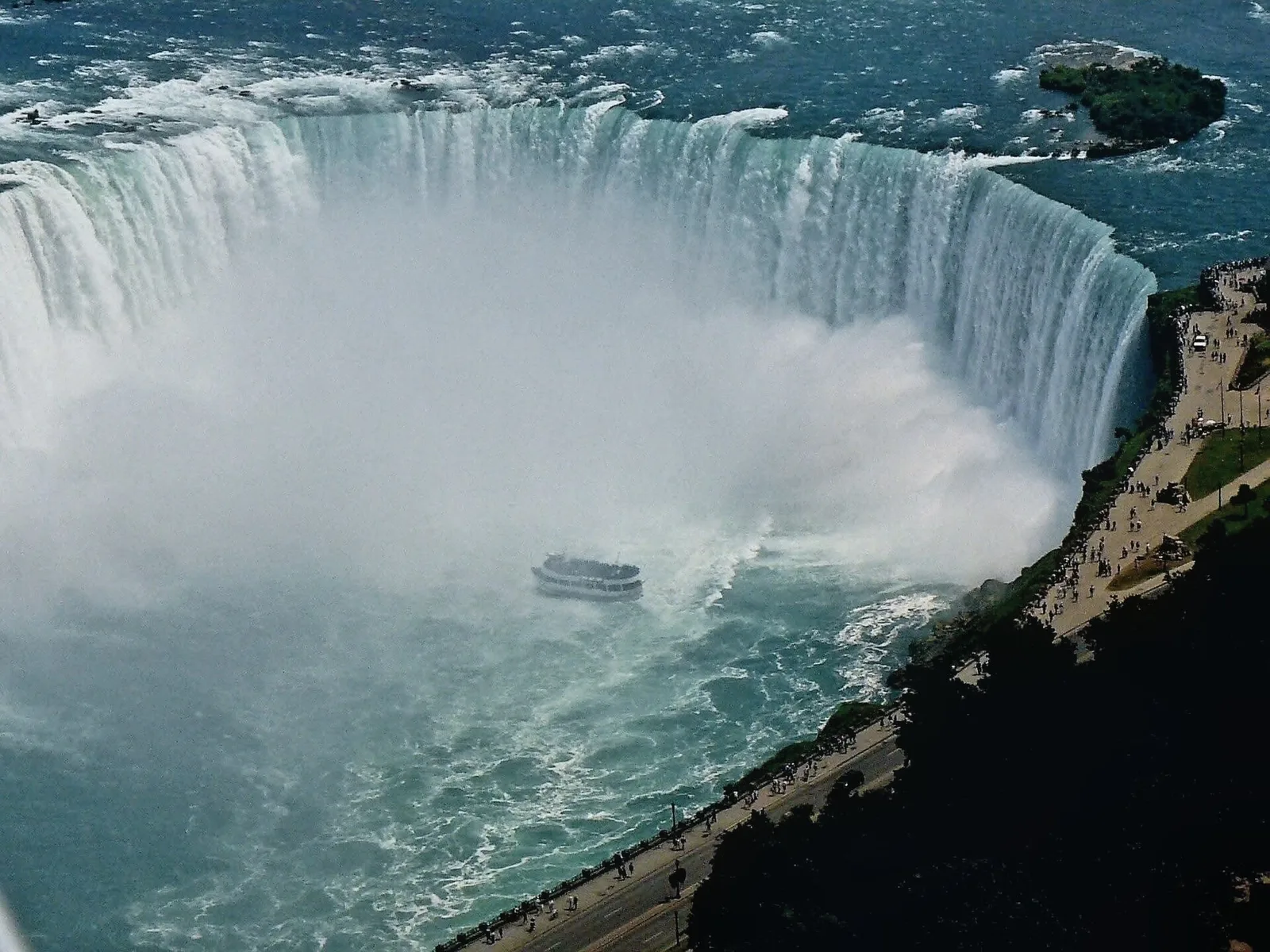
Horseshoe Falls from Goat Island
Fast Facts
Did You Know?
Before Niagara Falls State Park was established in 1885, the falls were surrounded by private land, factories, and tourist traps that charged admission just to see the water. The campaign to restore free public access, led by Frederick Law Olmsted and others, is considered one of the first major American conservation victories.
Niagara Falls produces approximately 4.4 gigawatts of electricity through power plants on both the US and Canadian sides, enough to power millions of homes. The Niagara Power Project on the US side is one of the largest hydroelectric generating facilities in the world, and has been generating power since 1961.
At least 15 people have intentionally gone over Niagara Falls in various types of barrels, containers, and protective devices. The first was Annie Edson Taylor, a 63-year-old schoolteacher, who went over in a wooden barrel on October 24, 1901, and survived with only minor injuries.
Plan Your Visit
Location
Niagara County, western New York, on the US-Canada border
Designation
State Park (oldest in the US)
Best Seasons
Summer for all attractions; winter for ice formations (reduced services)
Admission
Park free; Maid of the Mist and Cave of the Winds require tickets
Address
332 Prospect St, Niagara Falls, NY 14303
Park Hours
Open daily year-round; attractions seasonal
Getting There
I-190 to Exit 21; 20 miles from Buffalo; Rainbow Bridge to Canada
More Info
niagarafallsstatepark.com