

The House of
Representatives
435 regular people. 2-year jobs. Your most direct vote in the federal government. Here's everything, no law degree needed.
🏛️ So What Is the House of Representatives?
Think of the US government like a big company. Congress is the part that writes the rules (laws) and controls the money. But Congress has two sides, like two rooms that have to agree before anything gets done. The House of Representatives is the bigger, louder, faster-moving room.
It has 435 members, and they're picked directly by voters like you. They serve 2-year terms, which means they're always just around the corner from having to ask voters for their job back. Vote badly and you're out fast.
🗣️ People call it "The People's House", and that's exactly what it's meant to be.
The whole idea was to give regular Americans a direct voice in the government, not just rich landowners or political insiders.
📜 Why Does the House Even Exist?
After America broke free from Britain in 1783, the country was kind of a disaster. The first version of the national government, called the Articles of Confederation, was basically toothless. The government couldn't collect taxes, couldn't enforce anything, and had no real power. The 13 states were acting like 13 different countries that happened to share a name.
In 1787, leaders from all the states met in Philadelphia to fix it. Almost right away, they got into a huge fight.
Big states said: "We have more people, we should get more votes." Small states said: "No way, you'll just steamroll us." Nobody would budge, and the whole thing almost fell apart.
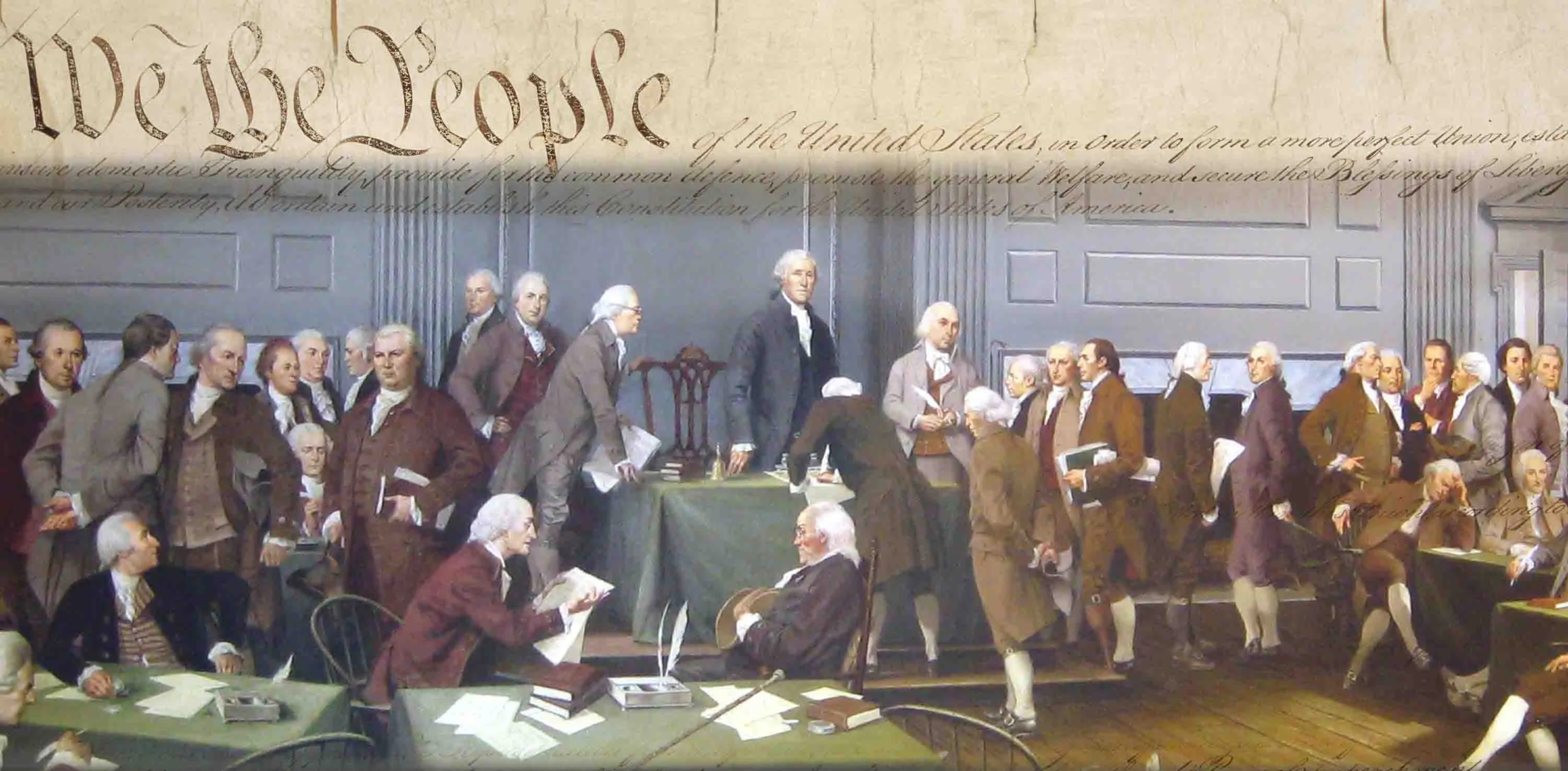
The Constitutional Convention, Philadelphia 1787, where the big fight happened (Public Domain)
⚖️ The Deal That Saved Everything
A guy from Connecticut named Roger Sherman came up with a fix: two rooms instead of one. The House of Representatives, where big states get more seats because they have more people. And the Senate, where every state gets exactly 2 seats, big or small. Nobody was thrilled, but everybody said yes. America was back on track.
The House was built to move fast and stay close to the people. Short terms, direct elections, seats based on population, the whole design was a reaction to the distant, out-of-touch British government they'd just gone to war with.
📖 Where Does It Come From?
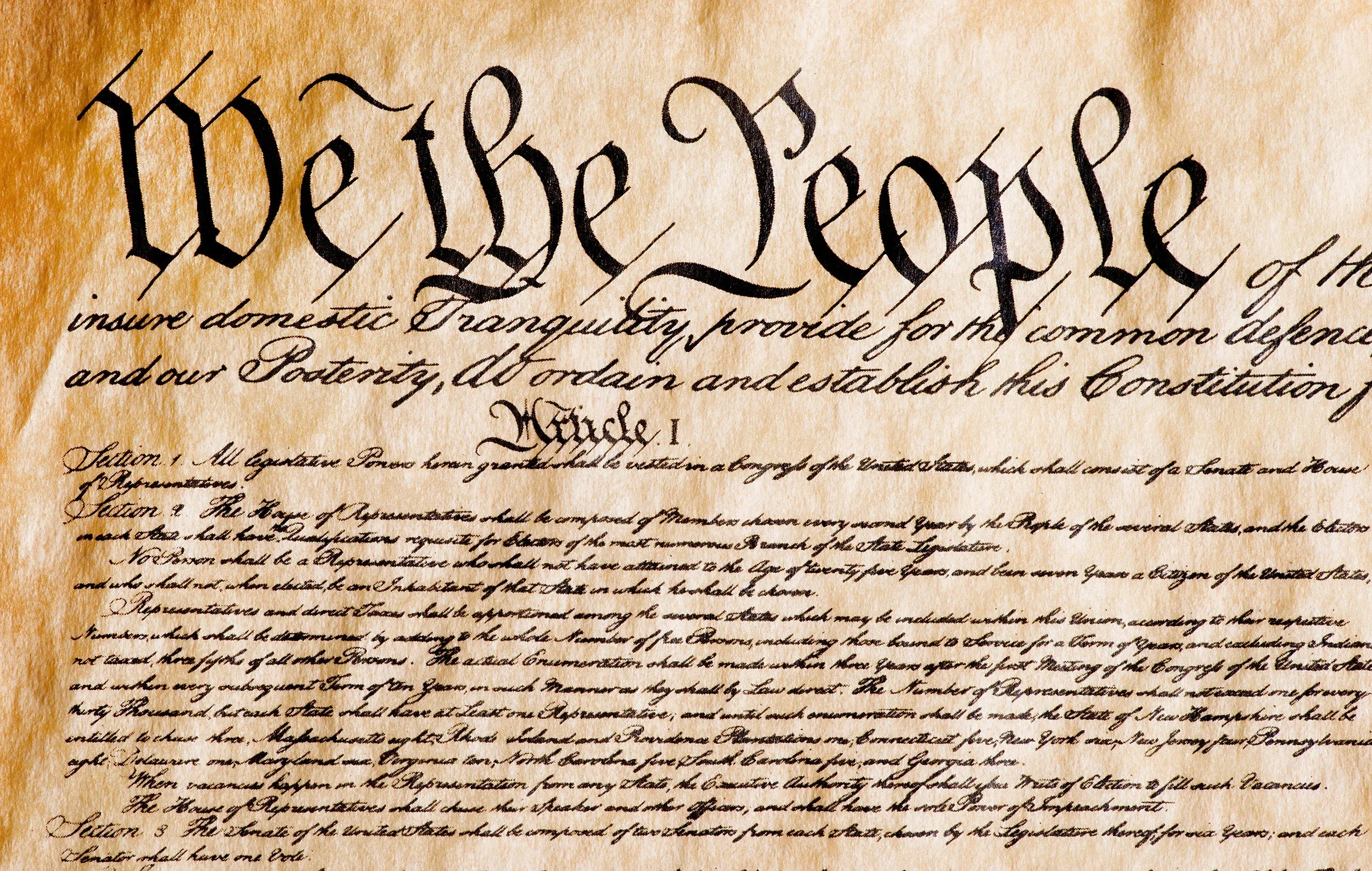
The actual Constitution, written in 1787, still the law of the land (Public Domain)
The House isn't just a good idea someone had, it's written right into the US Constitution. You'll find it in Article I, Section 2, which was ratified in 1788.
Here's something interesting: Article I, which covers Congress, is the very first article in the Constitution. Before the President. Before the courts. The founders put the people's representatives first on purpose.
The Constitution has been updated over the years (through amendments), but the basic rules for the House are still exactly what they wrote in 1787.
"The House of Representatives shall be composed of Members chosen every second Year by the People..."
"No Person shall be a Representative who shall not have attained to the Age of twenty five Years, and been seven Years a Citizen of the United States..."
"The House of Representatives shall chuse their Speaker and other Officers; and shall have the sole Power of Impeachment."
👆 In short: Elected every 2 years, must be at least 25 years old and a US citizen for 7+ years, must live in the state they represent, picks its own leader, and is the only group that can formally charge a president with wrongdoing.
✅ Who Can Run for the House?
The rules are actually pretty simple, and that was on purpose. The founders wanted regular people to be able to serve, not just lawyers or rich guys. There are only three requirements:
You have to be at least 25 when you're elected. That's it. No other age-related hoops to jump through.
You have to have been a US citizen for at least 7 years. If you became a citizen, you qualify, you just can't run the same week you got your papers.
You have to live in the state you want to represent. Not necessarily your exact neighborhood, just the state. You need to have real roots there.
No law degree needed. No wealth requirement. No political connections required. A teacher, a farmer, a nurse, a truck driver, anyone who meets those three rules can run for Congress. That was the whole point.
🗳️ How Do Representatives Get Picked?

Every 2 years, all 435 House seats go back to the voters (Public Domain)
The country is carved up into 435 districts. Each district picks one person to represent them in Washington. When you vote for your House member, you're only picking the person for your district, your neighbor a few miles away in a different district votes for a completely different person.
📊 How Many Seats Does Each State Get?
Seats are handed out based on population. Every 10 years the government does a head count (called the census), and then recalculates how many seats each state gets. States that grew get more seats. States that shrank lose some.
🏆 Most Seats (2023)
🐜 Only 1 Seat
These states have small enough populations that the whole state is just one district:
🦦 What's Gerrymandering?
Each state draws its own district borders, and politicians sometimes draw them in sneaky ways to help their own party win more seats. If you've ever seen a congressional district that looks like a squiggly mess on a map, that's probably gerrymandering. It's named after Governor Elbridge Gerry, whose 1812 district looked like a salamander. It's one of the most controversial things about how the House works today.
🗓️ How Do Elections Work?
House elections happen every two years, on the first Tuesday after the first Monday in November. Before the main election, candidates usually have to win a primary, a smaller election within their own party to become the official candidate.
Whoever gets the most votes in the district wins, even if it's not a majority. In a race with 3 or 4 candidates, you could win with just 35% of the vote as long as it's more than anyone else got.
⏱️ How Long Do They Serve?
House members serve 2-year terms, the shortest of any elected federal job in the US. This was totally intentional. The founders wanted House members to constantly have to go home and face voters. Unlike senators (6-year terms) or the president (4-year term), House members can't coast for long.
There are no term limits. A representative can keep running for re-election as long as voters keep saying yes. John Dingell from Michigan served for 59 years straight, the longest run in congressional history, before retiring in January 2015 after choosing not to run again in 2014.
📅 Every Two Years, All 435 Seats Are On the Ballot
The elections that happen halfway through a president's term are called midterms. Historically, the president's party tends to lose House seats in midterms, voters often use it as a way to pump the brakes.
🔁 What If a Seat Opens Up Mid-Term?
Unlike the Senate, if a House member dies or quits, nobody gets appointed to fill the seat. The state governor has to call a special election and voters fill the seat themselves. It stays empty until they do.
⚡ What Does the House Actually Do?

Inside the House chamber, all 435 seats (Public Domain)
Here's the big one: nothing becomes a federal law without the House saying yes. It doesn't matter if the Senate loves a bill, or the President is desperate to sign it, if the House won't pass it, it's dead. That's real power. But the House also has a few things that only it can do.
🔑 Things Only the House Can Do
Start All Tax Bills
Any bill that raises revenue through taxes must start in the House, not the Senate and not the President's desk. This is the Origination Clause, Article I, Section 7 of the Constitution. The Senate can still amend a revenue bill heavily once it arrives, and it sometimes strips a minor House bill down to a shell and substitutes its own tax language, but the House number goes first.
The framers gave this power to the House because it was the only part of the federal government directly elected by the people in 1789; senators were chosen by state legislatures until 1913. The idea, rooted in the English principle that taxes require the consent of the governed, was that the chamber closest to voters should hold the power of the purse. The colonists' slogan "no taxation without representation" is built directly into the clause.
Courts read "bills for raising revenue" narrowly. The Supreme Court held in United States v. Munoz-Flores (1990) that a measure is a revenue bill only if its main purpose is to raise money for the general treasury, not if it collects fees for a specific program. Disputes over whether the Senate violated the clause are usually settled politically, by the House "blue-slipping," or returning, an offending Senate bill, rather than in court.
In modern practice the requirement is more a matter of form than of real leverage, because tax policy is negotiated jointly and the Senate Finance Committee is at least as powerful as the House Ways and Means Committee. Still, the House guards the prerogative: the 2010 Affordable Care Act, for example, was attached to an unrelated House-passed revenue bill specifically to satisfy the clause.
Charge Officials With Wrongdoing (Impeachment)
Only the House can formally charge a president, vice president, federal judge, or other "civil officer" with "treason, bribery, or other high crimes and misdemeanors," a step called impeachment. Impeachment by the House is roughly equivalent to a grand jury indictment: it is an accusation, not a conviction. The Senate then holds the trial and needs a two-thirds vote to remove the person from office.
A simple majority of the House is enough to impeach. The House votes on one or more "articles of impeachment," each a specific charge, and a person is impeached if any single article passes. The House also appoints "managers," members who act as prosecutors in the Senate trial.
The House has impeached 21 federal officials in its history: three presidents, two cabinet secretaries (William Belknap in 1876 and Alejandro Mayorkas in 2024), one senator, and fifteen federal judges. Only eight, all judges, were convicted and removed by the Senate. Andrew Johnson was impeached in 1868 and acquitted by one vote; Bill Clinton was impeached in 1998 and acquitted; Donald Trump was impeached in 2019 and again in 2021 and acquitted both times. Richard Nixon resigned in 1974 before the full House could vote on articles the Judiciary Committee had approved.
Impeachment is a political process, not a criminal one: it cannot send anyone to prison, only remove them from office and, on a separate vote, bar them from holding future federal office. The Supreme Court held in Nixon v. United States (1993), a case about a federal judge, that how the Senate conducts an impeachment trial is a "political question" courts will not review.
Pick the President If There's a Tie
If no presidential candidate wins a majority of Electoral College votes (270 of 538), the choice goes to the House under the 12th Amendment, in what is called a "contingent election." The House chooses from among the top three finishers, and each state delegation casts a single vote decided among its own members. California's 52 representatives collectively get one vote; Wyoming's one representative gets one vote.
A candidate needs the votes of 26 state delegations to win. A delegation that is evenly split casts no vote, which can produce deadlock. The newly elected representatives, not the outgoing ones, do the voting, and it happens in early January after the Electoral College has met and Congress has counted the votes.
It has happened twice. In 1801 the House broke a tie between Thomas Jefferson and his own running mate Aaron Burr after 36 ballots, an ordeal that led directly to the 12th Amendment separating the presidential and vice-presidential ballots. In 1825, with four candidates splitting the electoral vote, the House chose John Quincy Adams over Andrew Jackson, who had won more popular and electoral votes; Jackson's supporters called it a "corrupt bargain."
If the House cannot choose a president by Inauguration Day, the vice president-elect, chosen by the Senate in a parallel contingent process, serves as acting president. The disputed 1876 Hayes-Tilden election was resolved by a special commission rather than a House contingent vote, but it prompted the Electoral Count Act of 1887, updated in 2022, which governs how disputed electoral votes are handled before any contingent election could occur.
📋 Things the House Does Together With the Senate
Pass Laws
Both the House and Senate have to agree on a bill word-for-word before it goes to the President. One side can't overrule the other.
Control All Govt Spending
Every dollar the federal government spends has to be approved by Congress first. No exceptions.
Declare War
Officially, only Congress can declare war. In practice, presidents often send troops without a formal declaration, a very ongoing debate.
Regulate Trade
Congress sets the rules for business between states and with other countries, the basis for most of the country's economic laws.
Change the Constitution
Congress can propose changes to the Constitution, but it takes a two-thirds vote in both chambers, plus approval from 38 states.
Override a Presidential Veto
If the President rejects a bill, Congress can overrule it, but only if two-thirds of both chambers vote yes. That's very hard to pull off.
👑 Who's In Charge of the House?
Putting 435 people in a room and expecting anything useful to happen requires some structure. Here's who runs the show:
The Speaker of the House
The Speaker is the most powerful person in the House , picked by a vote of all 435 members, and always from the party that has the most seats. They decide which bills even get a vote, control the daily schedule, run debates, and are second in line for the presidency if both the President and Vice President can't serve. It's often called the third-most-powerful job in the US government. The Speaker can also be removed, that happened dramatically in October 2023 when Kevin McCarthy was voted out mid-term.
Majority Leader
The day-to-day manager for the party in power. They decide what gets debated on the floor and when. Think of them as the Speaker's right hand.
Minority Leader
The top dog for the party that's outnumbered. Their job is to push back, offer different ideas, and keep their team fired up until they can flip the script.
The Whips
Both parties have whips, they round up votes, count who's with them, and pressure members to vote with the party. The name comes from fox hunting. Really.
🔬 Committees: Where Laws Are Really Made
Here's something most people don't know: the big dramatic floor votes you see on TV are almost never where the real action happens. Most of the work, reading bills, rewriting them, killing bad ones quietly, happens in committees.
When a new bill gets introduced, it gets sent to a smaller group of 15–50 representatives who focus on that specific topic. They dig into it, fight over the details, sometimes tear it apart and rebuild it, and often just let it die without ever bringing it to a vote. Most bills never make it out of committee. Getting past committee is the first big hurdle.
🗂️ The Big Committees You Should Know
🔄 How a Bill Moves Through the House
Any House member can write a bill. They drop it into a wooden box called the 'hopper' near the clerk's desk. Seriously.
The bill goes to the relevant committee. This is where most bills quietly die, they never get a vote.
If the committee approves it, the Rules Committee decides how it gets debated, how long and what changes are allowed.
The full House debates it. Time is strictly limited, unlike the Senate, nobody can talk forever to block a vote.
A simple majority of members present and voting wins (218 when all 435 seats are filled and everyone votes). Members have 15 minutes to get to the floor and vote electronically.
Frequently Asked Questions
The House is one of the two chambers of Congress. Its members write and vote on federal laws with the Senate, every bill that raises revenue through taxes must start there, and it holds the sole power of impeachment.
The House has 435 voting members, one for each congressional district. All 435 seats are on the ballot every two years.
A representative must be at least 25 years old, a U.S. citizen for at least seven years, and a resident of the state they represent.
Yes. Only the House can impeach a president, vice president, federal judge, or other civil officer, and a simple majority vote on any article of impeachment is enough. The Senate then holds the trial.