


About California
California takes its name from a fictional paradise described in a 1510 Spanish novel called "Las Sergas de Esplandian" by Garci Rodriguez de Montalvo. In the novel, California is an island near the Indies ruled by a Black queen named Calafia, rich in gold and precious stones. When Spanish conquistadors under Hernan Cortes explored the Baja California peninsula in the 1530s, they believed they had found the island from the story and named the land California. The name stuck and eventually spread northward to the present-day state. The fictional gold-rich island proved prophetic: the California Gold Rush of 1848 would draw hundreds of thousands of people from around the world.
California is a state of extraordinary contrasts, snow-capped mountains, scorching deserts, ancient redwood forests, and sunny beaches all within its borders.
It is the most populous state in the U.S. and, if it were a country, would rank among the five largest economies in the world. Innovation, entertainment, agriculture, and natural beauty define its identity.

Geography, Four Main Regions
California's geography is incredibly diverse, ranging from coastal redwoods to inland deserts.
Home to ancient redwood forests, rugged Pacific coastline, Napa and Sonoma wine country, and the cities of San Francisco and Sacramento. Cooler, wetter climate with dramatic natural beauty.
Redwood National and State Parks protect some of the tallest living trees on Earth, with coast redwoods exceeding 350 feet. Napa Valley wines gained international recognition in 1976 when California cabernets and chardonnays outscored top French wines in the blind 'Judgment of Paris' tasting, reshaping the global wine industry's view of American wine.
The far north is sparsely populated timber and cannabis country, where the 'State of Jefferson' secession movement has simmered since 1941. The Klamath and Trinity rivers have been the focus of a long dam fight: four dams on the Klamath were removed in 2024 in the largest dam-removal project in U.S. history, reopening about 400 miles of salmon habitat long sought by the Yurok, Karuk, and other tribes.
Sacramento, the state capital since 1854, sits where the American River meets the Sacramento at the north end of the Central Valley; it grew from Sutter's Fort and the Gold Rush and is now a fast-growing metro of about 2.4 million. Wildfire has reshaped the region: the 2018 Camp Fire destroyed the town of Paradise and killed 85 people, the deadliest and most destructive fire in California history.
One of the most productive agricultural regions on Earth. This vast flat valley produces an enormous share of America's fruits, vegetables, nuts, and dairy.
The valley depends heavily on an extensive system of dams, canals, and aqueducts, including the federal Central Valley Project and the California Aqueduct, which move water hundreds of miles from the wetter north to irrigate the drier south. Decades-long water-rights disputes between farmers, cities, and environmental interests remain a defining feature of California politics.
The valley stretches about 450 miles from Redding to Bakersfield and grows a quarter of the nation's food on a small share of its land. It also has some of the worst air quality in the country, the highest child-poverty rates in the state, and towns where the tap water is unsafe to drink, a gap sometimes called California's 'other California.'
Groundwater over-pumping during droughts has caused the ground itself to sink, more than 28 feet in places since the 1920s, one of the largest human-caused elevation changes on Earth, cracking canals and well casings. The Sustainable Groundwater Management Act of 2014 requires local agencies to bring aquifers into balance by the 2040s, which is expected to fallow hundreds of thousands of acres.
Includes Silicon Valley, San Francisco, and stunning coastal scenery. This is the heart of California's tech industry and innovation economy.
The name 'Silicon Valley' was coined in the early 1970s by journalist Don Hoefler, referring to the silicon computer chips first mass-produced there by companies like Fairchild Semiconductor, founded in 1957. The region's proximity to Stanford University helped seed decades of technology startups.
The nine-county Bay Area holds about 7.7 million people and, on its own, would rank among the world's 20 largest economies, driven by tech, venture capital, and UC Berkeley and Stanford. It also has the state's highest housing costs, with median home prices well over $1.5 million in San Francisco and San Mateo counties, and homelessness and out-migration have become defining political issues.
South of the metro, the Central Coast runs from Santa Cruz past Big Sur to Santa Barbara along a stretch of Highway 1 cut into cliffs in the 1930s, and inland lies the Salinas Valley 'salad bowl' that John Steinbeck wrote about. Monterey Bay, once fished empty of sardines by the canneries of 'Cannery Row,' is now a protected marine sanctuary and home to a major aquarium.
Famous for Mediterranean climate, beaches, Hollywood, Los Angeles, and San Diego. Home to the entertainment industry, major ports, and diverse urban centers.
Filmmakers began relocating to Hollywood in the early 1910s partly to escape patent lawsuits from Thomas Edison's film equipment monopoly on the East Coast, and partly for the region's reliable sunshine and varied scenery. The Port of Los Angeles and neighboring Port of Long Beach together form the busiest container port complex in the Western Hemisphere.
Greater Los Angeles is home to about 18.5 million people across five counties, the second-largest metro area in the country. It was built on the automobile and on imported water: the Los Angeles Aqueduct of 1913 drained the Owens Valley 200 miles to the north, and the Colorado River Aqueduct followed in 1941. The 1994 Northridge earthquake killed dozens of people and caused more than $40 billion in damage.
San Diego, on the Mexican border, is a Navy town with the largest concentration of naval power on the West Coast and a biotech center anchored by UC San Diego and the Salk Institute. The San Ysidro crossing between San Diego and Tijuana is the busiest land border crossing in the Western Hemisphere, and the region's deserts hold Joshua Tree and Death Valley, the hottest place on Earth by recorded temperature.

Economy
California has the largest economy of any U.S. state and would rank about fourth or fifth in the world if independent.
California is home to Apple, Google, Meta, Netflix, NVIDIA, and thousands of startups. The tech sector drives enormous economic output and shapes the future.
The region's tech dominance traces back to Stanford University's early-20th-century push for engineering graduates to found companies locally, plus a wave of federal defense and aerospace research funding during and after World War II that built up a deep regional talent base in electronics and computing.
California would be the world's fourth- or fifth-largest economy if it were a country, with a GDP around $4 trillion, and tech is the single biggest reason. Seven of the ten most valuable companies in the world, among them Apple, Nvidia, Alphabet, and Meta, are headquartered within about 40 miles of one another in the Bay Area.
The concentration has costs: it has pushed Bay Area housing prices to the highest in the country, contributed to net out-migration from California since 2020, and made the state budget dangerously dependent on capital-gains taxes from stock and IPO wealth, which swing revenue by tens of billions of dollars year to year. The current wave of investment is in artificial intelligence, centered on San Francisco.
The motion picture, television, music, and video game industries are centered in Los Angeles. California dominates American cultural exports.
Universal Studios, founded in 1912, became the first major film studio built in Hollywood, and by the 1920s Los Angeles had overtaken New York and Chicago as the center of American filmmaking. The state's entertainment sector today supports hundreds of thousands of jobs beyond the screen, in music production, visual effects, and video game development.
Film and TV directly employ over 100,000 people in California and add tens of billions of dollars a year to the Los Angeles economy, though production has increasingly moved to Georgia, New York, and abroad chasing tax credits; California raised its own credit to $750 million a year in 2025 to compete. The 2023 writers' and actors' strikes shut down most production for months.
Los Angeles is also the center of the U.S. recorded-music business and one of the largest hubs for video-game development, and its aerospace roots, Lockheed's 'Skunk Works,' Northrop, SpaceX in Hawthorne, sit alongside the studios. Streaming has scattered some jobs but kept the creative and financing decisions in Southern California.
The Central Valley produces over a third of the nation's vegetables and two-thirds of its fruits and nuts. Major exports include almonds, strawberries, grapes, and dairy.
California is the only U.S. state that commercially grows almonds, producing roughly 80 percent of the world's almond supply, most of it from Central Valley orchards. The state's farms rely heavily on irrigation, since most of California's rainfall falls in the north during winter while the most productive farmland lies further south.
California produces more farm output by value than any other state, over $50 billion a year, and grows more than a third of the country's vegetables and three-quarters of its fruits and nuts, including nearly all its walnuts, pistachios, artichokes, and processing tomatoes. It is also the top dairy state, with more milk cows than Wisconsin.
The system runs on cheap water and low-wage labor: farms use about 80 percent of the state's developed water, and the workforce is overwhelmingly immigrant, much of it undocumented, and increasingly short-handed as workers age out. Drought, groundwater limits, and mid-2010s farmworker overtime rules are pushing growers toward less thirsty, more mechanized crops.
Disneyland, Yosemite, Hollywood, beaches, wine country, and national parks make tourism a massive industry worth over $100 billion annually.
Disneyland opened in Anaheim on July 17, 1955, becoming the first Disney theme park ever built. Yosemite Valley was first set aside for public protection in an 1864 land grant signed by Abraham Lincoln, a precursor to the national park system that would formally protect Yosemite in 1890.
Tourism is roughly a $150 billion industry and one of California's largest employers, drawing more than 250 million visitors in a normal year. Disneyland, the state's biggest paid attraction, hosts around 17 million people a year, and California has nine national parks, more than any other state, including Yosemite, Sequoia, Redwood, Joshua Tree, and Death Valley.
San Francisco's tourism has struggled to recover since the pandemic, with downtown hotels and conventions still below 2019, while Los Angeles prepares to host the 2028 Summer Olympics and part of the 2026 World Cup. Napa and Sonoma wine country, hit hard by fires in 2017 and 2020, remains a major draw despite the risk.
The Ports of Los Angeles and Long Beach are the busiest in the Western Hemisphere and critical to global supply chains.
During the COVID-19 pandemic, a surge in imports created widely reported cargo backlogs at these ports in 2021, with dozens of container ships anchored offshore awaiting berths, a bottleneck that drew national attention to the fragility of U.S. supply chains.
The San Pedro Bay ports handle roughly a third of all U.S. containerized imports, most of it from Asia, and move goods east on the dedicated Alameda Corridor rail line and by truck. That trade supports hundreds of thousands of jobs in the Inland Empire warehouse belt around Riverside and San Bernardino, one of the largest logistics clusters in the world.
The Port of Oakland is a major agricultural-export gateway, and California's other big trade flows run overland to Mexico, its largest trading partner. The harbor is also a pollution flashpoint: diesel trucks and ships have long given nearby, mostly Latino and Black, neighborhoods some of the worst air in the country, and California has ordered the ports to reach zero emissions by 2035.

How California's State Government Works
California has a three-branch system similar to the federal government. It operates under a constitution adopted in 1879 (with many amendments since).
The state is known for progressive policies, strong environmental protections, and being a national trendsetter on many issues.
Governor of California
Current Governor
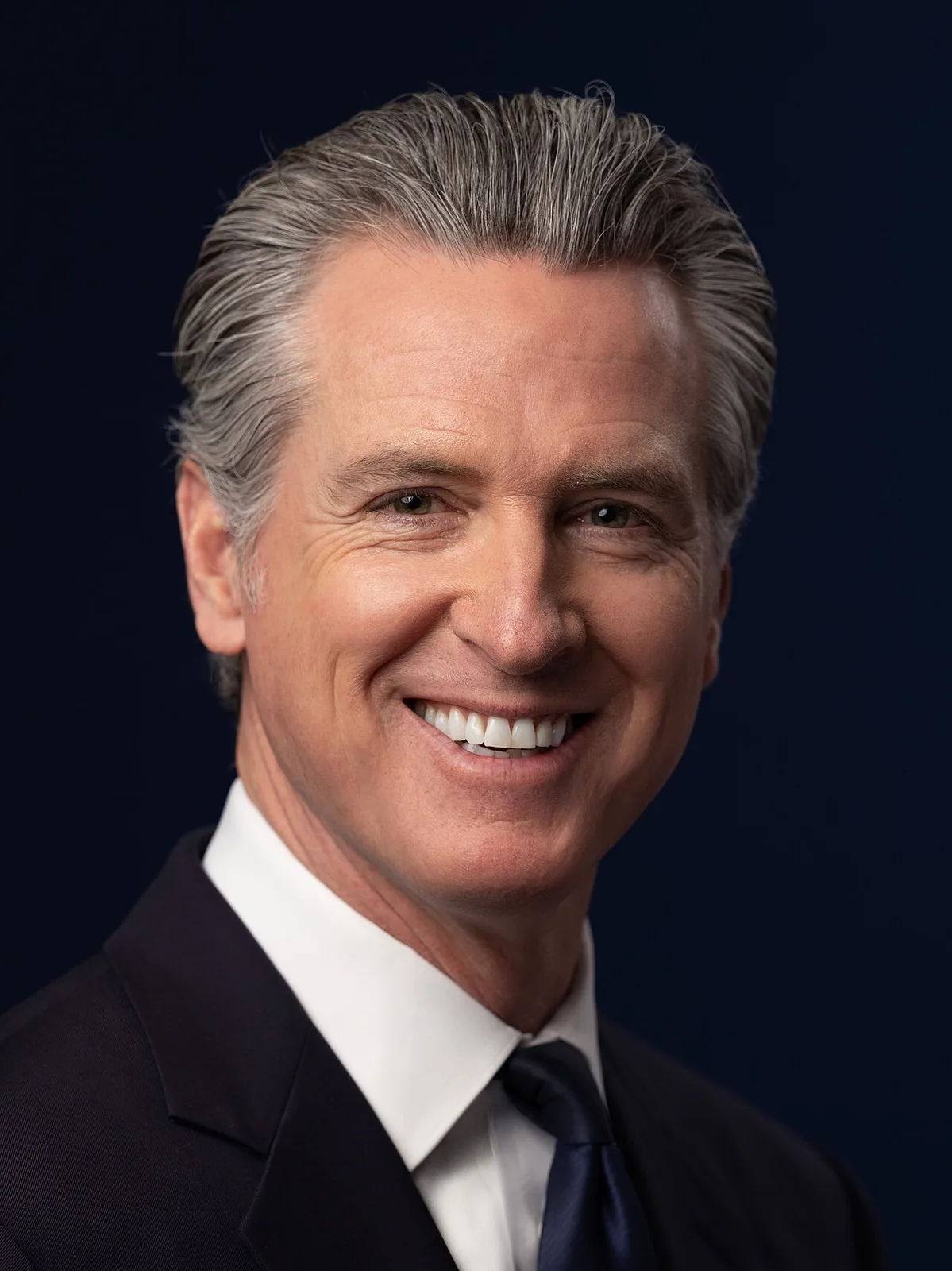
Gavin Newsom
- Party
- Democrat
- In Office Since
- January 7, 2019
- Elected
- 2018, re-elected 2022
- Term Ends
- January 2027
- Born
- October 10, 1967, San Francisco, California
- Prior Role
- Lieutenant Governor (2011-2019)
Gavin Newsom is the 40th Governor of California. A former Mayor of San Francisco, he is known for progressive policies on climate, healthcare, and social issues.
Other Current State Officials
Attorney General
Rob Bonta
In office since 2021.
The California State Legislature
California State Senate
- Seats: 40 members
- Terms: 4-year terms
The upper chamber. California's 40 senators each represent roughly 1 million constituents, the largest state senate districts in the country. Odd-numbered districts hold elections in presidential years; even-numbered in midterms.
California State Assembly
- Seats: 80 members
- Terms: 2-year terms
The lower chamber. California's lower house is called the Assembly, not the House of Representatives. It is a full-time professional legislature with substantial staff resources. All 80 seats are on the ballot every two years.
California's U.S. Senators
U.S. Senator
Alex Padilla
Former California Secretary of State. Appointed to the Senate in 2021 and elected in 2022. Focuses on immigration, climate, and tech policy.
U.S. Senator
Adam Schiff
Elected in November 2024 to the seat long held by Dianne Feinstein, winning both the special election for the final weeks of her term and the full six-year term; he took office on December 9, 2024. Schiff served 24 years in the U.S. House, where he chaired the Intelligence Committee. Laphonza Butler, a former labor leader appointed after Feinstein's death in 2023, held the seat until then.
California Through the Years
From early settlement to the present day. Tap any era to read more.
Home to over 100 distinct Indigenous tribes with rich cultures dating back thousands of years.
California is believed to have had one of the highest population densities and greatest linguistic diversity of any region in pre-contact North America, with well over 100 distinct Indigenous languages spoken across the area that is now the state.
Spanish missionaries built 21 missions along the coast between 1769 and 1823, and the system devastated Native California: Indigenous people were forced into the missions, and disease, forced labor, and violence cut the Native population from an estimated 300,000 before contact to about 150,000 by the 1840s.
Statehood made it far worse. California's first governor called in 1851 for 'a war of extermination,' the state paid bounties for Native scalps and funded militia campaigns, and by 1900 the Native population had fallen to roughly 15,000. In 2019 Governor Newsom formally apologized on behalf of the state and called it a genocide.
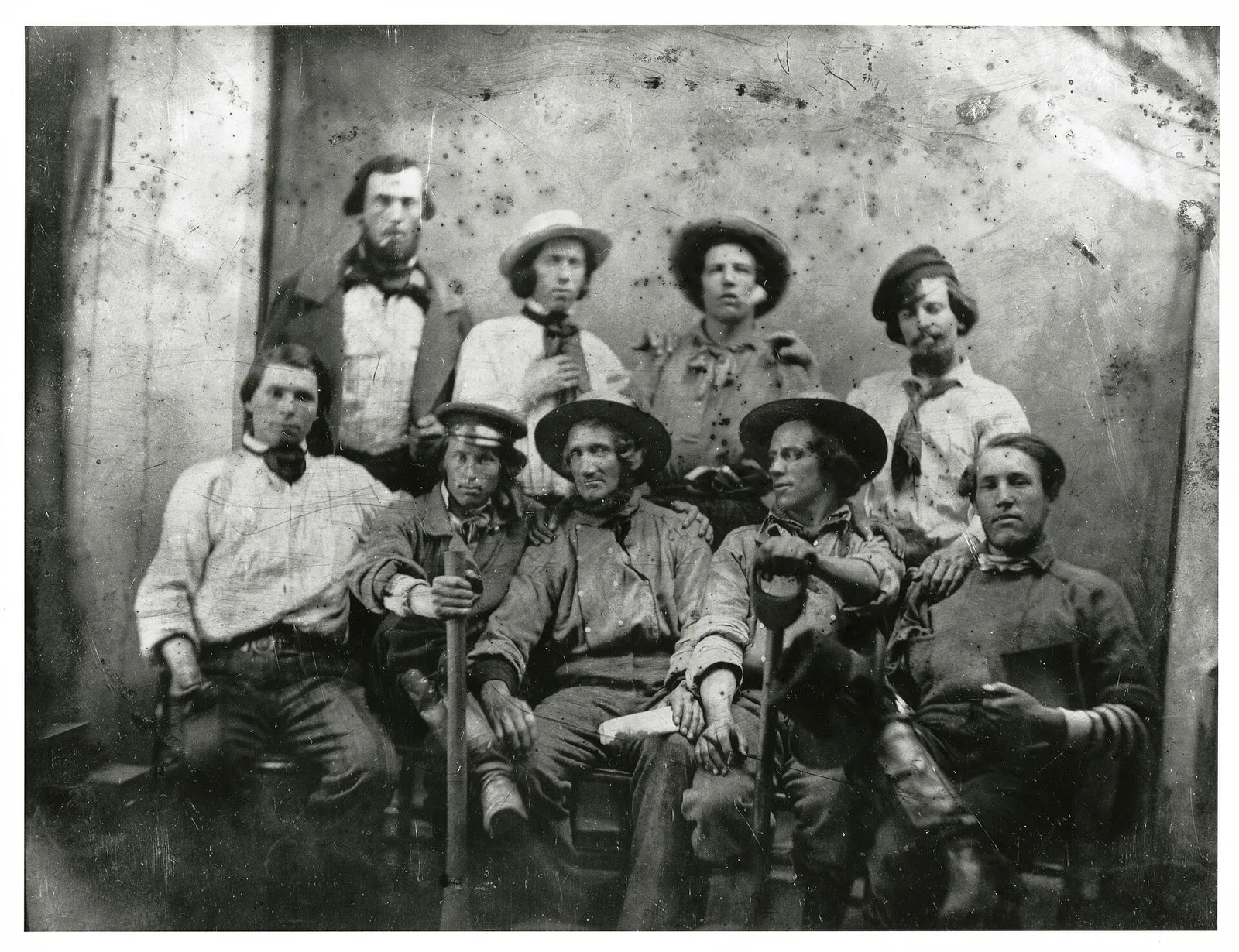
The discovery of gold at Sutter's Mill triggered one of the largest migrations in American history.
San Francisco's population exploded from roughly 1,000 residents in 1848 to an estimated 25,000 by 1850, as prospectors from across the world, including China, Latin America, and Europe, converged on the region. The rapid influx of people and wealth helped California skip territorial status entirely and enter the Union directly as a state in 1850.
Gold was found at Sutter's Mill in January 1848, nine days before the treaty that ended the Mexican-American War handed California to the United States. Roughly 300,000 people arrived over the next seven years, from the eastern U.S., Chile, Mexico, China, Australia, and Europe, in one of the largest voluntary migrations in world history.
The rush was catastrophic for others. Hydraulic mining washed billions of tons of debris into the rivers and buried farmland downstream until courts banned the practice in 1884. A 'foreign miners' tax' targeted Chinese and Latin American prospectors, and vigilante violence drove many off their claims; most of the gold ended up with a small number of merchants and companies, and most individual miners left broke.
California becomes the 31st state, admitted during the Compromise of 1850.
California's admission as a free state was part of the broader Compromise of 1850, a package of laws negotiated in Congress that also included a stronger Fugitive Slave Act, an attempt to balance the political interests of free and slave states in the years before the Civil War.
California skipped the territorial stage entirely: its Gold Rush population wrote a constitution at Monterey in 1849 and applied directly for statehood as a free state, upending the balance of 15 free and 15 slave states. The Compromise admitted California in exchange for the tougher Fugitive Slave Act and a promise that other territories could decide slavery for themselves.
Despite entering free, early California allowed a form of Indian indentured servitude until the 1860s and barred Black residents from testifying against whites in court. Its politics stayed split between pro-slavery and antislavery factions until the 1859 Broderick-Terry duel, in which a sitting U.S. senator was killed by the state's former chief justice, broke the pro-slavery hold.
Devastating earthquake and fire destroyed much of San Francisco, leading to major advances in building codes.
The 1906 disaster killed an estimated 3,000 people and destroyed more than 80 percent of San Francisco, making it one of the deadliest natural disasters in American history. The fires that followed the quake, fed by ruptured gas lines, caused far more destruction than the shaking itself.
The magnitude 7.9 quake struck at 5:12 a.m. on April 18, 1906, rupturing nearly 300 miles of the San Andreas Fault. City officials understated the death toll for years to protect real estate values; more than half of the city's 400,000 people were left homeless, and troops dynamited whole blocks to make firebreaks, which often spread the flames instead.
The unplanned rebuild was fast, and it made San Francisco a laboratory for earthquake science; the official 1906 investigation produced the 'elastic rebound' theory of how faults store and release energy. The disaster also pushed the insurance industry, and later the state, toward the building codes and retrofit rules that shaped California cities for the next century.
Haight-Ashbury, the Summer of Love, and the birth of Silicon Valley define modern California identity.
An estimated 100,000 young people converged on San Francisco's Haight-Ashbury neighborhood during the 1967 'Summer of Love,' a defining moment of 1960s counterculture. In the same era, the semiconductor industry that would define Silicon Valley began taking root nearby, setting the stage for the personal computer revolution of the following decade.
The decade also made California the center of American protest and reaction: the Free Speech Movement at Berkeley in 1964, the Black Panther Party founded in Oakland in 1966, the farmworkers' movement led by Cesar Chavez and Dolores Huerta from Delano, and Ronald Reagan's 1966 election as governor on a promise to crack down on campus unrest, which launched his path to the presidency.
The tech thread ran alongside it. Fairchild Semiconductor's founders left to start Intel and dozens of other companies, ARPANET's first message was sent from UCLA in 1969, and the Homebrew Computer Club, where Steve Wozniak showed off an early Apple design, met on the Peninsula in the mid-1970s. The hippie and hacker cultures are often credited together with shaping the personal-computer industry's ideals.
California's Defining Moments in American History
These are the events that didn't just shape California, they changed the nation.
The 1849 Gold Rush accelerated westward expansion and helped transform California into an economic powerhouse.
The wealth generated by Gold Rush-era mining helped finance California's early state government and infrastructure ambitions, even though the state remained physically disconnected from the rest of the country by rail until the transcontinental railroad's completion in 1869.
The rush pulled the young United States toward the Pacific and made a transcontinental railroad a national priority; when the line was joined at Promontory, Utah, in 1869, much of the westbound track had been laid by thousands of Chinese laborers recruited to California. Gold Rush merchant fortunes, Stanford, Crocker, Huntington, Hopkins, went on to found the railroads, banks, and universities of the modern West.
It set California's political character: a boomtown willingness to remake institutions fast, a diverse population from the start, and a long habit of turning that diversity into scapegoating during downturns, from the anti-Chinese violence of the 1870s to the Chinese Exclusion Act of 1882, which California's congressmen led.
From Hewlett-Packard's garage to today's tech giants, California has been at the center of the information age.
Intel, founded in Santa Clara in 1968, released the first commercially successful microprocessor, the 4004, in 1971. Five years later, Steve Jobs and Steve Wozniak founded Apple in a Los Altos garage, helping launch the personal computer industry that came to define the region.
The region's roots go back to Hewlett-Packard, founded in a Palo Alto garage in 1939, and to a Cold War pipeline of federal money: the Pentagon and NASA bought the first integrated circuits, funded Stanford's research, and seeded the defense-electronics firms around the bay. Venture capital, concentrated on Sand Hill Road in Menlo Park, later replaced the government as the main source of startup funding.
Silicon Valley now sets the terms of the global information economy, from the iPhone to cloud computing to social media and, most recently, the large AI models built in San Francisco. That power has brought antitrust suits, congressional hearings over privacy and speech, and debate over whether a handful of California companies should have so much control over what people see and buy.
The global influence of California’s entertainment industry is unmatched.
The first Academy Awards ceremony was held in Hollywood in 1929, and the annual event has since become the film industry's most watched global broadcast. American movies and television remain among the country's most visible cultural exports, generating billions of dollars in international box office and streaming revenue each year.
The studio system Hollywood built in the 1920s through the 1940s, a handful of vertically integrated majors that owned the studios, the stars, and the theaters, was broken up by the Supreme Court's 1948 Paramount decision, which forced the studios to sell their theater chains. Television, home video, and streaming each reshaped the business again, but the creative and financial center stayed in Los Angeles.
American film and television still run a services trade surplus in the tens of billions of dollars, and Hollywood's images have shaped how the rest of the world pictures the United States for a century. The 2023 strikes, and the fight over AI-generated performances and writing, were largely about who benefits from that reach as the industry consolidates.
Notable Californians
John Muir
Naturalist and conservationist who championed Yosemite and co-founded the Sierra Club
Ronald Reagan
40th President of the United States and former Governor of California
Marilyn Monroe
Iconic actress and cultural symbol of the 20th century, born in Los Angeles
Steve Jobs
Co-founder of Apple and visionary who transformed computing, music, and mobile phones
Kamala Harris
First female, first Black, and first South Asian Vice President, born in Oakland
John Steinbeck
Nobel Prize-winning author of The Grapes of Wrath, born in Salinas
State Symbols & Quick Facts
| Nickname | "The Golden State" |
| Capital | Sacramento |
| Largest City | Los Angeles |
| Statehood | September 9, 1850 (31st state) |
| Population | ~39.2 million (2025 est.), largest state |
| Area | 163,696 sq mi, 3rd largest state |
| Motto | Eureka (I Have Found It) |
| State Bird | California Quail |
| State Flower | California Poppy |
| State Tree | California Redwood |
| State Animal | California Grizzly Bear |
| State Fish | Golden Trout |
| State Song | "I Love You, California" |
| Time Zone | Pacific Time (UTC−8 / UTC−7) |
| Borders | Oregon (N), Nevada & Arizona (E), Mexico (S), Pacific Ocean (W) |
Did You Know?
California has the world's largest tree by volume, the General Sherman sequoia.
If California were a country, its roughly $4 trillion economy would rank about fourth or fifth in the world.
The state is home to more national parks than any other state.
Death Valley is the hottest place on Earth, while nearby mountains have snow year-round.
California produces over 80% of the world's almonds.
Quick Facts and Common Questions
Short answers to the questions people most often ask about California: its abbreviation, how it became a state, its capital, and its place in Congress.
California's two-letter postal abbreviation is CA. The U.S. Census Bureau places it in the West region, in the Pacific division. About 39.5 million people lived there in the 2020 census, the most of any state.
California became the 31st state on September 9, 1850, as part of the Compromise of 1850, which admitted it as a free state. It was never organized as a U.S. territory; it went from military government straight to statehood after the Gold Rush brought a flood of new residents.
California was part of Mexico until the Mexican-American War. Under the Treaty of Guadalupe Hidalgo, signed in February 1848, Mexico ceded California to the United States, just days after gold was discovered at Sutter's Mill in January 1848.
The name comes from a fictional island ruled by a Queen Calafia in "Las sergas de Esplandián," a Spanish novel by Garci Rodríguez de Montalvo published around 1510. Spanish explorers applied the name to the Baja California peninsula in the 1530s, and it later spread north.
Sacramento has been the capital since 1854. In the state's first years the legislature met in San Jose, Vallejo, and Benicia before settling in Sacramento. The current State Capitol was completed in 1874.
California borders three states: Oregon to the north, Nevada to the east, and Arizona to the southeast across the Colorado River. To the south it borders the Mexican state of Baja California, and its entire western side is Pacific Ocean coastline.
California has the largest population of any state, but it is the third-largest by area, after Alaska and Texas. If it were a country, its economy would rank among the largest in the world.
California is known as "The Golden State," for the Gold Rush and its golden poppy fields. Its motto is "Eureka," Greek for "I Have Found It." Its state bird is the California quail, its flower is the California poppy, and its tree is the California redwood.
Based on the 2020 census, California has 52 seats in the U.S. House of Representatives, down from 53, the first time in its history the state lost a seat. That gives it 54 votes in the Electoral College, the most of any state.
Yosemite National Park
Granite Cathedrals, Ancient Sequoias, and the Valley That Changed Conservation
About Yosemite National Park
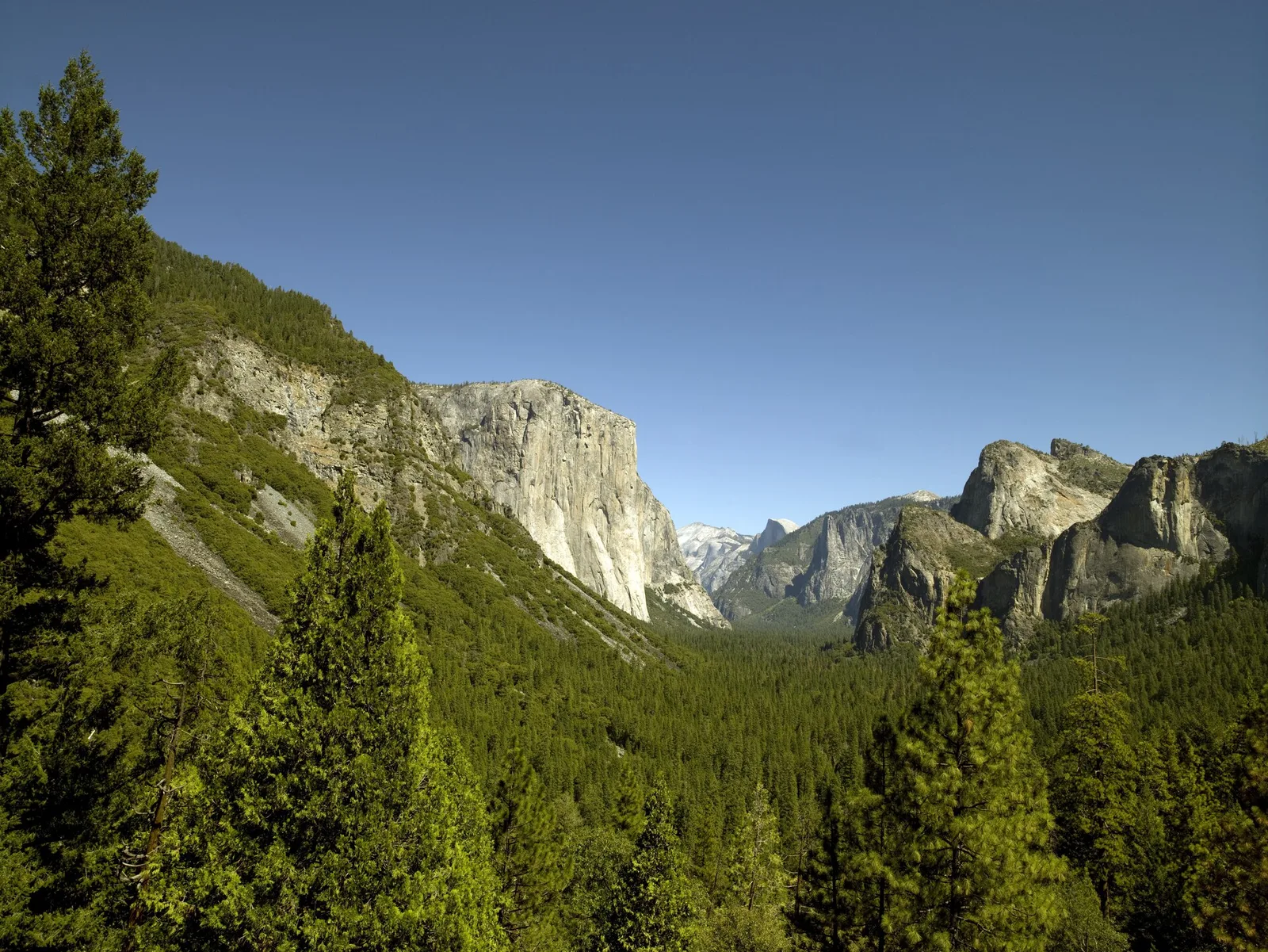
Yosemite National Park spreads across nearly 750,000 acres of the Sierra Nevada in central California, from the 4,000-foot floor of Yosemite Valley to peaks above 13,000 feet on the crest. Its centerpiece is the seven-mile valley, walled by El Capitan, a roughly 3,000-foot granite monolith, and closed at its head by Half Dome.
On June 30, 1864, in the middle of the Civil War, President Lincoln signed the Yosemite Grant, handing the valley and the Mariposa Grove to California to be preserved 'for public use, resort, and recreation.' It was the first time the federal government set land aside purely for preservation, and it became a model for the national park idea.
Congress created the surrounding national park on October 1, 1890, after a campaign by John Muir and Century magazine editor Robert Underwood Johnson. The state-held valley and grove were not folded into the federal park until 1906, three years after Muir camped for three nights with President Theodore Roosevelt on the valley rim.
Yosemite now draws close to four million visitors a year, and Ansel Adams's photographs made its granite and light familiar worldwide. That fame is also the park's central management problem, from valley gridlock to the peak-season entry reservations first imposed in 2020.
- Designation
- National Park, UNESCO World Heritage Site
- Location
- Sierra Nevada, Central California
- Established
- 1890
- Annual Visitors
- ~3.7 million
Yosemite's Iconic Features
The seven-mile valley was deepened by a series of glaciers that pushed through the Sierra over the past roughly one million years, the last of them, the Tioga glaciation, ending about 15,000 years ago.
When the ice melted it left a moraine that dammed the Merced River into ancient Lake Yosemite. The lake filled with sediment, which is why the valley floor is so unusually flat and level at 4,000 feet.
The walls rise as much as 3,000 feet in near-vertical granite: El Capitan and the Three Brothers on the north, Cathedral Rocks and Bridalveil on the south, Half Dome and Glacier Point at the head.
Glaciers cut the valley's U-shape and steep walls, but the rounded domes above it were shaped by exfoliation, curved sheets of rock peeling off like the layers of an onion as erosion released the pressure on them.
Yosemite's granite formed from bodies of magma that rose into the crust and cooled slowly several miles down between about 115 and 85 million years ago; erosion later stripped away the miles of rock that had covered them.
El Capitan Granite is among the oldest and most uniform rock in the valley, part of why its 3,000-foot southwest face is the world's benchmark big-wall climb.
Warren Harding, Wayne Merry, and George Whitmore made the first ascent of El Capitan's Nose route on November 12, 1958, after some 18 months of siege-style effort. The first one-day ascent came in 1975, and the speed record is now under two hours.
On June 3, 2017, Alex Honnold climbed the Freerider route with no rope in 3 hours 56 minutes, the first free solo of El Capitan; the film 'Free Solo' won the 2019 Academy Award for best documentary feature.
The Mariposa Grove holds about 500 mature giant sequoias, the largest trees on Earth by wood volume, some of them more than 2,000 years old.
The Grizzly Giant, roughly 209 feet tall and about 27 feet across at the base, is the grove's largest and one of the oldest sequoias anywhere; its lowest big limb is thicker than the trunk of most other trees in the forest.
The famous drive-through Wawona Tunnel Tree, cut in 1881, stood until it toppled under a heavy snow load in 1969, and the Park Service has never cut another.
A roughly $40 million restoration completed in 2018 tore out a parking lot, tram road, and gift shop that sat among the roots, restoring the springs and meadows that the shallow-rooted trees depend on.
Yosemite Falls drops 2,425 feet in three steps, an upper fall of 1,430 feet, a middle cascade, and a lower fall of 320 feet, making it the tallest waterfall in North America.
Every major fall in the valley is fed by snowmelt, so flow peaks in May and June and many of them, Yosemite Falls included, slow to a trickle or stop entirely by August.
For decades a man-made 'firefall' of burning embers was pushed nightly off Glacier Point above the valley; the Park Service ended it in 1968 as a spectacle out of keeping with a national park.
Its natural replacement is Horsetail Fall on El Capitan, which for about two weeks each February can glow orange at sunset when the low light catches the water just right, now a major photography draw.
Indigenous Connections
Ahwahnechee (Miwok and Paiute Peoples)
The Ahwahnechee, mainly Southern Sierra Miwok with Mono Lake Paiute ties, lived in Yosemite Valley for centuries and called it Ahwahnee, 'place of a gaping mouth.' They kept the valley's open meadows and black oak stands with regular controlled burning, creating the very scenery that later drew painters and tourists.
In March 1851 the state-authorized Mariposa Battalion under James Savage entered the valley during the Mariposa War, burned villages and acorn stores, and drove the people to a reservation on the Fresno River. It was a battalion member, Lafayette Bunnell, who applied the name 'Yosemite.'
Chief Tenaya's band returned but was attacked again in 1853. Ahwahnechee families kept living and working in the valley into the 20th century, in a village near the present museum that the Park Service finally demolished in 1969.
The Ahwahnechee were forcibly removed from the valley during the Mariposa War of 1850-1851. Some descendants returned and lived in the park until the NPS removed the last residents in the mid-20th century. The NPS now recognizes this history and has worked to restore cultural connections, including replanting traditional black oak acorn gardens.
Southern Sierra Miwuk Nation
The wider Miwok world stretched across the Sierra foothills and the edge of the Central Valley; the Ahwahnechee were its easternmost group, trading acorns, obsidian, and salt across the crest with Mono Lake Paiute relatives.
Descendants organized as the Southern Sierra Miwuk Nation and have sought federal recognition for decades. Though not yet recognized, the tribe works formally with the Park Service on the valley's cultural sites.
Since the 1990s the tribe has been rebuilding the Wahhoga village site near Camp 4 in Yosemite Valley, including a traditional cedar-bark roundhouse for ceremonies.
Several Miwok tribal groups in California maintain federal recognition and continue cultural practices tied to the Sierra Nevada region. The NPS consults with these tribes on archaeological sites, cultural landscapes, and traditional ecological knowledge.
Top Yosemite Experiences
Half Dome Cable Route
The Half Dome hike runs 14 to 16 miles round trip with about 4,800 feet of climbing, and most people take 10 to 14 hours to reach the 8,839-foot summit and return.
The last 400 feet up the dome's shoulder are climbed by holding a pair of steel cables strung on posts, which the Park Service puts up in late spring and takes down in October.
George Anderson first reached the summit in 1875 by drilling a line of iron eyebolts up the bare rock; the Sierra Club installed the first cables in 1919.
Since 2010 a permit obtained by lottery has been required for the cables, capping use at about 300 people a day after years when far more crowded the route and waited in exposed lines.
Valley Floor Loop
A mostly flat paved path and a few quiet roads form an 11.5-mile loop around the valley floor, past Yosemite Village, El Capitan Meadow, and Valley View on the Merced River.
Bicycles rented in the valley are the easiest way to ride it, and the loop connects to the free valley shuttle at several stops for a shorter one-way trip.
It passes directly beneath El Capitan, where climbers and their haul bags are often visible on the wall through binoculars, and through the meadows that give the classic ground-level views of Half Dome.
Because it stays on the floor, the loop is snow-free and open far more of the year than the rim trails, and much of it is wheelchair accessible.
Mist Trail to Nevada Fall
The Mist Trail climbs steeply from Happy Isles past Vernal Fall and on to the top of Nevada Fall, about 6.4 miles round trip with 1,900 feet of gain.
It is named for the spray off 317-foot Vernal Fall, which soaks hikers on the granite staircase, more than 600 steps, cut into the cliff right beside the water.
These are the first miles of the John Muir Trail and the standard approach to Half Dome and the High Sierra beyond.
In spring the steps are slick and the Merced runs high and fast; people drown most years after wading or slipping in above the falls, and railings and warning signs mark the worst spots.
Conservation Challenges
Overcrowding and Reservation System
Close to four million people visit Yosemite each year, the great majority crowding into the seven-square-mile valley, where summer traffic can back up for miles and parking fills by mid-morning.
The Park Service first required peak-season day-use reservations in 2020 during the pandemic and has run some version of the system most years since, testing timed entry as a lasting tool.
A free shuttle-bus network, bike rentals, and out-of-valley parking are meant to cut car trips, but demand still outstrips roads that were largely built in the 1930s.
Long-range plans going back to the 1980 General Management Plan have called for pulling some lodging, parking, and roads off the valley floor; progress has been slow and repeatedly litigated.
Wildfire Risk and Management
A century of putting out every fire left Yosemite's mid-elevation forests choked with small trees and brush, primed to burn hot.
The park now sets prescribed fires and lets some lightning fires in the backcountry burn, work that began here in the 1970s and made Yosemite a national leader in restoring fire to sequoia groves.
The 2013 Rim Fire burned more than 250,000 acres, including about 77,000 in the park, and the 2018 Ferguson Fire closed the valley for nearly three weeks in peak season.
The 2022 Washburn Fire started inside the Mariposa Grove; sprinklers set up around the Grizzly Giant, plus years of earlier thinning and burning, are credited with saving the big trees.
Air Quality and Sierra Nevada Ecosystem
Ozone drifting up from California's Central Valley regularly pushes Yosemite's summer air into unhealthy ranges, scarring the needles of ponderosa and Jeffrey pines and hazing the long views.
The 2012 to 2016 drought, the worst in the state's recorded history, helped kill an estimated 129 million trees across the Sierra as bark beetles overwhelmed weakened pines.
Warmer winters are shrinking the Sierra snowpack that feeds the park's rivers and waterfalls, shifting peak runoff earlier and stretching out the dry, fire-prone late summer.
Researchers track these shifts at long-term plots in the park, and Yosemite is a core site for Sierra-wide monitoring of forests, shrinking glaciers, and the rare Sierra Nevada red fox.
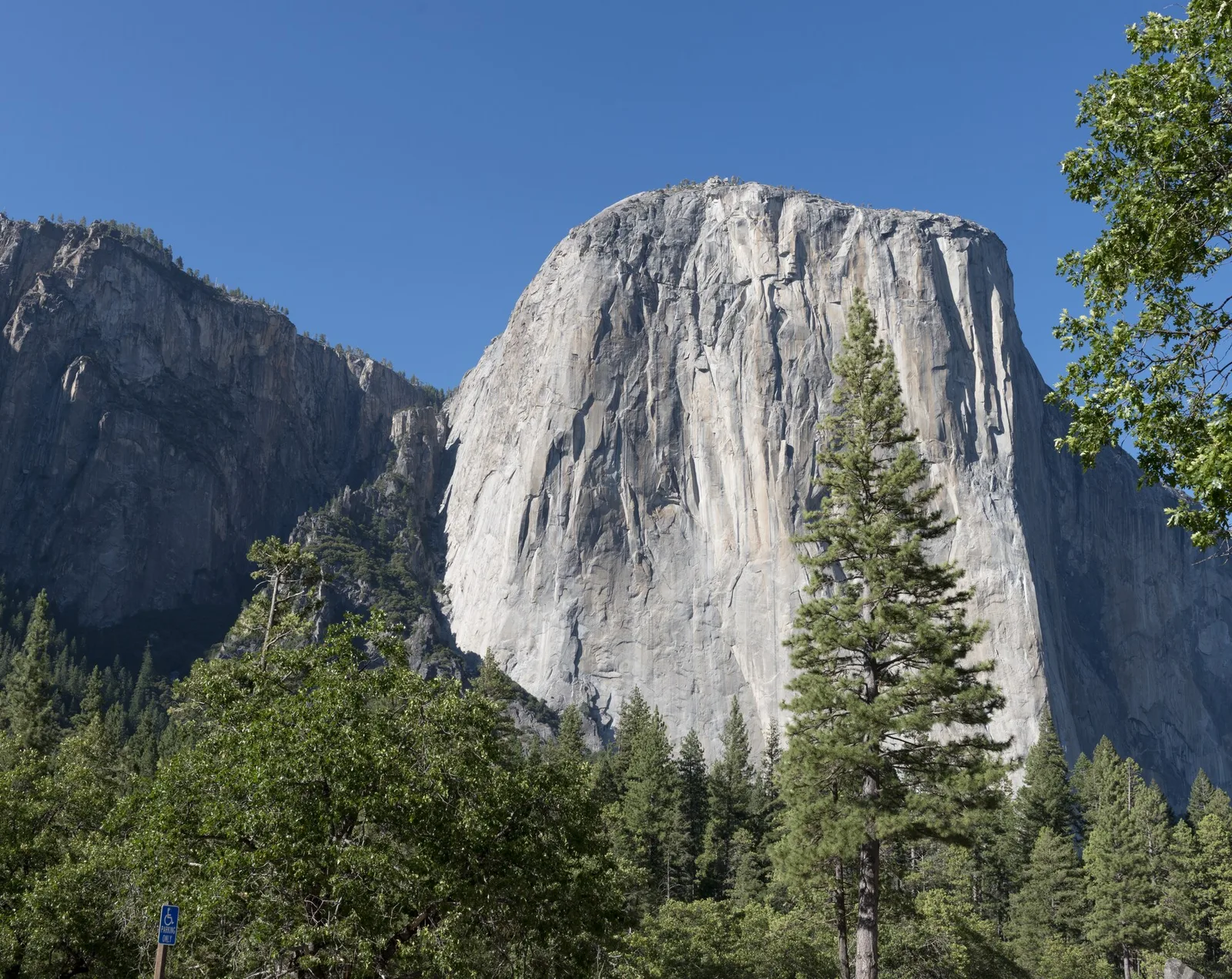
El Capitan, the largest granite monolith in North America at 3,000 feet
At a Glance
Did You Know?
Alex Honnold's 2017 free solo ascent of El Capitan's Freerider route took 3 hours and 56 minutes and is considered the greatest climbing achievement in history. The feat was documented in the Academy Award-winning film 'Free Solo.'
Photographer Ansel Adams spent decades photographing Yosemite and his black-and-white images helped build public support for wilderness preservation across the United States.
The giant sequoias in Mariposa Grove can only reproduce after fire, which opens their cones and clears the forest floor so seedlings can germinate. The NPS's restoration of prescribed fire has dramatically improved sequoia regeneration.
Yosemite Valley floor sits at only 4,000 feet elevation, but the park's high country reaches over 13,000 feet, creating dramatically different ecosystems within the same park boundaries.
Plan Your Visit
Location
Sierra Nevada, Central California
Designation
National Park, UNESCO World Heritage Site
Best Time to Visit
Spring (May-June) for peak waterfalls; fall for fewer crowds and golden light
Admission
$35 per vehicle (valid 7 days); day-use reservations required in peak season