About North Carolina
North Carolina takes its name from the Province of Carolina, which was granted by King Charles II of England in 1663 to eight of his political allies, known as the Lords Proprietors, as a reward for their support during his restoration to the throne. The name Carolina is derived from 'Carolus,' the Latin form of the name Charles, honoring the king. The original Province of Carolina was a vast grant covering territory from present-day Virginia south to Florida. The northern and southern portions developed separately and were formally divided into two distinct colonies in 1712. North Carolina became a royal colony in 1729 when the proprietors surrendered their charter.
North Carolina is a state of extraordinary contrasts and outsized historical consequence. Within its borders you find the second-largest banking center in the United States, one of the world's premier research and technology ecosystems, the oldest public university in the nation, the birthplace of powered flight, and the spark that ignited the modern Civil Rights Movement, all coexisting with a vast rural interior where sweet potato and hog farms spread across flat coastal plain land little changed from the 19th century, and mountain communities whose isolation has preserved cultures and crafts that disappeared elsewhere generations ago.
The state stretches 560 miles from the Atlantic coast to the Tennessee border, climbing from sea level at the Outer Banks to 6,684 feet at Mount Mitchell, the highest peak east of the Mississippi River. Between those two extremes lie the Piedmont's urban crescent (Charlotte, Greensboro, Raleigh), the Research Triangle's world-class universities and laboratories, and the broad coastal plain that remains North Carolina's agricultural and demographic heartland even as the cities grow.
North Carolina's motto, Esse Quam Videri, To Be Rather Than To Seem, captures something real about the state's character. It has rarely been flashy or self-promoting. Its achievements tend to be structural: a research park conceived in the 1950s that took decades to mature, a banking law change in the 1980s that quietly allowed national expansion, a lunch counter sit-in in 1960 that students described as ordinary moral obligation. North Carolina has shaped America repeatedly by doing things rather than claiming to.
North Carolina's Five Regions
Western North Carolina is defined by the Blue Ridge and Unaka ranges of the Appalachian Mountain system, a landscape of remarkable scenic beauty and ecological diversity that stands in vivid contrast to the flat coastal plain 500 miles to the east. Mount Mitchell, at 6,684 feet, is the highest peak east of the Mississippi River, part of the Black Mountain sub-range that includes six of the ten highest peaks in the eastern United States, all in North Carolina.
The mountain region's largest city, Asheville, has transformed from a tuberculosis resort town of the late 19th century (its dry mountain air drew the wealthy and the sick alike, including Thomas Wolfe, who was born there, and the Vanderbilt family, who built the Biltmore Estate there in 1895) into one of the most economically dynamic and culturally distinctive small cities in America. The surrounding mountains support a year-round outdoor economy: skiing at Beech Mountain, Cataloochee, and Sugar Mountain; white-water rafting on the Nantahala and Nolichucky rivers; hiking the Appalachian Trail (which enters North Carolina from Tennessee and passes through some of the most remote and challenging terrain on the entire 2,190-mile trail); and fly fishing in some of the best trout streams in the East.
The Great Smoky Mountains National Park, shared with Tennessee, is the most visited national park in the United States, drawing over 12 million visitors annually, primarily through the North Carolina gateway town of Cherokee, which is also the seat of the Eastern Band of Cherokee Indians, a sovereign tribal nation that has operated the Harrah's Cherokee Casino since 1997.
The mountains have long been a region apart, poorer, more isolated, and historically home to a subsistence-farming, small-landholding white population very different from the plantation east, along with the Cherokee. Highway and railroad access came late, the last stretch of the Blue Ridge Parkway around Grandfather Mountain opened only in 1987, and the region's economy leaned on timber, then tourism, then, in the coves and hollows, on a serious methamphetamine and later opioid problem that gave several far-western counties among the highest overdose rates in the state.
In late September 2024, Hurricane Helene stalled over the southern Appalachians and dropped more than two feet of rain on already-saturated ground, sending the French Broad, Swannanoa, Pigeon, and Nolichucky rivers to record crests that destroyed roads, water systems, and whole neighborhoods; the storm killed over 100 people in western North Carolina, was the deadliest natural disaster in modern state history, and left Asheville without running water for weeks, forcing a slow, expensive rebuild that is reshaping the region's economy and settlement patterns.
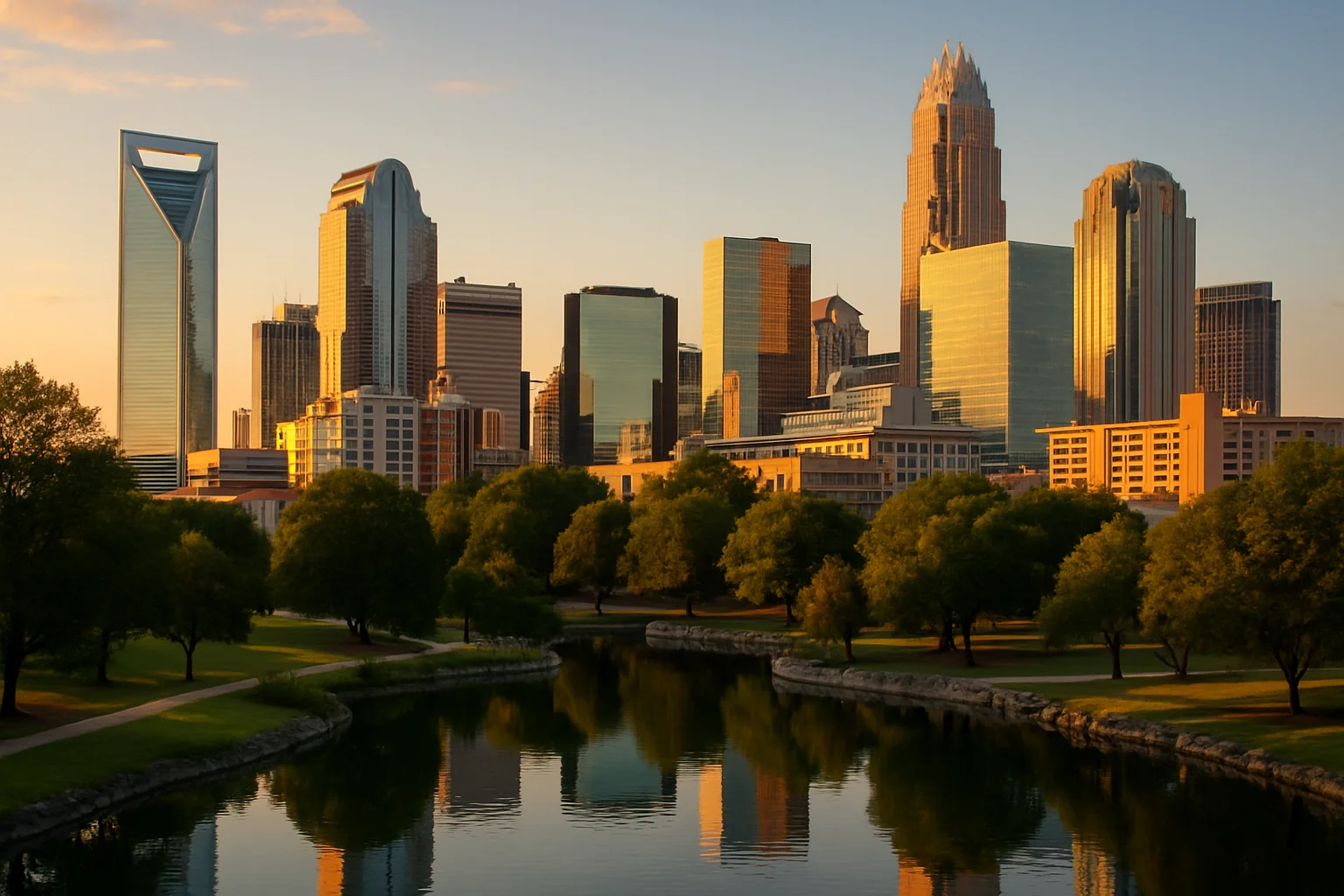
The North Carolina Piedmont, the rolling plateau between the mountains and the coastal plain, contains the state's urban and industrial core: a crescent of cities running from Charlotte in the southwest through Greensboro, Winston-Salem (the Triad), and High Point to Raleigh in the northeast. Charlotte, the state's largest city at over 900,000 people (metropolitan area nearly 2.7 million), has grown from a mid-sized regional commercial center in the 1970s into a major American city driven by banking, healthcare, and the business services economy. Its uptown skyline, nearly nonexistent before 1990, now rivals those of much larger Sunbelt cities.
The Triad region, Greensboro, Winston-Salem, and High Point, reflects an older industrial economy in transition: Winston-Salem was the headquarters of R.J. Reynolds Tobacco Company for most of the 20th century, and the ghost of the tobacco economy (the abandoned factory buildings, now converted to arts and residential uses, the Wake Forest Baptist Medical Center that grew on RJR philanthropy) shapes the city still. High Point, the furniture capital, hosts the biannual High Point Market, the world's largest home furnishings trade show.
Greensboro is defined by its civil rights history, the four Black students who sat down at the Woolworth's lunch counter on February 1, 1960 and refused to leave when denied service launched the sit-in movement that spread across the South and accelerated the Civil Rights Act, and by its universities and logistics economy. The Piedmont Triad International Airport, upgraded significantly in recent years, serves as a logistics hub.
The Piedmont was the industrial engine of the New South: textile mills lined the fall-line rivers around Gastonia, Kannapolis, and Burlington, making North Carolina the nation's leading textile state for most of the 20th century, and the 1929 Loray Mill strike in Gastonia, marked by the killing of the police chief and of the balladeer and union organizer Ella May Wiggins, was one of the era's most violent labor conflicts. Cannon Mills' company town of Kannapolis was later bought and, after the mills closed, redeveloped by the billionaire David Murdock into the North Carolina Research Campus for food and nutrition science.
Winston-Salem pairs its tobacco past, R.J. Reynolds, maker of Camel cigarettes, and the merged conglomerate RJR Nabisco whose 1988 leveraged buyout inspired the book 'Barbarians at the Gate,' with Wake Forest University and its medical school, a regenerative-medicine institute, and a downtown 'Innovation Quarter' built in old Reynolds factory buildings. Charlotte, meanwhile, has repeatedly landed and lost pro sports and conventions, and its 2016 fight with the state legislature over the 'bathroom bill' (House Bill 2) cost the state an estimated 3.7 billion dollars in canceled events and business before a partial repeal.
The Research Triangle metropolitan area, anchored by Raleigh (the state capital and home of NC State University), Durham (home of Duke University and a vibrant startup ecosystem), and Chapel Hill (home of UNC and one of the most educated small cities in the country), is one of the most economically dynamic regions in the United States and has been among the fastest-growing for two decades. Raleigh, the state capital since 1792, has grown from a planned legislative city of modest aspirations into a tech-forward metropolis of nearly 500,000 (metropolitan area 1.4 million) where the state government, NC State University, and a thriving downtown hospitality economy coexist with the technology economy centered on the Research Triangle Park to the south.
Durham, long dismissed as a declining tobacco city, has become one of the most celebrated urban turnaround stories in America: the conversion of the American Tobacco Historic District (the former Lucky Strike factory) into restaurants, offices, and entertainment venues; the success of the Durham Bulls minor league baseball team (immortalized in the 1988 film Bull Durham); and the growth of Duke and a startup culture that has produced multiple billion-dollar companies have transformed the city's self-image and economic trajectory. Chapel Hill and Carrboro, the progressive academic community surrounding UNC, form a distinct enclave within the Triangle, smaller, slower, more politically radical, and home to one of the most storied basketball programs in college sports.
The annual Duke-UNC basketball rivalry, played in Cameron Indoor Stadium and the Dean E. Smith Center, is one of the most intense in American sports.
The Triangle has been one of the fastest-growing metro areas in the country for two decades, adding hundreds of thousands of residents since 2010, many of them college-educated arrivals from the Northeast and California drawn by tech and pharma jobs and lower housing costs; the growth has strained roads, schools, and water supply, made once-cheap Durham and Raleigh neighborhoods expensive, and turned Wake County, long Republican-leaning, into a Democratic stronghold. The regional transit plan has struggled: a Durham-to-Orange County light-rail line collapsed in 2019 after Duke declined to sign on and costs ballooned past 3 billion dollars.
Raleigh was laid out from scratch in 1792 as a compromise capital, on land bought specifically for the purpose, because the coastal towns and the backcountry could not agree on an existing city; its grid of squares around the capitol is modeled on Philadelphia. The state government, the second-largest university (NC State, about 37,000 students), and the surrounding tech economy make the Raleigh area's job base unusually stable through recessions.
Eastern North Carolina, the vast flat coastal plain that constitutes roughly the eastern third of the state, is one of the most overlooked and economically challenged regions in America, a landscape of tobacco fields, hog farms, chicken houses, and small cities that has experienced decades of deindustrialization while the Research Triangle and Charlotte have boomed. The region was defined for 300 years by tobacco cultivation, the bright-leaf tobacco developed in Caswell County around 1839, cured with a new charcoal process that produced a milder, more aromatic leaf, became the dominant American cigarette tobacco and made North Carolina the nation's leading tobacco state for most of the 20th century.
The decline of smoking, the 1998 tobacco Master Settlement Agreement, and federal buyout of tobacco quotas in 2004 effectively ended the era of family tobacco farming, leaving communities from Wilson to Greenville to Rocky Mount to navigate an economic transition with limited resources. The region's largest city, Greenville (home of East Carolina University, whose medical school and Vidant Medical Center form the region's healthcare anchor), and Rocky Mount (the birthplace of Thelonious Monk and a railroad and pharmaceutical manufacturing center) have worked to build post-tobacco economies with mixed results.
The eastern Coastal Plain is also North Carolina's most diverse region demographically, with substantial Black, Latino, and Native American (particularly Lumbee) communities whose histories are intertwined with the region's agricultural and industrial economy.
Robeson County, on the South Carolina line, is home to the Lumbee Tribe, which at roughly 55,000 enrolled members is the largest Native American group east of the Mississippi and the largest tribe in the country without full federal recognition; a 1956 act of Congress recognized the Lumbee by name but explicitly barred them from Bureau of Indian Affairs services, and bills to grant full recognition have passed the U.S. House repeatedly without clearing the Senate. Robeson is one of the most racially tripartite counties in America, roughly split among Native, Black, and white residents.
Wilmington, the region's largest city and North Carolina's main deepwater port, was in 1898 the site of the only successful violent overthrow of a legitimately elected local government in U.S. history: a white-supremacist mob burned the Black-owned newspaper, killed dozens of Black residents, and forced the biracial city government to resign at gunpoint, an atrocity the state formally acknowledged only with a 2006 commission report. The port and the surrounding New Hanover County have since grown quickly on film, tourism, and a chemical industry, including the Chemours plant that discharged the 'forever chemical' GenX into the Cape Fear River, the drinking-water source for hundreds of thousands downstream.
North Carolina's Atlantic coastline is shaped by geography unlike anywhere else on the East Coast: the Outer Banks, a 200-mile chain of thin barrier islands that juts far out into the Atlantic before curving southward, creating the Pamlico Sound, the largest lagoonal estuary in the United States, between the islands and the mainland. This geography made the Outer Banks simultaneously a historic hazard to navigation (the shoals off Cape Hatteras have sunk over 1,000 ships, earning the region the name 'Graveyard of the Atlantic') and one of the most distinctive beach vacation destinations in the country.
Kitty Hawk and Kill Devil Hills, the villages on the northern Outer Banks where Orville and Wilbur Wright conducted their powered flight experiments, are among the most historically significant sites in America: the Wright Brothers National Memorial stands on the 90-foot dune from which the first powered, controlled airplane flight was made on December 17, 1903. Cape Hatteras National Seashore, the first national seashore established in the United States (1953), protects the central and southern Outer Banks, including the Cape Hatteras Lighthouse, the tallest brick lighthouse in North America at 198 feet, which was physically relocated 2,900 feet inland in 1999 as the shoreline eroded toward it.
The Crystal Coast, the section of mainland beaches and barrier islands south of the Outer Banks including Beaufort, Morehead City, and the Cape Lookout National Seashore, offers a less developed and quieter coastal experience, with the wild horse populations of the Shackleford Banks among its most celebrated attractions.
The barrier islands are held in place, for now, by NC Highway 12, a two-lane road repeatedly cut by storms at 'hot spots' like Rodanthe and the old Bonner Bridge site; the state spent about 250 million dollars on a replacement Oregon Inlet bridge that opened in 2019 and a 'jug-handle' bridge bypassing an unstable stretch in 2022, and geologists broadly agree the islands are migrating landward and that parts of the highway cannot be defended indefinitely. Ocracoke, reachable only by ferry, was heavily flooded by Hurricane Dorian in 2019.
Beneath the tourism, the coast keeps a working-waterfront economy of commercial fishing, shrimp and crab, out of Wanchese and the sounds, and Morehead City is a state port that ships wood pellets, phosphate from the Aurora mine (one of the largest phosphate operations in the country), and military cargo for Camp Lejeune. Blackbeard the pirate was killed in a 1718 battle off Ocracoke, and the wreck believed to be his flagship, the Queen Anne's Revenge, was found near Beaufort in 1996 and is still being excavated.

Economy
North Carolina's economy has undergone one of the most dramatic transformations of any American state over the past 50 years, from tobacco and textiles to banking, technology, and healthcare, while retaining a massive agricultural sector and a military presence that anchors entire regions of the state.
Bank of America, headquartered at 100 North Tryon Street with over $3 trillion in assets, is the second-largest bank in the US. Truist Financial, formed by the 2019 merger of BB&T and SunTrust, is also headquartered in Charlotte and ranks among the top ten US banks by assets. Wells Fargo's East Coast operational headquarters is in Charlotte.
This concentration of financial services has driven Charlotte's growth from 240,000 residents in 1980 to a metro area approaching 2.7 million today. Charlotte Douglas International Airport, now the sixth-busiest in the country and a major American Airlines hub, is both a product of and a driver of this financial growth.
Charlotte became a banking center largely through one man's ambition: Hugh McColl, who ran North Carolina National Bank and then NationsBank, exploited the gradual 1980s and 1990s relaxation of interstate-banking laws to make more than 100 acquisitions, culminating in the 1998 purchase of San Francisco's BankAmerica, after which the combined firm kept the Bank of America name but ran it from Charlotte. Wachovia, the other Charlotte banking giant, was itself acquired by Wells Fargo during the 2008 financial crisis after nearly failing.
The 2008 crisis exposed how concentrated the city had become: Charlotte lost tens of thousands of finance jobs, and Bank of America's near-collapse and forced absorption of Merrill Lynch and Countrywide required tens of billions in federal support. The city has since diversified toward fintech and back-office technology, with firms such as LendingTree (founded in Charlotte), Ally Financial, and Honeywell, which moved its headquarters to Charlotte in 2019.
Financial-services and insurance employment, plus the professional and technology services that support it, now underpins a metro economy that also includes the corporate headquarters of Lowe's (in nearby Mooresville), Duke Energy, Nucor (the largest U.S. steelmaker), and Sonic. Charlotte's uptown, essentially rebuilt since 1990, holds the tallest building in the Carolinas, the Bank of America Corporate Center.
The park hosts more than 300 companies employing approximately 65,000 workers and generating over $3 billion in annual payroll. IBM, GlaxoSmithKline, Cisco Systems, SAS Institute, and Red Hat (acquired by IBM for $34 billion in 2019) all have major presences here.
The strategy of leveraging NC State, Duke, and UNC Chapel Hill transformed a tobacco-dependent economy into a knowledge economy. Apple announced in 2021 it would build a campus in Research Triangle Park, its largest investment outside California.
Research Triangle Park covers about 7,000 acres, larger than many downtowns, and was deliberately built with no housing and no retail so it would read as a pure research campus; that design is now seen as a liability, and a 2010s master plan added a mixed-use center called Hub RTP to compete with walkable urban tech districts. IBM, which located a major facility there in 1965 and once employed more than 10,000 people at the site, gave the park its early credibility.
SAS Institute, founded on the NC State campus in 1976, grew into one of the largest privately held software companies in the world from a headquarters in Cary and became famous for its lavish employee perks, on-site health care, day care, and recreation, a model widely copied in the tech industry. Red Hat, the open-source software company, was founded in Raleigh in 1993 and bought by IBM in 2019 for about 34 billion dollars, the largest software acquisition in history at the time.
The Triangle's pharmaceutical presence, GSK, Biogen, Novo Nordisk, and dozens of contract manufacturers and clinical-research organizations, is among the densest in the country, a legacy of Burroughs Wellcome, which developed the first HIV drug AZT at its RTP labs in the 1980s. Apple's planned Research Triangle campus, announced in 2021 with a commitment of at least 1 billion dollars and 3,000 jobs, was later delayed but not canceled.
Fort Bragg near Fayetteville (named Fort Liberty from 2023 to 2025), home to the 82nd Airborne and Army Special Operations Command, is the largest military installation in the world by population with over 260,000 people. Camp Lejeune near Jacksonville is one of the largest Marine Corps bases in the country.
The aerospace manufacturing sector produces aircraft components through Spirit AeroSystems in Kinston and a constellation of suppliers in the Triad. The High Point Market, held twice yearly, remains the largest home furnishings industry trade show on Earth.
The 2023 renaming of Fort Bragg to Fort Liberty, ordered by a federal commission that stripped Confederate names from bases, was among the most contested of the changes because 'Bragg' was so entrenched in Army culture; a subsequent administration restored the Fort Bragg name in 2025 by tying it to a different, non-Confederate soldier. The post trains and deploys the 82nd Airborne Division and the Army's Special Operations Command, and its economic reach across the Sandhills, retirees, contractors, and defense suppliers, is estimated in the tens of billions of dollars.
Camp Lejeune's water supply was contaminated with industrial solvents and benzene from the 1950s into the 1980s, and Congress in 2022 passed the Camp Lejeune Justice Act allowing hundreds of thousands of Marines, family members, and civilian workers to sue the government for resulting illnesses, one of the largest toxic-exposure claims programs in U.S. history. The Marine Corps also runs the air stations at Cherry Point and New River.
North Carolina's older manufacturing base, textiles and furniture, was hollowed out after the 1994 NAFTA agreement and China's 2001 entry to the World Trade Organization, costing the state hundreds of thousands of jobs concentrated in the Piedmont and foothills; the survivors moved upmarket into technical textiles, and Hanesbrands and VF Corporation (Wrangler, The North Face) keep corporate roots in the state. Furniture design and marketing stayed even as production moved offshore, which is why High Point still hosts the industry's global market twice a year.
Duke University Hospital consistently ranks among the top hospitals in the US, recognized globally for transplant medicine, cancer treatment, and cardiac care. The UNC Health system serves as a major medical referral center for eastern North Carolina. Atrium Health in Charlotte is one of the largest nonprofit health systems in the Southeast.
UNC Chapel Hill, chartered in 1789, is the oldest public university in the United States to award degrees. The UNC System's 17 campuses enroll approximately 240,000 students statewide.
The UNC System's 17 campuses include five historically Black institutions, more than any other state system, among them North Carolina A&T in Greensboro, the largest HBCU in the country by enrollment, and North Carolina Central in Durham; the system is governed by a Board of Governors elected by the legislature, which has made its composition and decisions, from tuition to the removal of the 'Silent Sam' Confederate statue at Chapel Hill in 2018, a recurring political flashpoint.
Duke University, endowed in 1924 by tobacco and hydroelectric fortune from James B. Duke, spends more than 1.3 billion dollars a year on research and runs one of the country's leading academic medical centers; Duke University Health System and the state's other large nonprofit systems, Atrium (now part of Advocate Health, one of the biggest hospital operators in the U.S.), Novant, UNC Health, and ECU Health, make health care North Carolina's largest employment sector.
North Carolina remained one of only ten states that had not expanded Medicaid until a 2023 law, signed by Democratic Governor Roy Cooper after Republican legislative leaders reversed their long opposition, extended coverage to roughly 600,000 additional low-income adults starting in December 2023, drawing billions of federal dollars and a signing bonus into the state's hospital system.
Sweet potato production is concentrated in Wilson, Nash, Johnston, and Sampson counties and generates well over $500 million annually. North Carolina is consistently the second-largest pork-producing state in the country, with approximately 9 million hogs concentrated in the eastern Coastal Plain. The state's full agribusiness supply chain, spanning poultry, tobacco, blueberries, cotton, and greenhouse products, contributes approximately $100 billion in total economic output and employs hundreds of thousands.
The hog industry exploded in the 1980s and 1990s as vertically integrated contract farming, pioneered in North Carolina by Wendell Murphy, then a state legislator, concentrated millions of animals into large confinement barns, mostly in Duplin and Sampson counties. The waste is flushed into open 'lagoons' and sprayed onto fields, and a series of nuisance lawsuits by mostly Black and low-income neighbors against Smithfield Foods, the industry's dominant owner and since 2013 Chinese-owned, resulted in large jury verdicts in 2018 before the legislature passed a law sharply limiting future such suits.
Tobacco built North Carolina and is still grown here more than in any other state, but on a fraction of its former scale: the 2004 federal buyout of Depression-era production quotas paid North Carolina farmers roughly 3.9 billion dollars, the largest share of any state, to give up the system, and the number of tobacco farms fell from tens of thousands to a few thousand larger operations. Cigarette manufacturing continues at large plants near Winston-Salem and Greensboro.
Beyond sweet potatoes, pork, and tobacco, North Carolina ranks near the top nationally in Fraser fir Christmas trees, grown in the western mountains and supplying a large share of the U.S. market and multiple White House trees, and in turkeys, cucumbers for pickles, and greenhouse and nursery plants; blueberries and muscadine grapes are significant crops in the Coastal Plain. Agriculture and agribusiness together are frequently cited as the state's single largest industry by economic output.
The Blue Ridge Parkway is consistently the most visited unit of the National Park system, surpassing Yellowstone, Yosemite, and the Grand Canyon. Asheville has become one of the most popular tourism destinations in the American South, offering the 250-room Biltmore Estate and more breweries per capita than any other American city.
The Outer Banks includes Cape Hatteras National Seashore, the Wright Brothers National Memorial at Kill Devil Hills, and the 'Graveyard of the Atlantic,' where over 1,000 documented shipwrecks lie offshore.
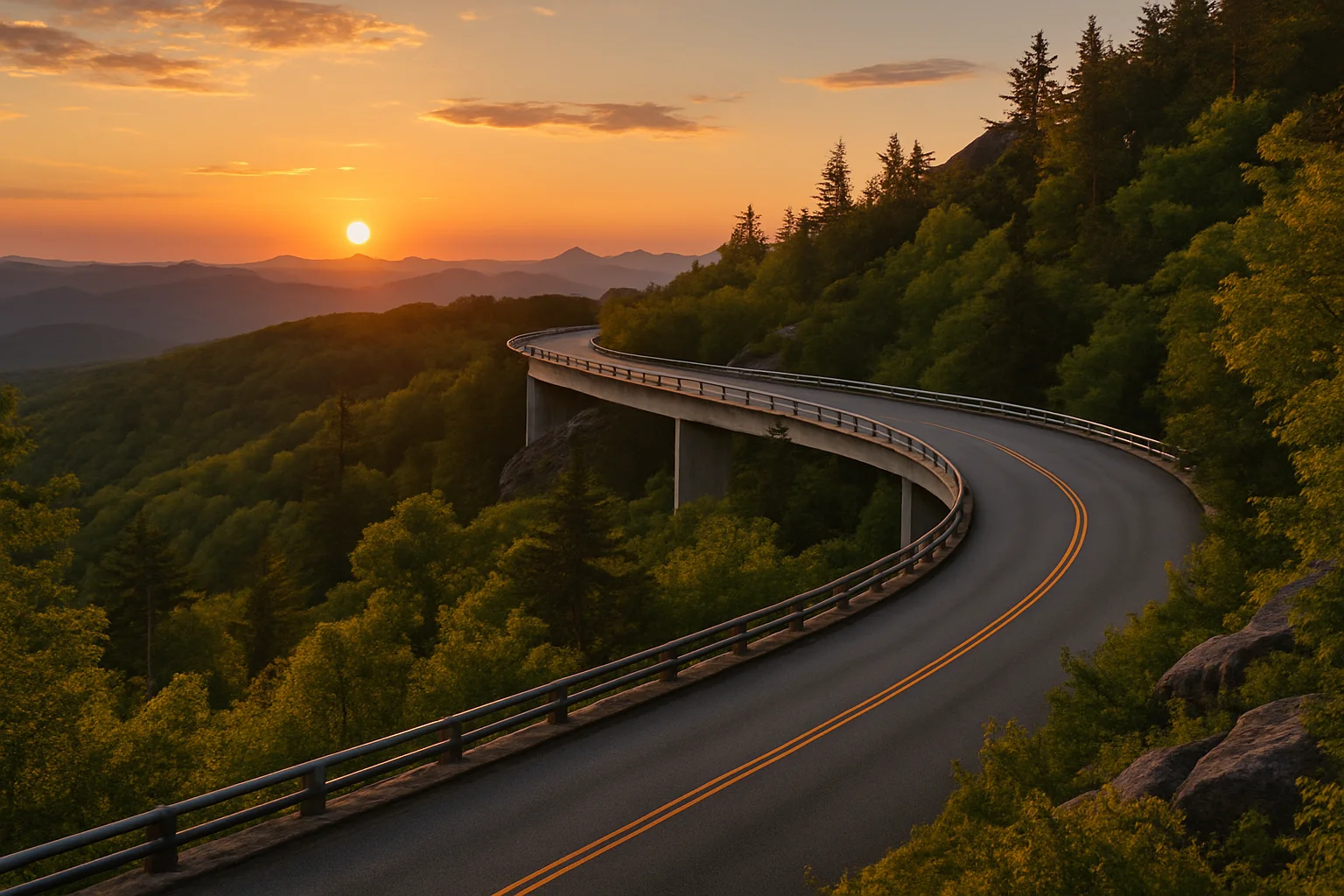
The Blue Ridge Parkway, a 469-mile scenic road begun as a Depression-era public-works project in 1935 and not fully completed until 1987, connects Shenandoah National Park in Virginia to the Great Smokies and is consistently the most-visited unit of the National Park System, drawing more than 15 million recreation visits a year, more than Yellowstone, Yosemite, and the Grand Canyon. The Great Smoky Mountains National Park, straddling the North Carolina-Tennessee line, is separately the most-visited national park in the country.
Asheville's tourism boom, built on the 250-room Biltmore, the Art Deco downtown, and one of the highest concentrations of craft breweries in the country, has driven housing costs far above local wages and made short-term rentals a chronic civic fight; in September 2024, Hurricane Helene brought catastrophic flooding to the French Broad and Swannanoa river valleys, killing more than 100 people in western North Carolina, destroying parts of the River Arts District, and cutting off whole mountain communities for weeks.
Coastal tourism runs from the family-beach strips of the Outer Banks and Wilmington-area islands to the wild-horse herds of Corolla and Shackleford Banks and the Fort Fisher and USS North Carolina historic sites near Wilmington, which has also become a significant film-production center, 'Wilmywood,' with EUE/Screen Gems Studios and productions from 'Dawson's Creek' to 'Iron Man 3.'
How North Carolina's Government Works
North Carolina's state government has been defined in recent decades by persistent tension between a Democratic-leaning urban majority and a Republican-dominated General Assembly empowered by legislative maps that federal and state courts have repeatedly found to be unconstitutional gerrymanders. The result has been structural divided government: Democratic governors unable to advance their legislative agendas, and a Republican legislature that has, in its most aggressive periods, attempted to limit the powers of Democratic governors elected by the same voters who returned them to Raleigh.
North Carolina has a strong-governor executive structure with a separately elected Council of State, eight executive officers including the Attorney General, State Treasurer, and Secretary of State elected independently of the governor. The governor has line-item veto power over the budget, but the Republican legislature has frequently overridden those vetoes when it held a supermajority (three-fifths of each chamber required).
The 2016 HB 2 'bathroom bill', which restricted transgender individuals' use of public bathrooms and preempted local nondiscrimination ordinances, illustrated North Carolina's political volatility: the legislation triggered an economic boycott, the relocation of NBA All-Star Game, and NCAA championship events, and is widely credited with the narrow defeat of incumbent Republican Governor Pat McCrory in 2016 by Attorney General Roy Cooper. The episode demonstrated both the power of corporate economic pressure on state politics and the degree to which North Carolina had become a genuine battleground state.
North Carolina's largest counties, Mecklenburg (Charlotte), Wake (Raleigh), and Durham, vote overwhelmingly Democratic, while the rural counties, particularly in the east and west, vote heavily Republican. The state has voted for the Republican presidential candidate in every election since 2012 except the 2008 Obama-McCain race, but statewide offices have been genuinely competitive, a reflection of a state electorate that is almost evenly divided.
Governor of North Carolina
Current Governor
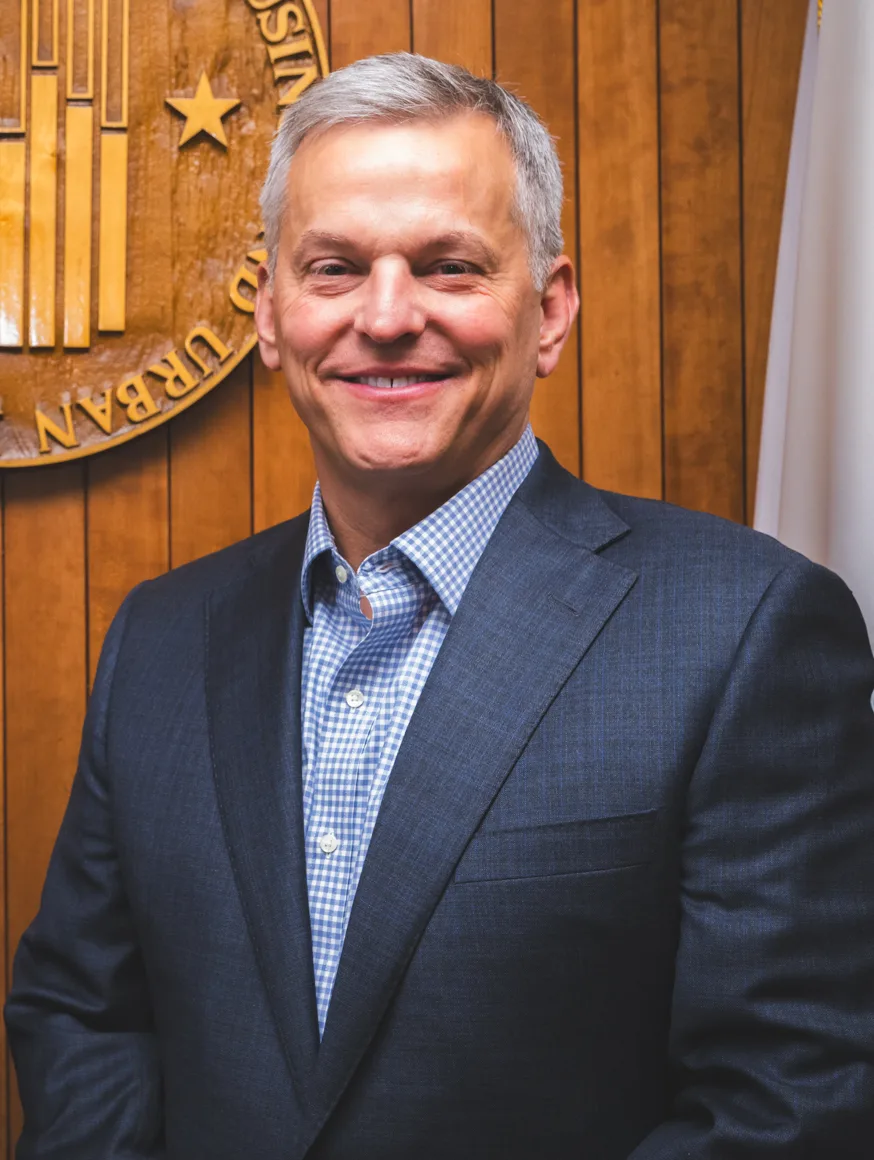
Josh Stein
- Party
- Democratic
- In Office Since
- January 1, 2025
- Term Ends
- January 2029
- Born
- 1974, New York City (raised in North Carolina)
- Education
- Harvard University (BA, 1996); Stanford Law School (JD, 1999)
- Prior Role
- NC Attorney General (2017-2025); NC State Senate (2009-2017)
Josh Stein is North Carolina's 76th Governor, elected in 2024 after serving two terms as Attorney General. During his time as AG, Stein pursued major consumer protection and environmental cases, including opioid settlements that brought hundreds of millions to the state. As governor, his administration has focused on expanding Medicaid access (North Carolina completed Medicaid expansion under his predecessor Roy Cooper in 2023), addressing the state's housing affordability crisis, and advancing economic development in rural and underserved communities. He took office in the aftermath of Hurricane Helene, the catastrophic September 2024 storm that devastated western North Carolina with flooding and landslides that killed over 100 people and caused billions in damage.
Other Current State Officials
Lieutenant Governor
Rachel Hunt
In office since January 1, 2025. A former NC State Senator representing the Charlotte area (District 36), Hunt is the first woman elected Lieutenant Governor of North Carolina in the modern era. She has focused on education policy and economic opportunity in her role, which in North Carolina includes presiding over the State Senate and chairing the State Board of Education.
Attorney General
Jeff Jackson
In office since January 1, 2025. A former one-term U.S. Representative (NC-14, 2023-2025), Iraq War veteran, and former NC State Senator, Jackson built a large social media following with direct, unscripted video posts about politics that helped him win the 2024 AG race against the incumbent Republican. He was previously known for his 'boots on the ground' campaign style of driving across every county in his congressional district.
State Treasurer
Brad Briner
In office since January 1, 2025. A Charlotte-based investment professional and Republican, Briner defeated incumbent Democrat Dale Folwell in the 2024 election. He oversees the North Carolina Retirement Systems, one of the largest public pension funds in the Southeast with over $120 billion in assets, and the State Health Plan, which covers approximately 750,000 state employees and teachers.
The North Carolina General Assembly
North Carolina State Senate
- Seats: 50 members
- Terms: 2-year terms
The upper chamber. All 50 seats are on the ballot every two years. Republicans have held the majority continuously since 2010 and held a supermajority for much of that period. The Senate President Pro Tempore is among the most powerful figures in state government.
North Carolina House of Representatives
- Seats: 120 members
- Terms: 2-year terms
The lower chamber. All 120 seats are up for election every two years. Republicans have maintained a substantial and at times supermajority majority since 2010. The House Speaker holds significant power over the legislative calendar and committee assignments.
North Carolina's U.S. Senators
U.S. Senator
Thom Tillis
North Carolina's senior senator, first elected in 2014 by defeating Democratic incumbent Kay Hagan and re-elected in 2020 in a race that was one of the most expensive Senate contests in history. A former NC House Speaker (2011-2014), Tillis serves on the Senate Judiciary and Banking committees. He has occasionally broken with his party on immigration reform and has been a consistent voice for bipartisan dealmaking on immigration legislation, including a 2024 deal that ultimately failed to advance. He is not seeking a third term, so his seat is open on the November 2026 ballot.
U.S. Senator
Ted Budd
North Carolina's junior senator, elected in 2022 after serving three terms in the U.S. House representing the 13th Congressional District. A gun store owner and businessman from Advance, NC, Budd received the endorsement of Donald Trump in the Republican primary, which was decisive in a competitive field. He serves on the Senate Banking and Commerce committees and has aligned closely with the conservative wing of the Republican Party.
North Carolina Through the Years
From the Cherokee Nation's mountain civilization to the first vote for American independence, the first powered flight, the lunch counter sit-in that sparked a movement, and the research park that remade a state's economy, North Carolina has been at the center of American history more often than its modest self-image suggests.
The territory that became North Carolina was home to dozens of distinct Native American peoples when European explorers first arrived in the 16th century. The most powerful and numerous were the Cherokee, who controlled the western mountain region and numbered perhaps 20,000 people organized into over 60 towns bound by a common language and confederate political structure. The Cherokee were the most politically sophisticated people in the American Southeast: their matrilineal society, their council-based governance, and their sophisticated agricultural practices, which included sophisticated irrigation and multi-crop farming in the mountain valleys, supported a civilization of considerable complexity.
In the Piedmont and Coastal Plain, the Catawba Nation, centered on the Catawba River valley, was a significant power whose alliance with South Carolina colonists proved important in early colonial conflicts. Smaller peoples, the Tuscarora in the eastern interior, the Hatteras and other Algonquian-speaking peoples on the Outer Banks and coastal plain, maintained their territories until the European onslaught of the 17th and 18th centuries shattered them. The Tuscarora War of 1711-1715, triggered by colonial encroachments, ended with the Tuscarora's defeat and the migration of most of their people north, where they joined the Haudenosaunee Confederacy as the sixth nation.
The Cherokee, whose territory in the mountains provided some protection, persisted and adapted, developing a written language (the Cherokee syllabary invented by Sequoyah around 1820), a newspaper, and a constitutional government before the forced removal of the Trail of Tears in 1838-1839. The Eastern Band of Cherokee Indians, ancestors of those who evaded or returned from removal, remain today on the Qualla Boundary in western North Carolina.
The roughly 1,000 Cherokee who avoided removal did so largely through the efforts of Tsali, a man executed by the Army after a scuffle in exchange for a promise that his community could stay, and of William Holland Thomas, a white trader raised by Cherokee who bought land in his own name and held it in trust for them because Native people could not then own land in North Carolina. That land became the Qualla Boundary, a 57,000-acre tract that is a land trust rather than a treaty reservation, held by the tribe and administered by the federal government.
The Eastern Band, now about 16,000 enrolled members, is one of the most economically successful tribes in the Southeast: its two Harrah's Cherokee casinos, opened in 1997 and 2015, fund tribal government, schools, and a per-capita payment to every enrolled member, and the tribe has invested in health care, language immersion for the endangered Cherokee language, and a share of North Carolina's newly legal sports betting.
On August 18, 1587, Virginia Dare became the first English child born in the Americas, on Roanoke Island at the mouth of North Carolina's Albemarle Sound. She was the granddaughter of John White, governor of the Roanoke Colony, a settlement of 117 English men, women, and children dispatched by Sir Walter Raleigh to establish England's first permanent American colony. White departed for England to obtain supplies just days after Virginia Dare's birth, leaving the colonists behind.
When he returned in 1590, delayed by the Spanish Armada crisis, he found the colony abandoned, the buildings dismantled, and the single word 'CROATOAN' carved on a post, the name of a nearby island and a friendly Native people. No survivor was ever found. The fate of the Lost Colony has never been established with certainty.
Archaeological evidence from the 2010s, including artifacts found on Hatteras Island (Croatoan) and at a site in the North Carolina interior, suggests some colonists may have dispersed and been absorbed into Native communities. The Lost Colony's mystery, its disappearance, its handful of known names (Virginia Dare most prominent among them), and the word 'CROATOAN', has generated more American folklore, speculation, and dramatic retelling than almost any other episode in early American history. An outdoor drama, 'The Lost Colony,' has been performed at Manteo on Roanoke Island every summer since 1937, making it the longest-running outdoor drama in American history.
Roanoke was actually England's second attempt at the site: a 1585 all-male military colony under Ralph Lane had spent a hard year there, alienated the local Roanoke people, killed their leader Wingina, and abandoned the fort with Sir Francis Drake in 1586, so the 1587 families arrived among Natives who had good reason to distrust them. John White himself had drawn some of the first European watercolors of Native life in North America during the 1585 venture.
White was unable to return promptly because Queen Elizabeth I commandeered every seaworthy ship in England to face the Spanish Armada in 1588, and a small relief voyage he did attempt that year was driven back by French privateers. By the time he finally reached Roanoke in August 1590, on his granddaughter's third birthday, the carved word and the absence of a distress cross (the agreed signal for trouble) suggested an orderly move to Croatoan, but a storm forced his ships to leave before he could search there.
In the years before the American Revolution, the backcountry of North Carolina was the site of one of the most serious internal rebellions in colonial American history. The Regulators, a movement of Piedmont farmers centered in Orange, Alamance, Rowan, and adjacent counties, organized in 1766-1768 to resist what they saw as corrupt and exploitative governance by county officials, sheriffs, lawyers, and tax collectors who enriched themselves at the expense of small farmers. The Regulators petitioned the colonial assembly for relief, then moved to more direct action: disrupting court sessions, attacking officials, and refusing to pay taxes.
The movement encompassed perhaps 6,000 men at its peak and represented a genuinely populist uprising against entrenched local power rather than against British authority per se. Royal Governor William Tryon raised a colonial militia and confronted the Regulators at the Battle of Alamance on May 16, 1771, defeating them in an engagement that lasted about two hours. Seven Regulator leaders were hanged.
The Regulator movement has been interpreted in multiple ways: as a proto-Revolutionary uprising, as a class conflict within colonial society, and as an early instance of American democratic dissent. Many Regulators, disillusioned with government of any kind, simply moved west, into the Tennessee and Kentucky borderlands where they helped form the Overmountain Men who would defeat British forces at the Battle of Kings Mountain in 1780.
The grievances were concrete: North Carolina had no paper currency and required taxes paid in scarce hard money, court and registration fees were fixed by officials who pocketed them, and sheriffs could seize a farm for a small unpaid debt. Governor Tryon compounded the anger by using tax revenue to build an opulent Georgian mansion, 'Tryon Palace,' at New Bern in 1770, which backcountry farmers saw as a monument to the corruption they were fighting.
After Alamance, Tryon marched his militia through the Regulator country forcing residents to swear loyalty oaths, and roughly 6,000 people are estimated to have signed. Some historians see continuity between the Regulators and the Revolution, but the picture is complicated: many former Regulators became Loyalists in 1776, unwilling to fight for the same coastal elite that had crushed them, while the officials who defeated them, including a young militia officer, later became Patriot leaders.
On April 12, 1776, more than two months before Thomas Jefferson put pen to the Declaration of Independence, North Carolina's Provincial Congress, meeting in Halifax, adopted the Halifax Resolves, instructing its delegates to the Continental Congress to 'concur with the delegates of the other Colonies in declaring Independency.' They were the first official action by any American colonial government authorizing independence from Britain, and April 12, 1776, appears on the state seal and, for years, on North Carolina license plates alongside the motto 'First in Freedom.'
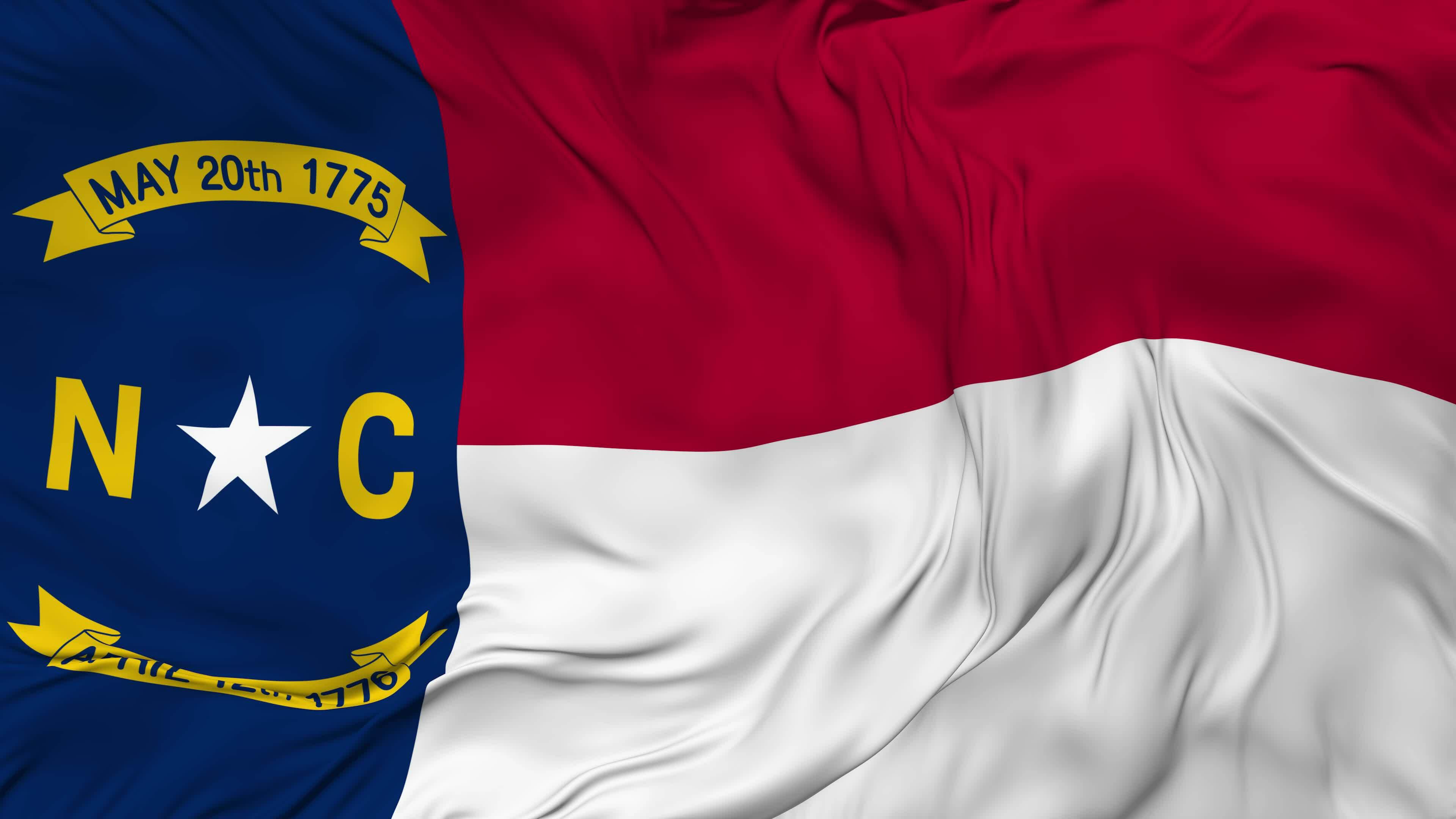
The distinction requires qualification, the Resolves authorized rather than declared independence, and Virginia's May 15 instruction went further by directing its delegates to propose it, but the historical fact that North Carolina moved first is genuine. A separate and much-disputed document, the 'Mecklenburg Declaration of Independence' supposedly adopted in Charlotte on May 20, 1775, also appears on the state flag and seal, though most historians consider it either a later fabrication or a garbled memory of the genuine, more limited 'Mecklenburg Resolves' of May 31, 1775.
The war reached North Carolina early and hard. At Moore's Creek Bridge near Wilmington in February 1776, Patriot militia routed a column of Loyalist Highland Scots in a few minutes, ending royal authority in the colony and helping stiffen the Continental Congress's resolve. Five years later the war returned: the Battle of Guilford Courthouse in March 1781, where Nathanael Greene inflicted such losses on Cornwallis that Horace Walpole wrote 'another such victory would ruin the British Army,' pushed Cornwallis toward Virginia and, that October, to surrender at Yorktown.
The Revolutionary-era backcountry Carolinas produced two future presidents, Andrew Jackson, born in the Waxhaws on a border so ill-defined that North Carolina and South Carolina still dispute which state can claim him, and James K. Polk, born in Mecklenburg County. Andrew Johnson, the third North Carolina-born president, was born in Raleigh in 1808.
On the morning of December 17, 1903, on a windswept sand flat called Kill Devil Hills near Kitty Hawk on the North Carolina Outer Banks, Orville Wright climbed aboard a 605-pound biplane of spruce and muslin and flew 120 feet in 12 seconds. The Wright Brothers made four flights that day; the longest, by Wilbur, covered 852 feet in 59 seconds. The age of powered, controlled human flight had begun, and North Carolina was its birthplace. The Wrights had chosen Kitty Hawk after writing to the U.S. Weather Bureau to identify a location with consistent wind, soft landing surfaces, and privacy: the Kill Devil Hills dunes offered all three.
They had been testing gliders there since 1900. The Flyer, the name they gave their powered machine, was a controlled aircraft, not merely a powered hop: the wing-warping control system Orville and Wilbur had invented was the key insight that separated their achievement from the claims of Samuel Langley, Gustave Whitehead, and others. News of the flight was poorly reported initially, the Wrights were secretive, the evidence was limited, and the press was skeptical.
It would be years before the world fully grasped what had happened in the North Carolina dunes. The Wright Brothers National Memorial, built on Kill Devil Hills, is one of the most visited historical sites in the state. North Carolina's 'First in Flight' claim has been contested by Ohio (the Wrights' home state), resulting in a gentle interstate rivalry that has produced two state license plate designs, North Carolina's 'First in Flight' and Ohio's 'Birthplace of Aviation', each asserting a form of priority.
The Wrights were bicycle mechanics from Dayton with no formal engineering training, and their decisive edge was systematic experiment: they built a small wind tunnel in 1901 and tested some 200 wing shapes, correcting published aerodynamic tables that were wrong, and they treated the problem of control, not just lift or power, as central, an insight rivals largely missed. The four-cylinder engine was cast by their shop mechanic Charlie Taylor because no manufacturer would build one light enough.
Only five witnesses and a handful of locals saw the flights, and one of them, John T. Daniels of the nearby lifesaving station, snapped the single famous photograph of the machine lifting off with Orville aboard and Wilbur running alongside. A gust flipped and wrecked the Flyer on the ground later that day, and it never flew again; it hangs today in the Smithsonian's National Air and Space Museum.
On February 1, 1960, four Black freshmen from North Carolina Agricultural and Technical State University, Ezell Blair Jr. (later Jibreel Khazan), Franklin McCain, Joseph McNeil, and David Richmond, sat down at the whites-only Woolworth's lunch counter at 132 South Elm Street in Greensboro and politely asked to be served. When they were refused, they remained seated until the store closed. They returned the next day with more students. By the end of the week, hundreds of students were participating in sit-ins at Greensboro lunch counters.
Within two months, the sit-in movement had spread to 54 cities in 9 states. The Greensboro sit-ins were not the first civil rights sit-ins in American history, earlier sit-ins had occurred in the 1940s and 1950s, but they were the ones that broke through into national consciousness and catalyzed the mass direct-action phase of the Civil Rights Movement. Within weeks, the Student Nonviolent Coordinating Committee (SNCC) had been founded at Shaw University in Raleigh, providing the organizational structure that would sustain years of nonviolent direct action across the South.
The Greensboro Woolworth's lunch counter, closed in 1993, was partially preserved and is now the centerpiece of the International Civil Rights Center and Museum, which opened in 2010. The four A&T freshmen are commemorated with a statue on their campus. Their act of courage on a February Monday morning in a North Carolina five-and-dime store changed the course of American history.
The four had planned the action carefully with a local NAACP official and a white businessman, Ralph Johns, who encouraged them; they dressed in coats and ties, bought school supplies elsewhere in the store to establish they were paying customers, and kept their receipts. Woolworth's, a national chain, integrated its lunch counters in Greensboro on July 25, 1960, after months of sit-ins and a boycott had cut its sales roughly in half; three Black employees were among the first served.
The tactic spread because it was cheap, replicable, and telegenic, and it forced businesses rather than legislatures to act. The Student Nonviolent Coordinating Committee, founded at Shaw University in Raleigh in April 1960 with the veteran organizer Ella Baker's guidance, gave the student movement a durable structure and would go on to lead the Freedom Rides, the Mississippi voter drives, and the 1965 Selma campaign.
In the late 1950s, North Carolina faced an economic crisis that could not be ignored: per capita income was among the lowest in the nation, the textile and tobacco industries that had defined the state economy were beginning their long decline, and the state was losing its most educated young people to other states. Governor Luther Hodges and a coalition of business leaders, academics, and urban planners conceived a radical solution: use the intellectual assets of three nearby universities, NC State in Raleigh, Duke in Durham, and UNC in Chapel Hill, as the foundation of a planned research and technology park that would attract high-wage employers to the state. The Research Triangle Park was incorporated in 1959, the first tenants arrived in the early 1960s, and within a decade the strategy was working.
IBM's 1965 decision to locate a major research campus in the park was the breakthrough moment that validated the concept and attracted subsequent waves of technology and pharmaceutical companies. The transformation of North Carolina's economy since 1959 has been one of the most remarkable state economic development stories in American history: from one of the poorest states in the country, dependent on low-wage manufacturing and agriculture, to a state hosting some of the most productive research institutions, pharmaceutical companies, and technology firms in the world.
The Research Triangle model has been studied and replicated by dozens of states and countries. It succeeded not because of any single company or invention but because of a deliberate, sustained, multi-decade commitment by state government, universities, and private industry to build an economy around knowledge rather than labor costs.
The park almost failed at the start: private developers could not attract tenants in the late 1950s, and it was rescued when a nonprofit, the Research Triangle Foundation, took it over in 1959 and the state landed the federal government's new National Institute of Environmental Health Sciences and the nonprofit Research Triangle Institute as anchor occupants before IBM committed in 1965. Governor Terry Sanford's parallel 1963 creation of a state-funded 'Governor's School' and later the North Carolina School of Science and Mathematics reinforced the human-capital bet.
The results are visible in the numbers: North Carolina's per-capita income rose from roughly two-thirds of the national average in 1960 to near the national average by the 2020s, and the Raleigh-Durham metro consistently ranks among the top U.S. metros for the share of adults with advanced degrees. The tradeoff has been sharp regional inequality, with the Triangle and Charlotte pulling far ahead of the eastern and western rural counties.
The modern story of North Carolina cannot be told without understanding Charlotte's transformation from a regional banking town into a major American city, and the tensions that metropolitan growth has created within a state that remains deeply divided between its urban and rural populations. Charlotte's growth, from a city of 315,000 in 1980 to a metropolitan area of 2.7 million in 2025, was driven by the banking acquisitions of Hugh McColl's NationsBank (which absorbed banks across the country and merged with BankAmerica in 1998 to create Bank of America) and by the infrastructure investment, particularly in Charlotte Douglas International Airport, that followed financial growth. The 2005 NBA All-Star Game, the 2012 Democratic National Convention, and Super Bowl 50 in 2016 signaled Charlotte's arrival as a major American city.
The Research Triangle meanwhile became one of the most in-demand real estate markets in the country as remote workers, tech employees, and retirees flooded in from higher-cost cities during and after the COVID-19 pandemic. North Carolina's population has grown by over 1 million people since 2010, making it one of the fastest-growing states in the country.
This growth has scrambled the state's political geography: once a reliably Republican state at the presidential level, North Carolina voted for Barack Obama in 2008 and came within a percentage point of doing so in 2012, 2020, and 2024. The collision of an urbanizing, diversifying demographic with a rural population that feels left behind by the knowledge economy is the central political drama of 21st-century North Carolina.
That tension has made North Carolina one of the most litigated states in the country over the rules of democracy itself. Its congressional and legislative maps have been redrawn repeatedly under federal and state court orders since 2011, with judges finding some versions unconstitutional racial gerrymanders and others extreme partisan gerrymanders, and the U.S. Supreme Court used a North Carolina case, Moore v. Harper (2023), to reject the 'independent state legislature' theory that would have removed state courts from reviewing federal election rules.
The closely divided government has produced recurring standoffs: a Republican supermajority in the legislature has overridden the vetoes of Democratic governors, stripped powers from incoming Democratic officials in 2016 and 2024, and clashed with the governor over Medicaid, the University system, and pandemic policy, while statewide elections for president, governor, and Supreme Court are often decided by a point or two.
North Carolina's Defining Moments in American History
These are the events that didn't just shape North Carolina, they changed the nation.
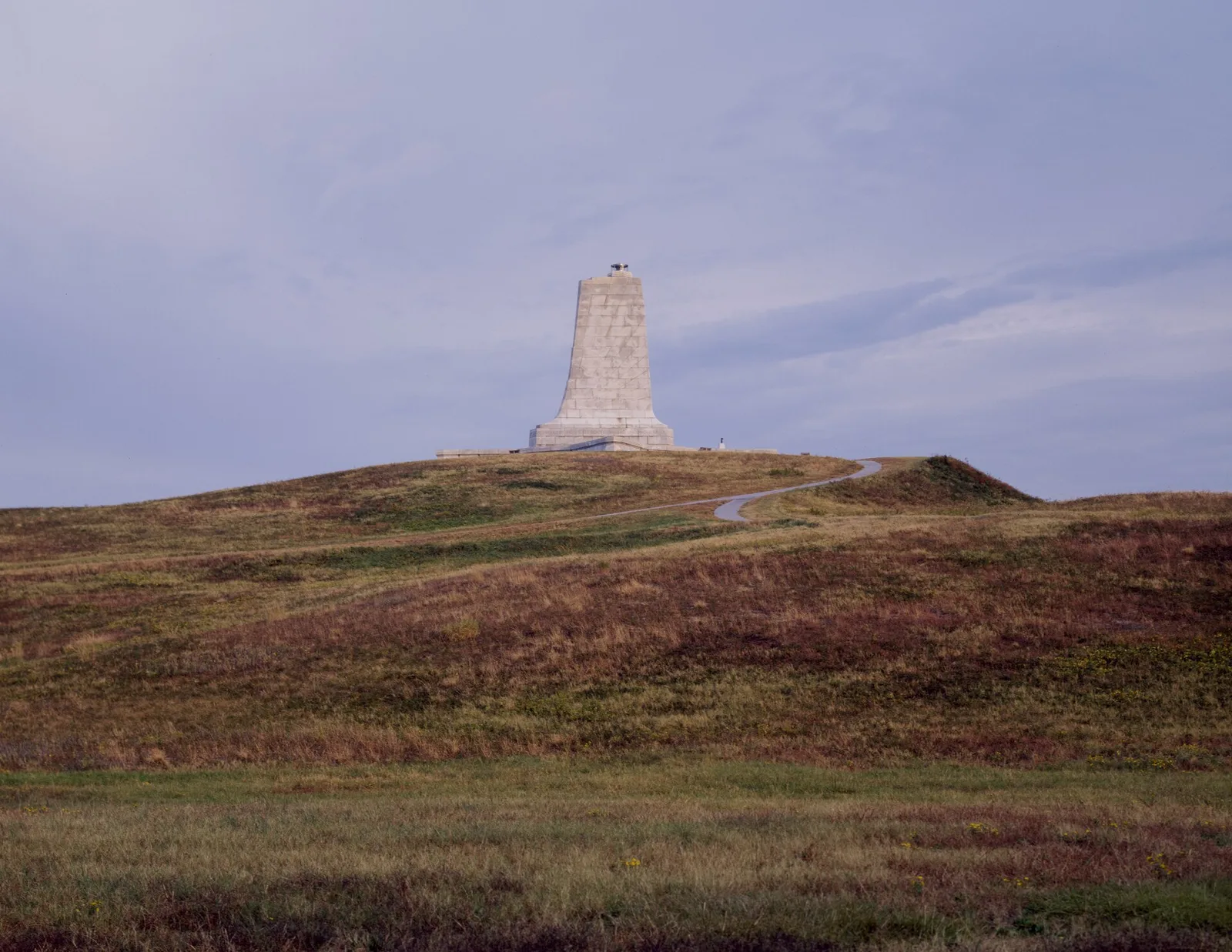
On December 17, 1903, Wilbur and Orville Wright achieved what humanity had dreamed of for centuries: controlled, powered, heavier-than-air flight. The first flight lasted 12 seconds and covered 120 feet. By the day's fourth flight, Wilbur had stayed aloft for 59 seconds and traveled 852 feet.
The Wrights chose the Outer Banks of North Carolina for its consistent winds and soft sand for landing. North Carolina's license plates read 'First in Flight,' a claim that has been disputed by Ohio (where the Wrights were from) but that honors where the actual flights took place.
The brothers wrote to the U.S. Weather Bureau in 1900 asking for a windy, isolated place with soft ground and settled on the fishing hamlet of Kitty Hawk, reachable only by boat, where they camped in a shed and tested gliders each fall from 1900 to 1902 before returning with a powered machine in 1903. Their systematic wind-tunnel work in Dayton the previous winter, testing roughly 200 miniature wings, gave them accurate lift data that contemporaries lacked.
The key invention was three-axis control, especially the wing-warping that let a pilot bank and turn, which is why aviation historians credit the Wrights over earlier experimenters who achieved lift or hops but could not steer. The first flight covered less distance than the wingspan of a modern airliner, yet within a decade aircraft were crossing the English Channel and flying combat missions.
News of the flight was buried or disbelieved for years because the Wrights, guarding their patents, refused public demonstrations until 1908, when Wilbur flew before crowds in France and Orville for the Army at Fort Myer, Virginia, silencing the skeptics. The 60-foot granite memorial on Kill Devil Hill was dedicated in 1932.
In 1587, a group of 117 English colonists landed on Roanoke Island in present-day North Carolina to establish England's first permanent American settlement. Their leader, John White, sailed back to England for supplies. When he returned in 1590, after a three-year delay caused by war with Spain, the colony had vanished.
The only clue was the word CROATOAN carved into a post. The fate of the Lost Colonists, including the first English child born in the Americas, Virginia Dare, has been debated and researched for over four centuries without definitive resolution.
Roanoke was Sir Walter Raleigh's project, financed under a 1584 charter from Elizabeth I to plant an English colony and a base for raiding Spanish treasure fleets. An earlier 1585 garrison had already soured relations by burning a Native town over a stolen silver cup and killing the Roanoke leader Wingina, so the 1587 settlers, families rather than soldiers, arrived among people with fresh grievances.
Governor John White sailed for supplies weeks after his granddaughter's birth and was trapped in England when the crown seized all shipping for the 1588 Armada campaign; he did not get back until August 1590. The colonists had agreed to carve a Maltese cross if they left under duress, and there was none, so the plain word 'Croatoan' pointed to a planned move to that island, home of the friendly Hatteras people, but a storm drove White's ships off before he could look.
Modern investigation has produced fragments rather than an answer: English artifacts and a possible fort site at Hatteras and at a location dubbed 'Site X' near Albemarle Sound suggest the colonists split up and assimilated with Native communities, and DNA studies of coastal families continue, but no burial, structure, or record has ever confirmed a single colonist's fate.
On February 1, 1960, four Black freshmen from North Carolina A&T sat down at the whites-only Woolworth's lunch counter in Greensboro and politely asked to be served. They were refused and refused to leave. Within two weeks, sit-in protests had spread to 54 cities in nine states.
Within six months, the Greensboro Woolworth's integrated. The Greensboro sit-ins demonstrated that nonviolent direct action by young people, organized and disciplined, could achieve concrete results. They directly inspired the formation of the Student Nonviolent Coordinating Committee and transformed civil rights strategy.
The four, Ezell Blair Jr., Franklin McCain, Joseph McNeil, and David Richmond, were 17 and 18, and they had studied Gandhi and the earlier CORE sit-ins; they came in coats and ties, bought items elsewhere in the store first, and kept their receipts so no one could claim they were not paying customers. Sympathetic white students from nearby women's colleges soon joined, and the counter's white patrons dwindled.
Woolworth's was a national chain, so the Greensboro sit-in put pressure on stores in hundreds of cities at once, and the company desegregated its Greensboro counters on July 25, 1960, after a boycott had cut local sales by roughly half; the first Black people served were three of the store's own employees. Nashville, where students trained by James Lawson desegregated downtown counters that May, showed the tactic could be systematized.
SNCC, organized at Shaw University in Raleigh in April 1960 under the mentorship of veteran organizer Ella Baker, became the shock troops of the movement for the next several years, running the Freedom Rides support network, the 1961 to 1964 voter-registration drives in Mississippi and Georgia, and the Selma campaign, before internal debates over nonviolence and Black Power split it in the late 1960s.
Stock car racing emerged from North Carolina's moonshining culture, where drivers souped up their cars to outrun federal revenue agents. Bill France Sr. formalized the sport, founding NASCAR in Daytona Beach, Florida, in 1948, but North Carolina became and remains its spiritual and operational home.
Mooresville, called Race City USA, houses dozens of NASCAR team headquarters. The sport grew from a regional curiosity into America's second most-watched sport, drawing 75 million fans, nearly all of them introduced to racing through North Carolina's cultural contribution to American sports.
The bootlegging link is literal: Junior Johnson of Wilkes County, one of the sport's first stars, learned to drive hauling his family's moonshine, served nearly a year in federal prison for it in the late 1950s, kept winning races afterward, and received a full pardon from President Ronald Reagan in 1986. North Wilkesboro Speedway, built in 1947 on a red-clay pasture, hosted NASCAR's top series from its first season until 1996 and was revived for racing in 2022.
The teams cluster in North Carolina because the talent does: the engine shops, fabrication skills, and wind-tunnel work concentrated in a roughly 50-mile arc north of Charlotte from Mooresville to Concord, where Hendrick Motorsports, Joe Gibbs Racing, and most other top teams are based, close to Charlotte Motor Speedway and the NASCAR Hall of Fame that opened downtown in 2010.
NASCAR peaked in television ratings and attendance in the mid-2000s and has declined since, closing or shortening tracks and experimenting with street courses and a Chicago downtown race, but its economic footprint in the Charlotte region, thousands of specialized manufacturing jobs, remains large, and the France family that founded it still controls the sanctioning body.
In the 1950s, North Carolina leaders recognized that the state's economy, dependent on tobacco, textiles, and furniture, was vulnerable. They created Research Triangle Park, a planned research campus situated among three universities: Duke, UNC-Chapel Hill, and NC State. It was a gamble that paid off spectacularly.
Today Research Triangle Park is home to hundreds of companies and research institutions employing tens of thousands of scientists, engineers, and knowledge workers. It became a national model for using university investment to transform regional economies, and it made North Carolina one of the most dynamic economies in the American South.
The idea came from a sociologist, Howard Odum, and a Greensboro contractor, Romeo Guest, in the early 1950s, and it was championed by Governor Luther Hodges, a retired textile executive, who put the state's political weight behind acquiring the land between the three universities. Early efforts to lure companies flopped until a nonprofit foundation bought the tract in 1959 and the federal environmental-health institute and the Research Triangle Institute became the first anchor tenants.
IBM's 1965 decision to build a large campus in the park, eventually its second-largest site anywhere, validated the concept and drew a chain of pharmaceutical and technology employers over the following decades. Burroughs Wellcome researchers in the park developed AZT, the first approved treatment for HIV, in the 1980s.
The payoff took a generation: North Carolina went from near the bottom of the states in per-capita income in 1960 to roughly the national average by the 2020s, and the Raleigh-Durham area became one of the country's fastest-growing and most highly educated metros, though the gains have been concentrated there and in Charlotte while much of the rural east and west lagged.
Notable North Carolinians
James K. Polk
Born in Mecklenburg County, North Carolina, November 2, 1795. The 11th President of the United States (1845-1849) and one of the most consequential one-term presidents in history. During his single term, he acquired more territory for the United States than any president except Jefferson: the Oregon Territory, Texas, and the Mexican Cession (California, New Mexico, Arizona, Nevada, Utah, and Colorado) were all added during his presidency. Died 1849.
Andrew Johnson
Born in Raleigh, North Carolina, December 29, 1808. The 17th President of the United States (1865-1869), who assumed office after Lincoln's assassination and pursued a lenient Reconstruction policy that restored former Confederate states quickly and without meaningful protections for formerly enslaved people. He was the first President to be impeached by the House (1868), acquitted by a single vote in the Senate. Died 1875.
Virginia Dare
Born on Roanoke Island, North Carolina, August 18, 1587. The first English child born in the Americas, granddaughter of John White, governor of the Roanoke Colony. Her fate, along with that of the entire Lost Colony, remains the oldest unsolved mystery in American history. She has become a symbol of American origins and the subject of more historical speculation and fiction than nearly any other figure from the colonial period.
Dolley Madison
Born in Guilford County, North Carolina, May 20, 1768. First Lady during the presidency of James Madison (1809-1817) and one of the most significant women in early American history. She is best remembered for saving a portrait of George Washington from the White House before British forces burned it in 1814. Her political acumen and social skill were widely credited with shaping Washington society and advancing her husband's political career. Died 1849.
Billy Graham
Born in Charlotte, North Carolina, November 7, 1918. The most influential American evangelical preacher of the 20th century, Graham delivered the Christian gospel to more people in person than any other figure in history, estimates range from 215 million to more than 2 billion total through his television ministry. His 'crusade' revivals filled stadiums on every continent. He served as unofficial spiritual counselor to every president from Truman through Obama. Died 2018.
Michael Jordan
Born in Brooklyn, New York, but raised in Wilmington, North Carolina from age two. The greatest basketball player of all time by most assessments: six NBA championships with the Chicago Bulls, six Finals MVP awards, five regular season MVPs, two Olympic gold medals. His association with UNC Chapel Hill (where he hit the game-winning shot in the 1982 NCAA championship) and with the Charlotte Hornets (which he purchased in 2010) makes North Carolina central to his identity.
Thomas Wolfe
Born in Asheville, North Carolina, October 3, 1900. One of the major American novelists of the 20th century, best known for Look Homeward, Angel (1929), a thinly veiled autobiographical novel about growing up in a fictionalized Asheville ('Altamont') that scandalized his hometown when published. His childhood home in Asheville is a National Historic Landmark and museum. Wolfe's prose style, expansive, lyrical, and torrential, influenced a generation of American writers. Died 1938.
O. Henry (William Sydney Porter)
Born in Greensboro, North Carolina, September 11, 1862. Short story writer whose sardonic wit and trademark twist endings made him the most widely read American fiction writer of the early 20th century. His most famous story, 'The Gift of the Magi,' has been reprinted and adapted more times than almost any other American short story. He spent time in a federal prison in Ohio (for bank embezzlement) and in New York City, which inspired many of his most celebrated stories. Died 1910.
Thelonious Monk
Born in Rocky Mount, North Carolina, October 10, 1917. One of the most original and influential musicians in American jazz history, Monk's idiosyncratic piano style, angular, dissonant, with deliberate hesitations and unexpected chord voicings, helped define bebop and remains instantly identifiable decades after his death. His compositions, including 'Round Midnight,' 'Straight, No Chaser,' and 'Blue Monk,' are among the most frequently performed in the jazz repertoire. Died 1982.
Roberta Flack
Born in Black Mountain, North Carolina, February 10, 1939. Singer-songwriter whose rich contralto voice and deeply personal performing style made her one of the most celebrated artists of the 1970s. 'Killing Me Softly with His Song' (1973) and 'The First Time Ever I Saw Your Face' (1972) both won Grammy Awards for Record of the Year in consecutive years, a feat unprecedented at the time. She was a classically trained pianist and music teacher before her recording career began. Died 2024.
State Symbols & Quick Facts
| Nickname | "The Tar Heel State" |
| Capital | Raleigh |
| Largest City | Charlotte |
| Statehood | November 21, 1789 (12th state) |
| Population | ~11.0 million (2024 est.) |
| Area | 53,819 sq miles (28th largest) |
| State Bird | Cardinal |
| State Flower | Dogwood |
| State Tree | Longleaf Pine |
| State Animal | Gray Squirrel |
| State Fish | Channel Bass (Red Drum) |
| State Insect | Honeybee |
| State Fruit | Scuppernong Grape |
| State Mineral | Emerald |
| State Motto | "Esse Quam Videri" (To Be Rather Than To Seem) |
| Time Zone | Eastern |
| Bordering States | Virginia, Tennessee, South Carolina, Georgia |
Did You Know?
On December 17, 1903, Orville Wright flew the first powered, controlled airplane flight in history at Kill Devil Hills, near Kitty Hawk, North Carolina. The flight lasted 12 seconds and covered 120 feet. North Carolina commemorates this on its license plates with the motto 'First in Flight', a claim that has generated a friendly interstate rivalry with Ohio, where the Wrights lived and built their machine.
The University of North Carolina at Chapel Hill, chartered in 1789 and opened in 1795, is the oldest public university in the United States to award degrees. Its first student, Hinton James, walked 170 miles from Wilmington to enroll in 1795 and was the only student for two weeks.
Pepsi-Cola was invented in New Bern, North Carolina in 1893 by pharmacist Caleb Bradham, who sold his carbonated beverage under the name 'Brad's Drink' before renaming it Pepsi-Cola in 1898. The original Pepsi-Cola building still stands in New Bern, which celebrates this piece of culinary history with a Pepsi-Cola memorabilia store.
The Biltmore Estate in Asheville, built by George Washington Vanderbilt II between 1889 and 1895, is the largest privately owned house in the United States: 178,926 square feet of floor space, 250 rooms, 35 bedrooms, and 43 bathrooms on an estate that originally covered 125,000 acres (now approximately 8,000). It remains privately owned by the Vanderbilt family's descendants and is one of the most visited historic houses in America.
North Carolina produces more sweet potatoes than any other state in the country, approximately 60 percent of the entire U.S. supply comes from the flat fields of the eastern Coastal Plain, particularly Wilson, Nash, and Johnston counties. The state's sweet potato dominance has continued for decades, supported by the sandy, well-drained soils and warm climate of eastern NC.
Charlotte is the second-largest banking center in the United States after New York City. Bank of America (assets over $3 trillion) and Truist Financial (formerly BB&T and SunTrust) are both headquartered in uptown Charlotte. This concentration of financial power in a Southern city was achieved in a single generation, primarily through the aggressive interstate acquisition strategy of Hugh McColl's NationsBank in the 1980s and 1990s.
The Outer Banks of North Carolina earned the name 'Graveyard of the Atlantic' because the waters off Cape Hatteras have claimed more than 1,000 ships over four centuries. The convergence of the cold Labrador Current from the north and the warm Gulf Stream from the south creates unpredictable weather, and the Diamond Shoals extending 14 miles offshore from Cape Hatteras have trapped hundreds of vessels since the age of sail.
Research Triangle Park, established in 1959 between Raleigh, Durham, and Chapel Hill, is one of the largest research parks in the world with more than 300 companies employing approximately 65,000 workers. The park includes the headquarters of SAS Institute, the largest privately owned software company in the world, and the campus where IBM conducts research that contributed to the development of Watson, the AI system that defeated Jeopardy! champions in 2011.
The Greensboro sit-ins of February 1, 1960, when four Black students from NC A&T sat at a Woolworth's whites-only lunch counter and refused to leave, sparked the sit-in movement that spread to 54 cities in 9 states within two months and led directly to the founding of the Student Nonviolent Coordinating Committee (SNCC) at Shaw University in Raleigh. The original Woolworth's counter stools are now in the Smithsonian Institution.
North Carolina claims three presidents born within its borders or on its border: Andrew Jackson (Waxhaw area, on the NC-SC border), James K. Polk (Mecklenburg County), and Andrew Johnson (Raleigh). Whether Jackson was born in North Carolina or South Carolina remains disputed, both states claim him.
Quick Facts and Common Questions
Short answers to the questions people most often ask about North Carolina: its abbreviation, who it was named for, its capital, and its place in Congress.
North Carolina's two-letter postal abbreviation is NC. The U.S. Census Bureau places it in the South region, in the South Atlantic division, and about 10.4 million people lived there in the 2020 census.
North Carolina became the 12th state on November 21, 1789. Its first convention, in 1788, refused to ratify the Constitution without a bill of rights, and the state ratified only after Congress had proposed the amendments that became the Bill of Rights.
The name Carolina comes from "Carolus," Latin for Charles. King Charles I of England first granted the region in 1629, and in 1663 King Charles II granted a new charter for Carolina, honoring his father. The colony's northern and southern parts were governed separately from 1712 and became separate royal colonies in 1729.
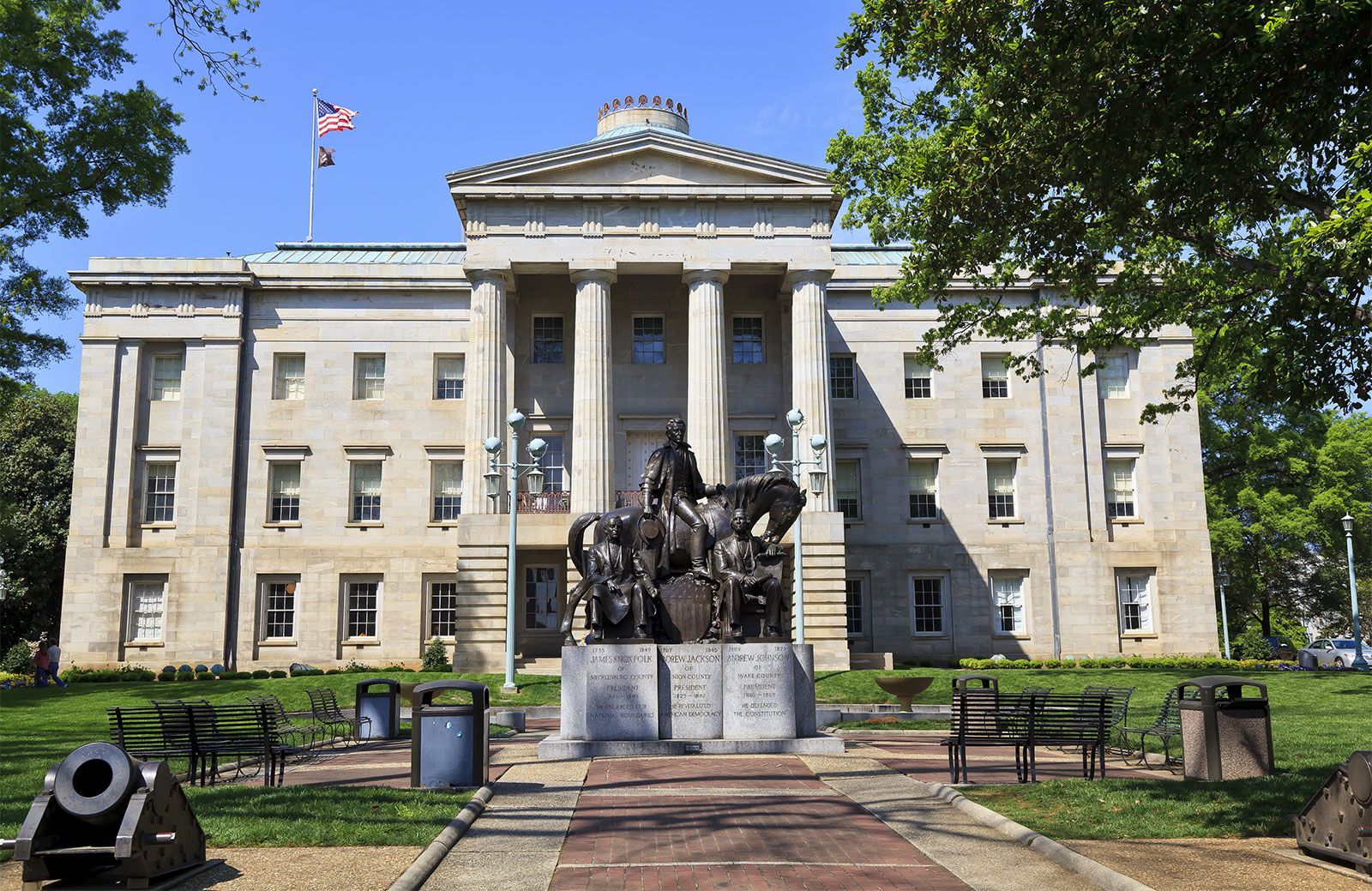
Raleigh has been the capital since 1792, when it was laid out as a planned capital city and named for Sir Walter Raleigh, who sponsored the Roanoke colonies of the 1580s. Before that the legislature had no permanent home and met in several towns, including New Bern. The current State Capitol was completed in 1840.
North Carolina borders Virginia to the north, Tennessee to the west, and Georgia and South Carolina to the south. Its eastern edge is Atlantic coastline, protected by the barrier islands of the Outer Banks.
On December 17, 1903, Orville and Wilbur Wright made the first controlled, powered airplane flights at Kill Devil Hills, near Kitty Hawk on the Outer Banks. The longest of the day's four flights covered 852 feet in 59 seconds, the start of the story of military and civil aviation. The site is now Wright Brothers National Memorial.
North Carolina is known as "The Tar Heel State," a nickname tied to its colonial production of tar, pitch, and turpentine. Its motto is "Esse quam videri," Latin for "To be, rather than to seem." Its state bird is the cardinal, its flower is the dogwood, and its tree is the longleaf pine.
Based on the 2020 census, North Carolina gained a seat and now has 14 in the U.S. House of Representatives, which gives it 16 votes in the Electoral College.
In 1587 more than 100 English colonists settled on Roanoke Island, and Virginia Dare became the first English child born in the Americas. When supply ships returned in 1590, the settlers were gone, leaving only the word "CROATOAN" carved on a post. Their fate remains unknown, and the site is Fort Raleigh National Historic Site.
Sources & Further Reading
- Census Regions and Divisions, U.S. Census Bureau
- 2020 Census Apportionment Results, U.S. Census Bureau
- Distribution of Electoral Votes, National Archives
- NCpedia, State Library of North Carolina
- Wright Brothers National Memorial, National Park Service
- Fort Raleigh National Historic Site, National Park Service
Cape Hatteras National Seashore
America's First National Seashore: 70 Miles of Wild Barrier Island Coastline on the Outer Banks
About Cape Hatteras National Seashore
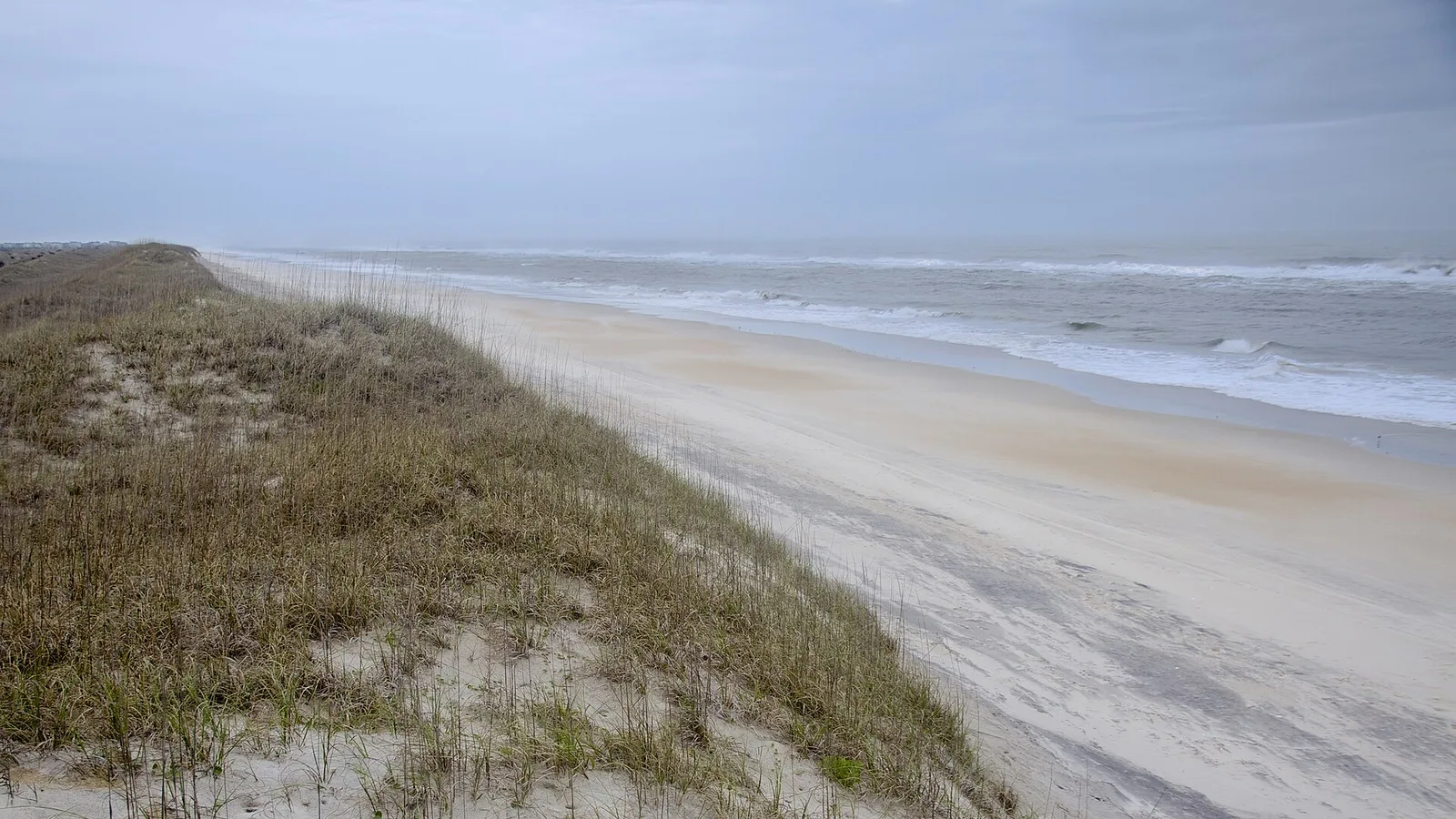
Cape Hatteras National Seashore protects about 70 miles of barrier-island beach on the Outer Banks of North Carolina, across Bodie, Hatteras, and Ocracoke islands, thin ribbons of sand between the Atlantic and the shallow Pamlico Sound.
Congress authorized it in 1937 as the first national seashore, but the Depression and the Second World War stalled land purchases, and it was not established until January 12, 1953, after a Mellon-family gift matched state money to buy the land.
The islands are among the most restless landforms on Earth: storms wash sand across them, cut new inlets, and push the whole chain slowly toward the mainland, which is why NC-12, the single road down the seashore, is repeatedly buried and rebuilt.
Offshore lie the Diamond Shoals and the 'Graveyard of the Atlantic,' where the warm Gulf Stream meets a cold coastal current over shifting sandbars; thousands of ships have wrecked here, and the 198-foot Cape Hatteras Lighthouse, the tallest in the country, has marked the danger since 1870.
- Designation
- National Seashore (first in the US)
- Location
- Dare and Hyde counties, Outer Banks, North Carolina
- Established
- January 12, 1953
- Annual Visitors
- ~2.5 million
Geology and Landscape
The Outer Banks are barrier islands, long low bars of sand thrown up and shaped by wave, wind, and the current that carries sand along the shore.
In a strong storm, waves run right over the low spots and drop sand on the sound side, 'overwash' that is how a barrier island builds itself higher and migrates landward.
Hurricanes also cut new inlets straight through the islands: Hatteras Inlet opened in a single 1846 storm, and Hurricane Isabel cut a new inlet across Hatteras Island in 2003 that had to be filled to reconnect the road.
Over the long run the whole chain is rolling west toward the mainland as the sea rises, a process the Park Service now manages by moving roads and buildings rather than trying to hold the line.
Diamond Shoals is a bank of shifting underwater sand that reaches about 14 miles seaward from the point of Cape Hatteras.
Here the warm, north-flowing Gulf Stream collides with a cold current running south along the coast, and the meeting throws up steep, confused seas over the shoals.
Sailors named the whole coast the 'Graveyard of the Atlantic'; estimates of ships lost along it run to several thousand, from colonial merchantmen to the ironclad USS Monitor, which sank off Hatteras on New Year's Eve 1862.
In 1942 German U-boats sank hundreds of ships off North Carolina, often silhouetted against the lit shore, in an episode locals called 'Torpedo Junction'; the Monitor wreck is now the country's first national marine sanctuary.
Pamlico Sound, behind the islands, is the largest lagoon on the East Coast, roughly 80 miles long and about 2,000 square miles, but shallow, mostly less than 20 feet deep.
It has almost no lunar tide; the water is pushed around instead by the wind, which can pile it up on one shore and bare the flats on the other.
The brackish sound is a nursery for blue crabs, shrimp, flounder, and menhaden, and much of North Carolina's commercial catch spends its early life here.
Its marshes and flats are a major stop on the Atlantic Flyway, holding tens of thousands of ducks, swans, and shorebirds in winter.
The current tower, built in 1870 by Dexter Stetson, is 198 feet tall, the tallest lighthouse in the United States; a shorter sandstone tower of 1803 stood nearby before it.
The black-and-white spiral 'barber pole' pattern was painted on in 1873 as a daymark, so ships could tell it apart from the other Outer Banks lighthouses.
By the 1980s the sea had come within a few hundred feet of the base, and in the summer of 1999 movers jacked the roughly 4,800-ton tower onto rails and rolled it 2,900 feet inland over 23 days, the largest lighthouse move in the country's history.
It reopened for climbing after the move and closed again from 2023 for a multi-year restoration of its ironwork, brick, and lantern room.
Indigenous Peoples of the Outer Banks
Croatoan/Hatteras Nation
The people the English called Croatoan, later the Hatteras Indians, lived on Hatteras Island and the sound shore, fishing, gathering shellfish, and hunting the marshes.
They are tied forever to the 'Lost Colony': when John White returned in 1590 to the English settlement he had left on Roanoke Island in 1587, the colonists were gone, with only 'CROATOAN' carved on a post and no sign of distress.
Archaeologists digging at Cape Creek on Hatteras since the 1990s have found English objects, a signet ring, a slate and pencil, gun parts, mixed into Croatoan house sites, which some read as evidence that colonists lived among them.
The Hatteras Indians and related groups were gradually displaced from the Outer Banks in the 18th century. Some historians and genetic studies have suggested that descendants of the Croatoan people may be found among the Lumbee Tribe of North Carolina, which is the largest non-federally-recognized tribe east of the Mississippi. The Lumbee Nation, headquartered in Pembroke, NC, has sought federal recognition for decades. The mystery of the Lost Colony and its possible connection to the Croatoan remains one of the enduring puzzles of American history.
What to Do
Cape Hatteras Lighthouse Climb
From roughly late spring to fall the lighthouse is open for a self-paced climb of 257 iron steps up the spiral stair, with landings to rest.
The gallery at the top, 165 feet up, gives a view over both the ocean and Pamlico Sound and, on the beach below, the ring of stones marking the tower's pre-1999 site.
Tickets are sold on-site the day of the climb, and the stair is hot, narrow, and one-way, so it is not for anyone with heart or breathing trouble.
The lighthouse has been closed and scaffolded since 2023 for restoration; the Park Service expects it to reopen for climbing in 2026.
Surfing and Swimming
Cape Hatteras has some of the most consistent surf on the East Coast, with swell wrapping around the point from several directions and sandbars that build good peaks.
Cape Point, the elbow of Hatteras Island, is the best-known break and also a notorious spot for strong rip and longshore currents.
Lifeguarded swimming beaches operate in summer at a handful of access points; the rest of the 70 miles is open and unguarded.
The same current collision that wrecks ships makes the water here unpredictable, and drownings in rip currents are the seashore's leading cause of death.
Off-Road Vehicle Beach Driving
Cape Hatteras is one of the few National Park Service units that allows driving on the beach, on marked corridors, to reach remote stretches of sand.
It takes a four-wheel-drive vehicle, a paid permit, and tires aired down to about 15 to 20 pounds to keep from bogging.
A 2007 lawsuit over shorebird protection led to a 2010 court order and a 2012 rule that set the current mix of permits, ramps, and seasonal closures.
Long stretches close each spring and summer for nesting piping plovers, oystercatchers, terns, and sea turtles, a recurring flashpoint between conservation groups and beach-access advocates.
Birding on the Outer Banks
The Outer Banks sit on the Atlantic Flyway, and the narrow islands funnel migrants down the coast in spring and fall.
Cape Point and the freshwater ponds behind the Bodie Island Lighthouse are the top hotspots, drawing shorebirds, terns, wading birds, and, in fall, hawks and falcons.
Winter brings rafts of sea ducks, loons, and gannets offshore and tundra swans and snow geese to the sound-side impoundments.
The seashore's Pea Island stretch borders Pea Island National Wildlife Refuge, one of the best-known birding sites on the East Coast.
Conservation Challenges
Sea Level Rise and Beach Erosion
Sea level on the North Carolina coast is rising faster than the global average, partly because the land itself is slowly sinking, and the barrier islands are eroding and migrating as a result.
NC-12, the two-lane road that is the only land route down the seashore, is repeatedly overwashed and buried; the state has answered with beach nourishment at Buxton and with new bridges, including a 2.4-mile 'jug-handle' bridge out over the sound around the worst washout at Rodanthe, opened in 2022.
Villages, campgrounds, and Park Service buildings on the islands sit only feet above the water, and the long-term question is which parts of the seashore can be kept accessible at all.
The Park Service treats the islands as a moving system, but the road, the villages, and the tourist economy that depends on both make simple retreat impossible.
Piping Plover and Sea Turtle Nesting
Cape Hatteras is one of the most important nesting sites on the Atlantic coast for the piping plover, a small shorebird listed as threatened, along with American oystercatchers, least terns, and black skimmers.
Loggerhead sea turtles, and a few greens, nest on the beaches in summer, and their crawls and nests are marked and protected.
The Park Service closes stretches of beach around active nests to vehicles, dogs, and sometimes foot traffic from spring into fall.
Those closures are the sharpest local conflict on the seashore, pitting bird and turtle numbers, which rose after the 2012 rule, against the loss of miles of driveable beach in peak season.
Ghost Fleet Preservation
Thousands of wrecks lie off the seashore, from wooden sailing ships to steel freighters and the WWII U-boats and their victims.
Many are popular dive sites, and the clear, warm Gulf Stream water and the marine life the wrecks attract make the Outer Banks a well-known wreck-diving destination.
The wrecks are archaeological sites protected by federal law, but anchor damage, souvenir-taking, and simple rusting away all wear them down.
The Graveyard of the Atlantic Museum in Hatteras village and the Monitor National Marine Sanctuary work to document and interpret the wrecks before they are gone.
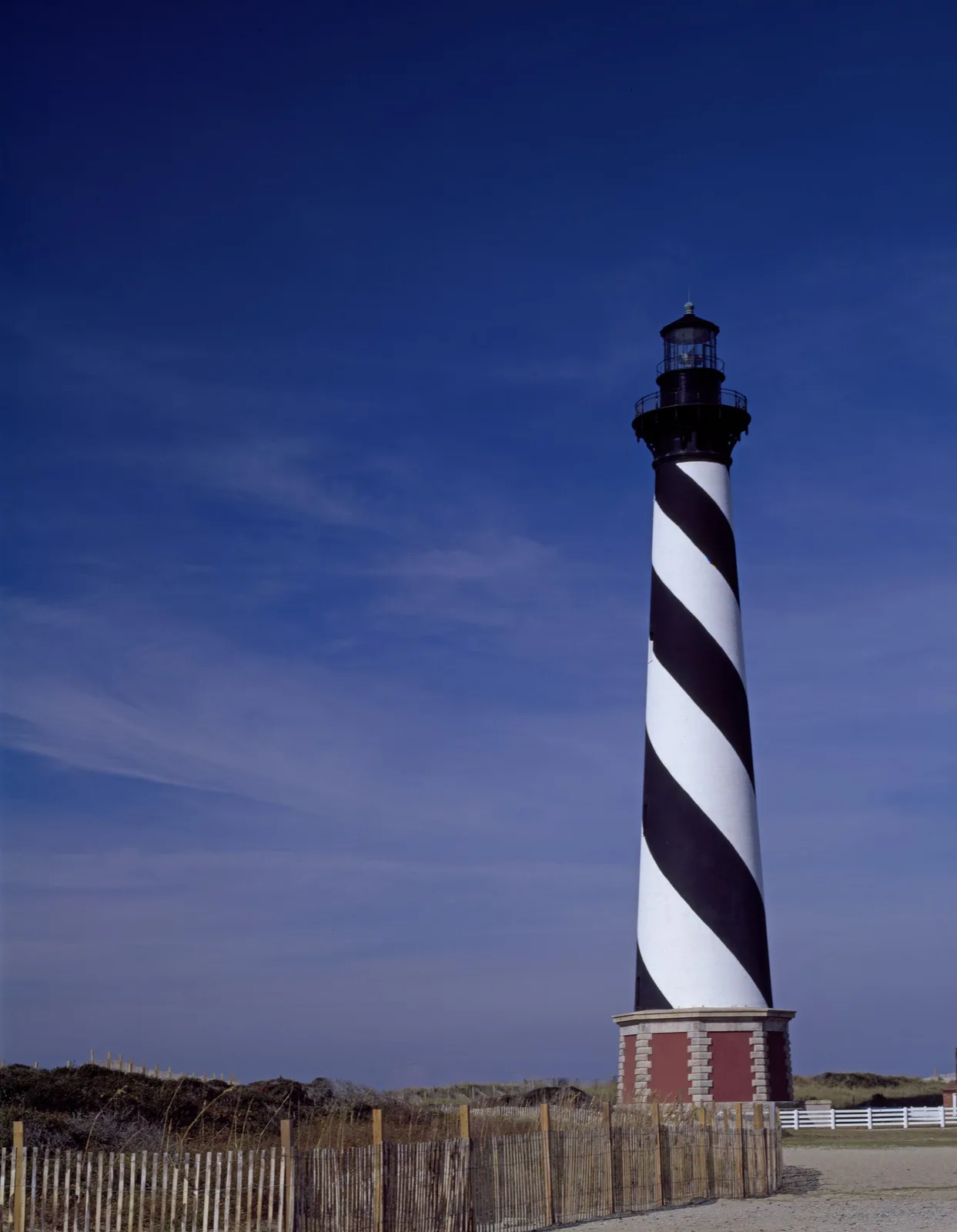
Cape Hatteras Lighthouse, 198 feet tall
Fast Facts
Did You Know?
In 1999, the Cape Hatteras Lighthouse was moved 2,900 feet inland to save it from the encroaching ocean. Engineers spent three years planning the move and then spent 23 days rolling the 4,800-ton structure on steel beams and hydraulic jacks. It is the largest lighthouse relocation in US history.
The waters off Cape Hatteras are known as the 'Graveyard of the Atlantic' because of the more than 1,000 ships that have sunk there over the centuries. The treacherous Diamond Shoals, where the warm Gulf Stream meets the cold Labrador Current, create unpredictable seas and shifting sandbars that have claimed ships from colonial times through World War II.
The Lost Colony of Roanoke, the first English settlement in America, disappeared in 1587 leaving only the word 'CROATOAN' carved on a post. The Croatoan were an Indigenous people of nearby Hatteras Island. Whether the colonists merged with the Croatoan, perished, or met some other fate remains one of the greatest mysteries in American history.
Plan Your Visit
Location
Dare and Hyde counties, Outer Banks, North Carolina
Designation
National Seashore (first in the US)
Best Seasons
Fall for crowds, summer for swimming and surfing, spring for birding
Admission
Park free; lighthouse climb $10 adults, $5 children
Visitor Center
1401 National Park Dr, Manteo, NC 27954 (park HQ)
Lighthouse Hours
Open for climbing mid-April through mid-October
Getting There
US-64 to Manteo, then NC-12 south; ferry from Cedar Island or Swan Quarter to Ocracoke
More Info
nps.gov/caha