About New Mexico
New Mexico takes its name from the Spanish "Nuevo Mexico," applied by Spanish conquistadors in the 1560s to the territory north of the Rio Grande. Spanish explorer Francisco de Ibarra used the name to refer to the region after hearing from indigenous peoples about rich settlements to the north that they hoped might rival the wealth of Mexico. The name reflected Spanish hopes for another conquest as spectacular as Cortes's defeat of the Aztec Empire in Mexico, though those hopes were not realized. Spain colonized the region in 1598 when Juan de Onate established the first permanent European settlement in the Southwest. New Mexico did not become a U.S. state until 1912, making it one of the last of the contiguous 48 states to be admitted to the union.
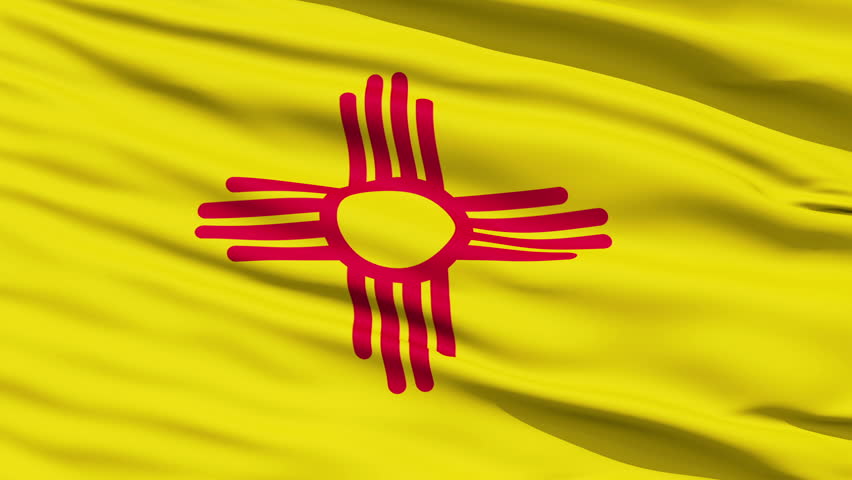
New Mexico is one of the most genuinely distinctive states in America: a place where three centuries of Spanish colonial history overlay thousands of years of Pueblo civilization, where the world's first atomic bomb was built and detonated in the desert, where Georgia O'Keeffe painted her greatest work from an adobe house in the high desert, and where the Zia sun symbol of an ancient Pueblo community became the emblem of a modern American state. Its landscapes, from the white gypsum dunes of the Tularosa Basin to the volcanic mesas of the northwest to the 13,000-foot peaks of the Sangre de Cristo Mountains, are among the most spectacular in the continent.
The state lives with deep paradox. It is home to two of the world's most important scientific laboratories and has more PhD scientists per capita than any other state, yet consistently ranks near the bottom of national measures of educational attainment and near the top of poverty rates. Its oil and gas revenues fund ambitious clean energy mandates; its Indigenous communities exercise genuine sovereignty while fighting persistent economic marginalization; its art market is world-class while its rural villages struggle with generational poverty. The enchantment in "The Land of Enchantment" is real, but it coexists with urgent challenges that the state has not yet fully answered.
New Mexico's three cultures, Pueblo and Navajo Indigenous, Hispanic descendants of 400 years of Spanish colonial and Mexican settlement, and Anglo Americans who arrived mostly in the 19th and 20th centuries, shape every dimension of life here. The food (green chile on everything, bizcochito at Christmas, posole at feast days), the architecture (flat-roofed adobe forms mandated by ordinance in Santa Fe), the language (New Mexico Spanish retains vocabulary from 17th-century Castilian), and the art all reflect this layered inheritance in ways that make New Mexico unlike any other place in the country.
New Mexico's Six Regions
Albuquerque, New Mexico's largest city with approximately 565,000 residents in the city proper and nearly a million in the metropolitan area, sits in the high desert of the middle Rio Grande valley at an elevation of about 5,300 feet, flanked to the east by the dramatic Sandia Mountains (which turn watermelon pink at sunset, giving them their Spanish name) and stretching westward across the river into the volcanic West Mesa. The city was founded in 1706 as a Spanish colonial villa and has grown into a diverse, sprawling city with a distinctive character: part Southwestern college town (the University of New Mexico, with 25,000 students, anchors the Nob Hill neighborhood), part military-scientific complex (Kirtland AFB, Sandia Labs, and numerous defense contractors), part tourist destination (the Old Town Historic District preserves the original Spanish colonial plaza, and the Albuquerque International Balloon Fiesta fills the October sky with 500+ hot-air balloons), and part gritty post-industrial city dealing with poverty, crime, and substance abuse challenges that have been among the most severe in the country.
Route 66, the historic highway that connected Chicago to Los Angeles, runs through the heart of Albuquerque on Central Avenue, its motels and diners now a mix of nostalgia and urban grittiness. The Bosque, the cottonwood forest ecosystem along the Rio Grande, is one of the most important riparian habitats in the Southwest.
Corrales and Rio Rancho to the north are rapidly growing suburbs; the Rio Rancho area in particular has attracted Intel Corporation's largest semiconductor manufacturing facility, one of the largest private employers in the state.
Albuquerque holds more than a quarter of New Mexico's population and dominates its economy, but it has a hard reputation: the city has repeatedly ranked among the highest in the country for property crime and auto theft, its police department operated under a federal court settlement from 2014 to 2023 over a pattern of excessive force, and it has one of the nation's worst pedestrian-fatality rates. Fentanyl and methamphetamine, much of it moving up Interstate 25 from the border, have driven a homelessness and overdose crisis centered downtown and along Central Avenue.
The screen industry is now a real employer here: Netflix bought the former ABQ Studios in 2018 and has expanded it into one of its largest production campuses outside Los Angeles, drawn by the state's 25 to 40 percent refundable film tax credit, and 'Breaking Bad' and 'Better Call Saul' tourism, house tours, the car wash, Los Pollos Hermanos pop-ups, has become its own small economy. Intel's Rio Rancho 'fab' won a multibillion-dollar 2021 expansion and federal CHIPS Act support.
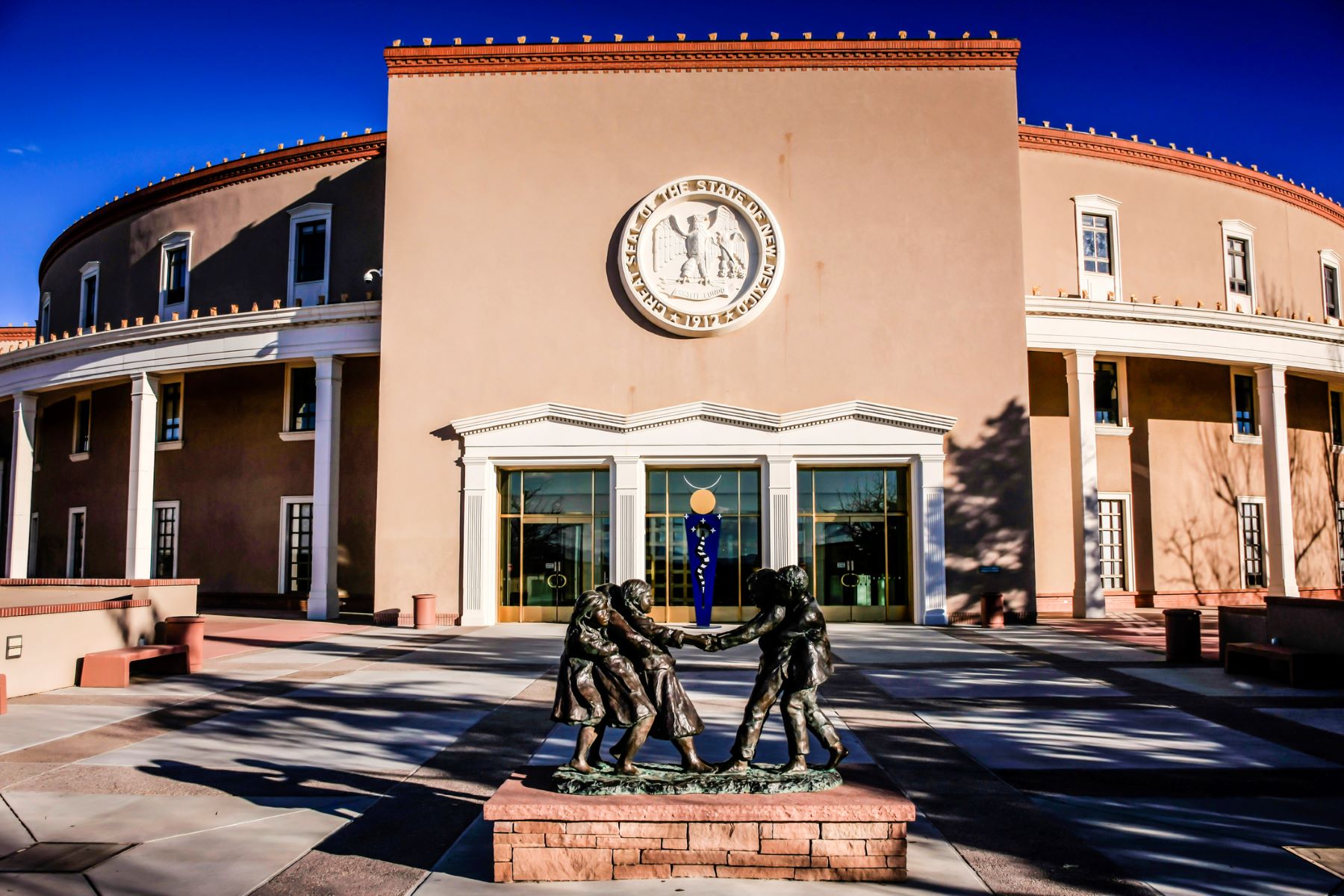
Santa Fe, New Mexico's capital and one of the most culturally significant cities in North America, was founded in 1610 by Spanish Governor Pedro de Peralta as La Villa Real de la Santa Fé de San Francisco de Asís, making it the oldest continuously occupied state capital in the United States and the second oldest European-founded city in the country after St. Augustine, Florida. The city's adobe architecture, mandated by ordinance to maintain its distinctive character, its Plaza at the center of civic life, and the Palace of the Governors (the oldest continuously occupied public building in the United States, in use since 1610) give it a physical environment unlike any other American city.
Santa Fe's art market, centered on Canyon Road and the gallery district, is one of the most significant in the world, generating over $1 billion in art sales annually and drawing collectors, curators, and artists from every continent. The surrounding region is a tapestry of Indigenous Pueblo communities: Pojoaque, Tesuque, Nambe, San Ildefonso, Santa Clara, Ohkay Owingeh, and others maintain their sovereignty, culture, and languages in the Rio Grande valley north of the capital.
Los Alamos, 35 miles northwest of Santa Fe on a mesa above Bandelier National Monument's canyon landscape, was built in secret beginning in 1943 as the scientific headquarters of the Manhattan Project; its sudden appearance from nothing in the middle of the wilderness and its continuing role as one of the world's most important research institutions give it a permanent mystique.
Bandelier National Monument itself protects the cliff dwellings and mesa-top ruins of the Ancestral Puebloans who inhabited the Pajarito Plateau from approximately 1150 to 1550 CE.
The Taos area in the Sangre de Cristo Mountains of northern New Mexico is one of the most artistically and culturally layered places in the United States. Taos Pueblo, a multi-storied adobe structure continuously inhabited for over 1,000 years, is one of the oldest continuously occupied communities in North America and a UNESCO World Heritage Site. The pueblo's two great houses, rising five stories on either side of Taos Creek, are the architectural icons of the American Southwest, photographed more than almost any other structure in the region.
The Taos art colony, which began drawing American and European artists to the area in the early 20th century (Georgia O'Keeffe, D.H. Lawrence, and Mabel Dodge Luhan were among its most celebrated inhabitants), established Taos as a global art destination. Taos Ski Valley, one of the most challenging ski resorts in North America, is tucked into the high peaks above town and has a devoted following among serious skiers who appreciate its steep terrain and lack of snowboarding (it was among the last major ski areas in the country to allow snowboards, admitting them only in 2008).
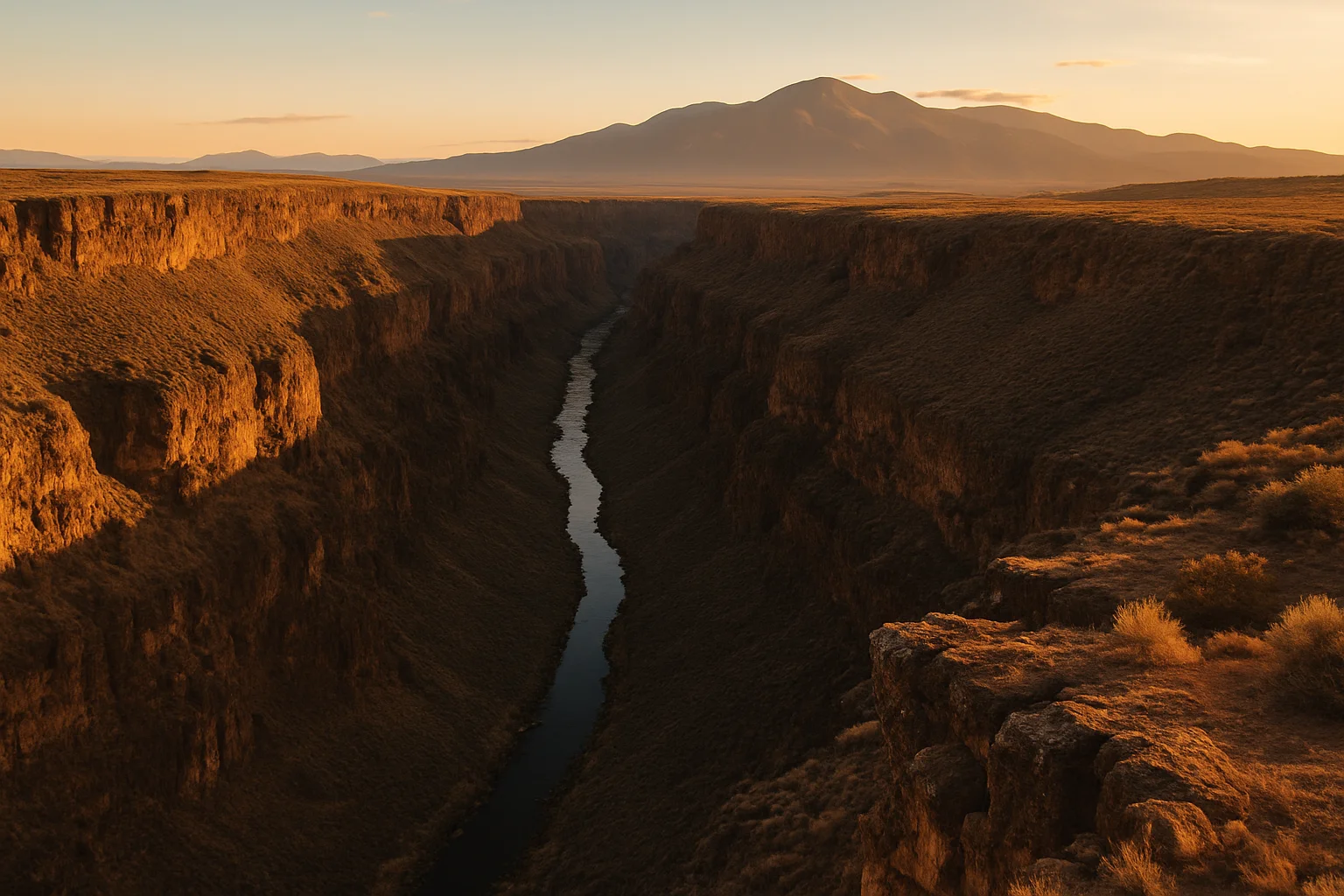
The Rio Grande Gorge, a 650-foot-deep chasm carved by the river through black basalt, is one of the most dramatic natural features in New Mexico; the Rio Grande Gorge Bridge, at 650 feet above the river, was the highest bridge in the US when built in 1965. The Enchanted Circle, a scenic byway looping through Eagle Nest, Angel Fire, and the Vietnam Veterans Memorial State Park, passes through some of the most spectacular mountain scenery in the Southwest.
Taos Pueblo has fought and won landmark sovereignty battles. In 1970, after a 64-year campaign, Congress returned 48,000 acres including Blue Lake, the tribe's most sacred site, in what is regarded as the first return of federal land to a tribe on religious rather than monetary grounds, a precedent for later sacred-lands claims. The pueblo still lives without electricity or running water in its core ceremonial village by choice.
The 1847 Taos Revolt, in which Hispanic and Pueblo residents killed the American territorial governor Charles Bent, was put down by U.S. troops who bombarded the pueblo's church, and the ruined adobe walls of San Geronimo mission still stand as a memorial. The area's early-20th-century art colony grew around Mabel Dodge Luhan, a wealthy patron who drew D.H. Lawrence, Ansel Adams, Georgia O'Keeffe, and others north.
The high country north and east, around Questa, Chama, and the Tierra Amarilla land grant, is old Hispanic ranching and sheep country and the birthplace of the 1960s land-grant movement; its economy now mixes ranching, a shuttered molybdenum mine at Questa (a Superfund site), the Cumbres and Toltec steam railroad, elk hunting, and the acequia irrigation ditches, some of them 400 years old and still community-governed, that thread the mountain valleys.
Southeastern New Mexico, encompassing Eddy, Lea, Chaves, Roosevelt, and Curry counties, is the economic powerhouse driving the state's current oil boom, a landscape of vast flat high desert punctuated by pump jacks, natural gas flares, and industrial facilities that have multiplied dramatically since the hydraulic fracturing revolution of the 2010s. The Permian Basin extends across Eddy and Lea counties, and the communities of Carlsbad, Hobbs, and Artesia have experienced the boom-bust-boom cycles of oil extraction economy: rapid population growth, worker shortages, housing crises, and infrastructure strain when prices are high; sudden unemployment and economic depression when they fall.
Roswell, the county seat of Chaves County, is globally famous for reasons entirely disconnected from its actual economy: the alleged crash of an unidentified flying object near the city in July 1947, subsequently explained by the Air Force as a classified weather balloon project, spawned the modern UFO mythos and made Roswell the center of alien-themed tourism, with the International UFO Museum and Research Center drawing visitors from around the world. The actual economic base of the region is agriculture (dairy farming in the Pecos valley is significant) and oil.
Carlsbad Caverns National Park, in the Guadalupe Mountains at the southeastern corner of the state, is one of the most spectacular natural wonders in North America: a system of more than 119 known caves whose largest chamber, the Big Room, is one of the largest natural underground spaces in the world. The park is famous for its evening bat flights, when hundreds of thousands of Mexican free-tailed bats emerge from the cave entrance in spiraling columns at dusk.
Southeastern New Mexico votes and thinks more like West Texas than like Santa Fe: it is the state's most conservative region, home to a large Anglo and evangelical population and to oil-town wealth, and the political counterweight to the Hispanic and Native north. Its 'Little Texas' identity extends to accent, football culture, and support for splitting the region off, an idea floated periodically and never serious.
The oil boom's strains are concrete. Carlsbad and Hobbs schools compete for teachers with oilfield wages, man-camps and RV lots ring the towns, truck traffic has made the roads among the deadliest in the state, and a 2021 sinkhole scare over abandoned brine wells near Carlsbad, a cavity big enough to swallow part of a highway and a church, forced a costly emergency stabilization.
Underneath Carlsbad, in a 250-million-year-old salt bed, sits the Waste Isolation Pilot Plant, the only operating deep geologic repository for nuclear waste in the United States, where defense plutonium debris is entombed 2,150 feet down; a 2014 chemical reaction in one waste drum released a small amount of radiation, closed the site for three years, and cost about a billion dollars to recover from.
Southern New Mexico, anchored by Las Cruces and the Mesilla Valley along the Rio Grande, is a region of extraordinary physical beauty, agricultural richness, and growing scientific and commercial significance. Las Cruces, the state's second-largest city with about 115,000 residents, sits in the Mesilla Valley between the Organ Mountains and the Rio Grande, at the northern end of the Chihuahuan Desert, and has grown dramatically as a retirement destination, university town (New Mexico State University is the state's land-grant institution), and service center for the surrounding agricultural and military economy.
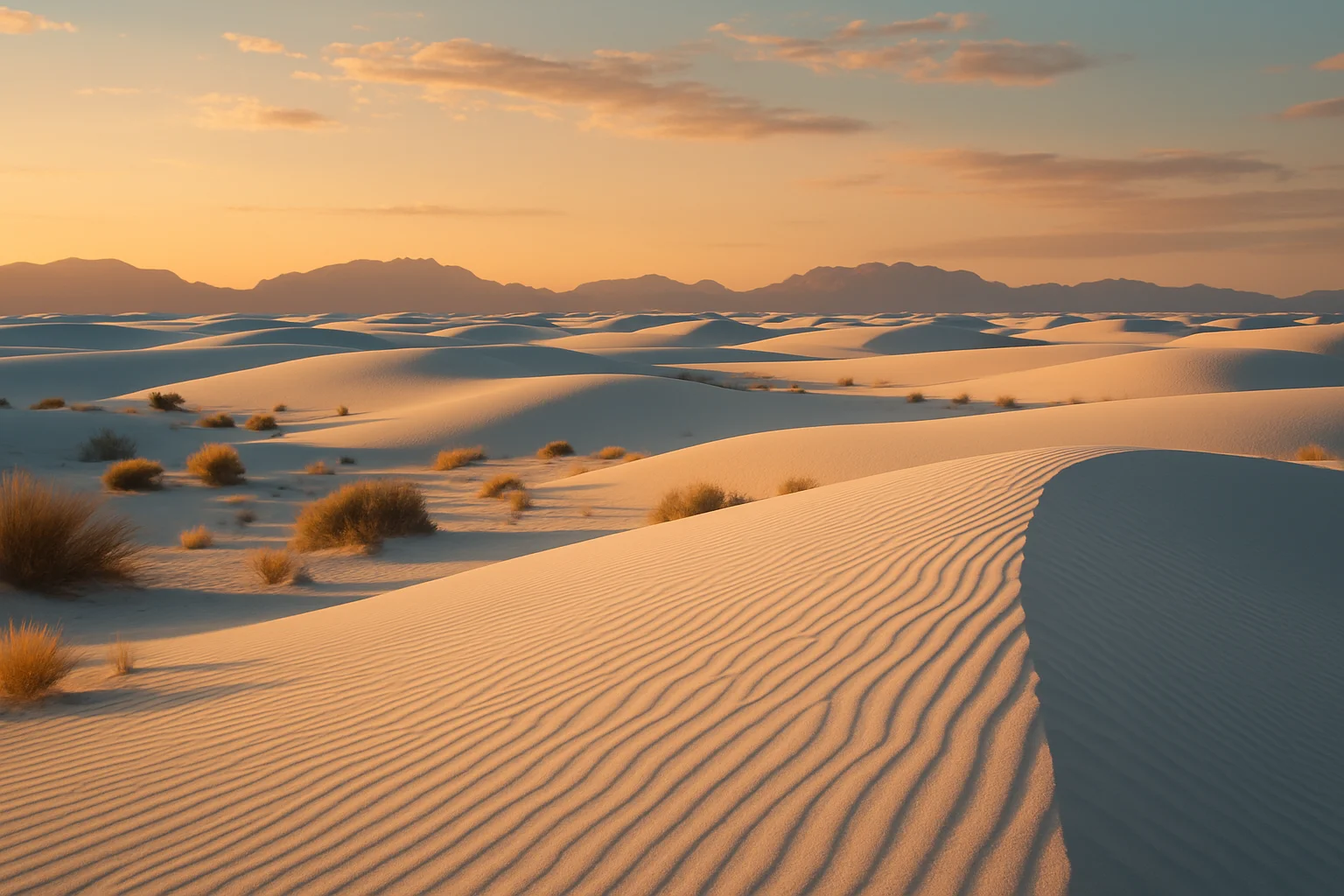
White Sands National Park, 20 miles west of Alamogordo, protects the world's largest gypsum dune field, 275 square miles of pure white gypsum sand that shifts and drifts like snowdrifts across the Tularosa Basin floor, a landscape so otherworldly that NASA has used it as a training analog for lunar and Martian terrain. White Sands Missile Range, adjacent to the park, is the largest military installation in the United States, encompassing 3,200 square miles of desert and mountain terrain.
Hatch, a small town of about 1,600 in the Rio Grande valley, is the undisputed chile capital of the world: its Hatch green and red chiles are the foundation of New Mexican cuisine, and the annual Hatch Chile Festival draws 30,000 visitors for fresh roasted chiles. The village of Mesilla, adjacent to Las Cruces, is one of the most historically significant communities in the Southwest, the site where the Gadsden Purchase was signed in 1854 (the land transaction that gave the United States its current southern border with Mexico) and where Billy the Kid was tried and sentenced to death.
Southern New Mexico is now one of the fastest-growing parts of the state. Las Cruces has passed 115,000 people, New Mexico State University anchors a research economy in agriculture and, increasingly, in aerospace, and the region draws retirees priced out of Arizona and Colorado; Doña Ana County's growth contrasts with the rural decline of most of New Mexico outside Albuquerque and Santa Fe.
The Organ Mountains-Desert Peaks National Monument, roughly 500,000 acres of jagged granite and Chihuahuan Desert around Las Cruces, was designated by President Obama in 2014 after a long local campaign, then targeted for shrinkage in a 2017 to 2018 federal review, and finally left intact, a fight that mirrored the national one over the Antiquities Act.
The border runs along the region's southern edge, and Sunland Park and Santa Teresa, next to El Paso and Ciudad Juarez, have grown as a binational manufacturing and logistics corridor, with a Union Pacific intermodal ramp, a Foxconn assembly plant, and warehouses moving goods to and from Mexico's maquiladoras; a stretch of border wall was built here, and migration surges through the El Paso sector regularly draw National Guard deployments.
Western New Mexico, encompassing McKinley, Cibola, Catron, and Grant counties, is one of the most culturally diverse and geologically dramatic regions in the United States, a landscape of mesas, lava flows, ancient ruins, and living Indigenous communities that stretches from the high pine forests of the Gila Wilderness to the volcanic badlands of El Malpais. Gallup, the region's largest city and the self-proclaimed 'Indian Capital of the World,' sits on Interstate 40 (the old Route 66 alignment) at the edge of the Navajo Nation and is one of the most important trading centers for Native American arts, jewelry, and crafts in the country; its Indian Ceremonial, held annually since 1922, is one of the oldest and largest gatherings of Native American arts and performance in the Western Hemisphere.
Acoma Pueblo, Sky City, sits atop a 365-foot sandstone mesa and is one of the oldest continuously inhabited communities in North America, its residents having lived on or near this mesa top for at least 2,000 years. The pueblo's San Estevan del Rey Mission, built with forced Pueblo labor between 1629 and 1641, is one of the most remarkable examples of Spanish colonial architecture on the continent.
El Malpais National Monument protects a vast lava flow landscape created by volcanic activity within the past 3,000 years, its black basalt flows contrasting with the white sandstone cliffs of El Morro (Inscription Rock), where centuries of travelers, from 13th-century Ancestral Puebloans to 17th-century Spanish soldiers to 19th-century American explorers, carved their names and messages into the soft sandstone of a prominent bluff beside a natural water pool.
Silver City in the southwestern corner, the gateway to the Gila Wilderness (the first designated wilderness area in the United States, established 1924), is an arts and outdoor recreation community built on the ruins of a 19th-century copper mining economy.

Economy
New Mexico's economy is anchored by two pillars unique in the country: federally funded national laboratories that make it the most scientifically concentrated state in the nation, and an oil and gas industry in the Permian Basin that has generated state revenues at historically unprecedented levels.
Los Alamos National Laboratory, established in 1943 as the scientific heart of the Manhattan Project and situated on a remote mesa in the Jemez Mountains, is one of the largest and most important research institutions in the world, employing approximately 15,000 scientists, engineers, technicians, and support staff and conducting research across nuclear security, energy, materials science, computational science, and bioscience. Its annual budget exceeds $3 billion, most of it from the Department of Energy and the National Nuclear Security Administration. Sandia National Laboratories, headquartered in Albuquerque with additional facilities in Livermore, California, employs approximately 14,000 people and focuses on engineering and science in support of national security, particularly in nuclear weapons design, systems integration, and nonproliferation.
Together, LANL and Sandia account for a substantial fraction of New Mexico's total economic output and are directly responsible for New Mexico having more PhD-level scientists and engineers per capita than any other state. Kirtland Air Force Base in Albuquerque is one of the largest and most important Air Force installations in the country, home to the Air Force Research Laboratory, the Nuclear Weapons Center, and multiple classified programs.
Holloman Air Force Base near Alamogordo houses the 49th Wing and has been a center of aerospace testing since the early jet age. White Sands Missile Range, the largest military installation in the United States by area, has been a center of rocket and missile testing since the captured German V-2 rockets were tested there in 1946.
The lab economy makes New Mexico an outlier on every measure of scientific concentration. Together the two labs and Kirtland employ on the order of 40,000 people and drive federal research spending in the state to among the highest per capita in the country, and the money is highly concentrated: Los Alamos County has the highest median household income of any county in New Mexico and one of the highest in the nation, while counties a short drive away are among the poorest.
That dependence cuts both ways. Los Alamos is now expanding to produce plutonium 'pits' for a modernized nuclear arsenal, a multibillion-dollar mission and jobs bonanza that also revives old fears about contamination of the Rio Grande watershed, and the state's whole science base, from the labs to White Sands to Spaceport America, rises and falls with Defense and Energy Department budgets set in Washington.
New Mexico Tech in Socorro, whose researchers train the world's bomb-disposal experts, the Air Force's directed-energy (laser) work at Kirtland, and the Trinity site itself, opened to the public once a year, are all threads of the same federal-science identity that no other small state has.
The Permian Basin extends across southeastern New Mexico and western Texas, and the hydraulic fracturing revolution of the 2010s unlocked vast reserves of previously inaccessible tight oil and natural gas. New Mexico's Permian production, centered in Eddy and Lea counties, has grown explosively: the state's oil production increased by more than tenfold between 2010 and 2024, generating extraordinary royalty revenues for the state government.
New Mexico's permanent fund for education is among the fastest-growing state education endowments in the country, fed by oil and gas royalty payments. The energy boom has created a paradox for the state: oil revenues fund public schools, universities, and social services at a level that would be impossible without fossil fuel extraction, while the climate and environmental implications of that extraction are profound.
The Permian Basin is one of the largest methane emission sources in the country, and New Mexico has enacted some of the strictest methane regulations of any oil-producing state in an effort to balance economic benefit with environmental responsibility. The state also has enormous renewable energy potential: New Mexico ranks among the top states in both solar and wind energy resources, and the transition from fossil fuel dependence to a diversified clean energy economy is one of the defining policy challenges facing the state.
Oil money now runs New Mexico's government. Severance taxes, royalties, and rents on the vast state and federal lands of Lea and Eddy counties provide roughly a third of the state's general fund and feed the Land Grant and Severance Tax permanent funds, which together hold tens of billions of dollars and pay a permanent annual distribution to public schools, the university system, and other beneficiaries, a structure that lets New Mexico spend far above what its own residents' incomes would support.
The boom is very local and very volatile. Almost all the new production is in the two southeastern counties, where sudden growth has overwhelmed housing, water, roads, and schools; a 2020 price crash briefly halved state revenue and forced special legislative sessions, and a 2022 to 2023 surge produced billion-dollar surpluses used to make community college tuition-free.
Alongside the Permian, New Mexico has a long-declining conventional gas basin in the northwest (the San Juan Basin), the coal that fed the now-mostly-retired Four Corners and San Juan power plants near Farmington, and the Waste Isolation Pilot Plant near Carlsbad, which buries the nation's defense nuclear waste, together making energy in every form a bigger share of this state's identity than of almost any other.
Santa Fe is the anchor: the oldest state capital in the United States (founded 1610), it has become one of the premier art destinations in the world, with Canyon Road's concentration of galleries, the Georgia O'Keeffe Museum, the Museum of International Folk Art, the New Mexico Museum of Art, and the Santa Fe Opera among its cultural landmarks. The Santa Fe art market is one of the largest in the country, and its Indian Market, held annually in August, is the world's largest and most prestigious juried Native American art show, drawing artists from 100+ tribes and hundreds of thousands of visitors.
The Albuquerque International Balloon Fiesta, held each October, is the world's largest hot-air balloon festival, drawing over 500,000 visitors for nine days of mass ascensions, night glows, and special shape balloons against the backdrop of the Sandia Mountains. White Sands National Park, the world's largest gypsum dune field, is one of the most visually stunning landscapes in North America.
Carlsbad Caverns National Park, Chaco Culture National Historical Park (a UNESCO World Heritage Site), Bandelier National Monument, and the Very Large Array radio telescope complex all draw visitors who find New Mexico's combination of geological, archaeological, and scientific heritage unlike anything else in America.
New Mexican food is itself a draw, and a legally defined one: the state named chile its official vegetable, made 'Red or green?' the official state question, and requires that anything sold as 'New Mexico Chile' actually be grown in the state, and UNESCO added the state's chile-and-tortilla cuisine to its list of intangible cultural heritage recognitions. Santa Fe and Albuquerque both market themselves heavily on the food.
The screen industry has become the fastest-growing cultural sector. 'Breaking Bad' and 'Better Call Saul' were shot almost entirely in Albuquerque, Netflix bought and expanded the former ABQ Studios into one of its largest production hubs outside Los Angeles, and the state's refundable film tax credit, 25 to 40 percent, has drawn dozens of features and series and thousands of crew jobs, though critics question the net fiscal return.
Culture also fuels a running conservation and access fight: Chaco's dark-sky isolation is threatened by drilling in the surrounding basin, tribal nations have pushed back on tourism at sacred sites, and 2020 protests led Santa Fe to remove a Civil War-era obelisk from its plaza and end the 'Entrada' reenactment of the 1692 Spanish return, a sign that even the heritage the state sells is contested.
The state averages over 300 days of sunshine per year and has some of the highest solar irradiance readings of any state in the country. Utility-scale solar farms have been developed across the southern desert regions, and New Mexico has set a target of 100% carbon-free electricity by 2045 under its Energy Transition Act (2019), among the most ambitious clean energy mandates of any state. Wind energy development is concentrated in the eastern plains and the highlands along the Texas border.
The combination of solar and wind resources, combined with the state's large land area and the declining cost of renewable technology, has attracted significant investment from major utility and energy companies. Spaceport America, the world's first purpose-built commercial spaceport, is located in the Jornada del Muerto desert of Sierra County near Truth or Consequences. Built with $220 million in state and county funding between 2006 and 2011, Spaceport America is the operational home of Virgin Galactic's SpaceShipTwo program, which conducts suborbital flights carrying paying passengers to the edge of space.
Blue Origin has also conducted operations at the facility. The spaceport has generated less economic activity than its proponents projected, and its financial sustainability has been a subject of ongoing debate, but it represents New Mexico's deliberate effort to position itself in the emerging commercial space economy.
New Mexico's 2019 Energy Transition Act set one of the country's most aggressive targets, 100 percent carbon-free electricity by 2045 (2050 for rural co-ops), and it was paired with a bond mechanism to help the utility PNM close the coal-fired San Juan plant near Farmington and to fund worker and community transition aid for the Navajo and non-Native towns that depended on it, a model watched by other coal regions.
The buildout has been rapid but constrained by wires. Large solar and wind projects have gone up across the eastern plains and the southern desert, and the roughly 1,500-mile SunZia transmission line, approved after a 17-year fight over its Rio Grande crossing and San Pedro Valley routing, is meant to carry New Mexico wind to Arizona and California markets starting in the mid-2020s.
Spaceport America's Virgin Galactic finally began commercial suborbital passenger flights from the site in 2023, more than a decade behind schedule, and the state has used it and the labs to court a small aerospace-startup and satellite cluster, but the facility still needs annual state subsidies and remains a symbol of both New Mexico's ambition and the gap between its space marketing and its results.
The result is an agriculture that is intensive, specialized, and deeply tied to cultural identity. New Mexico is the nation's leading producer of its own unique chile varieties, both the iconic Hatch green chile and the dried red chile that are fundamental to New Mexican cuisine.
The Hatch Chile Festival held annually in Hatch, the self-proclaimed 'Chile Capital of the World,' draws tens of thousands of visitors for the late-summer roasting season. Chile is so central to New Mexican identity that the state legislature designated it the official state vegetable, and the state question is officially 'Red or Green?' referring to which chile sauce accompanies meals.
New Mexico is also one of the nation's leading pecan producers, with the fertile bottom lands of the Mesilla Valley near Las Cruces supporting extensive pecan orchards; the family-owned McGinn's PistachioLand in Alamogordo operates what was for years the world's largest pistachio, a roadside attraction as beloved as any in the state. Cattle ranching on the eastern plains and in the mountains has been central to New Mexico's Anglo ranching culture since the 1870s; the Lincoln County cattle wars of the late 1870s, which brought Billy the Kid to notoriety, were fought over control of the beef supply business.
Water rules everything. Rio Grande farmers' allocations are set by the 1938 Rio Grande Compact among Colorado, New Mexico, and Texas, and Texas sued New Mexico at the U.S. Supreme Court in 2013 arguing that groundwater pumping near Las Cruces was stealing river water owed downstream; a proposed settlement collapsed in 2024 when the federal government objected, leaving one of the country's biggest interstate water cases unresolved. The Pecos River is governed by its own compact and a separate long-running Texas suit.
The Mesilla Valley pecan industry, dominated by a few large operations including one of the world's biggest single pecan farms, uses enormous amounts of irrigation water, and pecan acreage has kept expanding even as the river runs short, a tension that pits a lucrative export crop against every other water user in southern New Mexico.
The green-chile industry, though small in acreage, is culturally central and economically fragile: New Mexico's chile acreage has fallen by more than half since the 1990s as labor for the hand-harvest grew scarce and cheaper imports from Mexico and 'Hatch-style' chile grown elsewhere ate into the market, prompting a 2011 state 'New Mexico Chile Advertising Act' and public funding for a mechanical harvester.
The tribal gaming compact system in New Mexico requires tribes to share a percentage of gaming revenue with the state government in exchange for the right to operate certain games, generating tens of millions of dollars annually for the state's general fund. Beyond gaming, New Mexico's tribal economies are extraordinarily diverse: the Navajo Nation, the largest tribal nation in the United States by land area (extending into Arizona and Utah as well as New Mexico), has a complex economy including oil and gas extraction, coal mining, retail, and a growing renewable energy sector.
The 19 Pueblo communities of New Mexico, descendants of the ancestral Puebloans who built the great houses of Chaco Canyon, have developed economies ranging from tourism and arts (Acoma Pueblo's Sky City, continuously inhabited for 2,000 years, charges admission as a UNESCO-recognized cultural site) to manufacturing and retail.
New Mexico's Indigenous peoples constitute approximately 11% of the state's population, one of the highest proportions of any state outside Alaska, and their political, economic, and cultural influence on the state is profound and ongoing.
The Navajo Nation reaches into New Mexico's northwest quarter, and the transition off coal has hit it hard: the closure of the Navajo Generating Station in Arizona in 2019 and the state's plan to close San Juan and Four Corners cost the tribe a large share of its revenue and thousands of jobs, and the Navajo, the Jicarilla Apache, and others are now investing heavily in utility-scale solar on former mine and grazing land to replace that income.
The 19 Pueblos wield unusual political power for their size because they vote as blocs, sit close to Santa Fe and Albuquerque, and hold senior water rights: Pueblo water claims, some quantified only in the 2010s and 2020s, are among the most senior on the Rio Grande and its tributaries and constrain every other user, and several Pueblos run their own utilities, schools, courts, and police.
Tribal enterprises have diversified well beyond casinos into government contracting (the Chickasaw-style model has been copied by Laguna and others), construction, hospitality, cannabis (legal in New Mexico since 2021, with Pueblo-owned dispensaries), and, in the case of Sandia and Isleta pueblos just outside Albuquerque, large-scale commercial and resort real estate on land that was farmland a generation ago.
How New Mexico's Government Works
New Mexico's state government follows the standard three-branch structure under a constitution adopted at statehood in 1912 and amended many times since. The governor is elected to four-year terms and limited to two consecutive terms. The lieutenant governor is elected on the same ticket as the governor and serves as acting governor when the governor is absent or unable to serve.
New Mexico is a reliably Democratic state in statewide elections: its governor, both U.S. senators, and the majority of its state legislature are Democrats, and it has voted for the Democratic presidential candidate in every election since 2000. The state's Democratic coalition is built on its majority-minority population: Hispanic New Mexicans constitute approximately 49% of the population, Native Americans approximately 11%, and Black and Asian Americans additional percentages, making New Mexico one of the most ethnically diverse states in the country and one where no single racial or ethnic group constitutes a majority.
The federal government plays an outsized role in New Mexico's economy and governance: federal land agencies control approximately 35% of the state's land area, and federal employment through the national laboratories, military installations, and land management agencies constitutes a larger share of total employment than in almost any other state. Federal royalty payments from oil and gas production on federal lands are a major revenue source for state government.
New Mexico's government also reflects its unique demographic composition: it was the first state to elect a Hispanic governor (Ezequiel Cabeza de Baca, 1917), and Hispanic Americans have served in the governor's office, the U.S. Senate, and the state legislature throughout the state's history. New Mexico's 19 Pueblo nations, the Navajo Nation, and the Mescalero and Jicarilla Apache nations exercise sovereign governmental authority within the state alongside state and federal government.
Governor of New Mexico
Current Governor
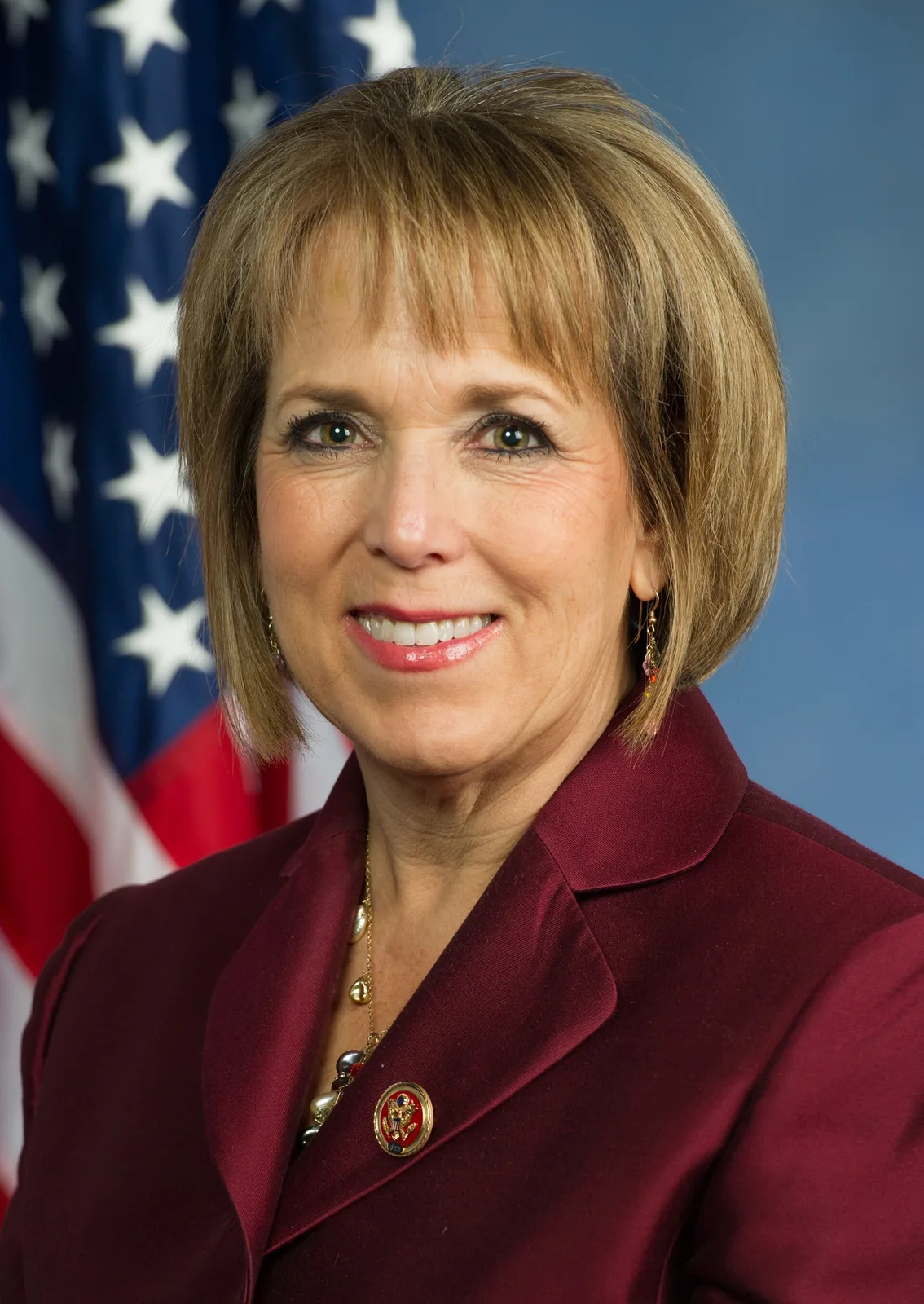
Michelle Lujan Grisham
- Party
- Democratic
- In Office Since
- January 1, 2019
- Term Ends
- January 2027
- Born
- October 26, 1959, Los Alamos, New Mexico
- Education
- University of New Mexico (BA, 1981; JD, 1984)
- Prior Role
- U.S. Representative, NM-1 (2013-2019); NM Secretary of Health (2003-2007); Bernalillo County Commission
Michelle Lujan Grisham is New Mexico's 32nd Governor and the first Democratic woman elected governor in state history. Born in Los Alamos during the Cold War nuclear era, she served as the state's Secretary of Health before winning a congressional seat in 2012. As governor she has pursued ambitious climate legislation including the Energy Transition Act, expanded Medicaid access, increased education funding using oil revenue, and navigated New Mexico through the COVID-19 pandemic with some of the stricter public health restrictions in the country. She was re-elected in November 2022 and is serving her final term.
Other Current State Officials
Lieutenant Governor
Howie Morales
In office since January 2019, re-elected with Governor Lujan Grisham in 2022. A former state senator from Silver City, Morales is the first Hispanic and first Native American (Zuni Pueblo descent) Lt. Governor in New Mexico history. He has focused on rural economic development, behavioral health, and education policy as lt. governor.
Attorney General
Raúl Torrez
In office since January 2023. A former Bernalillo County District Attorney known for aggressive prosecution of violent crime, Torrez was elected AG in 2022 with a mandate for public safety reform. He has pursued consumer protection cases, prosecuted human trafficking, and navigated tensions between progressive criminal justice reform and traditional law enforcement approaches.
Secretary of State
Maggie Toulouse Oliver
In office since 2015; re-elected in 2018 and 2022. Oversees elections, business registrations, and official state records. A consistent advocate for voter access and election security, Toulouse Oliver has implemented automatic voter registration in New Mexico and worked to modernize the state's election infrastructure.
The New Mexico Legislature
New Mexico State Senate
- Seats: 42 members
- Terms: 4-year terms (staggered)
The upper chamber. Senators represent districts across the state, with roughly half the seats up for election every two years. Democrats hold a strong majority. The Senate confirms the governor's judicial and cabinet appointments.
New Mexico House of Representatives
- Seats: 70 members
- Terms: 2-year terms
The lower chamber. All 70 seats are on the ballot every two years. Democrats hold a majority. The House originates appropriations bills and shares lawmaking authority with the Senate. The Speaker of the House is one of the most powerful officials in state government.
New Mexico's U.S. Senators
U.S. Senator
Martin Heinrich
New Mexico's senior senator. First elected in 2012 after three terms in the House representing Albuquerque's first congressional district. A mechanical engineer by training, Heinrich has focused on public lands conservation, renewable energy, and intelligence oversight as a member of the Senate Intelligence Committee. He has been a leading Senate voice on climate policy and Western water issues.
U.S. Senator
Ben Ray Luján
New Mexico's junior senator. First elected in 2020 after serving four terms in the House. The son of a northern New Mexico small business owner, Luján served as chair of the Democratic Congressional Campaign Committee (2015-2019) before running for Senate. In January 2022, he suffered a stroke that required several weeks of recovery before he returned to the Senate; he recovered fully and has continued serving. He focuses on healthcare, broadband access, and rural economic development.
New Mexico Through the Years
From the great houses of Chaco Canyon to the secret mesas of Los Alamos, from the Pueblo Revolt that expelled a colonial empire to the Trinity Test that ended a world war, New Mexico's history contains some of the most consequential moments in the human story.
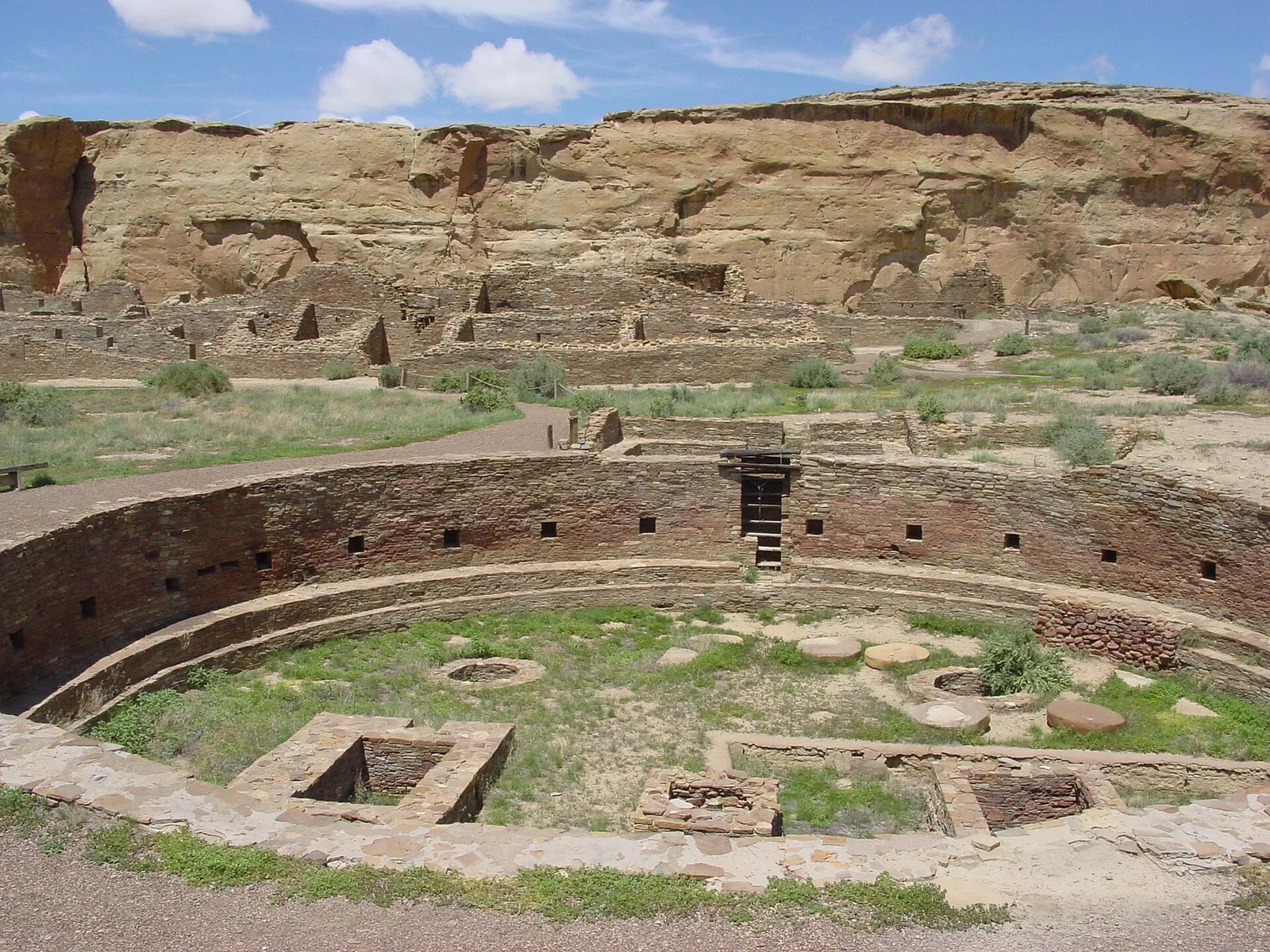
The human history of New Mexico stretches back at least 13,000 years, to the Clovis culture hunters whose distinctive stone projectile points, first found near Clovis, NM in 1929, defined what was for decades considered the earliest evidence of human presence in the Americas. But the most dramatic pre-contact achievement in New Mexico was the Chacoan civilization of the 9th through 12th centuries CE, centered on Chaco Canyon in the northwest. Between approximately 850 and 1150 CE, the Ancestral Puebloans of the San Juan Basin constructed a network of massive stone 'great houses' across an area of 25,000 square miles, connected by a system of engineered roads that radiated outward from Chaco in straight lines for hundreds of miles.
Pueblo Bonito, the largest great house, is a D-shaped structure of 650 rooms and 40 kivas built to a height of five stories, astronomically aligned so that sunlight enters specific rooms at the solstices and equinoxes. The Chacoan system was more than an architectural achievement; it was a regional center of ceremony, trade, and political organization that drew pilgrims and goods from across the Southwest.
By 1150, the Chacoan system had collapsed, possibly due to drought, deforestation, and social stress; the descendants of the Chacoans dispersed to found the Pueblo communities that survive to this day along the Rio Grande and its tributaries. When Spanish explorers arrived in the 16th century, they found approximately 80 Pueblo communities with populations ranging from a few hundred to several thousand, speaking several different languages but sharing a broadly common culture of multi-story adobe architecture, agricultural intensification, and complex ceremonial life.
New Mexico's other major pre-contact culture was the Mogollon of the southwest, whose Mimbres people around 1000 to 1150 CE painted black-on-white pottery bowls with bold geometric and animal designs, often 'killed' with a punched hole and buried with the dead, that are among the most prized ancient ceramics in the world and, because of it, among the most looted archaeological sites in the country.
The people the Spanish and later Americans called Apache and Navajo, both Southern Athabaskan speakers who migrated down from western Canada, probably arrived in the region only a few centuries before Europeans, around 1400 to 1500 CE. The Navajo (Dine) took up farming and, after the Spanish brought sheep, herding; the various Apache bands, Jicarilla, Mescalero, Chiricahua, remained hunters and raiders whose mobility made them the dominant military force across much of New Mexico into the 1880s.
Chaco Canyon is now a National Historical Park and UNESCO World Heritage Site, and the modern Pueblos, along with the Hopi and the Navajo, are consulted on its management; a long fight over oil and gas drilling on the surrounding federal land ended with a 2023 order barring new leases within about ten miles of the park.
Spanish exploration of New Mexico began in earnest with Francisco Vásquez de Coronado's expedition of 1540-1542, one of the most ambitious and ultimately disappointing enterprises of the Spanish colonial era. Coronado led approximately 300 Spanish soldiers and 1,000 allied Indigenous warriors north from Mexico in search of the legendary Seven Cities of Cíbola, rumored to be built of gold. What he found was the Zuni Pueblo of Hawikuh, a modest stone village that bore no resemblance to the golden cities of legend.
Coronado's men fought their way through the pueblos of the Rio Grande valley, wintering at Tiguex (near modern Bernalillo) in 1540-41 and conducting a brutal campaign against the Tiwa-speaking pueblos there. From Tiguex, Coronado led a smaller force northeast across the Texas panhandle and into Kansas in search of another legendary wealthy kingdom, Quivira, finding only grass-house villages of the Wichita people. He returned to Mexico in 1542 having found no gold and having killed a large number of Pueblo people and destroyed several villages.
The expedition was judged a failure in its time but produced some of the earliest geographical knowledge of the American Southwest and mapped the upper Rio Grande valley that would eventually be colonized. Serious colonization attempts began with Juan de Oñate's expedition of 1598, which established the first permanent European settlement in the Southwest at Ohkay Owingeh Pueblo, which the Spanish renamed San Juan de los Caballeros.
The name 'New Mexico' predates the state by more than three centuries: Spanish prospectors called the region 'Nuevo Mexico' in the 1560s in the hope it held silver-rich cities like those of the Aztecs, and Onate's contract to colonize it was, in effect, a business venture to find them. He never did.
Onate's rule was brutal from the start. After Acoma Pueblo killed 13 Spaniards in a 1598 dispute over supplies, he sent a punitive force that stormed the mesa in January 1599, killed some 800 people, enslaved the survivors, and ordered that every Acoma man over 25 have one foot cut off. Spain later tried and banished Onate for cruelty, and his statues in New Mexico have repeatedly been vandalized and, in 2020, removed.
The colony that survived was tiny and poor, a few thousand settlers strung along the Rio Grande who depended on Pueblo labor and food, on a supply caravan that came up from Mexico City only every three years, and on the Camino Real, the 1,600-mile royal road from Mexico City to Santa Fe that was the region's lifeline for two centuries.
Spanish colonial New Mexico, administered from its capital at Santa Fe (founded 1610), was a harsh and exploitative enterprise. The colonial system rested on the encomienda, which granted Spanish colonists the right to extract labor and tribute from the Pueblo communities under their authority, and on the mission system, which deployed Franciscan friars to convert the Pueblo people to Christianity, often by force, and to suppress traditional religious practices under pain of flogging or execution. The Pueblo peoples resisted this system throughout the colonial period but were outgunned and outorganized.
By the 1670s, a combination of drought, Apache raiding, and Franciscan persecution of traditional religious practices had created conditions of crisis. The response came from Popé (Po'pay), a religious leader of Ohkay Owingeh Pueblo who had been flogged by the Spanish for practicing traditional ceremonies. Popé organized the most successful Indigenous revolt against European colonialism in North American history: on August 10, 1680, Pueblo communities from Taos in the north to Isleta in the south rose simultaneously, killing 400 Spaniards including 21 of 33 Franciscan missionaries and forcing the remaining 2,000 colonists to flee south to El Paso del Norte.
The Pueblo people recaptured their territory and drove out the Spanish for 12 years. The revolt was eventually suppressed when the Spanish returned under Governor Otermín's successor Diego de Vargas in 1692-93, but the reconquest was accomplished on very different terms: the encomienda and forced labor systems were effectively ended, Spanish authorities never again prosecuted Pueblo people for practicing their traditional religion, and the Pueblo communities retained substantially greater autonomy than before.
The revolt was a logistical feat. Popay had runners carry knotted cords, one knot to be untied per day, to two dozen pueblos speaking six languages so that all would rise on the same day, August 10, 1680; when the Spanish caught wind of it, the leaders simply moved the date up. The rebels then besieged Santa Fe, cut its water, and let the roughly 1,000 survivors walk south to El Paso rather than slaughter them.
The 12 years of independence were not peaceful, factions fought, Popay was deposed, and drought and Apache raids continued, and by 1692 Diego de Vargas retook Santa Fe largely by negotiation before a harder second campaign in 1693 to 1696. But the terms held: after 1700 the Pueblos kept their kivas and ceremonies, often practiced alongside Catholicism, their communal land grants, and their own governors, an arrangement the United States later inherited and, after a fight, upheld.
The revolt is now openly commemorated. Popay's statue, carved by a Jemez Pueblo sculptor, was placed in the U.S. Capitol's Statuary Hall in 2005, one of the few Native American figures a state has chosen, and 1680 is taught as one of the rare times Indigenous North Americans decisively defeated a European empire.
Mexico's independence from Spain in 1821 brought immediate change to New Mexico: the new republican government opened the province to trade with the United States, which Spain had prohibited. The Santa Fe Trail, established in 1821 by Missouri merchant William Becknell, became one of the most important commercial routes in North America, connecting Missouri to Santa Fe in a journey of roughly 900 miles across the Great Plains and the mountains of eastern New Mexico. American merchants poured into Santa Fe, transforming the city's economy and culture; many stayed, married into prominent New Mexican families, and became influential figures in local society.
The trail carried enormous quantities of manufactured goods from the East in exchange for silver, furs, and mules from New Mexico and Chihuahua. By the 1840s, tensions between the expanding United States and Mexico were building toward war. When the Mexican-American War began in May 1846, Brigadier General Stephen Kearny led the Army of the West from Fort Leavenworth, Kansas, to Santa Fe, arriving in August 1846 after a march of nearly 1,000 miles.
Kearny proclaimed New Mexico a territory of the United States and established a civil government without firing a shot, the Mexican governor having withdrawn. The Taos Revolt of January 1847, in which a coalition of Pueblo people and Hispanic New Mexicans killed the newly installed American governor Charles Bent in Taos, was the most serious armed resistance to the American takeover; it was suppressed within weeks.
The Treaty of Guadalupe Hidalgo, signed February 2, 1848, formalized American acquisition of New Mexico and the rest of the Mexican Cession, and it promised that Mexican citizens who stayed would keep their property and be admitted to U.S. citizenship. In practice, Anglo lawyers and the U.S. Court of Private Land Claims spent the next 50 years chipping away at the Spanish and Mexican community land grants, and Hispanic New Mexicans lost the large majority of the roughly 35 million acres those grants had covered, a grievance that produced the 1960s Alianza land-grant movement of Reies Lopez Tijerina and a 1967 armed courthouse raid at Tierra Amarilla.
The 1854 Gadsden Purchase then bought a further strip of desert from Mexico for 10 million dollars to secure a southern railroad route, moving the border to its present line and adding the Mesilla Valley; the deal was signed in the village of Mesilla, now part of Las Cruces.
New Mexico stayed a territory for 62 years, longer than almost any other, because Congress repeatedly balked at admitting a majority-Hispanic, Catholic, Spanish-speaking state; a scheme in 1906 to admit it jointly with Arizona as one state was rejected by Arizona voters, and statehood came only on January 6, 1912.
The territorial period from the 1870s to statehood in 1912 was characterized by violent conflict over land, cattle, and political power, a culture of Anglo settlement that sometimes coexisted productively with and sometimes violently displaced the Hispanic and Indigenous communities already there, and a decades-long, ultimately successful campaign for statehood that Congress repeatedly delayed partly due to concerns about New Mexico's Hispanic and Catholic majority population. The Lincoln County War of 1878-1881 was ostensibly a cattle war between competing business factions, the Murphy-Dolan faction that controlled Lincoln County's commerce versus the Tunstall-McSween faction backed by cattle baron John Chisum, but it was really a conflict over monopoly control of government contracts and commercial trade in southeastern New Mexico.
Its most enduring legacy was the career of William H. Bonney, known as Billy the Kid, an eighteen-year-old drifter who became a skilled gunfighter on the Tunstall-McSween side, killed multiple men, was captured, tried, and sentenced to hang, escaped by killing his two guards, and was finally shot by Lincoln County Sheriff Pat Garrett at Fort Sumner on July 14, 1881 at the age of 21. Billy the Kid's legend grew with each retelling and he became one of the most mythologized figures in the history of the American West.
New Mexico was repeatedly denied statehood during the territorial period, finally achieving it on January 6, 1912 as the 47th state, alongside Arizona (the 48th), the last of the contiguous 48 states to be admitted.
Billy the Kid was almost certainly born Henry McCarty in New York City around 1859, drifted west with his widowed mother to Silver City, and was a teenage horse thief and small-time killer before the Lincoln County War gave him a cause and a following; contemporaries knew him as a fluent Spanish speaker popular with the Hispanic families who sheltered him. He is credited with killing eight or nine men, fewer than the legend's 21.
The territorial economy that the war was really about, government beef and supply contracts, land, and railroad routes, was run by a small clique of Santa Fe lawyers and merchants known as the 'Santa Fe Ring,' whose members included territorial officials, judges, and Thomas Catron, who at one point claimed to own or control roughly three million acres of Spanish land grants and later became one of New Mexico's first two U.S. senators.
Statehood in 1912 largely locked that establishment in place. New Mexico's constitution, still in force, made it unusually hard to amend the sections protecting Spanish-language rights and the community land grants, a deliberate protection for the Hispanic majority, and the state has kept a distinctive politics ever since, more Democratic and more Hispanic-led than its Mountain West neighbors.
The decision to build the atomic bomb changed New Mexico forever. In the spring of 1943, theoretical physicist J. Robert Oppenheimer persuaded the Army's General Leslie Groves to choose a remote mesa in the Jemez Mountains, then occupied by a boys' ranch school, as the site for the top-secret weapons laboratory where the bomb would actually be designed and built. Los Alamos was chosen for its isolation: few people would notice a sudden influx of scientists, and the surrounding terrain provided natural security.
The laboratory was built in months, and from early 1943 through the summer of 1945, it was the most intellectually extraordinary place on Earth, housing Oppenheimer, Enrico Fermi, Niels Bohr (traveling under the pseudonym 'Nicholas Baker'), Hans Bethe, Richard Feynman, and dozens of other physicists who between them represented the greatest concentration of scientific talent ever assembled in one location. On July 16, 1945, at 5:29:45 AM, the first atomic bomb in history was detonated at the Trinity Test Site in the Jornada del Muerto ('Journey of the Dead Man') desert of southern New Mexico, 210 miles south of Los Alamos. The explosion yielded approximately 21 kilotons of explosive force, turned desert sand into a new mineral (trinitite) and created a crater 5 feet deep and 30 feet wide, and was seen as far as Albuquerque, El Paso, and Amarillo.
Oppenheimer's famous remark, recalling a line from the Hindu scripture Bhagavad Gita, was: 'Now I am become death, the destroyer of worlds.' Three weeks later, atomic bombs were dropped on Hiroshima and Nagasaki. New Mexico had changed the course of human history from its desert floor.
Los Alamos was carved out of a place already inhabited: the Army took the Los Alamos Ranch School and the small farms of Hispanic homesteaders on the Pajarito Plateau by eminent domain in 1943, paying the ranch school well and the Hispanic families far less, and it sat within sight of Bandelier's Ancestral Puebloan cliff dwellings. The lab's roughly 6,000 residents shared one Santa Fe post office box and had their mail and phone calls censored.
The Trinity fallout was not contained. The plume drifted northeast over ranches and the Hispanic and Native villages of the Tularosa Basin, where families drank from open cisterns and ate local milk and produce, and cancers there were tracked for decades by the Tularosa Basin Downwinders Consortium; those residents were finally made eligible for federal Radiation Exposure Compensation only in a 2025 expansion of the law.
The bomb work never left. Los Alamos remains a nuclear-weapons design lab and is ramping up production of plutonium 'pits,' Sandia in Albuquerque engineers the arming and firing systems, and the Waste Isolation Pilot Plant near Carlsbad, the only deep geologic repository for nuclear waste operating in the United States, buries defense plutonium debris 2,150 feet down in a Permian salt bed.
The end of World War II did not end New Mexico's role as the center of American nuclear weapons development; it accelerated it. Los Alamos National Laboratory was made permanent and given the mission of designing, testing, and maintaining America's nuclear arsenal in the Cold War competition with the Soviet Union.
Sandia National Laboratories, established at Kirtland Field in Albuquerque in 1945 and initially operated as a division of Los Alamos, became a separate institution in 1948 with a mission focused on the engineering and non-nuclear components of nuclear weapons, eventually expanding into a broad range of science and technology research. White Sands Missile Range, where captured German V-2 rockets were first tested in 1946 by German scientists brought to the United States under Operation Paperclip, became the primary testing ground for American ballistic missiles throughout the Cold War.
The Atomic Energy Commission and its successors pumped billions of dollars into New Mexico's national laboratories, creating a scientific economy that remade the state's demographics: Los Alamos County, the community that grew up around the laboratory, consistently ranks as one of the most educated counties in the United States, with the highest concentration of PhD scientists and engineers of any county in the country. The Cold War science economy gave New Mexico a distinctive character: a state with extraordinary pockets of scientific sophistication and wealth (Los Alamos County's median household income is among the highest in the nation) existing alongside some of the deepest rural poverty in the country, particularly on the Navajo Nation and in the Hispanic villages of the Rio Grande valley.
Uranium tied the two New Mexicos together and left a lasting wound. From the 1950s to the 1980s the Grants Mineral Belt around Grants and the Navajo lands to the west were the largest uranium source in the United States; thousands of Navajo men mined it with little ventilation or protection, and lung cancer and kidney disease followed. On July 16, 1979, exactly 34 years after Trinity, a tailings dam at Church Rock burst and released about 94 million gallons of radioactive waste into the Puerco River, the largest accidental release of radioactive material in U.S. history, and hundreds of abandoned mines still await cleanup.
The bomb also seeded a broader science economy. The Very Large Array radio telescope was built on the Plains of San Agustin in the 1970s, the New Mexico Institute of Mining and Technology at Socorro became a center of explosives and mine research, and White Sands Missile Range hosted V-2, Redstone, and later Space Shuttle landing tests, giving the state a deep aerospace and testing base.
That federal money has always been double-edged: it makes New Mexico one of the most defense-dependent state economies in the country and one of the most reliant on federal spending overall, which cushions it in downturns but leaves it exposed to Washington budget fights and base-closure decisions.
Modern New Mexico is defined by paradox. It is a state of extraordinary cultural richness and natural beauty, consistently cited as one of the most desirable places in the country to live by creative professionals, retirees, and outdoor enthusiasts, and simultaneously one of the states with the highest poverty rates, lowest educational attainment scores, and most challenging public safety environments in the nation.
The oil and gas boom in the Permian Basin has generated unprecedented state revenue, funding education endowments and public programs at levels impossible in previous generations, while also fueling debates about climate change, methane emissions, and economic dependence on a volatile fossil fuel market. New Mexico's three principal cultures, Indigenous Pueblo and Navajo, Hispanic descendants of the Spanish colonial and Mexican periods, and Anglo Americans who arrived primarily in the 19th and 20th centuries, coexist in a complex social landscape that has sometimes generated conflict and sometimes produced the extraordinarily distinctive art, cuisine, architecture, and spiritual life for which the state is celebrated.
The Breaking Bad effect, the AMC television drama filmed almost entirely in Albuquerque, significantly raised the state's cultural profile and spurred a film production industry that has become economically significant, with Netflix and other streaming services building production facilities in Albuquerque. Governor Michelle Lujan Grisham's administration has pursued ambitious climate and energy policies, including the Energy Transition Act mandating 100% carbon-free electricity by 2045, while managing the contradictions of a state that finances those ambitions largely with oil and gas revenue.
The Permian boom of the 2020s made that contradiction acute. New Mexico became the second-largest oil producer in the country behind Texas, its oil-and-gas taxes and royalties came to fund roughly a third of the state budget and to swell a public-education endowment worth tens of billions of dollars, and the state used a run of surpluses to make community college free, expand childcare, and cut taxes, all on money the same government has pledged to stop producing by mid-century.
New Mexico's fiscal reliance on Washington is just as heavy: it consistently receives more federal spending per dollar of taxes paid than almost any state, between the two weapons labs, White Sands, Kirtland, Holloman, Cannon and other bases, and large Medicaid, food-aid, and tribal-program rolls in a state with one of the nation's highest poverty and child-poverty rates.
The state has meanwhile grown as a film center, drawing productions with a 25 to 40 percent refundable tax credit, and as a haven for retirees and remote workers priced out of Colorado and California, growth that has pushed housing costs up sharply in Santa Fe, Taos, and Las Cruces and revived a long-running fight over Rio Grande water among the state, Texas, and the U.S. Supreme Court.
New Mexico's Defining Moments in American History
These are the events that didn't just shape New Mexico, they changed the nation.
The most consequential scientific project in human history was headquartered at Los Alamos, New Mexico, where Robert Oppenheimer led the team that designed and built the world's first atomic bombs. On July 16, 1945, the first nuclear device was detonated at the Trinity test site in the New Mexico desert, 200 miles south of Los Alamos. 'Now I am become Death, the destroyer of worlds,' Oppenheimer later recalled thinking.
Three weeks later, atomic bombs destroyed Hiroshima and Nagasaki. New Mexico was where the atomic age was born, changing the nature of warfare, international relations, and human civilization forever.
The site was picked for secrecy: General Leslie Groves and Oppenheimer chose a boys' ranch school on the isolated Pajarito Plateau in November 1942, evicted the school and the Hispanic homesteaders farming the mesa, and built a fenced town of thousands where residents had a single mailing address, P.O. Box 1663, Santa Fe, and children born there listed it as their birthplace. At its peak the lab held perhaps the greatest concentration of scientific talent ever assembled, Fermi, Bethe, Feynman, and a young Klaus Fuchs who was passing the design to the Soviet Union.
The July 16, 1945, Trinity test at the Jornada del Muerto, a roughly 21-kiloton plutonium implosion device on a 100-foot tower, was watched by scientists from bunkers 10,000 yards away; the flash was seen 150 miles off, and an official cover story blamed an ammunition-dump explosion. Fallout drifted over ranches and Hispanic and Native villages downwind whose residents, the 'downwinders,' were never warned and were left out of federal radiation-compensation law until a 2025 expansion.
New Mexico's nuclear role never ended. Los Alamos and Sandia still design and steward the U.S. arsenal, the Waste Isolation Pilot Plant near Carlsbad buries defense plutonium waste in a salt bed, and the state has more nuclear infrastructure per capita than anywhere in the country, a legacy that funds thousands of high-paid jobs and sits uneasily with the communities it displaced and exposed.
New Mexico has the longest documented history of continuous human habitation in the United States. The Pueblo people have lived in what is now New Mexico for thousands of years, building multi-story adobe cities at places like Chaco Canyon and Taos Pueblo, which has been continuously inhabited for over 1,000 years.
When Spanish conquistadors arrived in the 16th century, they encountered sophisticated societies with complex religious practices, agricultural systems, and trade networks. The Pueblo Revolt of 1680, in which Pueblo peoples expelled the Spanish from New Mexico for 12 years, remains the most successful Native uprising against European colonizers in North American history.
The Chacoan world of roughly 850 to 1150 CE is the high point: at Chaco Canyon, Ancestral Puebloans built multi-story 'great houses' of up to 700 rooms, quarried and moved millions of sandstone blocks and 200,000 timbers hauled 50 miles or more, and laid out buildings and 30-foot-wide roads aligned to the sun and the 18.6-year lunar cycle, all in a canyon that grows little food. When it collapsed, likely from a 50-year drought and deforestation, the people moved to the Rio Grande and Hopi mesas, where their descendants live today.
The 19 Pueblos of New Mexico speak languages from four unrelated families, Keres, Tewa, Tiwa, Towa, and Zuni, a diversity that shows how long and separately these communities have existed; each is a sovereign nation with its own governor and, in most, a traditional religious leadership that predates and outlasted Spanish rule. Acoma's Sky City and Taos Pueblo have both been inhabited for around a thousand years, longer than any other place in the United States.
That continuity was fought for. Popay's 1680 revolt was preceded by a century of forced labor, mission floggings, and, at Acoma in 1599, Juan de Onate's punitive massacre in which hundreds were killed and surviving men had a foot amputated; the toppling of Onate statues in 2020 and the removal of the 'Entrada' pageant from Santa Fe's Fiesta reflect a still-active reckoning with that history.
The Lincoln County War of 1878-1881 was a violent conflict between competing merchant factions in southeastern New Mexico that became legendary because of one participant: Billy the Kid. Born Henry McCarty, the Kid killed his first man at 17 and became the most wanted outlaw in the territory.
He was captured by Sheriff Pat Garrett, escaped, was recaptured, and was finally shot and killed by Garrett in 1881 at age 21. Billy the Kid's story, real and mythologized, defined the archetype of the American outlaw and has inspired more films, books, and songs than virtually any other figure of the Old West.
The Lincoln County War was really a fight over a monopoly: Lawrence Murphy and James Dolan, backed by the Santa Fe political ring, controlled Lincoln County's only store, its bank, and the lucrative contracts to supply beef and flour to the Army at Fort Stanton and the Mescalero Apache agency, and the English rancher John Tunstall and lawyer Alexander McSween set up a rival store. Tunstall's murder by a Dolan-aligned posse in February 1878 set off five months of ambushes, climaxing in a five-day siege in the town of Lincoln in July 1878.
Territorial Governor Lew Wallace, who was writing 'Ben-Hur' in the Palace of the Governors between crises, met Billy secretly in 1879 and offered a pardon in exchange for testimony against Dolan's men; Billy testified but the prosecutor ignored the deal and charged him with murder anyway, and he broke out of the Lincoln courthouse in April 1881, killing two guards. Garrett shot him at Fort Sumner that July.
New Mexico has cashed in on the legend: Lincoln is preserved almost intact as a state historic site, Fort Sumner has two competing 'authentic' grave sites, and in 2010 Governor Bill Richardson held public hearings on whether to grant the century-old Wallace pardon, then declined to on his last day in office.
In July 1947, something crashed on a ranch near Roswell, New Mexico. The U.S. Army Air Forces initially announced the recovery of a 'flying disc.' The next day, they changed the explanation to a weather balloon.
What followed was one of the most enduring conspiracy theories in American history, fueled by witnesses who claimed to have seen alien bodies, decades of government classification, and the inherent mystery of the Cold War nuclear age. Roswell has become a cultural phenomenon, drawing hundreds of thousands of visitors annually and spawning an entire genre of UFO speculation that reflects deeper American anxieties about government secrecy and the unknown.
The story lay dormant for 30 years. It was revived in 1978 when a nuclear physicist and a UFO researcher tracked down Jesse Marcel, the intelligence officer who had recovered the debris in 1947, and it snowballed through 1980s books, a 1994 TV movie, and 'alien autopsy' footage later admitted to be staged. The Air Force finally responded with two reports, in 1994 and 1997, saying the wreckage was a balloon train from Project Mogul, a secret program to listen for Soviet nuclear tests, and that 'alien bodies' were probably parachute-test dummies from the 1950s.
None of that dented the tourism. Roswell renamed its main drag around the theme, put alien faces on the streetlights and the Walmart, and built the International UFO Museum, which draws visitors from all over the world; the annual July UFO Festival is the city's biggest event, and 'Roswell' has become worldwide shorthand for a government cover-up.
The episode is also a serious case study for historians of the Cold War: Roswell in 1947 was home to the 509th Bomb Group, the only atomic-armed unit in the world, and it sits between the Trinity site and White Sands, so a nervous, secretive nuclear geography helped make an ordinary balloon recovery into an enduring myth.
The Santa Fe Trail, opened in 1821 by William Becknell, was America's first major international trade route, connecting Missouri to Santa Fe in what was then Spanish-controlled New Mexico. When Mexico won independence from Spain, the trail became a conduit for American trade goods, ideas, and eventually settlers into Mexican territory.
After the Mexican-American War made New Mexico a U.S. territory in 1848, the trail became the primary route for American commerce and military expansion into the Southwest. The trail's end in Santa Fe, the oldest state capital in the nation, made it the gateway to the American Southwest.
Spain had jailed earlier American traders as smugglers, so Becknell's 1821 pack train, which arrived just as news of Mexican independence reached Santa Fe, found an eager market and made a large profit; within a few years wagon caravans of manufactured cloth, tools, and hardware were rolling the roughly 900 miles from Franklin, later Independence, Missouri, and returning with Mexican silver, mules, and furs. The trade drew New Mexico's economy away from Mexico City and toward the United States a generation before the conquest.
The route split at the Cimarron River into a shorter, drier 'Cimarron Cutoff' across the waterless Jornada and a longer 'Mountain Branch' up the Arkansas past Bent's Fort and over Raton Pass; both converged near Fort Union, the Army's supply hub for the entire Southwest. Comanche and Kiowa raids on the caravans led Congress to authorize military escorts as early as 1829.
The wagon trade ended abruptly in 1880, when the Atchison, Topeka and Santa Fe Railway reached the territory, but its ruts are still visible on the plains, it is a National Historic Trail, and it shaped Santa Fe, Las Vegas (New Mexico), and the Hispanic trading families who dominated commerce in the region for decades.
Notable New Mexicans
Popé (Po'pay)
Born at Ohkay Owingeh Pueblo, c. 1630. Religious leader and war chief who organized and led the Pueblo Revolt of August 10, 1680, the most successful Indigenous uprising against European colonialism in North American history. The revolt expelled the Spanish from New Mexico for 12 years and ended the forced labor and religious persecution of the Pueblo people. His statue represents New Mexico in the U.S. Capitol's National Statuary Hall. Died c. 1690.
Georgia O'Keeffe
Not born in NM (born in Sun Prairie, Wisconsin, 1887), but spent the last half-century of her life in Abiquiú and Ghost Ranch, NM. Her paintings of the New Mexico landscape, skulls, flowers, and adobe forms became some of the most recognized American artworks of the 20th century. Called the 'Mother of American Modernism.' Died in Santa Fe, 1986.
Dennis Chavez
Born in Los Chávez, New Mexico Territory, 1888. The first Hispanic American to be elected to the U.S. Senate by a state legislature (1935) and the first to serve a full Senate term. Represented NM in the Senate from 1935 until his death in 1962. A champion of civil rights for Hispanic Americans and Native peoples decades before the Civil Rights Act. Died 1962.
Conrad Hilton
Born in San Antonio, New Mexico Territory, 1887. Founder of the Hilton Hotels Corporation, which grew from a single hotel in Cisco, Texas into one of the world's largest hospitality companies. Hilton's career, described in his autobiography Be My Guest, is one of the most remarkable entrepreneurial stories of the 20th century. Died 1979.
Billy the Kid (William H. Bonney)
Born in New York City c. 1859, but associated entirely with New Mexico. The iconic outlaw of the Lincoln County War (1878-1881), Billy the Kid killed at least eight men, escaped from jail twice, and was shot by Sheriff Pat Garrett at Fort Sumner on July 14, 1881 at age 21. His legend, mythologized in hundreds of films, books, and songs, is inseparable from the New Mexico landscape.
Lew Wallace
Governor of New Mexico Territory (1878-1881), Civil War general, and author of Ben-Hur: A Tale of the Christ (1880), the best-selling novel of the 19th century. Wallace wrote much of Ben-Hur in the Palace of the Governors in Santa Fe while simultaneously trying to suppress the Lincoln County War and offering Billy the Kid a pardon in exchange for testimony (the Kid did not comply).
Rudolfo Anaya
Born in Pastura, NM, 1937. Author of Bless Me, Ultima (1972), the most widely read Chicano novel in the United States and a foundational text of Chicano literature. His depiction of growing up in the villages of the Rio Grande valley, mixing realism with magical elements drawn from curanderismo and Indigenous mythology, established his work as the voice of New Mexico's Hispanic heritage. Died 2020.
Demi Moore
Born in Roswell on November 11, 1962. One of Hollywood's highest-paid actresses of the 1990s, known for Ghost (1990), A Few Good Men (1992), Indecent Proposal (1993), and G.I. Jane (1997). Was the first actress to receive a $12.5 million salary for a single film. Her Roswell birthplace is one of the city's more unexpected celebrity claims.
Neil Patrick Harris
Born in Albuquerque on June 15, 1973. Actor known for his child role as Doogie Howser, M.D. (1989-1993), his satirical performance in Starship Troopers (1997), and his beloved role as Barney Stinson in How I Met Your Mother (2005-2014). Winner of multiple Tony Awards as a Broadway performer and host of the Tony Awards ceremony multiple times.
Al Unser
Born in Albuquerque on May 29, 1939. One of the greatest American racing drivers of the 20th century, winner of four Indianapolis 500 championships (1970, 1971, 1978, 1987), a record he shares with A.J. Foyt, Rick Mears, and Hélio Castroneves; his son, Al Unser Jr., won the race twice (1992 and 1994). The Unser racing family is one of the most celebrated in motorsports history; Albuquerque's National Museum of Nuclear Science & History sits near the old Unser family neighborhood. Died 2021.
State Symbols & Quick Facts
| Nickname | "The Land of Enchantment" |
| Capital | Santa Fe |
| Largest City | Albuquerque |
| Statehood | January 6, 1912 (47th state) |
| Population | ~2.1 million (2025 est.) |
| Area | 121,590 sq miles (5th largest) |
| State Bird | Greater Roadrunner |
| State Flower | Yucca |
| State Tree | Two-needle Piñon (Piñon Pine) |
| State Animal | Black Bear |
| State Fish | Rio Grande Cutthroat Trout |
| State Insect | Tarantula Hawk Wasp |
| State Vegetable | Chile |
| State Cookie | Bizcochito |
| State Question | "Red or green?" |
| State Song | "O Fair New Mexico" |
| State Motto | "Crescit Eundo" (It Grows As It Goes) |
| Time Zone | Mountain |
| Bordering States | Colorado, Oklahoma, Texas, Arizona, Utah |
Did You Know?
New Mexico has more PhD-level scientists and engineers per capita than any other state in the United States, a direct consequence of Los Alamos National Laboratory and Sandia National Laboratories, which together employ approximately 29,000 people in the highest concentrations of scientific talent in the country. Los Alamos County consistently ranks among the most educated counties in the nation.
The world's first atomic bomb was detonated at the Trinity Test Site in the Jornada del Muerto desert of southern New Mexico at 5:29:45 AM on July 16, 1945. The explosion yielded 21 kilotons of force, was visible from hundreds of miles away, and turned desert sand into a new mineral, trinitite. The Trinity Test Site opens to the public once a year for a single open house; it was held twice a year, in April and October, until the Army consolidated the events in 2022.
Santa Fe, founded in 1610 by Spanish Governor Pedro de Peralta, is the oldest state capital in the United States and one of the oldest continuously occupied cities in North America. Its Palace of the Governors, built around 1610 on the north side of the central plaza, is the oldest continuously occupied public building in the United States, in continuous governmental use for over 400 years.
The Pueblo Revolt of August 10, 1680, led by Ohkay Owingeh Pueblo leader Popé, was the most successful Indigenous revolt against European colonialism in North American history. Pueblo warriors killed 400 Spaniards including 21 of 33 Franciscan missionaries and expelled the remaining 2,000 colonists from New Mexico, retaking their lands for 12 years before the Spanish returned under very different terms.
New Mexico's official state question is 'Red or green?' referring to which chile sauce should accompany a meal. The answer 'Christmas' (meaning both) is also acceptable. New Mexico produces the Hatch green chile and New Mexico red chile that form the foundation of the state's distinctive cuisine, which is distinct from both Tex-Mex and Mexican food and has been designated an Intangible Cultural Heritage by UNESCO.
Chaco Culture National Historical Park, a UNESCO World Heritage Site in northwestern New Mexico, preserves the ruins of the most sophisticated pre-Columbian civilization north of Mexico. Between 850 and 1150 CE, the Chacoans built massive multi-story 'great houses' connected by a network of engineered roads extending 400+ miles, aligned with solar and lunar cycles, in a desert canyon in what is now one of the most remote corners of the lower 48 states.
New Mexico is the fifth-largest state by area (121,590 square miles) but only the 36th most populous, with about 2.1 million residents. The state contains remarkable geographic diversity: desert basins at 3,500 feet elevation, forested mountain ranges topping 13,000 feet, volcanic lava flows, limestone cave systems (Carlsbad Caverns), and the world's largest gypsum dune field (White Sands National Park).
The Very Large Array (VLA), one of the most powerful and recognizable radio telescope facilities in the world, sits on the Plains of San Agustin in Socorro County. Its 27 dish antennas, each 82 feet in diameter and arranged in a Y-configuration spread across 22 miles of desert, have been used to study everything from black holes to the first moments of the universe. The VLA appeared in the film Contact (1997) and is one of the most visited scientific facilities in the American Southwest.
Acoma Pueblo, known as Sky City, sits atop a 365-foot sandstone mesa in western New Mexico and is one of the oldest continuously inhabited communities in North America, with evidence of habitation dating back approximately 2,000 years. Its San Estevan del Rey Mission, built with forced Pueblo labor between 1629 and 1641, required all building materials including roof timbers to be carried up the steep mesa face by hand.
New Mexico's flag is one of the few state flags with no blue at all, using the red and gold of Spain. New Mexico's flag features the red Zia sun symbol of the Zia Pueblo on a gold background, the state's official colors. The Zia symbol, representing the four sacred directions, seasons, periods of the day, and stages of life, is also used in the state's license plate design and has been incorporated into countless pieces of New Mexico art and craft.
Quick Facts and Common Questions
Short answers to the questions people most often ask about New Mexico: its abbreviation, how it became a state, its historic capital, and its place in Congress.
New Mexico's two-letter postal abbreviation is NM. The U.S. Census Bureau places it in the West region, in the Mountain division. About 2.12 million people lived there in the 2020 census, and about 47 percent identified as Hispanic or Latino, the highest share of any state.
Yes. New Mexico is a U.S. state, the 47th, admitted on January 6, 1912, and its residents are U.S. citizens like those of any other state. It is sometimes confused with the country of Mexico, which it borders to the south.
Spain colonized the region beginning in 1598, and it became part of Mexico after Mexican independence in 1821. Most of it came to the United States in 1848 at the end of the Mexican-American War, and the Gadsden Purchase added the southern strip in 1853. Congress created the New Mexico Territory in 1850, and statehood took more than 60 years.
Spanish explorers in the 1500s called the land north of the Rio Grande "Nuevo México," after the Valley of Mexico and the Mexica (Aztec) people, hoping to find another rich civilization there. The name stayed through Spanish, Mexican, and U.S. rule.
Santa Fe has been the capital since about 1610, when Spanish colonists made it the seat of government, which makes it the oldest capital city in the United States. At about 7,000 feet above sea level, it is also the highest state capital. Its Palace of the Governors, built in the early 1600s, is the oldest continuously occupied public building in the country.
New Mexico borders Colorado to the north, Oklahoma to the northeast, Texas to the east and south, and Arizona to the west, and touches Utah at the Four Corners. To the south it borders the Mexican states of Chihuahua and Sonora.
New Mexico is known as "The Land of Enchantment." Its motto is "Crescit Eundo," Latin for "It Grows As It Goes." Its state bird is the greater roadrunner, its flower is the yucca, and its tree is the piñon pine. It even has an official state question, "Red or green?", which asks which chile sauce you want.
Based on the 2020 census, New Mexico has 3 seats in the U.S. House of Representatives, the same as before, which gives it 5 votes in the Electoral College.
The first atomic bomb was tested at the Trinity Site in the New Mexico desert, northwest of Alamogordo, on July 16, 1945. The bomb was designed at the secret Los Alamos Laboratory in northern New Mexico, now Los Alamos National Laboratory.
Sources & Further Reading
- Census Regions and Divisions, U.S. Census Bureau
- 2020 Census Apportionment Results, U.S. Census Bureau
- Distribution of Electoral Votes, National Archives
- New Mexico State Records Center and Archives
- Palace of the Governors, New Mexico History Museum
- Manhattan Project National Historical Park, National Park Service
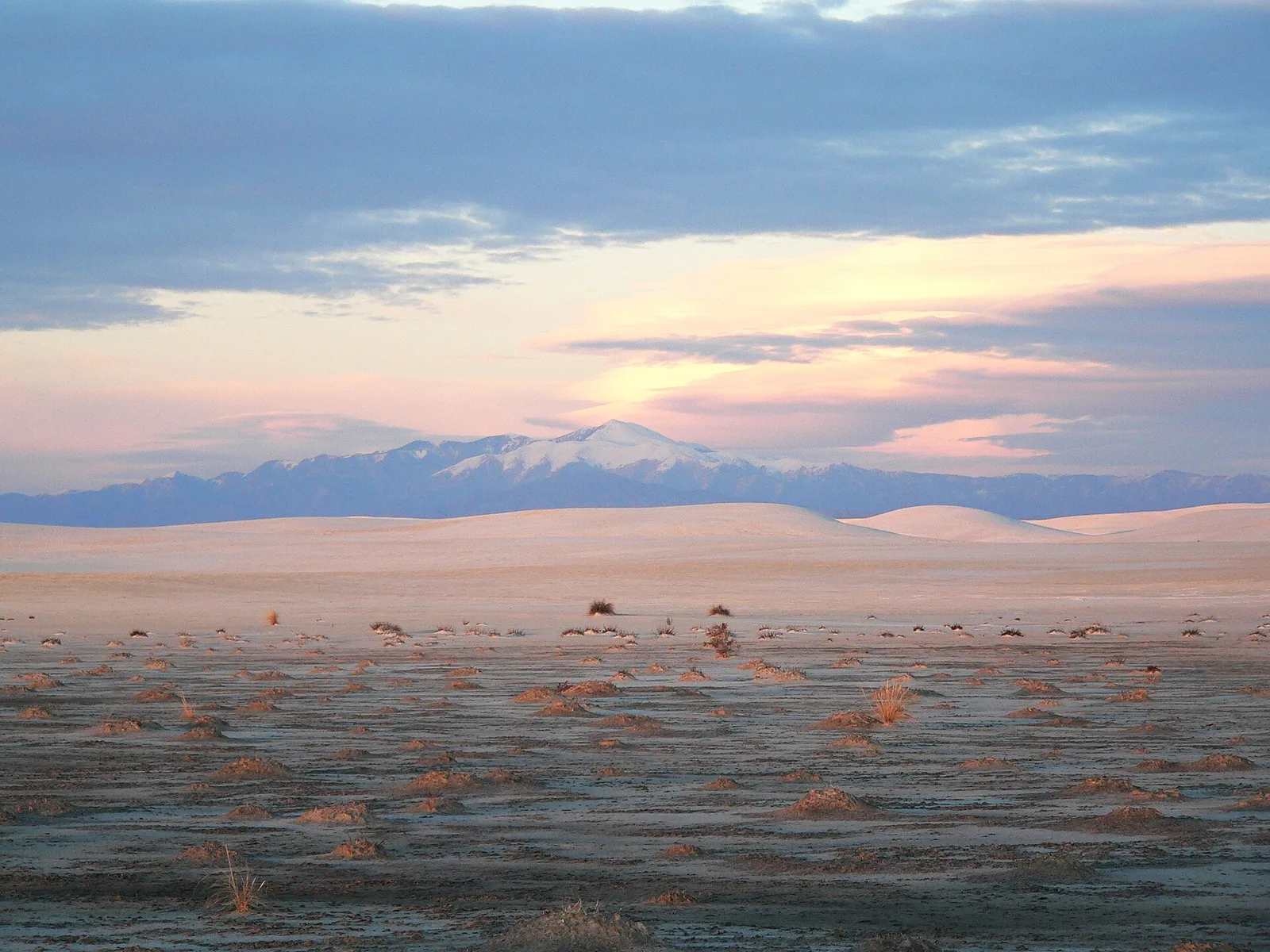
White Sands National Park
The World's Largest Gypsum Dune Field, 275 Square Miles of Wave-White Sand in the Tularosa Basin
About White Sands National Park
White Sands National Park protects the largest gypsum dune field on Earth, about 275 square miles of glaring white sand on the floor of the Tularosa Basin between the San Andres and Sacramento mountains.
Gypsum dunes are rare because gypsum usually dissolves and washes to the sea; here the basin has no outlet, so gypsum eroded from the surrounding mountains collects, crystallizes at the dry lakebeds, and blows northeast into dunes. The sand does not absorb the sun's heat, so it stays cool underfoot even in July.
Herbert Hoover proclaimed a national monument here in 1933; Congress made it a national park on December 20, 2019, New Mexico's second after Carlsbad Caverns, in a deal that also traded a few thousand acres with the surrounding missile range.
In 2021, researchers reported fossil human footprints preserved in the gypsum near the dunes, dated to roughly 21,000 to 23,000 years ago, which would make them among the oldest firm evidence of people in the Americas.
- Designation
- National Park (redesignated 2019)
- Location
- Otero and Doña Ana counties, south-central New Mexico, near Alamogordo
- Established
- National Monument 1933; National Park December 20, 2019
- Annual Visitors
- ~780,000
Geology and Landscape
The gypsum starts in the Permian-age rock of the mountains around the basin; rain dissolves it and carries it down into two dry lakebeds, Lake Lucero and the Alkali Flat, in the park's southwest corner.
As those shallow floods evaporate, the gypsum crystallizes into clear 'selenite' crystals, some of them several feet long; wind then chips the crystals down into sand-sized grains.
The prevailing southwest wind rolls those grains northeast, piling them into dunes up to about 60 feet high that themselves creep downwind a few feet to 30 feet a year.
The whole field is young and still growing; most estimates put the active dunes at around 7,000 to 10,000 years old, built as the ice-age Lake Otero that once filled the basin dried up.
The Tularosa Basin is a 'bolson,' a closed desert basin with no drainage to any ocean, dropped down between two mountain ranges along faults.
Water that runs off the mountains has nowhere to go and simply evaporates on the basin floor, which is why salts and gypsum have piled up here for a very long time instead of being flushed away.
The basin floor sits near 4,000 feet, and the peaks around it top 9,000 to 12,000 feet, so the white dunes are set against dark blue mountains and, in winter, snow.
A younger lava flow, the Carrizozo Malpais, spills across the north end of the basin, and animals there have evolved dark colors to match the black rock, a mirror image of the pale forms on the white sand.
Lake Lucero is a playa, a dry lakebed, at the low southwestern edge of the park, and it is the main pantry from which the dune field is supplied.
After a rare heavy rain it holds a shallow, salty lake for days or weeks, dissolving gypsum from the surrounding ground; when the lake dries, the gypsum recrystallizes as selenite.
The playa lies on the boundary with White Sands Missile Range, so it is reached only on ranger-guided caravans offered a few times a month.
The Alkali Flat just north of it is a firmer gypsum crust and the source of the ancient human footprints and megafauna trackways found nearby.
Between the bare crests, flatter 'interdune' ground holds a thin, specialized plant community rooted in the crusty gypsum: soaptree yucca, skunkbush sumac, rubber rabbitbrush, and a few grasses.
Some of these plants race their stems upward as sand buries them; when the dune moves on, a soaptree yucca can be left standing on a tall pedestal of sand held together by its roots.
Small animals have evolved to match the white ground: the bleached earless lizard and the Apache pocket mouse are much paler here than their relatives on ordinary desert soil.
Studies at White Sands have found the same handful of pigment genes under natural selection in several unrelated species, making the dune field a textbook case of rapid, parallel evolution.
Indigenous Peoples of the Tularosa Basin
Mescalero Apache Tribe
The Mescalero Apache ranged across southern New Mexico and west Texas, and their name comes from the mescal, the roasted heart of the agave plant that was a staple food; they used the Tularosa Basin for hunting and for travel between the Sacramento and San Andres mountains.
In 1863 the Army forced many Mescalero, along with thousands of Navajo, onto the Bosque Redondo reservation at Fort Sumner after the Long Walk; the Mescalero slipped away by 1865, and a reservation in the Sacramento Mountains was set aside in 1873.
The Army fought the Mescalero and the neighboring Chiricahua Apache across this country into the 1880s; some Chiricahua, including descendants of Geronimo's band, were later settled at Mescalero in 1913 after decades as prisoners of war.
The Mescalero Apache Tribe is headquartered on the Mescalero Apache Reservation in the Sacramento Mountains east of Alamogordo, adjacent to White Sands. The tribe operates the Inn of the Mountain Gods resort and manages cattle and timber operations. Tribal members maintain cultural connections to the landscape of the Tularosa Basin.
Pueblo Peoples of the Rio Grande
People have used the Tularosa Basin for well over 10,000 years, and the fossil footprints near the dunes show hunters walking the shore of the ice-age lake alongside mammoths and giant ground sloths.
Later, the Jornada Mogollon farmed and lived in pit-house and pueblo villages around the basin between about 200 and 1450 CE, leaving pottery and the dense rock-art panels at nearby Three Rivers.
Pueblo people of the Rio Grande, including the community now known as Tortugas Pueblo near Las Cruces, keep ties to the basin, and several Pueblo nations have worked with the Park Service on how the park tells the region's Indigenous history.
Pueblo communities maintain cultural and ceremonial connections to the Tularosa Basin. The Tortugas Pueblo in Las Cruces maintains traditions connecting them to the area. Several Pueblo nations have worked with NPS to ensure that the Indigenous history of the White Sands region is represented in park interpretation.
What to Do
Dunes Drive (Scenic Drive)
The Dunes Drive runs 8 miles from the visitor center into the heart of the field, the first few miles paved and the rest a hard-packed gypsum roadbed graded like a country road.
Pullouts, picnic shelters, and short marked trails, the Dune Life Nature Trail, the Interdune Boardwalk, and the Playa Trail, let visitors get out and walk into the sand.
The light is the point: low sun at either end of the day turns the dunes gold and pink and rakes long shadows across the ripples.
The road, and US-70 outside it, close for a couple of hours once or twice most weeks for missile testing, so visitors check the schedule before driving out.
Alkali Flat Trail
The Alkali Flat Trail is the park's longest and hardest, a 5-mile loop out across the tallest active dunes to the edge of the Alkali Flat playa and back.
There is no shade, the sand gives way underfoot, and the white glare is intense; the route is marked only by numbered orange posts that can vanish in blowing sand.
People lose the markers and become disoriented on this trail every year, and summer afternoon heat here is genuinely dangerous.
Hikers are told to carry a gallon of water each, start early, turn back in a sandstorm, and register at the trailhead.
Sunset Stroll Ranger Program
A ranger leads a free one-mile walk into the dunes each evening, timed to end as the sun sets behind the San Andres Mountains.
Along the way the ranger covers how the gypsum forms, why the sand is cool, how the plants and animals cope, and the basin's human history.
It is the park's most popular program and does not require a reservation; walkers just meet at the visitor center about an hour before sunset.
The park also runs full-moon night hikes and, on clear nights, star programs away from any city light.
Sledding on the Dunes
Sliding down the steep lee faces of the dunes on a round plastic disc is one of the things White Sands is known for, and it is allowed on any dune in the park.
Discs and wax are sold at the visitor center gift shop and can be turned back in for a partial refund; ordinary snow sleds and toboggans do not work as well.
The best runs are the tall, steep dunes near the end of the Dunes Drive, and the soft gypsum makes for gentle landings.
The Park Service asks sledders to keep off the vegetated dunes and away from the road, and to fill in any deep ruts they dig.
Conservation Challenges
Military Range Enclosure and Closures
The park is an island inside White Sands Missile Range, the Army's largest overland test range, and the two have had to coexist since the range was carved out around the older monument in 1945.
Missile and weapons tests close the park, and US-70 through it, for a few hours once or twice most weeks; visitors have to check the schedule, and a test can strand travelers on either side of the road for the duration.
The 2019 national park law came bundled with a land swap that traded acreage between the park and the range and settled some long-standing boundary questions.
The arrangement also means large stretches of the dune field, and Lake Lucero and the footprint sites, sit on the range and are reachable only with an escort.
Water and Groundwater in an Arid Basin
The Tularosa Basin has little fresh groundwater, and most of what there is is brackish; the city of Alamogordo, farms, Holloman Air Force Base, and the missile range all draw on it.
The gypsum machine depends on water, rain to dissolve the gypsum in the mountains and carry it down, and shallow groundwater to keep Lake Lucero's chemistry working, so a falling water table could slow the dunes.
Alamogordo built one of the country's larger brackish-water desalination plants in part to ease that pressure.
Climate projections for the Chihuahuan Desert point to less rain and more evaporation, which would stress both the water supply and the interdune plants.
Climate Change and Dune Dynamics
A warmer, drier climate is expected to reduce the runoff that feeds gypsum into the basin and to lower the water table under Lake Lucero, both of which could slow how fast the dunes are built.
Shifts in wind strength and direction could change the shape and movement of the field, though how is hard to predict.
Hotter, drier conditions also push the specialized interdune plants toward their limits, and losing them would let the bare sand move faster and farther.
The park and the U.S. Geological Survey monitor dune movement, groundwater, and vegetation to track which of these changes is actually happening.
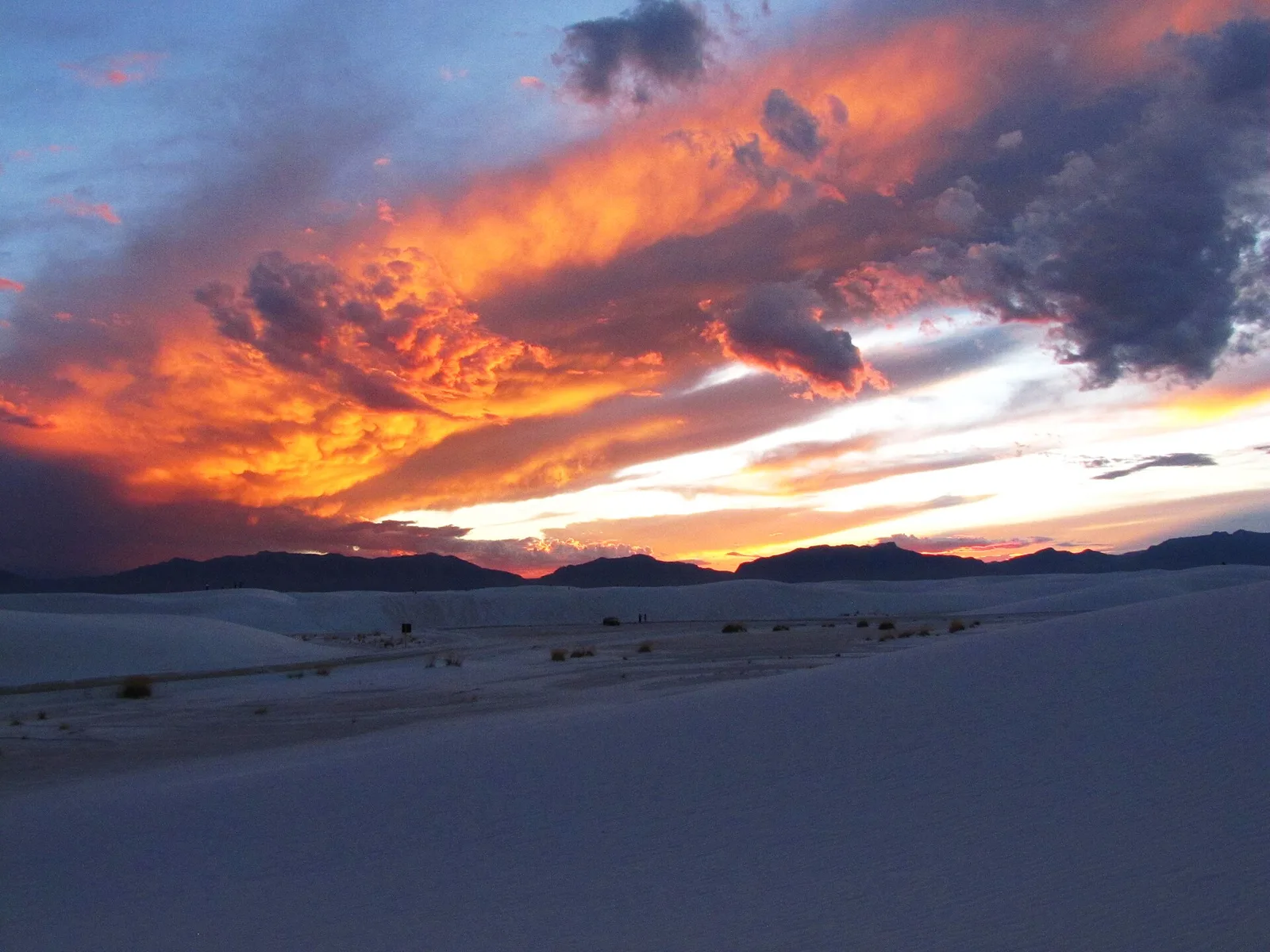
Sunset at White Sands National Park
Fast Facts
Did You Know?
The first atomic bomb, Trinity, was detonated on July 16, 1945, on what is now White Sands Missile Range, just 60 miles northwest of the dune field. The Trinity site opens to visitors for one open house a year and is a National Historic Landmark.
Several species at White Sands have evolved lighter coloration to match the white sand, including the bleached earless lizard, the Apache pocket mouse, and the white-lined pockets mouse. This is one of the best-documented cases of recent and rapid evolutionary adaptation in the world.
White Sands is the only national park in the United States where sledding is officially encouraged and where the park gift shop sells plastic sled discs. The gypsum sand stays relatively cool even in summer because, unlike quartz, it does not efficiently absorb solar radiation.
Plan Your Visit
Location
Otero and Doña Ana counties, south-central New Mexico, near Alamogordo
Designation
National Park (redesignated 2019)
Visitor Center Hours
Daily 9am to 5pm (extended in summer)
Entrance Fee
$25 per vehicle (7-day pass)
Address
19955 US-70, Alamogordo, NM 88310
Getting There
On US-70, 15 miles west of Alamogordo; 52 miles northeast of Las Cruces
Important Note
Park closes periodically for missile range tests. Check nps.gov/whsa for current closure schedule.
More Info
nps.gov/whsa