The Bill of Rights
The first ten amendments to the Constitution. The most important list of rights ever written, and the reason the Constitution was ratified at all.
What Is the Bill of Rights?
The Bill of Rights is the first ten amendments to the United States Constitution, a list of specific protections that the government cannot take away from individual citizens. It covers freedom of speech, religion, the press, and assembly. The right to bear arms. Protection from unreasonable searches. The right to a fair trial. Protection from cruel punishment. And more.
Together, these ten amendments form the most powerful legal shield between citizens and their government in world history. They don't give you these rights, the founders believed you already had them naturally. What the Bill of Rights does is tell the government in plain terms: you cannot take these away.
Nine of the ten amendments protect individual rights directly. The Tenth works differently: it confirms that powers not given to the federal government are reserved to the states or to the people.
Fourteen official handwritten copies were made in 1789, one for the federal government and one for each of the thirteen states. The federal copy is displayed in the Rotunda of the National Archives in Washington, alongside the Declaration of Independence and the Constitution.
Why It Was Created, The Story Behind the Bill of Rights
When the Constitution was written in 1787, it didn't include a list of individual rights. The founders who supported it, called Federalists, argued it wasn't necessary. The Constitution only gave the federal government specific, limited powers. Anything not listed was automatically left to the states or the people.
Their opponents, called Anti-Federalists, weren't buying it. Led by figures like Patrick Henry and George Mason, they argued that a government powerful enough to raise armies and collect taxes was powerful enough to become tyrannical. Without a specific written list of what the government could not do, there was nothing stopping it from silencing critics, searching homes, or throwing people in prison without trial. Several states refused to ratify the Constitution without a promise that such protections would be added.
James Madison, who had initially opposed the idea, came to agree. He drafted 17 amendments, Congress narrowed them to 12, and the states ratified 10 of them on December 15, 1791. The Bill of Rights was born.
Virginia's approval on December 15, 1791, supplied the final ratification needed. Three of the original states, Massachusetts, Connecticut, and Georgia, did not formally ratify the Bill of Rights until 1939, as a symbolic gesture marking its 150th anniversary.
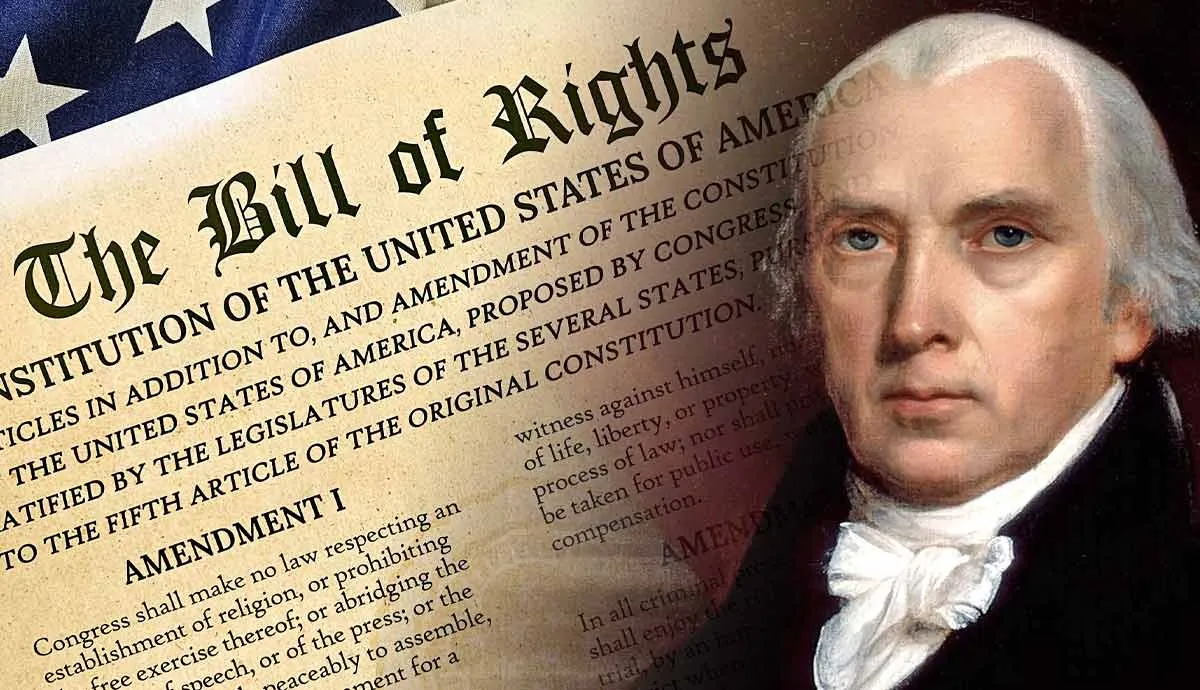
The original Bill of Rights, signed 1789, ratified 1791 (Public Domain / National Archives)
The Federalists' View
A Bill of Rights was unnecessary and possibly dangerous. If you listed specific rights, the government might assume anything not listed was fair game. Alexander Hamilton argued in Federalist No. 84 that the Constitution itself was a bill of rights, it only gave the government specific limited powers.
The Anti-Federalists' View
A strong central government without explicit written limits was a recipe for tyranny. They had just fought a revolution against exactly that. A line popularly credited to Patrick Henry sums up the idea: "The Constitution is not an instrument for the government to restrain the people, it is an instrument for the people to restrain the government." (Commonly attributed to Henry; the attribution is not verified.)
James Madison's Role
Madison is called the "Father of the Bill of Rights." He initially opposed it but changed his mind after corresponding with Thomas Jefferson, who wrote from Paris: "A bill of rights is what the people are entitled to against every government on earth." Madison promised Virginia voters he would push for amendments as a condition of their ratification, and he kept that promise.
All Ten Amendments, Explained
Click any amendment to expand the full explanation, real-world examples, and current debates.
“Congress shall make no law respecting an establishment of religion, or prohibiting the free exercise thereof; or abridging the freedom of speech, or of the press; or the right of the people peaceably to assemble, and to petition the Government for a redress of grievances.”
Summary
The government cannot force you to follow a religion, or stop you from practicing yours. It cannot silence what you say, what the press publishes, or what groups you peacefully join. And you have the right to complain to your government about what it's doing wrong.
The Five Freedoms It Protects
Religion, the government can't create an official religion or ban yours
Speech, you can say what you think without government punishment
Press, newspapers and media can report freely without government censorship
Assembly, you can gather peacefully in groups
Petition, you can demand the government fix what you believe is wrong
How It Affects Your Life Today
This is why newspapers can criticize the president. Why you can protest outside the Capitol. Why your church isn't run by the government. Why you can post political opinions online without being arrested. The First Amendment is the foundation of American democracy, without it, every other right is fragile.
The clause restrains government, not private parties. A private employer, platform, or publisher can set its own speech rules. The First Amendment binds Congress and, since Gitlow v. New York (1925), state and local governments through the 14th Amendment. Public schools, universities, and government workplaces are treated as state actors and face First Amendment limits.
The Establishment Clause is why public schools cannot organize prayer (Engel v. Vitale, 1962), and the Free Exercise Clause is why government generally cannot single out a religious practice for a burden it would not impose on others (Church of the Lukumi Babalu Aye v. Hialeah, 1993). The Free Speech Clause has also been read to protect symbolic acts, from students wearing armbands (Tinker v. Des Moines, 1969) to burning a flag (Texas v. Johnson, 1989).
The Ongoing Debate
Freedom of speech is not unlimited. You cannot make a genuine death threat, incite immediate violence, or commit fraud. The debate today centers on social media, whether private platforms can restrict speech, whether 'hate speech' is protected, and how to balance free expression with public safety. The Supreme Court has consistently held that the government cannot restrict speech simply because it's offensive.
Only a few narrow categories of speech fall outside protection: incitement to imminent lawless action (Brandenburg v. Ohio, 1969), true threats, defamation, obscenity, and speech that is part of criminal conduct such as fraud. The Court has declined to add new categories, striking down bans on selling violent video games to minors (Brown v. Entertainment Merchants Association, 2011) and on lying about military medals (United States v. Alvarez, 2012).
Live disputes include whether large social media platforms can be regulated like common carriers (Moody v. NetChoice, 2024), when public officials may block critics on their government social media accounts (Lindke v. Freed, 2024), and the reach of campaign-finance rules after Citizens United v. FEC (2010).
“A well regulated Militia, being necessary to the security of a free State, the right of the people to keep and bear Arms, shall not be infringed.”
Summary
Americans have the right to own and carry firearms. The amendment links this to the need for a militia (citizen soldiers), but the Supreme Court has ruled it also protects an individual's right to own a gun for self-defense, independent of militia service.
How It Affects Your Life Today
In District of Columbia v. Heller (2008), the Supreme Court ruled 5-4 that the Second Amendment protects an individual right to own a firearm for self-defense in the home, not just for militia service. This settled a long debate about whether the right was collective or individual. However, the Court also said the right is not unlimited, governments can still regulate who buys guns, where they can be carried, and what types are legal.
In McDonald v. City of Chicago (2010), the Court held 5-4 that the Heller right also binds state and local governments through the 14th Amendment, so a city cannot ban handguns any more than the federal District of Columbia could.
New York State Rifle & Pistol Association v. Bruen (2022) changed the test courts use: a gun law must be consistent with the nation's 'historical tradition of firearm regulation' rather than judged by balancing public-safety interests. United States v. Rahimi (2024) then upheld a federal law disarming people under domestic-violence restraining orders, finding a historical analogue for it.
The Ongoing Debate
The Second Amendment is one of the most fiercely debated parts of the Constitution. Supporters of broad gun rights argue the individual right to self-defense is fundamental and that restrictions disarm law-abiding citizens without stopping criminals. Supporters of gun regulations argue that modern weapons, including semi-automatic rifles, were unimaginable to the founders, and that the 'well regulated Militia' language shows the amendment was meant for collective defense. Courts continue to wrestle with where exactly the line is.
About 48,000 people died from firearm injuries in the United States in 2022, more than half of them suicides, according to the CDC. Advocates of regulation cite that toll and comparisons with other wealthy countries; advocates of broad gun rights cite an estimated 400 million firearms already in private hands and the role of guns in lawful self-defense.
Litigation after Bruen is unsettled and has produced repeated disagreements among the federal circuits over assault-weapon and magazine limits, minimum age rules, 'sensitive place' restrictions, and carry-permit standards, which makes it likely the Supreme Court will return to the subject.
“No Soldier shall, in time of peace be quartered in any house, without the consent of the Owner, nor in time of war, but in a manner to be prescribed by law.”
Summary
The government cannot force you to let soldiers live in your home during peacetime. During wartime, it can only be done under rules set by Congress.
How It Affects Your Life Today
This amendment is the least litigated in the entire Constitution, there is almost no modern case law around it because the government stopped quartering soldiers in private homes long ago. It was included because the British had forcibly housed soldiers in American colonists' homes before the Revolution, one of the specific grievances listed in the Declaration of Independence.
The closest case is Engblom v. Carey (1982), in which the Second Circuit held that National Guard troops moved into striking prison guards' staff housing could count as 'soldiers,' and that the Third Amendment applies to the states, though the officials ultimately won on qualified-immunity grounds. The Supreme Court has never decided a case squarely under the Third Amendment.
The Ongoing Debate
Though rarely tested directly, legal scholars sometimes argue the Third Amendment's underlying principle, that the government cannot commandeer private property for military use without consent, has broader modern applications, particularly in discussions about government surveillance and the use of civilian infrastructure for military purposes.
Because there is virtually no case law, the discussion is mostly about the amendment as evidence of original intent. It is cited as early proof that the founders recognized a right to be free of government intrusion into the home, a thread the Court later picked up in Griswold v. Connecticut (1965), which listed the Third Amendment among the constitutional sources of a 'zone of privacy.'
“The right of the people to be secure in their persons, houses, papers, and effects, against unreasonable searches and seizures, shall not be violated, and no Warrants shall issue, but upon probable cause, supported by Oath or affirmation, and particularly describing the place to be searched, and the persons or things to be seized.”
Summary
The government cannot search your home, car, phone, or body, or take your belongings, without a good reason and usually a warrant signed by a judge. To get a warrant, police must convince a judge there is probable cause that a crime occurred.
How It Affects Your Life Today
When police want to search your house, they generally need a warrant. When they pull you over and want to search your car, specific rules apply. This amendment is why evidence found in an illegal search can be thrown out of court, the 'exclusionary rule.' It's also the legal battleground for digital privacy: does the Fourth Amendment protect your email, your phone location data, your cloud storage? Courts are still working this out.
The warrant requirement has many judge-made exceptions: consent, a search incident to a lawful arrest, automobiles, evidence in 'plain view,' a brief 'stop and frisk' on reasonable suspicion (Terry v. Ohio, 1968), and urgent 'exigent circumstances.' Most everyday police-citizen encounters are governed by these exceptions rather than by a warrant.
The exclusionary rule was extended from federal to state courts in Mapp v. Ohio (1961), but later decisions narrowed it, including a 'good faith' exception for officers who rely on a warrant later found defective (United States v. Leon, 1984).
The Ongoing Debate
The Fourth Amendment is under constant pressure from technology. Courts have struggled to apply 18th-century principles to GPS tracking, cell phone searches, facial recognition, and mass data collection. The Supreme Court has ruled that police generally need a warrant to search your cell phone (Riley v. California, 2014) and to track your location via cell towers (Carpenter v. United States, 2018), but the full boundaries of digital privacy are still being drawn.
The 'third-party doctrine' from United States v. Miller (1976) and Smith v. Maryland (1979) long held that information voluntarily handed to a bank or phone company loses Fourth Amendment protection. Carpenter carved out an exception for long-term cell-site location data but did not overrule the doctrine, leaving email metadata, smart-home device data, and browsing history contested.
Other open questions include 'geofence' and 'keyword' warrants that sweep in many uninvolved people, searches of electronic devices at the border, and whether long-term pole-camera or aerial surveillance of a home needs a warrant.
“No person shall be held to answer for a capital, or otherwise infamous crime, unless on a presentment or indictment of a Grand Jury... nor shall any person be subject for the same offence to be twice put in jeopardy of life or limb; nor shall be compelled in any criminal case to be a witness against himself, nor be deprived of life, liberty, or property, without due process of law; nor shall private property be taken for public use, without just compensation.”
Summary
For serious federal crimes, a grand jury of citizens must approve charges before you can be tried. You cannot be tried for the same crime twice after being acquitted (double jeopardy). You cannot be forced to testify against yourself. The government cannot punish you or take your property without following legal procedures. And if the government takes your property for public use, it must pay you fairly.
What It Covers
Grand jury requirement, serious federal charges need citizen approval first
Double jeopardy, you cannot be tried twice for the same crime after acquittal
Right against self-incrimination, you don't have to testify against yourself
Due process, the government must follow fair legal procedures before punishing you
Takings clause, the government must pay fair market value if it seizes your property
How It Affects Your Life Today
When someone says 'I plead the Fifth,' they are invoking the self-incrimination protection. Miranda warnings (from the Sixth Amendment working alongside the Fifth) are required because of this right. The takings clause is invoked when the government uses eminent domain, the power to take private property for public use like roads or schools, but must pay fair compensation.
The self-incrimination right underlies the Miranda v. Arizona (1966) warnings police must give before custodial questioning, and it lets a witness refuse to answer questions in congressional hearings and civil cases, not only criminal trials. It covers 'testimonial' evidence only, so the government can still compel fingerprints, DNA, and handwriting samples.
The Double Jeopardy Clause does not bar separate prosecutions by a state and the federal government for the same act, the 'dual sovereignty' rule reaffirmed in Gamble v. United States (2019). The grand jury requirement, unlike most of the Bill of Rights, has never been applied to the states, so many states charge felonies by a prosecutor's 'information' instead.
The Ongoing Debate
The 'takings clause' has sparked intense debate about when government regulations go so far that they effectively 'take' property even without physically seizing it, called a 'regulatory taking.' The Supreme Court's 2005 ruling in Kelo v. City of New London, allowing a city to seize private homes for economic development, was so unpopular that 45 states subsequently passed laws restricting eminent domain use.
Regulatory-takings law is still developing. Penn Central Transportation Co. v. New York City (1978) set a multi-factor balancing test, and later cases such as Lucas v. South Carolina Coastal Council (1992) and Cedar Point Nursery v. Hassid (2021) expanded the situations in which a regulation or a right of physical access counts as a compensable taking.
The self-incrimination right has also returned to the Court's attention in the digital age, including whether police can force a suspect to unlock a phone with a passcode or a fingerprint, a question on which state supreme courts have divided.
“In all criminal prosecutions, the accused shall enjoy the right to a speedy and public trial, by an impartial jury of the State and district wherein the crime shall have been committed... to be confronted with the witnesses against him; to have compulsory process for obtaining witnesses in his favor, and to have the Assistance of Counsel for his defence.”
Summary
If you are charged with a crime, you have the right to: a trial that happens without unreasonable delay, a public trial (not held in secret), a jury of your peers from your local community, to know the charges against you, to face and cross-examine witnesses, to call your own witnesses, and to have a lawyer, even if the government has to pay for one.
How It Affects Your Life Today
The right to an attorney, even if you can't afford one, came from Gideon v. Wainwright (1963), in which the Supreme Court ruled that states must provide lawyers to defendants who cannot afford them. The right to confront witnesses means the government generally cannot convict you based on anonymous accusations or statements from people who are never cross-examined. These protections apply in every criminal courtroom in the country.
The right to counsel attaches at every 'critical stage' of a case and includes the effective assistance of counsel; Strickland v. Washington (1984) set the standard for overturning a conviction because a lawyer performed poorly. It also reaches plea bargaining, where more than 95 percent of convictions are now obtained (Missouri v. Frye and Lafler v. Cooper, both 2012).
Crawford v. Washington (2004) sharpened the Confrontation Clause, barring most out-of-court 'testimonial' statements unless the witness testifies and is cross-examined, which reshaped how forensic lab reports and 911 calls are used at trial. Ramos v. Louisiana (2020) held that the jury-trial right requires a unanimous verdict in state felony cases, ending split-verdict convictions in Louisiana and Oregon.
The Ongoing Debate
The 'speedy trial' right is one of the most debated in practice. Courts have rarely dismissed cases based on delays unless they are extreme. The confrontation clause has been tested by the use of recorded testimony, child witness protections, and hearsay evidence, courts balance the defendant's rights against witness safety, especially in child abuse cases.
Public-defender systems are chronically underfunded. The Bureau of Justice Statistics and the American Bar Association have documented caseloads far above recommended limits, and several states have faced class-action lawsuits arguing that indigent defense is so overloaded it violates Gideon.
The Speedy Trial Act of 1974 sets deadlines in federal cases, but courts still weigh delay under the flexible four-factor test of Barker v. Wingo (1972). Pandemic-era court closures created a large trial backlog and renewed litigation over what delay is 'unreasonable.'
“In Suits at common law, where the value in controversy shall exceed twenty dollars, the right of trial by jury shall be preserved, and no fact tried by a jury, shall be otherwise re-examined in any Court of the United States, than according to the rules of the common law.”
Summary
In federal civil cases, lawsuits between private parties over money or property, you have the right to have a jury decide the facts. The $20 threshold from 1791 has never been updated, but courts apply it with modern context. Once a jury decides the facts, appeals courts can only review legal errors, they can't simply substitute their own judgment for the jury's.
How It Affects Your Life Today
This is why major civil lawsuits, product liability cases, personal injury suits, contract disputes, can be decided by a jury of regular citizens rather than just a judge. It's a check on the power of judges and ensures that ordinary people, not just legal professionals, have a say in resolving disputes between private parties.
Unlike almost every other provision of the Bill of Rights, the Seventh Amendment has never been 'incorporated' against the states, so a state may limit or even abolish civil jury trials in its own courts. The $20 figure has never been raised, but in practice federal civil jury trials involve far larger sums.
The 're-examination clause' is why a federal appeals court generally cannot second-guess a jury's factual findings, only its legal rulings, and why a federal judge cannot raise a jury's damages award (the practice called 'additur' was held unconstitutional in Dimick v. Schiedt, 1935), though a judge may cut an excessive award through 'remittitur.'
The Ongoing Debate
The Seventh Amendment only applies to federal courts. State courts have their own rules about civil jury trials, and many civil cases settle before reaching a jury. Critics argue that juries in complex commercial or technical cases may struggle with complicated evidence, leading some to prefer bench trials (decided by a judge alone) for highly specialized disputes.
The larger modern reality is that most civil disputes never reach a jury at all. Mandatory arbitration clauses in employment, consumer, and telecom contracts, upheld in cases like AT&T Mobility v. Concepcion (2011) and Epic Systems Corp. v. Lewis (2018), route millions of claims into private arbitration where no jury sits.
Courts also resolve many cases before trial through summary judgment, and complex patent, antitrust, and securities litigation regularly raises the argument that lay jurors cannot fairly weigh highly technical evidence.
“Excessive bail shall not be required, nor excessive fines imposed, nor cruel and unusual punishments inflicted.”
Summary
The government cannot set your bail impossibly high just to keep you locked up before trial. It cannot fine you an unreasonably large amount. And it cannot punish you in ways that are brutal, degrading, or wildly disproportionate to your crime.
How It Affects Your Life Today
This amendment is the primary legal basis for challenges to the death penalty, long solitary confinement, and prison conditions. The Supreme Court has ruled that executing someone for a crime they committed as a minor is unconstitutional (Roper v. Simmons, 2005), as is executing someone with severe intellectual disabilities (Atkins v. Virginia, 2002). The 'excessive fines' clause was ruled applicable to states in 2019 in Timbs v. Indiana.
The Court reads 'cruel and unusual' in light of 'the evolving standards of decency that mark the progress of a maturing society' (Trop v. Dulles, 1958). On that basis it has barred the death penalty for the rape of an adult (Coker v. Georgia, 1977) and for crimes against individuals other than murder (Kennedy v. Louisiana, 2008), and it has limited life-without-parole sentences for juveniles (Graham v. Florida, 2010; Miller v. Alabama, 2012).
Prison-conditions claims require showing 'deliberate indifference' to a serious risk to an inmate's health or safety (Estelle v. Gamble, 1976; Farmer v. Brennan, 1994). The Court has upheld capital punishment in principle since Gregg v. Georgia (1976) while steadily narrowing who is eligible and reviewing execution methods, as in Glossip v. Gross (2015).
The Ongoing Debate
Whether the death penalty itself constitutes 'cruel and unusual punishment' is one of the most enduring constitutional debates in America. The Supreme Court has repeatedly upheld capital punishment in principle while restricting when and how it can be applied. Other active debates involve cash bail systems, critics argue that even 'legal' bail amounts effectively punish poor defendants who cannot pay while wealthy defendants go free, regardless of the severity of the charge.
Executions have fallen sharply, from a modern peak of 98 in 1999 to far fewer in recent years, and roughly half the states have abolished capital punishment or paused it, according to the Death Penalty Information Center. Litigation continues over lethal-injection drug protocols and decades-long stays on death row.
The Excessive Fines Clause, largely dormant for two centuries, has been active since Timbs v. Indiana (2019) applied it to the states. It is now raised against civil asset forfeiture, in which police can seize cash and vehicles without a criminal conviction, and against steep per-day municipal code-enforcement penalties.
“The enumeration in the Constitution, of certain rights, shall not be construed to deny or disparage others retained by the people.”
Summary
Just because a right isn't specifically listed in the Constitution doesn't mean you don't have it. The founders understood they couldn't list every right, and they didn't want the government to use the absence of a specific listing as an excuse to deny rights that people naturally have.
How It Affects Your Life Today
The Ninth Amendment is one of the most important yet least understood provisions in the Bill of Rights. It was James Madison's answer to critics who argued that listing specific rights was dangerous, because the government might claim anything not listed was permitted. The amendment has been cited in landmark privacy cases, including Griswold v. Connecticut (1965), which established a constitutional right to privacy in marital decisions about contraception.
In practice, courts almost never strike down a law on Ninth Amendment grounds alone. Its most influential use was Justice Arthur Goldberg's concurrence in Griswold, which pointed to the amendment as proof that the specific list in the Bill of Rights was not meant to be exhaustive.
The unenumerated rights the Court has recognized, to marry, to raise one's children, to use contraception, to travel between states, have generally been grounded in the 14th Amendment's Due Process Clause rather than the Ninth. Dobbs v. Jackson Women's Health Organization (2022) tightened the test for recognizing such rights, requiring that a claimed right be 'deeply rooted in this Nation's history and tradition.'
The Ongoing Debate
The Ninth Amendment is one of the most debated in constitutional law. Originalists argue it does not create new enforceable rights and should be read narrowly. Others argue it is a broad authorization for courts to recognize unenumerated rights, including privacy, bodily autonomy, and personal liberty. The debate over this amendment goes to the heart of questions about how broadly judges should interpret the Constitution.
During his 1987 confirmation hearings, Judge Robert Bork compared the clause to an 'ink blot' that judges cannot responsibly read, capturing the originalist objection that it hands courts a blank check. Defenders across the political spectrum argue it was meant to protect natural rights the framers assumed but chose not to list.
Because the Ninth and 14th Amendments overlap in the fight over unenumerated rights, the real argument is about judicial method: how much power unelected judges should have to identify rights the constitutional text does not spell out.
“The powers not delegated to the United States by the Constitution, nor prohibited by it to the States, are reserved to the States respectively, or to the people.”
Summary
The federal government only has the powers the Constitution specifically gives it. Everything else belongs to state governments, or to individual citizens. This amendment is the constitutional foundation of federalism: the idea that power is divided between the national government and state governments.
How It Affects Your Life Today
The Tenth Amendment is the basis for states controlling things like driver's licenses, marriage law, education systems, and most criminal law. It's also why federal drug laws and state marijuana laws can exist simultaneously, states can legalize something federally prohibited (though federal law still applies on federal property and in federal courts). It's why gun laws, abortion laws, and voting rules vary so dramatically from state to state.
The Court enforces the amendment mainly through the 'anti-commandeering' doctrine: Congress cannot order state legislatures to pass laws (New York v. United States, 1992) or force state officials to run a federal program (Printz v. United States, 1997; Murphy v. NCAA, 2018, on sports betting). Congress may attach conditions to federal grants, but only within limits set in NFIB v. Sebelius (2012).
This is why the federal government cannot compel local police to enforce federal immigration law, and why a state can legalize marijuana even though most of it remains a federal Schedule I drug (state-licensed medical marijuana moved to Schedule III in 2026), though federal agents keep their own authority to enforce federal law.
The Ongoing Debate
The Tenth Amendment has been at the center of nearly every major debate about federal power vs. state power in American history, from slavery to New Deal programs to civil rights to healthcare to marijuana legalization. The Civil War was the ultimate test of states' rights limits. The ongoing debate about federal vs. state authority is one of the most fundamental in American politics, and the Tenth Amendment sits at the heart of it.
For much of the 20th century the amendment was called 'a truism' (United States v. Darby, 1941) that adds nothing to the Constitution, while an expansive reading of the Commerce Clause let Congress regulate wages, civil rights in private businesses, and farm output. The Court began enforcing limits again in United States v. Lopez (1995) and United States v. Morrison (2000).
The recurring question is exactly where 'reserved to the States' ends and federal power begins on issues like health care, environmental regulation, election administration, and drug policy, questions the constitutional text genuinely leaves open.
The Two Amendments That Didn't Make It
Madison originally proposed 12 amendments. The states ratified 10, the ones we know as the Bill of Rights. The two that failed are interesting pieces of history:
The Congressional Apportionment Amendment
Would have set a formula for how many people each House member represented as the population grew, eventually guaranteeing one representative for every 50,000 people. It was ratified by 11 states but needed 12 and never reached that threshold. If it had passed, the House today would have over 6,000 members.
Not RatifiedThe Congressional Pay Amendment
Would have prevented any law changing congressional pay from taking effect until after the next election. Ratified by only 6 states in 1791, but the ratification process was never formally closed. Over 200 years later, in 1992, enough additional states had ratified it to make it the law. It became the 27th Amendment, the last amendment added to the Constitution.
Became the 27th Amendment, 202 years laterHow the Bill of Rights Applies to States, The 14th Amendment
Here's something most people don't know: the original Bill of Rights only restricted the federal government. In 1833, the Supreme Court ruled in Barron v. Baltimore that the Bill of Rights did not apply to state governments. States could, in theory, restrict speech, conduct warrantless searches, or hold trials without juries, and the Bill of Rights couldn't stop them.
That changed with the 14th Amendment, ratified in 1868 after the Civil War. It says no state can deprive any person of life, liberty, or property without due process. Through a process called incorporation, the Supreme Court has used the 14th Amendment to apply most of the Bill of Rights to state governments, meaning states must respect the same rights as the federal government.
The process began with freedom of speech in Gitlow v. New York (1925) and accelerated in the 1960s, when the Court applied most criminal procedure rights to the states, including the exclusionary rule (1961), the right to a lawyer for poor defendants in Gideon v. Wainwright (1963), the privilege against self-incrimination (1964), and the right to a jury trial (1968).
Incorporation has continued into the twenty-first century: the right to keep and bear arms in 2010, the ban on excessive fines in 2019, and the requirement of a unanimous jury verdict in serious criminal trials in 2020.
What "Incorporation" Means in Practice
The Supreme Court has "incorporated" most Bill of Rights protections against the states one by one through cases over the 20th century. Today, virtually the entire Bill of Rights applies to both federal and state governments, meaning your local police must follow the Fourth Amendment, your state court must honor the Sixth Amendment, and your state legislature cannot violate the First Amendment.
The Third Amendment (quartering soldiers) has never been formally incorporated. The Fifth Amendment's grand jury requirement applies only to federal courts, states can prosecute serious crimes without a grand jury. Nearly everything else has been incorporated, with the exceptions noted below.
Two other guarantees also do not bind the states. The Seventh Amendment's right to a jury in civil cases has never been incorporated, as the Court held in 1916, so states may decide civil cases without juries; and the Court has assumed, but never squarely held, that the Eighth Amendment's ban on excessive bail applies to the states.
The Court chose this case-by-case approach, called selective incorporation, over the view of Justice Hugo Black, who argued in a 1947 dissent that the Fourteenth Amendment applied the entire Bill of Rights to the states at once. The Fourteenth Amendment page covers the clause that made this possible.
Quick Reference
Key Facts
Did You Know?
Massachusetts ratified it 150 years late
Three states, Massachusetts, Connecticut, and Georgia, initially rejected the Bill of Rights. All three ratified it symbolically in 1939, 150 years after Congress proposed it: Massachusetts on March 2, Georgia on March 18, and Connecticut on April 19. The ratifications were entirely ceremonial at that point.
The original documents are in Washington DC
The original parchment copies of the Bill of Rights are held at the National Archives in Washington DC, alongside the Constitution and the Declaration of Independence. Fourteen original copies were made: one for the federal government and one for each of the 13 original states. Most still exist.
One state's copy was stolen during the Civil War
North Carolina's original copy of the Bill of Rights was stolen by a Union soldier in 1865. It surfaced at an antique dealer in 2003. The FBI recovered it after a sting operation. The state of North Carolina reclaimed it and it is now displayed in Raleigh.
The 27th Amendment took 202 years to ratify
One of Madison's original proposed amendments, preventing congressional pay raises from taking effect before the next election, was never formally closed for ratification. College student Gregory Watson noticed this in 1982, started a campaign, and by 1992 enough states had ratified it to make it the 27th Amendment. Watson got a C on the paper where he proposed the idea. His professor later changed it to an A.