
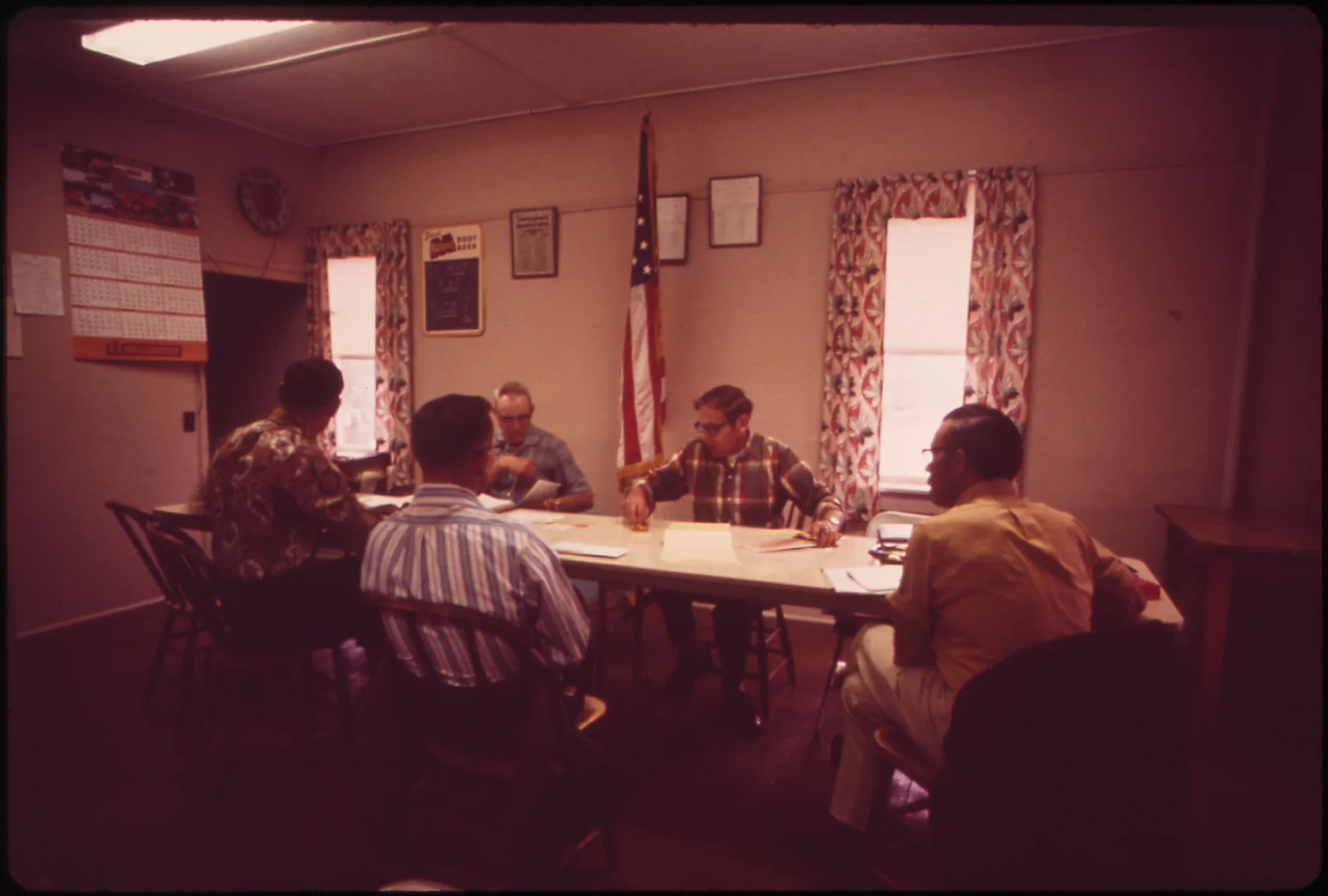
Two Colonial Models, Still Shaping Government Today
New England's town meetings and Virginia's county courts were two different colonial answers to the same question: how do you govern a place too small and too local for a distant legislature to manage directly? Both models survived, spread unevenly across the country, and still shape how local government works today.
Colonial New England towns governed themselves through open town meetings, gatherings where property-owning residents debated and voted directly on local matters, from road repairs to poor relief, rather than through elected representatives acting on their behalf. The practice traced its roots to Puritan congregational self-governance, and it became so central to town identity that many New England towns still hold some version of an open town meeting today.
Because a town meeting required physically gathering everyone in one place, the practice worked best in New England's compact, village-centered towns and never took hold the same way in the more sparsely settled South, one of the earliest examples of geography shaping which model of local government a region adopted.
The earliest recorded town meetings date to the 1630s in Massachusetts Bay towns such as Dorchester and Watertown, which soon created boards of selectmen to handle routine business between meetings. Dorchester's 1633 order establishing a regular meeting of townsmen is often cited as the oldest surviving instrument of representative town government in the English colonies.
The model survives in modified form. Roughly a thousand municipalities across the six New England states still hold open town meetings, and some larger towns use an elected 'representative town meeting.' Political scientists study these gatherings as one of the few living examples of direct legislative democracy in the United States.
The Virginia House of Burgesses organized the colony into eight original shires, soon renamed counties, modeled directly on the English county system, with an appointed county court and sheriff handling both judicial and administrative functions across a much larger, more spread-out territory than a New England town.
Virginia's county model spread through the South and, later, much of the West, while New England kept its town-based system, a divide still visible today: some states organize local government primarily around towns and townships, while others organize primarily around counties, and a handful, mostly in New England, use both in overlapping ways.
The eight 1634 shires were James City, Henrico, Charles City, Elizabeth City, Warwick River, Warrosquyoake, Charles River, and Accawmack. The county court, a bench of appointed justices of the peace, combined what later governments would separate into judicial, legislative, and administrative branches, with the sheriff serving as its enforcement and tax-collecting arm.
As settlement moved west, Congress and territorial legislatures carried the county forward as the default unit of organization, which is why counties blanket almost the entire country today. Only Connecticut, Rhode Island, most of Massachusetts, and much of Alaska lack functioning county governments, and Louisiana's parishes and Alaska's boroughs are county-equivalents under different names.
Iowa Supreme Court Justice John Forrest Dillon, ruling in City of Clinton v. Cedar Rapids & Missouri River Railroad Co., held that local governments possess only the powers a state legislature expressly grants them, plus whatever powers are necessarily implied, famously describing municipalities as "mere tenants at will of the legislature."
Dillon's Rule remains binding law in roughly 40 states today, meaning a city or county in one of those states generally cannot act on a genuinely new power, say, regulating a new industry, without first confirming the state legislature has actually authorized it, discussed further in the Legal Limits & Funding tab.
Dillon, who also wrote an influential 1872 treatise on municipal corporations, was reacting to the rampant corruption in Gilded Age city governments, including New York's Tweed Ring. His view competed with a rival 'Cooley Doctrine,' named for Michigan Justice Thomas Cooley, which held local self-government to be an inherent right, but the more restrictive Dillon position became the majority rule.
The U.S. Supreme Court effectively adopted Dillon's reasoning in Hunter v. City of Pittsburgh (1907), holding that a state may modify or abolish a municipality's powers at will because cities are 'political subdivisions' created by the state 'as convenient agencies for exercising such of the governmental powers of the state as may be entrusted to them.' That principle remains the constitutional baseline for state-local relations.
Missouri became the first state to write municipal home rule directly into its constitution, letting St. Louis draft and adopt its own city charter without seeking a specific act of the state legislature for each power it wanted to exercise, a direct response to the restrictions Dillon's Rule had imposed just seven years earlier.
Other states adopted home rule provisions gradually over the following century, and today most states offer at least some form of home rule to their larger cities, though the scope of that authority, and how it interacts with state law, still varies enormously from state to state.
The 1875 Missouri Constitution allowed cities above 100,000 residents, which then meant only St. Louis, to frame their own charters. A companion 1876 measure known as the 'Great Divorce' separated the City of St. Louis from St. Louis County entirely, making it an independent city, a structural split the region has spent recent years debating whether to reverse.
By the early 20th century, California (1879), Washington (1889), and Minnesota (1896) had added constitutional home rule, and the National Municipal League promoted model provisions. Roughly 40 states now grant home rule to at least some classes of cities, though the doctrine still coexists with Dillon's Rule for counties and smaller municipalities in many of them.
After a hurricane devastated Galveston, Texas in 1900, the city adopted a small elected commission to replace its mayor-council government, a structure local business leaders argued could rebuild the city more efficiently than traditional politics; the "Galveston Plan" spread to hundreds of cities within a decade.
In 1908, Staunton, Virginia went a step further, becoming the first U.S. city to hire a professional city manager, Charles E. Ashburner, to run day-to-day operations under the elected council's policy direction, creating the council-manager form of government that eventually became the most common form of city government nationwide.
The commission plan reached roughly 500 cities by 1918, including Des Moines, whose 1907 'Des Moines Plan' bundled in the initiative, referendum, and recall. It faded almost as quickly as it spread, because dividing a city among independently elected department heads produced budget conflicts and little central coordination.
The council-manager form largely replaced it. Dayton, Ohio became the first large city to adopt it in 1914 after a catastrophic 1913 flood, and the professional managers' association founded that same year adopted a code of ethics barring managers from partisan politics. By the 21st century the council-manager form was the most common structure among U.S. cities over 2,500 residents.
California voters approved Proposition 13, a constitutional amendment capping property tax rates at 1 percent of assessed value and limiting annual assessment increases to 2 percent, cutting local property tax revenue by an estimated $7 billion a year almost overnight and forcing the state to step in and help keep school districts and local governments operating.
Proposition 13 triggered a nationwide property tax revolt, with more than half the states adopting some form of property tax or spending limit on local governments within the following decade, permanently shifting many local governments toward greater reliance on state aid, sales taxes, and fees rather than property taxes alone.
Proposition 13 passed with about 65 percent of the vote after a decade in which California home values, and therefore assessments, had far outrun incomes. It reassesses property only when it sells, so long-time owners and recent buyers of identical houses can owe very different amounts, a feature the U.S. Supreme Court upheld in Nordlinger v. Hahn (1992).
Massachusetts voters answered with Proposition 2½ in 1980, capping annual local property-tax growth at 2.5 percent, and states from Oregon to Michigan adopted their own limits. California's Legislative Analyst's Office has concluded the measure shifted control of local finance toward Sacramento, since the state now backfills much of the school funding local property taxes once supplied.
The Census Bureau's 2022 Census of Governments counted 90,837 local governments nationwide: 3,031 counties, 35,705 municipalities and townships, 12,546 independent school districts, and 39,555 special districts, each with its own elected or appointed governing body.
Those governments are run by roughly 500,000 elected officials, and more than 98 percent of them serve at the local level rather than in Congress, a state legislature, or a governor's office, meaning the vast majority of elected representation in the United States happens in city halls, county courthouses, and school district offices most residents could drive to.
The totals have moved in opposite directions by category. School districts fell from more than 100,000 in the 1940s to about 12,500 today through consolidation, while special districts multiplied from roughly 8,300 in 1942 to nearly 40,000. The number of general-purpose governments, counties, municipalities, and townships, has held near 38,700 for decades.
The Census of Governments, conducted every five years in years ending in 2 and 7, is the only comprehensive national count of governments and their finances. It reports that local governments together employ about 14 million people, more than the federal and state governments combined, most of them in public education.
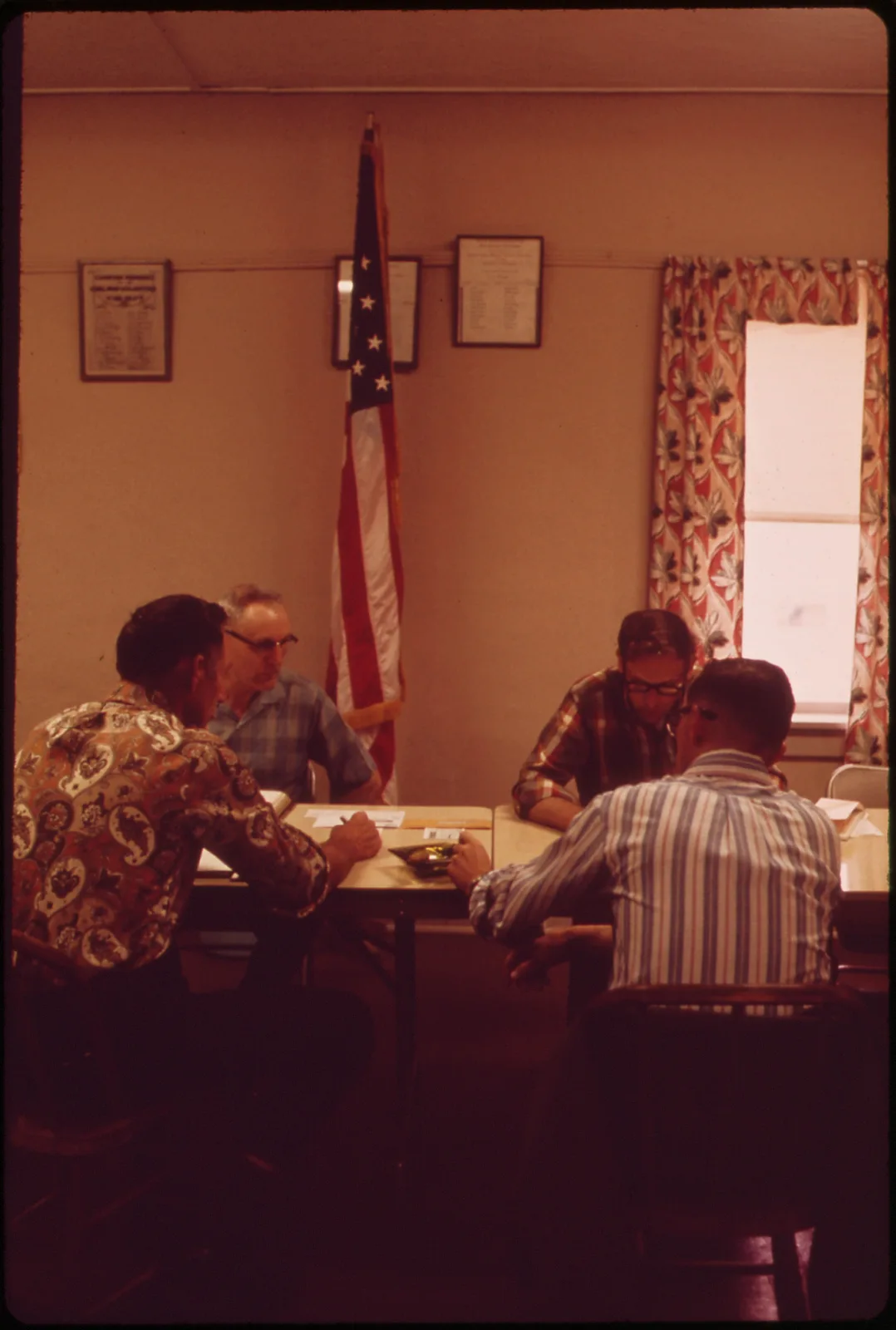
Most American local government looks less like a city council chamber and more like this: a handful of neighbors, meeting above the volunteer fire department, running the place they live in.
Three Basic Blueprints, Endless Local Variations
Nearly every incorporated city in the country uses some version of one of three basic organizational blueprints, mayor-council, council-manager, or commission, each with its own answer to a simple question: who actually runs the government day to day, an elected politician or a hired professional?
In a mayor-council system, voters separately elect a mayor and a city council, mirroring the federal separation of executive and legislative power. A "strong mayor" version gives the mayor full control over hiring department heads, preparing the budget, and vetoing council actions, similar to a governor or the President; a "weak mayor" version leaves most administrative power with the council or with department heads chosen independently of the mayor.
Nearly all of the largest U.S. cities, including New York, Chicago, Los Angeles, and Houston, use a strong mayor-council system, while many small and mid-sized cities use weaker mayor variants or have shifted to the council-manager model described below.
The strong-mayor model concentrates executive authority the way the federal and state constitutions do, and in the biggest cities the mayor oversees agencies with budgets larger than many states'. New York City's annual budget exceeds $100 billion, and its council members are full-time and elected from districts.
Weak-mayor systems, common in small towns and older Southern and New England municipalities, leave the mayor presiding over council meetings with little independent power while boards or independently elected officials run departments. Many cities have moved along this spectrum by charter amendment over time, usually toward a stronger executive as they grow.
Under council-manager government, voters elect only a city council, sometimes including a mayor who is really just a council member with largely ceremonial duties, and that council hires a professional, non-elected city manager to run daily operations, prepare the budget, and supervise department heads, similar to how a corporate board hires a CEO.
First adopted by Staunton, Virginia in 1908, the council-manager form is now used by a majority of U.S. cities with populations over 2,500, according to the International City/County Management Association, particularly common in mid-sized cities and suburbs, though it remains rare among the very largest cities.
The manager serves at the pleasure of the council and can be dismissed by a simple majority vote at any time, which keeps the appointed administrator accountable to the elected body. The council sets policy and adopts the budget the manager proposes, and charters usually bar council members from giving orders directly to department employees, a separation meant to insulate administration from politics.
Critics argue the model can leave no single elected official clearly accountable to voters for city performance, since the mayor is often just one council vote. Large cities that adopted it, including Dallas and Phoenix, have periodically debated switching to a strong-mayor system, and a few, such as San Diego in 2006, have made the change.
Commission government, pioneered in Galveston, Texas after the 1900 hurricane, elects a small board, typically three to seven members, who each individually head a city department, public works, finance, or public safety, while collectively acting as the city council.
Critics argued the model blurred the line between legislating and administering, made coordinated citywide budgeting difficult, and let each commissioner become an unchecked fiefdom over their own department; most cities that adopted it in the early 1900s have since switched to mayor-council or council-manager government, and only a small number of U.S. cities still use a pure commission system today.
At its peak around 1917, roughly 500 cities used commission government. Portland, Oregon was for decades the largest American city to keep it, until voters there approved a switch to a mayor-council system with a professional administrator and ranked-choice council elections, effective in 2025.
The model's core flaw was structural: with each commissioner running a department and also voting on the whole budget, commissioners had every incentive to protect their own turf and trade votes rather than weigh citywide priorities against one another.
Most U.S. city council and mayoral elections are legally nonpartisan, meaning candidates' party affiliation does not appear on the ballot, a Progressive Era reform aimed at reducing the influence of party machines over local patronage and contracts.
Nonpartisan ballots do not necessarily make local elections apolitical; voters, endorsing organizations, and local media often still know or publicize a candidate's party leanings informally, and a handful of major cities, including Chicago for some offices, retain partisan local elections by choice.
About three-quarters of U.S. cities hold nonpartisan elections, per surveys by the National League of Cities and ICMA. The reform was pushed by Progressives in the early 1900s to break the hold of machines like Tammany Hall, which used city payrolls and contracts as patronage to control votes.
Research on nonpartisan elections finds mixed effects: they tend to lower turnout, since the party cue that helps casual voters decide is absent, and they can advantage incumbents and better-funded candidates. Pennsylvania is notable for keeping partisan municipal elections across most of the state.
A city's charter functions as its local constitution, establishing its form of government, the powers of the mayor and council, and the procedures for passing ordinances and amending the charter itself. Home rule cities can amend their own charters through local votes; cities without home rule may need state legislative approval for major charter changes.
Charter amendments are typically placed on the local ballot for voter approval, meaning residents themselves periodically get a direct vote on restructuring their own city government, a level of direct control over the basic rules of government that does not exist at the state or federal level.
Charters are usually drafted by an elected or appointed charter commission and then ratified by local voters. They can run to hundreds of pages, specifying council size, term limits, the budget calendar, civil-service rules, and exactly how future amendments must be proposed, often by council referral or by a citizen petition meeting a signature threshold.
Cities without a charter, called general-law cities, instead operate under a standard template in state statute that applies to every city of their class. Moving from general-law to charter status is itself typically a ballot question, and it is the main way a growing city gains authority to tailor its own structure.
Cities expand their boundaries, and their tax base, through annexation, the legal process of incorporating adjacent unincorporated land into the city. Rules vary enormously by state: some states let a city annex land unilaterally under certain conditions, while others require a vote of the residents being annexed, or even of the annexing city's own voters.
Annexation fights are often driven by tax revenue and services: a growing development just outside a city's border generates property and sales tax a city wants, while the residents there may resist annexation to avoid city taxes or preserve rural zoning, a recurring local political conflict in fast-growing metro areas.
State annexation laws fall into roughly three camps: municipal-determination states, where a city can annex by ordinance subject to limited conditions (common in the South); popular-determination states, where affected residents must vote yes; and states routing annexations through a county boundary commission. Texas sharply curtailed forced annexation in laws passed in 2017 and 2019.
Where annexation is hard, metro areas fragment into many small incorporated suburbs, as around Los Angeles, St. Louis, and Atlanta. Where it is easy, central cities such as Houston, Charlotte, and Columbus have kept expanding their tax base and population, one reason many Sun Belt cities have grown far faster than older Northern cities hemmed in by incorporated neighbors.
Bigger Territory, More Independently Elected Officials
County government looks less like a scaled-down city and more like its own distinct animal: a small elected board sharing power with an entire slate of separately elected officials, governing a mix of incorporated cities and, often, large stretches of unincorporated land no city government touches at all.
Most counties are governed by a small elected board, called a board of commissioners, board of supervisors, or, in a few states, a county court or fiscal court, that sets the county budget, adopts ordinances for unincorporated areas, and oversees county departments. Board size typically ranges from three to more than a dozen members, usually elected from geographic districts.
A minority of counties, mostly larger and more urban ones, have adopted an elected county executive, similar to a mayor, who runs day-to-day administration separately from the legislative board, a structure closer to a mayor-council city government than the traditional commissioner model.
Kentucky and a few other states still call the governing body a 'fiscal court' presided over by an elected 'county judge/executive,' a title left over from the era when the same body handled both administration and minor judicial matters. Texas commissioners courts, led by an elected county judge, remain a prominent example of the combined form.
The National Association of Counties reports that most of the roughly 3,000 U.S. counties are still run by a commission of three to five members with no separate executive. Elected county executives, found in Maryland's large suburban counties, Erie County, New York, and King County, Washington, are concentrated where the administrative workload rivals a mid-sized city's.
Unlike a city, where the mayor or manager typically appoints department heads, many counties separately elect a whole slate of officials, often called "row officers": the sheriff, county clerk, treasurer, assessor, and sometimes the coroner or register of deeds, each accountable directly to voters rather than to the county board.
This structure, inherited from the original Virginia county-court model, means a county board often cannot fire or fully control an elected sheriff or clerk it disagrees with, since that official answers to voters at the next election rather than to the board, a genuine check on county board power but also a frequent source of friction between elected county officials.
The typical slate, sheriff, clerk, treasurer, assessor, recorder, coroner, surveyor, and prosecuting or district attorney, means a single county can hold a dozen or more partisan elections for administrative jobs a city would fill by appointment. Reformers have long argued that voters cannot meaningfully evaluate a candidate for county surveyor or coroner.
The sheriff is the most consequential of these offices. As an independently elected official, a sheriff generally cannot be fired by the county board and sets enforcement priorities, jail policy, and, in some states, whether to cooperate with federal immigration authorities. Roughly 3,000 elected sheriffs nationwide run agencies that operate most local jails and patrol unincorporated land.
Louisiana calls its county-equivalent units parishes, a holdover from its French and Spanish colonial and Catholic administrative history, while Alaska calls its units boroughs, and a large portion of Alaska's land area remains entirely "unorganized," with no county-equivalent government at all, served directly by the state instead.
Connecticut and Rhode Island abolished functioning county government decades ago; their counties still exist as geographic and judicial districting labels but perform no governing function, with all local governance instead handled directly by cities and towns, another example of New England's town-centered tradition overriding the county model.
Louisiana has 64 parishes, governed by 'police juries' or, in home-rule parishes, by councils. Alaska has 19 organized boroughs plus the Unorganized Borough, a single area larger than Texas that holds about 13 percent of the state's population and is served directly by the state and by independent city governments and school districts.
Connecticut ended county government in 1960, and Rhode Island's counties never held governing power; both states deliver essentially all local services through municipalities. Massachusetts abolished most of its county governments between 1997 and 2000, keeping a few by local choice. These New England exceptions all reflect the region's town-centered heritage.
Land that has never incorporated as a city or town, called unincorporated territory, is directly governed by the county rather than any municipal government, meaning county zoning, law enforcement, and services are the only local government many rural, and some suburban, Americans have.
Fast-growing unincorporated suburbs sometimes eventually incorporate into a new city specifically to gain more local control over zoning and services, or to capture sales and property tax revenue a county would otherwise collect, a pattern that has repeatedly reshaped county maps in growing Sun Belt metro areas since the 1990s.
Census estimates put roughly 60 million Americans in unincorporated territory, from remote ranchland to dense suburbs like unincorporated East Los Angeles or the parts of Clark County, Nevada, outside Las Vegas. For those residents the county board doubles as their city council, setting zoning, directing the sheriff's patrol, and maintaining local roads.
Incorporating a new city usually requires a petition, a county or state boundary-review of whether the area can fund services, and a vote of affected residents. Waves of Sun Belt incorporations, Sandy Springs, Georgia in 2005 and several neighbors, or Eastvale, California in 2010, were often driven by residents seeking local control of zoning or a share of sales tax the county had collected.
A small number of major cities, including San Francisco, Denver, Philadelphia, and New York City, have consolidated their city and county governments into a single entity, eliminating the usual separate layer of county government inside city limits and, in theory, reducing duplicated bureaucracy.
New York City is an unusual case even among consolidated city-counties: its five boroughs, Manhattan, Brooklyn, Queens, the Bronx, and Staten Island, are simultaneously New York City boroughs and, for certain state legal purposes, separate counties, a layered structure that traces back to the 1898 consolidation of the five boroughs into one city.
Roughly 40 consolidated city-county governments exist, most created by local referendum, including Nashville-Davidson County (1963), Jacksonville-Duval County (1968), Indianapolis-Marion County (Unigov, 1970), and Louisville-Jefferson County (2003). Supporters cite reduced duplication and a larger tax base; opponents in earlier decades sometimes argued consolidation diluted city voters' influence, and several proposals have failed at the ballot.
San Francisco has been a combined city and county since the 1850s, and Philadelphia since 1854. New York City's five district attorneys are still elected by county even though the city has a single mayor and council, a direct legacy of merging five counties' worth of territory into one municipal government in 1898.
Counties often carry out functions state government has delegated to them but does not want to administer directly, including running elections, maintaining courthouses and jails, administering welfare and public health programs, and, in many rural areas, providing services a city government would normally handle, like road maintenance and law enforcement, for anyone outside city limits.
Because so much of a county's budget goes toward state-mandated functions, courts, jails, elections, public health, counties often have far less discretionary budget flexibility than cities do, a recurring source of tension when state legislatures require a new county service without providing the funding to pay for it, discussed further in the Legal Limits & Funding tab.
Nationally, counties spend heavily on state-assigned work: courts and indigent defense, jails and pretrial detention, election administration, vital records, public health departments, and in many states a share of Medicaid or public-assistance costs. The National Association of Counties estimates counties own about 44 percent of the nation's road miles and 38 percent of its bridges.
Because so much county spending is state-directed, county officials often describe themselves as 'administrative arms of the state.' When legislatures add duties, higher indigent-defense standards, jail medical care, new voting equipment, without new money, county associations log them as unfunded mandates, and property-tax caps in many states leave counties little room to raise the revenue to cover them.
The Local Governments Most Voters Never Think About
Cities and counties get most of the attention, but school districts and special districts outnumber them combined, and collectively raise and spend a huge share of local tax dollars, on schools, fire protection, water, and transit, almost entirely outside the public's normal field of view.
Most American public school districts are governed by an elected school board, typically five to nine members, that sets district policy, approves the budget, and hires a superintendent to run daily operations, a structure that closely mirrors the council-manager model many cities use.
School boards operate within limits set well above the local level: state governments set curriculum standards, graduation requirements, and often a large share of school funding, and the federal government attaches conditions to funding streams like Title I, meaning a locally elected school board has real but bounded authority over what actually happens in its schools.
There are roughly 13,000 regular school districts and about 14,000 local boards nationwide, seating an estimated 90,000 members, most elected in nonpartisan races. Boards hire and evaluate the superintendent, adopt the budget and tax levy where allowed, approve curriculum and textbooks within state frameworks, and ratify teacher contracts.
Some large districts are governed differently. Big-city systems including New York City, and for years Chicago and Washington, D.C., have been run wholly or partly under mayoral control, with leadership appointed rather than elected. Hawaii is unique in having a single statewide district under a state board.
School board members are elected either at-large, where every voter in the district votes on every seat, or by sub-district, where voters elect only the member representing their specific geographic zone, a structural choice with real consequences for which communities within a district get direct representation.
Federal voting rights litigation has repeatedly targeted at-large school board elections in cases where they diluted the voting power of a racial or language minority community concentrated in one part of a district, leading a number of districts to switch to sub-district elections under court order or legal settlement over the past several decades.
At-large voting was in some places adopted specifically to keep minority neighborhoods from electing a representative. Section 2 of the federal Voting Rights Act of 1965 has been used in dozens of cases to force a switch to single-member districts where at-large elections were shown to dilute minority voting strength.
California's 2001 Voting Rights Act made such challenges easier under state law by shifting legal costs onto a government body that loses, and hundreds of California school districts, city councils, and community-college boards have converted from at-large to by-district elections since 2015, often after a single demand letter.
Public school funding in most states comes from a combination of local property taxes, state aid formulas designed to equalize funding between wealthy and poor districts, and a smaller share of federal funding, with the exact mix varying enormously by state; some states fund schools almost entirely through state aid, while others still rely heavily on local property wealth.
Because property-tax-funded districts sit on wildly different tax bases, this system has produced decades of school-finance lawsuits in dozens of states, arguing that funding students' education based on local property wealth violates a state constitution's guarantee of an adequate or equal education, with courts in states including New Jersey, Texas, and Kentucky ordering major funding overhauls.
Nationally, K-12 funding is split roughly evenly between state and local sources, with about 8 to 10 percent from the federal government, though the range runs from Vermont and Hawaii, where the state provides nearly all of it, to states where local property taxes still supply half or more. Total U.S. public K-12 spending exceeds $850 billion a year, around $15,000 per pupil.
The litigation has come in waves since California's Serrano v. Priest (1971). After the U.S. Supreme Court held in San Antonio v. Rodriguez (1973) that education is not a fundamental federal right, plaintiffs turned to state constitutions' education clauses, winning overhaul orders in New Jersey, Kentucky (Rose, 1989), Washington (McCleary), and more than 20 other states.
A special district is a limited-purpose local government created to provide one specific service, fire protection, water and sewer, mosquito control, public transit, or parks, often crossing city and county lines and typically funded by its own dedicated tax or fee rather than a general city or county budget.
The Census Bureau counted 39,555 special districts nationwide in its 2022 Census of Governments, more than the number of cities, townships, and counties combined, making special districts the largest single category of local government in the country even though most residents could not name the one that serves them.
They range from a single rural cemetery or fire district to giants: the Metropolitan Water District of Southern California serves about 19 million people, and transit authorities like New York's MTA and Chicago's RTA run multibillion-dollar budgets. Most districts are single-purpose, though some, like port authorities, bundle a few related functions.
The special-district count rose from about 8,300 in 1942 to 39,555 in 2022, and districts now hold a large share of local government debt nationally, because they frequently issue revenue bonds backed by user fees, water bills, tolls, airport charges, to finance infrastructure without adding to a city or county's own debt limit.
Special districts often form specifically because a service needs to cross city or county boundaries that a single municipal government cannot, a regional transit system or a water district serving several cities, or because a community wants a service, like fire protection or mosquito abatement, without creating an entire general-purpose government to provide it.
Special districts can also form to work around a Dillon's Rule-style limit or a local tax cap: because a district is a distinct legal government created for one purpose, it can sometimes levy its own tax or issue its own bonds even when the city or county that overlaps it has hit a legal borrowing or taxing limit, a workaround critics call fragmenting accountability and supporters call flexible, targeted governance.
A recurring reason is jurisdictional mismatch: watersheds, transit corridors, and air-quality regions do not follow city or county lines, so a district drawn to fit the problem can tax and plan across many municipalities. California's roughly 3,300 special districts (by the California Special Districts Association's count, which includes dependent districts) include water, irrigation, sanitation, mosquito-abatement, and community-services districts.
Public-finance scholars call heavy reliance on districts 'special-district fragmentation,' and studies link it to higher overall local debt and lower voter awareness, since each new district adds a taxing body most residents never notice on the ballot or the tax bill.
Governance varies enormously by type of special district: some, like many school and fire districts, have their own directly elected boards; others, like many water and sewer authorities, are governed by members appointed by the city or county officials the district serves, with no direct election at all.
Voter turnout for special district elections, when they are held at all, is typically far lower than turnout for city, county, or federal elections, in part because these races often appear on off-cycle ballots and get little media coverage, even though special districts collectively spend tens of billions of dollars a year on services residents use directly.
About two-thirds of special districts have elected boards and roughly one-third are governed by officials appointed by the city or county they serve, per Census of Governments data. Elected fire and water boards often run their own tax elections; appointed authorities, common for airports, housing, and redevelopment, answer to the appointing government rather than to voters.
Turnout in stand-alone special-district elections is frequently in the single digits as a share of eligible voters, and many seats go uncontested. Reform proposals in several states would consolidate small districts or move their elections onto the November ballot to raise participation, but existing districts and their employees often resist.
Local Government Answers to the State, Whether It Likes To or Not
Every city, county, and school district in the country exists because a state constitution or legislature allows it to, and that relationship, how much independent power a local government actually has, and how it pays for what it's required to do, has been fought over in courtrooms and at the ballot box for more than 150 years.
Under Dillon's Rule, first articulated by Iowa Supreme Court Justice John Forrest Dillon in an 1868 ruling, a local government has only the powers a state constitution or legislature has expressly given it, plus whatever powers are "necessarily implied" by those express grants, with any real doubt resolved against the local government.
Roughly 40 states apply Dillon's Rule to at least some local governments today, which means a city council in one of those states that wants to regulate something genuinely new, a type of business, a technology, a public health measure, may first need to confirm the state legislature has actually authorized that kind of local action, or risk having a court strike the ordinance down.
Because courts resolve genuine ambiguity against the local government, a city acting on an untested subject risks having its ordinance voided. Virginia is often cited as a strict Dillon's Rule state, where the Supreme Court of Virginia has repeatedly struck down local measures for lack of express legislative authority.
The National League of Cities' 'Principles of Home Rule for the 21st Century' argues Dillon's Rule leaves cities unable to respond quickly to local problems and forces them to lobby the legislature for narrow enabling acts every session. Defenders reply that it keeps state law uniform and prevents a patchwork of conflicting local codes.
Home rule flips Dillon's Rule's default: a home rule city or county may exercise any power not specifically prohibited or preempted by the state, rather than needing specific permission for each power it wants to use. Missouri became the first state to adopt constitutional home rule in 1875, and most states now offer some form of it, though usually only to cities above a certain population.
Home rule is not absolute even where it exists: state legislatures routinely pass "preemption" laws that override specific local ordinances on subjects ranging from minimum wage to short-term rentals to plastic bag bans, meaning even a home rule city's authority can be narrowed by the state at any time a legislature chooses to act.
Home-rule authority is generally limited to 'municipal affairs' or 'local concerns,' while matters courts deem of statewide concern stay under legislative control, with judges drawing the line case by case. Illinois's 1970 constitution is often cited as unusually generous, granting broad home rule automatically to municipalities over 25,000.
State preemption of local ordinances accelerated sharply after 2010. Legislatures have barred cities from setting their own minimum wages in about 25 states, and from regulating firearms, banning plastic bags, restricting oil and gas drilling, or setting landlord-tenant rules, often overriding ordinances already on the books in the state's largest cities.
Property taxes remain the largest single revenue source for local governments nationwide, particularly for school districts, because real estate cannot move or hide the way income or sales activity can, making it comparatively easy for a local government to assess and collect reliably year after year.
That same stability is also property tax's biggest political liability: unlike income tax, which rises and falls with earnings, a homeowner's property tax bill can climb even in a year their income does not, which is exactly the dynamic that produced California's Proposition 13 in 1978 and the broader property tax revolt that followed nationwide.
Property taxes supply roughly 30 percent of all local government revenue nationally and a much larger share for schools. The tax is administered locally: an assessor values each parcel, the taxing bodies set rates or levies, and the county usually bills and collects, then distributes shares to schools, the county, the city, and any special districts.
Its visibility, paid in one or two large bills rather than withheld from a paycheck, makes it politically fraught, and nearly every state now limits it somehow: rate caps, levy or 'truth in taxation' limits, assessment-growth caps, or homestead exemptions and 'circuit breakers' that cap bills for lower-income and elderly owners.
California's 1978 Proposition 13 capped property tax rates at 1 percent of assessed value, limited annual assessment growth to 2 percent, and required a two-thirds legislative vote for new state taxes, cutting local property tax revenue by an estimated $7 billion in its first year and forcing the state to step in with emergency funding to keep local governments and schools operating.
More than half the states adopted some form of property tax or local spending limit within a decade of Proposition 13's passage, and California school districts, which received roughly two-thirds of their funding from local property taxes before 1978, now rely primarily on state aid instead, a permanent shift in the balance of power between state and local government that outlasted the immediate tax revolt itself.
By also requiring a two-thirds vote for new state taxes and many local special taxes, Proposition 13 reshaped fiscal politics far beyond property tax. Local governments leaned on sales taxes, development impact fees, and assessment districts, and cities began competing for retail development to capture sales-tax revenue, a pattern California planners call 'the fiscalization of land use.'
Later ballot measures adjusted it: Proposition 218 (1996) required voter approval for most local assessments and fees, and Proposition 19 (2020) narrowed inherited-property tax breaks. Commercial property is still assessed under the 1978 rules after voters rejected a 2020 measure that would have taxed business property at market value.
State legislatures frequently require local governments to provide a specific service or meet a specific standard, an environmental requirement, a policing policy, a special-education service, without providing the funding to cover the added cost, a practice local officials call an unfunded mandate.
Many states have since passed their own mandate-reform laws requiring the legislature to either fund a new local mandate or explicitly declare it unfunded, modeled in part on the federal Unfunded Mandates Reform Act of 1995, though enforcement and exceptions vary widely, and local government associations in most states still track and publicly criticize new unfunded mandates every legislative session.
The federal Unfunded Mandates Reform Act of 1995 requires the Congressional Budget Office to flag bills imposing costs above a threshold (about $100 million, inflation-adjusted) on state and local governments, but it carries broad exceptions and does not stop Congress from proceeding, so most observers consider its practical bite modest.
About a dozen states have constitutional provisions requiring reimbursement of new local mandates; California's, added by Proposition 4 in 1979, has produced extensive litigation before the Commission on State Mandates over which requirements qualify. Local government groups in most states publish an annual list of new mandates each session regardless of whether a reimbursement rule exists.
Local voters in many states can place tax increases, bond measures, and even specific policy questions directly on the ballot through local initiative and referendum processes, a form of direct democracy far more common in local government than in Congress or, in most states, the state legislature.
School and infrastructure bond measures usually require voter approval specifically because they commit a local government to years of future property tax revenue to repay the debt, meaning residents get a direct vote on major long-term local spending in a way they never get for a comparable state or federal spending decision.
Local initiative and referendum powers exist in a majority of states, often broader than the statewide versions, and are used for zoning referenda, recall elections, charter amendments, tax overrides, and specific policy questions from rent control to water fluoridation. Whether a measure runs on a busy November ballot or a low-turnout special election can decide the outcome.
General-obligation bonds usually need voter approval, and many states require a supermajority of 55, 60, or two-thirds percent because the bonds pledge property-tax revenue for 20 or 30 years. Voters approve the large majority of school bond measures nationally, though passage rates drop in years with organized anti-tax campaigns.
Nine Facts Worth Knowing
A quick-reference set of facts drawn from the sourced material throughout this page, useful for a fast read or a classroom discussion starter.
The 2022 Census of Governments counted 90,837 local governments nationwide, including 3,031 counties, 35,705 municipalities and townships, 12,546 school districts, and 39,555 special districts.
More than 98 percent of the roughly 500,000 elected officials in the United States serve at the local level, not in Congress, a state legislature, or a governor's office.
Special districts, government units created for one specific service like fire protection or water, outnumber cities, counties, and townships combined.
Staunton, Virginia became the first U.S. city to hire a professional city manager in 1908, a reform that spread to become the most common form of city government nationwide.
Under Dillon's Rule, a legal doctrine from an 1868 Iowa court ruling, local governments in roughly 40 states can only exercise powers the state has specifically granted them.
Louisiana calls its counties "parishes" and Alaska calls its "boroughs," while Connecticut and Rhode Island abolished functioning county government decades ago.
California's 1978 property tax revolt, Proposition 13, cut local property tax revenue by an estimated $7 billion in its first year and triggered similar tax limits in more than half the states.
New York City's five boroughs are simultaneously city boroughs and, for certain legal purposes, separate counties, a structure dating to the 1898 consolidation that created modern New York City.
School board elections often draw far lower turnout than city or county elections, even though school boards typically control the largest single share of local property tax spending.
Sources & Further Reading
- U.S. Census Bureau, 2022 Census of Governments
- National League of Cities, Principles of Home Rule for the 21st Century
- ICMA (International City/County Management Association), History of Council-Manager Government
- Cornell Law School Legal Information Institute, Dillon's Rule
- California Legislative Analyst's Office, Common Claims About Proposition 13
- Public Policy Institute of California, Proposition 13: 40 Years Later
- City of Staunton, Virginia, Government History
This page draws on the U.S. Census Bureau's Census of Governments, the National League of Cities' research on home rule, the International City/County Management Association's history of council-manager government, Cornell Law School's Legal Information Institute on Dillon's Rule, and California's Legislative Analyst's Office and Public Policy Institute of California on Proposition 13. Government counts and elected-official figures reflect the most recently published Census of Governments data as of this writing and are updated by the Bureau roughly every five years.