The Oath of Office
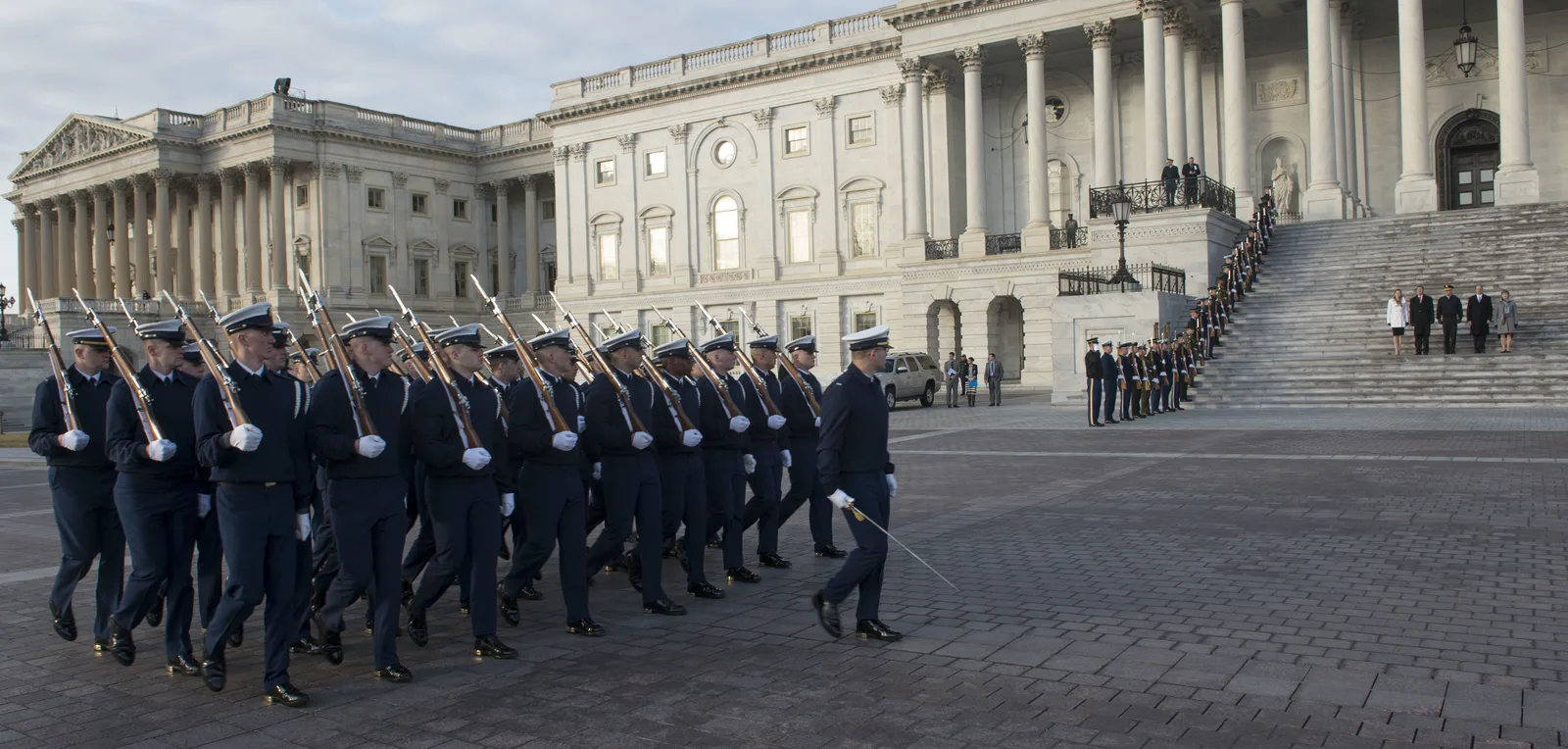
Every federal official, every member of the military, and every new citizen swears loyalty to the same thing: not a ruler, not a party, but the Constitution itself.
How the Oath Was Conceived
The founders inherited a long tradition of oaths to the king and his church. They kept the oath and changed its object: Americans would swear to support a written Constitution.
What the Constitution Says
"I do solemnly swear (or affirm) that I will faithfully execute the Office of President of the United States, and will to the best of my Ability, preserve, protect and defend the Constitution of the United States."
"The Senators and Representatives before mentioned, and the Members of the several State Legislatures, and all executive and judicial Officers, both of the United States and of the several States, shall be bound by Oath or Affirmation, to support this Constitution; but no religious Test shall ever be required as a Qualification to any Office or public Trust under the United States."
The colonists came from a country that used oaths as a test of loyalty. Under the Act of Supremacy of 1534, English officials swore an Oath of Supremacy recognizing Henry VIII, and later monarchs, as the head of the Church of England. After the Gunpowder Plot of 1605, Parliament added an Oath of Allegiance in 1606 aimed at Catholics who might side with the Pope against the Crown.
England's Test Acts of 1673 and 1678 went further. Anyone who held a public office or a military commission had to take communion in the Church of England and sign a declaration rejecting Catholic doctrine. The oath was not only a promise to serve well; it was a filter that kept Catholics and Protestant dissenters out of government. Those laws were not repealed until 1828 and 1829.
Colonial officials swore the same kinds of oaths to the Crown. Royal governors, judges, and customs officers promised loyalty to the king personally, and several colonies kept their own religious tests for office. By the time of the colonial and revolutionary era, Americans knew from experience how an oath could be used to decide who was allowed to govern.
That history explains two choices the founders later made. They kept the oath as a solemn promise of loyalty, but they pointed it at a written document instead of a person, and they barred any religious test for federal office. Both decisions were reactions to the English system they had lived under.
Once the colonies declared independence in 1776, the old oaths had to be replaced. States wrote their own loyalty oaths to separate patriots from Loyalists. Pennsylvania's Test Act of June 1777, for example, required adult white men to renounce George III and swear allegiance to the state; those who refused lost the right to vote, hold office, or serve on juries.
The Continental Congress did the same for its army. A resolution of February 3, 1778, required every officer to sign an oath acknowledging the United States as "free, independent and sovereign" and renouncing any allegiance to King George III. Officers swore to defend the United States against the king and his heirs.
George Washington signed his copy of that oath at Valley Forge on May 12, 1778, during the hardest winter of the war. The signed document survives in the National Archives. It is a reminder that the man who later took the first presidential oath had already sworn loyalty to the new nation while it was fighting for its life during the American Revolution.
These wartime oaths had a weakness the founders noticed. They swore loyalty to a cause and to the states, but there was not yet a single national charter to swear to. Under the Articles of Confederation, Congress had no power to make state officials promise to obey national law, and states often ignored it. The Constitution's oath clause was written to fix that.
The oath was in the plan from the first day of the Convention. Resolution 14 of Edmund Randolph's Virginia Plan, presented on May 29, 1787, proposed that state legislative, executive, and judicial officers "be bound by oath to support the articles of Union." Some delegates objected that binding state officials to the national government intruded on the states, but the idea survived, and on July 23 the delegates extended it to national officers as well.
On August 30, Charles Pinckney of South Carolina moved to add a ban on religious tests, and the delegates adopted it. The finished Article VI requires every member of Congress, every state legislator, and every executive and judicial officer at both levels to be bound "by Oath or Affirmation, to support this Constitution," and adds that "no religious Test shall ever be required" for any federal office.
The President's oath was written separately, and it is the only oath whose exact words appear in the Constitution. The Committee of Detail's draft of August 6 had the President swear only to "faithfully execute" the office. On August 27, George Mason and James Madison moved to add a promise to "preserve, protect and defend the Constitution," and the final text promises to do so "to the best of my Ability."
The words "or affirm" appear in both clauses on purpose. Quakers and members of some other faiths believed the Bible forbade swearing oaths, and the framers did not want that belief to bar anyone from office. An affirmation carries exactly the same legal weight as an oath; it simply leaves out the act of swearing.
Article VI says officials must take an oath to support the Constitution, but it does not say what the oath must say. The First Congress settled that before it did anything else. The very first law it passed, signed by President Washington on June 1, 1789, was "An Act to regulate the Time and Manner of administering certain Oaths."
The oath it set was only fourteen words: "I, A.B., do solemnly swear or affirm (as the case may be) that I will support the Constitution of the United States." The law also spelled out who would administer it to members of the Senate and the House, and required state legislators and state officers to take the same oath.
Making this the first law sent a clear message. Before Congress created a single executive department, set a single tax, or organized the federal courts, it made sure everyone holding power under the new government had promised to support the document that created it.
That short oath stayed in use for more than seventy years. Members of Congress, federal officers, and state officials across the country took it in the same words until the Civil War, when Congress decided a simple promise of support was no longer enough.
The Civil War changed the oath. Many officials who had sworn to support the Constitution, including senators and army officers, resigned to serve the Confederacy. In response, Congress passed the "Ironclad Test Oath" on July 2, 1862, requiring federal officials to swear that they had never voluntarily borne arms against the United States or helped anyone who did.
In 1864 the Senate required its own members to take the Ironclad Oath. Senator James Bayard of Delaware, who considered it unconstitutional, took the oath on January 29, 1864, and then resigned his seat in protest. In 1865 Congress extended a similar test to lawyers practicing in federal court.
The Supreme Court struck down that extension in Ex parte Garland (1867). Augustus Garland, a former Confederate senator who had received a presidential pardon, challenged the lawyers' oath, and the Court ruled that it punished people for past conduct without a trial, which the Constitution forbids as a bill of attainder and an ex post facto law.
As Reconstruction ended, Congress wrote a new oath for itself in 1884. It dropped the questions about past loyalty and instead looked forward: officials now swear to "support and defend the Constitution of the United States against all enemies, foreign and domestic," to bear it "true faith and allegiance," and to take the obligation "freely, without any mental reservation or purpose of evasion." That 1884 wording, now in 5 U.S.C. 3331, is the oath members of Congress and federal employees still take.
The Oaths Compared
There is no single oath of office. The Constitution writes out only the President's. Congress wrote the rest, and each one fits the job of the person taking it.
“I do solemnly swear (or affirm) that I will faithfully execute the Office of President of the United States, and will to the best of my Ability, preserve, protect and defend the Constitution of the United States.”
- Who takes it
- The President of the United States, at the start of each term and on succeeding to the office
- Set by
- U.S. Constitution, Article II, Section 1, Clause 8
This is the only oath whose words are fixed by the Constitution itself, so Congress cannot change it. It is 35 words long, not counting the optional "or affirm." It is the last thing a new President does before taking office, and under the 20th Amendment, ratified in 1933, the term begins at noon on January 20.
Notice what the oath does not say. It does not mention the people, the nation, the flag, or God. The President promises to carry out the office faithfully and to "preserve, protect and defend" the Constitution, a phrase that makes the President a guardian of the document as well as the head of the government it creates.
The Constitution does not say who must administer the oath. By custom it is the Chief Justice of the United States, and most Presidents have been sworn in that way since John Adams in 1797. But other officials have done it in emergencies, including a federal district judge, a federal circuit judge, and, in one case, a notary public.
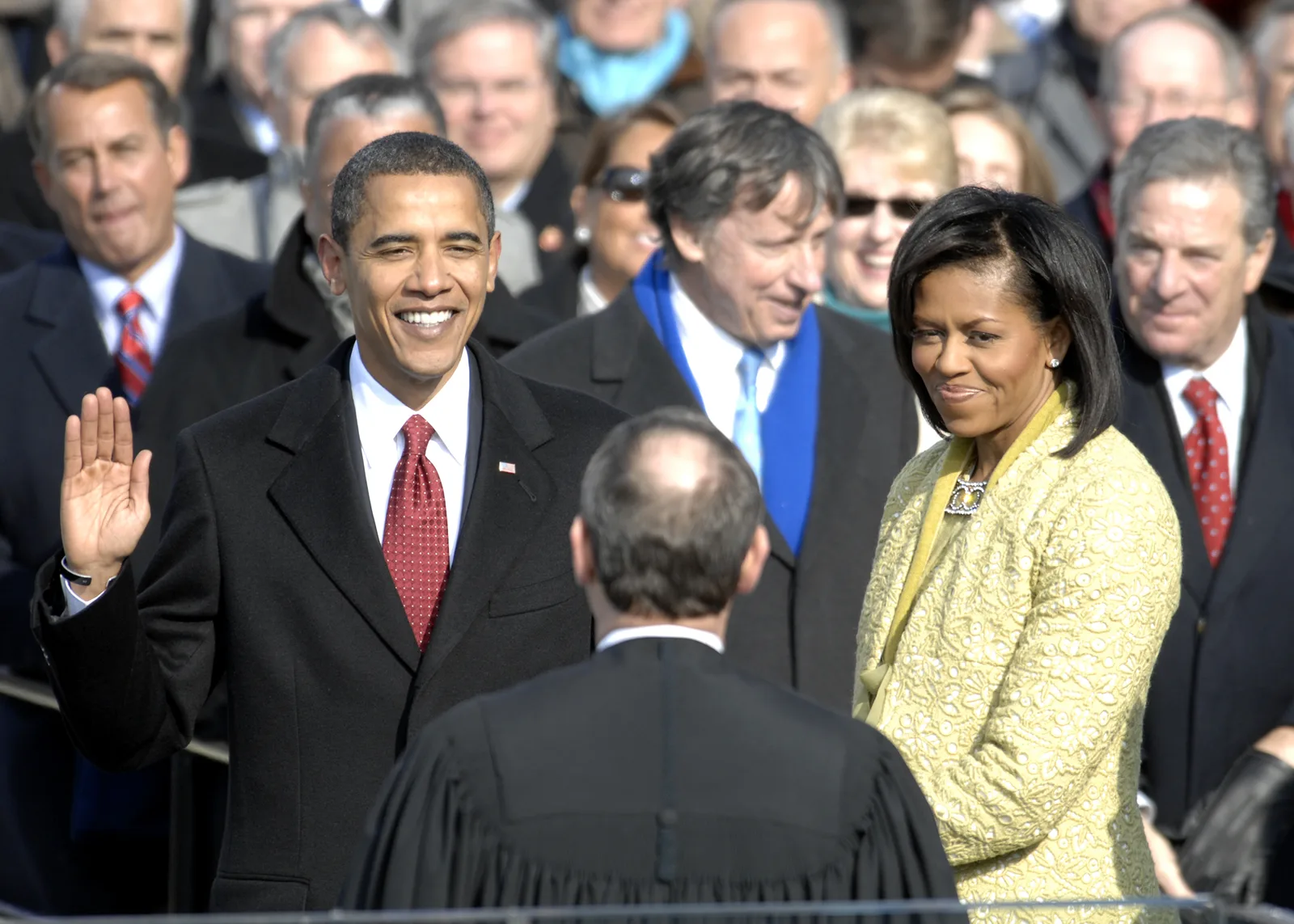
When January 20 falls on a Sunday, Presidents have taken the oath privately on that day and then repeated it at the public ceremony on Monday. That happened in 1985 for Ronald Reagan and in 2013 for Barack Obama.
“I, AB, do solemnly swear (or affirm) that I will support and defend the Constitution of the United States against all enemies, foreign and domestic; that I will bear true faith and allegiance to the same; that I take this obligation freely, without any mental reservation or purpose of evasion; and that I will well and faithfully discharge the duties of the office on which I am about to enter. So help me God.”
- Who takes it
- Senators, Representatives, the Vice President, Cabinet members, military officers, and federal civilian employees
- Set by
- 5 U.S.C. 3331 (the 1884 wording)
This is the most widely taken oath in the federal government. Because the Constitution writes out no oath for the Vice President, the Vice President takes this one, usually just before the President is sworn in on Inauguration Day.
Each new Congress is usually sworn in on January 3 of odd-numbered years, the date set by the 20th Amendment. In the House, the longest-serving member swears in the newly elected Speaker, and the Speaker then gives the oath to all members at once, with their right hands raised. In the Senate, the Vice President swears in newly elected senators in groups of four. The members chosen in the 2026 midterm elections will take this oath on January 3, 2027.
The same words are taken by every Cabinet secretary, every commissioned military officer, and the roughly two million civilians who work for the federal government, from a park ranger to a cabinet deputy. A federal employee who moves to a new job takes the oath again.
The final phrase, "So help me God," is part of the statute, but it is optional in practice. Because Article VI bans religious tests, an official may affirm instead of swear and may leave the phrase out. In the House, members take the official oath with no book at all; the photos of members with a hand on a Bible or another sacred text come from separate ceremonial reenactments.
“I, ___ ___, do solemnly swear (or affirm) that I will administer justice without respect to persons, and do equal right to the poor and to the rich, and that I will faithfully and impartially discharge and perform all the duties incumbent upon me as ___ under the Constitution and laws of the United States. So help me God.”
- Who takes it
- Supreme Court justices and every federal judge, in addition to the 5 U.S.C. 3331 oath
- Set by
- 28 U.S.C. 453 (the judicial oath)
Federal judges take two oaths. The first is the same oath every federal official takes. The second, the judicial oath, comes from the Judiciary Act of 1789 and is written only for judges. Every federal court judge, from a district court to a circuit court of appeals, takes both.
The judicial oath is about fairness, not loyalty. Judges promise to decide cases "without respect to persons," meaning without favoring anyone because of who they are, and to "do equal right to the poor and to the rich." Those phrases describe the basic promise of equal treatment under the law.
New Supreme Court justices sometimes take the two oaths in separate ceremonies, one private and one public, often on the same day. The Chief Justice or another justice usually administers them.
Congress revised the judicial oath once, in 1990, changing "agreeably to the Constitution and laws" to "under the Constitution and laws." The commitments themselves, impartiality and equal justice for rich and poor, have not changed since 1789.
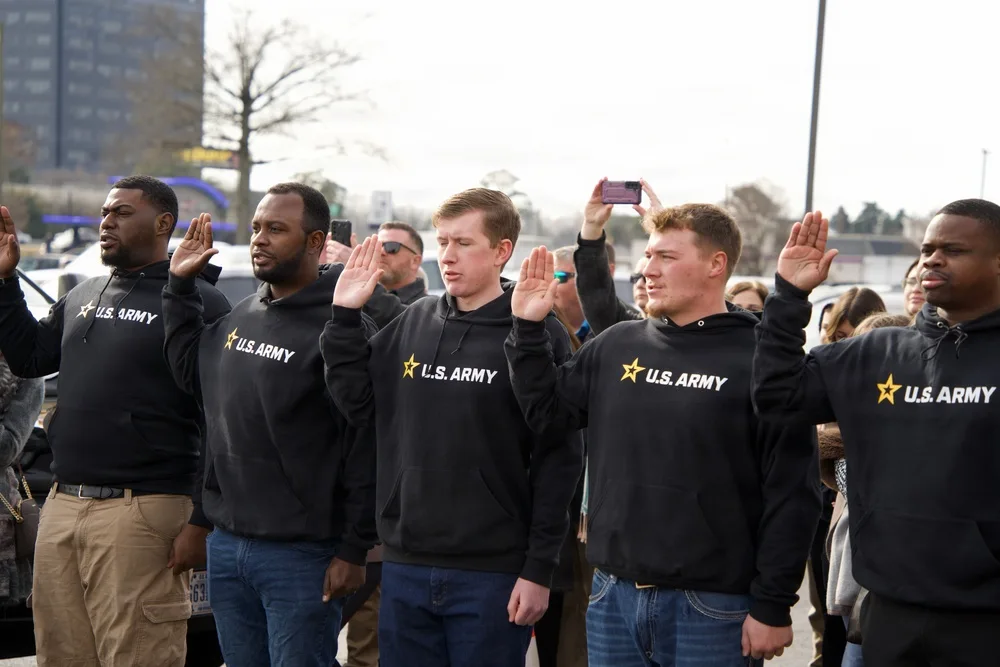
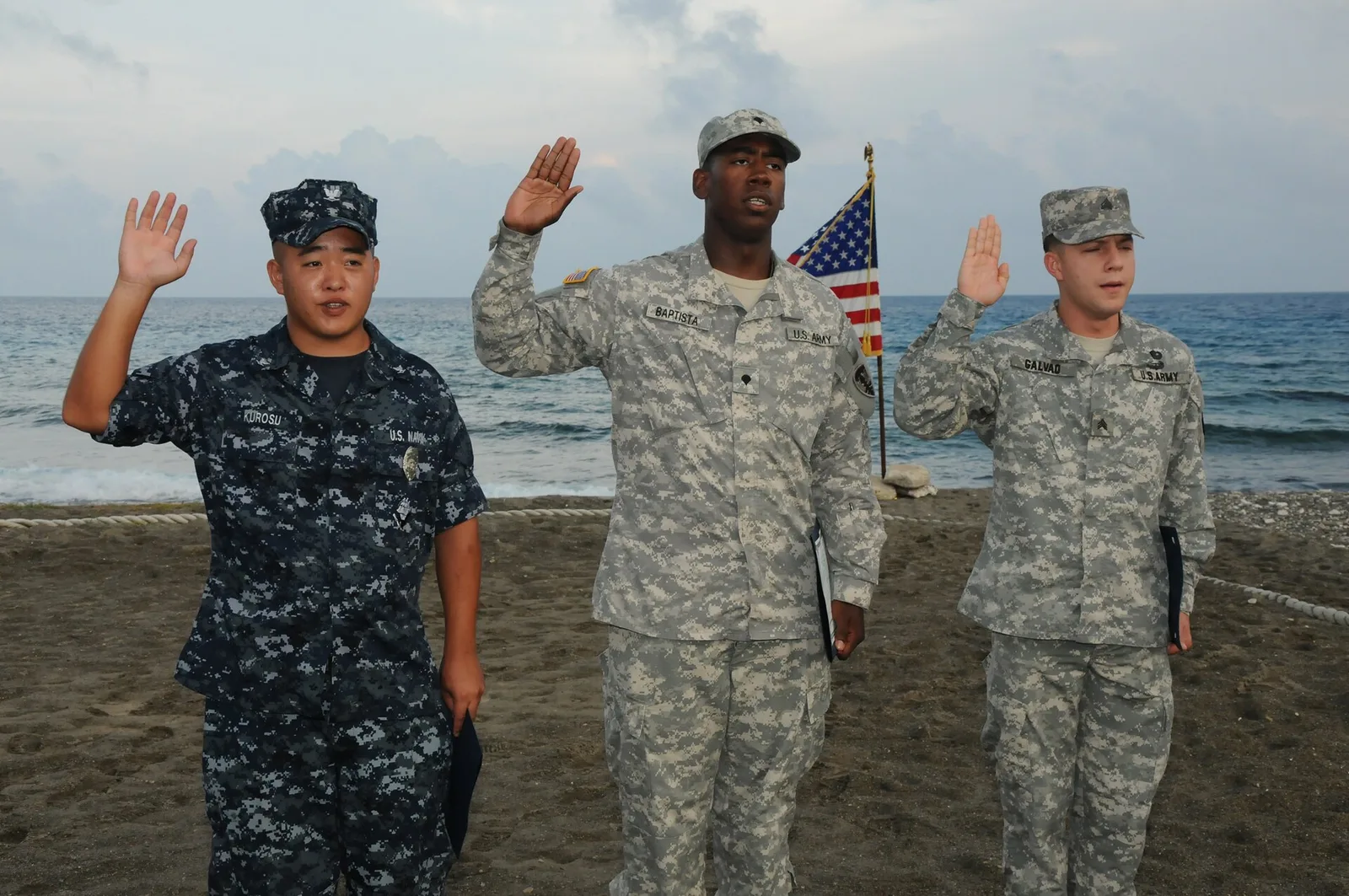
“I, ___, do solemnly swear (or affirm) that I will support and defend the Constitution of the United States against all enemies, foreign and domestic; that I will bear true faith and allegiance to the same; and that I will obey the orders of the President of the United States and the orders of the officers appointed over me, according to regulations and the Uniform Code of Military Justice. So help me God.”
- Who takes it
- Every enlisted member of the Army, Navy, Air Force, Marine Corps, Space Force, and Coast Guard
- Set by
- 10 U.S.C. 502 (the oath of enlistment)
Enlisted troops swear first to the Constitution and only then to obey orders. The order matters. Members of the armed forces promise loyalty to the Constitution, not to any individual commander, and their duty to obey is limited by the words "according to regulations and the Uniform Code of Military Justice," which require obedience to lawful orders.
The military oath is almost as old as the Constitution. A law of September 29, 1789, required soldiers to swear to support the Constitution and to obey the orders of the President and their officers. Congress has revised the wording several times, and the current text dates from 1962.
Commissioned officers do not take the enlistment oath. They take the same 5 U.S.C. 3331 oath as members of Congress, which contains no promise to obey orders at all. Officers swear to support and defend the Constitution and to faithfully discharge their duties, which places the responsibility for judging an order's lawfulness squarely on them.
Troops retake the oath each time they reenlist, and reenlistment ceremonies are often held at meaningful places, such as a battlefield, a ship's deck, or a memorial. The oath has no end date: many veterans describe it as a promise they still consider binding long after leaving the service.
“I hereby declare, on oath, that I absolutely and entirely renounce and abjure all allegiance and fidelity to any foreign prince, potentate, state, or sovereignty, of whom or which I have heretofore been a subject or citizen; that I will support and defend the Constitution and laws of the United States of America against all enemies, foreign and domestic; that I will bear true faith and allegiance to the same; that I will bear arms on behalf of the United States when required by the law; that I will perform noncombatant service in the Armed Forces of the United States when required by the law; that I will perform work of national importance under civilian direction when required by the law; and that I take this obligation freely, without any mental reservation or purpose of evasion; so help me God.”
- Who takes it
- Every immigrant who becomes a U.S. citizen through naturalization
- Set by
- 8 CFR 337.1, under section 337 of the Immigration and Nationality Act
The Oath of Allegiance is the final step on the path to citizenship. A person does not become a citizen when they pass the interview or the civics test; they become a citizen at the moment they take this oath at a naturalization ceremony.
It is the longest of the federal oaths, and it is the only one that asks the person to give something up. New citizens renounce allegiance to any foreign "prince, potentate, state, or sovereignty" before promising to support and defend the Constitution and the laws of the United States.
The law allows changes for reasons of conscience. An applicant who objects to bearing arms on religious or moral grounds may leave out that promise, and an applicant may affirm instead of swear and leave out "so help me God." The promise to support the Constitution can never be removed.
Ceremonies are led by a federal judge or a U.S. Citizenship and Immigration Services officer. In recent years more than 800,000 people a year have taken this oath, after studying for the citizenship test that covers the Constitution, the branches of government, and American history.
Famous Swearing-Ins
Most oaths are taken on schedule and in public. A few were taken in a hotel, a farmhouse, or an airplane, and they show how much weight the words themselves carry.
On April 30, 1789, George Washington took the first presidential oath on the second-floor balcony of Federal Hall on Wall Street in New York City, then the nation's capital. There were no federal judges yet, so Robert R. Livingston, the Chancellor of New York and the state's highest judicial officer, administered it.
No Bible had been brought for the ceremony, so one was borrowed from St. John's Masonic Lodge No. 1 nearby. Contemporary accounts say Washington kissed the Bible after taking the oath, and Livingston turned to the crowd below and called out, "Long live George Washington, President of the United States."
Washington then went inside to the Senate chamber and delivered the first inaugural address to the assembled members of Congress. It began the tradition of inaugural speeches that every President since has followed.
Many accounts say Washington added the words "So help me God" at the end of the oath. The phrase does not appear in the constitutional text, and no eyewitness account from 1789 records it; the story first appeared in print decades later.
Commonly attributed to George Washington; the attribution is not verified (National Park Service, Federal Hall National Memorial).
President William Henry Harrison died on April 4, 1841, one month into his term. The Constitution was unclear about whether the Vice President became President or only took on the office's "powers and duties" as an acting President.
John Tyler settled the question his own way. On April 6, 1841, he took the presidential oath from William Cranch, chief judge of the federal circuit court for the District of Columbia, at Brown's Indian Queen Hotel in Washington. Tyler believed his vice presidential oath was already enough, but he took the new oath to remove any doubt.
Tyler then insisted on being addressed as President, not Acting President, and returned mail addressed to the "Acting President" unopened. Critics nicknamed him "His Accidency," but Congress accepted his position.
The "Tyler Precedent" guided every later succession until the 25th Amendment wrote it into the Constitution in 1967. Eight more Vice Presidents have since taken the oath after a President's death or resignation, as described on the presidential succession page.
President Warren G. Harding died in San Francisco on the evening of August 2, 1923. Vice President Calvin Coolidge was visiting his family's farmhouse in Plymouth Notch, Vermont, which had no telephone, and the news reached him by messenger in the middle of the night.
His father, John Coolidge, was a notary public. At about 2:47 a.m. on August 3, by the light of a kerosene lamp in the family sitting room, he administered the presidential oath to his son using the family Bible. It is the only time a President has been sworn in by a parent.
Questions followed about whether a state notary could administer a federal oath. To settle any doubt, Coolidge quietly took the oath again on August 21, 1923, in Washington, from Justice Adolph A. Hoehling of the Supreme Court of the District of Columbia. The second oath was not made public until 1932.
Coolidge's case shows why the words matter more than the ceremony. Nothing about the farmhouse oath was grand, but once the words were spoken by a person with authority to administer them, the country had a President.
President John F. Kennedy was assassinated in Dallas on November 22, 1963. Less than two hours later, at 2:38 p.m. local time, Vice President Lyndon B. Johnson took the oath of office in the cramped stateroom of the presidential airplane at Dallas Love Field, before it took off for Washington.
Johnson asked for Sarah T. Hughes, a federal district judge in Dallas whom Kennedy had appointed in 1961. She remains the only woman to have administered the presidential oath. About 27 people crowded into the cabin, and Jacqueline Kennedy stood at Johnson's side.
The book used was a Catholic missal found in President Kennedy's cabin, which those present took to be a Bible. White House photographer Cecil Stoughton's picture of the moment became one of the best-known photographs in American history, and it remains the only presidential oath ever taken aboard Air Force One.
Johnson took the oath quickly so the country would see that the government was continuing without a gap. The photograph was released to the press within hours.
Gerald Ford had become Vice President on December 6, 1973, under the 25th Amendment, after Vice President Spiro Agnew resigned. He was the first Vice President chosen by the President and confirmed by Congress, rather than elected.
When President Richard Nixon resigned rather than face impeachment over the Watergate scandal, Ford took the presidential oath from Chief Justice Warren Burger in the East Room of the White House at about noon on August 9, 1974.
In brief remarks afterward, Ford told the nation, "Our long national nightmare is over," and described the Constitution as working the way it was designed to. He is the only person to serve as both Vice President and President without being elected to either office.
Ford's swearing-in was the first transfer of presidential power caused by a resignation. It showed the oath doing its job: the office passed to a new person under the Constitution's rules, with no break in the government.
At Barack Obama's first inauguration on January 20, 2009, Chief Justice John Roberts misplaced the word "faithfully" while reciting the oath, and Obama, following along, repeated the words in a different order than the Constitution sets.
Most legal scholars thought the oath was still valid, since the presidency passes at noon under the 20th Amendment regardless. But White House lawyers advised repeating it "out of an abundance of caution," given that the Constitution spells out the exact words.
On the evening of January 21, Roberts administered the oath again in the White House Map Room, this time word for word. No Bible was used, and only a few aides and reporters were present.
The episode showed how seriously the exact text is taken. Presidents had repeated the oath to be safe before: Chester Arthur took it at his home in New York in 1881 and again at the Capitol two days later, and Calvin Coolidge retook it in Washington in 1923.
Why the Oath Matters
The oath is short, but it does real work: it ties every official's power to the Constitution, keeps religion out of the test for office, and has consequences when it is broken.
Under the English system the founders left behind, officials swore allegiance to the king. Every federal oath in the United States instead names the Constitution. No official, soldier, or new citizen swears loyalty to the President, a party, or any other person.
This choice turns the oath into a check on power. Each branch swears to uphold the same document that limits all three, so no one can claim an oath requires them to follow a leader past the limits the Constitution sets. It supports the separation of powers by giving every official the same rulebook.
The military oath shows the idea most clearly. Enlisted troops swear to the Constitution before they promise to obey orders, and officers make no promise of obedience at all. Military leaders have often described the oath as the reason the armed forces stay out of politics: their loyalty runs to the Constitution, not to whoever holds power.
Article VI also binds state officials. Every governor, state legislator, and state judge swears to support the federal Constitution, alongside the oath to their own state's constitution. That is how the founders made sure state governments would respect the Constitution as "the supreme Law of the Land."
The ban on religious tests in Article VI was unusual for its time. Most states in 1787 still required officeholders to be Protestant Christians or to affirm a belief in God. The federal Constitution refused to do that, a principle later reinforced by the First Amendment.
Because of the "or affirm" option, no official has to swear at all. Franklin Pierce in 1853 is the President most often identified as having affirmed rather than sworn. Members of many faiths, and people with no religion, have taken the oath of office by affirmation.
The Supreme Court extended the principle to the states in Torcaso v. Watkins (1961). Maryland had refused to commission Roy Torcaso as a notary public because he would not declare a belief in God. The Court ruled unanimously that a state cannot require a belief in God, or in any religion, as a condition of holding public office.
Using a Bible is a tradition, not a requirement. Presidents have placed a hand on family Bibles, historic Bibles, and in some cases no book at all, and members of Congress have used other sacred texts in their ceremonial photographs. The legal oath is the same words either way.
The judges' oath played a part in one of the most important decisions in American history. In Marbury v. Madison (1803), Chief Justice John Marshall argued that courts must refuse to enforce a law that conflicts with the Constitution, a power known as judicial review. One of his reasons was the oath. That decision is one of the landmark Supreme Court cases that still shapes the government.
Marshall asked why the Constitution would require judges to swear to support it if they were then expected to enforce laws that violate it. He called it immoral to make judges take the oath and then use them as the knowing instruments for breaking what they had sworn to support.
The same reasoning applies outside the courts. Presidents have cited their oath when vetoing bills they considered unconstitutional, and members of Congress have cited theirs when voting against measures on constitutional grounds. The oath gives every official a reason, and a duty, to think about the Constitution in their own work.
The oath does not tell officials how to interpret the Constitution, and they often disagree about what it requires. What it does is make the Constitution the shared standard they all answer to.
Federal law does not make breaking the oath of office a crime in itself. The oath is a promise about the future, not a statement of fact, so the perjury laws that punish lying under oath do not apply to it. Officials who break the law while in office are prosecuted for the specific crimes they commit.
The main remedy is political. The Constitution lets the House impeach and the Senate remove the President, the Vice President, and other civil officers for "Treason, Bribery, or other high Crimes and Misdemeanors." Voters can also refuse to return an official to office.
The oath also matters under Section 3 of the 14th Amendment, ratified in 1868. It bars from federal or state office anyone who, "having previously taken an oath" to support the Constitution, later "engaged in insurrection or rebellion" against it or gave aid to its enemies. Congress can remove that bar by a two-thirds vote of each house, and it lifted it for most former Confederates in the Amnesty Act of 1872 and for the rest in 1898.
In Trump v. Anderson (2024), all nine justices agreed that Colorado could not remove a presidential candidate from its ballot under Section 3. The Court's opinion held that enforcing Section 3 against federal officeholders and candidates is the responsibility of Congress, under its power to pass laws enforcing the 14th Amendment, not of the states.
Most Americans who were born citizens never take an oath of office. But hundreds of thousands of people each year make a promise to support the Constitution: new citizens at naturalization ceremonies, new recruits at military entrance processing stations, and new federal employees on their first day.
The oath is different from the Pledge of Allegiance. The Pledge is a voluntary expression of loyalty to the flag and the republic, and the Supreme Court has ruled that no one can be forced to recite it. An oath of office is a legal requirement for holding the job, and it is sworn to the Constitution specifically.
State and local officials take oaths too: governors, mayors, city council members, police officers, school board members, and in many states, poll workers. Each one promises, in some form, to support the U.S. Constitution as well as their own state's.
Together these oaths make the Constitution more than a document in a museum. Every person who exercises government power has promised, out loud and in front of witnesses, to keep it. That shared promise is one of the quiet reasons the system holds together.
Common Questions About the Oath
The President swears or affirms: "I do solemnly swear (or affirm) that I will faithfully execute the Office of President of the United States, and will to the best of my Ability, preserve, protect and defend the Constitution of the United States." It is written in Article II, Section 1 of the Constitution, and it is the only oath whose exact words the Constitution sets.
Senators and Representatives take the oath in 5 U.S.C. 3331, written in 1884, promising to support and defend the Constitution against all enemies, foreign and domestic, and to bear true faith and allegiance to it. The Vice President, Cabinet members, military officers, and federal employees take the same oath.
No. Article VI of the Constitution bans any religious test for federal office and lets officials affirm instead of swear. Using a Bible and saying "so help me God" are traditions, and officials may take the oath with another book or no book at all.
The Constitution does not say. By custom the Chief Justice administers it, but in emergencies others have, including federal judge Sarah T. Hughes for Lyndon B. Johnson in 1963 and a notary public, Calvin Coolidge's father, in 1923.
Article VI requires officials to swear to support the Constitution but does not give the words. The First Congress set them in its first law, signed on June 1, 1789, so that everyone holding power under the new government had promised to support it before anything else was done.
Sources & Further Reading
- National Archives: The Constitution, Full Transcript
- Constitution Annotated: Article VI, Clause 3, Oaths of Office
- U.S. Senate: Oath of Office
- History, Art & Archives, U.S. House: Oath of Office
- 5 U.S.C. 3331, Oath of Office
- 28 U.S.C. 453, Oaths of Justices and Judges
- 10 U.S.C. 502, Enlistment Oath
- 8 CFR 337.1, Oath of Allegiance
- USCIS: Naturalization Oath of Allegiance
- Yale Avalon Project: Madison's Notes of the Constitutional Convention
- National Archives: Marbury v. Madison (1803)
- Supreme Court: Trump v. Anderson (2024), Opinion
- National Park Service, Federal Hall: Inaugural Traditions from Washington On
- Joint Congressional Committee on Inaugural Ceremonies
Oath texts are quoted from the Constitution (National Archives transcript), 5 U.S.C. 3331, 28 U.S.C. 453, 10 U.S.C. 502, and 8 CFR 337.1. Historical details come from the U.S. Senate Historical Office, the Office of the House Historian, James Madison's notes of the Constitutional Convention, and the presidential libraries and historic sites named above.