


About Nevada
Nevada takes its name from the Spanish word "nevada," meaning "snow-covered" or "snowy," part of the longer name "Sierra Nevada" (snowy mountain range) applied by Spanish explorers to the mountain range along its western border. The name "Nevada" was used for the Sierra Nevada mountain range before it was applied to the territory. When silver was discovered in the Comstock Lode in 1859, thousands of prospectors poured in and Congress organized the Nevada Territory in 1861. Nevada was rushed to statehood in 1864 in the middle of the Civil War, in part because President Lincoln needed the electoral votes of a new loyal state and in part because the silver mines were essential to financing the war effort.
Nevada defies easy categorization. It is the seventh-largest state by area but ranks only 32nd in population, most of its 110,000 square miles of basin and range landscape is virtually empty, over 85% of it owned by the federal government. Its largest city, Las Vegas, draws among the most visitors of any American destination and has built a concentration of resort, entertainment, and hospitality infrastructure unmatched anywhere on Earth. Its rural counties contain the Carlin Trend gold deposits, the world's second-largest, and some of the most dramatically beautiful and genuinely remote landscapes in North America.
The Nevada most people know is a desert state: the driest in the nation, averaging less than 10 inches of precipitation annually, with summer temperatures in Las Vegas regularly exceeding 115°F. That this landscape supports 3.2 million people, a $70+ billion economy, and 40 million annual visitors is a feat of human engineering and commercial ingenuity that has few parallels in American history.
Nevada was built on silver, reborn on gambling, and now faces its greatest challenge: water. Lake Mead, the Colorado River reservoir created by Hoover Dam that supplies drinking water to Las Vegas and enables the entire Southwest's agricultural economy, has been declining for decades under the pressure of overallocation and climate change. How Nevada adapts to this constraint will define its next century as much as silver defined its first.

Nevada's Five Regions
Clark County, the southernmost county in Nevada, encompassing Las Vegas, Henderson, North Las Vegas, Boulder City, and the unincorporated communities of the Strip, contains approximately 75% of Nevada's entire population and generates the overwhelming majority of its economic activity. The Las Vegas Valley sits in the Mojave Desert at an elevation of about 2,000 feet, ringed by mountain ranges that give the city its dramatic skyline backdrop. The Las Vegas Strip, a 4.2-mile stretch of Las Vegas Boulevard South that lies technically not in Las Vegas but in the unincorporated communities of Paradise and Winchester, is the most densely concentrated entertainment district in the world, lined with megaresorts whose combined hotel room inventory exceeds 100,000 rooms.
Downtown Las Vegas, anchored by the Fremont Street Experience (a 1,500-foot canopied LED light show over the original casino district), represents an older and now revitalized part of the gaming economy. Henderson, Las Vegas's largest suburb, has grown into a major city in its own right, a planned community with a strong manufacturing sector (Basic Magnesium, a WWII industrial plant, provided the base for its development) and increasingly upscale residential neighborhoods.
Boulder City is unusual in Nevada: it was built as a federal government town to house Hoover Dam workers and maintained a prohibition on gambling for decades (though it has since relaxed this). Lake Mead National Recreation Area, the nation's largest by acreage, anchors the eastern edge of Clark County, with Lake Mead itself serving as the primary water supply for Las Vegas and millions of people across the Southwest.
Clark County was created in 1909 and named for Montana copper senator William A. Clark, whose San Pedro, Los Angeles and Salt Lake Railroad had founded Las Vegas as a division point with a townsite auction on May 15, 1905. The population grew from about 273,000 in 1970 to more than 2.3 million by 2020, one of the fastest sustained expansions of any American metropolitan area. The Southern Nevada Water Authority, formed in 1991, spent $817 million on a deep 'third straw' intake completed in 2015 and a low-lake-level pumping station in 2020 to keep drawing from a shrinking Lake Mead, and drove the 2021 state law (Assembly Bill 356) banning 'nonfunctional' decorative turf, the first such measure in the nation. Paradise, the unincorporated township that contains most of the Strip, holds roughly 190,000 residents and would be Nevada's second-largest city if it incorporated, but it stays unincorporated so casino property taxes flow to the county rather than to a city hall.
Northern Nevada's urban core is defined by the Reno-Sparks metropolitan area and its surrounding communities, a region that sits in the Truckee Meadows valley at the base of the Sierra Nevada, at an elevation of about 4,500 feet, where the Truckee River emerges from the mountains. Reno, 'The Biggest Little City in the World,' as its famous arch proclaims, was Nevada's largest city until Las Vegas overtook it in the 1960s and has maintained a distinct character: smaller, cooler, more outdoors-oriented, and increasingly tech-focused compared to the casino megalopolis to the south.
The Tesla Gigafactory in Storey County (just east of Reno) and a proliferation of data centers have transformed the region's economic identity. Reno's gaming industry, historically anchored by casinos on Virginia Street downtown, has contracted as Las Vegas and online gaming have captured market share, but the city has successfully diversified.
Carson City, Nevada's capital and an independent city (not part of any county), sits 30 miles south of Reno in the Carson Valley, a small, historically significant city of about 55,000 that houses the state government and reflects Nevada's 19th-century silver-boom heritage in its elegant Victorian architecture. Lake Tahoe, shared with California, is one of the most spectacular natural environments in North America: a high-altitude alpine lake 22 miles long and 12 miles wide with water so clear that objects are visible 70 feet below the surface, ringed by granite peaks and ski resorts that include Palisades Tahoe (formerly Squaw Valley), Heavenly, and Northstar.
The steel Reno arch over Virginia Street was first raised in 1926 for the Transcontinental Highways Exposition, and the 'Biggest Little City in the World' slogan came from a 1929 contest that paid $100 to a Sacramento entrant. The University of Nevada, Reno, the state's land-grant institution, was founded in Elko in 1874 and moved to Reno in 1885; it runs the Nevada Seismological Laboratory, which tracks Nevada's standing as the third most seismically active state after Alaska and California. Roughly two-thirds of Lake Tahoe lies in California, and development around it is governed by the bi-state Tahoe Regional Planning Agency created under a 1969 congressional compact, while UC Davis clarity monitoring shows average visibility has fallen from about 100 feet in the 1960s to the 60s and 70s today.
The Great Basin region of central Nevada is one of the most genuinely remote and spectacular landscapes in the United States, a vast, high-elevation plateau of parallel north-south mountain ranges separated by broad, sagebrush-covered valleys, where towns are often 100 miles apart and the night sky is dark enough to see the Milky Way in its full glory. US Highway 50, which crosses Nevada from west to east from Fallon to Ely, was dubbed 'The Loneliest Road in America' by Life magazine in 1986, and the label stuck, becoming an unexpected tourism asset as road-trippers seek out the authentic emptiness the route delivers.
Ely, the largest town in this region with about 4,000 people, is a former copper mining center with a remarkable historic copper smelter and the Nevada Northern Railway Museum, where visitors can ride a century-old steam locomotive through the Great Basin landscape. Fallon, in Churchill County near Reno, is primarily a military and agricultural community, home to Naval Air Station Fallon and surrounded by productive irrigated farmland watered by the Truckee-Carson Irrigation District.
Great Basin National Park, near Baker on the Utah border, preserves a stunning mountain landscape that includes Wheeler Peak (13,063 feet), ancient bristlecone pine forests (some over 3,000 years old), and the Lehman Caves, a remarkable series of marble caverns discovered by rancher Absalom Lehman in 1885.
John C. Fremont coined the name 'Great Basin' in the 1840s for the roughly 200,000 square miles across Nevada, Utah, and parts of four other states where no river reaches the sea. Nevada's tourism commission answered the 'Loneliest Road' label by issuing a mock Highway 50 survival guide with a passport stamped at Fernley, Fallon, Austin, Eureka, and Ely, turning the insult into a marketing campaign that still runs. Austin, near the geographic center of the state, was a silver boomtown of some 10,000 people in the 1860s and now holds fewer than 200, keeping the 1897 stone Stokes Castle and three intact 19th-century churches. Both the Pony Express and the first transcontinental telegraph, completed in October 1861, ran along roughly this central Nevada corridor, and station ruins survive at Cold Springs and Sand Springs.
Northeastern Nevada, encompassing Elko, Eureka, Lander, and White Pine counties, is the heart of Nevada's contemporary mining industry and cattle ranching economy, and the repository of a cultural heritage unlike anywhere else in the American West. Elko is the region's center: a railroad and ranching town that became a gold mining hub when the Carlin Trend deposits were discovered in the 1960s. Today Elko is the base for Barrick Gold, Nevada Gold Mines (a joint venture between Barrick and Newmont), and other mining companies extracting gold from the world's second-largest known gold deposit.
The region is simultaneously defined by its Basque heritage, a remarkable historical legacy of Basque immigrants from Spain and France who came to Nevada beginning in the late 19th century to tend sheep and stayed to build a community. Elko's Basque Festival, Basque restaurants serving traditional picon punch and family-style meals, and the distinctive Basque boarding houses that served as community centers for generations of sheepherders are a living connection to this tradition. Winnemucca and Battle Mountain to the west are smaller mining and ranching communities along Interstate 80, the corridor that carries transcontinental truck freight across northern Nevada.
Eureka is a remarkably well-preserved 19th-century mining town, its opera house, court house, and newspaper building surviving from the silver boom era. The Ruby Mountains near Elko, sometimes called the 'Alps of Nevada,' offer backcountry skiing and climbing in a wilderness landscape most Americans have never seen.
Elko has hosted the National Cowboy Poetry Gathering every January since 1985, an event organized by the Western Folklife Center that draws thousands and helped touch off a national revival of the form. Elko County covers roughly 17,200 square miles, making it larger than nine U.S. states. The Western Shoshone land claim across much of the region, grounded in the 1863 Treaty of Ruby Valley, produced the decades-long Dann sisters grazing-rights litigation; the federal government paid a judgment award into trust in 1979 that most Western Shoshone still refuse to accept, maintaining that the land was never sold. Lamoille Canyon, a U-shaped glacial valley reached by a paved scenic byway, is the most-visited site in the Ruby Mountains, and the Ruby Lake National Wildlife Refuge to the south is a major stop on the Pacific Flyway.
The vast, sparsely populated southern Nevada landscape between Las Vegas and Reno, encompassing Nye, Esmeralda, and Lincoln counties, is one of the most historically rich and geographically dramatic regions in the American West. Tonopah, the seat of Nye County, sits at 6,000 feet elevation in the middle of the Mojave/Great Basin transition zone and was the site of the 1900 silver discovery that triggered Nevada's second mining boom, transforming a dying state and making Jim Butler one of the most famous prospectors in Western history. Nevada State Route 375, which passes near the top-secret Groom Lake facility (Area 51) north of Rachel, was officially designated the 'Extraterrestrial Highway' by the Nevada Legislature in 1996, acknowledging the alien mystique that has made it a global tourism draw.
Area 51, officially part of the Nevada Test and Training Range operated from Nellis AFB, is where the U-2 spy plane, the SR-71 Blackbird, and the F-117 stealth fighter were developed and tested in secrecy, real classified programs that spawned decades of UFO speculation. The Nevada National Security Site (formerly the Nevada Test Site), 65 miles northwest of Las Vegas in Nye County, is where 928 nuclear weapons were detonated between 1951 and 1992.
The site remains active for nuclear stockpile stewardship research and is open for limited public tours. The region also encompasses the Black Rock Desert in the north, a 1,000-square-mile dry lakebed where Burning Man festival creates a temporary city of 70,000 people every August, and where the jet-powered Thrust SSC set the first supersonic land speed record, 763 mph, on its playa in 1997.
Tonopah's Mizpah Hotel of 1907 was briefly the tallest building in Nevada and is now sold as a haunted-hotel attraction, while the town's Clown Motel beside an old miners' cemetery has become a cult roadside stop. Nearby Goldfield was for a year or two Nevada's largest city, near 20,000 people in 1906 and 1907, and staged the Gans-Nelson lightweight title fight of 1906, at 42 rounds the longest championship bout of the gloved era, promoted by Tex Rickard. Rachel, with about 50 residents, is the only settlement near Area 51, and its Little A'Le'Inn was the focal point of the 2019 'Storm Area 51' internet event that drew a few thousand visitors to the desert. Lincoln County holds Nevada's first state park, Cathedral Gorge, dedicated in 1935, and the legislature's 1996 naming of State Route 375 as the Extraterrestrial Highway was timed to promotion of the film Independence Day.

Economy
Nevada's $70+ billion economy is built on gaming and hospitality above all else, but also on gold mining, renewable energy, defense, and a fast-growing technology sector anchored by Tesla's Gigafactory and major data center investment near Reno.
Nevada legalized gambling in 1931, nearly a century before most of the country, and has spent every decade since building the infrastructure, regulation, and culture that has made Las Vegas the entertainment capital of the world. The Nevada Gaming Control Board oversees one of the most sophisticated regulatory systems anywhere in the economy, licensing thousands of establishments and generating billions in gaming taxes that constitute a significant share of state revenue, allowing Nevada to maintain no state income tax. Clark County's casino corridor, the Las Vegas Strip, Downtown Fremont Street, and dozens of off-Strip properties, generates more gaming revenue than Atlantic City, Macau's satellite casinos, and most of the world's other gaming markets combined.
Reno-Sparks is the second major gaming market, though its relative importance has declined as Las Vegas has grown. The industry employs approximately 250,000 people directly in Nevada and supports hundreds of thousands more in hospitality, food service, entertainment, and convention services. The major corporate gaming operators, MGM Resorts International, Caesars Entertainment, Wynn Resorts, Las Vegas Sands (now primarily focused overseas), and Station Casinos, are among the most powerful companies in the state's economy.
Online sports betting, legalized in Nevada, and the growing sports betting industry nationally have added new revenue streams. The industry's dependence on tourism makes it acutely vulnerable to downturns: the September 11 attacks, the 2008 financial crisis, and COVID-19 all devastated Nevada's economy faster and more deeply than almost any other state's.
Nevada taxes gross gaming revenue on a sliding scale that tops out at 6.75%, one of the lowest headline gaming tax rates in the country, a deliberate policy choice made to keep operators headquartered in the state as legal gambling spread elsewhere. Statewide gaming win passed $15 billion for the first time in fiscal year 2023, according to the Gaming Control Board, with the Las Vegas Strip alone reporting a record year. Room taxes earmarked by the 2016 Southern Nevada Tourism Improvements Act funded $750 million in public bonds for Allegiant Stadium, the Raiders' home, repaid through a Clark County hotel-room tax rather than general revenue.
Nevada's regulatory apparatus has been exported around the world. The two-tier structure of an investigative Gaming Control Board (created 1955) and a policy-setting Gaming Commission (1959), along with the 1960 List of Excluded Persons known as the Black Book that bars named organized-crime figures from every licensed floor, became the model later adopted by New Jersey and by every subsequent commercial-gaming state. Gaming and the associated Live Entertainment Tax and room taxes together fund a substantial share of Nevada's K-12 education budget, the mechanism by which a state with no personal or corporate income tax pays for public services.
The Las Vegas metropolitan area receives over 40 million visitors annually, among the most of any U.S. destination (only Orlando draws more) and competitive with the world's busiest travel hubs. The transformation of Las Vegas from a gambling town into a comprehensive entertainment destination is one of the most deliberate and successful rebranding exercises in American economic history. Beginning with Steve Wynn's opening of the Mirage in 1989, which established the template of the mega-resort combining a casino with world-class hotels, restaurants, spas, pools, entertainment venues, and convention space, Las Vegas has built an inventory of resort facilities unmatched anywhere on Earth.
The Strip's resort corridor includes properties with 5,000 to 7,000 hotel rooms under a single roof, arena-sized entertainment venues, Michelin-starred restaurants operated by celebrity chefs, and production shows that run 300+ nights a year. Las Vegas is also one of the top convention destinations in the world: the Las Vegas Convention Center and the vast meeting spaces within the major resorts host thousands of trade shows, conventions, and conferences annually, bringing corporate spending that supplements leisure tourism.
The Formula 1 Las Vegas Grand Prix, launched in 2023, represents the city's relentless effort to add marquee events that generate new visitor interest. The Raiders NFL franchise, the Golden Knights NHL franchise, the Las Vegas Aces WNBA franchise, and the arrival of the A's MLB franchise reflect the city's successful effort to become a major American sports market.
The gateway for most of this traffic is Harry Reid International Airport, renamed in December 2021 from McCarran International after the late senator; it handled roughly 57.6 million passengers in 2023, ranking among the ten busiest airports in the United States. The Consumer Electronics Show, the world's largest technology trade show, has been staged in Las Vegas every January since 1978 and regularly draws more than 100,000 attendees, anchoring a convention calendar that the Las Vegas Convention and Visitors Authority, a public agency funded by hotel-room taxes, promotes worldwide. The authority's 2003 'What Happens Here, Stays Here' campaign, created by the agency R&R Partners, is one of the most recognized tourism slogans ever produced.
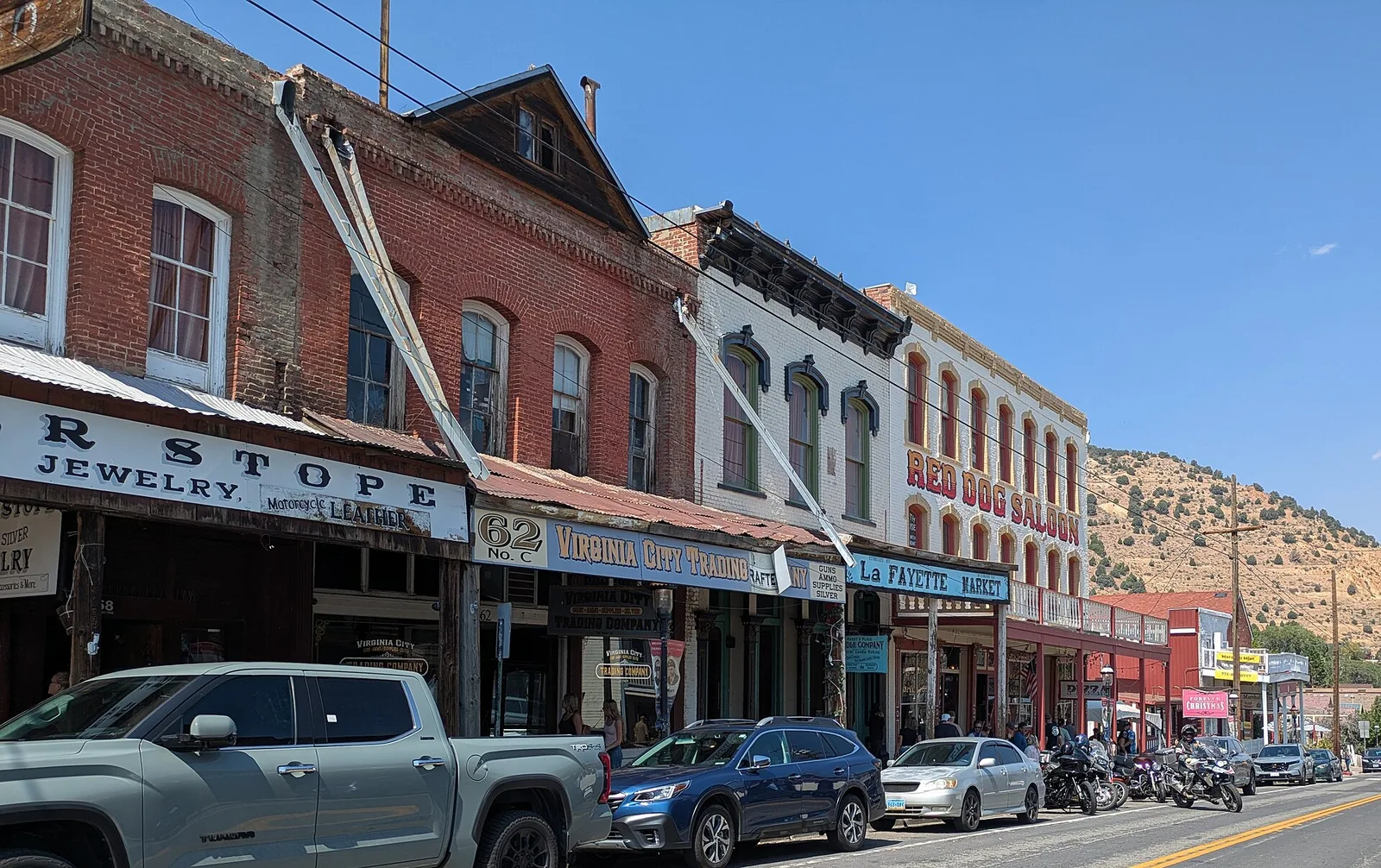
The Comstock's riches, over $300 million worth of silver and gold extracted in its heyday, financed San Francisco's growth as a financial capital, funded the Union's Civil War effort, and created some of the wealthiest men in American history. Virginia City at its peak was one of the largest and most cosmopolitan cities west of the Mississippi, with opera houses, grand hotels, newspapers (including the Nevada Territory newspaper where a young Samuel Clemens published under the name Mark Twain), and millionaires living amid the dust and dynamite of industrial mining. The silver ran out, the Comstock busted, and Nevada's population collapsed, but mining never died.
A new gold rush at Tonopah in 1900 and Goldfield in 1902 briefly revived Nevada's mining economy. Today, Nevada is by far the nation's leading gold-producing state, responsible for roughly 75% of all gold mined in the United States, and one of the world's major gold producers. The Carlin Trend in Elko County is the world's second-largest known gold deposit.
Nevada also produces significant quantities of silver, copper, lithium (increasingly important for electric vehicle batteries), and other minerals. The lithium deposits in Nevada, centered on the Thacker Pass mine in Humboldt County, may represent one of the largest lithium reserves in the world, positioning Nevada as a potential linchpin in the transition to electric vehicles.
The dominant operator is Nevada Gold Mines LLC, a 2019 joint venture that is 61.5% Barrick and 38.5% Newmont; its Carlin, Cortez, Turquoise Ridge, and Phoenix operations together form the single largest gold-producing complex on Earth, at roughly 3.3 million ounces a year. The Nevada Division of Minerals valued statewide mineral production at about $12 billion in 2022. Nevada's constitution caps the Net Proceeds of Minerals Tax at 5% of net proceeds, a limit long criticized as too generous to industry; in 2021 the legislature passed a separate mining excise tax dedicating the new revenue to education, and advanced a constitutional amendment to raise the cap. Thacker Pass, developed by Lithium Americas, broke ground in 2023 after federal courts rejected challenges from ranchers, tribes, and conservation groups, backed by a $2.26 billion Department of Energy loan and an investment from General Motors.
The state has become one of the leading solar power producers in the country, with multiple large solar farms across the Mojave and Great Basin deserts supplying electricity to Nevada utilities and to California under long-term power purchase agreements. Nevada's Renewable Portfolio Standard, requiring utilities to generate 50% of their electricity from renewables by 2030, has accelerated solar, wind, and geothermal development. Geothermal energy is particularly significant in Nevada: the state has more geothermal power plants than any other, tapping the volcanic heat of the Great Basin to generate reliable, non-intermittent clean energy.
The Great Basin's fault-controlled hydrothermal systems, concentrated around the Humboldt and Churchill county ranges and at Steamboat Springs south of Reno, give Nevada roughly 800 megawatts of installed geothermal capacity, second only to California. Nevada's wind resources, while less extensive than its solar potential, are being increasingly harnessed in the mountain passes and high plains.
The combination of abundant renewable resources, land availability, favorable tax treatment, and proximity to California's energy demand has attracted billions in investment. Perhaps most significantly for Nevada's long-term economic future, the state's enormous lithium deposits, essential for electric vehicle batteries and grid storage, have attracted major mining and battery manufacturing investment, with Tesla's Gigafactory near Sparks (which produces lithium-ion battery cells and electric vehicles) serving as the anchor of what may become a major battery and EV manufacturing cluster.
The 50% by 2030 Renewable Portfolio Standard was written into statute by Senate Bill 358 in 2019, after voters approved it as Question 6 in 2018. Nevada's utility landscape is dominated by NV Energy, owned since 2013 by Berkshire Hathaway Energy; voters approved a ballot measure in 2016 to open the state to retail electricity competition but reversed themselves in 2018 after a roughly $63 million opposition campaign, preserving the regulated-monopoly model. Large projects include the Copper Mountain complex at Boulder City, the 690-megawatt Gemini Solar plant near Las Vegas that came online in 2024 as one of the largest in the country, and the Crescent Dunes concentrated-solar plant near Tonopah, which pioneered molten-salt storage but suffered years of technical failures and bankruptcy.
The Reno-Sparks area has attracted significant technology investment: Tesla's Gigafactory, Apple's data center in Reno, Google's data center in Henderson, Switch's massive data center campus (one of the largest in the world), and Amazon Web Services facilities have collectively made northern Nevada a significant technology hub. Reno has made a deliberate effort to position itself as an alternative technology center to the Bay Area, close enough (3.5 hours by car, 1 hour by plane) to attract companies and workers priced out of Silicon Valley, but with dramatically lower costs.
The University of Nevada, Reno has grown its computer science, engineering, and data analytics programs to support the tech sector. Las Vegas, while primarily a hospitality and gaming economy, has also attracted technology investment, particularly in fintech, gaming technology, and logistics.
The ARIA Resort and Casino's technology-forward design and the numerous startup companies serving the gaming and hospitality industry represent a tech-adjacent ecosystem unique to Las Vegas. Nevada's data center boom raises important questions about water consumption (data centers require significant cooling) in one of the driest states in the country.
The growth is underwritten by data-center tax abatements first enacted in 1998 and expanded by Senate Bill 170 in 2015, which waive sales, use, and property taxes for large qualifying facilities. Most of the northern Nevada expansion sits at the Tahoe Reno Industrial Center in Storey County, roughly 107,000 acres that host Google, the Switch Citadel campus marketed as the world's largest data-center site at full build-out, and the Tesla Gigafactory Nevada, where Tesla announced a $3.6 billion expansion in 2023 to add Semi truck assembly and 4680 battery-cell production. A separate 2021 proposal by Blockchains LLC, which had bought 67,000 acres near the industrial center, to charter its own semi-autonomous 'Innovation Zone' city stalled in the legislature. The tech influx has driven Reno-area housing costs up sharply and put pressure on the Truckee Meadows Water Authority.
Nellis Air Force Base in North Las Vegas is one of the largest and most important USAF installations in the country, home to the USAF Warfare Center, the Air Force Thunderbirds aerial demonstration team, and operational and training squadrons flying the most advanced combat aircraft in the American inventory. The Nevada Test and Training Range (NTTR), the largest air and ground space in the United States, encompasses millions of acres of southern Nevada airspace and land used for combat training, weapons testing, and the classified facilities at Groom Lake (commonly known as Area 51). Naval Air Station Fallon in central Nevada is the Navy's premier tactical air warfare training center, where carrier aviation strike groups train before deployment, the real-world Top Gun.
The Nevada National Security Site (formerly the Nevada Test Site), 65 miles northwest of Las Vegas, was used for 928 nuclear weapons tests between 1951 and 1992, more than any other location on Earth. Above-ground atmospheric tests in the 1950s were visible from Las Vegas and briefly became tourist attractions, 'atomic cocktails' were served in casinos timed to the detonations.
Today the NNSS continues to support nuclear stockpile stewardship, emergency response training, and classified research. Defense spending contributes billions to Nevada's economy annually.
Creech Air Force Base at Indian Springs, northwest of Las Vegas, is the hub of U.S. Air Force remotely piloted aircraft operations, where crews of the 432nd Wing fly MQ-9 Reaper missions worldwide over satellite links. Nellis hosts Red Flag, the large-force air combat exercise created in 1975 after Vietnam-era studies found that a pilot's odds of survival rose sharply once past the first ten combat missions. The Radiation Exposure Compensation Act, passed by Congress in 1990, paid more than $2.5 billion to downwinders, uranium workers, and on-site test participants before its filing deadline; Congress allowed the program to lapse in June 2024 during a dispute over expanding it. Yucca Mountain, about 90 miles from Las Vegas, was designated by Congress in 2002 as the national repository for high-level nuclear waste but has been unfunded and politically stalled since 2011 in the face of unified Nevada opposition.

How Nevada's Government Works
Nevada's state government follows the standard three-branch structure: the Executive (Governor), the Legislative (the Nevada Legislature, a 21-seat Senate and 42-seat Assembly), and the Judicial (the Nevada Supreme Court, with seven justices elected in nonpartisan elections to six-year terms). Nevada is politically competitive at the statewide level: it has elected both Republican and Democratic governors, currently holds two Democratic U.S. Senators, and its state legislature is controlled by Democrats, while Republican Joe Lombardo won the governorship in 2022.
Nevada's largest county, Clark County, home to Las Vegas and about 75% of the state's population, overwhelmingly dominates state politics. Clark County's predominantly Democratic, ethnically diverse electorate frequently decides statewide races, while the rural counties and Washoe County (Reno) often vote Republican. Nevada was a key presidential battleground in 2016 and 2020, voting for Hillary Clinton and Joe Biden by narrow margins.
The Nevada Gaming Control Board and Nevada Gaming Commission, the two-tier regulatory system governing the state's most important industry, are among the most sophisticated and powerful regulatory bodies in any state. Their decisions affect billions of dollars in economic activity and are closely watched by the global gaming industry.
The Nevada Legislature meets for a constitutionally limited 120-day session in odd-numbered years (February through June). This part-time structure, a relic of the 19th century, means that Nevada's elected legislators hold other jobs and careers. The Governor may call special sessions between regular sessions. Nevada has no lieutenant governor who serves separately from the ticket, the Lt. Governor is elected separately.
Governor of Nevada
Current Governor
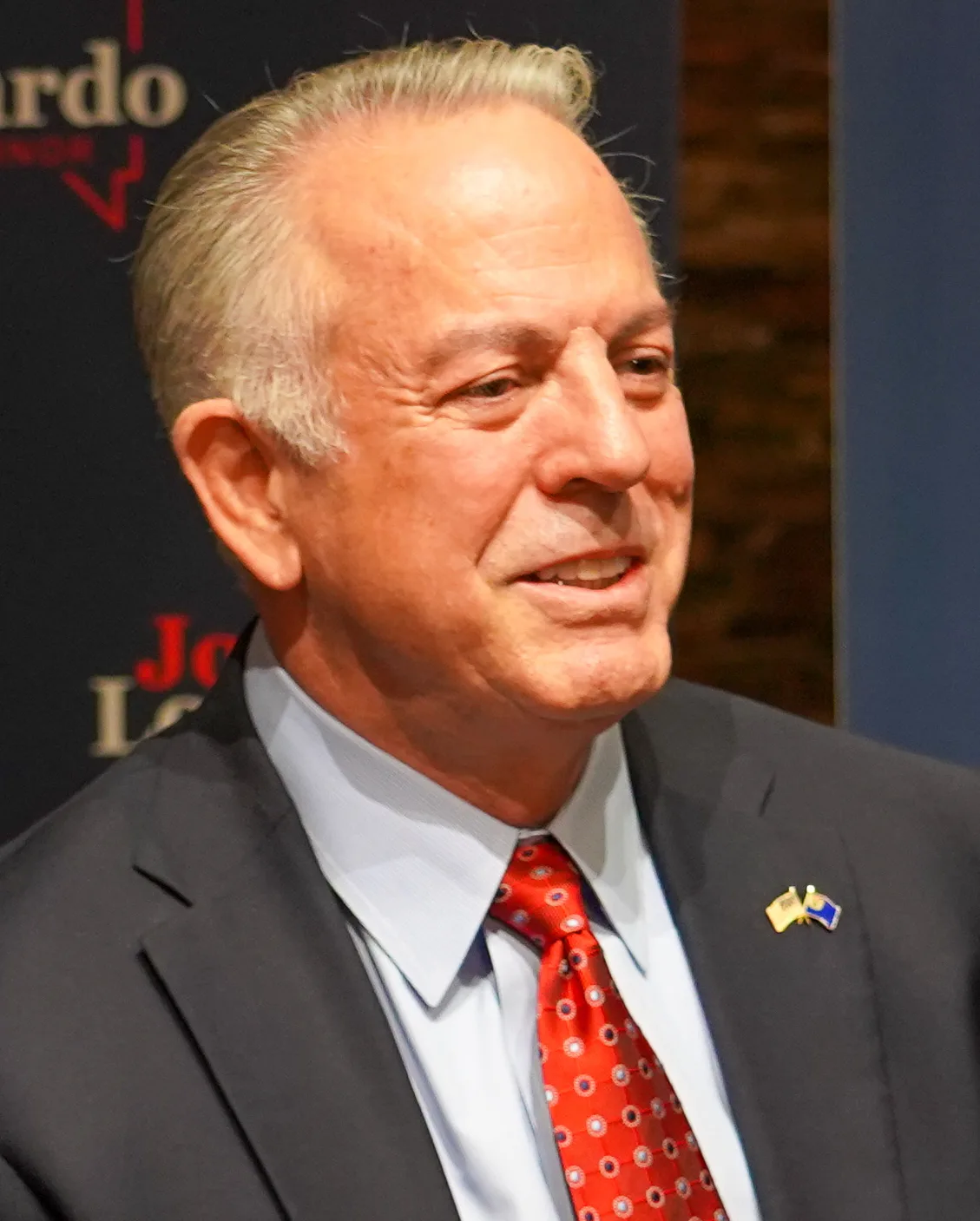
Joe Lombardo
- Party
- Republican
- In Office Since
- January 2, 2023
- Term Ends
- January 2027
- Born
- January 9, 1963, Leesville, Louisiana
- Education
- University of Nevada, Las Vegas (BS, Criminal Justice)
- Prior Role
- Sheriff, Las Vegas Metropolitan Police Department (2018–2023); LVMPD career spanning 30+ years; U.S. Army Military Police veteran
Joe Lombardo is Nevada's 31st Governor, a Republican who defeated incumbent Democratic Governor Steve Sisolak in November 2022. A career law enforcement officer, Lombardo served as Sheriff of the Las Vegas Metropolitan Police Department during the October 1, 2017 mass shooting, the deadliest in modern American history, and handled the response with widely praised professionalism that elevated his public profile. As governor he has pursued tax restraint, public safety, and education reform while governing a state with a Democratic-controlled legislature and a split executive branch.
Other Current State Officials
Lieutenant Governor
Stavros Anthony
In office since January 2023. A former Las Vegas city councilman and retired LVMPD deputy chief, Anthony is Nevada's first Greek American Lt. Governor. He oversees tourism and economic development and serves as acting Governor when Lombardo is out of state.
Attorney General
Aaron Ford
In office since January 2019, re-elected 2022. A former Nevada State Senate Majority Leader, Ford is one of the few statewide Democrats in office alongside the Republican governor. He has pursued consumer protection, healthcare access, and civil rights cases, and has resisted federal policies he views as harmful to Nevadans.
Secretary of State
Cisco Aguilar
In office since January 2023. A former attorney and civic leader, Aguilar is the first Latino to serve as Nevada Secretary of State. He oversees elections, business registrations, and securities regulation. Nevada's elections, particularly in Clark County, have been closely watched given the state's battleground status.
The Nevada Legislature
Nevada State Senate
- Seats: 21 members
- Terms: 4-year terms (staggered)
The upper chamber. Roughly half the seats are on the ballot in each biennial election. Democrats hold a strong majority. The Senate President pro tempore leads floor proceedings; Nevada's Lt. Governor serves as president of the Senate but rarely presides.
Nevada State Assembly
- Seats: 42 members
- Terms: 2-year terms
The lower chamber. All 42 seats are on the ballot every two years. Democrats hold a supermajority in recent sessions, giving them the ability to pass tax increases and budget measures without Republican votes. The Speaker of the Assembly is one of the most powerful figures in state government.
Nevada's U.S. Senators
U.S. Senator
Catherine Cortez Masto
Nevada's senior senator and the first Latina elected to the U.S. Senate. First elected in 2016 and re-elected in 2022 in one of the closest Senate races of the cycle, her narrow victory over Republican Adam Laxalt (by fewer than 8,000 votes) preserved the Democratic Senate majority. A former Nevada Attorney General, she serves on the Banking, Finance, Commerce, and Energy committees.
U.S. Senator
Jacky Rosen
Nevada's junior senator, re-elected in 2024. A former computer programmer and synagogue president from Henderson who served one term in the House before defeating incumbent Republican Dean Heller in 2018. Rosen serves on the Commerce, Armed Services, and Health committees, and has focused on veterans' issues, technology policy, and healthcare. Her 2024 re-election was a significant victory in a competitive state.
Nevada Through the Years
From the Paiute and Shoshone nations who mastered desert survival to the silver kings who built an empire overnight, from the atomic blasts that lit the desert sky to the megaresorts that turned a railroad stop into the entertainment capital of the world, Nevada's history is a story of transformation more dramatic than almost any other state's.
Nevada's Indigenous peoples adapted with extraordinary ingenuity to one of the most challenging environments in North America. The Northern Paiute occupied the Great Basin from eastern Oregon to central Nevada, living in small, highly mobile bands that followed seasonal food resources, pine nuts from pinyon forests in fall, waterfowl and fish at the region's wetlands, rabbits and deer hunted communally. The Southern Paiute occupied southern Nevada, the Colorado River corridor, and adjacent Utah and Arizona, developing sophisticated water management systems in the desert and trade networks connecting the Pacific Coast to the Colorado Plateau.
The Western Shoshone, known to themselves as the Newe, or 'People', inhabited the vast central Nevada basin and range country, developing a deep knowledge of the desert landscape that allowed survival in conditions most Europeans found impossible. The Washoe people occupied the Lake Tahoe basin and adjacent Sierra Nevada slopes, living in one of the most resource-rich high-altitude environments in the West.
All of these peoples were profoundly disrupted by the arrival of Euro-American settlers in the 1840s and 1850s, their food sources depleted by emigrant wagon trains, their lands invaded by miners and ranchers, their populations decimated by disease. The Northern Paiute leader Winnemucca and his daughter Sarah Winnemucca Hopkins became two of the most important Indigenous voices of resistance and accommodation in the late 19th century.
Human presence in the Great Basin runs back more than 12,000 years. Spirit Cave near Fallon yielded a naturally mummified man radiocarbon-dated to roughly 10,700 years old, among the oldest human remains in North America; after a long dispute under the Native American Graves Protection and Repatriation Act, the Bureau of Land Management returned the remains to the Fallon Paiute-Shoshone Tribe in 2016. Lovelock Cave, excavated in 1912 and 1924, produced thousands of artifacts including the oldest known duck decoys, woven from tule reeds and feathers about 2,000 years ago. Many linguists believe the Numic-speaking peoples spread across the Great Basin from a southwestern homeland only within the last thousand to fifteen hundred years, a comparatively recent expansion.
The first Americans to cross Nevada were fur trappers and mountain men following river systems through the Great Basin in the 1820s. Jedediah Smith crossed southern Nevada in 1826-27 on his historic overland expedition to California. Peter Skene Ogden explored the Humboldt River in 1828-29, identifying the key water corridor that would later serve as the emigrant highway across northern Nevada.
John C. Frémont, the 'Pathfinder,' conducted systematic geographical surveys of the Great Basin in 1843-1845, mapping the region scientifically for the first time, naming Lake Tahoe and the Humboldt River, and crucially demonstrating that the Great Basin was an internally draining region, rivers there flowed into sinks and disappeared rather than reaching the ocean. The Spanish Trail, a route connecting Santa Fe to Los Angeles through southern Nevada, carried mule caravans laden with woolen goods and horses across the Mojave from the 1820s until it was supplanted by the emigrant wagon roads.
Nevada was technically part of Mexico's Alta California from 1821 until the 1848 Treaty of Guadalupe Hidalgo ended the Mexican-American War and ceded the entire region to the United States. The discovery of gold at Sutter's Mill in California in January 1848, just weeks before the treaty was signed, set in motion the migration that would bring the first major American settlements to Nevada.
The period's most notorious emigrant disaster touched Nevada directly. The Donner Party, slowed after taking the untried Hastings Cutoff across Utah's salt desert, lost oxen and weeks crossing the Forty Mile Desert and the Truckee River corridor before being trapped by early Sierra snow in the winter of 1846 and 1847, when roughly half of its 87 members died. The Humboldt River route that Peter Skene Ogden had mapped became the main branch of the California Trail, and by 1849 tens of thousands of gold seekers were funneling along it past the alkaline Humboldt Sink, whose waterless final stretch killed draft animals by the thousand. Mormon settlers from Salt Lake founded Nevada's first permanent non-Native settlement, Mormon Station, now Genoa, in the Carson Valley in 1851 and briefly attached it to the proposed State of Deseret.
On June 12, 1859, two Irish prospectors, Peter O'Riley and Patrick McLaughlin, discovered a rich gold deposit in Six-Mile Canyon on the eastern slope of Mount Davidson in what is now Storey County, Nevada. Their discovery was quickly overwhelmed in significance by the complaint of Henry Comstock, a Canadian prospector who claimed a share of their find, and by the realization that the blue-gray clay the miners had been cursing as an obstruction to gold extraction was in fact an enormously rich silver ore. The Comstock Lode proved to be the richest silver deposit ever discovered in North America.
Virginia City erupted almost overnight, by 1863 it had 15,000 residents, by 1876 perhaps 25,000, with opera houses, grand hotels, dozens of saloons, four newspapers, a stock exchange, and a social life that Mark Twain (who worked for the Territorial Enterprise in Virginia City from 1862-64) described with incomparable irreverence. The mines required industrial technology, deep shafts, powerful pumps, and the 'square set' timbering system invented by Philip Deidesheimer, and attracted the capital of San Francisco's Bank of California, transforming the ownership of the Comstock from individual prospectors to corporate shareholders.
The silver financed the Bank of California, built San Francisco's financial district, funded the University of California, and helped the Union government finance the Civil War. Nevada's rush to statehood in 1864 was partly driven by the Union's need for Nevada's silver and its congressional votes to pass the 13th Amendment abolishing slavery.
The Comstock forced advances in mining engineering that spread worldwide. Philip Deidesheimer's square-set timbering, devised in 1860, let crews excavate an ore body dozens of feet wide without collapse, and Adolph Sutro's four-mile drainage and ventilation tunnel, bored beneath the lode between 1869 and 1878, became a model for deep-mine work. Shafts eventually passed 3,000 feet, where rock temperatures topped 130 degrees Fahrenheit and blocks of ice were lowered to keep men working. The 'Big Bonanza' strike of 1873 in the Consolidated Virginia mine, held by the firm of John Mackay, James Fair, James Flood, and William O'Brien, alone yielded well over $100 million and made Mackay one of the richest men in the world; total Comstock output is generally put near $400 million before the lode gave out in the 1880s.
Nevada's admission to the Union on October 31, 1864 was one of the most expedited in American history, driven by the politics of war rather than the logic of population. Nevada Territory had been created in 1861 from the western portion of Utah Territory, but by 1864 its population was still far short of the 60,000 typically required for statehood. President Lincoln and the Republican Congress needed Nevada's electoral votes for the 1864 election and its congressional votes to ratify the 13th Amendment abolishing slavery.
So Nevada was rushed through, its entire state constitution was telegraphed to Washington at a cost of $4,000 (one of the most expensive telegrams in history) because there wasn't time to send it by mail. Nevada became the 36th state on October 31, 1864, just eight days before the presidential election. The slogan 'Battle Born', referring to Nevada's birth during the Civil War, commemorates this unusual circumstance and appears on the state flag; the official state motto is 'All For Our Country.'
Carson City became the state capital, chosen over Virginia City partly because it was less controlled by the mining interests. The early state was thoroughly dominated by the Comstock's economic and political power: the Bank of California's William Sharon manipulated Nevada's U.S. Senate seats with the same ease he managed his mining properties, and the 'Silver Senators' of the 1870s were among the most notorious embodiments of Gilded Age plutocracy.
Nevada is the only state admitted with its constitution delivered by telegraph. The roughly 16,500-word document was wired from Carson City to Washington over two days in October 1864 at a cost usually given as $3,416.77, then the most expensive telegram ever sent, and it reached President Lincoln on October 26, five days before he proclaimed statehood on October 31. With about 40,000 residents by the 1870 census, far below the roughly 60,000 then customary, Nevada was the least populous state ever admitted at the time. It cast three electoral votes for Lincoln in November 1864, and its delegation voted for the 13th Amendment, which cleared the House on January 31, 1865; Sharon later won an 1875 Senate election while reportedly spending more than $800,000, and William Stewart, author of the federal Mining Law of 1872, held the state's other seat.
The two legislative acts that defined 20th-century Nevada were passed in the same week of March 1931. On March 19, Governor Fred Balzar signed a bill legalizing casino gambling statewide. On March 21, he signed a bill reducing the residency requirement for divorce to six weeks. Both were economic calculations made by a state desperate for revenue during the Great Depression: gambling would attract tourists, and the liberal divorce law would attract wealthy Americans fleeing the stringent divorce requirements of eastern states.
The calculations were correct beyond any reasonable expectation. The gambling bill launched the Nevada gaming industry. The divorce law created a 'divorce colony', initially in Reno, where wealthy Americans flocked to establish the required residency, fueling Reno's hotels, dude ranches, and restaurants. Reno became the 'Divorce Capital of the World,' a reputation it held for decades before other states liberalized their own divorce laws.
The gambling law's effects were slower to materialize but ultimately far more transformative: the first small casinos opened in Reno and Las Vegas, and the framework for the world's largest gaming industry began to take shape. Nevada also legalized prostitution at the county level, though Clark and Washoe counties (Las Vegas and Reno) have maintained prohibition. The combination of legalized gambling, easy divorce, no income tax, and minimal regulation established Nevada's identity as the state where the rules were different, an identity it has cultivated and marketed ever since.
Assembly Bill 98, the 1931 'wide open gambling' law sponsored by rancher-assemblyman Phil Tobin, repealed a 1910 prohibition that had pushed gaming underground for two decades; it taxed games by the table and left licensing to county sheriffs and commissions until the state assumed regulation with the Gaming Control Board in 1955 and the Gaming Commission in 1959. The six-week divorce law made Reno the national divorce capital, handling a peak of roughly 30,000 divorces a year in the 1940s, and the quick-marriage trade grew alongside it because Nevada required no blood test and no waiting period. Reno's divorce dominance faded after other states adopted no-fault divorce beginning with California in 1970. Nevada remains the only state with legal, licensed brothels, permitted under a 1971 local-option statute in counties below 700,000 population and now confined to about ten rural counties.
The construction of Hoover Dam on the Colorado River between Nevada and Arizona between 1931 and 1936 was one of the greatest engineering achievements in American history, and the single act that made the sustained human habitation of the desert Southwest possible at the scale it exists today. The project employed up to 5,000 workers simultaneously at the peak of construction, many of them desperate men who arrived by any means available during the depths of the Great Depression. The Six Companies consortium, led by Frank Crowe (the world's most celebrated dam builder), drove the work at a relentless pace: 112 workers died in construction-related accidents.
The dam, 726 feet high, 1,244 feet wide, containing 4.4 million cubic yards of concrete, was completed two years ahead of schedule in 1935 and dedicated by President Franklin Roosevelt in September 1936. Its twin purposes were flood control and water storage: Lake Mead, created by the dam, is the largest reservoir in the United States by volume when full, holding enough water to cover the entire state of Pennsylvania in a foot of water.
The dam's hydroelectric generators provided the power that fueled Las Vegas's growth, enabled the construction of military installations across the Southwest, and supplied the energy for the aluminum smelters and aircraft factories that built America's World War II arsenal. Without Hoover Dam, Las Vegas as we know it simply could not exist.
The dam's water is divided under the Colorado River Compact of 1922, which split the river between an Upper and Lower Basin at Lees Ferry and gave Nevada just 300,000 acre-feet a year, the smallest share of any basin state, a figure fixed when Las Vegas had barely 2,000 people. The Boulder Canyon Project Act of 1928 authorized construction, and the 'Boulder Dam' versus 'Hoover Dam' naming stayed in dispute until Congress settled it as Hoover Dam in 1947. Boulder City was run directly by the Bureau of Reclamation as a model town with alcohol and gambling banned inside its limits; it did not become a self-governing municipality until 1960 and still permits only two small gaming licenses. The dam's turbines produce about 4 billion kilowatt-hours in an average year, and power revenue had repaid the federal construction cost with interest by 1987.
World War II transformed Nevada's sleepy desert landscape into a critical military theater. The Las Vegas Army Air Field (now Nellis AFB) was established in 1941, and the vast Nevada desert became a training ground for bomber crews and fighter pilots. Workers building military installations swelled the Las Vegas population, and Bugsy Siegel's Flamingo, opened in December 1946 with Hollywood celebrity and mob money, established the template for the casino resort.
Siegel was murdered in June 1947, likely by his mob partners, before he could see his vision vindicated. The Strip slowly took shape through the late 1940s with the Thunderbird, Desert Inn, and Sands. In January 1951, the Atomic Energy Commission began detonating nuclear bombs at the Nevada Test Site, 65 miles northwest of Las Vegas.
The above-ground blasts, 100 of them between 1951 and 1963, were visible from Las Vegas, and the city leaned into the spectacle: hotels hosted 'atomic cocktail' parties on rooftops, 'Miss Atomic Bomb' beauty contests were held, and the mushroom clouds were incorporated into tourist marketing. The atomic tests made Downwinders, communities downwind in Nevada, Utah, and Arizona, into unwitting subjects of radiation exposure, a legacy that produced cancer clusters and congressional compensation legislation decades later. The Test Ban Treaty of 1963 ended atmospheric testing, pushing the remaining 828 detonations underground until the moratorium of 1992.
The Flamingo was in fact financed largely through the syndicate of Meyer Lansky and built by the Del Webb construction company; cost overruns from about $1.5 million to more than $6 million are the reason most historians give for Siegel's partners ordering his killing at his girlfriend Virginia Hill's Beverly Hills home. The Moulin Rouge, which opened on the west side in 1955 as Las Vegas's first racially integrated casino-hotel, closed within months but hosted the March 1960 meeting at which the city's hotels agreed to desegregate. Federal scrutiny of mob skimming intensified after the 1950 and 1951 Kefauver Committee hearings, and Nevada responded in 1955 by chartering the Gaming Control Board to vet license applicants and in 1960 by creating the 'Black Book,' the List of Excluded Persons that bars named organized-crime figures from every licensed casino.
Las Vegas's golden era as a mob-controlled entertainment capital peaked in the 1950s and early 1960s, when the Rat Pack, Frank Sinatra, Dean Martin, Sammy Davis Jr., Peter Lawford, and Joey Bishop, held court at the Sands Hotel, performing legendary shows and hosting Senator John F. Kennedy during his 1960 presidential campaign. The era combined spectacular entertainment with deeply problematic racial exclusion: Black performers could appear on the Strip's stages but were barred from staying in Strip hotels until civil rights activists and the performers themselves forced desegregation in the early 1960s.
The transformation of gaming's corporate structure was initiated in an unlikely way: Howard Hughes, the famously reclusive billionaire aviator and industrialist, arrived in Las Vegas by private train in November 1966 and checked into the Desert Inn's penthouse. When the casino tried to evict him to make room for high-rolling gamblers, Hughes simply bought the Desert Inn, and then, in a buying spree that occupied much of the next three years, purchased the Sands, Castaways, Frontier, Silver Slipper, and Landmark casinos and the local ABC television affiliate.
Hughes's entry legitimized casino ownership for corporate America: if the world's most famous capitalist could own casinos, they couldn't be purely criminal enterprises. The state's 1969 Corporate Gaming Act formalized this shift, allowing publicly traded corporations to own gaming licenses, paving the way for the corporate mega-resorts that would define modern Las Vegas.
Hughes left as abruptly as he came, spirited out of the Desert Inn penthouse over Thanksgiving weekend 1970 amid a fight for control of his empire, after a four-year stay that had made him the largest single employer and casino owner in Nevada. The 1967 Corporate Gaming Act and its 1969 revision, pushed by Governor Paul Laxalt, scrapped the rule that every shareholder of a licensed casino be individually investigated, which had made public-company ownership impossible. Kirk Kerkorian opened the International, now the Westgate, in 1969 as the world's largest hotel, then the original MGM Grand in 1973; a 1980 fire at the MGM Grand killed 85 people and drove sweeping changes to hotel fire-safety codes nationwide. The reforms brought Hilton, Holiday Inn, Ramada, and Del Webb onto the Strip, and by the early 1980s publicly traded corporations rather than hidden partners controlled most of Las Vegas gaming.
The opening of Steve Wynn's Mirage on November 22, 1989, is the clearest dividing line in Las Vegas history between what the city was and what it became. The Mirage cost $630 million, more than twice any previous casino construction, and required $1 million per day in revenue just to break even. Critics said it was impossible.
It broke even in its first week. The Mirage established the template of the modern Las Vegas megaresort: a massive, architecturally distinctive exterior (a South Pacific volcano erupting every 15 minutes), a hotel tower with thousands of luxury rooms, a casino floor larger than a football field, fine dining, a spa, a pool complex, a theater large enough for Siegfried and Roy's white tiger act, and branding coherent enough to sustain a global reputation. The Mirage spawned an era of competitive mega-resort construction: Treasure Island and the MGM Grand (1993), Luxor and Mandalay Bay, the Monte Carlo, New York-New York, Paris, and the Venetian through the 1990s, culminating in Wynn's Bellagio in 1998, which set a new global standard for casino luxury.
The decade between 1989 and 2000 saw more construction on the Las Vegas Strip than any comparable stretch of American commercial real estate development in history. Las Vegas became the fastest-growing metropolitan area in the United States, with workers from across the country and the world arriving to build the hotels and staff the casinos.
The spree peaked in 1993, when the 5,005-room MGM Grand, the pirate-themed Treasure Island, and the pyramid-shaped Luxor all opened within weeks of one another, briefly putting every one of the ten largest hotels in the world in Las Vegas. Wynn's $1.6 billion Bellagio in 1998 added the Fountains of Bellagio and a gallery of Picassos and Van Goghs, while Sheldon Adelson's $1.5 billion Venetian in 1999, built on the imploded Sands site, bet on convention and retail traffic; Adelson had bought the Sands in 1988 mainly for its convention center, an outgrowth of the COMDEX computer trade show he founded in 1979. Clark County's population roughly doubled in the 1990s, from about 741,000 to 1.38 million. Nevada was the fastest-growing state in the nation in percentage terms in nearly every year from 1986 through 2006.
The modern era of Nevada history has been shaped by three defining events. On October 1, 2017, a gunman opened fire from a 32nd-floor suite of the Mandalay Bay hotel into an outdoor music festival on the Las Vegas Strip, killing 60 people and injuring over 400 in what was the deadliest mass shooting in modern American history. The 1 October massacre traumatized the city, prompted national debate about gun regulation, and resulted in Nevada passing background check legislation.
On March 17, 2020, Nevada's casinos shut down entirely for the first time in history as COVID-19 spread across the country. The closures devastated the state's economy more completely than almost anywhere else in the nation: Nevada's unemployment rate peaked at 30% in April 2020, the highest of any state, as the gaming and hospitality industry that employs a quarter of the state's workforce went dark. The recovery was relatively rapid but uneven.
Through all of this, Nevada faces its most existential long-term challenge: water. Lake Mead, which supplies drinking water to over 2 million Las Vegas residents and enables the irrigation of farms across the Southwest, fell to historically low levels in 2022, prompting emergency water restrictions across the Colorado River Basin under Bureau of Reclamation authority for the first time in history. Nevada, Arizona, California, and the other Colorado River states continue to negotiate difficult compromises over a water supply that is simply inadequate for the demands placed upon it.
The shortage became official in August 2021, when the Bureau of Reclamation declared the first-ever Tier 1 shortage for Lake Mead, cutting Arizona's and Nevada's allocations beginning in 2022, with a deeper Tier 2 cut following for 2023. In May 2023 Arizona, California, and Nevada agreed to conserve at least 3 million acre-feet through 2026 in exchange for roughly $1.2 billion in federal payments drawn from the Inflation Reduction Act. Nevada's population passed 3.1 million in the 2020 census, and after decades of Republican-leaning presidential results the state voted Democratic in every presidential election from 2008 through 2020 before the pattern broke in 2024. Culinary Workers Union Local 226, representing about 60,000 Strip hospitality workers, remains the most effective political organization in the state and won record contracts following a wave of strike authorizations and one-day walkouts in 2023.
Nevada's Defining Moments in American History
These are the events that didn't just shape Nevada, they changed the nation.
In 1859, one of the richest silver deposits ever discovered was found on the eastern slope of Mount Davidson in what is now Nevada. The Comstock Lode, named for erratic prospector Henry Comstock who claimed credit for the discovery, produced more than $400 million in silver and gold over 20 years.
Crucially, this bonanza arrived at the beginning of the Civil War, when the Union desperately needed revenue. Nevada's silver helped fund the war that saved the Union, and its rapid settlement prompted President Lincoln to rush Nevada to statehood in 1864, just in time to cast electoral votes.
The wealth built institutions far beyond Nevada. It capitalized William Ralston's Bank of California, financed much of San Francisco's downtown, endowed early buildings at the University of California, and made fortunes for the 'Bonanza Kings,' John Mackay, James Fair, James Flood, and William O'Brien, whose 1873 Consolidated Virginia strike alone yielded more than $100 million.
Mining engineering advanced on the Comstock as nowhere else. Philip Deidesheimer's square-set timbering of 1860 made it possible to mine an ore body dozens of feet wide, and Adolph Sutro's four-mile drainage tunnel, completed in 1878, became a template for deep-mine ventilation worldwide. By the time the lode was exhausted in the 1880s it had produced roughly $400 million in silver and gold and had helped feed the 'Free Silver' movement that dominated national politics into the 1890s.
Nevada entered the Union on October 31, 1864, just eight days before the presidential election. The territory's population was small, well below what was normally required for statehood. But Lincoln and the Republican Congress needed Nevada's electoral votes and its likely support for the 13th Amendment, which would abolish slavery.
The state constitution was telegraphed to Washington at a cost of $3,416.77, then the most expensive telegram in history. Nevada's rushed statehood is a reminder that America's political history has always been shaped by calculated self-interest as much as principle.
Congress had passed the Nevada enabling act in March 1864, and after territorial voters rejected a first constitution, largely over a clause taxing unproductive mines, a second convention in July produced the document ratified that September. Because mail from Nevada took weeks, officials wired the full 16,500-word text east; it moved in relays through Chicago and Philadelphia and reached Washington on October 26, 1864.
Lincoln proclaimed Nevada the 36th state on October 31, 1864. Days later it delivered three electoral votes to Lincoln, and in early 1865 its new senators and representative voted for the 13th Amendment. With roughly 40,000 residents, Nevada was by far the least populous state admitted to that point, and its two Senate seats, equal in weight to New York's, were promptly captured by Comstock mining money, an imbalance still cited in debates over the design of the Senate.
Built between 1931 and 1936 during the Great Depression, Hoover Dam on the Nevada-Arizona border was the largest dam in the world at the time of its completion. It tamed the volatile Colorado River, created Lake Mead, provided flood control for millions of acres, and generated the electricity that powered Los Angeles and the entire American Southwest. More than 100 workers died building it.
The dam made Las Vegas possible and enabled the explosive post-war growth of Phoenix, Tucson, and Southern California. Hoover Dam is the infrastructure achievement that created the modern American West.
It was authorized by the Boulder Canyon Project Act of 1928 and built by Six Companies, Inc., a consortium of western contractors, under superintendent Frank Crowe, who finished it in 1936, more than two years ahead of schedule. At 726 feet it was the tallest dam in the world until 1957, and its 3.25 million cubic yards of concrete were cooled by an embedded grid of pipes carrying refrigerated water, because the mass would otherwise have taken about a century to set.
Ninety-six workers died in industrial accidents on the job, with more deaths attributed to heat and to carbon monoxide in the diversion tunnels. Lake Mead, filled behind the dam, is the largest reservoir in the United States by capacity, yet the Colorado River Compact's 1922 allocation of only 300,000 acre-feet a year to Nevada now constrains the fastest-growing part of the state. Power from the dam, sold mostly to California and Arizona, had repaid the federal construction cost with interest by 1987.
Between 1951 and 1992, the U.S. government conducted 928 nuclear weapons tests at the Nevada Test Site, a 1,360-square-mile area north of Las Vegas. Above-ground tests from 1951 to 1963 were visible from Las Vegas, which marketed itself as a tourist destination for watching the mushroom clouds. The tests exposed thousands of downwinders, residents in Nevada, Utah, and Arizona, to dangerous levels of radiation.
The 1963 Partial Nuclear Test Ban Treaty ended above-ground testing, but underground tests continued. Nevada absorbed more nuclear explosions than any other place on earth, at an environmental and human cost that is still being reckoned.
Testing opened with the 'Able' shot on January 27, 1951, and the site eventually covered about 1,360 square miles of Nye County. One hundred atmospheric detonations through 1962 carried fallout across Utah and beyond; the 'Dirty Harry' shot of 1953 heavily contaminated St. George, Utah, and later scientific reviews linked the fallout to elevated thyroid cancer and leukemia among downwinders.
After the 1963 treaty drove testing underground, 828 more devices were detonated in shafts and tunnels until President George H. W. Bush signed a moratorium in 1992. Congress passed the Radiation Exposure Compensation Act in 1990, formally apologizing and paying more than $2.5 billion to downwinders, uranium miners, and test workers before the program lapsed in 2024. Renamed the Nevada National Security Site in 2010, the range now runs 'subcritical' experiments that certify the aging U.S. arsenal without producing a nuclear yield.
Las Vegas is the most purely American city in the world: a metropolis built entirely around the principle that people will travel enormous distances to spend money on entertainment, gambling, and spectacle. The legalization of gambling in Nevada in 1931, the arrival of organized crime investment in the 1940s, the corporate takeover of the casino industry in the 1970s and 80s, and the transformation into a family entertainment destination in the 1990s all happened in Las Vegas first and spread outward.
Vegas invented the modern hospitality economy, the convention industry, the superstar residency, and the idea that a destination could be built from nothing but human desire.
The industry's ownership changed twice. Organized-crime figures financed the early Strip, from Bugsy Siegel's Flamingo in 1946 through Teamsters Pension Fund loans in the 1960s and 1970s, and Nevada's 1967 and 1969 Corporate Gaming Acts then opened licensing to public companies, drawing Hilton, MGM, and eventually Wall Street capital. Steve Wynn's Mirage in 1989 proved a luxury megaresort could be built with junk bonds and repaid within months, setting off roughly $20 billion in Strip construction over the following decade.
Las Vegas now draws about 40 million visitors a year, hosts the largest convention business in North America, and has added major-league sports, the Golden Knights from 2017, the Raiders from 2020, and an approved Athletics relocation, along with a Formula 1 street race launched in 2023. Gaming and hospitality employ roughly a quarter of the Southern Nevada workforce, which is why the 2020 COVID-19 shutdown pushed Nevada's unemployment rate to about 30 percent, the highest ever recorded for a U.S. state.
Notable Nevadans
Sarah Winnemucca Hopkins
Born c. 1844 near Humboldt Lake; Northern Paiute leader, author, and activist; published Life Among the Piutes (1883), the first book written and published by a Native American woman; lectured across the East Coast advocating for Indigenous rights
Harry Reid
Born in Searchlight, Nevada, 1939; U.S. Senator (1987–2017) and Senate Majority Leader (2007–2015); one of the most powerful congressional leaders of his era, steering the Affordable Care Act and major economic legislation; died December 2021
André Agassi
Born in Las Vegas, 1970; tennis champion and one of the greatest players in the sport's history; won all four Grand Slam singles titles (a career Grand Slam), an Olympic gold medal, and the Davis Cup; founded the Andre Agassi College Preparatory Academy in Las Vegas
Pat Nixon
Born Thelma Catherine Ryan in Ely, Nevada, 1912; First Lady of the United States (1969–1974) as wife of President Richard Nixon; one of the most widely traveled First Ladies in history; died 1993
Wayne Newton
Born in Norfolk, Virginia, but Las Vegas's most iconic entertainer; 'Mr. Las Vegas' performed in the city for over 50 years; his recording of 'Danke Schoen' and his marathon residencies made him inseparable from Las Vegas's identity
Walter Van Tilburg Clark
Born 1909 in East Orland, Maine, but identified with Reno and Nevada; author of The Ox-Bow Incident (1940), one of the great American novels; a profound meditation on mob justice, morality, and the mythology of the West
Paul Laxalt
Born in Reno, 1922; Governor of Nevada (1967–1971) and U.S. Senator (1974–1987); Ronald Reagan's closest political confidant, serving as his campaign chairman in 1976, 1980, and 1984; died 2018
Dat So La Lee
Born c. 1835 near Carson City; Washoe master basket weaver whose deghikup baskets, woven from willow and bracken fern, are among the most technically complex and artistically significant works in Native American art history; died 1925
Edna Purviance
Born in Paradise Valley, Nevada, 1895; actress and Charlie Chaplin's leading lady in over 35 films (1915–1923); appeared in The Kid and A Woman of Paris; her patrician beauty and naturalistic acting style were central to Chaplin's early style; died 1958
Mike O'Callaghan
Born in LaCrosse, Wisconsin, 1929, but spent his career in Nevada; Governor of Nevada (1971–1979); highly decorated Korean War veteran (lost a leg in combat; awarded the Silver Star and Bronze Star); beloved as one of Nevada's finest governors; died 2004
State Symbols & Quick Facts
| Nickname | "The Silver State" (also: "The Battle Born State") |
| Capital | Carson City |
| Largest City | Las Vegas |
| Statehood | October 31, 1864 (36th state) |
| Population | ~3.2 million (2025 est.) |
| Area | 110,572 sq miles (7th largest) |
| State Bird | Mountain Bluebird |
| State Flower | Sagebrush |
| State Tree | Single-leaf Pinyon |
| State Animal | Desert Bighorn Sheep |
| State Reptile | Desert Tortoise |
| State Fish | Lahontan Cutthroat Trout |
| State Metal | Silver |
| State Song | Home Means Nevada |
| State Motto | All For Our Country (slogan: Battle Born) |
| Time Zone | Pacific (most) / Mountain (West Wendover area) |
| Bordering States | Oregon, Idaho, Utah, Arizona, California |
Did You Know?
Nevada is the driest state in the United States, receiving an average of only 9.5 inches of precipitation annually. Paradoxically, it hosts one of the world's greatest concentrations of people in the Las Vegas Valley, a city of 2 million built in the middle of the Mojave Desert, dependent on a single river (the Colorado) for its water supply.
Over 85% of Nevada's land is owned by the federal government, the highest percentage of any state in the contiguous United States. The Bureau of Land Management, US Forest Service, Department of Defense, and other federal agencies control the vast majority of the Silver State's territory.
The Nevada Test Site (now the Nevada National Security Site), 65 miles northwest of Las Vegas, was the location of 928 nuclear weapons tests between 1951 and 1992, more nuclear detonations than any other location on Earth. Above-ground atomic tests in the 1950s were visible from Las Vegas rooftops, where hotels threw 'atomic cocktail' parties to watch the mushroom clouds.
Nevada is the only state in the United States where casino gambling is legal in every county. The state has maintained its gaming monopoly advantage for decades, though tribal gaming in other states and online gambling have eroded Nevada's share of the national gaming market.
Las Vegas receives over 40 million visitors annually, among the most of any U.S. destination (only Orlando draws more). The city has more hotel rooms than any other destination in the world, with over 150,000 hotel rooms in Clark County alone.
The Comstock Lode, discovered in 1859 near Virginia City, Nevada, was the richest silver deposit ever found in North America. The silver extracted from the Comstock's mines helped finance the Union's Civil War effort, which is one reason President Lincoln pushed Nevada to statehood in 1864, just days before the presidential election.
Nevada is the nation's leading gold-producing state by a wide margin, responsible for roughly 75% of all gold mined in the United States. The Carlin Trend in Elko County is the world's second-largest known gold deposit. Nevada's mines also contain enormous lithium deposits that could become critical for electric vehicle battery production.
Nevada's official motto is 'All For Our Country,' but its best-known slogan, 'Battle Born', printed on the state flag, commemorates the state's admission to the Union on October 31, 1864, just eight days before the presidential election, rushed through by President Lincoln who needed Nevada's electoral votes and congressional support for the 13th Amendment.
Area 51, officially the Nevada Test and Training Range at Groom Lake, is where the U-2 spy plane, SR-71 Blackbird, and F-117 stealth fighter were secretly developed and tested during the Cold War. The classified nature of these real programs generated decades of UFO speculation. The surrounding area was officially designated the 'Extraterrestrial Highway' by the Nevada Legislature in 1996.
Las Vegas has more weddings than any other city in the United States, approximately 80,000 per year. The city's 24-hour wedding chapels, including the famous Little White Wedding Chapel (where Britney Spears married in 2004 and countless others have exchanged vows), have made it synonymous with spontaneous matrimony. It is illegal to perform a wedding in Las Vegas without a valid marriage license, but obtaining one takes about 10 minutes.
Quick Facts and Common Questions
Short answers to the questions people most often ask about Nevada: its abbreviation, why it is Battle Born, its capital, and its place in Congress.
Nevada's two-letter postal abbreviation is NV. The U.S. Census Bureau places it in the West region, in the Mountain division, and about 3.10 million people lived there in the 2020 census.
Nevada became the 36th state on October 31, 1864, during the Civil War, which is why its official slogan is "Battle Born." To meet the deadline before the 1864 election, Nevada sent the full text of its constitution to Washington by telegraph, one of the longest telegrams sent up to that time.
Mexico ceded the region to the United States in 1848 at the end of the Mexican-American War. It was part of the Utah Territory until Congress created the Nevada Territory in 1861, after the 1859 discovery of the Comstock Lode silver deposit brought a rush of miners.
Nevada is a Spanish word meaning "snow-covered," taken from the Sierra Nevada mountain range along the state's western edge.
Carson City has been the capital since the territory was organized in 1861 and remained so at statehood. Its State Capitol, completed in 1871, is known for its silver-colored dome. Las Vegas is the state's largest city.
Nevada borders five states: Oregon and Idaho to the north, Utah to the east, Arizona to the southeast, and California to the west and southwest.
About 80 percent of Nevada's land is owned by the federal government, the highest share of any state. Most of it is managed by the Bureau of Land Management, with large areas also held by the military, the U.S. Forest Service, and the Department of Energy.
Nevada is called "The Silver State," and "Battle Born" is its official slogan. Its motto is "All For Our Country." Its state bird is the mountain bluebird, its flower is the sagebrush, and its tree is the single-leaf piñon.
Based on the 2020 census, Nevada has 4 seats in the U.S. House of Representatives, the same as before, which gives it 6 votes in the Electoral College.
Sources & Further Reading
- Census Regions and Divisions, U.S. Census Bureau
- 2020 Census Apportionment Results, U.S. Census Bureau
- Distribution of Electoral Votes, National Archives
- Nevada State Library, Archives and Public Records
- Federal Land Ownership: Overview and Data, Congressional Research Service
- Bureau of Land Management, Nevada
Great Basin National Park
Ancient Bristlecone Pines, Marble Caves, and Nevada's Highest Peak in a Desert Sky Island
About Great Basin National Park
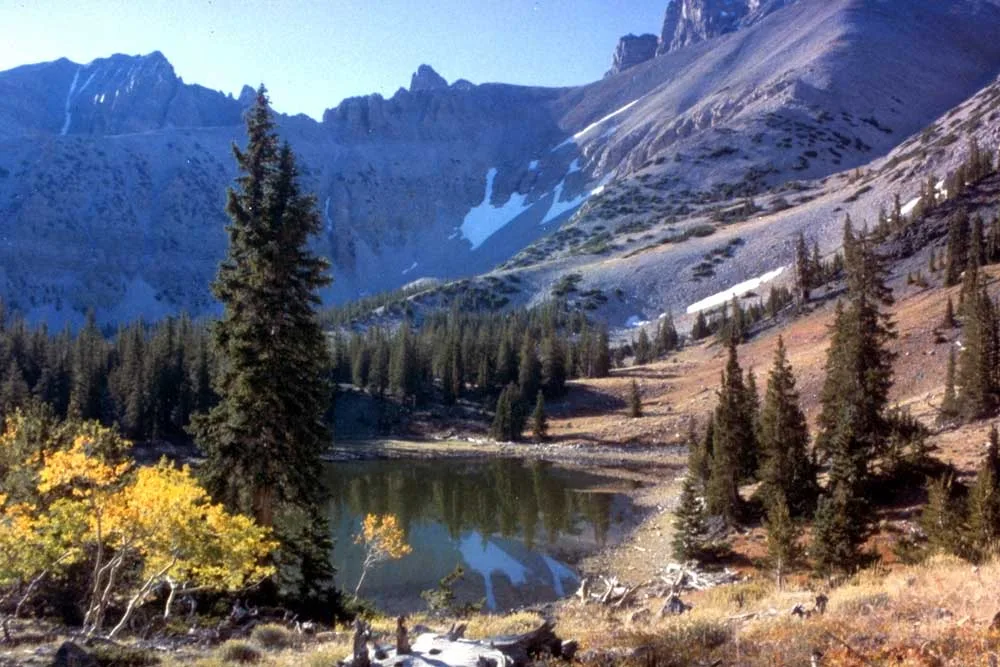
Great Basin National Park protects a slice of the Snake Range in remote eastern Nevada, rising from sagebrush desert at 5,000 feet to Wheeler Peak at 13,063 feet, the second-highest summit in the state.
Packed into a few miles of that climb are the marble rooms of Lehman Caves, groves of bristlecone pine among the oldest living things on Earth, a small glacier in a high cirque, and stands of Engelmann spruce and alpine tundra.
It is one of the least-visited national parks that a car can reach, about 140,000 people a year, and it charges no entrance fee; Congress created it in 1986 around the older Lehman Caves National Monument, over long opposition from ranchers and miners, and some grandfathered grazing still runs inside it.
The 'Great Basin' is the roughly 200,000-square-mile region between the Sierra Nevada and the Rockies where rivers drain inward and never reach the sea; its parallel ranges each rise as an isolated 'sky island,' and this park is a full cross-section of one.
- Designation
- National Park
- Location
- White Pine County, eastern Nevada, near Baker
- Established
- October 27, 1986
- Annual Visitors
- ~140,000
Geology and Landscape
Wheeler Peak stands 13,063 feet, and a small ice mass buried under rock debris sits in the cirque on its northeast face, usually called the only glacier in the Great Basin, though scientists argue over whether it is a true glacier or a rock glacier.
That cirque, and four others holding lakes named Stella, Teresa, Baker, and Johnson, were carved by Pleistocene glaciers when the range was much colder.
Above about 11,000 feet the trees give out, and the ground is alpine tundra and shattered quartzite talus, the same rock that forms the peak.
From the summit ridge the view takes in dozens of the Great Basin's parallel ranges marching off to every horizon.
Great Basin bristlecone pine, Pinus longaeva, is the longest-lived non-clonal organism known; individuals in the park's Wheeler Peak grove are 3,000 to nearly 5,000 years old.
They survive by growing almost imperceptibly slowly, in dense, resin-soaked wood that resists rot, and by dying back to a thin strip of living bark that keeps a few branches alive on an otherwise dead trunk.
In 1964 a graduate student had the Forest Service cut down a Wheeler Peak bristlecone, later called Prometheus, to count its rings; it proved to be about 4,900 years old, then the oldest tree ever dated, and the outcry helped drive the push for the national park.
A trail from near 10,000 feet loops through the grove and on to the glacier viewpoint, one of the most accessible old bristlecone stands anywhere.
Lehman Caves is a compact system of decorated rooms dissolved out of Cambrian limestone that was later cooked by heat and pressure into marble.
The rancher Absalom Lehman is credited with finding it around 1885; it was proclaimed a national monument in 1922 and folded into the national park in 1986.
It holds more than 300 'shields,' rare parallel-plate formations, more than any other known cave, along with helictites, 'cave bacon,' and popcorn, and the Civilian Conservation Corps built its trails and first lighting in the 1930s.
The air stays near 52 degrees and very humid year-round, and the walls of the Inscription Room still carry the candle-smoke signatures of 19th- and early-20th-century visitors.
Lexington Arch, in the park's little-visited southern end, is a six-story limestone span about 75 feet tall, one of the largest natural arches in the Great Basin.
Because it is limestone rather than the sandstone of Utah's arches, geologists think it may be the last standing piece of a collapsed cave passage rather than a wind-and-water arch.
The roughly 3-mile round-trip trail to it climbs about 800 feet through pinyon-juniper woodland from a remote dirt-road trailhead.
A 2016 wildfire burned the approach, and the route was rebuilt and reopened afterward.
Indigenous Peoples of the Great Basin
Western Shoshone (Newe)
The Western Shoshone, who call themselves Newe, 'the People,' have lived across this part of the Great Basin for thousands of years, in a seasonal round built around the fall pinyon-pine nut harvest, hunting in the ranges and gathering seeds, roots, and greens in the valleys.
The 1863 Treaty of Ruby Valley recognized a vast Western Shoshone homeland, 'Newe Sogobia,' and granted the United States rights of travel and mining across it but did not cede the land.
The United States later treated the land as taken by settlement; the Indian Claims Commission awarded about $26 million in 1979, which many Western Shoshone, led by the ranchers Carrie and Mary Dann, refused, arguing the land was never sold, in a fight that reached the Supreme Court in 1985.
The Western Shoshone Nation includes multiple bands across Nevada and Utah. The Te-Moak Tribe of Western Shoshone Indians and the Ely Shoshone Tribe are among the groups with historic ties to the Great Basin area. The Shoshone-Paiute Tribes of the Duck Valley Indian Reservation, near the Nevada-Idaho border, maintain cultural and ceremonial connections to the Great Basin landscape.
Southern Paiute
Southern Paiute bands, who call themselves Nuwuvi, held country to the south, and their range overlapped Shoshone land along the edges of the Snake Range.
Like the Shoshone they lived by an exact knowledge of where and when water and food appeared in a dry landscape, moving between spring camps, garden plots, and pinyon groves.
Ranching, mining, and the loss of the pinyon woodlands to woodcutting for the mining boom towns of the 1860s and 1870s disrupted that round across the region.
The Paiute Indian Tribe of Utah and the Las Vegas Paiute Tribe, among others, are federally recognized tribes descended from the Great Basin Paiute. Many Great Basin tribes have ongoing cultural connections to the park and work with NPS on ethnobotanical and traditional knowledge programs.
What to Do
Lehman Caves Guided Tour
The cave can be entered only on a ranger-led tour, offered several times a day from the visitor center, in a 60-minute 'Lodge Room' version and a 90-minute 'Grand Palace' version.
The route runs about 0.6 mile on paved, lit trail with some stairs and low spots, past the Gothic Palace, the shield-covered ceilings, and the 'Parachute' shield.
Tours sell out in summer, and tickets are released on recreation.gov 30 days ahead; the visitor center also holds a few same-day walk-up spots.
Visitors and gear are screened for white-nose syndrome, the bat disease, and no bags, tripods, or strollers are allowed inside.
Wheeler Peak Summit Trail
The summit trail climbs about 2,900 feet in 4.3 miles from the Wheeler Peak Campground at 10,000 feet, most of it along an exposed ridge above treeline.
It passes subalpine forest, the edge of the bristlecone grove, and alpine tundra before a long talus scramble to the top.
At 13,000 feet the air holds about 60 percent of the oxygen at sea level, so altitude sickness is common, and afternoon thunderstorms build fast in summer.
The Wheeler Peak Scenic Drive that reaches the trailhead is itself one of the highest paved roads in Nevada and is closed by snow well into June.
Bristlecone Pine Trail
From a 10,000-foot trailhead, a 2.8-mile round trip climbs gently through spruce and limber pine into the bristlecone grove on a glacial moraine.
Signs identify individual trees and explain how a bristlecone can stay alive for millennia on a sliver of bark.
A spur continues to a rock-glacier overlook below the Wheeler Peak cirque, adding about a mile.
It is the park's most popular hike, snow-free roughly July through October, and a good acclimatization walk before attempting the summit.
Stargazing Programs
Great Basin was certified an International Dark Sky Park in 2016, and on a moonless night the Milky Way casts a faint shadow here.
Rangers run astronomy programs at the Wheeler Peak and Grey Cliffs areas most summer nights, with telescopes set up for the public.
The park holds an Astronomy Festival each September that draws amateur astronomers from across the West, and it has built its own research telescope.
Its distance from any city, more than 200 miles from Las Vegas or Salt Lake City, is what keeps the sky this dark.
Conservation Challenges
Climate Change and Glacier Retreat
The ice body in the Wheeler Peak cirque has shrunk as winters warm and less snow falls and lingers, and researchers expect it could be gone within a few decades.
Losing it would remove the last glacial ice in the Great Basin and change the small streams that trickle out of the cirque all summer.
Warmer temperatures are also pushing the whole zonation of the range upward, squeezing the alpine tundra and the bristlecone belt from below.
Because each Great Basin range is an isolated sky island, alpine species that get pushed off the top have nowhere to go.
White Pine Blister Rust
White pine blister rust, a fungus from Europe and Asia that reached North America around 1900, kills five-needle pines, including bristlecone and limber pine.
It needs an alternate host, currants and gooseberries in the genus Ribes, to complete its life cycle, so the park monitors and, in key groves, removes those shrubs.
The rust has been found in the park's limber pines and is a standing threat to the bristlecones, though the dry high country here has so far slowed it.
A bristlecone killed by rust cannot be replaced on any human timescale, since a new one would take thousands of years to reach the same age.
Invasive Species
Cheatgrass, an annual grass from Eurasia, has invaded the sagebrush and pinyon-juniper zones at the park's lower edges, as it has across the Great Basin.
It cures to tinder by early summer and carries fire between shrubs that are not adapted to frequent burning, so one fire can flip sagebrush to weedy grassland.
That matters because sagebrush communities recover slowly and support sage-grouse, pygmy rabbits, and other declining animals.
The park cuts, sprays, and reseeds burned ground, and it treats the roadsides and trailheads where cheatgrass gets a foothold.
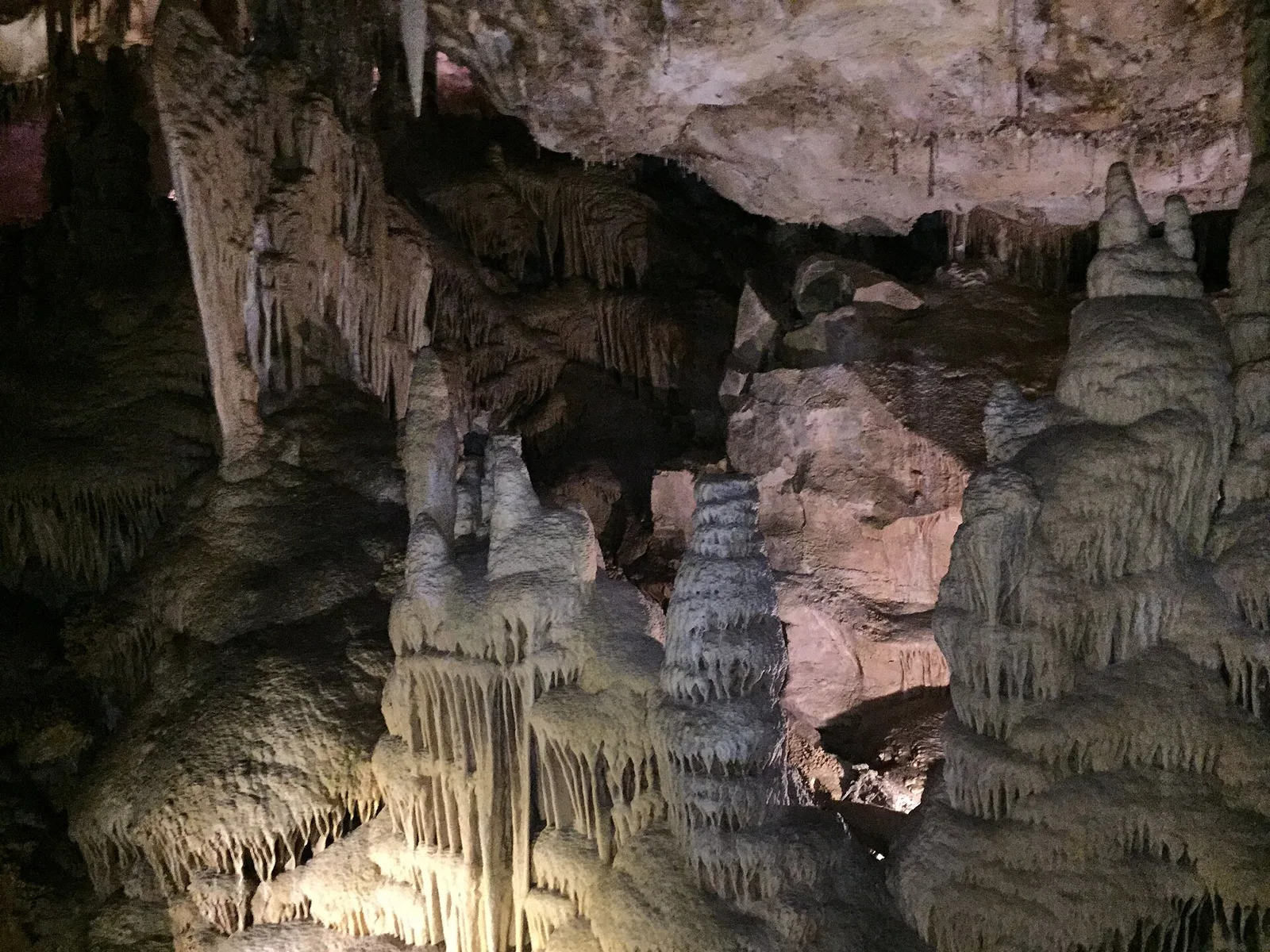
Lehman Caves, Great Basin National Park
Fast Facts
Did You Know?
A bristlecone pine in Great Basin National Park named 'Prometheus' was cut down by a researcher in 1964 and turned out to be approximately 4,900 years old, making it the oldest known living organism on Earth at the time. The cutting sparked controversy that led to stronger protections for the remaining trees.
Great Basin National Park is one of the least-visited national parks in the contiguous United States, receiving fewer than 150,000 visitors per year compared to millions at Yellowstone and the Grand Canyon. Its remote location in eastern Nevada means those who make the trip often have trails and campgrounds essentially to themselves.
Lehman Caves is home to six species of bats, which hibernate in the cave during winter. NPS manages cave tours carefully to avoid disturbing bat colonies, which provide crucial pest control services to the surrounding agricultural and natural landscape.
Plan Your Visit
Location
White Pine County, eastern Nevada, near Baker
Designation
National Park
Best Seasons
Late spring through fall; winter brings snow and some road closures
Entrance Fee
$35 per vehicle (cave tours extra)
Address
100 Great Basin Natl Park, Baker, NV 89311
Visitor Center Hours
Daily 8am to 4:30pm (may vary seasonally)
Getting There
5 miles west of Baker on NV-488; 4 to 5 hours from Las Vegas
More Info
nps.gov/grba