
What the Founders Understood
The men who wrote the First Amendment had lived under a government that prosecuted people for criticizing it. They had seen colonial governors shut down newspapers, prosecute printers for sedition, and use the legal system to silence political opposition. They did not protect press freedom as an afterthought. They put it in the very first amendment because they believed it was foundational to everything else.
The press clause of the First Amendment is eight words: "Congress shall make no law...abridging the freedom...of the press." Those eight words have generated more than two centuries of court decisions, legislation, and political conflict. What counts as "the press"? What counts as "abridging"? Does the protection cover broadcast television? Social media? A blogger? A foreign news organization?
The answers to those questions have never been fully settled, and they keep changing as technology and society evolve. But the core principle has remained remarkably stable: in the United States, the government cannot, as a general matter, tell the press what to print or punish it for what it has printed. That principle is the foundation of everything else on this page.

Five Reasons Press Freedom Matters
Watchdog on Government
The Founders had lived under a government that suppressed criticism. They understood that officials with unchecked power tend to abuse it, and that an independent press was the primary mechanism for informing citizens of that abuse. Thomas Jefferson wrote that if he had to choose between a government without newspapers and newspapers without a government, he would unhesitatingly choose the latter.
Marketplace of Ideas
Justice Oliver Wendell Holmes laid the foundation for the marketplace of ideas theory, writing of 'free trade in ideas,' in his 1919 dissent in Abrams v. United States. The idea is that truth is most likely to emerge from open competition among ideas, not from government determining which ideas are acceptable. This theory underpins most First Amendment jurisprudence. It is also critiqued, because markets can be distorted, and not all ideas compete on equal terms.
Informed Electorate
Self-government requires informed citizens. Voters cannot make meaningful choices without accurate information about candidates, policies, and public affairs. The press is the primary institution responsible for gathering and distributing that information. When the press fails, either through closure, capture, or incompetence, the quality of democratic decision-making degrades.
Check on Private Power
The press does not only hold government accountable. Investigative journalism has exposed corporate fraud, medical malpractice, environmental contamination, and abuses by private institutions. The Ida Tarbell exposé of Standard Oil, the Upton Sinclair investigation of the meatpacking industry, and more recent investigations into opioid manufacturers and the Catholic Church all produced legal and policy changes that government regulation alone had not achieved.
Historical Record
Journalism is, among other things, the first draft of history. Without a free press, the historical record of what governments and powerful institutions actually did is shaped by those institutions themselves. Authoritarian governments throughout history have controlled the press precisely because controlling information means controlling how history is understood and remembered.

What Press Freedom Does Not Mean
Press freedom is frequently misunderstood, in both directions. It is worth being clear about what the First Amendment does and does not guarantee.
It does not mean the press can publish anything without consequences
Defamation, fraud, incitement, true threats, and disclosure of certain national security secrets can all be punished after publication. The First Amendment restricts government; it does not create absolute immunity.
It does not mean the government must help the press
The First Amendment prevents the government from restricting the press. It does not require the government to give journalists access to proceedings, respond to questions, or make information available. Access rights are statutory, not constitutional.
It does not apply to private employers or platforms
A private newspaper firing a columnist for their views is not a First Amendment violation. A social media platform removing posts is not a First Amendment violation. The First Amendment restricts government action, not private decisions.
It does not guarantee accuracy or quality
A free press is free to be wrong, biased, incomplete, and sensational. Press freedom protects the right to publish, not the quality of what is published. Audiences bear responsibility for consuming news critically.
What it does guarantee
The government cannot prohibit publication before it happens (prior restraint), cannot punish publication of truthful information about public officials absent extraordinary circumstances, cannot require the press to obtain a license to publish, and cannot selectively prosecute news organizations for their editorial positions.
A Right Tested in Every Generation
Press freedom in America has never been a settled, unchallenged right. Every major war, every period of political crisis, and every new communications technology has brought new attempts to limit what journalists can report and new court battles over where the line should be. The history is not a story of steady progress. It is a story of the press constantly defending ground it has already won.
The milestones below trace the major episodes, from colonial America through the digital era, where the meaning of press freedom was tested, extended, or contracted.
Press Freedom Through the Years
Key cases, laws, and moments that defined the boundaries of press freedom in America.
English poet John Milton published Areopagitica, a pamphlet arguing against government licensing of the press. Though written in England, it became a foundational text in American press freedom thinking. Milton argued that truth would win out over falsehood in an open marketplace of ideas, a concept that still underlies First Amendment jurisprudence today.
Milton wrote Areopagitica in direct response to a 1643 licensing order from the same Puritan Parliament he generally supported, requiring government approval before anything could be printed. The pamphlet itself was published without a license, in defiance of the very law it criticized, though it had little immediate legal effect in England.
Milton's central image was that truth and falsehood should 'grapple' in 'a free and open encounter,' asking 'who ever knew Truth put to the worse, in a free and open encounter?' Justice Holmes's 1919 Abrams dissent, which spoke of 'free trade in ideas' (the phrase 'marketplace of ideas' came later, from Justices Douglas and Brennan), drew directly on that argument.
England did not actually abolish pre-publication licensing until 1695, when Parliament simply let the Licensing Act lapse rather than repealing it on principle. By then Areopagitica had circulated widely enough that colonial printers and the Founders treated it as a settled statement of the case against censorship.
Benjamin Harris published Publick Occurrences Both Foreign and Domestick in Boston, the first multi-page newspaper in the American colonies. Colonial authorities suppressed it after a single issue, citing publication without a license and content that offended the government. It illustrated exactly the kind of prior restraint the Founders would later prohibit.
The single surviving issue included an item questioning the French king's private conduct and criticized the colony's treatment of Native American allies during King William's War. No copies of a planned second issue exist, and historians believe Massachusetts authorities shut the paper down within days of its first printing.
Massachusetts had a 1662 licensing law requiring a government censor's approval for anything printed, and the governor and council issued an order on September 29, 1690 forbidding the paper's continuation and directing that existing copies be collected. Harris had planned to publish monthly, 'or, if any Glut of Occurrences happen, oftener.'
Harris, an English printer who had himself been jailed in London for seditious printing, returned to England in 1695. No further newspaper appeared in the colonies until the Boston News-Letter in 1704, which was 'published by authority,' meaning it carried the government's prior approval on its masthead.
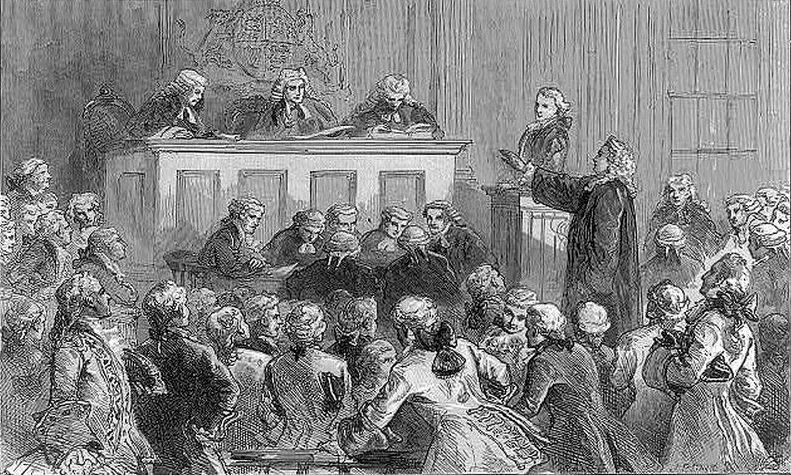
John Peter Zenger, publisher of the New York Weekly Journal, was tried for seditious libel after printing articles critical of New York's royal governor. His lawyer, Andrew Hamilton, argued that truth should be a complete defense against libel, a radical position at the time. The jury acquitted Zenger. The case did not immediately change the law, but it became a celebrated symbol of the press's role in holding government accountable and directly influenced the Founders' thinking.
The prosecution's actual legal position, that a true statement made libel worse rather than better because it was more likely to provoke public unrest, reflected the accepted English common law standard at the time. The jury's acquittal defied a judge who had explicitly instructed them that truth was not a valid defense, an early example of jury nullification shaping American press law.
Zenger, a German immigrant printer, spent about eight months in jail awaiting trial because he could not post the high bail set by the governor's allies. His wife Anna kept the Weekly Journal publishing while he was confined, one of the earliest instances of a woman running an American newspaper.
Andrew Hamilton, a Philadelphia lawyer with no relation to Alexander Hamilton, told the jury they were 'the best judges of the law' and asked them to acquit if Zenger's charges were true. Colonial juries increasingly refused to convict printers afterward, and truth was written into New York law in 1805 and many state constitutions later.
The First Amendment to the Constitution was ratified as part of the Bill of Rights on December 15, 1791. Its press clause reads: 'Congress shall make no law...abridging the freedom of speech, or of the press.' It was one of the first constitutional protections of press freedom, after Sweden's Freedom of the Press Act of 1766 and Virginia's 1776 Declaration of Rights. The amendment applied only to the federal government at first. It was not applied to state governments until the 20th century through the 14th Amendment's due process clause.
The press clause and the speech clause are separated by only a comma in the amendment's text, and for most of American history courts have treated them as closely related rather than fully distinct protections, though scholars still debate whether the press clause was meant to grant journalists rights beyond those held by ordinary citizens.
James Madison drafted the amendment and initially wanted it to bind the states as well, a proposal the Senate rejected. As ratified, it restrained only Congress, and several states kept laws punishing seditious or blasphemous publication for decades afterward.
The press clause was applied to the states through Gitlow v. New York (1925) for speech and Near v. Minnesota (1931) for the press, using the 14th Amendment's Due Process Clause. Only after that did 'Congress shall make no law' come to mean no government at any level.
Just seven years after the First Amendment was ratified, Congress passed the Sedition Act of 1798, making it a crime to publish 'false, scandalous, and malicious' writing against the government. Several newspaper editors were convicted and imprisoned. President John Adams used the law against critics in the opposition press. The acts expired in 1801 and Thomas Jefferson pardoned those convicted. The episode illustrated how quickly democratic governments move to suppress press criticism during times of perceived threat.
Roughly 25 people were arrested under the Sedition Act, nearly all of them editors or writers affiliated with Jefferson's opposition Democratic-Republican party, making the law's partisan target unmistakable. The public backlash contributed directly to the Federalist Party's defeat in the 1800 election.
Matthew Lyon, a Democratic-Republican congressman from Vermont, was jailed four months for an essay accusing Adams of 'ridiculous pomp' and 'selfish avarice'; his constituents re-elected him while he sat in prison. Benjamin Franklin's grandson, editor Benjamin Franklin Bache, was arrested but died of yellow fever before trial.
The Kentucky and Virginia Resolutions, drafted secretly by Jefferson and Madison in 1798 and 1799, argued states could judge federal laws unconstitutional, aimed squarely at the Sedition Act. The Supreme Court never ruled on the Act, but it stated in New York Times v. Sullivan (1964) that the 'court of history' had found it invalid.
During the Civil War, both Union and Confederate governments suppressed newspapers they deemed dangerous to the war effort. General Ambrose Burnside shut down the Chicago Times in 1863. Lincoln overruled him two days later. The telegraph created new military censorship challenges, as battlefield dispatches could reach the public before commanders could respond. The tension between military necessity and press freedom that emerged during the Civil War would recur in every major conflict afterward.
The Union also closed or suppressed dozens of Northern newspapers over the course of the war for perceived disloyalty, including a brief period when several New York papers were barred from the mail entirely after printing a fabricated presidential proclamation. The Confederacy imposed its own, generally less formalized, censorship on Southern papers critical of Jefferson Davis's government.
The War Department required telegraph companies to submit military news to a government censor, and General Order No. 67 in 1862 barred publication of unauthorized troop movements. Correspondents who violated the rules could be expelled from army camps or, in a few cases, briefly arrested.
In May 1864 the New York World and Journal of Commerce printed a forged proclamation attributed to Lincoln calling for 400,000 more troops; Lincoln ordered the papers seized and their editors held for two days before it became clear they had been hoaxed. The episode is often cited as the war's clearest overreach against the Northern press.
The Espionage Act of 1917 and the Sedition Act of 1918 criminalized criticism of the war, the draft, and the government. Socialist newspapers were shut down. Journalist Victor Berger was convicted for anti-war editorials. The Supreme Court upheld convictions under these laws in Schenck v. United States (1919), where Justice Oliver Wendell Holmes introduced the 'clear and present danger' test. Holmes later dissented in Abrams v. United States, arguing the government had gone too far, planting the seeds of a more protective press doctrine.
Holmes's 'clear and present danger' test from Schenck was used to uphold nearly every Espionage Act conviction that reached the Supreme Court during this period, including that of Socialist Party leader Eugene Debs for a single anti-war speech. Holmes's later Abrams dissent had no legal effect at the time but became hugely influential in 20th-century First Amendment doctrine.
The Postmaster General used a provision barring 'nonmailable' matter to deny second-class mailing privileges to dozens of socialist and German-language papers, including The Masses and the Milwaukee Leader, which the Supreme Court upheld in 1921. Losing the mails was often fatal to a publication.
Debs received a ten-year sentence for a 1918 speech and ran for president from prison in 1920, winning nearly a million votes; President Harding commuted his sentence in 1921. Holmes's Abrams dissent, joined by Justice Brandeis, argued only speech posing an imminent threat could be punished, a view that became majority doctrine in Brandenburg v. Ohio (1969).
The Supreme Court struck down a Minnesota law that allowed courts to shut down newspapers as 'public nuisances' before they published. Jay Near's paper had run anti-Semitic content and attacked local officials. Chief Justice Hughes, writing for the majority, held that prior restraint, censoring a publication before it prints, is presumptively unconstitutional except in the narrowest circumstances. Near v. Minnesota remains the foundational case against government pre-publication censorship.
The Minnesota 'public nuisance' law at issue had been used against only a handful of publications since its 1925 passage, but the Supreme Court's 5-4 ruling struck down the entire law rather than deciding the case on narrower grounds, establishing the prior restraint doctrine that would prove decisive four decades later in the Pentagon Papers case.
The law let a judge permanently enjoin any 'malicious, scandalous and defamatory' periodical, with truth a defense only if published 'with good motives and for justifiable ends.' A county attorney used it to shut down Near's Saturday Press, which had alleged that gangsters controlled Minneapolis and that officials were complicit.
Hughes acknowledged Near's paper was 'defamatory' and 'scandalous' but held that silencing it before publication was 'the essence of censorship.' He listed narrow possible exceptions, obstructing recruiting in wartime, publishing sailing dates of troop transports, incitements to violence, that courts have discussed but never actually applied to a newspaper since.
The Supreme Court unanimously ruled that the First Amendment protects newspapers from libel suits by public officials unless the official can prove 'actual malice,' meaning the publisher knew the statement was false or acted with reckless disregard for its truth. The case arose from a civil rights era advertisement in the New York Times describing police treatment of demonstrators in Alabama. Without this protection, the Court reasoned, the threat of expensive libel suits would make the press afraid to cover public officials at all.
The underlying advertisement contained several minor factual inaccuracies, including misstating which song protesters sang and how many times Martin Luther King Jr. had been arrested, details a Montgomery, Alabama jury had relied on to award the police commissioner $500,000 in damages before the Supreme Court unanimously reversed.
L.B. Sullivan, a Montgomery city commissioner, was not named in the ad but sued as the official who supervised the police; Alabama officials had roughly $3 million in libel suits pending against the Times, part of a broader Southern strategy of using libel law to deter civil rights coverage.
Justice Brennan's opinion required proof of 'actual malice' before a public official may recover for a defamatory falsehood about official conduct. Later cases extended the standard to 'public figures' (Curtis Publishing v. Butts, 1967) and limited presumed and punitive damages for private figures (Gertz v. Robert Welch, 1974).
The Nixon administration sought to block the New York Times and Washington Post from publishing the Pentagon Papers, a classified Defense Department study showing the government had systematically deceived the public about the Vietnam War. In New York Times Co. v. United States, the Supreme Court ruled 6-3 against the government in a landmark victory for the press. The government had not met the heavy burden required to justify prior restraint. The case affirmed that the press could publish government secrets absent an overwhelming national security justification.
The Times had already published three installments before a federal judge issued the first-ever prior restraint order against a major American newspaper; once an injunction stopped the Times, the Washington Post and then more than a dozen other papers began publishing their own installments, making the government's effort to suppress the story practically unworkable even before the Supreme Court ruled.
The study ran to 47 volumes and about 7,000 pages and was leaked by RAND analyst Daniel Ellsberg. The government argued publication would prolong the war and endanger prisoners; the Court disagreed on the record before it.
The 6-3 decision produced ten separate opinions and no majority rationale. Justices Black and Douglas thought prior restraint was never permissible; Justice Stewart's more influential concurrence said the government must show publication would 'surely result in direct, immediate, and irreparable damage.' Ellsberg's separate prosecution was dismissed in 1973 over government misconduct.
The Supreme Court held 5-4 that the First Amendment does not give journalists an absolute right to refuse to testify before a grand jury about confidential sources. The decision was a setback for the press, but Justice Powell's concurrence suggested some balancing test might apply. In response, many states passed shield laws giving journalists varying degrees of statutory protection. No federal shield law exists. The question of when reporters must reveal sources in federal proceedings remains unsettled.
The case actually combined three separate reporters' subpoenas from different states, including one involving Paul Branzburg's own reporting on drug use in Kentucky. Justice Powell's brief concurrence, despite joining the majority, has been cited by lower courts more often than the majority opinion itself when crafting narrower reporter-privilege exceptions.
Justice White's majority held that requiring reporters to testify like any other citizen imposes only an 'incidental burden' on newsgathering. Powell wrote separately that courts should quash subpoenas that harass the press or seek information with only a 'remote' relation to an investigation, language lower courts have used to build a qualified privilege.
Because of Powell's concurrence, most federal circuits recognize some qualified reporter's privilege in civil cases and, less consistently, in criminal ones. Forty-nine states and D.C. have shield protections; Congress's 2024 PRESS Act cleared the House but stalled in the Senate.
Section 230 of the Communications Decency Act immunized internet platforms from liability for content posted by users. The provision was crucial to the development of online media, allowing platforms to host user content without being treated as publishers responsible for every post. It has become one of the most consequential and contested laws in modern press freedom debates, with critics on both left and right arguing it shields platforms from accountability.
Most of the Communications Decency Act's original provisions, which restricted indecent content online, were struck down by the Supreme Court in Reno v. ACLU (1997) as unconstitutionally broad; Section 230 survived because it was a liability shield rather than a speech restriction, and it has since been credited and blamed for enabling everything from user-generated journalism to large-scale online disinformation.
Section 230(c)(1) says no provider of an 'interactive computer service' shall be 'treated as the publisher or speaker' of information provided by another; 230(c)(2) protects good-faith moderation. Representatives Chris Cox and Ron Wyden wrote it partly in reaction to a 1995 New York ruling that held Prodigy liable as a publisher because it moderated content.
The Supreme Court sidestepped a chance to narrow Section 230 in Gonzalez v. Google (2023), and its 2024 NetChoice decisions treated platform content-curation as expressive activity without resolving 230's scope. Proposals to repeal or amend it come from across the spectrum, for opposite reasons, but none has passed.
NSA contractor Edward Snowden leaked classified documents to journalists Glenn Greenwald and Laura Poitras revealing mass surveillance programs. The disclosures sparked a global debate about government surveillance, press freedom, and national security secrecy. The Obama administration pursued more leak prosecutions under the Espionage Act than all previous administrations combined. The episode raised fundamental questions about when publishing classified material serves the public interest and when it endangers national security.
Greenwald and Poitras, along with the Washington Post's Barton Gellman, led the reporting that won The Guardian US and The Washington Post the 2014 Pulitzer Prize for Public Service, even as the U.S. government charged Snowden himself under the Espionage Act and he remained in exile in Russia.
The first stories revealed bulk collection of Americans' phone metadata under Section 215 of the Patriot Act and the PRISM program collecting from major internet companies. A federal appeals court later ruled the phone-records program had not been authorized by statute, and Congress ended it in the USA FREEDOM Act of 2015.
The Obama administration brought Espionage Act charges in at least eight leak cases, more than all prior administrations combined, including against Chelsea Manning and Jeffrey Sterling. Press-freedom groups argue the pattern has chilled national-security sources without a single prosecution of a journalist for publishing.
Washington Post columnist Jamal Khashoggi was murdered inside the Saudi Arabian consulate in Istanbul, Turkey. U.S. intelligence concluded Saudi Crown Prince Mohammed bin Salman had approved the operation. The killing drew international attention to the physical dangers journalists face in covering authoritarian governments, and to the diplomatic and economic pressures that can constrain press coverage of allied nations.
The U.S. intelligence assessment of Crown Prince Mohammed bin Salman's role, based on intercepted communications and other intelligence, was formally declassified and released to the public in February 2021, though the U.S. government did not impose direct sanctions on the crown prince himself.
Khashoggi, a Saudi citizen and U.S. resident, had entered the consulate on October 2, 2018 to obtain marriage documents; Turkish intelligence said he was killed by a team flown in from Riyadh, and his body was never recovered. In November 2018 the Treasury Department used the Global Magnitsky Act to sanction 17 Saudi officials.
The Committee to Protect Journalists documents the killing as part of a wider pattern: hundreds of journalists have been killed worldwide over the past decade, most with impunity, and record numbers, more than 300 in some years, are jailed for their work, concentrated in China, Myanmar, Belarus, Russia, and Iran.
The Legal Framework
Press freedom in the United States is protected by a combination of the First Amendment, federal statutes, state shield laws, and court precedents accumulated over more than two centuries. No single law defines what the press can and cannot do. Instead, the legal framework is a patchwork of protections and limits that vary depending on what kind of information is involved, who is reporting it, and in what context.
The sections below explain the key legal concepts every citizen should understand about how press freedom actually works in practice, beyond the eight words of the press clause itself.
Key Legal Concepts
The doctrines and laws that define what press freedom means in real-world practice.
Prior restraint means censoring or blocking a publication before it goes out, as opposed to punishing it afterward. The Supreme Court established in Near v. Minnesota (1931) that prior restraint carries a heavy presumption of unconstitutionality. The Pentagon Papers case (1971) reinforced this, ruling the government could not stop the Times and Post from publishing even classified material unless it could meet an extremely high burden. In practice, prior restraint is almost never upheld by courts. The government's remedy is generally to prosecute the leaker, not stop the press.
Even the rare exceptions courts have discussed, such as publishing exact troop movements during wartime, remain largely theoretical: no U.S. court has actually upheld a prior restraint against a news organization on national security grounds since the doctrine was established in 1931.
The doctrine has held even in hard cases. In 1979 a federal judge briefly enjoined The Progressive magazine from publishing an article on hydrogen-bomb design, the only modern injunction against a publication on nuclear-secrecy grounds, but the government dropped the case when similar information appeared elsewhere, and no appellate court upheld the restraint.
Courts distinguish prior restraint from after-the-fact punishment: the government may prosecute a leaker, seek libel damages, or punish contempt, all consistent with the First Amendment, but stopping the presses in advance requires meeting Justice Stewart's 'direct, immediate, and irreparable' standard, which no court has found satisfied against a news outlet.
Defamation is a false statement of fact that damages someone's reputation. For private individuals, a publisher can be liable for negligent falsehoods. For public officials and public figures, New York Times v. Sullivan (1964) requires proof of actual malice, meaning the publisher knew the statement was false or acted with reckless disregard for truth. This high standard is intentional. The Court reasoned that democratic debate requires breathing room, and the threat of ruinous libel suits would otherwise chill legitimate reporting on public officials. Opinion and satire are generally protected even when harsh.
The actual malice standard has occasionally faced renewed challenge: two sitting Supreme Court justices, Clarence Thomas and Neil Gorsuch, have separately written opinions since 2019 suggesting the Court should reconsider Sullivan, though a majority of the Court has not taken up the invitation.
A defamation plaintiff must prove a false statement of fact (not opinion), publication to a third party, fault, and, usually, damages. Milkovich v. Lorain Journal (1990) held there is no blanket 'opinion' exemption, but statements that cannot reasonably be read as stating actual facts, hyperbole and satire, are protected.
Many states have anti-SLAPP laws that let a defendant quickly dismiss a 'strategic lawsuit against public participation' and recover fees. Awards can still be large: a 2016 Florida jury awarded Hulk Hogan $140 million against Gawker in a privacy case, and the site shut down, an outcome critics cite as a warning about litigation funded to destroy a publication.
After Branzburg v. Hayes (1972), Congress and state legislatures moved to fill the gap the Supreme Court left. 49 states and D.C. have some form of shield law protecting journalists from being compelled to reveal confidential sources. The laws vary enormously in strength. Some are absolute, others require courts to balance the need for testimony against press freedom interests. No federal shield law exists. In federal cases, reporters can still be subpoenaed and jailed for contempt if they refuse to testify. Judith Miller of the New York Times served 85 days in jail in 2005 rather than reveal a source in the Valerie Plame leak investigation.
New York's shield law, one of the strongest in the country, is what protected Miller's own colleagues even as she went to jail, since federal proceedings are governed by federal, not state, law regardless of where the underlying reporting took place, a gap that remains unresolved without federal legislation.
Shield laws range from near-absolute to qualified: most require a party seeking testimony to show the information is critical, unavailable elsewhere, and outweighs the press interest. They typically also cover unpublished notes, outtakes, and the identity of sources promised confidentiality.
James Risen of the New York Times fought a subpoena for seven years in the Jeffrey Sterling leak case before the government dropped it in 2015. The Justice Department tightened its internal guidelines in 2021 and 2022 to bar most subpoenas of journalists, but internal policy can change with each administration: Attorney General Pam Bondi rescinded that policy in April 2025.
The Freedom of Information Act, signed by President Johnson in 1966, gives any person the right to request records from federal executive agencies. Agencies must respond within 20 business days, though backlogs mean waits of months or years are common. Nine categories of information are exempt, including classified national security information, internal personnel rules, trade secrets, law enforcement records, financial institution records, and personal privacy information. When agencies improperly withhold records, requesters can sue in federal court. FOIA is one of the primary tools investigative journalists use to document government activity. Most states have parallel public records laws.
Federal agencies received more than 1.1 million FOIA requests in recent fiscal years (1,199,699 in fiscal 2023), according to the Justice Department's own annual reporting, and backlogs have grown large enough that some news organizations now budget for FOIA lawsuits as a routine cost of investigative reporting rather than a last resort.
FOIA covers executive-branch agencies but not Congress, the federal courts, or the President's immediate staff. The 1974 amendments passed over President Ford's veto after Watergate added deadlines and court enforcement; the 2016 FOIA Improvement Act added a presumption of openness and a 25-year limit on the 'deliberative process' exemption.
Requesters who substantially prevail in litigation can recover attorney's fees, which is why some newsrooms budget for FOIA suits. Government-wide request volume has topped 1.1 million in recent years with a backlog above 200,000, and agencies fully grant only a minority of requests.
The Espionage Act of 1917 makes it a crime to transmit national defense information to unauthorized persons. The law has been used repeatedly against leakers, from Daniel Ellsberg (Pentagon Papers) to Edward Snowden. What has never been tested in a full Supreme Court case is whether the Espionage Act can be used to prosecute a journalist or news organization that receives and publishes leaked classified material. The Justice Department has historically declined to charge journalists, but the legal question is unresolved. The Obama and Trump administrations both pursued more aggressive leak prosecutions than their predecessors.
Daniel Ellsberg himself was charged under the Espionage Act in 1971, but the case was dismissed in 1973 after evidence emerged that the Nixon administration had illegally wiretapped him and broken into his psychiatrist's office, a dismissal on government misconduct grounds rather than on the merits of the underlying charges.
The Act's key provision, 18 U.S.C. 793, criminalizes 'willful' retention or transmission of 'information relating to the national defense' by someone with reason to believe it could harm the U.S. It predates the modern classification system, which is set by executive order rather than statute.
The 2019 superseding indictment of WikiLeaks founder Julian Assange included Espionage Act counts for publishing, not just obtaining, classified documents, alarming press-freedom groups because the same theory could reach mainstream outlets. Assange pleaded guilty to one count in a 2024 deal and was released, leaving the constitutional question unresolved.
The Privacy Protection Act of 1980 limits law enforcement's ability to search newsrooms directly, generally requiring a subpoena rather than a search warrant so reporters have an opportunity to object in court. However, the law has exceptions, and digital records held by third parties like phone companies and email providers have weaker protections. In 2021 it was revealed that the Trump Justice Department had secretly subpoenaed Apple and Google for records belonging to reporters at the New York Times, Washington Post, and CNN as part of leak investigations. The episode prompted calls for a federal shield law.
The Privacy Protection Act was passed directly in response to a 1978 Supreme Court case, Zurcher v. Stanford Daily, which had upheld a police search of a student newspaper's offices; Congress passed the law within two years specifically to override the practical effect of that ruling.
The Act generally forbids searching for or seizing a journalist's 'work product' or 'documentary materials' with a warrant, with exceptions for national security, child exploitation, and cases where the journalist is a suspect, and it provides a civil damages remedy against the government.
The law does not reach records held by third parties: phone, email, and cloud providers can be served with a subpoena or a gag-ordered warrant, and the journalist may never learn of it, which is why the 2021 disclosures prompted a department policy of presumptively not seeking journalists' records, a policy rescinded in April 2025.
Print and online media are fully protected by the First Amendment with no licensing requirement. Broadcast media, radio and television using public airwaves, operate differently. The FCC licenses broadcasters and enforces content rules like the indecency standard. The Fairness Doctrine, which required broadcasters to present contrasting views on controversial issues, was eliminated in 1987, contributing to the rise of one-sided talk radio. Broadcast licensees can have their licenses revoked, a power that does not exist over newspapers. The rationale is spectrum scarcity, the public airwaves are a limited resource unlike the infinite supply of paper, but this distinction has become less persuasive as most people get TV over cable and streaming rather than over the air.
The FCC's indecency enforcement authority was significantly narrowed by the Supreme Court's 2012 decision in FCC v. Fox Television Stations, which found the agency's enforcement standards too vague to survive due process review, though the ruling stopped short of striking down indecency regulation of broadcast media entirely.
The scarcity rationale comes from Red Lion Broadcasting v. FCC (1969), which upheld the Fairness Doctrine on the ground that broadcast frequencies are limited and licensees are 'public trustees.' The FCC repealed the doctrine in 1987, concluding it chilled rather than promoted debate, and a bill to restore it by statute was vetoed.
Broadcasters still face equal-time rules for candidates, sponsorship-identification requirements, and indecency limits enforceable only between 6 a.m. and 10 p.m. The Supreme Court has applied full First Amendment scrutiny to cable (Turner Broadcasting, 1994) and the internet (Reno v. ACLU, 1997).
Who Counts as "The Press"?
The First Amendment says "the press" but does not define it. Courts have generally held that the press clause does not create a special class of licensed journalists with rights ordinary citizens lack. The protection belongs to the activity of journalism, not to a credential.
This matters practically in several contexts. Shield laws in many states define "journalist" or "news organization" for purposes of source protection. Some definitions are narrow, covering only employees of established news outlets, while others are broad enough to include bloggers, freelancers, and documentary filmmakers. Access credentials for press passes, congressional press galleries, and White House briefings are controlled by the outlets and credentialing organizations themselves, not by law.
The Digital Age Question
The rise of independent journalists, newsletter writers, podcasters, and citizen journalists has made the definitional question more pressing. Courts have extended First Amendment protections to online publications but have not uniformly extended the statutory protections of shield laws to individual creators. Whether a solo journalist with a newsletter has the same source protection as a reporter for a major newspaper depends on which state they are in and what their state's shield law says.
Challenges Facing the Press Today
The legal framework protecting press freedom in the United States is among the strongest in the world. But legal protection is not the only thing a functioning press requires. A press that is legally free but financially broken, physically intimidated, or algorithmically marginalized cannot do its job.
The challenges below are real and documented. They are presented with the strongest arguments on multiple sides where genuine disagreement exists, and as documented facts where the evidence is not seriously contested.
The Active Challenges
The Scale of the Problem
- +More than 3,200 newspapers have closed in the United States since 2005, according to Medill, leaving approximately 200 counties with no local news outlet of any kind.
- +Many surviving local outlets have been reduced to skeleton staffs unable to cover city hall, school boards, and local courts with any depth.
- +The advertising revenue model that sustained local journalism for 150 years collapsed when digital platforms captured local classified and display advertising without producing journalism.
- +Research links local news deserts to lower voter turnout, higher municipal borrowing costs, and increased government corruption, as officials face less scrutiny.
Proposed Solutions
- +Nonprofit news organizations funded by philanthropy have filled some gaps, though their reach and sustainability are uneven.
- +Some states have passed or considered tax credits for local news subscriptions or payroll tax credits for journalists, treating local news as a public good.
- +Public media expansion, strengthening NPR affiliates and PBS stations for local coverage, has been proposed but faces political opposition over government involvement in journalism.
- +Some researchers argue the market will stabilize and that digital newsletters, podcasts, and community-owned publications represent a sustainable future model.
Context
The collapse of local news is widely viewed as one of the most serious threats to American democratic accountability, affecting communities regardless of political orientation. It is distinct from debates about national media bias because it removes journalism entirely rather than replacing it with partisan alternatives.
Concerns About Consolidation
- +Large investment firms and hedge funds have bought hundreds of local newspapers, often cutting staff drastically to extract profit while reducing coverage.
- +A small number of corporations own the majority of television stations reaching most American households, concentrating editorial influence.
- +When a single owner controls multiple news outlets in a market, the diversity of editorial voices effectively disappears even if the mastheads remain.
- +Foreign ownership of American media outlets, including by state-adjacent entities, raises additional concerns about editorial independence.
Arguments for Consolidation
- +Consolidation can provide economies of scale that keep struggling outlets alive that would otherwise close entirely.
- +National ownership can sometimes protect local journalists from local political pressure by providing institutional backing.
- +The internet has lowered barriers to entry dramatically. Anyone can now launch a news publication, so concerns about concentration of distribution are less pressing than in the broadcast era.
- +Market forces, not government regulation, should determine who owns media. Government involvement in media ownership decisions raises its own First Amendment concerns.
Context
FCC ownership rules limit how many stations one entity can own in a market, but those rules have been significantly loosened over the past three decades through regulatory and court action. Newspaper ownership faces no equivalent federal regulation.
The Case for Platform Accountability
- +Social media platforms algorithmically amplify outrage and false information because it drives engagement, creating financial incentives that are structurally misaligned with truthful reporting.
- +The speed of social media sharing means false information reaches millions before corrections can catch up. Studies consistently find misinformation spreads faster and further than corrections.
- +Section 230 immunity allows platforms to profit from hosting false and harmful content without legal accountability traditional publishers face.
- +Foreign governments have used social media platforms as distribution channels for disinformation campaigns targeting American elections.
The Case Against Platform Regulation
- +Requiring platforms to fact-check or remove content makes them publishers, potentially subjecting them to liability and creating incentives to over-censor to avoid legal risk.
- +Who decides what is misinformation? Government-empowered fact-checkers or platform content moderators will inevitably make errors and arguably constitute a form of speech regulation.
- +The traditional press also publishes false information. The problem is not unique to social media and does not justify singling out platforms for special regulation.
- +Competition from alternative platforms is the appropriate market check. Regulatory intervention tends to entrench dominant incumbents who can absorb compliance costs.
Context
This is one of the most genuinely difficult First Amendment questions of the current era. Both the Supreme Court and Congress are actively wrestling with it. The Court's decisions in Moody v. NetChoice and NetChoice v. Paxton (2024) addressed whether states can require platforms to carry all speech, but left core questions unresolved.
The Documented Threat Landscape
- +The U.S. Press Freedom Tracker documented hundreds of journalist arrests, assaults, and equipment seizures during protest coverage in 2020 alone.
- +Journalists covering immigration, drug cartels, and organized crime along the U.S.-Mexico border face threats comparable to those in conflict zones.
- +Online harassment campaigns targeting journalists, especially women and journalists of color, have a documented chilling effect on coverage of certain topics.
- +Political rhetoric describing journalists as 'enemies of the people' correlates with periods of increased physical threats against members of the press.
Legal and Institutional Responses
- +Federal law provides some protection. Assault of a journalist covering a federal official or event can carry federal charges in addition to state assault charges.
- +Press freedom organizations including the Reporters Committee for Freedom of the Press and the Committee to Protect Journalists provide legal support and rapid response to journalists under threat.
- +Most documented arrests of journalists during protests have resulted in charges being dropped, and civil litigation has produced settlements acknowledging the arrests were improper.
- +States have increasingly passed laws criminalizing targeted harassment campaigns, which can apply to online attacks on journalists.
Context
The United States ranks in the top tier of global press freedom indices but has slipped in recent years. Reporters Without Borders ranked the U.S. 57th in its 2025 World Press Freedom Index (55th in 2024), citing political polarization, journalist arrests during protests, and harassment as key factors.
The Transparency Problem
- +FOIA backlogs at major agencies run to hundreds of thousands of pending requests, with average wait times of months to years making the information useless for breaking news.
- +Agencies routinely over-classify information and apply exemptions broadly, requiring journalists to litigate for records that should be routine public documents.
- +The classification system has expanded dramatically since the Cold War. Millions of documents are classified annually, many covering embarrassing policy failures rather than genuine secrets.
- +FOIA was not designed for the digital age. Request processing is often manual, slow, and expensive despite the existence of technology that could automate much of it.
Government's Position
- +Some agencies have made genuine reforms, including online FOIA portals and proactive disclosure of frequently requested records.
- +Certain exemptions exist for real reasons. Law enforcement investigation records, for example, cannot be disclosed without compromising ongoing cases or endangering sources.
- +National security classification protects methods and sources whose exposure would get people killed, a claim that deserves genuine weight even when invoked imperfectly.
- +Congress has periodically strengthened FOIA, including the OPEN Government Act of 2007 and the FOIA Improvement Act of 2016, reducing some of the worst agency stonewalling.
Context
Government transparency and press freedom are directly linked. A press that cannot access government records cannot hold the government accountable. FOIA reform is generally seen as a nonpartisan issue, with advocates from across the political spectrum supporting a stronger law.
Where Things Stand
Press freedom in the United States in 2024 is a study in contradictions. The legal protections are strong and have held through repeated attempts to weaken them. At the same time, the economic foundations of independent journalism have collapsed, the physical safety of journalists has deteriorated, and public trust in the press is near historic lows.
The sections below cover the current landscape, including where the U.S. stands globally, how technology is reshaping journalism, and what open legal and policy questions are still being contested.
The Current Landscape
Key dimensions of press freedom as it exists in the United States today.
Reporters Without Borders publishes an annual World Press Freedom Index ranking 180 countries. The United States ranked 57th in 2025, down from 55th in 2024, 45th in 2022, and 17th in 2002. The decline reflects journalist arrests during protests, politically motivated threats, the financial collapse of local news, and increasing political polarization affecting media independence. Norway, Denmark, and Sweden consistently rank first, second, and third. The index measures legal framework, political context, economic environment, sociocultural environment, and safety.
Reporters Without Borders attributed a significant part of the U.S. drop specifically to press-related arrests during the 2020 protests following George Floyd's death, when the U.S. Press Freedom Tracker recorded more journalist arrests in a single year than in the previous decade combined.
The index weights safety incidents heavily, and the U.S. score has been dragged down by the local-news collapse on the economic indicator, protest-related arrests and assaults on the safety indicator, and polarized political attacks on the press's legitimacy on the political-context indicator.
Freedom House still rates the U.S. 'free' overall, and the Committee to Protect Journalists notes the U.S. has no journalists imprisoned for their work, unlike the bottom-ranked countries. The gap between strong legal protections and a middling ranking reflects that the index measures conditions on the ground, not the law on the books.
Social media platforms have captured the advertising revenue that sustained journalism while distributing content produced by journalists without compensation. At the same time, individual journalists and content creators can now build direct audiences without institutional backing. The result is a bifurcated media landscape with a small number of large national outlets, a struggling local press, and an enormous volume of online commentary and partisan content that often blurs the line between journalism, opinion, and advocacy. The accountability journalism that investigates government and corporate wrongdoing remains concentrated in a shrinking number of newsrooms.
Facebook and Google together have captured more than half of all U.S. digital advertising spending in recent years, according to industry tracking firms, even as both companies distribute large volumes of news content produced at other organizations' expense, a dynamic that has driven several countries, including Australia and Canada, to pass laws requiring platforms to pay news publishers directly.
U.S. newspaper advertising revenue fell from about $49 billion in 2005 to under $10 billion by the early 2020s, per Pew Research Center, while newspaper newsroom employment dropped by more than half. Digital subscriptions have grown but replaced only a fraction of the lost print revenue, concentrated at a few national brands.
Australia's 2021 News Media Bargaining Code and Canada's 2023 Online News Act require large platforms to pay news publishers; Meta responded by blocking news links in Canada. The U.S. Journalism Competition and Preservation Act proposed a similar approach but has not passed.
News organizations are experimenting with AI for tasks like writing routine financial and sports reports, transcription, translation, and data analysis. AI also enables the mass production of realistic fake news, synthetic video (deepfakes), and automated disinformation campaigns at a scale and cost that were previously impossible. Distinguishing authentic from AI-generated content is an emerging challenge for journalists and their audiences. Several major news organizations have sued AI companies for training models on their content without compensation, raising unresolved questions about copyright and the economic sustainability of journalism in an AI-abundant information environment.
The New York Times sued OpenAI and Microsoft in December 2023, alleging their AI models were trained on millions of the paper's articles without permission or compensation, one of more than a dozen similar lawsuits news organizations have filed against AI companies since 2023.
The Associated Press has automated corporate-earnings stories since 2014, and Reuters uses AI for routine data-driven reporting and translation, while most major outlets have published guidelines barring AI-written articles from publication without human editing and disclosure.
Beyond the Times suit, News Corp, The Atlantic, and Vox Media have signed licensing deals with OpenAI while others have sued. The unresolved legal question is whether training on copyrighted articles is 'fair use'; in June 2025 two federal district courts (Bartz v. Anthropic and Kadrey v. Meta) found that training on lawfully acquired books could qualify, while leaving other questions open, and Anthropic agreed in September 2025 to a $1.5 billion settlement with authors over books taken from pirate sites.
The absence of a federal shield law means that in federal investigations, reporters can be subpoenaed and compelled to testify about confidential sources or face jail for contempt. Congress has repeatedly introduced federal shield legislation, most recently the PRESS Act, which passed the House in 2024 but stalled in the Senate. Without a federal law, the protection journalists receive in federal proceedings depends on the current administration's prosecutorial policy, not a stable legal standard. The Justice Department under different administrations has taken markedly different approaches to subpoenaing journalists.
The 2024 PRESS Act had rare bipartisan support and was also backed by the Justice Department itself under revised internal policy, but it failed to receive a Senate floor vote before the end of that Congress, meaning shield-law advocates had to restart the legislative process in the following session.
The PRESS Act would bar federal courts and agencies from compelling a 'covered journalist' to disclose sources or newsgathering records, with exceptions for terrorism and imminent violence, and would extend that protection to phone and email providers holding a journalist's records. It passed the House by voice vote in January 2024.
Advocates want a statute rather than a policy because an internal Justice Department guideline can be reversed by the next attorney general without any public process, which is what has happened repeatedly across administrations.
Research from Northwestern University's Medill School of Journalism found that as of 2024, the U.S. had lost more than a third of its newspapers since 2005, with approximately 200 counties having no news outlet at all. Communities without local news have measurably lower voter turnout in local elections, higher rates of government corruption, and higher municipal borrowing costs as bond markets discount the accountability function of local coverage. The affected communities are disproportionately rural, low-income, and minority. The problem is structural, not ideological, and affects communities regardless of political orientation.
Medill's research also found that more than half of all U.S. counties, out of roughly 3,000 nationwide, now have only one remaining local news source, typically a weekly paper with a small staff, meaning even communities not classified as full news deserts often have little independent local coverage left.
Medill's 'State of Local News' reports count more than 3,200 newspaper closures since 2005 and a loss of roughly two-thirds of newspaper newsroom jobs, with the country losing papers at a rate of more than two per week.
Peer-reviewed studies have linked local-news loss to reduced split-ticket voting, lower turnout in municipal elections, fewer candidates for local office, and higher long-term borrowing costs for local governments, effects researchers attribute to weakened local accountability rather than to any partisan tilt.
Media ownership transparency has become a significant issue as investment firms, private equity, and shell companies have purchased news outlets without public disclosure of ultimate ownership. Local TV stations may be owned by a national chain running centrally produced content under local branding. Online news sites may be funded by political or commercial interests with no disclosure. The FCC requires broadcast station ownership records to be publicly filed, but online publications face no equivalent requirement. Press freedom advocates argue that audiences have a right to know who owns the news they rely on for information about their communities.
Sinclair Broadcast Group, one of the largest local television station owners in the country, drew national attention in 2018 when dozens of its local news anchors across different cities were required to read an identical, centrally scripted promotional segment about media bias, an episode media critics cited as a clear example of the local-versus-national ownership problem.
Hedge funds and private-equity firms, led by Alden Global Capital, which owns the Chicago Tribune, Denver Post, and hundreds of other titles, now control a large share of U.S. daily circulation, and studies find their papers cut staff faster than other owners. Alden's ultimate investors are not publicly disclosed.
On television, Sinclair, Nexstar, and Gray Media reach most U.S. households. FCC rules cap a single owner's national reach at 39 percent of households, but a 'UHF discount' lets groups exceed that on paper, and the synchronized local-news scripts of 2018 became the standard example of centralized control behind local branding.
Did You Know?
The First Amendment, ratified in 1791, was one of the world's first constitutional protections of press freedom; Sweden's Freedom of the Press Act of 1766 came earlier.
The term 'Fourth Estate' for the press dates to 18th-century Britain, where the press was considered the fourth power alongside the clergy, nobility, and commons.
The Pentagon Papers were 7,000 pages of classified Defense Department history. Daniel Ellsberg photocopied them one page at a time over months using his children's help at night.
More than 3,200 newspapers have closed in the United States since 2005, according to Medill. That is more than two closures a week for nearly 20 years.
Judith Miller of the New York Times served 85 days in federal jail in 2005 rather than reveal a source to a grand jury, then ultimately testified anyway after her source released her from confidentiality.
The Espionage Act of 1917 was used more by the Obama administration to prosecute leakers, eight cases, than by all previous administrations combined.
Norway has ranked first in the Reporters Without Borders World Press Freedom Index for 8 of the last 10 years. The U.S. ranked 17th in 2002 and 57th in 2025.
The word 'journalism' derives from the French 'jour,' meaning day. Daily news publications were literally 'day-books,' recording each day's events.
Sources & Further Reading
- Reporters Committee for Freedom of the Press
- Committee to Protect Journalists
- Reporters Without Borders, World Press Freedom Index
- National Archives, The Bill of Rights
- Oyez, Supreme Court Case Archive
- Pew Research Center, Journalism and Media
- Northwestern Medill, State of Local News
- U.S. Press Freedom Tracker
- Freedom Forum, First Amendment Resources
This page describes the First Amendment's press clause and documented historical and legal examples of how it has been applied. It takes no position on any current political dispute. Case examples are sourced to primary historical documents and Supreme Court opinions via Oyez.