
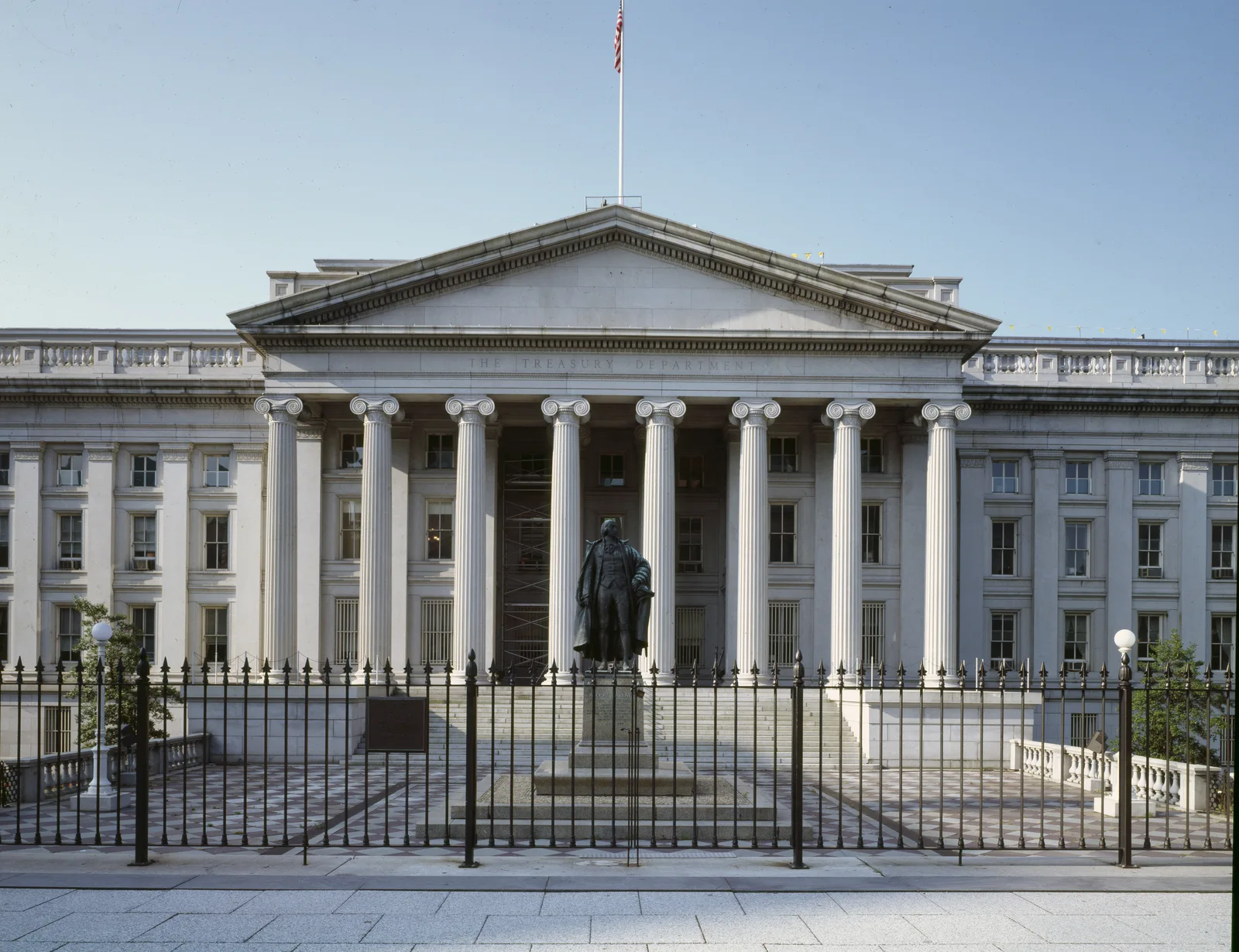
What The Treasury Department Does
Established September 2, 1789, The U.S. Department of the Treasury is one of the fifteen Cabinet-level departments of the U.S. federal government.
The Treasury Department is the government's chief financial agency. It collects federal taxes through the Internal Revenue Service, manages the roughly $40 trillion national debt by issuing and selling U.S. Treasury bonds and bills, and produces the nation's currency and coins through the Bureau of Engraving and Printing and the U.S. Mint.
Treasury also sets much of the country's international economic policy. It negotiates on trade and tariffs, represents the United States at the International Monetary Fund and World Bank, and imposes and enforces economic sanctions against hostile foreign governments, terrorist organizations, and drug cartels through its Office of Foreign Assets Control.
Domestically, Treasury oversees the safety and soundness of the banking system alongside the Federal Reserve and other regulators, fights financial crimes like money laundering and terrorist financing through its Financial Crimes Enforcement Network, and administers many of the tax credits and stimulus payments Congress creates during economic downturns.
The department also pays nearly all of the government's bills: the Bureau of the Fiscal Service disburses about 1.4 billion payments a year, roughly 90 percent of all federal payments, from Social Security checks to tax refunds to contractor invoices, and manages the government's daily cash flow and its checking account at the Federal Reserve.
The Secretary of the Treasury
The Secretary of the Treasury leads The Treasury Department, sits on the President's Cabinet, and is confirmed by a majority vote of the U.S. Senate.
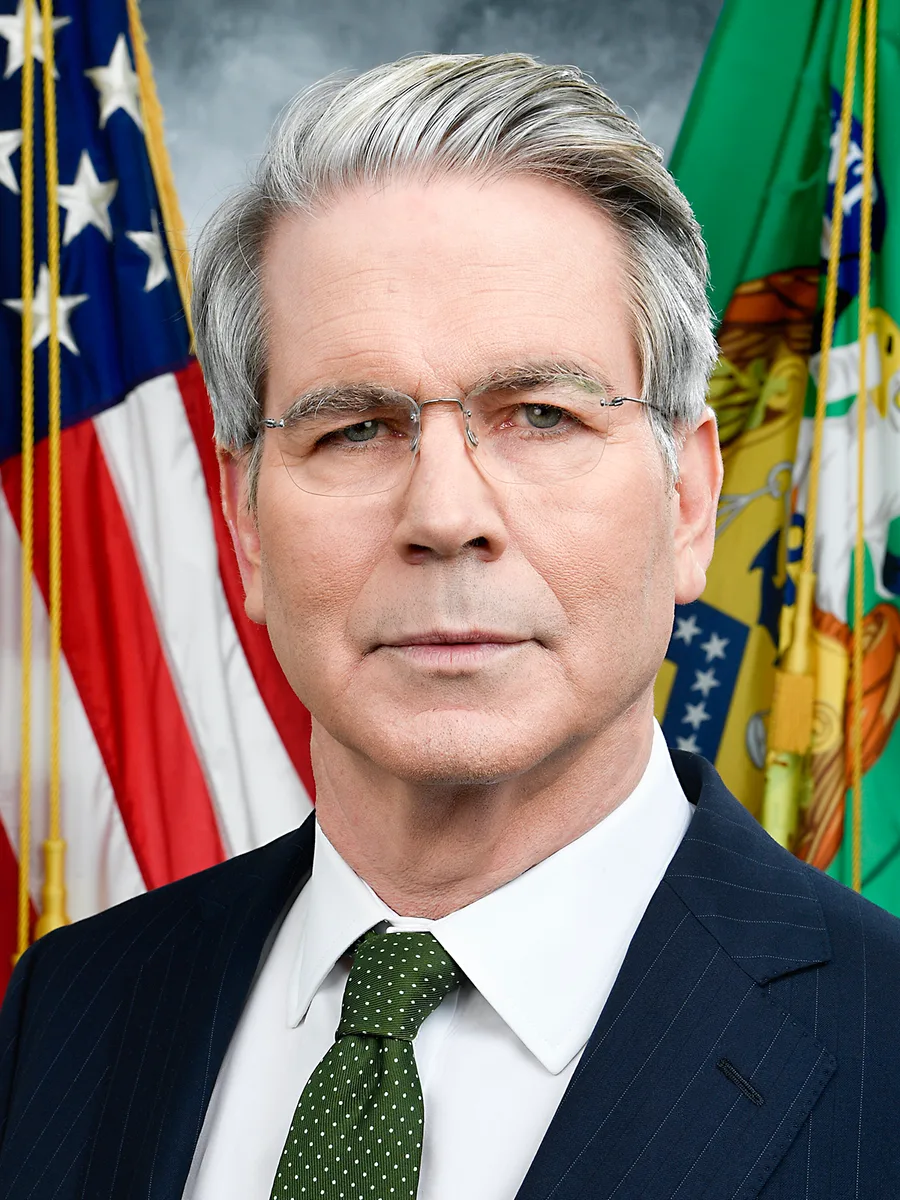
Current Secretary of the Treasury
Scott Bessent
In office since
January 28, 2025
Prior role: Founder and chief investment officer, Key Square Group (hedge fund manager)
Scott Bessent was confirmed as the 79th Secretary of the Treasury on January 28, 2025. Before joining the Cabinet, he spent decades in finance, including as a partner at Soros Fund Management and later as founder of his own macro hedge fund, Key Square Group.
As Treasury Secretary, Bessent has led the administration's tariff and trade negotiation strategy, overseen the department's response to federal debt ceiling standoffs, and chairs the Financial Stability Oversight Council, the interagency body created after the 2008 financial crisis to monitor systemic risk in the banking system.
Major Sub-Agencies & Bureaus
The Treasury Department carries out its mission through operating divisions and sub-agencies, each with its own specific mandate.
The IRS is the largest bureau within Treasury and the agency responsible for collecting nearly all federal tax revenue, more than $5 trillion in a typical year, from individual income taxes to corporate taxes to excise taxes. It processes over 160 million individual tax returns annually and administers the tax code Congress writes.
The IRS also runs taxpayer enforcement and audit programs, issues most federal tax refunds, and administers refundable tax credits like the Earned Income Tax Credit that function as a direct income supplement for millions of lower-income working families.
The agency's staffing and budget have been a running political fight. After years of cuts left it unable to answer most phone calls, the 2022 Inflation Reduction Act added roughly $80 billion over a decade for enforcement, service, and technology; Congress then clawed back a large share of it in subsequent budget deals.
Treasury and the Congressional Budget Office estimate every additional dollar spent on IRS enforcement returns several dollars in taxes that would otherwise go unpaid, part of a "tax gap" the IRS puts at several hundred billion dollars a year, concentrated among high-income filers and businesses with complex, hard-to-verify income.
The U.S. Mint produces all coins used in everyday commerce, striking billions of nickels, dimes, and quarters each year (it struck its last circulating penny on November 12, 2025) at facilities in Philadelphia, Denver, San Francisco, and West Point. It also produces commemorative coins and holds the nation's gold reserves at Fort Knox, Kentucky.
The Bureau of Engraving and Printing is where all U.S. paper currency is designed and printed, using specialized security features like color-shifting ink and embedded threads to deter counterfeiting. Both bureaus operate on a self-funding basis, largely covering their own costs through the value of the currency and coins they produce.
Coins have periodically cost more to make than they are worth: the Mint has reported that producing a penny costs several cents and a nickel more than a dime, prompting years of proposals to stop minting the one-cent coin, as Canada did in 2012; Treasury ended penny production in 2025.
The Mint keeps the difference between a coin's face value and its production cost, a profit called seigniorage that it returns to the Treasury general fund, historically several hundred million dollars a year. Fort Knox holds roughly 147 million ounces of gold, about half the government's total, and has had no full public audit since 1953.
OFAC administers and enforces U.S. economic and trade sanctions programs against targeted foreign countries, regimes, terrorist organizations, and drug traffickers. It maintains the Specially Designated Nationals list, which blocks designated individuals and entities from accessing the U.S. financial system.
OFAC's sanctions have become one of the U.S. government's primary non-military foreign policy tools in recent decades, used extensively against Russia following its 2022 invasion of Ukraine, against Iran's nuclear and missile programs, and against North Korea.
The office traces to the World War II-era Office of Foreign Funds Control, which froze Axis-country assets, and took its current form in 1950 to block Chinese and North Korean assets during the Korean War. Its authority rests largely on the International Emergency Economic Powers Act of 1977.
OFAC can fine or prosecute U.S. companies and, in effect, foreign banks that violate sanctions; penalties have reached into the billions of dollars for large European banks that processed transactions for sanctioned countries. Critics argue aggressive use of the dollar system is pushing some governments toward alternative payment channels.
FinCEN collects and analyzes financial transaction data to combat money laundering, terrorist financing, and other financial crimes. Banks and other financial institutions are legally required to report suspicious transactions to FinCEN, which shares that intelligence with law enforcement agencies across the federal government.
FinCEN also administers the Bank Secrecy Act, the primary federal anti-money-laundering law, and since 2024 has implemented new beneficial ownership reporting requirements aimed at unmasking the real people behind anonymous shell companies used to hide illicit finances.
Financial institutions file millions of Suspicious Activity Reports and Currency Transaction Reports (for cash movements over $10,000) each year. FinCEN itself has only a few hundred employees and acts mainly as an intelligence hub rather than an investigative agency.
The Corporate Transparency Act's beneficial-ownership registry, meant to end anonymous shell companies, was scaled back in 2025 after court challenges and a Treasury decision to exempt most U.S. companies, leaving the requirement to apply mainly to foreign-owned entities.
From September 2, 1789 to Today
The predecessor of The Treasury Department was no predecessor; created directly by the First Congress. Here is how the department reached its current form.
Congress established the Treasury Department on September 2, 1789, and President Washington appointed Alexander Hamilton as the first Secretary of the Treasury. Hamilton is credited with building the young nation's entire financial architecture, from the national bank to the assumption of state debts.
Hamilton's 1790 Report on Public Credit proposed that the federal government assume the Revolutionary War debts of the individual states, a controversial plan that ultimately passed Congress as part of the Compromise of 1790, which also relocated the national capital to the banks of the Potomac.
Congress gave Treasury an unusual degree of direct oversight, requiring the Secretary to report directly to the legislature on the state of the nation's finances, a reflection of Congress's constitutional power of the purse and its wariness of executive control over money.
To help fund the Civil War, Congress enacted the nation's first income tax in 1861 and created the office of Commissioner of Internal Revenue (the IRS's predecessor) in 1862. The wartime income tax was later repealed, and a federal income tax did not become permanent until the ratification of the 16th Amendment in 1913.
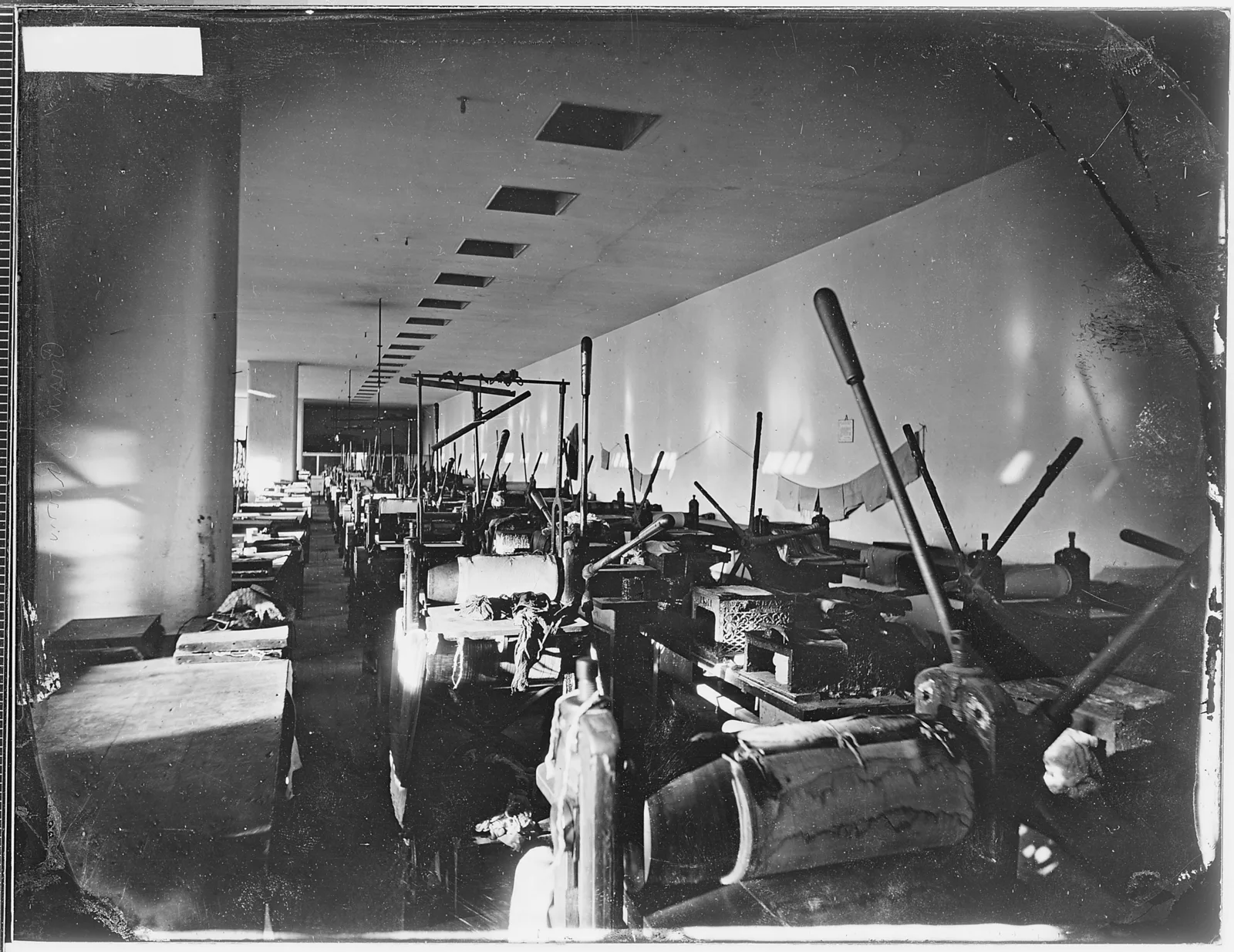
The Bureau of Engraving and Printing grew out of a Treasury operation begun in 1862 to trim and seal the first federally issued paper currency, known as 'greenbacks,' which helped finance the Union war effort when gold and silver reserves ran short.
The 1862 legislation also created the office of Commissioner of Internal Revenue and a web of excise taxes on goods from liquor and tobacco to playing cards. Alcohol and tobacco taxes remained the federal government's largest revenue source for decades after the income tax lapsed.
Ratification of the 16th Amendment in February 1913 gave Congress the constitutional authority to levy an income tax without apportioning it among the states, permanently establishing the income tax as the federal government's primary revenue source, administered through Treasury's Bureau of Internal Revenue.
Later that same year, Congress created the Federal Reserve System to serve as the nation's central bank. Though the Fed is an independent agency rather than part of Treasury, the Treasury Secretary works closely with the Fed chair on monetary and financial stability policy to this day.
The first modern income tax that year applied only to the roughly top 1 percent of earners, with a top rate of 7 percent. Rates rose steeply during the two world wars, and withholding from paychecks, the system most workers know, was introduced in 1943.
In 1953, the Bureau of Internal Revenue was reorganized and renamed the Internal Revenue Service, part of a broader modernization effort intended to professionalize tax administration and reduce the political patronage that had periodically plagued the agency's earlier decades.
The reorganization moved the agency toward the geographically decentralized, function-based structure that, with further modernization in the late 1990s, still largely shapes how the IRS operates today.
The 1998 IRS Restructuring and Reform Act, passed after Senate hearings featuring taxpayer complaints, reorganized the agency around taxpayer types rather than geography, created an independent oversight board and a taxpayer advocate, and added new protections and burden-of-proof rules for taxpayers in disputes.
During the 2008 financial crisis, Treasury Secretary Henry Paulson led the creation of the Troubled Asset Relief Program (TARP), a $700 billion fund Congress authorized to stabilize banks and other financial institutions on the brink of collapse, one of the largest single interventions in the history of the department.
The crisis also led Congress to pass the Dodd-Frank Act in 2010, which created the Financial Stability Oversight Council, chaired by the Treasury Secretary, to monitor risks to the broader financial system and coordinate response among the many federal agencies that regulate banks and markets.
TARP ultimately disbursed about $443 billion and, after repayments, dividends, and the sale of stakes in banks and automakers, was estimated to have cost taxpayers on the order of $30 to $40 billion, far less than the headline figure. Treasury also placed mortgage giants Fannie Mae and Freddie Mac into federal conservatorship, where they remain.
Defining Moments
Events that reshaped the department's authority, structure, or public role.
Hamilton's plan for the federal government to assume Revolutionary War debts incurred by the states was one of the most consequential financial decisions in early American history, establishing the credibility of the new federal government's credit in international markets.
The plan was deeply controversial, pitting states like Massachusetts that had large outstanding debts against states like Virginia that had already paid theirs off, and its passage required a political deal that also decided the permanent location of the national capital.
The bargain was struck at a June 1790 dinner Thomas Jefferson hosted for Hamilton and James Madison: the Southern states would allow assumption to pass, and in return the permanent capital would be built on the Potomac rather than remain in Philadelphia or New York.
Hamilton paired assumption with a plan to fund the combined national debt with reliable tax revenue and a national bank. The result was that U.S. bonds soon traded at or above face value in Europe, giving the young country the borrowing capacity it would need in later crises.
In August 1971, President Nixon, acting through Treasury, ended the direct convertibility of the U.S. dollar into gold, a move known as the 'Nixon Shock' that effectively ended the Bretton Woods international monetary system established after World War II.
The decision moved the world's major currencies to a floating exchange rate system that persists today, fundamentally changing how Treasury and the Federal Reserve manage the dollar's value and America's role in the global financial system.
By 1971 foreign governments held far more dollars than the United States could redeem for gold at the fixed $35-an-ounce rate, and countries such as France were converting dollars to bullion. Nixon closed the "gold window" and simultaneously imposed wage and price controls and an import surcharge.
The 1944 Bretton Woods conference had also created the International Monetary Fund and the World Bank, both of which Treasury still represents the United States at. Even off the gold standard, the dollar remained the world's dominant reserve currency and the unit for pricing oil and most commodities.
Because Congress separately caps how much the federal government may legally borrow, Treasury periodically finds itself managing the government's finances under a statutory debt ceiling that Congress has not yet raised, most notably during standoffs in 2011, 2013, 2021, and 2023.
When the ceiling is not raised in time, Treasury uses accounting maneuvers known as 'extraordinary measures' to keep paying the government's bills, a practice that has become a recurring flashpoint in Washington and, in 2011, triggered the first-ever downgrade of the United States' top-tier credit rating.
The ceiling has existed since 1917, when Congress stopped approving each bond issue individually, and has been raised, extended, or suspended roughly 100 times. Raising it does not authorize new spending; it lets Treasury borrow to pay for spending Congress has already approved.
Treasury has never actually missed a payment on the debt, but the 2011 and 2023 fights each came within days of a projected "X-date," and all three major credit agencies, S&P in 2011, Fitch in 2023, and Moody's in 2025, cited the brinkmanship as a reason for stripping the U.S. of a top rating.
Notable Programs & Initiatives
A selection of the programs The Treasury Department runs, and what each one is actually for.
Treasury issues a range of debt securities, from short-term Treasury bills to 30-year bonds, that finance the federal government's borrowing needs and are widely considered among the safest investments in the world. Individual investors can also buy Series I and EE savings bonds directly through TreasuryDirect.gov.
These securities form the backbone of the global financial system, since Treasury bonds are held as reserve assets by foreign central banks and used as the benchmark 'risk-free rate' against which nearly every other financial asset in the world is priced.
Treasury sells new securities through regular auctions run by the Federal Reserve Bank of New York, tens of trillions of dollars' worth a year counting the constant rollover of maturing debt. About a quarter of the publicly held debt is owned by foreign governments and investors, led historically by Japan and China.
Series I savings bonds, whose rate is tied to inflation, drew a surge of buyers in 2022 when the rate briefly exceeded 9 percent, overwhelming the aging TreasuryDirect website. Savings bonds are a small slice of federal borrowing but a long-running way for ordinary households to lend directly to the government.
Through the IRS, Treasury administers refundable tax credits such as the Earned Income Tax Credit and the Child Tax Credit, which reduce a filer's tax bill and, if the credit exceeds what they owe, pay out the difference as a refund, functioning as one of the largest anti-poverty programs in the federal government.
The IRS issues more than $300 billion in individual tax refunds each year, and for many lower-income families, the tax refund season represents the single largest cash infusion they receive all year.
The EITC alone delivers roughly $60 billion a year to about 23 million households, and research has linked it to increased work among single parents and to better birth and school outcomes for children in recipient families. It also has a relatively high improper-payment rate, largely from complex eligibility rules rather than fraud.
During downturns, Treasury and the IRS become the government's fastest delivery channel for aid: the 2020 and 2021 economic-impact payments and the temporarily expanded, monthly Child Tax Credit of 2021 were paid out directly through the tax system to most American households.
The CDFI Fund provides grants and tax credits to specialized banks, credit unions, and loan funds that serve low-income communities often overlooked by traditional banks, helping finance small businesses, affordable housing, and community facilities in underserved areas.
Since its creation in 1994, the CDFI Fund has certified more than 1,400 community development financial institutions across the country, channeling billions of dollars in private capital toward economically distressed communities.
Its largest tool is the New Markets Tax Credit, which gives investors a credit worth 39 percent of an investment over seven years for projects in low-income census tracts; Congress has authorized tens of billions of dollars in credit allocation since 2000.
The fund is small relative to Treasury's other work, a few hundred million dollars a year, but it is one of the department's few direct community-level programs, and CDFIs played an outsized role in distributing pandemic-era Paycheck Protection Program loans to the smallest businesses.
Treasury's sanctions programs, run primarily through OFAC, block designated individuals, companies, and even entire economic sectors of targeted countries from accessing U.S. dollars and the American financial system, one of the most powerful non-military levers the U.S. government has over foreign adversaries.
Because so much of global trade is denominated in U.S. dollars, even foreign banks with no U.S. operations often comply with Treasury sanctions to avoid being cut off from dollar-clearing systems, giving American sanctions global reach far beyond U.S. borders.
The SDN list has grown to well over 10,000 entries, and post-2022 measures on Russia went further than any prior program, freezing about $300 billion in central-bank reserves held abroad and, with allies, setting a price cap on Russian seaborne oil enforced through Western shipping and insurance.
Analysts debate how well broad sanctions change government behavior; targeted "smart" sanctions on individuals and firms are generally seen as more precise. Treasury periodically issues general licenses to permit humanitarian trade, food, and medicine even with heavily sanctioned countries.
How This Affects Everyday Americans
Nearly every working American interacts with the Treasury Department every year through the IRS, whether filing a tax return, receiving a refund, or having taxes withheld from a paycheck. The department's decisions about tax enforcement, refund processing speed, and credits like the Child Tax Credit directly affect household budgets nationwide.
Treasury's management of the national debt and interest rates on government borrowing ripples through the broader economy, influencing mortgage rates, credit card interest, and business borrowing costs, since Treasury bond yields serve as the baseline for pricing most other loans in the country.
The physical cash and coins in every American's wallet come directly from Treasury's Mint and Bureau of Engraving and Printing, and the department's sanctions decisions can also affect gas prices, import costs, and the availability of certain goods when they target countries that supply key commodities.
Treasury also cuts most of the checks the government sends: Social Security and veterans' benefits, federal salaries, and tax refunds all flow through the Bureau of the Fiscal Service, so a lapse in Treasury operations would be felt in tens of millions of bank accounts within days.
Quick Facts & Figures
Key statistics and reference information about The Treasury Department.
| Established | September 2, 1789 |
| Headquarters | Treasury Building, Washington, D.C. |
| Current Secretary | Scott Bessent |
| Annual Budget | ~$16 billion (FY2025 operating budget) |
| Employees | ~86,000 |
| First Secretary | Alexander Hamilton (1789) |
| Succession Order | 5th in line for the presidency |
| Website | treasury.gov |
Did You Know?
Treasury runs the IRS, the U.S. Mint, and the Bureau of Engraving and Printing, meaning it both collects the nation's tax money and physically prints and stamps the currency it's paid in.
Alexander Hamilton, the first Treasury Secretary, was killed in an 1804 duel with sitting Vice President Aaron Burr, one of the most famous events in early American political history.
The gold held at Fort Knox, managed by the U.S. Mint, has not been publicly audited in full since the 1950s, making it a persistent subject of conspiracy theories and congressional curiosity.
The federal income tax only became constitutionally permanent in 1913, with the ratification of the 16th Amendment, over a century after Treasury itself was created.
Treasury's OFAC sanctions list has grown to include thousands of individuals, companies, vessels, and even entire economic sectors of countries like Russia, Iran, and North Korea.