U.S. Army
"This We'll Defend", founded June 14, 1775.
The Continental Congress created the Continental Army on June 14, 1775, under the command of George Washington, making the Army the oldest branch of the U.S. armed forces. Today it is also the largest, with roughly 450,000 active-duty soldiers organized into divisions, brigades, and specialized commands responsible for the vast majority of sustained ground combat operations the United States conducts.
The Army's mission spans everything from armored warfare and infantry combat to logistics, medicine, cyber operations, and military intelligence, reflecting the sheer range of jobs needed to deploy and sustain a modern ground force anywhere in the world. Unlike the Navy and Air Force, which each run a single enlisted boot camp, the Army operates several Basic Combat Training posts to handle its much larger annual recruiting intake.
Counting the Army National Guard and Army Reserve, the total Army is close to a million people, and it offers roughly 190 enlisted job specialties (MOSs), the widest menu of any service. The Army also missed its recruiting goal by tens of thousands in 2022 and 2023 before rebounding, a shortfall that reshaped its incentives and led it to create the Future Soldier Prep Course for applicants who fall just short on fitness or academic standards.
The Army is a Department of the Army headed by a civilian Secretary of the Army, under the Secretary of Defense, with the four-star Chief of Staff of the Army as its senior uniformed officer. Its bases were among those renamed in 2023-25 (Fort Bragg to Fort Liberty and back, Fort Benning to Fort Moore, and others) as Congress and successive administrations changed the policy on installations named for Confederate officers.
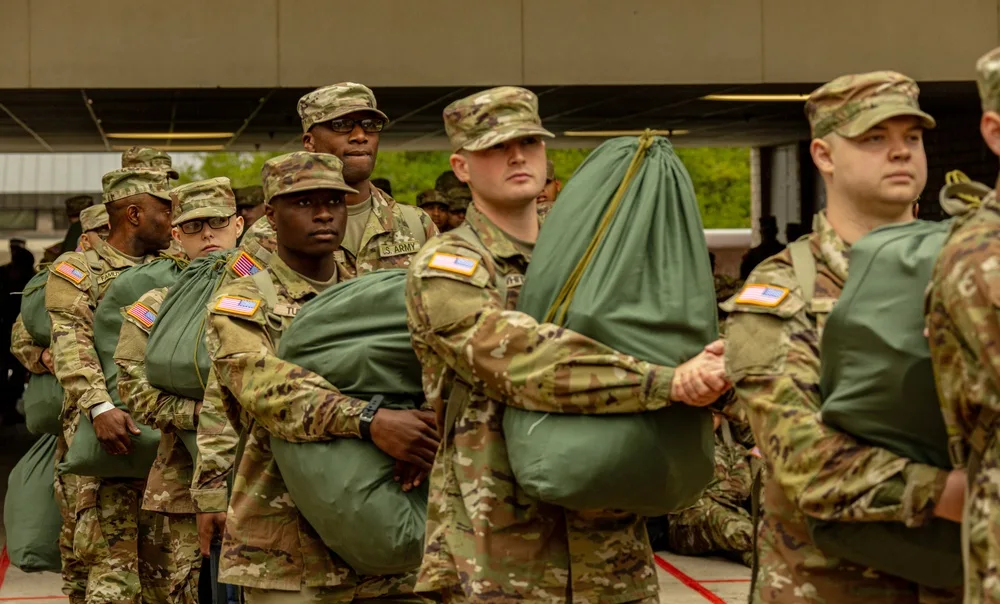
A drill sergeant directs Basic Combat Training soldiers at Fort Leonard Wood, Missouri, one of the Army's basic training installations alongside Fort Jackson, South Carolina, the largest.
How to Join the U.S. Army
Applicants must be U.S. citizens or permanent residents between 17 (with parental consent) and 34 years old, hold a high school diploma or equivalent, and pass the ASVAB along with a medical exam at MEPS. The Army sets a minimum Armed Forces Qualification Test (AFQT) score, drawn from ASVAB results, of 31 for most enlisted jobs, though competitive and technical specialties require higher scores.
The Army offers one of the widest ranges of enlistment options among the branches, including jobs the applicant can guarantee in writing before shipping to training, and programs like Army Prep Course for candidates who need to improve their fitness or academic scores before starting Basic Combat Training.
After ASVAB testing, applicants choose a Military Occupational Specialty (MOS) from the jobs their scores qualify them for and sign an enlistment contract at MEPS specifying that job in writing, a guarantee unique among the services in how explicitly it is documented before training begins.
New soldiers report to one of several Basic Combat Training (BCT) posts, Fort Jackson, South Carolina processes roughly half of all Army recruits, with additional BCT conducted at Fort Sill, Oklahoma, Fort Benning, Georgia, and Fort Leonard Wood, Missouri. BCT runs ten weeks, followed by Advanced Individual Training (AIT) at a location tied to the soldier's specific MOS.
Commissioning routes include the U.S. Military Academy at West Point, New York (a four-year, tuition-free program), Army ROTC, offered on more than 1,100 college campuses nationwide through host and cross-town programs, and Officer Candidate School (OCS) at Fort Benning, Georgia, a roughly 12-week program open to college graduates and enlisted soldiers.
The Army's 'Green to Gold' program lets qualified enlisted soldiers leave active duty to complete a bachelor's degree through ROTC and return as a commissioned officer, one of the more direct enlisted-to-officer pathways offered by any branch.
Popular Career Fields
Infantry soldiers close with and destroy the enemy through direct ground combat, organized into rifle squads, platoons, and companies that form the backbone of every Army combat brigade. Infantry remains one of the largest single career fields in the Army by raw number of soldiers.
The Army opened all infantry positions to women in 2016, following a Department of Defense decision to end the direct ground combat exclusion policy, and the first women graduated Infantry Basic Officer Leader Course and enlisted infantry training in 2017.
Army Military Police conduct law enforcement on Army installations, battlefield circulation control, detainee operations, and combat support missions, making MP one of the more operationally varied enlisted career fields, blending stateside policing duties with deployed combat roles.
MPs also provide the pool from which the Army selects Criminal Investigation Division (CID) special agents, who investigate felony-level crimes involving Army personnel and property worldwide, a career path that requires additional training and often civilian law enforcement partnership experience.
Combat medics provide emergency medical treatment to soldiers in the field and during combat, often under fire, and are trained and certified as Emergency Medical Technicians, a credential that transfers directly to civilian EMT and paramedic careers after service.
Every Army combat medic completes the same core curriculum at the Army Medical Center of Excellence at Joint Base San Antonio, alongside Air Force and Navy medical trainees, one of the clearest examples of the services sharing training infrastructure across branches.
Cyber Operations Specialists conduct offensive and defensive cyberspace operations to protect Army networks and disrupt adversary systems, working within Army Cyber Command and alongside the other services' cyber components under U.S. Cyber Command.
The Army created the Cyber career field as a distinct branch in 2014, one of the newest basic branches in Army history, and cyber soldiers train at Fort Gordon, Georgia, home to both the Army Cyber School and the National Security Agency's largest listening post outside its Maryland headquarters.
Pay & Benefits
Soldiers receive Tricare healthcare, a housing allowance, and eligibility for the Post-9/11 GI Bill, along with Army-specific tuition assistance for off-duty college coursework while still serving. The Army has offered some of the largest enlistment bonuses in the military for high-demand and hard-to-fill specialties, with bonuses for certain critical jobs reported as high as $50,000 during periods of aggressive recruiting.
After 20 years of service, soldiers qualify for a lifetime pension under the Blended Retirement System, combined with a Thrift Savings Plan the soldier contributes to throughout their career, and the Army's sheer size means it offers the widest range of stateside and overseas duty station options of any branch.
Sources & Further Reading
- U.S. Army, GoArmy.com, How to Join
- U.S. Navy, Navy.com, Joining the Navy
- U.S. Air Force, AirForce.com, Basic Military Training
- U.S. Marine Corps, Marines.com, Recruit Training
- USA.gov, How to Join the Military
- Naval History and Heritage Command, U.S. Navy
- Air Force Historical Support Division
- Marine Corps History Division
- U.S. Army Center of Military History
- U.S. Space Force, SpaceForce.com, How to Join
- U.S. Coast Guard, GoCoastGuard.com, Eligibility & Basic Training
- The National Guard, NationalGuard.mil, How We Began
Personnel figures, boot camp lengths, and age limits reflect the most recently published figures from each branch and are approximate, exact numbers change from year to year as each service adjusts its recruiting goals and policies.