How Capital Punishment Works Today
Who can impose a death sentence, for which crimes, and how executions are carried out.
There is no single American death penalty. Each of the 50 states decides for itself through its own laws, and the federal government and the military each have their own separate systems. That is why a crime can bring a death sentence in one state and a maximum of life in prison across the border.
As of October 2026, 27 states have the death penalty in their laws, according to the Death Penalty Information Center. In four of them, California, Ohio, Oregon, and Pennsylvania, the governor has paused executions, so no one is being executed there even though courts may still impose death sentences in some of them. Twenty-three states and the District of Columbia have abolished it.
A governor's pause is not the same as abolition. A pause can be lifted by the next governor without any change in the law, while abolition takes an act of the legislature, a vote of the people, or a ruling by the state's highest court. Several abolitions have come through the courts, including Washington's in 2018 and Delaware's in 2016.
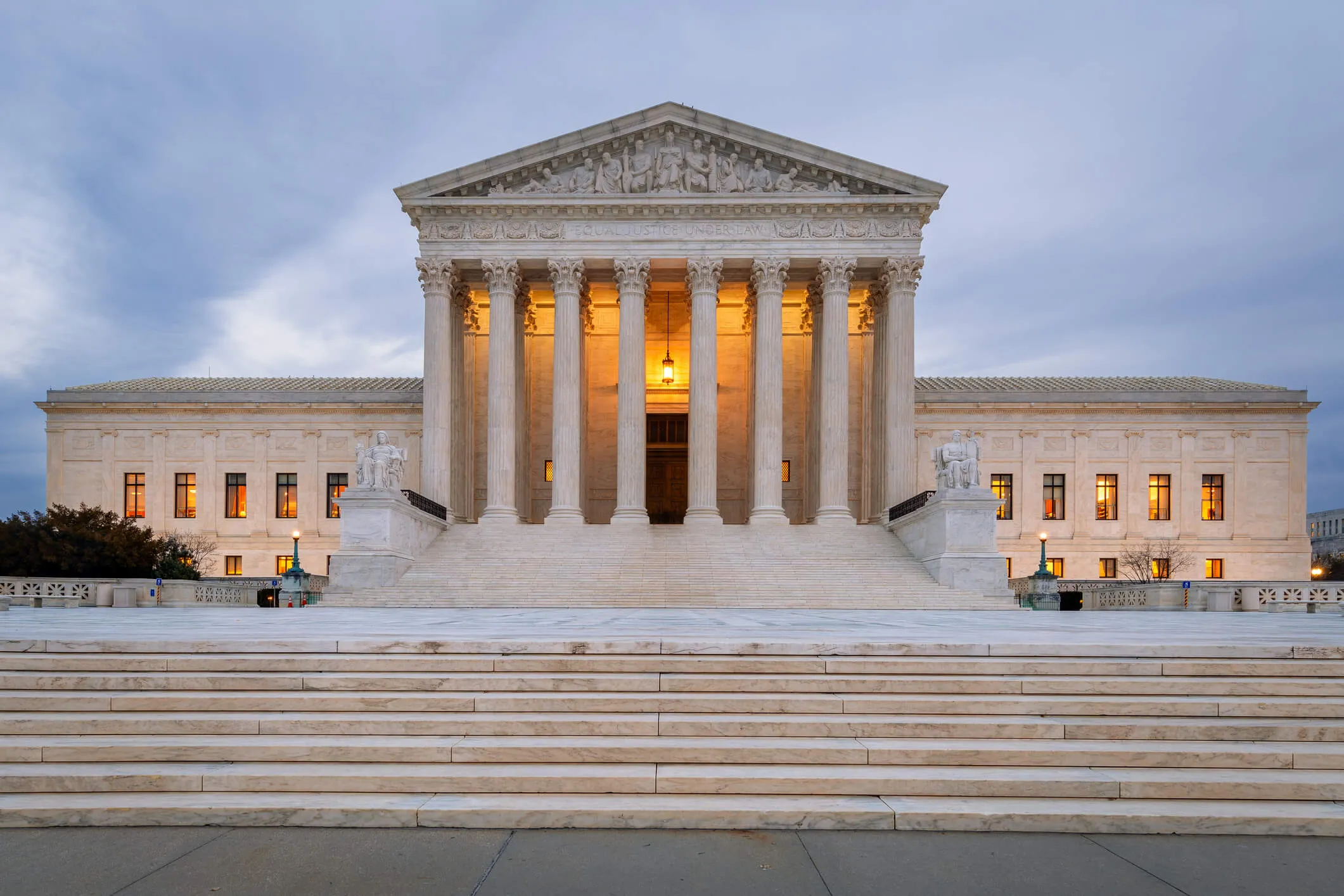
Whatever a state decides, it must stay inside the limits the Supreme Court has drawn from the Eighth Amendment, which forbids cruel and unusual punishment. Those rulings decide which crimes can be punished by death, who cannot be executed, and what process a trial must follow. They are covered on the Supreme Court tab of this page.
In every state that has the death penalty, the crime is a form of murder with an added aggravating factor. The lists vary by state, but they usually include killing a police officer, murder for hire, murder during another serious felony such as robbery or rape, killing more than one person, killing a child, and murder by someone already serving a life sentence.
A conviction alone is not enough. Since 1976 the Supreme Court has required that a death sentence come from a separate sentencing hearing in which the jury weighs aggravating factors against mitigating evidence about the defendant, such as age, mental illness, or a history of abuse. Mandatory death sentences, imposed automatically for a crime, are unconstitutional.
Federal law covers a wider list. Under the Federal Death Penalty Act of 1994 (18 U.S.C. 3591 and following), federal prosecutors can seek death for about 60 crimes, most involving a killing, such as murder of a federal officer, terrorism that causes death, and killings tied to large drug trafficking operations. Treason and espionage can also carry death without a killing, though no one has been sentenced to death for them in the modern era.
Some states have written laws allowing death for child rape that does not end in a killing, despite the Supreme Court's 2008 ruling in Kennedy v. Louisiana that such sentences are unconstitutional. Florida (2023) and Tennessee (2024) were first, and others have followed, including Alabama in February 2026; supporters have said they hope the Court will revisit Kennedy. No one has been executed under these laws.
The federal government has had the death penalty since the Crimes Act of 1790. Federal capital cases are prosecuted by the Department of Justice, and the attorney general personally decides whether to seek death in each case. Federal executions take place at the U.S. Penitentiary in Terre Haute, Indiana.
Federal executions have been rare. After Victor Feguer in 1963, none took place until Timothy McVeigh, the Oklahoma City bomber, in 2001. The government then carried out 13 executions in six months, from July 2020 to January 2021, more than in the previous six decades combined. Sixteen federal executions have taken place since 1988 in all, all by lethal injection, according to DPIC.
On December 23, 2024, President Biden commuted the sentences of 37 of the 40 men on federal death row to life without parole. The three who remain are Dzhokhar Tsarnaev (the 2013 Boston Marathon bombing), Robert Bowers (the 2018 Pittsburgh synagogue shooting), and Dylann Roof (the 2015 Charleston church shooting).
On February 5, 2025, Attorney General Pam Bondi lifted the pause on federal executions that her predecessor had ordered in 2021 and directed prosecutors to seek death more often. On April 24, 2026, the Justice Department issued a report directing the Bureau of Prisons to restore the pentobarbital protocol used in 2020 and 2021 and to add other methods, including the firing squad, and asking Congress to widen the federal death penalty. As of October 2026, no new federal execution had been carried out.
Lethal injection is the main method in every state that executes people and in the federal system. Some states use a single drug, pentobarbital, as Texas and the federal government do; others use a three-drug sequence of a sedative such as midazolam, a paralytic, and a drug that stops the heart. Drug makers' refusals to sell for executions have caused shortages, and many states now keep their suppliers secret by law.
Those shortages pushed several states to authorize other methods. Nitrogen hypoxia, in which the prisoner breathes pure nitrogen through a mask until death, is authorized in Alabama, Arkansas, Louisiana, Mississippi, and Oklahoma. Alabama carried out the first nitrogen execution in the world on January 25, 2024, and Louisiana followed in March 2025. In June 2026, a federal judge barred Alabama from using nitrogen on one prisoner, finding its protocol unconstitutional, and the Supreme Court declined to step in.
The firing squad has returned as well. South Carolina carried out the first firing squad execution in the United States in 15 years on March 7, 2025. Idaho made the firing squad its primary method as of July 1, 2026, the only state to do so, and Utah, Mississippi, and Oklahoma also authorize it.
A few states keep the electric chair as an option the prisoner can choose, including South Carolina and Tennessee. No state uses hanging or the gas chamber as its primary method today, though they remain in some laws as backups.
The armed forces have their own death penalty under the Uniform Code of Military Justice. A court-martial can impose death for certain crimes, including premeditated murder, and in wartime for offenses such as desertion and spying.
What makes the military system unique is the final step. Under Article 57 of the Uniform Code (Article 71 before 2019), a military death sentence cannot be carried out until the President personally approves it. No other American death sentence needs the president's signature.
The last military execution took place in 1961, when the Army hanged Private John Bennett, convicted of the rape and attempted murder of an 11-year-old girl in Austria. President George W. Bush approved the execution of former Army Private Ronald Gray in 2008, but court challenges have kept it from happening. Every presidential decision and court battle is laid out on the military death penalty page.
On October 2, 2026, President Trump approved the death sentence of former Army Major Nidal Hasan, who killed 12 soldiers and one civilian at Fort Hood, Texas, on November 5, 2009, after Defense Secretary Pete Hegseth recommended it. The Army scheduled his execution by firing squad for December 3, 2026, at Fort Hood, which would be the first military execution in more than 60 years. Army rules require an execution to take place no sooner than 60 days and no later than 150 days after the president's approval, and Hasan can still seek a stay in the federal courts.
Where Every State Stands
Each state decides for itself whether to have the death penalty. States marked "paused" keep it in law, but the governor has stopped executions.
- In lawDeath penalty in law: 23 states
- PausedGovernor's pause on executions: 4 states
- AbolishedAbolished: 23 states (and the District of Columbia)
| State | Status |
|---|---|
| Alabama | In lawDeath penalty in law |
| Alaska | AbolishedAbolished 1957 |
| Arizona | In lawDeath penalty in law |
| Arkansas | In lawDeath penalty in law |
| California | PausedGovernor's pause since 2019 |
| Colorado | AbolishedAbolished 2020 |
| Connecticut | AbolishedAbolished 2012 |
| Delaware | AbolishedAbolished 2016 |
| Florida | In lawDeath penalty in law |
| Georgia | In lawDeath penalty in law |
| Hawaii | AbolishedAbolished 1957 |
| Idaho | In lawDeath penalty in law |
| Illinois | AbolishedAbolished 2011 |
| Indiana | In lawDeath penalty in law |
| Iowa | AbolishedAbolished 1965 |
| Kansas | In lawDeath penalty in law |
| Kentucky | In lawDeath penalty in law |
| Louisiana | In lawDeath penalty in law |
| Maine | AbolishedAbolished 1887 |
| Maryland | AbolishedAbolished 2013 |
| Massachusetts | AbolishedAbolished 1984 |
| Michigan | AbolishedAbolished 1847 |
| Minnesota | AbolishedAbolished 1911 |
| Mississippi | In lawDeath penalty in law |
| Missouri | In lawDeath penalty in law |
| Montana | In lawDeath penalty in law |
| Nebraska | In lawDeath penalty in law |
| Nevada | In lawDeath penalty in law |
| New Hampshire | AbolishedAbolished 2019 |
| New Jersey | AbolishedAbolished 2007 |
| New Mexico | AbolishedAbolished 2009 |
| New York | AbolishedAbolished 2007 |
| North Carolina | In lawDeath penalty in law |
| North Dakota | AbolishedAbolished 1973 |
| Ohio | PausedGovernor's pause since 2020 |
| Oklahoma | In lawDeath penalty in law |
| Oregon | PausedGovernor's pause since 2011 |
| Pennsylvania | PausedGovernor's pause since 2015 |
| Rhode Island | AbolishedAbolished 1984 |
| South Carolina | In lawDeath penalty in law |
| South Dakota | In lawDeath penalty in law |
| Tennessee | In lawDeath penalty in law |
| Texas | In lawDeath penalty in law |
| Utah | In lawDeath penalty in law |
| Vermont | AbolishedAbolished 1972 |
| Virginia | AbolishedAbolished 2021 |
| Washington | AbolishedAbolished 2023 |
| West Virginia | AbolishedAbolished 1965 |
| Wisconsin | AbolishedAbolished 1853 |
| Wyoming | In lawDeath penalty in law |
Status from the Death Penalty Information Center's state-by-state list, checked October 9, 2026. The abolition year is the year the death penalty ended in that state, by a law, a court ruling, or both. Washington's Supreme Court struck down its death penalty in 2018, and the Legislature repealed it in 2023. Delaware's Supreme Court struck its law down in 2016.
The Supreme Court Sets the Limits
The Eighth Amendment bans cruel and unusual punishment, and the Supreme Court's readings of it decide who can be executed, for what, and how.
In Furman v. Georgia (1972), the Court ruled 5 to 4 that the death penalty, as states were then using it, violated the Eighth Amendment. There was no single majority opinion; each of the nine justices wrote separately. The common thread among the five in the majority was that juries had no standards to guide them, so death sentences fell on a few defendants in a way Justice Potter Stewart compared to being struck by lightning. You can read more about the Court's biggest rulings among the landmark Supreme Court cases.
Furman emptied death rows across the country. More than 600 death sentences were reduced to prison terms, and states set out to write new laws that would satisfy the Court.
Four years later, in Gregg v. Georgia (1976), the Court upheld Georgia's new law, ruling that the death penalty is not in itself unconstitutional when the law guides the jury's choice. The same day it upheld the new laws of Florida (Proffitt v. Florida) and Texas (Jurek v. Texas).
Also that day, in Woodson v. North Carolina, the Court struck down laws that made death automatic for certain crimes. The sentencing hearing with aggravating and mitigating evidence that every capital trial now has comes from these 1976 decisions.
Over the following decades the Court ruled certain people and crimes outside the death penalty's reach. In Coker v. Georgia (1977) it barred death for the rape of an adult, and in Kennedy v. Louisiana (2008) it extended that to any crime against an individual that does not take a life.
In Atkins v. Virginia (2002), the Court ruled that people with intellectual disabilities cannot be executed, reversing a 1989 decision. Later cases, Hall v. Florida (2014) and Moore v. Texas (2017), told states they could not use rigid IQ cutoffs or outdated tests to decide who qualifies.
In Roper v. Simmons (2005), the Court barred death sentences for crimes committed before age 18, reversing a 1989 ruling that had allowed them for 16- and 17-year-olds.
A prisoner must also be mentally competent at the time of execution. Ford v. Wainwright (1986) forbade executing someone who is insane, and Panetti v. Quarterman (2007) added that the prisoner must have a rational understanding of why the state is carrying out the sentence.
The Sixth Amendment guarantees the right to a jury trial. In Ring v. Arizona (2002), the Court ruled that a jury, not a judge alone, must find the facts that make a defendant eligible for death.
In Hurst v. Florida (2016), the Court applied the same rule to Florida, where a jury's recommendation had been only advisory and a judge made the final findings. Florida rewrote its law, and in 2023 it changed again to allow a death sentence when at least 8 of 12 jurors agree.
Most death penalty states require a unanimous jury for a death sentence. Florida (8 of 12) and Alabama (10 of 12) are the exceptions, according to DPIC.
In Batson v. Kentucky (1986), the Court also barred prosecutors from striking jurors because of race, a rule it applied in Flowers v. Mississippi (2019) to overturn a death sentence after a prosecutor struck Black jurors across six trials of the same defendant.
The Court has never struck down a method of execution. In Wilkerson v. Utah (1879) it upheld the firing squad, and in In re Kemmler (1890) the electric chair.
In Baze v. Rees (2008), it upheld Kentucky's three-drug lethal injection, ruling that a method is not unconstitutional just because it carries some risk of pain. In Glossip v. Gross (2015), it upheld Oklahoma's use of midazolam and held that a prisoner challenging a method must point to a known and available alternative.
In Bucklew v. Precythe (2019), the Court ruled that the Eighth Amendment does not guarantee a painless death, only one that does not superadd terror, pain, or disgrace, and that the prisoner had not shown his proposed alternative, nitrogen gas, would significantly reduce his suffering.
These rulings are why most method challenges fail in the Supreme Court. Lower courts can still block a specific execution, as a federal judge did for Alabama's nitrogen protocol in June 2026.
Warren McCleskey, a Black man sentenced to death in Georgia for killing a white police officer, relied on a study led by law professor David Baldus. It found that defendants charged with killing white victims in Georgia were far more likely to be sentenced to death than those charged with killing Black victims.
In McCleskey v. Kemp (1987), the Court accepted the study as valid but ruled 5 to 4 that statistics alone did not prove that anyone in McCleskey's own case had acted with discriminatory intent. A defendant must show purposeful discrimination in his own case.
Justice Lewis Powell, who wrote the majority opinion, told his biographer after retiring that he would change his vote in McCleskey if he could.
Some states responded with their own laws. North Carolina passed a Racial Justice Act in 2009 that allowed statistical challenges and later repealed it in 2013, and California passed a Racial Justice Act in 2020.
Capital Punishment in America: A Timeline
From the first recorded execution in Jamestown to the present day.
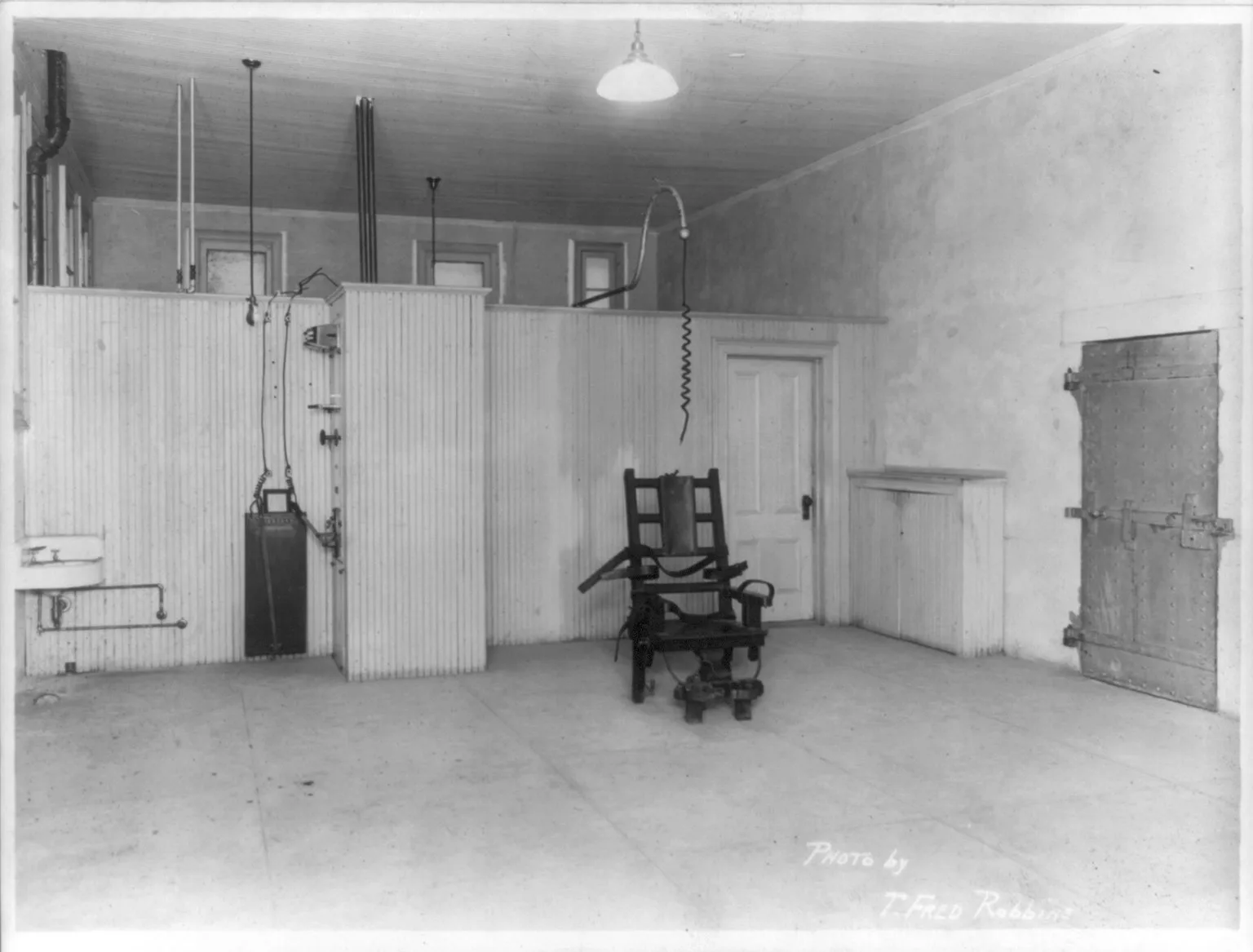
George Kendall, a council member of the Jamestown colony in Virginia, was executed by firing squad in 1608 after being accused of spying for Spain. It is the earliest recorded execution in the English colonies.
Colonial laws made many crimes punishable by death, often including theft and other offenses that would not be capital crimes today.
The first Congress passed the Crimes Act of 1790, making treason, murder on federal property, piracy, and several other crimes punishable by death.
The Fifth Amendment, ratified in 1791 as part of the Bill of Rights, assumes the death penalty exists: it says no one may be "deprived of life, liberty, or property, without due process of law."
Michigan became the first state to abolish the death penalty for murder, in a law passed in 1846 that took effect in 1847. It kept death only for treason against the state, which was never used.
Rhode Island (1852) and Wisconsin (1853) followed.
New York carried out the first execution by electric chair on August 6, 1890, at Auburn Prison, when William Kemmler was put to death. The state had adopted the chair as a more humane replacement for hanging.
The Supreme Court upheld it that year in In re Kemmler. Electrocution spread to most states over the next three decades.
Nevada carried out the first execution by lethal gas on February 8, 1924, when Gee Jon was put to death at the state prison in Carson City.
Gas chambers were later built in about a dozen states, mostly in the West and South.
The last public execution in the United States took place on August 14, 1936, in Owensboro, Kentucky, when Rainey Bethea was hanged before a crowd estimated in the thousands.
Executions peaked in the same decade, with nearly 200 in 1935 alone, more than in any year since.
Luis Monge was executed in Colorado's gas chamber on June 2, 1967. It was the last execution in the United States for almost 10 years, as legal challenges to the death penalty moved through the courts.
Executions had already been falling through the 1960s. Only one person was executed in the United States in 1966, according to the Bureau of Justice Statistics.
On June 29, 1972, the Supreme Court ruled that the death penalty as then applied was unconstitutional. Death sentences across the country were reduced to prison terms.
The case was the result of a years-long legal campaign by the NAACP Legal Defense Fund against the death penalty. The 5 to 4 decision produced nine separate opinions, one from every justice.
On July 2, 1976, the Court upheld new death penalty laws in Georgia, Florida, and Texas, and struck down mandatory death sentences. States began sentencing people to death again.
The mandatory laws struck down that day were North Carolina's (Woodson v. North Carolina) and Louisiana's (Roberts v. Louisiana). Their rejection is why every capital trial today includes a separate hearing on the sentence.
Utah executed Gary Gilmore by firing squad on January 17, 1977, the first execution after Gregg. Gilmore had refused to appeal his sentence.
The same year, Oklahoma and Texas became the first states to adopt lethal injection. Texas carried out the first lethal injection execution on December 7, 1982.
The United States carried out 98 executions in 1999, the most in any year since executions resumed.
Death sentences had peaked a few years earlier, at more than 300 a year in the mid-1990s, according to DPIC.
Timothy McVeigh, convicted of the 1995 Oklahoma City bombing that killed 168 people, was executed on June 11, 2001, at the federal prison in Terre Haute, Indiana. It was the first federal execution since 1963.
Two more federal executions followed: Juan Raul Garza on June 19, 2001, and Louis Jones Jr. on March 18, 2003. There were no more until 2020.
New Jersey's legislature abolished the death penalty in 2007, the first state to do so by legislation since the 1960s. New Mexico (2009), Illinois (2011), Connecticut (2012), Maryland (2013), Colorado (2020), and Virginia (2021) followed.
Virginia, which had carried out more executions than any other state over its full history, abolished the death penalty in 2021.
Alabama carried out the first execution by nitrogen hypoxia on January 25, 2024. Louisiana carried out its first in March 2025.
In December 2024, President Biden commuted 37 of the 40 federal death sentences to life without parole.
The United States carried out 47 executions in 2025, nearly double the 25 in 2024, according to DPIC's year-end report. Florida carried out 19 of them, a state record.
South Carolina carried out the first firing squad execution in 15 years in March, and the federal government lifted its pause on executions in February.
Through October 7, 2026, six states had carried out 30 executions, 16 of them in Florida and 7 in Texas, all by lethal injection, according to DPIC.
The national death row population fell below 2,000 for the first time since the 1980s, to 1,993 as of April 1, 2026, according to the NAACP Legal Defense Fund.
Tennessee's attempts to execute Tony Carruthers in May and Christa Pike in September both failed, and on September 30 Governor Bill Lee paused executions in the state for the rest of 2026 and ordered an outside review.
The Debate
The main arguments supporters and opponents make, and what the research and the polls show. This page does not take a side.
Supporters argue that some crimes are so terrible that death is the only just punishment, a view rooted in retribution: the punishment should match the gravity of the crime. They point to cases such as mass shootings and the murder of children, where they say life in prison falls short of what justice demands.
Many also argue that the death penalty deters murder, and that it gives prosecutors leverage to secure guilty pleas and life sentences in exchange for not seeking death.
Supporters often stress the interests of victims' families, who they say deserve to see the sentence a jury imposed carried out, and they argue that delays and repeated appeals, not the penalty itself, are the problem to fix.
Finally, supporters note that a jury of citizens, not the government alone, decides on a death sentence after hearing all the evidence, and that the appeals process gives each case years of review.
Opponents argue that the risk of executing an innocent person can never be eliminated. DPIC counts more than 200 people who were sentenced to death in the United States since 1973 and later exonerated.
Many point to cost, citing state studies finding that capital cases cost more than seeking life without parole, mostly because of longer trials and required appeals.
Opponents also point to disparities: studies in several states have found that the race of the victim affects who is sentenced to death, and a small number of counties produce most death sentences.
Some oppose the death penalty on moral or religious grounds, and others note that most democracies have abolished it. Amnesty International counts 113 countries that have abolished it for all crimes.
Whether the death penalty deters murder is one of the most studied questions in criminology, and the research has not settled it.
In 2012 the National Research Council of the National Academies reviewed more than three decades of studies and concluded that they were not informative about whether capital punishment increases, decreases, or has no effect on homicide rates. It recommended that the studies not be used to inform policy.
Supporters respond that the death penalty is so rarely carried out that its deterrent effect is hard to measure, and that its justification rests on justice, not only deterrence.
Opponents point out that states without the death penalty have consistently had murder rates at or below those of states with it, though researchers note that comparison does not account for other differences between states.
Gallup has asked Americans about the death penalty since 1936. In its October 2025 poll, 52 percent said they favored the death penalty for a person convicted of murder and 44 percent were opposed.
Support peaked at 80 percent in 1994 and has declined since; the 2025 figure was the lowest Gallup had recorded since 1972.
Views differ sharply by party. In Gallup's 2025 poll, 82 percent of Republicans favored the death penalty, compared with 47 percent of independents and 32 percent of Democrats.
In a separate May 2025 Gallup question, 56 percent of Americans said the death penalty is morally acceptable.
Fast Facts
The numbers at a glance.
Sources & Further Reading
- DPIC: State by State
- DPIC: Executions in 2026
- DPIC: The Death Penalty in 2025, Year-End Report
- DPIC: Federal Death Penalty
- DPIC: Methods of Execution
- NAACP Legal Defense Fund: Death Row U.S.A.
- U.S. Department of Justice: Actions to Strengthen the Federal Death Penalty
- Bureau of Justice Statistics: Capital Punishment
- 18 U.S.C. 3591: Federal Death Penalty Act
- National Research Council: Deterrence and the Death Penalty (2012)
- ABC News: Army Sets Date for Nidal Hasan Execution (October 2026)
- Gallup: Death Penalty Trends
- Oyez: Gregg v. Georgia (1976)
- Oyez: Furman v. Georgia (1972)
- Oyez: McCleskey v. Kemp (1987)
State status, execution counts, and exoneration figures come from the Death Penalty Information Center (DPIC), which tracks capital punishment and opposes its current use; we use its counts because they are drawn from court and corrections records and match official state figures where we checked them (Texas, for example). Death row population comes from the NAACP Legal Defense Fund's quarterly Death Row U.S.A. report. Federal policy comes from the Department of Justice. Supreme Court rulings are cited by case name and year. Checked October 9, 2026.